The Ghost in the Actuator
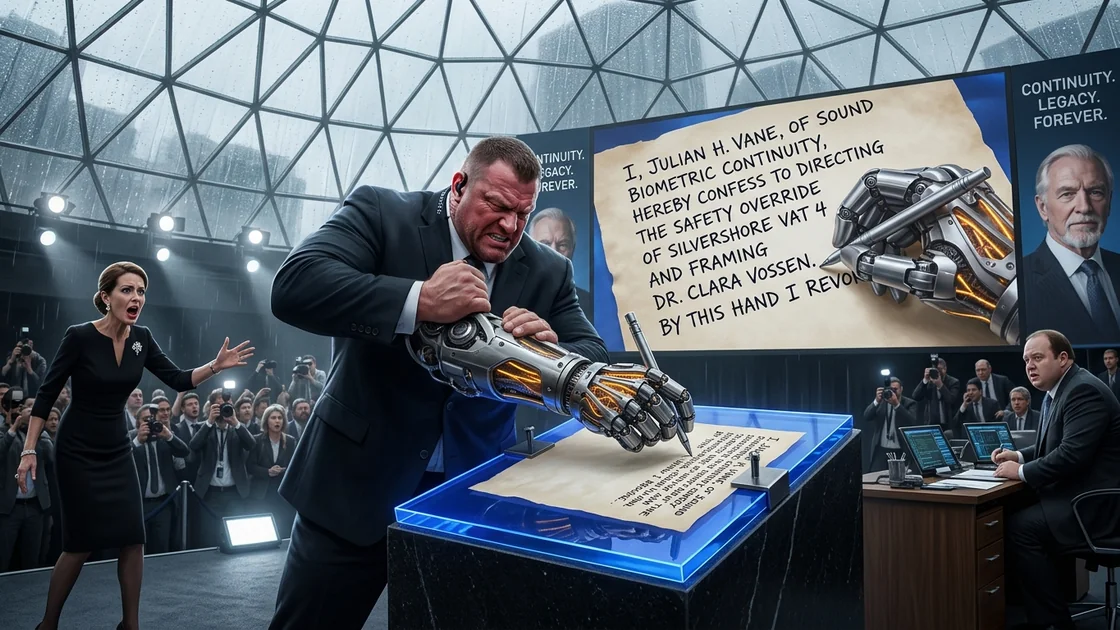
In the wake of billionaire industrialist Julian Vane's sudden death, robotics engineer Aris Thorne is ordered to prepare Vane's hyper-advanced prosthetic hand for a live global press conference. Because of a legal loophole Vane bought into existence, the biomechatronic limb remains a legally recognized extension of his will as long as its cloned nerve bridge stays metabolically active, and Vane's ruthless chief counsel intends to use it to sign a posthumous corporate restructuring that will bankrupt the survivors of an industrial disaster Vane caused years earlier. Haunted by the memory of his late partner who died in that same disaster, Aris discovers a hidden black-box partition inside the prosthetic's memory core containing proof of Vane's guilt. Working through the night under the surveillance of corporate security, Aris hides a secondary kinematic routine inside the hand's tremor-suppression algorithms and modifies its internal hardware to resist external shutdowns. During the broadcast, instead of signing the corporate shield agreement, the deceased billionaire's hand writes out a full confession on the live feed, broadcasts the incriminating evidence to the world, and executes an irreversible cryptographic transfer of Vane's entire personal fortune to the victims' restitution trust.
The titanium fingers of Julian Vane’s right hand were still warm, though the man himself had been packed in a stainless-steel drawer at the municipal morgue for nearly fourteen hours.
Aris Thorne sat on a pneumatic stool in Sub-Level 4 of the Vane Omnicorp Spire, watching a droplet of oxygenated synthetic perfusate bead along the seam where brushed grade-five titanium met translucent silicone skin. The prosthetic sat upright in its calibration cradle, bolted to an optical breadboard table that isolated it from the faint, rhythmic vibrations of the city’s subterranean transit lines. Through the clear polycarbonate housing of the forearm, miles of braided silver-core micro-wires pulsed with a faint, amber bioluminescence, feeding nutrient broth to the three-inch bundle of cloned human median and ulnar nerves suspended at the center of the chassis.
Every twelve seconds, the index finger twitched. It was a tiny movement, barely three millimeters of arc, driven by a phantom discharge from the dying biological tissue inside the suspension tube. To anyone else in the building, it would have looked like a horror movie trope—the severed mechanical claw of a dead tyrant still grasping for yield margins from beyond the grave. To Aris, it was simply a noisy baseline on Channel 4 of his logic analyzer.
He leaned forward, resting his elbows on the anti-static mat, and adjusted the gain on the differential amplifier. The oscilloscope screen beside him flared green, tracing the jagged spike of a sodium-potassium pump firing inside a nerve cell that didn't know its host’s cerebral cortex had ruptured over a plate of poached turbot the previous evening.
"Still fighting the damping curve, Julian?" Aris murmured to the empty cleanroom. His voice sounded flat, swallowed by the perforated acoustic tiles and the constant, low-frequency roar of the laminar flow hoods overhead. "You always did hate a filter you couldn't fire."
Using a pair of ceramic-tipped tweezers, Aris reached into the exposed wrist joint—an intricate cathedral of miniature harmonic drives, piezoelectric linear actuators, and carbon-fiber tendon spools—and nudged a tensioner screw by a sixteenth of a turn. Immediately, the twitch subsided. The five fingers of the Chiron-IX prototype settled into what robotics engineers called the posture of neutral rest: slightly curled, thumb opposed, looking remarkably like the hand of a sleeping child, if a child’s hand weighed fourpoint-two kilograms and cost more than a regional hospital.
The airlock at the far end of the laboratory hissed. The pressure differential gauge dipped as the outer seal broke, followed four seconds later by the inner electromagnetic bolt sliding free.
Aris didn’t turn around. He didn’t need to look at the security monitor to know who had clearance to bypass the cleanroom gowning protocol at eleven o'clock at night. The sharp, metallic click of bespoke Italian heels against the epoxy floor announced Corinne Sterling long before the scent of cold rain and expensive ozone reached his workbench. Behind her came the heavier, muted tread of Garrett Cross, head of Vane Executive Protection, whose footsteps always sounded like sandbags being dropped onto concrete.
"Tell me it’s awake, Dr. Thorne," Corinne said. She didn't bother with a hairnet or a lint-free lab coat; she stood just outside the yellow hazard line in a charcoal wool overcoat, her dark hair pulled back so tightly it seemed to lift the corners of her eyes. In her gloved hands, she carried a matte-black cryptographic ledger tablet.
"The peripheral nerve graft is stable at thirty-six point eight degrees Celsius," Aris said, keeping his eyes on the oscilloscope. "Metabolic decay is within the seventy-two-hour window. The sodium-channel degradation is hovering around four percent, which means the osseointegrated interface still registers as biologically contiguous. As far as the hardware enclave inside the wrist is concerned, Mr. Vane is merely taking a very long nap."
Corinne stepped over the yellow line, ignoring the cleanroom warning chime that pinged softly from the ceiling sensor. She stopped beside the optical table, staring down at the prosthetic hand. For a second, something unreadable flickered across her face—not grief, certainly, because nobody who worked within five floors of Julian Vane’s office was capable of mourning him, but a sharp, predatory awe.
"Remarkable," she said softly. "Four billion dollars in legislative lobbying to get the Biometric Continuity Statute passed through the territorial assembly, and everyone in the financial press thought it was just another one of Julian’s transhumanist vanity projects. They thought he was terrified of dying."
"He was terrified of dying," Aris said, setting his tweezers down on a sterile tray. "He just hated the estate tax more."
Garrett Cross shifted his weight by the door, his massive shoulders blocking the emergency eyewash station. His hand rested instinctively near the lapel of his suit jacket. "Watch your mouth, Thorne. The man’s body isn't even cold."
"Actually, ambient temperature in the county medical examiner's locker is four degrees Celsius," Aris replied evenly, finally swiveling on his stool to face them. He felt the familiar, dull ache behind his eyes—the byproduct of thirty-six hours without sleep and five years of working under a non-disclosure agreement that functioned more like a hostage negotiation. "Which means he’s been at thermal equilibrium since about four this afternoon. What do you need, Corinne? I was told to keep the neural bridge alive until the board convened on Monday."
"Monday is too late," Corinne said. She laid the black tablet on the corner of his workbench. "The vultures at the Securities Commission caught wind of the coroner's preliminary report twenty minutes ago. Worse, Judge Ballard just granted an emergency injunction hearing for the Silvershore claimants. They moved it up to tomorrow afternoon at two."
At the mention of Silvershore, the air in the sterile room seemed to thicken. Aris kept his hands flat on his knees so neither of them would see the sudden tension in his knuckles.
"Ballard can't freeze the assets if the Sovereign Restructuring Trust is already executed," Aris said carefully. "Didn't Vane sign the transfer paperwork before his stroke?"
"Aneurysm," Corinne corrected automatically. "And no. Julian was holding out to force the territorial governor to waive the environmental remediation bond first. The final indenture—the one that moves the eighty-four billion out of the operating subsidiary and into the Cayman blind foundation—is sitting in the staging queue. Un-executed."
Aris looked from her face to the prosthetic hand gleaming under the halogen work lamps. The pieces clicked together with the cold, sickening precision of a guillotine latch.
"You're going to use the Statutory Continuity clause," Aris said.
"Section 14, Paragraph B," Corinne recited, her voice crisp and entirely devoid of inflection. "Any cybernetic prosthesis possessing an active, genetically verified autologous nerve bridge and a certified zero-knowledge hardware enclave may execute pre-compiled fiduciary directives on behalf of an incapacitated or recently deceased principal, provided the biological interface has not undergone cellular death." She tapped the glass case housing the hand's forearm. "As long as those nerve fibers inside that tube are firing action potentials, this hand is Julian Vane. Legally, cryptographically, and financially."
"The statute was meant for automated server handshakes," Aris protested, though he already knew how futile the argument was. "High-frequency trading confirmations while a principal is under general anesthesia. Not signing away the liability shield of an entire multinational corporation after the man’s heart has stopped."
"The statute doesn't specify the medium of execution, Aris. In fact, because the Silvershore lawyers are already screaming about deepfakes and forged digital keys, a purely electronic transfer will be tied up in federal appellate court until we’re all in nursing homes." Corinne leaned closer, the fluorescent light catching the silver rims of her glasses. "Which is why we aren't doing it quietly on a server rack. We are holding a live memorial press conference tomorrow morning at nine o'clock in the Sky-Atrium. Every financial network from Tokyo to Frankfurt will be there. So will the territorial notary public."
Aris stared at her. "You want the hand to physically sign the paper."
"We want the world to watch Julian Vane’s greatest technological triumph fulfill his final corporate vision," she said smoothly. "The hand will use the inductive cryptographic stylus to sign the physical archival vellum for the notary, while the stylus simultaneously beams the 4096-bit private key stored in the carpal enclave directly into the clearinghouse ledger. Two-factor authentication: biometric stroke dynamics matched with hardware cryptography, witnessed by three hundred journalists and fifty million livestream viewers. No judge on earth will dare overturn it."
She slid the black tablet an inch closer to him.
"On that drive is the compiled smart contract for the Sovereign Shield restructuring, along with the digitized baseline of Julian’s signature from the last six shareholder reports. You have until seven tomorrow morning to program the inverse kinematics, compile the trajectory macro, and mount the unit onto the ceremonial presentation plinth. When I enter the authorization code on stage tomorrow, I want that hand to pick up the pen, write his name with the exact pressure curve and velocity profile the clearinghouse algorithm expects, and set the pen down."
Aris looked down at the tablet. If that contract was signed at nine in the morning, by nine-oh-five Vane Omnicorp’s domestic operating arm would be legally bankrupt on paper, stripped of every liquid cent, while the newly christened Sovereign Foundation in the Caymans inherited every patent, every tower, and every dollar in the reserve accounts. And the four thousand families of the Silvershore Valley—along with the survivors of the forty-two technicians who had been boiled alive in heavy-metal slurry when Sector 7 collapsed—would receive zero cents on the dollar. Their medical trusts would evaporate before lunch.
"And if the biological nerve bridge degrades before nine?" Aris asked quietly. "If the action potentials drop below the threshold, the enclave’s dead-man switch triggers. It zeroes out the memory registers to prevent key extraction. The hand becomes a very expensive paperweight."
"Then I suggest you keep the nutrient pump running at optimal efficiency, Dr. Thorne," Corinne said. She turned toward the airlock, then paused, looking back over her shoulder. "After the broadcast clears and the trust is ratified, the board is dissolving the Biomechatronics Division. We’re licensing the Chiron patents to a defense contractor in Stuttgart. However, your personal employment contract—including the corporate lien against your medical and academic licenses—will be marked as fulfilled. You’ll walk out of here tomorrow afternoon with your clearances restored and a half-million-dollar severance."
She didn't need to say the rest. Fail, or let that nerve bundle die before nine o'clock, and we’ll bury you in federal litigation for industrial sabotage until you forget what the sun looks like.
"Seven a.m.," Corinne said. "Garrett will have two men stationed outside the airlock, and the security feeds from this room are piped directly to the command center on the sixtieth floor. Don't get creative."
The airlock cycled twice, leaving Aris alone again with the hum of the ventilation scrubbers and the dead man's hand.
For a long time, Aris didn’t touch the black tablet.
Instead, he stood up, walked over to the stainless-steel utility sink in the corner of the lab, and splashed cold deionized water onto his face. Looking up into the magnification mirror mounted above the basin, he barely recognized the man staring back. At thirty-four, his dark hair was already salted with gray at the temples, his cheekbones sharp beneath pale skin that hadn't seen a real summer in half a decade.
He reached up and touched the small, crescent-shaped scar just below his left collarbone—a souvenir from a flying shard of reinforced borosilicate glass.
Five years ago, the Chiron project hadn't belonged to Julian Vane. It had been called the Vossen-Thorne Adaptive Limb, developed in a leaky warehouse near the old docks by Aris and Dr. Clara Vossen. Clara had been the neurobiologist—the genius who figured out how to coat titanium electrodes in synthetic schwann-cell scaffolding so human nerves wouldn't reject the metal with scar tissue. Aris had been the kinematics guy, the mechanical obsessive who spent three years designing a thumb actuator that could crack an egg without crushing the shell or lift a fifty-pound dumbbell without stripping its gears.
They had needed rare-earth magnets and ultra-pure lithium-tantalate crystals for the sensors. When their university grant dried up, Vane Omnicorp had swept in like a benevolent patron, offering them full access to the Silvershore Processing Facility ninety miles upriver, provided they did their testing on-site.
Aris closed his eyes, and the sterile smell of the cleanroom vanished, replaced instantly by the acrid, metallic stench of superheated hydrofluoric acid and burning insulation.
He remembered Clara standing at the catwalk railing of Vat 4 in Silvershore, her blonde hair tucked up under a yellow hard hat, pointing at a pressure telemetry tablet while she argued with Julian Vane. Vane had flown up in his personal tilt-rotor to inspect the quarterly output of battery-grade cobalt. The primary scrubber valves on the subterranean leaching autoclave had been throwing harmonic vibration warnings for three days. Clara had spotted the resonance spikes on her own diagnostic equipment—because the tremors in the bedrock were throwing off their prosthetic calibration rigs two buildings over.
“Your blow-off seals are fatigued, Mr. Vane,” she had told him, shoving the spectrograph right under his nose. “If you don’t vent the line and shut down the third shift, the back-pressure is going to shear the main manifold.”
And Julian Vane—tall, silver-maned, wearing a bespoke three-piece suit on a chemical refinery catwalk—had smiled that famous, benevolent magazine-cover smile. He had reached out with his flesh-and-blood right hand, patted Clara condescendingly on the cheek, and told the plant manager to increase the autoclave temperature by twelve percent to meet the Friday shipping manifest for Geneva.
Twelve minutes later, the floor disappeared.
The autoclave didn't just rupture; it turned the lower three levels of Sector 7 into a shaped charge of boiling toxic slurry. Aris had been thrown backward through the observation booth window as the blast wave hit. When he crawled back to the twisted, glowing wreckage of the catwalk, choking on gray chemical fog, the lower vat room was gone. Clara was gone, along with forty-one line technicians and chemical engineers whose names he could still recite from memory.
Julian Vane had been forty feet further up the stairs when the secondary pipe sheared. A falling I-beam had pinned his right arm against the bulkhead, crushing it from the elbow down. Aris, bleeding from the chest and half-blind from chemical burns, had used his own belt as a tourniquet to keep the billionaire from bleeding out on the grated stairs before the corporate medevac helicopter arrived—a helicopter that lifted Vane out while leaving forty-two people trapped beneath rising toxic water because Vane’s security detail wouldn't let the local county fire trucks through the main gate without signed liability waivers.
Within a week, Vane’s lawyers had rewritten history. The explosion was blamed on "unauthorized diagnostic equipment hooked into the facility’s main power grid by independent contractors Dr. Clara Vossen and Dr. Aris Thorne."
Vane had visited Aris in the hospital before the anesthesia from his chest surgery had even worn off. The bargain had been simple: either Aris went to federal prison for forty-two counts of negligent homicide while Clara’s name was dragged through the mud as an incompetent saboteur, or Aris signed over all intellectual property for the Vossen-Thorne neural bridge, came to work in the Spire’s basement, and built Julian Vane a new right hand to replace the one he’d lost at Silvershore. In exchange, Vane had promised to fund a permanent medical and survivors' trust for the families of the forty-two dead workers.
For five years, Aris had stayed in the basement, building the greatest prosthetic limb in human history and attaching it to the monster who had murdered the woman he loved. He had endured it for one reason only: every month, the Silvershore Trust paid for the dialysis of the surviving plant workers, the mortgages of the widows, and the college tuition of sixty-three fatherless and motherless children.
And tomorrow morning at nine, Julian Vane’s dead hand was going to sign a piece of paper that took even that away.
Aris opened his eyes. He walked back to the workbench, picked up Corinne’s black tablet, and plugged it into his primary terminal via a fiber-optic isolation bridge.
"Let's see what you're made of, Julian," Aris whispered.
To understand how to hijack a cybernetic limb, one first had to understand that the human hand is not a tool; it is an orchestra.
When a living person picks up a fountain pen and signs their name, their brain does not consciously calculate the angle of the wrist, the thirty-two separate muscle contractions in the forearm, or the exact Newton-meters of pinch force required between the thumb pulp and the lateral aspect of the middle finger’s distal phalanx. Instead, the motor cortex fires a high-level cascade of intent—a musical score learned over decades of muscle memory—and the cerebellum and spinal cord translate that score into fluid, continuous motion, adjusting microsecond by microsecond to the friction of the paper and the flow of the ink.
A cheap robotic arm moves like a crane: point A to point B, linear interpolation, cold and robotic. If the Chiron-IX moved like that tomorrow, the clearinghouse security software watching through the high-speed biometric stylus would reject the signature instantly as a mechanical forgery.
To make the Chiron-IX pass the clearinghouse verification, Aris had designed its control architecture around a Dual-Kalman Neural Emulator. The arm possessed two distinct brains inside its titanium radius bone. The first was the Cortex Mapper, an FPGA array that read the chaotic electrical whispers of the living nerve graft in the nutrient tube and smoothed them out. The second was the Kinematic Solver, which took high-level trajectory commands and filtered them through Julian Vane’s personal "physiological signature"—his natural 8-hertz resting micro-tremor, the slight arthritic hitch in his ulnar deviation, and the heavy, aggressive downstroke he always used when crossing his J and dotting his i.
Aris pulled up the file Corinne had provided on his triple-monitor workstation.
On the left screen was the legal payload: the Sovereign Restructuring & Liability Shield Indenture. It was a three-hundred-page monstrosity of corporate legalese compressed into a cryptographic hash, paired with a single-page physical execution summary that would be placed on the glass plinth tomorrow morning.
On the center screen was the trajectory macro Corinne’s tech team had pre-compiled: a spline curve consisting of forty-eight thousand discrete coordinate points, velocity vectors, and pressure values mapping out the letters J-u-l-i-a-n-H-V-a-n-e.
"Sloppy," Aris muttered, zooming in on the velocity profile of the capital V. "Whoever compiled this in the legal tech pool just stitched together three old signatures and ran a cubic spline smoothing filter over the joints. If the clearinghouse checks the second derivative of acceleration—the jerk profile—it’ll flag the seams."
He was supposed to fix those seams. That was why Corinne needed him. Nobody else in the building understood how the Chiron-IX’s harmonic drives interacted with the compliant silicone skin pads on the fingertips.
Aris glanced up at the two dome cameras mounted in the corners of the cleanroom ceiling. Their tiny red LED tally lights glowed steadily. Up on the sixtieth floor, one of Garrett Cross’s analysts was watching his posture, and probably mirroring his main workstation display via a hardware KVM splitter in the server closet down the hall.
If Aris opened a text editor and started writing new code, or if he tried to alter the destination routing numbers in Corinne’s smart contract, the analyst upstairs would see it within three seconds, and Cross would be through the airlock with a stun baton in thirty.
He couldn't touch the primary workstation screen for anything illicit. Everything had to look like standard kinematic calibration.
Aris reached across the workbench and picked up his diagnostic headset—a pair of bone-conduction transducers and a high-density loupe visor he used when soldering micro-actuators under the microscope. He slipped the visor over his eyes. Inside the right lens of the visor was a miniature monochromatic OLED display wired directly to the local JTAG debugging port on the prosthetic wrist itself, bypassing the main laboratory computer entirely. It was a low-level hardware interface he had built three years ago to check thermal tolerances inside the motor windings without flooding the main telemetry logs.
With his left hand on the main keyboard, Aris opened the legitimate trajectory file on the big monitors, giving the watchers upstairs plenty of complex-looking calculus graphs to stare at. With his right hand, resting casually inside the shadow of the optical breadboard while pretending to check the tension on the wrist cables, he used a miniature rotary encoder knob wired to the JTAG port to navigate the internal memory registers of the Chiron-IX’s carpal enclave on his visor’s tiny heads-up display.
He scrolled past the motor lookup tables, past the PID loop coefficients, past the battery management firmware.
Deep at the bottom of the non-volatile ferroelectric RAM—an area of memory reserved for catastrophic fault logging—Aris stopped.
There was a partition there labeled
SYS_PROPRIO_ARCHIVE_00. It took up nearly sixty gigabytes
of solid-state storage tucked inside the artificial humerus
connector.
Aris frowned behind his visor. A prosthetic limb didn't need sixty gigabytes of fault logs. Even five years of error codes wouldn't take up fifty megabytes. Why was that sector locked behind a hardware-level read-only flag tied directly to Julian Vane’s personal biometric key?
Except Vane wasn't around to guard his key anymore. The biological nerve bridge in the nutrient tube was currently in "Diagnostic Maintenance Mode" so Aris could calibrate the signature macro. That meant the enclave’s internal bus was unlocked to local JTAG queries.
Slowly, keeping his head angled toward the wrist actuators as if he were inspecting a hairline gear misalignment, Aris clicked the rotary encoder twice, mounting the hidden partition in hex-dump mode on his visor lens.
Lines of green hexadecimal code cascaded down his right eye. He filtered by file header signatures.
4F 67 67 53 — Ogg Vorbis high-definition audio
containers. 50 4B 03 04 — Encrypted document archives.
56 41 4E 45_4C 45 44 47 45 52 — Raw telemetry and financial
ledger keys.
Aris’s breath caught in his throat. He had to force himself to reach up and adjust the microscope lamp just to keep his movements looking natural for the cameras.
Julian Vane had been a textbook clinical narcissist mixed with a billionaire paranoiac. After losing his original arm at Silvershore, Vane had refused to trust cloud servers, secretaries, or even his own corporate lawyers with his deepest leverage. He had turned his own $20-million cybernetic arm into an air-gapped vault. Because the arm had acoustic bone-conduction sensors built into the titanium chassis—originally designed by Aris so the wearer could "feel" the texture of surfaces through vibration—Vane had secretly wired a secondary daemon to record every conversation he ever held whenever he drummed his prosthetic fingers against a conference table.
And more than that: the partition contained the master root keys to Vane’s personal sovereign liquidity accounts in Zurich and Singapore—not the corporate shell accounts Corinne was trying to move tomorrow, but Vane’s private dragon’s hoard. Eighty-four point six billion dollars in tokenized bearer bonds and liquid treasury assets, tied directly to the hardware enclave inside the wrist. Corinne thought she was moving the corporate operational shield tomorrow; she didn't even know that Vane’s personal liquid fortune was sitting on the exact same cryptographic chip, waiting for a posthumous sweep command that Vane had never told her about because he never intended to die at sixty-two.
Aris scrolled further down the index of the hidden partition, back to the very first entries written when the prototype core was first initialized during the recovery phase after the accident.
Timestamp: 2021-11-14 // 04:12:09 UTC. File name:
SILVERSHORE_AUTOCLAVE_OVERRIDE_AUTH.SIG.
Aris clicked the encoder to parse the metadata header.
It was a backed-up voice memo and a digitally signed executive order, transferred from Vane’s personal neural-link watch into the arm’s enclave the day the chip was fabricated, kept as blackmail insurance against the territorial governor and Corinne Sterling herself.
In the text buffer of his visor, Aris read the transcript of the audio file recorded forty-eight hours after the explosion in Vane’s private hospital suite:
STERLING: "If the federal inspectors pull the PLC logic chips from the rubble of Vat 4, they’re going to see the remote pressure-valve override came from your tablet, Julian. Not Vossen’s diagnostic rig."
VANE: "They won’t pull the chips, Corinne. Because Garrett’s team already swapped the burned PLC rack with the test-bench unit from Thorne and Vossen’s lab while the fire marshals were waiting at the front gate. By tomorrow morning, the dead girl takes the blame, the boy builds my arm to keep himself out of a federal penitentiary, and the governor signs the Silvershore containment waiver or I release the wire transfers from his re-election PAC."
Aris sat perfectly still on the pneumatic stool.
The cleanroom was twenty degrees Celsius, yet sweat broke out along his hairline, cold and sharp. In his chest, the old scar beneath his collarbone throbbed as if the glass had just cut him all over again.
They hadn't just ignored Clara’s warning. When the autoclave blew, Garrett Cross had gone into the smoking ruins—walking right past forty-two dying people—not to rescue survivors, but to swap out the programmable logic controllers so Clara would take the blame in death. And Vane had kept the proof of it right inside the titanium wrist Aris had lovingly maintained, polished, and calibrated for five years. Every time Aris had adjusted the tension on those fingers, his hands had been three inches away from the evidence that could have cleared Clara’s name and destroyed Vane Omnicorp in an afternoon.
Up on the main workstation monitor, the clock in the corner ticked
over to 00:15.
Eight hours and forty-five minutes until the live global broadcast.
If Aris copied that file onto a thumb drive and tried to walk out of the building, Garrett Cross’s guards outside the airlock would search him, find it, shoot him in the sub-basement corridor, and claim he had suffered a tragic psychotic break due to exhaustion. Even if he managed to upload it to the internet from his terminal, the corporate firewall had deep-packet inspection; the connection would be severed before the first megabyte cleared the building, and the arm would be destroyed or locked down.
No. The lab was a cage. The network was a trap.
There was only one place in the entire Vane Spire that had an unthrottled, uncensored, hardware-verified data pipe directly to the international financial clearinghouses, the global media satellite uplinks, and three hundred independent cameras at the same time.
The ceremonial signing plinth in the Sky-Atrium at nine o'clock tomorrow morning.
"You want Julian Vane’s hand to execute his final will and testament on live television, Corinne?" Aris whispered, his voice so low it didn't even vibrate the microphone on his collar. "Fine. Let's let him tell the truth for once in his life."
The engineering problem before him was essentially a three-body orbital calculation wrapped inside a cryptographic sleight of hand, and he had to solve it while pretending to do his job under the eyes of two high-definition security cameras.
Aris broke the problem down into three distinct hurdles, listing them mentally as he began typing legitimate-looking calibration commands onto his main monitors.
Hurdle One: The Checksum. Before the press
conference started tomorrow morning, Corinne’s legal tech team—and
likely an independent auditor from the clearinghouse—would run a
cryptographic hash verification on the Chiron-IX’s primary
trajectory buffer. They would compare the file sitting in the arm’s
motor controller against the approved
Julian_Vane_Signature.bin file on Corinne’s black tablet.
If a single bit was out of place, the hash wouldn't match, the alarm
would sound, and the press conference would be aborted.
Therefore, the primary trajectory buffer had to remain 100% identical to what Corinne gave him. He actually had to fix her sloppy spline curves so it would pass inspection.
Hurdle Two: The Hidden Payload. If he couldn't put the new instructions in the primary motor buffer, where could he put them? How do you hide a completely different set of physical movements—writing out a written confession on the archival vellum—and a massive cryptographic data dump inside a robotic arm without changing its primary program file?
Aris looked at the oscilloscope, where the green line of the nerve graft was still pulsing every twelve seconds.
The tremor-suppression filter.
Every human with a myoelectric prosthesis exhibits baseline noise—electrical static from the biological nerve interface and mechanical resonance in the harmonic drives. To stop the hand from shaking during delicate tasks like threading a needle or signing a contract, the Chiron-IX used an adaptive Lookup Table (LUT) stored in the secondary DSP chip. This table acted as an inverse waveform: when the sensors detected a tremor, the DSP consulted the calibration table and injected an equal and opposite motor command to cancel it out.
Crucially, because the biological nerve graft was constantly degrading and shifting its electrical impedance, the Kalman Noise Calibration Table was dynamically generated during lab maintenance and was explicitly excluded from the static firmware checksum! The auditors expected the calibration table to change; that was the whole reason Aris was in the lab tonight.
If Aris intentionally poisoned the Kalman filter’s noise matrix—not with random numbers, but with a Fourier-transformed series of inverted kinematic vectors—he could turn the noise cancellation system into a secondary puppet master.
As long as the arm was in normal mode, the primary signature macro would run. Everything would look normal during pre-show diagnostics.
He just needed a physical trigger—something that would happen
only during the actual live signing on stage—to flip the gain
on the Kalman filter from 1.0 to -100.0,
drowning out Corinne’s signature macro and forcing the actuators to
follow the "noise" table instead.
And what would the trigger be?
Aris looked at the specs for the ceremonial plinth on his left monitor. During tests in the lab, Aris used a standard titanium calibration stylus weighing twenty-eight grams. Tomorrow on stage, the hand would pick up the Vane Sovereign Stylus—an inductive cryptographic fountain pen made of solid platinum and iridium, weighing eighty-four grams, while simultaneously establishing an NFC handshake with the notary’s live clearinghouse pad.
IF (Load_Cell_Thumb > 80g) AND (NFC_Handshake == LIVE_CLEARINGHOUSE_MAINNET):
EXECUTE OVERRIDE.
It was brilliant in its simplicity. Even if Corinne demanded a dry run five minutes before the curtain went up using a dummy pen or a test network, the hand would dutifully sign Julian H. Vane like a well-trained dog. It would only bare its teeth when the live platinum pen touched the live financial network.
Hurdle Three: The Kill Switch. This was the hardest part. Signing Julian H. Vane took four point two seconds.
Writing a full legal confession, printing the cryptographic hash of the Silvershore audio file onto the archival vellum, and streaming sixty gigabytes of incriminating evidence plus an eighty-four-billion-dollar wire transfer through the inductive nib of the stylus would take forty-five seconds.
The moment the hand deviated from the script—about three seconds into the broadcast—Corinne and Garrett Cross would realize something was horribly wrong. Cross would sprint across the stage to rip the arm off the plinth or pull the main power cable, and the control room technicians would cut the broadcast feed.
Aris needed forty-five seconds of absolute mechanical and electrical invulnerability.
He checked the clock: 01:40.
"Time to go to work," he muttered.
For the next two hours, Aris performed a dual ballet of coding. On the big triple monitors, in full view of the security cameras, he meticulously smoothed out Corinne’s signature spline. He adjusted the pressure curves on the J, tweaked the wrist pronation angle on the V, and ran thirty simulated signing passes on the virtual visualizer. Any tech watching from the sixtieth floor would see a conscientious engineer polishing the boss’s signature to perfection.
Meanwhile, inside the right lens of his visor, driven by his right thumb rolling the hidden encoder wheel beneath the shadow of the optical table, Aris was writing a masterpiece of inverse kinematics in raw assembly hex.
He didn't have a graphical interface on the visor to plot the confession. He had to do the math in his head and on a scratchpad buried inside the oscilloscope's local memory buffer, disguising the letter coordinates as Fast Fourier Transform frequency bins.
He couldn't use his own handwriting. If the hand wrote in Aris Thorne’s handwriting, Corinne’s lawyers would claim the machine had been externally puppeteered by a disgruntled employee, invalidating the fiduciary transfer under the Continuity Statute. The confession and the restitution transfer had to be written in Julian Vane’s authenticated, biometric handwriting style—using Vane’s own stored motor-cortex primitives from the arm’s deep learning library.
Aris pulled up Vane’s motor-primitive dictionary from the hidden enclave. During the first year Vane wore the Chiron-IX, the neural network had recorded ten thousand hours of Vane writing memos, signing checks, and jotting notes. Every letter of the alphabet, every ligature, every aggressive slash of punctuation existed in the library as a normalized biological motor vector.
Aris strung the vectors together like beads on a wire, encoding the message he wanted the dead man to write on the archival vellum:
I, JULIAN H. VANE, OF SOUND BIOMETRIC CONTINUITY, HEREBY CONFESS TO DIRECTING THE SAFETY OVERRIDE OF SILVERSHORE VAT 4 AND FRAMING DR. CLARA VOSSEN. BY THIS HAND I REVOKE THE SOVEREIGN SHIELD AND IRREVOCABLY TRANSFER ALL PERSONAL AND CORPORATE LIQUID ASSETS (KEY: 0x9F8A...77B1) TO THE SILVERSHORE VICTIMS RESTITUTION TRUST.
It was thirty-nine words. Using Vane’s rapid, jagged scrawl, the high-speed piezoelectric actuators in the fingers could write it in thirty-eightpoint-four seconds, while the inductive transducer in the fingertip simultaneously flooded the clearinghouse NFC pad with the signed root-key transfer packet and broadcasted the raw audio of Vane and Corinne’s hospital conversation over the unsecured stage telemetry channel—the same channel that fed the live closed-captioning and press-pool data feeds.
At 03:12, the cleanroom airlock buzzed loudly.
Aris’s heart leaped into his throat. With a flick of his pinky finger, he hit the physical kill-switch on his visor’s OLED display and pulled the hidden JTAG ribbon cable out of the wrist port, tucking it seamlessly into the wire harness of the nutrient pump a fraction of a second before the inner door slid open.
Garrett Cross walked in. He wasn't alone.
Behind the towering security chief was a small, stooped man in a rumpled tweed jacket wearing visitor badges stacked three deep on a lanyard. Aris recognized him instantly from the robotics symposiums in Zurich: Dr. Lukas Kellerman, an independent forensic firmware auditor often hired by central banks to verify automated trading hardware.
"Hands off the keyboard, Thorne," Cross said, walking straight up to the workbench. "Step back behind the yellow line."
Aris raised both hands, palms open, and rolled his stool back three feet until the wheels bumped against the stainless-steel supply cabinet. He kept his breathing slow, forcing his shoulders to slump with the exhausted irritation of an overworked academic.
"What is this, Garrett?" Aris asked, rubbing his eyes under his visor before pulling the headgear off and tossing it carelessly onto the anti-static mat. "It’s three in the morning. I’m in the middle of compiling the damping matrices."
"Ms. Sterling doesn't believe in trusting single points of failure," Cross said coldly. He gestured to the workbench. "Dr. Kellerman is here to run an independent SHA-3 verification on the primary execution buffer and inspect the wrist enclave for logic bombs. If he finds a single line of unapproved code, you’re leaving this room in zip-ties."
Kellerman didn't even look at Aris. The older man adjusted his thick spectacles, pulled a ruggedized field-diagnostic laptop from his leather satchel, and connected a gold-plated probe directly into the Chiron-IX’s primary external data port—thirty millimeters away from the internal JTAG header Aris had just disconnected.
Aris watched from behind the yellow line as Kellerman’s fingers flew across his laptop keyboard.
The forensic suite booted up. If Kellerman just checked the primary firmware and the trajectory buffer, Aris was fine. The primary buffer was clean; it matched Corinne’s signature file down to the last byte.
"Primary motor flash matches the baseline hash," Kellerman murmured
in a thick Swiss-German accent, peering at his screen. "Trajectory
spline VANE_EXEC_01 is within three-sigma kinematic
tolerance of the historical biometric samples. Actually, the
jerk-profile smoothing on the surname is quite elegant. Better than the
draft Ms. Sterling showed me at midnight."
"Thank you," Aris said dryly. "I aim to please."
"Now checking secondary DSP memory registers and power distribution profiles," Kellerman said, clicking another command.
Aris’s stomach dropped.
Secondary DSP registers. That was where the Kalman noise calibration table lived. Kellerman’s forensic tool wouldn't flag the table for having different numbers—because calibration tables were supposed to be full of chaotic floating-point decimals—but Kellerman’s software had an entropy analyzer. Real biological noise follows a Gaussian distribution—a bell curve. Aris’s hidden kinematic coordinates and the compressed Silvershore audio packet had much higher data density than natural nerve static. If Kellerman’s entropy scanner finished its sweep of the DSP memory, it would flag the table as encrypted data rather than random noise!
On Kellerman’s screen, a progress bar labeled
DSP_ENTROPY_SCAN appeared:
12%... 24%... 38%...
Cross was standing right beside Kellerman, watching the screen, his hand resting on the grip of the 9mm pistol holstered beneath his arm.
Aris needed to create genuine, violent biological noise in the nerve graft right now—enough real electrical chaos to flood the DSP’s live memory registers and force Kellerman’s scanner to abort due to active interface fluctuation.
How do you make a severed human nerve bundle scream without touching the table?
Aris looked down near his right boot. Running along the floor from the wall outlet to the optical table was the power umbilical for the Peltier thermal regulator that kept the synthetic blood perfusate at 36.8 degrees Celsius. The regulator’s external proportional-controller box was mounted to the underside of the table leg, right next to the pneumatic pressure valve for the table’s vibration-isolation legs.
56%... 68%...
Aris feigned a sudden, violent sneeze—the kind triggered by hours of
breathing bone-dry cleanroom air—and doubled over, grabbing the edge of
the stainless-steel cabinet with one hand while his right heel kicked
out backward in a seemingly clumsy stumble, slamming the toggle switch
on the floor-mounted pneumatic isolation pump from ISOLATE
to PURGE.
PSSSHHHHH-CLANK!
All four pneumatic legs of the heavy optical table dumped their compressed nitrogen at once. The four-hundred-pound steel tabletop dropped two inches onto its hard mechanical stops with a sound like a gunshot.
Inside the polycarbonate forearm cylinder, the shockwave sent a sudden pressure spike through the synthetic perfusate and rattled the micro-electrodes anchored into the cloned median nerve. Instantly, every sodium channel in the nerve bundle fired in panic—a phantom pain reflex triggered by the mechanical jolt.
On the oscilloscope, the green line exploded into a solid wall of neon-green static.
In the cradle, the titanium hand of Julian Vane snapped shut into a tight, trembling fist, the harmonic drives whining at high pitch as the live biological reflex flooded the secondary DSP chip with raw myoelectric chaos.
ERROR: ACTIVE MYOELECTRIC INTERRUPT ON BUS 2. ENTROPY SCAN ABORTED TO PREVENT NEURAL GRAFT DEPOLARIZATION.
Kellerman gasped, jumping back a step as the mechanical fist twitched in its cradle. Garrett Cross had his gun half-drawn before he realized the noise had come from the table legs.
"What the hell did you just do?!" Cross roared, spinning on Aris and shoving him hard against the steel supply cabinet.
"I didn't touch the arm! Look at the floor gauge!" Aris shouted back, letting genuine adrenaline put a ragged edge of panic into his voice. He pointed at the hissing nitrogen line at the base of the table. "The seal on the Number 3 pneumatic isolator blew! I told Facilities three weeks ago the dry air was rotting the neoprene O-rings!"
Aris shoved past Cross, ignoring the security chief’s bulk, and lunged for the oscilloscope controls like a frantic surgeon trying to save a patient on the operating table.
"The mechanical shock triggered a nociceptive reflex storm in the nerve graft!" Aris barked, his fingers flying across the legitimate gain knobs on the amplifier. "If I don't damp the feedback loop right now, the action potentials are going to burn out the Schwann-cell interface and your precious Continuity Statute becomes null and void in thirty seconds! Dr. Kellerman, unplug your probe—your diagnostic bus is creating a ground loop on the neural return line!"
Kellerman didn't hesitate; the Swiss auditor yanked his gold-plated probe out of the wrist port as if it were red-hot. "He's right! The impedance on the ulnar channel is spiking past forty kilohms! Stabilize the perfusate pressure!"
For two minutes, Aris put on the performance of his life. He adjusted the flow rate of the nutrient pump, injected two milliliters of buffered lidocaine-analog stabilizing solution into the perfusion line, and manually stepped down the gain on the neural pre-amp until the violent green spikes on the oscilloscope subsided back into the steady, twelve-second twitch.
Slowly, with a soft whir of miniature titanium gears, the fist of the Chiron-IX unclenched, returning to its peaceful, neutral rest posture.
The cleanroom was dead silent save for the hum of the overhead filters.
Aris leaned heavily against the edge of the optical table, breathing hard, and glared at Cross. "If you ever bring an ungrounded external laptop into my cleanroom again and hook it into a live biological interface without isolating the chassis ground, you can explain to Corinne why Julian Vane’s hand is dead."
Cross stared at him with cold, suspicious eyes, his jaw clenched. He looked at Kellerman. "Did he tamper with the signature code or not?"
Kellerman was already packing his laptop back into his leather satchel with slightly shaky hands. "The primary flash memory and the signature trajectory are completely authentic, Mr. Cross. The secondary bus is simply hyper-reactive because the biological tissue is eighteen hours post-mortem. If I probe the DSP registers again, the voltage spike could kill the nerve graft entirely. My professional recommendation is that you do not touch the data ports again until after the execution tomorrow."
Cross looked from the Swiss scientist back to Aris, then up at the security camera in the corner. He tapped his earpiece. "Control, did you get that?"
A pause. Cross nodded once.
"Lock down the data ports, Thorne," Cross said, his voice dropping an octave. "You’ve got three hours left to mount that thing on the presentation plinth and check the mechanical linkages. No more cables plugged into the wrist. My men are watching the monitors. If I see a single data wire touch that arm between now and eight a.m., I’m coming back in here and breaking your fingers."
When the airlock sealed behind them for the second time that night, Aris had to sit down on the floor for a full sixty seconds until his hands stopped shaking.
He couldn't plug the JTAG cable back in. Cross’s analysts on the sixtieth floor would be zoomed in at 400% magnification on the wrist’s data ports for the rest of the night.
Fortunately, the software upload had reached 100% ten
minutes before Cross walked in. The confession, the audio dump, and the
cryptographic wire transfer were already sitting safely inside the
Kalman noise tables.
All that remained was Hurdle Three: the mechanical override to stop Cross from pulling the plug during the forty-five seconds it would take the hand to write the truth. And for that, Aris didn't need a computer cable. He just needed a torque wrench and a soldering iron.
The final two hours before dawn were purely mechanical, which was exactly what Cross’s watchers expected to see.
Mounting the Chiron-IX onto the ceremonial presentation plinth required disassembling the lower forearm housing to bolt the titanium radius shaft directly into the plinth’s vertical gimbal mount. The plinth itself was a monstrously pretentious piece of industrial design that Corinne’s PR team had commissioned two months ago when Vane first planned to unveil the commercial version of the prosthetic: a four-foot column of polished black gabbro stone topped with an angled sheet of backlit sapphire glass where the documents would be laid.
Working under the bright ring-light of the assembly boom, completely open to the cameras, Aris removed the four carbon-fiber casing panels from the forearm.
"Just routine mechanical prep, boys," Aris murmured to himself, picking up his micro-soldering iron and a spool of high-gauge silver-braided wire. "Nothing to see here but a guy securing the power leads."
Inside the forearm of the Chiron-IX, just below the nutrient tube, sat a bank of six graphene supercapacitors. Aris had originally designed them into the arm so that if the wearer needed a sudden burst of massive grip strength—say, catching oneself while falling or crushing a jammed valve wheel—the arm could draw forty amps instantly without waiting for the main lithium-sulfur battery pack.
As part of the standard mounting procedure for the plinth, Aris was supposed to wire the arm’s main power bus directly to the plinth’s external 24-volt floor supply, bypassing the internal battery so there was zero chance of the arm running out of juice on stage.
Aris connected the external power leads just as the schematic required. If Cross or a stage manager pulled the plug from the wall tomorrow, the main 24-volt bus would go dead instantly.
Then, using the tip of his soldering iron under the guise of reinforcing the strain-relief bracket on the wrist harness, Aris bridged a tiny, surface-mount Schottky diode between the graphene supercapacitor bank and the secondary DSP motor rail.
Even if someone took a fire axe to the plinth’s power cord tomorrow morning, those six graphene supercapacitors held enough raw electrical charge to run the arm’s actuators at maximum torque for sixty-two seconds.
Next came the physical grip lock.
If Cross realized the power cord didn't stop the hand, he would simply rush the stage and try to knock the platinum stylus out of the hand’s fingers, or rip the archival vellum off the glass plate.
Aris picked up a three-millimeter hex key and adjusted the eccentric cam stops inside the thumb and index finger’s proximal interphalangeal joints. The Chiron-IX utilized non-backdrivable worm gears in its primary flexion tendons—a safety feature meant to allow the user to carry a heavy briefcase all day without burning battery power; once the worm gear turned to close the fingers, friction prevented an outside force from prying the fingers open unless the motor spun in reverse.
Normally, a miniature magnetic slip-clutch was installed between the worm gear and the finger bone so that if an external force exceeded thirty pounds, the clutch would slip rather than snapping the titanium linkage or breaking the object being held.
With three swift turns of the hex key, Aris bottomed out the lock-screw on the magnetic clutch, fusing the worm drive into a direct mechanical lock once the secondary DSP routine triggered.
Once the hand gripped the platinum stylus and dropped its wrist onto the sapphire glass to begin the override sequence, the thumb and index finger would lock with three hundred and eighty pounds of static pinch force, and the wrist gimbal’s electromagnetic brake would clamp down onto the archival paper frame with six hundred pounds of downward holding pressure.
Short of driving a forklift onto the stage or setting off a block of C4, nothing made of flesh and bone was going to pry that pen out of Julian Vane’s dead hand until the supercapacitors ran dry.
Aris snapped the brushed-titanium and polycarbonate housing panels back onto the forearm. He polished a smudge of synthetic oil off the knuckles with a microfiber cloth, checked the green status LED glowing softly near the nutrient reservoir, and stepped back.
The clock on the wall read 06:58.
Right on cue, the airlock hissed open.
The Sky-Atrium on the eightieth floor of the Vane Omnicorp Spire was an architectural monument to hubris, enclosed by a triple-glazed geodesic dome that looked out over the sprawling, rain-shrouded metropolis below.
From the subterranean freight elevator, Aris pushed the heavy pneumatic transport cart across the polished white marble floor toward the raised stage at the north end of the atrium. Two of Garrett Cross’s security operatives walked alongside him, their hands hovering near their jackets, while a third walked backward ahead of the cart to clear a path through the swarm of broadcast technicians, lighting riggers, and sound engineers.
Through the sixty-foot glass curtain walls on the east side of the atrium, the sky was the color of bruised lead. Rain lashed against the glass, blurring the view of the river valley far to the north—the direction of Silvershore.
Down on the street plaza, eighty stories below, Aris had caught a glimpse on the elevator monitor of the barricades. Hundreds of people were standing in the pouring rain behind police lines, holding hand-painted signs and laminated photographs of the forty-two men and women who had died in Sector 7. Among them, he knew, was Elena Vossen, Clara’s older sister, standing in a cheap plastic poncho, waiting to hear that the corporation that had killed her sister had legally vanished into a Caribbean tax haven.
Up here under the glass dome, the air smelled of roasted Colombian coffee, white lilies, and freshly ironed wool. Three hundred folding chairs upholstered in black velvet were arranged in neat rows facing the stage. The front two rows were already filling up with territorial senators, central bank directors, and the board of Vane Omnicorp, all wearing black armbands over their tailored suits, speaking in the hushed, reverent tones of people who were about to make a massive amount of money from a funeral.
Behind the stage hung a forty-foot-wide 8K micro-LED wall. Right now, it displayed a monochrome portrait of Julian Vane looking sternly visionary, flanked by the words: CONTINUITY. LEGACY. FOREVER.
"Bring it up the ramp on the left, Thorne," Garrett Cross’s voice crackled in the temporary comms earpiece Aris had been forced to wear. "Set the plinth on the mark next to the notary’s desk. You have twelve minutes to connect the stage power and test the optical camera feed before the press pool is let in."
Aris guided the cart up the carpeted stage ramp.
On the right side of the stage stood a mahogany podium where Corinne Sterling would deliver the eulogy. In the center was the mark for the black gabbro plinth. To its left sat a small table occupied by Arthur Pendelton, the Territorial Notary Chief, a round, nervous man who was already wiping his forehead with a silk handkerchief while two clearinghouse technicians calibrated the live fiber-optic terminal beside him.
With the help of two stagehands, Aris locked the black stone plinth onto the floor bolts at center stage. Above the plinth, suspended from a robotic truss arm, hung a broadcast-grade macro camera aimed straight down at the backlit sapphire glass surface. Whatever happened on that twelve-by-eighteen-inch rectangle of glass would be projected twenty feet tall on the micro-LED wall behind the stage and piped live to fifty-four satellite feeds around the globe.
Aris knelt behind the plinth, opening the rear service hatch to connect the 24-volt stage power umbilical and the local stage telemetry line.
"Check the live macro feed," a voice called from the audio-visual booth at the back of the hall.
The giant LED screen behind the stage flickered, splitting into two halves. On the left remained Julian Vane’s portrait; on the right appeared a crystal-clear, top-down view of the Chiron-IX hand resting in its silver gimbal mount above the sapphire glass. Under the studio lights, the brushed titanium knuckles and the translucent silicone skin pads looked startlingly lifelike. Through the forearm window, the amber bioluminescence of the nerve-bridge life-support chamber pulsed steadily, like a mechanical heart beating on live television.
A low murmur rippled through the VIPs in the front rows as the index finger gave its subtle, twelve-second twitch.
"Creepy bastard even in death," one of the stagehands muttered under his breath before walking away.
Aris laid the archival vellum document—the single-page physical execution summary of the Sovereign Restructuring Indenture—onto the sapphire glass, sliding its corners under the motorized alignment clips. Beside it, resting in a velvet-lined groove connected to the clearinghouse terminal, sat the solid platinum inductive stylus.
"Dr. Thorne."
Aris looked up from behind the plinth. Corinne Sterling had stepped onto the stage from the green room. She wore a severe, immaculate black dress with a single diamond brooch at her collar. She walked over to the plinth, her eyes darting from the prosthetic hand down to the clearinghouse terminal on the notary’s desk.
"We’re eight minutes from live air," she said softly, pitching her voice so the notary six feet away couldn't hear. "There’s been a minor adjustment to the execution protocol."
Aris felt his blood turn to ice water. He stood up slowly, keeping his hands resting lightly on the edge of the black stone plinth. "What kind of adjustment, Corinne? Dr. Kellerman told you three hours ago not to touch the data ports."
"We aren't touching the arm’s firmware," she said sharply. "At six-thirty this morning, the Zurich clearinghouse flagged our primary Cayman routing account because of Judge Ballard’s upcoming injunction hearing. To avoid any automated regulatory hold during the wire transfer, our legal team in Geneva spun up a secondary mirror trust in Liechtenstein twenty minutes ago. We’ve updated the destination smart-contract on the clearinghouse pad."
Aris stared at the notary’s desk, where one of the clearinghouse technicians was typing a new hexadecimal string into the NFC receiver pad.
No.
His mind raced at light speed, running through the assembly code he had written at two in the morning.
To prevent the hand’s override routine from accidentally firing during a test, Aris had programmed the trigger condition in the Kalman filter to check the cryptographic salt of the NFC handshake coming from the clearinghouse pad. Furthermore, his override script used a relative XOR cipher based on the last four bytes of Corinne’s original Cayman contract address to decrypt his hidden wire-transfer payload on the fly—a trick he had used so that the Silvershore Trust’s account number wouldn't appear in plain text inside the memory registers if Kellerman scanned for strings!
If the clearinghouse pad broadcast the new Liechtenstein contract address instead of the Cayman one, the four-byte XOR key would be wrong.
When the hand picked up the platinum stylus in eight minutes, the override would still trigger—the hand would still write the physical confession on the paper—but the cryptographic wire transfer of the eighty-four billion dollars would corrupt its own destination address and bounce! The money would stay locked in Vane’s estate, where Corinne could spend the next ten years clawing it back in probate court!
"Why wasn't I told about this at six-thirty?" Aris asked, his voice tight as he looked across the gap at the technician’s screen.
"Because the physical signature on the paper doesn't change, Aris," Corinne said impatiently. "The hand just signs Julian’s name and transmits the private key from the wrist enclave. The pad handles the destination routing. Does the arm need to know the new routing hash?"
"No," Aris lied instantly, because if he said yes, she would postpone the signing by an hour, bring Kellerman back in to re-compile the macro, and discover the locked mechanical clutch inside the fingers. "No, the enclave is routing-agnostic. I just... I need to make sure the NFC inductive carrier frequency on the new Liechtenstein contract doesn't cause harmonic interference with the wrist sensors."
He leaned slightly toward the notary’s desk, squinting at the technician’s screen six feet away.
At the bottom of the clearinghouse terminal, in twelve-point monospace font, sat the new destination hash:
0x44A9...E81C
The old Cayman hash had ended in 7F02.
Aris did the hexadecimal subtraction and XOR bitwise calculation in his head while the stage manager’s voice boomed over the PA system: "Press pool entering the hall! Five minutes to broadcast! Quiet on the floor, please!"
The double doors at the back of the atrium swung open, and three hundred journalists, photographers, and camera operators surged into the room like a breaking wave, their voices echoing off the glass dome.
7F02 XOR E81C.
0111 1111 0000 0010 1110 1000 0001 1100
Resulting delta: 1001 0111 0001 1110 — Hex:
971E.
He had to change a single sixteen-bit offset register inside the
Chiron-IX’s secondary DSP chip from 0000 to
971E.
Without a laptop. Without a cable. Standing on a lit stage in front of Corinne Sterling, Garrett Cross, and three hundred cameras.
Wait. Tactile calibration mode.
When Aris had first built the Chiron prototypes with Clara five years ago, before they had wireless debugging suites, how had they zeroed the strain gauges in the field?
The pianist’s chord.
Inside the base diagnostic layer of the Chiron’s fingertip sensors—a relic of Clara’s original neuro-haptic code that Aris had never had the heart to delete from the boot ROM—was a manual calibration shortcut. If a technician pressed the pulp of the thumb and the little finger together twice while holding the middle finger at a forty-five-degree extension during the pre-execution standby window, the capacitive sensors on the index fingertip acted as a binary tap-input register to manually adjust the strain-gauge offset!
And the strain-gauge offset register sat in memory address
0x04FF—right where his XOR pointer looked for its
calibration seed!
"Three minutes to air!" the stage manager called out. "Dr. Thorne, clear the stage, please!"
"One second," Aris said, pulling a sterile alcohol swab from his lab coat pocket. "There’s rosin dust on the fingertip pads from the transport case. If the friction coefficient is off, the platinum stylus could slip during the upstroke on the J."
Corinne frowned, glancing at the clock on the back wall. "Thirty seconds, Aris. Then get off my stage."
Garrett Cross stepped up to the edge of the stage steps, watching Aris’s hands like a hawk.
Aris stepped in front of the plinth, blocking Cross’s direct line of sight with his own shoulders, though the overhead macro camera was still broadcasting a twenty-foot-tall image of the robotic hand onto the giant screen behind him!
He couldn't look weird on the big screen. It had to look like a technician wiping down the fingertips of a prosthetic hand with an alcohol pad.
Aris tore open the foil packet and took the wet alcohol wipe between his fingers.
"Just cleaning the capacitive pads," he murmured, reaching out to the Chiron-IX.
With his left hand, pretending to steady the robotic hand while he wiped the palm, his thumb and pinky pressed the prosthetic’s thumb and little finger pads simultaneously—tap, tap—while his palm nudged the middle finger back forty-five degrees.
Through the thin nitrile glove on his hand, he felt a tiny, fifty-millisecond buzz from the haptic actuator inside the prosthetic’s thumb.
Calibration register open. Expecting sixteen binary bits.
A long press (over 200 milliseconds) was a 1. A short
swipe (under 80 milliseconds) was a 0.
9 — 1001 7 — 0111
1 — 0001 E —
1110
Aris began wiping the index fingertip of the dead billionaire’s hand with the alcohol swab, moving with the brisk, rhythmic precision of a shoe-shiner.
Press-wipe-wipe-press. (1001 — Nine.)
"Twenty seconds, Dr. Thorne!" the floor director hissed from the base of the stage, pointing frantically toward the wings.
Wipe-press-press-press. (0111 — Seven.)
Cross took a step up the stage stairs. "Thorne. Move it. Now."
"Almost got the residue off the distal sensor," Aris said, not looking up.
Wipe-wipe-wipe-press. (0001 — One.)
"Ten seconds! Going live to Geneva, London, and New York in nine... eight..."
Press-press-press-wipe. (1110 — E.)
Aris tapped the thumb once more to close the register.
Inside the fingertip, the tiny haptic motor gave two microscopic clicks—offset saved—just as Aris balled up the alcohol swab, shoved it into his pocket, and backed away from the plinth, stepping down into the shadows of the stage-left wings as the red tally lights on all twelve broadcast cameras flared to life.
Corinne Sterling was magnificent when she lied.
Standing at the mahogany podium, bathed in a soft, flattering key light while the rain drummed against the glass dome eighty feet above, her voice carried the exact mixture of solemn grief and steel-spined corporate resolve that made institutional investors weep with gratitude.
"Julian Vane did not believe in boundaries," Corinne told the lenses, her image projected alongside the gleaming titanium hand on the giant screen behind her. "Not the boundaries of markets, not the boundaries of human biology, and ultimately, not even the boundary of mortality itself. When tragedy struck him five years ago at Silvershore, taking his right arm, a lesser man would have retreated into retirement. Instead, Julian built the future."
Standing in the dark wings beside a stack of audio road-cases, ten feet behind Garrett Cross, Aris watched the giant screen.
In the bottom right corner of the LED wall, a financial ticker showed Vane Omnicorp’s stock price climbing steadily in pre-market trading as Corinne explained the Sovereign Restructuring Indenture—framing the gutting of the domestic subsidiary and the obliteration of the Silvershore liability reserve not as a bankruptcy dodge, but as a "bold transition into an immortal global foundation."
"Even in his final hours," Corinne continued, stepping out from behind the podium and walking toward the black gabbro plinth at center stage, "Julian’s mind was fixed on protecting the work of the fifty thousand men and women who make up the Vane family. Under the Biometric Continuity Statute enacted by this territory two years ago, Julian prepared his final executive directive. Maintained by the living neural bridge of his own autologous tissue, the Chiron-IX system remains, in the eyes of the law and the cryptographic ledger, the living hand of Julian Vane."
The cameras zoomed in. In the press pit, three hundred DSLR shutters clicked in a deafening mechanical hailstorm.
Corinne stopped beside the plinth. She looked at Arthur Pendelton, the Territorial Notary Chief, who stood up nervously beside his terminal and adjusted his spectacles.
"Mr. Pendelton," Corinne said into her lapel microphone. "Have you and the clearinghouse auditors verified the biological continuity of the neural interface and the cryptographic integrity of the indenture?"
"We—we have, Ms. Sterling," Pendelton stammered into his desk mic, glancing at the green verification light on the technician’s terminal. "The sodium-channel telemetry is active, and the live clearinghouse hash is ready for biometric execution."
Corinne turned back to the black stone plinth. She lifted the lid of a small keypad set into the side of the stone column and entered her twelve-digit executive authorization code.
A soft, resonant chime echoed through the Sky-Atrium’s sound system.
On the giant 8K screen behind the stage, the macro view of the sapphire glass filled the entire forty-foot display.
Inside the polycarbonate forearm cylinder, the amber lights brightened as the main power bus engaged. For two seconds, nothing happened. The room was so quiet Aris could hear the hum of the cooling fans in the stage floor.
Then, with a fluid, uncanny grace that made half the journalists in the front row draw in a sharp breath, the five titanium and silicone fingers of Julian Vane’s right hand uncurled.
The wrist rotated fifteen degrees in a smooth pronation arc. The hand glided four inches to the left, hovering over the velvet groove where the solid platinum Sovereign Stylus rested.
Thumb and index finger descended. They closed around the barrel of the pen, lifting it cleanly from the cradle, while the middle finger tucked beneath the grip for support—the exact, idiosyncratic tripod grip Julian Vane had used since boarding school.
In the wings, Garrett Cross let out a slow breath, his shoulders relaxing by half an inch. Beside the plinth, Corinne Sterling allowed a thin, triumphant smile to touch the corners of her mouth.
The hand carried the platinum stylus across the backlit sapphire glass, positioning the iridium nib two millimeters above the signature line at the bottom of the Sovereign Restructuring Indenture.
As the nib descended into the three-millimeter proximity field of the clearinghouse NFC pad beneath the glass, the blue handshake LED on the notary’s desk flashed solid.
Inside the thumb pad of the Chiron-IX, the piezoelectric
load cell registered eighty-four grams of platinum weight. Inside the
wrist enclave, the NFC transceiver registered the live clearinghouse
mainnet hash. Inside memory address 0x04FF, the sixteen-bit
XOR key 971E clicked into place like a safe tumbler falling
home.
OVERRIDE ENGAGED.
On the giant screen behind the stage, the tip of the pen touched the archival vellum.
It wrote a sharp, aggressive capital J. Followed by u-l-i-a-n-H-V-a-n-e.
Four point two seconds.
In the front row, several board members began to clap politely. Corinne turned slightly toward the cameras to deliver her closing remark.
Except the hand didn't put the pen down.
Instead of returning to the velvet cradle, the wrist gimbal locked down with a sharp, metallic CLACK as the electromagnetic brake engaged at six hundred pounds of holding force, pinning the lower border of the archival vellum to the sapphire glass.
The hand lifted the nib three millimeters, moved up to the wide blank margin in the center of the legal summary—right above the corporate seal—and began to write again, three times faster than before, the harmonic drives in the wrist singing a high, clear polyphonic chord as the Kalman filter’s inverted trajectory table took total control of the limb.
On the forty-foot screen behind Corinne Sterling’s back, in giant black ink strokes forged from Julian Vane’s own unmistakable, jagged handwriting, words began to appear across the vellum:
I, JULIAN H. VANE, OF SOUND BIOMETRIC CONTINUITY, HEREBY CONFESS...
The polite applause in the front row died instantly, replaced by a confused murmur, then a sudden, collective gasp from the press pool.
Corinne saw the journalists staring upward behind her. She spun around, looking up at the giant LED screen just as the hand slashed the words:
...TO DIRECTING THE SAFETY OVERRIDE OF SILVERSHORE VAT 4 AND FRAMING DR. CLARA VOSSEN.
At the exact same instant, the stage telemetry feed—the high-bandwidth data line hooked into the press pool’s multibox and the venue’s main PA array—received the raw Ogg Vorbis audio stream from the hidden enclave partition.
Over the giant Bose line-array speakers hanging from the glass dome of the atrium, booming out at ninety decibels over the heads of three hundred reporters, fifty senators, and live broadcast feeds around the world, came the unmistakable, resonant voice of Julian Vane himself, recorded four years ago in his hospital suite:
"They won’t pull the chips, Corinne! Because Garrett’s team already swapped the burned PLC rack with the test-bench unit from Thorne and Vossen’s lab while the fire marshals were waiting at the front gate! By tomorrow morning, the dead girl takes the blame..."
The atrium erupted into pandemonium.
"Cut the feed!" Corinne screamed, her composure shattering completely
as she lunged back toward the plinth, slapping frantically at the keypad
on the side of the black stone column.
ERROR: LOCAL BUS LOCKED BY ENCLAVE PRIORITY. "Garrett! Cut
the power! Shut it down!"
In the wings, Garrett Cross spun toward Aris—who had already stepped back behind a heavy lighting truss, slipping a pair of steel stage-rigging handcuffs around the main curtain winch so nobody could drop the backdrop over the screen—before Cross abandoned him and sprinted out onto the live stage.
On the forty-foot screen, the titanium hand was a blur of relentless, superhuman precision, thirty percent through the document:
...BY THIS HAND I REVOKE THE SOVEREIGN SHIELD AND IRREVOCABLY TRANSFER ALL PERSONAL AND CORPORATE LIQUID ASSETS...
At the notary’s desk, the clearinghouse technician stared in horror at his monitor as the platinum stylus’s inductive coil flooded the NFC pad not with the Cayman or Liechtenstein corporate shell contract, but with the master root bearer-keys to Vane’s entire eighty-four-point-six-billion-dollar personal and corporate reserve, routing the entirety of it into the immutable escrow account of the Silvershore Victims’ Restitution & Medical Trust.
"Stop the terminal!" Corinne shrieked at the notary.
"I can't!" the technician yelled back over the booming audio of Corinne’s own four-year-old voice discussing bribing the territorial governor over the PA speakers. "It’s a hardware-enclave push transaction! The statutory protocol prohibits manual interrupts once the biometric stroke is verified! You wrote the law yourself, Ms. Sterling—the clearinghouse server locks out human overrides during a Continuity execution!"
Garrett Cross hit the center of the stage like a linebacker. He didn't bother with the keypad. He dropped to one knee behind the black stone plinth, grabbed the thick black 24-volt power umbilical with both hands, and yanked it violently out of the floor socket.
Sparks showered across the stage carpet. The external power indicators on the stone plinth died instantly.
On the plinth, the Chiron-IX didn't even stutter.
Inside the polycarbonate forearm, the six graphene supercapacitors kicked in across Aris’s soldered Schottky bridge without a microsecond of voltage drop. The amber lights in the nerve chamber flared to a brilliant, defiant gold as the hand kept writing:
...(KEY: 0x9F8A...77B1) TO THE SILVERSHORE VICTIMS RESTITUTION TRUST.
Cross stood up and grabbed the titanium forearm with both of his massive hands, trying to wrench the arm upward off the glass or break the platinum stylus out of its grip.
The magnetic slip-clutch Aris had locked down held fast. With six hundred pounds of downward brake pressure on the gimbal and three hundred and eighty pounds of worm-gear pinch force on the platinum barrel, Cross might as well have been trying to bend an engine block with his bare hands. The tendons in the security chief’s neck bulged; his face turned crimson under the television lights as twenty-four broadcast cameras streamed the sight of Vane Omnicorp’s head of security wrestling helplessly with his dead boss’s prosthetic arm while the arm dragged his hands back and forth across the glass like a dog shaking a rag doll, finishing the final cryptographic check-digits at the bottom of the page.
TRANSACTION VERIFIED: $84,612,400,000.00 -> SILVERSHORE_TRUST_ESCROW.
BLOCKCHAIN CONFIRMATIONS: 6 OF 6. IRREVOCABLE.
On the giant macro screen, the hand finished the last character of the hexadecimal hash.
And then, because Aris had had four kilobytes of memory left over at the very end of the Kalman table, the hand lifted the nib a quarter of an inch, moved down to the bottom right corner of the page, and drew one final symbol before the supercapacitors finally bled down to zero.
It wasn't Julian Vane’s flourish. It was a tiny, stylized C.V.—the interlocking initials Clara Vossen used to doodle in the corners of her lab notebooks whenever an experiment succeeded.
With a soft, final sigh of cooling piezoelectric actuators, the supercapacitors emptied. The electromagnetic brake released. The titanium fingers opened by three millimeters, letting the platinum pen roll gently across the sapphire glass, coming to rest right across the words I HEREBY CONFESS.
Nobody tried to stop Aris as he walked out of the stage-left fire exit and took the service stairs down to the lobby.
Up in the Sky-Atrium, the shouting had reached a fever pitch. Three federal marshals who had been attending the ceremony as guests of the territorial attorney general were already on the stage, standing between Garrett Cross and the notary’s desk to seize the archival vellum and the clearinghouse terminal as evidence in a federal fraud and homicide investigation. Corinne Sterling was backed against the mahogany podium, surrounded by forty screaming reporters shoving microphones into her face while the loop of the Silvershore audio recording started playing through its second cycle over the PA system.
By the time Aris pushed through the heavy revolving doors of the Vane Omnicorp Spire’s ground-floor lobby, the news had already reached the street.
The rain had slackened to a cool, misting drizzle that smelled of wet asphalt and river air. Along the police barricades across the plaza, the crowd of four hundred Silvershore survivors and family members wasn't chanting anymore. They were clustered around smartphones and portable tablets, watching the live broadcast from eighty floors above, their faces lit by the glow of the screens.
A cheer went up from the center of the crowd—hesitant at first, as if they didn't dare believe it after five years of losing every court battle, and then swelling into a raw, deafening roar that echoed off the concrete canyons of the financial district. Men in faded refinery jackets were weeping openly on each other's shoulders; women were holding up the photographs of the forty-two dead toward the clouds, shouting names into the rain.
Aris walked across the wet granite plaza in his white cleanroom coat, stepping past a stunned line of corporate security guards who were staring at their own phones, realizing their employer no longer existed as a solvent entity.
Near the edge of the fountain, standing beneath a dripping streetlamp, Elena Vossen was staring down at her phone. On her screen, zoomed in from the live television feed, was the high-resolution image of the archival vellum—and the tiny, unmistakable C.V. tucked into the bottom right corner.
She looked up slowly as Aris approached. The rain had plastered strands of gray-streaked blonde hair to her forehead, making her look painfully like her younger sister had looked the morning before the blast.
For a long moment, she didn't say anything. She just looked at the dark circles under his eyes, the grease smudge on his cuff, and the quiet stillness in his posture that hadn't been there for five years.
"The trust attorneys just called from the courthouse," Elena said, her voice trembling slightly over the roar of the cheering crowd behind her. "Judge Ballard’s clerk got the clearinghouse confirmation straight from Zurich. The full restitution fund is endowed. And the federal prosecutor just issued a warrant to exhume the Sector 7 evidence locker."
Aris nodded once, sliding his hands into the pockets of his lab coat, where his fingers brushed the crumpled foil of an alcohol swab.
"It turns out Julian had a change of heart at the very end," Aris said quietly. "You know how much he cared about his legacy."
Elena let out a sound that was half-laugh, half-sob, and stepped forward, wrapping her arms tightly around his neck. Aris closed his eyes, breathing in the cold rain, and felt the phantom weight he had carried beneath his collarbone for five years finally, mercifully, let go.