The Gallows Tree Sonata
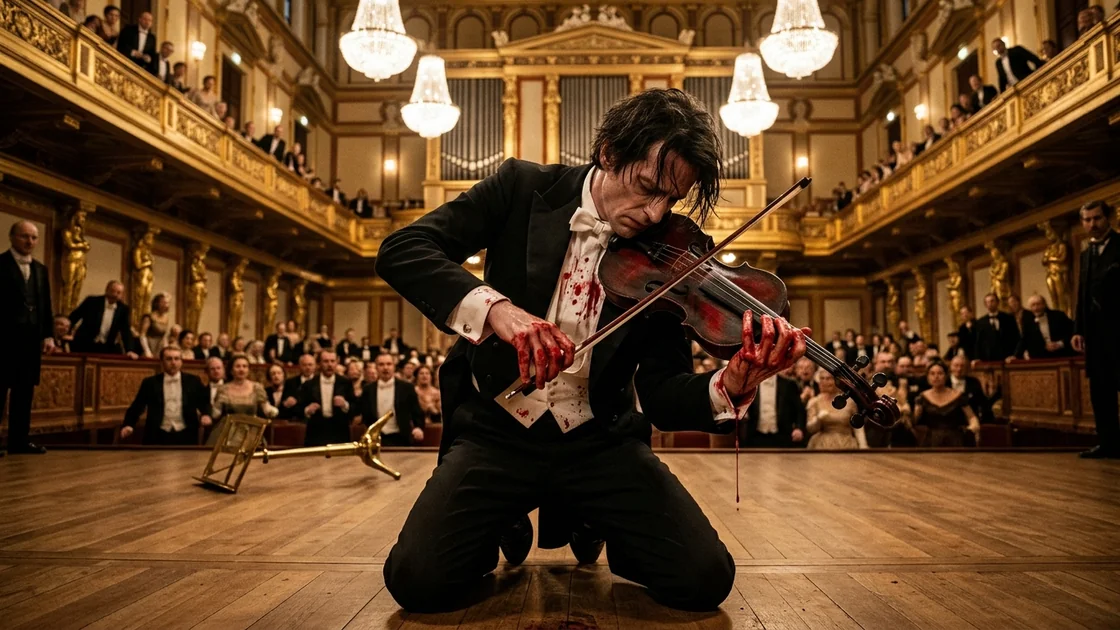
Julian Vance, a technically flawless but emotionally sterile violin virtuoso, is consumed by a festering envy of his younger rival, Lukas Marek, whose raw genius captivates the classical world. When Lukas acquires an antique violin crafted from the timber of an eighteenth-century execution tree and composes a revolutionary solo piece for it, Julian’s obsession curdles into murderous resolve. He kills Lukas in his apartment, stages the death as a tragic accident, and steals both the dark instrument and the unperformed manuscript to claim the masterpiece as his own. However, as Julian prepares for the grand premiere, he discovers that the gallows wood retains the vengeful memory of the dead. On the night of the concert, the cursed violin fuses to Julian’s hands, forcing him to play his victim’s final composition in an unending, agonizing loop until the strings slice through his flesh and his bleeding fingers expose his crime to a horrified audience.
The rain in Vienna did not fall so much as it clung, a cold, greasy mist that turned the cobblestones of the Innere Stadt into black mirrors. Inside the gilded salon of Baroness von Staufen, however, the air was suffocatingly warm, thick with the scents of beeswax candles, expensive French perfume, and the damp wool of fifty tailored evening coats. Julian Vance stood near the tall, Rain-streaked windows, his posture rod-straight, his long fingers curled around the stem of a crystal glass filled with untouched Tokaji. He was watching Lukas Marek.
Everyone was watching Lukas Marek.
At twenty-six, Lukas looked less like a conservatory prodigy and more like a Romantic poet who had wandered in from a storm. His dark hair fell across his forehead in damp curls; his linen cuffs were frayed at the edges, and a smudge of grey rosin dust stained the lapel of his ill-fitting velvet jacket. Yet when he tucked his chin over the tailpiece of the strange, dark violin he had brought with him that evening, the room ceased to breathe.
Julian knew the anatomy of the violin better than he knew the anatomy of his own body. He had spent thirty-two of his thirty-eight years chained to the fingerboard. He could play all twenty-four of Paganini’s Caprices at a blistering tempo without a single faulty intonation. He had won the Queen Elisabeth Competition in Brussels and the Tchaikovsky in Moscow. Critics praised his architectural precision, his glacial clarity, the diamond-hard brilliance of his spiccato. Vance is a surgeon, the feuilletons wrote. He dissects the score with a scalpel of pure gold.
And then, inevitably, in the very next paragraph, they would mention Lukas. Whereas Marek does not play the violin; he bleeds into it.
Lukas was not playing a known piece tonight. His eyes were closed, his body swaying like a reed in a dark current as he drew the bow across the G string. The sound that emerged from the instrument was not the bright, silvery soprano of a Stradivarius, nor the velvety, autumnal contralto of a Guarneri del Gesù. It was something altogether older and more disturbing. It had the hollow, rasping resonance of wind blowing through a bone flute, underscored by a bass register so deep and guttural it seemed to vibrate in the cavities of the listeners' chests.
Julian’s grip tightened on his wineglass until the delicate stem threatened to snap. He studied the instrument under Lukas’s chin. He had never seen it before. The varnish was not the traditional amber, gold, or Venetian red of the Cremonese masters. It was the color of dried venous blood, almost black in the candlelight, with a coarse, tortured grain showing through the ribs and the two-piece back. Even from twenty feet away, Julian could see that the scroll was carved not into the standard mathematical volute, but into something subtly asymmetrical, resembling a knotted knuckle or a twisted loop of rope.
The melody Lukas coaxed from it was a harrowing study in polyphony. Double and triple stops stacked upon one another in dissonant clusters that resolved only for a heartbeat before plunging back into an abyss of minor seconds and diminished fifths. Beneath a weeping, lyrical upper line, Lukas’s left hand plucked an relentless, marching pizzicato—thrum, thrum, thrum—like the steady tramp of boots up a wooden scaffold.
With a final, upward slash of the bow that ended in a harmonic so high and thin it sounded like a snapped neck, Lukas froze. The last vibration died in the velvet draperies. For five full seconds, the salon was as silent as a crypt. Near the front row, the Contessa di Savorgnan pressed a lace handkerchief to her eyes, her shoulders trembling.
Then the applause broke, loud and frantic, as if the aristocrats and critics were clapping to banish a ghost that had crept into the room.
Lukas blinked, looking almost bewildered as he lowered the violin. He offered a clumsy, self-conscious bow, his cheeks flushing.
Julian set his untouched wineglass on a marble console and began the slow, measured walk across the parquet floor. He arranged his features into the mask he had perfected over the last three years: the generous, slightly paternal smile of the established master greeting the brilliant protégé.
"Extraordinary, Lukas," Julian said as the crowd parted for him. His voice was a cultivated baritone, smooth and resonant. "Truly extraordinary. I don't recognize the work. Is it newly unearthed Ysaÿe? Perhaps an unpublished sketch by Ernst?"
Lukas wiped his brow with the back of his sleeve, leaving a faint streak of rosin across his skin. When he saw Julian, his expression softened with genuine, maddening affection. Lukas had never understood that they were enemies. He was too arrogant in his effortless gift to realize he was envied, or too naive to care.
"Julian! I didn't think you would come tonight. You hate the Baroness's soirées." Lukas looked down at the black violin cradled in the crook of his arm. "No, it isn't Ysaÿe. It’s mine. Just the first movement. I haven't even finished copying out the final bars of the coda yet."
A cold knot tightened in Julian’s stomach. He had tried to compose once, in his twenties. The result had been a series of mathematically unimpeachable, utterly lifeless exercises in counterpoint that he had burned in his stove after a single private reading.
"Yours?" Julian kept the smile fixed to his face, though his jaw ached with the effort. "You never cease to astonish. Does it have a name?"
"I am calling it Sonata for the Unshriven," Lukas said quietly, looking past Julian toward the dark windows. "Or perhaps she named it herself. To tell the truth, I feel less like I am writing it and more like I am taking dictation." He lifted the dark violin slightly.
"Yes," Julian murmured, stepping closer and looking down at the instrument. Up close, it radiated a faint, peculiar odor. Beneath the familiar smells of pine resin, linseed oil, and horsehair, there was something acrid and earthy—like wet bark, old iron, and rich river mud. "Where on earth did you find this? That is not the Bergonzi the Conservatory lent you."
"I returned the Bergonzi on Tuesday," Lukas said. His eyes gleamed with a feverish intensity that made Julian uneasy. Since the beginning of the autumn season, Lukas had grown thinner, the hollows beneath his cheekbones bruised with sleeplessness. "I found her in Prague three weeks ago, in the estate sale of an old magistrate in the Josefov quarter. The auctioneer thought it was nineteenth-century Bohemian trade work because the varnish is so dark and crazed. I bought it for forty guilders."
Julian leaned in, his trained eye scanning the f-holes. They were cut with savage, elongated slashes, wider at the center than any Stradivari pattern, resembling twin wounds in the belly of the spruce—Wait. Julian frowned. He looked closer at the top plate of the violin.
"That isn't spruce," Julian said, his professional curiosity momentarily overriding his malice. "Every violin belly since Andrea Amati has been carved from Alpine spruce. That grain is too wide, too porous. It’s... it’s oak. You cannot make a violin top out of oak. The wood is too dense, too heavy. It shouldn't project at all."
"And the back and ribs are black walnut," Lukas whispered, leaning in so the surrounding guests could not hear. "Look inside the bass f-hole, Julian. Look at the label."
Julian tilted his head, catching the light of the chandelier through the narrow slit in the wood. Pasted to the interior block, written in faded iron-gall ink that had turned the color of rust, was a slip of rag paper:
Lorenzo da Brescia, fecit Pragae, Anno Domini 1754. Ex Arbore Iustitiae.
"Lorenzo da Brescia," Julian translated softly. "Made in Prague, 1754. From the Tree of Justice." He looked up into Lukas’s pale face. "What does that mean?"
"I took it to Herr Kleist in the Dorotheergasse yesterday to have the soundpost adjusted," Lukas said, his fingers unconsciously caressing the grotesque, rope-like scroll of the violin. "Kleist nearly dropped it when he read the label. He wouldn't even keep it in his shop overnight."
"Kleist is a superstitious old fool who breathes too much spirit varnish," Julian said dismissively, though his eyes remained fixed on the blood-dark wood. "Whatever it is made of, the acoustics are... arresting. You intend to premiere the Sonata at the Musikverein next month?"
"On the fourteenth," Lukas nodded. "In place of the Brahms concerto. The committee was furious when I changed the program, of course, especially since it's an unaccompanied solo work, forty minutes long. They said no one since Bach has written a solo partita of that scale that can hold a hall." Lukas smiled then, a distant, haunted smile. "After they hear it, Julian, they won't remember the Brahms."
They won't remember you, either, a voice whispered in the back of Julian’s mind. It was his own voice, cold and entirely rational.
For ten years, Julian had worked to secure the lifelong chair as Director of Strings at the Imperial Academy, a position that carried with it not only wealth and social invulnerability, but historical permanence. The current Director, Hofrat Lindner, was seventy-eight and dying of dropsy. Two weeks ago, Lindner had hinted at dinner that while Julian’s pedagogy was unmatched, the Academy needed a figurehead of "transcendent, epoch-defining genius" to lead it into the new century. He had looked across the table at Lukas Marek when he said it.
If Lukas walked onto the stage of the Golden Hall on the fourteenth and played the piece Julian had just heard—a work that sounded as though Beethoven had descended into hell and returned with a four-stringed oracle—history would close its doors on Julian Vance forever. He would become a footnote. A Salieri. A competent mechanic who had lived in the time of a god.
"You must let me see the score before the fourteenth," Julian said, laying a warm, steady hand on Lukas’s frail shoulder. "The technical demands in that middle section—those tenth intervals over the left-hand pizzicato—are treacherous. Even for you. A second pair of eyes on the fingerings might save you a cramp on stage."
Lukas beamed, entirely disarmed. "Would you, Julian? Truly? I’m still wrestling with the final variations. My fingers are raw from trying to work out the shifts in the seventh position." He held up his left hand. The tips of his index and middle fingers were deeply grooved, the thick white callouses split at the edges and tinted pink. "Come by my rooms in the Spittelberg tomorrow night? Wait—no, Friday. I should have the final ink copy finished by Friday evening."
"Friday," Julian repeated, his smile never wavering. "At nine? Bring out a bottle of that atrocious Moravian brandy you like so much, and we will dissect your masterpiece note by note."
Julian did not wait until Friday to visit the Dorotheergasse.
At ten o’clock the following morning, while the gray Viennese drizzle continued to weep against the slate roofs, he pushed open the heavy oak door of Anton Kleist’s workshop. The little brass bell above the lintel gave a dull, flat clink.
The shop smelled of hide glue simmering in copper double-boilers, curls of shaved maple, and centuries of dust. Violins, violas, and cellos hung from the rafters like cured hams in a smoke-house—some stripped to the white wood, others glowing with fresh coats of amber oil varnish, their necks bound in linen bandages where fractures had been spliced.
Behind the workbench sat Anton Kleist, a man in his seventies whose spine had curved over decades to match the arch of a cello back. He wore a leather apron and a jeweler’s loupe screwed into his left eye socket. When he looked up and saw Julian’s tall, immaculate figure in his cashmere greatcoat and kidskin gloves, he removed the loupe and set down his miniature brass thumb-plane.
"Herr Vance," Kleist said, bowing his head respectfully. "Your Guarneri is not due for its winter bridge adjustment until November. Don't tell me the damp has popped a seam?"
"The Guarneri is sleeping safely in its silk case, Anton," Julian said, stepping up to the scarred wooden counter. He removed his gloves slowly, slapping them lightly against his palm. "I am not here about my instrument. I am here about the one Lukas Marek brought to you on Tuesday."
The silence that fell over the workshop was immediate and heavy, broken only by the gentle bubbling of the glue pot on the spirit stove. Kleist’s pale blue eyes dropped to the workbench. With a calloused thumb, he brushed a curl of spruce shaving onto the floor.
"I told young Herr Marek I could not work on that instrument," Kleist said quietly. "My hands are old. The wood is too hard for my knives."
"Do not lie to me, Anton. We have known each other for fifteen years." Julian leaned across the counter, lowering his voice. "You have restored three Stradivari, two Amatis, and a Gasparo da Salò for the Habsburgs. You do not turn away an eighteenth-century Brescian curio because the wood is hard. What is La Forca?"
Kleist flinched at the Italian word. He looked up sharply. "Did Marek call it that?"
"No. You did, just now, in your face," Julian said smoothly. He had spent three hours the previous night paging through his private library of rare organological texts—specifically, a nineteenth-century monograph on heretical and eccentric luthiers of the Austro-Hungarian Empire. He had found a single, footnote reference to Lorenzo da Brescia, who had fled Italy for Prague in 1740 after an inquest involving the desecration of church property, and who had died in a debtors' madhouse in 1755, leaving behind one final, monstrous instrument known to Czech collectors as Šibenice, and to the Italians as La Forca. The Gallows.
Kleist sighed, a long, wheezing sound. He walked to the front door, turned the iron key in the lock, and flipped the little cardboard sign in the window from Offen to Geschlossen.
"Come into the back, Herr Vance," the old man muttered.
Julian followed him behind a velvet curtain into a cramped office lined with ledger books and glass cases containing grotesque historical oddities: worm-eaten viol necks carved into satyr heads, bows made of whalebone, and coils of ancient, blackened sheep-gut strings. Kleist lowered himself into a creaking Windsor chair and rubbed his arthritic knuckles.
"Lorenzo da Brescia was not a madman when he apprenticed under Giuseppe Guarneri in Cremona," Kleist began, staring at the cold hearth. "By all accounts, he had an ear for tap-tones that rivaled Stradivari himself. He could strike a billet of raw maple with his knuckle and tell you which tree it grew beside, and which side faced the winter wind. Have you ever thought about what a violin truly is, Herr Vance?"
"It is a wooden amplifier," Julian answered clinically. "A box of spruce and maple under seventy pounds of string tension, designed to project the vibrations of horsehair rubbing against rosined catgut."
Kleist gave a sad, crooked smile. "Spoken like a modern virtuoso. No wonder your playing is so clean. No, Herr Vance. A violin is a resurrection machine. The tree lives for two hundred years in the forest, drinking the rain and the soil. Then the woodcutter kills it. The luthier saws its corpse into planks, gouges out its belly, bends its ribs over hot iron, and glues it into a hollow coffin. And yet, when the bow touches the string, the dead tree sings. It remembers the wind in its branches. That is what Lorenzo believed."
"A poetic conceit," Julian said impatiently. "Get to Prague, Anton."
"Lorenzo became obsessed with the idea that Alpine spruce and Bosnian maple only sang of peace—of mountain snows and quiet valleys," Kleist continued, unbothered by Julian’s tone. "He believed that to create a voice capable of expressing true human tragedy, the wood itself must have witnessed tragedy. It must have absorbed the final, violent vibrations of the human soul."
Julian felt a cold prickle along the nape of his neck, though he kept his expression stoic.
"In the autumn of 1753," Kleist said, his voice dropping to a rasp, "the municipal authorities of Prague finally tore down the old wooden scaffold on the Galgenberg—the Hill of the Gallows outside the New Town gates. It was not a platform built of timber planks, you understand. In the old days, they used a living tree—a monstrous, deformed black oak that had grown alongside a wild walnut tree until their trunks had fused together at the base. For three hundred years, the magistrates hung their condemned from its lower boughs. Murderers, parricides, thieves, false witnesses, betrayed rebels. Thousands of men and women kicked their last in the shadow of those leaves."
Kleist leaned forward, his cloudy eyes fixing on Julian’s.
"Think of it, Herr Vance. For three centuries, the roots of that tree drank the sweat, the blood, and the rot of the unshriven dead. The wood vibrated day and night with the creak of hemp ropes, the weeping of mothers, the curses of the guilty, and the final, strangled gasps of men choking on their own tongues. When the city finally felled it, the woodcutters refused to burn the timber in their stoves, fearing the smoke would poison their children. Lorenzo da Brescia bribed the executioner’s bailiff with every gulden he owned to cart the heartwood away in the dead of night."
"And he carved the violin from it," Julian murmured.
"Not just the violin," Kleist whispered. "He made four instruments from that wood, Herr Vance, before they locked him in the chains at St. Catherine’s. Three cellos and one violin. The cellos were burned by the Archbishop’s men in 1760 after a nobleman in Brno played one at a banquet and slit his own throat with a silver fish-knife during the sarabande. Only the violin survived, hidden away in the evidence vaults of the Prague magistracy for a century and a half."
"Because the wood is cursed," Julian said, a faint sneer curling his lip. "Really, Anton. We live in an age of electricity and railcars. You sound like a peasant crossing himself at a crossroads."
"I do not speak of curses! I speak of acoustics and sympathy!" Kleist slammed his palm on the arm of his chair. "When Marek brought that thing in here on Tuesday and asked me to reset the soundpost, I took my iron setter and reached through the f-hole. The moment the metal touched the interior of the back plate, the whole body of the violin hummed. There were no strings under tension—he had slackened them for the repair—and yet the wood hummed against my palm like a beehive! It was warm, Herr Vance. Wood does not hold heat like flesh. And the smell..."
Kleist shuddered, wiping his palm against his leather apron as if trying to rub away grease.
"I looked inside with my mirror," the luthier whispered. "Lorenzo did not line the interior blocks with willow or linen strips, as we do. He lined the ribs with dried strips of braided hemp. Hangman's rope, hardened with hide glue. And the purfling inlaid around the edges of the top and back is not dyed pearwood or ebony. It is whalebone, stained black with iron gall and human blood. That instrument was not built to play Mozart or Haydn, Herr Vance. It was built to execute justice. It craves the confession of the player."
"Lukas Marek has nothing to confess," Julian said coldly, turning toward the velvet curtain. "Except perhaps a criminal disregard for traditional harmonic structure. Thank you for the folklore, Anton. It will make an amusing anecdote for the program notes."
"Tell him to get rid of it!" Kleist called after him, his voice cracking in the dusty gloom of the shop. "Have you looked at the boy's hands? Have you looked at his eyes? That violin is drinking him dry! If he plays it at the Musikverein, it will kill him!"
Julian paused with his hand on the brass latch of the front door. He looked out through the rain-blurred glass at the grey figures hurrying along the Dorotheergasse under black umbrellas.
If he plays it at the Musikverein, Julian thought, it will kill me.
"Good day, Anton," Julian said, and stepped out into the rain.
Friday night arrived wrapped in a thick, yellow Danube fog that smothered the gas lamps along the narrow alleys of the Spittelberg.
Julian walked alone. He had left his carriage three districts away, near the Ringstraße, telling his coachman he was dining at his club and would walk home for the air. He wore a dark loden cloak with the collar turned up to his cheekbones, a soft felt hat pulled low, and a pair of heavy, lined leather driving gloves—not the thin kidskin he usually favored. In his right coat pocket, curled like a sleeping adder, was a thirty-inch length of silver-wound steel E-string, thicker gauge than standard, with two small rosewood dowels tied securely to either end. He had assembled it in his study an hour ago with the calm, methodical precision with which he prepared his tax returns or practiced his scales.
He did not think of himself as a murderer. As he climbed the four flights of steep, unlit wooden stairs to Lukas’s garret apartment, his pulse was steady—perhaps seventy-two beats per minute, an Andante moderato. He thought of himself as a conservationist. History was an unruly garden; occasionally, a wild, overgrown shoot had to be pruned so that the cultivated tree might receive the sun. Lukas was unstable, consumptive, erratic. Within five years, the boy would likely drink himself to death or lose his mind anyway, squandering his gift in bohemian obscurity. Julian, by contrast, had forty years of disciplined stewardship ahead of him. With Sonata for the Unshriven under his name—presented, perhaps, as a work Julian had secretly labored on for years to break free of his "clinical" reputation—and with the bizarre, hypnotic voice of La Forca in his hands, Julian Vance would ascend to the pantheon alongside Paganini and Corelli.
He reached the fourth-floor landing and knocked three times on the peeling green door.
Footsteps shuffled inside, slow and dragging. The bolt slid back, and Lukas pulled the door open.
Julian had to suppress a gasp. In the forty-eight hours since the Baroness’s salon, Lukas seemed to have aged a decade. He was dressed only in a sweat-soaked linen shirt and breeches, despite the freezing draft in the hallway. His cheeks were sunken, his lips cracked and dry, and his dark eyes burned like twin coals at the bottom of deep, blackened sockets. Both of his hands were wrapped in soiled linen rags, spotted with dark crimson blooms around the fingertips.
"Julian," Lukas breathed, his voice hoarse and rasping. "You came. What time is it? Have the bells rung nine?"
"Just now," Julian said, stepping inside and quietly pushing the door shut behind him. He slid the iron bolt back into its bracket—a casual, automatic gesture, as if merely keeping out the draft. "Good God, Lukas. Look at you. Have you slept at all since Wednesday?"
The garret was a pigsty of genius. Sheet music was strewn across the floorboards like fallen autumn leaves. Three empty bottles of cheap plum brandy lay rolled against the baseboard, and the tallow candles on the mantelpiece had burned down into grotesque, stalactite shrouds of wax. In the center of the room stood a brass music stand, and on the oak table beside it, resting on a piece of faded red velvet, lay La Forca.
Next to the violin lay a thick sheaf of manuscript paper, the ink still glistening wetly on the final page.
"I couldn't stop," Lukas whispered, stumbling back toward the table and gripping the edge with his bandaged hands to steady himself. "Every time I tried to set the bow down, Julian... the wood kept vibrating against my collarbone. If I put it in the case, I could hear the strings humming through the leather. It wouldn't let me sleep until the coda was finished."
He turned his feverish gaze on Julian, a terrifying mixture of terror and ecstasy on his face.
"Look at it, Julian. Read the last four pages. I finished it ten minutes before you knocked."
Julian walked slowly to the table. He did not take off his leather gloves. He looked down at the manuscript.
Lukas’s handwriting at the beginning of the score was neat, urgent, and legible. By the third movement, the notes were jagged, the stems slashing across the staves like knife cuts. And on the final two pages, mixed with the black India ink, were unmistakable brownish-red smears where Lukas’s bleeding left fingers had brushed the paper while turning the sheets.
Julian read the music silently, hearing the pitches in the flawless acoustics of his inner ear.
His breath caught in his throat.
It was a work of demonic, transcendent architecture. The final movement—marked Presto agitato, come un supplizio (Fast and agitated, like an execution)—was built around a recurring rhythmic ostinato that mimicked the drop of a trapdoor and the frantic, spasmodic dancing of a body at the end of a rope. Yet interwoven with this horror was a chorale melody in the high positions of the D and A strings of such aching, unbearable beauty that it felt like a soul begging God for a mercy that would never come. Technically, it was nearly impossible: simultaneous trills in thirds while the thumb and fourth finger executed a counter-melody in artificial harmonics.
No one in Europe could play this. Except Lukas.
And, with six weeks of ruthless practice, Julian.
"Have you played this final movement for anyone?" Julian asked softly, his eyes still fixed on the blood-stained final bar, where a quadruple-stop chord resolved onto a single, sustained open G that was marked morendo al niente—dying away to nothing.
"No one," Lukas rasped, sinking onto a wooden stool by the cold stove. He buried his bandaged hands between his knees, shivering violently. "No one knows it exists except you, Julian. I didn't even tell the committee the title yet. I wanted... I wanted you to be the first to see it."
Lukas looked up, and for the first time, the manic light faded from his eyes, replaced by the fragile, frightened lucidity of a twenty-six-year-old boy who had peered into an abyss too deep for his years.
"Julian," Lukas whispered, a tear cutting a clean track through the grime on his cheek. "Take the violin away from me. Please. Kleist was right. There is something wrong with it. When I play that final movement, I don't feel like I am moving my own arms. My left hand shifts into positions before my brain tells it to. When my fingers started to bleed an hour ago, I tried to drop the bow, and my knuckles locked around the frog like iron clamps. I had to tear my chin away from the chinrest—look!"
Lukas tilted his head back. Beneath his left jaw, where the ebony chinrest sat, the skin was not merely bruised with the standard "violinist’s hickey" that every professional bore; the flesh was raw, livid purple, and imprinted with a faint, textured pattern, like the weave of coarse hemp rope.
"It’s a parasite, Julian," Lukas sobbed, his voice breaking. "It wanted the song out of me, and now that the song is on the paper, it doesn't need me anymore. Help me burn it. Put it in the stove right now!"
"Burn a Lorenzo da Brescia?" Julian’s voice was infinitely gentle, almost hypnotic as he stepped behind the stool where Lukas sat hunched. "You are exhausted, my dear boy. You have starved yourself for days, you have poisoned your nerves with bad brandy, and you have played until your tendons have seized. It is called focal dystonia, Lukas. Every conservatory student who practices fourteen hours a day experiences it."
"No, it isn't cramps—"
"Hush," Julian murmured. He placed his left hand lightly on the crown of Lukas’s sweat-matted hair. With his right hand, he slipped the rosewood dowels and the coiled steel E-string from his coat pocket. "You are in pain. Your mind is racing with the music. You have given the world something immortal tonight, Lukas. Truly immortal. You don't need to carry the burden of it any longer. Let me carry it for you."
"Julian?" Lukas began to turn his head on the stool, sensing some subtle shift in the cadence of the older man's voice. "What are you—"
Julian did not hesitate. He crossed his wrists and whipped the steel wire down over Lukas’s head, pulling his arms wide with the sudden, explosive strength of a man whose upper body had been trained by thirty years of isometric bow tension.
The steel E-string bit into the soft flesh of Lukas’s throat, sliding neatly beneath the angle of his jaw, right over the purple bruise left by the violin.
Lukas made no sound—only a wet, percussive click in his windpipe as the cartilage of his larynx collapsed inward under the piano-wire gauge of the steel. He bolted upright, knocking the wooden stool backward onto the floorboards with a clatter.
Julian planted his knee firmly in the small of Lukas’s back, bracing himself, and twisted the rosewood dowels.
Lukas thrashed wildly, his bandaged hands flying up to claw at his neck, his torn fingernails scraping uselessly against the taut, buried wire and Julian’s thick leather gloves. In his blind, suffocating panic, Lukas lunged forward toward the oak table. His boots slipped on the scattered sheets of manuscript paper. His chest struck the edge of the table, sending an empty brandy bottle crashing to the floor.
Out of the corner of his eye, Julian saw the table tip. The violin! he thought in a flash of pure terror—not for the boy dying in his grasp, but for the priceless wood inches away.
Still holding the wire taut with his right hand, Julian released the left dowel just enough to wrap the wire twice around his fist, then used his free hand to shove Lukas’s convulsing body sideways, away from the table and toward the tall, dormer window overlooking the cobblestone courtyard four stories below.
They hit the floorboards together in a tangle of limbs. Lukas’s heels drummed a frantic, irregular tattoo against the pine planks—thrum, thrum, thrum—the exact rhythm of the pizzicato ostinato from his first movement. His dark eyes bulged, fixed upward on Julian’s face. There was no hatred in them, only a vast, bottomless confusion, as if until the very last second, he could not comprehend the dissonance of the chord Julian had struck.
A thin ribbon of bright crimson trickled from the corner of Lukas’s mouth, ran down his jawline, and dripped onto the floorboards.
Julian held the wire for three full minutes after the drumming of the heels stopped, counting the seconds in his head as if counting sixty-fourth rests in a slow adagio. One-and-two-and-three-and-four-and...
When he finally slackened the steel string, the garret was utterly silent, save for the drip of the gutter outside the dormer window.
Julian stood up. He was breathing heavily, a fine sheen of perspiration beneath his wool collar, yet his hands did not tremble. He looked down at the body.
The steel wire had cut a deep, narrow trench into Lukas’s throat, almost invisible beneath the swelling bruise, looking remarkably like the mark of a thin cord or the sharp edge of a broken windowpane.
Working quickly and methodically, Julian pocketed the steel wire. He unwrapped the blood-spotted bandages from Lukas’s fingers and tossed them into the cold stove, lighting them with a candle stub until they were grey ash. Then, he walked to the dormer window, unlatched the rotten wooden casement, and swung it wide into the yellow fog.
Four stories below, the courtyard of the tenement was paved with jagged granite flagstones and bordered by an iron coal-chute grating. No lights burned in the lower windows; the building housed mostly deaf pensioners and day-laborers who slept like stones.
Julian dragged Lukas’s light, wasted body to the sill. He took one of the empty brandy bottles, smashed its neck against the inner edge of the window frame so that glass shards littered the floor and sill, and smeared a drop of Lukas’s saliva and brandy onto the boy's chin. The narrative was already written in every salon in Vienna: Poor Lukas Marek, driven to delirious madness by overwork, exhaustion, and drink, threw open his window for air in a drunken stupor, lost his balance on the low sill, and plunged to his death, cutting his throat on the broken glass or the iron coal-grating below.
With a single, heave of his shoulders, Julian lifted Lukas by the ankles and tipped him out into the fog.
He did not lean out to watch. He listened. Three seconds later came a dull, wet crunch muffled by the mist, followed by the metallic rattle of the iron coal-grate. No screams. No windows opening.
Julian closed the casement window nearly all the way, leaving it ajar just enough for the wind to bang it softly. Next, he gathered every single scrap of sketch paper and musical draft from the floor, stuffed them into the stove, and burned them to nothing, stirring the ashes with an iron poker until no trace of ink remained.
Finally, he turned to the oak table.
He picked up the completed, clean manuscript of Sonata for the Unshriven, rolled it carefully into a cylinder, and slid it into the deep inner pocket of his loden cloak, right over his heart.
Then he reached for La Forca.
As his gloved fingers closed around the neck of the violin to lift it into Lukas’s shabby leather case, Julian froze.
A single drop of blood—flung from Lukas’s mouth or his torn fingers during the struggle—had landed squarely on the belly of the violin, just beside the bass f-hole.
Julian pulled a linen handkerchief from his pocket to wipe it away before the acid of the blood could damage the eighteenth-century varnish.
Before the linen touched the wood, the drop of blood vanished.
It did not run down the arch of the belly. It did not smear. The porous, unsealed grain of the dark oak simply drank it in, the way parched desert sand drinks a drop of rain. And as Julian held the neck of the instrument, even through the thick leather of his driving glove, he felt the E-string give a single, microscopic twitch against his thumb, producing a sound so faint it was barely audible: a high, plaintive ping, like a drop of water falling into a well.
Julian stared at the violin for a long moment. Then he shoved it into the case, snapped the brass latches shut, and walked out of the garret into the fog.
Vienna wept for Lukas Marek for precisely nine days.
The newspapers called it the greatest tragedy to befall Austrian music since the premature death of Franz Schubert. At the funeral at the Zentralfriedhof, where the rain turned the freshly dug earth into black porridge, Julian Vance delivered the eulogy.
Standing beside the open grave in black mourning crepe, his tall frame bowed with apparent grief, Julian spoke of his "beloved brother in art," a shooting star too bright and volatile for this cold world. The Baroness von Staufen wept openly on Julian’s arm afterward, whispering that Julian was the only true nobleman left in the Conservatory.
Two days after the burial, Hofrat Lindner summoned Julian to his chambers at the Imperial Academy and formally offered him the succession as Director of Strings.
And three days after that, Julian made his announcement to the press.
In honor of his fallen friend, Julian Vance would assume Lukas’s vacant date at the Musikverein’s Golden Hall on the fourteenth of the month. However, rather than playing the standard repertoire, Julian revealed that for the past two years, he had been secretly composing a monumental solo work—an elegy for the modern soul, which he had now completed in a white-hot fever of grief following Lukas’s death. He called it Partita in D Minor: In Memoriam L.M.
As for the strange, dark violin Lukas had played at the Baroness’s salon? When the Baroness inquired after it, Julian explained with a sad smile that the instrument had actually belonged to him—an obscure Italian curio Julian had purchased from a Prague dealer and generously lent to Lukas for the evening so the boy could test its projection. No one questioned him. Who would question Julian Vance? The municipal police had found no violin in Lukas’s garret, after all, and old Anton Kleist remained locked behind his shuttered shop door in the Dorotheergasse, refusing to speak to anyone after suffering what his neighbors described as a mild apoplectic stroke on the morning he read of Lukas’s fatal fall.
In the quiet sanctuary of his spacious apartment on the Schottenring, Julian began his work.
First, he meticulously copied out Lukas’s manuscript onto fresh, high-grade vellum paper in his own neat, precise hand, changing the title at the top of the first page. When he was finished, he burned Lukas’s original blood-smeared pages in his porcelain hearth, watching the paper curl into black flakes and vanish up the flue. The transformation was complete. The music was now his.
Then, he opened the leather case and took out La Forca.
He had intended, initially, to play the piece on his own priceless 1735 Guarneri del Gesù. On the first morning of practice, he set his music stand in the center of his drawing room, rosined his François Tourte bow, tucked the golden Guarneri under his chin, and laid the hair against the strings to play the opening chord of Lukas’s piece.
The sound that came out was hideous.
It was flat, nasal, and choked, as if someone had stuffed wet rags into the body of the violin. Julian frowned, adjusted his bridge, checked his tuning against his tuning fork, and tried again. On the fourth bar—a rapid ascending run in double-stops—the Guarneri’s gut A-string snapped with a report like a pistol shot, whipping back and slicing a thin red line across Julian’s left cheek.
With a curse, Julian lowered the Guarneri. As he did, he heard a sound from the leather case resting on the ottoman across the room.
Hmmmmmm.
A low, resonant D—the exact pitch of the note that had just snapped—was vibrating inside the closed case of the gallows violin.
Julian stood very still, pressing a handkerchief to his stinging cheek. Slowly, he walked over to the ottoman, flipped open the brass latches, and lifted La Forca from its velvet bed.
In the grey morning light filtering through his lace curtains, the violin looked slightly different than it had in the salon. Along the bass side of the oak belly, where the drop of Lukas’s blood had fallen, the wood grain seemed richer, the dark crimson varnish glowing with a faint, subterranean luster, like a coal blown upon in the dark.
Julian laid his Guarneri aside, tuned La Forca, and raised it to his chin.
The moment the ebony chinrest settled against the angle of his left jaw, a jolt ran down Julian’s spine—not painful, but cold and electric, like plunging an overheated hand into ice water. He drew the bow across the strings.
The room exploded with sound.
The opening chord did not merely vibrate in the air; it seemed to push back against the walls of the apartment, rattling the crystal prisms of the chandelier overhead. Julian’s breath caught in a gasp of pure, narcissistic rapture. The violin was magnificent. Under his fingers, the dense oak and black walnut responded with a terrifying eagerness. His left hand glided up and down the ebony fingerboard with an ease he had never experienced in thirty years of playing. The treacherous shifts into seventh and eighth position, the impossible stretches of tenths that had torn Lukas’s fingers to shreds—Julian executed them effortlessly on the very first reading.
It was as if the fingerboard were magnetized, pulling his fingertips to the exact micro-millimeter of true pitch before his mind could even read the notes on the page.
Lukas was weak, Julian thought triumphantly as he tore through the first movement, his reflection in the gilt wall-mirror showing a tall, commanding master in total dominion over his instrument. The boy had no technique, no discipline. He let the instrument frighten him. In the hands of a master, this wood is a slave.
He practiced for six hours that first day. When he finally lowered the bow at dusk, his shirt was soaked through with sweat, and he felt a strange, hollow ravenousness in his belly, as if he had run twenty miles. When he went to set the violin back in its case, his left fingers felt stiff. He looked down at his hand.
The four fingertips of his left hand, which bore thick, horn-like callouses built up over three decades of relentless toil, were stained a deep, bruising purple-black. And beneath the edge of his jaw, the skin burned as if he had rubbed it with nettles.
He washed his hands in warm water with Castile soap, massaged them with almond oil as he did every night, and went to bed early.
That night, Julian dreamed of the Galgenberg.
He was standing at the base of a colossal, malformed tree whose bark was black and slick with rain. The branches above him did not bear leaves; they bore violin scrolls, hundreds of them, dangling from lengths of braided hemp rope that creaked in the wind. And sitting high in the crook of the fused trunk was Lukas Marek. Lukas was naked to the waist, his head tilted at a broken, impossible angle, a length of silver-wound steel wire glittering deep inside the ruin of his throat.
Lukas was holding a violin bow made of white bone. He was drawing it across the steel wire in his own neck. And the sound that came out of Lukas’s open, purple mouth was the chorale from the third movement of the Sonata.
You missed a sharp in bar eighty-four, Julian, Lukas’s voice rasped through the music, wet and bubbling with blood. Play it again. From the top.
Julian woke at three in the morning, his heart hammering against his ribs.
The bedroom was freezing. And from the drawing room down the hall, through two closed oak doors, came a sound.
Thrum. Thrum. Thrum.
Slow. Steady. Plucked strings. The pizzicato ostinato from the first movement.
Julian threw back the eiderdown quilt, snatched the heavy brass candlestick from his nightstand, and strode barefoot down the dark corridor. He flung open the drawing-room door.
The room was empty. The moonlight slanted through the tall windows, illuminating the brass music stand and the ottoman. La Forca lay inside its open case—Julian distinctly remembered latching it before bed, though now the lid stood gaping like a coffin. The strings were still.
Yet as Julian stepped closer, the smell hit him. The drawing room did not smell of beeswax and Turkish carpets. It smelled overpoweringly of wet river mud, rotting leaves, hemp tar, and the sharp, coppery tang of a slaughterhouse floor.
Julian slammed the lid of the case shut, locked it with its miniature brass key, and shoved the case into the bottom of his mahogany wardrobe.
Ten days before the concert, the physical deterioration began.
Julian was a man who treated his body as a sacred temple of mechanics. He never drank spirits before a performance; he slept eight hours; he trimmed his fingernails with surgical scissors every forty-eight hours so that not a fraction of horn projected beyond the fleshy pad of the finger.
Yet on the morning of the fourth of November, as he practiced the brutal second movement of the Sonata, he felt a sharp, hot sting in the tip of his left index finger during a rapid passage of left-hand pizzicato. He stopped and looked at his hand.
The thirty-year-old callous on his index finger had split straight down the center, from the nail bed to the first joint, like the shell of an overripe chestnut. A bead of bright red blood welled up from the raw pink dermis beneath.
Julian stared at it in disbelief. His callouses hadn't split since he was twelve years old in the conservatory.
He went to the washbasin, rinsed the finger in cold water, and bound it tightly with court plaster and a thin layer of collodion to form an artificial skin. When he returned to the drawing room and picked up La Forca, he noticed that the gut G and D strings, and the steel E-string, looked subtly different. Under the magnifying glass on his desk, the sheep-gut strings did not look smooth; tiny, microscopic splinters of dried hemp fiber seemed to be protruding from the windings, rough as a rasp. And the ebony fingerboard beneath them was no longer glassy smooth. The wood had raised its grain, forming tiny, razor-sharp ridges across the positions.
"The humidity in this room is ruining the wood," Julian muttered aloud to the empty apartment. His voice sounded thin, ragged. He had lost eight pounds in a week. The hollows beneath his cheekbones were dark, and he had taken to wearing a high silk cravat even indoors to hide the livid, rope-patterned lesion beneath his left jaw, which now oozed a clear, sour-smelling serous fluid through the night.
He considered taking the violin to a luthier to have the fingerboard planed smooth, or changing the strings. He actually took a fresh set of Padua gut strings from his desk drawer and reached for the tuning pegs of La Forca to slacken the old ones.
The ebony pegs would not turn.
He gripped the E-string peg with a pair of leather-padded pliers and twisted with all his might. The wood groaned—a sound terrifyingly like a human joint popping on a rack—and the peg twisted back against his hand with such sudden violence that the pliers flew from his grip and shattered the glass front of a bookcase across the room.
Julian stood panting, staring at the violin on the table.
He could switch back to his Guarneri. The thought crossed his mind like a lifeline thrown to a drowning man. He didn't need La Forca. He had the score! The music was what mattered! He could play the premiere on his Guarneri!
Trembling, Julian walked to his closet, pulled out the double-case containing his Guarneri del Gesù, and threw it open.
Julian let out a strangled cry and staggered back against the wall.
Inside the velvet-lined case, the Guarneri was in pieces. The seventy pounds of string tension had somehow multiplied tenfold inside the locked case; the maple neck had snapped cleanly away from the upper block, the spruce belly had caved inward along the bass bar like a crushed ribcage, and the four strings were coiled around the shattered scroll like dead worms.
He had no backup instrument of concert caliber. And every great collector and dealer in Vienna already knew he was playing the famous "dark Italian violin" associated with Lukas for the memorial concert. To borrow a standard conservatory instrument now would invite questions, scrutiny, and a catastrophic drop in the titanic acoustic power the Sonata demanded.
He was bound to the tree.
For the next nine days, Julian descended into a private purgatory behind the locked doors of his Schottenring apartment. He dismissed his housekeeper, telling her he required absolute solitude for his composition work. He stopped eating solid food, surviving on cold beef broth and black coffee, though his stomach rebelled at the smell of the meat.
Because he could not stop playing.
Just as Lukas had confessed on the night of his murder, the violin would not tolerate silence. If Julian set it down for more than two hours, a high, maddening tinnitus began to ring in his ears—the sustained open G of the Sonata’s final bar. The only way to silence the ringing inside his skull was to pick up the violin and vibrate the wood against his collarbone.
By the tenth of November, the collodion and court plaster on his left hand had been shredded away twenty times over. All four fingertips of his left hand were raw, weeping pulps of abraded flesh. To practice, he had to soak his fingers in a bowl of alum and ice water until they went completely numb, dry them, and then attack the fingerboard until the blood made the strings so slippery his fingers slid out of tune.
Strangely, the blood never stayed on the violin. By the time he woke from his brief, nightmare-ridden stupors on the drawing-room sofa, the ebony fingerboard and the oak belly were always bone-dry, though the violin itself felt heavier every day, and its dark varnish had deepened to the glossy, wet crimson of a fresh clot.
On the thirteenth—the night before the premiere—Julian stood before the gilt mirror in his drawing room, holding the bow in his right hand and the violin in his left.
In the dim gaslight, he barely recognized the creature staring back at him. His hair, always so impeccably pomaded, hung in limp, greying strands around a face as gaunt and white as tallow. His eyes were sunken, fever-bright, identical to the eyes Lukas had turned upon him in the Spittelberg garret. When Julian looked closely into the tarnished silver of the mirror, the shadow cast on the wallpaper behind him by the gasolier did not look like a man standing with a violin. It looked like a man hanging by his neck from a crooked bough, his head cocked sideways at the exact angle a violinist cocks his head to hold his instrument.
"One performance," Julian whispered to the glass. His lips were cracked and crusted with dried blood where he had bitten them during the seventh-position shifts. "Only one. Tomorrow night. Forty minutes on the stage of the Golden Hall. They will hear it, they will crown me, and the moment the curtain falls, I will take an axe and chop you into kindling and throw you into the Danube."
On the table behind him, the open strings of La Forca hummed softly in the draft, answering him in a minor third.
The night of the fourteenth of November was clear and bitterly cold, the sky above Vienna dusted with hard, frost-bright stars.
Inside the Musikverein, the Great Hall glowed like the interior of a golden jewel box. Every seat in the parquet, the loges, and the upper galleries was packed, and rows of conservatory students stood three deep along the rear walls. The gilded caryatids lining the balconies seemed to lean forward under the weight of the anticipation. In the imperial box sat the Archduke and Hofrat Lindner; in the front rows sat every major critic from Vienna, Berlin, Paris, and London, their notebooks poised on their knees.
Backstage, in the soloist’s green room, Julian Vance sat alone.
He was dressed in immaculate evening tails, white tie, and starched linen shirtfront. To anyone glancing through the doorway, he looked like the marble monument of a virtuoso. They could not see that beneath his high white collar, a thick pad of cotton wool was taped over the weeping, blackened ulcer under his jaw to keep the pus from staining his linen. They could not see that his left hand, resting in his lap beneath a white silk handkerchief, had been injected twenty minutes ago by Julian himself with a five-percent solution of cocaine hydrochloride right into the ulnar and median nerves at the wrist.
He could not feel his fingers at all. They were four dead sausages of raw meat, painted over with three thick coats of surgical collodion glue so that the red flesh was temporarily sealed inside a hard, glossy shell. It only had to last forty minutes.
A knock sounded at the door. The stage manager poked his head in, his face pale with excitement.
"Two minutes, Herr Vance. The Archduke has taken his seat. The hall is electric."
Julian stood up. He left the white handkerchief on the chair, picked up his François Tourte bow and La Forca, and walked to the wings.
As he stood behind the heavy velvet curtain, listening to the low, oceanic roar of two thousand people murmuring on the other side, Julian looked down at the violin in his hand. Under the bright incandescent glare of the backstage lamps, the coarse grain of the oak belly seemed to pulse, expanding and contracting almost imperceptibly, like the ribs of a breathing animal. The smell of wet earth and old hemp rope was so strong Julian wondered if the stagehands could smell it, too.
The stage manager pulled back the heavy brass latch of the double doors onto the platform.
The roar of the crowd hushed for a fraction of a second, then swelled into a thunderous, reverent ovation as Julian stepped out onto the bare pine boards of the stage.
There was no orchestra tonight. No conductor’s podium. Only a single, empty expanse of polished wood beneath the blazing chandeliers, a lonely brass music stand—which Julian had requested only for protocol, as the score was burned into the marrow of his bones—and the golden organ pipes towering behind him like the bars of a gilded cage.
Julian walked to the center of the platform. The acoustics of the Golden Hall were so sensitive that each click of his patent-leather heels echoed back to him from the distant gallery. He bowed from the waist—stiff, aristocratic, commanding.
The applause died away. A silence settled over the hall so absolute that the rustle of a silk gown in the third row sounded like tearing paper.
Julian raised La Forca and tucked the chinrest beneath his left jaw.
Even through the cotton wool and the numbing fog of the cocaine, the contact sent a lance of white-hot agony through his trigeminal nerve. Simultaneously, as the thumb and fingers of his left hand closed around the maple neck of the violin, and the fingers of his right hand curled around the ebony frog of the bow, Julian felt something wet and sticky seep out from the pores of the wood.
Hide glue? Resin?
No. It was warm. The wood of the neck and the wood of the bow frog seemed to soften like warm wax under his grip, molding themselves to the exact contours of his knuckles, and then instantly hardening again with a faint, microscopic snick, like iron manacles locking shut.
Julian’s eyes widened slightly. He tried to lift his right pinky finger from the stick of the bow to check his balance.
The finger would not rise. The skin of his fingertips was fused to the ebony and pernambuco wood. And against his neck, the chinrest had dug its edges into his flesh beneath the jawbone, locking his skull at a tilted, thirty-degree angle toward the scroll.
Panic—cold, suffocating, and absolute—flashed through Julian’s chest. He tried to pull his right arm away from his body to lower the bow.
Instead, his right shoulder dropped with mechanical precision, bringing the horsehair down onto the G and D strings at the frog.
The violin began to play.
The opening chord of Sonata for the Unshriven tore through the Golden Hall like a thunderclap. In the front row, Hofrat Lindner physically flinched back into his velvet seat.
It was not the clinical, diamond-bright tone of Julian Vance. It was a sound of primordial, terrifying violence—the groan of an ancient oak tree splitting in a winter gale, the shriek of rusted iron hinges, the deep, weeping lament of a thousand unpardoned souls rising from the mud of the Galgenberg.
Julian was merely the wooden puppet hanging from the strings; the violin was the master.
His left hand flew up the fingerboard into the polyphonic labyrinth of the first movement. His fingers moved with a speed and demonic ferocity that defied human anatomy. Thrum, thrum, thrum went his fourth finger, plucking the relentless pizzicato march of the scaffold, while his first, second, and third fingers hammered down upon the steel and gut strings like iron pistons to voice the weeping melody above.
Within three minutes, the surgical collodion sealing his fingertips shattered under the seventy-pound tension of the strings.
Because of the cocaine in his wrist, Julian could not feel the lacerations at first; he only heard them—a tiny, wet squelch beneath the roaring acoustics of the violin every time his index finger slid down the rough, splintered E-string. He looked down the length of his nose toward the scroll.
In the blazing light of the chandeliers, a fine, crimson mist was flying off the vibrating strings with every pizzicato pluck, speckling the dark oak belly of the violin and staining his starched white cuffs with tiny red stars.
He reached the end of the first movement. In the score, there was a four-measure pause between the first and second movements to allow the soloist to breathe and retune.
Julian’s arms did not pause for a single millisecond.
Without lifting the bow from the strings, the violin dragged his right wrist into a vicious up-bow staccato, plunging straight into the second movement—and then, skipping the lyrical respite of the middle section altogether, tore directly into the final movement: Presto agitato, come un supplizio.
At the same moment, the cocaine in his wrists burned off, metabolized by the frantic racing of his heart.
The pain hit him all at once, so blinding and white-hot that Julian screamed.
Or he tried to scream. His jaw was clamped so tightly down upon the chinrest by the paralyzed muscles of his neck that the scream came out only as a strangled, wet gurgle in his crushed throat—the exact sound Lukas had made on the floor of the Spittelberg garret.
Every shift along the fingerboard was now a stroke of a razor blade across open bone. The steel E-string had sawed completely through the fleshy pad of his left index and middle fingers; he felt the cold metal grating directly against the periosteum of his distal phalanges. Blood poured freely from his left hand now, running down the maple neck of the violin, soaking his white linen cuff until it dripped onto the pine boards of the stage at his feet—drip, drip, drip—keeping perfect, horrific time with the tempo.
In the hall, the audience sat frozen in a state of collective hypnosis. At first, during the opening minutes, the critics had leaned forward in astonished rapture at the transcendent genius of the music. Then, as the tempo accelerated beyond human possibility, someone in the third row with opera glasses gasped aloud.
"His hands!" a woman whispered shrilly in the sudden quiet of a harmonic passage. "My God, look at his hands!"
Murmurs broke out across the parquet. Men stood up in the boxes, craning their necks. Hofrat Lindner rose trembling to his feet in the imperial loge, gripping the velvet balustrade as he saw the bright red ribbons running down Julian’s black sleeve and dripping from the bottom bouts of the dark violin.
"Stop!" Julian tried to shriek at the men in the wings, turning his bloodshot, bulging eyes toward the stage manager standing behind the curtain. "Help me! Cut the strings!"
Nothing came out of his mouth but a frothy pink bubble of blood and saliva where he had bitten clean through his own tongue.
He reached the final bar of the Sonata—the great quadruple-stop chord resolving onto the open G, marked morendo al niente.
Thank God, Julian wept inside his fracturing mind as his bow drew out the final, dying note. It's over. The piece is finished. It has to let me go.
The note died away.
Instead of dropping to his side, Julian’s bow arm whipped back to the frog with such violence that the rotator cuff in his right shoulder tore with an audible pop.
And his bleeding, bone-white left fingers slammed back down onto the fingerboard at the very first bar of the final movement, repeating the execution at double the tempo.
The violin was not playing the score anymore. It was playing the murder.
Above the sawing roar of the oak and walnut, another sound rose from the f-holes—a sound that had nothing to do with sheep-gut or horsehair. It was the high, metallic screech of a steel wire twisting around a boy’s throat, followed by the wet, rhythmic drumming of two boot-heels kicking against a garret floor.
And standing at the foot of the stage, right between Julian and the horrified front row, stood Lukas Marek.
No one else in the hall saw him, for their eyes were fixed in terror upon the madman on the platform who was shredding his own hands to ribbons. Lukas stood resting his chin on the edge of the stage apron, his neck purple and deeply trenched, his dark eyes luminous and calm. He was watching Julian’s left hand.
Your intonation is slipping in the seventh position, Julian, Lukas whispered inside Julian’s skull, his voice drowning out the screams of the women now rising from the parquet as the audience finally realized something catastrophic was happening. The blood makes the ebony too slick, doesn't it? Press harder. Use the bone.
Julian’s middle fingernail tore completely free from the nail bed, flipping spinning into the footlights as his exposed finger-bone grated up the A-string to hit a high harmonic F.
On the stage behind him, the double doors burst open. The stage manager and two burly stagehands rushed out onto the platform, ignoring all concert etiquette in the face of the butcher shop unfolding under the chandeliers.
"Herr Vance!" the stage manager shouted, grabbing Julian by the shoulders to pull him back from the edge of the stage. "Stop! For the love of Christ, man, drop the bow!"
One of the stagehands seized Julian’s right wrist with both hands and pulled downward with all his weight to wrench the bow away from the strings.
Julian’s forearm snapped—both the radius and the ulna breaking with a dry crack like a dead branch—and yet the broken arm continued to saw back and forth from the elbow and shoulder, the jagged ends of the bone tenting the black wool of his tailcoat sleeve as the Tourte bow slashed across the crimson-soaked belly of La Forca.
The stagehand screamed and jumped backward, cradling his own hands as if the violin had burned him through Julian’s coat.
Now the blood was not merely dripping from Julian’s fingers; an artery in his wrist had been pierced by his own fractured radius. Dark, pulsing jets spurted across the front of his white shirtfront and poured directly into the wide, gaping f-holes of the gallows violin.
The oak and walnut drank it greedily. With every ounce of blood that flooded its hollow belly, the voice of the violin grew louder, richer, and more triumphant, filling the golden vault of the Musikverein until the crystal prisms of the chandeliers began to shatter one by one, raining slivers of glass down onto the fleeing patrons below.
Julian fell to his knees at the center of the stage.
He could no longer see the hall. His vision had turned the color of old iron-gall ink. He felt the ebony chinrest push harder and harder beneath the angle of his left jaw, tilting his head further and further back, and to the right, until the braided hemp linings inside the violin seemed to reach out through the wood and wrap around his cervical vertebrae.
He was no longer in the Musikverein. He was swinging in the cold Prague rain above the mud of the Galgenberg, the black leaves of the oak tree rustling overhead, while down below, in the lantern light, a crowd of faceless judges watched him dance upon nothing.
With one final, downward slash of his shattered right arm, the horsehair of the bow sawed clean through all four strings at once—and simultaneously, the seventh vertebra in Julian’s neck gave way under the relentless leverage of the chinrest.
The strings parted with a sound like a trapdoor dropping open.
Julian Vance pitched forward onto his face upon the blood-slick pine boards of the stage, his arms still locked in the playing position around his chest.
In the sudden, ringing silence of the ruined hall, La Forca rolled free from beneath his broken chin. It slid a few feet across the polished wood, leaving a dark red wake behind it, and came to rest upright against the base of the brass music stand.
There wasn't a single drop of blood on its dark, immaculate varnish, nor a single scratch upon its ebony fingerboard. And as the first brave doctors climbed shaking onto the platform to turn Julian’s body over, the ancient wood gave one last, contented sigh, and went completely silent.