The Forty-Eight Hour Priority
Arthur Pendelton, a veteran examiner and statutory compliance auditor at the United States Patent and Trademark Office, discovers that a powerful biomedical corporation has stolen a revolutionary stroke-treatment invention from its destitute creator, Dr. Elena Vance. Bound by the ruthless legal reality of the first-inventor-to-file patent system, Arthur realizes that if the corporation secures a Wednesday afternoon filing date, Elena will lose her life work forever without the millions required to fight them in court. Using his encyclopedic knowledge of obscure bureaucratic regulations, technical drawing standards, and dual-use national security screening protocols, Arthur engineers a forty-eight-hour administrative quarantine on the corporate application. Racing against the clock and risking his career and freedom, he tracks Elena down to a freezing industrial garage in Alexandria to help her assemble a flawless specification from memory before the corporation can cure their defective filing on Friday afternoon.
The rain in Alexandria always smelled faintly of river silt and wet concrete, a damp, pervasive odor that clung to the wool coats of the examiners as they filed through the security turnstiles of the Madison Building. For twenty-six years, Arthur Pendelton had breathed that air. He knew the exact cadence of the revolving doors, the slight hitch in the third elevator bank between the fourth and fifth floors, and the precise temperature of the fluorescent-lit corridors where the intellectual property of a restless nation was weighed, measured, and either baptized in the waters of federal protection or cast back into the public domain.
Arthur was fifty-eight years old, a Grade-14 Senior Legal Instruments Auditor on rotational detail from Art Unit 3770, which handled therapeutic ultrasound, bio-acoustic instrumentation, and non-invasive surgical arrays. He was a man who appeared to have been assembled from the very materials of his trade: his hair was the color of archival bond paper, his spectacles were framed in unremarkable gunmetal wire, and his posture carried the slight, permanent forward curve of someone who had spent thirty-five thousand hours leaning over technical schematics. To the younger examiners who clicked past his cubicle in their smart-casual sneakers, drinking overpriced oat-milk lattes and listening to podcasts while running automated prior-art searches, Arthur was a relic. He still kept a six-inch brass proportional divider in his breast pocket. He still read the Manual of Patent Examining Procedure from physical loose-leaf binders whose margins were dense with his own microscopic, ruler-straight annotations in archival black ink.
They did not understand that to Arthur, the MPEP was not a book of chores. It was a liturgy.
Article I, Section 8, Clause 8 of the Constitution was etched into a bronze plaque in the lobby downstairs, and Arthur believed in it with the quiet, terrifying ferocity of a monk guarding a reliquary. To promote the Progress of Science and useful Arts, by securing for limited Times to Authors and Inventors the exclusive Right to their respective Writings and Discoveries. The operative word, as Arthur had once explained to an unimpressed Congressional intern, was Inventors. Not private equity syndicates. Not holding companies domiciled in Delaware with seventeen shell subsidiaries in the Cayman Islands. Not men with law degrees who had never smelled solder smoke or wept over a failed animal trial at three o’clock in the morning.
When Congress passed the America Invents Act and transitioned the United States from a "first-to-invent" system to a "first-inventor-to-file" regime, something inside Arthur had quietly calcified. Under the old law, if a corporation stole a garage tinkerer’s schematics and raced to the Patent Office, the tinkerer could still win by producing smudged, dated lab notebooks proving they had conceived the idea first. It was messy, human, and fair. Under the new law, the race belonged almost entirely to the swift. Whoever crossed the digital threshold of the USPTO’s servers first and secured an official filing date owned the presumption of priority. Technically, a defrauded inventor could petition for a derivation proceeding before the Patent Trial and Appeal Board, but such a proceeding cost upward of four hundred thousand dollars in legal fees and required proving a negative through layers of corporate privilege. For an independent inventor without venture backing, losing the filing date by ten minutes was the legal equivalent of a death sentence.
Arthur had first met Dr. Elena Vance on Monday afternoon, forty-eight hours before the storm broke.
Because of his senior compliance detail in the Office of Patent Application Processing, Arthur still took a voluntary two-hour shift every Monday in the Public Search Facility on the first floor of the Madison Building. Most veterans avoided the desk. The public who wandered in off Dulany Street were usually a depressing mixture of paranoid schizophrenics trying to patent perpetual-motion machines powered by planetary alignment, or retired plumbers convinced they had invented a better dual-flush valve that already existed in four hundred expired German patents from the 1970s.
Elena Vance was neither.
She had approached the reference desk at 3:10 PM, holding a tattered manila accordion folder against her chest as if it were a ballistic vest. She was perhaps thirty-six, though exhaustion had carved deep, violet hollows beneath her dark eyes. Her raincoat was missing two buttons, cinched at the waist with a length of braided coaxial cable, and her knuckles were raw and chapped, stained with the unmistakable yellowish-brown tint of piezoelectric epoxy resin.
"Excuse me," she had said, her voice raspy from the cold rain outside. "I need to know the exact statutory minimum to secure a provisional filing date today. And I need to know if the Cashier's Window accepts a post-dated check or if there is a hardship waiver for the micro-entity fee."
Arthur had looked up from his terminal, adjusting his wire-rimmed glasses. "There is no hardship waiver for the statutory filing fee, ma'am. Congress sets the fee schedule, and the Office has no discretion to waive it, even by a dollar. For a certified micro-entity filing a provisional application, the fee is sixty-five dollars. For a non-provisional utility application, it increases considerably."
The woman closed her eyes for a fraction of a second. A tremor passed through her jaw. "Sixty-five. Okay. I have forty-two in my account until Thursday morning, unless I sell my oscilloscope." She opened the accordion folder with fingers that shook so badly the paper rattled. "If I come back on Friday with a complete non-provisional utility specification—because I don't just want a placeholder, I need the claims examined immediately—what do I have to include so that nobody can challenge the adequacy of my disclosure?"
Arthur looked down at the top sheet protruding from her folder.
He had examined medical device applications for a quarter of a century. He could tell the difference between amateur delusion and genuine engineering in approximately four seconds. What lay on the scarred laminate counter between them was a hand-drafted isometric projection on pale green engineering vellum. It depicted a hemispherical cranial helmet lined with seven hundred and twenty miniature, hexagonally packed acoustic transducers, coupled with a mathematical phase-correction matrix written in a cramped, fiercely elegant hand down the right margin.
Arthur’s breath caught slightly. He knew that geometry. More accurately, he knew the problem that geometry was trying to solve.
For twenty years, the holy grail of neuro-interventional medicine had been transcranial non-invasive sonothrombolysis—using focused ultrasound waves from outside the skull to shatter ischemic blood clots deep inside the brain’s middle cerebral and basilar arteries without drilling a burr hole or threading a catheter up through the femoral artery. The obstacle had always been the human skull itself. Bone was porous, uneven, and variable in density; it scattered and absorbed sound waves like a frosted window scatters light, converting the acoustic energy into heat that cooked the patient's cortex before the focal point ever reached the clot.
Yet right there, in the margin of the vellum, Arthur saw a differential wave-inversion equation that used the skull’s own harmonic backscatter to dynamically calibrate the phase delay of a sub-megahertz dual-frequency pulse within three microseconds. Noticeably, wherever the Greek letter lambda appeared in the wavelength calculations, the writer had drawn it with an idiosyncratic double cross-tick through the descending stem—an old Russian typographical habit taught in Soviet-era physics academies.
"This is an acoustic metamaterial phase-array," Arthur murmured, forgetting himself for a moment. "You're using constructive shear-wave interference to induce localized inertial cavitation inside the thrombus without exceeding the thermal damage threshold in the peri-infarct tissue."
Elena Vance froze. Slowly, she pulled the folder back an inch, her dark eyes narrowing in sudden, cornered panic. "Who are you? How do you know what that is?"
"My name is Arthur Pendelton," he said gently, tapping his laminated USPTO identification badge. "I spent twenty-two years as a Primary Examiner in Art Unit 3770. Ultrasonic surgical and diagnostic devices. I am currently detailed to the Statutory Compliance and Filing Date Review division. And you, unless I am very much mistaken, are the Elena Vance who co-authored the 2019 Johns Hopkins paper on sub-harmonic cavitation nuclei before disappearing from the literature entirely."
The defensive hostility drained out of her face, replaced by a grief so acute it made Arthur look away out of sheer politeness.
"I didn't disappear," she whispered, leaning both hands on the counter to steady herself. "I went to work for Vane-Keller Dynamics in Reston. Harrison Thorne—Dr. Thorne, the VP of Neuro-Vascular Systems—promised me an independent lab and full inventorship rights on non-thermal clot lysis. Three weeks ago, the pig trials succeeded. We cleared ninety-eight percent of induced basilar artery occlusions in under four minutes with zero cortical heating and zero micro-hemorrhage."
"A miracle," Arthur said softly. His late wife, Clara, had suffered a pontine stroke eleven years ago. By the time the interventional neuroradiologist had prepped the angiosuite and threaded a mechanical retriever up into her brainstem, the ischemic cascade had already destroyed the pathways that let her speak, swallow, or recognize his face. She had lived for four more years in a silent, locked-in prison while Arthur read her nineteenth-century novels every evening after work. Four minutes from diagnosis to lysis would have given Clara back her life.
"Two days after the final swine necropsy," Elena continued, her voice dropping to a jagged hiss, "Thorne had corporate security escort me out of the building at six in the morning. They accused me of falsifying vendor invoices for the piezoceramic elements. It was a complete fabrication—Thorne himself had signed the purchase orders—but they used it to trigger a termination-for-cause clause and seize my laboratory workstations."
"Did you sign an invention assignment agreement when you were hired?" Arthur asked, his stomach sinking.
"Yes, of course, standard corporate boilerplate—except for Schedule B," she said fiercely. "Before I signed with Vane-Keller, I had already developed the core dual-frequency phase-inversion architecture in my garage in Baltimore. I listed it explicitly as an excluded prior invention on Schedule B of my employment contract. The pig trials at Vane-Keller only tested their commercial housing. The actual foundational algorithm and the metamaterial lens geometry—the heart of the array—were developed on my own time, without a single cent of their money, and I kept the only unencrypted mathematical proofs and calibration curves in a private rented workspace in Alexandria."
"Then file on the excluded architecture," Arthur said.
"They broke into my workspace on Saturday night," she said. A single tear spilled over her lower lid, though she wiped it away angrily with the sleeve of her frayed coat. "The police called it a burglary. Nothing was taken except my backup drives, three prototypes of the acoustic lens, and my four primary bound engineering notebooks. Thorne didn't have the phase-inversion equations on the company servers because I never uploaded them—I compiled the firmware binaries on my personal machine and flashed the array chips directly. He needed my notebooks to find out how I stopped the bone-heating spike. Now he has them."
Arthur felt a cold, heavy weight settle behind his ribs. "Can you prove the burglary was connected to Vane-Keller?"
"The police spent twelve minutes looking at the pried padlock and gave me a case number for insurance," she said bitterly. "I don't have insurance. I have ninety-one dollars to my name, a landlord who locked me out of my apartment last month, and a cot in the back of a friend's machine shop down by the river. Vane-Keller is preparing a Series D valuation round ahead of their acquisition by Medtronic next month. If Thorne hands my notebooks to their patent counsel and they file the foundational claims on the phase-inversion array before I do—"
"They become the first applicant on record," Arthur finished quietly. "And even though a thief cannot legally be a true inventor under Section 101, the Office does not investigate fraud or conduct discovery during routine examination. We take the inventor's oath at face value. Your only recourse would be a derivation proceeding or federal district court litigation."
"Which takes three years and half a million dollars," Elena said. "Money I will never have, while they use their pending patent application to block any university or grant foundation from touching me." She looked down at her vellum sheets. "I have all the math in my head, Mr. Pendelton. Every constant, every boundary condition, every transducer coordinate. I spent seven years deriving those equations after my mother died on a neurology ward. I don't need the notebooks to write the specification. I just need forty-eight hours to type the forty pages, redraw the twelve figures to statutory standards, and sell my Tektronix signal generator to a pawnshop in Arlington so I can pay the filing fees."
Arthur looked over his shoulder. The Public Search Room was quiet, save for the hum of the laser printers and the cough of an elderly patent searcher three rows back. He looked back at Elena Vance. He was forbidden by federal statute and strict USPTO ethics regulations from giving legal advice, drafting claims, or acting as an advocate for any applicant.
"Dr. Vance," Arthur said, keeping his voice low and meticulously neutral, "if you file a provisional application for sixty-five dollars, you secure a priority date, yes, but it is never examined, and a corporate adversary will know they have twelve full months to tie you up in state court employment injunctions before a single examiner ever looks at your claims. However, if you file a complete non-provisional utility application with a Petition to Make Special based on technology that materially enhances the quality of life and public health, it enters the examination queue immediately. As a certified micro-entity, the combined basic filing, search, and examination fee is three hundred and twenty dollars."
"Three hundred and twenty," she repeated, calculating rapidly in her head. "The signal generator will bring four hundred at the shop on Route 1, if I include the high-frequency probes."
"Listen to me very carefully," Arthur said, leaning forward an inch. "When you draft your specification, do not leave a single variable undefined. Under Section 112(a), your disclosure must enable a person of ordinary skill in the art to make and use the invention without undue experimentation. Include the exact ceramic composition of the transducer elements. Include the boundary conditions for the temporal bone thickness between two millimeters and nine millimeters. And make sure every single reference numeral in your drawings appears in the written description. If you miss a single statutory element under Section 111(a), the Office of Patent Application Processing will refuse to accord you a filing date until the defect is cured."
Elena nodded, her eyes bright with desperate focus. "I can have it done by Friday afternoon. Surely it will take Vane-Keller's lawyers at least a week to digest four hundred pages of raw differential equations from my stolen notebooks and turn them into a formal patent application."
"Large firms have teams of twenty associates working around the clock when an acquisition is on the line," Arthur warned her. "Do not wait until Friday if you can finish on Thursday. Walk it directly to the Customer Service Window in the Randolph Building, or file it right here at the public terminal after paying at the Cashier's Window."
She gathered her vellum sheets, sliding them carefully back into the battered folder. "Thank you, Mr. Pendelton."
"I haven't done anything, Dr. Vance. I am merely reciting the rules."
Forty-eight hours later, at 4:32 PM on Wednesday, the sky over Alexandria turned the color of bruised iron, and the system chimed.
Arthur was sitting in his fourth-floor office in the Madison West wing, working through his final compliance queue of the day. His current assignment in the Statutory Completeness and Filing Date Audit Division was normally a tranquil backwater. When electronic applications poured into the Patent Center portal, an automated ingestion algorithm checked them for basic metadata: an Application Data Sheet, a specification, at least one claim, and a fee payment token. Ninety-eight percent of applications sailed through the automated gate and were automatically stamped with that day’s filing date.
However, the remaining two percent—along with all Track One Prioritized Examination filings requesting immediate docketing for high-value corporate transactions, and any application containing anomalous file structures or potential national security keywords—were routed to the five Senior Auditors for manual verification before the official Filing Receipt was generated.
At 4:32 PM, a Track One Priority Flag blinked amber at the top of Arthur’s dual monitors.
APPLICANT: VANE-KELLER DYNAMICS, INC.
INVENTOR(S): THORNE, HARRISON E.; MILLER, BRADLEY
J.
TITLE: TRANSCRANIAL PHASE-INVERTED ACOUSTIC
METAMATERIAL ARRAY FOR NON-THERMAL SONOTHROMBOLYSIS
SUBMISSION TIME: 16:31:54 EST (WEDNESDAY, MAY 14)
REPRESENTATIVE: STERLING, MARCUS V. (REG. NO. 48,912) —
STERLING, KROSS & VANCE LLP
STATUS: AWAITING FINAL COMPLIANCE VALIDATION FOR MAY 14
FILING DATE STAMP.
Arthur’s hand stopped on his mouse. The small room seemed to grow very cold, the hum of the HVAC system suddenly loud in his ears.
They hadn't taken a week. They had taken less than four days.
With a steady, deliberate click, Arthur opened the raw ingestion container and pulled up the specification PDF and the accompanying drawing package. It was a seventy-two-page document, clearly assembled by a brigade of junior associates working on coffee and terror. The legal boilerplate—the background of the invention, the summary, the endless paragraphs of permissive definitions—was slick, polished corporate prose.
Then Arthur scrolled down to the Detailed Description of the Preferred Embodiments on page nineteen, and his breath turned to ice.
The associates hadn't had time to re-type or re-set the complex matrix calculus that governed the acoustic phase-inversion through the human skull. Instead, they had run Elena Vance’s notebooks through an optical character recognition program, and where the OCR had choked on her dense, multi-layered boundary integrals, they had simply cropped high-contrast raster images directly from her laboratory pages and pasted them inline as "Equation Blocks."
Arthur zoomed in to four hundred percent on Figure 4B and Equation 6.
The background of the equation block had been digitally bleached to pure white, and the handwritten borders had been scrubbed away with an eraser tool. Every Greek lambda in the wavelength calculations had been hastily dabbed with a white digital paintbrush to remove the Russian double cross-tick—except one.
Down in the denominator of the third sub-integral in Figure 4B, tucked so close to a square-root radical that the graphic artist had missed it at two in the morning, stood a tiny, unmistakable lambda with two crisp diagonal strokes across its stem. And in the bottom right corner of Figure 9A—a polar plot of the acoustic pressure field at the basilar artery bifurcation—the crop box had been drawn half a millimeter too wide. Faintly visible at the extreme edge of the pixel grid was the perforated tear-line of a spiral notebook and three letters written in pencil: ...ova.
Elena Vance’s mother had been Russian. Or perhaps Vance was her married name. It didn't matter. What mattered was that Arthur was looking at a felony in PDF format.
He sat back in his chair, taking off his glasses and rubbing the bridge of his nose. He knew exactly how this would play out if he clicked the green VALIDATE & ACCORD FILING DATE button at the bottom of his screen.
In four seconds, the USPTO mainframe would irrevocably assign Application Serial No. 18/944,201 a legal filing date of May 14. Tomorrow or Friday, when Elena Vance walked in out of the rain with her pawnshop cash and her painstakingly typed specification, her application would receive a filing date of May 15 or May 16. When both applications reached Art Unit 3770, Vane-Keller’s application would be senior prior art under 35 U.S.C. 102(a)(2). Elena’s application would be rejected over her own stolen work. Vane-Keller would close their nine-figure acquisition on Monday morning using the official USPTO Filing Receipt as proof of clean title, and Harrison Thorne would be given a seat on the board and a symposium keynote on how he cured catastrophic ischemic strokes.
Arthur looked at the clock on the wall. 4:41 PM. The automated batch processor swept the validated queue at 5:00 PM sharp to issue daily filing receipts.
"No," Arthur said aloud to the empty room.
He put his glasses back on. He could not delete the application; every keystroke on his terminal was logged by the Office of the Chief Information Officer, and destroying a federal record was a crime that would land him in a federal penitentiary while Vane-Keller simply re-uploaded the file using their electronic acknowledgment receipt to claim Wednesday’s date anyway. He could not call the FBI or the Office of Enrollment and Discipline and expect them to halt a filing date based on a single un-erased pencil tick on a lambda; administrative investigations took months, and the filing date was granted first and litigated later.
If he wanted to strip Vane-Keller of Wednesday, May 14, he couldn't break the law. He had to enforce it with such merciless, pedantic, suffocating perfection that the law itself rejected the file.
Arthur reached across his desk and pulled down Volume I of the Manual of Patent Examining Procedure, opening it to Chapter 500: Receipt and Handling of Mail and Papers, and Chapter 600: Parts, Form, and Content of Application.
To be accorded a filing date under 35 U.S.C. 111(a), an application must contain a specification that satisfies the baseline enablement requirements and includes any drawings necessary to understand the subject matter sought to be patented. Under MPEP 506 and 601.01(d), if the specification refers to specific figures or equations as being essential to the operation and safety of the invention, and those figures or equations are omitted or rendered completely illegible in the submitted file, the Office of Patent Application Processing has the statutory authority to issue a Notice of Incomplete Application and withhold the filing date until a legible copy of the omitted matter is submitted. Crucially, under 37 CFR 1.53(e), the filing date of the application then becomes the date on which the missing or readable matter is actually received by the Office.
Arthur hunched over his keyboard, his eyes scanning every line of Vane-Keller’s seventy-two pages like a hawk hunting a field mouse. The associates had worked fast. When people work fast with stolen math they don't actually understand, they make mistakes.
Page 12. Clean.
Page 18. Clean.
Page 23...
Arthur stopped. His heart gave a sharp, triumphant thud against his breastbone.
On Page 23, line 14 of the specification, the text—lifted word-for-word from Elena’s notes—read:
“CRITICAL SAFETY PARAMETER: Unlike prior-art focused ultrasound systems, the present invention prevents lethal thermal necrosis of the cranial vault and adjacent cerebral cortex SOLELY through the execution of the continuous real-time phase-attenuation matrix defined in Equation 9B and illustrated in the wave-front convergence map of Figure 11C. Operation of the transducer array without the exact boundary constraints of Figure 11C results in instantaneous bone heating exceeding 62°C and catastrophic tissue ablation.”
Arthur immediately scrolled to the specification appendix where Equation 9B was located, and then to Sheet 11 of the drawings to look at Figure 11C.
In Equation 9B, the junior associate’s OCR software had encountered
Elena’s hand-drawn Cyrillic and Greek subscripts for the bone-porosity
damping coefficient. Instead of rendering the math, the font encoding
had collapsed during the PDF conversion, replacing the entire second
half of the differential equation with a string of thirty-four hollow
rectangular tofu boxes: □□□□□□□□□□□□.
Even better, when Arthur clicked on Sheet 11 of the drawings to view Figure 11C—the wave-front convergence map—he saw what had happened during the associate’s frantic scanning session. Figure 11C had originally been drawn by Elena in multi-colored fine-liner ink on dark blue millimeter grid paper to distinguish the shear waves from the longitudinal waves. When the law firm’s high-speed scanner had forced the image into mandatory black-and-white bi-tonal TIFF format at 300 DPI without adjusting the luminance threshold, the dark blue grid had turned solid, pitch black.
Figure 11C was a four-inch-by-four-inch square of impenetrable black toner. Not a single line, number, or waveform was visible.
Under normal circumstances, a tired compliance clerk at 4:45 PM on a Wednesday would have simply issued a routine Notice to File Corrected Application Papers, which gave the applicant two months to send in a cleaner drawing while effortlessly preserving their May 14 filing date.
But this was not a cosmetic defect. The specification itself explicitly stated that without the exact boundary constraints of Equation 9B and Figure 11C, the device did not dissolve blood clots—it boiled the human brain to sixty-two degrees Celsius. Without those two elements, the disclosure failed on its face to describe an operative medical invention; it described an uncontrolled thermal weapon.
And that gave Arthur his second lock.
He opened a second terminal window and pulled up the internal directive for 35 U.S.C. 181 — Secrecy of Certain Inventions and Withholding of Patent (National Security & Dual-Use Screening).
Because Art Unit 3770 overlapped with high-energy acoustics, the Department of Defense and the Naval Surface Warfare Center maintained an automated keyword watch on any application involving phased-array acoustic emitters operating between 200 kilohertz and 2 megahertz with power densities capable of inducing inertial cavitation at range. Normally, medical ultrasound devices were automatically exempted from the Level-3 Defense Threat Reduction Agency review because their specifications included thermal dampening limiters that capped acoustic energy well below weaponized thresholds.
In Vane-Keller’s application, the thermal dampening limiter was Equation 9B and Figure 11C—both of which were unreadable black boxes and corrupted character strings.
Without the limiter defined in the record, Vane-Keller’s application technically disclosed an un-attenuated, seven-hundred-and-twenty-element high-intensity phased acoustic projector capable of causing instantaneous intracranial cavitation and thermal necrosis through solid bone.
Arthur’s fingers flew across the mechanical keyboard with the crisp, lethal precision of a concert pianist.
First, he drafted a Formal Notice of Incomplete Application and Refusal to Accord Filing Date Under 37 CFR 1.53(e) and MPEP 506. In four pages of dense, bulletproof statutory citations, he documented that because the specification explicitly conditioned the operability and baseline utility of the invention on Equation 9B and Figure 11C, and because both were completely absent/obliterated in the ingested record, the submission failed to constitute a valid specification under 35 U.S.C. 111(a). No filing date would be accorded until a complete, readable specification and drawing sheet were submitted without introducing impermissible new matter, at which time the filing date would be fixed as the date of receipt of the complete correction.
Second, to prevent Vane-Keller’s attorneys from simply calling a friendly supervisor at 8:00 AM on Thursday to override his refusal with a cursory administrative petition, Arthur executed a Mandatory Dual-Use Referral under 35 U.S.C. 181 (Category IV: Directed Acoustic Energy Systems).
The moment he attached the Category IV National Security Flag to Serial No. 18/944,201, the USPTO mainframe did something wonderful and entirely irreversible by civilian managers: it physically migrated the electronic file wrapper out of the standard Patent Center server and locked it inside the air-gapped Licensing and Review (L&R) Classified Quarantine Vault in the basement of the Madison Building.
To submit a corrected drawing or argue a petition on a file inside the L&R Quarantine Vault, an attorney could not use the online portal. They had to appear in person or submit physical media cleared by a Level-3 Security Examiner, and the file could not be released back to the regular filing queue until both the Naval Acoustics Liaison signed a de-classification clearance and the originating Compliance Auditor—Arthur Pendelton—certified that the missing technical parameters had been legibly restored.
Average processing time for a dual-lock Incomplete/L&R Quarantine: forty-eight hours.
At 4:58 PM, two minutes before the daily batch sweep, Arthur inserted his smart-card badge, typed his sixteen-character cryptographic PIN, and hit EXECUTE.
Across the Potomac River, in a glass tower in downtown Washington, Marcus Sterling’s computer did not receive a Filing Receipt. It received a cold, automated federal rejection notice informing him that Application 18/944,201 had been denied a May 14 filing date for statutory incompleteness and sequestered under the Invention Secrecy Act of 1951.
Arthur calmly logged out of his workstation, removed his smart card, placed his brass divider in his pocket, and picked up his umbrella. Now he had to find Dr. Elena Vance before Vane-Keller figured out how to reconstruct the math they had ruined.
The industrial strip along South Pickett Street and the old Alexandria freight yards was a world away from the marble atriums of the Patent Office. Here, the rain fell in thick, greasy sheets through the sodium-vapor glare of crooked streetlights, pooling in the potholed asphalt outside rusted muffler shops, salvagers, and sheet-metal fabricators.
Before leaving the Madison Building, Arthur had stopped by the Public Search Room security desk and casually flipped back through Monday’s paper visitor log—a clipboard kept by the contract guards that didn't require a digital query. Under Monday, 2:55 PM, Elena Vance had written her name and, under Current Address, had jotted down: 614 ½ Mill Road, Rear Bay 3, Alexandria, VA.
It took Arthur forty minutes of driving his twelve-year-old Honda Civic through the rush-hour downpour to find Mill Road, and another ten minutes walking down a flooded gravel alley behind a shuttered marine diesel repair shop to find Rear Bay 3.
It was a two-story cinderblock annex with a corrugated tin roof that drummed loudly under the pounding rain. A narrow iron staircase bolted to the exterior wall led up to a steel fire door with a cracked reinforced-glass window. Dim yellow light glowed behind the glass.
Arthur climbed the slick iron steps, water dripping from the brim of his grey fedora, and knocked three times with the handle of his umbrella.
The footsteps inside were slow and uneven. A bolt slid back, a security chain rattled taut, and the door opened two inches. Elena Vance peered out through the gap. She was wearing two mismatched wool sweaters over thermal coveralls, and wrapped around her shoulders was a faded moving blanket. Her face was flushed with fever, her hair damp against her temples, and she held a twelve-inch steel pipe wrench in her right hand.
When she recognized the elderly patent clerk standing in the pouring rain, the wrench dropped an inch.
"Mr. Pendelton?" she rasped, coughing into her collar. "What... how did you find me?"
"You signed the visitor register on Monday, Dr. Vance," Arthur said, raising his voice over the roar of the rain on the tin roof. "May I come in? It is remarkably wet out here, and we have a critical problem regarding the calendars of the United States government."
She stared at him for five seconds, looked down the empty, rain-swept alley to make sure he was alone, and unhooked the chain.
The room inside was roughly twenty feet square, smelling of kerosene, solder flux, wet cement, and peppermint tea. It had once been the shop foreman’s mezzanine office looking out over the empty machine bays below. In one corner sat an army cot covered in sleeping bags and stacks of textbooks; in the center stood a heavy butcher-block workbench illuminated by two clamp-on halogen work lights. Spread across the bench were dozens of sheets of grid paper, a disassembled ultrasonic transducer array wired to a breadboard, a kerosene space heater glowing dull orange, and a battered ThinkPad laptop from 2014 held together at the hinge with silver duct tape.
"I sold the oscilloscope and the signal generator this afternoon," Elena said, pulling the moving blanket tighter around her shivering frame as she walked back to the workbench. "Three hundred and fifty dollars cash. I’m on page fourteen of the specification. My hands keep cramping because the heater ran out of fuel for three hours this morning, and the 'E' and '7' keys on this laptop stick unless you hit them straight down, so I have to copy-paste the number seven every time I type an equation."
Arthur took off his wet hat and coat, hanging them carefully on a nail by the door, and stepped up to the workbench. He looked at the screen of the dying laptop, then at her flushed face and raw, trembling hands.
"You don't have until Friday afternoon anymore, Dr. Vance," Arthur said quietly. "And you cannot afford to have a single sticking key."
She stopped, her hand hovering over the keyboard. "What are you talking about?"
"I cannot disclose the contents or the existence of any unpublished patent application," Arthur said, reciting the federal statute by heart while looking her dead in the eye. "Doing so is a violation of 35 U.S.C. 122 and carries criminal penalties. Therefore, speaking purely as a hypothetical pedagogical exercise about patent procedure: if a corporate entity with vast legal resources had stolen a researcher's notebooks on Saturday night, they would not wait a week to file. They would hire ten associates to scan those notebooks directly into a Track One application and submit it at 4:31 PM on Wednesday."
Elena’s face went as white as chalk. She sank slowly onto the wooden stool behind the workbench. "They filed today," she whispered. "Oh, God. They already filed. It’s over. They got May 14th."
"Hypothetically," Arthur continued without missing a beat, "if that corporate entity rushed their filing so badly that they pasted a corrupted, unreadable font string for the primary thermal dampening equation and turned the critical wave-front convergence map into a solid black square, an extremely fastidious compliance auditor might refuse to accord them a May 14th filing date under MPEP 506."
Elena’s head snapped up. "You... you rejected their filing date?"
"Furthermore," Arthur said, adjusting his spectacles, "because the absence of the thermal dampening equation technically caused the specification to describe an unregulated high-energy acoustic emitter, that same fastidious auditor would be statutorily obligated to quarantine the file inside the Defense Licensing and Review vault under 35 U.S.C. 181."
A wild, incredulous laugh escaped her throat, ending in a wracking cough. "You flagged Harrison Thorne’s stroke helmet as a naval sonar weapon?"
"The statute leaves no room for subjective intent when acoustic cavitation parameters exceed three megawatts per square centimeter without a legible attenuation algorithm," Arthur said primly. "However, Marcus Sterling—who is, by reputation, a very unpleasant man with friends on the eighth floor—received that rejection notice ninety minutes ago. Tomorrow morning at 8:30 AM, he will descend on the Madison Building with a phalanx of lawyers. Because the file is in the L&R vault, it will take him all of Thursday to get the security hold lifted and realize that I will not budge on the illegible Figure 11C. And because Harrison Thorne doesn't actually know how to derive your phase-attenuation matrix from scratch, it will take his engineers until Friday morning to dig through the rest of your stolen hard drives, reconstruct a clean diagram, and re-file."
Arthur placed his hands palms-down on the edge of the butcher-block table.
"They do not have Wednesday’s filing date, Dr. Vance. Right now, nobody has a filing date. The lock I put on their file will hold for forty-eight hours—maybe forty-six, if Sterling bullies the Deputy Commissioner. If your complete, statutorily flawless utility application is not stamped and paid for at the USPTO before Vane-Keller submits their replacement sheets on Friday afternoon, everything I just risked my pension and my liberty to do will have been for nothing."
Elena stared at him, her dark eyes shining in the harsh halogen light. "Why are you doing this for me?"
Arthur looked past her, out the rain-streaked interior window into the dark cavern of the abandoned machine shop below.
"My wife’s name was Clara," he said simply. "She taught third-grade music in Fairfax County. Eleven years ago, a three-millimeter clot lodged in the basilar artery of her brainstem while she was making toast. The hospital was twenty minutes away, and it was a very good hospital, Dr. Vance. The doctors were brilliant. They did everything the state of the art allowed. And for four years afterward, the woman who used to play Chopin nocturnes from memory could only blink once for yes and twice for no while her lungs slowly filled with fluid."
He looked back at Elena.
"I have spent twenty-six years stamping dates on catheter balloons that improve arterial patency by four percent and orthopedic screws that save a hospital twelve dollars a unit. You built a machine that dissolves a brainstem clot in four minutes through an intact skull without leaving a scar. And Harrison Thorne wants to lock it inside a holding company portfolio to inflate an acquisition multiple, where half the sub-claims will be shelved so they don't cannibalize their parent buyer’s mechanical thrombectomy stent business."
Arthur pulled off his spectacles and polished them with a clean linen handkerchief.
"I am a civil servant, Dr. Vance. My oath is to the Constitution, which demands the promotion of science and the useful arts. Now—how much kerosene do you have left, and why are you drafting your drawings in ballpoint pen when 37 CFR 1.84 explicitly requires dense, uniform India ink or high-resolution vector lines?"
Before they wrote a single line, Arthur laid down the rules of engagement.
"Listen to me carefully," he said, setting his leather briefcase on the corner of the bench and removing nothing but a blank yellow legal pad, a mechanical pencil, and a copy of the consolidated patent rules. "Under 18 U.S.C. 205 and the ethical canons of the Office, I am strictly prohibited from acting as your agent or attorney, and I cannot invent, draft, or contribute a single word to your specification or claims. If Vane-Keller later discovers I visited this workshop and tries to depose you, you must be able to swear under penalty of perjury—and pass a polygraph if necessary—that every single word, equation, and line of drawing in your application was created entirely by your own hand."
"Then how can you help me?" she asked, pouring boiling water from an electric kettle into two chipped ceramic mugs.
"I am not going to write a word," Arthur said, accepting the mug of peppermint tea. "I am going to sit in that rusty swivel chair six feet away from your table, and I am going to act as a live diagnostic manual. You are going to read what you have typed out loud to me. When your language violates Section 112(b) for indefiniteness, or lacks antecedent basis, or fails to define a structural relationship between the transducer housing and the phase-delay processor, I am going to rap my pencil on this pipe and read you the relevant public regulation from Title 37 of the Code of Federal Regulations. You will then fix it yourself. And while you type, I am going to fix the 'E' and '7' keys on your keyboard, because cleaning mechanical scissor-switches with isopropyl alcohol does not constitute practicing patent law."
For the next nineteen hours, the mezzanine office above Rear Bay 3 became a monastery of furious, uncompromising precision.
First, Arthur took a small jeweler’s screwdriver and a bottle of rubbing alcohol from her electronics bench, popped the plastic keycaps off the ThinkPad, cleared the crystallized solder flux that had jammed the rubber domes beneath the 'E' and '7' keys, and snapped them back into place. When Elena tested them, the keys clicked with smooth, effortless speed.
Then the real work began.
"Read me Claim 1," Arthur said from his chair by the kerosene heater, his eyes closed, fingertips steepled under his chin.
Elena cleared her raw throat and read from the screen: "1. A transcranial sonothrombolysis system comprising a plurality of ultrasonic transducers arranged in a hemispherical array, an acoustic metamaterial lens coupled to the inner surface of the array, and a processor configured to invert the phase of the acoustic wave based on skull thickness to cavitate a blood clot without heating the brain."
Arthur tapped his pencil sharply against the iron water pipe beside his chair. Clink.
"Rejections under 35 U.S.C. 112(b) and 102," Arthur recited smoothly without opening his eyes. "First, 'without heating the brain' is a laudatory result, not a positive structural or algorithmic limitation—you are claiming a wish, not a mechanism. Second, 'based on skull thickness' is broad enough to read on existing diagnostic B-mode phase correction patents from the 1990s. What is the actual mathematical and physical operation that distinguishes your invention from every ultrasound helmet that has ever failed?"
Elena stared at the screen, her jaw tightening as her mind locked onto the physics. "It isn't just measuring thickness. The array pulses a low-energy pilot wave at 250 kilohertz, captures the shear-wave harmonic backscatter specifically from the diploë—the porous cancellous bone layer between the inner and outer tables of the cranium—and within 2.8 microseconds, calculates an inverse Green's function matrix that shifts the phase of a secondary 680-kilohertz therapeutic pulse by the exact complex conjugate of the diploic attenuation coefficient."
"Do not tell me," Arthur said, his eyes still shut. "Tell the keyboard. Define the frequency bands. Define the time window. Define the complex conjugate relationship between the pilot backscatter and the therapeutic pulse. Make the physics the wall that nobody can climb over."
Elena’s fingers began to fly across the repaired keyboard. The rhythmic clatter of the keys mingled with the steady drumming of the rain on the roof above them.
Hour by hour, the specification grew.
At 11:00 PM, Arthur walked down the alley in the rain to an all-night convenience store on Duke Street and bought two gallons of K-1 kerosene for the heater, a carton of eggs, a loaf of rye bread, a bag of oranges, and two reams of bright white, twenty-four-pound laser paper, along with three black Micron technical pens (0.25mm, 0.35mm, and 0.50mm) from a twenty-four-hour pharmacy’s stationery aisle.
When he returned, he cooked scrambled eggs on her single electric hotplate and forced her to eat for ten minutes while her fingers rested. As she ate, she talked—not about Vane-Keller or Harrison Thorne, but about the acoustic lens lying on the workbench beside them.
It looked like a curved disk of milky, translucent honeycomb, no thicker than a stack of three quarters, embedded with microscopic spiral channels filled with perfluorocarbon micro-droplets.
"Thorne never understood the lens," she said softly, turning the delicate polymer disk in her stained fingers. "He thought all the magic was in the software algorithm. He wanted to replace this metamaterial coupler with standard silicone ultrasound gel pads to save forty dollars per unit on manufacturing."
"What happens if you use standard silicone gel?" Arthur asked, pouring more hot water into her mug.
"Standard gel only matches longitudinal acoustic impedance," she explained, her feverish eyes lighting up with the pure, uncorrupted joy of a scientist explaining her life's work. "When an ultrasound wave hits the curved edge of the temporal or occipital bone at an angle greater than fourteen degrees, fifty percent of the energy converts into transverse shear waves. Silicone gel reflects those shear waves right back into the scalp, creating standing-wave hot spots that burn the periosteum. My honeycomb channels act as sub-wavelength acoustic waveguides—they bend the shear waves at a negative refractive index so they enter the skull perpendicular to the bone trabeculae, regardless of the patient's head shape."
Arthur paused, holding the kettle in mid-air. "Did Vane-Keller’s specification include the negative-refractive-index spiral waveguide geometry?"
He caught himself immediately—he couldn't tell her what was in their file.
Elena smiled faintly, reading his silence. "They couldn't have. Because the spiral channel geometry wasn't in the four notebooks Thorne stole from my locker. I kept the lithography masks for the metamaterial lens right here inside an old calculus textbook on that shelf. Thorne didn't even know the lens had internal microstructure; he thought it was just a molded polyurethane spacer."
Arthur set the kettle down slowly. A profound stillness settled over him.
"Dr. Vance," he said very quietly, "are you telling me that the prototype arrays at Vane-Keller only worked in the pig trials because they were using the physical lenses you hand-cast in this room?"
"Yes," she said. "And if you run my phase-inversion algorithm through a standard homogeneous silicone coupler instead of a negative-index spiral waveguide, the shear-wave refraction angle shifts by eleven degrees. The focal zone doesn't converge on the basilar artery at all—it splits into three secondary grating lobes that miss the clot by eight millimeters."
Arthur sat down heavily in his swivel chair.
It was better than he had dared to hope. Even when Vane-Keller’s engineers reconstructed the missing Equation 9B and Figure 11C on Friday, their application would only disclose half the invention—the software algorithm coupled to a generic acoustic pad. Elena’s application would disclose both the foundational algorithm and the critical negative-index metamaterial waveguide that made the algorithm physically function in a human skull. If she got her application on file first, not only would she beat their priority date on the algorithm, she would own the dominating physical architecture that rendered their stolen prototype commercially useless without a license from her.
"Put the waveguide geometry in Independent Claim 1, Claim 8, and Claim 15," Arthur said, his voice trembling with quiet intensity. "Every channel dimension. Every refractive index ratio. Every perfluorocarbon droplet viscosity parameter. Leave nothing out."
By 3:00 AM on Thursday, the written specification had reached fifty-four pages and twenty-eight claims—three independent claims of rock-solid precision and twenty-five cascading dependent claims that locked down every conceivable variation of the technology.
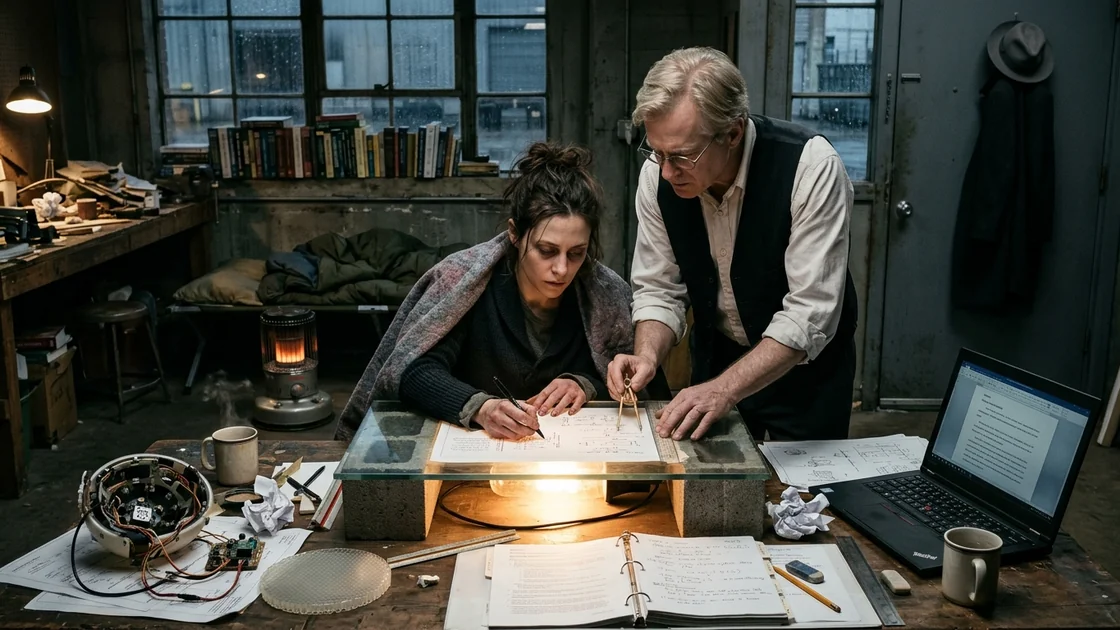
From 3:30 AM to 7:00 AM, while the sky outside slowly lightened from pitch black to a wet, dreary slate grey, Elena redrew all fourteen figures by hand on the twenty-four-pound white bond paper taped over a makeshift light box Arthur had rigged by laying a pane of salvaged window glass across two cinderblocks with a halogen work lamp underneath.
Arthur stood over her shoulder with his brass proportional divider and a metric ruler, checking every single sheet against the merciless geometry of 37 CFR 1.84.
"Your top margin on Sheet 4 is two point three centimeters, Dr. Vance; the rule requires at least two point five centimeters. Shift the template down two millimeters."
"Reference numeral 114—the diploic backscatter sensor—has a lead line that crosses the shading lines of the transducer housing at a ninety-degree angle; curve the lead line so it cannot be mistaken for a structural boundary."
"The numerals themselves must be at least zero point three two centimeters in height. Re-letter the vertical axis of Figure 11C. Make it so clear that a blind man could read it from across the room."
At 7:15 AM, Elena laid down the 0.35mm Micron pen, flexed her cramped, ink-stained fingers, and looked down at the stack of fourteen pristine, razor-sharp technical drawings—including a Figure 11C whose wave-front convergence curves were rendered in crisp cross-hatching instead of blue ink, and a flawless, hand-inked Equation 9B where every Greek lambda proudly bore its double Russian cross-tick.
"It’s done," she whispered, her head dropping onto her folded arms on the workbench. Within thirty seconds, exhausted by fever and nineteen hours of relentless mental exertion, she was fast asleep.
Arthur gently pulled the wool blanket up over her shoulders, turned the kerosene heater down to a safe low simmer, and checked his pocket watch. 7:22 AM.
She still needed to print the fifty-four-page specification, scan the drawings or carry the physical sheets directly into the Office, fill out the Application Data Sheet and the Micro-Entity Certification, and sign the Inventor’s Oath. Her printer in the corner had a dried-out ink cartridge, and she needed four hours of sleep before her fever turned into pneumonia.
More importantly, Arthur had to be at his desk in the Madison Building by 8:30 AM. Because Marcus Sterling was coming.
At 9:14 AM on Thursday morning, the double mahogany doors of Conference Room 8C in the Madison East wing swung open, and Marcus Sterling entered like a man who believed the federal government was a slightly underperforming subsidiary of his law firm.
He was forty-five, dressed in a bespoke charcoal pinstripe suit that cost more than Arthur’s car, his silver-blond hair swept back with architectural stiffness. Behind him walked two pale junior associates carrying calfskin litigation bags, and behind them came Dr. Harrison Thorne.
Arthur looked at Thorne with quiet clinical interest. The Vice President of Neuro-Vascular Systems at Vane-Keller Dynamics was a tall, patrician man in his early fifties with a manicured salt-and-pepper beard, a silk Hermes tie, and the smooth, tanned forehead of an executive who spent far more time at venture capital golf retreats in Scottsdale than in an acoustics lab.
Sitting at the head of the conference table was Arthur’s division chief, Supervisory Compliance Director Diane Holloway—a sharp, pragmatic woman who hated conflict almost as much as she hated getting calls from the Deputy Commissioner’s office before her first cup of coffee. Sitting calmly to her left, with Volume I of the MPEP and a printed security docket folder neatly aligned before him, was Arthur Pendelton.
"Director Holloway," Sterling began before he had even buttoned his suit jacket to sit down. "I want to thank you for convening this emergency supervisory review on two hours' notice, because what happened to my client’s Track One filing at 4:58 PM yesterday is nothing short of a bureaucratic catastrophe. We are seventy-two hours away from executing a four-hundred-million-dollar merger agreement whose primary escrow condition is an accorded USPTO filing date on Application 18/944,201."
"Mr. Sterling," Director Holloway said, glancing nervously at the notes in front of her, "I understand the commercial urgency, which is why I asked Senior Auditor Pendelton to join us. However, you haven't even filed a formal Petition under 37 CFR 1.53(e) yet, and—"
"I can't file an electronic petition because Mr. Pendelton locked the file inside a Pentagon submarine vault!" Sterling snapped, slapping his palm flat on the polished mahogany table. He turned his cold blue glare on Arthur. "My firm files nine hundred utility applications a year with this Office, Mr. Pendelton. When a drawing sheet suffers a minor TIFF compression artifact during upload, the Office issues a routine Notice to File Corrected Application Papers and grants the filing date. It does not strip a nine-figure medical device company of its priority date and refer a stroke helmet to the Naval Surface Warfare Center!"
Arthur folded his hands neatly on top of his MPEP binder. Despite having slept only forty minutes in his car in the basement garage while changing into a fresh white shirt he kept in his office locker, his voice was as calm, dry, and unhurried as rustling parchment.
"Good morning, Mr. Sterling. Dr. Thorne," Arthur said politely. "If we had received a minor compression artifact on an ancillary housing diagram, I would certainly have issued a routine notice under MPEP 601.01(g). Unfortunately, your specification left me no legal discretion to do so."
"That is absurd," Sterling said. "Seventy-two pages of specification and twenty claims were uploaded in full at 4:31 PM yesterday. Under In re Berkman, that is more than sufficient to establish a May 14 filing date."
"Under In re Berkman and MPEP 506," Arthur replied effortlessly, opening his binder to a flagged page, "an application is not entitled to a filing date if it omits matter that the specification itself characterizes as essential to the baseline operability and safety of the invention, such that the remaining disclosure fails to identify an operative device under 35 U.S.C. 111(a). On page twenty-three, lines fourteen through twenty-two of your own specification, you state—and I quote verbatim—that operation of the transducer array without the exact boundary constraints of Equation 9B and Figure 11C 'results in instantaneous bone heating exceeding 62 degrees Celsius and catastrophic tissue ablation.'"
Arthur slid two printed sheets across the mahogany table toward Director Holloway and Marcus Sterling.
"As you can see, Director Holloway, Equation 9B in the submitted file consists of thirty-four illegible rectangular character-encoding errors. And Figure 11C is a solid four-inch square of black ink. Without those two items, the document submitted yesterday does not disclose a medical device. By its own explicit admission, it discloses a device that cooks human brain tissue to sixty-two degrees. And because the power density claimed in Paragraph 44 exceeds three point two megawatts per square centimeter without a valid thermal damping algorithm in the record, Mandatory Directive 181-4 automatically triggered the Category IV Directed Acoustic Energy security quarantine."
Director Holloway looked down at the solid black square of Figure 11C and the string of empty boxes in Equation 9B. Her frown deepened. She looked up at Sterling. "Mr. Sterling, he’s right about the statute. Why did your associates upload a solid black square for a figure you designated as a critical safety parameter?"
One of the pale junior associates behind Sterling looked as though he wanted to sink through the carpet into the third floor.
"It was a clerical scanning conversion error during an expedited preparation," Sterling said through clenched teeth. "And as for the National Security quarantine, it’s ridiculous on its face. Dr. Harrison Thorne, the lead inventor himself, is sitting right here! We brought a clean replacement drawing and we can stipulate right now that this is a low-duty-cycle medical array so you can lift the quarantine and accord us yesterday’s May 14 filing date immediately!"
Arthur’s eyes shifted from Sterling to Dr. Harrison Thorne.
"Actually," Arthur said mildly, "that would be wonderfully helpful, Mr. Sterling. Because under MPEP 506, the only way to retain the original May 14 filing date without filing a new continuation or accepting a later date is to prove that the missing Equation 9B is inherently and unambiguously derivable by a person of skill in the art from the remaining equations already present on Page 22, so that supplying it does not constitute prohibited new matter under 35 U.S.C. 132."
Arthur stood up, walked over to the porcelain dry-erase whiteboard mounted on the conference room wall, picked up a black marker, and uncapped it.
"Since Dr. Thorne is the sole lead inventor of the mathematical architecture," Arthur said, offering the marker to Thorne with a deferential bow of his head, "and since the L&R Naval Liaison only requires verification that the diploic attenuation damping constant caps the cortical temperature below thirty-eight degrees Celsius, perhaps Dr. Thorne could simply step up to the board and write out the missing second half of Equation 9B from memory? Once I verify that the boundary terms flow inherently from Equation 9A on Page 22, I can sign the technical audit release right here in front of Director Holloway."
Silence fell over Conference Room 8C like a dropped guillotine blade.
Director Holloway nodded approvingly. "That seems very reasonable and efficient, Arthur. Dr. Thorne? If you just jot down the missing terms from Equation 9B so we can attach an Auditor’s Verification Memo to the file wrapper, I can ask the L&R division to expedite the release."
Harrison Thorne did not move.
He sat frozen in his leather chair, his manicured hands gripping the padded armrests. He looked at the black dry-erase marker in Arthur’s outstretched hand as if it were a venomous snake.
"I..." Thorne began, clearing his throat. A faint sheen of perspiration broke out just beneath his hairline. "Equation 9B is a forty-term partial differential matrix involving third-order Bessel functions and empirical bone-porosity lookup tables. I don't carry the raw alphanumeric subscripts around in my head like a parlor trick."
"Of course not, Doctor," Arthur said with gentle, devastating sympathy. "Nobody expects the empirical lookup tables. Just the general symbolic form of the complex conjugate phase-inversion operator that replaced the thirty-four corrupted boxes. Specifically, how did you resolve the shear-wave refraction divergence when the incident angle exceeds fourteen degrees across the temporal squama?"
Thorne blinked. His mouth opened slightly, then closed. He had no idea what happens at fourteen degrees across the temporal squama, because the explanation for that phenomenon was sitting on a butcher-block table on Mill Road inside a honeycomb polymer lens he had never bothered to put under a microscope.
"The... the shear-wave divergence is handled automatically by the firmware loop described in Paragraph 38," Thorne stammered, his eyes darting toward Sterling for rescue. "My computational physics team—Bradley Miller’s group—coded the sub-routines."
"Paragraph 38 only describes longitudinal time-of-flight delay," Arthur noted softly, still holding the marker out in the quiet room. "Longitudinal delay alone creates standing-wave periosteal burns at fourteen degrees. Unless you used a negative-index metamaterial waveguide or a cross-coupled Green's function tensor in Equation 9B. Which one was it, Dr. Thorne?"
Thorne’s face flushed a dark, ugly crimson. "I am the Vice President of Neuro-Vascular Systems, not a clerk taking an oral exam! I don't have to stand at a whiteboard for you!"
Marcus Sterling stood up abruptly, his sharp lawyer’s instincts realizing within three seconds that his client was about to dig a grave deep enough to bury the entire patent under an inequitable conduct charge if he spoke another sentence in front of two federal officials.
"We will not be doing informal mathematical derivations on a whiteboard," Sterling said coldly, stepping between Thorne and the table. "Clearly, the missing terms of Equation 9B cannot be summarized without referencing the complete laboratory data sets. What is the fastest procedural pathway to get the file out of the L&R vault and secure an undisputed filing date using corrected replacement papers?"
Arthur capped the dry-erase marker with a soft click and returned to his seat.
"To lift the 35 U.S.C. 181 security hold," Arthur said, looking at his watch—it was 9:42 AM on Thursday—"you must submit a physical, non-corrupted copy of Equation 9B and a clear, black-and-white line drawing of Figure 11C to the L&R Security Desk on the Concourse level, accompanied by a Petition under 37 CFR 1.53(e) accepting that the application was incomplete as filed on May 14. Once the L&R acoustic physicist verifies that the restored Equation 9B caps the thermal output within diagnostic medical limits, the quarantine will be lifted, and the application will be accorded an official filing date as of the date and hour the complete replacement specification and drawings are received."
"And how long does the L&R acoustic physicist take to sign off?" Sterling demanded.
"Given that the L&R division only processes physical vault clearances during two scheduled security windows—11:00 AM and 3:00 PM—and given that you do not currently have a clean version of Equation 9B or Figure 11C in your briefcase because you didn't realize the OCR font was corrupted until ten minutes ago," Arthur said smoothly, "if your engineers back in Reston can find the original notebooks, re-typeset the math, and redraw the blue grid paper into compliant black-and-white line art by tomorrow morning, you should be able to file your complete package during the 3:00 PM window tomorrow, Friday, May 16."
Sterling stared at Arthur for a long, silent moment. The high-priced attorney was no fool. Looking into the mild, unblinking eyes of the fifty-eight-year-old compliance auditor, Sterling suddenly sensed that the man across the table wasn't merely a pedantic bureaucrat—he was a brick wall who knew something he shouldn't know, and who had built his procedural trap out of solid titanium.
"Look very carefully at my face, Mr. Pendelton," Sterling said, his voice dropping to a low, silky threat. "If I discover that there is any irregularity, any outside interference, or any conflict of interest behind the hyper-technical scrutiny you have applied to my client's file, I will have the Inspector General dismantle your life down to the studs."
"I have lived in the same split-level house in Annandale since 1996, Mr. Sterling," Arthur replied serenely, closing his MPEP binder. "My finances consist of a Thrift Savings Plan and a checking account at the Patent and Trademark Office Federal Credit Union. You are welcome to audit them at your leisure. Just make sure that when you return tomorrow afternoon with Figure 11C, your top margin is at least two point five centimeters."
Thursday afternoon and Thursday night passed in a blur of quiet, agonizing tension.
Arthur remained at his desk in the Madison Building until 5:00 PM, completing thirty-four routine compliance audits with his customary flawlessness so that nothing in his productivity metrics appeared unusual. At 2:15 PM, his internal system log showed that Marcus Sterling’s law firm had filed an emergency Freedom of Information and status query with the L&R Division, trying to go around him through the Defense Liaison, only to be rebuffed by a retired Navy captain who didn't care how much Vane-Keller’s merger was worth and refused to release an un-audited Category IV file without the complete thermal dampening equations.
That bought them Thursday night.
At 6:00 PM, Arthur drove back to the industrial docks, stopping at an office supply superstore in Potomac Yard to buy a portable flatbed scanner and two fresh black ink cartridges that fit Elena’s ancient printer.
When he climbed the iron stairs to Rear Bay 3, Elena was awake, her fever broken, drinking vegetable broth and reviewing the final claim dependencies on the ThinkPad. She looked pale and hollow-eyed, but her hands were steady.
For four hours on Thursday evening, they printed the fifty-four-page specification, scanned the fourteen hand-inked drawing sheets at 600 DPI—checking every single pixel at four hundred percent zoom to ensure not a single line was broken or smudged—and compiled the Application Data Sheet, the Micro-Entity Gross Income Certification, the Inventor’s Oath under 37 CFR 1.63, and a Petition to Make Special for Age and Enhancement of Public Health.
"Tomorrow morning," Arthur said as he packed his scanner back into its box at 10:30 PM, "do not try to upload this from a coffee shop Wi-Fi network. If a packet drops or the PDF renderer corrupts a font, you lose everything. Come directly to the USPTO campus at 1:00 PM. Go to the Cashier's Window on the first floor of the Randolph Building to deposit your three hundred and twenty dollars in cash onto an instant Fee Deposit Receipt, then walk fifty yards across the courtyard to the Public Search Facility in the Madison Building. Log into Terminal 4—it’s a direct gigabit hardline straight into the Patent Center ingestion server—and upload the PDF packages directly. Once you hit submit, the timestamp is instantaneous."
"Why 1:00 PM?" Elena asked, carefully placing both the USB flash drive and the physical paper backup copies into a brand-new waterproof rigid document tube Arthur had bought for her. "Why not 8:30 AM when the doors open?"
"Because at 8:30 AM, Marcus Sterling and Harrison Thorne are going to be standing in the lobby of the Madison Building waiting to ambush the L&R Security Director," Arthur said grimly. "If Harrison Thorne sees you walking through the security turnstiles of the Patent Office with a drawing tube under your arm, he will know immediately what is happening. His lawyers will call a state court judge in Fairfax County and get an ex-parte Temporary Restraining Order claiming you are about to disclose stolen corporate trade secrets, and send a federal marshal to tackle you before you reach the terminal."
Elena’s breath caught. "Can they do that?"
"With enough billable hours, a corporate law firm can get a temporary twenty-four-hour injunction on a ham sandwich before the judge reads the exhibits," Arthur said. "Thorne and Sterling have their L&R security window scheduled for 3:00 PM in the Madison Concourse. Between 12:30 PM and 2:00 PM, Sterling always goes back to the Ritz-Carlton in Pentagon City for lunch with his clients. Come in through the Randolph Building entrance on Ballenger Avenue at 1:30 PM, pay the cashier, cross through the interior pedestrian tunnel to the Madison Search Room, and file at 2:00 PM. You will never cross paths with them."
Elena looked at the older man standing by the door in his damp raincoat. Impulsively, she stepped forward and took his hand in both of hers. Her palms were rough from resin and ink, warm with life.
"Whatever happens tomorrow, Arthur," she said softly, "you gave me back my dignity."
Arthur looked down at their joined hands, cleared his throat awkwardly, and patted her wrist gently. "Get eight hours of sleep, Dr. Vance. And bring two forms of government photo identification for the guards."
Friday, May 16, dawned crisp, bright, and washed clean by two days of rain. The glass towers of the USPTO campus gleamed like cut crystal against a pale Virginia sky.
At 10:45 AM, Arthur’s office phone rang. It was Keith Miller, the civilian physicist down in the L&R Classified Vault.
"Arthur," Keith said over the secure internal line, "Sterling, Kross & Vance just dropped off a courier package at the security window for Serial No. 18/944,201. Apparently, they had three optical engineers and two mathematicians locked in a room in Reston all night digging through raw lab scans. They finally re-typeset Equation 9B and redrew Figure 11C."
Arthur’s chest tightened. "At 10:45? I thought they wouldn't have it ready until the 3:00 PM window."
"Sterling paid a specialized litigation graphics firm fifty grand to hand-trace the blue grid plots overnight," Keith said, sounding faintly impressed. "They missed the 11:00 AM cutoff by three minutes because the courier got stuck behind a jackknifed tractor-trailer on I-395, so I told them the clearance review goes into the 3:00 PM batch. Honestly, Arthur, the restored Equation 9B looks clean—it caps the spatial-peak temporal-average intensity well below the weaponized cavitation threshold. I’m going to sign the security release at 3:00 PM, which means the file bounces back to your compliance queue at 3:05 PM for final filing-date assignment."
"Understood," Arthur said calmly. "Thank you, Keith. Send it up at 3:05."
Arthur hung up the phone. His palms were slightly damp. He wiped them on his handkerchief.
Vane-Keller’s cured application package was already in the building. It was sitting in the L&R inbox downstairs, waiting for the 3:00 PM security sign-off. The moment Keith signed the release and transmitted the cured replacement specification back to the main server at 3:05 PM, Vane-Keller’s application would be legally complete as of that exact timestamp.
Elena had to file before 3:00 PM.
At 1:30 PM, Arthur took the elevator down to the first floor of the Madison Building and walked into the Public Search Facility to cover a colleague’s lunch break at the reference desk. From his elevated wooden podium, he had a clear view of the security turnstiles, the row of high-speed public filing terminals, and the glass corridor leading from the Randolph Building where the Cashier’s Window was located.
1:45 PM. No sign of Elena.
2:00 PM. The big IBM wall clock clicked forward with a soft mechanical thud. Still nothing.
Arthur’s heart began to beat a slow, heavy rhythm against his ribs. Where was she? Had the fever returned? Had her friend’s borrowed pickup truck broken down on Route 1? Had Vane-Keller’s private investigators been watching the workshop on Mill Road?
2:12 PM.
At 2:14 PM, the interior glass doors from the Randolph Building corridor swung open, and Elena Vance walked through.
She wasn't wearing her frayed raincoat with the coaxial cable belt. She had borrowed a clean, slightly oversized navy-blue blazer over a white blouse, her dark hair pulled back in a neat low knot. Under her left arm she carried the black waterproof document tube; in her right hand she clutched a yellow stamped Cashier’s Deposit Receipt for $320.00.
"Sorry," she breathed as she reached the reference desk, her cheeks pink from running the last two blocks from the bus stop on King Street. "The pawnshop gave me three crisp hundred-dollar bills yesterday, and the cashier in the Randolph Building spent twenty minutes testing one of the hundreds with three different counterfeit pens because it was a 1996 series bill."
"Do not apologize," Arthur said briskly, gesturing toward the computer bank twenty feet away. "Terminal 4 is open. Log in as a Registered Guest Applicant, upload the five PDF files in the exact order we practiced, attach the Cashier’s Deposit Receipt number in the fee token field, and execute the electronic signature."
Elena hurried to Terminal 4, sat down, and plugged the USB flash drive into the tower.
Arthur stayed at the reference podium, watching the reflection of her monitor in the glass partition behind her while keeping one eye on the main building lobby outside.
On her screen, the Patent Center interface loaded:
SPECIFICATION_VANCE_FINAL.PDF — Uploaded (100%) — 0
Warnings, 0 Errors.
DRAWINGS_SHEETS_1_TO_14.PDF — Uploaded (100%) — 600 DPI
Validated.
ADS_AND_MICRO_ENTITY_CERT.PDF — Uploaded
(100%).
DECLARATION_OATH_1_63.PDF — Uploaded (100%).
2:26 PM.
Just as Elena reached for the mouse to enter the nineteen-digit Cashier’s Fee Token, Arthur looked out through the glass walls into the main marble atrium of the Madison Building—and froze.
Walking across the atrium toward the Concourse escalators thirty minutes early for their 3:00 PM L&R clearance window were Marcus Sterling, his two associates, and Dr. Harrison Thorne.
And then Harrison Thorne stopped beside the bronze bust of Thomas Jefferson to check his wristwatch, turned his head forty-five degrees to the left, and looked straight through the glass wall of the Public Search Facility.
Even from sixty feet away, Arthur saw the exact instant Thorne’s eyes locked onto the back of Elena Vance’s dark head at Terminal 4, and the black engineering document tube resting on the floor beside her chair.
Thorne’s jaw dropped. He grabbed Marcus Sterling violently by the sleeve of his pinstripe coat and pointed straight through the glass into the Search Room.
Sterling spun around. His eyes narrowed to razor slits as he saw Elena sitting at a federal filing terminal, and then his gaze traveled twenty feet to the right and landed on Senior Compliance Auditor Arthur Pendelton standing behind the reference podium.
In a single, blinding flash of comprehension, Marcus Sterling understood the entire forty-eight hours.
"Stop her!" Thorne shouted, his voice echoing across the marble lobby as both men bolted toward the Search Facility entrance turnstiles. "She has proprietary Vane-Keller data on that drive! Security! Stop that woman!"
Inside the Search Room, Elena looked up in alarm at the shouting outside the glass. Her hand froze on the mouse over the fee validation screen.
"Do not look at them!" Arthur’s voice rang out across the quiet Search Room with the commanding authority of a drill sergeant. "Type the nineteen digits of the receipt number, Dr. Vance! Type them right now!"
Outside the glass, Sterling and Thorne reached the Search Facility turnstiles, where a burly contract security officer stepped into their path, holding up a hand. "Whoa, gentlemen—visitor badges and sign-in required for the Search Room!"
"Out of my way!" Sterling roared, shoving his gold bar association card into the guard’s face. "That woman at Terminal 4 is committing industrial espionage in real time! Unplug that terminal!"
Arthur stepped out from behind the reference podium, walked purposefully across the carpet to the inner side of the security turnstiles, and pressed the magnetic emergency lock button on the guard console—a switch designed to seal the glass gates during unruly applicant disturbances. The heavy waist-high glass barriers locked shut with a pneumatic hiss just as Thorne slammed his hands against them.
"Mr. Pendelton!" Sterling shouted over the barrier, his face purple with fury. "Open this gate immediately or I will have you arrested for obstruction and conspiracy!"
"I am sorry, Mr. Sterling," Arthur said calmly, standing two feet behind the locked glass with his hands clasped behind his back, blocking their path into the room. "Under Public Facility Regulation 4.2, loud or disruptive behavior in the Search Room requires an immediate security pause until the Building Marshal arrives. Please lower your voice; researchers are working."
Behind him at Terminal 4, Elena’s fingers trembled as she typed the
final four digits of the cashier receipt: ...8-8-4-1.
She typed her forward-slash electronic signature:
/Elena Vance/.
"Elena!" Thorne screamed across the room, straining over the glass barrier. "If you hit that button, my lawyers will have you in a federal cell before dinner! You signed an employment agreement! Everything in your head belongs to Vane-Keller!"
Elena paused for half a second. She turned her head and looked at Harrison Thorne—the man who had stolen her life’s work, locked her out in the cold, and didn't even know why her acoustic lens bent sound at fourteen degrees.
Then she looked at Arthur Pendelton, who gave her a single, fractional nod.
Elena turned back to the screen and clicked SUBMIT & ACCORD FILING DATE.
For three seconds, the progress wheel spun on the monitor. The gigabit fiber line beneath the floor hummed. Deep in the climate-controlled server vaults of the Madison Building, the ingestion algorithm checked the fifty-four pages, verified the 600 DPI black-and-white drawings, confirmed the presence of Equation 9B and Figure 11C, verified the $320.00 fee token, and struck the electronic gavel.
The laser printer beside Terminal 4 whirred to life and spat out a single, warm sheet of bond paper stamped with the seal of the United States Patent and Trademark Office.
OFFICIAL ELECTRONIC ACKNOWLEDGMENT AND FILING
RECEIPT
APPLICATION NO.: 18/948,009
INVENTOR / APPLICANT: VANCE, ELENA R.
TITLE: TRANSCRANIAL PHASE-INVERTED ACOUSTIC
METAMATERIAL ARRAY AND NEGATIVE-INDEX WAVEGUIDE FOR NON-THERMAL
SONOTHROMBOLYSIS
FILING DATE: MAY 16 — 14:28:11
EST
STATUS: COMPLETE UNDER 35 U.S.C. 111(a) — ACCORDED
PRIORITY.
Elena picked up the paper, pulled her USB drive from the terminal, and stood up.
Arthur reached down and pressed the green release button on the console. The glass turnstiles clicked open.
Marcus Sterling didn't even step through. He stood utterly motionless on the marble floor outside the gate, staring at the official USPTO receipt in Elena Vance’s hand. He looked down at his gold Patek Philippe wristwatch.
It was 2:28 PM.
Thirty-seven minutes later, at 3:05 PM, Keith Miller down in the L&R Vault signed the routine security release on Vane-Keller’s cured replacement drawings and transmitted Serial No. 18/944,201 back up to Arthur’s compliance queue. At 3:06 PM, sitting back at his fourth-floor desk, Arthur dutifully clicked the green VALIDATE & ACCORD FILING DATE button, legally fixing Vane-Keller’s official filing date under 37 CFR 1.53(e) as Friday, May 16, at 15:05:44 EST.
Thirty-seven minutes too late.
A week later, on a warm Friday evening, Arthur Pendelton walked out the front doors of the Madison Building with his umbrella tucked neatly under his arm.
Marcus Sterling had, of course, tried to mount an administrative offensive on Monday morning, threatening petitions to the Director and whispering about internal investigations. The offensive had lasted approximately four hours—until the general counsel of Medtronic, the multinational giant acquiring Vane-Keller, conducted their final pre-closing IP due diligence check and discovered two devastating facts.
First, Dr. Elena Vance had called Medtronic’s Chief Scientific Officer directly on Monday morning and faxed him a copy of her stamped May 16, 14:28 EST Filing Receipt, along with her signed Vane-Keller employment contract showing the phase-inversion architecture explicitly listed as an excluded prior invention on Schedule B, and the Alexandria Police report documenting the Saturday night burglary of her laboratory notebooks four days before Vane-Keller’s aborted Wednesday filing.
Second, when Medtronic’s own acoustic engineers demanded that Harrison Thorne demonstrate the Vane-Keller prototype using a newly manufactured silicone coupler instead of the three stolen polymer lenses from Elena’s locker, the acoustic beam fractured into three useless grating lobes and burned a hole straight through a synthetic skull phantom in twelve seconds.
By Wednesday afternoon, Medtronic had terminated the Vane-Keller acquisition for material misrepresentation of intellectual property, Harrison Thorne had been placed on indefinite administrative leave pending a board fraud inquiry, and Medtronic’s venture arm had offered Elena Vance an eight-million-dollar non-exclusive licensing advance and a dedicated neuro-acoustics laboratory in Bethesda to bring the helmet to human clinical trials by autumn—with full title to Patent Application 18/948,009 remaining solely in her name.
As for Arthur, Director Holloway had called him into her office on Thursday afternoon, looked at him over her reading glasses for a full minute, and slid a routine transfer order across her desk, returning him from his rotational compliance detail back to his quiet home in Art Unit 3770.
"Sterling dropped his administrative complaint an hour ago," Director Holloway had said dryly. "Apparently, his client suddenly decided they had no desire to put Dr. Harrison Thorne under oath in front of the Patent Trial and Appeal Board to explain why his stolen drawings had solid black squares in them. Go back to examining ultrasound catheters, Arthur. My blood pressure cannot survive another week of you enforcing the MPEP."
Now, standing at the top of the wide granite steps overlooking Dulany Street, Arthur paused to put on his grey fedora.
Down at the bottom of the steps, leaning against a lamppost in the golden late-afternoon sunlight, stood Elena Vance. She was wearing a new trench coat—one with all its buttons intact—and holding a small, flat package wrapped in brown butcher paper.
Arthur walked down the steps and stopped beside her. "Dr. Vance. I trust you aren't here to file a continuation-in-part at 4:58 PM?"
She smiled, and without the hollow shadows of exhaustion and terror, her face looked ten years younger. "No. The lawyers are handling the foreign PCT filings now. I just wanted to give you this before I moved my equipment up to the new lab in Bethesda."
She handed him the flat package. Arthur untied the twine and folded back the brown paper.
Inside, mounted in a simple frame of dark walnut, was the original hand-inked sheet of Figure 11C—the wave-front convergence map that showed sound waves bending gently through the dense bone of the human skull to meet at the basilar artery without harming a single cell around it. Down in the bottom corner, beside Equation 9B, every Greek lambda stood tall and sharp with its double cross-tick, and beneath the scale bar, she had written in tiny, ruler-straight architectural lettering:
Dedicated to Clara Pendelton, and to the promotion of the useful Arts.
Arthur looked down at the drawing for a long time. The late afternoon breeze stirred the sycamore trees along the boulevard, carrying the scent of the river and the coming summer. He touched the glass lightly with his thumb, right over the focal point where the clot dissolved.
"Your top margin is still two millimeters proud, Dr. Vance," Arthur murmured, his voice thick as he tucked the frame carefully under his arm. "Fortunately for you, it is no longer under my jurisdiction."
He tipped his hat to the inventor, turned down the sidewalk toward the metro station, and walked home in the clear light.