The Flaw in the Autumn Wind
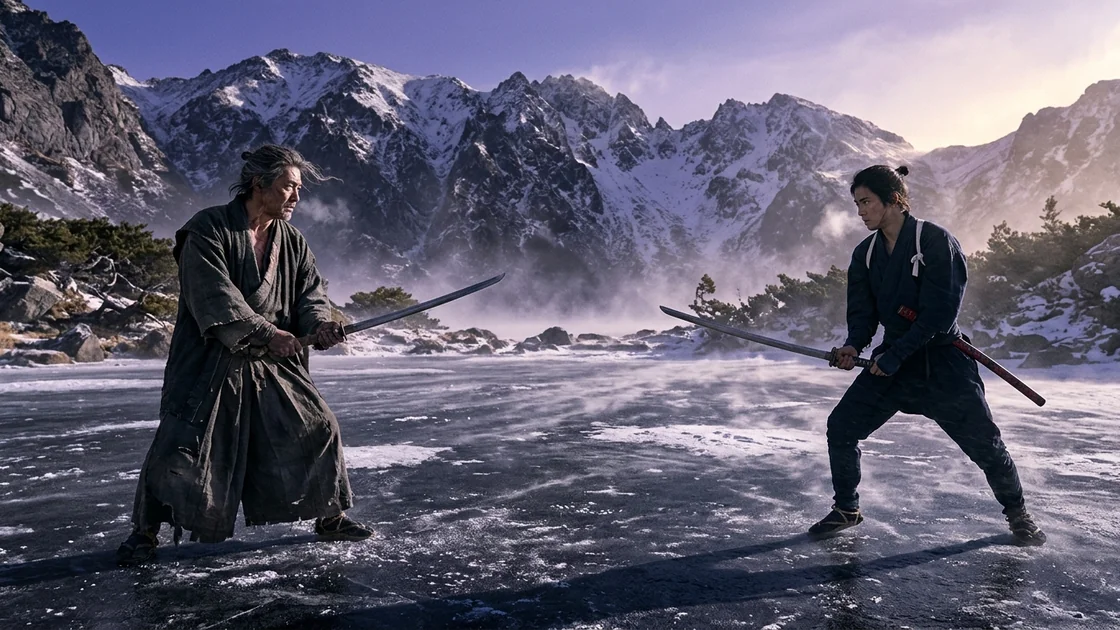
Kuroda Jin, once the celebrated sword master of the Asano clan, lives as a nameless woodcutter in the frozen northern mountains after being framed for treason by his jealous rival, Saito Masaru, whom Jin killed in secret before fleeing into exile. When a violent blizzard brings Masaru’s orphaned twelve-year-old son, Hideo, to Jin’s isolated cabin seeking a master to train him so he can hunt down his father’s killer, Jin recognizes the boy and conceives a cold, patient vengeance against his dead enemy’s bloodline. Keeping his true identity hidden, Jin spends the next eight years raising and training the boy in a counterfeit sword style specifically engineered with a hidden biomechanical flaw that grants blinding offensive speed against ordinary opponents while leaving a fatal opening for a master who knows the secret. As the seasons pass and the boy grows into a formidable young warrior of earnest honor and fierce loyalty, Jin finds his hatred complicated by an unspoken paternal bond, even as both men march toward the inevitable day when the truth will be revealed and the flawed technique will be tested in a duel to the death.
The snow in the Hida mountains did not fall; it hunted. It drove sideways through the black ribs of the cedar forests, scouring the bark from the windward side of the trunks and burying the charcoal kilns along the upper ridge beneath six feet of dry, squeaking powder. In the seventh year of the Horeki era, the storm began on the fourth day of the eleventh month and did not draw breath until the twelfth.
Kuroda Jin sat cross-legged beside the sunken hearth of his hut, drawing a block of pale gray whetstone along the curve of a billhook. The iron was cheap, smelted from river sand by the village smith down in Kurobe, full of slag blisters and soft spots that turned whenever he struck a frozen knot of pine. Yet Jin maintained the tool with the same ritual precision he had once lavished upon blades forged by the Bizen masters. Four strokes from heel to point on the coarse stone. Four strokes on the fine grain. A wipe with a rag soaked in rendered boar fat to keep the mountain damp from pitting the metal.
His hands were forty-four years old, though the knuckles looked sixty, thickened by frostbite and the heavy recoil of splitting mauls. Across the base of his right thumb ran a pale, raised ridge of scar tissue where a guard had shattered thirty-two months ago—no, thirty-eight months now—on the night he lost his name. A second scar, far deeper, began below his left ear, vanished beneath the frayed hemp collar of his robe, and terminated just above his breastbone. In the bitter cold, that deeper scar ached with a dull, rhythmic throb, like a second heart beating out of time with the first.
Outside, the wind tore at the thatch. A shutter rattled against its wooden peg.
Then came another sound, distinct from the gale. It was the heavy, sodden thud of deadweight striking the cedar-plank door, followed by a metallic scrape that set Jin’s teeth on edge. That was not an icicle falling from the eaves. That was the bronze ferrule of a scabbard dragging across timber.
Jin did not blow out the tallow lamp. A man who extinguished his light when footsteps approached his door in the middle of a blizzard was a man with a price on his head; a simple woodcutter named Genji would only wonder which of his neighbors had lost their way between the valley shrines. Even so, as Jin rose from the straw mat, his right hand abandoned the billhook and slid beneath a pile of dried bracken near the woodbox, where three feet of unmounted, oil-wrapped steel lay hidden inside a hollowed log of chestnut.
He paused two paces from the entrance, shifting his weight onto the balls of his feet, his heels barely kissing the floorboards.
"The latch is frozen from the outside," Jin called out, pitching his voice into the flat, nasal drawl of the northern river valleys. "Step back from the threshold."
Nothing answered save the shriek of wind funneled through the ravine.
Jin lifted the heavy oak bar with his left hand and kicked the lower frame. The door swung inward, shearing through a drift that immediately spilled across the packed-earth entryway in a crumbling white wave. Face-down in the snow lay a bundle of stiff straw matting tied with hemp cord. Protruding from the bottom of the bundle were two small feet wrapped in rags that had frozen solid and split open, staining the snow beneath them the color of diluted plum wine.
It was a boy. Not a man, and not an assassin from the Omi magistracy.
Jin frowned, reaching down to hook his fingers into the back of the boy’s stiffened straw raincoat. He dragged the body inside as easily as he might haul a calf killed by wolves, kicked the door shut against the storm, and dropped the oak bar back into its iron brackets.
When he rolled the boy onto his back beside the hearth, the straw cape cracked like dry reeds. The child could not have been more than twelve winters old. His cheeks were hollowed by starvation, the skin stretched tight and waxy over high, narrow cheekbones, mottled with the gray-white patches of early frostbite. Around his waist, tied over a filthy indigo tunic with a length of frayed silk cord that had once belonged to a courtier’s surcoat, were two swords.
The long sword was nothing—a battered, munition-grade blade in a chipped black lacquer sheath, the sort of crude iron scavenged from dead foot soldiers after a border skirmish.
The short sword made the breath stop in Jin’s throat.
Its scabbard was lacquered in the pattern of crushed abalone shell suspended in dark red amber, though half the finish had been scraped away by rocks and briars. The round iron guard was cast in the likeness of two cranes locked in a circle, their beaks meeting around the tang opening. The braid on the hilt was faded willow-green silk over black rayskin, and tucked beneath the wrapping were two small gold menuki shaped like ginger shoots.
The ginger shoots of the Saito house.
And the blade inside that red-and-abalone sheath was Kogarashi—the Winter Wind—forged by Rai Kunitsugu in the old capital two hundred years ago. Jin knew the weight of that short sword to the fraction of an ounce. He knew the tiny nick three inches below the temper line where it had once parried a halberd during the peasant uprising at Yawata. He knew it because, three years ago in the garden of the Asano residence, while the plum blossoms were drowning in spring rain, Saito Masaru had drawn that very blade with his left hand after his long sword had been knocked into the mud, lunging upward in a desperate, treacherous thrust that had laid open Jin’s neck from ear to collarbone.
Seconds later, Jin’s downward cut had cleaved Masaru’s right shoulder through to the lung.
Jin knelt over the unconscious child. Slowly, with fingers that did not tremble, he untied the frozen knot of the boy’s straw hat and pushed it back from his brow.
There was Masaru’s narrow chin. There was the slight, arrogant hook at the bridge of the nose, and the wide-set eyebrows that tapered like brushstrokes at the temples. Even unconscious, half-dead of exposure, the boy’s face carried the unmistakable stamp of the man who had forged the letters bearing Jin’s seal, planted the bags of Tokugawa silver beneath the floorboards of Jin’s armory, and stood beside Lord Asano with weeping eyes to denounce his oldest friend as a spy.
He had a son, Jin thought, the hearth fire reflecting in his dark, unblinking eyes. Yes. The boy would have been nine when I left Omi. His mother died of the red smallpox the summer before.
The boy’s eyelids fluttered. His lips, cracked and blackened by the wind, parted in a shallow gasp. One small, frost-blistered hand twitched toward the willow-green hilt of the short sword, his fingers curling around the braid even before his mind had climbed out of the dark.
Jin looked from those curled fingers to the iron billhook lying beside the whetstone.
A single blow would finish what he had begun in the plum garden three years ago. Nobody in Kurobe village knew the boy had climbed the mountain path. In four months, when the snows melted along the high pass, the crows and the mountain foxes would leave nothing behind but a scattering of small bones and a pair of rusted scabbards among the granite boulders. The Saito line would be extinguished root and branch. The debt would be closed.
Jin reached out and picked up the billhook. The oiled steel caught the orange glow of the charcoals. He rested the flat of the heavy blade against the side of the boy’s neck, right over the faint, fluttering pulse of the carotid artery.
The boy shivered violent, full-body spasms as the heat of the fire began to reach his core. His eyes opened. They were dark, fever-bright, and entirely blind with delirium.
"Father," the boy whispered, his voice like dry leaves scraping across stone. Then his brow furrowed in fierce, childish anguish. "No. Not yet. I haven't... I haven't found him yet. Kuroda Jin is still alive."
Jin’s hand stayed motionless. The cold iron of the billhook warmed against the boy’s fevered skin.
"I will learn the sword," the boy murmured to the soot-blackened rafters, his teeth chattering so hard he bit his own lip, drawing a bead of bright scarlet. "I will learn the secret cut. I will take his head to the temple at Hikone. I swear it... on the ginger crest..."
The boy’s head lolled sideways, his consciousness guttering out once more into fevered exhaustion.
Slowly, Jin drew the billhook back. He looked at this small, starving creature who had dragged himself through an impassable northern gale, kept alive solely by a child’s burning, ignorant devotion to a dead liar. If Jin cut his throat tonight, the boy would die without ever knowing what his father truly was, and without ever tasting the terror of absolute defeat. Death in sleep was a mercy reserved for cattle and old hounds.
Masaru had taken Jin’s name, his school, his honor, and thirty years of service, turning him into a shadow that jumped at the snap of a frozen twig. Masaru had died too quickly in the mud of the plum garden—four heartbeats of drowning in his own blood before the dark took him. He had died believing his son would one day inherit the Saito estate and the proud legend of a martyred father.
What if the son lived?
What if the son grew strong, tall, and proud under the hand of the very ghost he hunted? What if every drop of sweat he shed, every callus he raised on his palms, every prayer he whispered to his father’s tablet was spent mastering a sword technique that was nothing more than an elaborate, invisible noose?
A man who dies in a blizzard is merely unfortunate. A warrior who spends ten years perfecting a blade, only to discover at the moment of his sacred vengeance that his own master is his quarry, and that his own muscles have been trained to betray him—that was a ruin worthy of Saito Masaru’s blood.
Jin set the billhook down beside the hearth. He rose, fetched a wooden bucket of snow from the entryway, and knelt to begin rubbing the frostbite from the boy’s bleeding feet.
For six days the boy burned with mountain fever, thrashing upon the pile of dried bracken while Jin spooned broth made from dried char and wild burdock root between his teeth. On the seventh morning, the wind finally died, leaving the world outside wrapped in a silence so vast and brittle it seemed a loud word might bring the snow-laden pines crashing down upon the roof.
When Jin came inside carrying an armload of split birch, the boy was sitting upright.
He had dragged himself into the corner farthest from the door, his back pressed against the rough mud-and-wattle wall. His hands were wrapped around the hilt of the cheap long sword, which lay naked across his knees. The boy was so weak the point of the blade dipped and wavered like a dowsing rod, yet his dark eyes were fixed on Jin’s throat with the flat, unblinking hostility of a cornered weasel.
Jin ignored him. He knelt by the hearth, dumped the birch logs onto the boards, and blew on the banked embers until a curl of yellow flame licked at the bark.
"Put that piece of pig-iron away before you cut your own toes off," Jin said without turning around. "If I wanted your skin, I would have nailed it to the shed door a week ago. You ate three bowls of my millet and half a jar of salted plums while you were raving. You owe me four days of wood-splitting before we are even."
"Where is my short sword?" the boy demanded. His voice was hoarse, cracking in the middle, though he tried desperately to pitched it into the stern, commanding register of a retainers' hall.
Jin reached behind the water jar and tossed the red-and-abalone scabbard across the mats. It landed with a dull clatter an inch from the boy’s bare knees.
"Right there," Jin said, setting a kettle of snow over the tripod. "Though why a beggar brat carries a Rai blade worth forty koku of rice while wearing rags that wouldn't keep the wind off a scarecrow is none of my business. Unless you stole it from a dead lord along the post road."
Color flared in the boy’s gaunt cheeks. He snatched the short sword up with his left hand and hugged it to his chest. "I am not a thief! And I am no beggar! I am Saito Hideo, eldest son and heir of Saito Masaru, inspector of the guard for the Asano domain of Omi!"
Jin picked up a wooden ladle, examining a crack in its bowl. "Omi is two hundred miles south. And if your father is such a grand man, why didn't he send four spearmen and a pack-horse with you instead of letting you freeze to death on my porch?"
The boy’s jaw tightened. The pride in his face flickered, replaced by a raw, open grief that made him look younger than twelve. "My father is dead. He was murdered by a traitor three years ago. And when the traitor fled, my father’s enemies in the council claimed my father had been negligent in allowing the spy to escape. They stripped our house of its stipend. They took our residence in the castle town. My uncle took me to the countryside, and last autumn he died of the flux."
So, Jin thought, staring into the melting snow inside the iron kettle. Even after Masaru framed me, Lord Asano suspected enough foul play to punish the Saito house once Masaru wasn't alive to spin his lies. Poetic. Neither of us won the game.
"A sad tale," Jin said flatly. "Tell it to the priest down in Kurobe when the pass clears in April. Maybe he will let you sweep the temple steps for rice crusts."
"I did not come here for a priest," Hideo said. He lowered the cheap long sword and planted his fists on his knees, bowing his head until his forehead touched the frayed straw mat. "I came looking for the hermit of Mount Norikura. The charcoal burners in the lower valley said there is an old swordsman living alone above the timberline—a man who killed three mountain bandits with a carrying-pole four winters ago. That is you. You are the man they call Genji."
"The charcoal burners drink fermented millet until they see river-demons in their soup," Jin replied. "I am a woodcutter. Those bandits were drunk and slipped on the ice."
"Look at your hands," Hideo said, lifting his head just enough to stare at Jin’s grip on the ladle. "My father taught me how to recognize a swordsman before he died. A farmer’s calluses are across the palm and the inside of the fingers. Yours are thick at the base of the little finger and the heel of the left hand, from wringing the hilt of a sword. And when you walked through that door carrying firewood, your head did not bob up and down. Your hips stayed level, as if you were sliding across polished cypress boards."
Jin turned his head slowly, meeting the boy’s gaze. Hideo did not flinch, though his small shoulders were trembling under the thin indigo tunic from the effort of holding himself steady.
There was intelligence in the boy. Masaru’s cunning, perhaps, though stripped of the elder man’s oily court politeness.
"Suppose I knew which end of a sword to hold," Jin said softly. "What is that to a starved whelp from Omi?"
"Teach me," Hideo said, pressing his forehead back to the mat. "I have this short sword. Sell it if you must, to pay for my food and my training! Keep the gold fittings! Keep the scabbard! Only leave me the bare blade so that when I am grown, I can take it back to Omi and drive it through the heart of Kuroda Jin!"
The kettle began to hiss as the bottom water boiled before the ice on top had fully melted. The sound filled the small room like the breathing of a snake.
Jin looked down at the crown of the boy’s head, at the messy, unwashed black hair tied back with a piece of twisted straw.
"This Kuroda Jin," the woodcutter said, his voice dropping an octave. "If he killed your father, who was inspector of the guard, he must be a devil with a blade."
"He was the domain’s master-at-arms," Hideo said into the mat, his fists clenching until the knuckles turned white. "He taught the Suigetsu-ryu—the Water-Moon style. My father was his senior disciple before he uncovered Jin’s treason. The retainers said no man in the five provinces could match Jin’s drawing cut, the Tsuki-kage. They said his blade moves like light on broken water—you do not see the steel until your head is already on the ground."
"Then you are a fool," Jin said. "If he is the master of the Suigetsu-ryu, and he is already a grown man in his prime, how do you expect to beat him by learning from a broken-down hermit in the mountains?"
"Because a traitor’s heart is rotten!" Hideo cried, his head snapping up, tears of rage and weakness springing to his dark eyes. "My father told me that true swordsmanship comes from righteousness! A man who murders his brother-in-arms in the dark and sells his lord for silver cannot hold the Mandate of Heaven! Even if it takes me ten years, even if I have to chew bark and sleep in the snow, I will find a way through his guard!"
Jin stared at the boy for a long time.
Righteousness, Jin thought. Masaru sat with this boy on his knee in the evenings and spoke of righteousness, while the ink was still wet on the forged letters in his sleeve. The sheer obscenity of it made a dry, silent laugh rise in Jin’s chest, tasting of old copper and ash.
"Keep your short sword," Jin said, turning back to the fire and tossing a handful of dried pine needles into the boiling water. "If I went down to the valley trying to peddle a Rai blade, the bailiff would have me in wooden stocks before noon. A weapon like that belongs to your bloodline. In fact, you will wear it at your belt every day until the day you use it."
Hideo’s breath caught. "Then... you will teach me?"
"I will work you until your hands bleed into your millet bowl," Jin said, pouring the pale pine-needle tea into two cracked clay cups. "You will haul water from the gorge. You will split two cords of oak every week. You will tend the charcoal pits when the smoke is so thick it makes you vomit black phlegm. And for two hours at dawn, and two hours at dusk, I will beat you with a stick of seasoned white oak until I have knocked every drop of your father’s pretty court theories out of your skull."
Jin picked up one of the steaming cups and held it out toward the corner.
"The style I know has no fancy name like Water-Moon," Jin lied smoothly, watching the steam curl between their faces. "In these mountains we call it Kaze-ori-ryu—the Style of the Broken Wind. It was made for killing men who are faster, older, and better fed than you. Come and drink your tea, Saito Hideo. Tomorrow morning, we begin."
The construction of a flaw in a swordsman is no different from the construction of a flaw in a castle wall. If the mason leaves a gaping hole in the granite, any passing fool will see it and shore it up with timber. Instead, the mason must lay a cornerstone that looks thicker and heavier than all the others, yet sits upon a pocket of wet clay six feet beneath the turf, angled five degrees inward so that the very weight of the keep above it slowly, inevitably, drives the wall toward collapse when the battering ram strikes the one true spot.
Jin spent the rest of that winter watching the boy move before he ever allowed him to touch a wooden sword.
As Hideo carried buckets of water up the icy switchbacks from the frozen river, or swung the heavy iron maul to split birch logs, Jin studied the geometry of his bones. The boy had inherited Masaru’s long forearms and narrow hips, which gave him natural whip-like speed in the upper body, but alsoMasaru’s slight tendency to carry his weight too high in the shoulders when he was angry or tired.
When the snow began to rot and slump in the third month, dripping from the eaves in a constant, rhythmic patter that turned the clearing before the hut into a soup of black mud and pine needles, Jin carved two bokuto from the heartwood of a lightning-struck hornbeam tree.
He made the boy’s wooden sword three inches longer than standard measure for his height, and shaved the belly of the blade slightly thinner toward the tip, while leaving the hilt thick and heavy.
"Why is the balance so far back, Master Genji?" Hideo asked on that first raw morning, standing barefoot in the half-frozen mud while the mist coiled through the ravine below them.
"Because the man you want to kill uses the Suigetsu-ryu," Jin said, leaning on his own heavy wooden staff. "Do you know anything of that school?"
"Only what I saw in the courtyard when I was small," Hideo said, shivering in his thin tunic. "They fight from the middle guard, with the tip aimed at the enemy’s left eye, waiting for the opponent to commit before flowing around the blade like water."
"Correct," Jin said, feeling a strange, cold satisfaction at describing his own life’s work as if it belonged to a stranger. "The Water-Moon style relies on ma-ai—the mastery of the combative interval. A master of that school knows the exact length of a standard three-shaku blade to the width of a barleycorn. He will stand half an inch outside your reach, let your cut whistle past his nose, and take your wrists off before your sword finishes its arc."
Jin stepped forward and tapped Hideo’s wooden blade with his own.
"To kill such a man, you must deceive his eyes. By keeping the weight of your grip heavy against your rear hip and extending your arms only at the final instant of the step, your strike will reach four inches farther than his mind calculates. Look at my feet."
Jin sank into a low stance, the gedan posture, blade angled down toward the earth.
Here, in the black mud of early spring, Jin planted the first seed of Hideo’s ruin.
In the true Suigetsu-ryu, power was generated from the tanden—the center of the abdomen—with the rear foot planted flat and firm until the hips drove forward, keeping the spine vertical and the ribs shielded behind the crossing path of the elbows.
Jin showed Hideo the exact opposite, disguised as a secret mountain art.
"Lift your left heel the width of a thumb," Jin instructed, nudging Hideo’s back ankle with the tip of his wooden sword. "Good. Keep the tendon tight, like a drawn bowstring. When you drive forward into the Kiri-oroshi—the great downward split—do not glide your front foot across the mud. Launch yourself from that raised heel and rotate your right shoulder fully forward at the top of the arc, turning your right thumb inward as the blade descends."
Hideo tried the motion. Because of the raised heel and the violent over-rotation of the right shoulder, his wooden sword flashed downward with a sharp, terrifying whoosh that split the damp morning air far faster than a boy of twelve should have been able to manage.
Hideo blinked in surprise at his own speed. His eyes lit up. "It feels... light! As if the sword is pulling me forward!"
"Do it again," Jin said, his face carved from gray stone. "Five hundred times before the sun clears the eastern peak."
Jin watched from the porch as the boy lunged and cut, lunged and cut, splashing through the freezing mud until his calves cramped and his breath came in ragged, white plumes.
The technique did indeed add four inches of reach and a blinding burst of initial velocity. Against nine swordsmen out of ten—against village ruffians, highwaymen, or ordinary castle guards—that sudden, lunging whip-cut would smash through their parry before they could set their feet, cleaving them from collarbone to sternum.
Wait until he faced a man who knew what to look for.
Because the left heel was raised before the lunge, once Hideo committed his weight forward, he could not stop or change direction for the space of a single heartbeat. His momentum belonged entirely to the ground in front of him. Worse still, by rotating his right shoulder fully forward and turning his thumb inward to achieve that extra four inches of reach, his right elbow flared outward at the apex of the swing, pulling the guard of his sword three inches to the outside of his center line.
For the blink of an eye—right at the moment when the cut reached its fastest, most committed point—a triangle of flesh extending from the boy’s left armpit across his solar plexus to his throat was left completely bare.
To exploit that opening required lunatic courage and absolute precision: the defender could not retreat or block, for the speed of the lunging cut would catch him if he moved backward. Instead, the defender had to step inside the storm, angling forty-five degrees to the left at the exact instant Hideo’s left heel twitched upward, sliding a horizontal cut straight into that unprotected triangle beneath the boy’s rising arms.
Only the man who had designed the flaw—only a man who had watched the boy’s left heel twitch ten thousand times over the course of years—would ever know the exact rhythm to step inside it.
"Your heel dropped on the forty-second cut!" Jin barked from the porch, stepping down into the mud and cracking his hornbeam stick across the back of Hideo’s calves with enough force to send the boy sprawling face-first into the icy slush. "If your heel touches the earth before you strike, you are dead! Kuroda Jin will split your skull like a summer melon! Get up!"
Hideo spat out a mouthful of black mud, his chin bleeding where it had scraped a pebble. Without a word of complaint, he pushed himself up, wiped his eyes on his torn sleeve, lifted his left heel the width of a thumb, and swung again.
One year melted into two, and two into four.
The mountain seasons were a wheel of iron and green: the roaring white silence of winter; the black, rushing torrents of spring when the snowmelt tore boulders loose from the gorge; the brief, emerald explosion of summer when the wild lilies bloomed across the high meadows and the horseflies bit through sweated hemp; and the long, burning gold of autumn when the maples turned the ravines into rivers of fire before the frost stripped them bare again.
Hideo grew like a mountain cedar—slowly at first, while his starved bones drank in the millet, venison, and river trout of the high country, and then all at once between his fourteenth and sixteenth years.
His shoulders broadened from hauling eighty-pound sacks of charcoal down the seven-mile trail to Kurobe village. The baby fat vanished from his jaw, leaving behind the clean, hard angles of a young wolf. His voice dropped into a resonant baritone that startled the wild deer when he called out his kiai in the morning mists.
In the village below, the people began to look twice when the old woodcutter and his silent apprentice came down to trade charcoal for salt, lamp oil, and iron nails.
O-Haru, the widow who kept the small tavern beside the timber bridge, took to saving the fatty trimmings of boar meat and wrapping them in bamboo leaves for the boy. She was a woman of forty, with shrewd, wrinkled eyes and hands reddened from brewing cloudy rice wine.
One afternoon in the autumn of Hideo’s sixteenth year, while the boy was down at the smithy waiting for Taro to re-temper an axe head, O-Haru poured Jin a saucer of warm sake behind the tavern’s split-reed curtain and watched him through the steam of her kettle.
"He has a nobleman’s eyebrows, Genji-san," she said quietly, wiping the cedar counter with a damp rag. "And he walks like the bailiff’s men when they come up from the Toyama plain to count the rice bales. Only quieter."
Jin sipped the sour, cloudy wine. "He is an orphan from the south. His people lost their land."
"And you are a woodcutter who knows the Chinese characters in the priest’s almanac," O-Haru replied, not unkindly. The mountains were full of men who had fallen off the edge of the world—deserters from clan wars, bankrupt merchants, second sons who had killed a cousin over an inheritance. In Kurobe, nobody asked what lay south of the pass so long as a man paid his debts and helped repair the rope bridge after the spring floods. "Still, you ought to let the boy stay down in the valley this winter. Taro’s youngest daughter, Kiku, watches him from behind the well-house every time he comes down the trail. Taro has no sons to take over the bellows. A strong boy with a good back could marry into the forge, forget whatever ghosts he brought up the mountain, and die in a warm bed."
Jin set his clay saucer down. Through the gap in the reed curtain, he could see Hideo standing outside the smithy across the lane. The boy stood with his weight balanced on the balls of his feet, his left hand resting habitually on the red-and-abalone scabbard of Kogarashi at his waist, watching a hawk circle above the pine ridge. Even at rest, the boy was coiled like a spring.
"Ask him yourself if you like," Jin said.
When Hideo returned to the tavern to pick up the salt sacks, O-Haru did just that, smiling warmly as she offered him a bowl of sweet red-bean porridge and mentioned that Taro the smith was looking for an apprentice who didn't mind sparks and wanted a pretty wife with two kimono boxes to her name.
Hideo bowed to her with the formal, crisp courtesy that never failed to make the village women blush.
"You are always kind to me, O-Haru-san," the boy said gently. "And Taro-san is an honest man. Please thank him for the thought, and tell him that my life is already spoken for down in Omi. Until that business is finished, I have no roof and no name to offer any woman."
He hoisted the two sixty-pound sacks of salt onto his shoulders as if they were stuffed with buckwheat hulls and stepped out into the lane, waiting for Jin.
O-Haru watched him go, her smile fading as she turned back to Jin.
"What are you doing to him up on that mountain, old man?" she whispered. "When a father raises a son, he teaches him how to live. Look at that boy’s eyes. You are sharpening him like a pig-sticking knife."
Jin laid six copper coins on the cedar plank.
"He is not my son," Jin said, and walked out into the cold autumn sunlight.
Yet as they climbed the steep, winding path back toward the clouds, listening to the dry oak leaves crunch beneath their straw sandals, O-Haru’s words stuck in Jin’s ribs like a splinter of bone.
Four years. For nearly fifteen hundred days, the boy had been his shadow.
When Jin had been struck down by the pleurisy two winters ago, coughing up rust-colored blood onto the hearth stones until he could not lift his head, sixteen-year-old Hideo had stayed awake for seventy-two hours straight, melting snow, heating flat river stones in the coals to pack around Jin’s chest, and hunting ptarmigan in the waist-deep drifts with a bow he had strung himself so the old man would have strong broth.
Hideo could have taken the hidden chest of silver coins Jin kept beneath the floorboards—Hideo knew it was there, for he had helped replace the rotten joist the summer before—and walked down the mountain to hire a boat to Omi. He could have left the dying hermit to freeze. Instead, he had wept when Jin’s fever finally broke, pressing his rough cheek against Jin’s scarred hand in the dark when he thought the old man was asleep.
Every morning, Jin watched the boy execute the five kata of the Kaze-ori-ryu.
Over the years, Jin had added two more poison threads to the weave.
The second kata, which he called Ura-tsubame—the Returning Swallow—was a parry against a thrust to the chest. Jin taught Hideo to knock the enemy’s blade outward with a sweeping arc of the forte while pivoting on the right heel. It was a dazzling, aggressive movement that broke an ordinary spearman’s pole or knocked a swordsman’s wrist out of line. However, by pivoting on the heel rather than the ball of the foot, Hideo’s hips locked for a fraction of a second at the end of the turn, leaving him unable to defend against a maki-otoshi—the winding, circular bind that was the signature counter of the Suigetsu-ryu.
The third kata, the Mi-kudaki or Body-Crusher, was an upward drawing cut from the scabbard—an iai technique designed to match the legendary Tsuki-kage of Kuroda Jin.
Here, Jin’s malice had been at its most delicate.
When Hideo drew his blade in a lightning-fast arc from his left hip, Jin trained him to snap the back of the blade against the mouth of the scabbard at the final three inches of the draw, using the thumb on the guard to build pressure before releasing it like a catapult. It produced a terrifying, whistling speed as the steel cleared the wood.
But that pressure against the mouth of the scabbard created a microscopic hitch—a silence of three-tenths of a second where Hideo’s left shoulder dipped to brace the sheath before the steel flashed out.
To a normal man’s eyes, the draw was invisible.
To Jin, that dip of the left shoulder was as loud as a temple bell ringing across an empty valley. When the day came, Jin would not even need to watch Hideo’s blade. The instant the boy’s left shoulder dipped half an inch, Jin’s own sword would already be halfway out of its scabbard, cutting along a flatter, shorter line that would sever Hideo’s right carotid artery while Hideo’s tip was still clearing the horn mouth of his sheath.
A masterpiece, Jin told himself as he climbed the trail behind the boy’s broad back, watching the muscles work beneath Hideo’s sweat-stained hemp tunic. He is a work of art I have carved out of his father’s bones. When I break him, I break Masaru twice.
Then Hideo stopped on a narrow ledge where the trail skirted a hundred-foot drop into the roaring white gorge. He turned back, saw that Jin was breathing slightly heavier against the steep grade, and silently held out his hand to take Jin’s heavy iron wood-axe, adding it to his own load without a word that might wound the older man’s pride.
Jin let him take the axe. He did not meet the boy’s eyes.
Blood came to the mountain in the fifth year, when the summer rains failed across the central provinces and the roads filled with hungry men.
They called themselves the Red Bark band—fourteen masterless samurai and runaway camp-followers led by a scarred, one-eyed pike-captain named Goro who had lost his stipend when the Takeda branch family in Shinano was dissolved by the shogunate for maladministration. Finding the castle towns along the Kiso road too well guarded, Goro had led his pack up into the remote valleys of the Hida range, where the villages had no resident samurai and the magistrate’s deputies only visited once a year after the autumn harvest.
News reached Jin’s hut at dusk by way of Taro’s youngest boy, who scrambled up the mountain path on bleeding knees, gasping that twelve armed men had occupied O-Haru’s tavern, killed the village headman when he protested their demand for thirty sacks of seed-rice, and locked four of the village girls—including his sister Kiku—inside the timber storehouse until the villagers dug up whatever silver they had buried beneath their vegetable patches.
Jin stood in the doorway of the hut, listening to the boy sob.
A mile below, faint through the dark pines, a column of greasy black smoke was rising where the bandits had set fire to the headman’s thatch roof as a warning.
Technically, Kurobe village was nothing to Kuroda Jin. A man in hiding does not draw steel for peasants; to draw steel is to leave corpses, and corpses bring the bailiff’s inspectors with their notebooks and their questions about what kind of blade made such clean, surgical cuts through bone. The prudent course was to pack five days of dried meat, climb higher into the granite peaks toward Etchu province, and let the wolves have the sheep.
Jin turned his head.
Hideo was already standing beside the weapons rack. He had stripped off his woodcutter’s jacket, tied back the sleeves of his indigo tunic with a white hemp cord across his shoulders, and was sliding the cheap munition-grade long sword—which Jin had re-hilted for him with tough hickory pegs and deer-leather braid—through his sash alongside his father’s Rai short sword.
Hideo was seventeen now. He stood half a head taller than the boy who had collapsed at the door in the blizzard, his face calm, pale, and terrible in the twilight.
"If you go down there," Jin said quietly, "and one of those drifters gets lucky with a spear in the dark, Saito Masaru’s ghost will wait forever in Omi."
Hideo pulled the knot of his sash tight. He looked up at Jin.
"O-Haru-san gave me red-bean porridge when I had sores in my mouth from the winter scurvy," Hideo said simply. "And Taro-san gave us the iron for our wedges without charging for the charcoal. My father told me that a samurai who turns his back on those who feed him so that he may preserve his skin for a private quarrel is no better than a dog eating carrion."
Did Masaru tell you that? Jin wondered darkly. Or did you make that man up inside your own head out of the scraps of stories you heard as a child?
"They are fourteen men," Jin said. "They have spears and armor plates scavenged from the wars."
"Then it is a good thing you taught me the Kaze-ori-ryu, Master," Hideo said, bowing low. "Stay here. Your left knee swells when the damp comes off the river."
"Shut your mouth," Jin growled, stepping past him to pick up a six-foot staff of seasoned ironwood bound at both ends with heavy iron rings. "If I let you go down there alone, you'll get blood on the salt sacks I haven't paid for yet."
They descended the mountain at a trot as the purple twilight deepened into night, moving through the cedar shadows with the silent, gliding step Jin had drilled into the boy for five summers.
The village of Kurobe lay in a narrow bowl where the mountain torrent slowed enough to be spanned by a forty-foot timber bridge. Lamps had been hung from the eaves of O-Haru’s tavern, casting flickering pools of yellow light across the trampled mud of the lane. Three dead pigs lay gutted near the well. The headman’s house at the far end of the street was now a collapsing skeleton of red coals, lighting the underside of the valley mist like the mouth of a furnace.
Half of Goro’s men were inside the tavern breaking open casks of cloudy wine; the other six were lounging on the timber bridge and around the storehouse door, armed with long ash spears and naked daggers, laughing as they tossed burning brands onto the wet thatch of the smithy to watch Taro scramble across the roof with water buckets.
Hideo did not slow his pace when he hit the gravel at the mouth of the bridge.
The two sentries leaning against the bridge railings—unwashed foot-soldiers wearing dented iron breastplates over filthy padded jackets—barely had time to turn their heads at the sound of footsteps before the tall boy in the white shoulder-cords was among them.
"Who the devil—" the nearer sentry grunted, bringing the butt of his short spear around.
Jin, five paces behind in the gloom of the pines, watched with narrowing eyes.
Hideo sank two inches. His left heel lifted the width of a thumb.
The boy’s left shoulder dipped in that microscopic, three-tenths-of-a-second hitch as his thumb snapped the blade against the mouth of the sheath, and then the cheap three-shaku iron flashed out in the Mi-kudaki drawing cut.
Against a master of the Suigetsu-ryu, Hideo would have died before the blade cleared the leather.
Against a half-drunk ashigaru from Shinano, the result was slaughter.
Because of the slingshot pressure against the scabbard mouth and the extra four inches of lunging reach, Hideo’s blade crossed the ten-foot gap before the sentry’s brain had even finished forming the word devil. The steel caught the man beneath the left jaw, sheared straight through the neck vertebrae with a wet, snapping crunch, and exited through the top of his right shoulder, spraying dark arterial blood across the cedar planks of the bridge.
Before the headless body had even begun to tip backward over the railing into the torrent, Hideo’s right shoulder over-rotated at the top of the arc, turning his thumb inward as he launched off his raised left heel into the great downward split—the Kiri-oroshi.
The second sentry had raised his spear shaft horizontally in both hands to block his head.
Hideo’s over-extended, whip-like cut struck the ash wood with such ferocious velocity that it sheared the one-inch shaft cleanly in two and continued downward, splitting the man’s face from the bridge of his nose to his collarbone.
Two heartbeats. Two corpses.
Along the lane in front of the storehouse, the four remaining guards shouted in shock, scrambling for their weapons as the red glare of the burning house lit Hideo’s blood-spattered figure walking off the end of the bridge.
"Here!" shouted a burly ronin in a tattered brown surcoat, charging forward with a two-handed sword raised in the high jodan guard, two spear-men flanking him on either side.
Hideo did not retreat to the narrow neck of the bridge as a cautious fighter would have done. The Kaze-ori-ryu had no defensive footwork; Jin had made sure of that. It was an engine built entirely for forward destruction.
As the left-hand spearman thrust at his chest, Hideo executed the Ura-tsubame—the Returning Swallow—knocking the iron spearhead sharply outward with the forte of his blade while pivoting on his right heel. His hips locked for that fatal fraction of a second—an opening that made Jin’s fingers twitch involuntarily around his ironwood staff twenty yards away—but the burly ronin in the center was too slow and too clumsy to see it. Instead of winding around Hideo’s locked wrists, the ronin simply swung down with brute force.
Hideo’s locked pivot completed just in time to launch him forward off his left heel once more, ducking beneath the ronin’s clumsy arc while driving his long forearms straight through the man’s armpit where the armor plates gapped. He tore the blade free with a twisting jerk, spun left, and took the second spearman’s hands off at the wrists as the man tried to retract his weapon.
From the tavern doors burst Goro himself, followed by seven men roaring with drunken fury, blades drawn.
Jin moved.
He could not let seven men surround the boy in a tight circle; the flawed style required forward linear space to build its lethal momentum. Moving like a ghost through the smoke shadows behind the well-house, keeping his hood pulled low over his scarred neck, Jin intercepted four of the bandits before they cleared the tavern porch.
He used none of the fluid, circular grace of the Suigetsu-ryu. Instead, he fought with the ugly, brutal economy of a mountain peasant clearing brush—or so it would look to anyone who did not notice that every movement of his iron-ringed staff arrived half an inch before the bandits’ swords could gain leverage.
Crack. The ferrule took the first man square in the center of the forehead, collapsing the frontal bone like an eggshell.
A backhand sweep of the butt end crushed the windpipe of the second. When the third lunged low with a long dagger, Jin stepped on the blade, pinning it into the mud, and drove the top of the staff down through the man’s collarbone, snapping the bone and puncturing the lung beneath. The fourth man turned to run; Jin’s staff swept his ankles out from under him and caved in the base of his skull before his chest hit the gravel.
Out in the lane, Hideo was a whirlwind of red iron.
He fought with a terrifying, joyful purity. He did not know that his left side was swinging wide open like an unlatched gate on every third step; he only knew that everything Master Genji had beaten into him in the freezing mud of the high clearing worked like magic. His blade whistled through the smoke, four inches longer than the bandits expected, ten percent faster than their parries could rise to meet.
Only Goro, the one-eyed captain, had the veteran instincts to survive the first exchange.
Seeing three of his men go down in a tangle of severed limbs before the storehouse, Goro did not try to parry Hideo’s lunging cut. Instead, the old mercenary threw a handful of gravel at the boy’s eyes while stepping sharply to Hideo’s left—straight toward the blind spot of the flared right elbow.
Jin’s heart stopped.
Hideo had just launched into the Kiri-oroshi against a dying bandit, his left heel raised, his right shoulder fully rotated forward, his left ribs and throat utterly exposed in the red firelight as Goro’s heavy battle-sword came whistling around in a flat, murderous slash aimed directly at the boy’s unprotected neck.
The flaw was working. Five years too early, and for the wrong man’s blade.
Without conscious thought, Jin hurled his six-foot ironwood staff like a javelin across the thirty feet of mud separating them.
The heavy, iron-shod pole spun once in the air and struck Goro’s right forearm with the force of a falling pine branch a split second before his edge reached Hideo’s skin. The bone in Goro’s arm snapped with an audible report; the battle-sword deflected upward, slicing only a lock of hair from beside Hideo’s left ear.
Before Goro could even scream, Hideo recovered his stance, pivoted, and drove three feet of steel straight through the captain’s open mouth, pinning him to the timber wall of the storehouse.
Silence fell over Kurobe village, broken only by the crackle of the burning roof at the end of the lane and the bubbling groans of the dying in the mud.
Hideo stood before the storehouse door, chest heaving, his face and indigo tunic painted bright crimson in the firelight. Slowly, he pulled his blade free of Goro’s skull, shook the blood from the tip with the crisp, downward snap Jin had taught him, and turned to look at the ironwood staff lying in the mud at his feet.
Then he looked up at Jin, who was stepping out from the shadows beside the well-house.
"Master," Hideo breathed, his eyes wide with awe and gratitude. "My left side... I didn't see him step inside my arc. When I stretched for the downward cut, I couldn't bring my guard back in time."
Jin walked over, his boots squelching in the bloody mire, and bent to pick up his staff. His face was entirely unreadable beneath his hood, though inside his chest, his heart was hammering against his ribs with a violence he had not felt since the night he fled Omi.
If he had let Goro’s blade land, Saito Masaru’s bloodline would be lying headless in the mud right now, and Jin would be free.
Why had he thrown the staff?
Because it is my kill, Jin told himself fiercely, gripping the blood-slick wood until his knuckles Popped. No one-eyed gutter thief from Shinano takes the head I have spent five years cultivating.
"You dropped your rear heel too late," Jin lied coldly, slapping the flat of his palm against Hideo’s cheek—not hard enough to bruise, but sharp enough to break the boy’s battle-trance. "Your technique was sloppy because you were eager. The style has no blind spot if you commit your hips fast enough. Doubt the style, and you will die. Do you understand me?"
Hideo bowed low among the corpses, his blood-stained hands trembling slightly as he slid his blade back into its sheath.
"Yes, Master," the boy whispered reverently. "The fault was mine. The Kaze-ori-ryu is invincible. When we return to the mountain, I will do a thousand cuts before I sleep."
All around them, the villagers were creeping out from behind the stone walls and sliding back the heavy timber bolt of the storehouse door. O-Haru came out onto the tavern porch holding a lantern, her hand pressed over her mouth as she stared at the fourteen dead men scattered between the bridge and the forge, and then at the seventeen-year-old boy standing beside the old woodcutter.
"Burn the bodies in the charcoal trenches up in the north gully," Jin told Taro the smith, who was kneeling in the dirt hugging his weeping daughter. "Melt down their iron in your furnace before sunrise, and weight their ashes with river stones in the deep rapids. If a single buckle or sword-guard is found when the snows come, the shogun’s men will crucify every soul in this valley."
Jin turned his back on the village without waiting for their thanks.
"Come, Hideo," he said, walking back toward the dark wall of the pines. "We have wood to split before morning."
Three more years passed across the high peaks.
Hideo was twenty now. A man in full.
He stood five feet ten inches tall, with shoulders like an ox-yoke and a waist as narrow as a girl’s. The cheap munition sword had finally cracked along the spine during a winter frost practice two years back; with Taro’s help and a bar of prime Tamahagane steel that Jin had secretly bought from a traveling peddler with two of his hidden silver coins, they had forged Hideo a new long sword—a heavy, unpolished blade with a wide temper line like drifting snow, mounted in plain black oak.
At forty-seven, Jin felt the winter cold settling deeper into his marrow each year.
On wet mornings, the old scar across his neck and collarbone pulled tight, limiting the rotation of his left shoulder by half an inch unless he spent twenty minutes warming the muscle by the fire. In their daily sparring with the hornbeam sticks, Jin no longer matched Hideo blow for blow across the clearing; if he let the young man press him into a prolonged exchange of strength, Hideo’s ferocious, whip-like velocity battered Jin’s guard back until the older man’s forearms went numb.
Instead, Jin relied on deceit, timing, and the invisible strings he had tied to Hideo’s heels and wrists when the boy was twelve. Even at twenty, Hideo could not touch him—because Jin never let the match reach the point where he would have to expose the fatal counter. Whenever Hideo launched into the Kiri-oroshi or the Mi-kudaki, leaving that glorious, gaping triangle open over his heart, Jin simply stepped back out of range and rapped Hideo’s knuckles, chiding him for being half a breath too slow.
"When will I be ready, Master?" Hideo asked one evening in the late autumn of his twentieth year.
They were sitting on the flat granite rock above the waterfall, a mile north of the hut, cleaning a brace of mountain hares Hideo had snared. Below them, the forest was a sea of tarnished bronze and crimson maple leaves, already thinning as the first November winds blew down from the northern sea.
"Ready for what?" Jin asked, peeling the gray fur from a hare’s hind leg with his skinning knife.
"To go south," Hideo said. He was sharpening his father’s Rai short sword with the small finger-stone he carried in his pouch, his dark eyes reflecting the red sunset over the peaks. "Next spring it will be eleven years since my father died. Eight years since you took me out of the snow. If Kuroda Jin is still alive, he will be nearly fifty now. If I wait much longer, illness or another man’s blade may cheat me of his head."
Jin’s knife paused against the sinew of the hare’s hock.
"And what will you do," Jin asked softly, "after you have put Kuroda Jin’s head in a salt bucket and laid it before your father’s stone in Hikone?"
Hideo stopped the whetstone. For a moment, a strange, boyish uncertainty crossed his stern face—the look of a man who has spent his entire conscious life walking down a dark tunnel and suddenly realizes he has never once imagined the landscape outside its mouth.
"I will return here," Hideo said quietly.
Jin looked at him sharply. "Why would you return to a pile of rocks and snow? Once you clear the Saito name in Omi, Lord Asano’s council may restore a portion of your father’s stipend. You could wear silk in the castle town. You could take a wife from a house of two hundred koku."
"I do not know anyone in Omi anymore," Hideo said, looking down at the short sword in his lap. "When I try to remember my father’s face, Master... sometimes I cannot see his eyes clearly. I only remember the ginger crest on his sleeve, and the rain in the garden, and the sound of his voice telling me to remember our blood. When I close my eyes at night, the voice I hear is yours. The roof I know is our hut. If the council gives me silver, I will buy good charcoal iron and ten sacks of white rice from the plains, and I will bring them back up the pass so that you do not have to haul timber when your knee aches in the winter."
Jin looked away, staring out across the darkening gorge where the mist was rising from the white water.
His throat felt as though he had swallowed a handful of ground glass.
For eight years he had fed this boy’s obsession, stoking the fires of blood-vengeance every time they threatened to cool into ordinary human life, all so that he could one day stand before Hideo, peel back his collar to show the scar made by Kogarashi, and cut him down through the gap in his guard.
Now he looked at the twenty-year-old man sitting beside him on the granite boulder, and realized with a sudden, sickening vertigo that Saito Masaru had nothing left inside this boy except the shape of his nose and the short sword at his belt. Everything else—the patience, the quiet dignity, the fierce loyalty to the weak, the uncomplaining endurance—was Kuroda Jin’s.
He had not forged Masaru’s son into a weapon to destroy.
He had forged his own son. And he had built him to break.
"In the spring," Jin said, his voice rough and low as he stood up and tossed the skinned hares into his basket. "When the snow melts on the southern pass in the third month, I will test you with live steel. If you pass the test, you may go down to Omi."
He never got until the spring.
Four days later, while Hideo was five miles up the eastern ridge cutting seasoned yew for snowshoe frames, Jin went down to the sulfur springs at the bottom of the black ravine to gather yellow mineral crust for salving their winter skin-cracks.
The ravine was a narrow, steaming gash in the earth where boiling water bubbled out of gray volcanic mud, smelling of rotten eggs and old iron. The pines grew thick along the lip of the gorge, blocking out the pale November sky so that the rocks below sat in perpetual twilight.
Jin was kneeling beside a warm pool, scraping sulfur into a bamboo tube with a wooden spatula, when the jaybirds in the hemlocks fifty yards downstream suddenly stopped chattering.
Jin did not look up. He did not stop scraping.
Instead, his left hand slid three inches across the warm rock to rest upon the scabbard of his true sword—the nameless Bizen blade he had carried out of Omi wrapped in oilskin eight years ago, which he now wore only when Hideo was out of sight.
Footsteps sounded on the wet shale down where the stream bent around a wall of black basalt.
A single man walked out through the drifting steam.
He was fifty years old, dressed in the gray hemp leggings and stained oilskin cloak of a traveling medicine peddler, with a tall wooden chest strapped to his back. Yet he carried no rattle to announce his wares, and slung beneath his left arm, half-hidden by the fold of his cloak, was a heavy, straight-spined sword with an iron guard wrapped in greased leather to keep it from gleaming in the dark.
Over his right eyebrow was a purple birthmark shaped like a maple leaf.
Jin slowly stood up, brushing the yellow sulfur dust from his knees.
"You are a long way from the Lake Biwa reeds, Ishikawa," Jin said into the drifting steam.
Ishikawa Genzo—once the chief bloodhound of the Omi domain’s secret censorate—stopped twenty paces away on the flat gravel bar beside the boiling stream. He slipped his shoulders out of the straps of the medicine chest and lowered it carefully to the stones so as not to break the vials inside.
"Eight years, Master Kuroda," Ishikawa said, his voice almost conversational, as if they had met outside the bathhouse in Hikone castle. "I looked for you in the temples of Kii. I looked for you among the pirates in the Inland Sea. I never imagined a man who loved warm Kyoto wine and clean silk would bury himself in a frostbitten goat-track like this."
"And how did you find the goat-track?" Jin asked, his eyes measuring the wet shale between their boots. Twenty paces. Four strides and a lunge. The rocks to Ishikawa’s right were slick with sulfur slime; the gravel to his left was firm.
"Four years ago, fourteen ronin vanished in the valley below," Ishikawa said, pulling off his woven bamboo hat and tossing it aside. "Nothing unusual in that—peasants poison bandits' wine with monkshood all the time. Except three months ago, a charcoal peddler got drunk in a brothel in Matsumoto and bragged that his village had two guardian demons living on the mountain above them. An old woodcutter, and a boy who cut six men in half before their blood hit the bridge."
Ishikawa smiled thinly, reaching into the breast of his gray robe.
"Then I remembered that Saito Masaru’s twelve-year-old brat vanished from his uncle’s farm in the winter of the seventh year, carrying his father’s Rai short sword, swearing to every post-station guard along the North Road that he was hunting Kuroda Jin. Imagine my surprise when I watched your hut through a spyglass from the cedar ridge yesterday morning, and saw Kuroda Jin teaching Saito Masaru’s son how to swing a stick."
Jin remained utterly still, the steam curling past his grizzled cheek. "Are the Asano council’s pockets still so deep that they pay you to hunt me after eight winters?"
"Lord Asano died of apoplexy two summers ago," Ishikawa said, pulling a folded, wax-sealed parchment from his robe and holding it between two fingers. "When we cleaned out the late Chief Retainer’s private strongbox after the funeral, we found the rough drafts of the Tokugawa correspondence that got you condemned—written in Saito Masaru’s own hand, along with the receipt from the silver-merchant whose ingots were planted under your armory floor."
The only sound in the ravine was the bubbling hiss of the sulfur vents and the rush of the cold stream over basalt.
"Your name is clean in Omi, Master Kuroda," Ishikawa said softly. "The young lord issued this writ of pardon last spring. He wants his father’s greatest sword master back in the castle hall to train his guards."
Jin stared at the wax seal on the parchment.
Eight years of eating millet husks and freezing in the dark. Eight years of nursing a black, cancerous hatred in his belly, twisting an innocent boy’s muscles into a death-trap to avenge a theft that the world down below had already uncovered by accident in a dead man’s desk.
"If you bring a pardon," Jin said, his eyes dropping from the parchment to Ishikawa’s right hand, which was resting two inches from the leather-wrapped hilt of his sword, "why did you take off your pack on the firm gravel?"
Ishikawa sighed, tucking the pardon back into his sash.
"Because the Chief Retainer’s brother is now the head of the council," the tracker said simply. "If you come back to Hikone and tell your story, three high-ranking houses who helped Saito Masaru frame you will be ordered to open their bellies. So the council gave me two bags of gold: one to carry the young lord’s pardon into the mountains in case anyone asked where I was going, and the second to bring back your head and claim you attacked me before I could read you the scroll."
"And the boy?" Jin asked.
"Saito Hideo is an inconvenience to everyone," Ishikawa said, sinking slightly into his knees as his thumb pushed the iron guard of his sword a fraction of an inch forward. "If he returns to Omi and learns his father was a common forger who betrayed the domain’s best blade, he will either go mad and cut down the councilors in the street, or demand an inquiry. When I finish with you, I will wait inside your hut with a crossbow aimed at the door."
Something cold, clear, and silent settled over Kuroda Jin.
All the tangles of the past eight years fell away like rotten rope.
"You were always a good tracker, Ishikawa," Jin said, dropping his posture into the pure, uncorrupted middle guard of the Suigetsu-ryu—not the flawed, lunging stance he had taught Hideo, but the deep, rooted stillness of still water reflecting the moon, his rear foot flat against the stone, his elbows tucked tight before his ribs, the tip of his scabbard angled slightly inward. "You should have brought the crossbow into the ravine."
Ishikawa was fast. He had killed thirty men for the Omi censorate over twenty years, and he knew the reputation of Jin’s drawing cut. Instead of trying to beat the Tsuki-kage from a standing start, Ishikawa kicked a spray of scalding sulfur water toward Jin’s eyes with his front boot while lunging sideways toward the slick rocks on his right, drawing his straight blade in a defensive diagonal shield to deflect Jin’s upward slash before countering to the ribs.
It was a clever move. Ten years ago, it might have bought him a second exchange.
Today, Jin was not fighting for his name, or his stipend, or his pride.
Jin didn't even blink as the hot, acidic droplets stung his cheeks. His left shoulder did not dip to brace the scabbard; there was no hitch, no thumb-snap against the horn mouth. His hips glided forward over the wet shale as smoothly as mist over a pond, his Bizen steel sliding from the lacquer without a sound—Tsuki-kage, the Moon Shadow—not upward as Ishikawa expected, but horizontally in a flat, shimmering arc that passed three inches beneath Ishikawa’s rising defensive parry.
The edge met the gray hemp of Ishikawa’s robe just above the hipbone and exited at the opposite ribs, severing the spine and the descending aorta in a single, frictionless whisper of steel.
Ishikawa’s momentum carried his upper body two steps forward before his legs folded beneath him on the sulfur-slick rocks. His blade clattered untouched onto the stones. He stared up at Jin through the yellow steam, blood pouring from the corners of his mouth, his fingers twitching toward the folded parchment in his sash.
Within ten seconds, the tracker’s eyes glazed over, reflecting the dark hemlocks above the gorge.
Jin stood over the corpse, the steam rising around his boots, a thin red line dripping from the point of his Bizen blade onto the yellow crust of the rocks.
Slowly, Jin knelt and pulled the wax-sealed scroll from Ishikawa’s sash.
As he broke the red wax and unrolled the heavy mulberry paper to read the young lord’s seal—and the attached transcript of Saito Masaru’s confession letters discovered in the Chief Retainer’s chest—a stone dislodged from the upper trail forty feet above the ravine lip and rattled down through the dry ferns.
Jin looked up.
Standing on the narrow deer-track at the top of the shale slope, with a bundle of freshly cut yew poles slung across his shoulder, was Hideo.
The boy had come down the eastern shortcut to help carry the sulfur baskets.
He had seen the draw.
From forty feet above, through the gap in the pines, Hideo had watched the old woodcutter glide across the shale and execute the Tsuki-kage—the legendary, unmistakable horizontal water-cut of the Suigetsu-ryu that he had heard the old retainers whisper about in horror when he was nine years old.
And even from forty feet away, in the damp air of the gorge, Jin could see Hideo’s eyes fixed on the collar of Jin’s tunic, which had torn open when he knelt over Ishikawa’s body, laying bare the thick, pale ridge of scar tissue that ran from below his left ear down to his breastbone—the exact path of a left-handed upward thrust from a short sword.
Neither of them moved.
Above them, a cold wind came down from the northern snowfields, stripping the last dead leaves from the alders and sending them spiraling down into the steam of the ravine.
When Jin climbed the trail to the hut an hour later, having rolled Ishikawa’s body and medicine chest into a deep volcanic fissure where the boiling mud would strip his bones in a week, the clearing was empty.
Inside the hut, a small fire burned neatly in the hearth. The kettle was filled with fresh water. The yew poles for the snowshoes were stacked in the corner beside the door.
Laid squarely in the center of the straw mat, held down against the draft by Hideo’s small gray finger-stone, was the scroll from the Omi council.
Jin must have dropped it on the shale when he looked up, or perhaps he had left it on the flat boulder beside the path without realizing; no, Hideo had gone down into the ravine after Jin walked toward the fissure, found the parchment lying beside the bloodstain on the gravel, and read every word.
Beside the scroll, scratched into the grey wood-ash at the edge of the hearth with the point of an iron poker, were six characters:
At dawn. By the mirror lake.
Jin knelt beside the hearth. He picked up the scroll of his pardon—the paper that gave him back his name, his honor, his stipend, and his place in the sun—and tossed it onto the burning birch logs.
The mulberry paper curled, blackened, and flared into orange flame, lighting the scarred planes of Jin’s face as he reached behind the woodbox to unwrap his oil-cloth and prepare his blade for the morning.
The Mirror Lake lay two thousand feet above the hut, in a high granite amphitheater just below the permanent snow-cap of Mount Norikura. By the middle of the eleventh month, the water was frozen six inches thick—a flat, wind-scoured sheet of black ice three hundred yards across, bordered by stunted, twisted dwarf-pines and grey talus slopes.
When Jin crested the moraine as the eastern sky turned the color of a bruised plum, Hideo was already there.
He was sitting in formal seiza on a flat slab of granite at the edge of the ice, dressed in his cleanest indigo tunic, the white shoulder-cords tied tightly across his chest. His hair had been washed in the icy stream and bound into a neat samurai topknot. Across his knees lay the heavy black-oak long sword they had forged together in Taro’s smithy, and thrust through his sash was Kogarashi, its red-and-abalone scabbard gleaming dully in the dawn twilight.
As Jin’s straw sandals crunched on the frozen gravel, Hideo rose smoothly to his feet and turned.
His face was pale, composed, and utterly devoid of the boyish warmth that had lived there the afternoon before. Yet there were dark hollows beneath his eyes that told Jin the boy had spent the night walking the frozen ridges in agony.
Jin stopped ten paces away at the edge of the black ice. For the first time in eight years, he wore no woodcutter’s hood, and his tunic was left loose at the throat so that the long scar of Saito Masaru’s short sword was visible in the cold gray light.
"You burned the scroll," Hideo said. His voice carried clearly across the frozen bowl of the mountain.
"It was cold in the hut," Jin replied.
Hideo looked down at the red-and-abalone scabbard at his waist, his left hand resting lightly on the golden ginger-shoot menuki of the hilt.
"All my life," Hideo said, and for a fraction of a second his voice threatened to crack before he forced it flat again, "I prayed to my father’s spirit before I slept. When my hands bled on the hornbeam stick, when my feet froze in the slush, I pictured you standing over him in the plum garden, laughing while you took the Tokugawa silver."
"He fought well in the plum garden," Jin said quietly. "Wait until the end, when he knew the lie was uncovered. He drew that short sword faster than any man in Omi could have managed with his left hand. Half an inch deeper, and we would have gone into the mud together."
Hideo’s fingers tightened on the willow-green braid of the short sword until the rayskin creaked.
"He was a thief and a traitor," Hideo whispered, a single tear escaping his eyelashes to freeze instantly against his wind-burned cheek. "The scroll had the Censorate’s seal. It had a copy of his handwriting—the same handwriting I studied from his old notebooks when I was seven. My father sold your name, and when you came to demand an answer, he tried to murder you to hide his filth."
"Yes," Jin said. "He did."
"And when I came to your door in the storm," Hideo said, raising his dark, haunted eyes to Jin’s face, "you knew who I was the moment you saw this blade."
"I did."
"Why didn't you kill me that night?" Hideo cried out, the echoes ringing off the granite cliffs above the lake. "Why did you feed me? Why did you sit beside me when I had the fever? Why did you throw your staff to save my throat from that one-eyed bandit in the village, if I was only the son of the snake who ruined you?"
Jin looked at the tall young warrior standing before him on the frost-rimed stone.
If Jin told him the truth now—if he said, I saved you because I taught you a counterfeit sword style designed to open your chest like a butchered hog, and I wanted to be the one to drive the steel into the gap—what would happen? Hideo’s spirit would shatter on the spot. Or worse, Hideo would throw his swords onto the ice and bare his neck, refusing to draw against the man who had been both his father’s executioner and his own only father.
Wait. Could Hideo simply walk away?
"You know the code of the houses, Hideo," Jin said instead, keeping his voice as hard and cold as the lake ice beneath their feet. "Does the sin of the father release the son from the blood-debt?"
Hideo’s shoulders stiffened.
Under the iron law of the warrior houses, katakiuchi—the blood-feud—had nothing to do with guilt or innocence in a magistrate’s court. A son who lived under the same sky as the man who had spilled his father’s blood was an outcast, a creature without ancestors or honor, forbidden to pass through a castle gate or lay incense at a family grave. And now that Hideo knew his father was a traitor and Jin was his victim, the trap was doubly shut: Hideo could neither live with the shame of his father’s blood, nor live with the dishonor of sparing his father’s killer.
"No," Hideo said softly. "It does not."
"When I took you in out of the snow," Jin lied, looking straight into the boy’s eyes, "I told myself that when you reached twenty, I would give Saito Masaru’s blood one clean, fair chance on the ice. If you take my head today, your debt to your father’s ghost is paid, and nobody down in the valleys will ever see the scroll I burned last night. The Saito name remains clean enough for you to live."
"And if you kill me?" Hideo asked.
"Then the book is closed," Jin said, stepping out onto the black ice of the frozen lake, his straw sandals gripping the rough, wind-pitted surface. "Draw your sword, Saito Hideo. Show me what you have learned in eight winters."
Hideo stepped onto the ice.
The morning sun finally cleared the jagged tooth of the eastern peak, flooding the frozen amphitheater with blinding, pale gold light that turned the snowfields to diamond and cast two long, thin blue shadows across the ice between them.
They stopped twelve paces apart.
Slowly, Hideo reached to his sash, drew the black-oak long sword, and tossed the scabbard aside only when he realized he would not need the Mi-kudaki drawing cut from this distance—or perhaps he wanted the scabbard out of his belt so he could move freely. Wait—no, he kept the scabbard at his hip, only loosening his thumb on the guard before drawing the heavy blade into the low, coiled stance of the Kaze-ori-ryu.
Jin drew his Bizen blade and sank into the middle guard of the Suigetsu-ryu, the tip aimed directly at Hideo’s left eye.
For the first time since they had met, there were no wooden sticks. The air between them smelled only of snow, pine resin, and cold, oiled steel.
Hideo moved first.
With a sharp, ringing cry that startled a flock of snow-grouse from the cliffs, the young man surged across the ice. His speed was terrifying—far faster than Ishikawa’s, faster than any retainer Jin had ever faced in the halls of Hikone. The twenty-year-old body Jin had fed and hardened on the mountain moved like a loosed catapult, closing the twelve paces in two heartbeats, his blade rising to strike at Jin’s left temple before whipping around to attack the wrists.
Clang! Shhhk!
Sparks flew blue and orange in the thin mountain air as the Bizen steel met the Kurobe iron.
The shock of the first parry ran all the way up Jin’s forearms into his scarred shoulder, jarring his teeth. Hideo was no longer holding back out of deference to his master’s age; he was fighting with every ounce of grief, love, and despair inside his twenty-year-old chest.
Jin gave ground, sliding backward across the ice in a wide circle, letting Hideo’s initial flurry whip past his nose by the breadth of a hair.
One, Jin counted silently as Hideo’s first combination ended.
Hideo immediately transitioned into the second form, pressing forward with a low thrust aimed at Jin’s throat. Jin knocked the tip aside with a sharp downward beat of his forte, deliberately leaving his own right wrist slightly forward as bait.
Hideo’s training took over instantly. Seeing the wrist exposed, Hideo executed the Ura-tsubame—the Returning Swallow—sweeping his blade outward while pivoting sharply on his right heel to slice across Jin’s forearms.
As Hideo pivoted on the heel rather than the ball of his foot, his hips locked for that three-tenths-of-a-second pause Jin had built into him six years ago.
The opening was right there.
All Jin had to do was execute the maki-otoshi, wind his Bizen blade around Hideo’s locked wrists, and slide the point straight through the boy’s throat.
Jin’s muscles tensed to make the killing thrust—and stopped.
Instead of winding into the throat, Jin merely checked Hideo’s blade with his guard and shoved him backward across the ice with a violent clash of hilts.
"Why did you hold back?!" Hideo roared, his eyes wild with fury and pain as he skidded six feet across the black ice, recovering his balance instantly. "I felt your blade stop against my guard! My hips were locked! You could have taken my throat!"
Jin said nothing, his breath coming in short, white clouds in the freezing sun, his old scar throbbing like fire under his collar.
Why did I stop? Jin asked himself in terror. Do it on the next exchange. If you do not kill him, he will take your head off your shoulders. He is twenty years old and his blade is faster than yours.
"Fight me, Kuroda Jin!" Hideo shouted, tears freezing on his cheeks as he raised his heavy blade above his head, sinking his weight onto his back leg. "Do not mock me with mercy! If my life belongs to you, take it with the true sword!"
Look at his back foot.
Hideo’s left heel lifted the width of a thumb off the black ice.
The boy was preparing the ultimate lunge—the great downward split of the Kaze-ori-ryu, the Kiri-oroshi, into which he had poured five hundred cuts every morning since he was twelve years old.
Time seemed to slow until the wind blowing the snow-dust across the ice between their boots looked like drifting smoke.
Jin saw the geometry of the past eight years laid out before him on the frozen lake with blinding, mathematical clarity.
Hideo’s left heel twitched upward to launch his body across the nine-foot gap.
As his front foot left the ice, Hideo’s long forearms stretched to their maximum four-inch extension, his right shoulder rotating fully forward at the apex of the swing, his right thumb turning inward on the deer-leather hilt, pulling his right elbow three inches outside his center line as the heavy Kurobe blade came hurtling down toward Jin’s crown like a falling thunderbolt.
And there it was.
Beneath Hideo’s lifted arms, framed by the black cloth of his indigo tunic, the triangle from his left ribs across his solar plexus to his throat was wide open, completely unguarded, rushing straight onto the point of Jin’s waiting sword.
Every lesson in the mud, every whack of the hornbeam stick across the boy’s bleeding calves, every bowl of millet and cup of pine-needle tea had been paid for to buy this single fraction of a heartbeat.
Jin stepped forty-five degrees to the left—inside the storm, where Hideo’s downward cut could not reach him.
Jin’s Bizen blade flashed forward in a flat, horizontal line aimed directly at Hideo’s unprotected heart.
As the point of the steel came within three inches of the indigo cloth over Hideo’s chest, Jin looked up into the boy’s face.
Hideo saw it.
In that last tenth of a second, as his feet hit the ice and his guard hung uselessly high and wide to his right while his master’s blade arrived effortlessly inside his ribs, Hideo understood everything. He realized that the style he had worshiped was a cage; that the flaw was not his own clumsiness, but his master’s design; and that his life was already over.
Yet there was no hatred in Hideo’s dark eyes as he waited for the steel to pierce his heart. There was only a vast, quiet sorrow—and a strange, heartbreaking relief that the debt was finally ending at the hands of the only man he loved.
Jin’s right wrist turned.
To change the angle of a full-speed Suigetsu-ryu counter-cut inside a nine-foot lunge when a three-pound iron blade is descending inches from your own shoulder is a physical impossibility; the momentum has to go somewhere, and to pull the point away from the target requires abandoning your own defensive angle against the enemy’s falling steel.
Jin did it anyway.
With a wrenching twist of his thickened, forty-seven-year-old knuckles, Jin rolled his wrist ninety degrees counterclockwise at the final instant.
Instead of driving the razor edge horizontally through Hideo’s heart and lungs, Jin slammed the flat ridge of his Bizen blade upward and sideways against the flat of Hideo’s descending sword, right at the weak spot six inches below the guard where they had quenched the iron too quickly in Taro’s trough, while simultaneously letting the tip of his own blade flick shallowly across Hideo’s right wrist and collarbone.
CRACK.
The sound echoed across the frozen lake like a musket shot.
Hideo’s heavy blade snapped cleanly in two under the tremendous sideways torque of the collision, the broken upper half spinning away across the ice in a glitter of sunlight. At the same instant, Jin’s altered tip sliced through the skin over Hideo’s right wrist tendon—deep enough to force his fingers open, shallow enough to spare the cord—and drew a thin, four-inch line of scarlet across Hideo’s left collarbone, the exact twin of Jin’s own scar.
Because Jin had sacrificed his leftward footwork to turn the flat of his blade upward and save the boy’s chest, his own right shoulder remained inside the downward path of Hideo’s broken hilt.
The jagged, six-inch stump of Hideo’s shattered sword, driven by the full, unstoppable momentum of the raised-heel lunge Jin himself had taught him, plunged straight down through the top of Jin’s right collarbone, shearing through the subclavian artery deep inside his chest before locking into the bone of the ribs.
Both men crashed onto the black ice in a spray of crimson that steamed fiercely in the sub-zero air.
Hideo rolled twice, clutching his bleeding right wrist to his chest, and then scrambled back onto his knees, his eyes wide with horror as he saw the broken hilt of his oak sword protruding from the front of Jin’s tunic, while a dark, spreading pool of arterial blood melted the frost across the ice beneath the older man’s back.
"Master!" Hideo screamed, the formal coldness shattering into the raw, terrified cry of a twelve-year-old boy as he threw himself across the ice and slid his arms beneath Jin’s shoulders, trying desperately to press his torn sleeve against the pumping wound at Jin’s neck. "No! Why did you turn the blade?! You were inside my guard! You had my heart!"
Jin lay against the boy’s knees, looking up at the brilliant, cloudless blue of the mountain sky above the white peaks.
Strangely, it did not hurt very much. The cold of the ice beneath his spine and the warm rush of blood inside his tunic felt almost like sinking into the hot sulfur pools down in the ravine after a long day of splitting oak.
With his left hand, Jin reached up and wrapped his calloused, scarred fingers around Hideo’s blood-slick wrist, pulling the boy’s hand away from the wound. Both of them knew that no rag on earth could stop a cut artery beneath the collarbone.
"Your left heel..." Jin whispered, a bubble of bright red foam forming at the corner of his mouth as he gave a faint, dry chuckle. "I spent eight years... telling you to lift that damned heel... so that your chest would open up like a barn door when we met."
Hideo froze, tears and blood mixing on his hands as he stared down into Jin’s graying face. "You... you taught me a broken style?"
"From the very first day in the mud," Jin breathed, his vision beginning to darken around the edges like soot creeping across a lamp glass. "Every kata. Every pivot. I made you to fail, Hideo. I wanted to kill Masaru twice."
"Then why?!" Hideo wept, bowing his head until his brow rested against Jin’s blood-soaked shoulder, just as he had bowed on the straw mat eight winters ago. "Why didn't you drive it home?!"
Jin’s left hand lifted slowly, trembling with the sudden weight of his arm, and came to rest against the back of the young man’s neck, his thumb brushing the clean, neat tie of the samurai topknot Hideo had bound that morning.
"Because my mason’s work was poor," Jin murmured, the sound of the wind over the snowfields growing louder and softer in his ears like the surf on a distant sea. "I built a flaw into your sword... and you built a flaw into my hatred. When you go down the mountain... drop that left heel flat... keep your right elbow tucked inside your ribs... and no man in the five provinces will ever touch you..."
His hand slipped from Hideo’s neck, falling onto the black ice beside his fallen Bizen blade.
Above the frozen lake, the autumn wind swept down from the summit of Mount Norikura, swirling dry white powder over the shattered iron and the two men kneeling in the snow, until the red upon the ice was covered over, and the mountain was silent once more.