The Fifth Share of Ash
Fifteen years after his four partners betrayed him during a bullion robbery and left him trapped inside a burning waterfront warehouse, retired getaway driver Cole Mercer emerges from the shadows with a new face and a ruined voice to settle the score. Using a hidden fortune to secretly bankrupt and compromise his former crew, Cole poses as both an anonymous crime broker and a hired wheelman to lure the desperate quartet into one final, forty-million-dollar heist. The target is a remote subterranean depository that Cole himself secretly bought and rigged as an inescapable steel prison. As the crew breaches the inner vault, they discover that the promised fortune is an illusion designed to expose their greed, pit their paranoia against one another, and force them to reckon with the ghost they left behind in the flames.
Cold rain always made the skin on Cole Mercer’s left side feel two sizes too small.
He stood at the workbench in the back of his garage, turning the brass idle-mixture screw on a Dual-Jet carburetor by a quarter of an inch. The skin spanning his ribs, his left shoulder, and the underside of his jaw did not have pores or hair follicles. It didn't sweat, and it didn't stretch the way natural flesh did when he reached across a workbench for a three-eighths box wrench. It was a patchwork of shiny, tight, pale parchment harvested from his own thighs across seven surgeries at the state correctional medical facility in Waynesburg. When a low-pressure system rolled off the Atlantic and settled over the river valley, the grafts pulled taut against the underlying muscle like drying leather.
Cole didn't take anything for the ache. Pain was a tachometer. It told him the engine was still turning over.
He set the screwdriver down on a clean blue shop towel, wiped his knuckles with a rag soaked in mineral spirits, and looked at his hands. The right hand was mostly his—wide-palmed, calloused along the mounts of his fingers from forty years of gripping steering wheels, gearshifts, and breaker bars. The left hand was a landscape of pink ridges and glossy depressions where fourth-degree radiant heat had melted the synthetic leather of a steering wheel directly into his dermis. He flexed his fingers. Five seconds to close into a fist; five seconds to open. He did it two hundred times every morning before he drank his coffee, keeping the tendons from seizing up.
Outside, the rain hammered against the corrugated steel roof of the shop. A faded wooden sign above the roll-up bay door read Bram’s Foreign & Domestic Transmission, though the gate at the end of the gravel drive had worn a heavy brass padlock and a CLOSED FOR INVENTORY placard for the last six months.
Cole walked past the dark silhouette of the car sitting under a canvas tarp in Bay Two and approached the cinder-block wall at the rear of the building. He slipped a flat piece of spring steel into a mortar joint beside the air compressor, tripped a recessed magnetic latch, and swung open a section of shelving stacked with empty oil cans.
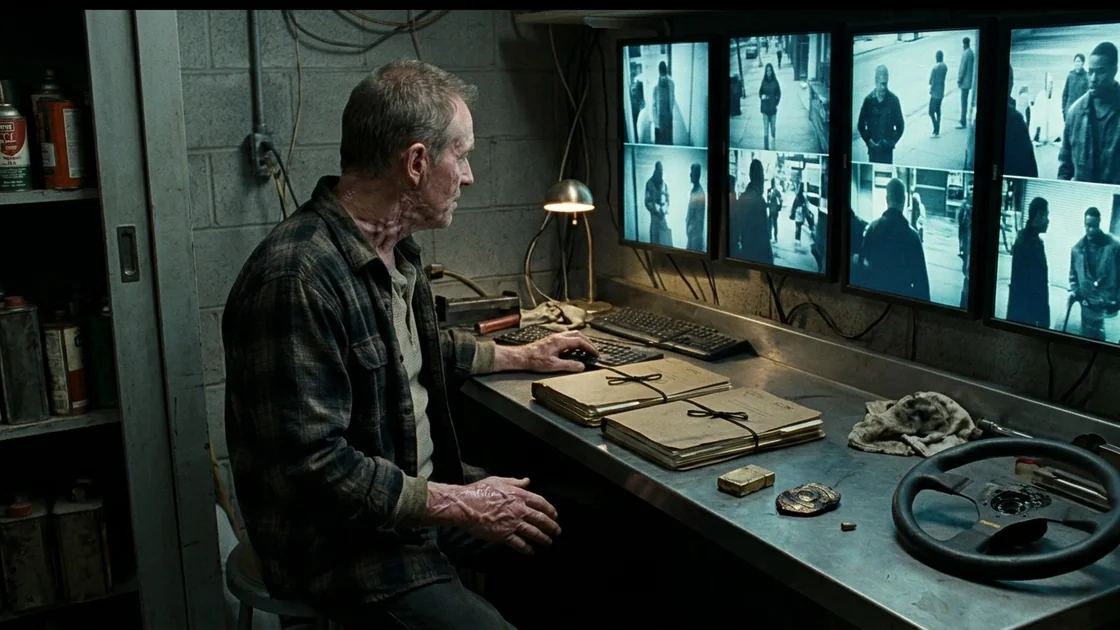
The room behind the false wall smelled of warm silicon, ozone, and old paper.
Four vertical monitors glowed in the dark, casting a pale blue light across a concrete floor swept free of dust. Below the screens sat a long steel desk holding four thick Manila folders, each bound with black twine. Beside the folders lay four objects arranged in a neat, symmetrical row: a heavy gold Dunhill Rollagas lighter with a dented corner; a burned, half-melted badge once belonging to a night watchman named Walter Miller; a flattened 9mm hollow-point slug extracted from a collarbone; and the charred center hub of a three-spoke Momo steering wheel.
Cole stood before the monitors, his breathing accompanied by the faint, dry whistle that had lived in his windpipe since the night at Pier 44.
On the leftmost screen, security footage from a high-rise parking garage in the financial district showed a tall man in a tailored charcoal overcoat walking briskly toward a silver Mercedes. Vincent Harlan. Sixty-one years old now, though he dyed the temples of his hair a distinguished iron-gray and kept his posture military-straight. Vince had always been the planner—the man who viewed heists the way a structural engineer viewed load-bearing trusses. To Vince, people were simply shear pins designed to snap under a calculated amount of stress so the rest of the machine could survive.
On the second screen, a traffic camera outside an upscale coffee shop in the West End captured a woman with sharp cheekbones and a severe bob of dyed black hair staring down at her phone while smoking a narrow clove cigarette. Elena Rostova. She had traded solder burns and frequency scanners for a boutique cybersecurity consultancy, though the tension in her shoulders—the constant, birdlike flick of her eyes toward every passing van and reflection in the plate-glass windows—proved she had never really left the trade.
The third screen showed the interior of a pawn brokerage and rare timepiece showroom in the jewelry quarter. Miles Sterling stood behind a velvet-lined glass counter, polishing a rose-gold chronograph with a chamois cloth. Miles was fifty-four, balding at the crown, wearing wire-rimmed spectacles that made him look like an archivist at a parochial school. Even on a low-resolution camera feed, Cole could see the slight tremor in Miles’s fingers when the shop door chimed.
The fourth screen displayed the parking lot of a roadhouse off Route 9. Deacon Kane was leaning against the fender of a dented pickup truck, chewing on a wooden toothpick and arguing with a man in a leather jacket. Deacon had gone thick around the middle, his neck spilling over the collar of his flannel shirt like cured ham, his shaved skull scarred from bar fights and bad decisions. He was still the blunt instrument he had been at thirty-five, only slower now, meaner, and more desperate.
Fifteen years. Five thousand, four hundred and seventy-five mornings of waking up to the smell of his own scorched skin in the back of his throat.
Cole reached out with his scarred left hand and tapped the keyboard.
A single encrypted transmission went out simultaneously to four burner phones that had been delivered by courier to four very different addresses thirty minutes earlier. Each phone contained a single audio file and a set of GPS coordinates pointing to an abandoned linseed oil mill on the industrial peninsula three miles south of the port.
"Time to go to work," Cole rasped to the empty room.
The memory of Pier 44 never came back to him as a dream; it only came back as temperature.
It had been an October night in 2009, dry and windy, the kind of wind that whipped whitecaps across the harbor and rattled the loose tin siding on the Maritime Foundry warehouse. Inside that warehouse sat two armored transport vans belonging to Consolidated Bullion, held overnight because of a wheel-bearing failure on the interstate and a corrupt dispatcher who owed Deacon’s cousin forty grand.
The score was supposed to be clean. Eight million dollars in kilo gold bars and uncut industrial diamonds bound for the diamond district up north. No gunfire. Three guards inside the breakroom, meant to be zip-tied and blindfolded within ninety seconds of Elena looping the CCTV cameras and cutting the central station alarm line.
Cole had been sitting in the driver’s seat of a modified 1989 BMW 535i backed into the loading bay just inside the sliding corrugated doors. He had built that car himself over eight months— bored-out inline-six, reinforced suspension to handle an extra twelve hundred pounds of dead weight in the trunk without squatting on the rear tires, dual fuel pumps, and a stripped interior fitted with a full roll cage. The engine was idling at seven hundred RPM, a low, rhythmic purr that vibrated through the soles of his driving shoes.
He had watched the stopwatch clipped to his dashboard. Four minutes. Five minutes. At six minutes and ten seconds, the side door of the foundry office kicked open.
They hadn't come out carrying the canvas transport bags smoothly. They had come out running.
Miles and Elena were hauling a steel dolly between them, their faces pale under the sodium vapor lights. Behind them came Vince, his trench coat billowing, and at the rear was Deacon, holding a stainless-steel Smith & Wesson 5906 that wasn't supposed to be on the job.
And staggering out onto the loading dock platform ten feet behind Deacon was an old night watchman—Walter Miller, sixty-four years old, three months from his pension—clutching his chest where a red stain was spreading across his gray uniform shirt.
Cole had hit the window switch, lowering the glass six inches. "What the hell did you do?" he had shouted over the rumble of the exhaust. "No iron! That was the rule, Vince! No bodies!"
Vince hadn't looked at the dying guard. He had looked directly at Cole, his cold gray eyes calculating weight, distance, and liability in the span of three heartbeats. Cole was the only one who hadn't stepped foot inside the office. Technically, if Cole walked away right then, or if the cops picked him up down the line, Cole could trade the four of them to walk clean on a felony murder charge. Worse, the second armored van inside the bay had turned out to be empty—a decoy run. There wasn't eight million on the dolly. There was barely two point four.
Two point four million split five ways was four hundred and eighty thousand apiece. Split four ways, with a dead scapegoat left at the scene holding the murder weapon, it was six hundred thousand and a clean slate.
"Load the backup van," Vince had said calmly, nodding toward the white Ford Econoline parked just outside the bay doors, the vehicle they had driven in to drop off the heavy cutting gear.
"What?" Cole’s hand had dropped to the gearshift.
He had been a half-second too slow.
Deacon raised the Smith & Wesson and fired twice through the laminated windshield. The first round took Cole across the left collarbone, shattering the clavicle and spinning him sideways against the center console. The second round punched through the dashboard and severed the main braided fuel line behind the firewall.
Before Cole could pull himself upright, blood pouring down his chest and blinding his left eye, Miles had sprinted past the driver’s window and tossed the hot murder weapon onto the passenger floorboard. Elena had reached the wall panel beside the loading dock, slapped the manual release to drop the heavy steel fire shutter across the front bumper of the BMW, and tossed an incendiary thermite grenade—meant for the vault’s slag chute—directly onto the pool of high-octane gasoline spreading beneath Cole’s engine block.
The last thing Cole saw before the windshield turned opaque with orange flame was Vince Harlan standing in the gap before the shutter slammed all the way down, checking his wristwatch under the streetlamp as if he were waiting for a commuter train.
The roll cage Cole had welded into the cabin saved him from being crushed when the roof beams collapsed eight minutes later, and it kept the firefighters’ hydraulic jaws from reaching him until the synthetic upholstery, the dashboard, and his own clothes had fused into his skin.
When he woke up three weeks later in the prison ward at Mercy General with chains shackled to the frame of his Striker bed, the district attorney told him that Walter Miller had died in the ambulance, that the murder weapon had been recovered inches from Cole’s right hand in the wreckage, and that an anonymous tip had led detectives to a locker rented in Cole’s name containing the blueprints to the Maritime Foundry.
Cole hadn't given up their names.
If he had named them, the state would have put them in adjoining cells at Blackwater Penitentiary, where they would have eaten three hot meals a day, watched television in the dayroom, and hired appellate lawyers with his share of the bullion. No. A prison sentence belonged to the state. The debt belonged to Cole.
He had served twelve years before a young innocence-project attorney—funded secretly through a numbered Cayman account Cole had established in 2004 from a solo bond courier job in Montreal—proved that the latent prints on the locker key had been lifted from an old arrest booking card and transferred via silicone mold. The state vacated the sentence quietly on a Tuesday afternoon to avoid a civil suit.
Walked out of the gates with a cardboard box, four hundred thousand dollars left in his offshore trust, and a body that looked like a topographical map of hell.
He hadn't bought a gun. He had bought a ledger.
The old linseed oil mill smelled of river silt, wet pigeon droppings, and rusting iron.
Cole arrived forty minutes before the time specified on the burner phones. He parked a nondescript, ten-year-old gray Volvo station wagon two blocks away behind a condemned boiler repair shop and walked the rest of the way through the rain. He wore a surplus navy pea coat with the collar turned up, a dark wool watch cap pulled low over his ears, and a pair of amber-tinted aviator glasses that hid the slight downward pull of the scar tissue beneath his left eye.
He climbed the iron fire escape to the second-floor catwalk and took a position in the shadows behind a massive, rusted settling vat. From here, he had a clear sightline down to the central floor where a single battery-powered camping lantern sat atop an overturned wooden cable spool.
Miles Sterling was the first to arrive.
He came through the sliding tin door on the east side at 10:48 PM, closing his black umbrella and shaking it out with fastidious little jerks before realizing how ridiculous the habit looked in a flooded ruin. He wore a beige raincoat over a suit and clutched a leather briefcase to his chest like a shield. Every few seconds, he took off his glasses, wiped the rain from the lenses with a silk pocket square, and peered into the dark corners of the mill.
Four minutes later, the heavy timber door at the north end groaned open. Elena Rostova stepped inside. She didn't carry an umbrella. She wore a hooded Gore-Tex jacket, black cargo pants, and combat boots. Her right hand stayed buried inside her jacket pocket, resting on what Cole knew to be a polymer-framed Glock 43 with the serial numbers milled off.
Miles jumped when he saw her. "Elena."
She stopped twenty feet away, staying out of the direct pool of light cast by the lantern. "Miles. You look old."
"It’s been eight years since the thing in Baltimore," Miles said, his voice high and tight. "And twelve since we all stood in the same room. Do you know who sent the phones?"
"If I knew, I wouldn't be standing in three inches of river mud," she said coldly.
Heavy footsteps crunched on the broken glass in the loading alley. Deacon Kane shouldered his way through the east entrance, water dripping from the brim of a greasy baseball cap. He looked from Miles to Elena, his narrow eyes squinting in the harsh white LED glare of the lantern.
"Well, look at the museum pieces," Deacon grunted, spitting his toothpick onto the concrete. "Where’s the boss man?"
"I am not anyone’s boss tonight, Deacon," a smooth baritone voice echoed from the shadows near the freight elevator shaft.
Vincent Harlan stepped into the light. Even in the damp chill of the mill, he looked immaculate—cashmere turtleneck under a dark trench coat, leather gloves, silver hair combed back without a single strand out of place. Yet Cole, watching from twenty feet above through a pair of compact binoculars, could see the tiny details the others missed: the frayed stitching inside the cuff of the ten-year-old coat, the pale indentation on Vince’s left wrist where his platinum Vacheron Constantin used to sit before it was quietly consigned at an estate auction in Boston four months ago.
"Vince," Deacon said, stepping forward, his massive shoulders bunching. "Is this your play? Because if you dragged me out here on some mystery cloak-and-dagger bullshit—"
"Hold your tongue, Deacon," Vince said sharply. He held up his own burner phone. "I received the same courier package you did at ten o'clock."
Silence fell over the mill, broken only by the steady drum of rain on the high skylights and the gurgle of the swollen river beneath the rotting wharf pilings outside.
"Then who?" Miles asked, his voice dropping to a whisper. "The audio file knew about the Maritime Foundry. It didn't name it, not directly, but the phrase—the four who walked out of the smoke on Pier 44—who else could know that? There was nobody left."
"The driver died in the state hospital five years in," Deacon said dismissively, though he shifted his weight from one foot to the other. "Lung infection or some shit. I had a screw at Blackwater check the rolls back in '15. Name wasn't even on the tier rosters anymore."
Cole allowed himself a thin, bloodless smile in the dark. In 2015, he had paid the deputy warden’s clerk twelve thousand dollars to list Prisoner #88412 as transferred to the chronic-care hospice wing under his middle name, Arthur, following a collapsed lung. Dead men don't get audited by nervous former associates.
"Someone knows," Elena said, her eyes scanning the upper rafters. "And whoever it is knows our accounts."
On cue, a burner phone taped to the underside of the wooden cable spool began to ring.
The four of them froze. Vince stepped forward, reached under the lip of the spool, and pulled the device loose. It was wired into a small portable speaker sitting in the center of the wood. Vince pressed the green answer button and set it down.
A voice filled the damp vault of the mill—mechanically pitched down through an octave divider that Cole had pre-recorded and routed through an automated relay server in Zurich, triggered ten seconds ago by the remote transmitter in Cole’s coat pocket.
"Good evening," the speaker hummed. "Do not waste your time sweeping for frequencies, Ms. Rostova. This call is bouncing through three satellite uplinks and a dead cellular repeater in Newfoundland. You are all here because you are all drowning."
Deacon bared his teeth. "Listen here, you mechanical son of a bitch—"
"Mr. Kane," the voice continued without pausing. "You owe two hundred and eighty thousand dollars in vigorish and principal to a syndicate in Atlantic City run by a man named Lazar. Three days ago, Lazar sold your paper to my organization. If that balance is not settled by Friday at noon, the men currently parked across the street from your sister’s house in Trenton will stop waiting in their car."
Deacon’s face drained of color. His hand went to the butt of the revolver tucked into his waistband, his eyes darting wildly around the dark perimeter of the mill.
"Mr. Sterling," the speaker went on smoothly. "In March, desperate to cover margin calls on your commercial real estate portfolio, you sold four supposedly vintage Patek Philippe perpetual calendars to a Russian collector named Volkov for six hundred thousand dollars. The movements inside those cases were modern Geneva clones aged with acid. Volkov’s authenticator in Antwerp finishes his inspection on Thursday morning. You know what Volkov does to people who wash his money with brass."
Miles gripped the handle of his briefcase with both hands, his knees visibly knocking together under his raincoat.
Cole watched them from above. He had been Volkov’s anonymous tipster. He had been the mysterious high-roller who kept feeding Deacon credit lines at the Borgata through a front man.
"Ms. Rostova," the speaker said. "The federal grand jury in the Southern District has already subpoenaed the server logs from the port authority ransomware attack in November. Your Cayman shell company was pierced forty-eight hours ago by a forensic accountant at Treasury. You need roughly one point two million in liquid bearer instruments to purchase a Diplomatic passport from Belgrade and disappear before Monday's indictment."
Elena didn't flinch, though her jaw clenched so hard a muscle ticked beneath her cheekbone.
"And Mr. Harlan," the speaker concluded. "Your architectural security firm lost its primary municipal contract after the structural failure of the Federal Courthouse annex vault—a failure caused by substandard steel alloys you signed off on to pocket the contractor kickback. The forensic audit becomes public on Monday. You are sixty-one years old, broke, mortgaged to the hilt, and facing twenty years in a federal penitentiary."
Vince stared down at the little black speaker, his face a mask of patrician fury. "You've gone to great expense to read our mail," Vince said clearly. "People who gather this kind of leverage don't do it to play moralist. What is the job?"
"Forty-two million dollars," the speaker replied. "In uncut Angolan rough diamonds and thousand-franc Swiss bearer certificates. Currently sitting inside a private, off-the-books clearinghouse forty miles north of the city called the Meridian Annex. It belongs to an Eastern European defense minister who was assassinated in Vienna yesterday morning. His estate does not officially exist. The cartel holding the facility has four days to move the contents before the building is decommissioned. We have the schematics, the guard rotation, and the outer gate codes. We need the crew that cracked the Consolidated Bullion transport."
"What’s the split?" Deacon demanded, his greed instantly overriding his panic.
"Fifty-fifty," the voice said. "Twenty-one million stays with my courier. Twenty-one million goes into four bags for the four of you. More than enough to pay Lazar, buy off Volkov, flee the Southern District, and retire to Zurich."
"And the catch?" Elena asked sharply. "If you have the schematics and the codes, why hire four relics?"
"Because the inner vault is a pre-digital Diebold Class-Five time lock retrofitted with a custom dual-frequency capacitance grid," the speaker said. *"Only three people on the East Coast have defeated that combination without tripping the seismic failsafe. You and Mr. Sterling are two of them, and the third died in Marion federal prison in 2018. You have seventy-two hours. Our wheelman and logistics coordinator is outside now. He has the blueprints and the advance equipment."
The line clicked dead.
At the bottom of the iron stairwell in the shadows at the far end of the mill, Cole stepped quietly off the bottom rung, walked through a connecting tunnel to the south entrance, and rapped three times on the rusted steel door with a heavy brass flashlight before pushing it open.
Four heads snapped toward him. Four hands moved toward pockets or waistbands.
Cole shuffled into the lantern light, keeping his shoulders hunched slightly to exaggerate his stiffness, his left leg dragging a fraction of an inch across the gritty concrete. With the wool cap pulled down to his eyebrows, the amber night-driving glasses, the thick gray-and-white beard covering his grafted jaw, and the twenty pounds of lean muscle he had dropped in prison replaced by a heavy flannel work shirt layered over a padded thermal vest, he looked like any fifty-eight-year-old mechanic who had spent his life inhaling brake dust under hydraulic lifts.
"Put the hardware away," Cole rasped, his voice a low, gravel-scraped whisper that sounded like two pieces of coarse sandpaper rubbing together. "If I wanted you dead, I'd have wired the lantern to forty pounds of C-4 before you walked in."
Vince narrowed his eyes, studying the newcomer with cold disdain. "And you are?"
"Name’s Bram," Cole whispered, tossing a heavy canvas roll onto the cable spool beside the dead speaker. "I drive. And I keep the schedule for the people paying the tab."
Deacon walked over, towering over Cole’s hunched posture by four inches, and looked down at the pink, puckered ridge of scar tissue visible just above the collar of Cole’s coat on the left side of his neck.
"What happened to your throat, old man?" Deacon sneered. "Swallow a blowtorch?"
Cole looked up through the amber lenses directly into the eyes of the man who had put two hollow-points through his windshield. He kept his face slack, dull, and indifferent.
"Stock car flipped at Langhorne in '98," Cole rasped. "Methanol fire. Didn't affect my shift hand, and it didn't affect my eyesight. You want to look at the paper, or you want to stand around talking about my beauty marks while your man in Atlantic City sharpens his pliers?"
Deacon stiffened, his fist balling up, before Vince stepped between them and laid a leather-gloved hand on Deacon’s shoulder.
"Leave him be, Deacon," Vince said smoothly, never taking his eyes off the canvas roll. "The help doesn't need to be pretty. He just needs to keep the engine running while we're inside."
Keep the engine running while we're inside.
Cole turned his back on them to untie the leather straps of the blueprint roll so they wouldn't see the way his scarred left hand trembled with a terrifying, pristine joy.
The staging ground was an abandoned granite quarry shed twelve miles outside the city limits, leased under the name of a defunct geological survey company.
Over the next forty-eight hours, Cole watched the four of them slide back into their old roles like rusted gears finding their teeth. Age and desperation had stripped away whatever veneer of respectability they had spent fifteen years cultivating. Underneath the cashmere, the silk pocket squares, and the cybersecurity jargon, they were the exact same scavengers who had stood on the loading dock of Pier 44.
Inside the quarry shed sat the getaway vehicle Cole had prepared: a matte-charcoal 2014 Audi S8 equipped with a twin-turbocharged V8 that Cole had stripped of every electronic limiter, fitted with run-flat Kevlar-belted tires, heavy-duty Bilstein suspension, and quarter-inch ballistic steel plating welded inside the door panels.
What the crew didn't know was what else Cole had welded inside those doors: secondary electromagnetic deadbolts wired to a concealed receiver under the front bumper, and a divided polycarbonate partition hidden inside the headliner behind the front seats that could drop and lock into a steel channel in four-tenths of a second.
On Wednesday afternoon, twenty-four hours before the heist, Miles Sterling was sitting at a folding table at the back of the shed, calibrating a high-torque magnetic drill press and laying out a row of diamond-tipped core bits.
Cole walked over carrying a mug of black coffee and set it down near Miles’s elbow.
"Appreciate it, Bram," Miles murmured without looking up. He reached into his vest pocket, pulled out a narrow cigarillo, and flicked a heavy gold Dunhill lighter.
The flame caught on the third strike. Cole looked at the dented bottom corner of the gold casing, where the initials W.M. had been buffed down so thin they looked like a mere scratch in the metal. Walter Miller’s wife had given him that lighter for their thirtieth anniversary; Cole knew because the widow had talked about it during her victim-impact statement at Cole’s sentencing hearing in 2010. Miles had taken it off the guard’s body while the old man was bleeding out on the concrete.
"Nice piece," Cole rasped, leaning against the edge of the workbench. "Don't make 'em like that anymore."
Miles glanced down at the lighter, rubbed his thumb over the buffed-out corner out of nervous habit, and slipped it back into his pocket. "An old souvenir. Brings me luck."
"Looked like it was dragging on the flint wheel," Cole said mildly. "Spring gets tired on those old Rollagas models if they sit in a drawer too long."
"Everything gets tired if it sits too long," Miles sighed, taking off his wire-rimmed glasses and rubbing the bridge of his nose. His hands were shaking again. "Tell me something, Bram. You've worked for these people before? The ones on the phone?"
"Three times," Cole lied smoothly. "Boston, Detroit, Montreal."
"And they always honor the split?"
"Down to the penny," Cole whispered. "Long as nobody tries to get cute with the weight."
Miles lowered his voice, glancing toward the front of the shed where Vince and Elena were bent over the architectural schematics of the Meridian Annex. "Between you and me... Deacon isn't stable. Back in the old days, he was a blunt tool, sure, but Vince could hold his leash. Now? He’s twitchy. Last job we all pulled together—long time ago, down by the docks—Deacon panicked and dropped a guard for no reason. Then he and Vince made a very messy executive decision about the wheelman."
Cole stared at the top of Miles’s balding head. "That right?"
"Burned him up right in the bay," Miles whispered, a pale sheen of sweat on his forehead. "I didn't want any part of it, understand? I'm a technician. I open boxes. I don't hurt people. If things go sideways tomorrow night inside that vault, and Deacon starts throwing weight around... I want to make sure there’s room in the car for the people who keep their heads."
"I hear you," Cole rasped. "Funny thing, though. Way I heard that old story down at the docks, it was the lock man who tossed the piece onto the floorboards so the driver would eat the murder beef if he lived."
Miles went completely still. His head snapped up, his watery blue eyes fixing on Cole’s amber glasses. "What did you say?"
Cole didn't blink. He reached out, picked up a three-quarter-inch diamond core bit, and held it up to the light. "Dock job in Baltimore, wasn't it? Ninety-six? Guy named Danny O'Neill drove a Lincoln Town Car into the harbor."
Miles let out a long, ragged breath, his shoulders slumping in relief. "Oh. Baltimore. No, I wasn't talking about O'Neill. Doesn't matter. Forget I said anything."
"Already forgot," Cole whispered.
An hour later, Elena was sitting in the back seat of the Audi with a Toughbook laptop balanced on her knees, testing the frequency-hopping signal jammer she had wired into the trunk’s auxiliary battery. Cole slid into the driver’s seat to adjust the steering column and check the pedal travel on the hydraulic brake booster.
In the rearview mirror, he watched Elena’s sharp eyes studying the back of his neck.
"You don't talk like a local, Bram," she said quietly, her fingers still flying across the mechanical keyboard.
"Grew up upstate," Cole rasped, turning the ignition key to the accessory position so the dashboard gauges swept across their arcs. "Moved around."
"I ran the prints off that coffee mug you gave Miles earlier," she said.
Cole’s hand remained completely steady on the ignition key. "Did you?"
"Didn't find any," she said, looking up into the mirror. "Just flat, parallel ridges. Skin grafts or acid burn on the pads of all ten fingers."
"Hot transmission pan dropped on my hands in '03," Cole said without missing a beat. "Why are you running the help, Ms. Rostova? Don't trust your broker?"
"I don't trust oxygen unless I check the tank mixture myself," she replied coldly. She closed the laptop halfway. "Your broker has a blind spot in his courier protocol. The drop point for their half of the split is an automated self-storage locker in Newburgh, three miles from the highway interchange. If the Audi takes the old timber road West instead of the interstate after we clear the facility, we bypass the drop entirely and hit the airstrip in Sullivan County forty minutes before their relay team realizes the locker is empty."
Cole turned slowly in the bucket seat, resting his scarred left forearm across the top of the headrest. "You're talking about burning the people who hold your federal indictment."
"Indictments don't matter in Montevideo when you're sitting on forty-two million instead of twenty-one," she said, her dark eyes glittering with the cold, reptilian calculation Cole remembered so well. "Wait—not forty-two divided by five. Vince and Deacon think they're running this crew. Deacon is a rabid dog who won't survive the year anyway, and Vince’s ego is writing checks his brain can't cash anymore. Cut the drop, leave the heavy luggage behind at the airstrip, and there’s four million on the tarmac for a driver who knows how to take a left turn instead of a right."
"You and Vince used to be close," Cole rasped.
"Fifteen years ago, four of us walked out of a fire," Elena said flatly. "We didn't stay alive by being sentimental. Think about the left turn, Bram."
She climbed out of the back seat and slammed the heavy armored door.
That night, after Miles, Elena, and Vince had driven back into the city in their respective cars to establish alibis before the Thursday night run, Deacon lingered behind in the shed, loading submachine-gun magazines with brass 9mm parabellum rounds from a surplus ammo can.
Cole was wiping down the Audi’s windshield with ammonia and newspaper.
Deacon walked over, the smell of cheap bourbon and tobacco rolling off him in waves, and leaned his hip against the front fender, deliberately smudging the clean matte paint with his dirty jeans.
"Hey. Torch," Deacon said.
Cole kept wiping the glass. "Something on your mind, Mr. Kane?"
"I don't like mysteries," Deacon said, tapping the side of his thick skull with a magazine. "And I don't like geek voices on speakerphones telling me about my sister’s house. So here’s how tomorrow night goes down. We crack this bunker, we load the cans into the trunk, and before we hit that storage locker in Newburgh, you're gonna pull over at the mile-fourteen rest stop."
"What’s at mile fourteen?"
"The courier who's waiting to pick up the broker’s half," Deacon grinned, showing a row of yellowed teeth. "And whatever piece of hardware he’s carrying, it ain't gonna stop twelve rounds of hollow-point through the windshield."
Cole stopped wiping the glass. Twelve rounds through the windshield.
"You're gonna rob your own employer," Cole rasped softly.
"Employer?" Deacon barked a harsh laugh. "Nobody employs me, old man. And honestly? Once those cans are in the trunk, I don't really see why I need a bankrupted suit, a paranoid Russian bitch, and a shaking watchmaker taking seventy-five percent of my retirement fund. Last big score we pulled, we trimmed the fat right on the loading dock. Left the driver cooking in his own grease and walked away fat and happy. Easiest six hundred grand I ever made."
Deacon leaned in close, his breath hot against the side of Cole’s face.
"Difference is, Torch, tomorrow night I actually need somebody to steer the boat while I clean house in the back seat. You keep your eyes on the white lines, help me dump three bodies in the quarry pond, and I'll peel off two million in stones for your pension. You get squeamish like that pussy at Pier 44, and you'll find out if lightning strikes twice."
Deacon slapped Cole hard on his scarred left shoulder—a deliberate, heavy thud meant to make the old man wince—and walked out into the rain, whistling between his teeth.
Cole didn't wince. The nerve endings in his left shoulder had burned away in 2009.
He waited until the taillights of Deacon’s pickup disappeared down the quarry road. Then he walked over to his private phone in the tool chest, dialed the encrypted Zurich relay that he himself controlled, and checked the voicemail inbox for "The Broker."
There was a new message recorded twenty minutes earlier from a payphone on the edge of town.
Cole pressed play.
"This is Harlan," Vince’s smooth, patrician voice came through the earpiece. "We need to discuss an adjustment to tomorrow night's extraction protocol. Kane is a liability; he intends to hijack the courier drop, and Rostova and Sterling are too compromised by their creditors to keep quiet once the heat comes down. Provide me with the secondary override code to the vault's inner airlock. When the merchandise is passed through the transfer chute to me and the driver, we seal the inner door and leave the three of them for the security response. A two-way split between your organization and myself is far cleaner than five. Leave a white chalk mark on the north retaining wall at the facility if we have an accord."
Cole lowered the phone.
In forty-eight hours, without a single prompt from him, every single one of them had offered to murder or betray the others. Miles wanted protection from Deacon; Elena wanted to abandon Vince and Deacon at the airstrip; Deacon planned to execute all three of them in the back of the car; and Vince wanted to seal his entire crew inside the vault before they even reached the parking lot.
Fifteen years ago, Cole had tortured himself in the burn unit wondering what he had done wrong to make them turn on him—what sign he had missed, what mistake he had made in judging their character.
Now he knew. He hadn't missed a thing. Vipers didn't bite because they had a reason; they bit because they had venom in their mouths and nowhere else to spit it.
Cole picked up a piece of white carpenter’s chalk from the workbench, slipped it into his coat pocket, and turned off the shed lights.
The Meridian Annex sat forty miles north of the city, buried inside the granite shoulder of Crow Mountain at the end of a decommissioned county access road.
Originally built in 1962 as a regional continuity-of-government fallout bunker for the Federal Reserve’s second district, the facility had been declared surplus in 1994, sold to a telecommunications archival firm in 2001, and eventually seized by the county for unpaid back taxes in 2019.
In May of 2022, a Panamanian holding company controlled by Cole’s offshore trust had purchased the deed at a sheriff’s auction for one hundred and eighty thousand dollars.
For the last twenty-two months, working entirely alone twelve hours a day with a bobcat loader, an industrial welding rig, three miles of armored fiber-optic cable, and surplus bank-vault hardware bought from demolition yards in Ohio and Pennsylvania, Cole had transformed the lower level of the bunker into a stage set.
It was the ultimate confidence game: a jewel box built from the inside out, designed not to keep thieves out, but to make four very specific thieves believe they were breaking into the most fortified room on the Eastern Seaboard.
Thursday night arrived wrapped in a thick, freezing fog that rolled off the reservoir and clung to the pine trees along the ridge.
At 1:15 AM, the matte-charcoal Audi S8 glided up the winding asphalt service road with its headlights killed, running entirely on an infrared thermal camera mounted behind the front grille that projected a green-phosphor image onto a heads-up display on the windshield.
Cole’s hands were steady on the leather wheel. Inside the car, the silence was suffocating, broken only by the low hum of the twin-turbo V8 and the metallic click of Deacon checking the safety on his suppressed Heckler & Koch MP5 for the fourth time in ten miles.
Vince sat in the front passenger seat, wearing a black balaclava rolled up on his forehead like a watch cap. In the back, Elena sat behind Cole with her frequency scanner glowing softly in her lap, while Miles sat wedged between her and Deacon, clutching his leather case of diamond drills.
"Half a mile to the outer perimeter gate," Vince murmured, watching the GPS tablet on his knee. "Elena, how is the local cell tower?"
"Spoofed," she whispered from the dark. "Any heartbeat signal leaving this mountain for the next ninety minutes is routing through my repeater loop on the ridge. As far as the central monitoring station in Albany is concerned, the facility is quiet and the guards are watching soccer."
Cole almost smiled behind his amber glasses. The repeater loop on the ridge was bouncing a signal directly into a dummy server sitting in the basement of Cole’s transmission shop in the city. There were no guards watching soccer. There were no guards at all.
The Audi crested the final rise and rolled to a halt fifty yards from a twelve-foot chain-link fence topped with concertina wire. Beyond the fence stood a brutalist concrete blockhouse set directly into the vertical granite face of the mountain. Two sodium floodlights illuminated a heavy steel rolling gate and a smoked-glass guard booth beside the entrance tunnel.
Inside the booth, the silhouette of a man in a peaked security cap sat motionless in front of a bank of monitors, occasionally rotating forty-five degrees to the left, pausing for twelve seconds, and rotating back—an oscillating window-display mannequin mechanism Cole had geared down with a wiper motor from a 1996 Ford Taurus.
"One guard in the primary booth, just like the broker’s dossier said," Vince whispered, lowering his night-vision monocular. "No roving patrol until the two-o'clock shift change inside the lower level. Bram, bring us up to the blind spot behind the transformer housing."
Cole eased off the brake, letting the heavy sedan coast silently down the slight grade into the shadow of a concrete electrical vault.
On the north retaining wall twenty feet to their right, clearly visible in the spill of the sodium lights, was a single six-inch vertical slash of white chalk.
In the passenger seat, Vince’s eyes lingered on the chalk mark for two seconds. When he looked back at the facility, his jaw was set, his hand resting calmly over the pocket where he kept a compact Sig Sauer P230.
"Move," Vince ordered.
They slipped out of the car into the freezing fog. Each of them wore a heavy, waterproof biometric wrist-transponder that Cole had distributed back at the quarry shed, explaining that the facility’s internal motion-sensor grid used passive RFID handshakes to distinguish authorized personnel from intruders; without the transponders tuned to the cartel’s encrypted key, the ceiling turrets in the main tunnel would supposedly open fire.
In reality, the wristbands contained high-precision pulse oximeters, short-range GPS tags, and miniature microphones wired directly into the bunker’s central recording console.
Elena knelt by the junction box at the base of the rolling gate, stripped back two shielded conduits with a pair of ceramic cutters, and clipped her bypass module onto the bare copper leads. Twelve seconds later, the green LED on the gate latch blinked twice and clicked open.
They moved in a tight wedge down the concrete vehicle ramp into the belly of the mountain. Cole brought up the rear, carrying two heavy canvas rigging bags slung over his right shoulder and a three-foot titanium Halligan bar in his scarred left hand.
As the last of them cleared the threshold of the outer blast door, Cole tapped a three-button sequence on the key fob hidden inside his coat pocket. Above them, concealed behind the ventilation louvers of the intake shaft, a secondary hydraulic gate slid quietly into place, sealing the ramp behind three inches of solid quarry stone and reinforced plate steel.
None of them heard it over the hum of the subterranean air handlers.
The main corridor of the Meridian Annex was three hundred feet of unpainted, poured concrete lit by recessed fluorescent cages. It smelled of damp limestone, hydraulic fluid, and cold iron.
"Two minutes on the clock," Vince whispered, checking his watch as they reached the first barrier: a heavy steel security door with a triple-redundant biometric keypad. "Elena."
Elena stepped up, pried the faceplate off the keypad with a flathead blade, and plugged a ribbon cable from her tablet into the circuit board’s JTAG diagnostic port. Her fingers danced across the keys.
Cole had programmed the microcontroller inside that keypad himself. He had written a custom emulation script that simulated a rotating 256-bit encryption key, designed specifically to resist standard brute-force dictionary attacks for ninety seconds before yielding to the exact side-channel timing exploit Elena had used on the Zurich bank job in 2007. He wanted her to sweat. He wanted her to feel the familiar, intoxicating rush of her own brilliance right before the floor gave way beneath her feet.
"Got a rolling parity check," she muttered, a drop of sweat sliding down her temple despite the fifty-degree chill of the tunnel. "Hold on... isolating the clock cycle... now."
The heavy magnetic lock disengaged with a loud clack.
Elena allowed herself a tight, arrogant smirk as she unplugged her cable. "Amateur firmware," she whispered.
"Save the victory lap," Deacon growled, pushing past her with his MP5 raised to clear the inner vestibule. "Keep moving."
At the end of the vestibule stood the prize.
It was a genuine 1964 Diebold circular vault door, seven feet in diameter, sixteen inches of solid high-carbon laminated steel, gleaming dull silver under the overhead spotlights. Its twin combination dials and massive spoked spider-wheel looked like the hatch of a sunken battleship embedded in the granite wall. Beside the main door sat a smaller, two-foot-square reinforced pass-through airlock chute—the exact chute Vince believed was going to be his private exit ramp for the diamonds.
Miles stepped forward, his nervousness vanishing the moment he was confronted with cold mechanics. He set his leather case down, pulled on a pair of thin latex gloves, and pressed an electronic acoustic stethoscope against the brushed steel plate beside the primary dial.
"Bram," Miles whispered, holding out his hand without looking back. "The magnetic drill rig and the quarter-inch carbide bit. Watch the coolant drip; if the bit overheats on the manganese layer, it'll shatter and trip the glass relocker inside the casing."
Cole knelt beside him, positioning the heavy magnetic base of the drill press against the precise template mark on the vault face and flipping the magnet switch. The rig locked onto the steel with a solid thud.
As Cole leaned in to attach the pressurized oil-coolant line to the drill chuck, his face was six inches from Miles’s ear.
"Take it slow, Miles," Cole rasped softly. "Wouldn't want the door to jam before everybody gets inside."
Miles nodded absently, his eyes glued to the oscilloscope waveform on his stethoscope display as the carbide bit began to bite into the hardened steel with a high, shrill whine.
Five minutes. Eight minutes. Twelve minutes.
Shavings of bright silver steel curled away from the hole, washed down the face of the door by the steady trickle of cutting oil. Behind them, Deacon paced the narrow concrete corridor like a caged bear, checking his watch and glaring at the back of Vince’s head, while Elena kept one eye on her frequency scanner and the other on the dark tunnel leading back to the surface.
At fourteen minutes and twenty seconds, the drill bit broke through the inner transfer plate.
Miles killed the motor, slid a fiber-optic borescope needle through the quarter-inch hole, and watched the miniature monitor in his palm as he spun the brass combination dial with his left hand.
"Third wheel gate aligned," Miles breathed, his voice trembling with reverence. "Dropping the lever nose... relocker bypassed... we're clear."
Deacon slung his submachine gun behind his back, grabbed the two upper spokes of the massive steel spider-wheel, and threw his two hundred and forty pounds against the rotation.
With a deep, resonant groan of greased planetary gears that hadn't borne weight in decades, the sixteen-inch locking bolts retracted from the granite jamb. Slowly, ponderously, four tons of balanced steel swung outward into the vestibule.
Warm, dry air rolled out of the chamber.
Inside, the vault was a twenty-by-twenty-foot cube lined with seamless half-inch steel plate. There were no safety deposit boxes on the walls. Instead, in the center of the floor under a bank of bright halogen floodlights stood two long stainless-steel tables. And resting atop those tables were eight heavy, airtight zero-Halliburton aluminum transport cases secured with thick steel security cables and lead customs seals.
For three full seconds, nobody breathed.
Even Vince Harlan’s aristocratic mask slipped, his lips parting slightly as the sheer gravity of forty-two million dollars seemed to pull the air out of their lungs.
Deacon broke first. He lunged across the threshold with a pair of heavy bolt cutters, snapping the steel security cable holding the cases to the first table. Miles hurried in right behind him, pulling a pry bar from his kit to pop the lead seals, while Elena stepped just inside the doorway, her hand dropping inside her Gore-Tex jacket toward the Glock 43 as her eyes darted from Deacon’s back to Vince’s profile.
Vince stopped right at the threshold, turning slightly toward Cole, who stood two paces behind him in the vestibule.
"Bram," Vince said softly, his hand slipping into his trench coat pocket and wrapping around his Sig Sauer. "Stay by the outer controls. Elena, help Miles verify the stone weight on the far table."
Elena didn't move toward the table until Vince took two steps inside the room to get a clear firing angle on Deacon’s back. That was all Cole needed.
While all four of them were inside the perimeter of the twenty-foot steel cube—Deacon bending over the first aluminum case, Miles reaching for the clasps on the second, Elena pivoting in the corner with her hand on her pistol, and Vince raising his coat pocket toward Deacon—Cole took one silent step backward into the vestibule.
He didn't grab the spider-wheel on the giant circular Diebold door; four tons of steel had too much inertia to swing shut before Elena or Vince could dive through the gap.
Instead, Cole hit the red palm-switch recessed into the concrete wall beside the door frame.
Hidden inside the upper ceiling lintel directly behind the decorative circular vault frame, a two-ton solid steel industrial guillotine blast gate—held aloft by a single explosive shear pin and guided by greased vertical tracks—dropped from the ceiling like a headsman’s axe.
It fell eight feet in less than half a second.
The impact shook dust from the concrete ceiling and echoed down the tunnel like a howitzer shell. Four inches of solid Krupp armor plate slammed into the floor channel directly behind Vince’s heels, sealing the twenty-by-twenty room completely. Pneumatic deadbolts fired horizontally from both walls into the vertical edge of the plate with a deafening series of metallic bangs.
Inside the vault, Vince whirled around and threw himself against the flat steel wall where the doorway had been a blink of an eye ago.
"What the hell is this?!" Vince roared, his composure shattering as he pounded a leather-gloved fist against the cold armor plate. "Elena! Did you trip a seismic wire?!"
"It wasn't seismic!" Elena screamed, her Glock drawn now as she spun around, looking for a seam or a keypad on the smooth interior wall. "That was a manual drop gate! The old man—he hit the switch outside!"
At the center table, Deacon ignored the door. He had wrenched open the latches on the first two aluminum Halliburton cases and thrown back the lids.
"Forget the door!" Deacon bellowed, before his voice died in his throat.
He stared down into the foam-lined interior of the cases.
There were no velvet pouches of Angolan rough diamonds. There were no crisp stacks of thousand-franc Swiss bearer bonds.
The first case was filled to the brim with gray, greasy incinerator ash and twisted fragments of melted black plastic. Sitting squarely on top of the ash was a charred, half-melted security guard’s badge belonging to the Maritime Foundry, and beside it, a laminated coroner’s autopsy photograph of sixty-four-year-old Walter Miller.
In the second case, nestled into custom-cut foam slots like priceless museum artifacts, lay the blackened, deformed aluminum hub of a three-spoke Momo steering wheel, a flattened 9mm hollow-point slug inside an evidence vial, and four thick Manila folders bound in black twine—each labeled with a name: HARLAN. ROSTOVA. STERLING. KANE.
Miles stumbled backward from the table as if a cobra had reared up out of the aluminum box, knocking over a steel stool with a clatter. "Oh, God," Miles whispered, his hands flying to his mouth. "Oh, sweet Jesus..."
On the north wall of the vault, twelve feet above the floor, a heavy steel shutter slid open with a quiet hum of electric motors, revealing a three-foot-wide window composed of four-inch-thick polycarbonate ballistic glass.
Behind the glass was a small elevated observation booth lit by a single green desk lamp.
Cole stood on the other side of the glass.
Slowly, deliberately, he pulled off the dark wool watch cap. He removed the amber-tinted aviator glasses and set them on the console. Then he reached up to his jawline, peeled back the spirit-gum adhesive holding the gray-and-white theatrical beard in place, and stripped it away.
Under the harsh glare of the vault’s halogen floodlights, the four people below stared up at the shiny, pale, taut landscape of grafted skin stretching across his left jaw and neck, and the unmistakable, ice-blue eyes that had looked out at them through the shattered windshield of a 1989 BMW fifteen years ago.
Nobody spoke. The silence inside the steel box was absolute.
Cole leaned forward and pressed the toggle switch on the gooseneck intercom microphone. When he spoke, he didn't use the exaggerated, halting cadence of old Bram the mechanic; he let his real voice—scarred and raspy from smoke, yet sharp as a straight razor—fill the vault through four flush-mounted ceiling speakers.
"Two point four million divided by four was six hundred thousand apiece," Cole said over the speakers. "How far did it go?"
Miles Sterling’s knees buckled. He sank onto the cold steel floor beside the center table, staring up at the observation window as if he were looking at a corpse that had clawed its way out of six feet of wet earth.
"Cole," Miles breathed, his voice barely audible before the sensitive ceiling microphones picked it up and played it into Cole’s booth. "It’s Cole Mercer... They said you died in Blackwater. Deacon said you died in '15!"
"I paid a clerk twelve grand to bury me on paper," Cole said calmly into the microphone. "Turns out it’s a lot easier to hunt four people when they stop looking over their shoulders."
Vince Harlan backed slowly away from the blast door until his shoulders hit the edge of the stainless-steel table. He stared up at the glass, his chest heaving beneath his cashmere turtleneck, trying desperately to force his brain back into the cold, analytical gear that had saved him his entire life.
"Mercer," Vince said, his voice trembling only slightly at the edges. "Listen to me. Whatever happened at Pier 44—it was chaos. Deacon fired without orders. The fire started from a stray spark on the fuel line, and the harbor patrol was less than two minutes out! The shutter jammed when Elena tried to raise it!"
Cole looked down at him without expression. "You stood in the gap and checked your watch, Vince."
Vince swallowed hard. "You were hit! We thought you were dead in the seat! If we had stayed thirty seconds longer, all five of us would have gone down for capital murder!"
"Instead, just one of us did," Cole said. "Twelve years in a six-by-nine concrete box at Blackwater after six months of having dead skin scraped off my ribs with wire brushes every morning at six o'clock without enough morphine to dull a toothache. Do you know what burned synthetic leather smells like when they peel it out of your collarbone, Vince? It smells just like this room is about to smell."
Deacon raised the suppressed MP5 to his shoulder and squeezed the trigger.
Phut-phut-phut-phut-phut.
Twelve 9mm rounds hammered into the four-inch polycarbonate window in a tight group dead center in front of Cole’s face.
Cole didn't flinch. He didn't even blink. The lead slugs flattened into harmless gray flowers embedded half an inch deep in the outer laminate layer of the glass before dropping onto the vault floor below.
"Surplus Federal Reserve ballistic glazing, Deacon," Cole said mildly over the intercom as the acrid smoke from the submachine gun drifted up toward the ceiling vents. "Rated for armor-piercing .30-06 at point-blank range. You're shooting paring knives at a battleship."
Elena hadn't fired her weapon. She was already at the far corner of the vault, her fingers tearing open the stainless-steel junction panel where the environmental control conduits entered the room. "It’s a closed loop," she snapped, her voice sharp with panic as she traced the heavy steel pipes with her flashlight. "There’s no return air duct wide enough to crawl through—it’s baffled with two-inch titanium bars every three feet!"
"Save your fingernails, Elena," Cole said. "I welded those baffles in myself last November. Just like I wired the dummy keypad you were so proud of cracking ten minutes ago. And just like I arranged every single debt that brought the four of you to my door."
All four of them froze, looking back up at the window.
"There is no Eastern European defense minister," Cole said, resting his scarred left hand on the edge of the console. "There are no Angolan diamonds. And there was no mysterious broker in Zurich. I was the one who tipped off Volkov’s authenticator in Antwerp about your fake Pateks, Miles. I was the one who handed the Treasury department the decryption key to your Cayman shell company, Elena. I bought the faulty steel alloy test reports from the metallurgical lab and mailed them to the city inspector to ruin your firm, Vince. And Deacon? I'm the man who bought your two-hundred-and-eighty-thousand-dollar marker from Lazar in Atlantic City on Monday afternoon."
Deacon’s face twisted into a mask of purple rage. "You son of a bitch! You bankrupt us just to lock us in a meat locker?!"
"Not a meat locker," Cole said softly. "A kiln."
He flipped a heavy red breaker switch on the panel beside his right hand.
Inside the vault, the bright white halogen floodlights shut off, replaced instantly by a deep, dull crimson glow coming from twelve industrial quartz radiant-heat lamps recessed behind heavy wire grates in the ceiling—sixty-kilowatt drying elements salvaged from an automotive paint-curing oven in Detroit.
Within ten seconds, the ambient temperature inside the insulated steel cube began to climb. Fifty-two degrees. Fifty-eight. Sixty-four.
"What are you doing?!" Miles screamed, clawing at his collar as the infrared heat washed down over his bare scalp. "Cole! I didn't shoot you! I swear to God on my mother’s grave, I didn't pull that trigger! That was Deacon! Deacon shot the guard and Deacon shot your car!"
"And you threw the hot piece onto my floorboard so the cops would chain me to a hospital bed while you spent my share on watches," Cole replied. "Don't worry, Miles. I'm not going to cook you all to death. I'm not you."
Cole leaned closer to the glass.
"Actually, three minutes ago, when Elena cut the outer gate loop, she didn't bypass a silent alarm. She triggered an automated packet transmission to the State Police barracks in Kingston, the FBI field office in Albany, and the Special Prosecutions unit at the District Attorney’s office. In about fourteen minutes, twelve tactical units are going to breach the upper tunnel."
Vince laughed—a harsh, brittle sound. "And find what, Mercer? Four people trespassing in an abandoned county bunker you bought through a shell company? You think breaking and entering carries twenty years?"
"No," Cole said. "Murder in the first degree carries life without parole. There’s no statute of limitations on Walter Miller’s death, Vince. Look inside the third aluminum case on the second table."
Vince hesitated, then stepped over to the second table and snapped open the latches on the smaller aluminum case.
Inside, resting on a velvet pad beneath a sheet of clear acrylic, was a 9mm Smith & Wesson pistol—Wait, no, that was in evidence; sitting there was Walter Miller’s gold Dunhill lighter that Cole had lifted right out of Miles’s coat pocket back at the quarry shed while handing him his coffee, alongside a high-definition digital audio recorder and the original paper ledger from the Maritime Foundry bullion split bearing all four of their fingerprints—stolen by Cole from Vince’s private wall safe during the "burglary" Cole had staged at Vince’s office six months ago.
"The ballistic forensics that vacated my conviction proved the fatal shot was fired from the loading dock angle by a shooter standing six feet two inches tall," Cole said. "And those biometric wristbands you're all wearing right now? They've been recording high-definition audio since yesterday afternoon. Including Deacon bragging in the quarry shed about leaving me to cook like a pig at Pier 44 and shooting the night watchman."
Elena stared down at the black band on her wrist and tore at the clasp, only to find the stainless-steel strap secured with a tamper-proof shear bolt.
"Fourteen minutes until the feds walk down that ramp and put all four of you in maximum security for the rest of your natural lives," Cole said. "Or..."
He paused, letting the word hang in the hot, crimson-lit air of the vault. The digital thermometer on his console read eighty-six degrees and climbing.
"Or," Cole continued softly, "one of you walks out of here before they arrive."
He flipped a second switch. On the far wall of the vault, the small two-foot-square pass-through airlock chute—the one Vince had asked about in his secret voicemail—illuminated with a green ring around its circular hatch.
"That maintenance chute leads directly to a vertical ventilation shaft that comes out in the pine woods three hundred yards behind the ridge, where a clean dirt bike with a full tank of gas is parked under a camouflage tarp," Cole said. "The inner hatch of that chute is controlled by the receiver tied to your four biometric wristbands."
He tapped the glass with a scarred knuckle.
"Right now, that receiver is reading four active pulse rates inside the room. The magnetic lock on that escape chute is programmed to release the instant the system registers only one beating heart."
For five seconds, the only sound inside the vault was the sixty-cycle hum of the radiant quartz heaters glowing cherry-red in the ceiling grates.
The temperature hit ninety-four degrees. Sweat rolled down Miles’s cheeks, fogging his wire-rimmed glasses.
"Don't listen to him!" Vince shouted, though his eyes immediately darted toward Deacon’s submachine gun and Elena’s right hand. "It’s a psychological trap! There is no open shaft behind that chute! He wants us to do his work for him!"
"Is it a trap, Vince?" Cole asked calmly over the speakers. "Or are you just worried they're going to find out you already asked me for that chute last night?"
Cole reached over to his digital playback deck and pressed a button.
Instantly, Vince Harlan’s smooth, unmistakable voice boomed out of the four ceiling speakers inside the vault:
"This is Harlan. We need to discuss an adjustment to tomorrow night's extraction protocol. Kane is a liability... and Rostova and Sterling are too compromised by their creditors to keep quiet once the heat comes down. Provide me with the secondary override code to the vault's inner airlock. When the merchandise is passed through the transfer chute to me and the driver, we seal the inner door and leave the three of them for the security response..."
Deacon slowly turned his head toward Vince.
The veins in Deacon’s thick neck bulged like knotted ropes under the red light. "You slimy, silver-haired cocksucker," Deacon whispered. "That’s why there was a chalk mark on the wall outside."
"Wait—" Vince backed into the corner, his hand diving into his trench coat pocket. "Deacon, use your brain! He’s playing us—Wait, what about what you told him yesterday?!"
"Let’s hear what Deacon told me yesterday," Cole obliged, pressing the second track button on the console.
Deacon’s gravelly voice echoed off the steel walls from the hidden microphone in the quarry shed:
"Once those cans are in the trunk, I don't really see why I need a bankrupted suit, a paranoid Russian bitch, and a shaking watchmaker taking seventy-five percent of my retirement fund... Tomorrow night I actually need somebody to steer the boat while I clean house in the back seat. You keep your eyes on the white lines, help me dump three bodies in the quarry pond..."
Elena didn't wait for the recording to finish.
Even as Cole queued up the third track—Elena’s voice from the back seat of the Audi offering to abandon Vince and Deacon at the Sullivan County airstrip—she cleared the Glock 43 from her Gore-Tex jacket in a blur of practiced motion and fired twice at Deacon’s chest from eight feet away.
The sharp cracks of the unsuppressed 9mm inside the sealed twenty-by-twenty steel box were deafening, hitting the eardrums like physical blows.
Both rounds struck Deacon’s heavy tactical vest directly over the sternum, knocking him backward against the first stainless-steel table and sending the aluminum case of Pier 44 ash crashing to the floor in a gray cloud.
Deacon roared, bringing the MP5 around from the hip and squeezing the trigger in a wild, sweeping burst.
Sparks showered across the steel walls as ricochets whined through the red-lit haze. Elena dove behind the overturned second table, catching a bullet high in her left thigh as she went down. At the same instant, Vince pulled his Sig Sauer from his coat and fired three rapid shots through the swirling ash at Deacon’s shaved head.
One round grazed Deacon’s ear; the second punched through his right shoulder, spinning him halfway around and causing him to drop the MP5 onto the floor with a clatter.
Miles was screaming in the corner on his hands and knees, covering his ears as hot brass casings rained down around him and the smell of cordite mixed with the rising oven heat of the quartz lamps.
Above them, behind four inches of ballistic glass, Cole stood motionless in the green light of the observation booth, his arms folded across his chest, watching the four people who had sold his life for a hundred and twenty thousand dollars apiece tear their twenty-by-twenty world apart.
"Mine!" Miles shrieked suddenly as Deacon’s submachine gun slid across the slick steel floor and bumped against his knee.
Terrified that Vince was about to turn the Sig Sauer on him to drop the pulse count, Miles lunged for the MP5 with trembling, oil-slicked hands, fumbled the pistol grip, and pulled the trigger before the barrel had cleared the floor.
The three-round burst ricocheted off the angled steel base of the table leg and caught Vince Harlan square in the throat and chest.
Vince staggered back against the guillotine blast door, his cashmere turtleneck turning black in the crimson light, his eyes wide with profound, insulted disbelief as he slid down the armor plate and collapsed onto his side.
On Cole’s console, the biometric monitor for Transponder #1 emitted a long, flat electronic tone. Inside the vault, the digital display above the escape chute clicked from 4 to 3.
That numeric change broke the last shred of human reason left inside the box.
They didn't believe it was a trap anymore. The number had moved. The machine was real.
Deacon, bleeding heavily from his right shoulder, lunged across the table like a wounded grizzly before Miles could raise the jammed submachine gun again. He grabbed Miles by the lapels of his raincoat with his massive left hand and slammed the back of the watchmaker’s skull against the sharp corner of the stainless-steel table with sickening force.
Miles went limp, his wire-rimmed glasses flying off into the pile of gray ash on the floor.
Before Deacon could finish him, three shots barked from behind the overturned second table.
Elena, propped up on one elbow with dark blood soaking the leg of her cargo pants, put three controlled rounds from her Glock directly into the side of Deacon’s ribs below the line of his kevlar vest.
Deacon gasped, his knees hitting the steel floor with a heavy thud. Yet even as he fell, his left hand found the three-quarter-inch solid carbide drill bit lying beside Miles’s dropped tool kit. With a dying lunge, he threw his bulk over the low table and drove the steel bit down into Elena’s chest before collapsing across her legs.
For thirty seconds, the vault was still save for the ragged, wet breathing of the injured and the steady, oppressive radiate heat of the lamps above.
Then, slowly, Elena shoved Deacon’s lifeless arm off her shoulder and dragged herself out from behind the table.
She was pale as chalk, her black hair plastered to her forehead with sweat and blood, one hand pressed tight against the puncture wound below her collarbone. Around her on the floor, Deacon wasn't moving; Vince stared sightlessly at the ceiling lamps; and in the corner, Miles lay curled on his side, unconscious and breathing in shallow, irregular gasps.
Above the two-foot airlock chute, the red digital display read 2.
Elena looked up at the number, then looked at Miles’s unconscious body ten feet away, and finally reached back across the floor for her dropped Glock.
Her fingers closed around the polymer grip. There was one round left in the chamber.
Wait—as she dragged the pistol toward her, Cole reached out on the observation console and flipped the master override switch for the airlock chute.
With a loud clank, the heavy magnetic latch on the green-lit chute released regardless of the pulse count, and the circular inner hatch swung slowly open on its hinges.
Elena froze, staring into the dark two-foot steel tunnel.
She didn't waste the bullet or her remaining strength on Miles. Driven by the pure, selfish survival instinct that had defined every breath of her life, she holstered the empty gun, pulled herself up onto the table edge, and crawled headfirst into the narrow steel chute, dragging her wounded leg behind her with a groan of agony as she pulled herself into the mountain’s ventilation shaft toward the promise of the pine woods and the dirt bike.
The moment her boots cleared the inner lip of the four-foot-long transfer cylinder, Cole flipped the second toggle switch beside the airlock controls.
The outer steel hatch at the far end of the four-foot cylinder didn't open to a ventilation shaft. It was bolted directly against a solid granite wall. And as Elena’s head bumped against the dead-end steel plate in the dark, the inner hatch behind her boots slammed shut on a spring-loaded hydraulic closer and locked into place.
A two-foot-by-two-foot-by-four-foot steel coffin, ventilated with quarter-inch air holes so she could breathe while she waited for the police hydraulic cutters to peel her out in twenty minutes.
Elena’s muffled, furious screams echoed faintly through the steel tubing as she realized she had crawled into a lockbox smaller than the back seat of the car Cole had burned in.
Down on the vault floor, Miles groaned and rolled onto his back, blinking blindly at the ceiling without his glasses, alive to face the homicide detectives and the thirty-year sentence waiting at the top of the ramp.
Cole turned off the radiant heat lamps, switched the crisp white fluorescent lights back on inside the vault, and clicked off the intercom microphone.
He didn't say a final word to them. He didn't gloat. A mechanic doesn't argue with broken parts once the job is finished; he just closes the hood and washes his hands.
Cole walked unhurriedly up the side maintenance stairs—the real exit shaft he had cut behind the observation booth—carrying a small canvas duffel bag containing the theatrical beard, the wool cap, the amber glasses, and the hard drive from the local repeater server.
When he emerged through a rusted bulkhead disguised as an old mine-shaft cap in a stand of hemlock trees on the west side of the mountain, the freezing fog was beginning to thin ahead of the approaching dawn.
Down in the valley four miles to the south, he could see a long ribbon of flashing red and blue lights winding silently up the county highway like a string of Christmas bulbs, right on schedule. They would find the matte-charcoal Audi S8 parked by the outer gate with its doors unlocked. On the front passenger seat, wrapped neatly in a waterproof plastic sleeve, they would find the complete ballistic, financial, and audio dossier on the 2009 Maritime Foundry robbery and murder, alongside the hard drive containing every word spoken inside the Meridian Annex over the last twenty-four hours.
Cole walked two hundred yards down an overgrown logging trail to a clearing where a weather-beaten wooden barn stood collapsing into the weeds.
Inside the barn, resting on dry timber planks beneath a grey canvas cover, was the car he had spent the last two years rebuilding in Bay Two of his shop whenever the graft scars on his ribs kept him awake past midnight.
He pulled the canvas tarp off and folded it neatly into the trunk.
It was a 1989 BMW 535i, painted a deep, mirror-flat anthracite gray. Every bolt in the suspension, every gasket on the three-point-five-liter inline-six, and every stitch on the black leather bucket seats had been turned or fitted by his own hands.
Cole tossed the small duffel bag onto the passenger floorboard, slid behind the wheel, and pulled the door shut. It closed with the solid, vault-like thunk of old German steel.
He slipped the brass key into the ignition and turned it.
The six cylinders caught instantly, settling into a smooth, mechanical seven-hundred-RPM idle that vibrated up through the steering column and into the scarred palm of his left hand. There was no smell of smoke. There was no sound of dropping shutters.
He depressed the heavy clutch pedal, eased the stick cleanly into first gear, and rolled out of the barn onto the old timber road heading west.
By the time he reached the state line, the rain had stopped altogether, and the eastern horizon behind him in the rearview mirror was turning the pale, cold color of clean ash. Cole shifted smoothly into fifth, rested his left arm along the open window frame to let the morning wind rush over his skin, and drove on into the light.