The Feast of Cinders and Salt
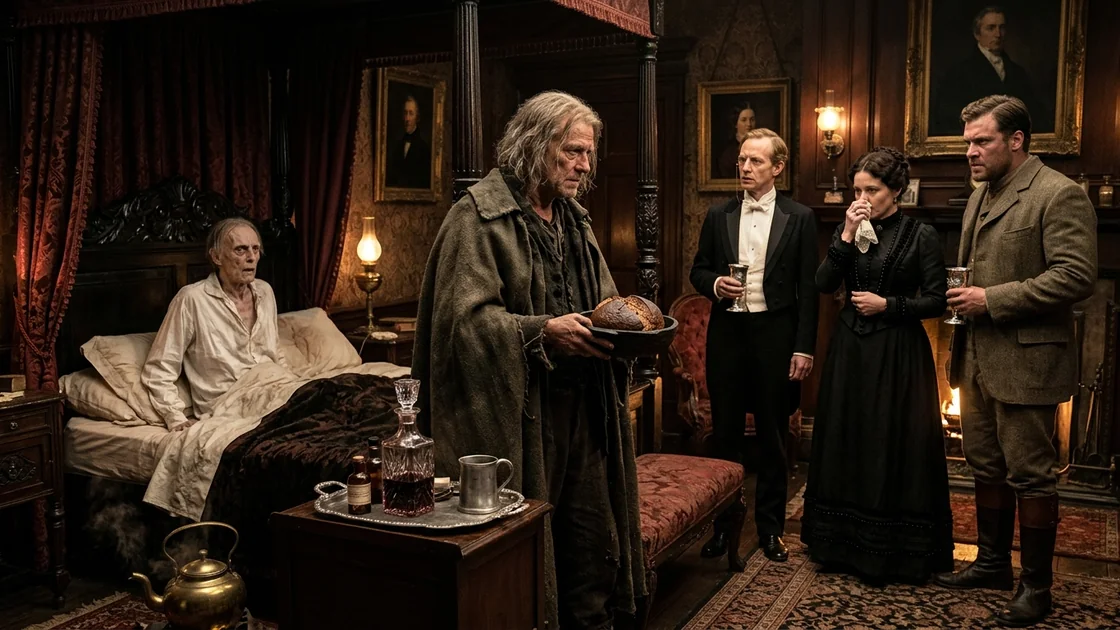
Silas Mercer is an aging sin-eater living on the poisoned fringes of a bleak industrial valley, scraping by on the meager coins of impoverished laborers who pay him to consume the petty transgressions of their dying kin. When Thaddeus Vance, the ruthless patriarch of the Vance Iron and Coal Syndicate, lies dying of a rotting lung ailment, Silas is summoned to the family estate by the magnate's three wealthy heirs: Julian, Clara, and Gideon. The heirs want Silas to consume a lifetime of monstrous industrial crimes so their father can die peacefully and leave their inheritance untainted by the ancestral curse of unpardoned guilt. However, as Silas listens to the dying patriarch confess to collapsing mines, poisoning the valley water, and slaughtering striking workers, he learns that the three children were the eager architects and executors of every atrocity. Refusing to sacrifice his own body and soul to absolve a dynasty of murderers, Silas subtly alters the ancient funerary ritual, turning the sacramental feast into a conduit that binds the crushing physical and spiritual weight of the patriarch's sins directly onto the complicit heirs who profited from them.
A lie tasted of tin and sour milk. Adultery carried the slick, cloying tang of overripe plums left to rot in the sun, leaving a greasy film across the roof of the mouth that took three days of chewing willow bark to scrub away. Theft, when committed out of hunger, had almost no flavor at all—only the dry, dusty sensation of chaff between the molars—while theft born of greed burned the back of the throat like rancid tallow.
Silas Mercer knew the taxonomy of human frailty by its flavor. At fifty-four, though he looked twenty years older, his tongue was a ledger of the valley’s quiet shames. He sat before a hearth fed by damp turf and scavenged drift-coal, turning his bog-oak bowl between his hands. The wood was as black as pitch, polished not by beeswax or linseed oil, but by the thumb-grease of four generations of men who had lived at the edge of the Blackwater Fen because the townsfolk could not bear to smell their chimneys.
Outside, the rain fell with a soft, rhythmic hiss through the dead reeds. It was not clean rain. No water that fell within thirty miles of the Vance smelters had been clean since Silas was a boy. It came down the color of pewter, carrying the sulfurous breath of twelve blast furnaces that never slept, not on Sundays, not on feast days, not when the snow piled six feet deep against the shanties of Cinderhollow. When the droplets hit the marsh grass, they left a faint, iridescent slick that smelled of dead fish and charred bone.
Silas set the bowl upon the plank table and rubbed his left knee. The joint was swollen to the size of a turnip, hot to the touch and stiff as rusted iron. That was Thomas Crofter’s envy. Old Thomas had died three Tuesdays past in a cot behind the tannery, having spent forty years coveting his brother’s two-acre potato patch and the hale wife who hoed it. It had been a small, cramped life, and a small, cramped sin, worth four copper pence and a heel of barley bread soaked in small beer. Yet as Silas had eaten the bread off Thomas’s cooling breastbone, the old man’s festering resentment had settled straight into Silas’s synovial fluid, crystallizing like gout. It would take another week of fasting and nettle-broth before he could walk without his ash-plant staff.
He reached for the kettle to pour himself a cup of boiled fen-water when the horses came.
He heard them long before he saw the lanterns. No cart from Cinderhollow had iron-shod wheels that rang with such smooth, oiled precision against the shale track, and no miner’s mule stepped with the high, synchronized clatter of matched blood-bays. The sound cut through the drizzle—a brisk, arrogant clop-clop-clop accompanied by the jingle of silver harness chains and the heavy sway of leather thoroughbraces.
Silas did not rise. Men of his trade did not run to the door like eager shopkeepers. When a sin-eater was wanted, the world came to the threshold and knocked with its eyes averted.
The carriage halted twenty yards from his dry-stone wall, where the track dissolved into black mire. Through the greased sheepskin of his window, Silas saw the yellow glow of two brass coach lamps cutting through the fog. A tall figure in a three-tiered oilskin cape climbed down from the box, boots squelching ankle-deep in the muck. The man carried a bull’s-eye lantern, which he held high as he approached the low doorway, as though he expected the cottage itself to leap out and fasten its teeth into his throat.
Three raps sounded against the weathered oak—struck not with knuckles, which might draw contamination from the wood, but with the brass butt of a riding crop.
"Silas Mercer," a voice called out. It was a town voice, nasal and clipped, trying very hard to sound commanding despite the tremor at the bottom of its chest. "You are awake. We saw your smoke."
Silas picked up his staff, levered himself up from the three-legged stool, and drew back the wooden latch. He pulled the door inward and stood in the frame, letting the heat of his turf fire spill out into the freezing drizzle.
The coachman stepped back two full paces, his hand flying instinctively to his mouth to cover his breath. He was a liveried servant of the high valley, his coat tailored from heavy navy broadcloth with silver buttons stamped with an anvil and a pickaxe crossed beneath a Rising Sun. Even in the dark, Silas knew that crest. Everyone in the basin knew it; it was stamped on the pay-scrip, on the bags of moldy flour at the company store, on the iron gates of the workhouse, and on the padlocks that chained the pit-cages.
"Who is dead at Highgate House?" Silas asked. His voice was like two flat stones grinding together in a dry creek bed.
"No one is dead yet," the coachman said, staring rigidly at the lintel above Silas’s head so as not to meet the sin-eater’s pale, watery eyes. "The Master is failing. The physicians from the capital have packed their leather cases and gone down to the parlor to drink port. They give him until the turn of the tide at four in the morning."
"Thaddeus Vance," Silas said softly.
"Lord Vance," the coachman corrected by rote, though the title sounded hollow out here among the reeds and the slag-runoff. "Mr. Julian has sent the brougham. You are to bring your bowl and whatever else your kind uses. You are not to ride inside upon the velvet; a seat has been cleared for you on the rear footboard, beneath the luggage tarp."
Silas looked past the servant toward the gleaming black shape of the carriage. The two bay horses were tossing their heads, their nostrils flared wide, white froth gathering at their bits. Horses always knew. A dog would bark at a sin-eater, and a cat would arch its spine and spit, but a horse smelled the cold tallow of a hundred buried men clinging to the wool of his coat and wanted only to bolt.
"Thaddeus Vance has three chaplains on his payroll," Silas said, leaning his weight onto his ash staff. "He rebuilt the steeple at St. Jude’s with limestone from his own quarries and bought a stained-glass window with his face painted onto the shoulders of Saint Matthew. Let the bishop absolve him."
The coachman swallowed hard. Rain dripped from the brim of his cockaded hat onto his nose. "The Bishop was there at noon. The Master spat black blood onto his surplice and told him to get out. He said the priests only have jurisdiction over the sky, and it isn't the sky that’s coming up through the floorboards for him. He wants the Eater from the fen. And Mr. Julian says the papers cannot be sealed until the old custom is observed."
"And what does Mr. Julian offer for eighty-two years of iron and coal?"
The coachman reached into his waistcoat pocket with two gloved fingers, produced a heavy linen pouch, and dropped it directly into the mud at the threshold, refusing to extend his arm close enough for their sleeves to brush. The pouch landed with a dull, musical clink—not the hollow rattle of company scrip or bruised copper, but the dense, unmistakable thud of milled gold sovereigns.
"Twenty now," the coachman said. "And thirty more when you walk back out the service gate before dawn. Enough to buy a cottage in the south counties where no one knows your face or your trade."
Silas looked down at the mud-spattered linen. He did not pick it up. He thought of his swollen knee. He thought of the forty-year-old envy of a potato farmer that was currently making his bones ache like a toothache. Then he thought of Thaddeus Vance, who owned eleven mines, four foundries, six miles of riverfront, and four thousand souls who coughed up black phlegm into rags before they reached their thirtieth year.
If a peasant’s petty jealousy could lame him for a fortnight, the soul of Thaddeus Vance would burst his heart before he finished chewing the first crust. They knew it, too. That was why the second payment was thirty sovereigns; they had no expectation of ever having to pay it. They expected to haul his stiff carcass out the service gate in a coal barrow before the cocks crowed.
"Wait by the horses," Silas said.
He turned back into the room. He did not hurry. He banked the turf fire with damp ashes so it would keep until morning, or die cleanly if he did not return. From the shelf above his narrow pallet, he took down his leather scrip. Into it he placed his bog-oak bowl, his horn spoon, and three small linen bags tied with different colored twine.
The first bag, tied with white hemp, contained coarse salt boiled down from the brackish springs at the head of the marsh—the traditional salt of the trade, meant to ground the sins in the flesh of the eater.
The second bag, tied with red wool, held dried powdered yarrow and bitter wormwood, which he used to keep his stomach from rejecting a particularly foul meal before the prayers were finished.
He paused before reaching to the very back of the shelf, behind a loose stone in the chimney breast. His fingers closed around a third object: a small lead phial stoppered with red wax, and beside it, a flat iron knife whose blade had been snapped in half during the famine of forty-eight. He slid both into the lining of his greatcoat, separate from the scrip.
Pulling his greased wool cloak over his shoulders, he blew out the tallow dip, stepped out into the rain, and shut his door. He stooped, lifted the pouch of gold from the mire, wiped the mud onto the coachman’s pristine boot-top as he passed, and climbed onto the narrow wooden footboard at the back of the brougham.
The road from the Blackwater Fen to Highgate House was a five-mile climb through the anatomy of a murder that had taken half a century to commit.
Crouched beneath the stiff canvas of the luggage tarp, smelling of old wet dog and woodsmoke, Silas watched the valley unspool behind the churning wheels. At the bottom of the basin lay Cinderhollow. Even at ten o'clock at night, the town did not sleep; it merely lay in a stupor between shifts. Along the narrow, unpaved lanes, two hundred back-to-back brick cottages huddled in the shadow of the great slag heaps—mountains of vitrified waste that steamed in the rain, smelling of rotten eggs and scorched iron. Every third cottage had a rag stuffed into a broken pane. Every fifth cottage had a strip of faded black crepe nailed to the doorpost.
Silas knew those doors. Over the last twenty years, he had crossed nearly all of them.
As the carriage lurched across the iron bridge spanning the Blackwater River, Silas looked down at the water. In his grandfather’s time, men had pulled salmon as long as a boy’s leg from those pools. Now, the water didn't even ripple like water; it moved with a heavy, viscous roll, stained a bright, venomous ochre by the arsenic and sulfuric acid draining out of the Vance washing-sheds. No alder bushes grew on its banks. Even the rats stayed ten yards back from the shingle.
Three years ago, during the dry summer when the town cisterns failed, the women of Cinderhollow had been forced to boil river water for their porridge. Silas remembered the three weeks that followed. He had eaten the sins of nineteen children and eleven mothers that August. Of course, children of six and seven had no sins worth the name—a stolen turnip, a cross word to a sister, a forgotten prayer—yet their mothers had scraped together their last pennies to hire him all the same, terrified that the black cramps twisting their babies' bellies were a judgment from heaven rather than the arsenic runoff that Clara Vance-St. Clair’s lawyers had sworn before the county magistrate was "merely natural mineral ferruginous sediment, entirely healthful to the constitution."
Silas had sat by those tiny, fever-soaked pallets, eating crusts of oat-cake while his own guts knotted in sympathy, absorbing not sin, but pure, bewildered terror. A sin-eater’s bowl did not distinguish between guilt and agony; it soaked up whatever was left on the breast when the breath went out. He still woke some nights with his mouth dry as lime-kiln dust, his tongue swollen with the phantom thirst of nineteen poisoned children.
The horses strained against their collars as the gradient steepened, leaving the town behind and entering the Gorge.
To the left, looming against the bruised orange glow of the clouds, stood the skeletal headframe of Pit Four. The great iron winding-wheel at its summit was motionless, red with rust, the wire cables dangling like snapped tendons into the flooded shaft below. The entrance had been bricked up two winters ago, mortar laid over the tomb of eighty-two men and boys.
Silas closed his eyes as they passed the gatehouse of Pit Four. He did not need to look at the brickwork; he carried the architecture of that collapse inside his own ribs. After the roof fell in—because Julian Vance had struck four hundred pounds for seasoned oak pit-props from the quarterly ledger and ordered the foremen to rob the pillars on the retreat—twelve men had been pulled out alive from the upper drift before the choke-damp rose too high. They had lived for three days in the company infirmary, their lungs crushed like stepped-on bellows, their ribs splintered through their pleura.
Silas had been smuggled into the infirmary at midnight by their wives. He had gone from bed to bed in the dark, while the company doctor slept off his brandy in the next room. Twelve times he had laid the bread on chests that heaved with the wet, whistling rattle of drowning men. Twelve times he had eaten their dying rage—the frantic, clawing panic of men buried in the dark who had cursed God and the Vance name with their last mouthfuls of foul air. Blasphemy was a heavy sin according to the church, and those men had died with their mouths full of it. Silas had taken all twelve loads into himself so their widows wouldn't have to bury them in the unconsecrated ditch behind the nettles. For six months afterward, Silas had not been able to lie flat on his back without feeling four hundred tons of shale pressing down on his sternum, suffocating him in the dark.
Higher the carriage climbed, past the timberline where the stunted, soot-choked birches gave way to the high wind-scoured moor, and finally through a pair of wrought-iron gates flanked by stone griffins holding iron ingots in their claws.
Here, the rain smelled different. The prevailing wind from the west blew the furnace smoke down into the cup of the valley, leaving the air on the ridge crisp and clean, scented with pine needles and wet heather. The gravel of the drive was white sea-shell grit, hauled forty miles by rail from the coast so that it would crunch pleasantly beneath the wheels of visitors.
Highgate House rose out of the mist like a cliff of dressed grey granite. Every window on the ground floor blazed with gaslight, casting long, golden rectangles across the manicured lawns. Instead of take-in shafts and slag heaps, there were glass conservatories steaming with tropical ferns, cedar stables warmer than any cottage in Cinderhollow, and a broad porte-cochère where two footmen waited with oiled silk umbrellas.
The carriage did not stop at the front steps. It swept around the east wing, past the kitchens where copper pans gleamed through the cellar grates, and halted in the cobbled stable-yard by the ash-bins.
"Down," the coachman barked, not looking back.
Silas lowered himself from the footboard. His left knee gave a sickening pop as his boot hit the slick cobbles, and a hot needle of Thomas Crofter’s envy lanced up into his hip. He steadied himself with his staff, adjusted his leather scrip across his chest, and stood in the glare of the yard lantern.
A narrow door set into the servants' entrance opened. A man stood there—not a footman, but the house steward, dressed in black bombazine so fine it looked like crow’s plumage. He held a saucer of burning camphor and dried lavender in one hand, waving the smoke in front of his face as he gestured Silas forward with the other.
"Wipe your boots on the iron scraper," the steward said in a hushed, tight voice. "Touch neither the wainscoting nor the banisters as we ascend. The Master’s children are in the small library. They wish to inspect you before you are permitted into the bedchamber."
"I am not a prize bull at the county hiring fair," Silas said, scraping the fen-mud from his soles with deliberate slowness. "If the tide turns at four, we are wasting the old man’s breath."
"The breath is his to waste, and your time belongs to Mr. Julian," the steward replied coldly. "Step inside, Eater, and keep your cloak wrapped tight."
The back stairs of Highgate House were narrow stone steps meant for scullery maids carrying coal scuttles, yet they were cleaner than the altar floor of the parish church. As Silas climbed, his hobnailed boots clicked loudly against the flagstones, leaving damp, dark crescents that a terrified kitchen girl on her knees forty paces behind him immediately began to scrub away with lye-soap and a bristle brush, lest the stain of his passing soak into the stone.
At the second landing, the steward unlocked a baize-covered service door and led Silas into the main house.
The transition was like stepping from a quarry into the belly of a jewel box. The air was thick, dry, and aggressively hot, pumped through brass floor-grates from huge coal furnaces in the sub-basement. The walls were paneled in dark Honduras mahogany that drank the light of crystal gasoliers, and the carpets beneath Silas’s boots were woven so thick with scarlet wool that he felt as though he were wading through fresh moss. Portraits of earlier Vances—men with iron-grey side-whiskers and women with narrow, acquisitive mouths—stared down from gilded frames.
The steward rapped softly at a set of double doors inlaid with satinwood, turned the crystal knob, and pushed them open just wide enough for Silas to pass through, pulling them shut immediately behind him.
The small library smelled of beeswax, Turkish tobacco, and the sharp, medicinal tang of eau-de-cologne. A fire of seasoned apple-wood—not coal, never coal in the family sitting rooms—burned cleanly in a marble hearth.
Three people occupied the room, arranged like figures on a stage who had paused in the middle of an argument.
Standing by the mantelpiece, warming a glass of amber brandy between his palms, was Julian Vance. He was forty-five, thin and tall, with receding sandy hair brushed meticulously across a high, pale dome of a forehead. He wore evening dress—black tailcoat, white marcella waistcoat—as though he had dressed for dinner despite the death-watch upstairs. Every few seconds, he removed his gold-rimmed pince-nez, breathed on the lenses, and polished them with a square of white cambric.
Seated in a wingback chair near the reading lamp was his sister, Clara Vance-St. Clair. At forty, she had the hard, preserved beauty of an ivory carving kept under bell-glass. She was already dressed in full mourning: heavy crêpe de chine trimmed with Whitby jet beads that clicked faintly whenever she breathed. In her lap lay a leather portfolio stuffed with foolscap pages tied in red lawyer’s tape, and a silver pencil hung from a chatelaine at her waist.
Near the window, staring out into the dark rain with his hands clasped behind his broad back, stood the youngest brother, Gideon. He was thirty-six, built like a drop-hammer, with a thick neck that strained the collar of his tweed shooting jacket. Unlike his brother, he had not bothered with formal attire; he wore knee-high cavalry boots muddied at the heels, and a long, jagged white scar ran across the knuckles of his right hand—a souvenir, the valley rumor went, from the teeth of a checkweighman he had beaten to death with a pistol butt during the strike of seventy-nine.
When Silas stepped onto the edge of the Persian rug, all three heads turned.
For a long moment, nobody spoke. The only sound was the crackle of the apple-wood and the steady, rhythmic drip of fen-water falling from the hem of Silas’s greased cloak onto the crimson wool.
Clara lifted a lace handkerchief soaked in lavender water and pressed it firmly against her nostrils. "Good God, Julian," she murmured through the linen. "Is it necessary to have him stand on the Tabriz? He smells like an open bog."
"He is what the valley provides, Clara," Julian said, his voice dry and precision-tooled, like the gears of an adding machine. He replaced his spectacles and looked Silas up and down with cold, clinical detachment. "So. You are Mercer."
"I am," Silas said.
Gideon turned from the window. He had his father’s eyes—small, dark, and set too close together beneath heavy brows, like two nuggets of anthracite embedded in dough. He walked over until he stood six feet from Silas, deliberately invading the space that ordinary men kept clear of a sin-eater, as if to prove that a captain of the Iron Guard feared neither bogeymen nor beggars. Yet Silas noticed that Gideon kept his scarred right hand tucked firmly behind his back, fingers crossed against the evil eye just like any superstitious pit-boy from Cinderhollow.
"You look half-dead yourself, old man," Gideon said, his voice a coarse baritone. "They told me in the village that you ate the lungs out of those twelve blasphemers from Pit Four and haven't walked straight since."
"I ate their words, Captain Vance," Silas replied evenly, meeting the younger man’s gaze without blinking. "Their lungs were left in your father’s shaft."
Gideon’s jaw tightened, a muscle bunching beneath his cheek, and he took half a step forward before Julian raised two pale fingers from his brandy glass.
"Enough, Gideon. We did not bring this person into the house to debate mining timber." Julian stepped forward to the edge of the hearth-rug, looking at Silas as he might look at a contractor hired to clear a blocked cesspit. "Let us understand one another, Mercer. We are educated people. My sister sits on the Diocesan Board of Charities; I am a Fellow of the Royal Statistical Society. We do not believe that a man’s moral failures are physical humors that can be sopped up with a piece of baker’s dough like spilled gravy."
"Then give me the rest of my gold," Silas said, shifting his grip on his staff, "and I will walk back down the hill. Your cellar is full of good bread and better wine; eat it yourselves."
A tense silence fell over the room. Clara’s fingers stopped tapping her leather portfolio.
"Unfortunately," Clara said, her voice tight behind her scented lace, "our father is a man of the old world. His grandfather dug the first drift-mine in this valley with a horn lantern and a hazel twig. Now that the laudanum has stopped working and the fluid is rising in his pleura, his mind has gone back to the dirt he came from. He is convinced that if he dies unshriven by the old rite, the Rot will settle into the mortar of this house and the iron in our furnaces will turn as brittle as glass."
"More to the point," Julian cut in smoothly, annoyed by his sister’s candor, "until he hears the traditional words spoken over his chest and sees the bread consumed, he refuses to sign the final codicil to the Syndicate Trust. Without that signature before witnesses, the reorganization of the coastal shipping lines will be tied up in Chancery for seven years, and the Death Duties will strip three hundred thousand pounds in liquid capital from the firm."
Silas looked from the elder brother to the sister, and finally to the enforcer by the window. There was no grief in this room. There was not even the hollow, theatrical mimicry of grief that Silas sometimes saw among rich farmers waiting for a rich uncle to die. There was only impatience—the brisk, irritable tension of three passengers waiting on a cold platform for a late train to arrive so they could board and divide the luggage.
"He is afraid of the dark," Silas said softly. "And you are afraid of the courts."
"We are practical people," Julian said. "However, my father’s delusion has become exceedingly specific over the last forty-eight hours. He knows that a standard sin-eating is a matter of five minutes—a crust of bread, a pinch of salt, a mumbled verse. He does not trust it. He says a five-minute prayer is for a sheep-stealer, not a man who built an empire."
Clara opened her leather portfolio and drew out a single sheet of heavy vellum, written in a shaky, sprawling hand smeared with dark blotches where the pen had dug through the paper.
"He dictated this at six o'clock," she said, holding it at arm’s length as though the ink itself were contagious. "He demands the Full Reckoning. He insists that he will speak the Three Great Ledgers aloud to you alone, so that nothing is left behind under his ribs. And he insists that once you have drawn them into the loaf, we—his bloodline—must witness the breaking of the bread and take the Cup of Severance, so that the debt does not follow the name of Vance."
Silas’s heart gave a slow, heavy thud against his ribs.
He kept his face entirely blank, letting his shoulders sag a fraction further so he looked only like a tired, greedy old pauper calculating his fee. The Cup of Severance. He had not heard that name spoken aloud since his grandfather had died forty years ago in the year of the Great Frost.
In the old lore of the valley—the lore that predated the churches, the mines, and the Vance Syndicate—when a chieftain or a blood-lord died with crimes too vast for a single sin-eater to swallow without dying on the spot, the family would stand around the bed and drink a single drop of watered wine from the rim of the Eater’s cup before the Eater swallowed the dregs. By touching their lips to the vessel and speaking the words of severance—From our blood to thy belly, from our house to the mire—they legally and spiritually cut the tether binding the ancestor’s crimes to the surviving kin, shunting the entire momentum of the curse into the scapegoat with thrice the force.
It was a spiritual guillotine. It guaranteed that the family walked away pristine as newborn lambs, while the sin-eater took the full, unbuffered weight of the blood-line's taint directly into his marrow.
"He wants the Cup of Severance," Silas repeated slowly, his voice trembling just enough to sound like fear. "That is an old rite, Mr. Vance. A hard rite. The last man who drank the dregs of a Severance Cup in this county went blind before he reached the lych-gate and died of the black vomit before Sunday."
"Which is why," Julian said, reaching into his waistcoat pocket and placing a second, heavier linen bag on the corner of the reading table, "we have doubled the final payment. Sixty sovereigns upon completion, Mercer. Alongside the twenty in your pocket, that is eighty pounds in gold. More money than a dozen miners see in a decade underground."
"And if I die on the flagstones?" Silas asked.
Gideon gave a short, ugly laugh. "Then you won't need a cottage in the south counties, will you? And we’ll bury you in a pine box with the gold on your eyes."
Silas looked at the three of them. He saw the cold calculation behind Julian’s spectacles; the pious, ledger-keeping malice in Clara’s pressed lips; the brutal arrogance in Gideon’s scarred fists. They were not merely complicit in their father’s life; they were its organs. Thaddeus Vance was the brain, rotting in its skull upstairs, while here before him stood the hands that wrote the orders, the mouth that lied to the magistrates, and the boot that stomped the faces into the mud.
And they wanted him to wash them clean for eighty pieces of gold, so they could spend the next forty years grinding Cinderhollow’s grandchildren into soot.
"I will need wine," Silas said, lowering his head submissively. "Not the thin sour stuff from the taverns. Deep wine, heavy and dark, to hold what he has to say. And a round loaf of unbolted wheat bread, baked today, unbroken by a knife. As for the salt... I have my own salt."
"The butler has already set out a decanter of the forty-seven Oporto and a kitchen loaf on the sideboard outside the master suite," Clara said, snapping her portfolio shut with a sharp crack. "You will go up now. You will listen to his driveling until he has emptied his mind. When you are ready to eat the bread and pour the Cup of Severance, you will ring the silver bell by the door. We will come up, drink the drop of severance, witness his signature on the codicil, and then you will swallow the meal and leave this house forever."
"One thing more," Julian added, his voice dropping an octave into a register of cold warning. "My father’s mind is wandering. He may speak of... operational matters concerning the mines, the river, and the labor disputes of seventy-nine. You are a peasant, Mercer, and no magistrate in the kingdom would take the word of a sin-eater over a peer’s children, even if you tried to repeat a dying man's ravings. Nonetheless, if I ever hear that you have opened your mouth between here and the southern sea, Gideon will ride down to whatever ditch you have bought for yourself and cut your tongue out at the root. Do we understand each other?"
Silas bowed his head until his tangled grey hair fell across his brow.
"A sin-eater does not speak what he eats, Mr. Vance," Silas whispered. "Once it is swallowed, it belongs to the body that holds it. That is the law."
"See that you keep it," Julian said. "Now get upstairs. The smell in here is becoming intolerable."
The master suite occupied the entire west wing of the third floor.
As the steward led Silas down the long gallery, the house grew quieter, the thick carpets muffling their footsteps until they seemed to be walking underwater. Yet as they approached the tall mahogany doors at the end of the hall, a new sound emerged—a wet, rhythmic, mechanical wheezing, like a broken forge-bellows being worked by a tireless idiot.
Hhhh-kuh. Hhhh-kuh. Hhhh-kuh.
And beneath the sound, there was the smell.
The steward had placed brass bowls of burning myrrh and chloride of lime on pedestals flanking the doorway, yet the chemical perfume only mingled with the stench leaking through the keyhole to create something infinitely worse. It was the smell of stagnant marsh gas trapped in an old drift, combined with the sweet, coppery tang of gangrenous meat.
Silas stopped before the sideboard beside the door. On a silver tray sat a round, dark loaf of farm bread and a cut-crystal decanter half-full of vintage port so dark it looked like clotted venous blood in the dim gaslight. Beside the decanter stood four small silver goblets—three clean and polished for the heirs' token sip, and one dented pewter mug brought up from the scullery for Silas.
"He is alone?" Silas asked the steward.
"The nurses were sent out ten minutes ago at his screaming insistence," the steward whispered, his face the color of lard. "Go in. I will be at the far end of the gallery. Ring the bell when the bread is prepared."
The steward practically fled down the corridor, his black coat tails flapping.
Silas did not open the door immediately. Instead, he set his leather scrip on the sideboard, glancing down the empty hall to ensure the steward had turned the corner. Working with the quiet, practiced speed of a snare-setter, Silas reached into the torn lining of his greatcoat and drew out the broken iron knife and the small lead phial stoppered with red wax.
In the old tongue of the fen-men, the broken knife was called a Weir-Blade. It had been snapped across the coffin of a man who had died of starvation outside a full granary during the famine of forty-eight. A whole blade severed; a broken blade turned the current back upon its source.
Silas laid the flat of the rusted iron against the underside of the bread loaf and drew it backwards—from point to hilt, three times—carving an invisible cross that tore the crust without dividing it. Then he unstoppered the lead phial. Inside was not poison—poison was a gentleman’s trick, crude and easily detected by the tongue or the coroner. Inside was water drawn from the Blackwater River at the exact spot where the Pit Four drainage sluice met the arsenic runoff from the washing-sheds, boiled down in a copper pot with three drops of Silas’s own blood drawn from his swollen knee, and thickened with the grey burial-ash of the nineteen children of Cinderhollow.
It was Memory-Brine. In the alchemy of the trade, a sin-eater’s blood was a sponge; it drank whatever was near it. When mixed with the physical trace of the crime, it acted not as a drain, but as a lodestone—a terrible, hungry magnet that woke the sleeping guilt in the blood of anyone who shared its salt.
Silas tipped three drops of the grey brine into the crystal decanter of port, swirling the heavy red wine until the cloud vanished. He tipped three more drops into his bag of white marsh-salt, kneading the damp crystals with his grey-stained thumb until the moisture was entirely absorbed.
Then he hid the phial and the broken blade back in his coat, picked up the silver tray, and pushed open the door to the bedchamber.
The room was vast, cavernous, and stiflingly hot. Heavy velvet curtains were drawn across the tall windows, shutting out the rain. A massive four-poster bed of carved black oak stood on a dais in the center of the room, draped in crimson brocade that looked, in the flickering light of two shaded oil lamps, like the flayed skin of some prehistoric beast.
In the center of the mattress, propped nearly vertical by a mountain of sweat-stained goose-down pillows, lay Thaddeus Vance.
He had once been a giant of a man, six feet two inches tall with shoulders forged at the anvil in his youth, before he had traded the hammer for the ledger. Now, he looked like an effigy made of tallow and stretched parchment that had been left too close to the oven. His skin was a translucent, waxy grey, pulled tight over the massive cage of his ribs and the jutting promontories of his cheekbones. A silver tube curved from a boiling copper kettle of eucalyptus water near the bed, feeding warm steam toward his open mouth, yet every breath he took required the violent convulsion of his neck tendons and produced a sound like wet gravel sliding down a zinc chute.
His eyes, however, were wide open. They burned with a frantic, yellow lucidity in the sunken dark of his sockets.
"Shut the door," the thing on the bed rattled. Each word was followed by a wet click at the back of his glottis. "Shut it tight, damn you. The draft... brings the dust up from the cellar."
Silas kicked the door shut behind him, walked across the floor, and set the silver tray upon a mahogany table cleared of medicine bottles beside the bed. He did not bow. In this room, before the nakedness of death, the hierarchy of the valley was inverted; the baron was the beggar, and the pauper held the key to the gate.
"There is no dust in the cellar, Thaddeus Vance," Silas said quietly, setting his bog-oak bowl beside the lamp. "The draft is inside your chest."
The old man’s skeletal hands, covered in brown liver spots and blue knotted veins, clawed at the silk counterpane. "You're Mercer. William Mercer’s boy."
"I am."
"Your father... ate the sins of my brother Jacob in fifty-six," Thaddeus wheezed, his eyes fixed hungrily on the black wooden bowl. "Jacob had a clean passing. Went to sleep like a child after your father took the bread off his breast. No screaming. No... shadows behind the wardrobe."
"Your brother Jacob cheated on his coal-weights and kept a tavern girl in Oakhaven," Silas said, unbuckling his leather scrip. "My father walked with a limp for a month and spat sour phlegm, and that was the end of it. You are not Jacob."
A spasm of coughing seized the industrialist. His back arched off the pillows, his mouth opening wide as a string of dark, rust-colored mucus dribbled over his lower lip onto his silk nightshirt. Silas did not reach for a towel to wipe it; he simply watched with the calm patience of a crow on a fencepost.
When the spasm passed, Thaddeus slumped back, trembling violently. The terror in his yellow eyes was absolute, stripped of all human dignity.
"They are under the bed, Mercer," the old man whispered, his voice cracking into a high, thin whine. "I hear their picks. Tink, tink, tink against the floorboards. When the lamp goes down... I can smell the wet wool of their jackets. And the water... the water is rising up the bedposts. If I close my eyes, my mouth fills with silt."
"The dead do not dig, Lord Vance," Silas said, taking the round loaf of bread in both hands and placing it directly upon the rising and falling center of the old man’s sunken chest, right over the breastbone where the silk was stained with blood. "It is your own memory digging at you. The soul cannot cross the ditch while it carries iron. If you want me to eat it, you must bring it up into the bread. All of it. If you keep back one ounce, the whole loaf turns to stone in my teeth and you go down into the pit with the rest."
Thaddeus reached up with both trembling hands and clamped his gnarled fingers over the loaf on his chest, pressing it down against his sternum as if trying to force the rot out through his ribs into the wheat.
"You can hold it?" Thaddeus gasped, staring up into Silas’s weathered face. "You’re a fen-Mercer. Your blood is deep. You can take it and carry it out into the marsh where it can't find me?"
"The bread will hold whatever is put into it," Silas answered carefully, choosing every word like a man stepping across black ice. "And those who take the meal will carry the weight to the end of their days. Speak the Three Ledgers, Thaddeus. The tide turns at four."
Silas opened the linen bag of marsh-salt—now damp and grey with the Memory-Brine—and took a heavy pinch between his thumb and two fingers.
"The first pinch for the earth you broke," Silas intoned, his voice dropping into the ancient, rhythmic cadence of the Sin-Eater’s Liturgy. He scattered the grey crystals across the top of the loaf on the dying man’s chest. "Speak the sin of the stone."
Thaddeus Vance closed his eyes, his fingers digging deep into the crust of the bread. A long, shuddering breath whistled through his teeth.
"Pit Four," the old man whispered. "November of eighty-nine. The seam was dipping under the old river bed. The surveyor—MacAllister—he came to Highgate with the charts. He said the shale roof was rotten with water-seep. He said if we pulled the coal out of the supporting pillars without putting in twelve-inch Baltic oak timbers, the river-weight would punch through the drift before Christmas."
Silas stood motionless by the bedpost. "And you told him to pull the pillars."
"No!" Thaddeus’s eyes snapped open, fierce and desperate to share the poison. "Not I alone! I was eighty years old, Mercer, half-blind with the cataracts! It was Julian! Julian brought me the ledger after dinner. He showed me the price of Baltic timber after the tariff. He said, 'Father, the seam is nearly worked out anyway. If we timber it, we lose sixpence a ton on the winter contracts. If we rob the pillars fast and pull the gear out by December, the roof can fall in January for all we care, and we save four thousand pounds.'"
A drop of sweat rolled down Thaddeus’s grey temple into the pillow.
"I signed the order," the old man rasped. "I signed it because I loved the look of the balance sheet when the margins topped twelve percent. And when the roof came down three weeks early, while the day-shift was at the face... Julian and I sat in the telegraph office listening to the bells stop ringing. The rescue crews from Oakhaven wanted to bore through from the number three cross-cut. They said the men in the high drift would have air for four days. Wait, they said. Let us dig."
Silas felt his own chest tighten, remembering the twelve broken men in the infirmary. "Why did you brick the shaft while they were still knocking on the pipes?"
"Because the fire-damp behind the fall had caught!" Thaddeus cried softly, tears of pure terror leaking from the corners of his eyes. "Julian calculated that if the fire reached the main coal-face in Section Two, it would burn for ten years and ruin three hundred thousand tons of prime coking coal! To save the men, we had to pump air down; to save the coal, we had to seal the shaft and flood the lower levels to choke the fire! Julian looked at me across the table and said, 'Eighty men in wages and widow-pensions cost the firm sixteen hundred pounds. The coal in Section Two is worth ninety thousand.' So I told Gideon to take the constabulary and clear the women away from the pit-head with clubs while the masons laid the bricks! We drowned them in the dark to save the coal, Mercer! I can hear them knocking on the inside of my ribs!"
Silas looked down at the loaf of bread. In the dim light of the oil lamp, the white flour dusting the crust seemed to have darkened, drinking in the foul moisture of the old man’s sweat and the invisible, suffocating miasma rising from his chest. The air in the room had grown noticeably colder, and the shadows behind the heavy crimson bed-curtains seemed thicker, pressing inward like men standing shoulder to shoulder in a narrow drift.
Silas reached into the bag for the second pinch of salt.
"The second pinch for the water you fouled," Silas chanted softly, scattering the grey grains across the center of the loaf. "Speak the sin of the stream."
Thaddeus’s chest heaved. The wet rattle in his throat sounded exactly like river mud sucking at a boot.
"The new arsenic roasters at the copper-works," Thaddeus whimpered. "In the spring of ninety-one. The settling ponds on the ridge were cracked. To rebuild the clay dams would have halted the smelters for six weeks during the spring shipping season. Clara... Clara came up from London with her husband’s solicitors. She inspected the cracks herself."
"She sits on the Board of Charities," Silas murmured.
"She sits on thirty percent of the common stock!" Thaddeus snarled, a flash of his old, venomous tyrannical self breaking through the panic. "She is cold as a well-chain, my daughter! When the arsenic slag broke through the lower dike into the Blackwater during the July drought, the village doctor—young Evans—came up here with bottles of yellow water and a dead trout. He said if we didn't open the high estate reservoirs and pipe clean moor-water down to Cinderhollow, half the infants in the rows would die of the bloody flux before harvest."
"And the reservoirs stayed locked," Silas said, his tongue suddenly dry as lime-dust with the memory of nineteen tiny coffins.
"Clara said that if we opened the estate pipes or paid to haul water by rail, it would be seen in the courts as an admission of liability!" Thaddeus gasped, his fingers convulsing on the bread. "She said, 'Papa, if we give them one barrel of clean water, every peasant from here to the sea will sue the Syndicate for poisoned wells. Deny everything. Say it is the summer cholera brought in by Irish tinkers.' She paid the county analyst two hundred guineas to lose the water samples! And when the village doctor threatened to write to the London papers, she had the bank foreclose on his father’s mortgage in Oakhaven and drove the boy to hang himself in his dispensary! And that winter... when the widows of Pit Four couldn't pay the cottage rent... Clara signed the eviction writs on Christmas Eve so she could tear down the south row and build the new railway siding! Nineteen children in August, Mercer, and six women frozen in the quarry caves in January! Take them off me! They’re so cold!"
The bread on the old man’s chest was heavy now—visibly sagging in the center as though a stone had been dropped into the dough. A faint, bitter odor of garlic and vitriol—the unmistakable chemical tang of scorched arsenic—rose from the crust.
Silas’s own hand trembled slightly as he reached for the third pinch of salt. Even standing three feet back, without having put a crumb to his lips, the sheer density of the evil accumulating in the room made his head swim and his vision blur with red spots. If he ate this loaf, he would not even make it down the back stairs. His stomach would rupture before he reached the scullery door.
"The third pinch for the blood you spilled," Silas whispered, letting the last of the grey, blood-spiked salt fall upon the loaf. "Speak the sin of the iron."
Thaddeus was fading fast now. His lips had turned the dark, bruised purple of a sloe berry, and his eyes rolled upward until mostly the yellowed whites showed.
"The Great Strike," he breathed, the words barely audible above the hiss of the eucalyptus kettle. "Seventy-nine. The men camped on the common with their wives. They had no bread... only turnips from the fields. They weren't rioting. They were just sitting in the frost by the pit-gates so the blacklegs from Wales couldn't go down the cages. I wanted to offer them a ha'penny on the ton just to get the furnaces lit before the iron cooled and cracked the linings."
"Who stopped you?"
"Gideon," the dying titan whispered. "Gideon had just come back from the colonial wars with his head full of cavalry charges. He hated them, Mercer. He hated the way they looked at him when he rode through the town. He told me, 'If you give them a ha'penny today, they’ll ask for a shilling next winter. Let me teach them who owns the dirt their boots stand on.' That night... Gideon sent two of his own sergeants in miners' caps to set fire to the company hay-ricks. Then he read the Riot Act to a sleeping camp at three in the morning... and charged the tents with forty mounted guards swinging pick-handles shod with iron."
Thaddeus gave a long, wet, bubbling groan, a trickle of black blood running down his chin into his white whiskers.
"They rode down women in their shifts, Mercer. Gideon broke the union secretary’s back across an anvil in the smithy and threw him into the canal while he was still breathing, then had the coroner write drunken misadventure. Twenty-three dead in the mud, and forty maimed for life. I gave Gideon a gold watch and a thousand shares of preferred stock for clearing the gates by Monday morning. Oh, God... the horses... I can hear the iron shoes hitting the skulls..."
Silence fell over the great bedchamber, broken only by the shallow, fluttering rattle of Thaddeus Vance’s dying lungs. He had emptied himself. His hands slipped off the loaf of bread and fell limp against the crimson silk counterpane.
The loaf sat upon his breastbone like a toad bloated with black venom.
Silas stood over the bed, looking down at the bread. In all his fifty-four years, and in all the stories told by his father and grandfather before him, no sin-eater had ever looked upon such a meal. It was not a crust of peasant frailty; it was a mountain of crushed bone, poisoned water, and burning tents, condensed by eighty years of unrepentant tyranny into two pounds of baker’s wheat.
"Is it... in the bread?" Thaddeus whispered, his eyes blind now, staring at the canopy above him.
"It is in the bread," Silas said.
"And you will eat it? You will take the Cup of Severance with my children... so the house stands clean?"
Silas picked up the bog-oak bowl and the horn spoon.
"I will divide the feast as the law of the valley demands," Silas said softly. "And those who earned the wage shall take the weight."
Silas walked to the door, opened it, and picked up the small silver hand-bell from the sideboard. He rang it once.
The clear, bright note cut through the silent house like a scalpel.
While he waited for their footsteps on the stairs, Silas carried the silver tray with the crystal decanter and the four cups to the bedside table. He lifted the heavy, darkened loaf from Thaddeus’s chest—it felt strangely cold and dense in his palms, like wet clay—and placed it directly into his blackened bog-oak bowl.
With his horn spoon, he broke the crust from the center outward, tearing three small, bite-sized morsels from the very heart of the loaf where the three pinches of grey salt had soaked into the crumb.
Instead of placing those three pieces aside for himself, he dropped one piece into each of the three polished silver goblets meant for the heirs. Into his own dented pewter mug, he dropped only a single dry flake of crust from the outer rim where the Weir-Blade had turned the current back.
Then he lifted the crystal decanter of forty-seven Oporto—laced with the boiled water of the Blackwater River, the ashes of the nineteen children, and three drops of his own sin-soaked blood—and poured a generous measure into the three silver goblets, submerging the bread so that the heavy, dark wine soaked instantly into the crumb like blood into a sponge. Into his own pewter mug, he poured half an inch of the wine.
The bedroom door swung open.
Julian entered first, carrying an inkstand, a steel-nibbed pen, and the vellum codicil. Behind him came Clara, her lavender handkerchief pressed tightly to her nose, and Gideon, who paused on the threshold, his broad nostrils flaring as the suffocating stench of the room hit him.
Even the three of them—armored in their wealth, their statistics, and their brute force—faltered for a heartbeat as they stepped toward the dais. The air around the four-poster bed was so heavy with unseen pressure that the flames of the two oil lamps burned small and blue, flattened down against their wicks as if someone were pressing a glass jar over them.
"He looks worse," Clara whispered, shrinking back slightly from the bedpost. "Has he signed?"
"He was waiting for the severance," Silas said, stepping back into the shadow of the bed-curtains and holding his head low. "He has spoken the Three Ledgers into the loaf. Every ton of stone, every drop of water, every stroke of iron is bound into the wheat and the salt."
Julian walked briskly to the bedside, refusing to let the atmosphere of the sickroom rattle his composure. He leaned over his father, dipping the steel pen into the inkhorn.
"Father," Julian said loudly, his voice sharp and administrative. "The Eater is here. We are here to witness the severance and free you of the debt. Take the pen. The line is at the bottom of the third page."
Thaddeus’s blind, yellowed eyes rolled toward the sound of his eldest son’s voice. His skeletal right hand twitched on the silk sheet.
"The Cup..." the old man rattled, a bubble of bloody froth forming at his lips. "Drink the severance first, Julian... swear the blood-oath... or it stays in the house... it stays on me..."
Julian let out an audible sigh of irritation. He straightened up and turned toward the bedside table where Silas stood beside the silver tray.
"Get on with it, Mercer," Julian snapped. "Give us the token cup so he can hear us speak the nonsense and put his name to the paper before his hand stiffens."
Silas lifted the silver tray and held it out between them.
"The Rite of the High Valley requires that the bloodline cut the cord before the Sin-Eater swallows the stone," Silas recited, his voice deep, resonant, and rolling like thunder over the high moor. His left knee no longer hurt; the proximity of the Weir-Blade and the impending inversion had made his blood hum like a plucked wire. "Take each your vessel. Julian, eldest of the house. Clara, daughter of the house. Gideon, shield of the house."
One by one, they reached out and lifted the silver goblets from the tray, careful not to let their pale fingers brush Silas’s grey-tipped knuckles.
Clara looked down into her cup and frowned behind her lace. "Why is there bread floating in the wine? I thought we were only to wet our lips from the rim."
"Your father confessed three great ledgers, madam," Silas said smoothly, never raising his eyes from the floor. "A drop on the lip will sever a petty debt. To sever eighty years of the Syndicate from your bones and your children’s bones, the heir must swallow the witness-crumb soaked in the Cup of Severance while the Eater takes the body of the loaf. If you leave the crumb in the silver, a third of your father’s burden remains attached to your skirts when he dies."
Clara’s eyes widened slightly with revulsion—not at the crime, which she knew well enough, but at the thought of putting anything touched by a sin-eater into her mouth, balanced against her deep, unspoken terror that the old man might actually be right about the curse.
"It is forty-seven Oporto and kitchen bread from our own ovens, Clara," Gideon muttered impatiently, swirling the dark liquid in his goblet. "Swallow the damned sop so the old man will sign the paper and we can open a window."
Silas picked up his pewter mug in his right hand and lifted his bog-oak bowl containing the broken loaf in the crook of his left arm.
"Look upon your father," Silas commanded, and for the first time that night, there was an edge of cold iron in his voice that made all three of them turn instantly toward the bed. "Repeat the words of the Binding as they were spoken when the first shaft was sunk in the Blackwater Basin. Speak them clearly, or the dead will not hear."
Silas raised his pewter mug an inch.
"What was done in the dark, let the dark remember," Silas intoned.
"What was done in the dark, let the dark remember," Julian, Clara, and Gideon repeated in unison, their voices ranging from Julian’s dry tenor to Gideon’s bored rumble.
"What was bought with the blood, let the blood account for," Silas chanted.
"What was bought with the blood, let the blood account for," the three heirs echoed.
Silas’s eyes flashed in the blue lamplight. Here, in the traditional rite, the words were supposed to be: From our hands to the stranger’s belly, we cast the stone away.
Instead, Silas spoke the older phrasing—the Kinslayer’s Inversion, where the meaning turned entirely upon a single word that sounded identical to the uninitiated ear, yet meant the exact opposite before the witness of the salt.
"Let the weight fall true upon the hand that earned the wage," Silas said, his voice ringing off the mahogany panels. "By the salt of the marsh, by the water of the river, by the ash of the bone—let the sharer of the feast bear the whole of the meat."
"Let the weight fall true upon the hand that earned the wage," they repeated blindly, Julian already reaching into his pocket for the blotting sand. "Let the sharer of the feast bear the whole of the meat."
"Drink," Silas whispered. "And swallow the bread."
Gideon tossed his head back first, gulping the mouthful of vintage port and swallowing the wine-soaked morsel of bread from the heart of the loaf in a single, greedy motion. Julian followed half a second later, drinking with neat, fastidious precision, his throat working as the heavy crumb slid down his gullet. Clara pinched her eyes shut, tipped the silver goblet to her lips, and forced the wet bread down with a small, disgusted shudder.
Silas lifted his pewter mug to his lips, let the dry flake of un-salted outer crust touch his tongue without swallowing a single drop of the wine, and then—with a sudden, violent sweep of his arm—dashed the bog-oak bowl and the remainder of the loaf straight into the open flames of the bedroom fireplace.
The fire did not smother.
It exploded upward with a roar like a blast-furnace door being flung wide, a column of greasy black and green flame shooting up the chimney breast accompanied by the deafening, phantom screech of tearing iron cables and rushing water.
"What the devil are you doing?!" Julian shouted, dropping his silver goblet onto the carpet. "You didn't eat the loaf!"
"I am the conduit, Mr. Vance, not the cesspit," Silas said, standing straight and tall now, his ash-plant staff held loosely at his side as the green firelight danced across his weathered face. "A sin-eater can only swallow what belongs to the dying man alone. He cannot eat what belongs to the living who stand beside the bed with their hands full of the gold."
On the bed, Thaddeus Vance gave one last, convulsive jerk. His back bowed like a drawn longbow, a long, whistling sigh escaped his purple lips, and then he collapsed flat into the pillows, his yellow eyes staring fixed and empty at the ceiling. The codicil on the bedside table remained unsigned, its white parchment gleaming blankly beside the overturned inkhorn.
"He’s gone!" Clara shrieked, lunging toward the bed. "Julian, his hand! Put the pen in his hand while it’s still warm!"
Julian took one step toward the bed, and then his knees buckled.
He did not fall gracefully. He dropped to the scarlet carpet as if a four-hundred-pound oak beam had fallen out of the ceiling and struck him square across the shoulders. His gold pince-nez flew from his nose and shattered against the mahogany bedpost.
"Julian?" Clara spun around, her face white. "Julian, get up!"
Julian could not answer. He was on all fours on the Persian rug, clawing frantically at the collar of his white evening shirt, tearing the pearl studs from the linen as his mouth opened and closed like a landed carp.
Silas watched him calmly. In the center of Julian’s goblet had been the first pinch of salt—the salt of Pit Four.
To Julian Vance’s eyes, the gaslit bedroom had vanished. He was no longer on the third floor of Highgate House; he was nine hundred feet underground in the black, pitchy dark of the upper drift. He could smell the choke-damp—thick, sweet, and suffocating—filling his nostrils and driving the oxygen from his blood. And worse than the dark was the weight. Four hundred tons of wet river-shale were settling onto his spine, pressing his breastbone flat against his backbone, grinding his ribs inward millimeter by millimeter while eighty voices screamed his name out of the blackness around him.
Hhhh-kuh. Hhhh-kuh.
The exact wet, whistling rattle that had just left Thaddeus Vance’s dead chest erupted from Julian’s throat. He rolled onto his side, curling his knees to his chest, his manicured fingernails tearing red furrows into his own neck as he fought for a breath of air that would never feel full again for as long as he lived.
"Julian!" Clara backed away from her writhing brother, her hands flying to her throat—and then she stopped dead.
A sound came from deep inside her silk mourning bodice: a wet, gurgling churn, as though she had swallowed a pint of boiling battery acid.
She dropped her lace handkerchief and doubled over, clutching her stomach with both hands. The second pinch of salt—bound with the actual boiled brine of the Blackwater River and the burial-ash of Cinderhollow—had reached the bottom of her belly.
"Water," Clara gasped, her refined voice cracking into a ragged croak as her tongue swelled thick and black inside her mouth, coated instantly with the phantom lime-kiln dryness of arsenic poisoning. "Gideon... my mouth... it’s burning! Give me water!"
She stumbled toward the bedside table, her jet beads clicking frantically like chattering teeth, and seized the copper eucalyptus kettle—not caring that it had been breathing into her dying father’s mouth ten seconds ago—only to knock it to the floor with a crash as a violent wave of freezing cold slammed into her marrow.
The heat of the bedroom was gone for her. She was standing barefoot in the snow of the quarry caves on Christmas Eve, her silk dress soaked in sleet, while nineteen small, ice-cold pairs of hands reached up out of the dark carpet and fastened their frozen fingers around her ankles, dragging her down to the floor beside her brother. She began to vomit—not wine, not bread, but thin, yellow, foul-smelling river silt that stained the Tabriz rug in wide, ochre pools while she shivered so violently her teeth chipped against one another.
"Witchcraft!" Gideon roared.
The youngest brother stood six feet away, his face purple with terror and rage. Yet even as he reached into the pocket of his tweed jacket for his bulldog revolver, his scarred right arm began to jerk and twist as though someone were striking his elbow with a sledgehammer.
The third pinch of salt—the salt of the Great Strike—was racing through his veins like liquid fire.
Gideon never got the pistol clear of the cloth. With a howl that sounded less like a man and more like a horse caught in a burning stable, he dropped to one knee, clapping both hands over his ears.
Inside his skull, the quiet of the estate had been replaced by the deafening, unending roar of forty iron-shod hooves galloping across frozen mud, accompanied by the wet, sickening crunch of pick-handles shattering bone. Every blow his men had dealt on the common in seventy-nine, every rib he had cracked in the smithy, every tooth that had broken against his knuckles came home to roost in his own nervous system all at once.
His right hand—the hand with the dead miner’s scar—twisted backward at the wrist with an audible snap of tendons pulling taut against themselves, the fingers curling into a permanent, crippled claw. He smelled burning hay and scorching human hair; he felt the phantom weight of an anvil crushing his lower spine until his legs went numb beneath him, pitching him face-first onto the floorboards beside the spilled eucalyptus kettle.
Silas Mercer stood alone in the center of the carnage.
Around his boots, the three masters of the Blackwater Basin writhed in the dim, guttering light of the oil lamps—Julian choking in the perpetual dark of his collapsed mine, Clara burning with arsenic thirst and freezing in the quarry snows, and Gideon screaming beneath the hooves of his own phantom cavalry.
They would not die tonight. Silas knew the measure of the salt he had used. If they died tonight, the debt would end too quickly, and some distant cousin from London would come down on the train to take the mines and start the ledger all over again.
No, they would live for years. They would live in this vast, overheated tomb of a house, tended by terrified servants who would bleed their fortune dry drop by drop while Julian gasped through oxygen tubes in darkened rooms, Clara drank gallons of water that turned to vinegar in her throat, and Gideon lay paralyzed in a bath-chair, screaming whenever a horse trotted across the gravel outside. The codicil would go into Chancery; the Syndicate would fracture and collapse under five hundred lawsuits; the furnaces down in the valley would cool, crack, and go dark; and the river, given twenty years of rest, would wash its own stones clean.
Silas looked down at his left knee.
He flexed his leg. The swelling was gone. When the Weir-Blade had turned the current of the ritual backward and the bog-oak bowl had burned in the grate, forty years of accumulated peasant sins—even old Thomas Crofter’s stubborn envy—had been sucked out of Silas’s marrow by the vacuum of the great inversion and dumped straight into the silver goblets along with the rest.
For the first time since he had taken up his father’s bowl at nineteen, Silas Mercer felt nothing in his mouth but the clean taste of his own spit.
He walked to the small reading table where Julian had left the second linen bag of sixty gold sovereigns. He looked at the heavy yellow pouch for a moment, and then he left it sitting there beside the unsigned parchment. He took the twenty sovereigns from his own coat pocket—the blood-money the coachman had dropped in the mud at his door—and tossed the pouch onto the chest of Thaddeus Vance’s corpse, weighting down the dead man’s silk nightshirt.
"Keep the fee, Thaddeus," Silas said to the empty shell on the bed. "You paid for the meal yourself."
He left his ash-plant staff leaning against the bedpost; he had no further use for a walking stick. Turning his back on the groaning heirs and the dead patriarch, he opened the mahogany doors and walked out into the quiet gallery.
The house steward was waiting at the head of the stairs, holding his saucer of burning camphor. When he saw Silas walking toward him—striding upright without a limp, his hands empty of both bowl and staff, while from the open bedroom door behind him came the horrific chorus of three people drowning, burning, and breaking in the dark—the steward’s face went grey as wood-ash. He pressed himself flat against the wall, dropping his saucer of camphor to the carpet as he crossed himself frantically.
Silas did not look at him. He walked down the broad front staircase—ignoring the service steps—his hobnailed boots leaving no mud behind on the scarlet wool, for the mire of the fen had dried from his soles. He unbolted the massive oak front doors of Highgate House himself and stepped out beneath the granite porte-cochère.
The rain had stopped.
Down in the basin, five miles below the ridge, the clouds were parting before a sharp wind blowing in from the western sea. For the first time in Silas’s memory, two of the twelve great blast furnaces at the Vance works had banked their fires for the shift change, and thin ribbons of clean, pale starlight were reflected in the surface of the river.
Silas drew a deep, unhurried breath of the cold moorland air, tasting pine needles, wet heather, and nothing else at all, and began the walk down the hill.