The Darkness Off Gallow's Reef
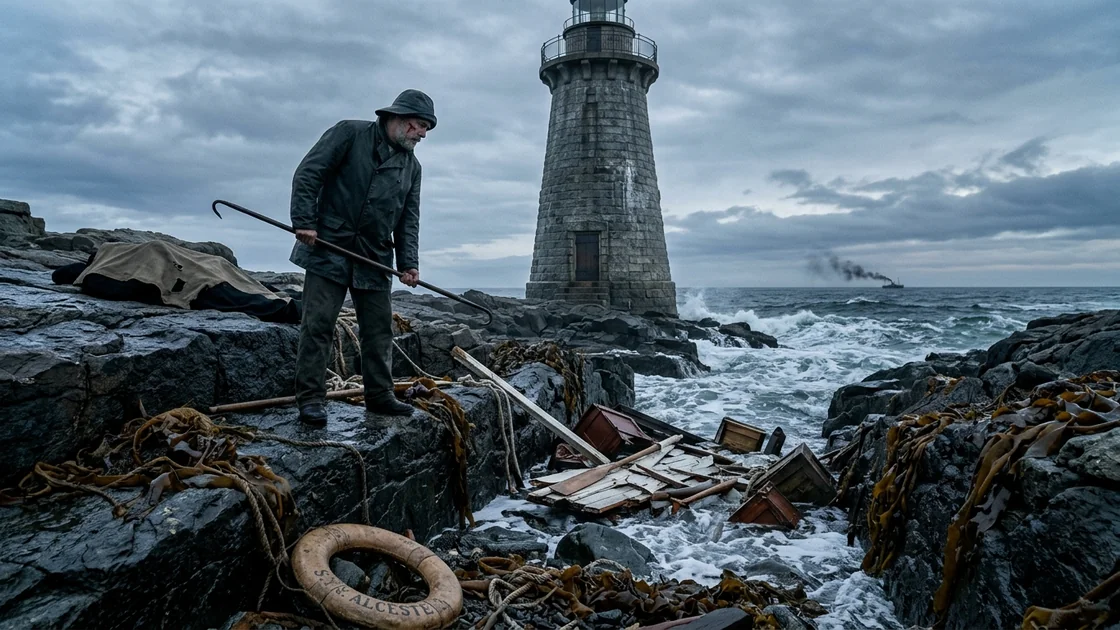
In the winter of 1879, Silas Vance tends the isolated beacon upon Gallow's Ledge, a jagged spine of granite fifteen miles off the coast of Maine. For seven years he has kept the great lamp burning through fog and gale, living in quiet grief for his younger brother Julian, an honest shipbuilder who was financially ruined, disgraced, and driven to his death by the ruthless shipping magnate Cornelius Thorne. When a supply boat brings news that Thorne is sailing down the coast from Halifax aboard his private steam yacht during a rising equinox storm, Silas realizes the magnate will rely entirely upon the Gallow's Ledge light to clear the lethal shoals known as the Shambles. Consumed by a cold desire for retribution, Silas drugs his young assistant keeper and climbs to the lantern room at the height of the hurricane. He extinguishes the lamp, plunging the coast into total darkness, and listens through the roaring night as Thorne's vessel drives straight onto the submerged rocks, only to discover by the grey light of dawn the terrible price of his vengeance upon his own soul.
The brass clockwork inside the pedestal gave its customary hitch and groan every forty seconds, a metallic clearing of the throat before the great bullseye panels of French glass swept another spoke of white fire across the Atlantic. Silas Vance stood with his boots planted wide on the iron grating of the gallery deck, a chamois cloth pinched between the thumb and two remaining fingers of his left hand. Below him, through the diamond-patterned lattice of the cast-iron floor, the spiral staircase dropped away for one hundred and ten feet like the shell of a bleached whelk, terminating in the granite bowels of the base where the oil cisterns sweated cold moisture into the dark.
Outside the storm panes, the November twilight was already curdling into the color of wet slate. A long, oily groundswell rolled in from the southeast, lifting the kelp beds around the base of Gallow's Ledge before dropping them back with a hollow, sucking roar that vibrated through the masonry and up into the soles of Silas’s boots. There was no wind yet, only that heavy, greasy lifting of the sea that old coasters called the devil’s cradle, because it rocked a vessel gentle and slow while the sky above prepared its execution.
"The mercury has dropped three-tenths since the noon watch, Mr. Vance," a voice called up from the landing below the watch-room door.
Silas did not turn his head until he had finished wiping a microscopic smear of soot from the lower catadioptric prism of the third panel. The glass had been forged at Saint-Gobain outside Paris thirty years before, ground to tolerances finer than a watchmaker’s balance wheel, and Silas treated it with a reverence he had long since ceased to accord the Almighty. If a keeper wore a wool coat with bone buttons inside the lantern room, Silas would have him strip it off at the watch-room door lest a stray cuff scratch the lenses.
"Three-tenths," Silas repeated, his voice rough from forty years of salt air and the habit of silence. He tucked the chamois into the pocket of his linen bib-apron and stepped down the six steep iron treads into the watch-room. "And the thermometer?"
Jonas Pike, the second assistant, was nineteen years old and still possessed the soft, wind-chafed cheeks of a boy raised on an inland dairy farm behind Wiscasset. He stood by the mahogany barometer case, holding a brass lantern up to the spirit tube that hung outside the casement window.
"Twenty-nine degrees, sir. And the wind has just backed around from the south-southeast to due east. It’s got a taste of snow in it."
"Not snow," Silas said, crossing to the slate desk where the journal lay open beside an inkhorn and a saucer of drying sand. His left knee, which had been crushed by a spared timber aboard the bark Hesperus off the Falklands twenty-two years ago, clicked audibly in the quiet room at every second step. "Sleet first, then rain, then the gale out of the northeast by midnight. When the glass falls that fast with an easterly backing, the frost gets blown clean out of the clouds before it can set. Did you grease the fog-bell striker?"
"Yes, sir. Laid on the tallow thick, and wound the weight-chain all the way to the cross-beam."
"Good. Go down and heat the spare mineral oil in the copper kettle. Keep it at seventy degrees, no higher. If the draft gets into the burner gallery tonight, we cannot have the feed-pipes clotting."
Jonas hesitated at the top of the stairs, his red knuckles wrapped around the iron handrail. He looked up through the circular hatchway at the great four-wick concentric burner burning steadily inside its beehive of stacked glass prisms. The heat from the lamp drifted down into the watch-room, carrying the faint, sweetish odor of refined kerosene mixed with warm brass.
"Do you reckon the tender made it back inside the breakwater at Rockland, Mr. Vance?" the boy asked.
The lighthouse tender Myrtle had stood off the lee side of the ledge at ten o’clock that morning, rolling wildly in the trough while four oarsmen in a double-ended dory fought the backwash at the landing derrick to sling ashore six barrels of winter coal, two crates of salt pork, and the leather canvas mail-pouch that came out once a month if the surf permitted.
"Captain Bragg knows the smell of an easterly better than you know your mother’s kitchen," Silas said, dipping the steel nib into the ink. "He was behind Owl’s Head before the dinner bell."
Jonas nodded, though he looked only half-reassured, and clattered down the iron corkscrew of the stairs, his hobnailed boots ringing out a diminishing rhythm until the heavy oak door at the base of the tower thudded shut, cutting off the draft.
Left alone, Silas wrote the four o’clock entry in his neat, slanting copperplate: Barometer 29.10 and falling rapidly. Wind E, moderate breeze, backing. Sea heavy swell from SE. Horizon thick with grease. Lit lamp at 4:12 p.m. Flame clear, three inches.
He laid the pen in its groove, sprinkled a pinch of black sand over the wet ink, and tipped the excess back into the saucer. Only then did his hand drift toward the side pocket of his pea-coat, which hung from a brass peg behind the door. From it he drew the folded copy of the Portland Daily Eastern Argus, five days old, which had come out in the morning canvas sack alongside a bundle of official circulars from the Lighthouse Board in Washington and a knitted muffler from Jonas’s sister.
Silas had already read the paper once over his noon salt-beef, sitting at the scrubbed pine table in the kitchen cottage while Jonas was out in the boat-house stowing the coal. At the time, his face had not changed—forty years at sea and seven on a rock three hundred yards long had taught his features the immobility of the granite underfoot—so the boy had noticed nothing when Silas folded the grey sheet and laid it beside his plate.
Now, under the yellow drip of the watch-room wall lamp, Silas unfolded it again and smoothed the creases against the slant of the log desk.
Near the bottom of the third page, wedged between the tallow quotations from Liverpool and the notice of a brigantine lost with all hands on the Georges Bank, was the shipping intelligence from the Maritime Provinces:
HALIFAX, N.S., Nov. 14.—The iron screw steam-yacht ALCESTE, 480 tons register, owned by Cornelius Thorne, Esq., of Boston and New York, cleared this port at daybreak today bound for Boston direct. Mr. Thorne has been in the Provinces for the past fortnight concluding arrangements with the Dominion authorities regarding the new winter timber and mail concessions for the Thorne Black-Star Line. Accompanying Mr. Thorne aboard the ALCESTE are Mr. Hamilton Vance-Sterling of the Suffolk Marine Insurance Board, Judge Luther Gannett, and a small party of gentlemen. Captain Amos Reed, formerly of the packet service, is in command. Despite the late season, Mr. Thorne expressed confidence that the ALCESTE, whose compound engines were recently refitted on the Clyde, would make Boston Light within thirty-six hours, taking the inside passage west of Matinicus to avoid the heavy southerly swell reported on the outer banks.
Silas read the paragraph three times, his lips unmoving, the thumb of his mutilated hand resting just below the name of Cornelius Thorne.
The inside passage west of Matinicus.
Silas raised his head and looked at the coast chart pinned under strips of beveled brass on the bulkhead beside the desk. The chart was stained at the edges with salt damp and marked with pencil bearings he had drawn himself over eighty-four months of solitary watches.
To come down from Cape Sable and take the inside passage west of Matinicus meant threading the eye of a five-mile needle between the outer islands and the submerged granite teeth that littered the approaches to Penobscot Bay. It was a steamer’s shortcut, favored in clear weather by captains who wanted to shave four hours off the run from Nova Scotia to Cape Ann and save ten tons of Welsh coal against the offshore Gulf Stream drift.
And the key to that passage—the sole pivot upon which a vessel turned when running blind before an easterly gale—was the first-order fixed white light varied by a flash every forty seconds on Gallow's Ledge.
Four miles to the nor'west of the tower lay the Shambles: two miles of jagged black porphyry that never quite showed above water at high tide and showed only like a row of broken cauldron-rims at dead low, where the sea boiled into ten feet of yeast even on an August afternoon. A vessel coming down from the northeast had to hold her course southwest-by-west until she brought Gallow's Ledge Light broad on her port beam at a distance of two miles; only when the white flash bore due south-southeast could she haul her helm over and run down the deep-water channel toward Monhegan. If she missed that bearing—if she overran her distance by so much as a mile and a half in the dark with an easterly wind shoving her lee quarter—she would walk straight over the lip of the Shambles in forty fathoms of water and have her bottom ripped out before the leadsman could haul in his line.
Silas took a pair of brass dividers from the rack, set their points against the latitude scale at the border of the chart, and walked them across the paper from Cape Sable to Gallow's Ledge.
One hundred and sixty-five nautical miles.
The Alceste had cleared Halifax at daybreak on the fourteenth. Today was the fifteenth. Allowing for the time it took her to round Sambro and clear the coast down to Cape Sable, she would have entered the open crossing of the Gulf of Maine by midnight last night. A fast Clyde-built screw yacht of nearly five hundred tons, pushed by a captain anxious to please an owner who measured men by the minute-hand of his gold chronometer, would make eleven knots in smooth water, nine against a heavy head-swell. With the wind backing into the east and northeast behind her, she would have set her fore-and-aft steadying sails by noon today, adding another knot and a half to her log.
Silas laid the dividers down.
Eleven o’clock tonight. Perhaps midnight, if the sleet thickened early and made Captain Reed cautious with his steam pressure. Between eleven and one, at the very top of the flood tide when the Shambles were completely hidden beneath a roaring sheet of unbroken white water, the Alceste would be feeling her way through the murk, every pair of eyes on her bridge straining through the driving sleet for the forty-second flash of Gallow's Ledge.
Cornelius Thorne. Hamilton Sterling of the Suffolk Marine Board. Luther Gannett.
All three of them in one iron hull, driving down through the dark toward his lamp.
Silas turned from the chart and climbed back up the six steps into the lantern room. The great clockwork weights were descending slowly through their central iron trunk, the brass cog-wheels meshing with a soft, oiled click-click-click as the chariot carrying the eight bullseye panels revolved around the stationary flame. Each time a lens center passed before his face, the heat and glare struck his skin like an opened furnace door, projecting a solid beam of light two feet thick out through the streaming storm panes into the gathering night.
For seven years, two thousand five hundred and fifty-five nights, he had kept that fire alive. In the great blizzard of '75, when the spray had frozen four inches thick on the outside of the lantern glass and blocked the beam, he had tied a hemp line around his waist and crawled out onto the narrow iron gallery in a seventy-mile gale, chipping the ice away with a wooden mallet for six hours while his fingers bled into his mittens, because a timber schooner might be out there in the bay looking for the mark. He had received a letter of commendation from the Treasury Department for that night. It was downstairs at the bottom of his sea-chest, wrapped around Julian’s silver pocket-watch.
Silas looked into the heart of the lamp. The four concentric wicks burned with a steady, dazzling crown of yellow-white fire inside their tall glass chimney. Down below the burner, a thumb-cock of knurled brass controlled the main plunger pump from the service reservoir. A quarter-turn to the left, and the oil ceased to rise. Three turns of the racks, and the wicks dropped into their sleeves.
A puff of breath down the chimney, and the world outside the glass would become as black as the day before Genesis.
At six o’clock, when Silas went down to the kitchen cottage through the covered stone passageway that connected the tower to the dwelling, the wind had found its voice. It was no longer a breeze; it was a solid, whistling pressure that sang through the iron guy-wires of the stove-pipe and sent sheets of salt spray rattling like dry peas against the shuttered oilskin windows.
Jonas had supper on the table: fried salt cod, boiled potatoes in their jackets, and a pot of black molasses tea. There were only two keepers on Gallow's Ledge this winter. The Head Keeper, an asthmatic seventy-year-old veteran of the Mexican War named Peleg Ward, had been carried ashore on a mattress in October with bleeding lungs, and the district inspector in Portland had sent word that until the Department approved a permanent replacement after the New Year, Vance and Pike would have to split the night into two six-hour watches between them.
It was an arrangement Silas had welcomed. Peleg Ward had been a talker, a man who filled the stone walls with endless, wheezing reminiscences of Vera Cruz and Portsmouth taverns. Jonas Pike was quiet, slightly terrified of Silas’s scarred face and iron routines, and grateful whenever the older man offered to take an extra hour on the mid-watch.
They ate in silence, listening to the deep, rhythmic boom of the sea striking the southeastern shelf of the ledge. Every fourth or fifth wave was a heavy one; when it hit, the stoneware mugs on the dresser hook gave a faint, musical shiver.
"My ankle’s giving me the toothache tonight, Mr. Vance," Jonas said as he cleared away the tin plates. The boy had slipped on the green sea-slime of the boat slip two weeks back while hauling up the dory, wrenching the tendons of his right foot. It was still swollen the size of a turnip inside his wool stocking, though he had done his work without complaint. "Always starts throbbing when the wet gets into the stone."
Silas looked at the boy’s pale, pinched face as Jonas hobbled across to the iron sink with the dish-pan.
"You’ve been standing on it too much today hauling that coal," Silas said. His voice was unusually mild. "Which watch have you got tonight?"
"First watch, sir. Six until midnight. I was just going to put on my oilskins and go up."
"Leave them on the peg," Silas said, rising from the table and reaching up to the high pine shelf above the mantelpiece where the Government medicine chest was kept locked behind a brass hasp. "The wind is going to be a whole gale by nine o’clock. When the tower begins to rock in a northeaster, the lens chariot binds on the leeward rollers if you don't watch the plumb-line and adjust the friction screws every half hour. You haven't done a full gale at the top yet, Jonas."
"I can manage it, Mr. Vance. Mr. Ward showed me the friction screws in the September blow."
"September was a capful of wind compared to what's coming off the Fundy tonight," Silas said. He took a small iron key from his watch-chain and unlocked the mahogany box. Inside, arrayed in square velvet-lined compartments, stood rows of square glass bottles with Latin labels pasted on their flanks: Calomel, Ipecacuanha, Spiritus Ammoniae, Tinctura Opii.
Laudanum.
Silas lifted the dark amber bottle of opium tincture and held it toward the lamp. It was three-quarters full, thick and dark as port wine.
"Besides," Silas continued, his back turned to the boy as he drew the cork and fetched a clean tin mug from the dresser, "with that ankle swollen up, if you slip on the watch-room ladder when a heavy sea hits the masonry, I’ll have a man with a broken neck on my hands and no doctor within fifteen miles of white water. Sit down at the table. I’ll take the first watch and see us through the height of the blow. You can come up at two in the morning when the tide turns and the sea eases off."
Jonas looked torn between relief and a boyish sense of duty. "That’s eight hours straight in the lantern for you, sir. And you were up at four this morning for the morning cleaning."
"I’ve stood thirty-six hours on a quarterdeck off Cape Horn with two feet of ice on the ratlines and nothing in my belly but raw salt pork," Silas said, pouring hot water from the kettle into the mug, adding a generous spoonful of molasses, and then—shielded by his broad shoulders—tipping the amber bottle over the steaming rim. The regulation dose for pain was fifteen drops. Silas did not count drops. He let the dark stream run for a slow count of four—enough to drop a grown horse into a twelve-hour stupor, though not quite enough to stop a strong nineteen-year-old heart. He stirred the black mixture vigorously with an iron spoon until the bitter smell of the poppy was buried beneath the heavy, burnt-sugar reek of West Indian molasses.
He turned and set the mug down in front of the boy.
"Drink that off while it’s hot, and go turn in with your foot propped up on your sea-bag. I mixed ten drops of the paregoric from the chest into it. It’ll draw the fire out of that tendon and let you sleep through the racket on the roof."
Jonas looked up gratefully, wrapping both hands around the warm tin. "Thankee, Mr. Vance. You’re uncommon kind to look out for me."
"Drink it," Silas said, turning away to take down his heavy oiled canvas coat from the peg behind the door. "The molasses settles if you let it stand."
He kept his back to the table while he buttoned the brass frogs of his jacket from throat to knee, listening to the sound of the boy gulping the hot liquid. Each swallow sounded loud in the small room between the gusts of wind outside.
"Bitter stuff, ain't it?" Jonas coughed, setting the empty mug down with a clink.
"Medicine isn't meant to taste like cider," Silas said. He picked up his sou'wester hat, tied the strings beneath his grey-stubbled jaw, and looked down at the boy. Jonas was already blinking heavily, his hand resting on the edge of the pine table. The fast from noon to six and the warmth of the stove were helping the drug take hold with merciful speed.
"Get into your bunk before your boots are off," Silas said. "And bolt the passage door from the inside when I go through. When the tide makes at ten o’clock, the green water is going to come clean over the saddle of the rock and hammer against the entry. I don't want the kitchen flooded if the outer storm-door gives way."
"Yes, sir. Two o’clock... you'll ring the speaking-tube bell for me?"
"I’ll ring when I need you," Silas said.
He watched from the doorway as Jonas limped into the tiny ground-floor bedroom off the kitchen, sat down heavily on the edge of his ticking mattress, and bent over to untie his bootlaces. Before the boy had the first leather thong out of its eyelets, he listed sideways onto the bolster, his mouth falling slightly open, one mud-caked boot still dangling four inches off the floorboards.
Silas walked back into the bedroom, lifted the boy’s legs onto the mattress, and pulled the grey Government wool blanket up to his chin. He stood over the bunk for ten seconds, his crippled hand resting on the bedpost, watching the slow, deep rise and fall of the boy’s chest.
"You've no part in this, lad," Silas whispered to the stone wall. "Sleep it through."
He blew out the kitchen lamp, leaving only the banked red coals behind the iron grate of the stove, stepped out into the covered granite passage that led to the base of the tower, and pulled the iron-studded oak door shut behind him.
The tower was a granite chimney twenty-eight feet thick at the base, tapering to twelve feet beneath the gallery cornice, its massive blocks dovetailed into one another like a carpenter’s joint and pinned to the living bedrock of Gallow's Ledge with two-inch rods of Swedish iron. Yet as Silas climbed the winding stairs in the dark, carrying only a tiny bullseye hand-lamp, he could feel the stone breathing around him.
When a great sea—hundreds of tons of Atlantic water moving at thirty miles an hour—struck the eastern face of the ledge, it did not merely break; it detonated. The shock traveled instantly through the solid rock base, sending a deep, bass shudder up the masonry walls that made the iron steps hum beneath Silas’s boots like a plucked harp string. Halfway up, at the third landing where the spare oil butts were chained to the wall, the air was ice-cold and smelled of wet granite and old whitewash.
By the time he emerged into the watch-room at the top, the storm had burst upon the coast in its full November fury.
The sound up here was entirely different from the dull booming down in the cottage. Here, a hundred feet above the waves, the wind shrieked against the cylindrical iron lantern turret with the pitch of a thousand circular saws tearing through seasoned oak. Sleet had begun to fall, driven horizontally by a sixty-knot gale, striking the half-inch plate glass of the storm panes with a continuous, deafening rattle that made it impossible for a man to hear his own voice unless he shouted.
Silas hung his coat and dripping hat on the pegs, checked the barometer—down to 28.85, the mercury concave in its tube like a cup—and climbed up into the lantern room.
The great lamp was burning magnificently.
He stood beside the brass pedestal, his face illuminated by the fierce golden glow of the four concentric wicks. Around him, the eight panels of the first-order Fresnel lens turned with stately, indifferent majesty. Each panel was six feet high, built of dozens of curved crystal prisms set in heavy bronze frames that caught every stray ray of light above and below the burner and bent them into a single horizontal sheet of fire. As the central bullseyes passed the seaward panes, Silas could see the beams boring out into the howling chaos of the night—long, milky tunnels of light choked with flying horizontal needles of sleet and the white tops of waves that were being sheared off by the wind fifty feet below the rock.
Out there, twenty miles to the northeast, the Alceste was running down the coast.
Silas sat down on the leather-topped watch stool in the corner of the lantern room, folded his arms across his linen apron, and looked at the flame. In the intense, shadowless brilliance of the glass cage, surrounded by the screaming black void of the ocean, a man’s mind had nothing to look at but itself. That was why the Lighthouse Board never left a man alone on an offshore rock; two men might hate each other by April, might go months without speaking a word beyond the passing of the salt cellar, yet the mere presence of another pair of eyes kept the ghosts from climbing up out of the foam and coming through the glass.
Tonight, Silas was alone, and he let the ghosts come.
He saw the Kennebec River first, in the summer of sixty-eight, when the war was three years cold and the yards along the water at Bath were smelling of fresh white-oak shavings and boiling Stockholm tar.
Silas had come home from the Pacific that spring with a stiff leg, a mutilated hand, and four thousand two hundred dollars in gold eagle certificates sewn into the canvas lining of his sea-chest—the blood-money of twenty years before the mast and on the quarterdeck, saved dime by dime out of thirty dollars a month while other men spent their pay in the grog-shops of Callao and Hong Kong. He had meant to buy a twenty-acre farm up-river near Gardiner, build a white clapboard house with green shutters, and never look at salt water again.
Then he had walked down to the foot of Washington Street and seen Julian standing under the stern-post of a half-planked hull.
Julian was twelve years younger than Silas—the late-born child of their mother’s forty-second year, whom Silas had raised more like a son than a brother after their father’s dory went down on the Grand Banks in forty-nine. Where Silas was square, dark, slow-spoken, and built like a capstan, Julian was tall and fair-haired, with quick, nervous hands that were never without a carpenter’s pencil and a pocket scale. Silas had paid for the boy’s schooling at the academy in Brunswick out of his second-mate’s wages, and had sent twenty dollars a quarter to keep him apprenticed in the drafting lofts of McKay’s yard in East Boston.
"Look at the run of that bilge, Si," Julian had said that morning, his blue eyes blazing with the clean, fierce pride of a man who has found the work God put him on earth to do. He had slapped the raw oak futtocks of the thousand-ton clipper-bark rising on the stocks. "There isn't a yard north of Baltimore laying down frames like this. Iron knee-strapping diagonally from the keelson to the main-rail, and a compound steam donkey-engine on deck that allows twelve men to work the canvas of twenty-four. She’ll carry sixteen hundred tons of Deal timber or Calcutta jute and outsail anything the British have got in the tea trade."
"Who’s paying for the oak, Julie?" Silas had asked, squinting up at the towering stem.
"Vance Brothers," Julian had said, grinning as he threw an arm around Silas’s scarred shoulder. "Me and you, Si. I’ve got the yard lease for three years, the timber is bought on ninety-day notes from the Penobscot mills, and the Boston merchants are begging for fast American bottoms now that the Confederate raiders are off the seas. With your four thousand to clear the iron-foundry bills, we’ll launch the Verity in October and clear twelve thousand dollars on her maiden charter to Rio."
Silas had never been able to refuse the boy anything since Julian was five years old and begging for a jack-knife to whittle pine boats in the woodshed. And looking at the hull—so clean, so honest in every bolt and scarph, without a single stick of sap-rot or short-grained hackmatack hidden behind the planking—Silas’s own sailor’s heart had been caught. He had spent his life sailing in death-traps owned by counting-house sharks who insured rotten hulls for twice their value and sent men to drown in the Western Ocean to collect the policy. To build a ship that would keep her crew dry and bring them home—that seemed a better monument than twenty acres of hayfield in Gardiner.
He had signed over the gold certificates that afternoon in the notary’s office on Front Street.
And for two years, Julian had been right. The Verity was a witch under canvas. With Silas limping across her poop as master and Julian managing the shore books in Portland, she made the Rio coffee run in thirty-eight days out and thirty-four home, beating the crack ships of the Thorne Black-Star Line by nearly a week. The shippers along India Wharf began holding their prime cargoes for Vance Brothers. By the spring of seventy-one, Julian had laid the keel of a second vessel, the Constance, and had married Sarah Cushing, the daughter of the Congregational minister in Brunswick.
Silas rose from the watch stool in the lantern room, his knee clicking loudly against the roar of the sleet. The outer wick of the great lamp had thrown up a tiny carbon mushroom on its western edge, causing a dark streak the width of a finger in the upward reflection. Silas took the curved brass trimmers, opened the small mica-windowed working door in the side of the burner, and snipped the char away with practiced delicacy.
That was when Cornelius Thorne had looked north from State Street.
Thorne did not build ships; he bought men, and when the men were squeezed dry, he bought their hulls at the marshal’s auction. His Black-Star Line held a virtual monopoly on the winter coastal trade between Boston, Portland, and the Maritimes, running a fleet of iron-sheathed steamers and elderly packet barks that were notoriously under-manned and over-insured with the Suffolk Marine Board—where his brother-in-law, Hamilton Sterling, sat as chief actuary.
In June of seventy-one, Cornelius Thorne had come down to Portland in his private parlor car and walked into Julian’s four-dollar-a-month office on Commercial Street. Silas had been there, sitting in the corner by the stove with his pipe, watching the great man brush the shipyard sawdust from the silk lapels of his frock coat.
Thorne was a small, neat man with grey mutton-chop whiskers trimmed as square as a boxwood hedge and eyes the color of cold mutton fat. He had not sat down. He had laid his gold-headed cane across Julian’s drafting table, right over the half-drawn sheer plan of the Constance, and offered thirty cents on the dollar for a controlling interest in Vance Brothers, on condition that both hulls be transferred to the Black-Star registry and put under Thorne’s captains.
"That wouldn't clear our timber notes at the bank, Mr. Thorne," Julian had said, his face flushing to the roots of his fair hair. "The Verity alone is worth sixty thousand on the London exchange today."
"A wooden bark owned by two men without capital is worth what the underwriters say she is worth when she asks for a cargo policy next winter, Mr. Vance," Thorne had replied mildly, tapping the sheer plan with a gloved finger. "The coastal trade is becoming crowded. Rates are falling. If a small owner should find himself unable to secure first-class cargo insurance in Boston or New York, he might find that no merchant on the Atlantic seaboard will put a crate of boots into his hold. Thirty cents is a generous figure today. In November, it will be ten."
"Get out of my loft," Julian had said.
Silas closed the mica door of the burner and stepped back. A tremendous gust of wind out of the northeast struck the lantern turret, making the heavy bronze chandelier of the lens shiver in its mercury bath. Outside, the sleet had turned to a thick, driving mixture of rain and freezing spray lifted straight off the tops of the waves. Through the south-facing panes, Silas could see nothing at all—not even the white boil of the surf on the tail of the ledge three hundred feet away. The light beams simply ran out ten yards into the flying soup and were choked to death by the mist.
Yet the central flash—that concentrated bolt of three hundred thousand candlepower thrown by the bullseye panels—would still pierce five miles through the thickest weather on earth. A captain on the bridge of a steamer, blinded by salt and sleet, wouldn't see the beam itself, but every forty seconds the whole eastern sky ahead of him would give a faint, ghostly blink, like summer lightning behind a cloudbank. And by that blink, he would take his compass bearing and haul clear of the Shambles.
Silas walked slowly around the brass pedestal, his crippled hand trailing along the cool, polished rail.
Thorne had not waited until November. He had done his work in September, while Silas was three thousand miles away in Liverpool discharging a cargo of deals from the Verity.
First, the Suffolk Marine Board—at the signature of Hamilton Sterling—had abruptly revoked the Verity’s A-1 copper-fastened classification, citing an anonymous surveyor’s report alleging sour oak in her garboard strakes. Without that certificate, the Liverpool brokers had canceled Silas’s return charter of Welsh rails, forcing him to bring the bark home across the North Atlantic in ballast, burning up four thousand dollars in wages and port dues without a penny of freight in the hold.
Simultaneously, in Portland, the Casco Commercial Bank—where Thorne’s syndicate held forty percent of the stock—had refused to renew the routine ninety-day builders' notes on the Constance, which stood fully framed and half-planked on the stocks at Bath. They demanded thirty-two thousand dollars in gold specie within ten days.
Julian had gone to Boston like a madman, carrying the timber receipts and affidavits from every master shipwright on the Kennebec proving the Verity was as sound as the day she was launched. Nobody on State Street would see him. Then, three days before the notes fell due, a waterfront crimp named Miller—who had been discharged from the Verity the year before for stealing ship’s stores—swore out a deposition before Judge Luther Gannett in the District Court. The deposition stated that Julian Vance had paid him two hundred dollars to bore three two-inch auger holes in the Constance’s hull on the night after she was launched, in order to sink her off Cape Elizabeth and defraud the underwriters of forty thousand dollars.
It was a lie so clumsy, so vile to anyone who knew Julian’s worship of his own ships, that Silas had laughed aloud when the pilot boat brought the newspapers aboard outside Boston Light.
He had stopped laughing when he reached Portland two days later.
The attachment writ issued by Judge Gannett had been enough to freeze every dollar of credit Julian possessed during the crucial seventy-two hours before the bank notes matured. On the morning the notes defaulted, the United States Marshal nailed the seizure notices to the mainmast of the Verity and the gate of the Bath shipyard. Four days later, before the perjury charge could even be brought before a grand jury—where Miller conveniently failed to appear, having sailed for Melbourne with five hundred dollars of Cornelius Thorne’s money in his belt—the Verity and the unfinished hull of the Constance were knocked down at a sheriff’s sale on the steps of the Custom House.
There was only one bidder. An agent for the Thorne Black-Star Line bought both vessels, along with the yard lease and six thousand feet of seasoned white oak, for eight thousand four hundred dollars—precisely eleven cents on the dollar.
Silas had taken the night train from Boston to Portland in a third-class smoking car, his crippled knee wedged against a crate of chickens, his teeth ground so hard together that his jaw ached for a week. He had reached the little house on Congress Street at five o’clock on a raw October morning, while the mist was still hanging in the elms.
Sarah had met him at the front door in her black dress, her face the color of tallow, unable to make a sound with her dry lips. She had simply pointed toward the back yard, where Julian had built a small drafting shed under the apple tree.
Silas had had to put his shoulder against the shed door to force it open, because Julian’s boots were swinging three inches inside the threshold and had jammed against the sill.
He had used a piece of three-strand Italian hemp bolt-rope—the finest line made, the kind they used for the foot-ropes of the Verity’s topsails. On the drafting table beside him, weighted down with his brass parallel rules, was a half-sheet of foolscap addressed to Silas:
I have killed your life’s work as well as my own, Si, and left Sarah without a roof. My name is filth in every coffee-house from here to New York, and no honest man will ever give me a ship to build again. God forgive me, I cannot look at your face when the ship comes in.
Sarah had lost her child—a boy—three weeks later in the charity ward of the Maine General Hospital, and had died of the puerperal fever before the ground in the Evergreen Cemetery was frozen too hard to dig a second grave beside her husband’s.
And in the spring of seventy-two, while Silas was working as a night watchman on the coal wharves in Portsmouth to pay off the undertaker’s bill, he had stood on the pierhead one morning and watched the Verity—renamed the Thorne Castle, with her tall royal masts cut down into a cheap, stump-rigged coal drogher and her bright mahogany deckhouse painted over in dirty black lead—being towed out to sea with a load of Pennsylvania anthracite.
Six months after that, when the vacancy on Gallow's Ledge was advertised at five hundred dollars a year—a post few men wanted because the rock had neither soil for a cabbage patch nor space for a man to walk fifty paces without stepping into twenty fathoms of kelp—Silas had presented his master’s certificates to the collector of customs and buried himself alive in the Atlantic.
Clang.
The sound came from the watch-room below, sharp and metallic above the roar of the wind.
Silas started, his hand dropping from the brass rail of the lens pedestal. He went down the six steps into the watch-room and looked at the fog-bell mechanism in the alcove. A tremendous wave had broken completely over the western horn of the ledge, fifty feet high, and the flying crest of solid green water had struck the thousand-pound bronze bell that hung on the outer cantilever beam, making it ring once against its iron tongue like a tolling church.
Silas looked at the round dial of the station clock on the wall above the chart table.
Ten-fifteen.
The barometer was down to 28.52. The mercury had fallen nearly six-tenths of an inch in six hours. Outside, the wind was no longer gusting; it was a solid wall of moving air out of the east-northeast, blowing at well over seventy miles an hour, driving the tide before it into the mouth of Penobscot Bay three feet higher than the almanac tables allowed.
The tower was rocking now.
A landsman would not have believed that eight thousand tons of dressed granite could move, yet Silas could see the brass plumb-bob that hung by a fine copper wire inside its glass tube beside the barometer swinging steadily two inches to the leeward side of its center cross-hair, pausing for three seconds as the gale leaned against the masonry, and then easing back an inch before the next blast shoved it over again. Up in the lantern room, the lens chariot was giving a slight, rhythmic groan at every half-revolution as its bronze guide-wheels pressed hard against the western lip of the circular iron track.
Silas took a long-spouted brass oil-can from the rack, climbed back up into the lantern, and carefully fed drops of sperm oil into the twelve vertical roller bearings as they passed him. He adjusted the two western tension screws by a quarter-turn, relieving the bind on the clockwork. Immediately, the groaning stopped, and the great crystal beehive resumed its silent, effortless glide.
He was still a keeper. Even now, with the murder of a ship forming like a block of ice in his belly, his hands refused to let the machinery suffer.
He stepped to the eastern panes of the lantern and pressed his forehead against the cold glass, shading his eyes from the back-glare of the burner with both hands.
Nothing. Only the monstrous, lifting backs of the waves as the forty-second flash swept over them—black hills of water veined with livid green foam, forty feet from trough to crest, racing past the rock toward the invisible mainland at the speed of an express train. When they struck the eastern shelf of the ledge, the whole base of the tower vanished in a boiling cauldron of white water that shot straight up the granite shaft, sending heavy gouts of brine slapping across the storm panes a hundred feet in the air.
Silas lowered his hands and looked at his silver pocket-watch—Julian’s watch, which he had taken from the dead boy’s waistcoat pocket in the apple-shed before the coroner’s men arrived.
Ten-thirty.
Where was the Alceste now?
Silas went back down to the chart table in the watch-room and laid his dividers across the paper once more.
With a seventy-mile gale on her port quarter and a flood tide running three knots to the westward, Captain Amos Reed would have no choice left to him. He could not heave to in the shallow, rock-strewn funnel between Mt. Desert and Matinicus without being blown side-on onto the Seal Island ledges; and he dared not try to haul out to seaward against that mountainous southeast cross-swell with a narrow-beamed iron yacht whose bunkers were already half-lightened of coal—she would roll her funnel out at the first turn of the helm.
No. Reed was an old packet captain; Silas knew the breed. He would keep two-thirds steam on his compound engines to give her steerageway, set a storm staysail to keep her head from yawing in the troughs, and run dead before it down the slot, betting his ship and his life on picking up the white flash of Gallow's Ledge five miles off his port bow before he reached the broken water of the Shambles.
And Cornelius Thorne would be down in the mahogany saloon—or perhaps wedged into the corner of the leeward wheelhouse wing in his fur-lined ulster, chewing an unlit cigar and asking the captain every ten minutes why they had not yet raised the light.
Silas closed his eyes.
Wait.
What about Captain Amos Reed?
Silas had met Reed once, fifteen years ago in the shipping office at Calcutta—a quiet, gray-bearded man from Newburyport with three daughters and a cottage behind Plum Island. And what about the two engineers down in the Alceste’s grease-pit, watching the water-gauges while the iron plates groaned around them? What about the four firemen shoveling coal in their singlets, the quartermaster at the wheel, the lookoutslashed to the bridge dodger with frostbite in their cheeks, the pantry-boy bracing himself in the galley to keep the soup tureen from smashing on the tiles?
Twenty men, perhaps twenty-two, on a yacht of five hundred tons. Men who worked for thirty-five dollars a month and salt beef, who had never heard the name of Julian Vance, who had no share in the Suffolk Marine Board or the Casco Bank, and whose wives were lying awake right now in East Boston and Newburyport listening to the apples fall in the orchard as the gale tore the roofs off the barns.
Silas’s crippled hand closed into a fist on the edge of the chart table until the stump of his third finger turned white.
"God damn you, Thorne," he whispered into the roar of the tower. "Even now you hide behind honest men’s backs."
For a long time—twenty minutes by the swinging brass pendulum of the station clock—Silas stood motionless by the desk, his head bowed between his shoulders like an old bull in a slaughter-pen. Above him, through the open hatch, the great lamp purred with its soft, steady draft, throwing its wheeling spokes of salvation out into the dark. Every forty seconds, as the main eastern panel swept past the meridian, a miles-long finger of light reached out toward the approaching ship, saying as plainly as a human voice: Keep off to port. Death lies to the north. Here is the channel.
If he left the lamp burning, the Alceste would see that flash within the next half-hour. She would alter course two points to the southward, pass safely through the deep water a mile and a half off the rock, and by daybreak she would be steaming past Thatcher’s Island into the calm lee of Massachusetts Bay. By noon tomorrow, Cornelius Thorne would be sitting at his desk on State Street, signing the papers that would crush three more small coasters in Rockland and Bath before the spring thaw, while Judge Gannett went back to his bench and Hamilton Sterling went back to his ledgers.
And Julian would still be rotting in six feet of freezing clay on the hill behind Portland, with the purple mark of the Italian hemp around his throat and his name entered on the records of the District Court as an unindicted marine felon who had hanged himself to escape the penitentiary.
Nobody else would ever touch Cornelius Thorne. The law was his dog; he fed it biscuits from his table. The church had his name carved in gilt letters on the end of the front pew at Trinity. The newspapers printed his speeches to the Chamber of Commerce in double-leaded type.
Only the sea had no stock in the Black-Star Line. Only the black porphyry teeth of the Shambles could not be bought off with a check on the Suffolk Bank.
"Twenty men," Silas said aloud. His voice was flat and dead in the small stone room. "When the Thorne Castle—when my Verity—went down off Hatteras in the gale of seventy-four because you wouldn't pay for new rigging screws, nineteen men went down with her, Thorne. Nineteen men from Bath and Wiscasset, and you collected forty-five thousand dollars from Sterling’s board before their bodies washed ashore at Ocracoke."
He looked up at the clock.
Ten minutes to eleven.
If the Alceste was making eleven knots before the gale and the flood tide, she was now less than nine miles to the northeast. In this thick stuff—sleet, rain, and flying spindrift—the visibility of a first-order flash was cut from nineteen miles to barely six or seven.
Within fifteen minutes, the lookout in the Alceste’s fore-top would catch the first faint yellow blink through the smother. Once he saw it, even once, and got a compass bearing on it before it went out, Captain Reed would know his exact position off the Shambles. A dead light after that would only make him haul off to the southward into open water.
To bring the ship onto the reef, she must never see the light at all. She must come down through the blind dark believing she was still three miles further to the eastward, overrun her reckoning on the flood tide, and walk straight into the white water before she knew she had passed the meridian of the rock.
Silas turned and climbed the six steps into the lantern room.
He did not hesitate again. The time for thinking was thirty years behind him, or ten hours ahead of him when the sun came up; right now there was only the trade of a seaman executing a maneuver he had laid down on the chart.
He stepped inside the circular bronze cage of the lens, ducking his head beneath the lower ring of prisms just as the chariot revolved around him. Inside the cage, the heat was intense, like standing inside the firebox of a locomotive, and the glare of the four concentric wicks five inches from his eyes was blinding.
Silas reached down to the brass service reservoir at the base of the burner column and turned the knurled oil-cock ninety degrees to the left.
The soft, rhythmic ticking of the clockwork plunger-pump ceased instantly.
Next, he laid his hand upon the four brass rack-wheels that controlled the wicks. One by one, beginning with the outermost four-inch ring and working inward to the center button, he turned them counter-clockwise.
The dazzling crown of white fire shrank. It dropped from three inches to one, turning from incandescent white to a dull, smoky orange as the cotton sleeves retreated into their brass tubes.
For a few seconds, a thin ring of blue flame danced around the charred lips of the burner, throwing monstrous, leaping shadows of the prism frames across Silas’s scarred face.
Silas leaned over the top of the tall crystal chimney, drew a deep breath into his lungs, and blew straight down the glass tube.
The blue ring vanished.
A thin ribbon of foul-smelling grey kerosene smoke curled up out of the chimney, struck the copper ventilator cowl in the roof, and was sucked instantly out into the gale.
The darkness that fell upon the lantern room was not merely the absence of light; it was a physical blow that struck Silas across the eyes like a wet canvas sail. For seven years that room had been the brightest spot within fifty miles of ocean from sunset to sunrise; now, in the space of a heartbeat, it was an ink-well. He could not see his own hands. He could not see the gleaming walls of French crystal six inches from his nose.
All that remained was the sound: the steady, oiled click-click-click of the clockwork chariot continuing to turn the blind lenses in the dark, and around it, suddenly ten times louder now that the eyes had nothing to do, the demonic screaming of the hurricane against the glass and the thunder of the Atlantic tearing at the rock below.
Silas ducked back out from beneath the lens skirt, feeling his way by memory to the eastern storm panes.
As his eyes slowly adjusted after the blinding glare of the burner, a faint, spectral greyness began to separate itself from the pitch black outside the glass. It was the phosphorescence of the breaking seas—acres of churned, agonized foam fifty feet below, glowing with a sickly corpse-light as they smashed across the submerged ledges of the reef.
Above that livid floor of foam, the sky and the horizon were an impenetrable wall of black sleet.
Gallow's Ledge was dead. For the first time since the masons had laid the coping stones in 1848, the coast between Matinicus and Monhegan was a wall without a gate.
Silas did not sit down.
He stood with his forehead pressed against the cold glass of the northeast pane, his fingers hooked into the brass hand-rail that ran around the inside of the lantern parapet. His knee throbbed with a dull, sickening ache from the damp cold that was rapidly filling the room now that the great burner was out. Within ten minutes, the temperature inside the glass turret had dropped thirty degrees; the moisture of his breath began to freeze in a thin rime on the pane in front of his mouth, and he had to wipe it away every few minutes with the sleeve of his linen apron.
Inside the pedestal, the heavy iron drive-weights continued to descend through the heart of the tower, turning the four tons of bronze and crystal around him in the pitch dark. Click-click-click. Every forty seconds, a great bullseye panel passed between Silas’s face and the glass, focusing nothing, projecting nothing, a dead eye staring out into a dead world.
Eleven o’clock came and went, marked by the faint, muffled chime of the ship’s bell clock down in the watch-room.
Eleven-fifteen.
Silas’s mind began to play tricks with him in the dark. Half a dozen times he thought he saw a tiny needle-prick of white light—a masthead steamer lamp—lifting on the black crest of a wave three miles out in the northeast, only to realize as he strained his burning eyeballs against the glass that it was a fleck of phosphorescent spume flung high against the storm pane and sliding down the wet surface.
Once, he was certain he heard the deep, throbbing chug-chug-chug of a compound engine working against a head sea, before his sailor’s ear told him it was only the back-suck of the surf booming inside the hollow granite cavern on the lee side of the boat-slip.
What if Reed had not taken the inside passage after all?
What if, when the barometer began to tumble off Mount Desert at sundown, the old packet captain had defied Cornelius Thorne to his face, put his helm down, and stood out to sea for sixty miles of sea-room on the Georges Bank?
A terrible, suffocating sensation rose in Silas’s throat at the thought—and in that moment he knew that whatever scrap of mercy or doubt had lived inside him an hour ago was dead and cold. He did not want the Alceste to be safe out at sea. If the sun rose tomorrow and showed him an empty ocean, he would have murdered his own honor, betrayed the Service that had fed him for seven years, and drugged an innocent boy below, all for nothing. He would never get a second chance. A lighthouse keeper whose first-order lamp went out for two hours on a night of hurricane would be dismissed from the service by telegraph the moment a passing coaster reported the dark tower to the customs house at Rockland.
"Come on," Silas whispered against the freezing glass, his teeth bared in the dark. "Come on, you bastard. Keep your course."
Eleven-thirty.
The wind backed another point to the northward, and with the shift came a torrential burst of freezing rain that drowned the sleet and beat upon the copper dome of the lantern like a hundred men hammering with crowbars on a boiler. The whole granite shaft of the tower gave a sickening corkscrew shudder as two cross-seas met squarely on the eastern shelf and exploded upward; green water—solid water, not spray—struck the cast-iron gallery deck outside the panes with a crash that made Silas flinch back from the glass, half-expecting the half-inch plate to burst inward in a shower of crystal daggers.
The glass held, streaming like a cataract.
And then, as the sheet of water sluiced off the panes, Silas saw it.
There was no mistaking it for spume this time.
Two miles to the north-northeast, slightly westward of the true channel line—already a full mile inside the fatal set of the flood tide—a tiny green spark hung for three seconds against the black curtain of the rain, vanished as a wave rose between it and the tower, and then lifted again.
A starboard side-light. And high above it, swaying through a forty-degree arc against the invisible clouds, the white masthead light of a large screw steamer.
She was running fast—faster than Silas had calculated—driven headlong by the seventy-mile wind on her quarter and the racing flood beneath her keel, heading west-southwest straight for the outer horn of the Shambles.
Silas’s heart gave a single, tremendous bound against his ribs, then seemed to stop altogether. He gripped the brass rail with both hands until the iron-hard tendons in his wrists stood out like stays.
From the deck of that rolling vessel, Gallow's Ledge was less than two miles distant on the port bow—so close that on an ordinary night the glare of the great lens would have lit up the wet oilskins of the men on her bridge like a street-lamp. Tonight, Gallow's Ledge was a black tooth of wet stone indistinguishable from the black sky behind it and the black water around it.
They were looking for the light. Silas knew it as surely as if he were standing beside Amos Reed on the heaving bridge grating. He could see the captain wiping the freezing salt from his night-glasses with a sodden handkerchief, shouting into the ear of the mate above the scream of the rigging: She ought to bear south-by-east by the log! Why don't we raise the flash? He could see the leadsman out in the chains on the leeward side, swinging the thirty-pound deep-sea lead into the dark, unable to get a bottom reading because the yacht was still driving through eleven knots of deep water in the gut—water that remained forty fathoms deep right up to the sheer granite wall where the Shambles rose like a butcher’s block to within four feet of the surface.
For three minutes—minutes in which the clockwork behind Silas ticked two hundred andforty times—the green spark and the swaying white masthead light drove steadily westward across the dark panes of the lantern room.
She was less than a mile from the reef now. Half a mile.
If Silas struck a lucifer match right now—if he even held the little bullseye watch-room lantern up against the glass—would they see it? No; not through two miles of horizontal rain and flying spray. Even if he plunged the wicks up and lit the great burner, it took three minutes for the cold mineral oil to vaporize and throw a full flame.
It was already out of his hands. The sentence was passed; the executioner was only waiting for the hull to cover the last four hundred yards of foaming water.
Suddenly, the white masthead light gave a violent lurch to the southward. The green starboard light vanished altogether, and for ten seconds both the red and green side-lights shone together like the bloodshot eyes of a beast turning in its tracks.
The lookout in the bows had heard the roar of the breakers on the Shambles above the howl of the wind—or had seen the ghostly, twenty-foot wall of white water leaping up out of the blackness dead ahead.
Reed had thrown his helm hard a-port, trying to bring the yacht’s head around into the wind and claw off the reef with his engines full astern.
Too late. With that sea running behind her and the flood tide gripping her iron keel, no screw steamer ever launched on the Clyde could turn inside three cables' length. As she came broadside to the trough, a monstrous northeast sea caught her high counter, lifted her stern, and hurled her bodily sideways toward the rocks.
Even at two miles' distance, with the hurricane screaming in the iron guy-wires outside the turret, Silas heard the whistle.
It was a thin, frayed thread of sound torn to pieces by the wind—the high, brassy shriek of a steam-whistle tied down by the lanyard as the water rose over the stokehold plates.
At the same instant, the masthead light stopped swaying. It gave one terrible, sickening whip forward and downward, describing a long white arc across the dark like a falling star as the foremast snapped short off by the deck at the shock of impact, and then went out.
A second later, the red port light vanished as well.
There was a pause of thirty seconds in which nothing moved in the blackness to the northwest. Then a bright red streak climbed sluggishly up into the driving rain, bent over at an angle of forty-five degrees before the gale, and burst into a shower of crimson sparks that lit up a single, appalling snapshot of the ocean: a boiling caldron of milk-white surf three miles wide, and in the middle of it, canted over at a sixty-degree angle with the seas breaking clean over her funnel-top, the black, broken back of an iron hull.
A second rocket went up a minute later, lower and weaker than the first, its tail hissing out into the foam before it reached a hundred feet.
Then a third.
After that, the whistle stopped—choked off abruptly as the cold Atlantic poured down the fiddley gratings and reached the main boiler crowns, exploding them in a cloud of unseen steam or drowning the fires in their beds.
The blackness returned, absolute and unbroken.
Silas stood at the glass for another hour, while the clockwork weights reached the bottom of their drop inside the central tube and came to rest against the timber buffer with a dull thud. The lens chariot stopped turning. The last mechanical sound inside the tower died away, leaving only the wind and the sea.
Not another rocket rose from the Shambles. In forty-degree water, inside a surf that could smash a three-inch oak lifeboat into barrel-staves before it cleared the davits, no swimmer ever lived ten minutes, and no iron hull ever held together through two hours of the flood tide on those rocks. By one o’clock in the morning, when the tide turned and the wind began to haul around into the northwest with the passing of the storm center, the Shambles would be swept as clean as a scrubbed bone.
Silas turned slowly from the cold glass.
His legs were so stiff with the frost and the locked tension of the past two hours that when he tried to step down the iron ladder into the watch-room, his crippled left knee buckled completely beneath him. He missed his footing on the third tread, pitched forward, and crashed down the remaining steps onto the cast-iron floor of the watch-room, striking his cheekbone against the iron rim of the coal-scuttle.
He lay there in the dark for a long time, tasting the warm, salty trickle of blood running into the corner of his mouth, listening to the stone tower tremble around him.
At half-past one, he crawled to his knees, felt for the box of lucifer matches on the corner of the slate desk, and lit the small brass hand-lamp.
His face in the small shaving-mirror beside the water pitcher was the face of an old, dead man—grey as putty beneath a three-day growth of white bristles, with a jagged purple split across his left cheekbone that was oozing dark blood down onto his linen bib-apron.
Silas wiped the blood away with the oil-soaked chamois cloth. Then, moving with the slow, mechanical precision of an automaton whose springs are nearly unwound, he climbed back up into the lantern room.
He wound the clockwork weight-chain back to the top of the barrel with the heavy iron crank, feeling the muscles across his back tear and burn with every turn of the drum. He opened the brass oil-cock, pumped the reservoir plunger until the mineral oil stood brimming in the four wick-tubes, raised the cotton sleeves with the rack-wheels, and touched a match to them.
The yellow flames caught, ran around the four circles, and united as he lowered the tall glass chimney into its gallery clips. Within three minutes, the great first-order lamp was burning at its full three-inch crown of blinding white fire, and the eight bullseye panels were once more wheeling their majestic spokes of salvation across the subsiding sea.
Finally, Silas took a wrench from the tool-rack, knelt beside the clockwork pedestal, and deliberately loosened the main bronze bush-nut on the vertical drive-spindle by three turns. Reaching into the coal-bucket below, he took a pinch of hard anthracite grit—clinker dust no bigger than grains of blasting powder—and dropped it into the exposed gear-train of the governor.
Within five minutes, the grit had worked its way into the soft brass teeth of the worm-gear. The chariot gave a loud, grating screech, jerked twice, and jammed solid, shearing the brass safety-pin clean off in its collar.
Silas turned down the lamp to a single low wick, went down to the watch-room desk, and wrote in the official log-book with a hand that did not shake by the breadth of a hair:
11:15 p.m. At the height of the gale, a tremendous sea struck the eastern face of the tower, causing such violent vibration in the lantern turret that the vertical drive-spindle jumped its collar, shearing the governor pin and jamming the chariot rollers. At the same instant, the draft-cowl was flooded by solid green water breaking over the dome, extinguishing the burner and cracking the inner chimney. Owing to the binding of the lens frame directly across the working door of the pedestal, it was impossible to remove the broken glass or re-light the burner until the frame was pried back with an iron crowbar and the spindle wedged. Lamp re-lit at 1:40 a.m. revolving gear disabled; showing fixed light only.
It was a lie that every lighthouse engineer on the Maine coast would accept without a second glance. In the great gale of '69 at Matinicus Rock, and again at Minot’s Ledge in '73, the exact same casualty had occurred when green water overtopped the hundred-foot masonry shafts.
His alibi was cast-iron. No living soul would ever know that the lamp had been blown out by a man’s breath at ten minutes to eleven, and that the spindle had been jammed with coal-dust two hours after the Alceste had gone to pieces in the dark.
At six o’clock in the morning, when the first dirty smear of lead-colored dawn showed along the eastern horizon, Jonas Pike came stumbling up the spiral stairs into the watch-room, holding a hand to his forehead.
The boy looked ghastly. His eyes were bloodshot and sunken from the opium stupor, his tongue was coated with white fur, and he had to hold onto the door-jamb to keep his balance as the tower swayed in the dying gusts of the northwest wind.
"God forgive me, Mr. Vance," the boy croaked, staring in horror at the grey daylight outside the casement and then up at the stationary lens in the lantern room. "You never woke me at two! I slept right round the clock... and your face, sir! What happened to your face?"
"Never mind my face," Silas said. He was sitting on the watch stool by the log desk, his oilskin coat already buttoned to his chin, a coil of three-inch manila line over his shoulder and an iron boat-hook in his hand. "You took a chill in your kidneys with that sprained foot, lad; when I came down at two to call you, you were burning up with fever and talking out of your head about your mother’s cows, so I let you sleep it off. Look to the lamp and clean the soot off the upper prisms. The chariot jammed in the gale at midnight—read the log entry and you’ll see what happened."
"Jammed, sir?" Jonas’s jaw dropped. "The light was out?"
"Two hours, while I pried the bronze ring clear of the door and got a new chimney seated," Silas said evenly. "I got my cheek split when the bar slipped on the grating. Put the kettle on when you’ve trimmed the wicks. I’m going down to inspect the boat-slip and see if the sea has carried away the derrick boom."
He went down the stairs before the boy’s fogged brain could frame another question.
When Silas unbolted the heavy iron-bound oak door at the base of the tower and stepped out onto the wet granite saddle of Gallow's Ledge, the storm had broken, though the sky was still a low, torn ceiling of scudding grey rags rushing seaward before a bitter northwest wind.
The ocean was an awesome sight. The wind having hauled dead against the direction of the old easterly swell, the waves were no longer marching in long lines; they were leaping up into monstrous, three-sided pyramids of dirty green water that collided with one another in explosions of yellow spume. Yet the tide was now dead low, exposing a hundred yards of black, jagged rock around the foot of the tower, festooned with torn banks of rubbery brown kelp as thick as a man’s thigh that had been ripped up from ten fathoms down by the fury of the night.
And there, caught in the deep V-shaped cleft on the northwestern side of the ledge—the Dead Man’s Gulch, as old Peleg Ward had called it, because the eddy behind the rock always sucked the drift of the Shambles straight into its jaws on the ebb tide—lay the harvest of the dark.
Silas walked slowly down the wet, sloping granite slabs, planting the iron ferrule of his boat-hook into the crevices to steady his stiff knee against the wind.
The cleft was choked with a churning porridge of splintered white pine decking, broken oars, cork life-belts painted with the gilt letters S.Y. ALCESTE — R.Y.S., and long planks of French-polished Honduras mahogany that had been the panelling of Cornelius Thorne’s deck saloon. Among the timber bobbed a crate of dead Leghorn fowls from the deck-coop, a leather portmanteau split open at the lock and trailing wet silk shirts across the barnacles, and the gilded figurehead of the yacht—a classical woman with a broken nose and one arm sheared off at the shoulder by the porphyry teeth of the reef.
Silas did not stop at the timber. He went down to the very lip of the surge, where a narrow shelf of shingle and crushed mussel-shells formed a little beach at the head of the gulch.
There were four of them lying there, rolled high up into the tangled wrack of kelp by the receding tide, with a fifth washing back and forth by the heels in the shallow froth ten feet out.
Silas looked at the first one.
It was a boy no older than Jonas Pike, dressed only in a pair of blue dungaree trousers and a striped flannel singlet, one foot bare and the other still laced into a heavy stoker’s brogan. The rocks had been merciful to him; except for a blue bruise above his right temple where a falling bunker-plate had struck him senseless before the water took him, his face was quite peaceful, his mouth slightly open as if he were still gasping for a breath of cool air at the top of the stokehold ladder.
Twenty yards further up the shingle lay Captain Amos Reed, still buttoned into his heavy blue bridge-coat with the tarnished gold braid of the old packet service on the sleeves, his grey beard matted with salt sand and crushed kelp, his right hand locked with the rigor of death around the brass spoke of a shattered steering wheel that had been torn out of the steering-box when the wheelhouse went over the side.
Silas stood over the old captain for a long minute, the wind whipping the skirts of his oiled canvas coat against his knees. He took off his sou'wester hat and held it against his chest.
Then he walked on to the rocks at the far corner of the cove, where a bundle of dark broadcloth trimmed with rich beaver fur was wedged face-down between two boulders above the watermark.
Silas hooked the point of his iron boat-hook into the thick fur collar of the ulster and heaved hard with both hands. The body was heavy—waterlogged in its thick woolens and winter flannel underclothes—and it came over with a heavy, sodden flop onto its back across the kelp, one stiff arm rising into the air as if gesturing to a waiter at the Union Club.
It was Cornelius Thorne.
The Shambles had not been as gentle with the owner of the Black-Star Line as they had been with his stoker. The sea had stripped the trousers from his legs and torn one patent-leather Congress boot clean off, leaving a white, blue-veined foot sticking out into the cold morning air. His left cheek had been ground against the barnacles until the bone showed grey through the tattered mutton-chop whisker, and his cold, tallow-colored eyes were wide open, staring straight up at the torn grey clouds with a look of furious, incredulous astonishment—as if, even at the moment the green water filled his throat, he had been preparing to demand the name of the official responsible for this outage on his coast.
Across his sodden velvet waistcoat, the heavy gold curb-chain of his chronometer was still looped from pocket to pocket.
Here it was.
This was the hour Silas had lived for through two thousand five hundred nights of listening to the clockwork tick in the tower. Here, at his boots, lay the thief who had stolen the Verity, the murderer who had put the Italian hemp around Julian’s throat, the shark who had sent Sarah to die in the charity ward while her baby rotted in her womb.
Silas waited for the warm flood of triumph to rise in his chest. He waited to feel the weight of the seven years lift from his shoulders, to hear Julian’s voice in the crying of the gulls overhead telling him that the books were balanced at last and the debt marked Paid in full.
Nothing came.
He looked down at the small, battered, sixty-year-old corpse wedged in the seaweed with its one bare white foot sticking up in the wind, and then he looked back down the shingle at the nineteen-year-old stoker lying in his striped singlet, and at old Amos Reed clutching his broken wheel-spoke.
A wave ran up the gulch, lifted the stoker’s bare heel, and dropped it back onto the stones with a dull thump.
In Silas’s mind, with a clarity more terrible than the glare of the great Fresnel lens, he saw the kitchen cottage on Congress Street in Portland on that raw October morning eight years ago. He saw himself putting his shoulder against the jammed door of the apple-shed; he saw Julian’s fair head tilted sideways against the knot of the hemp rope.
And for the first time since that morning, Silas saw Julian’s face not as the face of a victim crying out from the ground for blood, but as the face of the boy who had stood under the stern-post of the Verity in the Bath shipyard, his blue eyes shining with the clean pride of a man who built ships to keep sailors alive in the dark.
What would Julie say to you now, Si?
If Julian Vance had stood beside him in the lantern room last night when the green side-light of the Alceste lifted through the sleet—if Julian had seen his brother’s hand reach down to turn the brass oil-cock and send twenty innocent working seamen driving blind onto the Shambles in order to drown one old man in a beaver coat—Julian would have struck Silas’s crippled hand from the brass with an iron bar.
Thorne had only ruined Julian’s fortune and driven him to despair. It was Silas who, in a single night, had taken the memory of his brother and turned it into a wrecker’s false light—a thing more foul than anything Cornelius Thorne had ever done on the floor of the Boston Exchange.
Silas dropped the boat-hook. It clattered loudly across the wet granite and slid into a tide-pool.
He turned his back on Cornelius Thorne and walked slowly back to the head of the shingle where the young stoker lay. Kneeling down in the wet kelp—ignoring the sharp stab of pain in his crushed left knee—Silas slipped his arms beneath the boy’s cold, rigid shoulders and dragged him ten feet higher up the shelving rock, out of reach of the rising flood tide. He folded the boy’s stiffening hands across his chest, over the blue tattoo of an anchor and a girl’s initials—M. E. C.—on his right forearm.
Then he went back and did the same for Captain Amos Reed, and for the two other seamen—a quartermaster with a ring in his ear and a colored ship’s cook in a white apron—who lay among the splintered mahogany panels of the saloon.
He left Cornelius Thorne where he was, down among the boulders at the tidemark.
When he had laid the four sailors side by side on a flat shelf of dry granite below the boat-house and covered their faces with a piece of torn canvas sail-cloth from the wreck, Silas straightened his back and looked out toward the mainland.
Seven miles to the westward, just clearing the southern point of Matinicus Island, a small smudge of black coal-smoke was staining the pale horizon. Even without a spyglass, Silas knew the squat, black-hulled silhouette with the white buff funnel-band that was plugging steadily out against the dying head-swell.
It was the lighthouse tender Myrtle.
Captain Bragg had seen the two red rockets from his anchorage behind Owl’s Head—or perhaps the lookout at the Whitehead Life-Saving Station had seen that Gallow's Ledge Light was dark between eleven and one, and had telegraphed Rockland before the wires went down. Within an hour, the tender’s whaleboat would be pulling into the landing slip below the derrick. Captain Bragg and the district inspector would step ashore, see the wreckage of the Alceste in the gulch, and climb the tower to examine the log-book and the jammed spindle of the lens.
And they would believe him.
Silas looked up at the tall grey shaft of the tower rising a hundred feet above his head against the clearing November sky. Up behind the diamond panes of the lantern room, he could see the pale figure of Jonas Pike moving around the great crystal beehive with his linen apron and his rouge-cloth, polishing the French prisms so they would be bright for the sunset lighting.
They would believe the log entry. They would look at the anthracite grit in the brass worm-gear, nod their heads over the fury of the equinoctial gale, praise Second Assistant Vance for his devotion to duty in getting the fixed lamp re-lit with a split cheek while his young partner lay delirious with kidney-fever below, and within a month the Treasury Department would send out a machinist from Portland to fit a new bronze spindle and promote Silas to Head Keeper in Peleg Ward’s room at six hundred dollars a year.
He was completely safe.
And he would have to live here on this rock, walking past Dead Man’s Gulch every morning on his way to the oil-house, climbing those hundred and ten iron steps every sunset, and standing alone for six hours every night inside that blinding cage of glass with Captain Amos Reed and a nineteen-year-old stoker standing behind his shoulder in the glare of the four concentric wicks, watching him trim the flame until the day he died.
Silas reached into the pocket of his waistcoat beneath his oilskins and drew out Julian’s silver watch.
The crystal had been cracked across its face when he fell down the watch-room ladder in the dark, and the hands had stopped at twenty minutes past one.
Silas looked at it for a moment. Then he closed the silver case with a soft snap, put it back into his pocket, and began the long, slow climb up the granite path toward the tower door to wait for the boat.