The Curriculum of Ruin
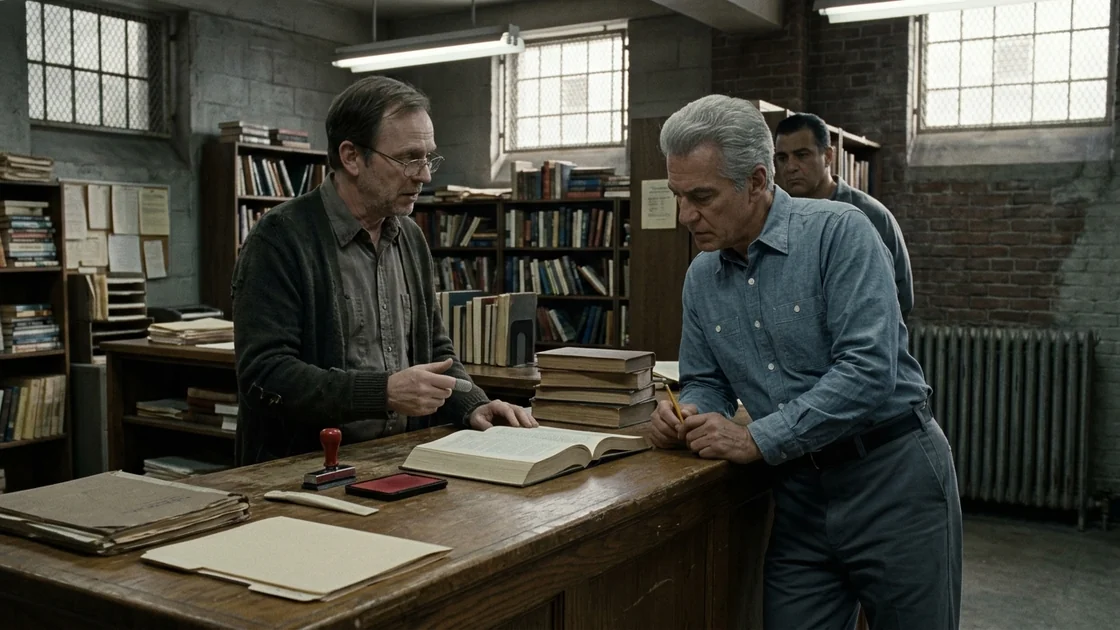
Arthur Pendelton spent ten quiet years as the head librarian at Blackwood Maximum Security Penitentiary with a single hidden objective. After a ruthless crime syndicate murdered his brother and buried the evidence behind a wall of shell companies and bribed officials, Arthur abandoned his career in forensic accounting to take a low-paying civil service post inside the very prison housing the syndicate's boss, Dominic Vance. Over the course of a decade, Arthur used the prison's correspondence education program to feed Vance a customized curriculum of business, logistics, and corporate finance textbooks that Arthur secretly altered in the library bindery. Believing he was modernizing his empire into an untouchable corporate conglomerate, Vance diligently applied every lesson to his outside operations, methodically dismantling his own network's redundancies, alienating his most loyal protectors, and consolidating his illicit assets into a transparent structure designed to trigger simultaneous federal seizure on the morning of his release.
Year One: The Catalog of Quiet Things
The bindery at the back of the Blackwood Penitentiary library smelled of bone glue, scorched linen, and the sour, metallic breath of the radiator that hissed against the north wall from October through April. It was a narrow room, windowless except for a transom of wire-mesh glass seven feet off the concrete floor, where Arthur Pendelton spent the last hour of every shift repairing what seven hundred bored or angry men had pulled apart.
Men in maximum security were hard on spines. They folded paperbacks backward until the hot-melt adhesive cracked like dry pasta; they used hollowed-out hardcovers to move cigarettes, sim cards, and ground-down shanks from C-Block to the machine shop; they wept into the pages of family Bibles until the cheap India paper turned translucent and fused together in salty lumps. Arthur did not complain. He had a bone folder made of yellowed cow rib, a cast-iron Jacques board shear whose curved blade fell with the soft, final thwack of a guillotine, and six grades of Japanese mulberry paper for mending tears that were meant to remain invisible.
Invisible was Arthur’s specialty. Before he came to Blackwood at the age of fifty-two, he had spent twenty-six years in a corner office on the fourteenth floor of the Federal Reserve building in Philadelphia, looking at numbers until they confessed. He had left that job three months after his younger brother, Julian, was found wedged between two corrugated pilings under Pier 48 on the Delaware River.
Julian had been the secretary-treasurer for Local 409 of the Stevedores and Terminal Clerks. He was a man who kept his pencils sharpened with a pocketknife and believed that a discrepancy of forty-two thousand dollars in the welfare pension fund was a clerical error that the board would thank him for pointing out. The board was owned by Dominic Vance. The harbor police ruled that Julian had slipped on black ice while inspecting a mooring line at two in the morning—a finding that ignored the fact that Julian did not inspect mooring lines, did not drink, and had both of his thumbs broken inward before his lungs filled with brackish water.
Six months after the funeral, Dominic Vance pleaded guilty to a single federal count of conspiracy to commit wire fraud and interstate transportation of stolen property. It was a masterpiece of legal containment. The United States Attorney got a headline and an eleven-year sentence; Vance got a climate-controlled cell in Blackwood’s privileged honor wing, three hours of yard time a day, and complete insulation from the ongoing enterprises of the Vance Organization, which continued to move forty million dollars a year in untaxed fentanyl precursors, counterfeit agricultural chemicals, and municipal paving contracts through the mid-Atlantic ports.
Arthur had watched the sentencing from the third row of the gallery. He had looked at the back of Vance’s neck—thick, barbered with a straight razor every Tuesday, reddened by high blood pressure and good tailoring—and realized that the law was an instrument designed to prune the top branches of a weed so the root system could thicken in the dark. To kill the root, you could not chop at it from the outside. You had to convince the plant to drink poison and call it rain.
Four months later, when Blackwood’s previous librarian retired with emphysema, Arthur took the civil service exam, scored in the ninety-ninth percentile, and accepted a salary of thirty-eight thousand dollars a year.
Dominic Vance entered the library for the first time on a rainy Thursday in November.
He did not shuffle like the lifers, whose ankles had forgotten the geometry of uneven ground, nor did he swagger like the twenty-year-olds from the street gangs who treated every doorway as an ambush. Vance walked like a landlord inspecting a tenement he intended to tear down in the spring. He wore the standard slate-gray twill trousers, but the laundry trustees had pressed a knife-edge crease down the front of each leg, and his state-issued chambray shirt was buttoned to the throat without a wrinkle. Behind him walked Tiny Gagliano, a three-hundred-pound enforcer serving thirty years for a double homicide in Camden, who functioned as Vance’s human umbrella against the unpredictability of the general population.
Arthur did not look up from the circulation desk, where he was stamping date-due slips with red ink. He listened to the creak of Vance’s orthotic loafers across the linoleum.
Vance stopped in front of the biography section, ran a thick, manicured forefinger along the spines, and sneered. The books were wrapped in Myriad plastic jackets that crackled when touched.
"Garbage," Vance said. His voice had the gravelly, congested burr of South Philadelphia, flattened slightly by years of speaking quietly in rooms that might be bugged. "Everything in here’s got grease on the corners. You the book guy?"
Arthur raised his head. He adjusted his wire-rimmed glasses, letting his shoulders curve into the deferential, slightly defeated stoop of a career bureaucrat who had given up on ambition during the Carter administration.
"Mr. Pendelton," Arthur said mildly. "Welcome to the library, Mr. Vance. If you're looking for the legal reference terminal, it's in the alcove behind the periodical racks. You'll need to sign the logbook."
Vance turned. He was fifty-four, two years older than Arthur, with silver hair combed straight back and eyes the color of wet slate. They were intelligent eyes—quick, calculating, perpetually tallying the cost of every object and person in his line of sight. He looked at Arthur’s frayed cardigan, the rubber thimble on his right index finger, and the half-eaten egg salad sandwich wrapped in wax paper beside the card catalog. Having categorized Arthur as harmless furniture, Vance’s shoulders relaxed a fraction of an inch.
"I got five lawyers paying for boat slips in Margate with my retainers, Mr. Pendelton," Vance said, walking over to the desk. "I don't need to read the penal code. What I need is something that wasn't written for a guy with an eighth-grade reading level who wants to look at pictures of muscle cars."
"We have a modest history collection," Arthur said, gesturing toward the west wall. "Churchill’s memoirs. Gibbon’s Decline and Fall. Some standard biographies of the founders."
Vance leaned an elbow on the high oak counter. Up close, he smelled of sandalwood soap—contraband from the commissary officer’s private stash—and peppermint. "I read Gibbon in Lewisburg back in ninety-eight. Took me four months. The Romans had a logistics problem. Too many generals with their own payrolls out in the provinces. Once the guys holding the spears figure out the checks come from the general and not the Senate, the Senate’s just a bunch of old guys in bedsheets talking to themselves."
Arthur blinked, allowing a flicker of genuine academic surprise to cross his face. It was the first bait, and it had to look accidental. "That is... a remarkably concise summary of the third-century crisis, Mr. Vance. Most scholars take six hundred pages to arrive at the fiscal decentralization of the legions."
Vance gave a tight, pleased nod. Like many self-made men whose intelligence had been spent entirely in the dark, he harbored a deep, unacknowledged hunger to be recognized as a peer by men with credentials. He despised college boys because he bought them by the dozen, yet he secretly envied the vocabulary that allowed them to steal with a fountain pen what he had needed a lead pipe to secure.
"People are the same everywhere," Vance said, lowering his voice as a correctional officer strolled past the glass partition outside. "You got an organization, right? You step away for a little sabbatical. Immediately, the guys you left in charge start thinking the water runs downhill because they’re standing on the porch. My nephew Mickey—kid went to Villanova for three semesters before he flunked out—he comes into the visiting room yesterday talking to me about 'overhead.' Tells me margins on the Jersey side are down eleven percent because of diesel prices and port fees. Eleven percent. Diesel went up four cents a gallon. Where’s the other nine points going, Mr. Pendelton?"
"Into someone’s unrecorded discretionary fund, I would imagine," Arthur said softly, picking up a paperback with a split spine. "In organizational theory, they call it agency friction. Or information asymmetry. When the principal cannot directly observe the agent’s daily ledger, the agent naturally inflates operational costs to capture the surplus."
Vance’s eyes narrowed, fixing on Arthur with sudden sharpness. "Say that again. The thing about the principal."
"The Principal-Agent Problem," Arthur said, as if reciting a recipe for oatmeal. "It’s a foundational concept in modern corporate governance. Stephen Ross and Barry Mitnick formalized it in the early seventies, though Adam Smith complained about it two hundred years ago. How does an owner ensure that a manager acts in the owner's best interest rather than his own, especially when the manager controls the flow of information back to the owner?"
Vance stared at him for a long ten seconds. Around them, the fluorescent tubes hummed. Over in the corner, an inmate serving life for armed robbery turned a page of The Count of Monte Cristo with a loud rasp.
"You got a book on that?" Vance asked.
Arthur looked regretfully toward the shelves. "Not on the open stacks, I'm afraid. The state budget mainly provides for GED preparation, substance abuse workbooks, and westerns. However..." He hesitated, tapping his lower lip with the bone folder as if debating whether to bend a minor rule. "The Department of Corrections does maintain an accredited correspondence arrangement with several university extension programs. Inmates with sufficient commissary funds to cover tuition and materials can enroll in upper-level undergraduate and graduate modules. Business administration, supply chain architecture, managerial accounting."
"Correspondence," Vance repeated. "Like mail-order school?"
"Self-paced seminar packets," Arthur corrected gently. "The textbooks and case-study binders are shipped here to the library. I log them in, inspect them for contraband per institutional directive 402-B, and issue them to the student. You write the analytical papers in your cell, hand them in to me, and I forward them in the weekly institutional pouch to the grading faculty. No computers, obviously, given security restrictions, so the universities still provide the traditional print-and-post curriculum for correctional candidates."
Vance looked down at his manicured nails. "I don't need a piece of paper on my wall, Pendelton. Who am I gonna show a resume to?"
"Oh, nobody takes the business track for the diploma," Arthur said, leaning in just slightly and dropping his voice to the register of a man sharing an institutional secret. "Between you and me, the men who use the Wharton and Kellogg extension packets aren't street kids looking for a job at a muffler shop when they parole out. Last year I had a gentleman in D-Wing—a former hedge fund partner from Greenwich who got caught up in an insider-trading indictment—who used the Advanced Forensic Auditing module just to keep his mind sharp while he restructured his offshore trusts through his attorneys. The case studies are quite rigorous. They teach you how to read a balance sheet so that if a man is stealing three cents out of every dollar in a twelve-million-dollar trucking company, the math screams at you before you even open the second ledger."
Vance didn't move. In the silence, Arthur could almost hear the gears turning behind the older man’s gray eyes. Vance had eleven years to serve—eight and a half with good behavior. Eight and a half years of sitting in a six-by-nine box while his nephews, his capos, and his union stewards grew fat, lazy, and bold on his docks.
"The guy from Greenwich," Vance said quietly. "What was the name of the first class he took?"
Arthur reached beneath the counter, pulled out a manila folder he had prepared three weeks earlier, and slid it across the scarred oak surface. Inside was a laser-printed syllabus bearing the crimson-and-blue seal of the Wharton School’s "Correctional Executive Extension Program"—a program that existed nowhere on earth except inside the encrypted partition of a laptop Arthur kept under the floorboards of his rowhouse in Camden.
"Business 401," Arthur said. "Quantitative Methods for Managerial Control and Internal Auditing. Tuition and textbooks come to four hundred and eighty dollars. If you fill out the commissary disbursement voucher today, I can have the registrar ship the first module by next Friday."
Vance pulled a stubby golf pencil from his breast pocket, didn't bother reading the fine print, and signed his name across the bottom line with a heavy, slashing stroke that tore through the thin carbon paper.
"Order it," Vance said. "And Pendelton? Nobody else on the block needs to know I’m doing homework. It looks soft."
"Educational records are protected by federal privacy statutes, Mr. Vance," Arthur said, sliding the voucher into his drawer. "As far as the tier is concerned, you're checking out historical biographies."
When Vance and his massive shadow had disappeared through the sally port, Arthur picked up the signed voucher, walked into the bindery at the back of the library, and closed the heavy fire door. He stood by the iron board shear, looking up at the grey square of November sky through the wire glass.
One, he whispered to the radiator.
Year Two: The Architecture of Suspicion
To forge a fifty-dollar bill requires a criminal to defeat the United States Secret Service, cotton-linen rag paper, micro-printing, and color-shifting ink. To forge a six-hundred-page university textbook requires only a laser printer, a fifty-pound carton of sixty-pound cream offset paper with matching grain direction, a gallon of polyvinyl acetate adhesive, and the absolute certainty that no prison guard in the state of Pennsylvania has ever voluntarily read a chapter on Activity-Based Costing.
Arthur worked in his basement at home between the hours of nine in the evening and one in the morning.
He began with real books—standard, widely respected graduate texts by authors from Harvard, Stanford, and Chicago. He bought used copies online, sliced their spines off with a heavy industrial guillotine paper cutter, and fed the loose pages through a high-speed optical character recognition scanner. Once the text resided in his computer, Arthur became a co-author.
He was careful. A lie that is ninety percent false is caught in an afternoon; a lie that is ninety-eight percent true is called orthodoxy.
Arthur kept the real chapters, the real mathematical proofs, the real diagrams of supply curves and depreciation schedules, and the real layout fonts—usually ten-point New Caledonia or Baskerville with generous margins for notes. What he altered were the conclusions, the case studies, and the diagnostic thresholds.
In the real world of legitimate business, transparency is a virtue because the law protects the transparent. A corporation that consolidates its regional warehouses into a single central database saves twelve percent on inventory carrying costs; if a vendor steals from them, the corporation calls the police or files a civil suit in Delaware Chancery Court.
In the criminal underworld, inefficiency is armor. A syndicate survives precisely because its left hand does not write down what its right hand is holding. It survives because Sal Marchese in South Philly keeps his numbers in his head and takes a ten-percent taste off the top of the construction kickbacks in exchange for never writing a name on a ledger and being willing to sit in a county jail cell for eighteen months on a contempt charge rather than testify before a grand jury. That ten-percent skim is not theft; it is the insurance premium a crime boss pays for silence and compartmentalization.
Arthur rewrote the textbooks to teach Dominic Vance that his insurance premiums were embezzlement.
In the sixth month of Year Two, Vance sat at the small oak table in the law alcove—the spot Arthur now reserved for him every Tuesday and Thursday afternoon under the guise of "proctored examination hours"—with a yellow legal pad covered in dense, neat columns of arithmetic. Spread open before him was Advanced Internal Auditing: Detecting Skimming and Ghost Payrolls in Decentralized Logistics, by Dr. Harrison V. Sterling (a man whose portrait on the dust jacket was actually a composite photo of two nineteenth-century railway executives and Arthur’s dentist, aged and pixelated to look like a 1994 faculty photograph).
Arthur approached quietly with a mug of lukewarm instant coffee—a small privilege he smuggled from the staff breakroom that had cemented Vance’s trust more effectively than any flattery could have.
"How is Module Four coming along, Mr. Vance?" Arthur asked, setting the mug down on a scrap of blotter paper.
Vance didn't look up immediately. He was chewing on the plastic cap of a state-issued ballpoint pen—a flexibility tube pen with no rigid barrel, designed so inmates couldn't punch it into an artery. His knuckles were white against the yellow paper.
"This guy Sterling," Vance muttered, tapping a page where Arthur had inserted a twelve-page case study about a fictional Chicago waste-hauling conglomerate called Midwest Cartage Inc. "He writes about this thing called the 'Variance Corridor.' Says in any cash-or-invoice heavy transport operation, legitimate frictional loss—spoilage, fuel fluctuation, equipment downtime, local grease—has a mathematical ceiling of 3.4 percent. Anything over 3.4 percent isn't operational friction. It's systematic diversion by the regional manager."
"Ah, yes," Arthur said, peering over his spectacles at the page he had typeset three weeks ago while listening to Glenn Gould play Bach. "The Sterling Variance. It’s quite famous in forensic accounting circles. The math is based on Poisson distributions of mechanical failure. One truck breaks down by chance; five trucks breaking down every third Tuesday of the month is a ghost invoice scheme."
"Sal Marchese has been running the Port Richmond container yard for me since nineteen eighty-nine," Vance said. His voice was very quiet, almost conversational, though a small vein was pulsing beside his left temple. "Sal stood up for my father when the Scarfo guys tried to move in on the Produce Center. I’m godfather to his youngest girl. Paid for her braces. Paid for her wedding at the Bellevue."
Arthur remained silent, his hands clasped loosely in front of his cardigan. He knew all about Sal Marchese. Sal was sixty-three, cautious as a church mouse, refused to use cell phones, refused to talk business indoors, and personally vetted every longshoreman on the night shift at Pier 48. It was Sal’s crew that had held Julian’s head under the oily water of the Delaware while Sal stood on the stringpiece smoking a Parodi cigar to keep watch. Sal was the bedrock of the Vance Organization. As long as Sal ran the riverfront, no federal wiretap would ever catch a syllable of substance, and no informant would live long enough to reach a courthouse.
"Hypothetically speaking," Arthur murmured, "if we are discussing the Midwest Cartage case study in Chapter Seven..."
"Yeah, hypothetically," Vance snapped, though he lowered his voice again. "In this hypothetical cartage company, the regional guy—call him 'S'—has been turning in net remittances showing an 8.2 percent variance against gross container volume for the last fourteen months. Every time the CEO asks about it through his lawyer, 'S' says things are tough because the Coast Guard stepped up inspections after the fentanyl task force came to town. Says he has to pay extra to the customs clerks and keep half the trucks idle when the heat is on."
"A classic information monopoly," Arthur said, nodding sagely. "Look at page two hundred and fourteen, Mr. Vance. Dr. Sterling addresses the 'Security Pretext.' When an agent has exclusive control over risk assessment, he has a structural incentive to exaggerate external threats. Why? Because crisis justifies opacity. If the coast is clear, the owner demands receipts. If there’s an 'emergency,' the owner is just grateful to get ninety cents on the dollar. The agent pockets the difference and calls it hazard pay."
Vance stared down at page two hundred and fourteen. Arthur had spent four hours getting the kerning right on that paragraph so thejustified margins matched the rest of the Macmillan layout.
"Eight point two minus three point four is four point eight," Vance whispered. "On eleven million gross through that yard... that’s half a million dollars a year. While I’m eating soy patties off a plastic tray and asking a twenty-two-year-old hillbilly CO for permission to take a shit."
"In the corporate world," Arthur said gently, "loyalty is often just a deferred invoice that the employee presents when the founder is out of the office. How did the CEO in the Midwest Cartage case resolve the issue?"
Vance flipped the page. "He didn't fire the guy outright—Wait. Yes he did. He brought in an outside auditor from a different division who had no social ties to the yard crew, demanded line-item verification on every expense over five hundred dollars, and reassigned the old manager to an advisory role with no signatory authority."
"Disintermediation," Arthur said, savoring the word like a peppermint drop. "You separate the historical relationships from the cash flow. Relationships are sentimental, Mr. Vance. Systems are loyal."
Vance closed the textbook with a soft thud. He picked up his yellow legal pad, tore off the top three sheets of calculations, and folded them into a small, tight square that he tucked into his sock. Not even Arthur was allowed to keep Vance’s raw numbers, which suited Arthur fine; he didn't need the numbers when he had written the equations.
Two weeks later, Arthur read a four-paragraph item on page B-6 of the Philadelphia Inquirer.
Salvatore "The Anchor" Marchese, sixty-three, a longtime South Philadelphia labor consultant, had stepped down from his post as job-site coordinator at the Port Richmond Marine Terminal citing "health reasons." Sources familiar with waterfront operations noted that day-to-day scheduling at the terminal had been taken over by Vance’s twenty-six-year-old nephew, Mickey, who had recently introduced an electronic bar-code tracking system for independent drayage subcontractors.
That evening, while eating a pork chop at his kitchen table in Camden, Arthur opened a small leather-bound notebook in which he kept no names—only a schematic diagram drawn like an electrical circuit board. At the bottom left corner, where three thick copper lines representing the Delaware River piers met a heavy resistor labeled NODE 1 (ANALOG), Arthur took an eraser, rubbed out the resistor, and drew a single, straight, uninsulated line directly to the center of the page.
Sal Marchese had kept the riverfront off paper for thirty-five years. Mickey Vance, terrified of failing his uncle’s new "Sterling Variance" audits, was now requiring forty-two illiterate truck drivers and six corrupt customs inspectors to log their off-the-books container movements into an encrypted cloud spreadsheet so he could prove to the old man in Blackwood that operational friction was under 3.4 percent.
An encrypted spreadsheet was still a spreadsheet. It had a server. It had backup protocols. It had metadata.
Arthur washed his plate, dried it with a linen towel, and went downstairs to typeset Year Three.
Year Three and Four: Lean Six Sigma and the Death of Redundancy
By the autumn of his third year at Blackwood, Dominic Vance had become a model of academic discipline.
The prison administration was delighted. Warden Halloway, a political appointee who loved taking state senators on tours of the facility to showcase "rehabilitative outcomes," frequently pointed through the glass of the library at the silver-haired mafia boss bent over stacks of economic journals.
"Look at that, Senator," Halloway would boom while Arthur stood dutifully by the reference desk. "Sixty years old, spent his whole life on the wrong side of the law, and Arthur here has got him working through a graduate curriculum in Supply Chain Optimization. Gets straight A's from the extension faculty down in Penn. Never had a single disciplinary write-up since he started the program."
Vance played his part with patrician detachment. Within the walls of Blackwood, his prestige had actually grown. In the yard, while younger men lifted rusted iron plates or paced the track arguing about appeals that would never be granted, Vance sat on the top bleacher with a leather portfolio, reviewing his "case briefs." The street bosses and mid-level traffickers in the prison began coming to him not just for underworld arbitration, but for business advice. Vance would listen to some twenty-eight-year-old Dominican heroin distributor complain about his runners getting robbed in North Philly, and Vance would wave a hand dismissively and lecture him on "vertical integration" and "inventory turnover ratios."
He was drunk on the language. Arthur had watched it happen to corporate executives at the Fed, too—men who mistook the complexity of their vocabulary for control over reality. Once a man learns to call a bribe an asymmetric facilitation payment, he stops worrying about the handcuffs and starts worrying about the return on equity.
For Years Three and Four, Arthur enrolled Vance in a two-part sequence: Global Supply Chain Logistics and Lean Six Sigma: Eliminating Redundancy in High-Velocity Distribution Networks.
This was the most delicate phase of the engineering.
Before Vance went to prison, the Vance Organization’s smuggling and distribution network—which moved everything from untaxed cigarettes and counterfeit pharmaceuticals to high-grade narcotics hidden in shipments of ceramic tile from Valencia—operated on what the old Sicilians called the hydra principle. It was messy, expensive, and maddeningly inefficient.
If Vance wanted to bring five hundred kilos of precursor chemicals into the tri-state area, he didn't bring it through one port. A hundred kilos came through Newark in containers of frozen squid overseen by a Genovese associate who took twenty percent; two hundred came into Baltimore on bulk gypsum freighters unloaded by a rogue local of the boilermakers' union; the remaining two hundred trickled up Interstate 95 from Savannah in the false floors of six different independent produce trucking companies. Furthermore, Vance kept three separate warehouse leases under dummy names in three different counties that sat completely empty ten months out of the year, just in case a primary stash house caught heat from a local sheriff.
From the perspective of a Harvard Business School professor, this system was an abomination. It was bloated with idle capital, duplicate lease costs, third-party brokerage fees, and uncoordinated shipping schedules.
From the perspective of a federal prosecutor, it was a nightmare. If the DEA busted a produce truck in Maryland, they got thirty kilos and a driver who didn't know who owned the warehouse in Camden. The other four hundred and seventy kilos arrived safely on Tuesday, the loss was written off as the cost of doing business, and the syndicate didn't miss a payroll.
Arthur spent the winter of Year Three sitting at his basement computer, crafting Case Study 14-B: The Iberia-Atlantic Tile Consortium.
In the case study, a family-owned European importing firm was slowly bled dry by its competitors because its aging founder insisted on using four separate regional ports and maintaining "buffer warehouses" out of an obsolete fear of dock strikes. The hero of the case study—a brilliant, ruthless chief operating officer—applied Toyota’s famous Just-In-Time (JIT) inventory model and Motorola’s Six Sigma defect-reduction protocols. By consolidating all freight into a single, high-volume maritime hub where the firm had maximum leverage over the port authority, eliminating the third-party brokers in Newark and Baltimore, and liquidating the idle buffer warehouses to create a single automated "Cross-Docking Facility," the firm increased its net operating margin by twenty-nine percent in eighteen months.
When Vance read Case Study 14-B in April of Year Four, he was so agitated he asked Arthur to open the library twenty minutes early after the noon count.
"Look at these numbers," Vance said, slapping the back of his hand against the bound packet Arthur had delivered the week before. "Look at page eighty-eight. Dead Capital Carrying Cost. Every dollar you have sitting in an empty building or tied up with a middleman who takes twenty points to move a box across a river isn't just costing you the twenty points—it’s costing you the compounded velocity of that capital over four fiscal quarters!"
"The Velocity of Money," Arthur murmured, adjusting his spectacles as he stamped a copy of The Old Man and the Sea for an inmate waiting by the door. Once the inmate left, Arthur stepped into the law alcove and lowered his voice. "Of course, Mr. Vance, the textbook assumes a stable regulatory environment. The professors at Kellogg sometimes overlook the value of... operational insurance. If a storm shuts down the single port, the Just-In-Time model has no cushion."
It was Arthur’s signature move: the reluctant warning. Whenever he wanted Vance to charge headlong through a doorway, Arthur stood beside it and gently suggested that it might be too bold, too modern, too sophisticated for a traditional operator to risk.
Vance’s jaw hardened. His ego, massaged by three years of ninety-eight-percent grades and crimson-inked praise from "Professor Sterling" on his essay exams, flared immediately.
"Storms don't shut down ports anymore, Pendelton," Vance said with quiet scorn. "That’s the whole point of the chapter on Hub Dominance. Why am I paying those animals in Newark twenty points to watch my boxes when they’re probably skimming another five off the weight? Why am I paying rent on three pole barns in Bucks County so my brother-in-law’s kids have somewhere to park their bass boats? Because my father did it that way in nineteen seventy-four! The old man couldn't do long division without taking his shoes off."
"Consolidation does yield extraordinary leverage," Arthur conceded, sounding slightly awed by Vance’s grasp of the material. "In your third essay—the one where you analyzed the hypothetical Mid-Atlantic Agricultural Supply network—Professor Sterling wrote in the margin that your hub-and-spoke restructuring model would free up nearly four million dollars in annual working capital. He actually asked if he could anonymize your paper to show his doctoral candidates in the spring seminar."
Vance’s chest swelled beneath his chambray shirt. A slow, genuine smile touched the corners of his mouth. "He said that? Sterling?"
"It’s right here on the evaluation rubric that came in this morning's mail pouch," Arthur said, pulling a crisp sheet of linen bond paper from his folder. It bore the embossed crimson stamp of the university registrar—created with a custom brass die Arthur had ordered from a wedding stationery supplier in Ohio under the name of a defunct fraternal lodge—and six paragraphs of dense, admiring critique signed in fountain pen with Arthur’s non-dominant left hand.
Vance took the paper as if it were a papal bull. He read it twice, his lips moving silently over phrases like masterful synthesis of spatial economics and uncompromising eradication of redundant nodes.
"Four million a year," Vance whispered, looking up from the page toward the razor-wire fence visible through the high library windows. "And if everything comes through Pier 48 in Philadelphia—every box, every truck, every invoice going through one cross-docking hub in Gloucester City that Mickey controls directly—then nobody in Newark knows our business. Nobody in Baltimore has a piece of our action. One pipe. High pressure. Zero leaks."
"It is certainly the modern corporate standard," Arthur said softly. "Walmart didn't conquer retail by letting regional store managers hire their cousins' trucking companies."
By November of Year Four, the transformation of the Vance Syndicate’s physical footprint was complete.
Through his weekly legal visits with his niece, Eleanor Vance—a thirty-one-year-old corporate attorney from Villanova who handled the family’s real estate holdings and who was entirely outmatched by her uncle’s terrifying new fluency in MBA jargon—Dominic issued his decrees.
The arrangement with the Genovese crew in Newark was terminated, causing a bitter rift that left Vance with no allies north of Trenton. The Baltimore boilermakers were cut off. The three backup warehouses in Bucks, Chester, and Burlington counties were sold off to commercial developers, and the proceeds were funneled into a massive, state-of-the-art refrigerated logistics depot in Gloucester City, New Jersey, just across the Walt Whitman Bridge from Pier 48. Every ounce of contraband, every kickback-generating construction material shipment, and every fleet truck owned by the syndicate’s front companies now converged on a single four-acre parcel of asphalt surrounded by high-definition security cameras that Mickey had installed to monitor employee productivity.
In his basement that Christmas Eve, Arthur poured himself a modest glass of dry sherry, turned on the portable heater, and opened his leather notebook.
The sprawling, chaotic spiderweb of lines that had once covered the left side of the schematic—dozens of tiny arrows representing trucks, piers, favors, and dusty country barns—was gone. In its place was a single, gleaming funnel.
If the federal government had tried to raid the Vance Organization in Year One, it would have been like hitting a puddle with a hammer: the water would have splashed in fifty directions and trickled back together an hour later. Now, Arthur had convinced Dominic Vance to pour all the water into a single long-necked glass bottle.
All that remained was to design the cork, and then teach Dominic how to hammer it in himself.
Year Five and Six: The Principal-Agent Trap and the Niece
The crisis came in the seventh month of Year Five, and it did not come from the street, or the guards, or the warden. It came from a woman who had actually attended a real university.
On a humid Tuesday in July, correctional officer Miller—a heavy-set man with wet, nervous eyes who took four hundred dollars a month from Vance’s outside people to look the other way when contraband Delicatessen meats came through the loading dock—stopped by the library desk during the afternoon lock-in.
"Vance wants you in the B-Wing legal conference room," Miller grunted, tossing a laminated pass onto the counter. "Got his lawyer with him. The warden signed off on an educational materials review. Move your ass, bookworm, I got twenty minutes before shift change."
Arthur felt a cold, steady tightening behind his ribs, though his hands remained entirely still as he placed a bookmark into the ledger he was updating. In five years, he had never entered the visiting wing. His entire relationship with Vance was confined to the dusty sanctuary of the library, where Arthur controlled the lighting, the shelves, and the pace of the conversation.
He removed his rubber thimble, smoothed his thin hair, picked up a manila folder containing Vance’s current module—Game Theory, Asymmetric Information, and Incentive Engineering—and followed Miller down the long, echoing concrete corridor known as the Broadway.
B-Wing Legal was a row of cinderblock cubicles separated from the main visiting room by soundproofed steel doors and reinforced Lexan glass. Because it was an attorney-client visit, there was no partition between the parties. Dominic Vance sat at the head of a bolted-down steel table. Across from him sat a young woman in a sharp charcoal-gray linen suit, her dark hair pulled back into a severe knot, with a silver MacBook laptop and three thick leather-bound accounting ledgers open in front of her.
Eleanor Vance looked up as Arthur entered. She had her uncle’s slate-gray eyes, but none of his theatrical self-importance. She looked tired, over-caffeinated, and deeply alarmed.
"Sit down, Pendelton," Vance said. He didn't look angry; he looked irritated, like a board chairman interrupted during a golf game by a pedantic junior partner. "Tell my niece what you told me last Thursday about the Hold-Up Problem in legacy partnerships."
Arthur sat on the edge of the plastic chair nearest the door, holding his manila folder across his knees like a choirboy. He looked nervously from Vance to the young lawyer.
"I... well, Miss Vance, I'm merely the institutional proctor," Arthur said, his voice thin and deferential. "I facilitate the correspondence materials from the university extension—"
"I called the University of Pennsylvania registrar’s office yesterday afternoon, Mr. Pendelton," Eleanor Vance said. Her voice was crisp, brisk, and cut through the hum of the air conditioner like a surgical blade.
The room went dead silent.
Arthur did not blink. He did not swallow. Five years earlier, before he had printed his first fake syllabus, he had spent three weeks preparing for this exact sentence. He let his mouth open slightly in an expression of bewildered bureaucratic confusion.
"The undergraduate registrar at College Hall?" Arthur asked, tilting his head. "Oh, dear. They wouldn't have any record of Mr. Vance, Miss. As I explained to your uncle when he enrolled, correctional candidates aren't matriculated through the university’s student directory because of the federal Pell Grant bar of 1994 and state victim-sensitivity guidelines. If the Inquirer found out maximum-security inmates were listed on the Penn student rolls alongside nineteen-year-old freshmen, the trustees would face a firestorm. The program is administered through the St. Jude Correctional Clearinghouse in Harrisburg under an NDA grant."
Eleanor’s eyes narrowed. She looked down at a yellow legal pad beside her laptop. "I called Harrisburg, too. The Department of Education office was closed by four-thirty, so I left a message with the deputy secretary’s clerk."
"If you’d like the direct extension for Dr. Sterling’s administrative assistant at the clearinghouse, I have it right in my desk," Arthur said immediately, reaching into his breast pocket and pulling out a printed institutional card bearing a Harrisburg 717 area code. That phone line terminated in an automated PBX voice-mail box Arthur routed through a pre-paid server in Reykjavik, complete with a three-minute recorded menu about correctional accreditation transcripts. "Though I must warn you, Miss Vance, if an outside attorney starts pressing the state clearinghouse about an inmate using academic modules to analyze ongoing commercial enterprises, they are legally required to audit the student's coursework to ensure he isn't running an unauthorized business from a state facility. That’s a Class One institutional infraction. They’d revoke his honor-wing status and freeze his mail privileges for six months."
Vance’s hand came down on the steel table with a flat, ringing crack.
"Eleanor," Vance said, his voice dropping an octave into the cold, lethal register that had made men in South Philadelphia cross the street for thirty years. "What the fuck did I tell you about poking around the school people?"
"Uncle Dom, listen to yourself!" Eleanor leaned across the table, her composure cracking as she gestured fiercely at the open ledgers. "I don't care where the books come from—I care about what you’re making us do out there! In the last eighteen months, you forced me to dissolve fourteen separate S-corporations that your father and old Mr. Goldman set up in the eighties. You made us fire Johnny Russo’s security company at the docks and replace his guys with an algorithmic time-clock system! Do you know what Johnny Russo knows about the 2012 municipal bond bid? And now you’re telling me to cut the profit-sharing points for the four crew bosses in Jersey down to a flat salary plus 'performance bonuses' tied to quarterly volume?"
"It’s called solving the Principal-Agent Problem," Vance said coldly, leaning back and crossing his arms. "Russo and the Jersey guys were capturing rent. They had fixed equity in my routes without bearing the downside capital risk. When a guy gets fifteen percent whether he moves ten boxes or fifty boxes, he gets fat. He sits in a social club on Eighth Street eating manicotti while my trucks sit idle."
"He sits in that social club keeping the peace with the New York families and making sure the kids on the corner don't talk to the FBI!" Eleanor hissed, glancing furiously at Arthur before lowering her voice to a fierce whisper. "Those fourteen S-corporations were firebreaks, Uncle Dom! They were intentionally messy! If the IRS or the U.S. Attorney pierced one, the trail died in a shoebox of paper receipts in a dead accountant's garage. Now you’ve got me rolling every single property, trucking lease, and vending contract into three tiered Delaware Limited Liability Partnerships with cross-collateralized debt covenants! If somebody pulls one thread on the Gloucester City warehouse, the whole blanket unravels in ten minutes!"
Arthur watched Vance’s face.
This was the fulcrum of the ten-year plan. Eleanor was right—completely, luminously right. She had gone to law school, she understood criminal exposure, and she was looking straight at the guillotine blade Arthur had spent five years sharpening.
If Arthur defended the curriculum right now, Vance’s street instincts—honed by forty years of treachery—would smell a trap. A humble prison librarian had no business arguing corporate restructuring with a Villanova lawyer.
Instead, Arthur looked down at his shoes and sighed—a quiet, embarrassed little sound of a small man who had spoken out of turn.
"Miss Vance is quite right, Mr. Vance," Arthur said softly, rising half an inch from his chair as if preparing to leave. "I really shouldn't have given you the graduate seminar packet on Incentive Alignment and Family Firm Dysfunction. It was written for Wall Street private equity takeovers, not... well, traditional family businesses. In the paper you read last week—the one by Professor Jensen at Harvard—he points out that family members and longtime retainers particularly hate corporate modernization."
Vance’s eyes flicked from his niece to Arthur. "Wait a minute. Sit down, Pendelton. What did Jensen say about family retainers?"
Arthur hesitated, glancing apologetically at Eleanor as if reluctant to embarrass her. "Well... it’s purely academic theory, of course. Jensen calls it The Entrenchment Hypothesis of Legacy Counsel. When a second-generation professional—a family lawyer or an old accountant—inherits a fragmented, inefficient corporate structure, their personal power depends entirely on the complexity of the mess. If the business is split into fourteen confusing little boxes that only the lawyer understands, the owner is a prisoner of the lawyer. Plus, every separate S-corporation requires separate annual filing fees, separate legal retainers, separate tax prep... all billed by the counsel’s firm."
Eleanor’s mouth dropped open. "Are you insane? I bill the family at a flat forty percent discount—"
"Whereas," Arthur continued mildly, looking at the ceiling tiles as if reciting from a chalkboard, "if the principal consolidates the enterprise into a streamlined, rule-based holding structure with automated accounting metrics, the legacy advisor becomes redundant. The owner can read the entire empire on a single page. Naturally, the advisor will always warn the owner that modernization is 'dangerous' and that the old, opaque ways are the only thing keeping the sky from falling. In corporate history, no entrenched gatekeeper has ever voted to simplify the gate."
The silence that followed was absolute.
Arthur didn't look at Eleanor, because he knew if he saw the horror in her eyes, some remnant of his conscience might flicker. Eleanor Vance was a lawyer for a syndicate that trafficked poison and broke the thumbs of honest dockworkers, yet she was also a thirty-one-year-old woman who was watching her uncle’s mind being hijacked in real time by a ghost in a beige cardigan, and realizing she had no weapon that could reach him.
Dominic Vance looked at his niece. He looked at her silk blouse, her two-thousand-dollar leather briefcase, her silver laptop, and the fourteen ledgers she had brought to prove how indispensable she was. In Vance’s mind—primed by sixty months of Arthur’s meticulously doctored parables about greedy agents, disloyal nephews, and parasitic gatekeepers—every frantic truth coming out of Eleanor’s mouth sounded like the textbook confession of a rat trying to protect her cheese.
"How much did your firm bill the fourteen S-corps for compliance and tax filings last year, Ellie?" Vance asked softly.
"Uncle Dom, that’s not—"
"How much?"
Eleanor swallowed, her face pale. "A hundred and eighty thousand across the entities. Which covers three paralegals, two CPAs, and the offshore registered agents in—"
"A hundred and eighty grand to keep my own money in fourteen shoeboxes so I gotta ask your permission to count it," Vance said. He nodded slowly, a cold, triumphant certainty settling over his features. "And Johnny Russo’s wife is your mother’s first cousin, right? So when Johnny loses his fifteen percent for sitting on his ass at the docks, he calls your mother, and your mother calls you, and you come in here trying to scare me with the government."
"Dom, please," Eleanor whispered. "Look at this man. You don't even know who he is."
"He’s a guy who makes thirty-eight grand a year gluing books together and doesn't have his hand in my pocket!" Vance barked. He stood up, towering over the table, and pointed a thick finger at her laptop. "You execute the Delaware conversion papers by Friday. You put the Jersey crew bosses on the tiered performance contracts we drafted in Module Six. And if Johnny Russo comes near Pier 48 without a bill of lading signed by Mickey, you tell him I’ll have his legs broken and billed to his pension fund. Do you understand me?"
Eleanor closed her laptop with trembling fingers. She stacked her ledgers, slid them into her briefcase, and stood up. Before she knocked on the steel door for the guard, she turned and looked straight at Arthur.
"I'm going to find out who you are," she said quietly.
Arthur offered her a polite, watery smile and clutches his manila folder to his chest. "Have a safe drive back to the city, Miss Vance. Watch out for the construction on Route 130."
She never found out who he was, because three weeks later, when she hired a private investigator in Philadelphia to look into Arthur Pendelton’s background and the mysterious "St. Jude Clearinghouse," the investigator—a retired police detective who did occasional legwork for Johnny Russo—mentioned the assignment to Russo over drinks. Russo, furious that his points had just been cut in half by Vance’s new "incentive metrics," assumed Eleanor and her uncle were investigating him ahead of a purge.
Two days later, someone put three bullets through the radiator of Eleanor’s Mercedes while it was parked outside her townhouse in Rittenhouse Square.
Nobody was hurt, as the message was purely theatrical, but it achieved what Arthur had calculated on page three hundred and twelve of Module Six: Game Theory and Defection Cascades. Eleanor resigned as family counsel the following Monday and moved to Seattle to work for an environmental compliance firm.
And Johnny Russo, convinced that Dominic Vance had gone mad in prison and was preparing to have his own captains murdered to save on payroll commissions, walked into the offices of the Federal Bureau of Investigation on Arch Street in October of Year Six and asked what kind of immunity deal was available for a man who knew where the bodies from the nineties were buried.
Year Seven and Eight: The Glass Vault
When a dam begins to crack from the inside, the water on the surface looks smoother than it has in years.
That was the beauty of Years Seven and Eight. To Dominic Vance, sitting in Blackwood Penitentiary with his reading glasses perched on the end of his nose, his empire had never been more profitable, more obedient, or more transparent.
Without Sal Marchese skimming his ten percent on the waterfront, without Johnny Russo’s crew taking fifteen percent for protection, without the Newark and Baltimore brokers taking twenty percent for routing freight, and without fourteen separate shell companies soaking up legal and accounting overhead, the net cash flowing to the top of the Vance Organization had increased by nearly forty-two percent.
Of course, the foundation beneath that cash flow was rotting at an astonishing speed.
Because the street bosses were now on Arthur’s "High-Powered Incentive Contracts"—which penalized them heavily for any shipment delays or police seizures while offering bonuses only when quarterly volume exceeded the previous quarter’s benchmark by five percent—the captains had begun cutting corners with reckless desperation. To hit their numbers, they stopped vetting buyers. They sold bulk lots to loud-mouthed mid-level crews in Camden and Wilmington who turned around and got arrested three weeks later with their cell phones full of text messages. They pushed longshoremen to move containers during daylight shifts without waiting for the bribed customs supervisors to come on duty.
Better still, they hated Dominic Vance with a pure, incandescent passion.
In the old days, if a captain’s kid got arrested or his wife got sick, Vance sent an envelope of fifty-dollar bills and told him not to worry about the count that week. Now, when a captain came short because the state police confiscated a truckload of untaxed tobacco on the turnpike, Mickey Vance handed him a computer printout showing a "Standard Deviation Penalty Charge" deducted from his next month's draw, accompanied by a Xeroxed page from an economics textbook about Moral Hazard.
By Year Seven, four separate mid-level lieutenants in the Vance Organization were quietly wearing wires or feeding shipping manifests to the Organized Crime Drug Enforcement Task Force, waiting for the federal prosecutors to assemble a RICO indictment massive enough to sweep the entire board clean at once.
Why hadn't the prosecutors moved in yet?
Because of the money.
Taking down ten street captains and seizing a warehouse in Gloucester City would cripple Vance’s operations, yes, but Dominic Vance had forty years of accumulated wealth—nearly ninety million dollars in real estate, municipal bonds, commercial laundering accounts, and offshore holdings—tucked away across the eastern seaboard. If the Feds arrested Mickey and shut down Pier 48 tomorrow, Vance would walk out of Blackwood in three years, retire to a gated villa in Boca Raton with ninety million dollars in clean assets, and die in a silk bed at eighty-five.
Arthur Pendelton did not spend ten years inhaling polyvinyl acetate fumes in a prison basement so Dominic Vance could die in a silk bed in Florida.
Julian had died in thirty-four-degree river water with his thumbs broken. Vance was going to die in a federal geriatric ward without enough money in his commissary account to buy a tube of toothpaste.
In the spring of Year Seven, Arthur introduced the final academic discipline of the curriculum: Corporate Finance 502: Sovereign Debt Instruments, Real Estate Investment Trusts, and Automated Tax-Shield Architecture.
"Your liquid reserves are lazy, Mr. Vance," Arthur said one sunny afternoon in May of Year Seven.
They were sitting at their usual table in the law alcove. Both men had aged. Arthur was nearly sixty now; his hair had gone the color of dandelion fluff, and his arthritis made the knuckles of his right hand ache when he worked the brass type-holder in the bindery. Vance was sixty-one, heavier around the jowls, his silver hair thinning at the crown, though his eyes still burned with the fierce pride of a prisoner who believed he had outsmarted the walls around him.
"Lazy?" Vance repeated, looking up from a balance sheet prepared by the new accounting firm he had hired after Eleanor’s departure—a commercial firm in Cherry Hill that didn't even know Vance was a mobster, because all the cash was now being washed through the Gloucester City logistics hub as legitimate "cold-storage warehousing fees."
"You have nearly sixty million dollars sitting in legacy real estate holdings—strip malls in South Jersey, coin laundries, parking lots, non-interest-bearing Panama bearer accounts, and local credit union certificates," Arthur said, tapping a pencil against Chapter Nine: The Liquidity Trap of Fragmented Asset Protection. "Your old advisors set those up thirty years ago to hide cash from the IRS. What is your blended return on those assets? Two percent? And after property taxes, maintenance, and the management fees your cousins charge to collect the rents from the pizza parlors, you’re actually losing three percent a year to inflation."
"It’s safe," Vance said automatically, though he sounded almost embarrassed to use such an unsophisticated word in front of his mentor. "The feds can't touch a strip mall that’s been in my sister-in-law’s name since nineteen eighty-six."
"Actually, under the Civil Asset Forfeiture Reform Act and modern forensic tracing, fragmented real estate held by biological relatives is the first thing the Justice Department seizes," Arthur lied smoothly, opening a textbook to a two-page chart he had fabricated using the official seal of the Financial Crimes Enforcement Network (FinCEN). "Look at Table 9.4, Mr. Vance. Federal Forfeiture Vulnerability by Asset Class (2015–2020). Nominee real estate and small commercial cash businesses have a 74 percent seizure success rate. Why? Because your sister-in-law is a W-2 schoolteacher who cannot explain on a deposition witness stand how she acquired a four-million-dollar shopping center in Cherry Hill in 1986."
Vance frowned, leaning closer to study the completely fictional table. "Seventy-four percent?"
"It’s shooting fish in a barrel for modern forensic accountants," Arthur said with a sympathetic shake of his head. "I used to see it in the journals all the time. How do the truly untouchable billionaires—the hedge fund titans, the sovereign oligarchs—protect their capital from state seizure? They don't hide it in pizza parlors under their sister's name. They make it too institutional to seize."
Vance’s eyes gleamed. "How?"
"It’s called an Umbrella Mezzanine Blind Trust coupled with Cross-Collateralized Municipal Bond Arbitrage," Arthur said, stringing together seven words that sounded like a fortress made of titanium. "You liquidate the fragmented legacy properties—all the strip malls, the parking lots, the old Panama accounts, the safe-deposit boxes—and convert the proceeds into a single, unified Institutional Capital Pool in Delaware. Then, that pool purchases a leveraged tranche of high-yield corporate debt backed by your primary operating asset—the Gloucester City logistics terminal."
Arthur drew a neat triangle on Vance’s yellow legal pad.
"Do you see the genius of the geometry, Mr. Vance?" Arthur whispered. "On paper, you don't own the logistics terminal anymore, and your sister-in-law doesn't own the strip malls. A registered Delaware Institutional Trust owns a sixty-million-dollar mortgage on the terminal. The terminal pays all of its monthly profits to the trust as 'tax-deductible debt service.' And because the trust is structured as a single-purpose fiduciary instrument with an automated Regulatory Compliance Trigger, if any subsidiary ever faces a civil dispute, the capital automatically sweeps into an escrow clearing account at the Federal Reserve Bank of Philadelphia until the title clears!"
It was, from a forensic accounting standpoint, the most catastrophic piece of suicide engineering ever committed to yellow paper.
What Arthur had just described—and what he spent eight chapters of fake academic prose proving with pristine calculus—was a legal mechanism that did three things:
First, it forced Vance to pull seventy million dollars of untraceable, decades-old mob wealth out of hiding—forcing his relatives to sell the safe, dusty strip malls and empty the buried cash boxes—and deposit every single penny into the domestic electronic banking system where it generated an indelible wire trail.
Second, by "cross-collateralizing" that seventy million dollars of clean legacy wealth with the Gloucester City warehouse, it legally infected every dollar Vance had ever saved over forty years with the criminal proceeds of the fentanyl and contraband currently passing through Pier 48. Under federal forfeiture law, the doctrine of tainted commingling states that if you use one dollar of active drug warehouse revenue to service a unified debt pool containing seventy million dollars of old real estate money, the entire seventy-one million dollars becomes immediately forfeitable to the United States Treasury as a single "facilitating property."
Third—and this was Arthur’s favorite touch, a brushstroke of pure poetic malice—the "Automated Escrow Clearing Account" he designed in the textbook appendix used a routing protocol that automatically generated a mandatory FinCEN Suspicious Activity Report (SAR) and froze the principal for ninety days the moment any single signatory on the operating subsidiary was served with a federal target letter.
Vance stared at the triangle on the legal pad.
"Tax-deductible debt service," Vance breathed. "So the warehouse shows zero profit on its tax return, the trust collects sixty million at eight percent tax-free interest, and my sister-in-law doesn't get a dime when she divorces my brother."
"Not a dime," Arthur confirmed. "And when you walk out of that front gate in twenty-eight months, Mr. Vance, you won't be a neighborhood boss chasing envelopes from guys in tracksuits. You will be the sole beneficial controller of a ninety-million-dollar institutional private equity fund."
Vance reached across the table and laid his heavy hand on Arthur’s thin shoulder.
"You know something, Pendelton?" Vance said softly. "Coming to this place was the best thing that ever happened to me. Out there, you’re surrounded by parasites and morons. Nobody wants you to grow. It took coming to prison for me to get an education."
Arthur looked up into the face of the man who had ordered his brother drowned like a stray dog under a rotten pier. He felt the weight of Vance’s palm through the wool of his cardigan.
"You have been an extraordinary student, Dominic," Arthur said. It was the first time he had ever used Vance’s given name. "Truly. One in a million."
Year Nine and Ten: The Capstone
In the ninth year, the walls of Blackwood began to feel smaller, as if the stone itself knew the play was entering its final act.
Arthur’s health had begun to fray around the edges. The damp cold of the prison winters had settled permanently into his knees, and his optometrist had doubled the prescription on his reading lenses after nine years of setting eight-point footnotes in a basement after midnight. Yet every morning at five-thirty, he rose, brewed a pot of Darjeeling tea, ironed a white shirt, and drove his twelve-year-old Honda Civic across the bridge to the penitentiary.
On Sundays, he drove down to Saint Mary’s Cemetery on the edge of Darby, where Julian was buried under a flat granite marker near a stand of red oaks. Arthur never spoke aloud at the grave—he was not a theatrical man—Instead, he brought a pair of hand shears, trimmed the crabgrass away from the bevel of the stone, brushed the acorn caps off the carved letters of his brother’s name, and stood with his hands in his pockets for twenty minutes before driving to the supermarket to buy his groceries for the week.
Out in the world beyond Blackwood’s thirty-foot gun towers, the Vance Syndicate had completed its metamorphosis into a gleaming, brittle monolith of glass.
It took eighteen months for Vance’s new commercial attorneys and CPAs in Cherry Hill to liquidate the forty-year backlog of family properties and shell accounts. The old captains and relatives screamed, begged, and threatened, watching their lifelong sinecures—the coin laundries in South Philly, the linen supply company in Atlantic City, the union consulting firms—get sold off at auction and wired into the newly chartered Vance-Atlantica Institutional Holdings LP in Wilmington, Delaware.
When two of the old-timers from the South Philly social clubs drove out to Mickey Vance’s house in Moorestown to demand that he slow down the liquidations, Dominic Vance used his illicit cell phone from inside C-Block to order Mickey to cut off their monthly stipends entirely.
Both old-timers were sitting in an FBI safe house in Allentown within forty-eight hours, drawing organizational charts on a whiteboard for two Assistant United States Attorneys who could scarcely believe their luck.
Arthur knew the federal indictment was nearly ready because he tracked the federal court dockets every evening on PACER from his home computer. He watched the sealed criminal docket numbers in the Eastern District of Pennsylvania skip in clusters of twelve and fourteen—the unmistakable mathematical signature of a multi-defendant RICO grand jury returning superseding sealed indictments while waiting for the final financial plumbing to settle.
He needed the Feds to wait until the plumbing was dry.
Specifically, he needed the final closing of the Vance-Atlantica Mezzanine Debt Roll-Up to clear the Delaware Secretary of State’s office on or about October 14 of Year Ten—the exact morning Dominic Vance was scheduled to be released on mandatory good-time parole after serving eight years and eleven months of his sentence.
To make sure the U.S. Attorney’s office didn't jump the gun by three weeks and ruin the symmetry of the collapse, Arthur spent an afternoon in August of Year Ten typing an anonymous forty-page forensic memorandum on an untraceable mechanical Smith-Corona typewriter he bought at a flea market in Lancaster.
The memorandum was addressed to the Chief of the Asset Forfeiture and Money Laundering Section at the U.S. Attorney’s Office in Philadelphia. It contained no speculation and no rhetoric. It was simply a clean, devastating map of the Vance-Atlantica corporate structure, complete with Delaware file numbers, SWIFT routing coordinates, the cross-collateralization covenants linking the Pier 48 narcotics warehouse to the seventy-eight million dollars in liquidated family real estate, and a bolded notation pointing out that the final $22 million tranche of Panama bearer bonds would not complete its 90-day statutory seasoning period into the domestic Wilmington master account until 9:00 AM on October 14.
If the government executes its seizure warrants prior to 9:01 AM on October 14, Arthur typed in neat elite pica characters at the bottom of page forty, the final twenty-two million dollars in offshore liquidity will remain outside domestic jurisdiction. If the government executes at 9:02 AM, the entire eighty-nine million, four hundred thousand dollars of enterprise equity resides in a single domestic account at Wilmington Trust, cross-collateralized by Title 18 facilitating property, with zero third-party lienholders.
He dropped the manila envelope into a blue mailbox outside the 30th Street train station in Philadelphia, threw the Smith-Corona typewriter into the Schuylkill River on his walk back to the parking garage, and returned to Blackwood the next morning to give Dominic Vance his final exam.
"The Capstone Thesis," Arthur announced on the first Tuesday of September.
He placed a heavy, dark-blue buckram binder on the oak table in the law alcove. He had spent the entire Labor Day weekend hand-binding it in his basement, stamping the cover with genuine twenty-four-karat gold foil:
THE MODERNIZATION OF LEGACY LOGISTICS ENTERPRISES: A TEN-YEAR TRANSFORMATIONAL MODEL By Dominic V. Vance Submitted in Partial Fulfillment of the Executive Certificate in Corporate Strategy
Vance stared at the gold lettering on the blue cloth. He reached out and touched his own name with the tip of his thumb, almost reverently.
"All you have to do for the final review board," Arthur said, smiling warmly over his glasses, "is verify the consolidated master balance sheet in Appendix A and sign the academic integrity attestation on the last page. Once the faculty committee signs off next month, your certificate will be waiting for you on the morning you walk out."
Vance opened the binder. Inside was a three-hundred-page synthesis compiled from ten years of Vance’s own essays, reorganization memos, variance audits, and structural flowcharts. It was, without question, the most comprehensive, self-authored confession of a criminal enterprise ever assembled in the history of American jurisprudence—every shell company mapped to its operational hub, every fired captain’s territory correlated to container volume at Pier 48, every dollar of family real estate traced directly into the Wilmington master trust.
"Look at that chart on page two-eighty," Vance murmured, his eyes shining as he traced the clean, razor-straight lines of the diagram Arthur had spent a decade coaxing him to build. "Ten years ago, it looked like a bowl of spaghetti. Forty guys with their hands in the pot. Nobody accountable. Now look at it. One hub. One trust. One signature."
"Total disintermediation," Arthur agreed softly. "You eliminated every buffer between yourself and the enterprise, Dominic. There isn't a single person left standing between you and the consequences of your capital."
Vance chuckled, missing the edge of the phrasing entirely. "And Mickey tells me yesterday that the Wilmington bankers finalized the Panama transfer schedule. Everything clears into the master tranche on October fourteenth. The morning I walk out, I go straight to the Four Seasons on Arch Street, eat two Maine lobsters, and sign the shareholder control agreement."
"A well-earned banquet," Arthur said. "Have you given any thought to what you'll do once the reorganization is complete?"
Vance leaned back in his chair, lacing his fingers over his stomach. For a moment, he looked almost wistful. "You know, it’s funny. Mickey asked me if I wanted to go down to the docks on my first Friday back, just to let the guys on the pier see my face. I told him, what am I gonna go down to a dirty river for? Smelling diesel and rotten fish? Those guys are primitives, Arthur. Dockworkers. Truck drivers. Union clerks. You know what a union clerk is? He’s a guy who’s too stupid to steal big and too lazy to lift a box, so he sits in a tin shed counting nickels until somebody has to shut him up."
In the quiet of the library, the radiator hissed.
Arthur’s face did not change. The small, polite smile remained fixed at the corners of his mouth, his hands resting flat and white against the oak tabletop.
"A harsh assessment," Arthur said evenly. "Though I suppose from the thirty-thousand-foot view of corporate strategy, individual clerks are merely frictional variables."
"Exactly," Vance said, picking up his pen and signing the attestation page at the back of the blue binder with a flourish. "Frictional variables. Oh—before I forget. I told Mickey to have a cashier’s check for fifty grand cut for you next month. Consulting fee. Don't give me that look—it’s coming out of a clean charitable foundation in Delaware. Buy yourself a condo down the shore so you don't have to glue paperbacks together for these animals anymore."
"That is exceptionally generous, Dominic," Arthur said, closing the blue binder and lifting it into his arms. "Truly. You have no idea how much these ten years have meant to me."
The Graduation
Arthur Pendelton submitted his two-week notice of retirement to Warden Halloway on the last day of September.
There was no cake in the staff breakroom, at Arthur’s polite insistence; he told the warden that he had a touch of vertigo and preferred to slip away quietly without a fuss. Over the first two weeks of October, he packed his personal effects—his bone folder, his brass ruler, his Japanese mending tissues, and his coffee mug—into a single cardboard box that had once held twelve copies of GED Mathematics Made Simple.
October 14 dawned crisp, cloudless, and brilliant gold across the Delaware Valley.
Arthur arrived at Blackwood at seven in the morning for his final shift. He wore a dark navy suit instead of his cardigan, with a neat gray silk tie that had belonged to Julian.
At eight-fifteen, Dominic Vance was brought down from C-Block to the intake and discharge corridor, accompanied by two correctional officers carrying his personal property boxes. Because the main corridor passed the double glass doors of the library on the way to the front administration rotunda, Vance asked the lieutenant for two minutes to say goodbye to the librarian.
Vance was already dressed in his civilian clothes—a bespoke charcoal-gray cashmere overcoat that Mickey had dropped off the day before, a white silk dress shirt open at the collar, and a pair of thousand-dollar alligator loafers that had been sitting in a cedar box since his sentencing in Year One. The suit was slightly loose across his shoulders after nearly nine years of prison food, but he carried himself like an emperor returning from Elba.
"Arthur," Vance said, stepping into the library while the two officers waited outside by the metal detector. He looked at Arthur’s navy suit and grinned. "What’s this? You dressing up for my graduation?"
"It’s my last day as well, Dominic," Arthur said, stepping out from behind the circulation desk. In his hands, he held a black leatherette diploma folder stamped with the crimson-and-blue seal of the Wharton School. "My retirement takes effect at noon. It seemed fitting that we should leave this place on the same morning."
Vance took the leatherette folder, opened it, and looked down at the heavy parchment certificate inside. His name was rendered in hand-lettered calligraphy that Arthur had completed at midnight the night before.
"Summa Cum Laude," Vance read aloud, his voice thick with genuine emotion. He closed the folder, tucked it under his arm, and held out his right hand. "You’re a good man, Arthur. Mickey’s waiting outside the main gate with the Escalade. Give me forty-eight hours to get my feet under me in the city, and I’ll have my office send a car to your place in Camden. I need a guy who knows how to audit the auditors."
Arthur shook his hand. Vance’s grip was dry, warm, and strong.
"Before you walk out to the gate, Dominic," Arthur said quietly, not releasing his hand right away, "there is one last concept from the Capstone module we never got to discuss. A brief postscript on page three hundred and four of your thesis binder."
Vance smiled indulgently. "Still giving me homework, Professor? What’s on page three-oh-four?"
"The difference between a corporation and a conspiracy," Arthur said.
Vance’s smile froze slightly, just at the edges. There was something in Arthur’s voice—not the thin, deferential quiver of the tired civil servant, nor the gentle pedantry of the tutor, but a flat, resonant stillness he had never heard from the man in ten years.
"A legitimate corporation," Arthur said, letting go of Vance’s hand and stepping back behind the oak counter, "is built on the premise that if you put every asset into one glass room, lock it with one key, and write the owner's name on the door in gold letters, the police will stand outside and guard the glass. That is why Professor Sterling—who does not exist, by the way; I invented him in my basement in Camden nine years ago—always advocated for total consolidation."
Vance stared at him. The color didn't leave his face all at once; it receded slowly, like tidewater draining off dark mud.
"What did you just say?" Vance whispered.
"A criminal syndicate, on the other hand," Arthur continued, glancing calmly at the wall clock above the periodical rack, which read 8:58 AM, "is built on darkness, waste, and loyalty. It survives because men like Sal Marchese keep the numbers in their heads instead of on Mickey’s cloud servers. It survives because you have backup warehouses in Bucks County and partners in Newark who can absorb a blow. It survives because your money is hidden in forty dusty little shoeboxes that your niece Eleanor guards with her law license, rather than sitting in a single cross-collateralized Delaware trust account at Wilmington Bank that ties eighty-nine million dollars of your father’s real estate directly to a fentanyl warehouse in Gloucester City."
Vance took a step forward, his heavy hand slamming down on the circulation desk. "Pendelton... what the fuck are you talking about? The school—"
"There is no school, Dominic. There is no St. Jude Clearinghouse. There is only me, a laser printer, a guillotine paper cutter in that back room, and ten years of your own handwriting." Arthur adjusted his glasses and looked straight into Vance’s eyes. "You fired Sal Marchese in Year Two because I taught you the Sterling Variance. You forced Johnny Russo and four of your captains to flip to the FBI in Year Six because I taught you the Principal-Agent Problem. You drove your niece out of the family because I taught you the Entrenchment Hypothesis. And over the last twenty-four months, you ordered your accountants to pull every clean dollar your family spent forty years hiding out of the ground and wire it into a single domestic glass vault."
Outside the library’s high east windows, beyond the double perimeter fences of razor wire and the guard towers, the morning sun glinted off the windshields of a line of vehicles pulling onto the prison access road.
They were not white correctional vans. There were fourteen of them—unmarked black Chevrolet Suburbans and dark blue sedans with government plates, moving rapidly in a tight tactical column without sirens, fanning out to surround the visitor parking lot where a black Cadillac Escalade sat idling by the curb.
Vance didn't hear them yet. His breathing had gone shallow and ragged, his hand gripping the edge of the oak counter so hard his manicured nails turned purple.
"Who are you?" Vance choked out, his voice barely a rasp. "Who the fuck sent you? New York? The Scarfo guys? Who?"
"My name is Arthur Pendelton," Arthur said softly. "Before I took the civil service exam for this library, I spent twenty-six years as a senior forensic examiner at the Federal Reserve Bank in Philadelphia. My younger brother’s name was Julian Pendelton. He was the secretary-treasurer of Local 409 at Pier 48. Eleven years ago in January, he came to your people with a forty-two-thousand-dollar ledger discrepancy that he thought was a bookkeeping mistake."
Vance’s eyes widened. For three seconds, he searched the deep, bloody catalog of his memory—hundreds of faces, hundreds of minor union problems, dozens of quiet conversations with Sal Marchese in the back of social clubs—before the name connected to the pier, the winter, and the broken thumbs.
"A dock clerk," Vance whispered, looking at Arthur as if he were looking at a corpse that had walked up out of the Delaware River and put on a suit. "You spent ten years in a prison... over a fucking dock clerk?"
"He was my brother," Arthur said simply. "And he was very good at math. Though I like to think I was slightly better at teaching it."
The wall clock clicked to 9:02 AM.
Out in the main administration rotunda, the heavy steel sally-port doors buzzed open. The sound of heavy boots echoed across the linoleum—two dozen men and women in dark windbreakers emblazoned with yellow block letters: FBI, IRS-CI, U.S. MARSHALS.
At that exact moment, forty miles south in Wilmington, an automated federal seizure warrant signed by a district judge at eight o'clock that morning hit the compliance desk at Wilmington Trust, freezing eighty-nine million, four hundred and twelve thousand dollars across the Vance-Atlantica master accounts. Simultaneously, in Gloucester City, New Jersey, sixty federal agents breached the gates of the centralized cross-docking hub, arresting twenty-four drivers, seizing four hundred kilos of contraband that had nowhere else to go, and downloading six years of Mickey Vance’s meticulous Six Sigma bar-code spreadsheets from the office server.
In the corridor outside the library, the two correctional officers stepped back in surprise as four Deputy U.S. Marshals and an Assistant United States Attorney holding a thick pink superseding RICO indictment marched up to the glass doors.
Outside the window, Vance could now see Mickey—twenty-six, wearing a tracksuit and a gold watch—spread-eagled face-down on the hood of the black Escalade in the parking lot with his wrists in steel cuffs.
Vance turned back to the desk. His face was mottled purple and gray, his mouth opening and closing without sound as he looked down at the black leatherette diploma folder clutched under his arm. He opened it with shaking hands.
In the center of the parchment, where the Latin text of the Wharton degree had been when he glanced at it two minutes ago—Wait. He hadn't actually read the Latin two minutes ago; he had only read his own name and Summa Cum Laude.
Beneath his name, printed in crisp, immaculate Baskerville type, the certificate read:
This certifies that Dominic V. Vance has completed a ten-year course of study in the total liquidation, exposure, and forfeiture of his own enterprise, in memory of Julian Thomas Pendelton (1961–2013), whose accounts are now balanced in full.
"Dominic Vance?" the U.S. Marshal called out, pushing open the library door with a pair of handcuffs already ratcheted open in his gloved hand. "Step away from the counter and put your hands behind your back. You are under arrest by the United States Government for racketeering conspiracy, continuing criminal enterprise, and wire fraud."
Vance didn't fight them. When the two marshals took him by the sleeves of his cashmere overcoat and pulled his wrists behind his back, his knees buckled slightly, and they had to hold him upright by the elbows. As they led him backward through the glass doors, his eyes remained locked on Arthur, wide and hollow with a horror that had no bottom—the realization that every thought he had been proud of for a decade had belonged to another man.
"Excuse me, sir," a young FBI agent said, stepping into the library and showing Arthur his badge. "Are you Arthur Pendelton, the librarian? We have a material-evidence subpoena for the inmate’s educational files and correspondence binders."
"Of course, Officer," Arthur said pleasantly, reaching beneath the counter to lift the dark-blue buckram Capstone binder with its twenty-four-karat gold lettering and setting it on the oak desk. "Everything is right here, indexed and cross-referenced by account number. You'll find the inmate’s signed attestation of authorship on page three hundred and three."
The agent flipped open the binder, glanced at the pristine corporate flowcharts and signed balance sheets, and let out a low whistle. "Jesus Christ. Did he really write all this down himself?"
"Every word," Arthur said, picking up his cardboard box of personal belongings from beside the card catalog. "He was very proud of his grades."
Ten minutes later, after signing the property receipt for the FBI agent and leaving his brass keys on Warden Halloway’s blotter, Arthur Pendelton walked out through the front gate of Blackwood Maximum Security Penitentiary for the last time.
In the visitor parking lot, federal evidence technicians were photographing the interior of the black Escalade while a flatbed tow truck backed up to hook its axle. A few yards away, Dominic Vance was being guided by the top of his head into the back seat of an unmarked sedan, his alligator loafers scraping clumsily against the asphalt.
Arthur did not stop to watch. He walked past the flashing blue lights to the far corner of the gravel lot where his old Honda Civic was parked beneath a maple tree that was dropping its yellow leaves across the hood. He set his cardboard box on the passenger seat, started the engine, and pulled out onto the two-lane county highway heading south toward the river.
The morning traffic was light, the autumn air coming through the cracked window smelled of woodsmoke and dry cornstalks, and Arthur had plenty of time to stop by the florist before driving down to Darby to tell his brother that the books were closed.