The Crimson Provenance
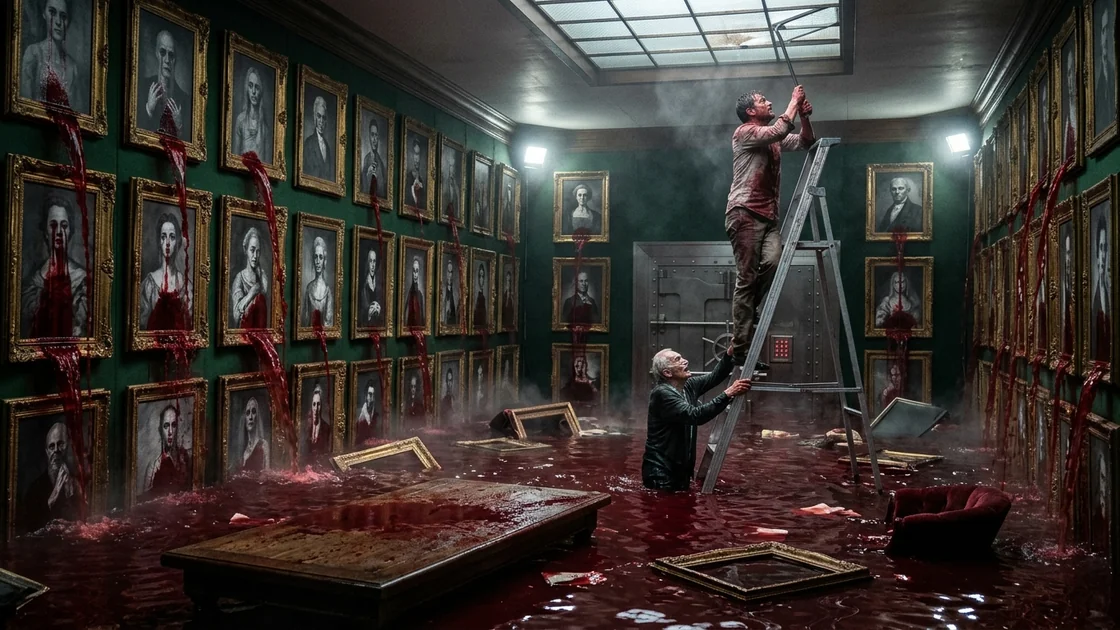
Julian Vance, a disgraced art conservator desperate for work, accepts a lucrative commission at the isolated Ravenglass Manor to treat a private collection of European portraits suffering from a mysterious degradation. Upon examining the gallery belonging to the dying billionaire Arthur Sterling, Julian discovers that every painting in the collection was looted from murdered families during the Second World War, and the canvases are not suffering from chemical decay, but are weeping real human blood. As Julian investigates the hidden histories on the backs of the frames, the weeping accelerates into a torrential deluge, triggering the estate's automated vault locks and trapping Julian, Arthur, and Arthur's daughter Eleanor inside the mansion as the stolen portraits empty decades of spilled blood to drown the collector and his dynasty.
The road to Ravenglass Manor did not ascend toward a windswept crag, as Julian Vance had expected of a nineteenth-century gothic revival estate, but instead plunged steadily downward into the throat of a drowned valley. For the last five miles, the asphalt had been swallowed by a tunnel of ancient yew and weeping beech trees, their canopies knitted so tightly overhead that the October twilight was choked out entirely. Julian drove with his high beams cutting through a thick, particulate mist that smelled of rotted leaf mold and cold limestone. Beside him on the passenger seat rested his aluminum conservation cases, packed with binocular microscopes, scalpels, heated spatulas, cotton swabs, and rows of amber glass vials containing solvents that could strip a century of grime from a masterwork without disturbing a single brush-stroke of pigment.
When the trees finally parted, the manor did not rise before him; it squatted at the bottom of a natural granite basin, surrounded by terraced lawns that sloped down toward its foundations like the sides of a funnel. It was an immense, brooding structure of black ashlar stone and slate, devoid of ivy, its windows narrow and deeply recessed. As Julian pulled his sedan onto the gravel forecourt, his headlights swept across the ground-floor casements, and he noticed with a professional’s eye the subtle, silvered sheen of triple-glazed ballistic glass and the thick housing of motorized steel storm shutters recessed into the stone lintels above every opening. Ravenglass was not merely an ancestral home; it was a climate-controlled bunker disguised as a country seat.
Before Julian could unlatch his seatbelt, the massive oak front doors swung inward, spilling a rectangle of warm, amber light across the wet gravel. A tall, thin man in a charcoal suit stepped out under the stone porte-cochère, holding a wide black umbrella.
"Mr. Vance," the man said, his voice flat and resonant in the damp air. "I am Hendricks. Miss Sterling is waiting for you in the foyer. Leave your keys in the ignition; I will see to the vehicle. Would you prefer to carry your instruments yourself?"
"I always carry my own kit, thank you," Julian replied, stepping out into the chill air and lifting the two heavy aluminum cases from the car. The dampness here was immediate, clinging to the wool of his overcoat and the skin of his throat. "The humidity down in this hollow must be a nightmare for your HVAC engineers."
Hendricks offered a tight, humorless smile. "The manor is hermetically isolated from the valley air, sir. Three redundant desiccant systems maintain the interior at a constant forty-eight percent relative humidity and sixty-five degrees Fahrenheit. Or at least, they did until last Tuesday."
Julian followed the butler through the vestibule and into the great hall. As the heavy oak doors boomed shut behind him, he felt a distinct change in atmospheric pressure against his eardrums, followed by the soft, pneumatic hiss of rubberized weather-seals inflating around the doorframe. The hall was vast, floored in checkerboard Belgian marble, yet it felt suffocatingly enclosed. And then there was the smell. Beneath the polite top-notes of beeswax polish and cedarwood, there was a faint, metallic tang hanging in the air—like a wet copper penny held too long in a closed fist, or the raw, mineral scent of an old butcher’s block scrubbed with cold water.
A woman stood at the foot of the grand bifurcated staircase. She was in her early forties, dressed in cream cashmere that looked starkly clinical against the dark oak paneling of the hall. Her blonde hair was pulled back so severely it seemed to tug at the corners of her pale blue eyes.
"Mr. Vance," she said, extending a cool, dry hand. "I am Eleanor Sterling. Thank you for coming on such short notice, and for signing the non-disclosure agreement without the usual tedious revisions from legal counsel."
"When a client offers three times the standard guild rate for an emergency consultation, Miss Sterling, I find curiosity outweighs bureaucracy," Julian said, setting his cases down on the marble floor. "Though I confess, your brief was remarkably vague. You mentioned 'accelerated exudation of the binding medium' across multiple nineteenth- and early twentieth-century oil paintings. In my experience, paint does not suddenly decide to liquefy unless someone has taken a heat gun to the gallery or the climate control has failed catastrophically."
"The climate control has not failed," Eleanor said, her gaze flickering briefly toward the upper landing of the stairs. "In fact, the system has been working at maximum capacity trying to pull the excess moisture out of the north wing. Come with me. My father is already in the Long Gallery. He rarely leaves it these days."
They ascended the wide staircase, their footsteps deadened by a thick crimson runner held in place by brass rods. As they climbed, Julian noted that the walls of the stairwell, where most estates of this grandeur hung ancestral portraits or hunting scenes, were entirely bare, save for faded rectangular patches on the silk wallpaper where frames had once hung.
"You’ve moved the collection?" Julian asked.
"My father consolidated everything into the Long Gallery five years ago, after his first stroke," Eleanor replied without looking back. "He wanted them all in one room where he could view them from his wheelchair without having to navigate the drafts of the house. He had the gallery retrofitted to museum-grade vault specifications. Steel-lined walls, independent air scrubbers, halon fire suppression, and a single entrance."
At the top of the stairs, they turned down a wide corridor that ended at a door that belonged in a Zürich bank rather than an English manor. The wooden paneling had been stripped away around a massive frame of brushed stainless steel. The door itself was four inches thick, fitted with an electronic keypad and a biometric palm scanner, currently propped open by a heavy rubber wedge.
As they approached the threshold, the metallic odor Julian had noticed in the foyer grew exponentially stronger. It was no longer a faint tang; it was thick, sweetish, and unmistakably organic. Julian’s stomach gave a subtle, instinctive roll.
They stepped through the vault door into the Long Gallery.
The room stretched for nearly a hundred andtwenty feet, narrow and high-ceilinged, illuminated by recessed halogen track lighting tuned to a warm, museum-standard three thousand Kelvin. There were no windows; the exterior wall on the left and the interior wall on the right were completely covered in deep green baize fabric. And hanging upon that green baize, stacked three tiers high in the tight, crowded style of a nineteenth-century salon, were dozens upon dozens of portraits.
There were at least eighty paintings in the room. None of them were landscapes, still lifes, or mythological scenes. Every single canvas depicted people. There were austere patriarchs in dark wool frock coats, young women in the shimmering silks of the Belle Époque, solemn children holding wooden hoops or porcelain dolls, and entire family groups arranged around parlor tables and grand pianos. From every square foot of the walls, hundreds of painted eyes looked down into the center of the room.
Near the far end of the gallery sat a figure in a motorized wheelchair, draped in a plaid cashmere lap blanket. A portable oxygen concentrator sat beside the chair, rhythmic and wheezing—hiss-click, hiss-click—breaking the heavy silence of the room.
"Father," Eleanor called out, her voice echoing slightly off the parquet floor. "Mr. Vance has arrived."
Arthur Sterling turned his chair around with a soft electric whine. He was a man in his late eighties, his face a roadmap of broken capillaries and liver spots stretched taut over a prominent, hawkish skull. A clear plastic cannula looped around his ears, feeding oxygen into his nostrils. Despite his frailty, his dark eyes were fiercely alert, pinning Julian with the predatory appraisal of a man who had spent a lifetime buying and selling things that other men could not afford to lose.
"You’re younger than I expected, Vance," Arthur rasped, his voice like dry leaves scraping across slate. "They told me at Sotheby’s that you were the finest chemical restorer in London before that unpleasantness with the Medici panel."
Julian stiffened slightly. The "unpleasantness" had involved Julian publicly whistleblowing on a prominent auction house—and his own employer—for knowingly certifying a forged provenance on a sixteenth-century panel, an act of integrity that had gotten him blacklisted by the polite art world inside a month. "The chemistry of oil and varnish doesn't require gray hair, Mr. Sterling. Only patience and a steady hand. Which of the pieces is showing the defect?"
Arthur raised a trembling, liver-spotted hand and gestured broadly at the walls around him. "Take your pick. It started ten days ago with the Vienna canvas on the lower tier. By Thursday, the Budapest paintings were doing it. This morning, I counted nineteen."
Julian frowned, stepping away from Eleanor and walking toward the left wall where Arthur had pointed. As he drew closer to the lower tier of paintings, his boots made a sudden, sharp tock-stick sound against the oak parquet. He looked down.
At the base of the wall, directly beneath a large, gilt-framed portrait from the late 1920s, sat a dark, glistening puddle about the size of a dinner plate.
Julian knelt, setting his cases down, and leaned over the puddle without touching it. Under the halogen lights, the liquid was a deep, opaque carmine, almost black at its center and thinning to a bright, arterial crimson at its outer edges. It hadn't spread the way water or mineral spirits would spread across varnished wood; it had pooled thickly, its surface already skinning over with a dull, gelatinous film.
Slowly, Julian raised his eyes from the floor to the painting above it.
The portrait was roughly four feet by five feet, painted in the rich, psychological realist style of interwar Central Europe. It depicted a family of four in a sun-drenched Viennese drawing-room. The father, a handsome man with a neatly trimmed beard and gentle, dark eyes, sat in a Biedermeier armchair with a cello resting between his knees, his bow held loosely in his right hand. Standing behind him was his wife, her hand resting affectionately on his shoulder, wearing a drop-waist dress of sapphire blue silk and a string of pearls. Flanking them were twin boys, perhaps आठ or nine years old, dressed in matching sailor suits, their expressions caught somewhere between solemn obedience for the painter and a barely suppressed giggle.
A brass plaque affixed to the bottom of the heavy ornate frame read simply: Portrait of a Musician and His Family, Oil on Linen, c. 1928. No artist was named. No family surname was given.
Julian stood up and leaned to within three inches of the canvas. The surface of the painting was covered in a fine, age-appropriate network of craquelure—the microscopic spiderweb of cracks that develops in aged oil paint and varnish over decades as the linen support expands and contracts.
In the center of the mother’s sapphire dress, and along the collar of the younger boy’s sailor suit, the cracks were swollen. And from a hairline fissure running directly across the father’s knuckles—where his fingers gripped the neck of the cello—a single, heavy bead of dark red liquid was slowly forming. As Julian watched, the bead grew too heavy for its surface tension, broke free, and slid down the varnished surface of the cello, leaving a wet crimson track before dropping from the bottom edge of the gilt frame to strike the puddle on the floor with a soft, viscous plip.
"Good God," Julian whispered.
He popped the latches on his smaller aluminum case, pulled on a pair of blue nitrile gloves, and extracted a high-intensity LED loupe and a sterile glass microscope slide. He pressed the edge of the slide against the wet track on the canvas, collecting a smear of the fluid, and held it up to the light.
"What is it?" Eleanor asked, stepping up behind him, though she kept a careful distance of several feet from the wall, her arms crossed tightly over her chest. "Is it the red lake pigment separating from the linseed oil? I read that nineteenth-century bitumen and madder lake can sometimes remain unstable for decades if exposed to moisture."
"Bitumen turns black and alligator-skinned when it fails, Miss Sterling, and it takes years to creep a millimeter," Julian said absently, his eyes fixed on the glass slide through his loupe. "And there is no madder lake in a sapphire blue dress or a white linen collar."
He lowered the loupe and held the slide a few inches from his nose. The smell was unmistakable now. There was no turpentine, no boiled linseed oil, no dammar resin or beeswax. It smelled of iron, salt, and raw meat.
Julian looked at the smear on the glass again. Already, at the edges where the layer was thinnest, the crimson fluid was separating into a pale yellowish straw-colored fluid and a dark, clumping web of solids.
It was coagulating.
"Have you had someone in here cleaning these?" Julian asked, turning sharply toward the old man in the wheelchair. "A local restorer? Someone using an enzymatic solvent or an unbuffered aqueous gel?"
"No one touches my pictures," Arthur snarled over the rhythmic hiss-click of his oxygen machine. "Nobody has laid a brush or a rag on these canvases since I brought them to Ravenglass in eighty-two. Why do you think I sent for you? The things are sweating. They’re ruining the frames, they’re staining the parquet, and if the moisture gets behind the gesso ground, the paint will flake right off the linen! They are worth forty million pounds altogether, Vance. Stop staring at that piece of glass and tell me how to seal them."
Julian didn’t answer immediately. He walked down the line of the gallery, looking closely at the other paintings.
Ten feet away hung a striking portrait from the late 1890s of a young woman with high Slavic cheekbones and dark, braided hair, wearing a velvet riding habit. Across the painted skin of her throat was an old, diagonal tear in the canvas—about six inches long—that had been crudely repaired decades ago with heavy wax-resin lining and poorly matched overpaint. From that old scar on her painted neck, a steady, thin ribbon of red was weeping down across her velvet bodice, soaking into the gilded acanthus leaves of the bottom frame and dripping onto the baseboard.
Further down, a 1930s portrait of an elderly gentleman with a velvet skullcap seated before a wall of leather-bound books was bleeding from the corners of the painted eyes, two twin tracks of dark red carving down through the impasto of his bearded cheeks. Across the room, a delicate pastel-and-oil sketch of three young sisters in summer dresses was soaked along the bottom edge, the unpainted raw linen turning soggy and dark as crimson droplets pattered steadily onto the oak floor like a slow leak from a rusted pipe.
Plip. Plip. Plip.
Now that Julian was listening for it, the entire hundred-and-twenty-foot gallery was alive with the sound. A quiet, wet percussion, random and hollow, echoing off the high ceiling.
"I need to take the Vienna portrait off the wall," Julian said, turning back to Arthur. "I need to examine the verso—the back of the canvas and the stretcher bars. If there is a contaminant, or some kind of biological growth—a red mold or bacteria feeding on the animal-skin glue used in the sizing—it will be originating from the back of the linen support."
"Biological growth?" Eleanor repeated, her pale face tightening with disgust. "In a climate-controlled vault?"
"Fungi like Serratia marcescens can produce a bright red pigment called prodigiosin," Julian said, though even as he spoke the words, he knew it was a lie he was telling himself to keep his mind anchored in the rational world. Bacteria did not clot on a glass slide. Bacteria did not smell like an abattoir. "Help me lift the frame down. Where is Hendricks?"
"Hendricks is not permitted inside the vault," Arthur said flatly. "Only Eleanor and myself have the biometric clearance. Eleanor, help him. And for God’s sake, don't jar the corners of the frame; it’s original Viennese Secessionist giltwood."
Eleanor stepped forward reluctantly, taking a pair of white cotton conservation gloves from Julian’s open case. Together, they took the weight of Portrait of a Musician and His Family.
The painting was unexpectedly heavy—far heavier than a standard linen canvas on pine stretcher bars had any right to be. As they lifted it off the brass picture hooks, Julian felt a subtle, sickening shift of weight inside the frame, as though the wooden backing held something sodden and waterlogged. When they tilted it forward to lay it face-up on the long oak examination table in the center of the room, warm red liquid sloshed out from the rabbet of the frame, splashing across Eleanor’s cream cashmere sleeve.
She let out a sharp, strangled cry, dropping her corner of the frame an inch before Julian caught the load, his biceps straining as he eased the heavy piece onto the padded blocks of the table.
"Look at this!" Eleanor hissed, tearing off her cotton gloves and staring in horror at the widening crimson stain on her cuff. She dabbed at it frantically with a silk handkerchief from her pocket, only to smear the thick, dark fluid across her wrist. "It’s warm! Julian, it’s warm!"
"Go wash it off with cold water, Miss Sterling," Julian said quietly, his eyes locked on the painting on the table. "Warm water will set the proteins."
Eleanor froze at the word proteins, her pale blue eyes lifting slowly to meet Julian’s. She didn't ask what he meant. Turning on her heel, she hurried toward the small lavatory door tucked into the far corner of the gallery near the vault entrance.
Julian waited until the lavatory door clicked shut, then carefully lifted the edge of the frame and flipped the entire painting face-down onto a sheet of clean Tyvek protective sheeting, taking care that the raised wet streaks on the front did not touch the padding.
What met his eyes on the verso made the breath catch in his throat.
To an art historian, the back of a painting is its passport, its biography, and its autopsy report. Honest paintings that have passed peacefully through legitimate auctions and estate sales bear neat paper labels from Christie’s, Wildenstein, or Marlborough, clean customs stamps from Dover or New York, and the gentle patina of dry dust on aged pine.
The back of the Vienna portrait was a crime scene.
The heavy pine stretcher bars were stained with old, blackened brown splotches that had soaked deep into the grain of the wood eighty years ago. In three places, rectangular paper gallery labels had been violently gouged off with a chisel or a palette knife, leaving raw, splintered scars in the timber to erase the painting’s pre-war identity.
Wait—not entirely erased.
In the upper right quadrant of the wooden cross-brace, someone had tried to sand away a purple ink stamp, but the aniline dye had bled too deeply into the porous pine. Under his LED loupe, Julian could still clearly read the circular outline of an eagle grasping a swastika, surrounded by the fragmented Gothic lettering: Einsatzstab Reichsleiter Rosenberg... Dienststelle Wien.
The ERR. Hitler’s specialized looting task force, responsible for systematically stripping the homes of Jewish families across occupied Europe before they were deported to the camps.
Beneath the faded Nazi stamp was a code written in blue grease pencil: LIND-442-W. And below that, stenciled in black military block letters—the kind used by Allied supply depots in 1945—were the initials: COL. T. STERLING - USFET - PRIVATE BAGGAGE.
Julian’s gaze dropped from the wooden stretcher bars to the raw brown linen of the canvas itself.
The back of the linen should have been dry and brittle with age. Instead, the entire reverse surface of the fabric was distended, swollen outward like a gorged tick, and pulsing with a faint, rhythmic warmth. Dark crimson moisture was sweating through every weave of the threads, gathering in the wooden corners of the stretcher frame.
And written directly onto the raw linen in faded black fountain pen ink—in a neat, sweeping Continental hand that must have belonged to the artist or the father with the cello—were the words that the chisel had missed because they had been hidden beneath the bottom stretcher bar until the wood warped:
Familie Viktor und Amalia Lindemann, mit Leo und Felix. Wien, Mai 1928.
Julian stood very still in the harsh halogen glare of the vault. The hiss-click of Arthur Sterling’s oxygen concentrator rolled behind him as the old man maneuvered his wheelchair closer to the examination table.
"They had a townhouse on the Ringstrasse," Julian said softly, not turning around. He knew the name. Anyone who had studied European provenance and the post-war restitution databases knew the name Lindemann. "Viktor Lindemann was first cellist for the Vienna Symphony. He and his wife Amalia and their ten-year-old twins were arrested by the Gestapo in November 1938, two days after Kristallnacht. Their apartment was liquidated by the Dorotheum auction house and the ERR. They were put on a transport to Minsk in 1941. None of them survived."
The electric hum of the wheelchair stopped three feet behind Julian.
"My father, the Colonel, had an eye for quality," Arthur Sterling said, his voice entirely devoid of remorse or surprise. "He was attached to the Monuments and Fine Arts section in Munich and Salzburg in forty-five. While the other fools were busy cataloguing church bells and shipping crates back to people who no longer existed, my father understood a fundamental truth of history, Mr. Vance: to the victor belong the spoils. Europe was a graveyard. Those people were smoke in the Polish wind. Who was going to care for these canvases? The Russians? They would have burned them in oil drums to keep warm."
Julian turned slowly to face the old man. He looked past Arthur at the walls of the Long Gallery—at the eighty portraits stacked floor to ceiling. The Slavic woman with the slashed throat. The scholar in the skullcap. The three sisters in summer dresses.
"All of them," Julian breathed, the horror of the room suddenly crystallizing into sharp, sickening focus. "Every single painting in this room is Holocaust loot. Or plunder from the Eastern Front. That’s why the plaques have no names. That’s why this room is a windowless vault with biometric locks and no staff allowed inside. You haven't consolidated your collection for your health, Mr. Sterling. You’re hiding eighty stolen families from the restitution tribunals."
"I am preserving my inheritance!" Arthur snapped, his gaunt hand slamming down onto the armrest of his wheelchair. A thin fleck of spittle caught on his lower lip. "My father paid for their shipping! I have paid for their electricity, their climate control, their security for seventy years! Do you have any idea what it costs to maintain this room? The Lindemanns didn't paint that picture—they merely sat in a chair for a week in 1928 and wrote a check to an artist! Possession is the law of the world, Vance. Every museum in London and Paris is built on bones and plunder; I simply have the honesty not to pretend mine is a public charity!"
"They aren't artifacts, Arthur," Julian said, pointing down at the swollen, weeping back of the Lindemann canvas. "Look at the table. Look at the floor!"
A thick stream of blood was now running off the edge of the Tyvek sheeting, pattering onto the parquet between Julian’s boots.
"I am paying you thirty thousand pounds to stop it!" Arthur barked. "Put a wax lining on the back! Spray them with acrylic resin! Seal the pores of the canvas! I don't care what the hell is happening chemically inside the paint layers—lock it inside the wood!"
The lavatory door clicked open, and Eleanor stepped out. Her face was the color of chalk. She had taken off her cream cashmere sweater entirely, standing in a silk camisole, her hands still wet and trembling.
"Father," she whispered, staring at the sink inside the open lavatory door behind her. "It wouldn't wash out of the wool. When I wrung the sleeve out in the basin... there was so much of it. More than spilled on me. The sweater just kept bleeding until I threw it in the bin."
As she spoke, a loud, wet rip echoed from the far end of the gallery.
All three of them turned their heads toward the upper tier on the right-hand wall.
Thirty feet above the floor hung a massive, eight-foot-tall full-length portrait of an aristocratic Polish family from 1939—a husband in an ulan cavalry uniform, his wife in white satin, and three small children gathered around a great dane. Beneath the weight of the fluid accumulating behind the paint layer, the aged gesso and oil over the cavalry officer’s chest had blistered outward to the size of a cantaloupe.
With a sound like tearing wet parchment, the blister ruptured.
A gout of dark, steaming blood burst from the painted officer’s chest, splashing down across the glass and frames of the two tiers below it before cascading onto the parquet floor in a heavy, splashing sheet. Within seconds, the rupture widened, and the portrait wasn't merely dripping anymore; it was pouring, like an open femoral artery, a steady column of red the thickness of a man's wrist pattering loudly onto the wood.
Simultaneously, an amber strobe light mounted above the stainless-steel vault door began to flash, accompanied by a sharp, synthesized mechanical chime.
Warning. Relative humidity in Vault Sector One has exceeded seventy-five percent. Contamination protocol initiated.
"What is that?" Julian demanded, backing away from the examination table as the Lindemann portrait behind him gave a low, fibrous groan, its linen fibers stretching as crimson liquid began pooling across its wooden cross-bars like water rising in a well.
"The environmental sensors!" Eleanor cried, rushing toward the vault door. "If the humidity spikes that fast, the computer assumes a water main has burst in the main house above us or the valley has flooded! It’s going to isolate the vault to protect the collection!"
"Stop it!" Julian shouted, sprinting after her down the hundred-foot length of the gallery. His boots splashed through widening crimson puddles that were already merging across the center of the floor. Every painting he passed on both walls was weeping now—from painted eyes, from parted lips, from the hems of dresses and the cuffs of coats, hundreds of tiny red rivulets racing down the green baize walls to feed the rising film on the parquet.
Above the stainless-steel doorway, a heavy pneumatic cylinder hissed, discharging a cloud of white condensation. The rubber doorstop at the bottom of the four-inch-thick steel door was crushed flat like a child's toy as the hydraulic arm engaged, pulling the massive vault door inward with slow, inexorable force.
"Eleanor, the keypad!" Arthur yelled from the far end of the hall, his wheelchair whining at top speed of four miles per hour as he tried to follow them, its solid rubber tires leaving twin tracks through the blood on the floor.
Eleanor slammed her palm against the biometric scanner beside the doorframe just as Julian reached her. The scanner beeped angrily—three short, red flashes.
Biometric read error. Surface moisture detected. Please clean sensor.
She wiped her bloody, damp hand furiously against her silk camisole and slapped it onto the glass plate again. Red smeared across the optical reader.
Biometric read error. Manual override required.
Julian grabbed the heavy steel handle on the inside of the door and braced his boot against the jamb, pulling with all his strength against the hydraulic closer. It was like trying to hold back a locomotive. The steel door swung shut with a deep, resonant thud that vibrated through the soles of his shoes, followed immediately by the heavy clack-clack-clack of six solid titanium deadbolts shooting into the reinforced steel frame from all four sides.
From behind the walls came the rumble of heavy steel plates dropping down across the ventilation ducts, sealing the room's air supply into a closed internal loop.
The synthesized voice chimed one last time from the speaker grille: Vault Sector One hermetically sealed. External rescue lock engaged until moisture levels return to baseline.
Silence fell over the doorway, broken only by the rising sound behind them—a sound that was no longer a series of discrete drips, but the steady, rushing patter of an indoor rainstorm.
Julian turned his back against the cold steel of the vault door and looked down the length of the Long Gallery.
Under the warm three-thousand-Kelvin museum lights, the walls were turning completely red.
"There’s a telephone," Julian said, forcing his voice to stay level and analytical even as his heart hammered against his ribs. He looked around the area near the door. "Every vault has a hardline emergency phone or an intercom to the main house. Where is it?"
Eleanor pointed with a shaking finger toward a recessed stainless-steel panel set into the green baize wall five feet from the door. Julian strode over, popped the spring-loaded latch, and lifted the black handset inside.
There was no dial tone—only the low, crackly hum of an internal estate intercom. He pressed the black call button labeled STAFF QUARTERS / SECURITY.
"Hendricks!" Julian barked into the receiver. "Hendricks, pick up!"
For five agonizing seconds, there was only static. Then a click.
"Mr. Vance?" Hendricks’s voice came through the tiny speaker, tinny and distant. "Sir, the main house alarm board just lit up like a Christmas tree. The system says the gallery vault has gone into flood-isolation lockdown. Is Mr. Sterling with you?"
"We’re all in here, Hendricks! Listen to me very carefully," Julian said, watching as a portrait of an elderly couple from Prague on the middle tier suddenly bowed outward from its stretcher bars, pouring a sheet of dark crimson down over a portrait of two young girls beneath it. "The humidity sensors inside the vault have been triggered by liquid on the floor. Because the moisture is inside the room rather than outside, the automated lockdown won't release. You need to go to the master server room and manually cut the hydraulic power to the vault bolts, or enter the external override code on the corridor side of the door."
"Only Mr. Sterling has the external master code, sir," Hendricks replied, a note of confusion entering his voice. "And the server room is in the sub-cellar directly beneath the gallery. I’m actually on the cellar stairs right now because the sump alarms are going off down here too. Wait a moment..."
Over the intercom, Julian heard the echoing sound of Hendricks’s hard-soled shoes descending stone steps, followed by a sudden, wet splash.
"Good Lord," Hendricks’s voice came back, muffled and horrified. "Mr. Vance... what is leaking up there? It’s coming right through the ceiling joists and the air return grates down here! It’s... it’s thick, sir. It’s all over the floor around the main breaker panels!"
"Hendricks, don't touch the breaker panels if the floor is wet!" Julian shouted. "Just come upstairs to the gallery door on the second floor and we’ll talk you through the override through the intercom!"
"If I don't trip the manual release lever on the hydraulic pump down here first, the keypad upstairs won't disengage the deadbolts while the flood sensor is active!" Hendricks called back. Through the receiver, Julian could hear the heavy, rhythmic splashing of liquid cascading into the basement—gallons of it draining through the tiny seams in the gallery’s parquet floor and the low-wall air return vents before the dampers had fully sealed. "Hold the line, sir! The pump lever is right behind the main transformer cage. I can reach it from the dry concrete plinth—"
There was a sudden, violent sound over the line—like a heavy sack of wet grain slipping on slick tile—followed by a frantic clatter as the intercom handset in the cellar was dropped, swinging wildly by its coiled cord.
"Hendricks!" Julian yelled.
Through the dangling receiver in the basement came a deafening, high-voltage CRACK, followed by the sizzling roar of an electrical arc fault as iron-rich, highly conductive blood bridged the busbars of the main estate transformer. A man’s scream—short, agonizing, and cut off abruptly by a heavy splash—echoed through the earpiece before the intercom line went completely dead with a pop of burnt circuitry.
Simultaneously, the halogen track lights along the ceiling of the Long Gallery flickered violently, dimmed to half-power, and died.
Pitch blackness swallowed the room for three seconds before a series of battery-powered emergency floodlights mounted at the four corners of the ceiling clicked on, bathing the gallery in a stark, shadowless, spectral white glare.
In the sudden silence of the dead air-conditioning units, the acoustic reality of the room hit them with full force.
It sounded like a slaughterhouse floor during washdown.
"Hendricks?" Eleanor whispered, her hands pressed over her mouth. "Julian, what happened to Hendricks?"
Julian slowly hung the dead black receiver back on its hook. When he looked down at his boots, the blood was no longer in puddles. The entire hundred-and-twenty-foot expanse of the oak floor was covered from wall to wall in a continuous, gleaming mirror of dark crimson, already half an inch deep and rising visibly against the leather soles of his shoes.
"The sub-cellar is flooded," Julian said quietly. "The blood is conductive. It shorted the main transformers. The external keypad is dead, and the hydraulic bolts fail-safe in the locked position when the power goes out."
"Impossible!" Arthur Sterling’s voice cracked from the center of the room. His wheelchair had stopped ten feet away, the black rubber tires sitting in the dark mirror of the floor. Under the harsh white emergency lights, the old man looked like a corpse carved from gray wax. "A painting is two millimeters of oil on a piece of dry cloth! There isn't a gallon of moisture in the entire room! Where is it coming from? Vance, you’re the scientist—where the hell is the mass coming from?"
Julian didn't answer him with words. Instead, he waded back to the center examination table, his footsteps sending slow, heavy ripples across the floor.
He grabbed the top edge of the Lindemann portrait and flipped it back over so the painted surface faced the ceiling lights.
Eleanor let out a whimper behind him.
The painting was changing.
Ten minutes ago, Viktor Lindemann and his family had been rendered in rich, glowing, lifelike flesh tones—warm ochres, vermilions, and delicate lead whites blended by a master’s hand to capture the flush of life in a Viennese spring.
Now, the color was draining out of them.
As blood continued to well up through the cracks in the canvas and spill over the gilt frame onto the table, the painted faces of Viktor, Amalia, and the twin boys were turning a stark, chalky, cadaverous gray. Not only was the color vanishing, but the very brushstrokes seemed to be altering beneath the wet film. The plumpness of the ten-year-old boys' cheeks had hollowed inward, showing the sharp geometry of their cheekbones and eye sockets. Viktor’s gentle smile had tightened into a gaunt, exhausted grimace, his dark eyes sunken deep into bruised, monochromatic shadows. They no longer looked as they had in May 1928; the canvas was rendering them as they had looked in the freezing forests outside Minsk in 1941, at the moment their lives had been torn from their bodies.
And Julian finally understood the physics of the vault.
"A family of four has roughly twenty liters of blood in their bodies, Mr. Sterling," Julian said, his voice echoing strangely across the wet floor. "Except a family isn't just four people on a given afternoon in 1928. It’s their children, and their grandchildren, and their great-grandchildren. Every generation that should have been born over the last eighty years, compressed into a single piece of stretched linen that you locked in a steel box."
Julian looked up at the walls, where eighty families—hundreds of painted figures—were turning pale and skeletal under the harsh white emergency lights while rivers of steaming crimson poured from their frames.
"You didn't just steal their property, Arthur," Julian whispered. "You trapped their bloodlines. And now they’re giving it all back at once."
"Shut up!" Arthur screamed, his frail chest heaving as he sucked furiously at the plastic oxygen tube in his nostrils. He jammed the joystick of his wheelchair forward, driving the machine toward the right-hand wall with a low, churning splash. "You’re mad! It’s a trick! Someone has piped water behind the baize! Restitution lawyers—the Austrian committee—they paid you to sabotage my vault!"
The old man reached out from his chair and seized the bottom edge of a small, lowest-tier portrait—a 1935 painting from Krakow showing a young rabbi and his pregnant wife—trying to rip it from the wall to expose the drywall behind it.
The brass picture wire snapped under his tug. The heavy frame tipped forward, falling directly into Arthur’s lap.
As the canvas struck the armrests of the wheelchair, the wet, distended linen ruptured completely from corner to corner like a burst water main. Five gallons of thick, warm blood surged out of the torn frame, drenching Arthur from the chest down, soaking his cashmere lap blanket, and cascading over the battery housing and joystick controller beneath his seat.
The wheelchair gave a sharp, blue electrical spark at the base of the chassis, let out a long electronic beep, and died, locking its magnetic brakes in place.
"Eleanor!" Arthur shrieked, clawing at the heavy, sodden frame lying across his knees as blood continued to gush from the ripped canvas over his legs and into the rising pool around his wheels. He threw the ruined frame aside; it hit the floor with a heavy splash and did not sink, bobbing slowly on the surface of the blood, which was now two inches deep across the entire gallery. "Eleanor, the chair is dead! Push me! Release the manual clutch on the rear wheels!"
Eleanor didn't move toward him. She was backing up against the stainless-steel vault door, staring down at her silk-clad legs. The blood had reached the tops of her ankles. It was thirty-seven degrees Celsius—exact human body temperature—and in the sixty-five-degree air of the vault, a thin, ghostly haze of steam was beginning to curl upward from the surface of the floor, carrying the suffocating stench of iron, copper, and old smoke.
Julian ignored the screaming old man and evaluated the architecture of the room with desperate calculation.
The gallery was one hundred and twenty feet long, twenty-five feet wide, and twenty feet high. There were no windows. The vault door was four inches of solid steel bolted into a steel frame. The walls behind the green baize were lined with quarter-inch security steel plate to prevent burglars from breaching through the adjoining rooms of the manor.
He looked straight up at the ceiling.
Twenty feet overhead, centered in the ornate plaster vaulting between the emergency floodlights, was a single architectural feature that hadn't been completely covered over during the vault conversion: a twelve-by-twelve-foot neoclassical rotunda skylight.
From the floor, Julian could see that the glass of the skylight was covered on the outside by heavy, motorized steel security louvers—the same storm shutters he had seen over the ground-floor windows when he arrived. Beneath the outer shutters lay the thick, wired glass of the skylight itself, and beneath that, flush with the ceiling plaster, was a secondary panel of polycarbonate security glazing designed to keep the climate-controlled envelope intact.
It was twenty feet in the air, with sheer, smooth walls on either side.
Or rather, walls covered in three tiers of heavy wood-and-gilt picture frames hanging from brass chains and iron picture rails.
"The table," Julian muttered to himself.
The oak examination table in the center of the room was eight feet long, four feet wide, and three feet high, constructed from solid four-inch timber legs and a thick butcher-block top. And in the corner near the lavatory door stood a tall, rolling aluminum library ladder with locking casters that Arthur’s staff had once used to hang and dust the upper tiers of paintings.
If Julian pushed the rolling library ladder directly beneath the skylight, the top platform of the ladder would reach fourteen feet—putting his head and shoulders right against the twenty-foot ceiling.
"Julian," Eleanor’s voice trembled beside him. She grabbed his wool overcoat, her blood-slicked fingers leaving dark handprints on the fabric. The red tide was halfway up their shins now—nearly eight inches deep and rising at an impossible rate of an inch every two minutes. Above the waist-high wainscoting, the lower tier of paintings was no longer dripping from above; the rising surface of the blood was beginning to lap against the bottom edges of the lowest frames. "We’re going to drown in here. There’s nowhere for it to go. Once the sub-cellar fills completely to the floorboards, it has nowhere to rise except up these walls."
As if to punctuate her words, a series of deep, rhythmic bloops erupted from the floor grates along the baseboards. The sub-cellar beneath them had reached capacity. Air pockets were purging upward through the floor vents as the basement became a solid tank of blood, meaning every drop pouring from the eighty canvases would now stay entirely within the sealed volume of the gallery.
"Help me clear the table and move the ladder," Julian commanded, grabbing Eleanor by the shoulders to break her paralysis. "Look up. The skylight opens onto the central roof valley. The power is out in the sub-cellar, which means the magnetic locks on the exterior storm shutters may have disengaged or can be pried from the inside if we can break through the interior glazing."
"What about my father?" she cried, looking back toward the middle of the gallery.
Arthur Sterling was sitting motionless in his dead wheelchair, the rising crimson tide already lapping over the footrests and soaking his trousers up to his knees. Beside him, the green hose of his portable oxygen concentrator was floating on the surface like a pale snake, while the machine itself—sitting on its low rolling cart—was already half-submerged, its intake filters gurgling horribly as it began sucking warm blood instead of air into its compressor before stalling out with a wet whine.
"We can tie a conservation strap under his arms and haul him onto the examination table to buy him time while I breach the ceiling," Julian said, wading forward through the heavy, dragging current. Walking through eight inches of blood was nothing like walking through water; it was viscous, clinging, and slick as motor oil on the oak parquet, threatening to sweep his boots out from under him with every step.
Together, Julian and Eleanor waded to the center of the room.
As they passed between the walls, the psychological terror of the gallery pressed in on them like physical weight. In the stark white beams of the corner floodlights, the eighty portraits were scarcely recognizable as oil paintings anymore. With the crimson life drained out of their pigments, the canvases had become eighty windows looking into a monochromatic charnel house. Hollow-eyed mothers clutched skeletal infants; bearded scholars stared down with the sunken, gray-white faces of the starved; young sisters stood in tattered, colorless rags, their dark sockets fixed relentlessly on the three living figures wading through their spilled essence below.
And still the frames poured. It cascaded from the middle and upper tiers like red waterfalls over cliff faces, splashing down onto Julian’s head and shoulders as he reached Arthur’s wheelchair, matting his hair and stinging his eyes with warm salt.
"Get this thing moving!" Arthur snarled, spitting red spray from his lips as a stream from a 1938 Dresden portrait above him splashed across the canopy of his thin white hair. Even now, sitting knee-deep in the lifeblood of his father’s victims, his terror was fused with a furious, tyrannical rage. "Lift me onto the table, Vance! Where are your tools? Break the vault door hinges!"
"The hinges are on the outside, Mr. Sterling, as you designed them to be," Julian grunted, reaching down beneath the crimson surface to find the seat belt buckle on the wheelchair. His gloved fingers slid across the slick metal release, popping it open. "Eleanor, take his left arm. On three, we lift him onto the butcher block."
"Wait!" Arthur wheezed, his skeletal hand darting out with surprising strength to clamp onto the front of Eleanor’s silk camisole as Julian hooked an arm beneath the old man’s armpits. Arthur wasn't looking at the examination table; he was pointing with his other hand toward a small, watertight aluminum Haliburton case resting on a shelf built into the back of his wheelchair, just above the rising fluid line. "The ledger! Eleanor, get the ledger case off the back of the chair first! It has the Swiss bearer bonds and the Zurich vault keys for the Impressionist drawings! Don't let it go under!"
Julian stared at the old man in utter disbelief. "Your lungs are failing and the blood is a foot deep, and you’re worried about bearer bonds?"
"Those drawings are worth ninety million!" Arthur choked out, his gray face mottling purple without his oxygen supply. "If Vance gets us through the roof, the gallery here is ruined—the insurance won't touch unlicensed war art! The Zurich vault is all you’ll have left, Eleanor! Grab the case!"
Eleanor looked from her father’s desperate, blood-streaked face to the aluminum case strapped to the rear handles of the wheelchair. For a fraction of a second, the conditioning of forty years as a Sterling heir warred with the primal instinct to survive.
She let go of Arthur’s left arm and splashed behind the chair to unbuckle the leather straps holding the Haliburton case.
At that precise moment, directly above them on the third tier of the left wall, the massive, ten-foot-wide oak frame of The Rostov Family at Their Odessa Dacha (1912)—the heaviest piece in the entire collection, weighing nearly two hundred pounds—pulled its rusted iron anchors straight out of the waterlogged plaster behind the steel wall-lining.
Julian heard the shriek of tearing metal an instant before the shadow fell over them.
"Look out!" Julian roared, throwing his entire body weight sideways against Arthur’s wheelchair to shove it clear while lunging backward toward the examination table.
The colossal gilt frame plummeted fifteen feet through the air like the blade of a guillotine.
Its bottom corner struck the rear handle of the wheelchair just as Eleanor freed the aluminum briefcase. The impact sheared the handle off the chair and caught Eleanor squarely across the collarbone and shoulder, driving her beneath the crimson surface with a sickening crunch of bone and splintered giltwood.
The two-hundred-pound painting slammed flat onto the surface of the blood directly over her, its sodden canvas acting like a massive weighted blanket as the heavy oak frame sank to the parquet below.
"Eleanor!" Julian shouted, scrambling through the churning red foam and plunging his arms elbow-deep into the opaque crimson tide where the frame had gone down.
He seized the ornate edge of the Odessa frame and heaved upward with every ounce of strength in his back and legs. The wet canvas created an immense vacuum suction against the floor beneath the twelve inches of blood. Beneath the heavy wood, he felt Eleanor’s body thrashing violently for three seconds—her fingers clawing once at his wrist, still réflexively clutching the handle of the aluminum briefcase—before the heavy corner of the sunken frame shifted, pinning her coat and hair against the twisted rear axle of the wheelchair.
Julian braced his knees and pulled until the tendons in his neck stood out like cords, lifting one side of the massive frame six inches off the floor.
A single stream of pale air bubbles broke the dark crimson surface, smelling of copper and winter snow, and then the thrashing beneath the frame stopped completely.
When Julian lost his footing on the slick parquet and went down on one knee, the heavy frame settled back into the depths with a dull, submerged thud.
Ten feet away, the force of Julian’s shove had sent Arthur’s wheelchair tipping onto its side against the solid oak legs of the examination table.
Arthur had managed to catch himself on the edge of the butcher-block tabletop as the chair went over, dragging his frail, useless lower body halfway up onto the wooden surface like a half-drowned spider climbing onto driftwood. He lay sprawled across the face-up Lindemann portrait, his face pressed against the painted cello, gasping raggedly for air as his wheelchair vanished beneath the rising tide below him.
"Eleanor?" Arthur wheezed, peering over the wet edge of the table into the dark crimson mirror where only the floating corner of the Odessa frame broke the surface. "Eleanor, where is the case?"
Julian stood up slowly in the hip-deep blood. He didn't answer the old man. He didn't look back at the spot where Eleanor had gone under. His face was entirely covered in crimson, only the whites of his eyes flashing under the emergency lights as he looked across the gallery toward the rolling aluminum library ladder near the lavatory door.
The blood was rising faster now—two feet deep, two and a half. The entire lower tier of paintings was completely submerged, their empty, pale faces staring through the dark fluid while the middle and upper tiers continued to gush like open sluice gates. Furniture was beginning to move: two velvet viewing benches from the center of the hall had lifted off their brass feet and were drifting slowly toward the vault door like dark barges on the River Styx.
Julian waded toward the library ladder, throwing his weight against the thick, dragging resistance of the fluid. Each step felt like wading through warm, liquid lead. When he reached the ladder, he reached beneath the surface to kick the brake levers off the four heavy casters, then gripped the steel handrails and began pushing the fourteen-foot structure toward the center of the room, directly beneath the skylight rotunda.
Before he could move it ten feet, he realized he needed tools to breach the polycarbonate and wired glass overhead.
His aluminum conservation cases had been sitting on the examination table—Right next to where Arthur Sterling was now sprawled.
Julian turned and pushed the tall ladder through the rising tide until its base bumped against the side of the oak examination table. The blood was now thirty-four inches deep—only two inches below the top surface of the three-foot-high table. The Lindemann portrait, lying flat on the table beneath Arthur’s chest, was beginning to float.
Julian reached across the tabletop and grabbed his smaller steel instrument case before the rising tide could sweep it away. He popped the latches, dumped out the glass solvent vials—which floated away like tiny message bottles across the red expanse—and stuffed a heavy steel framing hammer, two cold chisels, and a high-tensile steel pry bar into the deep pockets of his soaked overcoat.
As he turned to climb the steps of the library ladder, two cold, claw-like hands shot out and locked around his belt.
"Take me up!" Arthur Sterling shrieked. The rising blood had finally cleared the top of the thirty-six-inch examination table, washing over the butcher block and lifting the old man’s floating lower body while the heavy Lindemann canvas slid out from underneath him and drifted away across the room. "Vance, you bastard, you can't leave me on the table! Help me onto the ladder!"
Julian looked down into the old man’s wild, blood-streaked face.
All around them, the floating paintings that had torn free from the lower walls or drifted off the table were gathering in a slow, circular eddy around the examination table, nudging against Arthur’s legs like silent, wooden rafts. The Lindemann twins stared up at the billionaire from the floating canvas at his hip; the woman with the slashed throat bobbed gently beside his elbow.
"Your legs don't work, Arthur, and the ladder rungs are twelve inches apart and slick with blood," Julian said, his voice dead calm over the roar of forty pouring canvases above them. "If I try to carry your dead weight up fourteen feet of vertical wet aluminum with no harness, we will both slip and break our necks before we reach the top."
"I’ll give you half the collection!" Arthur screamed, his fingers digging like iron hooks into Julian’s leather belt as the red tide rose over the tabletop, submerging the old man to the waist even as he propped himself up on his elbows. "Ten million pounds! Twenty! The Zurich codes are in my head—if I die, nobody gets into the bank! Pull me up the rungs!"
"Keep your codes," Julian said.
He reached down, unbuckled his own leather belt entirely, and slid it free of his coat loops, leaving the wet leather strap clutched uselessly in Arthur Sterling’s fists.
Without looking back down, Julian planted his boots on the submerged third rung of the library ladder and began to climb.
As he ascended out of the warm, dragging depths into the cool air of the upper gallery, the sheer weight of his blood-soaked wool overcoat nearly pulled him backward off the slick aluminum steps. Halfway up, he paused on the seventh rung, shrugged out of the heavy coat—carefully transferring the hammer, chisels, and pry bar into the waistband and pockets of his trousers—and let the coat drop into the crimson sea below.
Below him, the oak examination table had completely disappeared beneath the surface.
Arthur Sterling was clinging frantically to the fifth rung of the ladder, having dragged himself off the submerged tabletop by his arms alone, his useless legs trailing beneath him in the four-foot-deep blood while he screamed curses and ragged prayers that echoed off the vaulted plaster ceiling.
Julian climbed to the top platform of the fourteen-foot ladder and stood up.
His head and shoulders were now inside the recessed twelve-foot square of the skylight rotunda. He was level with the highest tier of paintings—massive, dark canvases of Austrian barons, Polish countesses, and Hungarian industrialists, their pale, emptied faces gazing directly at him from ten feet away as the last of their crimson stores poured from the bottom of their frames into the rising lake below.
Julian looked straight up and pressed his gloved palm against the interior ceiling glazing.
It was quarter-inch Lexan polycarbonate, screwed into an aluminum retrofit frame with tamper-proof hex screws every six inches around the perimeter. Above that six-inch dead-air space was the original nineteenth-century wired glass of the skylight, and directly above that were the closed steel louvers of the exterior storm shutters.
Julian pulled the heavy steel pry bar and the framing hammer from his waistband. You couldn't shatter polycarbonate with a hammer blow, no matter how hard you hit it; it would simply flex. You had to tear its mounting frame out of the plaster and wood blocking of the ceiling joists.
He wedged the flat chisel-end of the pry bar into the seam between the aluminum Lexan frame and the neoclassical plaster molding at the corner of the rotunda, then drove it deep with three ringing blows of the hammer.
CLANG. CLANG. CLANG.
Bracing his boots on the narrow top platform of the ladder, Julian threw his body weight down on the end of the two-foot steel bar.
The aged Victorian plaster and lath behind the modern vault retrofit groaned, cracked, and gave way in a shower of white dust and crumbling gypsum. A three-foot section of the aluminum frame bent downward, opening a gap along the edge of the plastic sheet.
Down below, the blood was rising with terrifying speed now—five feet deep, then six, then seven.
Because the room was completely sealed, the rising liquid was compressing the remaining air in the upper half of the gallery like a piston in a cylinder. Julian’s ears popped painfully as the barometric pressure inside the vault climbed. The air was becoming hot, thick with steam, and dangerously low on oxygen as the thousands of gallons of warm blood radiated heat into the shrinking headspace.
"Vance!" Arthur’s voice came from directly beneath Julian’s boots, hoarse and bubbling with exhaustion.
Julian glanced down between his feet.
The blood had reached ten feet in depth, submerging two-thirds of the library ladder. Arthur Sterling was no longer hanging dead-weight from the lower rungs; the buoyancy of the dense fluid had lifted his body up the ladder as the tide rose, and he was clawing his way hand-over-hand up the remaining dry rungs toward Julian’s ankles, his chin barely three inches above the steaming crimson surface.
Around the ladder, dozens of detached, empty canvases floated on the surface like pale lily pads on a dark pond, bumping gently against Arthur’s shoulders.
Julian turned his attention back to the ceiling, working with frantic, desperate fury. He jammed the pry bar further along the seam of the polycarbonate panel and wrenched downward again. With a loud, snapping report of sheared screws, an entire corner of the interior glazing folded down, giving him access to the original Victorian skylight two feet above his head.
Here, there was no modern steel—only cast-iron mullions glazed with traditional putty and quarter-inch wired glass, installed in 1885.
Julian swung the steel claw of his hammer upward into the center of the glass pane.
The glass starred and shattered, held together only by the internal chicken-wire mesh. Using the claw of the hammer and the chisel, Julian hacked and tore at the wire mesh, ripping jagged openings through the pane as shards of dusty glass rained down past his shoulders to splash into the blood around Arthur’s head.
Through the torn hole in the glass, Julian’s fingers touched the cold, wet steel of the exterior storm shutters.
And he heard the rain—the real, cold October rain—drumming heavily against the outside of the steel slats in the open valley air, only half an inch from his bleeding knuckles.
He jammed the tip of the pry bar into the overlapping joint between two of the six-inch steel louvers and pushed upward with everything he had left in his muscles.
The shutter didn't budge.
A worm-gear motor held the louvers locked in the closed position from the outside housing. Even without electricity, a worm gear cannot be back-driven by pushing on the slats; the mechanical advantage only works in one direction.
Julian hung from the pry bar, his chest heaving in the hot, iron-stinking pocket of compressed air at the top of the gallery.
Down below, the middle tier of paintings was completely submerged now. The blood was twelve feet deep—only two feet below the top platform of the library ladder where Julian stood.
And then Julian noticed something about the walls of the gallery.
The green baize walls—and the structural brickwork of the nineteenth-century manor behind them—were groaning.
A low, sub-audible vibration was shuddering through the soles of Julian’s boots via the ladder resting on the floor twelve feet below.
Julian did the math in a flash of sudden, terrifying clarity.
A cubic foot of blood weighs roughly sixty-six pounds—slightly denser than seawater. In a room one hundred and twenty feet long, twenty-five feet wide, and filled to a depth of twelve feet, there were thirty-six thousand cubic feet of liquid pressing down on the second-story floor joists and outward against the exterior walls of the north wing.
Over one thousand two hundred tons of hydrostatic pressure.
The vault had been lined with thin quarter-inch security steel to stop men with drills and crowbars—not engineered like a hydroelectric dam to contain a thousand-ton reservoir on the second floor of an 1880s masonry building.
Suddenly, a hand closed around Julian’s left ankle.
Arthur Sterling had reached the top platform of the ladder. The blood was right behind him, lapping over the top step, thirteen feet deep. The old man pulled his head and shoulders onto the small aluminum grating between Julian’s boots, his eyes bulging and bloodshot in the glare of the corner floodlights—which were now only inches above the rising crimson mirror.
As the floodlights touched the rising surface, three of them shorted out with muffled underwater pops, plunging the three-foot gap of air beneath the ceiling into a dim, hellish twilight lit only by the single remaining bulb in the southwest corner.
"The paintings have stopped," Arthur whispered, his voice a mad, rattling croak as he looked out across the vast, dark expanse that now filled the gallery nearly to the ceiling cornice.
Julian looked.
Every single frame on the highest tier—now half-submerged at the fourteen-foot mark—had gone dry. The canvases were completely white, stripped down to bare, chalky gesso and spectral graphite outlines, every trace of pigment and every drop of their stolen history emptied into the room.
They were done.
And the blood was still rising—squeezed upward by the sagging inward flex of the inner walls and the expanding thermal volume of the sealed vault, climbing up Julian’s calves as he stood on the very top platform of the ladder, forcing his head and shoulders up into the narrow two-foot recess of the skylight well.
Below him, Arthur Sterling couldn't stand. His paralyzed legs hung down beneath the platform while he clung to Julian’s knees, his face tilted straight up as the crimson tide rose over his chest, then his collarbones, then his chin, leaving only two feet of air inside the square skylight well and less than four inches across the main ceiling of the gallery.
"Lift me into the well!" Arthur choked, his mouth filling with red foam as a ripple washed across his lips. In his desperation, he released Julian’s knees and lunged upward to grab the jagged aluminum frame of the torn polycarbonate panel, trying to haul his torso up into the skylight box beside Julian.
His hands missed the aluminum frame and caught the sharp, ragged edge of the broken Victorian wired glass instead.
The glass sliced deep into his palms. With a strangled cry, Arthur’s grip slipped.
At that exact instant, from thirty feet away at the far end of the gallery, came a sound like an artillery shell detonating inside the masonry.
Under the crushing weight of twelve hundred tons of fluid, the exterior ashlar stone wall of the north wing—and the welded seams of the internal steel vault lining—ruptured outward near the floor level.
The physics inside the room inverted instantly.
As a ten-foot section of the lower gallery wall blew outward into the dark gardens of the valley, a colossal vortex formed in the center of the fourteen-foot-deep reservoir. The air pressure at the ceiling dropped in a violent vacuum decompression that nearly sucked Julian’s eardrums out of his skull.
Down below, the entire rolling library ladder was ripped sideways across the parquet floor by the terrifying undertow of a thousand tons of blood rushing toward the breached wall.
Julian barely threw his forearms up over the heavy cast-iron mullions of the Victorian skylight frame as the ladder vanished out from beneath his boots.
His hands caught the iron bars, his shoulders wrenching in their sockets as his full weight dropped into empty air.
Directly beneath him, Arthur Sterling had nothing to hold onto but Julian’s trousers.
For two agonizing seconds, the eighty-eight-year-old billionaire hung from Julian’s right ankle over the roaring, draining maelstrom in the dark below, as thousands of gallons of blood and eighty shattered gilt frames churned toward the gaping breach in the outer wall like timber in a burst logging dam.
"Vance!" Arthur screamed, looking down into the swirling black-red abyss where the ancestral portraits of eighty murdered families were rushing below him like a pack of wolves.
The wet wool of Julian’s trouser cuff tore under the strain.
Arthur Sterling fell ten feet into the raging current, was swept instantly off his feet by a floating six-foot oak frame from Budapest, and was carried headfirst through the jagged steel breach in the lower wall, disappearing into the roar of the cascading torrent outside.
Hanging by his bleeding hands from the cast-iron skylight mullions, Julian heard the secondary structural collapse begin.
With the lower exterior wall blown out, the heavy slate roof of the north wing was losing its load-bearing support. The cast-iron frame of the skylight twisted violently in Julian’s grip as the roof trusses shifted by six inches.
And as the roof frame racked out of square, the external housing of the motorized storm shutters above his head buckled—popping the worm-gear drive pin with a loud SNAP like a rifle shot.
Three of the heavy steel louvers directly above Julian’s face sprung open four inches, letting in a sudden shaft of freezing autumn wind and driving rain.
Summoning the last shred of strength in his arms, Julian hooked his left elbow over the cast-iron mullion, grabbed the pry barstill wedged in the shutter track above him with his right hand, and wrenched the sprung steel slats wide open until the aluminum brackets sheared away completely.
He pulled himself up through the jagged hole in the wired glass, scraping his ribs and knees raw against the iron frame, and hauled his body out through the twisted steel louvers onto the wet slate roof of Ravenglass Manor.
He collapsed onto his back in the freezing rain, his chest heaving as he gulped down the clean, cold air of the valley, while the rainwater washed the warm, clotting crimson from his face and eyes.
Beneath him, the slate tiles trembled like the back of a dying beast.
Julian crawled on his hands and knees to the stone parapet at the edge of the roof and looked down into the floodlit gardens of the sunken granite basin.
A twenty-foot-wide section of the manor’s ground and second-floor masonry had blown completely out into the terraced lawns. From the jagged wound in the black stone house, a crimson waterfall was still thundering outward, flooding the manicured boxwood parterres, filling the ornamental koi ponds to overflowing, and turning the gravel forecourt where Julian had parked his car into a wide, steaming red lake that had no drainage exit from the valley basin.
Floating across the drowned lawns in the beam of the estate’s perimeter security lights were dozens of pale, blank rectangles of stretched linen—stripped clean of every brushstroke of oil, washed bare by the rain, bobbing silently among the topiary like white headstones in a flooded churchyard.
Fifty yards from the breach, caught against the iron gates of the forecourt where the crimson floodwaters pooled four feet deep against the stone walls of the valley, Arthur Sterling’s white hair briefly broke the surface, surrounded by a floating circle of empty gilt frames, before the heavy velvet curtains from the gallery interior washed over him and dragged him down into the dark red silt at the bottom of the drive.
Julian Vance sat back against the cold stone of the roof parapet, shivering in his torn shirt as the October rain poured down from the black yew trees on the ridge above, watching the last of the stolen bloodlines reclaim the house of Sterling.