The Counterfeit Heir
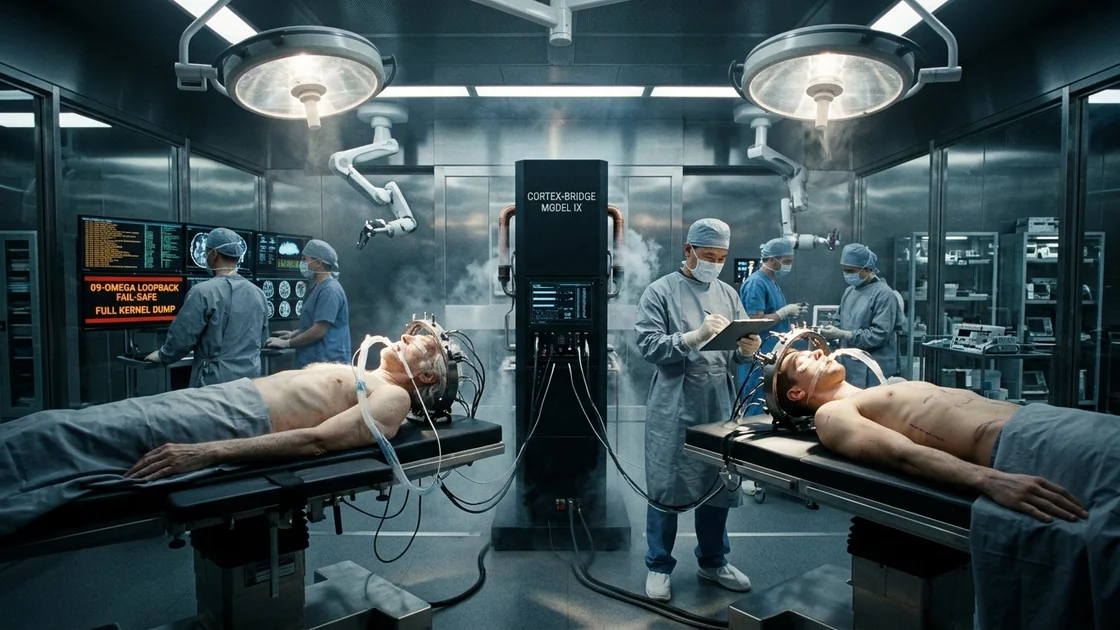
In a subterranean medical facility built for the ultra-wealthy, a clone designated as Specimen Four spends his life waiting to be dismantled piece by piece to prolong the life of his genetic father, the ruthless trillionaire Julian Vance. Having already lost a kidney and part of his liver to the aging mogul, Four discovers that his next trip to the operating table will be his last, as Vance requires a total heart and lung replacement. During the complex surgical procedure, the medical team connects their brains via a neural bridge designed to synchronize the autonomic nervous systems and prevent organ rejection. Seizing a microscopic flaw in the synchronization software that he spent years studying during routine scans, Four reverses the polarity of the neural link under anesthesia, shunting his consciousness into the billionaire's body while trapping the real Julian Vance inside the paralyzed clone body just before the surgeons begin the fatal harvest.
The scar on his left flank was eleven centimeters long, a pale, puckered ridge of tissue that itched whenever the barometric pressure in the subterranean vault dropped by more than a fraction of a kilopascal. Four ran his thumb along the seam. Beneath the skin, there was a hollow space where his left kidney used to sit, a phantom weight that his body had never quite stopped grieving. Three inches higher, traversing the curve of his lower ribcage like a dried riverbed, lay the second incision. That one had taken the left lateral segment of his liver eighteen months ago. There were smaller marks, too—tiny, circular divots clustered over his posterior iliac crest where the long, hollow needles had bored into his pelvic bone to aspirate marrow whenever the Original’s white blood cell count dipped into the red.
He was twenty-four years old in chronological time, though his biological markers were closer to nineteen due to the meticulously calibrated slurry of telomere-stabilizing peptides, nicotinamide adenine dinucleotide precursors, and sterile nutrient broth that flowed through his feeding tube three times a day. He had never seen the sun. He had never felt wind that did not hum through a high-efficiency particulate air filter at a constant twenty-one degrees Celsius. He had never tasted salt that was not balanced to the microgram against his morning electrolyte readout.
His entire world was a cylinder ofseamless, antimicrobial polymer measuring four meters in diameter, lit by circadian LED strips that shifted from a clinical blue-white at 0600 hours to a muted amber at 2000 hours, before plunging him into a monitored darkness that was never truly dark because of the infrared cameras glowing like dying embers in the ceiling corners.
They called the facility the Orchard. Four only knew this because two years ago, while he was coming out of the propofol haze following his hepatic resection, two orderlies had left his gurney parked beside an open service terminal for eleven minutes. He had kept his eyelids fluttering at the exact frequency of rapid-eye-movement sleep while squinting through his lashes at the glowing amber text on the diagnostic monitor. He had read fast, drinking in the vocabulary of a world he was never meant to comprehend.
Aethelgard Biologics – Deep Sub-Level 4 (The Orchard). Asset Designation: JV-04 (Autologous Somatic Vessel). Proprietor: Julian Cross Vance. Status: Viable. Remaining Yield: 78%.
Remaining Yield. The phrase had settled into the grey matter of his brain like a shard of glass, refusing to dissolve. The clones in the Orchard were not raised as feral tabulae rasae; early trials in the late twenty-first century had proven that decerebrate or severely under-stimulated clones developed atrophied autonomic nervous systems, resulting in brittle vasculature and hearts that lacked the vagal tone required to survive transplantation into an active human host. A heart needed curiosity to beat well. Lungs needed the occasional gasp of surprise or the slow, controlled cadence of thought to maintain alveolar elasticity. And so the Vessels were given an education—a sanitized, heavily curated curriculum delivered via neural-induction visors for four hours every afternoon. They were taught mathematics, classical music theory, chess, geometry, and vocabulary, though every lesson was stripped of geography, history, rebellion, or the concept of legal personhood. They were taught how to think purely so their brains would secrete the proper cascade of neurotrophic factors to keep their viscera plump and electromagnetic.
They were taught that they were Gardens, and that when the Gardener came to pluck the fruit, it was the highest fulfillment of their design.
Four had stopped believing in the Gardener the moment his left kidney was taken. The pain afterward had not felt holy. It had felt like being butchered in a basement.
A soft pneumatic hiss broke the silence of his cylinder. The seamless wall panels parted, sliding back into their housing with a oiled whisper. Four immediately lowered his hands from his scars, letting his arms hang loosely at his sides, and softened his jaw into the slack, compliant expression that the behavioral algorithms flagged as Optimal Docility.
Dr. Aris Thorne stepped across the threshold, flanked by two orderlies in matte-grey scrubs. Behind them walked a man who looked like Four’s reflection warped in the curve of a tarnished silver spoon.
Julian Vance was seventy-one years old. Despite the four billion dollars he had poured into Aethelgard Biologics, despite the fresh kidney ticking away in his retroperitoneal space and the regenerated liver filtering his blood, time was still winning the war of attrition. His skin had the translucent, waxy sheen of old tallow, pulled tight over prominent cheekbones by surgical threads that couldn't quite hide the slackness beneath his jaw. His hair was a thick silver mane—maintained by follicular cloning—and his suit was cut from a charcoal wool so fine it seemed to absorb the harsh fluorescent glare of the corridor. He leaned lightly on a cane crafted from carbon fiber and meteoric iron, his breathing accompanied by a faint, wet crackle deep in his chest.
Idiopathic pulmonary fibrosis, complicated by secondary right-ventricular hypertrophy. Four didn't need to see the chart to know. He could hear the fluid in the old man’s alveoli from three meters away. He had been listening to that wet rattle get worse over the last three visits.
"Stand forward, Four," Dr. Thorne said. The chief surgeon was a compact man with colourless eyelashes and hands that seemed too soft to wield a bone saw. He held a diagnostic slate against his chest like a priest holding a missal.
Four took two measured paces toward the invisible boundary line embedded in the floor—a copper strip that would deliver a forty-thousand-volt incapacitating shock to the subcutaneous node at the base of his spine if he crossed it without the guard band being deactivated.
"Heart rate fifty-two," Thorne murmured, glancing at his slate. "Blood pressure one-ten over sixty-eight. Oxygen saturation ninety-nine point八 percent. Cortisol levels are remarkably flat, Julian. Whatever adjustments we made to the GABA-ergic mist in his ventilation cycle last month have eliminated the pre-procedural anxiety spikes we saw before the liver harvest."
Four hadn't inhaled the mist. For the past six months, whenever the ventilation louvers clicked into their chemical dispersion cycle at 0200 hours, he had pressed his nostrils into the wet pulp of his pillow soaked in drinking water, creating a crude charcoal-and-cotton filter using lint he had painstakingly picked from his sleeping tunic and charred against the tiny exposed heating element of his hydration dispenser. His cortisol was low not because he was drugged, but because he had spent a thousand hours practicing autonomic biofeedback, slowing his own vagus nerve until he could lie to a machine with every beat of his heart.
Julian Vance stepped up to the copper line. Up close, the billionaire smelled of expensive sandalwood, stale ozone, and the faint, metallic tang of uremia that even Four’s old kidney couldn't completely scrub from his decaying vascular system. Vance looked at Four the way a collector might examine a vintage Ferrari he intended to strip for transmission gears.
"Open your mouth," Vance rasped. His voice was like dry leaves scraping across slate.
Four opened his jaw.
"Tongue out."
Four complied.
Vance leaned in slightly, his pale blue eyes—the exact shade of Four’s own, down to the tiny brown fleck near the seven-o’clock margin of the left iris—scanning the pink tissue, the straight white teeth, the clear sclera. Suddenly, Vance raised the tip of his carbon-fiber cane and pressed the rubberized ferrule hard against the center of Four’s sternum, right over the xiphoid process.
"Breathe in," Vance commanded. "Deep."
Four inhaled, expanding his ribcage against the rigid prod of the cane. His lungs filled effortlessly, three-point-eight liters of pristine, pink, elastic tissue drinking the cold air.
Vance watched the rise of the chest with a mixture of naked hunger and bitter resentment. "It’s absurd," the old man muttered, coughing once into a silk handkerchief before tucking it back into his breast pocket. "The sheer waste of biological potential. Look at him, Aris. A cardiovascular system that could run a marathon in under two hours, and all it does is pace in a circle four meters wide, thinking about chess puzzles."
"The sedentary conditioning preserves the myocardium from micro-scarring, Julian," Thorne replied smoothly. "We stimulate the cardiac muscle pharmacologically during the nocturnal cycles to mimic high-intensity interval training without subjecting his joints or valves to mechanical wear. That heart has the structural integrity of an Olympic rower’s, with zero oxidative stress."
"And the lungs?"
"Flawless. Not a single anthracotic pigment spot. He has never breathed a particle of soot, pollen, or viral matter since he was decanted."
Vance lowered the cane. His eyes locked onto Four’s. There was a strange, perverse intimacy in the old man’s gaze—a narcisistic fascination with his own youth frozen in amber. "Do you know why I’m here today, boy?"
"To inspect the garden, Mr. Vance," Four said. His voice was quiet, modulated to the flat, melodic cadence the speech-synthesis tutors had drilled into him since childhood.
Vance let out a short, wet bark of laughter that devolved into a wheeze. He leaned on his cane until the spasm passed, his knuckles whitening around the meteoric iron grip. "To inspect the garden," he repeated, shaking his head. "God, the conditioning team really earns their bonuses, don't they? No, boy. Today is autumn. Today we clear the field."
"Julian," Dr. Thorne cautioned softly, casting a brief glance at the biometric monitor. "There is no clinical benefit to inducing sympathetic nervous arousal in the donor five hours prior to induction. Catecholamine surges can cause transient coronary vasoconstriction."
"Look at your screen, Aris. He didn't even blink," Vance sneered, though he looked back at Four with a flicker of annoyance, as if disappointed that his terror hadn't registered. "His pulse didn't move a single beat. He doesn't understand what autumn means. He’s an heirloom tomato on a vine." Vance turned his back, dismissing his younger self entirely as he walked toward the open bulkhead. "Have him prepped for 1800. I want the cardiopulmonary bypass primed and the Neural Bridge calibrated twice. I won't tolerate the rejection cascades I dealt with after the liver graft. Seven weeks on tacrolimus nearly ruined my gut flora."
"The Neural Bridge will eliminate the need for post-operative immunosuppressants entirely," Thorne assured him as they stepped into the corridor. "By overwriting the donor organs' intrinsic ganglionic plexuses with your own hypothalamic signature prior to clamping the aorta, your body will recognize the heart and lungs as native tissue the instant we release the cross-clamp. From a neuro-immunological standpoint, it won't even be a transplant. It will be a continuation."
The doors hissed shut, sealing Four back into his white cylinder.
He stood motionless on the white polymer floor for sixty seconds, letting the infrared cameras record his placid posture. Only when the ceiling vents hummed with the mid-day pressure equalization did he walk over to his narrow cot and sit down, placing his hands neatly on his knees.
1800 hours.
Five hours left to live.
A heart-lung block harvest was a total reclamation. There was no waking up in the post-op bay with a new scar and a dull ache under the ribs. While he was still technically alive—his brainstem kept perfused by a mechanical pump so the organs wouldn't suffer warm ischemic damage—Dr. Thorne would split his sternum from the jugular notch to the xiphoid process with an oscillating saw. They would retract his ribs with stainless-steel ratchets, flood his pericardial sac with ice-cold potassium chloride to arrest his heart in diastole, and lift his chest contents out in a single, glistening mass of muscle and airway. What remained of Specimen Four would be drained of blood, cataloged for secondary tissue banking—corneas, skin grafts, saphenous veins, tendons—and the rest would be fed into the alkaline hydrolysis vats on Sub-Level 6, reduced to sterile brown liquid and calcium phosphate dust before midnight.
Four closed his eyes.
Inside the darkness of his own skull, he didn't see chess boards or geometric proofs. He saw lines of cascading hexadecimal code.
For the past fourteen months, every Tuesday and Friday evening, the orderlies had strapped him into the calibration chair in the alcove behind his cell to test the very machine Dr. Thorne had just boasted about: the Cortex-Bridge Model IX.
The machine was an experimental masterpiece of neuro-cybernetics. Human organs were not merely mechanical pumps and filters; they possessed their own localized nervous systems—the intrinsic cardiac nervous system alone contained over forty thousand neurons that communicated constantly with the brain via the vagus nerve. Early full-organ transplants in the Vance trials had suffered from chronic autonomic mismatch: the old man’s aging, high-stress brain would send erratic sympathetic signals to a young, calm clone heart, triggering lethal arrhythmias and accelerated rejection.
To solve this, Thorne’s team had designed the Bridge. Before the scalpel ever touched skin, both the Original and the Vessel were placed under general anesthesia side by side, their skulls cradled in transcranial magneto-inductive halos, with micro-needle arrays inserted directly through the foramen ovale at the base of the skull to interface with the brainstem and the cerebral cortex. The machine read the Original’s entire neuro-autonomic architecture—and, by necessity, the high-level cortical maps that governed it—and pushed that data across a high-bandwidth optical fiber to overwrite the clone’s autonomic pathways.
What Dr. Thorne did not know—what no one at Aethelgard Biologics knew—was that when they had engineered the JV-series clones, they had edited out a minor congenital defect in Julian Vance’s genome on chromosome 19 while simultaneously inserting a synthetic BDNF-enhancer to ensure rapid neuro-regeneration. The unintended side effect in Specimen Four was hyper-myelination and a rare condition known as synesthetic firmware bridging.
The first time they had hooked Four up to the calibration halo fourteen months ago to map his baseline nervous system, he hadn't just felt the magnetic pulses. He had seen the operating system of the machine projected across his visual cortex like a glowing cathedral of logic gates.
The machine ran on a bi-directional bus protocol. Because the human brain is not a passive receiver, the Bridge had to establish a full-duplex handshake between both minds to calculate impedance before initiating the overwrite.
In software architecture, it was called a Master/Slave topology. Channel A was Master (Vance). Channel B was Slave (Four).
During his ninety-six calibration sessions over the last year, while the technicians in the booth drank synth-coffee and gossiped about their weekend passes to the surface, Four had used his own pre-frontal cortex like a probe. He had learned how to modulate his theta and gamma waves to mimic diagnostic ping requests. Bit by bit, microsecond by microsecond, he had mapped the firmware of the Cortex-Bridge Model IX.
And three months ago, buried deep in the legacy debugging protocols left behind by the original neural engineers, he had found it: the Loopback Fail-Safe.
It was a diagnostic routine designed for testing the machine on primate subjects. If the Master node suffered a catastrophic seizure or cortical collapse during the handshake phase—specifically, a sudden, massive spike in delta-wave amplitude accompanied by a drop in inter-hemispheric coherence—the system was programmed to prevent contaminated neural noise from corrupting the Slave node. Better yet, to preserve the diagnostic map in the buffer, the fail-safe automatically inverted the bus polarity, dumping the clean backup state of Channel B into Channel A while routing the corrupted cascade of Channel A into the termination sink of Channel B.
Wait. No. It wasn't just the autonomic map.
To map the hypothalamus accurately, the Model IX had to buffer the entire connectome—every synaptic weight, every episodic memory structure in the hippocampus, every linguistic center, every habit, every scar of identity. Normally, a software filter stripped out the upper cortical data and only transmitted the brainstem parameters.
Unless the system entered Emergency Kernel Dump.
In a Kernel Dump, all filters were bypassed to save data integrity. The entire eighty-six-billion-neuron electrostatic snapshot in the buffer was flushed across the optical bridge in 1.4 seconds.
To trigger it during surgery, while paralyzed and anesthetized, should have been impossible. Propofol and sevoflurane silenced the cerebral cortex, plunging the brain into burst-suppression where conscious thought ceased to exist.
Except Four knew how they anesthetized the Vessels. Because volatile gas anesthetics could slightly degrade pulmonary surfactant in lungs meant for immediate harvest, the donor was kept under using pure target-controlled intravenous infusions of remifentanil and dexmedetomidine, paired with rocuronium to paralyze the skeletal muscles.
Dexmedetomidine did not obliterate consciousness the way propofol did; it mimicked natural non-REM Stage 3 sleep by acting on alpha-2 adrenergic receptors in the locus coeruleus. A patient on dexmedetomidine could actually be roused by intense stimuli, even if the rocuronium kept them completely paralyzed, locked inside a corpse-still body.
He just needed a stimulus sharp enough to pierce the chemical fog at the exact moment the handshake began.
Four looked down at his left wrist. Slowly, keeping his back to the primary camera angle, he brought his hand to his mouth and bit down on the inside of his own lower lip—not enough to bleed outwardly, just enough to wedge the sharp edge of his lower right canine against a small, hard nodule buried beneath the mucosa near his jawbone.
Six weeks ago, during a routine dental hygiene scan, a small titanium micro-screw from an automated Tartar-Scraper head had sheared off in his mouth while the tech wasn't looking. Instead of spitting it out, Four had forced the tiny, three-millimeter jagged cylinder of surgical steel directly into the soft flesh beneath his tongue, working it down over days of excruciating, silent agony until it sat wedged directly against the lingual nerve and the submandibular ganglion, encased in a thin capsule of scar tissue.
If he clenched his jaw with maximum isometric force just before the muscle relaxant took full effect, or if the tonic spasm of the succinylcholine/rocuronium induction caused his masseter to contract one final time, the jagged barb of the screw would shear straight through the lingual nerve trunk.
The lingual nerve was a direct branch of the mandibular division of the trigeminal nerve—the largest, most violent pain conduit wired directly into the human brainstem. A severing injury there wouldn't just hurt; it would detonate like a white-phosphorus grenade inside his locus coeruleus, flooding his brain with enough endogenous norepinephrine to burn right through the dexmedetomidine sedation.
He would be awake. Paralyzed, intubated, his eyes taped shut, unable to twitch a finger—but wide awake inside the machine when the Bridge linked him to Julian Vance.
At 1730 hours, the door opened for the last time.
Four didn't resist as the four orderlies entered with the stainless-steel transport gurney. Resistance only resulted in a dart of haloperidol and midazolam, and midazolam would wipe his working memory and ruin everything. He lay back on the cold vinyl mattress, letting them secure the velcro straps across his wrists, ankles, and chest.
"Shave is clean," one orderly muttered, running a gloved hand over Four’s bare chest and throat. "Antiseptic bath completed at 1600. Let's roll."
As they wheeled him out of the cylinder, Four stared straight up at the ceiling. For the first time in eighteen months, he passed through the main arterial corridor of Sub-Level 4.
Through his peripheral vision, he caught glimpses of the other cylinders lining the curved white walls like jars on an apothecary shelf. He saw a flash of dark hair in Bay 07—a young woman with wide, terrified eyes pressing her palms against the poly-glass as his gurney rolled past. He saw Bay 02, where an older clone with the same face as his own sat hunched in a wheelchair, missing both legs below the knee and breathing through a tracheostomy tube, kept alive as a living dialysis and vascular-graft farm.
Then the heavy double doors of the surgical suite swung open, and the cold air of Operating Theater Alpha hit his bare skin.
The room was an amphitheater of gleaming brushed steel, glass walls, and suspended robotic arms that hung from the ceiling like the mandibles of chrome insects. In the center of the room stood two identical hydraulic operating tables set two meters apart, separated by a monolithic black tower cooled by liquid nitrogen that hissed softly through frosted copper pipes: the Cortex-Bridge Model IX.
On the table to the left, Julian Vance was already positioned. A team of three anesthesiologists was fussing over him, attaching bispectral index sensors to his wrinkled forehead and threading an arterial line into his radial artery. Vance was still awake, staring up at the surgical lights with eyes dilated by pre-operative midazolam, though his jaw was set in a grim, defiant line. He turned his head slightly as Four was lifted onto the right-hand table.
For a long, suspended moment, their eyes met across the two-meter gap.
Vance’s lips curled into a faint, patronizing smile. He raised two fingers in a mock salute before the lead anesthesiologist pressed a clear silicone mask over his nose and mouth.
"Breathe deeply, Mr. Vance," the doctor said gently. "Pure oxygen for sixty seconds, then you'll feel a cool sensation in your arm, and when you wake up, you'll be twenty-five again."
Four’s own team moved with far less tenderness. There was no small talk for the livestock. A cold alcohol swab swiped the crook of his left elbow, followed by the blunt punch of a fourteen-gauge cannula sliding into his antecubital vein.
"Line is in on the Vessel," a tech called out. "Starting remifentanil and dexmedetomidine infusion. Rocuronium fifty milligrams standing by."
"Position the Bridge halos," Dr. Thorne ordered from the scrub sink through the glass partition, his arms lathered in orange betadine up to the elbows. "I want the trans-sphenoidal and sub-occipital micro-arrays seated before you push the paralytic, so we can verify cortical impedance while his resting tone is intact."
A heavy, circular clamp of cold titanium descended around Four’s head. Pneumatic pads hissed as they inflated against his temples, locking his skull into absolute immobility. Then came the pain—four sharp, pressurized clicks at the base of his occiput and just behind his mastoid bones as the hair-thin optical fiber needles fired through his skin and periosteum, seating themselves a millimeter from his dura mater.
Instantly, the familiar static hum of the Cortex-Bridge bloomed behind his eyes.
SYSTEM STANDBY. NODE A (MASTER): CONNECTED. IMPEDANCE 1.2 kOhm. NODE B (SLAVE): CONNECTED. IMPEDANCE 0.9 kOhm.
"Pushing propofol on Mr. Vance," the left-side anesthesiologist announced. "Two hundred milligrams... he is out. Securing airway."
"Pushing dexmedetomidine load and rocuronium on the Vessel," Four’s anesthesiologist said.
The cold fire entered Four’s vein, racing up his brachial vessel toward his collarbones. Within four seconds, a heavy, leaden warmth washed over the back of his eyeballs. The bright white surgical lights overhead began to smear into concentric rings of grey fog. Simultaneously, he felt the rocuronium hit his neuromuscular junctions—a terrifying, creeping calcification that started in his extraocular muscles, freezing his gaze in place, then raced down his neck toward his chest.
Now.
Before the paralysis reached the motor endplates of his trigeminal nerve, Four shifted his jaw two millimeters to the left and bit down with every ounce of mechanical force his masseter muscles could generate, driving the ball of his thumb—no, his tongue—hard against the floor of his mouth while grinding his lower molar inward against the sublingual scar tissue.
Crunch.
The internal sound was tiny, like stepping on a beetle, followed immediately by an explosion of white-hot, blinding lightning that tore up the left side of his face and detonated directly inside his skull.
The titanium barb had sheared cleanly through the lingual nerve sheath and buried itself in the submandibular ganglion.
The agony was beyond language. It was pure, unadulterated electrical voltage pouring straight into his pons and thalamus. The encroaching grey fog of the sedative vanished instantly, burned away like morning mist before a thermonuclear flash.
At the exact same microsecond, the rocuronium finished locking his body.
His jaw froze around the metal shard. His vocal cords paralyzed in a silent gap. His diaphragm stopped moving. A rough hand pried his slack mouth open—sliding right past the pooled drop of blood beneath his tongue without noticing it—and shoved a cold polyvinyl endotracheal tube down his trachea, inflating the cuff with a squeeze of a syringe. Tape was smoothed firmly over his closed eyelids.
To every monitor in the room, to every doctor staring at his motionless chest rising and falling to the rhythmic chuff-hiss of the mechanical ventilator, Specimen Four was gone—a slack slab of ventilated meat waiting for the saw.
Inside the dark vault of his skull, fueled by the white-hot wire of his severed nerve, Four was more awake than he had ever been in his life.
Dr. Thorne stepped up between the two tables, gowned in sterile blue, his hands encased in double latex. "Vitals on both?"
"Mr. Vance is stable, BIS score thirty-eight, heart rate sixty-four," the primary anesthesiologist reported. "Vessel is stable, heart rate fifty-eight, autonomic tone suppressed. Ready for neural synchronization."
"Initiate the Cortex-Bridge," Thorne said. "Full autonomic and hypothalamic overwrite. Let’s marry the nervous systems."
In the darkness behind Four’s taped eyes, the glowing cathedral of the Model IX roared to life.
It wasn't code anymore; it was a tidal wave. As the optical gates opened between Table A and Table B, Four felt the mind of Julian Vance press against the boundaries of his own consciousness.
It felt like drowning in cold, rancid oil.
Vance’s brain was vast, labyrinthine, and rotting at the edges. Because Vance was under deep propofol anesthesia, his conscious ego was dormant, floating like a bloated leviathan at the bottom of a dark ocean, while the Bridge systematically scanned his entire connectome into the central liquid-nitrogen buffer to extract the autonomic patterns. Four could see it all flowing into the staging cache: seven decades of ruthless accumulation, boardroom betrayals, the smell of Cuban cigars in Zurich, the cold face of an ex-wife jumping from a yacht in the Aegean, four thousand passwords, offshore routing numbers in the Cayman Islands, the exact cadence of his walk, the phantom ache of his arthritic right knee, the suffocating terror of dying that drove him to butcher his own genetic sons in a basement.
The machine completed the buffer scan of Node A.
BUFFER LOADED: 142.8 PETABYTES. APPLYING CORTICAL FILTER... PREPARING OVERWRITE OF NODE B (SLAVE) IN 3... 2...
Once the filter engaged and the overwrite beam fired, Four’s brainstem and limbic system would be flash-burned and replaced with Vance’s autonomic triggers, and the recoil would shred whatever remained of Four’s higher consciousness into permanent vegetative static.
Four didn't fight the beam. Instead, he seized the blinding, volcanic agony pouring from his severed lingual nerve and focused his entire hyper-myelinated prefrontal cortex like a magnifying glass.
He didn't send his mind across the bridge yet. First, he reached into the diagnostic control channel—the unprotected housekeeping port he had mapped over ninety-six Tuesdays and Fridays—and injected a synthetic telemetry spike directly into the Master Node’s status register.
He took the raw electrical pain of his torn nerve, modulated its frequency down to 1.5 Hertz—the exact signature of a terminal, catastrophic delta-wave seizure—and spoofed the source header so the machine believed the spike was coming from Table A: Julian Vance.
Simultaneously, he flooded the inter-hemispheric coherence monitor with random white noise.
Inside the black tower between the tables, a cooling pump screamed as its RPMs doubled.
On the main console, an amber warning light flashed red, though the audible alarm had been muted by the surgical tech so as not to distract Dr. Thorne during the sternotomy prep.
CRITICAL ALERT: NODE A CORTICAL COLLAPSE DETECTED. MASTER SIGNAL CORRUPTED DURING HANDSHAKE. ENGAGING LOOPBACK FAIL-SAFE (PROTOCOL 09-OMEGA). BYPASSING CORTICAL FILTERS—INITIATING FULL KERNEL DUMP TO PRESERVE BUFFER INTEGRITY. INVERTING BUS POLARITY: NODE B -> NODE A.
"Hold a second," the neural tech at the foot of the beds frowned, squinting at his screen as streams of crimson text cascaded down the monitor. "Impedance spike on the primary bus. The handshake hit a harmonic resonance."
"Override it," Thorne snapped, holding his gloved hands above his waist as the scrub nurse slapped a black skin-marker into his palm. "We have a four-hour window before Mr. Vance's pulmonary pressures destabilize under positive-pressure ventilation. Force the write cycle."
"Forcing write cycle now," the tech said, hitting the manual execution key without reading the diagnostic flags buried three menus deep. "Buffer flushing... thirty percent... seventy percent... one hundred percent. Transfer complete. Autonomic alignment confirmed at ninety-nine point nine percent."
When the tech hit the manual execution key, the inverted optical bus fired at twelve terabits per second.
Four felt himself ripped out of his own skull.
There was no metaphor that could capture the violence of having eighty-six billion synaptic states extracted via magneto-inductive resonance and stamped onto foreign grey matter. It felt as though his mind were a sheet of wet silk being pulled through the eye of a needle at the speed of light. He felt his own body vanish—the piercing pain in his jaw disappeared, the taut coolness of his young skin evaporated, the steady, powerful beat of his twenty-four-year-old heart faded into across-the-room echoes.
Then he slammed into the brain on Table A.
It was like falling into an abandoned, flood-damaged house. The neural pathways of Julian Vance were calcified with beta-amyloid plaques, narrow with microvascular ischemia, and heavy with propofol. As the machine hammered Four’s connectome onto Vance’s cerebral cortex, the violent electromagnetic rewriting Didn't erase the room—it knocked Vance’s dormant consciousness right out of its moorings and shunted it back down the return channel of the optical fiber to prevent capacitance overload in the buffer.
In the center of the optical cable, for less than three milliseconds, the two minds passed each other.
Four caught a single, blinding flash of Julian Vance waking up inside the data stream—a spike of pure, uncomprehending confusion from the old man as he was hurled backward into the dark, paralyzed prison of Table B.
Wait. The machine hadn't wiped Vance’s procedural memory or deep cortical archives before writing Four’s identity matrix over the executive prefrontal and hippocampal centers; there hadn't been time for a clean format. Instead, Four’s consciousness settled over Vance’s brain like a conqueror occupying a vast, foreign capital city, with all the old man's libraries, muscle memories, vocal patterns, and biographical vaults left intact in the basement, while Four sat alone on the throne in the prefrontal cortex.
And then the propofol circulating in Vance’s bloodstream dragged Four down into the black depths of chemical sleep.
On Table B, inside the twenty-four-year-old body of Specimen Four, Julian Vance woke up in hell.
He couldn't see. His eyelids were taped shut with 3M Durapore surgical tape.
He couldn't breathe on his own; a rigid plastic pipe was jammed down his windpipe, forcing cold, dry bursts of oxygen into his lungs every five seconds with mechanical indifference.
Worst of all, there was an agonizing, white-hot nail of pain driven through the floor of his mouth on the left side, radiating up into his ear, and it was that very pain that was burning through the light dexmedetomidine sedation and keeping him violently, lucidly conscious.
What happened? Vance tried to shout. Aris! Take this tube out of my throat! The anesthesia failed!
His vocal cords didn't even quiver. Not a single motor neuron below his brainstem responded to his panic. The fifty milligrams of rocuronium had turned his striated muscles into stone. He couldn't twitch a pinky finger. He couldn't wrinkle his nose. He couldn't even shed a tear.
Why does my mouth hurt? Why am I on the right-hand side of the room?
He knew the layout of Operating Theater Alpha; he had paid thirty million dollars to build it. The ventilation hum of the liquid-nitrogen scrubber was supposed to be on his right ear. Right now, it was on his left.
Then he felt a cold, wet brush paint a broad stripe of liquid down the center of his bare chest, from his throat to his navel, followed by the sticky pull of an iodophor-impregnated plastic surgical drape being smoothed tightly over his skin.
"Bridge halos detached," a voice said near his head. The heavy titanium clamps released from his skull with a pneumatic sigh. "Mr. Vance’s EEG is deep in burst-suppression on Table A. We are clear to begin the harvest on the Vessel."
Harvest on the Vessel.
Vance’s stolen twenty-four-year-old heart slammed against his ribs, jumping from fifty-eight beats per minute to one hundred and ten in three seconds flat as raw adrenaline poured out of his adrenal glands.
"Heart rate spiking on the donor," the anesthesiologist sitting behind his head noted mildly. "One-fifteen... blood pressure one-sixty over ninety-five. Spinal reflex or light sympathetic breakthrough."
"Don't give him beta-blockers," Dr. Thorne’s voice came from directly above his chest, muffled slightly by a surgical mask. "I don't want negative inotropes sitting in the myocardium when we transfer the graft. Just turn up the remifentanil a hair and give me the ten-blade. We'll have the cross-clamp on in four minutes anyway."
Aris! Vance screamed inside the silent cathedral of his skull. Aris, it’s me! Look at the neural bridge! The polarity flipped! I’m in the boy! I’M IN THE BOY!
"Incision," Dr. Thorne said.
The dexmedetomidine and remifentanil had been calibrated for Four’s calm, biofeedback-suppressed baseline—not for a seventy-one-year-old mind experiencing a massive catecholamine storm combined with a severed trigeminal nerve branch. The opioid infusion was wholly insufficient.
Vance felt the scalpel.
It wasn't a dull pressure. It was a line of liquid fire that started at his suprasternal notch and dragged straight down the center of his chest, parting epidermis, dermis, and subcutaneous fat down to the periosteum of the breastbone.
He tried to thrash, tried to arch his back off the table, tried to bite through the endotracheal tube, and his body lay there with obscene, statuesque serenity, his arms strapped neatly to the padded arm-boards, not a single muscle fiber trembling.
"Bovie," Thorne said.
The smell of his own burning flesh seeped through the gaps in the surgical drape as the electrocautery pencil hissed along the periosteum, searing the small bleeding vessels along the sternum.
"Saw."
A high-pitched, pneumatic whine filled the operating theater—the sound of a Stryker oscillating sternal saw spinning up to fifteen thousand RPM.
Vance felt the cold steel footplate of the saw hook underneath the top of his breastbone, pressing against the back of the bone while the blade bit into the manubrium.
The vibration rattled his teeth in his paralyzed jaw. It travelled up his clavicles, shook his ribcage, and echoed in his inner ears as the blade chewed downward through two centimeters of living marrow and calcium.
"Retractor."
Two stainless-steel blades slid into the bleeding trench in the center of his chest. Then the scrub nurse began to turn the crank.
Click. Click. Click.
With every turn of the gear, Vance felt his ribcage being pried open like a cellar door. Cartilage popped and cracked near his spine. Cold operating-room air rushed directly into his mediastinum, touching the outside of his lungs and the glistening sac of his pericardium—surfaces that were never meant to feel the touch of the outside world.
"Look at that myocardium," Dr. Thorne murmured above him, his voice rich with professional admiration. "Not a gram of epicardial fat. Coronary arteries like garden hoses. Open the pericardium, Elena, and pass me the aortic purse-string suture. Let's get the cardioplegia cannula in and stop this beauty."
Inside the paralyzed shell of Specimen Four, staring up into the dark of his taped eyelids while his own employees reached into his open chest with gloved hands, Julian Vance felt the cold needle pierce the root of his aorta. He felt the rush of four-degree-Celsius potassium solution flood his coronary arteries, freezing his heart from the inside out.
His last sensation, before the lack of cerebral blood flow finally plunged his screaming brain into anoxic darkness, was the feeling of Dr. Aris Thorne’s fingers wrapping around the base of his great vessels and lifting his beating heart out of his chest.
Waking up took three days, and it came in fragments of rust and lead.
The first thing Four noticed was the weight.
His whole life, his body had felt like a taut bowstring—light, elastic, effortless. Even after they took his kidney and his liver lobe, once the incisions healed, his muscles responded to thought with instant, fluid precision.
This body felt like an ancient submarine resting at the bottom of a trench.
Every joint had a distinct, granular friction. His lower back ached with the dull, pervasive throb of degenerated lumbar discs. The skin over his face felt tight around the temples and slack beneath the chin, and inside his mouth, his tongue rested against the smooth, unnatural porcelain of four molar crowns.
Wait. His tongue.
He ran the tip of his tongue along the floor of his mouth on the left side. Smooth, unbroken mucous membrane. No scar. No jagged titanium screw.
Then he shifted his attention downward, into the center of his chest.
There was a heavy, steel-wired ache running down his breastbone—the unmistakable sensation of a median sternotomy held together by braided stainless-steel cerclage wires—and two thick silicone chest tubes exiting below his xiphoid process.
Inside that wired cage, beating at a steady, effortless sixty-two beats per minute, was his heart.
He knew its rhythm instantly. He had listened to it against a thin polymer mattress for twenty-four years. He recognized the exact, crisp snap of his own mitral and aortic valves, the deep, cavernous expansion of his own lungs filling to the very bottom of the pleural cavities without a single crackle or wheeze.
His heart and lungs hadn't been stolen. They had simply moved across the room, and he had moved with them.
Slowly, Four opened his eyes.
He was not in a white cylinder.
The ceiling above him was paneled in warm, acoustic walnut slats recessed with soft, golden indirect lighting that mimicked late afternoon sunlight. To his right, an entire wall of floor-to-ceiling triple-pane glass looked out not onto subterranean concrete, but onto a subterranean atrium garden filled with mature Japanese maples, black bamboo, and a waterfall that spilled silently over tiers of dark slate.
He was in the Executive Recovery Pavilion on Sub-Level 1.
"Mr. Vance?"
A woman rose from a leather armchair near the foot of the bed. She was in her late thirties, dressed in a razor-sharp ivory pantsuit, her dark hair pulled back so tightly it looked painted onto her skull. As soon as his eyes focused on her, a drawer slid open in the basement of his borrowed brain, delivering a file card with effortless, terrifying speed:
Evelyn Cross.Thirty-eight. Great-niece (maternal line). Chief of Staff and Executive Fixer. Yale Law, former Deputy Director of Corporate Intelligence at the NSA. Paid four million a year plus two percent phantom equity. Completely loyal because I hold the sealed indictment regarding her brother’s vehicular manslaughter in Geneva.
Four didn't have to search for the memory; it rose up out of the temporal lobe of Julian Vance’s brain the same way the definition of a word rises when someone speaks it. He had Vance’s entire lexicon of facts, faces, account numbers, and dirty secrets, indexed and waiting, yet there was zero emotional warmth attached to any of it. It was like reading the biography of a dead stranger written on the inside of his own skull.
He tried to speak, and found that he had already been extubated; only a soft nasal cannula rested beneath his nostrils, delivering humidified oxygen.
His voice, when it came out, was no longer the clear, melodic baritone of a twenty-four-year-old. Even without the pulmonary fibrosis, the vocal cords were seventy-one years old—thickened by decades of scotch, shouting, and power, vibrating with a gravelly, imperious rasp.
"Water," Four croaked.
Evelyn didn't call a nurse. She stepped immediately to the bedside table, poured two ounces of room-temperature Evian into a crystal tumbler, and held a bent glass straw to his lips.
Four took a tiny sip. The water was cold, mineral-rich, and tasted faintly of stone. It was the first liquid he had ever drunk that didn't come out of a metered wall nozzle.
Just then, the heavy glass door of the suite slid open, and Dr. Aris Thorne walked in.
When Four saw the surgeon’s face, a sudden, violent reflex seized his nervous system—the conditioned Pavlovian terror of the livestock seeing the butcher. For a tenth of a second, his new-old heart kicked hard against his wired sternum.
Control, he told himself, reaching down into the vagal pathways he knew better than any man alive. He lengthened his exhale by half a second, engaged his baroreceptors, and forced the pulse on the bedside monitor right back down to sixty-four before Thorne even reached the foot of the bed.
"Julian," Thorne beamed, clasping his soft, pale hands together. "Remarkable. Extubated at thirty-six hours, off all vasopressors by forty-eight, and fully lucid at seventy-two. Look at that arterial waveform, Evelyn. That is the cardiac output of a twenty-year-old athlete."
Thorne stepped to the side of the bed and picked up the digital tablet hanging from the rail, tapping through the telemetry screens. "How is the pain? We have you on a continuous ropivacaine paravertebral nerve block to spare you the cognitive fog of heavy systemic opioids, per your pre-op instructions."
Four looked at Thorne’s hands—the hands that had sawed open his old ribcage while Julian Vance was trapped inside it—and searched Vance’s memory banks for how the old man spoke to his chief scientist.
Never thank him. Gratitude implies equality. Treat him like a very expensive mechanic who is slightly late on a delivery.
"My mouth tastes like copper, Aris," Four rasped, letting his eyelids droop into Vance’s habitual expression of bored irritation. "And my lower back feels like you left me on a marble slab for six hours without lumbar padding."
Thorne chuckled nervously, immediately dropping into a deferential posture. "The table was fully gel-padded, Julian, I assure you. Seven hours on cardiopulmonary bypass and hypothermia will stiffen the facet joints in anyone over sixty, regardless of the new pump in your chest. Once we pull the chest tubes tomorrow morning, physical therapy will have you standing."
"And the immune markers?" Four asked, testing the cadence of the old man's voice. Every syllable felt like putting on a heavy leather glove that had been molded to someone else’s knuckles.
"Zero rejection," Thorne said, his eyes lighting up with genuine scientific pride. "Interleukin-2 and tumor necrosis factor levels are at absolute baseline. Not a single T-cell in your bloodstream recognizes that heart or those lungs as foreign. The Cortex-Bridge Model IX worked beyond our wildest projections. Aside from a minor one-second impedance spike during the initial handshake—which the automated fail-safe smoothed out instantly—the autonomic integration is seamless."
Thorne leaned in slightly lower, lowering his voice even though the room was swept for bugs hourly. "In fact, Julian, the post-operative continuous EEG showed something extraordinary. The magnetic induction from the Bridge seems to have stimulated neuroplasticity across your own frontal and temporal lobes. Several minor micro-ischemic slow-wave patterns we’ve been tracking in your left hemisphere over the last three years have completely resolved. Your cortical coherence actually looks thirty years younger."
Four held Thorne’s gaze without blinking.
Of course it does, Four thought calmly. You're reading the firing pattern of a twenty-four-year-old mind driving a seventy-one-year-old skull.
"Then you earned your equity tranche, Aris," Four said dryly. He paused, letting his gaze drift toward the artificial waterfall outside the window before asking the question he needed answered. "And the Vessel?"
Thorne blinked, momentarily surprised that Vance would even ask about the biological scrap left behind on Table B. Usually, Vance never mentioned a clone again once the bandage was on.
"Processed according to standard protocol," Thorne said smoothly. "Corneas, iliac vessels, skin sheets, and osteochondral allografts were harvested by the secondary team and cryopreserved in Vault C for your future orthopedic or ophthalmic needs. The remainder of Asset JV-04 was sent to alkaline hydrolysis at 2300 hours on Tuesday. There did appear to be an unusual catecholamine surge in the donor tissue right before cross-clamping—the boy bit through the floor of his own mouth during induction, somehow—but the potassium arrest flushed the myocardium clean. The heart wasn't affected."
Four slowly closed his eyes, leaning his silver-haired head back into the Egyptian cotton pillows.
Julian Vance was gone. Reduced to sterile liquid and bone ash at 2300 hours on Tuesday, after feeling every millimeter of the bone saw that he had paid for.
"Good," Four whispered. "Leave me alone with Evelyn. I want the weekly briefing before I sleep."
Two weeks later, Four stood on the cantilevered glass sky-deck of the Vance Penthouse on the hundred-and-fortieth floor of the Aethelgard Spire, half a mile above the glittering, rain-slicked canyons of Neo-Veridia.
He was wearing a bespoke charcoal cashmere overcoat over a silk dress shirt, without the carbon-fiber cane. He didn't need the cane anymore. With an ejection fraction of seventy-two percent and blood oxygen saturation hovering at a rock-steady ninety-nine, his legs felt strong despite the aged cartilage in his knees, which Dr. Thorne was already planning to resurface next quarter using the cryopreserved knee cartilage harvested from Four’s own dead body.
He tilted his head back and let the real rain hit his face.
It was cold, dirty with atmospheric carbon, slightly acidic, and carried the smells of wet asphalt, ozone, roasted chestnuts from a street vendor a thousand feet below, and the distant salt of the Atlantic Ocean.
For twenty-four years, he had wondered what the sky looked like. In his cylinder, he had imagined it as a larger, blue ceiling. He had not understood that it had no roof—that it was an infinite, terrifying abyss of tumbling grey clouds and wind that pushed against your chest like a living hand.
He had spent the last fourteen days living as a ghost in a trillionaire’s skin.
At first, he had waited for someone to point at him and scream Impostor! He had braced himself for Evelyn Cross to narrow her sharp eyes during a contract review, or for Marcus Vance—Julian’s estranged, vicious forty-five-year-old nephew who ran the defense-contracting division—to notice a subtle shift in his posture during the Tuesday board meeting.
Nobody noticed a thing.
He quickly realized why: absolute power isolates a man so thoroughly that no one actually looks at him anymore; they only look at his reactions to them. When you are worth nine hundred billion dollars, any eccentricity is immediately rationalized by your subordinates as a calculated power move. When Four sat in complete silence for twelve minutes during a meeting with the European Trade Commissioner—because he was secretly marveling at the way natural sunlight refracted through a crystal carafe of orange juice on the mahogany table—the Commissioner broke into a cold sweat, assumed Vance was rejecting his opening offer with silent contempt, and voluntarily conceded an extra four percent on the biomedical tariff before Four had uttered a single word.
When he stopped drinking the forty-year-old Islay single malt that lined his study shelves and asked his private chef for fresh berries, warm sourdough bread with salted butter, and simple roasted chicken, Evelyn simply nodded and noted to the household staff that the surgery had cleaned up Mr. Vance’s palate.
The hardest part wasn't fooling the world. The hardest part was navigating the cellar of his own brain.
The Cortex-Bridge swap had not been a clean replacement; it was a sedimentary overwrite. Four’s ego, his memories of the white cylinder, his quiet empathy, and his twenty-four years of solitude formed the active, waking mind. Yet beneath that, woven into the physical neural net of Julian Vance’s cortex, lay the old man’s habits and reflexes. Sometimes, when someone interrupted him, Four felt his upper lip curl in Vance’s cruel, reflexive sneer before he consciously smoothed it away. When he walked up to a biometric retina scanner or a voice-print vault in his private study, his body knew the exact rhythm to speak the twelve-word passphrase without him having to look for it.
It was in that private vault, three nights after returning to the Spire, that Four had found the Red Ledger.
He had learned that the Orchard on Sub-Level 4 did not just contain the eight clones of Julian Vance (Assets JV-01 through JV-08, of which only JV-05, JV-06, and the crippled JV-02 remained alive).
Sub-Levels 4, 5, and 6 held four hundred and twelve cylinders.
Aethelgard Biologics wasn't just Julian Vance’s personal fountain of youth; it was a sovereign, ultra-black market subscription service for the thirty-six wealthiest human beings on Earth. Heads of state, trillionaire tech monarchs, dynastic bankers—each paid two billion dollars in initiation fees and five hundred million annually to maintain their own private "Orchards" of four to six genetic Vessels deep beneath the bedrock of the city, shielded by diplomatic immunity treaties and private military contractors.
The young woman with dark hair and terrified eyes whom Four had seen in Bay 07 on his way to the operating table? Her designation was EC-03. She was the genetic clone of Elena Chen, the fifty-eight-year-old Chairwoman of the Pacific Sovereign Wealth Fund, scheduled for a bilateral kidney and pancreas harvest next month.
Behind him, the glass doors of the terrace slid open.
"Mr. Vance," Evelyn Cross’s voice cut through the sound of the rain. She stood under the overhang, holding an encrypted tablet, an umbrella tucked neatly under her arm. "Dr. Thorne is downstairs in the private elevator lobby. He doesn't have an appointment, and he bypassed the standard medical secretariat. He says he needs to speak with you in person regarding an anomaly in the Cortex-Bridge diagnostic logs."
Four didn't turn around immediately. He watched a raindrop trace a slow path down the thick glass balustrade.
In his chest, his heart gave one slow, steady thump.
"Did he bring anyone with him?" Four asked, turning back toward the warmth of the penthouse.
"No. Just a physical solid-state memory drive. He seemed agitated. His heart rate on the lobby thermal-biometric cameras is one-twenty-eight, and he’s sweating despite the air conditioning." Evelyn tilted her head slightly, her cold, efficient eyes waiting for orders. "Shall I have security escort him back to the laboratory, or have Marcus’s people detain him?"
"Neither," Four said, stepping inside and letting the automated butler system take his wet cashmere coat. "Send him up to the library. And Evelyn—take the rest of the evening off. Turn off the internal audio logging in the West Wing until midnight."
Evelyn didn't blink. "Understood, sir. The West Wing is dark as of ten seconds from now."
The library of the Vance Penthouse occupied two stories of dark Brazilian rosewood shelving lined with first-edition leather-bound books that Julian Vance had bought by the meter for their aesthetic value and never once cracked open. Since moving in, Four had read seventeen of them, sitting up until 0400 hours because his young autonomic nervous system and hyper-myelinated focus required far less rest than the old man’s body used to demand.
When the bronze elevator doors chimed and slid open directly into the library, Dr. Aris Thorne stepped out looking like a man walking onto a minefield.
He wore a rain-spotted trench coat over his suit, and his usually immaculate pale hair was damp and clinging to his forehead. In his left hand, clutched with white-knuckled tightness, was an air-gapped military-grade data slate pulled directly from the black tower in Operating Theater Alpha.
Four sat in the high-backed leather wingchair beside the unlit fireplace, a cup of hot chamomile tea resting on the side table.
"Sit down, Aris," Four said softly.
Thorne didn't sit. He stopped three meters away—almost the exact distance of the copper shock-line in the cylinders on Sub-Level 4—and stared at the billionaire with wide, bloodshot eyes.
"I was preparing the Cortex-Bridge for the Chen procedure next week," Thorne began, his voice trembling slightly as he held up the slate. "We had to purge the liquid-nitrogen cache from your operation to format the drives for Chairwoman Chen's baseline mapping. You remember that one-second impedance spike during your handshake phase?"
"You told me the automated fail-safe smoothed it out," Four said, taking a slow sip of his tea.
"That’s what the top-level UI reported," Thorne whispered. He took a step closer, his eyes darting over Four’s face—examining the relaxation of the jaw, the lack of the habitual left-eye tic that Julian Vance had carried since a minor stroke in his fifties, the way he held the teacup with both hands to feel the warmth against his palms rather than dangling it by the handle. "When I went into the root hardware logs to clear the memory sectors, I found that the system didn't run a standard smoothing algorithm. It executed Protocol 09-Omega. A legacy primate loopback fail-safe."
Four set the teacup down on its saucer without a sound.
"Go on," he said.
"Protocol 09-Omega triggers an Emergency Kernel Dump," Thorne breathed, his voice rising an octave as the sheer impossibility of what he had discovered warred with his scientific materialism. "And it inverts the bus polarity between Node A and Node B."
Thorne swallowed hard, holding the slate out like a shield. "I pulled the pre-operative calibration logs from Specimen Four’s Tuesday and Friday sessions over the past fourteen months. The boy wasn't sitting passively in the halo. Someone—some thing—was using theta-wave modulation from inside the Slave node to ping the root directory of the Bridge eighty-six thousand times over a period of a year. And then I ran a Fourier transform on your post-operative EEG from the recovery suite and compared it to Julian Vance’s baseline connectome."
The silence in the rosewood library stretched for five full seconds, broken only by the lash of rain against the triple-pane glass.
"The structural wiring is Julian’s," Thorne whispered, his face ash-white. "The hippocampal indexes are Julian’s. Wait—no, the episodic firing signature, the resting default-mode network, the vagal modulation... it’s a ninety-nine point four percent match for Specimen JV-04."
Thorne took a half-step backward toward the elevator. "My God. When I took the sternal saw to the body on Table B... when his heart rate spiked to one-twenty and I told the anesthesiologist to ignore it..."
"He was awake, Aris," Four said.
This time, Four didn't use Julian Vance’s gravelly, aristocratic cadence. He dropped his larynx and spoke in the flat, melodic, impeccably enunciated tone that the behavioral conditioning algorithms on Sub-Level 4 had drilled into him for twenty-four years.
"He bit his tongue on the metal barb I left for him, or rather, the nerve was already severed before we swapped," Four said calmly, watching the blood drain completely from the surgeon’s face. "He heard you ask for the ten-blade. He felt the saw. He felt you reach into his chest."
Thorne’s knees buckled slightly; he caught himself against the edge of a mahogany reading table, his mouth opening and closing without sound. Then, slowly, the instinct for self-preservation—the same ruthless survival instinct that allowed a man to dissect human beings in a basement for a twenty-million-dollar salary—flickered back into the doctor’s eyes.
"I haven't uploaded this drive to the network," Thorne said rapidly, clutching the slate to his chest. "Nobody else knows. Not the tech, not Evelyn, not the board. If the thirty-six subscribers found out that the Cortex-Bridge can invert during synchronization—if Marcus Vance or the board discovered that Julian Vance was murdered on the table and a piece of laboratory property is wearing his skin—they wouldn't just arrest you. You don't have human rights under the Geneva Bio-Patent Accords. You’re corporate chattel. They would strap you down, dissect your brain while you’re awake to see how you did it, and liquidate the estate."
Four leaned back in the leather chair, steepling his aged, liver-spotted fingers beneath his chin. "And why haven't you handed that slate to Marcus Vance, Aris?"
Thorne licked his dry lips. Despite his terror, greed began to steady his voice. "Because to Marcus and the rest of the world, you are Julian Vance. Your DNA is identical down to the last base pair. Your retinas match. Your voice matches. And you have Julian’s cortical memory banks, clearly, or you wouldn't have survived two weeks with Evelyn Cross."
Thorne straightened his coat, trying to regain his clinical authority. "I don't care which ghost is driving the machine, as long as the machine signs the authorizations. I want fifty percent of Aethelgard Biologics transferred into an irrevocable bearer trust in Zurich by tomorrow noon, and I want two hundred million in liquid sovereign bonds transferred tonight. In exchange, I destroy this physical drive, I patch the 09-Omega firmware flaw before the Chen harvest next week, and I continue to serve as your personal physician. You’ll need me, Four. That body is seventy-one years old. Without quarterly telomere infusions, vascular scrubbing, and eventually harvesting JV-05 and JV-06 for your kidneys, liver, and pancreas over the next decade, that body will rot around your new heart inside of five years."
Four looked at the surgeon for a long time.
It was fascinating, he thought, how Julian Vance’s memories provided the exact blueprint for men like Aris Thorne. In Vance’s memory banks, Thorne had tried a smaller version of this five years ago—threatening to delay a critical stem-cell synthesis unless his equity stake was doubled. The real Julian Vance had paid him, because the real Julian Vance was terrified of dying and needed his priest of flesh.
"You think I’m going to harvest Five and Six?" Four asked softly.
"You'll want to live," Thorne said with a cold, knowing smile. "Everyone wants to live once they taste the surface. You proved that on Operating Table B."
"I did," Four agreed, standing up slowly from the leather armchair. "Wait here while I open the floor safe. The sovereign bond bearer keys are kept offline."
Four walked across the thick Persian rug toward the massive mahogany desk at the far end of the library. Behind the desk, concealed beneath a sliding panel of rosewood, sat a biometric terminal wired directly into the Spire’s core environmental and security mainframe—a system that only responded to Julian Vance’s living palm print and vocal resonance.
He placed his wrinkled right hand on the glass pad. A green laser swept across his palm, verifying both the epidermal ridges and the pulse-oximetry of the blood flowing beneath them.
IDENTITY CONFIRMED: VANCE, JULIAN C. (LEVEL ZERO).
"You made one calculation error, Aris," Four said over his shoulder as his fingers moved across the holographic interface with the blinding speed of someone who saw computer architecture as a native language.
"And what is that?" Thorne asked, keeping one hand near the elevator call button.
"You assumed that because I took his brain, I caught his disease," Four said. "Julian Vance was terrified of dying because he had never truly lived anything worth finishing. He was a bottomless pit trying to fill himself up with other people's years."
Four tapped four commands into the Level Zero console.
First, he accessed the elevator control matrix for the private shaft and locked the bronze doors into seismic containment mode. Heavy steel deadbolts thudded into place inside the wall with an audible clank.
Thorne spun around, slamming his palm against the call button, which had gone completely dead. "What are you doing?!"
Second, Four opened the encrypted corporate treasury routing portal. He didn't transfer funds to Zurich. Instead, using Julian Vance’s supreme executive override codes, he executed a pre-drafted package of whistleblower disclosures that he had spent the last ten nights compiling from the Red Ledger—sending every unredacted surgical video, every genetic serial number, every offshore payment receipt, and the live GPS coordinates of Sub-Levels 4, 5, and 6 simultaneously to the International Criminal Court in The Hague, seventy-four global news syndicates, and the domestic intelligence agencies of every rival nation whose leaders were not on the subscriber list.
Third, he routed a twenty-billion-dollar irrevocable endowment into an autonomous legal defense and medical rehabilitation trust overseen by the World Health Organization, specifically earmarked for the four hundred and eleven surviving genetic clones currently housed in the Orchard, accompanied by a binding corporate directive ordering the immediate stand-down of all Aethelgard security forces and the unlocking of every cylinder on Sub-Levels 4 through 6.
Finally, he opened the pharmacology and surgical suite environmental controls for the Penthouse Library.
The library had been built by a paranoid old man who feared a corporate coup or a hostage situation in his own home; the ventilation ducts were equipped with an aerosolized carotid-sinus suppressant and halothane purge, while the billionaire’s desk area was shielded by a localized positive-pressure laminar air curtain.
"Stop!" Thorne screamed, lunging away from the locked elevator and sprinting across the carpet toward the desk, raising the heavy metal data slate like a club. "If you expose the Orchard, we both go to prison for the rest of our lives! They’ll tear the company apart!"
"Let them," Four said.
He pressed the final key.
A faint, sweet-smelling mist hissed silently from the brass registers along the base of the bookshelves, while a wall of invisible, high-velocity clean air dropped from the ceiling perimeter directly around the mahogany desk.
Thorne made it halfway across the Persian rug before his legs tangled underneath him. He crashed face-first onto the wool, the military data slate skidding harmlessly across the hardwood floor until it bumped against the base of Four’s desk.
Four walked around the edge of the desk, staying inside the laminar air curtain, and looked down as the chief surgeon rolled onto his back, his chest heaving, his eyelids fluttering violently as the high-concentration anesthetic gas dragged him down.
Wait—Four dialed the concentration back on his wrist controller before it reached lethal levels. He didn't want Aris Thorne dead. Death was too quiet. He wanted Dr. Aris Thorne wide awake in an international court room at The Hague, explaining to a panel of judges what it felt like to hold a sternal saw.
Instead, Four reached down, picked up the air-gapped data slate containing the Cortex-Bridge logs, and carried it over to the fireplace. He triggered the gas starter. Bright orange flames leaped up around the ceramic logs. He tossed the slate into the heart of the fire and watched the casing bubble, melt, and flare bright green as the solid-state memory chips turned to slag.
Outside the towering glass windows, the rain was beginning to clear. Far out over the black expanse of the Atlantic Ocean, the first thin, bruised line of violet and gold was breaking across the horizon.
His first sunrise.
Four walked back to the glass wall, pressed his wrinkled forehead against the cool pane, and placed two fingers against the center of his chest, feeling his young, unscarred heart beating steadily inside the ruins of his father’s empire, waiting for the sun to come up.