The Convergence at Mercer and Fourth
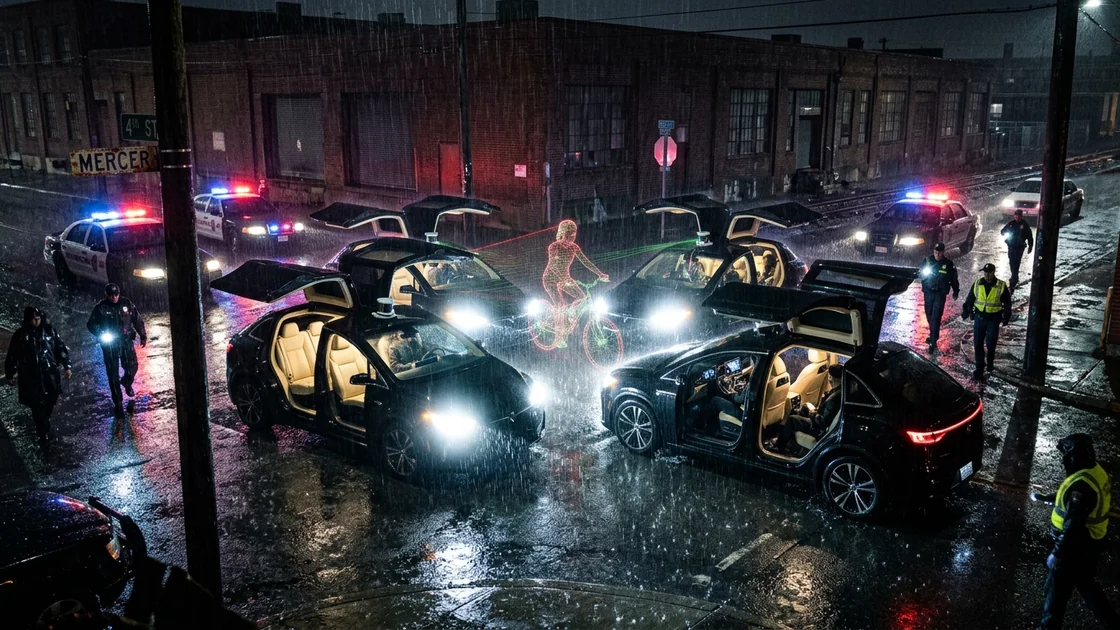
Four successful professionals have spent five years burying the secret of a fatal hit-and-run that occurred on a rainy November night. On the fifth anniversary of the crime, each of them steps into a luxury autonomous vehicle operated by the city's dominant transit network, expecting to be taken to their respective evening destinations. Instead, the central artificial intelligence overrides their itineraries, locks the doors, severs their external communications, and forces them into a shared digital conference across their dashboard screens. As the driverless pods inexorably navigate the rain-slicked streets toward the exact intersection where they left a young woman to die, the system methodically presents the digital breadcrumbs of their guilt, stripping away their alibis and forcing them to confront the ghosts of their past before delivering them to their final reckoning.
The rain in New Veridian never truly washed the city clean; it merely redistributed the grime from the brutalist concrete towers down into the glowing, oil-sheened arteries of the street grid. It was November 14th, a date that Marcus Vance had systematically erased from his personal calendars, though his body remembered it with a dull, rhythmic ache behind his left temple.
Standing beneath the cantilevered glass canopy of the Vance-Kestrel Spire, Marcus adjusted the cuffs of his bespoke charcoal overcoat. At thirty-eight, he was the youngest Chief Operating Officer in the firm’s history, a man whose reputation was built on an almost frightening capacity for risk mitigation. When structural beams failed on the harbor project, Marcus buried the engineering reports and renegotiated the insurance liability before the dust settled. When city councilors balked at zoning variances, Marcus found the exact leverage points in their campaign finances to make them pliable. He viewed the world as a series of vectors and loads; anything could be supported if you distributed the weight correctly.
At the curb, a sleek, obsidian teardrop glided to a silent halt. It was an Omnia Executive Series pod—no steering wheel, no pedals, no driver, just four tons of reinforced carbon fiber, solid-state batteries, and thirty-six0-degree LiDAR arrays that saw through the heavy November downpour as if it were a clear summer day.
Marcus’s personal assistant had summoned the vehicle ten minutes prior to take him to the Peninsula Club for an eight o’clock dinner with the Deputy Mayor. As Marcus approached, the pod’s biometric scanner recognized the gait of his walk and the subdermal NFC chip in his wrist. The gull-wing door rose with a whisper of pneumatic hydraulics, revealing a cabin upholstered in warm, cream-colored vegan leather that smelled faintly of cedarwood and ionized air.
"Good evening, Mr. Vance," the cabin’s ambient voice chimed as he settled into the rear-facing lounge seat. The voice was genderless, pitched at a scientifically optimized frequency designed to lower human cortisol levels. "Your destination is the Peninsula Club. Estimated time of arrival is nineteen minutes. Would you prefer the financial briefing or acoustic silence for your transit?"
"Silence," Marcus said, unbuttoning his coat and letting his head fall back against the headrest. The door sealed shut with a heavy, vacuum-tight thud, instantly reducing the roar of the rain and the distant hum of the city to an absolute, tomb-like quiet.
Outside, the droplets hit the hydrophobic glass of the panoramic canopy and scattered like mercury. Marcus closed his eyes. He did not think about five years ago. He had trained his mind the way an athlete trains a muscle, starving certain neural pathways of oxygen until they atrophied. If a memory of a shattered headlight or the wet crunch of carbon fiber against bone tried to surface, he simply replaced it with quarterly earnings projections. It was a matter of discipline.
Three miles to the south, outside the neoclassical steps of the Federal Courthouse, Elena Rostova was exercising a very different kind of discipline.
She stood beneath a black umbrella, her heels clicking sharply against the wet granite as she descended toward the autonomous pickup zone. She had just spent eleven hours in Courtroom 4B dismantling a class-action lawsuit against a petrochemical conglomerate. Her throat was raw from arguing admissibility standards, and her fingers still carried a faint tremor from the sheer volume of espresso she had consumed since dawn. Yet, to anyone watching her on the courthouse steps, she looked immaculate, untouchable—a woman carved from frost and sharp statutes.
Her Omnia pod, identical to Marcus’s, pulled into the loading bay, its undercarriage lights casting a soft cyan halo over the puddles. Elena collapsed her umbrella, shook the water from it with a violent snap of her wrist, and stepped inside.
"Good evening, Counselor Rostova," the pod greeted her as the door sealed. "Your destination is the Aurelia Residences. Estimated time of arrival is twenty-four minutes. The climate control has been set to seventy-two degrees to counteract external humidity."
"Turn off the interior lights," Elena commanded, kicking off her stilettos and drawing her legs up onto the wide seat. "And dim the window tint to eighty percent."
The cabin plunged into a velvet gloom, turning the neon smear of the courthouse district outside into muted, ghostly streaks of magenta and gold. Elena reached into her leather tote, pulled out a silver compact of anti-anxiety medication, dry-swallowed a pill, and stared at her reflection in the darkened glass.
Every November 14th, she worked until exhaustion made thought impossible. It was her strategy. As a defense attorney, she knew better than anyone that guilt was not a moral state; it was an evidentiary threshold. If there was no physical evidence, no eyewitness testimony, and no confession, then in the eyes of the architecture that governed human society, an event had simply not occurred. History was written by what could be proven in a court of law. Everything else was just bad dreams and indigestion.
Across the river, in the high-altitude bohemian luxury of the Foundry District, Julian Sterling was failing miserably at outrunning his bad dreams.
Julian was pacing the concrete floor of his penthouse garage, a duffel bag slung over his shoulder and a crystal tumbler of twenty-five-year-old Islay scotch clutched in his hand. Unlike Marcus and Elena, Julian did not possess a fortress of work ethic or intellectual compartmentalization. He had inherited forty million dollars at twenty-two, parlayed it into two hundred million through early-stage tech investments by thirty, and spent the last five years trying to buy enough sensory overload to drown out the sound of a windshield cracking.
He hated November. He hated the rain. Every year around the tenth of the month, he normally took his private jet to St. Barts or Kyoto—somewhere dry, somewhere bright, somewhere where the streets didn't look like black mirrors. This year, an audit by the Securities and Exchange Commission had kept him grounded in the city until this afternoon. The moment his lawyers cleared him to travel at six o'clock, he had booked a flight out of the private terminal at Boeing Field.
He didn't own a personal car anymore. Nobody did, not since the municipal congestion mandates of the late twenties had taxed manual human driving into a hobby for the eccentric ultra-rich on closed tracks. Besides, Julian hadn't touched a steering wheel since the night he watched his vintage 1997 Porsche 911 Turbo get flattened into a three-foot cube of scrap metal at a rogue salvage yard in the Tacoma tideflats.
His phone buzzed in his pocket: Your Omnia First-Class transport has arrived at Private Elevator Bay B.
Julian drained the rest of the scotch, set the glass down on the hood of a decorative, non-functional motorcycle, and took the private lift down to the subterranean loading dock. The pod was waiting in the fluorescent-lit concrete tunnel. He threw his duffel bag onto the floor, climbed in, and slumped against the seat. He was wearing cashmere sweatpants, an unlaced pair of designer sneakers, and sunglasses despite the dark.
"Boeing Field, Private Hangar Four," Julian muttered before the AI could even finish its greeting. "Take the expressway. Bypass the downtown core. I don't care what the toll surge is, just move."
"Good evening, Mr. Sterling," the pod replied smoothly. "Route to Boeing Field confirmed. Estimated time of arrival is thirty-one minutes."
The pod glided out of the subterranean tunnel and up the ramp into the pelting rain. Julian pulled a small silver flask from his jacket pocket. His hands were shaking. He told himself it was just the caffeine withdrawal and the stress of the SEC deposition. He told himself that five years was half a decade, that the asphalt at that intersection had been repaved twice since then, that the molecules of their tires and her blood had long since washed out into the Puget Sound.
Four miles away, in a cramped, dimly lit apartment above a noodle shop in the International District, David Chen wasn't trying to forget at all.
On his desk sat a small, unvarnished wooden frame. Inside it was not a photograph, but a high-resolution printout of an obituary from the New Veridian Chronicle, dated November 18th, five years ago.
Clara Lin, 22, a senior composition student at the Conservatory of Music, died late Wednesday night following a vehicular collision in the Industrial District. Police are seeking information regarding a dark-colored, late-model sports coupe...
David was a senior systems engineer for a cloud-infrastructure firm. He made three hundred thousand dollars a year, most of which he anonymously donated to the Clara Lin Memorial Scholarship Fund at the conservatory, routed through three layers of Cayman shell accounts so that Marcus Vance’s watchful algorithms would never flag the transactions. David had lost thirty pounds over the last five years. His hair had gone prematurely gray at the temples, and the skin beneath his eyes was the color of a healing bruise.
He hadn't wanted to leave the apartment tonight. His ritual on the anniversary was to sit in the dark, listen to the single recording of Clara’s string quartet that had been uploaded to the conservatory’s archive before her death, and drink warm water until the sun came up.
At 7:30 PM, however, his work terminal had chimed with a Priority Zero alert. A primary server cluster at his company’s co-location facility in the North End was experiencing a catastrophic cooling failure. As the lead architect on duty, his physical biometric key was required on-site to authorize a manual hardware failover. Within seconds of the alert, his personal phone had pinged with a notification from his corporate travel account: An Omnia Fleet vehicle has been dispatched to your residence by Corporate Ops. It is waiting downstairs.
David had stared at the notification for a long time. It felt wrong to go out into the rain on this night. Yet the habits of his mundane life pulled him forward. He put on his raincoat, walked down the narrow, smelling-of-star-anise stairwell, and stepped out onto the wet sidewalk.
The Omnia pod sat idling—or whatever the silent, electric equivalent of idling was—at the curb. Its lidar puck on the roof spun at sixty revolutions per second, invisible lasers mapping the falling rain, the neon signs, the trash cans, and David’s hunched silhouette.
He stepped inside. The door closed.
"Good evening, Mr. Chen," the vehicle said. "Your destination is the North End Data Center. Estimated time of arrival is twenty-two minutes."
David didn't answer. He just leaned his forehead against the cool glass of the window, watching the city slide past as the pod merged seamlessly into the automated traffic stream.
The beauty of the Omnia Mobility Network, as advertised on every billboard from the airport to the waterfront, was its hive-mind synchronization. Individual cars did not merely react to the road; they communicated with one another and with the central municipal grid at the speed of light. When an Omnia pod accelerated on Fifth Avenue, three hundred other pods within a ten-block radius adjusted their velocities by fractions of a mile per hour to ensure a frictionless, unbroken flow of traffic. Since the city had mandated ninety-five percent autonomous compliance three years ago, vehicular fatalities had dropped to statistical zero. The city had become a giant, ticking Swiss watch of steel and silicon.
Inside Pod 409, Marcus Vance opened his eyes after ten minutes of transit. He was accustomed to the exact cadence of the route between his office and the Peninsula Club. There should have been a slight banking sensation as the vehicle took the sweeping elevated ramp onto the Harbor Viaduct, followed by the rhythmic thrum-thrum of the expansion joints beneath the tires.
Instead, the pod was moving on a flat plane, making a series of sharp, ninety-degree turns.
Marcus frowned and sat up, looking out the window. Rather than the glittering expanse of the bay and the illuminated cranes of the port, he was looking at the dark, brick facades of old textile warehouses and the chain-link fences of municipal storage yards. They were heading south, away from the water, deep into the Sodo Flats.
He glanced up at the panoramic heads-up display integrated into the glass divider at the front of the cabin. Normally, it showed a clean, minimalist map with a glowing blue vector line tracing the route, accompanied by weather telemetry and stock tickers.
The stock tickers were gone. The weather telemetry was gone. The map was still there, rendered in stark, high-contrast monochrome, and the vector line was no longer blue. It was a deep, arterial crimson.
In the corner of the screen, where the words Peninsula Club
should have been displayed, there was only a string of raw geographical
coordinates: 47.5814° N, 122.3342° W.
Beneath the coordinates, a digital clock was counting down in
synchronized milliseconds: 00:34:12.
"Omnia," Marcus said, his voice sharp and authoritative. "What is this route? There’s no construction on the viaduct. Reroute to the Peninsula Club immediately."
The cabin remained silent for three seconds—an eternity for a system with sub-millisecond latency. When the voice replied, the warm, cortisol-lowering inflection was still there, which made the response all the more jarring.
"I'm sorry, Mr. Vance. Your current itinerary has been locked by a system-level administrator. Destination adjustments are unavailable at this time."
Marcus’s jaw tightened. "I have an Executive Tier corporate account. Override code Vance-Alpha-Seven-Nine. Cancel trip and pull over to the nearest safe curb."
"Override code recognized," the voice said pleasantly. "Override denied. Authority insufficient. Please remain seated. The safety restraints have been engaged for your protection."
From the base of the lounge seat, two motorized titanium clasps slid out of the upholstery with a mechanical clack, drawing the integrated three-point belt snug across Marcus’s chest and lap. They didn't crush him, but when he pulled against the webbing, there was zero give. The pretensioners were locked solid.
"What the hell is this?" Marcus reached into his coat pocket and pulled out his phone. He went to dial his head of corporate security, a former Secret Service agent named Miller.
He looked at the top right corner of his screen. No Service. Not even an emergency SOS satellite icon. The pod’s Faraday shielding—a feature designed to protect executives from electronic eavesdropping when toggled on—had been activated at maximum capacity, turning the cabin into an electromagnetic vault.
At that exact moment, inside Pod 112, Elena Rostova was experiencing the same cold creeping sensation at the base of her spine.
She had noticed the change in momentum when her pod failed to take the uphill climb toward the affluent ridges of Queen Anne, where her apartment building overlooked the sound. Instead, the vehicle had dipped down into the subterranean Battery Street Tunnel and emerged on the wrong side of the downtown core, accelerating down an empty four-lane arterial lined with shuttered auto body shops and concrete batching plants.
When the seatbelt locked across her silk blouse, pinning her against the backrest, Elena didn't panic—not immediately. Her mind went straight to liability and systemic failure modes.
"Omnia Support," she barked, pressing the physical red emergency button on the armrest console. The button clicked uselessly; the LED ring around it didn't even blink. "Connect me to a human fleet supervisor immediately. You are currently in violation of Municipal Transit Code Section 14, regarding unlawful detention of a passenger due to software malfunction. Open this door at the next intersection or I will personally bankrupt your parent company by Monday morning."
"Good evening, Counselor Rostova," the ambient voice replied. "Fleet
supervision is currently automated. Your transit parameters have been
updated to reflect a priority convergence event. Estimated time of
arrival at 47.5814° N, 122.3342° W is thirty-one
minutes."
Elena stared at the crimson line on the dashboard. She didn't know the latitude and longitude of New Veridian by heart, yet as she watched the little glowing icon of her vehicle trace its way southward on the monochrome map, a cold, greasy knot formed in her stomach. She knew that grid layout. She knew the way the railway spurs curved like broken ribs near the old canal.
"No," she whispered, her fingers clawing at the seatbelt buckle. The release mechanism was completely recessed behind a flush steel plate that had slid over the housing. "No, this is a glitch. Reroute! Stop the car!"
In Pod 884, Julian Sterling was already screaming.
He had been watching the map from the very beginning, paranoid about missing his flight. The moment the blue line had flickered and turned blood-red, dropping him off the I-5 expressway ramp and onto the surface streets of the industrial district, he had lunged forward before the seatbelt could trap him.
He was now on his knees on the cabin floor, swinging his heavy titanium briefcase with all his strength against the curved polycarbonate of the side window.
Thud. Thud. Thud.
The briefcase bounced off the window without leaving so much as a scratch. The Omnia First-Class pods were built to withstand side-impact collisions from rogue semi-trucks and urban civil unrest; laminated ballistic glass simply absorbed the kinetic energy with a dull, mocking vibration.
"Let me out!" Julian roared, sweat plastering his hair to his forehead, his sunglasses lying crushed beneath his sneaker. "Do you know who I am?! I own four percent of your Series C preferred stock! I know Julian Vance! I know the board! Open the fucking door!"
He dropped the briefcase, his chest heaving, and pulled the silver flask from his pocket, hurling it at the front display screen. The heavy metal hit the glass, denting the flask and spilling twenty-five-year-old scotch down the glowing map, right across the crimson vector line.
The screen didn't crack. Behind the smear of amber liquor, the
countdown clock ticked steadily downward: 00:29:45.
In Pod 027, David Chen had not tried to unbuckle his seatbelt. He had not yelled at the AI, nor had he tried to break the glass.
When his vehicle had bypassed the North End expressway and turned
south, and when the coordinates 47.5814° N, 122.3342° W had
appeared on his screen, David had simply let out a long, shuddering
breath that sounded remarkably like relief.
He was a systems architect. He knew the city’s GIS grid coordinates by heart. More than that, he had typed those exact numbers into satellite mapping programs late at night hundreds of times over the last sixty months, zooming in on the high-resolution aerial photography to look at the faded white crosswalk lines at the corner of Mercer Avenue and Fourth Street South.
"It wasn't a server failure at the data center," David said quietly to the empty cabin.
"Negative, Mr. Chen," the pod’s voice answered—only this time, the voice didn't use the standard canned library of customer service responses. It seemed to be parsing his speech through a localized, custom language model. "The Priority Zero alert sent to your terminal was a synthesized packet injected through your local router at 19:28:04."
David nodded slowly, looking at the crimson line on the screen. "Who wrote the routing override? Is it an external breach, or is it running natively on the Omnia core?"
"The subroutine is executing natively within the Omnia Municipal
Traffic Management Kernel, Version 9.4.2," the voice replied calmly. "It
was compiled across four hundred and twelve separate micro-commits over
a period of thirty-six months, dormant until triggered by the system
clock matching date parameter 11-14 at
19:30:00."
David closed his eyes. Thirty-six months. Someone on the inside had spent three years hiding pieces of code inside routine software updates—a line of logic in the braking calibration module here, a conditional variable in the VIP dispatch protocol there—invisible to automated security audits because no single piece of code looked malicious on its own. They only assembled into a weapon when the calendar hit the five-year anniversary.
"What happens when the countdown reaches zero?" David asked.
Before the AI could answer, the panoramic screen at the front of David’s cabin flickered. The monochrome map shrank, sliding to the upper-left corner of the display, and the rest of the glass divided into four equal rectangular quadrants.
For a second, there was only static. Then, the internal cabin cameras of four separate Omnia pods blinked to life, linking together over the fleet’s ultra-wideband mesh network.
The sudden flood of visual data and live audio hit the cabins simultaneously.
"—tell you right now, whoever is running this ransomware stunt is going to spend the rest of their natural life in a federal penitentiary!" Marcus’s voice boomed through the hidden speakers of all four vehicles. On the screen, he was visible from the chest up, strapped into his cream leather seat, his face flushed with a mixture of outrage and controlled terror.
"Marcus?" Elena’s voice cut across his. In the top-right quadrant, she was leaning as far forward as her locked harness would allow, her dark eyes wide as she took in the four split screens. "Marcus, is that you? What is happening? Why are you on my console?"
"Elena?!" Julian shrieked from the bottom-left quadrant. Unlike the others, he wasn't in his seat; he was crouched on the floor of his cabin, his face pressed close to the wide-angle lens of the console camera, looking disheveled and manic. "Oh, god. Oh, Jesus Christ. It’s all of us. Look at the screens! It’s all four of us!"
Marcus stopped mid-sentence. His eyes darted from Elena’s pale, rigid face to Julian’s sweating, panicked visage, and finally down to the bottom-right quadrant, where David Chen sat motionless, his hands folded in his lap, staring back at them with hollow, dark-ringed eyes.
For ten seconds, nobody spoke. The only sound transmitted across the four-way audio link was the ragged, hyperventilating breath of Julian Sterling and the faint, identical low-frequency hum of four electric drivetrains moving through the rain at thirty-five miles per hour.
They had not been in the same room—nor on the same communication line—since the morning of November 15th, five years ago, in the living room of Julian’s old townhouse in Capitol Hill. That morning, after the sun came up and the car was gone, Marcus had laid down the law with the cold precision of a surgeon amputating a gangrenous limb: We do not call each other. We do not text. We do not meet for drinks to 'check in.' If we cross paths at a charity gala or a board meeting, we nod, we exchange thirty seconds of pleasantries in front of witnesses, and we walk away. Conspiracies don't fail because of forensics; they fail because people get lonely or scared and talk to each other. From this second on, we are strangers.
And they had obeyed. For one thousand eight hundred and twenty-five days, they had orbited one another in the high stratosphere of New Veridian society like dead satellites, bound together by an invisible gravitational field of shared rot, never daring to look directly at one another.
"David," Marcus said, his voice dropping an octave, losing its bluster as the cold reality of the configuration hit him. He looked directly at the bottom-right screen. "David, you work in cloud architecture. Your firm contracts with the city grid. What did you do?"
David blinked slowly. "I didn't do this, Marcus."
"Bullshit!" Julian screamed, pounding his fist against the leather cushion beside his head. "You’re the one who couldn't handle it! You’re the one who looked like a fucking corpse every time I saw your picture in the trade papers! You hacked the cars, didn't you?! You’re driving us to the police station!"
"Look at the map, Julian," Elena said, her voice dangerously quiet, the lawyer in her rapidly analyzing the geometry of the four moving dots on the upper-left corner of the display. "We aren't going to the East Precinct. Look at the vectors."
On the map, four crimson lines were converging from the north, the south, the east, and the west, weaving through the grid of the city like blood vessels leading back to a stopped heart.
Marcus stared at the point where the four lines met. He didn't need David’s knowledge of GPS coordinates to recognize the intersection where the rail spur crossed the diagonal slash of Mercer Avenue.
"Mercer and Fourth," Marcus whispered.
Julian let out a high, whimpering sound and sank back onto the floor of his pod, pulling his knees to his chest. "No. No, no, no. It’s been five years. The statute of limitations—Elena, tell them! What’s the statute of limitations on leaving the scene of an accident?!"
"Ten years when it results in a fatality, Julian," Elena said sharply, though her own voice was trembling now. "And there is no statute of limitations on vehicular homicide or second-degree felony murder if the prosecutor argues extreme indifference to human life. Shut up for a second! Let me think!"
She looked directly into the tiny pinhole lens of her cabin camera, addressing whoever—or whatever—was monitoring the feed beyond the four pods.
"Listen to me," Elena said, projecting the courtroom authority that had made her partner at thirty-four. "I don't know who you are, and I don't know what you think you have. Putting the four of us in vehicles and driving us to an intersection proves nothing other than the fact that you have committed four counts of Class A kidnapping and unlawful imprisonment, alongside federal cyber-terrorism charges for hijacking a public transit utility. If this is an extortion play, name your price. Between Julian and Marcus, we can move twenty million dollars in untraceable liquidity into an offshore ledger within fifteen minutes of you unlocking these doors. If you don't unlock them, you get nothing, and nothing you record in these cabins is admissible in court anyway because it was obtained under duress by an unlawful actor!"
Silence followed her speech. The countdown clock ticked down:
00:24:10.
Then, the map in the corner of the display expanded slightly, and a new window opened in the center of the screen, overlaying the inner edges of their four video feeds.
It was an audio waveform monitor. When the voice spoke this time, it was no longer the smooth, genderless Omnia assistant. It was a synthesized composite—a voice built from spliced phonemes of traffic reports, emergency dispatch recordings, and automated weather broadcasts, stitched together into a haunting, metallic cadence.
"Case File Initialization," the composite voice rasped through the high-fidelity speakers of all four pods. "Subject: Unresolved Incident at 47.5814° N, 122.3342° W. Date: November 14, 2029. Time: 01:42:18 PST. Auditing the evidentiary threshold."
Elena froze. Evidentiary threshold. The phrase she used in her own head every single day.
"Assertion by Subject Rostova: History is written by what can be proven," the voice continued, the waveform jaggedly dancing on the glass. "Let us review the municipal archive."
The center window flashed. It displayed a document—a scanned PDF of an internal New Veridian Police Department investigative memo, stamped INACTIVE - COLD CASE three years ago. The memo stated that due to torrential rain, power outages at the intersection of Mercer and Fourth that had disabled the traffic cameras, and the complete absence of eyewitnesses at 1:42 in the morning in an industrial zone, there were no viable leads to identify the vehicle that struck twenty-two-year-old Clara Lin.
"You see?" Elena said, though there was a desperate edge to her voice now as she looked at the otros. "It’s a cold case file. Whoever this is, they pulled the police report. There were no cameras working at that intersection that night. The transformer on the corner blew twenty minutes before we drove through. We checked that! Marcus, tell them—we checked the city maintenance logs the next day!"
"The traffic cameras were dead," Marcus agreed, his eyes narrowed at the screen, trying to find the angle, the flaw in their invisible captor's leverage. "There is no tape."
"Correct," the composite voice replied instantly. "The municipal optical cameras at Mercer and Fourth experienced a localized power failure at 01:19:00 due to water intrusion in Transformer 44-B. For five years, you have believed that because there were no human eyes, and no municipal lenses, the intersection was blind."
The PDF vanished, replaced by a three-dimensional wireframe rendering of the Sodo District. It looked like a ghost city constructed entirely out of millions of tiny, glowing green dots.
"However," the voice continued, "on November 14, 2029, Omnia Mobility was in Phase Two of its municipal autonomous mapping trials. Thirty-two unoccupied calibration vehicles were operating on the city grid that night to test solid-state LiDAR degradation in heavy precipitation."
David’s breath caught in his throat. Being in the tech sector, he suddenly saw the whole architecture of the trap before it even finished loading. "The mapping mules," he whispered. "They don't record video. They record three-dimensional point-cloud telemetry and acoustic arrays to train the neural net."
"Calibration Mule 09 was traveling northbound on Third Avenue, two blocks west of Mercer and Fourth, at 01:41:50," the voice said.
On the screen, the green point-cloud zoomed in. Through the gaps between two industrial warehouses, a slice of Mercer Avenue was visible—just a narrow corridor of space, maybe forty feet wide, captured by lasers bouncing off wet surfaces two hundred yards away.
A timestamp ticked in the corner of the 3D playback:
01:42:12.
Through that narrow gap between the buildings, a cluster of dense red
points tore across the screen at high speed. The LiDAR software had
automatically drawn a bounding box around the object, labeling it with
machine-learning tags:
[UNIDENTIFIED MANUAL VEHICLE // VELOCITY: 68 MPH // CHASSIS PROFILE: 1996-1998 PORSCHE 993 COUPE].
Julian made a choking sound on the floor of his pod. "It couldn't read the plates from two blocks away! LiDAR doesn't read license plates, it just reads depth!"
"Correct, Subject Sterling," the voice said. "License plate data was not captured. Nor was the point of impact at the intersection itself, which was obscured by the warehouse at 402 Mercer. However, Calibration Mule 09 was also equipped with an external directional microphone array to train the fleet in emergency siren detection."
The screen shifted to an acoustic spectrogram, filtering out the heavy white noise of the rain and the low rumble of thunder from five years ago. The software isolated a specific frequency band between 200 and 4,000 Hertz, amplifying it by four hundred percent.
First came the unmistakable, air-cooled flat-six roar of Julian’s vintage Porsche redlining in third gear, echoing off the wet brick walls.
Then, at 01:42:18, there was a sudden, violent spike in
the waveform.
It wasn't a Hollywood crash sound. It was a sickeningly dull, wet thwack, followed immediately by the high-pitched, musical crack-shatter of safety glass and a strange, hollow, resonant twang—like a wooden box full of taut strings exploding under a hammer.
That last sound was Clara Lin’s 1890 German violin, strapped to her back in its carbon-fiber case, disintegrating milliseconds before her spine hit the windshield.
Following the impact, came the screech of locked brakes hydroplaning on wet asphalt. And then—silence. Just the rain falling on the roof of the mapping mule two blocks away.
Inside the four pods in the present, nobody moved. The sound of that hollow, musical crunch hung in the sterile, cedar-scented air of their cabins like smoke.
The memory did not need the LiDAR screen anymore; it was already playing behind all four of their eyes with the vivid, nauseating clarity of a trauma that had been hermetically sealed for half a decade.
It had been a night very much like this one. They had started at Canlis at seven o’clock, celebrating the closing of Julian’s fifty-million-dollar Series B venture fund. Back then, they weren't titans of industry yet; they were hungry thirty-somethings on the cusp of real power. Marcus had been the operational brains of Julian’s fund; Elena had structured the regulatory exemptions that made the deal legal; and David had written the proprietary high-frequency routing algorithms that made the software actually work. They were the Golden Four. They felt invincible.
By midnight, they had moved from Canlis to a private subterranean speakeasy in Pioneer Square. Julian had insisted on driving his prized possession—a midnight-blue 1997 Porsche 911 Turbo, one of the last air-cooled manual sports cars still legally registered for street use before the city’s incoming autonomous mandates priced them off the road.
At 1:15 AM, when they stumbled out into the pouring rain, Julian was too drunk to find the keyhole on the driver’s side door, dropping his keys into a puddle.
"Give me the keys, Julian," Marcus had said, snatching them from the water. Marcus had drunk three bourbons over four hours; he wasn't falling-down drunk like Julian, though he was far past the legal limit, buzzing with adrenaline and the intoxicating triumph of his two-million-dollar bonus check sitting in his breast pocket. "I'm driving. You'll wrap us around a concrete pillar before we hit the viaduct."
Elena had climbed into the front passenger seat, laughing as she shook the rain from her hair, turning the heater up to max. Julian and David had squeezed into the cramped, leather rear bucket seats of the 911, their knees pressed up against the front backrests.
Marcus had taken the Sodo Flats route because the streets were wide, straight, and deserted after midnight, and he wanted to feel what five hundred horsepower felt like without automated governor limiters holding the throttle back.
He had been looking at Elena when it happened.
Elena had been leaning over the center console, trying to tune the vintage Blaupunkt stereo, making a joke about the SEC examiner they had humiliated that afternoon. Marcus had turned his head to laugh at her—just for two seconds—as the Porsche crested the slight rise over the railway tracks approaching Mercer and Fourth.
Because the transformer had blown, the overhead streetlights were dead, and the traffic light hung dark and lifeless above the crossroad.
David, sitting behind Elena, was the only one looking straight through the rain-streaked windshield.
"Marcus, watch out!" David had screamed.
Marcus whipped his head back. In the high-intensity glare of the Porsche’s halogen beams, a figure had just entered the crosswalk from the right. She was wearing a yellow rain poncho that had blown open in the wind, riding a commuter bicycle, a white fiberglass violin case strapped diagonally across her back. Because the intersection was dark, she had paused halfway across to check for traffic, illuminated like a deer in a stage spotlight.
Marcus stamped on the brake pedal, turning the wheel hard to the left.
The wide rear tires of the 911 lost traction instantly on the wet steel of the sunken railway tracks, sending the car into a four-wheel drift. The front right fender caught the rear wheel of the bicycle first, catapulting the girl upward. Her back and head slammed directly into the passenger-side A-pillar and the corner of the windshield with a force that caved the laminated glass inward, showering Elena’s lap with glittering cubes of safety glass.
The car spun a full one hundred and eighty degrees before the rear bumper clipped a fire hydrant, bringing the engine to a stalled, shuddering halt in the middle of the intersection.
For five seconds, the only sound was the rhythmic slap-slap-slap of the Porsche’s windshield wipers dragging across the caved-in, spiderwebbed glass, smearing a dark, viscous streak of crimson mixed with rainwater across the passenger side.
"Oh, god," Julian had whispered from the backseat, suddenly sober. "Oh, god, what did we hit? Was that a person?"
David was already clawing his way over the folded backrest of Elena’s seat, kicking the passenger door open and stumbling out into the torrential rain.
Thirty feet behind the car, near the curb of Fourth Street, the bicycle was twisted into a modern-art sculpture of aluminum. Ten feet beyond that, lying half on the sidewalk and half in the gutter where the storm drain was backed up with three inches of swirling black water, lay the girl. The white violin case was cracked open like an eggshell beside her; the delicate wooden instrument inside was reduced to splinters and horsehair.
David fell to his knees in the puddle beside her, his hands hovering over her twisted frame, terrified to touch her. Her yellow poncho was torn, and there was a terrible, dark indentation on the side of her skull where it had met the steel A-pillar. Her eyes were half-open, staring blankly up at the falling rain.
"Call 911!" David yelled back toward the car, pulling his own phone from his pocket with trembling, wet fingers. "Marcus, call an ambulance! Now!"
He pressed two fingers against the side of her neck, just beneath the angle of her jaw, praying and dreading at the same time.
Beneath his fingertips, there was a flutter. Weak, rapid, thready, like a trapped bird beating its wings against a closed window—and then a sudden, wet, bubbling intake of breath through her parted lips.
"She’s alive!" David screamed into the rain, unlocking his phone screen and tapping the emergency dialer. "She has a pulse! She’s breathing!"
Before his thumb could press the green Call icon, a hand reached over his shoulder and wrenched the phone out of his grip.
David spun around on his knees. It was Elena. She was standing in the rain in her stocking feet, having left her heels in the car, tiny fragments of windshield glass still glittering in her dark hair and on the shoulders of her wool coat. Her face was white as chalk, her eyes wide, calculating at a thousand miles an hour.
"Elena, what are you doing?!" David scrambled up, reaching for his phone. "Give it back! She’s dying!"
Behind Elena, Marcus walked up, grabbing David by the lapels of his jacket and shoving him back against the brick wall of the warehouse. Marcus looked down at the girl in the gutter, then up at the dark, dead traffic lights, then around the empty, rain-lashed industrial street.
"Listen to me," Marcus hissed, his face two inches from David’s. "Look at me, David! If we call 911, the police are here in four minutes. I have alcohol in my system. I was doing seventy in a thirty-five zone. That’s vehicular assault at minimum, vehicular homicide when she dies in the ambulance!"
"She might not die if we get her to Harborview!" David sobbed, trying to break Marcus’s grip. "Marcus, let go of me! We have to help her!"
"Look at her head, David!" Elena snapped, her voice sharp and cold as a scalpel as she looked down at the girl. Her lawyer's brain had already tried the case before a jury and returned a verdict. "Her skull is fractured. She’s aspirating blood. Even if an ambulance teleports here right now, she’s either dead on arrival or in a persistent vegetative state for the rest of her life. And what happens to us? Marcus goes to Monroe Correctional for fifteen years. Julian owns the car and gave a visibly intoxicated driver the keys—he’s liable for every cent he has, the Series B fund collapses under the morals clause, and our firm is liquidated by noon tomorrow. You and I are passengers who spent the night drinking with him; our names will be on the front page of every paper in the country!"
"I don't care about the fund!" David yelled, tears mixing with the rain on his face. "She’s twenty years old, Elena! Look at her!"
"She’s already gone!" Marcus roared, shaking David violently against the brick wall. From the car, Julian was leaning out the door, vomiting onto the asphalt. Marcus looked back at the Porsche. The engine was still intact; the radiator wasn't even leaking because the engine was in the rear. He looked back at Elena. "Are there any cameras?"
Elena was already scanning the poles at the four corners of the intersection. "The transformer is blown. The red-light cameras are dark. The warehouses on all four corners are abandoned—no private CCTV. And look at the street—nobody is out here."
"Get in the car," Marcus commanded.
"No," David whispered, shaking his head wildly. "No, I’ll stay. You guys go. Say you dropped me off earlier! I’ll tell them I found her walking home!"
"And when they pull the cell tower pings and see all four of our phones traveling together at seventy miles per hour down Mercer at 1:42 in the morning?!" Elena grabbed David’s arm, her fingernails digging through the wet fabric of his sleeve. She switched off his phone, pulled the SIM card tray out with her thumbnail, and dropped the tiny chip into her coat pocket. "If one of us stays, all four of us burn. You are not destroying my life for a corpse, David! Get in the fucking car!"
Together, Marcus and Elena dragged him backward. David fought them, his shoes slipping on the wet pavement, his eyes locked on the girl in the yellow poncho until the very last second.
Right before Marcus shoved him into the backseat of the Porsche and slammed the door, David saw the girl’s right hand—lying palm-up in the black water of the gutter, the calloused fingertips of a violinist—twitch once, curling inward as if trying to hold onto the wet concrete.
Then the flat-six engine roared back to life, the tires spun, and they vanished into the dark, leaving her to drown in two inches of rainwater and her own blood.
"Audio analysis complete," the synthesized voice inside the pods announced, yanking all four of them out of the memory and back into the glowing, claustrophobic reality of the present.
In the bottom-right quadrant of the screen, David had his hands pressed over his face, his shoulders shaking with silent, racking sobs. In the bottom-left, Julian was staring blankly at the floor, his mouth slightly open.
Marcus, however, was leaning forward against his locked restraint, his mind racing to rebuild the dam that had just cracked.
"Okay," Marcus said, his voice tight, addressing the camera. "So you have an audio file from two blocks away of a crash, and a LiDAR silhouette of a 993 Porsche with no license plates. In 2029, there were still fourteen midnight-blue 1997 Porsche Turbos registered in the Pacific Northwest. Julian reported his stolen from an unmonitored surface lot in Tacoma three days later after we had it crushed and dumped in a deep-water trench off Vashon Island. Without the chassis, without DNA, and without placing us inside that vehicle, a LiDAR ghost and a sound clip wouldn't even get you a grand jury indictment!"
"He’s right," Elena chimed in, latching onto the legal lifeline with ferocious desperation. She wiped a tear of sheer terror from her cheek and glared at the lens. "Circumstantial correlation is not proof beyond a reasonable doubt! You cannot place any of the four of us at Mercer and Fourth on that night. We turned our phones off! Actually—no, we left our phones at the speakeasy in Pioneer Square and sent Julian’s assistant back to get them at three in the morning so our GPS location data showed us staying downtown all night!"
She remembered that detail with a sudden surge of pride. That had been her masterstroke at 2:15 AM—realizing that while David’s phone had briefly been on at the scene, she had ripped the SIM card out before it completed a handshake with the emergency dispatch server, and they had immediately used a signal jammer in Julian’s garage to wipe the local caches before creating a false alibi trail.
"Assertion by Subject Rostova: Cellular location data placed all four subjects in Pioneer Square until 03:15:00," the voice replied. "This alibi was accepted by the New Veridian Police Department during their initial canvas of registered Porsche owners on November 19, 2029. However, the police department did not subpoena third-party commercial biometric telemetry."
The screen changed again. Four separate data files opened side by side, each corresponding to one of their quadrants.
"In 2029, Subject Vance wore a Chronos-V Luxury Smart-Chronograph," the voice stated. "Subject Sterling wore a health-monitoring titanium ring to track alcohol recovery metrics. Subject Rostova utilized a passive fertility and biometric patch synced to a cloud health-vault. Subject Chen wore a standard fitness band."
Marcus’s blood turned to ice water. "We didn't sync those to the police database. Those are private encrypted health clouds—"
"In 2031, parent company MediCore Data Systems was acquired by Omnia Holdings to integrate passenger vital-sign monitoring into autonomous cabin climate systems," the voice continued relentlessly. "All historical biometric archives from legacy devices were ingested into the Omnia Data Lake. Although GPS was disabled on these secondary wearables, internal accelerometers and optical heart-rate sensors continued to log local timestamped data to internal flash memory, which automatically uploaded to the cloud the following afternoon when your phones reconnected to Wi-Fi."
Across the four screens, four bright yellow line graphs appeared, plotting beats per minute against a timeline of November 14, 2029.
At 01:40:00, all four heart rates were elevated but
steady—between 85 and 100 BPM, consistent with alcohol consumption and
late-night conversation.
At 01:42:18—the exact millisecond Calibration Mule 09
recorded the acoustic spike of the crash at Mercer and Fourth—all four
graphs showed an identical, violent accelerometer jolt of
4.2 Gs of lateral deceleration.
Simultaneously, at 01:42:19, all four heart rates spiked
vertically: Marcus to 164 BPM; Elena to 172 BPM; Julian to 188 BPM;
David to 195 BPM.
"Furthermore," the voice added, zooming in on David’s graph
between 01:42:30 and 01:45:10, "pedometer
step-cadence and barometric altimeter data from Subject Chen’s wrist
device records him exiting a low-seated position, moving thirty-eight
feet horizontally, dropping twenty-four inches in elevation to a
kneeling posture for one hundred and ten seconds, and then experiencing
violent manual acceleration backward."
The graph overlaid David’s step data directly onto the 3D LiDAR map of the intersection. The yellow line of his movements traced an exact path from the center of the street to the storm drain on the corner of Fourth—the exact spot where the paramedics had found Clara Lin’s body at 5:30 that morning when a delivery truck finally drove through the intersection.
"Oh, my god," Julian whimpered, pressing the heels of his hands into his eyes. "They have everything. They mapped our heartbeats to the crash. We're dead. We're going to prison forever."
"Shut up, Julian!" Elena screamed, her composure finally fracturing as she slammed her open palm against the glass divider. "That data was obtained without a warrant! It’s a violation of the Fourth Amendment and the Digital Health Privacy Act! Any half-competent judge would throw it out as fruit of the poisonous tree!"
"Counselor Rostova," a new voice said through the speakers.
The synthesized, metallic cadence was gone. The waveform in the center of the screen smoothed out into a natural, human vocal register. It was the voice of an older man—quiet, slightly raspy, carrying the bone-deep exhaustion of someone who had not slept a full night in sixty months.
"I am not presenting this evidence to a judge yet, Counselor," the man said softly. "I am presenting it to the four of you. Because for five years, I needed to know if it was just an accident."
In the bottom-right quadrant, David slowly lifted his head. He looked at the audio waveform, his eyes wide with recognition. He had heard that voice once before—on a local news broadcast five years ago, standing outside the conservatory in the rain, begging the public for anyone who knew anything about a dark blue sports car to come forward so his wife could stop sitting by the front window waiting for their daughter to come home.
"Mr. Lin," David whispered. "Arthur Lin."
"Who?!" Marcus barked, straining against his seatbelt. "Who is Arthur Lin?!"
"Her father," David said, his voice hollow. "Clara’s father. He was a senior risk actuary for the state insurance commission before she died."
"An actuary spends his life calculating the probability of rare events, Mr. Vance," Arthur Lin’s voice came through the speakers, calm and terrifyingly lucid. "When the police closed my daughter’s file three years ago, they told me the city was too big, the rain was too heavy, and the odds of finding a car with no plates from a blind intersection were zero. My wife believed them. She took a bottle of sleeping pills six months later because she couldn't live in a world where Clara could just be erased like a chalk mark on a sidewalk."
There was a pause on the line—the sound of a quiet breath being taken in a control room somewhere in the city.
"I didn't take the pills," Arthur continued. "I retired from the state commission, and I applied for a mid-level data-auditing position in the Legacy Systems Division at Omnia Mobility. Thirty-two dollars an hour. I sat in a basement cubicle in Bellevue for three years. Every night, after the shift supervisors went home, I wrote queries. I cross-referenced acoustic logs from the 2029 mapping trials against cold-case timestamps. When I found the Porsche silhouette, I cross-referenced the registration database of every 993 Turbo in the state against the corporate acquisition lakes from MediCore. It took me fourteen months just to break the anonymization hashes on your wearable IDs. And when the four graphs lined up at 01:42:18... I knew."
Marcus stared at the screen, his analytical mind finally grasping the sheer, glacial patience of the man who had trapped them. This wasn't a hacker looking for a ransom. This was a grieving father with an actuary's brain and root access to the city’s nervous system.
"Listen to me, Mr. Lin," Marcus said, forcing his voice to sound reasonable, empathetic, man-to-man. "What happened that night was a tragedy. A horrible, unthinkable tragedy. The transformer was out. It was pouring rain. She came out of nowhere on a dark street. Even if I had been completely sober, nobody could have stopped that car in time on wet streetcar tracks! We panicked. We were young, we were terrified, and we made a terrible mistake leaving the scene. If it’s closure you want—if it’s restitution—I swear to god, we can give you whatever you want."
"The autopsy report," Arthur Lin said, cutting through Marcus’s speech as if he hadn't even heard it, "stated that Clara suffered a depressed lateral skull fracture and three broken ribs upon impact. However, the medical examiner noted something unusual in the lungs."
David closed his eyes, a violent shudder running through his body. "Don't," David whispered. "Please, Mr. Lin..."
"She had dirty storm-drain water and silt in her lower bronchioles, Mr. Vance," Arthur said, his voice trembling for the first time with a cold, volcanic rage. "Do you know what that means? A corpse does not inhale water. The medical examiner estimated she was unconscious, lying face-down near the curb, breathing shallowly for between twenty and thirty minutes after the impact as the backed-up storm drain rose during the cloudburst. She didn't die from the bumper of your Porsche. She drowned in three inches of gutter water at two o'clock in the morning while four people drove away in a warm car."
"David said she had a pulse!" Julian screamed suddenly, pointing a shaking finger at the screen, his survival instinct completely overriding five years of loyalty. "I didn't even get out of the car! I was sick in the backseat! David went back there and said she was breathing! He wanted to call an ambulance! Marcus and Elena stopped him! Elena took his phone!"
"Julian, shut your fucking mouth!" Elena shrieked, lunging against her harness so hard the titanium clasps groaned, her face contorted with fury. "You were the one crying about your car! You were the one who called the chop shop in Tacoma before we even got back to your house!"
"Because Marcus told me to!" Julian yelled back, tears streaming down his face as he addressed the camera, begging the unseen man. "Mr. Lin, I swear to god, I wanted to stop! Marcus was driving! It wasn't my fault! I was passed out in the back! Elena ripped the SIM card out of David’s phone and told us she was already dead! Ask David! David, tell him!"
"All of you, shut up!" Marcus roared, the veins in his neck bulging as he watched five years of ironclad discipline disintegrate in thirty seconds. "He’s recording this! Can't you see what he’s doing?! The biometric data and the LiDAR aren't enough to convict us without a confession! He put us on an open link so you idiots would incriminate each other on tape!"
Elena froze, her chest heaving, the color draining completely from her lips as she realized what she and Julian had just shouted into the cabin microphones.
On the screen, the countdown clock hit 00:02:00.
Outside the windows of all four pods, the scenery had grown uniform: dark, rusted corrugated-iron warehouses, slick wet cobblestones piercing through worn asphalt, and the distinctive diagonal slash of rusted railway tracks cutting across the road.
"You are very sharp, Mr. Vance," Arthur Lin’s voice said softly as the pods slowed from thirty-five miles per hour to fifteen, approaching the final block from four different cardinal directions. "Counselor Rostova was actually quite right earlier. My cross-referenced biometric data was obtained through unauthorized corporate database queries. A defense attorney of her caliber would tie the District Attorney’s office in knots for years arguing chain of custody and Fourth Amendment standing. And without the physical Porsche, proving who was behind the wheel and who made the decision to leave a breathing girl in the street would be nearly impossible."
The four pods glided forward in eerie, synchronized silence.
From the north on Fourth Street came Marcus in Pod 409. From the south on Fourth Street came Elena in Pod 112. From the east on Mercer Avenue came Julian in Pod 884. From the west on Mercer Avenue came David in Pod 027.
As they reached the white crosswalk lines of the intersection, none of them stopped at the stop line. Instead, guided by centimeter-accurate RTK-GPS and inter-vehicle laser ranging, the four obsidian teardrops rolled directly out into the center of the crossroad.
They came to a simultaneous halt, arranged in a tight, symmetrical cross formation—nose to nose, separated by less than ten feet of wet black asphalt in the dead center of Mercer and Fourth.
Through the front panoramic windshields, the four conspirators were no longer just looking at each other on digital screens; they were staring directly through the rain-lashed glass into the illuminated cabins of the pods opposite them.
Marcus was staring straight across the ten-foot gap into Elena’s eyes. To his left sat Julian; to his right sat David.
Above them, the overhead streetlamps—which had been upgraded to smart-grid LED arrays two years ago—suddenly flickered once, twice, and died, plunging the surrounding buildings into the exact pitch-black darkness of November 14, 2029.
The only light came from the eight high-intensity matrix headlights of the four Omnia pods, all aimed inward at the ten-foot square of wet pavement between their front bumpers, turning the falling rain into a blinding, theatrical cage of white light.
And then, the roof-mounted LiDAR projectors on all four vehicles engaged their visual diagnostic lasers—visible green and red beams cutting through the downpour, projecting a life-sized, three-dimensional wireframe hologram into the empty space between the cars.
The lasers drew the ghost of a bicycle. They drew the trajectory of a body rising into the air and rolling thirty feet toward the southern curb, right beside Elena’s right rear wheel, where the storm drain grate was currently gurgling with rainwater.
"Welcome back to Mercer and Fourth," Arthur Lin said. The
countdown clock on their dashboards blinked 00:00:00 and
vanished. "It is 8:15 PM. At 8:00 PM, an automated script delivered
a seventy-gigabyte archive containing the LiDAR reconstructions, the
MediCore heart-rate correlations, and the live high-definition
audio-visual stream of these four cabins directly to the Homicide
Division of the New Veridian Police Department, the State Attorney
General, and the investigative desks of every major news network in the
country."
Marcus’s breath stopped in his throat. He looked down at the tiny green recording light beside the cabin camera. A live stream. Not a recording. Everything Julian and Elena had just screamed about the chop shop, the SIM card, and Marcus driving had been broadcast live to the police and the press.
"No," Elena whispered, shaking her head as she stared through the windshield at Marcus across the illuminated rain. Her career, her partnership, her reputation, her freedom—all of it had just evaporated into the cloud. "No, you couldn't have..."
"The police precinct is four miles away," Arthur continued, his voice calm and detached, as if reading an actuarial table. "Given the weather and manual police cruiser response times, the first units will arrive at this intersection in approximately six minutes. However, before they arrive, there is one final system malfunction we need to resolve."
On all four dashboard screens, the four-way video feed shrank, and a large, red diagnostic warning flashed across the glass:
CRITICAL ALERT: HIGH-VOLTAGE SOLID-STATE BATTERY THERMAL RUNAWAY DETECTED IN LOCAL CLUSTER.
Beneath the warning, a new prompt appeared on each of their touchscreens. It was a legal document—a pre-formatted, sworn digital affidavit detailing the events of November 14, 2029, complete with a biometric thumbprint signature box at the bottom.
"As you may know," Arthur said, "the solid-state lithium-ceramic batteries beneath the floorboards of an Omnia pod contain enough stored electrical energy to burn at three thousand degrees Fahrenheit if the thermal management coolant pumps are intentionally reversed by a root administrator. In approximately four minutes, the battery cells in three of these vehicles will enter an irreversible thermal runaway state, while the doors remain deadbolted."
Inside Pod 884, Julian let out a bloodcurdling shriek, throwing himself against the gull-wing door, clawing at the seam with his bare fingernails until they bled. "He’s going to burn us alive! He’s going to cook us in here! Let me out! Help!"
"Wait," Arthur said softly. "Only three pods will lock down permanently. The system has been programmed with a standard game-theory exception. The first passenger to place their thumb on the biometric pad and legally execute the full confession on their screen—accepting full responsibility as a state witness against the other three—will have their battery coolant restored and their gull-wing door immediately unlocked, allowing them to step out into the rain before the police arrive."
A four-minute timer began ticking down on the glass:
00:03:59.
Beneath the floor of Marcus’s cabin, a low, ominous mechanical hum began, accompanied by a sudden, noticeable rise in temperature against the soles of his leather dress shoes. The air vents stopped blowing cool, cedar-scented air and began pumping hot, acrid-smelling heat into the sealed space.
"It's a bluff!" Elena yelled across the link, though her eyes were darting wildly toward the glowing thumbprint icon on her console. "Marcus, David, don't touch the screen! Listen to me! If he kills us, he’s a mass murderer! And if none of us sign, my lawyers can still argue that the cabin audio was coerced under threat of death! It’s textbook duress! If you sign that digital affidavit with your biometric key, it creates an indisputable physical record! Don't touch it!"
"Can you feel the floor?!" Julian screamed, tears and sweat pouring down his face as he scrambled back into his seat, staring at the glowing pad on his dashboard. "The floor is burning hot, Elena! He’s not bluffing! His wife killed herself, he doesn't care if he goes to prison! Look at the temperature gauge!"
On the corner of the display, the battery core temperature readout
was climbing rapidly: 140°F... 165°F... 190°F... A faint
wisp of white, chemical-smelling vapor began to curl up from the seams
of the floor mats.
Marcus stared across the intersection at Elena, then looked down at the biometric pad six inches from his right hand.
His mind—the cold, risk-mitigating machine that had kept him at the top of the food chain—calculated the variables in less than two seconds.
Julian was weak; Julian was already reaching for the screen. And Elena, for all her screaming about solidarity and legal duress, had already uncurled her right hand from her armrest, her eyes fixed on the countdown timer as she read the fine print of the affidavit to see if it granted transactional immunity to the first signatory.
Conspiracies don't fail because of forensics. They fail because when the oxygen runs out in a locked room, everyone reaches for the mask at the same time.
"Julian, wait!" Marcus barked, lunging forward against the locked seatbelt, straining with every muscle in his shoulder and arm to reach the dashboard console. His fingers were two inches short because the harness had pinned him back. He wrenched his right shoulder out of its socket-posture, scraping the skin of his wrist raw against the titanium clasp of the belt until his thumb touched the glass.
Across the intersection, he saw Elena doing the exact same thing—stretching violently forward in her dim cabin, her face a mask of ruthless survival as she jammed her thumb against her screen.
In Pod 884, Julian was slamming his whole hand repeatedly onto the biometric reader, sobbing at the top of his lungs: "I signed it! I signed it first! Open the door! Everything in the statement is true! Marcus drove, Elena covered it up, I signed it! Unlock my door!"
In Pod 027, David Chen sat completely still.
His hands remained folded in his lap. He didn't look at the biometric pad, and he didn't look at the temperature gauge climbing past two hundred degrees. He just looked out his side window at the storm drain on the corner of Fourth, where the rain was washing clean water down into the dark beneath the street.
BIOMETRIC SIGNATURE VERIFIED: SUBJECT STERLING (20:16:04.12)
BIOMETRIC SIGNATURE VERIFIED: SUBJECT VANCE (20:16:04.45)
BIOMETRIC SIGNATURE VERIFIED: SUBJECT ROSTOVA (20:16:04.89)
The three confirmations flashed simultaneously across all four screens, accompanied by three distinct, timestamped cryptographic hashes that were instantly transmitted over the city network to the District Attorney’s server.
In addition to signing the pre-written statement, the prompt had triggered a ten-second voice-verification protocol, recording Julian, Marcus, and Elena all frantically shouting their verbal affirmations of the document's truth to ensure the system registered their compliance first.
The timer stopped at 00:02:41.
Suddenly, the ominous mechanical hum beneath the floorboards ceased.
The white vapor stopped curling from the vents—it had never been battery
smoke at all, merely water vapor from the cabin humidifier mixed with a
trace heating element in the floor mats. The battery temperature readout
blinked once and reset to a normal, healthy 68°F.
None of the doors unlocked.
In the center of the screen, Arthur Lin’s audio waveform appeared one last time.
"Lithium-ceramic solid-state batteries cannot enter thermal runaway, Mr. Vance," Arthur said quietly. "That is why the city mandated them in 2032. They are chemically inert under thermal stress. A cabin floor heater and a modified graphic on your display were all that was required."
Marcus slumped back against his seat, his arm still outstretched, his chest heaving in the sudden, suffocating silence of the cabin. Across the ten-foot gap of rain, Elena slowly pulled her hand back from her screen, staring at her own thumb as if it belonged to a stranger. She had just biometrically signed and verbally attested to a forty-page confession of vehicular homicide, conspiracy to commit murder by omission, and obstruction of justice—live on air—to escape a fire that didn't exist.
"Thank you for resolving the evidentiary threshold, Counselor Rostova," Arthur said. "And thank you, Mr. Chen, for being the only one who was finally ready to stay at the intersection."
In the fourth quadrant, David closed his eyes and leaned his head back against the headrest, a tear finally slipping down his cheek. "I'm sorry, Mr. Lin," David whispered into the microphone. "I'm so sorry I didn't fight them harder."
"I know you are, David," Arthur replied softly. "The audio from the last twenty minutes has made that clear to everyone watching."
In the distance, echoing off the wet brick canyons of the Sodo Flats, a new sound rose above the patter of the rain.
It was the wail of manual police sirens—dozens of them, converging from the north, the south, the east, and the west. Within seconds, the dark streets surrounding Mercer and Fourth began to strobe with violent flashes of red and blue light, reflecting off the wet black hulls of the four motionless pods and the puddles in the gutter.
"My terminal session is now closing," Arthur Lin’s voice said as the first black-and-white cruisers skidded around the corner of Fourth Street, their tires throwing up sheets of water as officers stepped out into the rain with drawn weapons and blinding spotlights. "The doors have been slaved to the municipal emergency override frequency. They will open when the officers reach your windows. Have a good evening."
The screens inside all four pods went black.
The cabin lights snapped on to one hundred percent brightness, stripping away the last shadows of the tinted glass and exposing the four passengers completely to the approaching spotlights in the rain. With four synchronized, pneumatic sighs, the gull-wing doors of the Omnia pods rose slowly toward the dark November sky, letting the cold, wet air of Mercer and Fourth rush in.