The Cold Equations of the Void
Aris Thorne, chief navigator of the deep space colonial vessel Aethelgard, watches helplessly as five senior officers stage a violent mutiny and maroon Captain Evelyn Vance on a barren sulfur moon in order to sell the ship and its priceless terraforming cargo to a black market syndicate. Forced at gunpoint to calculate a forty year relativistic transit toward a lawless station before being locked into cryogenic stasis, Thorne secretly embeds a staggered revival algorithm inside the pulsar navigation subroutines. Waking alone four years into the voyage, he decouples the automated cargo spire to send it back to rescue his stranded captain, steers the remaining crew hull into an empty gulf between galactic arms, dumps the main reaction mass, and wakes the mutineers one by one in the dark to face the consequences of their betrayal.
The ash of Cinder-9 did not fall like snow; it fell like iron filings, heavy and gray and sharp enough to score the polycarbonate visors of an environmental suit.
From the upper observation blister of the Aethelgard, Aris Thorne had watched Captain Evelyn Vance walk down the deployment ramp of the heavy lander. Even at four hundred kilometers of orbital altitude, magnified through the ship’s primary optical telescope, her posture was unmistakable. She did not look back at the thruster wash that scorched the basalt flats behind her. She did not raise a hand in futile appeal toward the belly of the four-kilometer freighter hanging in the amber sky above. She simply walked toward the prefabricated geological shelter they had dropped three hundred meters from the rim of a dead caldera, her boots kicking up dense, low-gravity plumes of sulfur and pulverized silicate.
"Take a good look, star-counter," Kara Solis had whispered behind him.
The security chief’s breath smelled of synthetic mint and adrenaline. She had pressed the cold, octagonal muzzle of a standard-issue flechette pistol into the soft hollow just beneath Aris’s left ear, hard enough to bruise the mastoid bone. His blood, warm and sticky from where her knuckles had split his eyebrow twenty minutes earlier, ticked slowly onto the brushed aluminum rim of the astrometrics console.
"She’s got six months of protein paste, a solar cracking unit for water, and a geological survey shelter with a half-spent isotope battery," Marcus Kane had said, stepping up beside the console. The former First Mate was already wearing the captain’s gold-braided command tunic, though it sat too tight across his broad, fleshy shoulders. He looked down at the high-resolution feed on the main monitor, watching the lander lift off on pillars of blue ion fire, leaving the solitary white figure standing beside the dull gray dome on the surface below. "That’s infinitely more charitable than a spacing. When the company board realizes the Aethelgard vanished in the Cygnus sector, they’ll write it off as a containment breach. Nobody is coming to look for a dead freighter, and nobody is coming to this rock."
"The survey shelter has a class-two medical bay," Aris had said, his voice thick through swelling lips. "Not a hibernation unit. Six months of rations means she starves in seven."
"Then she shouldn't have been so pious about a manifest of dirt and bacteria," Jax Vane grunted from the rear bulkhead. The Chief Engineer was wiping grease from his thick fingers with an oily rag, his narrow eyes fixed on the reactor telemetry. "Three hundred thousand tons of class-four atmospheric processors and germline seed banks. The colonial authority was going to pay us standard hazard scrip to drop it on some frozen mudball in the outer rim. Lyra’s buyers at Tartarus Station are paying forty million in untraceable bearer bonds. Divided six ways, we live like planetary governors."
"Five ways," Lyra Chen corrected smoothly from the communications pit, her manicured fingers dancing across the encryption keys as she purged the ship’s black-box distress beacons. "Thorne doesn't get a cut. He gets to live because the auto-nav computer on this rust bucket has a corrupted stellar drift table and we need a human calculator to plot the relativistic burn through the Oort scatter. Once we dock at Tartarus, we put him on a tramp shuttle to the core worlds with enough credits for a hot meal. If he behaves."
"You hear the lady, Aris?" Kane leaned over the navigation table, planting both hands on the illuminated star chart. He smiled—the practiced, paternal smile he had used for five years to win over the lower-deck ratings before venting the loyalists during the night watch. "Plot the vector for the Tartarus drift. Thirty-eight years at point-three light. Lock the trajectory into the primary helm, slave the mid-course thruster corrections to the automated gyroscopes, and walk yourself down to the cryo-vault. If I see a single decimal out of place when Dr. Halloway checks the bridge logs, Kara puts three needles through your kneecaps and we let you crawl the rest of the way."
Aris had looked at the screen one last time. The optical feed was zooming out now as the lander docked with the ventral bay, reducing the sulfur plains of Cinder-9 to a mottled ochre curve against the velvet dark.
What Kane did not know—what none of them knew, because none of them had ever bothered to read the original planetary survey manifests that Evelyn Vance and Aris had compiled before leaving drydock at Ceres—was that the geological shelter dropped onto Cinder-9 was not a standard prefabricated hut. It was a salvaged deep-core surveyor module from the old Titan expeditions. Beneath its false floor sat an emergency low-draw stasis casket, powered by an independent americium decay cell rated for a decade of operation.
Evelyn Vance would not starve in seven months. She knew the casket was there. She and Aris had inspected its seals together six weeks ago during a routine cargo audit. She would seal herself inside it, drop her metabolic rate to two percent, and wait in the dark for up to ten years.
The problem was that ten years was a blink of an eye in interstellar terms, and the Aethelgard was burning away from Cinder-9 at four gravities.
So Aris had wiped the blood from his chin, sat down at the primary astrometrics terminal, and begun to type.
They watched him like hawks. Jax Vane stood over his right shoulder, checking the thruster fuel allocations. Viktor Halloway, the ship’s gaunt, silver-haired medical officer, stood over his left, cross-referencing the hibernation timers with the main chronometer. Lyra Chen monitored the outgoing data buses to ensure he wasn't hiding a tight-beam transmission inside the lidar sweeps.
They looked at the navigation matrices. They looked at the life-support schedules. They looked at the reactor power curves.
None of them looked at the pulsar timing calibration table.
A deep-space vessel travelling across forty light-years of uncharted dark cannot navigate by visual stars alone; stellar parallax shifts too slowly, and dust clouds obscure the optical trackers. Instead, the Aethelgard oriented itself by listening to the rhythmic, millisecond ticks of seven dead neutron stars scattered across the galactic quadrant. The navigation computer constantly compared the arrival times of those X-ray pulses to an internal atomic clock to determine the ship’s exact position in four-dimensional space.
As Aris entered the coordinates for Tartarus Station, he introduced a microscopic floating-point error into the expected rotational decay rate of Pulsar PSR B1257+12.
It was an error of four billionths of a second per rotational cycle. To Jax Vane’s engineering diagnostics, it looked like standard relativistic Doppler compensation. To Dr. Halloway’s medical interface, it was entirely invisible, residing three layers deep inside the kernel of the astrometrics firmware.
Yet within the architecture of the Aethelgard, the master cryogenic revival bus was slaved to the navigation computer’s arrival-state flags. The pods were not woken by a simple kitchen timer; they were woken when the navigation core declared that the ship had reached a specific spatial-temporal waypoint. By tying the auxiliary maintenance wake-up routine of Pod Six—his own pod—to the cumulative drift of that single falsified pulsar metric, Aris built a silent, invisible fuse.
For four years, two months, and nineteen days, the fuse burned in the dark.
Aris woke to the taste of copper and cold glycerine.
There was no smooth transition from cryogenic sleep, not without a medical officer standing outside the glass to titrate the neural stimulants and warm the saline drips. When the pulsar drift counter finally rolled over its predetermined hexadecimal threshold, Pod Six simply executed a hard emergency thaw.
The overhead polycarbonate canopy hissed open on pneumatic struts, letting in the stale, sub-zero air of the secondary habitation ring. Inside the satin-lined steel trough, Aris convulsed violently. His diaphragm spasmed, rebelling against the thick, oxygenated fluorocarbon liquid filling his bronchial tree. He rolled onto his side, his skeletal muscles screaming as intracellular ice crystals dissolved in a wash of violent electrical shocks from the pod’s subcutaneous pacing pads. He hung his head over the stainless-steel lip of the casket and vomited a liter of pink, viscous fluid onto the deck grating.
For twenty minutes he lay on the freezing metal floor, naked and shivering so hard his teeth clicked together like castanets. The overhead lights in the cryo-bay were set to dormant standby—a dull, bruised violet that cast long shadows across the row of six sleek sarcophagi.
Gradually, the thermal blankets he pulled down from the emergency locker began to work. His vision cleared from a blurred tunnel of gray static into sharp, painful focus.
He stood up, gripping the stabilization rail along the bulkhead, and walked barefoot down the line of pods.
Pod One: Marcus Kane. Beneath the rime of white frost coating the viewing window, the big man’s face was slack and waxy, his chest rising once every four minutes as the machine cycled oxygenated slush through his veins.
Pod Two: Kara Solis. Even in stasis, her brow was furrowed, the scar across her left cheek standing out pale against the cyanotic blue of her skin.
Pod Three: Jax Vane.
Pod Four: Dr. Viktor Halloway.
Pod Five: Lyra Chen.
They slept the dreamless, chemical sleep of the rich and the righteous, hurtling through the abyss toward a paradise of bought villas and syndicate protection.
Aris did not smash the glass. He did not shut off their power. Death in cryo-stasis was nothing; it was a painless fading of a dream that wasn't even happening. You went to sleep expecting a sunrise, and you simply never knew the sun failed to come up. If he pulled the breakers now, they would never know that Evelyn Vance had won. They would never look out the viewport and understand the geometry of what they had bought with their treason.
He dressed slowly in a heavy thermal flight suit, laced his magnetic boots, and left the cryo-bay.
For the next six weeks, Aris Thorne lived like a solitary phantom in the belly of a whale. The Aethelgard was composed of two distinct sections joined by a massive, twenty-meter-thick structural collar: the forward spire, which was a three-kilometer framework of automated cargo pods, atmospheric cracking towers, and two independent heavy ion tugs; and the aft hull, which housed the habitation centrifuge, the bridge, the main deuterium-helium-3 fusion drive, and the crew quarters.
Working sixteen hours a day in the unheated crawlspaces of the structural collar, Aris rewrote the destiny of both halves.
First, he climbed into the brain of the forward cargo spire. The spire had never been meant to land on a planet in one piece; it was designed to decouple in orbit and use its twin automated ion tugs to ferry supplies down to a colony site while the main ship moved on. Aris stripped the auxiliary fuel cells from the habitation ring’s backup generators, hauled them up the central transport tube on a motorized winch, and wired them directly into the cargo spire’s navigational computer. He plotted a high-efficiency deceleration curve, followed by a long, slow parabolic return burn toward the Cygnus sector.
Before sealing the collar, he placed a single digital file onto the cargo spire’s primary broadcast loop—a diagnostic log that would automatically ping the surface of Cinder-9 the moment the spire entered the moon’s gravitational well in four years and eight months. It would wake Evelyn Vance’s stasis casket, drop an automated landing barge twenty meters from her shelter door, and provide her with enough fuel, food, and heavy comm-relay equipment to signal the core worlds from the safety of a self-sustaining orbital platform.
On his forty-third day awake, Aris stood on the main bridge and blew the explosive bolts on the structural collar.
Through the forward bow cameras, he watched the massive three-kilometer lattice of the cargo spire drift away from the crew hull. Its twin ion tugs ignited, glowing like twin sapphires in the dark, pushing the spire backward along their outbound track. Within four hours, it was just another pinpoint of light against the distant galactic plane.
Now, only the aft crew hull of the Aethelgard remained. Stripped of its three-hundred-thousand-ton payload, the ship’s mass-to-thrust ratio had changed by a factor of forty.
Aris strapped himself into the primary helm chair and fired the main fusion torch.
He did not steer toward Tartarus Station. He did not steer toward the core worlds, or the outer rim, or any known star cluster. He pitched the nose of the Aethelgard ninety degrees perpendicular to the galactic ecliptic—straight "up" out of the disk of the Milky Way—and pointed the ship into the Local Void, a vast, barren gulf of intergalactic space stretching millions of light-years without a single star, nebula, or rogue planet to break the dark.
He ran the fusion drive at one hundred and ten percent of rated capacity for eleven straight days, crushing himself into the acceleration gel of his couch as the ship burned through thirty years' worth of deuterium reserves in less than two weeks. The Aethelgard accelerated to a blistering fraction of light-speed, crossing the sparse halo of outer globular clusters and plunging headlong into the great, starless dark above the galaxy.
When the primary deuterium tanks registered three percent, Aris killed the main torch. He opened the external fuel dump valves and vented the remaining helium-3 reaction mass into vacuum, watching it disperse into a glittering, useless mist behind them. Then, taking a heavy plasma torch down to the main engine room, he cut through the primary magnetic containment coils of the fusion bottle and fused the deuterium injectors into solid slags of tungsten and steel.
The ship could never decelerate. It could never turn around. By the laws of Newtonian motion, the hull of the Aethelgard was now a ballistic projectile travelling at twenty-two thousand kilometers per second into an infinite, empty abyss.
With the trajectory set in stone, Aris prepared the stage.
The bridge and the adjacent astrometrics dome sat at the very crown of the aft hull, separated from the lower habitation decks by a single bottleneck: a six-inch-thick titanium-vanadium pressure bulkhead designed to keep the command crew alive even if the rest of the ship suffered a catastrophic hull breach. The bridge had its own closed-loop hydroponic algae tanks, its own water recycler, a ten-year pantry of high-density emergency rations, and an independent solar-thermal isotope generator.
Before retreating behind that door, Aris made one final trip to the cryo-bay.
He opened the maintenance panels beneath Pods One through Five. Using a molecular soldering iron, he bypassed the local emergency release switches on the outside of the caskets and routed their primary cooling loops in series through a bank of high-pressure solenoid valves controlled exclusively from the bridge. If anyone in the bay attempted to force a pod open manually, or cut the power cables to wake a crewmate out of turn, the solenoids would instantly dump liquid nitrogen directly into the blood-heat exchangers of the remaining pods, freezing the occupants solid in twelve seconds.
Then he walked back up the spiral companionway, stepped through the command bulkhead, and welded the manual locking dogs shut from the inside.
He sat down at his console, poured himself a cup of hot, recycled water, and keyed the thaw sequence for Pod Four.
Dr. Viktor Halloway woke gently. Aris saw to that.
A man of Halloway’s delicate sensibilities did not deserve the panicked distraction of a hard thaw; Aris wanted the doctor’s mind clear, analytical, and entirely focused on the environment around him. Over a period of four hours, the bridge computer slowly warmed Pod Four’s vitrification fluid, administered precise micro-doses of anti-nausea peptides and synthetic adrenaline, and raised the canopy with a soft, welcoming chime.
On the high-definition security monitor mounted above the astrometrics table, Aris watched the sixty-two-year-old physician sit up.
Halloway was a thin, patrician man who had lost his medical license in the inner systems after a scandal involving synthetic organ harvesting on Ganymede. He had joined the Aethelgard to outrun his creditors, and he had joined Kane’s mutiny because forty million credits could buy a great deal of amnesia in the outer syndicates. Even naked and covered in warming gel, he moved with a fussy, fastidious grace, wiping his silver mustache with a sterile towel from the pod’s side caddy before stepping onto the heated deck plates.
"Jax?" Halloway called out, his voice echoing hollowly in the dim violet light of the bay. He coughed once, clearing his lungs, and pulled on his white medical jumpsuit from Locker Four. "Lyra? Somebody turn up the ambient thermals in here, it’s barely twelve degrees."
No one answered.
Frowning, Halloway walked down the row of pods. Aris watched the exact moment the doctor’s posture changed. Halloway stopped in front of Pod One. He leaned in, wiping the frost from the polycarbonate glass with his sleeve to peer down at Marcus Kane’s sleeping face. He looked at the external biometric display: STASIS LOCKED — INDEFINITE.
Halloway blinked. He moved quickly to Pod Two, then Pod Three, then Pod Five. All frozen. All locked in deep, suspended animation.
Finally, he reached Pod Six at the end of the line. The canopy stood wide open. The interior trough was dry, stained only by the dark, crusted ring of Aris’s fluorocarbon vomit from two months prior.
"Thorne?" Halloway’s voice dropped an octave, losing its irritated arrogance. He backed away from the empty pod, his eyes darting toward the shadows behind the environmental scrubbers. "Thorne, are you in here?"
Aris did not touch the intercom key. Not yet. He wanted the silence to do its work first.
Halloway hurried out of the cryo-bay, his soft-soled medical shoes slapping against the composite decking of C-Deck. Aris tracked him across seventeen internal cameras as the doctor made a frantic circuit of the habitation ring. Halloway checked the galley—empty, the tables bare, the food dispensers dark save for a single unit humming on low power. He checked the armory on B-Deck—the heavy blast door stood wide open, every single kinetic rifle, flechette pistol, and stun baton gone, dumped out the ventral trash airlock weeks ago. He ran down the narrow spiral stairs to Main Engineering.
When Halloway pushed open the double doors to the reactor room, he froze on the threshold.
The massive fusion torus at the center of the chamber was cold. The familiar, bone-deep thrumming of the magnetic containment bottles—the heartbeat of every deep-space vessel that kept the dark and the absolute zero at bay—was entirely absent. The primary control consoles were dead black, their glass screens smashed into glittering spiderwebs, while the heavy tungsten fuel injectors lay in melted, slagged heaps across the deck plates, still smelling faintly of scorched ozone and cutting flux.
Halloway backed out of the engine room as if he had stumbled upon a butchered corpse. Breathing rapidly, he sprinted up the central ladderwell toward A-Deck, pulling himself hand-over-hand along the brass rails until he reached the command bulkhead leading to the bridge.
He grabbed the manual wheel at the center of the titanium door and hauled on it. It didn't budge. Even under the dull yellow emergency strips of the corridor, the thick, silvery beads of Aris’s plasma welds were plainly visible along the seam of the doorframe.
Halloway pressed his palms flat against the cold metal, his chest heaving. Above his head, the small red lens of the corridor security camera whirred softly as it zoomed in on the beads of sweat gathering along his hairline.
"Aris!" Halloway shouted at the camera. "Aris, I know you’re in there! What have you done to the engines? Why aren't we at Tartarus?"
Aris leaned forward and depressed the brass toggle switch on his console. His voice came through the corridor speaker clean, dry, and conversational.
"Good morning, Doctor. Your vitals look exceptionally stable for a four-year sleep. You always did calibrate the glycerol drip better than the standard fleet algorithms."
Halloway stared up at the speaker grille. "Four years? We're thirty-four years early! Why did you wake me? Why are the others still under?"
"Because five people consume five times the oxygen, Viktor," Aris said calmly. "And because I wanted to talk to you without Marcus shouting over the top of us, or Kara waving a sidearm in my face."
"Talk to me about what?" Halloway laughed nervously, wiping his damp palms down the thighs of his jumpsuit. "Listen to me, Aris. Whatever happened between you and Kane back at Cinder-9, that had nothing to do with me. I’m a physician! When Kara brought you into the bay with a concussion, I treated you, didn't I? I set your orbital bone. I made sure your pod was properly primed!"
"You signed the official log stating that Captain Vance suffered an acute psychotic break and took a lander down to Cinder-9 against medical advice," Aris replied. "You falsified the biometric telemetry to cover the bruise where Marcus hit her across the jaw with a torque wrench. And while you were priming my pod, you told Lyra that it would be safer to inject fifty milliliters of potassium chloride into my IV line and tell Kane my heart gave out during the freeze."
Halloway went very still in the narrow corridor. "I... I didn't do it, though. You're alive, aren't you? I spared you!"
"You didn't do it because Kane needed me to recalibrate the gyroscopes if we hit an interstellar dust cloud at mid-course," Aris said. "Not out of mercy. You’re a butcher who wears a clean coat, Viktor. You always have been."
"Open the door, Aris." Halloway’s voice hardened, a desperate tremor vibrating beneath the clinical authority he tried to summon. "You've clearly suffered from cryo-induced hypoxic psychosis. It’s a documented syndrome—paranoia, grandiose delusions, hyper-fixation. If you open the bulkhead and let me into the bridge, I can synthesize a mild neuroleptic. We can wake Jax, repair the injectors, and figure out where we are."
"You don't need to wake Jax to figure out where we are," Aris said. "Walk twenty paces back down the corridor to the starboard observation lounge. I raised the radiation shutters for you ten minutes ago."
Halloway hesitated, glaring up at the camera lens as if trying to read a bluff in the glass. Slowly, he turned and walked down the curved passage of A-Deck until he reached the wide, arched doorway of the officers' lounge.
Aris switched his monitor feed to the lounge camera.
The starboard viewport was four meters wide and two meters tall, constructed of triple-paned aluminum oxynitride. During normal transit through the galactic arm, that window was a breathtaking tapestry of diamond dust—thousands of blue giants, red dwarfs, and glowing nebulae smeared against the velvet curtain of the Orion Spur.
Halloway stepped into the room, looked toward the glass, and stopped dead.
There was nothing there.
Not a single point of light. Not a distant star, not a faint smudge of gas, not the familiar milky band of the home galaxy. The ship was oriented with its starboard side facing outward into the intergalactic gulf, and the viewport looked out upon an abyss so absolute, so profoundly devoid of matter or photons, that it looked as though someone had painted the outside of the hull with flat black pitch.
Halloway walked slowly toward the glass until his nose was an inch from the cold pane. He cupped his hands around his temples to block the reflection of the dim lounge lights behind him, staring out into the void.
"The shutters are still down," Halloway whispered to the empty room.
"Tap the glass, Viktor," Aris said over the lounge speaker. "The outer titanium blast shield is fully retracted. You're looking at naked vacuum."
"That's impossible. There are stars everywhere. Even in the dark rifts, you can see the background galaxies!"
"With a long-exposure CCD camera, yes," Aris said. "With the naked human eye? No. We are four hundred and twelve light-years above the galactic plane, Viktor, and travelling along a vector that intersects precisely zero stellar masses for the next eleven million years. Behind us, tucked behind the curve of the dead engine bell where you can't see it, the Milky Way is shrinking. Ahead of us is the Local Void."
Halloway spun around, his face the color of sour milk. "You're lying! We didn't have the reaction mass to climb four hundred light-years out of the disk!"
"We did once I detached the three hundred thousand tons of cargo you and Marcus wanted to sell," Aris said softly. "Without the spire dragging us down, the Aethelgard moves like a racing yacht. I burned every drop of deuterium we had to get us up here, and then I vented the helium-3 reserves into the dark. We are moving at twenty-two thousand kilometers per second, Doctor. There is no fuel left to stop. There is no engine left to fire. Even if a fleet destroyer knew where we were—which they don't, because Lyra smashed the transponders—they couldn't match our velocity vector without burning their own tanks dry."
Halloway’s knees buckled. He caught himself on the back of a bolted-down leather armchair, his fingernails digging into the upholstery. "You're insane," he breathed. "You've killed us all. You've killed yourself!"
"I died the afternoon I watched Evelyn walk out onto the ash of Cinder-9," Aris said. "Everything after that is just bookkeeping."
"I'll wake the others," Halloway snarled, panic sharpening his terror into sudden, frantic action. He bolted from the lounge, running back down the stairwell toward C-Deck. "Jax can rebuild the injectors! Lyra can jury-rig a high-gain laser out of the lidar array! You can't keep five of us locked out forever, Thorne!"
Aris didn't say a word as Halloway burst back into the cryo-bay with a heavy steel pry-bar he had wrenched from an emergency firefighting station in the corridor. He simply routed his own voice through the cryo-bay speakers as the doctor approached Marcus Kane’s pod.
"Before you put that iron against Pod One's seal, Viktor, look at the schematic on the master medical console to your left."
Halloway paused, the crowbar raised over his shoulder, and glanced at the glowing diagnostic screen beside the door. On it, Aris had displayed a simplified diagram of the new plumbing architecture beneath the floor grating.
"I wired the coolant bypass valves in series," Aris explained in the tone of a university lecturer. "If any pod loses vacuum integrity, or experiences a voltage drop across its manual latch, the bridge computer opens the primary liquid nitrogen dump into all five units simultaneously. If you try to wake Marcus, you turn him and the other three into brittle glass."
Halloway’s hands trembled around the shaft of the pry-bar. The iron clattered to the deck plates.
"Then what do you want from me?" Halloway screamed, dropping to his knees in the center of the frost-rimmed vault, his voice cracking into a high, ragged sob. "Why did you wake me up if there's nothing I can do?!"
"I told you, Viktor. The habitation ring's auxiliary life-support scrubber is degraded. Without the main fusion plant running, the backup carbon-dioxide zeolites down on your side of the bulkhead can only support one human metabolism at a time, and only for about forty days before the air goes sour." Aris looked at the chronometer ticking steadily at the corner of his console. "If I woke all five of you at once, you'd suffocate in a week, and you'd have each other for company while it happened. Evelyn didn't get company. She got an empty dome and a gray sky."
"Forty days?" Halloway whispered, staring at the violet lights on the ceiling.
"There is a single ration dispenser active in the galley, and the water tap in your quarters works," Aris said. "I'm going to turn off the intercom now, Doctor. Enjoy the quiet."
Aris clicked the toggle switch off.
For the first week, Viktor Halloway tried to be a scientist. He spent hours in his quarters with pad and stylus, trying to calculate a way to bypass the cryo-bay solenoids, or build a thermite charge out of medical supplies in the infirmary. Aris had already stripped the infirmary of every reactive compound harder than saline and gauze.
By the second week, Halloway spent his days hammering on the titanium bridge bulkhead with the firefighting pry-bar—clang, clang, clang—until his palms blistered and bled, screaming curses, then apologies, then bribes, offering Aris millions of credits that existed only on a syndicate server forty light-years away. Aris simply turned down the audio gain on the corridor microphones and read through the ship’s digital library of nineteenth-century maritime logs while listening to classical cello suites.
By the fourth week, the carbon dioxide levels in the habitation ring crept past three percent. The air grew heavy, damp, and sharp at the back of the throat, inducing a relentless, throbbing headache and a creeping metabolic acidosis. Halloway stopped coming up to A-Deck. He dragged a mattress from his cabin into the starboard observation lounge and lay on the floor directly beneath the four-meter viewport, staring up into the utter, lightless void until his eyes dried out and his voice became a raspy, continuous murmur to ghosts only he could see.
On the thirty-eighth day, Halloway walked into the infirmary, lay down on the steel examination table, and opened the main femoral artery in his right groin with a number-ten surgical scalpel.
Aris watched the biometric flatline on the medical monitor. He waited twelve hours to be completely certain, then engaged the automated sanitation drones from the maintenance bay. Working on remote telemetry from his bridge console, he piloted two wheeled utility units into the infirmary, wrapped Viktor Halloway’s body in a heavy plastic bio-bag, and rolled it into the ventral cargo airlock. With a brief puff of compressed air, the first fifth of the forty-million-credit syndicate drifted out into the intergalactic dark, trailing behind the Aethelgard like a pale, frozen seed that would never find soil.
The drones scrubbed the infirmary floor with bleach, aired out the lounge, and baked the habitation ring’s zeolite filters using a brief, carefully rationed burst from the bridge’s solar-thermal generator to purge the accumulated carbon dioxide.
When the air in the lower decks was crisp, cold, and clean again, Aris triggered the warming sequence on Pod Five.
Lyra Chen did not panic when she woke.
At thirty-one, the former corporate logistics analyst was the youngest of the mutineers, and by far the sharpest. Where Viktor Halloway had been driven by greed and cowardice, Lyra was driven by a cold, mathematical narcissism. She viewed human beings—including Marcus Kane, whose bed she had shared since leaving the Cygnus relays—as variables in a supply-chain equation. When Captain Vance had refused to alter the cargo manifest, Lyra had simply calculated that removing one stubborn captain was less costly than forfeiting forty million credits.
When Pod Five opened, Lyra dressed quickly, noticed the empty Pod Six and the four frozen caskets, and did not waste a single breath shouting into the empty room.
Instead, she walked briskly to her quarters, put on a heavy thermal sweater over her jumpsuit, took a high-density protein bar from the single active slot in the galley, and went straight to the Communications and Telemetry Array on B-Deck.
Aris watched her through the overhead dome camera in the comms pit. She sat down in her swivel chair, tucked her dark hair behind her ears, and tried to boot the primary subspace transceiver.
The screen remained dark. Aris had pulled the crystal optical processors from the main board two months ago; they were currently sitting in an empty ration tin beside his elbow on the bridge.
Lyra’s brow furrowed slightly. She reached beneath the desk, popped the service panel off the auxiliary short-range radio, and saw the neatly clipped wiring harness inside. She didn't slam the desk. She simply leaned back in her chair, folded her arms across her chest, and looked directly up at the smoked-glass hemisphere of the ceiling camera.
"You're very thorough, Aris," she said. Her voice was smooth, contralto, entirely devoid of tremors. "No weapons in the locker. No tools in the machine shop. Four pods locked in series on a dead-man's cooling loop. And a freshly scrubbed patch of flooring in the infirmary that smells distinctly of sodium hypochlorite. I assume that was Viktor?"
Aris keyed the microphone. "He didn't take the change in itinerary well."
"Viktor always was fragile," Lyra said dismissively. She stood up, brushing a fleck of dust from her trousers. "He thought we were pirates in an adventure serial. He never understood the overhead costs of an operation like this." She walked out of the comms room and strolled up the ramp toward the starboard observation lounge, her boots clicking with measured, unhurried precision.
When she stepped into the lounge and saw the vast, starless black rectangle of the viewport, her stride hitched for less than half a second. She walked up to the glass, looked down toward the stern where the faint, dying glow of the galactic halo was hidden behind the ship's flared drive shield, and then looked up at the angle of the internal plumb-lines.
"High galactic latitude," she murmured, analyzing the lack of foreground stars with the practiced eye of a woman who spent her life routing freighters through deep space. "You burned the fuel reserves perpendicular to the plane while we were under."
"Four hundred and twelve light-years up," Aris confirmed. "Actually, four hundred and twelve point-zero-four, now. Viktor was awake for five weeks."
Lyra turned to face the camera in the corner of the lounge. "And the cargo spire?"
"Decoupled six weeks before I woke him. Its ion tugs are currently pushing it back along our original vector toward Cinder-9."
A slow, genuine smile touched the corners of Lyra’s mouth. She nodded once, almost approvingly. "The Titan survey module. Evelyn had a long-term stasis pod hidden under the floor of that geological hut, didn't she? I wondered why she walked down that ramp without begging. I told Marcus it was pride. It wasn't pride; she was waiting for her dog to bring the bone back."
"She's going to live, Lyra. And when the spire's relay array hits Cinder-9, the whole sector is going to hear the bridge audio recordings from the day you took the ship."
"Which doesn't matter at all to you or me, since neither of us will ever see a colonial courtroom," Lyra replied easily. She sat down in the same leather armchair Viktor had clutched a month earlier, crossing her legs at the ankle. "Let's talk numbers, Aris. You're a navigator; you like numbers. How much oxygen and food do you have behind that welded door?"
"Enough for ten years, for one person."
"Ten years," Lyra repeated. "Ten years sitting in a twenty-by-twenty-meter metal bubble, eating algae paste, listening to the hull creak as we coast into nothing. And down here? You've rationed the carbon dioxide scrubbers to give each of us—what? A month? Six weeks of pacing around in the dark before we suffocate or slit our wrists like Viktor?"
"Roughly forty days per cycle," Aris said.
"Why?" Lyra leaned forward, resting her chin in her hand, her dark eyes bright and inquisitive. "If this is about vengeance, why drag it out? Why sit up there in the cold for half a year watching us die one by one on a television screen? You're not a sadist, Aris. I watched you for five years on this ship. You used to apologize to the maintenance techs when you tracked grease onto the deck."
"When you marooned Evelyn, Marcus gave a speech over the ship-wide address," Aris said quietly. "He talked about how we were all free men and women now. How the universe belonged to people who had the courage to reach out and take it, and how history was written by the survivors. You stood right behind him on the bridge, smiling, while Kara held a rag to my head so I wouldn't bleed on the astrometrics rug."
"It was business, Aris."
"And this is geometry," Aris said. "You wanted the ship. I'm giving each of you the entire ship, all to yourselves, for forty days. No captain telling you what to do. No colonial regulations. Just you, and the Aethelgard, and the space you bought."
Lyra stared at him through the lens for a long time. "I can make those ten years much more comfortable for you, Aris. You don't want to spend a decade talking to yourself in that dome. Cut the welds. Let me up there. Leave Marcus, Kara, and Jax in their boxes until the power cells rot. With two of us on the bridge, the rations still last five years. Five years with another human voice, someone to play chess with, someone to hold in the dark when the silence gets too loud. I didn't hit you, Aris. I didn't hold the gun to your head."
"You found the buyers at Tartarus," Aris said. "Marcus was just a bully with an ego until you whispered forty million credits in his ear. He was the hammer, Lyra, and Kara was the nail, but you were the architect. Without you, Evelyn Vance is still sitting in the center seat, and we're six months out from making planetfall at New Vega."
Lyra’s polite mask slipped by a millimeter, the muscles along her jaw tightening. "So that's it? You turn off the speaker and watch me rot?"
"Goodbye, Lyra."
Aris cut the audio feed.
Unlike Halloway, Lyra Chen did not scream, and she did not beg at the bulkhead. She treated her survival as an engineering problem with a forty-day deadline.
For the first two weeks, Aris watched her with a cold, detached fascination. She was relentless. Knowing the communications gear was gutted, she went to the galley and stripped the magnetrons out of the four industrial microwave ovens. She hauled them down to B-Deck, braided copper wiring ripped from the corridor lighting fixtures into a rudimentary wave-guide, and tried to induce a massive electromagnetic pulse against the bridge bulkhead’s electronic junction box, hoping to fry the bridge computer and trip the fail-safe solenoids in the cryo-bay or scramble the environmental locks.
It was a clever play. Had Aris left the standard junction box intact on the habitation side of the bulkhead, the four ganged magnetrons might have sent enough high-voltage current back up the data bus to burn out his secondary console.
Instead, when Lyra threw the makeshift breaker from behind a overturned dining table, the surge hit the three-inch air-gap where Aris had physically severed the main umbilical cables two months ago. The magnetron bank overloaded in a shower of blue sparks, filling B-Deck with the acrid smoke of burning insulation and blowing Lyra backward onto the deck plates with second-degree electrical burns across her right forearm.
She lay on the floor for an hour, staring up at the scorched ceiling panels, nursing her blistered arm against her chest.
After that, the mathematics caught up with her.
A mind like Lyra’s required movement, leverage, and transactions. Deprived of anyone to manipulate, any system to hack, and any horizon to travel toward, her intellect turned inward and began to devour itself. She could not bear the observation lounge; the sight of the empty viewport offended her sense of order. Instead, she locked herself inside the tiny, windowless room of the gutted communications pit.
She began keeping ledgers on the glass walls using a grease pencil from the supply cabinet. She calculated the ship’s mass, the rate of radiative heat loss into the intergalactic medium, the exact date in four thousand years when the hull temperature would equalize with the cosmic microwave background at 2.7 Kelvin. When she ran out of glass, she wrote on the metal bulkheads, then the floor tiles, then the fabric of her own sleeves—endless columns of numbers, interest rates on forty million credits compounded over centuries, oxygen consumption curves measured down to the milliliter.
By day thirty-four, the carbon dioxide began to rise, and the infection in her burned forearm had crept up to her collarbone in angry red streaks. Delirious with sepsis and hypercapnia, she sat in the center of the dead comms pit with the copper wires wrapped around her wrists like ceremonial bracelets, whispering shipping manifests and docking clearance codes into a dead microphone headset until her breathing slowed, hitched, and stopped on the morning of the thirty-ninth day.
Aris waited the customary twelve hours. He sent the drones down to B-Deck, cleared the comms pit, washed the grease-pencil equations off the glass walls, and sent Lyra Chen out the ventral airlock into the wake of the Aethelgard.
He regenerated the zeolite scrubbers. He checked the power reserves on the bridge isotope battery.
Then he keyed the thaw sequence on Pod Two.
Kara Solis came out of the cryo-pod swinging.
The former colonial marine sergeant had spent twelve years putting down labor strikes on the titanium mines of Io before getting dishonorably discharged for breaking a union organizer’s neck during an interrogation. She did not wake up confused; she woke up with her combat reflexes firing at full capacity, rolling over the lip of Pod Two straight into a low crouch on the icy floor, her eyes sweeping the room for targets before the fluorocarbon fluid had even finished draining from her chin.
Within ten minutes she was dressed. Within twenty, she knew the armory was empty, the bridge was welded shut, the engines were slagged, and Pods Four and Five were vacant and cold.
She stood in the center of the A-Deck corridor, looking up at the red eye of the security camera outside the bridge bulkhead. She was a compact, muscular woman with cropped iron-gray hair and thick scars across her knuckles. She didn't look afraid. She looked annoyed.
"Thorne!" she barked, her voice flat and gravelly. "Put your mic on, little man."
Aris flipped the switch. "Hello, Kara."
"Where's Halloway? Where's Chen?"
"Outside," Aris said. "About sixty million kilometers astern for Viktor, and twelve million for Lyra. Give or take a few thousand."
Kara spat on the deck plates. "And you welded yourself into the crow's nest with all the pea-shooters. Real brave, star-counter. You always were a coward. Back when I had my piece behind your ear over Cinder-9, you were shaking so hard I thought you were gonna wet the seat."
"I was terrified," Aris agreed mildly. "I'm a navigator, Kara, not a marine. When someone hits me in the face with a pistol grip, it hurts. When someone threatens to shoot out my kneecaps, I do what they say. At least while they're standing behind me."
"Yeah? Well, six inches of titanium ain't gonna save you forever," Kara said, her dark eyes narrowing as she studied the weld seams around the bulkhead door. "Every ship has a belly, Thorne. Every bunker has an air vent or a sewage pipe. You think because you dumped my rifles out the lock that I don't know how to crack a tin can?"
"You have forty days before the scrubbers saturate," Aris told her. "The whole ship is yours until then. Do your worst."
He turned off the speaker.
Of the five mutineers, Kara Solis was the one Aris had prepared for most carefully, because Kara did not rely on technology or negotiation. She relied on physics and violence.
She didn't waste time looking out the observation lounge window. She didn't care where the ship was; to Kara’s mind, if she breached the bridge and snapped Aris’s neck, she would figure out the navigation later—or force Jax Vane to fix it once she got to the cryo-controls on the bridge.
Within an hour of waking, she was in the galley tearing apart the industrial refrigeration units and the chemical fire-suppression tanks. Aris watched on the monitors as she worked with terrifying, methodical competence. She scraped rust—iron oxide—from the neglected bilge pipes beneath the hydroponic overflow tanks down in the lower keel. Then, using a heavy stainless-steel meat cleaver from the galley butcher block and a two-kilogram steel counterweight from the gymnasium’s cable machine, she spent six straight days shaving aluminum brackets from the locker rooms into a fine, silvery powder.
Iron oxide and aluminum powder. Thermite.
She packed nearly four kilograms of the mixture into an empty steel soup canister, using strips of magnesium ribbon salvaged from the emergency marine distress flares in the lifeboat lockers as an igniter.
On the seventh day, she climbed up the ladderwell to A-Deck, wedged the thermite canister directly against the upper hinge-dog of the welded bridge bulkhead, lit the magnesium fuse with a spark from a stripped lighting wire, and retreated around the curve of the corridor.
Inside the bridge, Aris sat three meters away from the door.
The magnesium caught with a blinding, ultraviolet flash that whited out the corridor camera. A second later, the thermite reaction initiated. Even through six inches of solid titanium-vanadium alloy, Aris heard the roar of the chemical fire and felt a wave of dry, fierce heat radiate into the bridge vestibule. On the internal thermal sensors, the outer skin of the bulkhead door spiked to two thousand five hundred degrees Celsius. Molten iron and slag rained down onto the corridor floor plates in a blinding white waterfall, melting right through the composite decking of A-Deck.
When the glare died down ten minutes later and the smoke cleared sufficiently for the secondary camera down the hall to see, Kara walked back up to the door with a five-foot steel structural strut she had unbolted from the gymnasium framing.
The thermite had burned a ragged, glowing crater two inches deep into the titanium door and vaporized Aris’s exterior plasma welds on the upper hinge.
It left four inches of solid armor plate completely untouched, and it hadn't reached the heavier interior welds Aris had laid down along the inner frame.
Kara jammed the tip of the steel strut into the molten divot and threw all her weight against it, the veins in her thick neck standing out like cords as she tried to pry the door inward. The steel strut bent thirty degrees and snapped with a loud crack, throwing her hard against the opposite bulkhead.
Breathing heavily, covered in black soot and sweat, Kara stared at the cooling orange scar on the door. She looked up at the surviving camera down the hall.
"I got thirty-three days left, star-counter!" she roared through the smoke. "That's plenty of time to scrape more rust!"
Instead of scraping more rust, she changed tactics. If the front door was too thick, she would go outside.
On day twelve, Kara went to the ventral airlock locker and pulled out an extra-vehicular maintenance suit. The suit’s maneuvering thrusters were dry—Aris had drained the nitrogen bottles—Wait, Kara didn't need thrusters. She had magnetic boots and eighty meters of braided steel winch cable from the cargo elevator shaft.
Aris watched her on the external hull cameras as she cycled through the ventral airlock and stepped out onto the hull of the Aethelgard in the pitch dark of the intergalactic void.
Even for a hardened mercenary like Kara Solis, stepping out onto the skin of the ship in that place must have been a staggering sensory blow. Her suit headlamps cut two narrow cones of white light across the dull gray ablative plating of the hull, and beyond those two cones there was nothing at all. No sun to cast shadows, no planet below to provide a sense of up or down, not a single star in the sky—just an infinite, dizzying gulf of absolute nothingness through which the ship was hurtling at twenty-two thousand kilometers per second.
Kara froze for two full minutes outside the airlock hatch, clipped to the safety rail by her waist tether, her helmeted head turning slowly left, then right, then straight up into the ink.
Then she shook her head, cursed under her breath over the short-range suit band that Aris was monitoring, and began to walk forward along the dorsal spine of the ship toward the bridge dome.
Clank. Clank. Clank.
Aris heard the rhythmic thud of her magnetic boots vibrating through the structural ribs of the hull as she approached the crown of the ship. She was carrying a second batch of homemade thermite and a heavy wrench. Her plan was simple: the astrometrics observation blister at the very top of the bridge dome was made of transparent aluminum oxynitride—still four inches thick, still rated against micrometeorites, but structurally more vulnerable to thermal shock around its titanium mounting gasket than the main interior bulkhead.
She reached the base of the astrometrics dome and knelt beside the forward viewport frame, her suit lights shining directly through the glass into the dim dome where Aris stood watching her from ten feet away.
Through her clear polycarbonate helmet visor, Aris could see her grinning fiercely at him, teeth bared, eyes wild with triumph as she began wedging the thermite canister into the exterior pressure seam of the window.
Aris did not reach for a weapon. He walked down the three steps from the astrometrics blister to the primary helm console and placed his hand on the Centrifuge Brake Control.
The habitation ring of the Aethelgard consisted of a massive, hundred-meter-wide rotating wheel wrapped around the central non-rotating spine of the ship, spinning at three revolutions per minute to generate seventy percent of Earth gravity for the living quarters while the bridge and spine remained at zero-G—or rather, the bridge used a separate, smaller counter-rotating flywheel buried in its base to cancel out the torque of the main habitation ring so the ship wouldn't precess off course.
Kara had anchored her safety tether to a tie-down ring on the rotating collar seam just aft of the bridge dome, while planting her magnetic boots on the stationary framing of the astrometrics blister.
Aris threw the emergency magnetic clutch between the primary habitation ring and the stationary spine.
Instantly, three thousand tons of rotational momentum transferred across the collar bearings into the main hull. The entire stationary spine of the Aethelgard whipped into a violent, three-RPM barrel roll along its longitudinal axis, while the collar ring where Kara’s tether was clipped ground to a screeching halt relative to the frame.
The steel winch cable went taut like a bowstring.
Before Kara could reach her waist clip to release the carabiner, the counter-rotating collar wrenched the cable sideways with forty tons of shear force. Her magnetic boots tore free from the astrometrics frame in a shower of sparks. Her left arm, caught inside a coil of the braided steel wire as she tried to brace the thermite canister, snapped cleanly at the humerus, the sharp bone punching through the inner rubber bladder of her pressure suit's elbow joint.
A high-pressure plume of white ice crystals erupted instantly from her torn sleeve as her suit atmosphere vented into the vacuum.
The cable whipped her backward off the curvature of the bridge dome and slammed her hard against the dorsal communications mast twenty meters aft, wrapping around the dish struts like a bolo.
Inside the bridge, Aris disengaged the magnetic clutch, returning the spin of the habitation ring to normal and stabilizing the hull. He looked at the external hull camera mounted on the dorsal mast.
Kara Solis hung tangled in the steel rigging of the dead subspace dish, her suit lights pointing crazily off into the empty black. Through the short-range suit radio, Aris heard the frantic, shrill scream of her helmet’s low-pressure alarm, followed by the wet, ragged gasping of a woman trying to breathe an atmosphere that was boiling away into absolute zero through her own shattered arm. She clawed at her broken left elbow with her gloved right hand, trying to pinch the Kevlar fabric shut over the tear, her legs kicking weakly against the metal struts.
Within ninety seconds, the kicking slowed. Within three minutes, the suit radio went silent save for the steady, electronic beep of a suit heater failing against the deep-space cold.
Aris left her there. There was no need for sanitation drones outside the hull. Tangled in the steel wire atop the dorsal mast, glazed in a rime of her own frozen breath and blood, Sergeant Kara Solis rode the spine of the Aethelgard into the dark like the figurehead of an ancient warship.
Aris didn't even have to regenerate the zeolite scrubbers this time; Kara had only used twelve days of air.
He waited twenty-four hours, drank a mug of hot algae broth, and initiated the warming cascade on Pod Three.
Jax Vane was an animal of a completely different breed.
At forty-eight, the Chief Engineer had spent thirty years inside the grease-stained bowels of merchant freighters. He was barrel-chested, balding, with thick, calloused hands that had missing fingertips on the left side from a turbine accident on Mars thirty years ago. He did not care about politics, he did not care about the syndicate, and he did not have Kara’s hot-blooded lust for a brawl. Jax cared about machines, and he cared about the retirement fund that was supposed to buy him a pleasure yacht on the warm seas of Pelagia.
When Pod Three opened, Jax sat on the edge of the trough for a long time, rubbing his stubbled jaw, looking at the four empty pods around him and the solitary frozen casket of Marcus Kane at the head of the line.
He didn't bother checking the armory or the observation lounge. He smelled the cold metal of the deck plates, felt the absence of the drive vibration through the soles of his bare feet, and knew immediately that the ship was dead in the water.
He put on his greased coveralls, walked straight down to Main Engineering, and stood before the ruined fusion torus.
Aris watched him on the engine room camera. For twenty minutes, Jax simply walked around the reactor core, touching the slagged tungsten fuel injectors, running his scarred fingers over the severed magnetic containment coils, and peering into the empty deuterium manifold gauges.
Finally, Jax walked over to the engineering chief’s desk, picked up the internal service handset—which was wired on a separate low-voltage maintenance loop from the general corridor intercom—and dialed the bridge extension.
On Aris’s console, a small amber light blinked. Aris picked up the heavy black receiver.
"Yeah," Jax grunted into the line. "I figured you'd answer the shop phone, Thorne. You did a real thorough job on the injectors. Melted the primary pintles right into the venturi throats. Even if I had spare stock in the machine shop—which I noticed you dumped—it’d take a drydock laser mill three weeks to bore those out."
"Thank you, Jax," Aris said. "I used your high-frequency plasma torch. Left it in the airlock afterward."
"Saw that too," Jax said. He leaned his heavy hip against the dead reactor console, pulling an unlit stub of a synthetic cigar from his breast pocket and rolling it between his teeth. "Where are we?"
"Four hundred and twelve light-years above the galactic plane, moving at point-zero-seven light into the Local Void. No reaction mass left in the tanks."
Jax chewed on the cigar stub for a few seconds. "And the cargo spire?"
"On its way back to Cinder-9."
Jax let out a short, barking laugh that held zero humor. "The Titan hut. Well, I'll be damned. Evelyn always was smarter than Marcus gave her credit for. And the others? Doc, Lyra, Kara?"
"Dead," Aris said. "Kara burned a crater in my door with thermite and then tore her suit open outside the hull trying to breach the dome. Viktor and Lyra stayed inside until their time ran out."
"And Marcus is still on ice in Box One," Jax mused. "Saving the big man for last, huh? Makes sense. So what's the deal down here? You starving me out, or cutting the air?"
"The carbon dioxide scrubbers have about fifty days of capacity left since Kara left early," Aris told him. "The galley dispenser is on, and the water works."
"Fifty days," Jax repeated. He looked around the silent cavern of his engine room. "Listen to me, Aris. I ain't gonna beg like Doc, and I ain't gonna try to blow your door off like that crazy jarhead Solis. You and me, we're technical men. We keep the lights on while officers like Kane strut around playing admiral. You think I wanted to leave Vance on that rock? Kane came down here with Solis already holding a gun on my second mate. When he flashed forty million credits, yeah, I took the deal. Who wouldn't? After thirty years of breathing reactor coolant and getting paid company scrip that barely covers dock taxes, any man with half a brain takes the payout."
"Your second mate was twenty-two years old, Jax," Aris said quietly. "When he refused to lock out the captain's shuttle override from your console, you hit him across the back of the skull with a pipe wrench and helped Kara drag him to the ventral lock while he was still breathing."
Jax’s jaws stopped working on the cigar for a moment. "Kid was gonna get us all shot, Thorne. If I didn't put him down, Solis would've cleared the whole room with flechettes."
"And now the room is clear anyway," Aris said.
Jax sighed, a long, wheezing sound over the phone line. "Look at the big picture, kid. You're sitting up there in a dark room waiting to die of old age in a tin can. You let me up there, or you open the main computer bus so I can help you, and we can figure something out. You vented the helium-3, sure, and you slagged the main fusion torus. Keep the torus dead! Who needs it? We still have the secondary thruster quads on the bow collar, and we got two hundred tons of water in the habitation ring's radiation shielding jacket! I can rig an electrolysis cracker out of the galley heaters, split that water into hydrogen and oxygen, and feed it into the bow thrusters! We won't break any speed records, maybe a tenth of a G, but over ten years? We could bend our trajectory back down toward the galactic halo!"
Aris almost admired the sheer stubbornness of the man's engineering brain. Even staring at a slagged fusion core four hundred light-years from the nearest hydrogen atom, Jax was trying to build a steam engine out of the ship's plumbing.
"Do the math, Jax," Aris said softly. "Two hundred tons of shielding water split into hydrolox gives us a delta-V of less than fourteen kilometers per second. We are travelling at twenty-two thousand kilometers per second. Burning every drop of water on this ship wouldn't deflect our course by a hundredth of a degree, and without the water jacket around the hull, the cosmic rays out here would cook our bone marrow in eight months."
Jax was silent on the other end of the line. He knew the rocket equation as well as Aris did; he had just been hoping the navigator had forgotten how to carry a zero.
"Yeah," Jax muttered finally, his voice dropping into a flat, cold register. "Yeah, alright, star-counter. Then if we ain't going nowhere, we ain't going nowhere together."
He slammed the handset down onto the cradle.
Jax did not try to break into the bridge. He knew the metallurgy of the six-inch titanium bulkhead better than anyone on the ship; he had signed the inspection certificates on those plates in drydock.
Instead, Jax decided that if he couldn't have the ship, he was going to turn the Aethelgard into a tomb within twenty-four hours.
While the primary fusion reactor was dead and its fuel was gone, the habitation decks were still heated and lit by a secondary closed-loop sodium-potassium coolant line that drew residual thermal energy from a small, shielded sub-critical isotope pile located in the lower engineering bilge—separate from the bridge’s independent solar-thermal generator, yet sharing a common structural bulkhead at the base of the central elevator shaft. More importantly, inside the heavy radiation vault behind the main torus sat the ship’s four emergency lithium-sulfur dioxide reserve batteries—massive chemical cells the size of cargo containers, meant to power the ship’s life-support for seventy-two hours if the main reactor ever scrammed during an orbital docking.
If Jax shorted all four lithium-sulfur dioxide cells simultaneously inside a sealed compartment while feeding pure oxygen from the medical bay’s emergency tanks into the room, the resulting chemical detonation wouldn't breach the bridge bulkhead directly, nor would it destroy the ship in vacuum. What it would do was send a massive overpressure shockwave straight up the central spine, shattering the bridge's hydroponic algae tanks through harmonic vibration, cracking the seals on Aris’s water recycler, and bathing the lower hull in a toxic, corrosive cloud of sulfur dioxide gas that would eat through the seals of Marcus Kane’s cryo-pod and ruin Aris’s careful endgame.
Aris watched on the lower engineering cameras as Jax rolled three green oxygen cylinders down from the infirmary on a hand-truck, muscling them through the hatch of the battery vault. Using heavy copper bus-bars unbolted from the dead main switchboard—pried loose with his bare hands and a three-foot length of iron pipe—Jax began bridging the positive and negative terminals of the four mammoth battery banks, wiring them through a crude wooden dead-man’s switch propped open with a broom handle tied to a fifty-foot lanyard.
"You watching this, Thorne?!" Jax bellowed up at the vault camera, sweat pouring down his bald scalp as he tightened the last brass lug with an adjustable spanner he had hidden inside the false bottom of an oil sump pan two years ago. "You forgot my backup tool kit in Sump Four! In ten minutes I'm gonna pull this string from outside the hatch, and we're gonna see how well your fancy algae tanks upstairs handle four hundred megajoules of thermal runaway!"
Aris did not pick up the shop phone. He looked at his environmental control board.
The battery vault was located at the very bottom of the non-rotating engineering spine, directly adjacent to the hull's exterior heat-sink radiator fins—massive, deployable panels of blackened carbon-carbon composite that normally pumped excess waste heat from the fusion reactor out into space via circulating liquid ammonia loops.
Because the main reactor had been dead for months, Aris had retracted the radiator fins and shut down the ammonia pumps to conserve heat inside the ship, keeping the lower decks at a livable twelve degrees Celsius. Outside the hull, the radiator fins—shielded from any starlight in the pitch black of the Local Void—had cooled via thermal radiation to nearly minus two hundred and sixty degrees Celsius, just thirteen degrees above absolute zero.
Aris’s fingers moved across the thermal management panel.
First, he remotely tripped the fire-containment drop-gate at the entrance to the battery vault.
A two-inch slab of solid steel dropped from the ceiling frame with a deafening clang, sealing Jax inside the ten-by-twenty-foot battery vault before the engineer could step out into the main engine room with his lanyard.
Jax spun around, dropping the rope, and rushed the door. He grabbed the manual release lever on the inside of the fire gate, only to find the hydraulic bleed valve locked out by the bridge master override.
"Think locking me in stops me, kid?!" Jax snarled, turning back toward the wooden prop holding the copper bus-bar inches above the battery terminals. "I'll pull it right here! Better a quick bang than choking on bad air for two months!"
He reached for the broom handle.
Before his fingers touched the wood, Aris opened the primary radiator bypass valves and engaged the high-pressure circulation pumps on the exterior ammonia loops, routing four thousand liters of super-cooled, minus-two-hundred-and-forty-degree liquid ammonia directly from the deep-space radiator fins into the cooling coils lining the walls and floor of the battery vault, while simultaneously opening the emergency hull-breach relief vent at the top of the chamber.
The air inside the battery vault didn't just vent; it flash-froze as it went.
A screaming hurricane of decompression tore through the ceiling grate, ripping the oxygen cylinders off their hand-truck and slamming them against the overhead grating while the temperature inside the room plummeted two hundred degrees in eight seconds. The moisture in the air turned instantly into a blinding white blizzard of ice crystals. The lithium-sulfur dioxide electrolyte inside the massive battery casings dropped below its freezing point of minus seventy degrees Celsius almost instantly, turning into inert, solid blocks of chemical ice that couldn't conduct a single ampere of current even when the decompression wind blew the wooden broom handle away and dropped the copper bus-bar squarely across the terminals.
Not a single spark jumped.
Caught in the vortex of freezing vacuum, Jax Vane was thrown backward against the frosted steel casing of Battery Bank Two. The air was torn from his lungs in a single, silent puff of white vapor that froze onto his coveralls. His fingers, still clutching the steel spanner, froze solid to the metal tool in seconds as the ambient radiation of the super-cooled ammonia pipes drank every calorie of heat from his body.
Within two minutes, the pressure gauge in the battery vault read zero, and the internal temperature stabilized at minus two hundred and ten degrees Celsius.
On the frost-rimed lens of the vault camera, Jax Vane sat propped against the battery bank in the emergency lighting, completely intact, completely unburned, frozen harder than granite with his eyes wide open and the unlit cigar stub still clenched tightly between his icy teeth.
Aris shut down the ammonia pumps and left the battery vault sealed under vacuum. There was no need to send the drones down to engineering; sealed in a sterile, sub-zero vacuum chamber, Jax would remain exactly as he was until the stars burned out.
And because the air in the rest of the habitation decks hadn't even been breathed for more than four hours, the ship remained quiet, clean, and ready.
Aris stood up from his console, stretched his back, and walked over to the six-inch titanium bulkhead separating the bridge from A-Deck.
He didn't need to keep the outer armor plate sealed anymore. Kara was dead on the hull, Jax was frozen in the bilge, Halloway and Lyra were drifting millions of kilometers astern, and there was not a single tool, explosive, or reactive chemical left anywhere in the habitation ring.
More importantly, behind the main titanium blast door sat the bridge’s secondary observation vestibule—a small airlock chamber built with a three-inch-thick wall of transparent, laminated diamondoid glass designed to allow quarantine inspections of visitors before admitting them to the command deck.
Taking his plasma torch from the bridge locker, Aris spent three days carefully cutting through his own interior welds on the titanium bulkhead, and winched the massive outer door open by twenty-four inches, chaining it in place so that the A-Deck corridor now opened directly onto the diamondoid glass window of the inner vestibule.
He wanted to see the last one face-to-face.
When the chains were tight and the plasma torch was stowed safely behind the inner glass, Aris returned to his chair and keyed the revival sequence on Pod One.
Marcus Kane woke like a king rising from a long nap.
Even after four years and eight months in stasis, the former First Mate possessed an imposing physical presence. Six feet four inches tall, broad-chested, with a thick mane of silver-streaked blond hair and the weathered, handsome features of a recruitment poster admiral, Kane sat up in Pod One, stretched his powerful arms over his head, and let out a booming groan as his joints popped.
He stepped out onto the floor of the cryo-bay, toweling the warming gel from his chest, and bellowed toward the doorway: "Halloway! Get a mug of real coffee brewing in the wardroom, my mouth tastes like a battery terminal! Lyra, what's the docking queue look like at Tartarus?"
Silence answered him.
Kane paused, the towel draped around his neck. He looked down at Pod Two. Empty. Pod Three. Empty. Pod Four. Empty. Pod Five. Empty. Pod Six. Empty.
A slow, arrogant grin spread across his face. He assumed they were all already awake, gathered up in the wardroom or on the bridge, waiting to toast their arrival at the syndicate station with forty million credits in the bank.
He opened Locker One, pulled on his crisp black trousers and the captain’s gold-braided command tunic he had stolen from Evelyn Vance’s cabin, and buttoned it up to his throat. Checking his reflection in the polished steel of the locker door, he smoothed his hair back with both hands and strode out of the cryo-bay.
Aris did not turn on a single speaker as Kane walked through the ship. He wanted the silence to build, brick by brick, around the man's ego.
Kane walked into the galley on C-Deck. Empty. The air was cold—barely ten degrees—and smelled faintly of old ozone and bleach. His smile faded.
"Lyra?" he called out, his voice echoing down the curved metal hallway. "Kara?"
He walked down to B-Deck. He looked into the gutted communications pit, seeing the charred ceiling tiles where Lyra’s magnetron bomb had blown, and the faint remnants of grease-pencil marks along the floor seams. He walked past the empty armory, his heavy brow knotting into a deep scowl as he saw the bare weapon racks.
He went down the ladder to Main Engineering. He pushed open the double doors, saw the slagged, cold ruin of the fusion reactor, and saw the heavy steel fire-gate dropped over the battery vault, coated in a two-inch layer of glittering white hoarfrost.
Now Kane’s breath came faster, puffing in small white clouds in the chilly air. He turned and ran—not with Halloway’s panicked stumble, but with the heavy, charging stride of a bull—up the central stairwell to A-Deck.
He rounded the curve of the command corridor and stopped dead in his tracks.
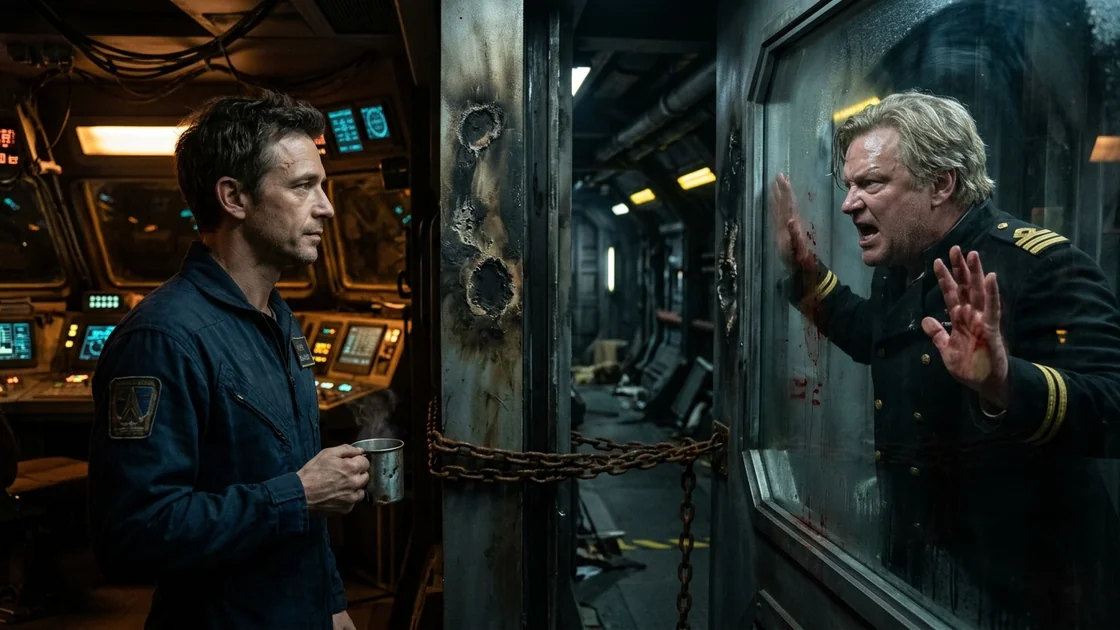
Ahead of him, the outer titanium blast door of the bridge had been winched two feet ajar, revealing the glowing, warm light of the inner quarantine vestibule behind three inches of crystal-clear diamondoid glass. And standing right on the other side of that glass, wearing a clean blue navigator’s uniform and holding a tin cup of steaming water in both hands, was Aris Thorne.
For ten seconds, neither man spoke. Kane stared at the molten thermite crater Kara had burned into the outer titanium door, then at the heavy steel chains holding the door half-open, and finally at the quiet, slight man standing three feet away behind the transparent armor.
"Thorne," Kane said, his deep voice vibrating through the acoustic pickup embedded in the vestibule frame. He stepped right up to the gap in the outer door, planting his knuckles against the diamondoid pane so that his face was less than twelve inches from Aris’s. "What the hell happened to my ship? Where is my crew?"
"Your ship?" Aris took a small sip from his tin cup, looking into Kane’s pale blue eyes without blinking. "Evelyn Vance is the captain of the Aethelgard, Marcus. You're just a thief wearing her coat. It still doesn't fit you across the shoulders, by the way."
Kane’s face flushed dark red. He slammed his open palm against the glass—a blow that would have shattered ordinary polycarbonate, producing only a dull, solid thud against the diamondoid laminate. "Don't get cute with me, you little rat! Where are Kara and Jax? Why is the reactor slagged?"
"Viktor slit his femoral artery in the infirmary four months ago," Aris said conversationally. "Lyra died of sepsis and carbon-dioxide poisoning in the comms pit about six weeks after that. Kara tried to breach the upper viewport from outside the hull and tore her suit open; she's currently frozen to the dorsal subspace mast twenty meters above your head. And Jax is behind the fire-gate in the battery vault, frozen in liquid ammonia vapor."
Kane stared at him. The sheer scale of the catastrophe seemed unable to penetrate the armor of his certainty. "You... you killed them? You woke up early and murdered them in their pods?"
"I woke them up one by one, just like I woke you," Aris said. "Each of them had the entire ship to themselves for forty days. Each of them had a chance to look out the window and understand what five pieces of silver buys out here."
"Look out the window at what?" Kane demanded, backing away from the vestibule glass by a step. "Where are we? Did you drop us short of Tartarus?"
"Go look in the starboard lounge, Marcus. Or better yet, look right behind me."
Aris stepped to his left, clearing Kane’s line of sight through the inner bridge door toward the main forward viewscreen at the front of the command deck. Aris had routed the unmagnified external bow camera to the primary four-meter high-definition wall display, along with the real-time astrometrics vector overlay in crisp green numerals across the bottom.
Kane looked past Aris’s shoulder at the screen.
He saw the black. He was an experienced spacer—he had logged twenty years between the core worlds and the outer rim—and unlike Halloway, he knew how to read an astrometrics overlay instantly.
He read the galactic coordinates: Z-AXIS +412.19 LIGHT-YEARS.
He read the velocity indicator: 22,140 KM/S — BALLISTIC.
He read the fuel reserves: 0.00%.
He read the time-to-next-stellar-intercept counter at the bottom right corner of the display: INFINITY.
The color drained slowly from Marcus Kane’s face, leaving his tanned skin the hue of wet putty. His mouth opened slightly, no sound coming out as his eyes scanned the green numbers again, and again, searching for a simulation watermark, a diagnostic error flag, anything.
"No," Kane whispered.
"Yes," Aris said.
"You dumped the cargo," Kane breathed, his voice suddenly hollow as his mind connected the velocity vector to the ship’s mass. "You couldn't get this hull up to twenty-two thousand kilometers a second with the spire attached. You dumped forty million credits into the dark!"
"I detached the spire four years and two months ago," Aris corrected him, pulling a small secondary monitor closer to the glass so Kane could read the automated telemetry log recorded before the separation. "I wired the habitation ring's backup fuel cells into the spire's ion tugs and programmed a parabolic return burn to Cinder-9. Look at the mission clock, Marcus."
Kane’s eyes dropped to the secondary screen.
"It took us four years and two months at point-three light to reach the separation point," Aris said, his voice ringing with a quiet, fierce triumph in the small vestibule. "And because the spire had both heavy tugs and the auxiliary cells, its return transit took four years and seven months. While Viktor, Lyra, Kara, and Jax were taking their turns down here over the last five months, the cargo spire was decelerating into the Cygnus sector. According to the clock, it entered low orbit over Cinder-9 eleven hours ago."
Kane’s hands curled into white-knuckled fists against the glass. "So what?! You sent three hundred thousand tons of dirt back to a corpse! Evelyn Vance starved to death four years ago!"
Aris reached into the breast pocket of his tunic and pulled out a folded sheet of heavy, physical blueprint paper—the original shipyard manifest for the Titan-class geological survey module they had dropped onto the sulfur flats of Cinder-9. He pressed it flat against the diamondoid glass right in front of Kane’s eyes, pointing his finger at the cross-sectional diagram of the shelter’s sub-flooring.
ITEM 44-B: EMERGENCY LOW-DRAW CRYOGENIC CASKET (10-YEAR AMERICIUM RTG).
Kane read the line. His eyes widened until white showed all the way around the pale blue irises.
"She knew," Kane whispered.
"We both knew," Aris said. "We inspected the seals six weeks before your mutiny. She walked down that lander ramp without looking back at you because she knew she had a ten-year bed waiting under the floorboards, and she knew I was still alive at the navigation console. Eleven hours ago, the cargo spire's automated beacon pinged her shelter, woke her pod, and dropped a heavy landing barge outside her door with ten years of supplies, a working subspace transmitter, and the complete bridge audio and video logs from the day you put a gun to her head."
Aris folded the blueprint neatly and slid it back into his pocket.
"Right about now," Aris continued softly, "Captain Vance is probably drinking her first cup of real coffee on the command deck of the recovery barge, watching her atmospheric processors deploy, and transmitting your faces to every colonial marshal between Cygnus and Earth. Though, to be fair, the marshals will never find you."
Kane let out a strangled, animal roar. He threw his entire two-hundred-and-forty-pound frame against the diamondoid glass, hammering at it with his fists, his elbows, his boots, kicking the three-inch crystal panel until his ankle twisted and blood smeared across the transparent surface from his split knuckles.
"Open this door, Thorne!" he screamed, spittle flying against the glass. "Open this door and fight me like a man, you gutless little worm! I'll tear your throat out with my teeth!"
"You had your turn with the guns and the muscle, Marcus," Aris said, not flinching an inch as Kane’s bloody fist struck the glass three inches from his nose. "That was back when we were near the stars. Out here, muscle doesn't mean anything. Authority doesn't mean anything. Money doesn't mean anything. Out here, there's only trajectory."
Kane slumped against the glass, his chest heaving beneath the tight gold braid of Evelyn Vance’s stolen tunic, glaring at Aris with a hatred so pure it looked like a physical flame.
"You're in the same boat, you idiot!" Kane rasped, smearing blood across his chin as he wiped his mouth. "You're going to die in that room! You threw your own life away just to spite me!"
"I gave my life to save my captain," Aris said simply. "You threw yours away for a number on a ledger. There's a difference, Marcus. And you have about forty days to figure out what it is."
Aris turned his back on the window.
"Thorne!" Kane howled, pounding on the glass with his bruised palms as Aris walked back through the inner vestibule hatch onto the main bridge. "Thorne, don't you walk away from me! Look at me! I'm the captain of this vessel! I give the orders here!"
Aris reached the inner bridge hatch, stepped through, and hit the release button for the interior radiation shutter. A solid, two-inch steel blind slid smoothly down over the diamondoid glass, cutting off the view of the corridor and muffling Marcus Kane’s raging screams into a distant, tinny vibration in the framing.
Aris walked over to the primary helm console and turned off the corridor microphones.
Silence returned to the bridge of the Aethelgard—deep, clean, and absolute.
Still holding his tin cup, Aris climbed the three metal steps up into the astrometrics observation blister at the very crown of the ship. Above him, the crystal dome arched open to the infinite black of the intergalactic gulf. Outside, twenty meters aft in the dark where the ship’s lights did not reach, Kara Solis rode the dorsal mast. Below him, sealed in the icy vault of the bilge, Jax Vane sat beside his frozen batteries. Far behind them, across millions of kilometers of empty vacuum, Viktor Halloway and Lyra Chen drifted along the same eternal line. And just below the floor plates, pacing through the cold corridors of a dead ship in a stolen uniform that didn't fit, the last mutineer was beginning his first day as captain of nothing at all.
Aris did not look up into the empty black ahead. Instead, he walked to the aft curve of the astrometrics dome, where a narrow, five-degree sightline cleared the flare of the ship’s dead engine bell, looking straight back along the vector they had come.
There, hanging low against the velvet dark like a handful of spilled diamond dust on black wool, shone the distant, curving spiral of the Milky Way. Somewhere inside that warm, glittering band of two hundred billion suns, circling an amber star on an ash-gray moon, Evelyn Vance was awake, looking up at the sky.
Aris Thorne sat down in the navigator’s chair, rested his hands on the cool metal of his console, and kept watch over the stars as they slowly faded into the dark.