The Cold Aisle
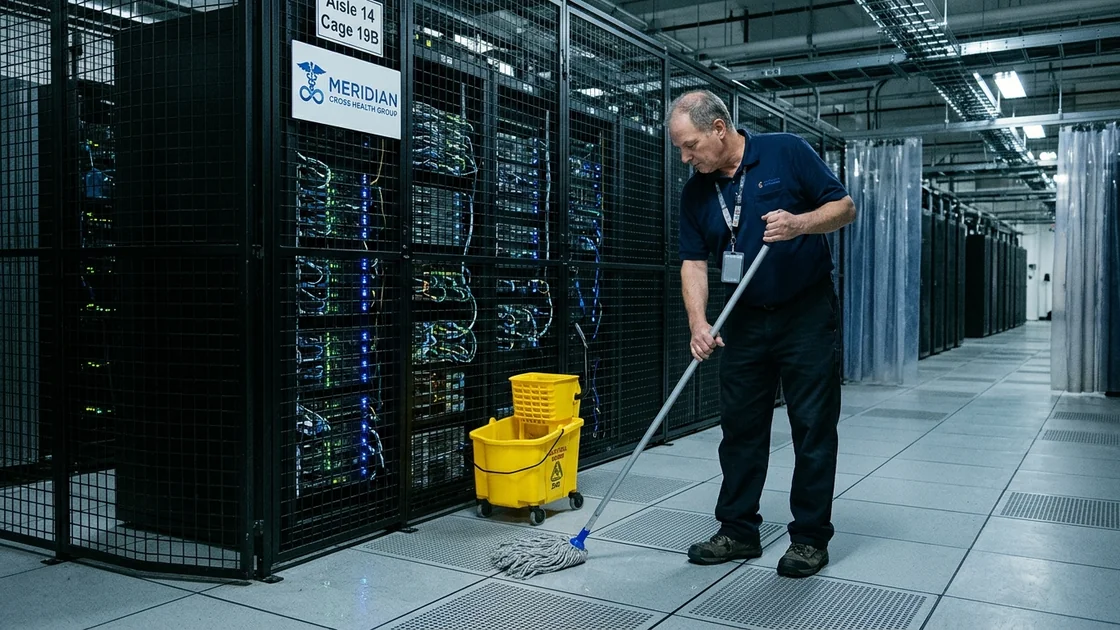
Arthur Linwood spends his nights mopping the endless, freezing corridors of a Northern Virginia data center after losing his nine-year-old daughter to a curable illness when an automated healthcare algorithm denied her treatment. Armed with a standard yellow janitorial bucket concealing an industrial-grade neodymium magnet and a carefully balanced saline solution, he wages a silent, methodical war against the physical servers of the insurance giant responsible for her death. Over the course of several months, invisible to the security cameras and the engineers who walk past him without a second glance, Arthur systematically corrupts the company's deep archival tape vaults, spinning disk arrays, and active blade servers, erasing the digital brain that decided his child's life was not cost-effective.
The noise inside Hall Four was not a sound you heard with your ears; it was a pressure you felt behind your teeth. It lived at a constant eighty-two decibels, a flat, unyielding roar produced by four thousand high-velocity cooling fans spinning in unison, sucking chilled air through perforated steel floor tiles and blasting it out the back of black anodized aluminum cabinets. To someone stepping through the biometric airlock for the first time, it sounded like standing behind the turbine of a commercial jetliner locked on the tarmac. To Arthur, after eleven months on the eleven-to-seven shift, it sounded like nothing at all. It was simply the air he breathed, heavy with ozone, static electricity, and the faint, sterile tang of lemon-scented quaternary ammonium disinfectant.
He pushed the yellow polypropylene cart down the center of Aisle 14, the non-marking gray rubber casters rolling smoothly over the grid of two-foot-by-two-foot raised floor panels. Every third panel was grated to allow the subfloor Computer Room Air Conditioning units to pump fifty-five-degree air upward into the cold aisle. The cold aisle was where the servers inhaled. The hot aisle, sealed behind clear vinyl containment curtains on the opposite side of the racks, was where they exhaled at nearly a hundred and ten degrees.
Arthur wore a short-sleeved navy blue polo shirt with the stitched logo of his staffing agency over the left breast, polyester work pants that swished softly when he walked, and composite-toe shoes with electrostatic-dissipative soles. Around his neck hung a laminated lanyard bearing three different badges: his contractor ID, his facility escort clearance, and a dull gray RFID keycard printed with the letters JAN-L2. In a building guarded by retinal scanners, man-traps, concrete bollards capable of stopping a dump truck at fifty miles per hour, and twenty-four-hour armed private security, that dull gray card was the closest thing to omnipotence that existed. Engineers were restricted to their clients' leased cages. Auditors were confined to conference rooms and escorted paths. Only the fire marshals, the senior facility directors, and the men who emptied the trash cans and damp-mopped the subfloor grates could walk from one end of the twelve-acre fortress to the other without raising an alarm on the central security console.
He stopped at the end of Aisle 14, right where the general colocation racks gave way to the high-security enterprise cages. Thick wire-mesh partitions rose from the concrete subfloor all the way to the true ceiling sixteen feet above, bypassing the drop-grid entirely so no one could climb over the top. Inside Cage 19B, bathed in the cold blue glow of overhead LED strips and the frantic, stuttering emerald pulse of network activity lights, sat forty-two cabinets belonging to Meridian Cross Health Group.
Arthur did not look directly at the sign bolted to the mesh door. He didn't need to. The corporate logo—a stylized blue caduceus intertwined with an infinity symbol—was burned into the backs of his eyelids. He had seen it at the top of nineteen separate envelopes pulled from his mailbox in Culpeper over the course of eight agonizing months.
Instead, he looked at the floor. Even in a Tier-IV data center where the air was filtered through MERV-15 pleats to strip out pollen, spore, and skin cells, dust found a way. It came in on the soles of the network engineers' sneakers; it shed from cardboard shipping boxes when new switches were uncrated in the staging bay; it flaked off the black neoprene insulation wrapped around the overhead chilled-water pipes. Left unchecked, particulate matter settled into the server intakes, coating heatsinks in a microscopic gray felt that drove thermal baselines up by tenths of a degree. And in a place where fractions of a degree translated to thousands of dollars in kilowatt-hour surcharges, Arthur’s mop was considered a critical piece of preventative maintenance.
He reached into his pocket, pulled out the gray RFID card, and held it against the black Mullion reader beside the cage door.
Beep.
The heavy mag-lock disengaged with a loud metallic clack. Somewhere in the Security Operations Center three hundred yards away, a line of text scrolled across a monitor: 02:14:09 – CAGE 19B – ACCESS GRANTED – LINWOOD, A. (MAINT/CUST). If the night guard, a twenty-two-year-old named Devon who spent most of his shift watching mixed martial arts highlights on his phone, bothered to glance up at the CCTV feed for Camera 114, he would see an ordinary fifty-four-year-old man with thinning gray hair and slightly stooped shoulders pulling a mop bucket into the aisle, propping the cage door open with a rubber wedge, and beginning the tedious work of wiping down the floor tiles from left to right.
Nobody ever watched the janitor after the first ten seconds. That was the fundamental law of human perception upon which Arthur had built his entire second life. A man in a suit carrying a laptop in a server room was a potential corporate spy. A man in a dark hoodie with a USB drive was a hacker from a television show. A man with a bad back pushing thirty-five pounds of dirty water and a microfiber string mop was furniture.
Arthur gripped the tubular steel handle of the wringer and pushed down.
The bucket was a standard commercial model, thirty-five-quart capacity, molded from high-density yellow plastic with the universal black stick-figure symbol for Caution: Wet Floor silk-screened on both flanks. At least, it had been standard when he bought a matching one off an industrial supply website eight months ago and carried it down into his basement workshop.
The bucket currently sitting inside Cage 19B looked identical to the one issued by his supervisor, right down to the scuff marks along the bottom rim that Arthur had painstakingly replicated with eighty-grit sandpaper and a black rubber mallet. The difference lay inside the false bottom and the thickened front wall of the downward-press wringer housing.
Mounted flush against the interior front plate of the bucket, encased in two-part marine epoxy and backed by a quarter-inch plate of high-permeability mu-metal to redirect the rear magnetic field away from the steel casters, sat an array of four N52-grade neodymium-iron-boron block magnets. Each block measured four inches by four inches by two inches thick. Arthur had ordered them separately through four different hobbyist and salvage accounts using prepaid debit cards bought at grocery stores along Route 29. Individually, each block possessed a pull force of nearly six hundred pounds. Arranged in a Halbach array—a specific geometric configuration of permanent magnets that augments the magnetic field on one side of the array while canceling the field to near-zero on the other—they projected an invisible, silent, and devastating cone of magnetic flux directly out the front of the yellow plastic bucket.
At a distance of three feet, the field was negligible, barely enough to make a pocket compass twitch. At fourteen inches, the flux density exceeded four thousand gauss. At four inches—the exact distance between the front bumper of the bucket and the lower bezel of a server rack when Arthur parked the cart parallel to the cabinets to wring out his mop—it exceeded nine thousand gauss.
Nine thousand gauss was more than triple the coercivity threshold required to permanently flip the magnetic domains on a spinning hard disk platter or strip the servo tracks off an LTO magnetic backup tape, rendering the cobalt-alloy film inside as blank and meaningless as a ribbon of brown party streamer.
Arthur lifted the mop from the wringer, let the excess water drip back into the basin with a soft plastic patter that vanished instantly into the roar of the cooling fans, and laid the damp microfiber strands against the white composite floor tiles in front of Rack 01.
He began to mop. Left to right. Figure-eight pattern. Slow, deliberate strokes.
When he finished the four-foot square in front of Rack 01, he nudged the yellow bucket forward with his shin so the front nose of the plastic basin rested less than three inches from the perforated black steel door at the very bottom of the cabinet. He left it there while he walked four paces down the aisle to wipe the base of the next rack, giving the invisible field thirty seconds to soak through the thin aluminum mesh and bathe the lower twelve units of the rack in raw magnetic force.
In the top half of those racks lived the glamorous hardware: the ultra-fast NVMe solid-state drives, the blade servers humming with dual-socket processors, the fiber-optic switches flashing like angry fireflies. Arthur knew his magnets couldn't touch those. He had spent four months sitting at a corner table in the Culpeper County Library after Maya died, reading thick textbooks on enterprise storage architecture, solid-state physics, and disaster recovery protocols until his vision blurred. Solid-state drives stored data as electrical charges trapped in silicon floating-gate transistors. You could rub a magnet directly across an SSD all night and do nothing unless the magnet was moving fast enough to induce an eddy current.
For the top half of the racks, Arthur had the water.
For the bottom half—Units 1 through 14, right down near the floor where the heavy hardware was always mounted to keep the cabinets from becoming top-heavy—the magnets were king. Because down at floor level sat the deep-storage JBOD shelves: high-density drawers packed sixty drives deep with twenty-two-terabyte helium-filled spinning magnetic hard drives. That was the warm archive. The compliance vault. The training repository where ten years of patient claims, actuarial tables, diagnostic codes, and neural-network weight matrices were mirrored every night at midnight.
Arthur nudged the bucket forward another two feet, parking it squarely against the lower bezel of Rack 02.
He didn't hurry. He had all night. He had every night.
Her name was Maya, and she had liked frogs, cinnamon toast with the crusts cut into triangles, and the sound of rain hitting the corrugated tin roof of the backyard shed.
When she was seven, she had caught a green tree frog in the hydrangeas beside the porch and kept it for three days in a five-gallon aquarium Arthur had caulked together out of scrap windowpane glass from his garage. On the third evening, sitting cross-legged on the braided rug in the living room while the frog stared through the glass at the television, she had announced that its name was Mr. Senator because it looked like it was wearing a very large suit and had nothing important to say.
"You have to let him go tomorrow, bean," Arthur had told her, leaning back against the sofa with an ice pack pressed against his lower lumbar, where two herniated discs from twenty years of hauling cast-iron boilers up basement stairs had finally ended his career as an HVAC journeyman. "He’s got constituents in the bushes."
"He likes it here," Maya had argued, pressing the tip of her nose against the glass until it turned white. "There are no snakes in the living room."
"True. Also no bugs."
"You can catch him bugs."
"My union contract explicitly prohibits catching moths after six p.m.," Arthur said. "Besides, look at his throat. It’s not puffing up. A frog that doesn't sing is a frog that's just waiting out a sentence."
She had thought about that for a long time, her chin resting on her folded forearms, her dark hair—her mother’s hair, thick and stubbornly curly at the ends—falling over her ears. Sarah had died of an aneurysm when Maya was three, leaving Arthur with a half-paid mortgage, a pickup truck with two hundred thousand miles on the odometer, and a ferocious, terrifying love for this small person who smelled of strawberry shampoo and crayoned paper.
The next morning, before the school bus came rattling up the gravel road, Maya had carried the glass box out to the hydrangeas in her pajamas and tipped it gently onto its side. When the frog leaped into the wet leaves and vanished, she hadn't cried. She had simply wiped her palms on her flannel knees, looked up at Arthur with solemn brown eyes, and said, "Okay. Tell me if you hear him tonight."
The headaches started in the autumn of her eighth year.
At first, the pediatrician thought she needed glasses. Then they thought it was sinus pressure from the ragweed bloom in the Shenandoah Valley. By November, when Arthur found her sitting at the bottom of the stairs at three in the morning, holding her hands over her ears because the refrigerator downstairs was "humming too loud in her teeth," they sent her to Charlottesville for an MRI.
Arthur remembered the MRI suite with a clarity that would later seem prophetic. He remembered the blue tape on the linoleum floor marking the five-gauss line, the warning signs about pacemakers and loose keys, the heavy copper-shielded door, and the deep, rhythmic, mechanical thump-thump-thump of the superconducting coils imaging his daughter's brain.
It was a pediatric low-grade glioma, nestled deep near the optic chiasm and the hypothalamus. Benign by histological grade, the neuro-oncologist explained in a quiet room with a box of tissues sitting squarely in the center of a round oak table, yet malignant by location. You couldn't cut it out without blinding her or destroying her endocrine system. Standard photon radiation carried a massive risk of secondary malignancies and devastating cognitive decline in a developing nine-year-old brain, essentially trading her future away to buy five years.
"There is a standard of care for this specific anatomical presentation," Dr. Aris Thorne had said, turning his monitor so Arthur could see the three-dimensional rendering of Maya’s skull, where a pale green contour traced the tumor like frost on a window. "Pencil-beam proton therapy, paired with a targeted MEK-inhibitor regimen called Selumetinib to shrink the mass away from the optic nerve before we irradiate. Because protons have mass, they stop at a precise depth in the tissue—what we call the Bragg peak. There is zero exit dose. We hit the tumor, and the healthy brain tissue two millimeters behind it receives virtually no radiation. Her long-term survival rate with intact neurological function is upwards of eighty-eight percent."
Arthur had felt the floor return beneath his boots. Eighty-eight percent. He was a mechanic; he understood tolerances and probabilities. Eighty-eight percent wasn't a miracle; it was a solid engineering margin.
"When do we start?" Arthur had asked.
"As soon as Meridian Cross clears the prior authorization," Dr. Thorne said, and for a fraction of a second, the doctor’s shoulders had dropped in a way Arthur didn't yet know how to read. "We’re submitting the packet today. Urgent expedite."
That was on a Tuesday in early December.
The first denial letter arrived the following Monday, printed on crisp twenty-pound bond paper with the blue caduceus-and-infinity logo at the top. The font was Times New Roman, ten-point, justified so neatly that the paragraphs looked like grey concrete blocks.
Dear Member or Guardian, it read. We have reviewed the request submitted by your provider for Service Code 77523 (Proton Beam Delivery, Intermediate) and J8999 (Targeted Oral Antineoplastic). Based on our clinical guidelines and utilization management review, the requested treatment has been determined to be NOT MEDICALLY NECESSARY. Alternative standard photon therapy (IMRT) is a covered benefit under your plan and represents the most cost-effective clinically equivalent pathway.
At the bottom was a digitized signature belonging to Dr. Gregory H. Vance, Medical Director, Utilization Review.
Arthur hadn't panicked at first. It was a clerical mistake. Someone had checked the wrong box on a form and failed to see that Maya was nine years old, and that photon therapy would irradiate her temporal lobes and carotid arteries. Dr. Thorne’s office filed an immediate peer-to-peer appeal.
Arthur spent four hours a day on the phone at the kitchen table while Maya slept on the couch under a quilt, her small face pale and pinched from the dexamethasone they were giving her to keep the brain swelling down. He learned the cadence of the Meridian Cross automated phone tree by heart. He learned the four-bar synthesizer loop that played between the recorded reminders that his call was very important to them. He filled three yellow legal pads with reference numbers, claim IDs, extension numbers that led to dead voicemails, and the first names of customer service representatives in Tampa and Manila who spoke in hushed, exhausted voices and read from screens they were not allowed to deviate from.
"I can see the appeal was received on the fourteenth, Mr. Linwood," a woman named Brenda told him three days before Christmas. Outside the kitchen window, a gray sleet was falling over the dead hydrangeas. "And it shows here it went to Level Two Secondary Clinical Review on the fifteenth."
"And?" Arthur asked, his knuckles white around the receiver. "Dr. Thorne sent forty pages of peer-reviewed oncology studies showing that IMRT is contraindicated for optic-pathway gliomas in children under ten. Did Dr. Vance read them?"
There was a long pause on the line, filled only by the faint clatter of a keyboard.
"Sir, the system shows the Level Two determination was finalized on the fifteenth. The denial was upheld."
"Wait. It was submitted on the fifteenth and denied on the fifteenth? What time?"
"Let me look at the timestamp... Submitted at 2:14 p.m. Eastern. Determination logged at 2:14 p.m. Eastern."
Arthur stared at the salt shaker on the kitchen table. "The same minute?"
"That's just when the batch processes, Mr. Linwood," Brenda said quickly, her voice tightening with practiced corporate defensiveness. "The medical director reviews the electronic file and enters the code."
"Nobody reads forty pages of pediatric neuro-oncology in less than sixty seconds, Brenda."
"You have the right to request an External Independent Review through the state bureau of insurance," she recited, her voice dropping into the flat, rhythmic cadence of a legally mandated script. "The standard turnaround time for an external review is thirty to forty-five business days..."
Forty-five business days. Nine weeks.
By mid-January, while the External Review packet was sitting in an inbox in Richmond awaiting assignment to an independent contractor, Maya lost the vision in her left eye. It happened on a Thursday morning while she was trying to color a picture of a horse. She simply stopped, put the blue crayon down on the table, and asked Arthur why the room had gone dark on the side by the window.
When they rushed her back to Charlottesville, the emergency scan showed the tumor had expanded by four millimeters, compressing the third ventricle and causing acute hydrocephalus. They took her into surgery that night to place a ventriculoperitoneal shunt to drain the fluid from her skull. Five days later, her immune system weakened by six weeks of high-dose steroids that were only ever meant to be a ten-day bridge until proton therapy started, she developed a line infection that turned into gram-negative sepsis.
She died on February 11th at 4:08 in the morning in the Pediatric Intensive Care Unit.
The letter from the Virginia State Bureau of Insurance overturning Meridian Cross’s denial and ordering immediate coverage of the proton therapy arrived in Arthur’s mailbox on February 16th, two days after he buried her beside her mother in the churchyard off Route 15.
It was two months later, sitting alone in a house so quiet he could hear the dust settling on the floorboards, that Arthur read an investigative article in a regional business journal. A whistleblower from Meridian Cross’s IT department had leaked internal audit logs to a Senate subcommittee.
There was no Dr. Gregory H. Vance reading forty-page clinical packets. Dr. Vance was a retired urologist living in Scottsdale who was paid four hundred dollars an hour to lend his medical license number to an electronic signature macro. The utilization reviews were processed by an enterprise predictive analytics module called Aethelgard-7, licensed and customized by Meridian Cross to evaluate high-cost oncology and rare-disease claims.
According to the leaked logs, Aethelgard-7 ingested the ICD-10 diagnostic code, cross-referenced the CPT treatment cost against the patient’s actuarial lifetime premium value and the statistical probability of the family pursuing costly litigation, and generated an automated denial if the treatment exceeded a proprietary cost-per-quality-adjusted-life-year threshold. It processed claims in batches of five hundred. Its average adjudication time per child was 1.38 seconds.
In ninety-one percent of cases, the families either gave up, accepted the cheaper inferior treatment, or the patient died before the forty-five-day statutory appeal window closed—which the algorithm’s machine-learning reinforcement loop logged as a successful cost-avoidance outcome, further weighting the model to deny similar claims in the future.
Maya’s death had not been a tragedy to the machine. It had been a positive training signal. A data point that proved the refusal had saved Meridian Cross two hundred and四十 thousand dollars in fiscal quarter one, reinforcing the neural weights stored on a spinning platter of cobalt-chromium alloy so that the next nine-year-old girl with a shadow behind her eyes would be denied a fraction of a millisecond faster.
Inside Cage 19B, Arthur pulled the mop back, gave the handle a practiced twist to catch a stray gray dust bunny near the cable management arm of Rack 08, and stepped back to inspect his work.
He had been inside the Meridian Cross cage twenty-two times over the past five months, strictly adhering to the facility’s bi-weekly deep-cleaning schedule for leased enterprise suites so his badge logs would show nothing out of the ordinary. Every second and fourth Tuesday of the month, between 2:00 a.m. and 3:15 a.m., Arthur Linwood mopped Cage 19B.
During the first two months, he hadn't used the magnets or the modified water at all. He had simply cleaned, keeping his head down while mapping every square inch of the forty-two cabinets in his mind. When he returned to his truck at seven in the morning, before driving home down Route 28, he would sit in the back corner of a diner parking lot in Manassas and sketch the rack elevations in a composition notebook using a mechanical pencil.
He knew that Racks 01 through 12 housed the primary application servers and the active database clusters running on all-flash arrays. He knew Racks 13 through 24 held the high-density spinning disk shelves—the local RAID-6 arrays and the warm backup snapshots. He knew Racks 25 through 36 were network switches, patch panels, and redundant uninterruptible power supplies.
And he knew that Racks 37 through 42 weren't standard racks at all. They were a single, continuous, monolithic black enclosure with a tinted polycarbonate viewing window across the front: a modular automated tape library. Inside that twelve-foot-long cabinet, two robotic gantry arms glided silently along precision aluminum rails, plucking barcoded LTO-9 magnetic tape cartridges out of honeycomb storage slots and sliding them into read/write drives.
Eight thousand cartridges. Nearly a hundred and fifty petabytes of compressed, air-gapped cold storage. Every seven-year financial audit log, every HIPAA compliance archive, every master backup of the Aethelgard algorithmic weights, every claim history, every digitized signature of Dr. Gregory H. Vance.
In enterprise IT, there was a religion called the 3-2-1 Rule: three copies of your data, on two different types of media, with one copy offsite. This Ashburn facility was Meridian Cross’s offsite disaster recovery and archival hub, tethered by dedicated dark fiber to their corporate headquarters in Reston. When the primary servers in Reston hiccuped, they failed over to the active racks in Cage 19B. When the active racks in Cage 19B needed to roll back or verify data integrity, they pulled from the spinning disk shelves at the bottom of Racks 13 through 24. And if the spinning disks suffered a catastrophic multi-drive failure, the engineers restored from the robotic tape library in Racks 37 through 42.
To kill a monster that didn't have a heart, you had to kill its memory in reverse order. You had to rot the parachute before you cut the engine.
Arthur started with the tape library in November.
The polycarbonate window of the tape vault was too thick and set too high off the floor for the bucket’s Halbach array to reach the upper honeycomb slots where the robotic arm danced. However, at the bottom right corner of Rack 42 was the bulk I/O station—a sliding metal drawer at knee height where engineers loaded and unloaded batches of thirty cartridges at a time for quarterly rotation, along with two locked steel cabinets immediately adjacent to the library that held the overflow carousels and the "Golden Master" system recovery tapes in fireproof plastic cases.
The steel cabinets were standard twenty-gauge sheet metal. Twenty-gauge steel offered almost zero magnetic shielding against a four-thousand-gauss static field held two inches from the door.
Every Tuesday for ten weeks, Arthur had parked his yellow mop bucket flush against the doors of those overflow cabinets for fifteen minutes while he meticulously hand-wiped the vinyl curtains of the hot aisle containment system with a microfiber cloth. Then he would slide the bucket six inches to the left and leave it there for another fifteen minutes while he polished the biometric reader and the fire extinguisher glass.
Magnetic tape was remarkably fragile when it came to coercivity. Even worse than erasing the data outright, a strong external magnetic field passing unevenly across a wound spool of LTO tape destroyed the factory-written magnetic servo tracks—the microscopic timing rails written onto the tape at the manufacturing plant that told the read-head where the data tracks were located. Without the servo tracks, the tape drive couldn't even initialize the cartridge. Best of all, there was no sensor inside a plastic cartridge case to tell the system the tape had been blanked. As far as the inventory software was concerned, every single barcoded cartridge sitting in those cabinets and in the lower three rows of the library was healthy, verified, and green. Nobody would know they were dead until the day they tried to read them.
In December, Arthur moved on to the spinning disk shelves at the bottom of Racks 13 through 24.
Here, he had to be much more careful. Unlike magnetic tapes sitting passively on a shelf, the 22-terabyte hard drives in the JBOD enclosures were spinning at 7,200 revolutions per minute, constantly running background "patrol reads" and parity scrubs to check for bad sectors. If Arthur wheeled his bucket up to Rack 13 and instantly scrambled twelve hard drives in a single shelf, every alarm in Meridian Cross’s Network Operations Center would light up like a Christmas tree. A simultaneous twelve-drive failure in one chassis didn't happen in nature; it would bring vendor forensic teams down on the cage within twelve hours.
Instead, Arthur became the patron saint of bit rot.
Instead of parking the bucket flush against the active drive bays at four inches, he parked it at sixteen inches, angling the Halbach array just enough so the fringe of the magnetic field brushed the outer edge of the bottom chassis for two or three seconds as he rolled past.
At sixteen inches, the field wasn't strong enough to wipe a platter or crash a spindle motor. It was just strong enough to exert a minuscule magnetic drag on the voice-coil actuator arm inside two or three drives at the corner of the shelf, causing the read/write head to drift by fifty nanometers for a fraction of a second while writing a parity block, or flipping a handful of weak magnetic domains on a single track.
To the RAID controller, this looked like an ordinary, everyday Unrecoverable Read Error (URE) or a bad sector—the kind of routine mechanical aging that happened to thousands of hard drives in data centers every single week. When the controller detected a drive throwing too many bad sectors during its weekly scrub, it simply marked the drive as Predictive Failure, blinked a little amber light on the drive caddy, and automatically began rebuilding the lost data onto a hot-spare drive using the parity calculations from the remaining disks in the array.
Except two weeks later, when Arthur came back through with his mop, he brushed the opposite end of the same shelf while the array was still carrying weak, unverified sectors from the previous pass.
He was seeding silent data corruption—what storage engineers called silent bit rot—across the backup volumes. When a sector degraded silently while the array was rebuilding another failed drive, the RAID controller unknowingly took the corrupted bits, ran them through its XOR parity math, and wrote garbage directly into the reconstructed volume, marking the rebuild as 100% Successful.
Every time an engineer walked into Cage 19B on a Wednesday afternoon with a cardboard box under his arm, pulled out a blinking amber drive caddy, tossed it into the e-waste bin, and slid a fresh drive into the slot, he wasn't fixing the array. He was helping Arthur launder corrupted math into the master backup tables.
And then there was the water.
Arthur looked down at the murky liquid sloshing gently around the plastic grate of his wringer.
Facility rules strictly forbade the use of bleach or harsh acids inside the data halls because chlorine vapors corroded copper contacts. The approved cleaner was a neutral-pH synthetic detergent diluted at one ounce per gallon of deionized water from the janitorial sink in the service corridor.
Arthur used the approved detergent so the smell would be right. Then, once he was out of view of the corridor cameras in the blind spot behind the main chilled-water risers, he unscrewed the cap of a sixteen-ounce plastic sports bottle he carried in his lunch cooler and poured its contents into the bucket.
The bottle contained a saturated, filtered brine of reagent-grade potassium chloride and magnesium chloride dissolved in distilled water, mixed with five milliliters of a commercial wetting agent used in agricultural crop spraying to break surface tension.
When Arthur mopped the perforated steel floor tiles in the cold aisle directly in front of Racks 01 through 12—the all-flash active servers where Aethelgard-7 lived and breathed—he left a razor-thin film of hyper-saline solution across the thousands of quarter-inch air holes in the floor grates.
Immediately, the high-velocity air blasting upward from the subfloor plenum at twelve hundred cubic feet per minute sheared microscopic, sub-micron droplets off the wet grates and carried them straight into the bottom intake bezels of the servers.
Because the droplets were microscopic, they bypassed the coarse dust filters entirely and evaporated within milliseconds in the dry data-center air, leaving behind invisible crystals of hygroscopic chloride salts directly on the high-density printed circuit boards, the gold-plated PCIe fingers of the NVMe drives, and the lead-free silver-tin solder joints of the motherboard voltage regulators.
Magnesium chloride had a deliquescence point of thirty-three percent relative humidity. The data center’s environmental controls were locked at forty-five percent relative humidity to prevent static discharge. That meant the microscopic salt crystals sitting on the motherboards inside Racks 01 through 12 never actually dried out. They pulled moisture directly out of the conditioned air, forming a conductive, corrosive electrolyte layer only a few molecules thick across the traces.
Electrochemical migration. Dendritic growth. Microscopic whiskers of copper and tin dissolving from one trace and bridging the sub-millimeter gap to the next, causing intermittent voltage drops, phantom memory parity errors, and slow, inexorable oxidation of the silicon pathways.
It didn't blow fuses. It didn't trip circuit breakers. It just gave the machine a terminal, inoperable brain tumor.
At 2:48 a.m. on the fourth Tuesday of February—one year and two weeks after Maya died—the heavy mag-lock on the main airlock door at the far end of Hall Four clacked open.
Arthur didn't look up from his mop. He was working the floor outside Cage 22, forty feet down the aisle from the Meridian Cross enclosure, having finished inside 19B twenty minutes earlier. Even over the roar of the CRAC units, he recognized the footsteps. Custodians walked with a slow, flat-footed shuffle. Security guards walked with a heavy, bored heel-strike. Engineers in a hurry walked on the balls of their feet, fast and clipped, their keycards already out and held at waist height before they reached the readers.
Two men came around the corner of the main cross-aisle.
The first was in his late thirties, wearing a wrinkled button-down shirt under a fleece vest, dark jeans, and wireless noise-canceling headphones pushed back around his neck. He was carrying a ruggedized laptop cradled open against his forearm and a bundle of aqua-colored LC-to-LC fiber patch cords draped over his shoulder. The second man was younger, maybe twenty-six, wearing a gray hoodie with the logo of a Virginia university and carrying a heavy static-shielded pelican case.
They didn't belong to the colocation facility's resident "remote hands" crew. They wore red visitor badges clipped alongside corporate Meridian Cross photo IDs. For the company to send two senior systems engineers out from Reston to Ashburn at three in the morning meant something had finally crossed the threshold from an automated ticket to a pager-waking crisis.
Arthur pulled his mop cart tight against the wire mesh of Cage 22 to give them room to pass, keeping his eyes fixed on the baseboard molding.
The two men didn't even glance at him as they hurried past, raising their voices to be heard over the eighty-two-decibel drone of the hall.
"—telling you, the checksums on the SAN mirror don't make any sense," the older one in the fleece vest shouted, tapping his badge against the reader of Cage 19B. "If it was a bad fiber transceiver in the spine switch, the CRC error counters on the port would be incrementing. The port counters are clean! The corruption is sitting at rest on the blocks!"
"Maybe the controller firmware bug from the October patch?" the younger one yelled back, catching the cage door before it swung shut and hauling the pelican case inside.
"We rolled that patch back on Cluster B three weeks ago, Kevin! And Cluster B just threw four thousand uncorrectable ECC memory faults during the midnight batch run! Compliance is breathing down my neck because the Q4 actuarial verification job failed three nights in a row!"
The cage door swung shut behind them and locked with a heavy thud.
Arthur stood still for a moment, his hands resting atop the rubber grip of his mop handle.
The midnight batch run.
He knew what the midnight batch run was. At midnight, Aethelgard-7 reconciled the day's utilization review determinations against the claims ledger and pushed the updated weighting tables down to the warm storage shelves in Racks 13 through 24.
Slowly, methodically, Arthur dipped his mop into the yellow bucket, lifted it into the wringer, and leaned his weight onto the steel lever. Water sluiced through the perforations. He released the lever, lifted the mop, and began working his way back down Aisle 14 toward Cage 19B, wiping the exterior corridor tiles along the wire-mesh perimeter where he could watch and listen through the steel grid.
Inside the cage, the older engineer—his badge read MARCUS in bold block letters—had set his laptop on the fold-down crash-cart tray attached to Rack 04 and plugged a blue serial console cable directly into the management port of the primary blade chassis. Kevin was down on his knees in front of Rack 15, shining a penlight through the hexagonal mesh of the lower cabinet door at the spinning disk shelves.
"Marcus," Kevin called out, his voice pitched higher to carry over the fans. "Look at Shelf 3 in Rack 15."
Marcus didn't look up from his screen, his fingers flying across the laptop keyboard. "I see it in the iDRAC log. Drive 4 and Drive 19 went offline at 01:40. The hot spares picked it up."
"No, man, come look at the physical bezel," Kevin insisted, tapping the black mesh with his knuckles. "There are seven amber lights blinking across two different RAID groups in the same shelf. And the activity LEDs on the rest aren't pulsing in sync—they're stuttering like the heads are thrashing."
Marcus frowned, swore under his breath, and walked five paces down the cold aisle to crouch beside the younger engineer. Through the diamond pattern of the wire partition, less than eight feet from where Arthur was slowly drawing his mop back and forth across the white floor panels, Arthur watched Marcus’s face turn pale green in the glow of the server lights.
"Why didn't Nagios page us on seven drives?" Marcus demanded, pulling his phone from his vest pocket.
"Wait—look at the management module at the back of the shelf," Kevin said, peering through the side gap. "The green heartbeat LED is frozen solid. The enclosure management controller is locked up. It stopped sending SNMP traps to the monitoring server hours ago, so the dashboard in Reston still shows the array as healthy green while the drives are dying in the dark."
Why had the enclosure management controller locked up? Because three weeks ago, when Arthur noticed that specific controller card sat on the bottom-left lip of the chassis right behind the front air intake, he had given the floor grate six inches in front of it an extra-generous soaking of magnesium chloride brine. A single dendritic short across the 3.3-volt rail of the management daughterboard had lobotomized the alarm bell while leaving the rest of the shelf powered on to eat itself alive.
Marcus stood up fast, wiping his palms on his jeans, and strode back to his laptop at Rack 04. "Okay. Okay, don't panic. Don't pull any drives. If we have multiple drives degrading across a RAID-6 stripe and we force a hard reset on the controller right now, the whole volume is going to drop offline."
"Should we fail over the active database to the Reston primary?" Kevin asked, standing up and hovering behind Marcus's shoulder.
"We are the primary right now! Reston went into scheduled maintenance mode at midnight for the core router upgrade! Everything is running live off Cage 19B until six a.m.!" Marcus typed furiously, his jaw clenched. "I’m going to halt the Aethelgard training batch and initiate a read-only snapshot from the Secondary SAN in Rack 18 before we touch Rack 15. If Rack 15 craters, we rebuild the primary tables from the Secondary SAN."
Arthur paused beside the cage mesh, leaning on his mop handle to ease the dull, familiar ache in his lower spine. He watched Marcus’s fingers strike the Enter key.
Rack 18 was twelve feet down the aisle from Rack 15. It sat right next to the pillar where Arthur always parked his bucket for ten minutes while he changed out the trash liner in the wall-mounted receptacle outside the cage door.
On the screen of Marcus’s laptop, a black terminal window began scrolling lines of white text. Then the white text stopped, and a block of red characters appeared.
[CRITICAL] ZFS/SAN POOL 'MCH-PROD-WARM-02' STATUS: FAULTED.
[ERROR] METADATA CORRUPTION DETECTED AT BLOCK 0x004F8A9100C.
[ERROR] INSUFFICIENT PARITY REPLICAS TO RECONSTRUCT BTREE.
[WARNING] MOUNT FAILED: INPUT/OUTPUT ERROR.
Nobody inside the cage moved for five full seconds. The cooling fans roared on, completely indifferent to the fact that forty terabytes of Meridian Cross's clinical adjudication history had just turned into digital static.
"What the hell is that?" Kevin whispered, though he had to shout to be heard. "Input/output error on the secondary mirror? We just ran a verification scrub on Tuesday!"
"The scrub ran against cached metadata in RAM," Marcus said, and for the first time, Arthur heard genuine fear cracking through the engineer's professional irritation. "When I forced a cold read off the physical platters just now, the B-tree headers weren't there. The pointers are completely scrambled."
"How can both the primary and secondary disk shelves have corrupted block headers at the exact same time? Is this ransomware? Did somebody breach the firewall?"
"No! Ransomware encrypts the file system from the top down and leaves a note! This is low-level sector magnetic degradation—the drive firmware is reporting bad servo sync and cyclical redundancy failures across forty different physical spindles!" Marcus grabbed the edges of the laptop screen with both hands as another alert box popped up in the corner of his display, flashing crimson. "Oh, God. Look at Blade 3 and Blade 7 in Rack 02."
"What's happening?"
"Kernel panic on the main database nodes. Voltage regulator fault on CPU-1 in Blade 3, and uncorrectable PCIe bus errors on the NVMe backplane in Blade 7. The cluster just lost quorum. The active database just went down hard."
Arthur slowly pushed his mop across the tile, watching the amber fault LEDs begin to cascade up the front of Rack 02 like sparks climbing a dry curtain. When the active database nodes lost quorum and crashed in the middle of a write operation while the underlying storage arrays were throwing I/O errors, the file system journal tore itself in half.
Inside the cage, Kevin’s hands went to the top of his head, his fingers tangling in his hair. "Marcus. If the active cluster just dropped, every automated prior-auth portal, every hospital EDI link, and the entire Aethelgard claims engine just went dark across fourteen states."
"I know that, Kevin!"
"And if the Reston routers are torn apart on the floor until morning, we don't have a live replication target to pull from!"
"I know that!" Marcus shouted back, slamming his palm against the side of the server rack. He took two deep, ragged breaths, forcing his voice back down into a tight, trembling register. "Listen to me. Stop freaking out. This is why we have the StorageTek library in Rack 40. The weekly full cold-metal backup finished Sunday night at four a.m. It’s completely air-gapped on LTO-9 tape. Even if every hard drive in this room is possessed by the devil, we spin up the spare hypervisor blades in Rack 09, provision a clean LUN on the untouched array in Rack 22, and pull the Sunday night Golden Master straight off the tapes. We lose forty-eight hours of automated claims logs—which can be re-ingested from the clearinghouse queues tomorrow—and we're back online before the East Coast hospitals open at seven."
Kevin let out a long, shaky breath and nodded rapidly. "Right. Right,
the tapes. The Sunday incremental and the Sunday full master. Cartridges
MCH-8840L9 through MCH-8865L9."
"Go unlock the overflow vault next to Rack 42 and verify the physical write-protect tabs on the master recovery set," Marcus ordered, already typing commands to initialize the backup software interface. "I’m queuing the robotic arm in the main library to mount the first four cartridges into Drives 0 through 3 right now."
Arthur stopped mopping.
He pulled his yellow bucket two feet down the exterior of the cage mesh, positioning himself directly opposite the end of the aisle where the monolithic black tape library stood. He dipped the mop into the gray water, set it into the wringer, and leaned his forearm on the handle, watching through the wire grid as the two engineers converged on Rack 40.
Behind the tinted polycarbonate window of the tape library, an interior strip of white maintenance LEDs snapped on automatically as Marcus sent the wake command. The robotic gantry arm—a sleek black assembly of aluminum rails, optical barcode scanners, and precision mechanical grippers—whirred to life, sliding horizontally at six feet per second before dropping straight down to the lower three rows of the honeycomb matrix.
Lower Row 2. Slots 104 through 130.
Eighteen inches off the raised floor. Right where Arthur had rested the nose of his bucket for twenty minutes every other Tuesday while he ate a peanut-butter sandwich in the blind spot behind the open doors of Rack 36.
The robotic gripper plucked cartridge MCH-8840L9 from
its plastic cradle, pivoted ninety degrees with a crisp mechanical
zip, and slid the purple-and-black cartridge into Tape Drive 0
at the bottom of the stack. Immediately, the second gantry arm slotted
MCH-8841L9 into Drive 1, MCH-8842L9 into Drive
2, and MCH-8843L9 into Drive 3.
Inside the drives, tiny mechanical fingers caught the leader pins of the tapes, unspooling the half-inch-wide ribbons of barium-ferrite magnetic film across the thirty-two-channel magneto-resistive read heads.
Arthur watched the small LCD status panels on the front of the four tape drives.
For three seconds, the panels displayed MOUNTING...
Then SEEKING SERVO...
From inside the lower bay of Rack 40 came a faint, high-pitched whine as the drive motors spun the reels up to full speed, searching for the factory magnetic timing tracks that weren't there anymore. The drives slowed down, reversed direction, and spun up again, the read heads stepping frantically across the width of the ribbon, hunting for a magnetic horizon that had been wiped as flat and featureless as salt flats after a flood.
On all four LCD panels simultaneously, the green backlight died and turned a harsh, solid orange.
ERR 74: MEDIA CORRUPT / SERVO TRACK NOT FOUND
TAPE UNREADABLE — EJECTING
"What?" Kevin said, his nose two inches from the polycarbonate glass. "All four drives just threw an Error 74."
Marcus stared at his laptop screen, where four consecutive red error flags had just cascaded down the NetBackup console. "Dirty heads? How could all four drives have dirty heads at the same time? Wait—it’s auto-mounting the next four cartridges in the set."
The robotic arm plucked the four rejected cartridges from the drives, flagged them as defective in the inventory map, and slammed the next four cartridges from Row 2 into the slots.
Whirrrrr. Click. Whirrrrr.
ERR 74: MEDIA CORRUPT / SERVO TRACK NOT FOUND
ERR 74: MEDIA CORRUPT / SERVO TRACK NOT FOUND
ERR 74: MEDIA CORRUPT / SERVO TRACK NOT FOUND
ERR 74: MEDIA CORRUPT / SERVO TRACK NOT FOUND
"They're blank," Kevin whispered. The color had drained completely from his face, leaving his skin looking like wet dough under the blue LEDs. "Marcus, error 74 isn't a bad block. Error 74 means the drive can't even find the factory formatting on the tape. It only happens if a cartridge has been run through a bulk degausser."
"Nobody degaussed the library, Kevin! You can't fit a degausser inside a sealed robotic enclosure!" Marcus pushed past him, his hands shaking as he fumbled with the keyring on his belt and jammed a small brass tubular key into the lock of the steel overflow cabinet beside Rack 42—the cabinet where the air-gapped, quarter-end Golden Master recovery tapes were stored in locked orange Pelican cases.
He yanked the steel door open, unlatched the top orange case, and pulled out two cartridges from December and January. He didn't even use the bulk I/O drawer; he put the library into manual override mode, opened the service access port, and shoved the January master tape directly into Drive 4 near the top of the rack.
Arthur didn't need to look at the LCD panel to know what it was going to say. He had parked his mop bucket against the thin sheet metal of that cabinet so many times that the yellow plastic bumper had left a faint, pale streak on the black powder-coat paint five inches above the floor.
Inside Drive 4, the motor whined, stuttered, reversed, and stopped.
Orange light.
ERR 74: MEDIA CORRUPT / SERVO TRACK NOT FOUND
Marcus didn't move. He stood frozen with his fingertips resting against the polycarbonate window of the tape library, staring at the little glowing orange rectangle as if it were written in a dead language he couldn't translate.
Behind him, on the crash-cart tray at Rack 04, his laptop chimed softly as the last surviving node of the Aethelgard-7 compute cluster suffered a fatal voltage drop across a salt-corroded VRM mosfet, dumped its core memory into an unmounted void, and powered itself off to prevent a thermal runaway. One by one, the frantic green network activity lights across Racks 01 through 12 stopped stuttering and went dark, replaced by the slow, rhythmic, funeral pulse of amber system-fault beacons.
In the quiet of his own mind, beneath the roar of the four thousand fans, Arthur thought of the tree frog in the five-gallon glass tank. A frog that doesn't sing is a frog that's just waiting out a sentence.
"Marcus," Kevin said. His voice was small, stripped of all its technical swagger. He was sitting on the floor tiles now, his back pressed against the cold mesh of Rack 16, staring up at the wall of blinking amber lights. "What about the vault in Reston?"
Marcus didn't turn around. "There is no tape vault in Reston. Management consolidated all physical cold storage to Ashburn eighteen months ago to save four hundred grand a year on facility leases. Reston only holds a seventy-two-hour rolling cache on the primary SAN."
"Which is offline right now for the router upgrade," Kevin said. "Wait—so when the network guys bring the Reston routers back up at six a.m. and the primary SAN reconnects to the Ashburn mirror..."
"Don't say it," Marcus whispered.
"...and sees that the Ashburn cluster has newer timestamps from the midnight batch run..."
"I said don't say it."
"...the automated synchronization daemon is going to replicate the corrupted Ashburn block tables straight over the Reston SAN unless we sever the dark-fiber link before they finish."
Marcus spun around, lunged for his laptop, and then stopped dead when he saw the black screen of the crashed management node. They didn't have console access to the core spine switches from inside Cage 19B; the network fabric was managed remotely by the colocation facility's NOC or from the terminal in Reston.
"Call the NOC!" Marcus roared, grabbing his phone and staring at the screen. "No signal—the concrete shielding—get out to the main corridor and use the emergency wall phone! Tell them to pull the physical fiber uplinks on Cage 19B right now!"
Kevin scrambled to his feet, slipped once on a patch of floor tile just outside the cage door that was still slightly damp from Arthur’s mop, caught himself on the wire mesh, and sprinted down Aisle 14 toward the airlock doors at a dead run.
Marcus stayed inside the cage, pacing frantically between the dead racks, pulling cartridges out of the steel cabinet by the handful and staring at the plastic shells as if he might see the invisible fingerprints of whatever force had reached through solid steel and plastic to wipe away a billion-dollar corporation's institutional memory.
He looked right through the wire mesh at Arthur.
Their eyes met from six feet away.
Marcus saw a tired fifty-four-year-old janitor in a navy blue polo shirt and polyester pants, leaning on a mop handle beside a yellow plastic bucket, looking back at him with the mild, slightly bewildered curiosity of a night-shift custodian wondering why the computer guys were running down the hall in such a hurry.
"Hey," Marcus barked through the mesh, pointing a shaking finger at the floor inside the cage. "You! Did you see anyone else in this aisle tonight? Any facility techs? Anyone with an equipment cart or a power supply?"
Arthur blinked slowly, took a half-step closer to the mesh so the engineer wouldn't have to strain his voice over the fans, and shook his head.
"No, sir," Arthur said mildly. "Just me since two o'clock. Doing the floors."
Marcus stared at him for two seconds more, dismissed him completely from his universe, and bolted out of the cage after Kevin, leaving the heavy mesh door swinging wide open behind him.
Arthur watched him disappear around the corner of the main cross-aisle.
He knew Kevin wouldn't get the fiber links pulled in time. He knew how Tier-IV colocation facilities worked; he had listened to the NOC technicians complain about their bureaucracy in the breakroom for eleven months. A visiting engineer screaming into a hallway courtesy phone at three in the morning could not authorize a physical disconnect of an enterprise client’s dark-fiber cross-connects. That required a Severity-1 change-control ticket signed and authenticated via multi-factor cryptographic token by the client’s Chief Information Officer or VP of Infrastructure. And by the time they woke a vice president in his bed in Great Falls, explained why his multi-factor authentication server wasn't responding, and got verbal authorization through the legal department, the automated script in Reston would have already finished its early check-in, drunk deep from the poisoned well of Cage 19B, and overwritten its own block tables with garbage.
It wouldn't kill Meridian Cross Health Group entirely. Corporations that size didn't die from a single blow; they were too vast, backed by too many banks and reinsured by too many holding companies.
But come eight o'clock this morning, Aethelgard-7 would not exist. Its neural weights, refined over five years and ten million patient denials, were gone—erased from flash, scrambled on disk, and blanked on tape. Even more catastrophic for the executives on the fourteenth floor in Reston, seven years of legally mandated HIPAA audit trails, actuarial justifications, and Medicare Advantage risk-adjustment logs had just vanished into thin air. Every pending prior authorization in the queue would default to manual human review under emergency federal continuity-of-care mandates, because an insurer could not legally issue an automated denial without an auditable clinical record. Thousands of pending claims—for proton beams, for biologics, for wheel-chairs, for insulin pumps, for nine-year-old girls sitting on living room rugs waiting for someone to let them out of the box—would have to be rubber-stamped and pushed through simply to keep the state insurance commissioners from revoking their operating licenses while they spent the next eighteen months and four hundred million dollars trying to rebuild their infrastructure from paper records and vendor receipts.
Arthur turned back to the open door of Cage 19B.
He reached down, picked up the small black rubber door wedge he had left by the base of the frame earlier, and dropped it into the side pocket of his cart. He pulled the cage door shut until the magnetic lock caught with its familiar, heavy clack.
Then he gripped the cool steel handle of his wringer and pushed the yellow bucket slowly down the center of Aisle 14, his gray rubber casters rolling silently over the perforated floor grates.
At 6:30 a.m., Arthur wheeled his cart into Janitorial Closet 3B in the basement service corridor.
The service corridor was quiet compared to the data halls above—just the low, rhythmic thrum of the massive chilled-water pipes overhead and the buzz of fluorescent tubes in wire cages. He positioned the yellow bucket over the square concrete floor drain in the corner, kicked the release catch on the bottom drain plug with the toe of his shoe, and watched the dirty, salt-heavy water swirl down into the municipal sewer line.
He took the green garden hose attached to the brass utility faucet and rinsed the inside of the basin thoroughly for three full minutes, washing away every trace of potassium and magnesium chloride until a conductivity meter wouldn't have found anything stronger than Loudoun County tap water. He rinsed the microfiber mop head, wrung it dry, and hung it on the stainless-steel pegboard to air out for the afternoon shift.
Then he wheeled his modified bucket not into the main supply line where the three day-shift carts sat waiting, but into the back corner behind the tall cardboard drums of floor-stripper wax, where broken equipment waited for the quarterly bulk trash pickup. He took a pair of heavy channel-lock pliers from his tool pouch, gripped the tubular steel arm of the downward-press wringer, and bent the main pivot pin sideways with one sharp, practiced wrench of his shoulders until the spring assembly snapped with a loud crack.
He slapped a pre-printed orange OUT OF SERVICE — BROKEN WRINGER maintenance tag onto the handle, signed it with an illegible scrawl, and pulled the spare, unmodified yellow bucket—the original one issued to him on his first day—out from behind the locker bank and set it onto his cart. Tomorrow night, when the regional staffing supervisor came by to collect broken plastics for the dumpster outside the security fence, the bucket with the twenty-five pounds of neodymium epoxied into its false nose would be tossed into the back of a pickup truck, which Arthur would intercept at the transfer station off Route 50 on Saturday morning.
At 6:52 a.m., Arthur walked into the men's locker room, changed out of his navy blue polo shirt into a worn flannel work shirt and his heavy canvas Carhartt jacket, and picked up his gray plastic lunch cooler.
As he walked up the concrete stairwell toward the main lobby and the employee turnstiles, the building around him was waking up into full pandemonium. Through the reinforced glass windows of the second-floor NOC corridor, he saw half a dozen facility engineers standing in a tight, frantic huddle around a wall of flashing red monitors. Down at the main security desk, two men in tailored overcoats with leather briefcases were arguing loudly with the morning shift commander about emergency escort badges into Hall Four while three vendor technicians from Dell and StorageTek stood behind them pushing hand trucks stacked high with sealed cardboard replacement parts.
Nobody looked at Arthur as he walked past the glass booth.
He held his laminated contractor badge against the exit reader on the stainless-steel full-height turnstile.
Beep.
The heavy steel bars rotated smoothly, letting him through into the vestibule, and locked behind him. He unclipped the lanyard from around his neck and dropped his facility badge into the plastic return bin marked OFF-DUTY CONTRACTORS, just as he did every morning at seven. Except this morning, he knew he wouldn't be picking it back up at eleven tonight. His back was hurting worse lately, he would tell his staffing agency manager when he called in from the road this afternoon; the concrete floors were getting to be too much for an old HVAC mechanic, and he thought he might head out west for a few months to visit his brother-in-law in Montana.
Arthur pushed open the heavy glass exterior doors and stepped out into the Virginia dawn.
It had rained during the night, a cold late-February rain that had washed the salt off the asphalt parking lot and left the air smelling of wet pine needles, red clay, and woodsmoke drifting east from the Blue Ridge Mountains. The sky over the concrete perimeter walls and the rows of diesel backup generators was the color of a robin's egg, streaked with pale gold along the eastern horizon.
He walked across the empty back row of the employee lot to his twenty-year-old Ford pickup, unlocked the driver's door with the physical key, and climbed up into the cab. He set his empty plastic lunch cooler on the passenger seat beside an old, faded green towel he kept over the springs.
Before he put the key in the ignition, he rolled the manual window down all the way and sat for a minute with both hands resting on the steering wheel, listening.
Half a mile away, across the wet grass of the retention pond that bordered the data center’s cooling towers, where the cat-tails and the wild blackberries grew thick along the chain-link fence, a single early peeper frog started up in the mud. It was a small, reedy, stubborn sound—creek, creek, creek—rising right up through the distant hum of the cooling fans and the rumble of commuter traffic building on the highway.
Arthur leaned his head back against the headrest, closed his eyes, and listened until the sun came over the trees.