The Chemistry of Clean Hands
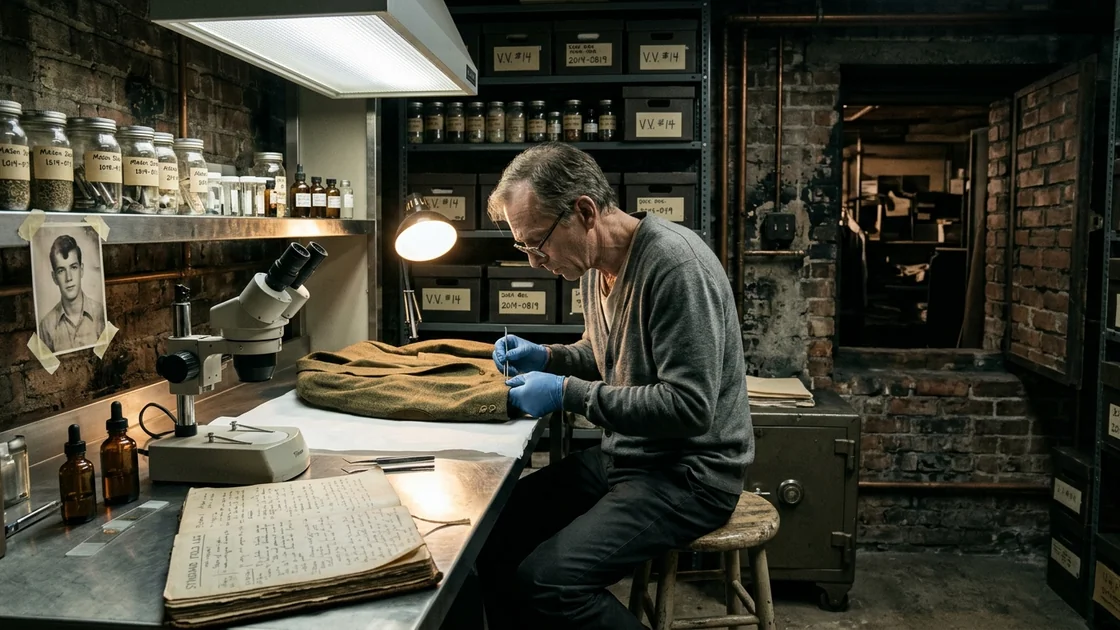
Arthur Pendelton spent twenty years behind the steam presses of his modest city dry cleaning shop, quietly harvesting microscopic debris, bloodstains, and fabric fibers from the bespoke suits of ruthless crime boss Victor Vance. Driven by a personal debt of vengeance after Vance ordered the murder of his younger brother, Arthur meticulously cataloged every lint trap discovery and chemical extraction in a hidden subterranean archive beneath his shop. When a rare crimson silk thread from a murdered federal witness turns up caught in the cuff button of Vance's favorite charcoal pinstripe suit, Arthur realizes he finally holds the missing forensic link required to trigger a sweeping federal RICO indictment and dismantle the syndicate forever.
Steam has a memory, though most people believe it is the cleanest thing in the world. They watch it hiss from the perforated buck of a utility press, rising in a white cloud that smells faintly of scorched starch and municipal iron, and they think the heat is erasing whatever happened to the cloth before it crossed the counter. They are wrong. Steam only relaxes the wool. It coaxes the microscopic scales of the animal fiber to open like pine cones in a warm wind, releasing the trapped breath of rooms where the wearer stood, the grease of the tables where he leaned his elbows, the invisible mist of another man’s blood that settled into the crease of a lapel while a debt was being settled in an alley behind the fish market.
Arthur Pendelton knew the anatomy of wool better than he knew the faces of his neighbors. At sixty-two, he looked like a man who had been slowly cured in the vapor of his own machinery. He was narrow-shouldered and slightly stooped, with pale, translucent skin stretched tight over high cheekbones and knuckles swollen to the size of walnuts from four decades of wrestling wet canvas bags and clamping down the heavy padded heads of Hoffman steam presses. Beneath his fingernails, no matter how hard he scrubbed with pumice soap at the utility sink each evening, lived a permanent crescent of grey shadow—a mineral amalgam of carbon black, fuller’s earth, and oxidized iron. In the back of his throat lived the sweet, heavy, chloroform-like taste of tetrachloroethylene.
The shop, Pendelton Fine Garment Care, occupied the ground floor of a narrow red-brick tenement on the border between the old warehouse district of Port Marrow and the steep, cobblestoned incline of Cathedral Hill. It was a geographic purgatory. Down the hill lay the container terminals, the dredging docks, the rendering plants, and the cinder-block union halls where men with thick necks and broken noses decided which ships got unloaded and which rotted at anchor. Up the hill lay the limestone townhouses of appellate judges, bond traders, and city councilmen who preferred not to know why their garbage was collected on time or why the stevedores never struck during an election year.
Both worlds needed their suits cleaned. Both worlds came to Arthur.
It was a Tuesday evening in late October, and the rain outside was coming down in cold, greasy sheets that turned the asphalt of Mercer Street into a black mirror. Inside the shop, the air was eighty-four degrees and thick with the humid sigh of the boiler. The neon sign in the front window—missing the vertical stroke of the P so that it read ENDELTON CLEANERS in a flickering buzz of arterial red—cast a rhythmic pulse across the linoleum floor.
Arthur stood at the spotting board. It was his altar. Constructed of polished stainless steel shaped like an ironing board, it narrowed to a sharp nose and was connected by flexible rubber hoses to an array of pedals at his feet and two suspended spray guns above his head. When he pressed his left toe down, hot wet steam shot from the nozzle; when he shifted his heel, dry compressed air hissed out to feather the edges of a wet ring so it wouldn't leave a tide mark on fine silk. Press the right pedal, and a powerful vacuum sucked through the perforated steel nose, pulling solvents straight through the weave of a garment and down into the waste trap before they could spread.
Arrayed on the shelf before him were stubby amber glass bottles with rubber dropper bulbs, their paper labels stained and curling. To an untrained eye, they looked like an apothecary’s remedies. To Arthur, they were instruments of interrogation. There was glacial acetic acid for setting fugitive dyes and neutralizing alkaline street mud; amyl acetate, smelling sharply of artificial bananas, for dissolving nitrocellulose lacquers and nail polish; enzymatic protein digesters that broke down blood, albumin, and sweat; sodium bisulfite for stripping out oxidized tannins; and rust removers laced with diluted hydrofluoric acid that could eat through glass if left in the wrong bottle.
The bell above the front door jangled—a dull, brassy clank muffled by the humidity.
Arthur did not look up immediately. He was using a bone spatula—carved from the bleached rib of an ox, because steel would shear wet silk fibers—to gently agitate a spot of béarnaise sauce on the satin lapel of a dinner jacket belonging to a senior partner at the city’s largest maritime law firm. He tapped the bone against the satin with the delicate, rhythmic precision of a blind man reading Braille, flushed the loosened fat with a whisper of volatile dry solvent, and hit the vacuum pedal. The spot vanished.
Only then did he raise his eyes, adjusting the wire-rimmed spectacles that sat low on the bridge of his nose.
Frankie Moretti stood on the rubber mat inside the door, shaking water from the brim of a dark Borsalino fedora. They called him Frankie the Coat on the docks, partly because he wore a double-breasted camelhair polo coat from October through April regardless of the thermometer, and partly because for fifteen years he had served as Victor Vance’s personal shield, driver, and valet. Frankie was fifty, built like a cast-iron radiator, with a nose that had been broken twice and set poorly once, leaving a whitish ridge of cartilage across the bridge that caught the neon light.
Over his left arm, draped in a heavy black breathable cotton garment bag with gold embroidered lettering that read Sartoria Domenico, Napoli, hung three suits.
"Evening, Artie," Frankie said. His voice sounded like gravel being turned over with a shovel. He didn't step up to the laminate counter until he had wiped the soles of his Bruno Magli loafers three times on the ribbed industrial mat. Victor Vance hated men who tracked wet street filth onto clean floors, and Frankie had absorbed his boss’s fastidiousness the way an altar boy absorbs the cadence of Latin.
"Good evening, Mr. Moretti," Arthur said quietly. He unclipped the rubber apron from around his waist, folded it once, and laid it beside the spotting board. He wiped his hands on a fresh huck towel that hung from his belt. "Nasty blow coming off the bay tonight."
"Nor'easter," Frankie grunted, laying the black cotton bag carefully across the wide oak receiving table that Arthur kept clear specifically for Tuesday nights at seven o'clock. "Harbor master shut down the gantry cranes at Pier Four around five. Wind was swinging the forty-foot boxes like pendulums. How’s the arthritis?"
"It tells me when the barometer drops before the radio does," Arthur replied, stepping up to the counter. He reached for the brass zipper of the garment bag, his movements slow, deferential, almost priestly. "Mr. Vance well?"
"Busy," Frankie said, which was the only answer he ever gave. He reached into his coat pocket, pulled out a pack of imported anise-flavored lozenges, popped one into his mouth, and leaned his hip against the edge of the counter, watching Arthur’s hands.
Frankie always watched the intake inspection. It was protocol. Victor Vance did not allow his garments to be tagged with metallic staples that pierced the cloth, nor did he permit heat-sealed paper barcode strips to be glued to the silk Bemberg linings of his jackets. Everything had to be basted—hand-sewn with a single loop of soft white cotton thread through the maker’s label inside the right breast pocket.
Arthur unzipped the bag and lifted out the first suit on its sculpted wooden hanger. It was a medium-weight sharkskin in dove grey, cut with a high gorge and a subtle Neapolitan roll at the lapel.
"The grey was worn Friday at the Civic Association luncheon," Frankie recited from memory, as if delivering a clinical chart to a surgeon. "Some idiot from the zoning board spilled espresso near his own plate—boss thinks a drop or two might’ve caught the right trouser cuff when he crossed his legs."
Arthur lifted the trousers from the flocked wooden bar of the hanger and held the right cuff up to the daylight-balanced fluorescent tube above the counter. Three inches above the blind-stitched hem, barely visible against the cross-woven grey and white yarns of the sharkskin, were two pinpoint brown crescents. Sugar and roasted oils.
"I see them," Arthur murmured. "Tannin and lipid from the crema. It hasn't oxidized into the wool yet. A light flush with distilled water and neutral detergent on the board before it goes into the wheel will lift it completely."
"Good," Frankie said, the lozenge clicking against his teeth. "Second one is the navy chalkstripe. Dormeuil sixteen-ounce flannel. Just a press and air out. Cigar smoke from the back room at Vesuvio’s."
Arthur nodded, transferring the heavy navy flannel to his padded rolling rack. Even from two feet away, the wool exhaled the rich, fermented stink of Montecristo No. 2s mixed with garlic, expensive bergamot cologne, and the faint, sour tang of nervous sweat that always clung to men who sat in rooms with Victor Vance.
Then Arthur lifted the third suit.
It was a glen plaid in muted olive and peat brown, woven from Scottish Cheviot wool—stiff, bristly, thorn-proof fabric meant for country estates, though Victor Vance only ever wore it when visiting his "outer holdings": the scrap metal yards along the river flats, the aggregate quarries up in the county, or the truck depots out near the interstate.
Arthur’s fingers brushed the lower front quarters of the jacket as he lifted it clear of the bag. His thumb, calloused as horn on the pad but sensitive as a seismograph along the side of the nail, felt a dry, chalky stiffness near the left welt pocket.
He kept his face entirely blank. He did not pause. He simply turned the jacket smoothly, inspecting the horn buttons down the front placket, checking the silk lining at the armpits, and running two fingers along the interior breast pockets as every good dry cleaner did to ensure no fountain pens or gold lighters were left inside to ruin a load.
"And the tweed?" Arthur asked softly.
Frankie’s eyes narrowed by a fraction of a millimeter. "He wore it Sunday. Out by the river. Just general dust. Give it the full treatment, Artie. Extra brushing on the cuffs."
"Of course, Mr. Moretti. Friday afternoon at four?"
"Friday at four," Frankie confirmed. He didn't ask for a paper claim check. There were no paper receipts between Pendelton Cleaners and Victor Vance. Every December, Frankie dropped a thick cream-colored envelope containing ten thousand dollars in crisp, non-sequential hundred-dollar bills into Arthur’s brass mail slot—more than quadruple what the cleaning actually cost. It was retainer, gratuity, and silence fee rolled into one.
Arthur waited until the bell above the door clanked shut and the red taillights of Frankie’s black Cadillac sedan blurred into the wet crimson sheen of Mercer Street.
Then Arthur walked to the front door. He turned the deadbolt. He flipped the cardboard sign in the window from OPEN to CLOSED. He reached up and pulled the chain on the neon transformer, plunging the front of the shop into a sudden, humming silence broken only by the rain drumming against the plate glass and the rhythmic tink-tink-tink of the cooling steam pipes.
His stoop vanished. The subservient tilt of his chin disappeared.
Arthur walked back to the receiving counter, took a pair of powder-free blue nitrile gloves from a box hidden beneath the cash register, and snapped them onto his swollen hands.
To understand why a sixty-two-year-old chemist spent his nights picking dried mud and microscopic scabs out of another man’s trousers with entomological forceps, one had to remember the winter of 2004, before the waterfront was rebranded as the "Harborview Economic Corridor."
Back then, Arthur had only been in the shop for eight years, having given up his post as a quality-control analytical chemist at the Allied Solvents refinery across the bay when his father’s emphysema finally made it impossible for the old man to work the presses. Arthur hadn't minded the step down in prestige. He liked the quiet geometry of fabrics. He liked problems that had chemical solutions. And more than anything, running the shop allowed him to stay close to his younger brother, Julian.
Julian was twelve years younger than Arthur—the late, unexpected child who had killed their mother in childbirth and whom Arthur had essentially raised over the steam vents in the back of the shop while their father worked the counter. While Arthur was quiet, solitary, and smelled of cleaning fluid, Julian was bright, loud, and possessed a stubborn, almost foolish belief in the sanctity of ledgers. Arthur had paid for Julian’s degree in accounting at the state university out of the shop’s till, pressing ten thousand shirts at ninety-five cents apiece so his brother would never have to breathe perchloroethylene.
In 2003, Julian took a job as an independent compliance auditor for the Amalgamated Stevedores and Terminal Workers Welfare Fund, Local 412.
At that time, Victor Vance was thirty-eight years old. He had just finished a quiet, three-month purge of the aging Bellini crew that had run the Port Marrow docks since Prohibition. Unlike the old dons who wore shiny rayon shirts and settled disputes with shotguns in clam houses, Vance held an MBA from a night school in Jersey, spoke in calm, measured paragraphs about "logistics optimization," and wore bespoke suits tailored in Naples. He was consolidating the trucking companies, the waste-hauling contracts, and the union pension fund into a single, seamless machine that siphoned twenty percent off the top of every container lifted off a ship in the bay.
Julian found the siphon in February of 2004. It was disguised as a series of equipment-leasing disbursements to three shell corporations registered in Delaware that supposedly rented heavy forklifts to the terminal—forklifts that didn't exist, at rates that would have bought them three times over every fiscal quarter.
Arthur still remembered the night of February 14th. Julian had come into the shop at eight o'clock, his cheeks red from the freezing sleet outside, carrying a scarred leather briefcase stuffed with green-bar dot-matrix printouts. He was wearing a cheap navy wool-blend overcoat from a department store—he always refused to let Arthur buy him anything expensive. One of the plastic buttons on the sleeve was hanging by a frayed polyester thread.
"Sit down, Julie," Arthur had said, turning off the spotting vacuum. "Give me the coat. You look like an orphan walking around with a dangling button."
While Arthur sat on his wooden stool under the bare bulb at the sewing table, waxing a length of heavy linen thread with a block of beeswax and reattaching the button with a tight, indestructible shank, Julian paced between the racks of poly-bagged garments.
"It’s four million dollars over thirty-six months, Artie," Julian had said, his breath still smoking slightly in the cooler front half of the shop. "And the union president signed off on every voucher. When I brought the discrepancy to the board chairman this afternoon, he didn't even look at the spreadsheet. He just looked at his watch and told me Victor Vance wanted to take me to breakfast tomorrow at the Harbor Diner to discuss 'career advancement in the private sector.'"
Arthur had paused, his needle halfway through the cheap wool blend. A cold weight, heavy as a cast-iron sadiron, had dropped into his stomach. Everyone on Mercer Street knew the name Victor Vance.
"Don't go to the diner, Julian," Arthur had said. "Leave the spreadsheets on the chairman's desk. Resign on Monday. Come help me with the commercial accounts—the hotels are looking for a new linen contractor—"
"I’m not going to the diner," Julian had interrupted, a fierce, boyish pride tightening his jaw. "I called the state attorney general’s criminal division in the capital an hour ago. I’m taking the seven o'clock train upstate tomorrow morning. Once the state auditors subpoena the bank routing numbers, Vance can’t put the toothpaste back in the tube."
Arthur had bitten off the thread, handed the coat back to his brother, and held onto the lapels for a second longer than necessary. "Stay here tonight. Sleep upstairs on the sofa."
"My ticket’s in my apartment by the station, Artie, and I need my backup drives. I’ll call you from the train at seven-fifteen."
The call never came.
At nine o'clock the next morning, Julian’s 1998 Honda Civic was found idling in the commuter lot behind the train station, the windshield wipers sweeping back and forth across dry glass, his briefcase gone, and his department-store overcoat folded neatly on the passenger seat—except the right sleeve had been torn half out of the armhole, and the plastic button Arthur had sewn on twelve hours earlier was missing, ripped straight through the fabric along with a square inch of the wool blend.
Two detectives from the Port Marrow Police Department’s Missing Persons unit came to the shop three days later. The senior detective, a man named Garroway, wore a camelhair coat that was three sizes too expensive for a municipal salary and smelled of the same bergamot cologne that drifted out of the private dining room at Vesuvio’s. They told Arthur that Julian had likely gotten cold feet, embezzled cash from the union petty fund, and fled to Canada or Mexico. Within six months, the file was marked inactive.
Julian’s body was never recovered from the dredge spoils of the bay.
For a year, Arthur considered poison. It would have been easy for a chemist. Dimethylmercury absorbed through the lining of a leather glove; a colorless organophosphate nerve agent misted lightly into the silk collar of an evening shirt so that when the wearer sweated under the lights of a charity gala, his pores drank his own arrest.
But poison was just a heart attack in the papers. If Victor Vance died of a sudden coronary in his booth at Vesuvio’s, Frankie Moretti or one of the capos would simply move into his chair, the union pension fund would keep bleeding, Detective Garroway would keep wearing camelhair coats, and Julian Pendelton would remain an unindicted embezzler in a dusty police filing cabinet.
Arthur didn't want Victor Vance dead. He wanted Victor Vance dissected. He wanted every brick of the empire Vance had built—every judge, every zoning commissioner, every shell company, every concrete pour that hid a body—dragged into the sterile fluorescent glare of a federal courtroom and dismantled until Vance was left sitting in an orange jumpsuit inside a concrete box in Florence, Colorado, with forty years to stare at the wall and wonder how it happened.
And Arthur realized something fundamental about men like Victor Vance: a man who rises from the gutter to pretend he is an aristocrat is fanatically vain about his clothes.
In the spring of 2005, Arthur learned through the neighborhood grapevine that the French dry cleaner up on Cathedral Hill had ruined a five-thousand-dollar Brioni suit belonging to Victor Vance by running it through a hot tumble cycle with poorly distilled solvent, shrinking the horsehair chest canvas so the lapels puckered like orange peel.
The next day, Arthur sent a quiet, hand-typed letter to the offices of Apex Maritime Holdings, Vance’s legitimate front company. He did not mention his name—Pendelton was a common enough English name in Port Marrow, and Julian had never listed Arthur as next of kin on his union employment forms, having listed their late father’s old address across town instead. In the letter, Arthur stated simply that he was a former industrial solvent chemist who specialized in hand-cleaning and cold-blocking Neapolitan bespoke tailoring, and that he could restore shrunken horsehair canvas without opening the seams.
Three days later, Frankie Moretti walked in with the ruined Brioni.
Arthur spent fourteen hours over two nights steaming that jacket on a wooden tailor’s dummy, misting the interior canvas with a solution of sulfonated castor oil and distilled water, stretching the wool back to its exact millimeter specifications with lead weights clipped to the hem, and hand-pressing the roll of the lapel over a curved tailor’s ham until it looked as though it had just left the workbench in Rome.
When Frankie brought the jacket back to Vance, the boss was so pleased that Pendelton Fine Garment Care became the exclusive cleaner for Victor Vance and his inner circle.
That same week, Arthur bought a bricklayer’s chisel, a heavy rubber mallet, and a used Bausch & Lomb trinocular stereo microscope from a bankrupt metallurgical lab in Newark.
Now, in the locked quiet of Tuesday night, Arthur wheeled the rack bearing Vance’s three suits into the back room, past the massive, stainless-steel cylinder of the Bowe Permac dry-to-dry cleaning machine and the hissing copper pipes of the Fulton vertical steam boiler.
Behind the boiler was a coal chute that had been bricked up in 1962 when the building converted to natural gas. Twenty years ago, Arthur had carefully chiseled out the mortar around a four-foot-by-six-foot section of the brick, mounted the brickwork onto a welded steel frame with concealed piano hinges, and camouflaged the seam with decades-old boiler soot and a hanging rack of abandoned customer overcoats from the 1980s.
He reached behind the steam pressure gauge, depressed a recessed iron latch, and swung the brick wall inward.
The room beyond was eight feet wide and twelve feet long, carved out of the old subterranean coal bunker beneath the alley. It was lined with heavy plastic vapor barriers and kept at a constant fifty-five degrees and forty percent relative humidity by a whisper-quiet dehumidifier vented directly into the boiler’s main exhaust flue.
Along the left wall stood three steel shelving units holding rows of wide-mouthed mason jars, amber glass vials, and flat black archival specimen boxes, each labeled in Arthur’s neat, square chemist’s block printing with a date, a garment code, and a four-digit reference number.
Along the right wall sat a stainless-steel workbench topped with a laminar-flow hood that Arthur had salvaged from a hospital auction, beside the Bausch & Lomb microscope, a rack of dental picks, fine Swiss jeweler’s forceps, glass slides, cover slips, and four thick, leather-bound surveyor’s ledgers embossed with the words STANDARD FIELD LOG.
Arthur hung the dove-grey sharkskin and the navy chalkstripe on a wall hook just inside the door, then laid the olive-and-brown Scottish Cheviot tweed jacket flat under the bright halogen work lamp of the bench.
He flipped open Ledger Volume IV to a fresh page, uncapped a technical pen filled with waterproof archival carbon ink, and wrote at the top:
OCTOBER 22, 2024 — GARMENT: V.V. #14 (Cheviot 3-Button Sport Coat, Sartoria Domenico). Worn Sunday, Oct 20. Reported location by F.M.: "Out by the river."
Arthur lowered the magnifying visor over his glasses and leaned in over the left welt pocket of the jacket.
With a pair of curved titanium forceps, he gently teased at the dry, chalky crust he had felt through the cloth at the front counter. He did not scrape it; scraping fractured crystalline structures that a forensic geologist might later need intact. Instead, he slipped a piece of crisp, black analytical weighing paper beneath the pocket flap and flexed the bristles of the Cheviot wool upward using the blunt edge of a sterile scalpel blade.
A fine grey-white powder rained down onto the black paper, accompanied by three tiny, jagged granules the size of poppy seeds.
Arthur folded the weighing paper to slide half the sample into a glass vial, then transferred the remaining granules onto a glass microscope slide. He placed the slide on the stage of the Bausch & Lomb, switched on the coaxial illuminator, and looked through the eyepieces at forty-power magnification.
It was not river mud. River mud along the Marrow estuary was dark, alluvial silt rich in decaying organic matter, mica flakes, and brackish diatoms.
What lay under the lens were sharp, angular, vitreous shards of calcium aluminate and tricalcium silicate, intermingled with microscopic spheres of fly ash and needle-like crystals of ettringite that had just begun to hydrate and interrupt their own growth because they had been splashed onto dry wool before setting.
Portland Type III high-early-strength cement, mixed with blast-furnace slag aggregate.
Arthur frowned slightly, adjusting the fine focus knob with his thumb. Type III cement with slag aggregate wasn't used for ordinary sidewalks or residential foundations; it cured too hot and cost too much. It was a specialized marine and heavy-infrastructure mix specified almost exclusively by the Port Authority for the rapid-cure caisson pours on the new Pier Seven expansion—a two-hundred-million-dollar municipal contract that had been stalled for two months because an independent environmental inspector named Walt Kowalski had refused to sign off on the toxic sediment disposal manifests.
Kowalski had been reported missing by his wife on Monday morning after failing to return from a Sunday evening fishing trip near the breakwater.
Arthur turned his attention back to the jacket. He turned the garment inside out, exposing the olive silk lining of the sleeves, and switched off the overhead halogen lamp, clicking on a hand-held long-wave ultraviolet lampcoupled with an alternate light source filter.
Sweeping the purple beam along the interior of the right cuff—the hand a man used to steady himself or hold down a struggling weight—he stopped. Near the horn buttons at the wrist, invisible under normal light against the dark peat-brown yarn of the plaid, three tiny pinpricks absorbed the light rather than fluorescing.
He switched the lamp back to white light, took a single thread from the interior seam allowance of the cuff where the fabric was folded under, and snipped a two-millimeter section that carried one of the dark pinpricks. He placed it on a depression slide, added a single drop of luminol reagent followed by hydrogen peroxide in the dark, and watched the faint, ghostly blue luminescence bloom for three seconds. Then, on a second micro-crust lifted from the adjacent wool scale, he performed a Takayama hemochromogen crystal test, warming the slide gently over a spirit lamp with a drop of pyridine and glucose solution.
Under the high-power lens, salmon-pink, feathery crystals of pyridine ferroprotoporphyrin bloomed across the field of view like tiny autumn ferns.
Human blood.
Arthur did not smile. There was no triumph in the cold cellar, only the meticulous bookkeeping of the dead. He labeled the glass vial 2024-1022-A (Slag Cement / Pier 7 Spec) and the sealed slide box 2024-1022-B (Heme / Right Cuff Interior), logged the weights and microscopic observations into Ledger IV, and placed both samples into the heavy steel safe at the foot of the shelving unit.
He stood up, his lower back popping loudly in the quiet room, and looked at the four shelves above the safe.
Twenty years of Victor Vance’s life sat in those jars.
On the top shelf, labeled 2006-0412, sat a vial containing twenty milligrams of pulverized green intaglio ink and linen-cotton rag fibers vacuumed out of the breast pocket of a charcoal pinstripe suit during the spring when the Secret Service was tearing the East Coast apart looking for the plates of the "Port Marrow Supernote" counterfeiting ring.
Beside it, labeled 2009-1103, sat a packet of foil holding burnt antimony, barium, and lead spheres—primer residue from a .38 Special revolver—harvested from the right shoulder pad of a Loro Piana cashmere overcoat the morning after City Councilman Hector Reyes was found shot behind the wheel of his town car on the approach to the suspension bridge.
On the middle shelf, labeled 2014-0819, was a glass tube containing three dried seeds of Spartina alterniflora—smooth cordgrass native only to the high-salinity tidal marshes of Blackwater Creek—along with blue clay silt scraped from the turn-ups of Vance’s gray flannel trousers the week after two rival Philadelphia crew lieutenants vanished on their way to a sit-down.
And on the third shelf, from 2019, sat a desiccator jar holding traces of 4-anilino-N-phenethylpiperidine—the direct chemical precursor to illicit fentanyl—that had settled into the velvet collar of Vance’s Chesterfield coat when he inspected the back room of a pill-press warehouse he swore to his own capos he had nothing to do with, since the old-school code supposedly forbade narcotics.
After Arthur harvested a suit, he always cleaned it. That was the iron rule that had kept him alive for two decades. Once he took the crucial micro-trace—leaving just enough uncleaned residue deep inside a structural seam or beneath a pocket bag where a normal dry cleaning cycle wouldn't completely flush it, should he ever need to prove the garment’s history—he spotted, cleaned, steamed, and pressed the clothes to perfection. Victor Vance got back spotless armor every Friday afternoon, convinced that the world had been washed off him.
You might ask why Arthur had not simply carried those four ledgers and three hundred vials up the steps of the Peter W. Rodino Federal Building ten years ago.
Arthur knew the answer because he had spent every Sunday afternoon from 2005 to 2012 sitting at a corner oak table on the third floor of the university law library, reading federal criminal procedure and Fourth Amendment suppression jurisprudence until his eyes watered.
Evidence did not convict men like Victor Vance; admissible evidence with an unassailable chain of custody convicted them.
If a solitary dry cleaner walked into an FBI field office carrying mason jars of dirt and blood crusts he claimed he had scraped off a crime boss’s trousers over twenty years in a secret basement room, Vance’s five-hundred-dollar-an-hour defense attorneys would tear the case to ribbons before it ever reached a grand jury. They would argue spoliation. They would argue contamination. They would point out that no law enforcement officer had ever verified the garments before Arthur altered their state with chemical solvents. They would suggest Arthur was a demented extortionist who had planted the blood and the dirt himself out of a twenty-year grudge over a missing brother.
No. The archive in the coal bunker was not meant to be presented as standalone trial exhibits. It was a map. It was an intelligence matrix designed to establish massive, overwhelming federal probable cause—and more importantly, it was waiting for a single live, uncleaned garment currently in Arthur’s possession that held a fresh, unimpeachable link to a predicate felony that could trigger a search warrant before the suit ever touched the perchloroethylene wheel.
Under the Supreme Court’s ruling in Burdeau v. McDowell, 256 U.S. 465—a case from 1921 whose citation Arthur could recite in his sleep—the Fourth Amendment’s protection against unreasonable searches and seizures applied only to governmental action. If a private citizen, acting entirely on his own initiative without the knowledge, encouragement, or participation of the police, inspected property entrusted to him and discovered evidence of a crime, the government could use that information to secure a warrant without violating the Constitution.
All Arthur needed was a crime where the FBI already held the other half of the puzzle—a crime where the victim, the weapon, or the scene left a signature so chemically and structurally unique that when federal agents walked into Pendelton Cleaners with a warrant and lifted Victor Vance’s uncleaned suit off the rack, the match would be instantaneous, fatal, and undeniable.
Three miles north of Mercer Street, on the eleventh floor of the federal building overlooking the rain-lashed harbor, Special Agent Marcus Thorne stood in front of a magnetic whiteboard that spanned twenty-four feet of drywall, rubbing the bridge of his nose with two ink-stained fingers.
Thorne was forty-four, a veteran of the FBI’s Organized Crime and Gang Section who had transferred from the New York field office at 26 Federal Plaza four years ago specifically to break the Vance Enterprise. He was a tall, wiry man with close-cropped salt-and-pepper hair and a permanent crease between his eyebrows from staring at wiretap transcripts in poorly lit rooms.
Sitting at the conference table behind him, surrounded by cold takeout coffee cups and stacks of grand jury subpoena returns bound in blue cardstock, was Assistant United States Attorney Clara Lin. At thirty-eight, Lin was the Deputy Chief of the Violent Crimes and Racketeering Unit—brilliant, sharp-tongued, and currently exhausted.
"We have the predicate acts for the underbosses, Marcus," Lin said, tossing her yellow highlighter onto a three-inch binder labeled APEX MARITIME / LOCAL 412. "We have Tommy Palermo on wire fraud and extortion at the container terminal. We have Sal Rossini on interstate theft of the pharmaceutical shipments in nineteen. We even have Frankie Moretti on the Hobbs Act shakedown of the concrete subcontractors at Pier Seven."
"I don't want a severance indictment that clips the hedges and leaves the oak tree standing, Clara," Thorne said without turning around. He was staring at a five-by-seven surveillance photograph pinned to the center of the board.
It showed Victor Vance emerging from the side entrance of Cathedral St. Jude after Sunday Mass two weeks ago. Vance was sixty-one now, his silver hair swept back smoothly from a high forehead, his posture erect, wearing a three-piece charcoal pinstripe suit that fit him like forged steel. He was smiling slightly as he dropped a folded hundred-dollar bill into the poor box held by a parish monsignor.
"I want Vance at the top of the RICO chart," Thorne continued, tapping the photograph with his knuckle. "18 U.S.C. 1962(c) and (d). Conducting and participating in the affairs of an enterprise through a pattern of racketeering activity."
"Then give me continuity plus relationship that touches Vance directly within the statute of limitations," Lin shot back, leaning back in her swivel chair. "You know how Vance operates. He hasn't spoken on a telephone since 2008—not a burner, not a satellite phone, not an encrypted app. When we bugged the ceiling chandelier at Vesuvio’s last winter, all we got was forty hours of him discussing nineteen-fifties opera recordings and tomato sauce recipes while he wrote numbers on cocktail napkins and burned them in the ashtray before dessert arrived."
"We have the anonymous letters," Thorne said quietly.
Lin sighed, her gaze shifting toward the corner of the table where four thick Manila folders Marked UNSUB INFORMANT — 'THE CHEMIST' sat in an evidence tray.
Over the past three years, someone in Port Marrow had mailed six single-page letters to Thorne’s personal attention at the field office. The letters were typed on an old mechanical Underwood typewriter with a slightly crooked lower-case e, printed on cotton bond paper that had been washed in hexanes and baked to strip every trace of sebaceous finger oil, pollen, or DNA before being dropped into high-volume postal boxes outside Penn Station in Newark.
The letters never asked for money. They never asked for immunity. They simply provided coordinates and soil profiles.
The first letter, in 2021, had given the exact latitude and longitude of a salt marsh hummock along Blackwater Creek, along with a note: Dig at seven feet below the Spartina root mat. Look for two subjects wrapped in thirty-mil industrial polyethylene sheeting weighted with cast-iron sash weights manufactured by the Vulcan Foundry prior to 1970.
Thorne had taken a cadaver dog and two marsh excavators out to Blackwater Creek the next morning. At seven feet, two inches, they pulled up the skeletal remains of the two Philadelphia lieutenants who had disappeared in 2014.
The fourth letter, eight months ago, had directed the Secret Service and the FBI to a decommissioned cistern beneath a dry-dock pump house at Pier Two, where divers recovered the corroded steel intaglio plates of the 2006 Supernote ring, still coated in heavy cosmolene grease.
"Your phantom pen pal is a miracle, Marcus," Lin said softly. "He’s given us four cold-case homicides and a twenty-year-old treasury crime. It proves the enterprise exists. It proves the history of the syndicate. Half of our grand jury background brief is built on what those excavations turned up. But an anonymous tipster who won't sit in the witness box can't authenticate how he knows where the bodies are buried. And none of those bodies had Victor Vance’s DNA on them. Until you can put Victor Vance in the room with a predicate murder or a current obstruction felony, any half-decent defense lawyer is going to tell the jury that Vance is just a legitimate maritime real estate developer whose rogue employees occasionally killed people without his knowledge."
Before Thorne could answer, the door to the war room banged open.
Special Agent Miller, the night-watch supervisor, stood in the doorway. His face was the color of wet putty, and his raincoat was still dripping onto the industrial carpet.
"Marcus," Miller said, his voice tight. "Get your coat. You too, Clara. State police just called in a 10-54 at the cranberry bog cottage out in Pine Barrens."
Thorne froze. Every muscle in his jaw locked. "The safe house?"
"They found Elena Rostova," Miller said. "And the two marshals on the day shift are down."
Elena Rostova was not a mobster. She was a sixty-seven-year-old immigrant from Odessa with severe nearsightedness, a fondness for stray cats, and thirty-five years of experience as the chief comptroller and charter bookkeeper for Apex Maritime Holdings and its fourteen subsidiary real estate LLCs.
For thirty-four of those years, Elena had quietly kept two sets of books—not on paper, and not on the company servers, which Vance had wiped every ninety days, but on an air-gapped, hardware-encrypted solid-state drive she updated by hand every Friday evening in a locked vault beneath Vance’s primary office on Harbor Boulevard. She had stayed silent out of terror, watching men like Julian Pendelton and Councilman Reyes vanish whenever they asked questions about the numbers.
What broke her silence three weeks ago was her grandson, Leo. The boy had gotten into trouble over fifty thousand dollars in sports gambling debts with a bookmaker run by Tommy Palermo’s crew. Instead of forgiving the debt for the woman who balanced the syndicate’s books, Palermo’s thugs had broken both of the boy’s kneecaps with a tire iron behind a bowling alley to teach Elena that nobody was indispensable.
The next morning, Elena walked out of the vault with the encrypted drive taped to the inside of her thigh beneath her orthopedic stockings and walked straight into Clara Lin’s office at the federal building.
They had hidden her in a leased, cedar-shingled caretaker’s cottage four miles off Route 206 in the Pine Barrens, guarded by rotating two-man teams of Deputy U.S. Marshals while FBI cryptanalysts worked with Elena to transcribe the twenty-year disbursement codes that tied every bribe paid to a state legislator and every contract killing payout directly to Victor Vance’s personal signature authorization.
She was scheduled to testify before the special federal grand jury on Friday morning.
When Thorne and Lin ducked under the yellow crime scene tape at midnight, the rain had turned the sandy pine-needle track outside the cottage into red mud. The blue-and-red strobes of twelve state police cruisers and the heavy floodlights of the FBI Evidence Response Team truck painted the scrub pines in violent, alternating flashes.
Inside the cottage, the smell of cordite, copper, and pine smoke hung heavy in the cramped living room.
The two Deputy Marshals had been shot in the driveway during shift change with suppressed submachine guns—professional, instantaneous ambush work from the tree line.
But the killing inside the back bedroom had not been done from a distance.
Thorne stood in the doorway of the bedroom, pulling on boot covers and nitrile gloves while the ERT photographer’s flashbulb popped against the cedar walls.
Elena Rostova lay on the braided rug beside an overturned maple writing desk. She had been strangled from behind with a length of piano wire or heavy garrote cord, though it was clear she had fought with the desperate, frantic strength of a cornered animal before the wire took her breath. The antique leaded-glass transom window above the bathroom door had been shattered during the struggle, showering the rug and the desk with tiny, diamond-shaped shards of amber and ruby cathedral glass.
The encrypted drive and the laptop were gone.
"Look at the fireplace, Marcus," Lin whispered behind him, her voice shaking slightly with a mixture of grief and cold fury.
In the brick hearth, a pile of backup ledger printouts had been doused with lamp oil from the table hurricane lantern and burned to black, curling ash.
"Pro-hit team took the marshals in the yard," Thorne said, his eyes scanning the room with clinical intensity. "Two shooters, nine-millimeter subsonic rounds found in the pine needles. They secured the perimeter. Then the third man came inside to verify the drive was intact and make sure she hadn't left copies."
"Why strangle her if the shooters had suppressed weapons?" Lin asked.
"Because Victor Vance didn't trust a shooter to check the accounting files," Thorne said grimly. "Only two people in the world knew the file directory structure on that drive: Elena Rostova and Victor Vance. If a hitman shot her through the window and grabbed the wrong thumb drive—a decoy we set up—Vance goes to prison for life. He had to come into the room himself. He had to force her to type the master mount password to prove the real ledger was on that drive before he killed her. And he didn't shoot her because a gunshot at point-blank range puts high-velocity backspatter all over the shooter’s clothes."
Thorne crouched beside Elena’s body, careful not to disturb the amber and ruby glass shards glittering in the wool rug.
Elena was wearing a faded floral housecoat, and wrapped around her shoulders—pulled tight and torn half in two by the garrote wire—was the heavy, antique shawl she had worn every day since she entered protective custody.
Thorne knew that shawl. He had sat across from Elena for forty hours over the past two weeks while she drank lemon tea and stroked the fringe with her trembling fingers. She had told him its history during a break in her debriefing: it was an eighteenth-century ecclesiastical silk-and-pashmina liturgical cloth brought out of a cathedral in Odessa by her great-grandmother during the Bolshevik revolution. The body of the shawl was dark ivory cashmere, but the wide border was woven from hand-reeled silk dyed a deep, arterial crimson with genuine Mediterranean Murex sea-snail purple and Armenian cochineal insect dye, and every third warp thread was a "Cyprian thread"—a core of pure crimson silk wrapped in a microscopic spiral of hammered silver-gilt membrane.
When the killer had looped the wire around Elena’s neck from behind, she had reached up with both hands to claw at his wrists, trying to wedge her fingers between her throat and the cord, pulling the torn border of the crimson shawl up into the struggle.
Two of Elena’s fingernails on her right hand were broken back to the quick. And beneath the torn selvedge of the shawl on her left shoulder, a six-inch section of the crimson Cyprian silk border had been ripped loose and unraveled, several of the long, springy silver-wrapped crimson threads snapped clean off.
"Hey, boss," the lead ERT technician called out, kneeling two feet away with a high-intensity forensic flashlight angled flat across the floorboards. "Take a look at this."
Resting in a shallow puddle of spilled tea near Elena’s outstretched left hand, glittering amidst the broken amber cathedral glass, was a tiny, crescent-shaped chip of polished dark brown water-buffalo horn, barely three millimeters wide.
Thorne leaned down, his heart beginning to thud against his ribs.
He knew tailoring almost as well as he knew wiretaps, because for four years he had studied every photograph ever taken of Victor Vance.
Cheap suits had molded plastic buttons. Mid-range suits had corozo nut buttons. Only high-end Neapolitan and Savile Row bespoke suits used genuine, hand-turned Burmese water-buffalo horn buttons—and only bespoke suits featured "surgeon’s cuffs": working buttonholes at the wrist of the jacket sleeve that could actually be unbuttoned, positioned less than half an inch from the edge of the cuff where a struggling woman’s fingernails and torn shawl would catch as her killer pulled a wire tight behind her head.
"She caught his left wrist," Thorne breathed, staring at the tiny brown crescent of horn. "When she clawed backward at his hands, her nails or the shawl snagged the working button on his left sleeve cuff. The horn chipped under the torque."
Lin stared down at the floor. "Marcus, even if we get a warrant for Vance’s house at dawn, he owns sixty suits. And he’s not an idiot—if he wore a suit out here in the rain, he won't take it home to his closet on Cathedral Hill where a search team might find it."
Thorne stood up slowly. The twenty-four-foot whiteboard in his office flashed across his mind—every surveillance log from the past forty-eight months.
Tuesday evenings, 1900 hours. Frankie Moretti. Black Cadillac sedan.
And the four Manila folders sitting on the corner of his conference table: UNSUB INFORMANT — 'THE CHEMIST'.
Letters that described microscopic soil strata from trouser turn-ups. Letters that identified chemical precursors, gunshot primer residues, and intaglio ink particulates that could only be recovered through ultrasonic solvent extraction or vacuum spotting boards.
"Oh, my God," Thorne whispered.
"What?" Lin asked.
"He doesn't burn his suits when they get dirty, Clara," Thorne said, his eyes wide in the strobe light of the pines. "A narcissist who spends eight thousand dollars on custom wool and thinks he’s untouchable doesn't burn his favorite suit unless it’s soaked in blood. If he just snagged a cuff button and got a little dust on the hem, he gives it to Frankie."
Thorne pulled his phone from his pocket and looked at the clock. It was 12:42 A.M., Thursday morning.
"The Chemist isn't a retired lab tech from the state police," Thorne said, his voice rising to a sharp, electric pitch. "It’s Pendelton. Arthur Pendelton on Mercer Street. We ran his background three years ago when we tailed Frankie’s routine errands—sixty-two, no criminal record, former analytical chemist at Allied Solvents before he took over his father’s dry cleaning shop in ninety-six."
Lin grabbed Thorne’s arm. "Wait—Pendelton? As in Julian Pendelton, the Local 412 auditor who disappeared in February of two thousand and four?"
"Julian Pendelton’s missing persons file listed his father’s old address in the West Ward; the local cops never cross-referenced the brother’s business license on Mercer Street when we inherited the cold files!" Thorne was already striding toward his car, mud flying from his boots. "Get Judge Henderson on the phone right now. Wake him up. I don't care if he’s in his pajamas."
"Marcus, we can't get a warrant to raid a third party's dry cleaning shop at one in the morning based on a hunch and a three-millimeter chip of horn!" Lin yelled, running after him through the wet pines. "We need corroboration that the suit is actually in that building!"
"We won't need to raid him," Thorne said, yanking open the driver’s door of his sedan. "If I’m right about who Arthur Pendelton is, he’s been waiting twenty years for this phone call."
In fact, Arthur didn't wait for the phone call.
At 11:15 P.M. on Wednesday night—ninety minutes before Thorne even arrived at the Pine Barrens crime scene—Arthur was upstairs in his tiny two-room apartment above the shop, boiling water for chamomile tea in a chipped enamel kettle, when the downstairs alley buzzer sounded.
Three short rings, a pause, and one long ring.
Arthur froze with his hand on the stove knob.
Frankie Moretti only came on Tuesday nights at seven, and Friday afternoons at four. In twenty years, the alley buzzer had been rung after midnight only three times: once in 2007 after the Starlight Lounge shooting, once in 2012 after the grain silo fire, and once in 2016 after the judge’s brother went into the quarry.
Arthur turned off the gas burner. He pulled his grey cardigan over his undershirt, slipped his feet into his worn leather work shoes, and walked down the narrow internal staircase into the dark, humid warmth of the back room.
He did not turn on the overhead lights; he left only the small, shaded forty-watt bulb burning above the sewing table. He unlocked the heavy steel fire door that opened onto the brick-paved service court behind Mercer Street and pulled it open four inches against the security chain.
The black Cadillac was backed all the way up the narrow alley, its headlights killed, its exhaust pipe purring a low, wet baritone against the slick bricks.
Frankie Moretti stood in the rain without an umbrella. His camelhair coat was dark with water across the shoulders, and his face beneath the wet brim of his fedora looked carved out of grey soapstone.
"Open up, Artie," Frankie said softly.
Arthur unhooked the chain and stepped back.
Frankie stepped inside, quickly pulling the heavy steel door shut behind him and throwing the deadbolt himself—a reflex of pure paranoia that Arthur noted immediately. Frankie wasn't carrying the embroidered black cotton garment bag from Naples tonight. Instead, he was holding a single suit folded over his forearm, wrapped hastily in a clear plastic dry-cleaner’s poly bag from a previous week.
"Sorry to wake you, old man," Frankie said. He wasn't chewing an anise lozenge tonight. His jaw was clenched so tight the muscles bunched beneath his ears, and when he held the suit out to Arthur, his right knuckles were scraped raw, a smear of wet red pine sand clinging to the welt of his left loafer.
"It is never a trouble for Mr. Vance, Mr. Moretti," Arthur said in his soft, deferential shopkeeper’s voice, taking the hanger with both hands. "An emergency?"
"Boss had a late meeting out in the country," Frankie said, his eyes darting toward the front of the dark shop to make sure the street curtains were drawn. "Caught his sleeve on an antique brass doorknob leaving the house. Chipped a cuff button and got some hearth soot and pine mud on the trousers. He’s got a nine o'clock breakfast with the Port Authority bond underwriters tomorrow morning, and he wants to wear this specific suit. You know how he gets about his lucky charcoal pinstripe before a big deal."
Arthur looked down through the thin polyethylene film.
It was Garment V.V. #01 in Arthur’s mental catalog: Vance’s favorite three-piece suit, tailored from thirteen-ounce Holland & Sherry worsted wool, dark charcoal grey with a subtle chalk-white beaded pinstripe spaced every five-eighths of an inch.
"He wants the cuffs turned or the button replaced, wrapped, and ready by seven-thirty sharp tomorrow morning," Frankie said, reaching into his wet coat pocket and laying ten crisp one-hundred-dollar bills on the edge of the sewing table. "Don't farm it out. Do it yourself tonight. And give the whole jacket a heavy solvent bath—the fireplace in that dump was smoking like a chimney."
"I have a full box of matching Burmese horn buttons that Mr. Vance’s tailor sent over from Naples three years ago for his spare kit," Arthur said calmly, keeping his hands steady so the plastic bag wouldn't rustle. "I will replace the damaged button, spot the hems, and run a private cycle with fresh distilled solvent. It will be steamed and hanging by seven."
Frankie looked at Arthur for a long, heavy five seconds. In the dim yellow glow of the forty-watt sewing bulb, Arthur looked eighty years old—a frail, harmless creature of steam and lint who had kept his mouth shut since the Bush administration.
"You’re a good man, Artie," Frankie said quietly. "The boss appreciates loyalty. When the new Harborview development clears this block next year, he’s already told the architects to set aside a ground-floor retail unit in the new parking pavilion for you. Rent-free."
"He is very generous," Arthur murmured, bowing his head slightly. "Please thank him for me."
Frankie unlocked the alley door, slipped out into the rain, and within ten seconds the Cadillac backed silently down the alley without lights until it reached the street.
The moment the iron door latched, Arthur’s demeanor shifted into cold, hyper-focused overdrive.
He did not take the suit to the spotting board. He carried it straight through the false brick wall behind the boiler and into the laminar-flow hood of the coal bunker.
He snapped on two pairs of sterile nitrile gloves—double-gloving so he wouldn't transfer a single microscopic skin cell of his own—and placed a clean sheet of white butcher paper across the stainless-steel examination table before laying the charcoal pinstripe suit down.
He switched on the halogen examination lamps and lowered his magnifying visor.
He didn't need to search for hours tonight. The suit was practically screaming.
First, the trousers: wedged into the blind-stitched hem of the cuffs was coarse, iron-stained quartz sand mixed with needles of Pinus rigida—pitch pine—and tiny fragments of sphagnum moss. The New Jersey Pine Barrens.
Second, the shoulders and lapels of the jacket: scattered across the dark charcoal wool, glittering like microscopic rubies and topazes under the halogen beam, were dozens of tiny, razor-sharp splinters of antique leaded stained glass—amber and deep red—along with microscopic soot spheres from kerosene lamp oil.
Then Arthur moved the swing-arm stereo microscope directly over the left sleeve cuff of the jacket.
The jacket had four working surgeon’s cuff buttons made of dark brown Burmese horn, sewn with functional buttonholes so the wearer could unfasten the bottom two buttons as a subtle display of bespoke craftsmanship—a habit Victor Vance always indulged in so people would know his sleeves weren't off the rack.
The third button from the edge was cracked cleanly in half; a crescent-shaped piece of the brown horn had snapped off under violent outward tension. The remaining half of the button was pulled four millimeters away from the wool, dangling on its hand-wound waxed linen thread shank.
And wrapped tightly around that waxed linen shank—cinched into a microscopic slipknot by the violent jerk of a struggling victim’s hands before snapping clean—was a two-and-a-half-inch strand of deep crimson thread.
Arthur leaned his eyes against the rubber cups of the Bausch & Lomb oculars and dialed the magnification to sixty power.
His breath caught in his chest.
He had examined ten thousand fabrics in forty years. He knew polyester, viscose, mercerized cotton, mulberry silk, and tussah silk at a glance.
This was none of the ordinary commercial yarns of the twentieth or twenty-first centuries. Under the bright coaxial beam, the core fibers showed the triangular, prismatic cross-section of un-degummed, hand-reeled Bombyx mori silk, dyed an intense, slightly uneven historic crimson that showed the unmistakable purple-red dichromism of organic shellfish dibromoindigo and carminic acid. And wound around that crimson silk core in a tight, microscopic left-handed helix was a ribbon of beaten metallic silver gilded on one side with twenty-four-karat gold, tarnished dark grey along the edges by two hundred years of exposure to the air.
Cyprian gold-and-silver liturgical silk.
And caught right in the fork where the crimson metallic thread wrapped around the broken horn button shank was a tiny, translucent yellow-white crescent of human keratin, torn raggedly at the base, coated on its underside with a microscopic smudge of dried pink tissue.
A human fingernail paring, ripped from a living finger during a struggle, still married to the crimson silk thread and the broken button of Victor Vance’s jacket.
Arthur sat back from the microscope. His heart was hammering so violently against his ribs that he could see the pulse jumping in the cloth of his cardigan.
He didn't know the name Elena Rostova yet. He didn't know about the cottage in the Pine Barrens.
But he knew what a murder looked like under sixty-power magnification. Whoever wore that antique crimson silk shawl had died tonight—within the last three hours—at the hands of the man wearing this charcoal pinstripe suit. Because the keratin and the subcutaneous cellular debris wedged inside the waxed linen button shank had not yet touched water, steam, or perchloroethylene, it contained intact, un-degraded nuclear DNA of the victim. And the sweat and skin cells rubbed into the raw cotton sleeve lining two millimeters beneath that button contained the intact nuclear DNA of the man whose wrist had been clawed: Victor Vance.
If Arthur cleaned this suit—even if he clipped the thread and saved it in a vial—the legal defense would remain the same: The dry cleaner planted it on the suit.
To destroy Victor Vance forever, the suit could not be cleaned. The thread could not be removed by Arthur’s forceps.
The suit had to be seized intact, with the thread, the fingernail fragment, the stained-glass micro-shards, and the Pine Barrens sand still sitting undisturbed on the garment, by federal agents executing a lawful warrant before seven-thirty tomorrow morning.
Arthur looked at his watch. It was 12:55 A.M.
He stepped out of the coal bunker, walked to the rear of the main shop behind the boiler, and opened a locked metal electrical junction box that had been disconnected from the power grid ten years ago. Inside sat a cheap, prepaid flip phone with the battery stored separately in a plastic bag, alongside a slip of paper bearing a single direct-dial desk number at the Peter W. Rodino Federal Building—a number Arthur had found two years ago in a public federal court filing signed by Special Agent Marcus Thorne.
Arthur snapped the battery into the back of the phone, held down the power button, and dialed the ten digits.
Thorne’s sedan was flying south down the New Jersey Turnpike at ninety-five miles an hour, the windshield wipers beating a frantic tattoo against the downpour, when his desk line forwarded to his encrypted bureau cell phone.
The screen flashed: UNKNOWN CALLER.
Thorne hit the speaker button and held the phone between himself and Clara Lin. "Thorne."
For two seconds, there was only the sound of a distant, rhythmic mechanical hiss—the unmistakable sigh of a high-pressure steam trap bleeding condensation into a return line.
"Special Agent Thorne," a quiet, measured, slightly raspy voice said. "My name is Arthur Pendelton. I am the proprietor of Pendelton Fine Garment Care at 418 Mercer Street."
In the passenger seat, Clara Lin’s hand flew to her mouth. Thorne gripped the steering wheel so hard his knuckles turned white.
"Mr. Pendelton," Thorne said, forcing his voice to stay level over the roar of the tires on wet asphalt. "I’m listening. Are you safe right now?"
"For the next six hours and thirty minutes, yes," Arthur said calmly. "Until this evening, I have communicated with your office strictly by mail because the evidence in my possession was historical and had been separated from its parent garments prior to cleaning. Tonight, the situation has changed."
"Tell me what you have, Mr. Pendelton," Lin said, leaning toward the microphone, her notebook already open on her knee. "And before you speak, for the record and for the magistrate judge we are about to wake up: have you ever spoken to me, Agent Thorne, or any member of state or federal law enforcement prior to this telephone call?"
"I have not," Arthur replied cleanly, recognising the Burdeau v. McDowell foundation question immediately. "Every observation I have made over the past nineteen years and seven months, including the inspection I conducted twenty minutes ago, was performed entirely as a private citizen and bailor of garments in the ordinary course of inspecting clothing for damage prior to dry cleaning, without the knowledge, request, or encouragement of any government agent."
Lin looked at Thorne with wide, astonished eyes and mouthed: He knows the case law.
"Go ahead, Mr. Pendelton," Thorne said.
"At 11:15 P.M. tonight," Arthur said, reading from the fresh entry at the bottom of Ledger Volume IV, "Francis Moretti delivered a three-piece charcoal pinstripe suit tailored by Sartoria Domenico of Naples from Holland & Sherry wool, belonging to and worn exclusively by Victor Vance. Mr. Moretti instructed me to replace a broken button on the left sleeve and clean the garment prior to 7:30 A.M. tomorrow. Upon routine pre-spotting visual inspection under stereo magnification—without altering, washing, or removing any material from the garment—I observed the following items currently in situ on the suit."
Arthur paused, drawing a breath that rattled slightly in his solvent-scarred lungs.
"First: coarse quartz sand mixed with needles of Pinus rigida and sphagnum moss trapped in the trouser hems. Second: microscopic angular shards of leaded amber and ruby cathedral glass across the shoulders and lapel creases. Third: the third Burmese water-buffalo horn button on the left working surgeon’s cuff is fractured cleanly along its vertical axis, with approximately three millimeters of the horn missing. Fourth: wrapped tightly around the waxed linen shank of that broken button is a two-point-five-inch strand of antique crimson Bombyx mori silk dyed with organic shellfish purple and carminic acid, wrapped in a microscopic spiral of tarnished silver-gilt membrane. Fifth: wedged beneath that crimson thread against the button shank is a torn fragment of human fingernail keratin bearing un-degraded cellular tissue."
Inside the speeding car, there was absolute silence for three seconds.
Thorne felt the hairs on the back of his neck stand straight up. Twenty minutes ago, he had been kneeling beside Elena Rostova’s body looking at the other half of that horn button and the torn edge of that exact eighteenth-century Odessa liturgical shawl.
"Mr. Pendelton," Thorne said, his voice tight with adrenaline. "Have you touched or removed the thread or the nail fragment from the sleeve?"
"Nothing has been removed," Arthur said. "The suit is resting on sterile paper beneath a laminar-flow hood in my basement storage room. Furthermore, in the adjacent safe and shelving units of that room are four contemporaneous analytical ledgers and three hundred and fourteen sealed, dated trace-evidence specimens extracted from Victor Vance’s garments between April 2005 and tonight, correlating to the locations I previously provided to you by mail."
"Mr. Pendelton," Clara Lin said, her pen flying across her legal pad as she drafted the oral affidavit language in real time, "do we have your voluntary consent as the sole owner and proprietor of 418 Mercer Street to enter the premises and secure the building, while we simultaneously obtain a federal Rule 41 warrant to seize the property of Victor Vance currently held in your bailment?"
"You have my complete consent to enter the premises through the rear service alley off Fourth Street," Arthur said. "Do not use sirens or lights on Mercer Street; Mr. Vance’s associates operate an all-night social club four blocks south and monitor police frequencies. Bring a forensic photography unit and sealed garment transport boxes. I will have the coffee on."
The line clicked dead.
Lin was already dialing the night-duty magistrate judge with her left hand while calling the FBI SWAT and Evidence Response Team commanders on Thorne’s radio with her right.
"A Rule 41 telephonic warrant under Federal Rule of Criminal Procedure 4.1," Lin said breathlessly as the magistrate’s line began to ring. "We have an eyewitness private inspection matching unique trace evidence from a federal witness homicide less than three hours old, corroborating a twenty-year pattern of racketeering activity. Marcus, this isn't just a murder charge. The murder of a federal grand jury witness to prevent testimony on union embezzlement and money laundering is a textbook predicate obstruction and homicide count that binds the entire twenty-year enterprise together."
Thorne pressed the accelerator to the floor, the city skyline of Port Marrow rising out of the black rain ahead of them like a jagged wall of wet iron.
At 3:10 A.M., two unmarked black Ford Transit vans—one painted with the faded magnetic logo of a restaurant linen supply company—rolled quietly down the slick bricks of the Fourth Street service alley behind Mercer Street with their headlights on parking dimmers.
Before the vans had fully stopped, the heavy steel fire door of Pendelton Fine Garment Care swung open.
Thorne stepped out of the lead van into the rain, his hand resting near his holster out of twenty years of habit, followed by Clara Lin and four ERT forensic specialists carrying aluminum Pelicase kits.
Standing in the doorway, framed by the warm yellow glow of the sewing lamp and a cloud of fragrant steam, was a small, stooped man in a grey cardigan and wire-rimmed glasses, holding a clean huck towel over his arm like a maître d’.
Thorne stopped at the threshold, looking into Arthur’s pale, lined face.
"Mr. Pendelton?" Thorne asked softly.
"Agent Thorne. Ms. Lin," Arthur said, stepping aside so the agents could file quickly into the warmth of the back room and bolt the steel door behind them. "Please wipe your feet on the mat. We want to keep the Pine Barrens mud strictly confined to the evidence table."
Thorne almost smiled. He pulled a multipage document from inside his raincoat, signed digitally via tablet by United States Magistrate Judge Robert Henderson twelve minutes earlier, and handed a copy to Arthur.
"A federal search and seizure warrant for one charcoal pinstripe three-piece suit belonging to Victor Vance, along with all historical ledgers, logs, and chemical or physical samples related to the garments of the Vance Enterprise," Thorne said formally.
"Everything is through here," Arthur said.
He walked past the massive stainless-steel cylinder of the dry-cleaning machine, reached behind the boiler pressure gauge, and swung open the hinged brick wall.
When Thorne, Lin, and the lead ERT chemist stepped into the subterranean coal bunker and switched on the overhead lights, all three of them stopped dead in their tracks.
It did not look like a dry cleaner’s basement. It looked like a subterranean wing of the Smithsonian Institution’s forensic anthropology division.
Three hundred and fourteen glass vials and archival boxes gleamed in neat, chronological rows along the steel shelves, every single one cross-referenced by garment number, date, chemical composition, and historical crime scene.
And resting in the center of the stainless-steel workbench under the laminar-flow hood lay Victor Vance’s charcoal pinstripe suit.
The lead ERT chemist leaned over the Bausch & Lomb stereo microscope without touching the stage, peered through the eyepieces at the left sleeve cuff, and let out a low, reverent whistle.
"It’s all right there," the chemist whispered, looking up at Thorne. "The horn fracture matches the three-millimeter crescent we bagged off the floor in the Pine Barrens—it’s a physical jigsaw fracture match, which is as absolute as a fingerprint. The crimson silver-wrapped silk thread is knotted right around the button shank, and there’s a two-millimeter avulsed fingernail tip with soft tissue trapped underneath it."
Lin walked slowly along the steel shelves, reading the block-printed labels on the jars: 2006 Supernote Ink... 2009 Councilman Reyes GSR... 2014 Blackwater Creek Spartina... 2024 Pier Seven Slag Cement & Heme.
She turned to Arthur, who was standing quietly by the brick doorway with his swollen hands folded over his cardigan button.
"Mr. Pendelton," Lin said softly, "why did you do it like this? Twenty years in the dark, breathing these fumes, letting those men walk in and out of your shop twice a week?"
Arthur looked past her at a small, framed three-by-five photograph taped to the side of the laminar-flow hood—the only personal item in the entire bunker. It showed a smiling young man of thirty in a cheap navy wool-blend overcoat, standing on the ferry deck with the harbor wind in his hair, holding up a newly minted CPA certificate.
"My brother Julian was an accountant, Ms. Lin," Arthur said quietly. "He taught me that you cannot prove a theft by showing a single missing dollar. Anyone can claim a single dollar was lost through a clerical error. To prove that an enterprise is corrupt to its core, you must audit the entire ledger from the first entry to the last, until the math leaves nowhere to hide."
Arthur reached into his cardigan pocket and pulled out a small, sealed glass specimen tube that was not on the shelves. Inside lay a cheap, four-hole navy plastic overcoat button with a frayed loop of waxed linen thread still attached to it.
"In March of 2005," Arthur said, his voice never rising above a calm, steady murmur, "the very first week that Mr. Vance began sending his crew’s clothing to my shop, Frankie Moretti brought in a heavy leather car coat that had been sitting in the back of his closet for a year. Wedged deep down inside the torn seam of the left lower pocket bag, where the lining had ripped during a struggle fourteen months earlier, I found that plastic button. I sewed that button onto my brother’s coat with my own hands the night before he vanished, using my own beeswax and my own Irish linen thread."
Thorne looked down at the plastic button in the glass tube, then back up at Arthur’s eyes.
"I knew then that if I killed Frankie Moretti or Victor Vance, it would only be a murder," Arthur said. "I did not want a murder. I wanted a balancing of the books."
At 7:28 A.M., the rain had stopped, leaving a pale, washed-out dawn gleaming over the wet cobblestones of Mercer Street.
Inside Pendelton Fine Garment Care, the neon sign in the window buzzed to life with its missing stroke—ENDELTON CLEANERS—and a fresh plume of white steam hissed from the utility press as Arthur stood behind the spotting board in his rubber apron, tapping a bone spatula rhythmically against a piece of scrap silk.
The bell above the front door jangled.
Frankie Moretti stepped onto the rubber mat. He looked exhausted, his eyes bloodshot under the brim of his Borsalino, though he had changed into a dry camelhair coat and clean shoes. He glanced quickly up and down Mercer Street through the plate glass before stepping up to the laminate counter.
"Morning, Artie," Frankie rasped. "Tell me you’re ready. The boss is already in the shower up on the hill."
"Good morning, Mr. Moretti," Arthur said calmly. He set down the bone spatula, wiped his hands on his huck towel, and gestured toward the overhead garment conveyor rack behind the counter.
Hanging at the front of the rack, sealed inside a crisp, clear polyethylene bag over a contoured wooden hanger, was a dark charcoal pinstripe suit. It was an identical decoy suit from the rack of abandoned customer clothes in the back, padded out with tissue paper at the shoulders so the silhouette through the frosted plastic looked indistinguishable from Vance’s Holland & Sherry worsted.
"Replaced the cuff button from the Naples kit," Arthur said, lifting the wooden hanger off the hook and laying the bagged suit across the oak receiving table. "Lifted the pine sand from the hems, flushed the smoke soot, and blocked the lapels."
Frankie let out a long breath that seemed to deflate his chest by two inches. He reached out and gripped the hook of the wooden hanger. "You’re a lifesaver, Artie. See you Friday at—"
The steel fire door in the back room banged open. At the exact same instant, two unmarked black SUVs screeched to the curb outside the front plate-glass window, blocking Mercer Street in both directions.
Before Frankie could drop the suit and reach beneath his camelhair coat for the nine-millimeter Beretta in his shoulder holster, Special Agent Marcus Thorne stepped out from behind the steam press with a Remington 870 shotgun leveled squarely at the bridge of Frankie’s broken nose, while four FBI SWAT operators in tactical vests came through the front door with carbines raised.
"Don't even twitch, Frankie," Thorne said softly. "Or Artie here is going to have to spend the rest of the morning getting you out of that camelhair."
Frankie froze, his hands half-raised, his bloodshot eyes darting wildly from Thorne’s badge to the tactical team, and finally landing on Arthur Pendelton.
Arthur was no longer stooped. He had taken off his wire-rimmed glasses and was polishing the lenses calmly with the corner of his huck towel, looking at Frankie with a gaze as clear, cold, and corrosive as hydrofluoric acid.
"You," Frankie whispered, his jaw dropping open as twenty years of Tuesday evenings and Friday afternoons suddenly rearranged themselves in his brain. "You’re a fucking dry cleaner..."
"I am an analytical chemist, Mr. Moretti," Arthur corrected gently. "And you have been bringing me your laundry since the fourteenth of February, two thousand and four. You left a button from my brother’s coat in the lining of your leather jacket in two thousand and five."
Frankie’s face went utterly grey. As two agents stepped forward, wrenched his arms behind his back, and ratcheted steel handcuffs around his wrists, Frankie didn't say another word. A man who had lived by omertà his entire life knew what twenty years of unwashed secrets meant when he saw the federal evidence vans pulling into the alley out back.
Forty minutes later, at 8:10 A.M., while Victor Vance was standing in front of the gilded mirror in the dressing room of his limestone mansion on Cathedral Hill, fastening his platinum cufflinks and waiting for Frankie to arrive with his lucky charcoal pinstripe suit, thirty federal agents and U.S. Marshals breached his front gates with a battering ram.
They arrested Vance in his custom silk shirtsleeves before he could put on a jacket.
The indictment in United States of America v. Victor Vance, et al. ran to one hundred and eighty-six pages.
When Clara Lin unsealed it before the press corps on the steps of the Peter W. Rodino Federal Building three weeks later, legal scholars called it the most forensically airtight racketeering prosecution in the history of the Third Circuit.
It charged Victor Vance, Frankie Moretti, Tommy Palermo, Sal Rossini, Detective Thomas Garroway, and fourteen corporate entities with thirty-eight predicate acts of racketeering under the RICO statute, including six capital murders, witness tampering, union pension embezzlement, counterfeit currency manufacturing, narcotics trafficking, and municipal bribery.
Faced with the physical jigsaw match of the Burmese horn button found beside Elena Rostova’s body, the Cyprian crimson silk thread wrapped around his cuff shank, his own nuclear DNA inside the sleeve lining three millimeters from Elena’s torn fingernail, and three hundred and fourteen cross-indexed forensic samples that placed his personal clothing at every major crime scene in Port Marrow for two decades, Vance’s empire collapsed in seventy-two hours.
Tommy Palermo and Sal Rossini pleaded guilty before Christmas in exchange for twenty-five-year sentences, handing over the backup decryption keys that unlocked the remaining bank accounts in the Cayman Islands.
Victor Vance and Frankie Moretti went to trial in the spring.
Arthur Pendelton sat in the witness box for four straight days. He wore his one good navy suit—pressed by his own hands until the creases could have cut paper—and spoke in a calm, quiet, professorial voice as he walked the jury through four leather-bound surveyor’s ledgers. When Vance’s lead defense attorney tried to suggest on cross-examination that Arthur had contaminated or fabricated the samples out of grief for his brother, Clara Lin simply called the FBI Laboratory’s Chief of Trace Evidence to the stand. The bureau chief testified that because Arthur had left untouched micro-deposits deep inside the structural horsehair canvas and interior seam allowances of six suits still hanging in Vance’s own bedroom closet on Cathedral Hill, the FBI had independently extracted identical slag cement, marsh diatoms, and gunshot residue directly from Vance’s home wardrobe, validating every single line of Arthur’s twenty-year ledger down to the microgram.
On a warm afternoon in May, the jury deliberated for two hours and forty minutes before returning guilty verdicts on all thirty-eight counts. Victor Vance was sentenced to four consecutive terms of life imprisonment without the possibility of parole at the federal supermax facility in Florence, Colorado—a facility where inmates wore standardized, wash-and-wear polyester jumpsuits that never required a dry cleaner.
Two days after the sentencing, state environmental divers, guided by a soil-and-slag coordinate analysis that Arthur had extrapolated from the 2004 dredge manifests recovered in Elena Rostova’s files, excavated an abandoned timber crib beneath the old Pier Two bulkhead.
Inside a rusted fifty-five-gallon steel drum filled with harbor silt, they found the skeletal remains of Julian Pendelton, still wearing a cheap department-store navy wool-blend overcoat with the right sleeve torn and one plastic button missing.
On the last Saturday of June, the neon sign in the window of 418 Mercer Street was dark.
Arthur stood in the back room of the shop. The racks were empty. Over the past month, he had quietly returned every garment to his remaining customers free of charge, sold the Bowe Permac dry-cleaning machine and the Hoffman steam presses to a young Korean couple starting a business across the river, and had a mason brick up the coal bunker behind the boiler for good.
He walked over to the Fulton vertical steam boiler. For forty-six years, that iron cylinder had breathed fire and water in the back of this room, keeping the air at eighty-four degrees, coating the walls in a fine mist of damp starch, and filling Arthur’s lungs with the heavy ghosts of other men’s lives.
Arthur reached up, gripped the red cast-iron wheel of the main gas supply valve, and turned it clockwise until it seated with a solid metallic clunk.
He opened the blowdown valve at the base of the tank. With a long, declining roar that slowly faded into a gentle sigh, the last of the steam vented up the copper flue toward the roof and dissolved into the blue summer sky above the harbor.
Silence settled over the shop—not the tense, waiting silence of a locked Tuesday night, but the deep, clean silence of a finished equation.
Arthur washed his hands at the utility sink with warm water and plain castile soap. For the first time in twenty years, the grey crescents beneath his fingernails were gone.
He picked up his small leather valise from the oak counter, where the church bulletin for tomorrow’s funeral Mass and burial of Julian Pendelton at St. Jude’s Cemetery lay tucked inside the front pocket. He walked to the front door, stepped out onto the sunny sidewalk of Mercer Street, locked the deadbolt behind him, and walked up the hill into the clean morning air without looking back.