The Catalyst of Retribution
Dr. Julian Mercer is a brilliant process chemist whose career and reputation are systematically destroyed when he attempts to expose a lethal manufacturing flaw in a flagship cardiac medication produced by his employer, Vane Kestrel Pharmaceuticals. Blacklisted from the entire scientific community and framed for corporate espionage, Julian retreats into obscurity and uses his analytical mind to master quantitative finance and corporate structuring. Over five years of meticulous planning, he discovers that Vane Kestrel is betting its entire corporate survival on a revolutionary new neurological drug that relies entirely on a single, irreplaceable chemical precursor produced by a struggling family-owned plant in Ohio. Operating behind a labyrinthine wall of offshore trusts, Delaware limited liability companies, and distressed debt vehicles, Julian quietly acquires a controlling majority stake in the chemical supplier. When he halts shipments of the precursor weeks before the drug's global launch, he forces the executives who ruined his life to the negotiating table, demanding not only astronomical financial terms but the full public exoneration of his name and the total dismantling of their corrupt leadership.
The rain against the reinforced glass of the fourth-floor conference room did not sound like weather; it sounded like static. Julian Mercer sat with his hands folded over the blue leatherette binder he had spent seventy-two sleepless hours compiling. Across the polished mahogany table, the three people who controlled the fate of Vane Kestrel Pharmaceuticals—and, by extension, the cardiovascular health of four million patients globally—looked back at him with expressions of practiced, clinical detachment.
At the head of the table sat Arthur Sterling, the Chief Executive Officer, a man whose silver hair and patrician jawline had graced the covers of every major business periodical over the past decade. To his left was Evelyn Cross, the General Counsel, her thin lips pressed into a bloodless line as she turned the pages of Julian’s duplicate binder with the tip of a gold montblanc pen, as though the paper itself might be infectious. To his right sat Dr. Richard Hallowell, Vice President of Global Research and Development, and the man who had recruited Julian out of MIT eight years earlier.
It was Richard who spoke first, though he did not look Julian in the eye. He looked at the water carafe in the center of the table.
"You bypassed the internal review portal, Julian," Richard said, his voice drop-forged in disappointment. "You pulled raw chromatographic data directly from the servers at the Puerto Rico synthesis plant. That is a Tier One breach of information security protocols."
"The internal review portal has been scrubbing my flags for six weeks, Richard," Julian replied, his voice raspy from exhaustion and too much black coffee. He leaned forward, tapping the binder in front of Evelyn Cross. "Look at Tab Four. Look at the high-performance liquid chromatography readouts from Batch 409 through Batch 488 of Cardiovex. When the plant transitioned to the high-throughput continuous flow reactors in November, the thermal variance in the second-stage reduction rose by four degrees Celsius."
"Four degrees is within the operational tolerances established by the engineering team," Sterling said smoothly. His voice had the resonant, reassuring baritone of a commercial airline pilot. "We spent forty million dollars retrofitting that facility to meet third-quarter demand projections, Julian. The board was briefed on the thermal parameters."
"The engineering team doesn't understand stereochemistry," Julian said, his pulse hammering against his collar. "Cardiovex is a chiral molecule. At sixty-eight degrees Celsius, the palladium catalyst maintains a ninety-nine-point-eight percent enantiomeric excess of the dextro-rotatory isomer. That’s the medicine. That’s what keeps arterial walls from spasming. At seventy-two degrees, the catalyst degrades just enough to allow racemization. You start producing three-point-four percent of the levo-rotatory isomer."
Evelyn Cross stopped turning pages. She looked up, her dark eyes flat and unblinking. "Is that number above the regulatory threshold for general impurities?"
"The FDA threshold for unspecified impurities is zero-point-one percent, Evelyn, and you know that," Julian said. "Because the levo-isomer has the exact same molecular weight and elemental composition as the active drug, standard mass spectrometry passes it right through quality control. You need chiral-stationary-phase chromatography to see it. I ran the assays myself in the New Jersey lab using retail samples pulled from three regional distributors. The levo-isomer isn't just an inert impurity. It binds irreversibly to hepatic cytochrome P450 enzymes. Over a six-month regimen, it causes progressive, irreversible liver necrosis. We are poisoning people. Right now."
Silence settled over the room, heavy and suffocating. The HVAC system hummed a low, steady B-flat. Julian waited for the horror to register on their faces. He waited for Richard—the man who had once lectured him for two hours on the moral sanctity of empirical truth—to stand up and demand an immediate product recall.
Instead, Sterling exchanged a long, measured glance with Evelyn Cross. Some silent, pre-arranged calculus passed between them.
"Who else has seen these assays, Julian?" Cross asked softly.
"Nobody," Julian said. "I wanted to bring it directly to leadership so we could initiate a voluntary Class I recall before the FDA’s pharmacovigilance database starts linking the hepatic failure cases. If we move today, we can halt the Puerto Rico line, purge the distribution channels, and switch back to batch-reactor synthesis within three weeks."
"A Class I recall of Cardiovex would evaporate eleven billion dollars in market capitalization before the closing bell," Sterling said, his tone entirely conversational. "More importantly, it would trigger the material adverse change clauses in our credit facilities for the Phase III trials of Neurovane. You know what Neurovane means to this company, Julian. It is the future of Alzheimer’s treatment. Everything else—including Cardiovex—is merely the engine funding that launch."
Julian stared at him, the floor seeming to tilt beneath his chair. "People are going to die of liver failure, Arthur."
"Patients on late-stage cardiac regimens have complex comorbidities," Richard Hallowell murmured, finally looking up, though his eyes were glassy with cowardice. "Hepatic decline in a population with chronic congestive heart failure is statistically noisy. Furthermore, the engineering team in Puerto Rico has already been instructed to recalibrate the cooling jackets on the reactors for the third-quarter production run. The issue is self-correcting."
"And the eight million doses already sitting in pharmacies?" Julian demanded, his voice rising. "We just let patients swallow them and hope the statistical noise buries the bodies?"
Evelyn Cross closed the blue binder with a soft, definitive thud. She slid it into her leather briefcase and snapped the brass locks shut.
"Thank you for your diligence, Dr. Mercer," she said, standing up. "Your commitment to analytical rigor is noted. Take the remainder of the week off. You look exhausted. We will convene an independent internal task force to verify your chromatographic methodology and determine the appropriate regulatory disclosures."
Julian stood up slowly, his palms flat on the cool mahogany. "I want a written receipt for that binder, Evelyn. And I want the task force charter on my desk by Monday morning, or I am driving down to Silver Spring and handing my backup drives directly to the Center for Drug Evaluation and Research."
It was the fatal mistake of an honest man—revealing his leverage before he had left the building.
Sterling didn't flinch. He simply offered a thin, almost sympathetic smile. "Go home, Julian. Get some sleep. We’ll have everything sorted out by Monday."
Julian didn't make it to Monday. He didn't even make it to Friday afternoon.
At 6:00 AM the next morning, he was awakened in his townhouse in Princeton by the relentless pounding of FBI agents and federal marshals executing a search warrant. While he stood barefoot in his hallway in a t-shirt and sweatpants, four forensics technicians dismantled his home office, carrying out his personal laptops, his external hard drives, his encrypted thumb drives, and every notebook he had kept since graduate school.
By 9:00 AM, he received an automated notification on his phone—before the device itself was seized—that his employment at Vane Kestrel Pharmaceuticals had been terminated for cause.
The narrative Evelyn Cross and her army of four-hundred-dollar-an-hour crisis attorneys had constructed overnight was a masterpiece of preemptive character assassination. According to the civil complaint filed in the United States District Court for the District of New Jersey, and the concurrent criminal referral handed to the U.S. Attorney’s Office, Dr. Julian Mercer had not discovered a flaw in Cardiovex. Instead, facing purported personal financial stressors, he had illegally accessed Vane Kestrel’s proprietary manufacturing servers in Puerto Rico with the intent to steal the continuous-flow synthesis schematics and sell them to a generic manufacturer in Hyderabad.
When caught by internal network monitors—the complaint alleged—Mercer had hastily fabricated a set of falsified chromatographic assays claiming the drug was contaminated, attempting to extort the executive board into paying him four million dollars in exchange for his silence.
To prove the fabrication, Dr. Richard Hallowell submitted a sworn affidavit stating that he had personally re-tested the retain samples Julian had used, and found zero trace of the levo-isomer. The laboratory logs in New Jersey had been wiped and rewritten; the digital audit trails had been surgically altered by Vane Kestrel’s cybersecurity contractors to show Julian manually altering the peak integrations on the chromatograms.
Because the criminal investigation ultimately stalled—the U.S. Attorney declined to prosecute after eighteen months when the supposed "Indian buyers" failed to materialize—Julian did not go to federal prison. That was the only mercy, and even that was calculated. A criminal trial would have granted Julian’s defense attorneys subpoena power over the physical drug batches in the field. By keeping the battle in civil court and administrative arbitration, Vane Kestrel bled him dry without ever letting him near discovery.
They froze his unvested stock options. They sued him for breach of fiduciary duty, trade secret misappropriation, and defamation. His legal defense consumed his savings, then the equity in his Princeton townhouse, and finally the inheritance his parents had left him. His fiancée, a pediatric oncologist at Penn Medicine whose career depended on institutional grants heavily subsidized by Vane Kestrel’s philanthropic arm, left him during the seventh month of the depositions. She couldn't bear the whispers in the hospital corridors or the compliance audits that suddenly began targeting her department.
When the civil suit finally concluded with a forced, non-public settlement—Julian had no money left to pay his lawyers for a trial, and Vane Kestrel agreed to drop the monetary damages only if he signed an ironclad non-disclosure agreement and consented to a permanent injunction barring him from ever discussing Vane Kestrel products—thirty months had passed.
He was thirty-six years old, living in a studio apartment above a dry cleaner in Newark, with eleven thousand dollars to his name and a Ph.D. that had become radioactive.
He applied to forty-two pharmaceutical companies, from global titans to three-person biotech startups in Cambridge. He never made it past the initial human resources screening. Vane Kestrel had entered his name into the industry’s informal back-channel blacklists as a data fabricator and an extortionist. He applied for adjunct teaching positions at community colleges; a week after a promising interview in Trenton, the department chair called to say the position had been eliminated due to budget cuts, though Julian later learned Evelyn Cross’s office had sent the college dean a courtesy packet containing the original civil complaint.
They didn't just want him fired. They wanted him erased. Because as long as Julian Mercer was a discredited pariah who couldn't even be trusted to teach freshman organic chemistry, no journalist or regulator would ever listen if he broke his NDA. Over the next two years, Cardiovex quietly racked up four hundred and twelve cases of idiosyncratic acute liver failure in the FDA’s Adverse Event Reporting System—a tragic but statistically manageable footnote that Vane Kestrel resolved by adding a small, four-line warning label in eight-point font on page eleven of the prescribing information, right before transitioning their cardiac patients onto their next-generation formulation.
Julian watched it all from the glow of three refurbished monitors in his Newark apartment.
In the beginning, the rage was an acid that ate through his stomach lining, leaving him curled on the linoleum floor at three in the morning. Gradually, however, the chemist in him took over. In organic synthesis, when a reaction pathway is blocked by steric hindrance or thermodynamic instability, you do not beat your fists against the glass reaction vessel. You change the solvent. You alter the temperature. You find an orthogonal pathway.
If he could no longer touch molecules, he would touch the only thing Vane Kestrel cared about more than chemistry: capital.
Julian possessed a mind trained to model complex, multi-variable kinetic systems—tracking how millions of molecules interact under shifting pressures and temperatures over microsecond intervals. When he turned that same mathematical architecture toward the financial markets, specifically the small-cap biotechnology and specialty chemical sectors, he realized that Wall Street analysts were functionally illiterate when it came to industrial chemistry.
Hedge funds traded pharmaceutical stocks based on clinical trial headlines and charismatic CEO presentations. They didn't read the Chemistry, Manufacturing, and Controls sections of FDA filings. They didn't understand yield bottlenecks, reagent purity constraints, or the thermodynamics of scaling a synthesis from a five-liter benchtop flask to a ten-thousand-liter hastelloy reactor.
Julian did.
Taking his last ten thousand dollars, he opened a margin account through a broker in the Cayman Islands—registered using his middle name and a series of automated online incorporation filings—and began trading options on biotech firms undergoing Phase II to Phase III transitions.
He read the patent literature like sheet music. When a darling oncology startup in San Diego claimed they were six months from commercial production, Julian looked at their patented twelve-step synthesis, recognized that step seven required an unstable organolithium intermediate at cryogenic temperatures that no contract manufacturer in North America had the capacity to handle at scale, and bought deep out-of-the-money put options. Three months later, when the FDA issued a Complete Response Letter halting the drug due to manufacturing deficiencies, the stock cratered by seventy percent. Julian turned ten thousand dollars into two hundred and forty thousand in a single morning.
He did it again with a gene-therapy company in Boston whose lipid nanoparticle purification process relied on a chromatography resin facing a global supply shortage. He shorted them into the ground and walked away with one-point-eight million.
He flipped his strategy on the way up, buying distressed equity in obscure European agrochemical firms weeks before their patented molecular scaffolds were licensed by major pharmaceutical players. He lived on forty dollars a week—eating rice, lentils, and cheap canned fish—while compounding his capital with cold, monastic discipline. He didn't buy a car. He didn't move out of the apartment above the dry cleaner until his net worth crossed fourteen million dollars, and even then, he only moved to an anonymous, high-security industrial loft in Jersey City leased under the name of a Delaware limited liability company.
By the fourth year of his exile, Julian’s fund—which existed entirely on encrypted servers and had a single investor, himself—held sixty-eight million dollars in liquid assets.
He had enough money to vanish to a villa in Mallorca and never think about Arthur Sterling, Evelyn Cross, or Richard Hallowell again.
He never considered it for a second. Every dollar he extracted from the market was merely reagent mass being accumulated for a single, specific reaction. And in the autumn of his fourth year in the wilderness, while combing through the supplemental regulatory filings for Vane Kestrel’s crown jewel, Neurovane, he found the catalytic site.
Neurovane—generically known as baniracetam-fumarate—was poised to be the biggest pharmaceutical launch in human history. Phase III trials had demonstrated an unprecedented ability to halt cognitive decline in early-stage Alzheimer’s patients. Wall Street had already priced the drug’s success into Vane Kestrel’s soaring stock, and Arthur Sterling had leveraged the company’s balance sheet to the absolute hilt, issuing nine billion dollars in high-yield corporate bonds with strict revenue covenants tied to Neurovane’s Q3 commercial rollout. If the launch was delayed by even two quarters, the debt covenants would trigger a technical default, collapsing the stock and wiping out the executive board's heavily leveraged equity packages.
Julian spent three weeks dissecting the ninety-four-page patent family covering Neurovane’s commercial manufacturing process.
The active pharmaceutical ingredient was a marvel of synthetic complexity. It contained four contiguous stereocenters wrapped around a strained bicyclic core. Vane Kestrel manufactured the final drug in their flagship facility in Ireland, where the last three chemical steps were performed. However, to build that strained bicyclic core without generating toxic isomers, the Irish facility did not start from scratch. They bought the key starting material—a complex, ultra-pure intermediate called Bicyclo-azetidinone-7, or BAZ-7—from an outside vendor.
In pharmaceutical regulation, once a company locks in its Chemistry, Manufacturing, and Controls (CMC) dossier with the FDA for a New Drug Application, the supply chain for complex starting materials becomes set in concrete. If a starting material has multiple chiral centers, the FDA requires exhaustive impurity profiling tied specifically to the exact factory, the exact reactors, and the exact synthetic route of the supplier. Switching to a new supplier for BAZ-7 wouldn't be like switching cardboard box vendors; it would require six months of pilot batch synthesis, twelve months of accelerated and real-time stability testing, and an eighteen-month FDA Prior Approval Supplement review.
Curious to see which global chemical conglomerate held the contract for BAZ-7—expecting it to be Lonza, Evonik, or WuXi AppTec—Julian dug into the customs import manifests for Vane Kestrel’s Cork facility and cross-referenced them with EPA chemical registration databases.
What he found made him sit back in his chair, his heart beating with the slow, heavy thud of a predator catching a scent on the wind.
BAZ-7 was not made by a multi-billion-dollar Swiss giant. It was manufactured exclusively by a single facility in Toledo, Ohio: Halcyon Fine Chemicals, Inc.
To execute the next phase, Julian knew he needed a surgeon whose medium was corporate law and forensic accounting. He found her in a cramped, windowless office on the fourteenth floor of a pre-war building in Lower Manhattan.
Elena Rostova had once been a rising partner at a prestigious white-shoe law firm on Park Avenue, specializing in cross-border mergers, acquisitions, and offshore tax structuring. Four years earlier, she had discovered that one of the firm’s premier private equity clients was using their Caribbean subsidiary network to launder embezzlement proceeds out of a pension fund for municipal transit workers. When she brought the discrepancy to the managing partners, they had quietly pushed her out, blackballed her from the big firms, and left her scrambling to pay off her law school loans by setting up asset-protection trusts for mid-tier Manhattan real estate developers.
She was forty-two, chain-smoked menthol电子 cigarettes by her cracked window, and possessed a cold, encyclopedic mastery of global corporate opacity.
When Julian walked into her office, he didn't give her his real name at first. He introduced himself as a representative of "Aletheia Capital," laid a cashier’s check for two hundred and fifty thousand dollars on her blotter as a retainer, and slid a thick dossier on Halcyon Fine Chemicals across the desk.
Elena looked at the check, then at the dossier, and finally up at Julian through a pair of austere wire-rimmed glasses.
"People who pay quarter-million-dollar retainers in certified funds don't want real estate trusts," she said, her voice tinged with a faint Eastern European cadence. "Who are we hiding from? The IRS, an ex-wife, or the Justice Department?"
"None of the above," Julian said, sitting down across from her. "Every transaction we execute will be scrupulously legal, fully tax-compliant, and utterly impenetrable to corporate forensic investigators from a Fortune 100 pharmaceutical company. Specifically, Vane Kestrel."
Elena’s eyebrows rose a fraction of an inch. She picked up the check, examined the watermark, and set it down. "Tell me who you really are, and then tell me what Halcyon Fine Chemicals is."
So Julian told her. He didn't spare himself the indignity of the story; he laid out the Cardiovex data, the raid on his home, the destruction of his life, and the exact chemical mechanics of why Vane Kestrel’s survival now hung by a thread connected to a sixty-year-old chemical plant on the banks of the Maumee River in Ohio.
Elena listened without interrupting, her eyes narrowing as she flipped through Julian’s financial analysis of Halcyon. When he finished, a slow, wolfish smile touched the corners of her mouth.
"Evelyn Cross," Elena murmured. "I dealt with her when she was a senior associate at Cravath. She tried to bury a discovery motion of mine on Christmas Eve by dumping four million unindexed PDFs onto our servers. She’s vicious, arrogant, and relies entirely on overwhelming force." Elena tapped the folder. "Walk me through the target."
"Halcyon Fine Chemicals was founded in 1964 by a chemist named Walter Lindquist," Julian explained, leaning forward. "In the eighties, Walter’s son, Thomas, developed a proprietary family of rhodium- ferrocenyl catalysts capable of performing asymmetric hydrogenations at pressures that would destroy normal catalysts. That technology is the only way to synthesize BAZ-7 at ninety-nine-point-nine percent purity without spending ten thousand dollars a kilogram on chromatographic separation."
"If they hold a monopoly on the precursor for the biggest drug in the world, why aren't they swimming in cash?" Elena asked.
"Two reasons," Julian said. "First, family fragmentation. Thomas Lindquist died four years ago. He didn't leave a clean succession plan. The company is privately held, divided into one hundred thousand voting shares. Forty-two percent is held by Thomas’s older son, Gregory Lindquist, who runs the plant in Toledo. He’s a decent engineer, sixty-two years old, conservative, cares about his workers, hates Wall Street. The remaining fifty-eight percent is fractured across five other family members—a sister in Santa Fe who runs an art gallery, a brother in Miami who has gone through three divorces and a failed yacht brokerage, and three cousins in Chicago who haven't set foot in Ohio since 1998."
"And the second reason?"
"Vane Kestrel’s procurement department," Julian said softly. "Three years ago, before the cousins realized how big Neurovane was going to be, Vane Kestrel’s supply chain sharks locked Halcyon into a brutal master services agreement. They demanded that Halcyon spend twenty-eight million dollars upgrading their Toledo plant to cGMP pharmaceutical standards to handle the commercial volume of BAZ-7. Vane Kestrel promised them massive volume orders starting this coming June, but forced Halcyon to finance the capital expenditures themselves through regional bank debt. Then, six months ago, Halcyon’s legacy agrochemical division in Michigan lost its largest herbicide contract to a Chinese competitor. Right now, Halcyon is bleeding cash. They are carrying thirty-two million dollars in senior secured debt with Midwest Industrial Bank, they haven't paid a dividend to the family shareholders in nine quarters, and Vane Kestrel is intentionally slow-walking their milestone payments to keep Gregory Lindquist desperate and compliant."
Elena leaned back, blowing a thin plume of vapor toward the ceiling. "Vane Kestrel is starving them out so they can either dictate rock-bottom pricing once commercial production starts, or swoop in and buy the company for pennies on the dollar if they default on the bank loan."
"Except Vane Kestrel can't let them go into disorderly bankruptcy," Julian noted. "Because a bankruptcy trustee might shut down the reactors during restructuring. They just want Halcyon on a choke chain. And because Halcyon is a private, mid-sized manufacturing company in the Rust Belt, Vane Kestrel’s M&A team isn't even watching their cap table. They think Gregory Lindquist has the family locked down."
"And you want to buy the choke chain," Elena said.
"I don't just want the chain," Julian said. "I want fifty-one percent of the voting stock and a hundred percent of the senior secured debt. And I need to acquire it piece by piece over the next six months without Gregory Lindquist, the cousins, the bank, or Vane Kestrel realizing that a single buyer is consolidating the board. If Vane Kestrel catches even a whiff that an outsider is buying up their sole supplier of BAZ-7, Arthur Sterling will drop a hundred million dollars on the table tomorrow morning and crush us."
Elena pulled a yellow legal pad toward her and uncapped a black fountain pen. Her eyes were bright with the focused intensity of a grandmaster looking at a chessboard.
"If you buy shares from five different family members and purchase a distressed commercial loan from a regional bank using a single entity—or even three entities registered by the same corporate service provider—a sophomore paralegal at Vane Kestrel will connect the dots in twenty minutes," she said, sketching boxes and arrows on the pad. "When they eventually panic and hire Kroll or Hakluyt to run corporate intelligence on who owns Halcyon, those investigators are going to pull corporate registries, UCC-1 financing statements, IP addresses on domains, notary stamps, and registered agent logs. If we want to keep you invisible until the exact second you choose to step into the light, we need asymmetric compartmentalization."
Over the next four hours, Julian and Elena designed a ghost fleet of corporate entities.
It was a structure built like a set of Russian nesting dolls dipped in smoke. At the absolute bottom of the pyramid—the ultimate source of the capital—they established the Katharos Irrevocable Purpose Trust in the island nation of Nevis, a jurisdiction whose statutory privacy laws made it a criminal offense for local registrars to divulge beneficial ownership without a domestic court order predicated on violent crime or terrorism.
From Nevis, the capital flowed horizontally through three separate, non-affiliated international business companies in the British Virgin Islands, Singapore, and Ras Al Khaimah. Those entities, in turn, acted as limited partners in a pair of Luxembourg Special Limited Partnerships (Société en Commandite Spéciale), which required no public filing of partner identities or financial statements.
From Luxembourg, the branches split again before entering the United States. Elena refused to use standard mass-incorporation websites or common registered agents like CT Corporation. Instead, she hired seven retired transactional attorneys across seven different states—New Mexico, Wyoming, Delaware, Nevada, Ohio, South Dakota, and Montana—paying each of them a flat fee to form standalone LLCs using their own law offices as the registered addresses and acting as the nominal "Authorized Managers" on the public paperwork.
None of the seven attorneys knew the others existed. None of them knew Elena’s real client. Each attorney was given a specific, isolated mandate with a plausible economic story.
Boreal Ridge Industrial Partners LLC, registered in Cheyenne, Wyoming, was presented as a boutique family office looking to invest passive capital in Rust Belt manufacturing minority stakes.
Sycamore Heritage Equities LLC, formed in Wilmington, Delaware, posed as an estate-liquidity fund specializing in buying illiquid private shares from third-generation heirs of family businesses.
Ironwood Commercial Credit Acquisition Corp, registered in Pierre, South Dakota, was capitalized with thirty-five million dollars to purchase non-performing and sub-performing industrial loans from regional agricultural and manufacturing banks in the Midwest.
"Every entity will have its own dedicated bank account at a different regional institution," Elena instructed Julian as the winter snow began to dust the Manhattan streets outside her window. "No two entities will ever wire money to each other. They will use separate law firms for the transaction closing documents, separate accounting firms in different time zones, and separate virtual private networks routed through dedicated residential proxy servers if any digital communication is required. To the outside world—and to Gregory Lindquist—it won't look like a hostile takeover. It will look like random, disconnected market friction."
The hunt began in December under the gray skies of Miami.
Dennis Lindquist, the younger brother of Halcyon’s CEO, owned fourteen percent of Halcyon Fine Chemicals—fourteen thousand voting shares left to him by his father. Dennis was fifty-eight, had a permanent sunburn, owed four hundred thousand dollars in back taxes to the IRS, and was currently facing foreclosure on his waterfront condo in Brickell after his latest venture—importing luxury catamaran hulls from Croatia—had imploded during a supply chain crunch.
Julian did not go to Miami. Instead, Elena dispatched a smooth-talking, sixty-year-old workout specialist named Paul Vance, whom she had retained through Sycamore Heritage Equities. Paul met Dennis at a high-end steakhouse in Coral Gables over two bottles of Silver Oak Cabernet.
"Look, Dennis," Paul told him, leaning across the white tablecloth with paternal sympathy. "My fund buys dead-weight paper in old family companies. We know your brother Gregory isn't going to pay a dividend for the next five years; he’s pouring every dime into those fancy pharmaceutical reactors in Toledo. Meanwhile, your shares are locked up in a private company with no market. Technically, your shareholder agreement says you have to offer the shares to Gregory and the family first under the right of first refusal."
Dennis scowled into his scotch. "Greg offered me eighty bucks a share last month when I told him I needed cash for the IRS. One point one million! The company’s land and equipment alone are worth forty million! He’s trying to rob me because he knows I’m illiquid."
"Which is why we don't buy the shares outright today," Paul said smoothly, sliding a thirty-page leather-bound contract across the table. "If we trigger the right of first refusal, Gregory has ninety days to match our offer, and even if he doesn't, it alerts the whole family and tanks the price. Instead, Sycamore Heritage will loan you three-point-two million dollars today—cash in your account by Friday morning. Non-recourse. If you don't pay it back in ninety days, you simply surrender your fourteen thousand shares to us as collateral forfeiture, and in the meantime, you sign an irrevocable voting proxy over to our managing director. Under Ohio corporate case law and Section 9 of Halcyon’s outdated 1988 bylaws, an involuntary collateral forfeiture upon loan default does not trigger the family’s right of first refusal."
Dennis stared at the number on the page. Three-point-two million dollars was more than double what his brother had offered, and he never had to have an awkward Thanksgiving conversation about selling out the family legacy; he could simply claim the evil finance sharks foreclosed on his loan.
He signed the documents before dessert arrived. By the first week of January, Julian silently controlled fourteen percent of Halcyon.
The second piece fell in Santa Fe two weeks later, though it required a completely different psychological approach.
Clara Lindquist-Vaughn held twelve percent of Halcyon. She was sixty-four, lived in an adobe compound in the Sangre de Cristo Mountains, and sat on the boards of three environmental conservation nonprofits. She detested the chemical industry, viewed her father’s company as an ecological stain on her conscience, and hadn't spoken to her brother Gregory since an argument three years prior over Halcyon’s carbon emissions. However, she refused to sell her shares back to Gregory because she knew he would just use the consolidated equity to borrow more money for industrial expansion.
She wasn't motivated by desperation; she was motivated by ideology.
Five days after New Year’s, Clara was approached at a charity gallery opening by a representative of the Green Canopy Endowment Management Group, a newly minted Delaware public-benefit LLC backed by one of Julian’s Luxembourg conduits.
The representative—an articulate environmental attorney hired for the occasion—explained that Green Canopy was assembling a portfolio of minority stakes in mid-sized American chemical and manufacturing firms specifically to exercise shareholder activism from the inside, forcing legacy Rust Belt factories to adopt green chemistry principles, zero-liquid-discharge water systems, and carbon-neutral synthesis routes.
"With twelve percent of the vote, Ms. Vaughn, our environmental compliance directors can demand seats on the operational audit committee," the representative told her over herbal tea the next morning. "We’re prepared to pay two-point-eight million dollars directly into your conservation foundation, and to bypass your brother’s right of first refusal, we’ll structure it as a merger: you place your Halcyon shares into a single-asset New Mexico LLC that you own, and then Green Canopy purchases the New Mexico LLC. The Halcyon shares never technically change hands on the company’s transfer ledger until we choose to dissolve the subsidiary."
Clara was thrilled. Not only was she funding her wildlife sanctuary for the next decade, she was planting an environmental Trojan horse right in the middle of her brother’s boardroom. She signed the papers on January nineteenth.
Julian was at twenty-six percent.
The three cousins in Chicago—who collectively held thirty-two percent of the company splits in three equal ten-point-six-percent blocks—were harder. They were a retired dentist, a high school principal, and an insurance actuary. They weren't broke like Dennis, and they weren't ideological like Clara. They were Midwestern conservatives who viewed their Halcyon shares as a retirement lottery ticket once Vane Kestrel’s big Alzheimer’s drug finally hit the market.
To break the Chicago bloc, Julian had to change the temperature of the reaction. He needed to create acute financial terror at the corporate level.
He turned his attention to Midwest Industrial Bank in Cleveland, which held Halcyon’s thirty-two-million-dollar senior secured credit facility.
Like many regional banks overexposed to commercial real estate and mid-market manufacturing debt in a high-interest-rate environment, Midwest Industrial was under quiet pressure from federal banking regulators to clean up its balance sheet before the end of the first quarter. Halcyon’s loan wasn't technically in default yet, but because of the collapse of their Michigan herbicide division, Halcyon’s debt-service coverage ratio had slipped from a required 1.25x down to 0.95x. It was classified internally by the bank’s risk committee as a "Special Mention / Sub-Performing Asset."
In early February, Ironwood Commercial Credit Acquisition Corp—Julian’s South Dakota vehicle—approached Midwest Industrial’s Special Assets division. Ironwood offered to buy a bundle of four distressed Ohio manufacturing loans, totaling forty-six million dollars in face value, at ninety-four cents on the dollar—cash, closing in ten business days. Three of the loans were random, small machine-shop mortgages in Akron and Dayton that Julian had no interest in; they were merely camouflage so Halcyon didn't look like the sole target.
For Midwest Industrial’s executives, getting ninety-four cents on the dollar for Halcyon’s shaky thirty-two-million-dollar note was a miracle that saved their quarterly regulatory ratios. They jumped at the bid.
On February fourteenth, Julian Mercer—for the total price of forty-three million dollars—became Halcyon Fine Chemicals’ senior secured creditor. He now held the first-lien mortgage on the Toledo factory, the patent portfolio on the rhodium catalysts, the equipment, the accounts receivable, and the inventory of BAZ-7.
Two days after the loan assignment closed, Ironwood’s servicing attorneys sent a formal, icy legal notice to Gregory Lindquist and all registered shareholders of Halcyon Fine Chemicals—including the three cousins in Chicago.
The letter was a masterpiece of banking terror drafted by Elena. It noted that Halcyon’s debt-service coverage ratio was in technical breach of Covenant 6.4(b) of the Credit Agreement. Consequently, Ironwood was invoking the default interest rate escalator—raising the interest rate from seven percent to fourteen percent retroactively—imposing an immediate cash-sweep on Halcyon’s operating accounts, prohibiting all shareholder distributions indefinitely, and giving Halcyon forty-five days to cure the capital ratio deficit with a minimum ten-million-dollar equity injection, failing which Ironwood would initiate foreclosure proceedings to seize all corporate assets and wipe out the common shareholders entirely.
In Toledo, Gregory Lindquist went into a tailspin. He called Vane Kestrel’s procurement VP in New Jersey, begging for an advance on the June BAZ-7 delivery payments to cure the bank covenant.
Julian knew exactly how Vane Kestrel would react, because he knew Arthur Sterling’s corporate culture. Vane Kestrel’s procurement director treated Gregory’s panic as a bluff—or better yet, an opportunity. They told Gregory that Vane Kestrel did not advance capital to vendors, suggested he negotiate with his new lender, and privately noted in their internal memos that if Halcyon got squeezed a little harder, Vane Kestrel could force them to drop the per-kilogram price of BAZ-7 by another fifteen percent in April. They didn't bother checking who Ironwood Commercial Credit was; to them, it was just some random vulture fund in South Dakota squeezing a distressed factory.
In Chicago, however, the three cousins panicked. Facing a scary legal notice threatening total foreclosure and the evaporation of their equity within forty-five days, and told by Gregory during an emergency family Zoom call that Vane Kestrel had refused to help them, the cousins looked for the exits.
Four days after that Zoom call, Boreal Ridge Industrial Partners—Julian’s Wyoming shell—contacted the Chicago cousins’ personal financial planner. Boreal Ridge claimed they were a distressed-manufacturing turnaround fund that had been looking at Halcyon’s herbicide plant in Michigan. They acknowledged the perilous Ironwood debt situation, expressed skepticism about Gregory’s management, and offered to buy out all three cousins’ thirty-two percent stake for seven-point-five million dollars total—contingent on closing before the forty-five-day foreclosure clock expired, using an option-and-irrevocable-proxy structure that bypassed the family right of first refusal.
For the retired dentist, the principal, and the actuary, two-point-five million dollars apiece in guaranteed cash today beat getting wiped out to zero in a creditor foreclosure next month.
On March tenth, the Chicago cousins signed.
Elena Rostova called Julian at 4:15 PM from her Manhattan office. Even over the encrypted signal line, he could hear the triumph in her voice.
"Dennis’s ninety-day loan in Miami defaulted at noon today, transferring his fourteen percent into Sycamore Heritage," she said. "Clara’s twelve percent in Santa Fe is fully vested in Green Canopy. And the escrow wires for the Chicago cousins just cleared through Boreal Ridge. Add them together, Dr. Mercer."
"Fifty-eight percent," Julian said quietly, standing by the tall industrial windows of his Jersey City loft, looking out across the gray expanse of the Hudson River toward the Manhattan skyline. "And one hundred percent of the senior secured debt."
"Every single share and debt instrument is now held across four separate states, backed by two offshore jurisdictions, with voting proxies assigned to a freshly incorporated Delaware parent company we registered thirty minutes ago called Vanguard Synthesis Holdings LLC," Elena said. "You are now the absolute majority owner and sole senior creditor of Halcyon Fine Chemicals. What is your next move?"
"I need to go to Ohio," Julian said. "Before we pull the pin on Vane Kestrel, I need to secure the plant."
Toledo in mid-March was a study in slate gray and rusted iron. The Halcyon Fine Chemicals facility sat on forty acres along the industrial corridor near the river—a sprawling complex of corrugated steel buildings, stainless-steel distillation towers, nitrogen storage tanks, and piping bridges emitting white plumes of steam into the freezing air.
Julian arrived in a rented black sedan on a Tuesday morning, dressed in a charcoal wool overcoat and carrying a leather briefcase. He was flanked by Elena Rostova and two corporate restructuring specialists on retainer.
Twenty minutes before their car pulled through the security gates, Elena’s process server had delivered the formal Notice of Change in Control and Debt Restructuring to Gregory Lindquist’s office.
When Julian and Elena walked into the wood-paneled second-floor boardroom of the administration building, Gregory Lindquist was standing behind the table, his face mottled red, his tie loosened at the collar, staring at the stack of proxy transfers and share assignments spread out before him. Standing beside him was Halcyon’s corporate counsel, a wide-eyed local attorney in his late fifties who looked as though he had just witnessed a magic trick he couldn't explain.
"Dennis, Clara, and the Chicago boys," Gregory breathed, looking up as Julian entered. He was a stocky, broad-shouldered man with calloused hands that showed he still spent time on the reactor floor. "You bought my entire family out from under me without a single right-of-first-refusal notice crossing my desk. And you’re the ones behind Ironwood. You bought the bank note just to scare the cousins into selling."
"Actually, Mr. Lindquist, your lawyer will confirm that every transaction complied strictly with the 1988 corporate bylaws your father’s attorneys drafted," Elena said briskly, taking off her coat. "And Ironwood didn't invent your covenant breach; Vane Kestrel’s predatory pricing and your Michigan losses did that."
"Who the hell are you people?" Gregory barked, slamming his palm onto the table. "Are you private equity? Are you going to strip the pension fund, auction off the Toledo reactors, and sell the land to a logistics company? Because I’ll tell you right now, you don't know how to run a high-pressure asymmetric hydrogenation line! If I walk out that door with my senior engineers, your shiny sixty-percent stake is worth scrap metal!"
"Sit down, Gregory," Julian said.
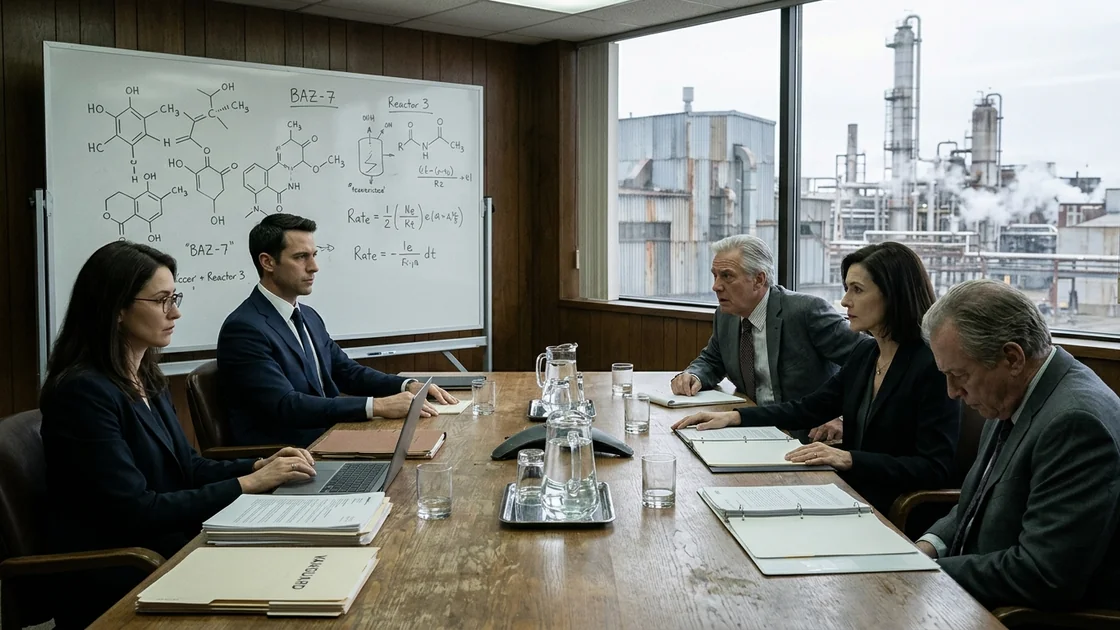
His tone wasn't loud, nor was it aggressive, yet something in its absolute calm made the older man pause. Julian walked over to the whiteboard on the wall, picked up a dry-erase marker, and uncapped it.
Without looking at a single note, Julian drew the complex chemical structure of BAZ-7, followed by the catalytic cycle of Halcyon’s proprietary rhodium-ferrocenyl complex, writing out the kinetic rate equations and the hydrogen partial-pressure curves for the reduction step.
"On your second-stage hydrogenation in Reactor Three," Julian said, turning back to Gregory, "you’re running at forty-five bar pressure in tetrahydrofuran using a substrate-to-catalyst ratio of five thousand to one. You’ve been having trouble with trace palladium leaching from the upstream coupling step poisoning your rhodium catalyst, which is why your batch yields dropped from eighty-eight percent to eighty-one percent in January. To fix it, you’ve been running a silica-thiol scavenger column between steps two and three, which is costing you an extra fourteen hours of cycle time per batch and eating your profit margin alive."
Gregory Lindquist’s mouth fell slightly open. The anger drained from his face, replaced by the stunned bewilderment of a master craftsman realizing a stranger knows his deepest workshop secrets.
"How... how could you possibly know that?" Gregory whispered. "We haven't even reported the cycle-time variance to Vane Kestrel."
"I saw the spike in your waste-manifest filings for spent silica-thiol media with the Ohio EPA last month, and I calculated the thermodynamic drag it would have on a five-thousand-liter hastelloy batch," Julian said, setting the marker down. "And if you replace the tetrahydrofuran solvent in step two with 2-methyltetrahydrofuran and wash with a five-percent aqueous cysteine solution at forty degrees Celsius before phase separation, you’ll strip the palladium down to less than two parts per billion in twenty minutes without ever touching a scavenger column. Your yield will go back to eighty-nine percent, and you’ll save ninety thousand dollars a batch."
Gregory stared at the whiteboard, mentally running the chemistry. Slowly, he sank into his leather chair. "You're not a Wall Street banker."
"No," Julian said, sitting down across from him. "My name is Dr. Julian Mercer. Five years ago, I was the Lead Process Chemist at Vane Kestrel Pharmaceuticals. And I didn't buy your company to strip it, Gregory. I bought it to save it—and to bring Vane Kestrel to its knees."
For the next hour, behind locked doors, Julian laid his cards on the table.
He showed Gregory the debt forgiveness documents Elena had already drafted. Under the restructuring plan of Vanguard Synthesis Holdings, the default interest rate on the thirty-two-million-dollar loan was immediately rescinded. The principal was converted into long-term, low-interest preferred equity, wiping away the foreclosure threat overnight. More than that, Julian committed an immediate ten million dollars in working capital to modernize the Michigan plant and shore up the employee pension fund.
"You keep your forty-two percent equity stake, Gregory," Julian said. "You remain President and Chief Operating Officer of Halcyon, with a five-year guaranteed contract and a fifty-percent increase in base compensation. Not a single worker in Toledo or Michigan loses their job."
Gregory looked from the financial guarantees back to Julian’s eyes. "Nobody spends fifty-five million dollars to rescue a chemical plant out of charity, Dr. Mercer. What’s the catch?"
"The catch," Julian said, his voice dropping an octave, "is that as Chairman of the Board and controlling shareholder, I am assuming exclusive control over one single contract: the Master Supply Agreement with Vane Kestrel Pharmaceuticals for BAZ-7."
Gregory frowned. "We have sixteen metric tons of BAZ-7 sitting in drum storage in Warehouse B right now, scheduled for shipment to their Cork facility next Monday. That’s the primary commercial launch stock for Neurovane. If they don't get those sixteen tons by the end of the month, their Irish plant goes idle, and they miss their Q3 launch window."
"I know," Julian said. "And those drums are not leaving Warehouse B on Monday."
Gregory’s lawyer choked on his coffee. "Wait a minute! If we intentionally withhold shipment on a binding supply contract, Vane Kestrel will sue Halcyon into oblivion! They’ll get an emergency court injunction forcing us to ship, and they’ll hit us with hundreds of millions of dollars in consequential damages for delaying Neurovane!"
"Read Section 14.2 of the Master Supply Agreement that Vane Kestrel’s own lawyers forced you to sign," Elena said, sliding a highlighted copy of the contract across the table to Halcyon’s counsel. "Vane Kestrel was so obsessed with protecting themselves from FDA regulatory liability after their past scandals that they included a mandatory 'Quality and Safety Self-Audit Halt' clause. If Halcyon’s Quality Assurance director identifies a potential trace analytical discrepancy or equipment calibration uncertainty that could theoretically impact cGMP compliance, Halcyon is not only permitted, but contractually required to place an immediate quarantine hold on all shipments until a comprehensive, multi-point validation audit and reactor re-qualification protocol is completed to the satisfaction of Halcyon’s board."
"And how long does a comprehensive multi-point validation audit take?" Gregory asked slowly, a glint of dawning comprehension appearing in his eyes.
"If we do it thoroughly?" Julian smiled thinly. "Checking every valve, re-calibrating every mass flow controller, and running ninety-day accelerated stability assays on every drum? About five months."
Gregory let out a low whistle. "Five months would destroy Vane Kestrel. Their nine-billion-dollar bond covenant triggers on September thirtieth if Neurovane isn't in commercial distribution. And the way they’ve been squeezing us... last month, their procurement VP told me that if I didn't cut our price per kilo by twelve percent, he’d make sure my family lost the house after Neurovane launched." Gregory looked at his rough hands, then looked up at Julian. "My father built this company to make molecules that heal people, Dr. Mercer. Not to be bullied by corporate parasites in New Jersey. Tell me where to sign the quarantine order."
On Monday morning at 8:00 AM Eastern Time, instead of eighteen climate-controlled freight containers of BAZ-7 leaving the Toledo railyard for the port of Newark and onward to Ireland, a single automated email was transmitted from Halcyon’s Quality Assurance portal to Vane Kestrel’s Global Supply Chain division in New Jersey.
The subject line was dry and bureaucratic: NOTICE OF MANDATORY cGMP QUARANTINE & PRECAUTIONARY SHIPMENT HOLD – INTERMEDIATE BAZ-7 (LOTS 204-229).
At first, the tremor started low in the hierarchy of Vane Kestrel Pharmaceuticals.
At 9:30 AM, a junior procurement manager called his contact at Halcyon to ask what the hell was going on, assuming it was a paperwork glitch or a minor labeling error. Instead of reaching the usual account manager, his call was routed to a voicemail box for a law firm in Wilmington, Delaware.
By 2:00 PM on Tuesday, when the air-freight carrier in Cleveland confirmed that Halcyon had canceled the customs bond for the Irish shipment, Vane Kestrel’s Vice President of Supply Chain, a blustering man named Henderson, called Gregory Lindquist’s cell phone directly. Gregory didn't answer; he had taken his wife on a two-week fishing trip to a cabin in Ontario with no cell reception, at Julian’s expense.
Instead, Henderson received a formal couriered letter from Vanguard Synthesis Holdings LLC, informing Vane Kestrel that Halcyon had recently undergone a private recapitalization, and that the newly seated Board Quality Committee had initiated a mandatory ninety-to-one-hundred-and-fifty-day comprehensive facility re-validation audit pursuant to Section 14.2 of the Master Supply Agreement, triggered by "anomalous baseline noise detected in secondary chromatographic calibration standards."
By Wednesday afternoon, the panic reached the executive suite on the thirty-second floor of Vane Kestrel’s glass headquarters in New Jersey.
Inside the main boardroom—the very same room where Julian Mercer had been destroyed five years earlier—Arthur Sterling stood at the head of the table, his patrician composure cracking as Dr. Richard Hallowell and Evelyn Cross stared at the supply projections projected onto the wall screen.
"What do you mean we only have nineteen days of BAZ-7 inventory in Cork?" Sterling demanded, his voice tight with disbelief. "We are launching the largest pharmaceutical product in corporate history in ten weeks! Where is our buffer stock?"
"There is no buffer stock, Arthur," Hallowell stammered, wiping sweat from his forehead with a handkerchief. "You ordered supply chain to implement lean, just-in-time inventory protocols in Q4 to keep thirty million dollars of working capital off the balance sheet before the bond issuance. And Halcyon is the sole registered source on our FDA New Drug Application."
"Then call Lonza! Call WuXi! Call someone in Basel or Shanghai and pay them whatever it takes to synthesize sixteen tons of BAZ-7 by May first!" Sterling roared.
"It’s chemically and legally impossible," Hallowell said, his voice trembling. "Even if another manufacturer could replicate Halcyon’s proprietary rhodium catalyst—which is covered by four active process patents that Halcyon owns—synthesizing BAZ-7 takes eleven weeks from raw materials. And more importantly, BAZ-7 is the designated regulatory starting material on our approved FDA dossier. If we change the supplier of a chiral starting material, the FDA requires a Prior Approval Supplement with six months of comparative impurity profiling and three commercial validation batches. It would take fourteen to eighteen months to qualify a new vendor. If we don't get those sixteen tons out of Toledo in the next fourteen days, the Cork facility shuts down on April twelfth. We miss the Q3 launch."
Sterling turned slowly toward Evelyn Cross. His face had gone the color of wet ash. "If we miss the Q3 launch, the revenue covenants on the nine-billion-dollar senior notes trigger a cross-default. The bondholders will take control of the company, the stock will drop sixty percent in a day, and the board will fire every single one of us before the ink is dry. Evelyn, get a judge on the phone right now and get an emergency mandatory injunction forcing Halcyon to release those drums!"
"I tried four hours ago in the Northern District of Ohio," Cross said, her jaw clenched so tightly the muscles twitched in her cheek. "Vanguard Synthesis Holdings already had a wall of motions waiting for us. Because we drafted Section 14.2 of the supply agreement to give the vendor unilateral authority to halt shipments over cGMP quality audits—and because Halcyon has submitted sworn affidavits from two independent analytical consultants claiming they need ninety days to verify their chromatographic baselines—the federal judge refused to grant a temporary restraining order. He said a federal court is not going to force a pharmaceutical supplier to ship potentially unvalidated chemical intermediates for an Alzheimer’s drug in violation of FDA quality guidelines."
"It’s a shakedown!" Sterling slammed his fist onto the mahogany table. "There’s nothing wrong with those drums! Who the hell is Vanguard Synthesis Holdings? Some greenmail hedge fund bought out Lindquist and they’re holding our launch hostage to extort a higher price!"
"That’s what I thought yesterday," Cross said quietly, looking down at her tablet. For the first time in the twelve years Sterling had known her, Evelyn Cross looked unsettled. "I put Kroll’s top corporate intelligence team on it twenty-four hours ago. I told them to peel back Vanguard Synthesis Holdings and find the managing partner so we could either buy them out or bury them in personal litigation."
"And?"
"And it’s a ghost ship, Arthur," Cross said, scrolling through a complex diagram on her screen. "Vanguard Synthesis in Delaware is owned by four separate LLCs in Wyoming, Delaware, New Mexico, and South Dakota, alongside a senior credit vehicle that bought Halcyon’s bank debt in February. Each of those four LLCs used a different law firm and a different structure to quietly buy out five minority members of the Lindquist family over the past ninety days without triggering a single public filing. When Kroll traced the capital behind those four LLCs, it ran straight into two Luxembourg Special Limited Partnerships, which are funded by three corporations in Singapore, the BVI, and Ras Al Khaimah, all leading back to an impenetrable statutory purpose trust in Nevis."
The room went dead silent.
"Someone spent over fifty million dollars in cash, across seven jurisdictions, over six months, specifically to corner our sole supply of BAZ-7 right before our inventory buffer hit zero," Cross said, her dark eyes rising to meet Sterling’s. "This isn't a random private equity firm looking for a ten-percent price bump on a chemical contract. This was surgical. Whoever is behind that curtain knows our inventory levels, knows our FDA CMC vulnerabilities, knows our bond covenants, and knows our contract clauses."
"Then get on a plane to Toledo or Wilmington or wherever their lawyers are," Sterling snapped, his breath coming faster. "Offer them double the contract price for BAZ-7. Offer them a hundred million dollars to buy Halcyon outright! Just get those sixteen tons on a truck before Wall Street finds out our Irish plant is about to go dark!"
Evelyn Cross didn't have to fly to Wilmington. At 5:00 PM that evening, a courier delivered a single heavy cream envelope to her office on the thirty-second floor.
Inside was a single sheet of heavy cotton bond paper under the letterhead of Vanguard Synthesis Holdings.
It read: Ms. Cross, Mr. Sterling, Dr. Hallowell. The Ultimate Beneficial Owner of Halcyon Fine Chemicals is prepared to discuss a resolution to the current quality quarantine of Intermediate BAZ-7. We will meet this Friday at 10:00 AM at the offices of Halcyon Fine Chemicals in Toledo, Ohio. All three of you must attend in person. If any member of your party is absent, or if Vane Kestrel makes any public or regulatory disclosure prior to the meeting, the quarantine audit will be extended to one hundred and eighty days and the existing sixteen tons of BAZ-7 will be incinerated as non-conforming waste.
There was no signature.
Friday morning in Toledo was cold and bright, the winter sun glinting off the steel fractionating columns of the Halcyon plant.
Arthur Sterling, Evelyn Cross, and Richard Hallowell arrived via Vane Kestrel’s Gulfstream G650 at Toledo Express Airport and were driven straight to the facility in a black town car. None of them had slept more than three hours since Wednesday. On Thursday afternoon, a rumor had leaked on a biotech supply-chain forum that Vane Kestrel’s Cork facility had canceled its April maritime freight slots; Vane Kestrel’s stock had dropped four percent in the final twenty minutes of trading, erasing three billion dollars in value and prompting frantic phone calls from two institutional board members.
They were escorted up the industrial stairs of the administration building by a silent security guard and led toward the main conference room.
Inside, Elena Rostova sat near the end of the long oak table, a neat stack of bound legal agreements in front of her, her laptop open. At the far end of the room, standing with his back to the door, looking out the interior observation window that overlooked the cavernous main reactor hall below, was a man in a tailored navy suit.
Sterling marched into the room first, stripping off his leather gloves, immediately launching into his boardroom cadence. "All right, enough with the theatrics. You have our attention. We are prepared to offer Vanguard Synthesis a one-hundred-and-ten-million-dollar immediate buyout for a hundred percent of Halcyon’s equity, a forty-five-million-dollar breakup fee to your investors, and full indemnification—"
The man by the observation window turned around.
Sterling’s voice died in his throat.
Behind him, Richard Hallowell made a soft, strangled sound, his briefcase slipping from his fingers and hitting the carpeted floor with a heavy thud. Evelyn Cross froze halfway to her chair, the color draining completely from her cheeks until her skin looked like parchment.
Julian Mercer walked slowly to the head of the table. He looked nothing like the haggard, sleep-deprived chemist they had broken five years ago, nor the desperate defendant they had bled dry in civil depositions. He was calm, impeccably composed, his eyes carrying the cold, measured precision of a mass spectrometer.
"Good morning, Arthur," Julian said, pulling out the chairman’s seat and sitting down. "Evelyn. Richard. Please, take a seat. We have a lot of chemistry to discuss."
"You," Sterling whispered, gripping the back of a leather chair as if his knees might buckle. "How... you were bankrupt. You were living in Newark. How could you possibly have fifty million dollars?"
"Sixty-two million, actually, though after shorting Vane Kestrel’s over-leveraged suppliers during the pandemic and riding the volatility on five of your competitors’ failed Phase II trials, the fund is sitting closer to ninety," Julian said conversationally. "It turns out that when you blacklist a process chemist from the laboratory, you give him a tremendous amount of free time to read SEC filings and patent literature. Sit down, Arthur. You’re cutting into your Cork plant’s lead time."
Slowly, mechanically, the three executives lowered themselves into the chairs on the opposite side of the table. Richard Hallowell couldn't bring himself to look at Julian; he stared at the oak grain of the table, his hands visibly shaking in his lap.
Evelyn Cross was the first to recover her reflexes, though her voice lacked its usual steel, coming out thin and brittle. "This is extortion, Julian. You are tortiously interfering with a critical pharmaceutical supply chain out of personal malice. Now that we know you are the beneficial owner behind Vanguard, I will go straight back to the federal judge in Cleveland and show him that this quality quarantine is a bad-faith pretext orchestrated by a disgruntled former employee! And by speaking to us about this, you are in direct violation of your settlement NDA!"
Julian looked at Elena, who smiled faintly and slid a single sheet of paper across the table to Cross.
"First of all, Evelyn, Julian hasn't mentioned the word Cardiovex once, so his NDA remains intact," Elena said smoothly. "Second, regarding your federal judge: at 8:00 AM this morning, Halcyon’s independent third-party analytical laboratory in Chicago completed a high-resolution chiral assay on retain samples of the raw azetidine precursor that Vane Kestrel’s own approved vendor in New Jersey supplied to Halcyon last autumn for the synthesis of BAZ-7. It turns out your upstream vendor cut corners on their distillation temperature. There is a zero-point-one-eight percent trace heavy-metal contamination in the starting feed you sent us."
Julian leaned forward, resting his forearms on the table. "In reality, Gregory and I can purge that trace contamination using a twenty-minute cysteine wash that I designed on Tuesday. We can have all sixteen metric tons of BAZ-7 re-washed, certified to ninety-nine-point-nine-nine percent purity, and loaded onto air-freight pallets for Ireland by midnight tonight. Or, we can follow standard bureaucratic cGMP protocol, declare the entire sixteen tons contaminated due to Vane Kestrel’s faulty raw material feed, incinerate the lot, and wait four months for you to supply us with clean precursor while your bondholders carve Vane Kestrel into pieces. The judge won't force us to ship contaminated product, Evelyn. In fact, if you go to court, that Chicago lab report becomes part of the public docket in twenty minutes."
Cross stared at the analytical readout in front of her. She knew she was beaten. The trap wasn't just financial or legal; it was anchored in empirical, undeniable chemistry. Julian had found a genuine microscopic flaw in Vane Kestrel’s own upstream feed—something only a world-class process chemist would ever know how to look for—that made the quarantine 100% legally bulletproof, while simultaneously holding the only rapid chemical solution to fix it in time for the launch.
Sterling looked at Julian, the patrician mask completely gone, leaving only an aging executive staring into the abyss of his own ruin.
"What do you want, Julian?" Sterling asked huskily. "Name the price. Two hundred million? Three hundred million?"
"You always thought everyone operated on your currency, Arthur," Julian said softly. "Elena, give them the term sheet."
Elena slid three thick, spiral-bound legal volumes across the oak table.
"There are four conditions for the immediate release and purification of the sixteen metric tons of BAZ-7," Julian said, ticking them off on his fingers. "Condition One is commercial. Vane Kestrel will execute an amended Master Supply Agreement with Halcyon Fine Chemicals today. It is a ten-year, irrevocable, take-or-pay contract. The price of BAZ-7 is increasing from four thousand dollars per kilogram to sixteen thousand dollars per kilogram, indexed to inflation, with a mandatory fifty-million-dollar upfront capacity reservation fee wired to Halcyon’s operating account before 4:00 PM today."
Sterling winced. "Sixteen thousand a kilo will shave four hundred million dollars a year off Neurovane’s gross margins."
"Neurovane will make twelve billion a year, Arthur; your shareholders will survive," Julian replied coldly. "And a third of that new revenue at Halcyon is going straight into an employee profit-sharing trust for the workers in Toledo and Michigan whom your procurement team tried to starve out. Which brings us to Condition Two."
Julian’s gaze shifted to Richard Hallowell. The older scientist flinched as if struck.
"Condition Two," Julian said, his voice hard as diamond. "A full, unconditional public exoneration. Today, before the markets close, Vane Kestrel Pharmaceuticals will file a joint motion in the United States District Court for the District of New Jersey vacating the prior civil settlement, dismissing all past claims against me with prejudice, and entering a formal Stipulation of Fact into the public record. That stipulation, along with a global press release issued over PR Newswire and sent to every major pharmaceutical journal and regulatory agency, will state that an internal forensic audit has revealed that Dr. Julian Mercer never stole trade secrets, never attempted extortion, and never fabricated chromatographic data. It will state that the data anomalies in the 2019 Cardiovex assays were the result of an internal calibration error by Dr. Richard Hallowell’s department, and that Dr. Mercer acted at all times with the highest scientific integrity in raising valid patient safety concerns."
Hallowell’s head snapped up, his face pale with terror. "Julian, if I sign an affidavit saying I falsified the verification tests in 2019, the board will fire me! My pension, my seats on the National Academy committees—I’ll be ruined!"
"You mean people won't return your calls?" Julian asked quietly, leaning across the table until his eyes bored straight into his former mentor’s. "You mean universities will shred your resume, your colleagues will cross the street when they see you coming, and you’ll have to sit in a dark room wondering why you threw your life away for a man like Arthur Sterling? You signed a false affidavit that destroyed my life, Richard, and let four hundred people suffer acute liver failure so you could keep your country club membership. Sign the retraction, or by Monday morning I will release the unredacted Puerto Rico thermal logs that I pulled from your retired server contractor’s backup tapes last month."
Hallowell slumped back in his chair, burying his face in his hands. "I’ll sign it," he whispered through his fingers. "God help me, I’ll sign it."
"Condition Three," Julian continued, turning back to Sterling and Cross. "Vane Kestrel will wire seventy-five million dollars today into an independent, blind Patient Restitution Trust administered by Elena’s firm, dedicated to providing full medical coverage and financial compensation to the families of every cardiac patient who suffered documented hepatic injury while taking Batch 409 through 488 of Cardiovex, along with a twenty-five-million-dollar damages settlement to me personally for wrongful termination and defamation."
Evelyn Cross’s hand was trembling as she flipped through the pages of the term sheet. "If we release a statement exonerating you and simultaneously fund a seventy-five-million-dollar restitution trust, the SEC and the FDA will ask questions, Julian. The board of directors will demand an explanation for why we suddenly surrendered five hundred million dollars in contract value and settled a dead five-year-old whistleblower case."
"I know they will," Julian said. "Which brings us to the fourth and final condition."
He stood up, buttoning his suit jacket, looking down at the three of them.
"Along with the wire transfers and the signed court stipulations, Elena requires three signed letters of resignation, effective 5:00 PM this coming Monday, citing personal reasons and a desire to pursue other opportunities," Julian said. "Yours, Arthur. Yours, Evelyn. And yours, Richard. In exchange for your immediate departure from the pharmaceutical industry and the surrender of your golden parachutes back into the patient restitution fund, Vanguard Synthesis will keep the upstream contamination report confidential and ensure that Vane Kestrel’s board receives every kilogram of BAZ-7 required to make Neurovane a triumph. The company survives. The Alzheimer’s patients get their medicine. The workers in Toledo keep their factory. Only the three of you are removed from the equation."
"You are out of your mind," Sterling hissed, standing up so fast his chair slammed against the wall behind him. His face was purple with rage. "I built Vane Kestrel! I am not resigning my chairmanship for a blacklisted lab rat! I will go to the board right now, tell them what you’re doing, and we will fight you in every court in the country until you are dust!"
Julian didn't flinch. He pulled his phone from his pocket, glanced at the time, and set it face up on the oak table between them.
"It is 10:42 AM, Arthur," Julian said calmly. "If you walk out that door without signing, at 11:00 AM Elena will transmit the Chicago lab report proving Vane Kestrel supplied contaminated starting material for Neurovane directly to the FDA’s Division of Neurology Products and the Wall Street Journal. At 11:05 AM, Halcyon’s engineers will open the purge valves on Warehouse B and pump sixteen metric tons of BAZ-7 straight into the thermal oxidizer for incineration. By 11:30 AM, Vane Kestrel’s stock will be halted on the New York Stock Exchange, your nine-billion-dollar bond syndicate will issue a notice of anticipatory default, and by 2:00 PM, your board of directors will fire you for cause anyway—except you’ll be walking out in handcuffs when the Department of Justice opens a securities fraud investigation into why you hid a sole-source supply chain collapse from your bondholders."
Julian tapped the leather-bound agreement on the table.
"If you sign, you walk away quietly on Monday with your base vested shares, avoiding prison and letting your company launch the drug. You have seventeen minutes to do the math, Arthur. Chemistry is entirely predictable once you understand the activation energy."
Julian turned and walked out of the boardroom, followed by Elena, leaving the door to click shut behind them.
They walked down the steel steps into the warm, thrumming expanse of the main reactor hall, where Gregory Lindquist was waiting beside the gleaming, two-story stainless-steel vessel of Reactor Three. Above them, through the soundproof glass of the second-floor observation window, Julian could see Arthur Sterling standing frozen at the table, while Evelyn Cross desperately made a phone call—likely to her outside securities counsel—her face growing paler with every word she heard on the other end of the line.
"We prepped the cysteine wash solution in Tank Four just like you specified, Julian," Gregory said, handing Julian a pair of safety glasses. "If they sign, how fast do you want my crew to run the purification cycle?"
"As soon as the wires hit the escrow account, Gregory," Julian said, slipping the glasses on and looking up at the pressure gauges on the reactor column. "Not a second before."
At 10:56 AM—with four minutes left on the clock—Elena’s tablet chimed inside the reactor hall.
She looked down at the screen, her sharp eyes scanning the incoming document transmissions from upstairs, followed three minutes later by the encrypted confirmation codes from the Federal Reserve wire desk in New York.
"The court stipulations are signed and filed electronically in New Jersey," Elena said, looking up at Julian with a quiet, fierce satisfaction. "The press release just hit the wire services. The seventy-five million for the patient trust and the fifty million for Halcyon’s reserve have cleared escrow. And I am holding the notarized resignations of Arthur Sterling, Evelyn Cross, and Richard Hallowell."
Julian looked back up at the observation window. The conference room was empty now; the three executives were already retreating down the back stairwell toward their waiting car and a long, silent flight back to New Jersey.
Below him, the reactor floor hummed with clean, purposeful energy. For the first time in five years, the static in Julian’s head was gone, replaced by the steady, rhythmic pulse of pumps and condensers doing exactly what they were designed to do.
He turned to Gregory Lindquist and nodded toward the main control panel.
"Open the valves, Gregory," Julian said. "Let’s make some medicine."