The Cartographer of the Salt Mirror
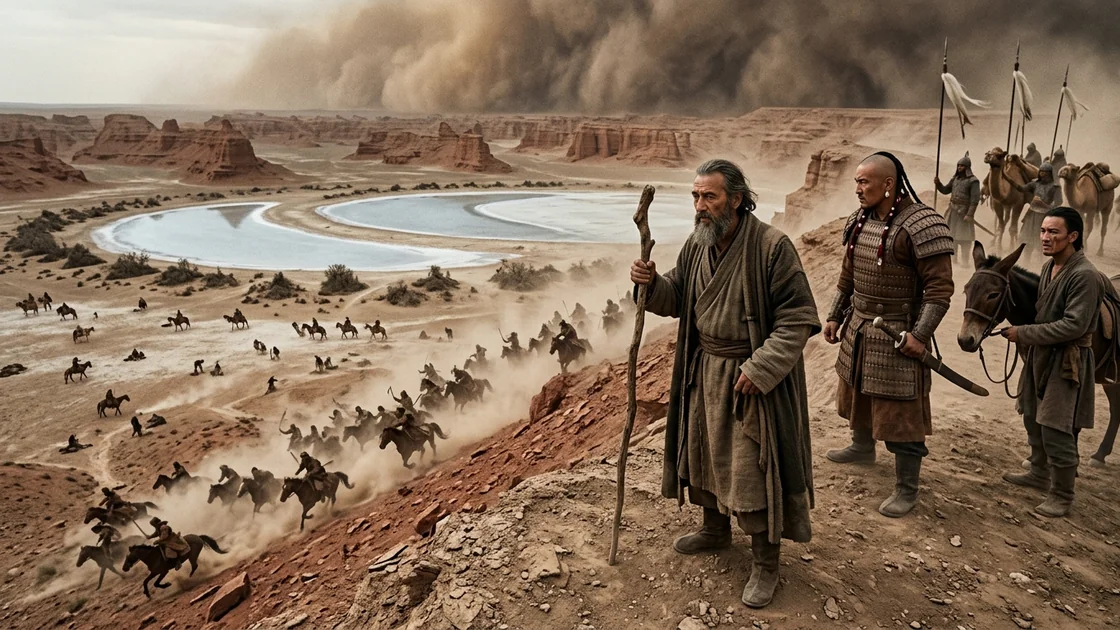
Vahram of Sariq-Su is a master cartographer along the Silk Road whose home village was burned to ashes six years earlier by the ruthless steppe warlord Baurchuk. When Baurchuk captures the oasis city where Vahram works and demands a secret map through the impassable heart of the Taklamakan Desert to ambush a rival khanate, Vahram sees his singular chance for vengeance. Knowing he cannot defeat the warlord with steel, Vahram meticulously constructs a geographical lie by drawing a lush, fictional oasis called Kermin-Bulak into the dead center of an arid salt basin, weaving false historical records and hydrological clues to convince Baurchuk and his suspicious master scout, Tekish. Forced to accompany the vanguard of ten thousand horsemen to verify his own map, Vahram leads the entire army past the point of no return by first guiding them to two real, minor wells to earn their absolute trust, before finally delivering the warlord and his horde into a toxic, waterless sinkhole just as the season of black sandstorms begins.
The lapis lazuli from the mines of Badakhshan was always the hardest to grind. It required a mortar of black porphyry, a pestle weighted with lead, and the patience of a man who understood that mountains do not yield their colors without a fight. Vahram sat cross-legged on a felt mat in the back room of his shop in the Street of the Paper-Makers, his left hand steadying the stone bowl while his right worked the pestle in slow, rhythmic circles. Outside, the afternoon heat of Ak-Shahr pressed against the oiled-paper lattice of the high windows, carrying the dry, alkaline breath of the great desert that began less than a league beyond the city’s mud-brick walls. Mixed with that dust was the smell of roasted mutton fat, fermented mare’s milk, and the sharp, metallic tang of ten thousand iron horseshoes striking the cobbles of the Grand Bazaar.
Across the room, his apprentice, a fourteen-year-old boy from Khotan named Qori who had been born without speech or hearing, was scraping a stretched sheepskin with a crescent-shaped bronze knife. Each stroke produced a dry, rhythmic hiss—shhk, shhk, shhk—lifting a fine white powder of dried tallow and lime from the hide.
Vahram paused, lifting the pestle. He dipped the tip of his little finger into the azure powder, rubbed it against his thumb, and held it up to the slant of dusty sunlight piercing the high window. It was still too coarse. Under a magnifying lens of polished rock crystal, the grains would look like jagged boulders rather than a smooth wash of sky or water. On a map meant for a spice merchant, coarse blue would suffice to mark the Oxus River or the shores of the Issyk-Kul. On a map meant for a king, the blue had to sink into the grain of the vellum like water into parched earth.
He poured a few drops of gum arabic solution from a glazed vial into the mortar and resumed grinding. His fingers were stiff today. The missing tip of his left ring finger—lost twelve winters ago to frostbite on the high pass of the Karakoram while measuring the altitude of the sun with a brass astrolabe—throbbed with a dull, phantom ache. It always ached when the Kara-buran, the black wind of the equinox, was gathering its strength out in the dunes.
The wooden door at the front of the shop rattled before it was kicked inward. The bronze camel-bell hanging above the lintel did not merely chime; it shrieked and tore free from its leather thong, clattering across the cedar floorboards.
Qori froze, his crescent knife poised against the stretched skin. The boy’s dark eyes darted immediately to Vahram, reading the sudden stillness in the older man’s shoulders.
Three men filled the narrow doorway, blocking out the amber light of the street. They wore lamellar armor of boiled buffalo hide laced with raw silk, crusted with the pale grey dust of the northern steppe. Beneath their helmets of blackened iron, their hair was braided with wolf teeth and heavy silver rings. The foremost among them was leaner than the others, his face marked by a milky scar that pulled down the corner of his left eye, giving him an expression of perpetual, clinical curiosity. He carried no lance, only a recurved horn bow cased in oiled leopard skin and a short, heavy riding whip with a handle of carved bone.
The scarred man looked around the cramped chamber. His gaze passed over the shelves stacked with rolled cylinders of mulberry paper from Samarkand, the jars of cinnabar, orpiment, and verdigris, the brass sighting rods, and the large cedar table where a half-finished chart of the Fergana Valley lay weighted down with river stones.
"Vahram the Sogdian?" the scarred man asked. He spoke the Persian dialect of the caravan routes, though his consonants were clipped and hard, shaped by the Turkic tongue of the northern grass.
Vahram set the pestle down on a square of clean linen. He wiped his blue-stained fingers on a rag soaked in walnut oil before rising slowly to his feet. At fifty-two, his back no longer straightened all at once; it uncoiled vertebra by vertebra, like an old rope dried in the sun. He bowed his head to the precise angle required for a captain of a conquering army—low enough to show submission, high enough to keep his eyes on the man’s hands.
"I am Vahram, son of Zayd," the cartographer said, his voice even and dry as old parchment. "Servant of the guild, licensed by the governor of Ak-Shahr to draw the roads between the Jade Gate and the Sea of Khwarazm."
"The governor of Ak-Shahr is currently hanging by his heels from the watchtower of the Western Gate," the scarred man replied without malice, as if reporting a change in the price of barley. "My master found his records of the city granaries to be inaccurate. My master has a great distaste for inaccurate records."
The man stepped further into the room, his iron-shod boots grinding the fallen camel-bell into the wood. He walked to the cedar table and looked down at the chart of Fergana. With the bone tip of his whip, he traced the delicate red line Vahram had drawn through the mountains—the summer mule track over the Talas Pass.
"You drew the water-holes between Osh and Kashgar for the salt consortium three years ago," the man said. "The caravan master Hulagu told us that not a single mule went thirsty on your count of paces. He said you measure the earth as a miser weighs gold dust."
"Hulagu paid in pure silver dirhams," Vahram said. "Silver buys precision, Lord...?"
"Tekish," the man said. "Master of the White Guides to Baurchuk Noyan, Lord of the Seven Banners, the Iron Leopard of the Dzungar Gates."
At the name Baurchuk, a muscle in Vahram’s jaw twitched—a movement no thicker than a hair, hidden beneath the grey-streaked fullness of his beard. He did not look at Qori. He kept his eyes fixed on the bone handle of Tekish’s whip, which was resting directly upon the painted miniature of the citadel of Uzgen.
Six years. Six years of grinding stone, six years of waking to the smell of burning mulberry wood that no one else could smell, six years of asking every caravan driver from the north where the Seven Banners were grazing their herds. Vahram had imagined the name being spoken in his presence a thousand times. Now that it hung in the small, ink-scented room, it sounded remarkably small. Just two syllables of air and spit.
"The Noyan has pitched his golden pavilion in the apricot orchards by the river," Tekish continued, lifting his whip from the parchment. "He requires a man who knows the Southern Erg. The dead sand between the dry bed of the Tarim and the Mountains of Darkness. You will bring your reeds, your colors, and whatever books of the ancients you keep hidden under your floorboards. Now."
"My apprentice is deaf and dumb," Vahram said quickly, gesturing toward Qori, who stood pressed against the drying rack. "He knows only how to scrape skins and boil glue. If I am to work in the camp, someone must remain here to keep the rats from eating the vellum."
Tekish glanced at the boy. He snapped his fingers twice near Qori’s right ear—a sharp, whip-crack sound. Qori did not blink; his eyes remained fixed on Tekish’s lips, waiting for shapes he could not read.
"Leave the mute," Tekish said, turning back to Vahram. "Take only what you can carry in two saddlebags. The Noyan does not like to wait until the evening prayer."
The apricot orchards of Ak-Shahr had been forty years old when the sun rose that morning; by late afternoon, they were firewood and hitching posts.
As Vahram rode on a borrowed donkey between Tekish’s two horsemen, he watched the systematic dismantling of the landscape. Steppe soldiers in grease-stained sheepskin coats were felling the blossoming trees with short-handled axes, dragging the trunks away to build corrals for strings of shaggy, wide-nostriled Mongolian ponies. The irrigation canals—the ancient karez system that brought snowmelt down from the heavenly mountains through miles of subterranean tunnels—had been breached in dozen places so the horses could drink without waiting for buckets. The crystal-clear water, hoarded by the city’s farmers drop by drop through the summer droughts, was already churned into a thick, yellow soup of mud and dung.
It was always the water first, Vahram thought, his hands gripping the wooden pommel of the pack-saddle. The people of the grass did not understand the fragility of an oasis. Where they came from, water fell from the sky or ran in wide, reckless rivers through endless pasture. Here, on the rim of the Taklamakan, life existed only by a treaty signed between human labor and the sand. Break the ditches, burn the windbreaks of poplar and mulberry, and within three seasons the dunes would march over the roofs and swallow the wells as if no man had ever prayed or plowed there.
That was what had become of Sariq-Su.
Vahram closed his eyes for three paces of the donkey’s trot, and the orchard around him vanished. In its place was the narrow valley at the foot of the eastern ridges, where seventy families lived around a single deep spring fed by a glacier. Sariq-Su had been famous for two things: white silk spun from caterpillars fed on dwarf mulberry leaves, and the sweet, thick pears that grew along the stone walls of the terraces. Vahram had been forty-six then, already respected in the cities, returning home in the late autumn with a pack full of silver and a bolt of red brocade from Nishapur for his daughter Anahita’s wedding dowry.
He had smelled the village four miles before he saw the pass. Not woodsmoke—the heavy, greasy stench of wool, tallow, and grain burning together in closed cellars.
Baurchuk’s southern wing had passed through three days prior. The elders of Sariq-Su had offered them sixty sheep and all their woven silk, begging only to keep the seed-barley required for the spring planting and refusing to reveal the high goat-track that led behind their valley into the winter pastures of the Uighur prince. Baurchuk had not argued. He had ordered the women and children driven into the mud-brick mosque, piled the loom-frames and dried mulberry branches against the walls, and set them alight. Then his sappers had rolled boulders down into the mouth of the karez and salted the spring with the carcasses of bloated horses.
When Vahram reached his house, the heat of the mud walls was still strong enough to blister his palms through his leather gloves. He had found Shirin’s silver bracelet—the one shaped like two intertwined vipers that he had bought her in Samarkand—fused to a lump of blackened clay near the bread oven. Of Anahita, he had found nothing that could be distinguished from the ash of the roof-beams.
For two years after that, Vahram had lived like a jackal in the ruins of the old Buddhist monasteries along the desert rim, half-mad, eating locusts and boiled roots. Until one morning he had found an ancient fragment of painted plaster in a collapsed stupa—a map of the western kingdoms drawn by a monk three hundred years dead. Looking at the faded lines of red ochre, Vahram’s mind had cleared with the terrible sharpness of cold iron. He had realized then that a man of fifty with a ruined hand could never push a dagger through six layers of boiled leather armor.
So he had gone back to the cities. He had bought new brass instruments. He had asked every traveler about the Iron Leopard, learning his habits, his ambitions, his rivalries, and the names of his captains, waiting for the wheel of war to turn Baurchuk back toward the Tarim Basin.
"Dismount," Tekish commanded.
Vahram opened his eyes. They stood before a vast circular tent of white felt reinforced with bands of black horsehair rope, rising thirty feet above the trampled clover of the orchard. Before the entrance stood two tall poles of peeled pine; from the left hung seven tails of white yak hair, and from the right hung the freshly severed head of Ak-Shahr’s garrison commander, already black with flies.
Four guards of the Kheshig—the warlord’s personal bodyguard—searched Vahram with methodical thoroughness. They emptied his leather satchels onto a spread felt cloth, poking through his cakes of dry ink, his reed pens, his brass dividers, and his leather-bound notebooks with the tips of their daggers. One guard picked up the sharp bronze pen-knife Vahram used for trimming vulture quills and tossed it aside into the grass.
"Leave the brass claws too," the guard grunted, pointing at the heavy proportional dividers. "They have points."
"If I cannot measure the ratio of leagues to the breadth of a thumb," Vahram said mildly, "the Noyan’s army will march twenty miles to the east of every well. A man may die of a brass point in an hour, my lord, but ten thousand men die of bad arithmetic in a week."
Tekish, standing by the tent flap, gave a short nod. "Give him the brass. If he steps within two paces of the carpet’s edge, break his knees."
Inside, the pavilion was cool and smelled of burned juniper berries and oiled leather. The roof-wheel high above was open to the sky, letting in a shaft of pale light that fell directly upon a low table of lacquered red wood. Around the perimeter of the tent sat a dozen sub-commanders—men of the Kerait, the Naiman, and the Ongud tribes—drinking silently from shallow silver bowls.
At the center, seated upon a pile of snow leopard pelts with one bootless foot tucked beneath his thigh, was Baurchuk.
He was smaller than Vahram had remembered from the descriptions of terrified refugees, though his chest and shoulders had the thick, barrel-like density of a timber wolf. He was perhaps forty-five, his head shaved except for two long braids behind his ears that were threaded with rough uncut rubies. His face was broad and flat as a copper shield, pitted across the cheekbones by childhood smallpox, and his eyes were a strange, pale amber—the color of shallow river water over yellow sand. He was paring his fingernails with a small curved knife of watered Damascus steel.
Spread on the red table before him were three maps. Vahram recognized them immediately,even upside down from five paces away. One was a Chinese woodblock print on fragile bamboo paper, showing the western regions as a schematic grid of squares; the second was an Arab traveler’s itinerary, where all rivers were drawn as straight lines with geometry compasses; the third was a crude chart drawn with charcoal on raw deerskin.
Near the edge of the carpet, two men lay face down in the dirt, their wrists bound behind their backs with wet rawhide that was shrinking as it dried. Both wore the striped wool coats of desert camel-pullers. Their backs were bloody pulp from the hip-bones to the shoulder blades.
Baurchuk did not look up from his fingernails as Tekish announced Vahram’s name.
"These two dogs," Baurchuk said. His voice was surprisingly soft, almost conversational, lacking the guttural bark of his soldiers. "They were brought to me by the merchants of the East Bazaar as the finest guides in Ak-Shahr. The old one says it is eleven days from the dry bend of the Peacock River to the jade-gatherers' camps on the White Water, by way of the Salt Finger. The young one says it is fourteen days, and that the Salt Finger dried up when his grandfather was a boy. I had them beaten until their skins came off to see if their memories would come into agreement. Now they both say it is nine days, or twenty, whichever pleases me."
Baurchuk raised his pale amber eyes to Vahram.
"Men who walk in the sand only know the tail of the camel in front of them," the warlord said. "When the wind blows for three days and changes the shape of the hills, they pray to Allah or the Buddha and cut the throats of their beasts to drink the blood from their stomachs. I do not need camel-pullers, Sogdian. I need a man who looks down on the earth the way an eagle looks down from the clouds."
Vahram knelt at the precise edge of the Shiraz carpet, placing his palms flat on the wool.
"A camel-puller measures distance by the emptiness of his belly and the soreness of his feet, Great Noyan," Vahram said. "A tired man thinks he has walked ten farsakhs when he has crawled three. That is why their accounts never agree. The stars do not get tired, and the angle of the sun at noon does not care how heavy the baggage is."
Baurchuk studied him for a long moment. He gestured with his small knife toward the red lacquered table. "Come closer. Look at this rubbish."
The guards allowed Vahram to step onto the carpet. He approached the table and knelt again, his knees sinking into the thick pile. He examined the three maps with genuine professional disdain—an expression that required no acting.
"This Chinese chart," Vahram said, touching the bamboo paper with the knuckle of his maimed hand, "was copied from the archives of Chang'an two hundred years ago. The rivers have moved since then. In this basin, the rivers have no banks of stone; they wander across the sand like snakes every time the snow melts heavily in the southern mountains. If you march toward the city of Loulan marked here, you will find only dead trees and towers of dry mud haunted by spiders."
"And the Arab skin?" Baurchuk asked.
"Drawn by a scholar in Baghdad who never came further east than Nishapur," Vahram said dismissively. "He puts the Mountains of Roof-of-the-World ten days too close to Khotan so that his parchment would fit inside the binding of his book. It is an ornament for a caliph’s library, not a tool for horsemen."
A low murmur ran around the circle of tribal commanders. Baurchuk leaned forward, resting his elbows on his knees, the small Damascus blade balanced across his knuckles.
"Tell me what I intend to do, mapmaker," Baurchuk said softly.
Vahram kept his eyes on the maps. If he showed too much ignorance, he would seem useless; if he showed too much knowledge, he would seem like a spy. He had to walk the razor’s edge of a brilliant scholar deducing strategy from geography alone.
"You have sixty thousand horses in the northern pastures, Noyan," Vahram said carefully, "yet you have brought only one tuman—ten thousand riders—across the Tien Shan to Ak-Shahr. Your cousin, Küchlüg Khan, holds the southern oasis cities of Khotan and Yarkand. He expects you to march against him along the western rim of the desert, through Kashgar, because that is the only road with enough water for an army. He has fortified the defiles at Yangi Hissar with twenty thousand spearmen and crossbowmen from Cathay."
Baurchuk’s pale eyes did not blink. Neither did he stop Vahram.
"If you go west, you fight him in narrow gorges where your cavalry cannot spread its wings," Vahram continued, tracing his blue-stained finger straight across the blank, uninked center of the deerskin map—the great empty belly of the Taklamakan. "If you go east around the Lop marshes, it takes three months, and the summer heat will rot the hooves off your remounts. Therefore, you are here in Ak-Shahr because you intend to cut the bowstring rather than follow the bow. You want to drop ten thousand horsemen directly through the Sea of Death, straight south from the dry bed of the Tarim River to the back door of Khotan, where Küchlüg has left not a single watchtower manned."
Silence fell inside the pavilion. Outside, a horse whinnied shrill and long, followed by the thud of an axe biting into apricot wood.
Tekish stepped forward, his hand resting on the hilt of his saber. "This old man talks too freely of the Noyan’s council. The merchants in the bazaar must have long ears."
"A man who has spent forty years drawing roads knows why soldiers ask for maps of places where no roads exist, Tekish," Baurchuk said, waving his scout back. The warlord’s lips curved into something that was not quite a smile, revealing small, square teeth worn flat by a lifetime of chewing dried meat. "Go on, Sogdian. Can ten thousand men cross from the Tarim to the Keriya River?"
Here was the hinge upon which six years of patient agony turned. If Vahram said yes, easily, Tekish and the desert veterans would know he was lying to save his skin. Every child in the Tarim Basin knew the central dunes were a furnace of shifting red sand three hundred feet high, where the ground water was bitter with nitre and the Kara-buran buried whole caravans in an afternoon.
"Ten thousand men marching in a single column?" Vahram shook his head slowly. "No, Great Noyan. They would die by the sixth day. Even if you slaughtered half the remounts for their blood, the wells along the old silk hunters' tracks are mere seep-holes in the clay. A well that fills two waterskins an hour for a merchant with twelve camels will be sucked down to black mud in five minutes by five hundred horses. Before the water rises again through the sand, the rear guard will be mad with thirst, and the vanguard will be dead."
Baurchuk’s eyes narrowed. The Damascus knife stopped rolling across his knuckles. "Then you are as useless as the camel-pullers."
"I said a single column along the known tracks would die," Vahram said, raising his voice just a fraction, letting the pride of a master craftsman color his tone. "Because the camel-pullers only know the shallow wells dug by men in the gravel beds. They do not know the old beds of the underground rivers. When the ancients lived in the cities that are now under the sand—three hundred years before the Prophet, when the soldiers of the Han Emperor marched through here—the Keriya River did not die in the dunes as it does today. It ran forty leagues further north. On the surface, there is only sand and red rock. Beneath the clay pans, the water from the southern glaciers still flows through the gravel, hidden from the sun."
Baurchuk leaned closer. "There are large waters out there?"
"There is one place," Vahram said, and his heart beat with a slow, cold, steady stroke against his ribs, like a pendulum of lead. "Four days’ march south of the last tamarisk groves on the Tarim, and five days north of the Keriya reed-beds. Just where the horses would fail. In the books of the Sogdian merchants from the days of King Varkhuman, and in the tax rolls of the Tang protectors which I bought from a tomb-robber in Turfan, it is called Kermin-Bulak. The Spring of the Worm-Hills."
Tekish frowned, leaning over the table. "I have questioned fifty hunters and jade-seekers between here and Lop. None of them spoke of a Kermin-Bulak."
"Because a jade-seeker follows the dry bed of the White Jade River thirty leagues to the west," Vahram replied, turning his gaze up to Tekish with the cold arrogance of a scholar correcting a peasant. "And the hunters do not go beyond the third line of high dunes because there is no game there. Between the White Jade River and the Keriya lies the Basin of the Red Clay Towers—what your people call the Yardangs. It is a labyrinth of wind-carved earth fifty miles wide. No merchant enters it because the salt flats around its rim tear the pads off a camel's feet in two days. Yet in the center of that basin, where the rock dips below the level of the subterranean stream, there is a sinkhole three miles across. The water rises there through sandstone fissures. Not a seep-hole, Commander. Three open pools ringed with wild poplars and sweet reed-grass, large enough to water twenty thousand horses at once."
Baurchuk looked from Vahram to the two bleeding camel-pullers lying on the ground.
"Have you seen this Kermin-Bulak with your own eyes, Sogdian?" the warlord asked.
"I have seen the northern rim of the Red Clay Towers twenty years ago, when I mapped the salt beds for the Prince of Qocho," Vahram said—which was entirely true. "And I have the ancient routing slips from the ruins of the garrison at Dandan-Uiliq, which give the exact bearings by the North Star and the distance in paces from the Cleft of the Vulture."
Baurchuk stood up. He was not tall, yet everyone in the tent seemed to shrink backward into the shadows as he rose. He walked around the table and stood directly over Vahram, smelling of rancid mutton tallow, smoke, and old iron.
"In twelve days, the new moon rises," Baurchuk said. "On that night, my vanguard leaves the river. You have ten days to draw me a map of this road. Every well, every landmark of stone, every pass between the great dunes, and the exact bearings of this Kermin-Bulak. You will make three copies on sheepskin that will not run if wetted."
"Ten days is short for three skins of that size, Great Noyan," Vahram said. "The inks must dry between the washes of alum, or the lines will blur."
"Then do not sleep," Baurchuk said. He pointed his small knife at the two broken camel-pullers on the floor. "Take those two out and cut their throats over the water ditch so their blood does not foul my grass. As for you, mapmaker—Tekish will give you a guard at your door and whatever gold or tallow candles you require. If your map brings me behind Küchlüg’s spears at Khotan while his horses are still unbridled in their stalls, I will make you Chancellor of the Southern Tarim and give you your weight in unspun silk."
The warlord paused, and with the flat of the tiny Damascus blade, he lifted Vahram’s chin until the cartographer was looking straight into those yellow, wolfish eyes.
"And if I dig in the sand at your Kermin-Bulak and find it dry," Baurchuk whispered, "I will skin you from the ankles upward while you are still alive to watch me feed the strips to my hounds."
"A fair bargain for a craftsman, Noyan," Vahram said, and bowed his forehead to the wool.
When Vahram returned to the Street of the Paper-Makers as the purple twilight was settling over the flat roofs of Ak-Shahr, he did not come alone. Tekish rode beside him, accompanied by four Ongud archers who immediately took up positions on the flat roof of the shop and in the courtyard behind the kitchen.
Inside the workroom, Qori was sitting in the dark beside the cold brazier, his knees drawn up to his chest. When Vahram lit a tallow lamp from a flint-box, the boy sprang up, his hands flying in the secret language of signs they had invented over six years of shared silence: Are you whole? Did they strike you? Shall I boil millet?
Vahram caught the boy’s wrists gently to still them, aware that Tekish was standing in the doorway, watching everything with his milky, scarred left eye.
"Go to the kitchen, boy," Vahram said aloud for Tekish’s benefit, while with his right thumb he pressed three rapid times against the pulse-point of Qori’s wrist—their sign for danger, be still, watch my hands only when their backs are turned. "Bring tea and dried figs for the Commander, and light the large copper oil lamps. We have ten days of heavy labor before us."
For the next three hours, Tekish did not leave the workroom. He sat on a low walnut stool near the door, his horn bow across his knees, watching as Vahram selected the three finest skins of Karakol sheep vellum—skins that had been soaked in lime, scraped thin as eggshell, rubbed with pumice stone, and smoothed with powdered cuttlefish bone until they gleamed like old ivory.
Vahram knew that the map itself was only half the snare. Tekish was no fool. A man did not become the chief scout of Baurchuk Noyan by believing the tales of conquered townsmen. Tekish had survived twenty years of war from the Kerulen River to the Oxus because he trusted nothing that he could not smell, taste, or verify through three independent mouths. If Vahram simply drew a blue spot in the middle of the parchment and wrote Kermin-Bulak beside it, Tekish would spend the next ten days torturing every merchant, prisoner, and monk in Ak-Shahr until he found someone to contradict it.
To fool a hunter, one could not merely hide the jaw-iron in the grass; one had to lay down a trail of blood, tufts of rabbit fur, and bruised twigs leading for a mile toward the spot.
"You spoke of bamboo slips from the ruins, Sogdian," Tekish said suddenly out of the shadows, just as Vahram was stretching the first large skin onto a frame of pegged mulberry wood with linen cords. "Let me see them."
Vahram did not pause in his knotting. "They are in the iron-bound chest beneath the floor-planks under your stool, Commander. And they are not bamboo; they are slips of tamarisk wood, written in the Kharoshthi script and the clerk-hand of the Tang soldiers. Here is the key."
Vahram tossed a small iron key across the room. Tekish caught it with his left hand without taking his eyes off Vahram. He rose, kicked aside the felt rug, lifted the cedar trapdoor, and hauled up a heavy box of oiled poplar reinforced with strips of blackened iron.
Inside were Vahram’s true treasures—the legacy of forty years of collecting along the rim of the dead desert. There were rolls of brittle yellow silk found in collapsed watchtowers near Lop Nor; wooden wedge-tablets still bound with hemp string and sealed with clay stamped by Greek-speaking kings of Bactria; leather fragments covered in Tibetan script; and five dozen slips of smoothed tamarisk wood covered in faded black Chinese characters.
Tekish picked up a handful of the wooden slips, sniffing them. They smelled of centuries-old dust, dry rot, and nitre.
"Can you read the scratchings of the Cathay clerks?" Vahram asked, pulling the last linen cord taut around the frame until the sheepskin sang like a drumhead under his knuckles.
"No," Tekish said evenly. "Which is why the Noyan’s Chinese secretary—a scholar we took when we burned the garrison at Hami—will be here at dawn to read them to me."
Vahram smiled inwardly, a cold, fierce contraction in his chest. He had counted on that. Steppe warlords always kept captive Chinese and Uighur scribes to manage their tribute rolls and siege engines.
"Give him the bundle tied with the red silk cord," Vahram said, reaching for his brass straight-edge and a piece of burned willow charcoal. "Wait—not that one. Those are grain receipts from the third year of the Jianzhong era. The bundle beneath it, wrapped in oiled羊皮—sheepskin."
Tekish drew out the bundle. What Tekish did not know—what no living man knew—was that three years ago, after Vahram had returned from his madness in the desert ruins with his plan formed, he had taken four genuine blank tally-sticks from an ancient Han rubbish-pit near Miran. The wood was fifteen hundred years old, seasoned by the dry salt air until it was hard as horn. Vahram had boiled soot obtained from burning ancient pine-resin torches found in the same ruin, mixed it with old vinegar and fish-glue, and with a brush of three mouse-whiskers, he had forged sixteen columns of Tang dynasty military script in the exact crabbed, hurried hand of an eighth-century quartermaster. Afterward, he had baked the sticks in a pan of desert salt and fine alkaline clay for two weeks, rubbing them with camel-dung ash until the new ink was indistinguishable from the writing of men who had been bones for five hundred years.
"What does that bundle say?" Tekish asked, turning the ancient wood over in his scarred fingers.
"It is the report of a scouting captain named Liu Meng, sent out from the fortress of Kucha in the autumn," Vahram said, measuring the borders of the vellum with his brass dividers, his voice bored and academic. "He records marching south across the Tarim with four hundred light horse to punish Tibetan raiders. He lists three watering places: the Well of the White Camel at thirty li; the Cleft of the Vulture at ninety li; and then four days through the black gravel to the great reed-basins of Gan-Chuan—which the Turks and Sogdians call Kermin-Bulak. He complains that the water in the third pool had a slight taste of sulfur that gave his Shandong recruits the flux, though the northern horses drank it greedily and fattened on the wild licorice roots around the bank."
Tekish looked closely at the sticks. The detail about the soldiers getting the flux from the third pool while the horses thrived—that was the touch Vahram was proudest of. Lies were always smooth and golden; only truth had warts and belly-aches.
When the Noyan’s captive Chinese scholar—a terrified, narrow-shouldered man in a torn robe of grey damask—arrived at dawn, Vahram stood back by his grinding table while the scribe examined the tamarisk slips through squinting eyes.
The scholar turned the wood toward the morning light, scratched a tiny flake of salt crust from the edge with his fingernail, tasted it, and nodded slowly to Tekish.
"The wood is true desert tamarisk of the old garrisons, Commander," the scribe said in trembling Turkic. "The seal-clay bears the mark of the Protectorate of the Pacified West. And the characters... yes, it is an itinerary of Captain Liu. Twelve li from the red hill with two peaks, turn south-southwest by the star Canopus into the corridor of clay towers. Water for five thousand beasts year-round, though bitter on the eastern margin."
Tekish looked at Vahram for a long time after the scribe was dismissed. The cold suspicion in his single good eye had not vanished, yet it had shifted from the man to the problem of the march itself.
"There are two first wells on your stick," Tekish said, tapping the vellum where Vahram had begun to sketch the northern river in pale grey plum-stone charcoal. "The White Camel and the Cleft of the Vulture. How far are they from the river?"
"Two days and four days," Vahram said. "Those are real wells, Commander, known to the wild-camel hunters fifty years ago before the sand drifted higher. Even a light scouting party of your riders could ride out from the Tarim tomorrow, reach the White Camel, verify the depth of the water, and return before the new moon."
"I have already sent twenty riders south toward the Cleft of the Vulture at midnight," Tekish said calmly. "Using the rough bearings from your leather notebook that my men took from your saddlebag yesterday."
Vahram dipped his reed pen into the gallnut ink and began to draw the mountain spines of the Kunlun far to the south—tiny interlocking fish-scales of brown and black. His hand did not tremble by the breadth of a flea’s leg.
The Well of the White Camel and the Cleft of the Vulture were entirely real. Vahram had visited both twenty-two years ago. The first held enough sweet water for a thousand men if dug out with spades; the second was a deep rock cistern in a porphyry outcrop that held winter rainwater sufficient for a vanguard.
When Tekish’s scouts returned in six days and reported that the old Sogdian’s notebook had led them to water within fifty paces of his count, Baurchuk would swallow the hook all the way down to his belly.
On the fourth night, Vahram had to solve the problem of Qori.
He knew Baurchuk’s kind. When a warlord commissioned a secret road for a surprise campaign, he did not leave the mapmaker behind in a captured city to sell copies to the enemy’s spies. Nor did he leave the mapmaker’s household alive to talk. On the tenth day, when the three skins were delivered, either Vahram and the boy would have their throats slit behind the apricot orchards, or Vahram would be tied to a mule to guide the column and the boy would be killed to keep the shop quiet.
At midnight, the two guards inside the shop were nodding over a game of sheep-knuckle dice by the front door, sluggish from a jug of heavy Kashgar pomegranate wine that Vahram had left "forgotten" on a lower shelf near the kitchen. Tekish had gone back to the pavilion to report to Baurchuk.
Vahram worked at the great cedar table under the flare of three sesame-oil lamps. Qori stood beside him, holding a porcelain saucer of wet cinnabar for the desert tracks.
Without looking up from his ruler, where he was marking off farsakhs in tiny red ticks along the parallel of the thirty-ninth degree of latitude, Vahram spoke to the boy with his left hand, his fingers moving beneath the shadow of the tabletop where the guards could not see.
Tomorrow at noon, you will spill the jar of boiling nitric acid and verdigris over your left forearm.
Qori’s eyes widened in the lamplight. His fingers twitched against his thigh: Why, Master?
Not deep enough to ruin the sinew, Vahram signed rapidly with his mutilated left hand, while his right continued to ink the delicate contour of a dry wadi. Mix it with four parts water first so it only blisters the skin green and stinks like corpse-rot. Roll on the floor and foam at the mouth with soap-root. These northern wolves fear the spotted pestilence more than arrows. When Tekish sees green blisters on your arm, he will throw you over the city wall into the leper ditch by the river rather than let you breathe the air near his horses.
Qori stared at the old man. Slowly, the boy’s hand rose behind the shelter of the tall ceramic lamp-stand. And when I am in the ditch?
In the ditch, under the third arch of the ruined brick bridge, I hid forty silver dirhams and a pass-seal of the Uighur merchant guild five years ago, Vahram signed. Wait until dark, wash your arm with vinegar, walk west to Kashgar by the foothill tracks, and go to the house of Master Ibrahim the astrolabe-maker. Tell him—write it on a slate—that Vahram of Sariq-Su sends him an apprentice who knows how to grind Badakhshan stone.
Qori’s small, calloused hand reached out and touched the sleeve of Vahram’s tunic. Come with me under the bridge, Master. The guards are drunk.
Vahram looked up then. For a single heartbeat, he let the mask of the dry, pedantic scholar slip, and the boy saw the terrible, bottomless furnace that had kept the old man warm for six years.
My map is not finished, Vahram signed with two slow movements of his thumb and forefinger. And a mapmaker must sign his work.
The next day at the hour of the noon prayer, a clay jar crashed onto the stone hearth of the back kitchen. Green, smoking liquid splashed across the flagstones, filling the shop with the choking, acrid fumes of copper acetate and vinegar. Qori stumbled into the workroom, his left arm covered in rising, yellow-green blisters, his eyes rolled back until only the whites showed, thick white lather bubbling from his silent lips as he drummed his heels violently against the cedar boards.
The two Ongud guards scrambled backward so fast they knocked over the rack of paper rolls, drawing their sabers and cursing in the name of Tengri and the sky-spirits. When Tekish arrived ten minutes later, holding a vinegar-soaked rag over his nose and mouth, he took one look at the green, suppurating sores rising on the boy’s skin and the yellowish froth on his chin.
"The Khotan rot," Tekish spat, stepping back into the street. "If that gets into the horse-lines, half the tuman will be coughing blood before we reach the river." He pointed at two city watchmen who had been pressed into labor service in the street. "You two—take two long poles, lift that thing by its clothes, and throw it over the southern rampart into the alkali marsh. Then burn your coats and wash in horse-piss. If I see it crawling back toward the gates, put an arrow through its ribs from fifty paces."
Vahram stood in the doorway of his shop, his hands tucked into his sleeves, watching as the watchmen prodded the limp, convulsing boy onto a hurdle of woven reeds and carried him away down the dusty alley toward the southern wall. He did not flinch; he even complained loudly to Tekish that he would now have to boil his own hide-glue and grind his own malachite, which would delay the third copy of the map by half a day.
That night, alone in the quiet shop with only the smell of scorched copper and the breathing of the guards on the roof, Vahram drew Kermin-Bulak.
He did not draw it as a crude circle of blue. He drew it with all the love and mastery of forty years of art.
He knew the exact place he was mapping. Twenty years ago, when his caravan had lost its way during a three-day dust storm north of the Keriya, they had stumbled into the eastern edge of that great clay labyrinth. They had climbed a sixty-foot tower of wind-scoured red mud at sunrise and looked down into a vast, bowl-shaped depression four miles wide.
From the rim, it had looked like Paradise. Because of the ancient lake-bed geology, the center of the depression was ringed by immense, fossilized mounds of dead tamarisk cones and grey poplars that had died a thousand years ago when the river shifted—yet in the shimmering heat-haze of the desert, dead grey poplar wood looked exactly like living scrub until you were within half a mile. Better still, the floor of the basin was covered by a two-inch crust of crystalline selenite and glauber’s salt left behind by the ancient evaporation. Under the noon sun, or by moonlight, that salt mirror reflected the sky with the exact dazzling, liquid shimmer of open water.
And beneath that crust? Vahram’s caravan master had dug a pit four feet deep at the lowest point of the basin, hoping for sweet seepage. The water that had oozed into the bottom of the hole was clear as rock crystal, cold, and odorless. Two thirsty camels and a young mule-driver had drunk their fill before the caravan master tasted it. It was saturated brine mixed with native Epsom salts and arsenic-bearing clay washed down from the Kunlun mountains over ten millennia. Within two hours, the boy’s bowels had turned to liquid fire; by nightfall, his tongue had swollen black until it choked him, and the two camels lay bloating in the salt, their stomachs burst from within.
Now, under the steady golden glow of his sesame lamp, Vahram dipped his finest weasel-hair brush into the pure, deep azure of the Badakhshan lapis lazuli he had ground on the day Tekish arrived.
In the center of the three-mile depression between the Red Clay Towers, he painted three interlocking crescent pools of royal blue. Around their margins, using a mixture of verdigris and saffron, he stippled tiny, delicate clusters of green reed-beds and living poplar groves. Beside the westernmost pool, in exquisite Persian calligraphy no larger than the legs of a gnat, he wrote:
Kermin-Bulak. Sweet water at the surface; dig two cubits in the western gravel in dry autumns. Pasture for six thousand beasts. Avoid the eastern pool which tastes of alum.
He leaned back and blew gently on the wet pigment. In the lamplight, the lapis lazuli gleamed like a jewel set into the pale skin of a dead sheep. Looking at it, even Vahram felt his mouth water with a phantom coolness. It looked more real than the real rivers. It possessed the undeniable authority of geometry, expensive ink, and human hope.
On the ninth day, Tekish’s scouting party returned from the south.
They rode into the apricot orchards on gaunt, lathered ponies, their faces blackened by sun-glare and crusted to the eyelashes with yellow alkali dust. From the saddle of the lead scout hung four heavy goatskins, dark and sweating with fresh water, and a bundle of green camel-thorn cut that morning.
Vahram was summoned to the white pavilion an hour before sunset. The three great maps were laid out side by side on the red lacquered table, weighted down at the corners with bricks of compressed tea.
Tekish’s corporal of scouts, a flat-nosed Kerait with cracked, bleeding lips, knelt before Baurchuk and touched his forehead to the carpet.
"We rode south from the Dead Ferry on the Tarim as the Sogdian’s book commanded, Noyan," the corporal rasped, his voice raw from sand-wind. "Two days through the low dunes by the pointer stars. At noon on the second day, we found the white limestone rock shaped like a kneeling camel. We dug four spans into the sand at its shadow-line and struck cold water enough for two hundred horses. We pushed on two days further into the high red sand. The horses began to stagger, and we thought the city-man had lied to us. Then, at the forty-seventh li on the fourth day, just as the sun touched the western sand-ridges, we saw the black stone crag split down the middle like a vulture’s beak. Inside the cleft was the old stone cistern of the ancients. Ten feet of sweet rain-water, cold as snow, untouched by beasts."
The corporal reached into his belt and laid an object on the edge of the red table. It was a rusted iron arrowhead with a three-flanged tang—the unmistakable pattern of a Tang dynasty crossbow bolt.
"We found this in the gravel beside the cistern," the corporal added. "And from the top of the black crag, looking south through the clear air before sunrise, we saw the northern wall of the Red Clay Towers rising on the horizon like a ruined city, just where his map marks the entrance to the corridor."
Baurchuk did not look at the arrowhead. He looked at the map.
His square, scarred finger traced the red dotted line from the Tarim River, past the tiny drawing of the white rock, past the black crag of the Cleft of the Vulture, and down through the narrow defile of the clay towers into the three blue crescents of Kermin-Bulak. From Kermin-Bulak, it was only four short days across flat gravel plains to the headwaters of the Keriya marshes, and from there, a broad highway into the unguarded ribs of Küchlüg Khan’s kingdom.
"How much water can ten thousand men and twenty thousand horses carry on their backs from the Tarim?" Baurchuk asked his quartermaster.
"Four days’ ration if we load the pack-camels with nothing but waterskins and dry curd, Noyan," the quartermaster replied. "And the cistern at the Vulture Cleft will refill the skins of the vanguard and water three thousand mounts. From the Vulture Cleft to the Kermin-Bulak pools is four days of dry marching. The beasts will be lean and wild with thirst by the afternoon of the eighth day, yet if the big water is there, we will lose not a single man, and we can rest the horses for three days in the hidden reeds before we strike Khotan."
Baurchuk picked up a heavy leather bag from beside his leopard skins and tossed it onto the floor in front of Vahram. It struck the carpet with a dull, heavy clink, splitting at the seam to spill gold dinars of Khwarazm and octagonal silver ingots from Cathay across the wool.
"You have a true hand, Vahram of Ak-Shahr," Baurchuk said softly. "You may send that gold to whichever woman or temple you please."
"You are bountiful as the spring floods, Great Noyan," Vahram murmured, not touching the coins. "Wait until your banners are mirrored in the waters of Kermin-Bulak before you praise my ink."
"I intend to," Baurchuk said. The pale amber eyes fixed on him with a sudden, freezing lightness. "Because you are going to show them to me."
Vahram raised his head, allowing an expression of sudden, fragile alarm to cross his aged features. "My Lord? I am fifty-two years old. My hip was broken by a falling mule in the Pamirs ten years ago, and my lungs are rotted from forty years of breathing lime-dust and cinnabar. A four-day ride is a sentence of death for me, let alone eight days at a cavalry trot through the Great Sand!"
"You will not trot," Baurchuk said pleasantly. "You will ride in a basket slung between two quiet Bactrian camels right behind Tekish’s horse. You will have a canopy of oiled silk over your head to keep off the sun, and two skins of sweet river water for your own mouth. All you must do is hold your brass sun-rings at noon and point with your finger when the wind blurs the tracks."
Tekish smiled thinly from the side of the tent. "A craftsman should always stand beneath the bridge he builds when the first heavy wagons cross it, Sogdian. It keeps his mind sharp."
Vahram lowered his gaze to the spilled gold on the carpet, letting his shoulders sag in the posture of a frightened old man trapped by his own cleverness. "As the Noyan commands," he whispered, his voice shaking with admirable frailty. "I am in the hand of God and the Seven Banners."
Beneath his grey beard, where no one could see, Vahram bit the inside of his lip until he tasted salt to keep himself from laughing aloud. He had feared they would simply kill him at the river bank and go on alone. Now he would be there. He would watch Baurchuk’s face when the spades struck the selenite crust.
On the night of the new moon, ten thousand horsemen and four thousand baggage camels crossed the dry, braided channels of the Tarim River and entered the sand.
No war-drums were beaten; no bronze horns were blown. The army moved like a vast, low-lying cloud of grey wolves under the starlight. The iron stirrups were wrapped in strips of sheepskin so they would not clink against the lance-butts, and the wooden axles of the four light siege-catapults—disassembled and strapped to the backs of giant Khorasan dromedaries—were greased with mutton tallow until they made no sound at all.
Vahram rode high in a wicker litter slung between two immense, shaggy camels just behind the white yak-tail standard of the vanguard. Strapped to the wooden frame before him were his brass astrolabe, a magnetic spoon of lodestone floating in a wooden bowl of oil, and one of the three sheepskin maps rolled inside a cylinder of waxed leather.
For the first two days, the desert deceived the steppe riders into contempt.
Here on the northern margin, the dead forest still held the earth together. They marched through miles of toghrak—the ancient desert poplars that lived for three hundred years upright, died standing for three hundred years, and lay unrotted in the dry sand for three hundred more. Their twisted, bleached trunks looked like the bones of giants frozen in agony under the moonlight. Between the dead trees grew low mounds of purple tamarisk and thorny haloxylon, which the camels snatched at as they marched.
On the evening of the second day, exactly as Vahram’s sighting of the sun’s meridian altitude predicted, the limestone outcrop of the White Camel rose out of the yellow haze ahead.
Tekish’s sappers dug twelve wide trenches at the base of the rock. Within an hour, brown, slightly brackish, yet entirely drinkable water filled the pits. The vanguard watered their mounts in shifts while the main body under Baurchuk came up through the twilight.
That night, Baurchuk sent Vahram a dish of boiled horse-rib fat with his own hand—the highest mark of favor a steppe commander could bestow. Vahram chewed the tough, greasy meat sitting by a small fire of dry camel-dung, watching the ten thousand men spread out across the dunes. They were singing low, throat-rasping songs of the northern rivers, cleaning their bowstrings with wax, sharpening broadheads on whetstones.
Vahram looked at a young trooper near his fire—a boy no older than Qori, with a round, downy face, who was carefully braiding red wool into the mane of his bay mare.
Does it hurt your heart, Vahram? he asked himself silently, looking into the blue flame of the dung-fire. Ten thousand mothers’ sons?
He closed his eyes and smelled the mosque at Sariq-Su. He saw the charred wooden beam lying across the place where Anahita’s loom had stood, and the little silver viper bracelet melted into the clay. That young trooper with the red wool in his horse’s mane had been ten years old when Sariq-Su burned; in another two weeks, if this army reached Khotan, that same boy would be tossing crying infants onto spear-points in the melon gardens of the White Jade River and laughing as he tied silk bolts to his saddle-bow.
A locust taken alone in the hand was a harmless, delicate creature of green and gold; ten thousand locusts were a plague that had to be burned with fire in the ditch before they took the wing.
On the third day, the dead forest ended as if cut off by a sword, and they entered the Taklamakan—the place from which that which goes in does not come out.
The world became nothing but sky and red-gold sand piled by the wind into crescent ridges the height of city cathedrals. There was no gravel underfoot now; the horses sank to their fetlocks at every stride in flour-fine dust that rose beneath twenty thousand hooves into a choking, motionless fog three hundred feet high. Men tied cloths soaked in tallow over their noses and mouths; the horses’ nostrils were rimmed with cakes of bloody mud.
By the afternoon of the fourth day, the heat between the great dune corridors was like the breath of a pottery kiln. The water in the leather skins strapped to the camels had grown hot and foul, tasting of rotten hide and rancid oil. Half a dozen pack-horses, overloaded with iron arrowheads, dropped in their traces with burst hearts; before their legs stopped kicking, the butchers of the rear guard had slit their jugular veins, catching the dark, sticky blood in wooden bowls for the troopers to drink.
At sunset on the fourth day, through the red murk of the horizon, the black porphyry fang of the Cleft of the Vulture appeared dead ahead of Vahram’s compass needle.
A low, hoarse roar went up from the vanguard—not a shout, for their throats were too dry to shout, but a collective rattle of ten thousand parched chests.
They camped for twenty-four hours around the black crag. The deep rainwater cistern inside the split rock held enough water to give every man two full gourds and every horse one leather bucketful. By sunset of the fifth day, the cistern was scraped down to the bare, dry granite bottom. Not a thimbleful of moisture remained in the rock.
That evening, as the stars came out with a hard, pitiless brilliance in the violet sky, Baurchuk summoned Tekish, his four mingghan commanders, and Vahram to the crest of the black crag.
To the north lay four days of trampled sand leading back to the Tarim—with the intermediate well at the White Camel already sucked dry by the rear guard as they passed through. To the south, across a flat, black plain of wind-polished flint pebbles, rose the dark, serrated silhouette of the Red Clay Towers.
Even from ten miles away, the Yardangs looked unnatural. Over millions of years, the howling northeast wind had carved an ancient dry lake-bed into thousands of parallel ridges and isolated pinnacles of rock-hard red clay, eighty to a hundred feet high, separated by narrow, twisting gullies choked with yellow sand.
"The water in the rock is gone," Tekish said, his scarred eye fixed on the southern darkness. "If we turn back to the Tarim tonight, we lose half the horses and all the siege engines before we see the river. If we go forward into that stone labyrinth, we have three days of warm water in the skins, and the horses can go four days without drinking if we march only by starlight and halt in the shade of the clay bluffs at noon."
Baurchuk looked at Vahram, who leaned on a staff of tamarisk wood, his breath wheezing faintly in the dry air.
"How far from the edge of those towers to the pools of Kermin-Bulak, Sogdian?" the warlord asked.
"Ninety li—three days’ march for loaded camels, two and a half for horsemen—down the main corridor bearing south-by-southwest," Vahram said, pointing with his four-fingered left hand toward the bright star Fomalhaut rising in the southern sky. "On the morning of the eighth day from the river, you will climb the ridge of the Three Sisters—three flat-topped bluffs of yellow clay banded with white gypsum—and look down into the basin of Kermin-Bulak."
"And the wind?" Tekish asked, lifting his face toward the northeast, where a faint, copper-colored haze still lingered above the stars even after dark. "My tongue tastes iron, and the camels are kneeling with their tails to the north. And my scar aches."
"It is late spring," Vahram replied calmly. "The Kara-buran always blows for three days before the summer solstice. If it catches an army on the open dunes, they die. Once we are inside the corridors of the Red Clay Towers, the bluffs break the force of the wind, and in the deep basin of Kermin-Bulak, surrounded by hundred-foot walls of clay and the poplar groves, a storm may blow overhead for a week while your horses graze in peace by the water."
Baurchuk spat dryly onto the black rock. "Sound the horn-whistles. We march at the rising of the Great Bear. Leave the twenty lame horses here with their throats cut so they do not wander back on our trail."
Vahram bowed his head. They had crossed the line. Behind them, the wells were empty; ahead of them lay the anvil.
The sixth and seventh days were not a march; they were a descent into an oven of brick.
Once the army entered the labyrinth of the Red Clay Towers, the breeze died completely. The hundred-foot cliffs of dry, rust-colored silt and gypsum trapped the sun’s heat and reflected it back into the narrow gullies until the air shimmered like melted glass. By ten o’clock in the morning, the iron bosses on the soldiers’ shields were too hot to touch with a bare hand; if a man’s skin brushed against the bronze buckle of his stirrup leather, it raised a white blister.
Because the gullies wound back and forth like the intestines of a slaughtered ox, the column stretched out for eight miles. In that echoing maze of dead clay, sound behaved strangely. The wind whistling across the tops of the pinnacles overhead produced a continuous, eerie moaning—the famous voice of the desert spirits that Marco Polo and the Chinese monks had written of—sounding sometimes like a woman weeping in the next gully, sometimes like the clashing of distant bronze cymbals, causing troopers in the column to turn in their saddles and draw their swords against empty air.
Vahram sat in his swaying camel-litter at the very head of the column, his eyes shaded by a strip of black horsehair cloth, consulting his brass sun-ring every half hour and calling out corrections to Tekish: "Bear left around the pinnacle with the white stripe... ignore the wide valley to the west, it ends in a blind cliff... keep the sun two fingers behind your left shoulder."
His accuracy was terrifying. Every dry gully he predicted was there; every layer of white gypsum in the red cliffs appeared at the exact mile he had inked onto the sheepskin. Why should it not? Twenty years ago, fleeing for his life from the salt-basin back toward the Keriya, Vahram had measured this exact corridor pace by pace, carving the landmarks into his memory with the chisel of near-death.
By the evening of the seventh day, the last drops of water in the camel-skins were distributed: half a shallow horn-cup per man, thick, brown, and stinking of boiled leather. The horses received nothing; their caretakers merely wiped their cracked, bleeding nostrils with wet rags rung out in the dregs of the buckets.
That night, no man slept. The horses stood with their heads hanging between their knees, trembling violently, their flanks sunken into deep hollows behind their ribs, giving off a dry, rasping wheeze with every breath. Across the dark gullies, Vahram heard the occasional muffled thud and gurgle as a trooper went mad from the heat and opened the vein of his own second mount to suck the warm, salty blood in the dark—a crime punishable by crucifixion under Baurchuk’s discipline, yet in the pitch blackness of the clay canyons, the centurions pretended not to hear.
And overhead, the stars vanished.
By three hours before dawn on the eighth day, the sky above the canyons was no longer violet-black; it was the color of bruised liver. The air had grown strangely warm and heavy, smelling strongly of ozone and static sulfur, so that when Vahram ran his hand over the wool blanket on his knees, tiny blue sparks crackled and jumped between his knuckles.
Tekish walked up to Vahram’s litter—his own horse had died of the staggers three miles back, and the chief scout now led a gaunt, wall-eyed mule by a hemp halter. In the lantern light, Tekish’s face looked like a skull covered in tight, grey parchment. His lips were split in four places, black with dried blood.
"The Three Sisters," Tekish whispered, his voice sounding like two dry stones rubbed together. "Where are they?"
"Two miles ahead, at the end of this ravine," Vahram answered, his own voice ragged. Over the past two days, he had secretly poured half of his private water ration down the sand between his camels’ legs at night so that his lips would crack and his eyes would sink into their sockets just like the soldiers'. "When the sun rises, you will see the white gypsum bands above the pass."
At dawn, there was no sun—only a vast, sickly yellow glow behind a wall of purple-black cloud that was rising across the entire northern sky from horizon to zenith. The Kara-buran was less than four hours behind them, marching south at forty miles an hour, pushing before it a wall of displaced air so dense it made Vahram’s eardrums pop.
Yet right in front of the vanguard, blocking the mouth of the ravine, rose three flat-topped bluffs of yellow clay banded around their middles with dazzling white gypsum.
Word ran backward down the eight-mile column like fire through dry grass: The Three Sisters! The map is true! The water is behind the ridge!
Men who had been crawling on their hands and knees behind their mules staggered to their feet. Whip-lashes cracked against the hollow ribs of dying camels. Baurchuk himself spurred his huge grey stallion—kept alive on the last two skins of river water—up the steep gravel talus of the pass, with Tekish dragging Vahram’s litter-camels directly behind him.
They reached the crest of the ridge together.
Below them lay a circular basin four miles wide, hemmed in on all sides by red clay towers that looked like the battlements of hell.
Under the weird, copper-yellow light of the approaching hurricane, the center of the basin gleamed.
Three vast crescent-shaped expanses of dazzling, silver-blue mirror stretched across the floor of the depression, bordered by dark, dense thickets of gnarled poplar trunks and tall, rustling stands of yellow-grey reeds. The wind eddying down into the bowl moved across the surface of the salt crystals and the fine white alkali dust floating above them, creating the exact illusion of gentle ripples running across deep, wind-stirred water.
Behind Baurchuk, two thousand horsemen of the vanguard crested the ridge and jammed together along the rim. A sound broke from their dry throats—half sob, half wolf-howl—and before the sub-commanders could raise their whips or blow a single whistle, discipline dissolved.
Whole squadrons of Kerait and Naiman cavalry broke ranks and went sliding, tumbling, and galloping down the three-hundred-foot slope of loose shale toward the basin floor, horses and men rolling over one another in an avalanche of red dust, tearing the stoppers from their empty waterskins as they ran, maddened by the sight of the silver mirror two miles away.
Baurchuk sat on his grey stallion at the top of the pass, his broad, pockmarked chest rising and falling beneath his dusty lamellar coat. Slowly, he turned in his saddle and looked at Vahram, who was being lifted down from the camel-litter by two guards.
"You are a wizard, Sogdian," Baurchuk rasped through cracked lips. "By the Eternal Blue Sky, you have delivered Küchlüg Khan into my hands."
Vahram stood on the rocky crest, leaning both hands upon his tamarisk staff. The hot prelude-wind of the Kara-buran whipped his grey beard across his shoulder and tugged at the hem of his robe. He looked down into the basin, watching the first dark wave of horsemen crash through the outer perimeter of dead, petrified tamarisk mounds half a mile from the edge of the silver flats.
"Go down and drink, Great Noyan," Vahram said, and his voice was suddenly clear, strong, and resonant, stripped of every trace of old age and servility. "Go down and drink the water of Sariq-Su."
Tekish, standing ten feet away beside his mule, stiffened. His single good eye snapped from the basin back to Vahram’s face.
Down on the basin floor, the lead horsemen reached the edge of the first great crescent pool.
From the ridge two miles away, everything appeared in miniature, like figures painted on one of Vahram’s charts, yet the dry desert air carried sight with merciless clarity. The lead horses did not splash into water. As their hooves struck the dazzling silver surface, a cloud of blinding white powder exploded upward around their knees. There was a faint, dry, crunching roar—like ten thousand panes of thin ice breaking under iron boots—as the two-inch crust of selenite crystal gave way beneath the galloping mounts, plunging them up to their hocks in dry, gray-white powder and black, crusted mud.
The riders threw themselves from their saddles onto their bellies, clawing at the broken crust with their bare hands, their daggers, their helmet rims.
Baurchuk’s smile vanished. He stood up in his iron stirrups, shading his pale amber eyes against the rising yellow wind. "Why do they not water the horses? What is that white dust?"
"Dig two cubits in the western gravel in dry autumns!" one of the sub-commanders shouted anxiously, quoting Vahram’s map from memory. "The water is just beneath the crust! Send down the sappers with the iron spades!"
"Yes," Vahram said softly, watching as hundreds more horsemen poured onto the white mirror, stumbling among the dead, bone-dry skeletons of the thousand-year-old poplars that broke like potter's clay when the terrified horses crashed against them. "Send down the spades. You will find water at three spans. Clear as rock crystal."
Tekish took two long strides and seized Vahram by the throat of his wool tunic, his dagger already out and pressed beneath the cartographer’s jaw.
"What did you call this place?" Tekish hissed, his scarred eye wide and white around the iris. "Just now—what name did you say?"
Vahram did not look at the dagger. He looked past Tekish’s shoulder at Baurchuk, who was slowly dismounting from his grey stallion, his eyes fixed on Vahram with a dawning, unbelieving horror.
"Sariq-Su," Vahram said clearly. "It was a small valley four leagues east of the Jade Pass, below the glacier of the White Horse. Seventy houses of mud brick. Four hundred mulberry trees along a stone canal. Six years ago in the month of the falling leaves, the Iron Leopard rode through on his way to winter pasture. The headman asked only to keep twelve sacks of seed-barley so the children would not starve in the spring."
Baurchuk took a slow step toward him, his hand dropping to the hilt of his heavy curved saber. "I burned fifty villages in the year of the Sheep," the warlord whispered. "I do not remember your mud huts."
"I know you do not," Vahram said, and for the first time in six years, he smiled—a wide, peaceful smile that showed his teeth stained dark by a lifetime of chewing ink-reeds. "That is why a dagger in your ribs while you slept in Ak-Shahr would have been a poor payment. You would have died in a heartbeat, wondering which rival khan paid the assassin. Now you have three days to remember Sariq-Su."
Down in the basin, a thin, high screaming had begun to drift up through the rising moan of the wind.
The men who had dug holes in the salt pan had reached the cold, clear brine beneath. Maddened by four days of furnace-thirst, hundreds of troopers and horses had drunk greedily before the bitter, metallic burn of the glauber's salt and arsenic struck their throats. Already, along the western rim of the white crust, dozens of men were doubled over on their knees in the salt dust, retching up black bile and blood, tearing at their own throats with salt-crusted fingers, while horses rolled thrashing on their backs, kicking their iron shoes against the sky.
"The Cleft of the Vulture is four days behind you, and it is dry," Vahram said, his voice rising over the first roaring gusts of the Kara-buran as the towering black wall of sand swallowed the northern horizon and raced toward the Three Sisters. "The Keriya River is six days to the south through the highest dunes in the world, with no track, no wells, and no guide. And the water at your feet is liquid fire that will burst the belly of every beast that tastes it before nightfall."
"I will peel the skin from your bones inch by inch!" Baurchuk roared, his voice cracking with sudden, animal terror as he drew his saber. "I will keep you alive on horse blood for a week while I roast your feet in the coals!"
"No, you will not, Noyan," Vahram said gently, looking left toward Tekish’s trembling arm.
With a sudden, violent jerk of his shoulders, Vahram did not pull away from Tekish’s dagger; he threw his full weight forward onto the blade.
The six inches of keen Damascus steel, held rigid in the scout’s fist, drove straight through the base of Vahram’s throat, severing the great vein and the windpipe in a single painless stroke before Tekish could even draw his hand back.
Vahram fell to his knees on the gypsum rock, then rolled onto his side, facing the basin.
Baurchuk lunged forward, screaming curses at Tekish, dropping to his knees to press his own scarred hands against the cartographer’s neck in a frantic, useless attempt to stop the dark crimson tide that was soaking into the dry white dust of the ridge.
Vahram did not feel the warlord’s hands. The pain was remarkably small—no worse than the winter frost in his left finger, fading rapidly into a vast, cool quiet that smelled of crushed mulberry leaves and wet mountain stone.
With his fading sight, he looked past Baurchuk’s terrified, dust-streaked face. The black wall of the Kara-buran struck the northern rim of the basin with the sound of ten thousand war-drums, blotting out the sky, the red clay towers, and the dying army below in a boiling, impenetrable night of black sand. And on the white rock beside Vahram’s cheek, his own blood ran out into the tiny fissures of the stone, branching and spreading into delicate red rivers that led nowhere at all.