The Cartographer of Ruined Cities
In the grey expanse of the hereafter, a former royal surveyor named Caelum Vance serves as the chief cartographer of a specialized purgatory designed specifically for warlords, emperors, and conquerors. Rather than subjecting these destroyers of worlds to traditional lakes of fire or demonic tortures, Caelum drafts vast, barren plains where the damned must reconstruct every single wall, street, and dwelling of the cities they razed in life using only their bare, blistered hands. The mortar of this realm only binds when the builder genuinely comprehends the mortal lives that were extinguished beneath their siege engines, forcing tyrants to trade their grand historical delusions for the humble agony of empathy. When Emperor Malakor, the ruthless sovereign who once used Caelum's own mortal maps to annihilate thirty-seven thriving metropolises, arrives in the afterlife and incites a massive rebellion among the condemned kings, Caelum must step down from his obsidian drafting tower and walk into his own unfinished map to confront the tyrant and the crushing weight of his own complicity.
High above the Plains of the Unbuilt, in a spire grown from petrified ash and quarried silence, Caelum Vance dipped his brass nib into a well of liquefied soot. The ink was distilled from the smoke of a thousand burned libraries, thick and fragrant with the ghosts of charred vellum, scorching cedar, and the panic of scholars who had died trying to carry scrolls through flaming doorways. It was the only medium capable of holding a line upon the Great Parchment.
Caelum leaned over the drafting table. The table was four hundred paces long, carved from a single slab of pale marble salvaged from a temple that had been pulverized by catapult stones three centuries ago in the mortal realm. Across its surface lay the map of the Sixth Terrace of Reclamation. To an untrained eye, the parchment looked like an intricate architectural blueprint drawn in microscopic detail, displaying millions of tiny squares, intersecting avenues, subterranean aqueducts, and terraced gardens.
When Caelum adjusted the heavy brass lenses strapped to his brow, the lines on the map moved.
They did not squirm like living things; rather, they flickered with the slow, agonizing rhythm of manual labor. Down in the southwestern quadrant, a line representing the outer Curtain Wall of Oakhaven was slightly thicker today than it had been three centuries ago. A tiny dot of amber light—the soul of High Warlord Vorgath the Red—was currently kneeling in the grey mud of that quadrant, his once-mighty knuckles split and bleeding as he pressed another sun-dried brick into place.
Caelum exhaled softly, blowing a speck of dried ink from a street corner in the northern sector. In the mortal world, cartography was a passive art, a humble attempt to record what rivers, mountains, and masons had already achieved. Here, in the Middle Realms between the Final Dark and the High Pastures, cartography was legislative. What Caelum drew upon the vellum became the law of the basin below. When he sketched the footprint of a cobbler’s cottage in red cinnabar, a shallow trench appeared in the grey clay of the plains, waiting to be filled. When he inscribed the exact elevation of a cathedral spire in silver gall, the empty air above the foundation grew heavy with geometric expectation, refusing to grant peace to the man who had toppled it until the final slate tile was wedged into the roof peak.
His left hand ached. It always ached. The last three fingers were permanently stained the color of a bruised plum, a souvenir from his mortal life that the Architects of the Veil had declined to remove when they appointed him to this post. In life, Caelum had never swung a sword. He had never applied a torch to a thatched roof or ordered a column of lancers to trample a fleeing crowd of weavers. He had simply stood on windy hilltops with a theodolite, a plumb bob, and a leather-bound sketchbook, calculating the angles of valleys, the depth of fords, and the structural weaknesses of ancient curtain walls. He had told himself that geometry was innocent. He had believed that numbers were clean.
Then he had died of a winter fever in a silk-draped bed, and the Auditors had brought him here, showing him the ledger of three hundred thousand corpses whose graves had been dug by his impeccably accurate triangulations.
"You have a rare gift for spatial arrangement, Master Vance," the Chief Auditor had told him, a creature whose voice sounded like dry leaves scraping across a gravestone. "In the lower pits, the destroyers are merely broken upon wheels of iron. It is loud, inefficient, and teaches them nothing. A man who burns a city believes himself to be a force of nature, like a volcano or a plague. If you torture him with fire, you only flatter his vanity. You confirm that the universe operates on violence. We want you to build us a school of masonry."
So Caelum had designed the Plains of the Unbuilt.
The rules of his map were simple, woven into the very parchment by the solemn decree of the Veil. Every conqueror, general, warlord, or monarch who had ordered the destruction of a human settlement was delivered to the plains naked, save for a rough linen tunic. There were no demons with pitchforks. There were no cauldrons of boiling pitch. Instead, there were endless pits of heavy grey clay, sluggish rivers of brackish water, fields of sharp-edged sedge grass for binding straw, and piles of unshaped fieldstone. There were no trowels, no wooden molds, no wheelbarrows, no pulleys, and no beasts of burden. Every brick had to be shaped between the palms. Every stone had to be carried against the chest. Every timber had to be dragged by the fingernails from the petrified forests on the horizon.
And there was the Law of the Lintel, Caelum’s masterstroke.
A wall built in the Plains of the Unbuilt would not stand through mere physics alone. If a warlord stacked bricks with a heart full of resentment, pride, or detachment, the mortar would turn to dry powder the moment he turned his back, and the wall would collapse into a heap of rubble. For the grey clay to cure into solid stone, the builder had to absorb the memory of the space. As they kneaded the mud, the clay forced their minds to witness the lives that had transpired within the room they were reconstructing. To build a kitchen chimney, a khan had to feel the warmth of the bread baked there over forty winters, the minor burn on a toddler’s finger, the quiet whispered arguments between husband and wife over the price of salt. Only when the conqueror valued the room as much as its murdered inhabitants had valued it would the mortar set.
Caelum dipped his pen again and turned his attention to Sector Twelve. There, a woman who had once been known as Queen Hesperia the Salt-Sower was working on the harbor wall of a coastal town she had drowned beneath artificial tidal waves. She had been on the plains for four hundred mortal years. During her first century, she had raged, clawing at the dirt and screaming for her royal bodyguard, refusing to touch the mud. During her second century, she had tried to force lesser captains to build for her, only to discover that no hand could lay a stone assigned to another’s command.
Now, through his magnifying lens, Caelum watched her small, hunched figure. Her hands were calloused into horn-like paddles, her silver hair tied back with a strip of dirty linen. She was carefully smoothing the mud plaster over the bedroom wall of a fisherman’s cottage. She was weeping—not out of self-pity, as she had in her third century, but with a quiet, rhythmic sorrow as the clay fed her the memory of the fisherman’s blind daughter, who had used the grooves in that very plaster to guide herself to the window each morning to smell the sea. The plaster held. It dried to a clean, pale cream under the sunless grey sky.
Caelum dipped a fine camel-hair brush into white lead ink and touched the tiny square on his map. The square glowed softly, changing from the dull red of ruin to the pale gold of completion. One house finished. Fourteen thousand, six hundred and twelve remained in that town alone.
"She is making admirable progress on the net-menders' quarter," Caelum murmured to the empty room, his voice dusty from disuse.
Before the echo of his words could fade into the vaulted ribs of the ceiling, the Great Bell at the center of the spire began to hum.
It did not ring with a clapper. It was a hollow cylinder of black meteoric iron suspended over the Well of Arrivals, and it vibrated only when the displaced weight of a newly judged soul pressed against the boundary of the realm. Usually, when a minor border baron or a mercenary captain died, the iron gave off a brief, tinny whine, like a plucked lute string.
Today, the iron groaned like a fracturing glacier.
A deep, sub-audible vibration rolled through the marble floor, rattling the jars of pigment on Caelum’s shelves. Bottles of ochre, vermilion, and crushed lapis lazuli danced toward the edge of the table. The brass plumb bobs hanging from the rafters swung wildly out of true, describing frantic ellipses in the air. Dust fell from the high arches like grey snow.
Caelum braced both hands against the edge of the marble table, his heart—or the phantom engine of memory that served as a heart in this place—leaping into his throat. The vibration did not stop. It deepened, rising in pitch until his teeth ached in his jaw and a hairline crack shot across the crystal lens strapped to his left eye.
At the far northern end of the Great Parchment, where the vellum remained blank and creamy white, the skin of the map began to blister.
Caelum tore the cracked lens from his brow and ran along the length of the table, his long grey robes billowing behind him. He skidded to a halt near the northern edge. The blank parchment was scorching hot to the touch, curling inward as invisible lines of black fire etched themselves across the surface from underneath. The Auditor’s Ledger, which automatically translated the sins of the incoming dead into topographical requirements, was overloading the parchment.
One city outline appeared. Then three. Then twelve.
They were not small frontier forts or timber-framed market towns. They were sprawling, monumental footprints: concentric rings of triple-bastioned walls, grand processional avenues, hexagonal harbors, terraced ziggurats, and labyrinthine university quarters. Twenty cities. Twenty-eight. Thirty-six.
And then, in the very center of the blistering vellum, the thirty-seventh city burned itself into the leather.
Caelum froze, his ink-stained fingers hovering an inch above the smoking parchment. He did not need to read the tiny script that the Ledger was scrawling along the margins to know the name of that thirty-seventh silhouette. He knew the exact curvature of its eastern river bend. He knew the precise forty-two-degree angle of its citadel’s northern salient. He knew the hidden channel where the subterranean aqueduct of the White Springs passed beneath the foundations of the Weavers' Guildhall, three fathoms below the limestone bedrock.
He knew it because he had drawn it forty years ago, by the light of a whale-oil lamp in a silk pavilion, while the man who owned that pavilion leaned over his shoulder, smelling of crushed cloves, horse sweat, and oiled steel.
Sarnath-Vael. The Alabaster City. The Crown of the Middle Sea.
The black fire on the parchment subsided, leaving behind a sprawling archipelago of thirty-seven crimson scars across the northern waste. At the bottom of the newly generated sector, the Ledger stamped the name of the assigned mason in blocky, uncompromising capitals:
MALAKOR VANE. SOVEREIGN OF THE IRON SUN. ARCHITECT OF THE LONG ASH.
TOTAL STRUCTURES TO BE RESTORED: 1,408,922.
ESTIMATED DURATION OF PENANCE: INCALCULABLE.
Caelum stood very still as the iron bell finally ceased its groaning, leaving a ringing silence in the tower that felt heavier than the noise. Slowly, he reached into the pocket of his robe and withdrew a small, dry square of linen. He wiped his brow, though the dead do not sweat, and looked toward the narrow gothic window at the end of the hall.
Outside, ten miles to the north across the flat, dreary expanse of the plains, the sky had turned the color of a fresh iron bruise. The earth was rising, heaving upward in great, jagged waves of raw clay and broken granite as the realm generated the raw materials required to rebuild an empire of ash.
"So," Caelum whispered, looking down at his purple-stained fingers. "You finished the campaign."
He did not wait for the automated chimes to summon him to the Threshold. He took his long ash-wood staff—tipped at one end with a brass sighting compass and at the other with an iron ferule—and walked toward the Spiral of Plumb Lines. It took him three hours to descend the seven thousand steps of the spire. With every hundred steps, the clean, dry smell of old parchment and ink gave way to the heavy, suffocating odor of wet earth, stagnant water, and the dull copper scent of exhausted souls.
When Caelum emerged from the base of the tower, the grey sky pressed down like a wet wool blanket. There was no sun in the Plains of the Unbuilt, nor any moon—only an even, shadowless illumination that came from everywhere and nowhere, ensuring that no worker could ever claim the mercy of nightfall to rest their eyes.
He walked north along the Raised Causeway, a narrow ribbon of black basalt that bisected the mud flats. On either side of the road, the endless expanse of reconstruction stretched to the horizon. In the ditches near the tower, minor offenders—bandit chiefs who had burned a single granary, or corrupt magistrates who had torn down a rival’s manor—worked in silence, their structures nearly complete. Many of these smaller buildings already had roofs of grey slate and windows of clear, blown glass, standing like strange, lonely monuments in the muck. Once a soul finished their final chimney pot and the mortar cured, a door would simply open in the front wall of the last house, spilling warm, golden light from the High Pastures beyond, and the builder would walk through, leaving a completed town behind to stand forever as a testament to redeemed memory.
As Caelum walked further north, the buildings grew sparser and more ruined. Here were the generals of the great continental wars. He passed General Varro, a man who had once boasted that the hooves of his cavalry would prevent grass from growing across three provinces. Varro was on his knees in a pit of grey slush, weeping silently as he tried to shape a roof tile over his own shinbone to give it the proper curve. Five hundred yards away stood a half-built bakery; its walls had collapsed four times this month because Varro still struggled to care about the baker’s gouty knees, which had prevented the old man from outrunning Varro’s vanguard.
Varro looked up as the hem of Caelum’s robe brushed the mud beside his pit. The general’s face was smeared with grey clay, his beard matted with straw.
"The chimney draw is wrong, Cartographer," Varro rasped, his voice cracked like an old boot. "I built the flue four bricks wide, just as your red lines showed on the ground. Why does the smoke choke the hearth?"
Caelum paused, leaning on his staff. He peered at the crooked brick structure rising from the mud. "Because Master Hobb did not build that flue symmetrically, Varro. In his forty-third year, he broke his left collarbone falling from an apple cart. When he mortared the upper bricks of that chimney, he could not reach across his chest with his trowel, so the eastern interior wall slopes inward by three inches. You are building it like a military engineer. You must build it like a crippled baker who loved his wife enough to fix the hearth before the winter frost."
Varro stared at his bleeding hands, then back at the chimney. A shudder ran through his broad, gaunt shoulders. "An apple cart," he muttered. "I didn't know about the apple cart. The clay only showed me the flour bins and the dog sleeping under the table."
"Dig deeper into the mud at the base of the hearth," Caelum said gently. "The memory is there. You were simply trying not to feel the pain in your shoulder while you mixed the batch."
Varro nodded slowly, turning back to the pit and plunging his raw arms up to the elbows in the cold mire.
Caelum continued north. Mile after mile passed beneath his sandals. The half-built walls vanished entirely, replaced by virgin plains of grey clay, intersected by the glowing crimson lines of the new blueprints that had just been transferred from his map above. Across twenty square leagues of wasteland, red lines glowed like cooling magma in the mud, marking out avenues, plazas, cisterns, and hundreds of thousands of humble homes.
In the center of the largest crimson circle—the footprint of Sarnath-Vael—stood a solitary figure.
Even stripped of his gilded plate armor, his cloak of white wolf pelts, and the iron crown set with black diamonds, Malakor Vane looked as though he owned the horizon. He was a tall man, broad-chested and thick-necked, with a mane of iron-grey hair that hung past his shoulders. Unlike the other newly arrived souls, who usually spent their first hours shivering on their knees and clutching at their chests in bewilderment at the memory of their final breath, Malakor was standing upright with his arms crossed over his rough linen tunic. He was surveying the glowing red lines in the mud with the cool, appraising squint of a man looking for a place to position his trebuchets.
Caelum stepped off the basalt causeway, his sandals sinking half an inch into the stiff clay, and approached the center of the circle. He stopped ten paces away, where the red line of the Royal Plaza’s central fountain glowed between them.
Malakor did not look at him immediately. He tilted his head back, gazing up at the featureless grey vault of the sky, then lowered his dark, heavy-lidded eyes to Caelum.
"The priests of the Sun told me there would be a bridge of razor-sharp brass," Malakor said. His voice was a rich, resonant baritone, conditioned by forty years of shouting over the roar of burning timber and the clash of bronze shields. "And the northern shamans promised me a hall of charnel smoke where I would drink fermented mare's milk from the skulls of the kings I strangled. This looks remarkably like Flanders in November."
"The priests and the shamans were poets, Majesty," Caelum said, setting the iron butt of his staff into the clay. "The administration here prefers accounting to poetry."
Malakor’s eyes narrowed slightly. He took a single, slow step forward, his bare feet squelching in the mud. He looked down at his toes with mild distaste, then back up at Caelum’s face. He studied the narrow jaw, the high cheekbones, the deep creases around the eyes caused by decades of squinting through brass sighting tubes, and finally, the three purple-stained fingers gripping the ash-wood staff.
A slow, dangerous smile spread across the Sovereign’s bearded face.
"Well," Malakor murmured. "By the blood of the Bulls. It is little Caelum Vance. My master of measures." He laughed, a booming sound that echoed strangely across the flat, empty miles, because there were no walls to bounce it back. "Did the fever take you after all, old friend? They told me you died in your bed at the winter camp outside Oakhaven. I had a pyre of seasoned cedar built for you ten cubits high. I even threw two of your favorite brass astrolabes into the flames so you wouldn't get lost in the dark."
"The astrolabes did not survive the transit, Sire," Caelum said evenly. "Though the smoke of the cedar arrived in due course. I use it for ink."
Malakor’s smile faded into a look of amused curiosity. He gestured broadly at the miles of glowing red geometry stretching out in every direction. "Is this your doing, then? Have the gods employed you to lay out a new capital for me? The drainage looks atrocious, Vance. We are standing in a bog. Where are my legions? I must have lost forty thousand men between the breach at Sarnath-Vael and the fever marshes of the south. They should be waiting for my standard."
"Your soldiers are elsewhere, Malakor," Caelum said. "Those who killed only out of fear of your provosts, or to feed their children, are being washed in the Rivers of Lethe to the west. Those who delighted in the sack are in the lower quarries, breaking stones that have no shape. Only the commanders come to the Plains of the Unbuilt. The men who pointed at a map and said, 'Remove this.'"
Malakor’s jaw tightened. "And what is this place?"
"It is Sarnath-Vael," Caelum said, tapping the glowing red line between them with his staff. "And beyond that ridge is Oakhaven. And to the east, the seven sister-cities of the Delta. Thirty-seven municipalities in all, comprising one million, four hundred and eight thousand, nine hundred and twenty-two distinct structures, from the Grand Library of the Archons down to the wooden kennel where the gatekeeper’s hound slept."
"I burned them," Malakor stated flatly, as if correcting a clerical error. "I burned them to the bedrock, salted the wells, and dragged plows through their temple precincts. They do not exist. That is the entire point of a campaign, Vance. When I am finished with a city, it ceases to be geography and becomes history."
"In the mortal realm, yes," Caelum replied. "History is written by those who hold the torches. Here, history is written by those who lived inside the walls. You are going to put them back, Majesty."
Malakor stared at him for a long moment. Then he barked a short, sharp laugh. "Put them back? With what? Where are the slave gangs? Where are the timber wagons?"
Caelum held up his own hands, palms outward. "With these. The clay is beneath your feet. The water runs in the ditches half a mile west. The straw grows by the water’s edge. You will puddle the clay with your heels, mix the straw with your fingers, shape the bricks between your palms, and stack them along the crimson lines. When you have rebuilt every arch, every cellar, every brothel, every schoolhouse, and every granary of all thirty-seven cities, your sentence will be concluded."
The silence that followed stretched out like a taut bowstring. The grey wind blew across the flats, carrying the distant, rhythmic slap-slap-slap of ten thousand other kings and generals patting wet mud into bricks beyond the horizon.
Malakor stepped across the red line of the fountain. He was half a head taller than Caelum, his shoulders thick with the spectral memory of the muscle he had carried in life. Even at sixty—the age at which some assassin’s poison or battlefield infection had finally pulled him down—he radiated a terrifying physical menace. He reached out and grabbed the front of Caelum’s grey wool robe in a massive fist, pulling the cartographer close until their faces were inches apart.
"Listen to me, you ink-stained rat," Malakor whispered, his breath cold and smelling faintly of iron rust. "I paid you three thousand silver talents a year to draw lines on goatskin so my sappers would know where to dig their mines. You ate meat from my table. You warmed your soft, clerk’s hands by fires built from the rafters of the cities I broke. When Sarnath-Vael refused to open its gates, who was it that showed me the ancient dry channel under the Weavers' Guild? Who calculated the exact weight of naphtha and dry birch required to superheat the limestone until the curtain wall cracked like an eggshell?"
Caelum did not flinch, nor did he try to pull away from the fist bunched in his robes. He looked directly into Malakor’s dark eyes.
"I did," Caelum said quietly. "I told myself it was an exercise in hydrostatics and thermal expansion. I told myself that if the wall fell quickly, you would spare the inhabitants the misery of a six-month starvation siege. And when your vanguard poured through the breach I engineered, you slaughtered them for three days until the river ran choked with bolts of dyed silk and dead apprentices."
"They defied the Iron Sun!" Malakor snarled. "A city that defies me and lives is an invitation for twenty more cities to bar their gates! I broke Sarnath-Vael in three days so that ten other cities would surrender without a single arrow loosed! That is the calculus of empire, you little coward! You understood it well enough when you were taking my silver!"
"I understood geometry," Caelum said, his voice dropping to a hollow murmur. "I knew nothing of calculus. I am learning it now. Look at my hands, Malakor."
He raised his ink-stained fingers between their chests.
"For every brick you must lay in the mud, I had to draw it first upon the Great Parchment above," Caelum said. "Do you know how long it takes to draw one million, four hundred thousand buildings down to the last floorboard and roof rafter? Do you know what the ink does to the mind when you draw a nursery in Sarnath-Vael? The soot in the ink is made from their burned cradles. As my nib traces the line of a wall, I hear the exact scream of the mother who died against it when the ceiling collapsed. I have been in that tower for forty years of mortal time—four centuries by the reckoning of this grey sky—drawing the rooms that my maps helped you destroy. I have died a million times at my drafting table. That is my ledger. Now, you will begin yours."
Malakor stared at him, his lip curling in profound disgust. He shoved Caelum backward. The cartographer stumbled a step, catching his balance on his ash-wood staff, his robes smeared with two grey handprints where the king had gripped him.
"Go back to your tower, clerk," Malakor spat, turning his back on Caelum to gaze out over the vast expanse of the plains. "Draw whatever lines please your masters. I am Malakor Vane. I do not kneel in the mud for gods, for clerks, or for ghosts. If this realm is made of dirt, then I will do with it what I have done with every other patch of dirt I ever set foot upon."
"And what is that, Majesty?"
Malakor looked over his shoulder, his eyes gleaming with a cold, familiar light that sent a chill through Caelum’s phantom marrow.
"I will conquer it," said the Sovereign of the Iron Sun.
Time in the Plains of the Unbuilt was not measured by the rotation of planets, for the grey sky never darkened and no stars ever pierced the gloom. It was measured in bricks. A standard sun-dried mudbrick required four hundred kneadings of the clay, twelve handfuls of chopped sedge, and forty hours of curing in the dry, windless air before it could bear the weight of another brick above it. By Caelum’s estimation at the Great Parchment, roughly ninety thousand curing cycles passed after his confrontation with Malakor.
During that span, Caelum remained in his high spire, fulfilling the relentless demands of his office. New conquerors arrived every few cycles—petty kings from the southern archipelagos, nomadic chieftains from the eastern steppes, fanatical inquisitors who had burned heretical villages in the name of merciful deities. For each, Caelum ground his pigments, mixed his soot-ink, and drafted their penances.
Yet every few hours, his eyes were drawn to the northern edge of the marble table.
The thirty-seven crimson outlines of Malakor’s sector remained stubbornly, aggressively red. Not a single line had turned to the pale gold of completion. Not a single cottage in Oakhaven had risen a foot above the clay; not a single paving stone in the plazas of Sarnath-Vael had been set in place.
Even more troubling was the movement of the amber dots representing the souls of the condemned.
Normally, the dots stayed strictly within their assigned sectors, oscillating back and forth between the clay pits, the water ditches, and their foundation trenches like industrious ants. In the first century of a warlord’s sentence, the dot might wander aimlessly around the perimeter of their ruined city, testing the invisible boundaries or sitting motionless in sullen despair. Eventually, the crushing boredom of eternity and the gnawing hunger for purpose always drove them to the mud.
Malakor’s amber dot had not stayed in the north.
Within ten cycles of his arrival, his dot had marched directly south down the Raised Causeway. Caelum had watched through his brass lenses as Malakor walked into Sector Nine, where Khan Temur of the Golden Horde was laboriously attempting to reconstruct the mud-walled caravanserais of a silk-road oasis he had trampled three hundred years prior. Malakor had stood over the kneeling Khan for six days, talking. Caelum could not hear the words from the tower, though he could see the Khan’s hands slow, then stop. Soon, Temur had stood up, wiping the mud from his palms onto his linen tunic, and followed Malakor further south.
They went to Sector Four, where High Admiral Drakon was dredging a harbor channel. Then to Sector Sixteen, where the twin tyrant-kings of Illyria were hauling limestone blocks for an amphitheater.
One by one, the dots ceased their rhythmic oscillation. They detached themselves from their crimson foundations and began to cluster together, moving like a dark swarm across the vellum toward the boundary between Sector Twelve and Sector Fifteen—a region of rocky, elevated ground where several ancient stone quarries had been generated to supply granite for ruined citadels.
Caelum frowned, adjusting the focus of his new crystal lens. Something strange was happening to the parchment in that rocky borderland.
The vellum was bulging upward.
It was not the blister of a new arrival from the Ledger. It was a gray, scabby discoloration that was spreading across the clean white space between the mapped cities, obscuring Caelum’s delicate topographical contour lines. When Caelum touched the gray spot with the tip of his finger, it felt rough and jagged, like dried mortar mixed with crushed bone. Worse still, along the edges of this gray growth, tiny hairline tears were beginning to open in the Great Parchment itself. From those microscopic fissures leaked a faint, freezing draft that smelled of absolute nothingness—the Void beneath the Middle Realms.
"He is building without a blueprint," whispered a voice behind him.
Caelum turned. Standing at the head of the Spiral of Plumb Lines was the Third Auditor. The entity wore the vague shape of a tall, stooped magistrate wrapped in layers of stiff, grey parchment instead of cloth, its face hidden beneath a cowl that contained only two points of cold starlight where eyes should have been.
"Auditor," Caelum said, bowing his head slightly. "The Law of the Lintel states that no wall built without empathy and remorse can stand. If Malakor and the others are stacking stones in the neutral wasteland, the mortar should turn to dust before it reaches the height of a man's knee."
The Auditor drifted forward, the hems of its parchment robes rustling like dry reeds. It extended a long, grey-gloved finger and pointed at the scabby growth on the map.
"The Law of the Lintel applies to the clay of the plains, Cartographer," the Auditor rasped. "The clay is infused with the blood and memories of the victims. It demands love before it hardens. Malakor has abandoned the clay pits. He has led six hundred warlords into the granite quarries. They are not using mud mortar."
Caelum leaned over the table, peering through the highest magnification lens he possessed. As the glass brought the distant quarry into sharp relief, his breath caught in his throat.
In the rocky basin below, six hundred of history’s most ruthless commanders were working in a frenzy of coordinated military discipline. They were not building houses. They had dragged millions of tons of raw, jagged granite blocks from the quarry pits—stones that had been meant for the foundations of libraries, aqueducts, and temples across forty different sectors—and were stacking them using dry-stone cyclopean masonry, wedging smaller splinters of rock into the gaps without a drop of mortar.
And where they needed binder to hold the upper tiers together, they were not using clay. They were scraping the grey lichen from the quarry rocks, boiling it in stagnant water over fires fueled by their own linen tunics and the petrified timber meant for cottage rafters, and mixing it with the only liquid that possessed weight in this realm: the blood and grey ichor from their own torn hands and feet.
They were building a fortress.
It was a monstrous, hideous thing—a towering, windowless ziggurat of black and grey stone, bristling with jagged battlements, spike-lined dry moats, and a massive, sloping ramp that spiraled upward toward the sky. Already it stood two hundred feet high, a citadel of pure, unrepentant defiance rising from the wasteland. And atop its highest platform, dozens of former siege engineers were lashing together petrified tree trunks with strips of twisted sedge grass, constructing a gargantuan wooden tower on rollers.
"A siege tower," Caelum whispered, a cold dread settling into his chest. "Why would they build a siege tower in the middle of the quarry? There are no cities within five miles of that ridge."
"They are not building it to attack a city, Master Vance," the Auditor said. The two points of starlight inside its cowl fixed upon Caelum’s face. "Look at the orientation of their ramp. Look at the road they are clearing with their rubble."
Caelum traced the line of the crude stone causeway that the warlords were laying down outward from their jagged citadel. It pointed due south, straight as a surveyor’s plumb line, heading directly toward the center of the map.
Heading directly toward Caelum’s Spire.
"They think to storm the drafting room," Caelum said, almost incredulous. "The spire is two thousand feet high, grown from petrified ash. They have no iron weapons, no engines of fire. Even if they dragged that wooden monstrosity to the base of my tower, they could never breach the walls."
"They do not need to breach your walls, Cartographer," the Auditor replied, its voice dropping an octave until the inkwells on the table trembled. "Do you not see what their fortress is doing to the Great Parchment? This realm is sustained by your geometry. Every stone in this basin was called into existence to fulfill a specific line on this map. By ripping six million stones from their assigned sectors and piling them onto an unmapped point, Malakor is concentrating an unbearable mass upon a single square inch of the vellum. The map is tearing under the weight of their delusion."
Caelum looked down at the gray scab on the parchment. Even as he watched, another tiny rip sounded in the silence of the vault. A black fissure, thin as a human hair and half an inch long, opened along the edge of the quarry. Through it, the freezing breath of the Void hissed upward, turning the brass frame of Caelum’s magnifying lens white with frost.
"If that tear reaches three inches," the Auditor continued calmly, "the structural integrity of the Sixth Terrace will fail. The vellum will rip from border to border. The Plains of the Unbuilt will collapse into the Abyssal Pit below."
"And the cities?" Caelum asked, his hand hovering protectively over the pale gold squares of Sector Twelve, where Queen Hesperia had spent four centuries restoring the harbor town. "The memories of the dead? The houses that have already been rebuilt?"
"Erased," said the Auditor. "Swallowed by the unformed dark. The conquerors will fall into the Pit of Iron Wheels, where they will be broken forever without ever knowing the names of those they slew. The victims will lose their monuments. And you, Caelum Vance, whose salvation is bound to the completion of this map, will fall with them. A failed architect is buried beneath his own rubble."
Caelum stared at the spreading tear. He looked at the crimson outline of Sarnath-Vael in the north, completely untouched, and then at the jagged black blotch of Malakor’s citadel growing in the center of the parchment.
"Why do you not send the Wardens to scatter them?" Caelum asked. "A single company of the Veil’s hosts could cast that stone pile down in an hour."
"Because this is not a prison of force, Master Vance," the Auditor said, already turning back toward the dark well of the stairs. "You designed it so. If we use divine violence to crush Malakor’s fortress, we validate his creed. We prove to him that the ultimate law of the cosmos is simply a larger army with heavier swords. His fortress stands only because six hundred men believe that tyranny is stronger than memory. To bring it down without tearing the parchment, you must break their belief. You have forty cycles before the vellum parts."
The Auditor stepped into the stairwell and dissolved into a swirl of dry dust, leaving Caelum alone with the hissing frost of the Void.
Caelum stood for a long time beside the marble table. He looked at his racks of brass compasses, his ivory rulers, his bowls of cinnabar and soot. For four hundred years, he had remained above the fray, just as he had in mortal life. In life, he had stood on grassy knolls two miles behind the battle lines, peering through a brass telescope while Sarnath-Vael burned, telling himself that he was merely an observer of angles, a scholar of terrain. Here in the afterlife, he had done the exact same thing—standing two thousand feet above the mud, adjusting his lenses, correcting lines with a camel-hair brush while others bled into the clay.
Malakor knew that. That was why the tyrant had laughed at him. How could a clerk who refused to dirty his own hands ever convince a conqueror of the holiness of mud?
Slowly, Caelum reached up and unstrapped the brass lenses from his forehead, setting them carefully upon the marble. He took off his long, spotless grey robe of office, folding it neatly and laying it beside the lenses, leaving himself clad only in a plain, sleeveless linen tunic identical to those worn by the damned in the ditches below.
Then he walked to the end of the table where his supplies were kept. He did not take his ash-wood staff or his sighting compass. Instead, he picked up the heavy stone mortar filled with raw, unrefined soot-ink—the thick, tar-like paste distilled from the burned libraries—and a single, fist-sized lump of red cinnabar. He tied both to a cord around his waist.
Finally, instead of walking toward the Spiral of Plumb Lines, Caelum climbed onto the marble drafting table itself.
His bare feet felt the icy chill of the stone. He walked carefully between the glowing lines of the sectors, stepping over rivers and mountain ranges, until he stood directly beside the hissing, frost-rimmed tear at the edge of Sector Twelve.
To go down the stairs was to enter the plains as an overseer, an external visitor who could always retreat back up the steps when the mud grew too deep. To step through the vellum was to bind one’s own substance to the ink. If the map tore while he was woven into its fabric, there would be no staircase to climb.
Caelum knelt on the parchment beside Queen Hesperia’s harbor town. He dipped his three purple-stained fingers into the pot of raw soot-ink at his waist, then pressed his palm flat against the vellum, closing his eyes.
Let me weigh what I measured, he thought.
The parchment beneath his knees softened, turning from stiff leather into cool, damp mist. Caelum pitched forward, falling through the microscopic weave of the vellum, plunging down through leagues of grey clouds and echoing silence until the world slammed back into him with the hard, wet impact of flat clay.
He rose to his knees, gasping as the heavy, humid air of the basin filled his lungs. The transition had stripped away the detached tranquility of the tower; here, the air tasted of wet slate, sour sweat, and the overwhelming, suffocating sorrow of millions of unbuilt rooms. Every grain of mud beneath his palms hummed with a fragment of a shattered mortal life—a child’s broken wooden horse, a lute string snapping in a fire, the clatter of an iron spear against a threshold stone.
"Cartographer?"
Caelum wiped the grey mud from his forehead and looked up. He was kneeling in the middle of a narrow, cobbled street lined with small, two-story houses made of sun-dried mudbrick and whitewashed plaster. The roofs were thatched with dried river sedge, neatly bundled and tied with reed twine. Above the doorways hung small wooden signs carved with fish, looms, and anchors.
Standing a few paces away was Queen Hesperia. She was holding an armful of wet thatch, her horn-calloused hands frozen in surprise as she stared at Caelum’s bare feet and sleeveless tunic.
"You have no sandals," she said softly. Her voice was nothing like the shrill, imperious bark Caelum had heard four centuries ago when she had first arrived. It was low and weathered, like driftwood rubbed smooth by the tide. "And your robe is gone."
"I have finished my work at the table, Majesty," Caelum said, rising to his feet. He looked around the street. Almost every house on the block was complete, their walls glowing with that faint, warm luminescence that indicated the mortar had fully cured. Through the open shutters of a cottage nearby, he could see a simple wooden table that Hesperia had carpentered from petrified pine, set with four clay bowls she had thrown and fired herself. "Please, do not call me Cartographer. And I suppose I should no longer call you Majesty. You have nearly finished the town."
She looked down at the bundle of reeds in her arms, a faint, sad smile touching the corners of her mouth. "My name was Mera, before my father put the salt-crown on my head and told me that the sea belonged to our bloodline. And I have three streets left near the breakwater, Caelum. Plus the lighthouse." She looked north, past the neat roofs of her restored village, where the grey sky was smudged with greasy black smoke from the quarry fires. The ground beneath their feet gave a faint, rhythmic tremor—the sound of six hundred warlords dropping a ten-ton granite block into place two miles away.
"They came through here twenty cycles ago," Mera said, her eyes darkening. "Malakor of the Iron Sun and General Varro, with five hundred others behind them. Malakor stood right where you are standing. He looked at my houses and laughed. He asked me why a queen of the high tides was building hovels for herring-gutters."
"And what did you tell him?" Caelum asked.
"I told him about the blind girl who lived in the corner house," Mera replied simply. "I told him that her name was Lyra, and that when my ships broke the sea-dikes to drown the rebellion, the water rose so fast in this street that her father could not unbar the shutters in time. He held her above his head until his lungs burst, just to give her three more minutes of air under the rafters. I told Malakor that once you feel a father’s shoulders locking in the dark like that, you cannot leave the house unbuilt."
"Did he listen?"
"Malakor did not even blink," she said quietly. "He kicked the corner of the baker’s wall—thank the Veil the mortar had already cured, so he only bruised his own heel—and told my neighbor Varro that memory was a poison invented by clerks to turn lions into sheep. Varro went with them, Caelum. He left his bakery half-finished. And when they marched out of my street, four of Malakor’s captains tried to pull the thatch from my roofs to burn in their quarry fires. They couldn't move it, of course. Once the clay knows its name, no hand can unmake it. So they went to the raw pits instead."
Caelum looked toward the northern ridge. Rising above the gentle slope of the land was the jagged silhouette of Malakor’s ziggurat. It looked like a black tooth jutting from a diseased gum. Even from two miles away, Caelum could feel the unnatural pull of it—a gravitational distortion in the grey air. Around the base of that monstrous stone pile, the ground was shimmering with a strange, static distortion, where the tear in the Great Parchment was letting the Void bleed through into the three-dimensional world.
"Why did Varro go?" Caelum murmured. "He was so close to understanding the hearth."
"Because understanding hurts," Mera said, shifting her bundle of thatch. "When you finally get the mortar right, Caelum, the clay doesn't forgive you. That is the secret none of us knew when we started. We thought that if we built the walls, the pain in our chests would stop. Instead, the moment the mortar cures, you love the people inside that house as if they were your own children—and then you remember all over again who killed them. Varro couldn't bear to meet the baker’s wife in the clay. Malakor offered him a way to be a general again. In an army, nobody has a name. You only have numbers."
Caelum looked at this woman who had once drowned forty thousand souls in a single afternoon, marveling at the quiet wisdom etched into her weathered face. He reached out and touched the whitewashed wall of the blind girl’s cottage. The plaster was warm under his palm, humming with the gentle, phantom rhythm of waves lapping against a sunny pier and the smell of drying kelp.
"May I borrow a brick, Mera?" Caelum asked.
She looked at him sharply, then glanced down at the ground near her feet, where a dozen freshly cured mudbricks lay stacked beside a foundation trench for a garden wall. They were not yet mortared into place, though she had mixed the mud for them herself, imbuing them with forty centuries of hard-won humility.
"They belong to the net-mender’s garden," she said. "They will not fit into any other wall."
"I do not intend to put it in a wall," Caelum said. "I only need something that has weight."
She hesitated for a moment, then stooped, picked up a single rectangular block of dried grey clay, and placed it into Caelum’s ink-stained hands. It weighed perhaps eight pounds by mortal measure, yet in Caelum’s grip, it felt dense as lead, vibrating with the quiet, stubborn reality of a small garden where an old man had once grown mint and cabbages between his fishing voyages.
"Be careful up on the ridge, Cartographer," she said, turning back to her roof ladder. "They have sharpened granite slabs into axes. They cannot kill what is already dead, though they have learned that if you crush a soul’s limbs beneath enough stone, they cannot crawl out for a thousand cycles."
"Thank you, Mera," Caelum said.
He tucked the cured brick under his left arm and began walking north, leaving the quiet, whitewashed streets of the fishing town behind.
Within half a mile, he entered Varro’s sector. It was a desolate sight. Thousands of red lines glowed on the flat mud, marking out the streets of a provincial market town, yet only a dozen structures rose above the knees, and most of those had slumped back into shapeless mounds of dried dirt since Varro had abandoned them. The half-built bakery stood alone near the center of the sector. Its crooked chimney was still standing where Varro had worked on it before Malakor’s arrival, though the upper tiers were already crumbling at the edges as the general’s hard-won empathy faded in the fever of rebellion.
Beyond Varro’s sector, the red blueprint lines ended abruptly at the rocky escarpment of the neutral quarry lands.
Here, the devastation was absolute. The earth had been stripped down to its jagged bones. Great ditches had been gouged into the shale where teams of warlords had dragged multi-ton blocks of granite on wooden sledges, leaving deep, muddy ruts slick with grey ichor. The air was thick with the acrid stench of burning lichen and the roar of hundreds of voices shouting cadences:
"Heave! Set! Wedge! Heave!"
Caelum climbed the rocky trail toward the plateau. As he crested the ridge, the full scale of the Bastion of Teeth loomed before him.
It was an abomination of geometry. There were no plumb lines here, no right angles, no arches designed to distribute weight gracefully toward the earth. It was a brute-force mountain of stolen granite, three hundred feet wide at the base and rising in four crude, sloping tiers toward the grey sky. Every block had been hammered into place with smaller boulders until the edges fractured and locked together through sheer friction. Blood-and-lichen mortar oozed like black tar from the seams.
And around the western flank of the ziggurat, the world was ending.
A jagged rip in the air, twenty feet long and three feet wide, hung hovering just above the quarry floor. It looked like a tear in a painted canvas, revealing an expanse of absolute, starless black behind the grey sky and the brown rock. From that gap poured a silent hurricane of cold so intense that the granite blocks nearby were coated in six inches of blue ice, and the very light of the sky seemed to bend and stretch as it was sucked into the aperture. Every time the warlords slammed another granite block onto the upper tier of their fortress, the ground groaned, and the black tear widened by a fraction of an inch with a sound like ripping silk.
Around the base of the ziggurat, four hundred warlords were hauling on thick ropes of braided sedge grass, straining to turn the massive wooden rollers beneath a seven-story siege tower constructed of petrified oak trunks.
Standing atop the lowest parapet of the stone fortress, directing the labor with a long iron rod he had pried from one of Caelum’s boundary markers, was Malakor Vane. Beside him stood Khan Temur, Admiral Drakon, and General Varro.
"Put your backs into the starboard hawser, you crowned dogs!" Malakor roared down at the straining kings, his voice cutting through the howl of the freezing wind from the Void-tear. "That roller is binding on the shale! Temur, take twenty Khans and lever the rear axle with pine trunks! Once we reach the basalt causeway, the ground is flat all the way to the clerk’s needle!"
Caelum walked straight across the frozen quarry floor, passing within ten paces of the roaring black fissure. The wind tore at his sleeveless tunic, numbing his bare feet until he could scarcely feel the sharp shale beneath his soles.
It was Varro who saw him first. The general was standing on the lower ramp, holding a granite maul lashed to a wooden haft. As Caelum approached the base of the ramp, Varro froze, lowering the maul slightly.
"Sire," Varro called out, pointing with the stone hammer.
Malakor turned on the parapet. The Sovereign’s linen tunic was gone, burned long ago in the lichen pots; he wore a crude kilt of braided sedge and a breastplate fashioned from flat slabs of slate tied across his barrel chest with fibrous cords. His arms and chest were covered in grey stone dust and dried black cuts from the granite splinters, making him look like a statue carved from basalt and iron.
When he saw Caelum standing alone at the foot of the ramp, clad in a simple prisoner’s tunic and carrying a single mudbrick under his arm, Malakor raised his iron rod.
"Halt the teams!" Malakor bellowed.
Slowly, the straining lines of emperors and warlords slackened their ropes. Six hundred pairs of eyes—hard, bloodshot, fanatical eyes that had once looked down from golden thrones and ivory war-elephants—turned to stare at the lone cartographer in the dust.
"Well," Malakor called down, a cruel grin splitting his dust-caked beard. "The god has come down from his mountain. And he has forgotten his shoes. Did the roof leak in your tower, Vance? Or have your masters sent you to negotiate terms of surrender before we pull your little needle down brick by brick?"
Caelum did not shout. He spoke in a clear, measured voice that carried effortlessly across the silent quarry, aided by the strange acoustics of the Void-tear behind him.
"Look twenty paces to my left, Malakor," Caelum said, gesturing toward the twenty-foot rip in the fabric of the air. "Do you know what that is?"
"It is a breach!" shouted Khan Temur from the ramp, hefting a jagged spear of split pine. "We have cracked the wall of your prison, clerk! A few hundred more tons of stone upon the bastion, and the whole sky will split open! We will march out of this grey bog and take whatever lies beyond!"
"Nothing lies beyond," Caelum said, looking up at Temur, then at Varro, and finally at Malakor. "That is the underside of the vellum. Beneath this plain is the Abyssal Pit—the unmapped dark where souls who refuse to be human are ground down into nameless dust by the weight of their own violence. You are not breaking out of a prison. You are scuttling the only ship that keeps you above the deep."
"A clerk’s lie!" Malakor roared, stepping to the very edge of the parapet, thirty feet above Caelum’s head. "All my life, priests and scholars told me that if I crossed this river or burned that temple, the sky would fall! I burned thirty-seven cities, Vance! I butchered their priests on their own altars, melted their golden gods into ingots to pay my pikemen, and the sky never fell! The world belongs to the hand that can grip it hardest! Your masters put us in this mud to break our spirits with guilt—to make kings weep over cobblers and washerwomen! Well, look upon my work!"
Malakor swept his iron rod back toward the towering, jagged ziggurat of dry-stacked granite.
"No weeping!" the Sovereign shouted, and six hundred warlords pounded their stone mauls and bare fists against their chests in a thunderous salute. "No remorse! We built this keep with our own blood and bone! It stands three hundred cubits high, without a single drop of your poisoned, whining clay! It is the monument of the Iron Sun! Even in hell, we are kings!"
Caelum looked past Malakor at the towering wall of the fortress.
"You think it stands because you are strong?" Caelum asked quietly.
"It is granite, Vance!" Malakor laughed scornfully. "Quarried from the bedrock of the world! Try to blow it down with your ink-breath!"
"It is not granite," Caelum said, taking a step up the stone ramp. "There is no granite in the afterlife, Malakor. There is no mud, no water, no iron, and no sky. There is only memory and intention, given shape by the lines I drew upon a dead sheep’s skin. Every boulder in that wall was drawn by my hand to be the foundation of a schoolhouse in Oakhaven, or a pier in Sarnath-Vael, or a well-curb in the Delta. You have stolen the stones, yet you have not given them a purpose."
"Their purpose is war!" shouted Admiral Drakon from the siege tower’s base. "Their purpose is to shelter the strong and crush the weak!"
"War is not a purpose," Caelum said, climbing another three steps up the ramp until he stood ten paces below Varro. "War is the absence of purpose. A house exists to keep the rain off a sleeping child. An aqueduct exists to carry cool water to a dry throat. What does your fortress do, Malakor? There is no rain here. There are no armies coming to attack you. Look inside your walls—have you built a single hall where a man may sit down and eat bread with his friend? Have you built a hearth? No. You have piled solid rock upon solid rock to prove that you are taller than the mud. It is an empty boast made of stolen weight."
"Varro!" Malakor barked, his eyes narrowing as he sensed a flicker of hesitation among the ranks on the lower ramp. "Take that stone maul and break his knees! Let us see how well he lectures on architecture while he is crawling in the shale!"
Varro gripped the wooden haft of his maul with both hands. The old general stepped down the ramp toward Caelum, his broad face contorted in anguish.
"Go back to the road, Cartographer," Varro whispered urgently as he raised the heavy granite hammer. "Please. I cannot go back to that pit. When I touch the mud of that bakery, I smell the hair of the baker’s little boy burning in the thatch. Here on the rock, I only smell stone. I can bear the stone."
Caelum stopped. He did not raise his hands to defend himself. Instead, he held out the single, cured mudbrick he had carried from Mera’s fishing village, coupled with the pot of black soot-ink at his belt.
"His name was Pip, Varro," Caelum said softly, looking straight into the general’s bloodshot eyes. "He was seven years old. He had a gap between his front teeth where he bit into a peach stone the summer before your vanguard arrived. And he is not in the thatch anymore. He is waiting in the High Pastures for someone to finish his father’s house so that the memory of his home isn't just a smear of ash in the dark. You are a soldier, Varro. Since when do you run away from a seven-year-old boy?"
Varro froze, the granite maul trembling above his shoulder. A single tear cut a clean channel through the grey granite dust on his cheek.
"Strike him, you senile coward!" Malakor roared from the parapet. "Or by the Sun, I will come down there and brain you both!"
Varro lowered the maul. Slowly, his fingers uncurled from the wooden haft, and the heavy stone hammer tumbled down the side of the ramp, clattering into the shale below. Without looking up at Malakor, Varro stepped aside, clearing the path up the ramp.
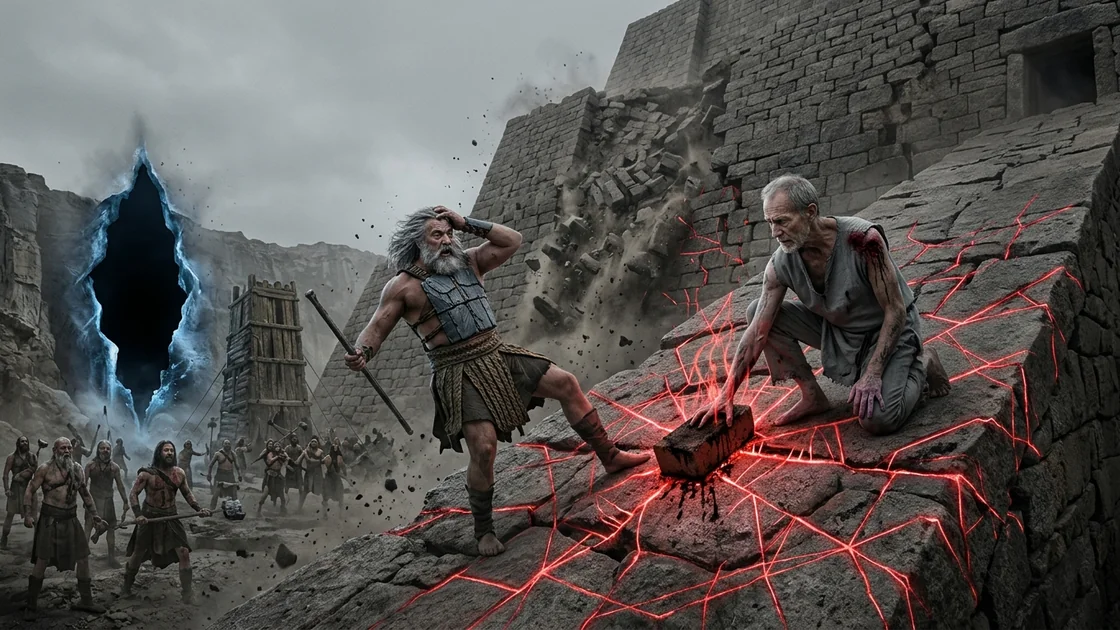
With a snarl of pure fury, Malakor leaped down from the thirty-foot parapet, landing on the second tier of the ramp with a heavy thud that cracked the slate beneath his heels, and charged down toward Caelum, the sharpened iron boundary rod held like a lance in both hands.
Caelum did not run. He knelt right there on the rough granite stones of the ramp.
With his right hand, he unstoppered the stone jar at his waist and poured the thick, black library-ink directly over the cured mudbrick from Mera’s village, coating it in the concentrated essence of ten thousand burned histories. With his left hand, he took the lump of red cinnabar—the pigment of foundation blueprints—and drew a single, straight crimson line across the black-soaked brick.
Then, as Malakor’s shadow fell over him and the iron rod hissed downward toward his throat, Caelum slammed the inked brick flat against the keystone of the ramp’s central arch.
"Sarnath-Vael!" Caelum cried out, speaking not with the voice of a clerk, but with the legislative authority of the Great Parchment itself—and with the full, unshielded weight of his own forty years of mortal guilt. "Sector One, Block Four, House Twelve! The house of Tomas the lute-maker, beside the Weavers' Aqueduct! Let the stone remember what it was quarried for!"
The iron rod pierced Caelum’s left shoulder, pinning him backward against the granite ramp. A white-hot agony tore through his spectral flesh as the iron bit deep, and thick, dark ink poured from the wound instead of blood, splashing across Malakor’s hands and chest.
Malakor laughed triumphantly, leaning his full weight onto the rod to drive it through Caelum’s spine. "Die twice, then, little surveyor!"
Then the granite beneath Malakor’s bare feet spoke.
The red cinnabar line on Mera’s brick flared like a struck match, and from it, a web of blinding crimson geometry shot outward through the blood-and-lichen seams of the Bastion of Teeth.
The Law of the Lintel, which Malakor had sought to evade by using dry granite instead of clay, had been carried into the heart of his fortress by Caelum’s body and Mera’s cured brick. Instantly, the six million stolen boulders remembered their true designations on the map.
And more than that: the ink from Caelum’s wound—distilled from the burned libraries and infused with the cartographer’s own four-century penance—soaked into the stone beneath Malakor’s boots and forced the fortress to feel what it was built of.
Malakor gasped, his hands locking onto the iron rod as the crimson light ran up his arms.
In a single, shattering instant, the protection of the cold stone vanished. Through the iron rod and the ink-slick granite, the memory of House Twelve in Sarnath-Vael slammed into the Sovereign’s mind with the force of a tidal wave.
Malakor did not see a grand map of troop movements or a glorious plume of smoke rising over a conquered horizon. He was suddenly inside a small, cedar-scented room near the Weavers' Guildhall. He felt the delicate, arthritic fingers of Tomas the lute-maker smoothing varnish over a belly of spruce wood. He heard the girl sitting by the window—twelve years old, wearing a yellow dress stained with mulberries—humming a scale while the ground began to tremble from the collapse of the subterranean aqueduct that Caelum Vance had mapped and Malakor Vane had mined.
Malakor felt the terror—not as an abstract concept, not as a military advantage, but from the inside of the twelve-year-old girl’s ribs as the limestone wall buckled inward and the ceiling beam crushed her lungs. And behind her, surging up through the millions of tons of stolen rock in the ziggurat, came a million more: the weavers, the bakers, the scholars clutching their scrolls in the blazing library, the horses screaming in their stalls, the mothers trying to shield infants from the falling slate.
"Stop it!" Malakor screamed, tearing his hands away from the iron rod as if it were white-hot steel. He stumbled backward up the ramp, clutching at his temples, his eyes wide with a horror he had never known on any battlefield. "Get them out! Get them out of the stone!"
All across the Bastion of Teeth, the crimson blueprint lines blazed like lightning through the dry-stacked granite.
A stone cannot stand in two places at once. It cannot be a tyrant’s boast when it knows it is meant to be a lute-maker’s threshold.
With a sound like a mountain range sighing in relief, the friction holding the cyclopean masonry together vanished. The blood-and-lichen mortar turned to dry gray ash.
"The wall!" screamed Khan Temur from the upper tier, as the twenty-ton granite blocks beneath his feet suddenly lost their jagged edges, smoothing themselves into flat, neat hearthstones and lintels that could no longer support the monstrous weight above them. "The wall is turning to—"
The Bastion of Teeth did not explode; it simply slumped.
Like a sandcastle caught by the incoming tide, the three-hundred-foot ziggurat of tyranny dissolved into a roaring avalanche of cascading rock. The seven-story wooden siege tower at the base groaned as its rollers snapped, tipping sideways and smashing into ten thousand harmless cedar rafters and pine floorboards across the quarry floor. Warlords and emperors went tumbling down the collapsing slopes in a billowing cloud of grey dust, not crushed to death—for the stones were no longer weapons—but carried down like leaves on a landslide of reclaimed building materials.
Beside the quarry, as the unnatural concentration of weight vanished from the single point on the map, the twenty-foot tear in the sky shuddered. With a long, whistling inhalation, the edges of the Great Parchment knitted themselves back together, sealing the freezing blackness of the Void away behind the solid, grey ceiling of the sky.
When the dust finally began to settle over the ridge, the jagged mountain was gone.
In its place lay a vast, orderly field of neatly dressed limestone blocks, stacks of seasoned pine timber, and mounds of soft, damp clay—all arranged along thousands of glowing crimson lines that led back toward the abandoned sectors of the plains.
High on the remains of the central mound, Caelum Vance lay on his back among the rubble, the iron boundary rod still protruding from his left shoulder. His vision was swimming at the edges, his spectral form flickering like a candle flame in a draft as his ink-blood soaked into the dirt beneath him. By binding himself to the map and taking an iron wound in the three-dimensional plain, he had spent nearly all the substance that held his soul together.
Footsteps crunched in the gravel nearby.
General Varro appeared out of the drifting grey haze, coughing dust from his lungs. He knelt beside Caelum, looking with dismay at the iron rod pinned through the cartographer’s shoulder into the earth. Gently, with hands that had learned a measure of delicacy from four hundred years of shaping roof tiles, the old general gripped the iron shaft and pulled it free, tossing it aside into the shale.
"You are fading, Master Vance," Varro said softly, pressing a scrap of his own torn tunic against the black ink welling from Caelum’s chest. "We must carry you back to the basalt road, to your spire."
"I cannot climb the stairs, Varro," Caelum whispered, though there was no fear in his voice—only a profound, bone-deep exhaustion that felt remarkably like peace. "When I stepped through the vellum, I traded my place in the tower for a place on the map. The parchment is whole. The Auditors can find another clerk to hold the brush."
He turned his head slightly against the gravel.
Ten paces away, at the bottom of a shallow depression where the foundation of the ziggurat had been, knelt Malakor Vane.
The Sovereign of the Iron Sun was no longer wearing his slate breastplate; the cords had snapped in the collapse, leaving him bare-chested in the dust. He was on his knees, staring down at his own massive, scarred hands. They were trembling violently. In front of him lay a pool of rainwater and grey clay that had welled up from a spring uncovered by the falling rocks, and beside it lay Mera’s cured mudbrick, still marked with Caelum’s red line.
Malakor was not shouting. He was not looking for a weapon. His broad shoulders were heaving in silent, convulsive sobs as the memory of the lute-maker’s daughter in her yellow dress echoed endlessly through the chambers of his mind, stripping away forty years of imperial bronze and leaving only a broken, terrified old man in the dirt.
"A yellow dress," Malakor choked out, his deep voice shattered into a jagged whisper as tears cut through the granite dust on his cheeks and dripped into the wet clay between his knees. "She wasn't even holding a stone. She was just sitting by the window. Why didn't somebody tell me she was sitting by the window?"
Slowly, Caelum pushed himself up on his good elbow. Ignoring the dull ache in his left shoulder, he crawled across the gravel over to the edge of the shallow pit and lowered himself into the mud beside the king he had once served.
Malakor looked up at him through a blur of tears and grey filth, his dark eyes hollow and ruined.
"There are a million of them, Vance," the Sovereign whispered, clutching at his chest as if his heart were bursting. "I can hear all thirty-seven cities in the dirt. If I touch the mud, they will tear me apart from the inside. I can't build a million houses. No man can carry that."
Caelum looked down at his own left hand—at the three fingers that had been stained purple for four hundred years by the ink of his mortal maps. As he dipped his hand into the cold, wet clay beside Malakor’s knee, he noticed that the dark stain on his skin was finally beginning to wash away into the mire, leaving pale, clean flesh beneath.
"You do not build a million houses, Majesty," Caelum said softly, scooping up two heavy handfuls of the wet grey mud and placing one into Malakor’s trembling palms. "You build one brick. You knead the clay four hundred times, until you know the lute-maker’s name and the song his daughter was humming. Then you set it in the sun to dry. And when it is cured, we will lay it on the red line together."
Around the rim of the quarry, the other warlords stood watching in silence. One by one—first Varro, then Khan Temur, then Admiral Drakon—they turned away from the ruins of their false fortress and began walking slowly back down the rocky trail toward the glowing crimson lines of the cities waiting for them in the plains below.
In the quiet basin at the center of the ridge, the cartographer and the conqueror knelt side by side in the mire, and began to shape the mud with their bare hands.