The Breath of Glass and Sawdust
Silas Vance, a solitary master taxidermist living in a remote mountain lodge, is brutally murdered by a quartet of ruthless poachers after he refuses to preserve their illegal kills and threatens to expose their crimes to the authorities. Trapped at the estate by a catastrophic winter blizzard, the killers celebrate their conquest by drinking the old craftsman's liquor and planning to loot his priceless collection of preserved wildlife. However, Silas's dying blood mingles with his ancestral curing compounds upon the floor of the grand trophy room, awakening the dozens of stuffed predators and massive game beasts he spent his life honoring. One by one, the poachers discover that bullets cannot stop creatures made of iron wire, cured leather, and sawdust, as the silent mounts step down from their pedestals to hunt the hunters through the dark corridors of the snowbound lodge.
The eyes were always the hardest part to get right. Anyone with a sharp scalpel, a bag of borax, and a rudimentary grasp of anatomy could skin a carcass, salt the hide, and stretch it over a polyurethane mannequin bought out of a wholesale catalog. The valleys of northern Montana were full of amateur stuffers who turned noble stags into lopsided, glassy-eyed caricatures that hung above the neon beer signs in roadside taverns.
Silas Vance did not buy forms from catalogs, and he did not use cheap acrylic spheres.
Sitting at his heavy maple workbench beneath the amber cone of a single articulated lamp, Silas held a pair of curved surgical forceps between thumb and forefinger. Caught in the serrated tip of the steel was a concave dome of hand-blown German crystal, painted on the reverse side with microscopic strokes of oil pigment—amber, burnt umber, and a ring of oxidized gold around a pupil as deep and black as an abandoned mine shaft.
On the table before him rested the head of a great gray owl. The bird had been brought to him three days ago by a forestry ranger who had found it dead at the base of a fire tower, its neck snapped during a midnight gale. Silas never killed the animals that graced his workshop. That was his first and most inviolable law. He took only what winter starved, what lightning struck, what old age claimed, or what the blind steel of logging trucks left cooling on the mountain passes. To take a life merely to arrest its motion was, to Silas, a blasphemy against the very art he practiced.
With the tip of a modeling tool, he adjusted the thin ribbon of dark grey apoxie clay lining the interior rim of the owl’s orbital socket. Gently, with a steady breath that barely fogged the cold air of the subterranean cellar, he slipped the glass sphere beneath the preserved skin of the eyelid. He used a slender needle to coax the tiny, stiffened feathers of the facial disc back into their natural radial symmetry.
When he leaned back and switched off the magnifying loupe strapped to his forehead, the owl stared back at him. It did not look dead. It looked merely interrupted, as though between one heartbeat and the next it had chosen silence over flight.
"There you are, old ghost," Silas murmured. His voice was a dry rasp, underused and rough as bark. At sixty-eight, his knuckles were swollen with the arthritis that came from forty winters of submerging his hands in alum baths and icy mountain streams, yet his grip remained as sure as a vise.
Above his head, the heavy timber joists of Blackpine Lodge groaned under the weight of the December blizzard. The wind coming down off the Continental Divide didn't just blow; it shouldered against the log walls like a herd of freezing cattle seeking warmth. Fine sifts of snow, driven like powdered glass through the microscopic seams of the storm shutters, hissed against the hot stovepipe in the corner of the workshop.
Silas stood up, untying his oil-stained leather apron. He was a tall man, gaunt and slightly stooped, with a shock of iron-gray hair and eyes the color of river slate. Before leaving the cellar, he walked along the long steel tables to check the curing vats and the drying racks. The air down here was a sharp, familiar soup of turpentine, cedar shavings, carbolic acid, and the mineral tang of his grandfather’s preservative paste—a thick, dark unguent kept in lead-lined crocks that used bitter salts, crushed wintergreen, and white arsenic rather than modern synthetic formaldehydes.
Satisfied that the dampers on the coal stove were set for the night, he climbed the heavy oak stairs leading up to the main floor of the lodge.
Blackpine Lodge had been built in the late nineteenth century by a copper baron who had gone bankrupt before he could ever spend a winter within its walls. Silas’s grandfather had bought the defaulted property for a song in 1924, turning the massive, isolated estate into both a home and a private museum of natural history. There was no town for forty miles in any direction. The single gravel road that wound up through the treacherous switchbacks of Devil’s Kettle Pass was impassable from November to April, save by snowcat or heavy tracked vehicles.
Silas pushed through the heavy baize-lined door at the top of the cellar stairs and stepped into the Great Hall.
Even after six decades of living under its roof, the room never failed to command his reverence. It was sixty feet long and forty feet wide, with a vaulted ceiling of peeled Douglas fir beams lost in the high, smoky gloom above. At the far end, a hearth large enough to roast an ox held a bed of glowing larch coals.
And in the shadows between the hearth and the doorway stood the congregation.
There were no plaques with dates or brass plates boasting of rifle calibers and Boone and Crockett scores. Silas detested the language of the trophy room, though that was what the few outsiders who had ever seen the hall insisted on calling it. To him, it was the Sanctuary.
Along the eastern wall, poised upon a crag of faux granite constructed from burlap, plaster, and real mountain scree, stood Phantom—a two-hundred-pound tom cougar that had died fighting a pack of wolves during the harsh winter of ninety-six. Every muscle under its tawny hide had been carved by Silas out of high-density basswood before the skin was ever laid on, capturing the precise kinetic ripple of a cat coiled to spring.
Across the room, near the tall lancet windows now banked four feet high with drifted snow, stood The Monarch. He was a Roosevelt elk of prehistoric proportions, his antlers spreading nearly six feet across, boasting fourteen dagger-like tines polished to the color of old ivory and dark walnut by decades of rubbing against pitch pines. He had drowned breaking through the thin ice of Crater Lake ten autumns ago; Silas had spent four months with a winch and a sled recovering the carcass and another year building the internal steel armature required to support the massive neck.
In the dark rafters overhead hung the raptors—golden eagles with seven-foot wingspans, goshawks frozen in steep stoops, and a parliament of ravens and great horned owls perched along the crossbeams, their glass eyes catching the dull crimson wink of the fireplace embers. Beneath them, arranged in naturalistic dioramas along the perimeter of the hardwood floor, were the smaller cousins of the timberline: a wolverine snarling over a splintered marrow bone, its coarse brown fur glistening with lacquer; a pair of badgers with three-inch digging claws; a pack of three timber wolves led by Sable, an enormous black alpha female who had died of old age in the sanctuary boundary and whose lips were drawn back only slightly, revealing real enamel teeth set into cast resin gums.
And in the exact center of the hall, towering upon a circular plinth of oiled red cedar, stood Boreas.
Boreas was a Kodiak grizzly, brought down from Alaska on a flatbed railcar thirty years prior after being struck and killed by a freight locomotive near Seward. Standing on his hind legs, the bear reached nearly twelve feet into the air. His forepaws were the size of iron skillets, tipped with five-inch curved claws of dark keratin. His coat was a thick, grizzled expanse of silver-tipped chocolate fur that smelled faintly of camphor and ancient pine. Silas had spent two years of his prime constructing the bear’s interior—welding heavy iron pipe for the spine and femurs, wrapping the frame in hemp twine and wood wool, and sculpting the terrifying, cavernous roar of the mouth with such anatomical precision that even the tiny papillae at the back of the throat were visible if one dared to stand close enough to peer between the four-inch canines.
Silas walked up to the cedar plinth and laid his palm against the thick fur of the bear’s flank. The hide was cold, absorbing the ambient chill of the drafty hall.
"Hard freeze tonight, old man," Silas whispered, his breath pluming white. "Thirty below before dawn."
That was when he heard the engines.
At first, he mistook the low, rhythmic throbbing for the wind vibrating against the chimney flue. Then a beam of piercing bluish-white light swept across the frosted clerestory windows near the ceiling, briefly illuminating the glass eyes of the eagles in the rafters like a constellation of falling stars.
Silas frowned, stepping away from the bear. The Forestry Service never came up Devil’s Kettle Pass at night during a whiteout, and the county snowplow stopped at the mile-twelve gate three leagues down the mountain.
The heavy grinding of metal tracks biting into packed snow grew louder, accompanied by the deep, diesel roar of a high-torque engine. A second pair of headlights joined the first. They pulled right up to the broad timber porch at the front of the lodge, the engines idling for a long moment before shutting off with a twin shudder that rattled the windowpanes.
Silas walked to the front vestibule, pausing by the umbrella stand where he kept an old side-by-side twelve-gauge shotgun loaded with buckshot—a precaution against rabid coyotes or the occasional desperate drifter. He didn't pick it up, not yet, though his hand lingered near the checkered walnut stock. He switched on the exterior floodlight and peered through the narrow sidelight of the four-inch-thick oak door.
Two modified Bombardier snowcats sat in his driveway, their matte-black hulls encrusted with rime ice and equipped with heavy winches, roof-mounted LED light bars, and external rifle scabbards. Four figures in high-end Arctic expedition parkas were climbing down from the cabs.
Before they could reach the heavy iron knocker, Silas threw the deadbolt and pulled the door open six inches, leaving the heavy forged-steel security chain hooked across the gap. A blast of needles—wind-driven ice at forty miles an hour—slashed across his face.
"Can I help you?" Silas called out over the howling gale.
The tallest of the four stepped onto the porch, stamping snow from his insulated boots. He pulled down his neoprene face mask and pushed back a hood trimmed with what Silas’s trained eye immediately recognized as rare snow leopard fur. The man was in his late forties, handsome in a sharp, predatory way, with a neatly trimmed beard salted with gray and cold, amused blue eyes.
"Silas Vance?" the man shouted over the wind.
"I'm Vance. The pass is closed. How did you get past the forestry gate?"
"Bolt cutters and a six-ton winch," the man replied smoothly, offering a smile that didn't reach his eyes. "My name is Marcus Thorne. My associates and I are in need of shelter—and your professional services. I’m prepared to pay ten thousand dollars in cash just for the inconvenience of opening this door at midnight, and fifty thousand more by morning."
Silas looked past Thorne. Two men stood behind him near the open cargo bed of the first snowcat, while a woman in a sleek white parka stood on the lower step, her hands buried deep in her pockets. Even in the harsh glare of the floodlight, Silas saw the dark, frozen smears of crimson streaking the tailgate of the vehicle.
"I don't run an inn, Mr. Thorne, and I don't take unscheduled commissions," Silas said evenly. "If you have an emergency, you can come inside until the wind drops, and you can use my satellite phone to call the wardens."
"No wardens," said one of the men by the truck, stepping forward. He was built like a stump—wide, thick-necked, with a jagged scar running through his left eyebrow and a heavy semi-automatic shotgun slung across his chest. "Just open the damn chain, old man. My fingers are freezing to my trigger guard."
"Manners, Garrett," Thorne said mildly, never taking his eyes off Silas. "Mr. Vance is an artist. I've seen your work at the Smithsonian exhibition in eighty-nine, Silas. And the private collection of Senator Halloway in Jackson Hole. You're the best in the hemisphere. You won't turn away what we have in the back of that cat. It’s the opportunity of a lifetime."
Silas’s gaze dropped to the shotgun on the bulky man’s chest, then to the suppressed high-caliber bolt-action rifle slung over the shoulder of the third man—a wiry, nervous-looking fellow with dark, sunken eyes who was scanning the treeline as if expecting an ambush.
Silas knew these men. Not by name, perhaps, though he had read about Marcus Thorne in the papers—a billionaire logistics magnate who had been fined a pittance two years ago for shooting black rhinos from a helicopter in Namibia. Silas knew their breed. They were the reason the forests were growing quiet.
"If you're freezing, come into the vestibule," Silas said, his voice hardening. "Leave the firearms on the porch."
Thorne chuckled. He reached into his coat. Silas tensed, reaching toward the twelve-gauge in the stand, but Thorne didn't draw a weapon. Instead, he nodded to the burly man, Garrett.
Before Silas could slam the heavy oak door shut, Garrett lunged up the steps with terrifying speed for a man of his bulk. He didn't use his shoulder; he slammed the heavy steel muzzle of a hydraulic breaching tool—the kind used by tactical teams—directly into the gap of the door, hooking the forged chain. With two rapid pumps of his thick arm, the pressurized jaws sheared through the half-inch iron links with a sound like a pistol shot.
The door flew inward. The heavy oak edge struck Silas squarely in the collarbone, knocking him backward off his feet. He hit the slate floor of the vestibule hard, the breath exploding from his lungs in a gray mist as the umbrella stand overturned, sending his antique shotgun clattering across the polished floorboards into the shadows of the Great Hall.
The four of them poured in out of the storm, bringing a vortex of swirling snow and the stench of diesel fuel, cordite, and wet blood with them. Garrett kicked the front door shut, throwing the deadbolt himself, and instantly leveled his combat shotgun at Silas’s chest.
"Stay down, grandpa," Garrett grunted, his boot coming down on Silas’s wrist as the old man tried to push himself up.
"Enough, Garrett. Let him up," the woman said. She pulled back her hood, shaking out a bob of platinum-blonde hair. Her face was angular, pale, and entirely devoid of empathy, like a porcelain mask left out in the frost. She looked past the vestibule arch into the Great Hall, and her dark eyes widened slightly as they took in the towering silhouette of Boreas and the dozens of silent beasts emerging from the firelit gloom. "My God. Look at this place, Marcus. The broker in Hong Kong said he had a collection, but this... this is a goldmine."
"Told you, Evelyn," Thorne said, unbuttoning his snow-leopard parka and tossing it onto an antique Victorian settee. He walked over to Silas, offering a gloved hand. Silas ignored it, struggling to his feet while clutching his bruised shoulder.
The fourth man—the wiry one with the sunken eyes—had already retrieved Silas’s twelve-gauge from the floor. He cracked the breech, ejected the two red shells, and tossed the empty gun onto a pile of firewood. "Clear, boss," he muttered, rubbing his unshaven jaw as he stared uneasily up at the rafters where the golden eagles loomed. "Though I don't like this room. Too many eyes."
"Relax, Cole. They're stuffed with sawdust," Garrett laughed, walking into the hall and slapping the solid wooden flank of The Monarch’s elk form. "Damn thing feels like it's carved out of ironwood."
"Basswood and laminated ash," Silas said, his voice shaking not with fear, but with a rising, volcanic fury. He wiped a trickle of blood from his split lip with the back of his hand. "Get your hands off that mount."
Thorne strolled into the center of the hall, his boots clicking on the oak floor as he circled the twelve-foot Kodiak bear. He craned his neck, admiring the glistening resin gums and the fierce glass eyes. "Magnificent. Truly magnificent. There's no tension loss in the hide, no shrinkage around the tear ducts or the nostrils. How old is this mount, Vance?"
"Thirty-two years," Silas spat. "And it is not for sale. None of this is. You have broken into my home. Take whatever food you want from the kitchen, warm yourselves by the fire, and at first light, get off my mountain."
"I'm afraid we can't do that, Silas," Thorne said softly. He turned to Garrett and Cole. "Bring them in. The cold will ruin the ears and the paw pads if they freeze solid before they're fleshed."
Garrett and Cole unlocked the front door and went back out into the howling dark. A moment later, they returned, dragging a heavy crimson-stained canvas tarp between them across the slate vestibule and dumping it directly onto the antique Persian rug in front of the fireplace.
Silas took three slow steps forward. He didn't want to look, yet the compulsion that had driven his entire life pulled him toward the bundle.
Evelyn knelt beside the tarp, pulling on a pair of latex gloves from her pocket, and threw back the heavy canvas flaps.
Silas stopped breathing.
Lying on the wool rug was the skinned, butchered hide and severed head of a mature female Kermode bear—a spirit bear, the exceedingly rare white-coated subspecies native only to the coastal rainforests of British Columbia, though rumors had persisted for years among the rangers that a solitary sow had migrated across the northern Rockies into the Glacier sanctuary. Her thick, cream-white fur was matted with dark, clotted blood and shredded by at least a dozen high-velocity bullet holes. There was no sport here, no clean shot to the vitals; she had been hosed down with automatic gunfire while trying to flee.
And tucked into the folds of the bloody hide beside her massive head were two smaller bundles. Twins. Cubs no more than four months old, their tiny white pelts still attached to their skulls, their throats slit ear to ear to avoid ruining the fur with bullet holes.
Silas felt his knees weaken. He reached out a trembling hand, his fingers hovering an inch above the scorched, blood-caked fur of the mother’s muzzle. Powder burns blackened the white hair around her left eye. They had shot her at point-blank range after she was already down.
"We tracked her for six days inside the sanctuary border," Thorne said, his voice ringing with proud nostalgia as he walked over to the bar cabinet and poured himself three fingers of Silas’s twenty-year-old scotch. "Used thermal drones to find the den. Smoked her out with phosphorus flares. Garrett got a little enthusiastic with the carbine on the sow, I’ll admit, which is why we need a miracle worker like you. Someone who can stitch up the exit wounds on the cape and make it look like a clean single-shot take. I want her standing over the cubs in my foyer in Aspen."
Evelyn stood up, stripping off her latex gloves. "And while I have no interest in the skins, Mr. Vance, I require the gallbladders and the paws packed in dry ice and certified as antique estate specimens from your collection so they can clear customs in Vancouver. You have dozens of pre-ban CITES certificates and museum transfer permits down in your office, don't you?"
Silas slowly raised his eyes from the butchered cubs to look at the four of them. The fear that any rational man would have felt in the presence of four armed killers in an isolated house forty miles from help simply evaporated, burned away by a cold, absolute hatred.
"You smoked a hibernating mother and her cubs out of a winter den," Silas whispered.
"Do you know what a white grizzly diorama is worth on the private market?" Thorne asked, swirling the amber liquor in his glass. "More than you've made in your entire miserable life down in that basement smelling of dead meat and mothballs."
"I would rather cut my own hands off at the wrists with a bone saw," Silas said, each word dropping like a stone into a deep well, "than touch a single hair on those pelts. You are not hunters. You are filth."
The room went dead silent, save for the crackle of the larch coals and the mournful shriek of the wind against the roof timbers.
Thorne’s smile faded. He took a slow sip of the scotch, then set the crystal tumbler down on the cedar plinth between the massive hind paws of Boreas the Kodiak.
"I was hoping you were a pragmatist, Silas," Thorne said quietly. "Evelyn told me you might be difficult. She did some digging into your finances before we came up the mountain. No heirs. No wife. A sister who died in Oregon ten years ago. Nobody checks on you until the spring thaw in May."
Silas didn't wait. Despite his age, he knew every inch of the Great Hall in the dark. He pivoted on his heel and bolted toward the side corridor that led to his office, where the shortwave radio and a heavy .45-70 lever-action rifle hung behind the door.
"Cole," Thorne said lazily.
A sharp, muffled pfft sounded from the vestibule—no louder than a champagne cork popping.
Something struck Silas in the back of the right thigh with the force of a swinging sledgehammer. His leg simply ceased to exist beneath him. He pitched forward, his face smashing against the edge of a glass display case housing a family of preserved pine martens. The tempered glass shattered in a shower of glittering cubes as Silas collapsed onto the hardwood floor, a hot, arterial river of blood soaking instantly through his wool trousers.
He gasped, clutching his shattered femur, the pain blinding white and nauseating.
Cole lowered the suppressed rifle, working the bolt with a slick metallic click and catching the brass casing in his palm before it could hit the floor. "Clipped the femoral, I think," Cole said flatly. "He won't be running anywhere."
Garrett walked over, grabbed Silas by the collar of his flannel shirt and his belt, and dragged him backward across the polished floor like a gutted deer. A wide, glistening smear of dark crimson followed them across the oak planks, staining the edges of the dioramas. Garrett dumped him at the base of the Kodiak’s cedar pedestal, right beside the tarp holding the dead white bears.
Silas groaned, his head lolling back against the cedar wood. Above him, Boreas towered into the shadows, his glass eyes glinting red in the firelight, his massive claws poised inches above Silas’s head.
"Where is the safe, old man?" Evelyn asked, crouching beside him, careful to keep the hem of her white trousers out of the expanding pool of blood. "The CITES permits and the blank provenance ledgers. Tell me the combination, and Cole will put one cleanly through your head so you don't have to feel this anymore."
"Go... to hell," Silas choked out, blood bubbling at the corners of his mouth. His vision was already blurring at the edges, the vast hall tilting and spinning.
Garrett sighed, pulling a heavy ten-inch skinning knife with a gut-hook from his belt sheath. "Let me work on him for five minutes, Marcus. I'll take his fingers off at the knuckles one by one. He'll sing."
"No need for theatrics," Thorne said, walking toward the cellar door that Silas had left slightly ajar. "He was working when we arrived. The lights are on downstairs. Cole, come with me. Let's see what he keeps in his workshop. Garrett, find some rope and tie him to that bear stand so he doesn't bleed on the pelts."
For the next twenty minutes, Silas drifted in and out of a red haze of agony. Garrett didn't bother with rope; instead, the big man simply stood over him, occasionally nudging Silas’s broken leg with the toe of his boot whenever the old man’s eyes began to close, laughing softly as Silas bit through his own tongue to keep from screaming.
Then Thorne and Cole returned from the cellar.
Cole was carrying a steel strongbox he had pried directly out of the masonry wall down in the workshop with a crowbar, and Thorne was holding two heavy stoneware crocks sealed with red wax and labeled in faded fountain-pen ink: Vance Compound – 1928.
"Found the ledgers in the desk," Evelyn said, flipping through a leather-bound folder Cole handed her. "And dozens of signed customs declarations. We don't just have enough paper for the bears, Marcus. We can strip this entire room tomorrow. That elk, the black wolf, this Kodiak—do you have any idea what Russian oligarchs will pay for museum-grade mounts of this scale?"
"And what did you bring up, boss?" Garrett asked, eyeing the heavy stoneware crocks in Thorne’s hands. "Moonshine?"
"His tanning liquor, or whatever alchemical garbage he uses," Thorne said, unscrewing the heavy wire bail on one of the crocks. A pungent, suffocating odor immediately billowed out into the room—a sharp, chemical wave of bitter almonds, wintergreen, camphor, dried nightshade, and metallic arsenic salt. Thorne wrinkled his nose in disgust. "Smells like a morgue in here. You didn't want to preserve my bears, Silas? Fine. Have a drink of your own trade."
Thorne tipped the heavy crock over.
Two gallons of thick, iridescent black-green fluid splashed down over Silas’s chest and face, burning his eyes and pouring down over the cedar pedestal of the Kodiak bear. The heavy stoneware vessel slipped from Thorne’s fingers and shattered against the hardwood floor, the jagged shards slicing into Silas’s hands as the ancient liquid spread outward in a sizzling, oily tide. It mixed with the warm lake of Silas’s arterial blood, turning the crimson pool into a strange, luminescent violet-black mire that soaked deep into the base of the Kodiak’s stand, crept under the wooden plinth of Sable the black wolf, and wicked up into the hem of the tarp holding the butchered spirit bears.
Silas convulsed as the toxic salts entered the open wound in his thigh and the cuts on his palms. It felt as though liquid fire were being pumped directly into his veins, replacing his blood with molten glass and ice.
"Finish him," Thorne said, turning away toward the bar to pick up his scotch. "I don't want to listen to him wheezing while we eat. Garrett, use his own tools. Leave no extra brass on the floor. Tomorrow, before we pull out with the best mounts, we'll douse the place in heating oil and let the fire take the rest. The wardens will think the old hermit knocked over a kerosene lamp in a storm."
Garrett grinned. Moving over to a small rolling cart near the cellar door where Silas had left a tray of grooming instruments, the big poacher picked up a heavy, two-pronged steel fleshing iron and a long, curved upholsterer’s needle used for sewing thick hides along the spine.
Silas couldn't move his legs. His heart was hammering a frantic, erratic tattoo against his ribs. Through a veil of blood and stinging preservative, he looked up into the shadowed vault of the room he had tended for half a century.
He looked at Boreas. He looked at Sable. He looked at Phantom crouching on his plaster crag, and The Monarch with his crown of fourteen daggers.
I gave you back your shapes, Silas thought, the words screaming silently inside his dying mind as his left hand pressed flat against the blood-and-arsenic-soaked fur of the Kodiak’s lower foot. I kept you from the rot. I honored your stillness. Do not let them burn this house. Do not let them walk off this mountain.
Garrett stepped up behind Silas, grabbed a fistful of the old man’s gray hair to expose his throat, and drove the six-inch fleshing blade straight through Silas’s windpipe and deep into the cedar wood of the bear’s pedestal behind his neck, pinning him there like a beetle on a corkboard.
Silas’s body arched once. A single tear, mixed with blood and dark preservative, rolled down his cheek and dropped onto the exposed iron armature wire protruding slightly from the heel of the Kodiak bear.
Then Silas Vance stopped breathing.
And two feet above his head, deep inside a ribcage constructed of welded iron pipe, chicken wire, and tightly packed excelsior shavings, something drew a long, dry, rattling breath.
By two in the morning, the storm had reached its zenith.
Outside, the temperature had plunged to thirty-eight degrees below zero. The wind screamed through the dark pines around Blackpine Lodge like a chorus of grieving banshees, piling eight-foot drifts against the lower windows and burying the two snowcats up to their treads.
Inside the Great Hall, however, the poachers had made themselves comfortable.
They hadn't bothered to move Silas’s body. Garrett had simply thrown an old canvas drop-cloth over the corpse pinned to the base of the Kodiak bear and kicked a few scatter rugs over the sticky pool of blood and spilled chemicals so they wouldn't track it onto the furniture. They had built the fire up until the larch logs roared up the chimney, casting long, dancing shadows across the forty-foot walls.
Evelyn sat in a deep leather armchair near the hearth, a laptop balanced on her knees as she photographed Silas’s blank CITES permits and forged transfer documents by the light of a silver candelabra. Thorne and Garrett sat at the long oak dining table at the south end of the hall, carving thick slices from a smoked venison haunch they had raided from Silas’s larder and washing it down with bottles of vintage Bordeaux from his cellar.
Only Cole wasn't eating.
The wiry sharpshooter stood near the tall, frost-sheathed windows, a cigarette burning between his nicotine-stained fingers, his suppressed rifle still slung across his chest. Every thirty seconds or so, his dark, restless eyes flicked toward the center of the room.
"Will you sit down, Cole?" Thorne said, cutting a piece of rare meat with his pocketknife. "You're pacing like a caged coyote."
"It's freezing in here, Marcus," Cole muttered, exhaling a plume of blue smoke that seemed to hang motionless in the frigid draft. "That fire's roaring like a blast furnace, and I can still see my breath ten feet away from the hearth."
"It's an old log barn with forty-foot ceilings in the middle of an Arctic front," Garrett scoffed around a mouthful of venison. "Drink some wine. Warm your gut."
"It ain't the draft," Cole said. He walked slowly toward the center of the room, stopping six feet shy of the dark stain on the floorboards where Silas lay beneath the canvas sheet. He squinted up at the towering form of Boreas, then turned his head sharply toward the plaster crag along the eastern wall where the cougar, Phantom, was mounted. "Did somebody touch that mountain lion?"
Garrett rolled his eyes. "What are you talking about?"
"When we came in," Cole said slowly, lifting his hand to point with his burning cigarette, "that cat was looking toward the front door. Its head was turned left, ears pinned back, looking right at the vestibule."
Thorne paused, his wineglass halfway to his lips, and glanced over at the eastern wall.
In the flickering orange glow of the fire, the massive tom cougar crouched upon its ledge of faux stone. Its head was no longer turned toward the front door. Its chin was lowered between its muscular forepaws, and its head was angled squarely toward the dining table. Its yellow glass eyes gleamed like twin coins in the gloom.
"You're drunk, Cole, and you haven't even touched a bottle," Garrett laughed, though his hand drifted unconsciously toward the combat shotgun resting on the table beside his plate. "It's a trick of the firelight. Shadows moving on the wall."
"I'm a tracker, Garrett," Cole snapped, his voice tight. "I notice how things sit in the brush. I'm telling you, that cat's head was turned toward the door. And that black wolf over there—" He jabbed his finger toward the timber wolf diorama near the cellar door. "Wasn't there three wolves on that base when we walked in?"
Evelyn looked up from her laptop, irritation creasing her pale brow. "There are three wolves on that base, Cole. Two grays and the big black one in the middle."
Cole stared into the corner. The two gray wolves were there, frozen in mid-trot over a bed of dried moss and pine needles. Between them stood a pair of four-inch iron mounting pins sticking straight up out of the wooden base, shiny and bare where the bolts had been sheared clean through from the inside.
The black alpha female, Sable, was gone.
Before Cole could open his mouth to scream, every light in the lodge died at once.
The electric chandelier overhead winked out. The reading lamps along the walls vanished. Down in the bowels of the house, the low, steady hum of the diesel generator gave a violent, metallic clank-grind and fell dead silent.
Plunged instantly into near-total darkness save for the dying crimson glow of the fireplace at the far end of the hall, the four poachers froze.
"What the hell was that?" Evelyn hissed, the blue glow of her laptop screen illuminating her terrified face like a ghost mask. "Close that damn screen!" Garrett barked, grabbing his shotgun and clicking on the tactical flashlight mounted beneath the barrel.
A harsh, blinding white beam cut through the gloom of the Great Hall. Garrett swept it toward the corner by the cellar door.
Two gray wolves stood on the wooden diorama base. The center space was empty.
"What did you do, Cole?" Thorne demanded, standing up so fast his heavy oak chair toppled backward with a loud crash. Thorne snatched his custom .458 Winchester Magnum double rifle from the sideboard and broke it open, thumbing two massive brass cartridges as thick as cigars into the chambers before snapping it shut. "Is somebody else in this house? Did the old man have a helper down in the basement?"
"Nobody was down there when we got the safe!" Cole said, his voice rising an octave as he flicked on his own weapon light, sweeping the rafters overhead. "Look! Look at the base! The iron rods are snapped right off!"
"Nobody snaps half-inch steel rods by hand," Garrett growled, though the arrogance had vanished from his voice. "The generator threw a rod or ran out of fuel in the cellar. Or there's somebody else down there who cut the breaker and dragged that wolf off to mess with our heads."
"Why would someone steal a stuffed wolf in the middle of a blizzard?" Evelyn whispered, pulling a compact nine-millimeter pistol from her shoulder holster beneath her wool sweater.
"I don't know, and I don't care," Thorne snarled. "Cole, Garrett—go down to the cellar. Check the generator and clear the basement rooms. If there’s a ranch hand or a ranger hiding down there, put him down."
"I ain't going down there alone with Garrett while you sit by the fire," Cole said, backing away from the cellar door, which stood ajar like a black, yawning mouth at the edge of the room.
"You'll go down there if you want your quarter-million cut when we get off this mountain!" Thorne roared. "Garrett, cover the stairs. Cole, check the breaker panel and the fuel tank. Move!"
Swearing under his breath, Cole wiped the sweat from his upper lip despite the bitter cold of the room. He thumbed the safety off his suppressed rifle, keeping his flashlight beam trained squarely on the dark doorway. Together, he and Garrett approached the cellar entrance.
As they passed the center of the hall, Garrett’s light swept across the base of the Kodiak’s cedar pedestal.
Garrett stopped dead in his tracks, grabbing Cole’s shoulder. "Wait."
"What?" Cole hissed.
Garrett pointed the beam of his shotgun light down at the floor. The canvas drop-cloth they had thrown over Silas Vance’s corpse was still there, soaked dark with blood and the black-green preservative fluid. Sitting right beside it was the heavy steel fleshing blade Garrett had driven through the old man’s throat into the cedar post.
The blade was twisted into a corkscrew, wrenched straight out of the solid wood.
And from the dark, sticky pool of fluid surrounding the pedestal, a set of massive, five-toed paw prints—each pad four inches wide and tipped with long, dragging gouges in the oak varnish—led away from the wolf diorama and straight toward the open cellar door.
"Wolves don't bleed black," Cole whispered, his hands shaking so violently that the beam of his rifle light danced wildly against the doorjamb. "That's the stuff Marcus poured on the old man."
"Shut up," Garrett spat, though his broad face had gone the color of tallow in the cold. "A stray dog got in through the coal chute, stepped in the mess, and knocked the mount over. Come on. I'm right behind you."
Garrett kicked the baize-lined door all the way open and aimed his twelve-gauge down the steep oak staircase. The beam illuminated the concrete floor at the bottom, the rows of stainless-steel fleshing tables, and the dark, quiet corners of Silas’s subterranean workshop. Nothing moved. Only the faint hiss of cooling coal in the basement stove broke the silence.
"Clear down the steps," Garrett muttered. "Go left when you hit the bottom, Cole. The generator room is behind the boiler. I'll hold the landing so nothing gets behind us."
Cole swallowed hard. He hated tight spaces; he had spent his whole life in the open timber and the high scree where a man could see a mile through a rifle scope. Down here, the air was so thick with the chemical stench of carbolic acid, old skins, and that sweet, sickly wintergreen compound that it coated the back of his tongue like grease.
Step by slow step, his insulated boots creaking on the heavy oak treads, Cole descended into the basement.
At the bottom, he pivoted left, sweeping his light across the long workbenches. Everywhere he looked, glass eyes stared back at him out of the gloom. Half-finished mounts sat clamped in iron vises—a red fox with only half its face skinned over a clay skull; a bobcat wired into a mid-air leap, its belly still slit open and stuffed with gray wood-wool held in place by crisscrosses of butcher’s twine; jars of pickled reptiles and glass bell-jars filled with preserved crows and hawks.
"Cole?" Garrett’s voice echoed down from the top of the stairs, sounding distant and small. "You see the breaker box?"
"Yeah. Across the room by the curing vats," Cole called back, keeping his voice low.
He moved between two long steel tables. To his right stood the great gray owl Silas had been working on when they arrived. Cole’s light caught it, and he flinched, nearly pulling the trigger before realizing it was clamped to a wooden perch.
Then he heard it.
Click-scrape. Click-scrape.
It wasn't the sound of a living animal. Cole had hunted wolves across three states and two Canadian provinces; he knew how a living wolf moved. A living wolf had soft, pliable footpads and tendons that cushioned its weight.
This sounded like hardened leather and dry horn dragging across concrete, accompanied by the faint, rhythmic creak of an old saddle and the metallic tink of heavy gauge iron wire flexing inside a hollow wooden chest.
Cole spun around, bringing his rifle to his shoulder.
At the far end of the aisle between the worktables stood Sable.
The black timber wolf was huge—nearly a hundred and forty pounds of prime winter fur over a solid laminated wood and polyurethane core. Her glass eyes didn't shine with the natural tapetum reflection of a living canine; they reflected the LED beam like cold, dead marbles. Her lips were curled back in a permanent, sculpted snarl of pink epoxy gums and real yellowing fangs. And protruding from the bottoms of her four paws were the jagged, sheared stubs of the half-inch iron mounting rods that had anchored her to the pedestal upstairs, scraping sparks and white grooves into the concrete floor with every stiff, jerking step she took.
Cole didn't hesitate. He was a marksman by trade. He centered the crosshairs of his scope directly between the wolf’s chest and squeezed the trigger twice in rapid succession.
Pfft! Pfft!
Two heavy .308 subsonic rounds struck the wolf dead center at fifteen feet. A living animal would have been lifted off its feet, its heart and lungs liquefied by hydrostatic shock.
The bullets punched neat holes through the black fur. There was a dull, woody thud-thud, like firing into a dry cedar log, and two small puffs of gray sawdust, powdered borax, and dry plaster burst out of the wolf’s chest.
Sable didn't even break stride.
"Garrett!" Cole shrieked, working the bolt of his rifle in a blind panic and firing again.
The third shot struck the wolf squarely in the left eye. The hand-blown German glass sphere shattered into a thousand glittering shards, revealing the dark, unpainted gray clay and twisted iron wire inside the hollow eye socket.
With a sound like tearing canvas and snapping pine branches, the dead wolf launched itself thirty feet down the aisle.
Cole tried to scramble backward over the stainless-steel fleshing table, knocking scalpels, forceps, and jars of glass eyes crashing to the concrete. Before he could clear the edge, the wolf’s jaws clamped down on his left ankle.
There were no muscles in the wolf’s jaw—only whatever terrible, sympathetic force drove the cured hide and the resin skull—yet the bite came down with the hydraulic pressure of an industrial rock crusher. Cole screamed as his insulated boot, his wool sock, and both bones of his lower leg shattered instantly with a wet, echoing snap. The sheared iron mounting rods beneath the wolf’s front paws came down on his thigh as the beast landed on the table with him, punching two deep, ragged holes straight through his flesh and pinning him to the steel surface.
At the top of the stairs, Garrett heard the screaming and the dull pop of the suppressed rifle.
"Cole!" Garrett yelled, taking two steps down the stairs before stopping cold as the sounds from below registered in his mind. It wasn't just one animal down there. Amidst Cole’s high, ragged shrieks, Garrett heard the frantic scuttling of dozens of tiny, hard claws on metal, the dry whir-smack of stiffened feathers beating the air, and the wet, tearing sound of teeth ripping through Gore-Tex and muscle.
Down on the steel table, Cole thrashed wildly, swinging the butt of his rifle into the black wolf’s skull again and again, denting the taxidermy clay beneath the fur and tearing loose flaps of stitched hide, yet the jaws on his leg only ground deeper.
And then the rest of the workshop came to the table.
From the overturned bell-jars and the drying racks along the walls, the half-finished mounts dropped onto the concrete and scrambled up the steel legs of the workbench. The bobcat—still slit open down the belly, trailing yards of unraveling butcher’s twine and spilling clumps of sawdust across Cole’s chest—raked its preserved claws across his face, blinding his right eye in a spray of crimson. The half-skinned red fox, half of its head nothing more than a glistening gray sculpture of modeling clay and exposed brass wire, buried its small, needle-sharp teeth into his wrist, forcing him to drop the rifle.
Above him, the great gray owl wrenched its talons free of its wooden clamp with a splintering crack and dropped straight down onto Cole’s face, its curved black beak striking between his teeth as he opened his mouth to scream one last time.
Sable shifted her grip from Cole’s shattered leg, planted her iron-pinned paws on his chest with a crunch of breaking ribs, and clamped her resin-set fangs around his throat. With one violent wrench of her rigid wooden neck, she tore his windpipe out in a shower of dark blood.
At the top of the stairs, Garrett didn't wait to see what climbed up out of the dark. As the screaming abruptly choked off into a wet gurgle, followed by the rhythmic scrape-clank, scrape-clank of iron rods ascending the bottom oak treads of the staircase, Garrett leaped backward into the Great Hall, slammed the heavy baize door shut, and threw the massive brass deadbolt across the frame.
"What happened?" Thorne shouted, backing toward the fireplace with his double rifle leveled at the cellar door. "Where is Cole?!"
Garrett was breathing like a winded horse, sweat pouring down his scarred face as he backed away from the bolted door, his twelve-gauge trembling in his grip. "They're moving," he whispered, his voice cracking like a boy’s. "The things down in the basement—the wolf—Cole shot it three times point-blank and it didn't even slow down! It tore him apart!"
"Are you out of your mind?!" Evelyn screamed, pressing her back against the stonework of the chimney, her nine-millimeter wavering between Garrett and the shadows of the vast room. "They are dead animals! They're wood and stuffing!"
BOOM.
Something struck the inside of the cellar door with the force of a battering ram. The heavy oak panels bulged inward, splintering down the center seam, and dust rained down from the doorframe. Outside the door, the sound of heavy claws—not just the wolf’s, but dozens of frantic, scratching digits—raked against the wood like a legion of iron rakes.
Thorne stared at the bulging door, the color draining completely from his face. Then, slowly, he raised his eyes to the center of the Great Hall.
The circular cedar plinth in the middle of the room was empty.
Twelve feet of Kodiak grizzly—six hundred pounds of cured hide, iron pipe, hemp rope, and five-inch claws—was no longer standing on its pedestal.
And neither was Silas Vance’s body.
"Look up!" Garrett roared, jerking the barrel of his shotgun toward the vaulted ceiling forty feet overhead.
In the high, smoky darkness among the Douglas fir rafters, the wooden perches were bare. The air above them was suddenly filled with a dry, papery rustling, like autumn leaves blowing across a graveyard, accompanied by the creak of stiffened wing-wires bending against seventy years of lacquer.
A golden eagle dropped out of the gloom like a feathered anvil.
It didn't flap its wings; its wings were fixed in a permanent, rigid stoop by quarter-inch steel rods threaded through its hollow humorous bones. It fell with the silent, terrifying velocity of a lawn dart, its three-inch yellow talons extended straight toward Evelyn’s face.
Garrett fired from the hip.
The blast of the twelve-gauge was deafening inside the log walls. A cloud of buckshot caught the eagle mid-dive, shredding its tail feathers and blowing a fist-sized chunk of balsa wood and wire mesh out of its breast. The impact knocked the bird off course just enough that its talons missed Evelyn’s throat and instead raked deep across her left shoulder as it crashed onto the dining table in a shower of shattered wine bottles and splintered porcelain.
Evelyn shrieked, clutching her bleeding shoulder as the mangled eagle immediately began dragging itself across the oak tabletop toward her, using its broken, wired wings like crutches, its glass eyes fixed blindly on her face while a long piece of iron spine-wire protruded through the back of its neck.
"Run!" Garrett bellowed, firing two more shells into the rafters as a swarm of preserved crows, goshawks, and great horned owls detached themselves from the crossbeams in a dry storm of dust and feathers. "Upstairs! Get to the second-floor gallery!"
Thorne didn't wait for the woman. The billionaire bolted across the Great Hall toward the grand staircase made of split pine logs that curved up to the second-floor balcony overlooking the room. Garrett grabbed Evelyn by the collar of her bloodstained sweater and hauled her after him, swatting a stuffed raven out of the air with the hot barrel of his shotgun—the bird bursting like an old pillow filled with arsenic powder and straw as it hit the stone hearth.
Just as they reached the bottom of the grand staircase, a shadow detached itself from the plaster crag along the eastern wall.
Phantom, the two-hundred-pound tom cougar, hit the hardwood floor twenty feet behind them with a heavy, wooden thump. Unlike the wolf, the cougar’s internal mannequin had been articulated by Silas with flexible steel cables and laminated ash joints. It ran with a terrifying, jerky imitation of feline grace—its spine snapping upward and downward like a giant steel mousetrap with every bound, its dry leather hide groaning as it closed the distance across the polished oak in three massive leaps.
"Behind us!" Evelyn screamed, scrambling up the log steps on her hands and knees.
Garrett spun on the fifth step, pumping the action of his shotgun, and pulled the trigger.
Click.
He was out of shells.
Before he could reach into his tactical vest for another round, the cougar launched itself from the bottom of the stairs. It struck Garrett squarely in the chest, driving the two-hundred-pound ex-mercenary backward onto the first-floor landing.
"Marcus! Shoot it! Shoot it!" Garrett howled, wedging the steel barrel of his empty shotgun crosswise between the cougar’s open jaws as the beast tried to clamp its four-inch canines onto his face.
From ten feet above on the balcony railing, Marcus Thorne looked down. He had his .458 double rifle leveled, but he didn't fire. He saw something emerging from the shadows near the front vestibule that turned his blood to slush.
Walking out of the gloom with the heavy, deliberate cadence of a siege engine was The Monarch. The colossal bull elk lowered its head until the tips of its fourteen-point antlers brushed the floor, its hooves clicking like castanets on the wood, blocking the only path back to the front door. And behind the elk, stepping out of the shadows behind the bar, came a pair of wolverines and two badgers, their rigid bodies hopping forward in stiff, unnatural lunges.
Instead of helping Garrett, Thorne turned and sprinted down the second-floor hallway, slamming a heavy bedroom door behind him.
"You bastard!" Garrett roared. With a surge of desperate, adrenal strength, Garrett brought his heavy boot up into the cougar’s stiff wooden belly and shoved with everything he had. The cat tumbled backward down the five steps onto the floor of the hall.
Garrett didn't try to climb the stairs—the cougar was already scrambling back up onto its paws at the base of the steps, and the massive bull elk was breaking into a thunderous, stiff-legged charge across the hall toward him. Instead, Garrett rolled to his feet and dove headfirst down the narrow service corridor behind the staircase that led toward the kitchen and the attached garage where the snowcats were parked outside.
Up on the second-floor balcony, Evelyn watched Garrett disappear down the service hall just as The Monarch struck the bottom of the grand staircase.
The impact shook the entire log structure of the lodge. Two of the elk’s massive brow tines punched four inches deep into the solid pine newel post like railway spikes. With a jerk of its thick wooden neck, the elk wrenched its antlers free, tearing the heavy post out by the roots, and turned its blind, glassy gaze upward toward Evelyn on the balcony.
Whimpering, blood streaming between her fingers from the deep talon gouges in her shoulder, Evelyn scrambled backward away from the railing. She didn't go toward the bedroom where Thorne had locked himself in; she knew Marcus well enough to know he would shoot her through the door before he let her compromise his hiding spot. Instead, she remembered the layout of the lodge from the blueprints she had studied before the trip: the back stairs at the end of the kitchen wing led directly down to the mudroom and the exterior side door, barely ten yards from the parked snowcats.
She had the spare ignition keys in her pocket.
Checking that the magazine of her nine-millimeter was full, she ran on silent feet down the dark upper gallery, past glass cases filled with preserved songbirds and mounted trout that seemed to vibrate and rattle against their brass plaques as she passed.
Down in the freezing darkness of the kitchen wing, Garrett was reloading on the move.
His thick fingers were numb with cold and slick with sweat as he shoved five twelve-gauge foster slugs—solid one-ounce lead projectiles meant for stopping charging grizzlies—into the magazine tube of his Benelli shotgun. He racked the bolt, chambering a slug, and pressed his back against the stainless-steel door of the walk-in meat locker to catch his breath.
The kitchen was pitch-black, lit only by the faint, milky luminance of the snowbank piled against the high window over the sink.
Behind him, out in the Great Hall, he could hear the rhythmic thud-crack of something massive battering against the grand staircase, and the frantic, chittering rush of smaller paws dispersing throughout the house.
Just get to the mudroom, Garrett told himself, wiping his bloody nose on his sleeve. Get out the side door, dig out the driver's door of the Bombardier, and drive that six-ton tracked tank straight through the wall of this cursed house if you have to.
The mudroom door was twenty feet away, past the central butcher-block island where Silas prepared his meals.
Garrett switched on his weapon light and stepped out from behind the meat locker.
Sitting directly in the center of the butcher-block island was the wolverine.
It was a forty-pound specimen, mounted in a classic aggressive posture over a piece of driftwood. Except the driftwood had been torn away, leaving ragged strips of burlap and plaster dangling from its belly, and buried deep in its jaws was a piece of Cole’s camouflage parka, wet and dripping with dark blood.
Before the wolverine could spring, Garrett raised the shotgun and fired a one-ounce lead slug from six feet away.
BOOM!
The heavy slug hit the wolverine squarely in the snout. Unlike buckshot, the massive lead ball had enough kinetic energy to completely shatter the cast-resin skull and blow the entire front half of the polyurethane form into a cloud of white foam shrapnel and torn fur. The headless body of the wolverine flew backward off the butcher block and slammed against the cast-iron stove.
Garrett allowed himself a grim, vicious smile. "Eat lead, you sawdust freak."
Then he looked down at the floor.
The headless wolverine was already pushing itself back up onto its four paws. Because it had no brain to destroy and no nervous system to shock, the missing head meant nothing to the enchanted hide and the twisted wire spine inside it. With the jagged, broken neck-wire whipping back and forth like an angry snake, the headless beast charged blindly across the linoleum straight at the sound of Garrett’s boots.
And from the dark space beneath the kitchen sink, two preserved badgers and a four-foot timber rattlesnake coiled on a cedar base lunged out into the aisle.
Garrett fired again, blowing one of the badgers in half, and kicked the headless wolverine across the room like a heavy football. The second badger sank its teeth into the heavy leather of his boot heel while its three-inch front digging claws shredded the Kevlar weave of his snow pants, slicing deep into his Achilles tendon.
Garrett howled, dropping to one knee as his leg gave out. He jammed the muzzle of his shotgun directly against the badger’s spine and pulled the trigger, blasting the creature—and a six-inch hole in the oak floorboards—to splinters.
Dragging his crippled right leg, leaving a bright smear of blood on the linoleum, he hauled himself up by the kitchen counter and threw himself through the swinging door into the mudroom.
"Garrett!"
A frantic whisper came from the narrow back staircase to his left. Evelyn was limping down the steps, her white sweater soaked crimson down one side, her nine-millimeter clutched in one hand and the set of snowcat keys jingling in the other.
"You have the keys?!" Garrett gasped, slamming the heavy wooden bolt on the kitchen door just as the headless wolverine threw itself against the panels from the other side.
"Right here!" Evelyn panted, reaching the bottom of the stairs. The mudroom was a long, narrow space lined with wooden lockers, snowshoes, and pegs hung with heavy winter coats—and along the upper shelf above the coat racks sat a row of mounted deer and caribou heads. "Help me get the storm door open! The snow is drifted against it!"
The exterior door was heavy pine with a small pane of wire-reinforced glass near the top. Garrett threw the deadbolts and pulled inward. Behind it, the aluminum storm door was packed solid from the outside with five feet of wind-driven snow.
"Give me your gun and hold the light!" Garrett barked, leaning his shotgun against the wall with one shell left in the chamber. He put his massive shoulder against the aluminum frame and heaved with all his might.
The storm door groaned, compressing the snowdrift outside by three inches. Ice crystals poured into the mudroom, followed by the deafening shriek of the thirty-below gale.
"Again!" Evelyn cried, glancing terrified up at the row of deer mounts above the coat pegs. In the beam of Garrett’s flashlight, the glass eyes of a ten-point whitetail buck shifted downward in their clay sockets, and the dry leather of its neck gave a slow, twisting creak as the wooden plaque bolted to the wall began to pull its screws out of the pine logs. "Garrett, hurry! The heads on the wall—"
Garrett slammed his shoulder into the door again, forcing an eighteen-inch gap into the snowbank. "Squeeze through! Dig from the other side and start the engine!"
Evelyn didn't need to be told twice. She didn't care about helping Garrett once she was out; the moment she got into the heated cab of that Bombardier, she was throwing it in reverse and heading down the mountain alone. She dropped her pistol, shoved herself sideways through the narrow gap into the blinding whiteout, and began clawing her way up the five-foot drift toward the black silhouette of the nearest snowcat ten yards away.
Inside the mudroom, Garrett grabbed his shotgun and prepared to force himself through the gap after her.
Then the interior wall of the mudroom—the partition separating it from the Great Hall—simply exploded inward.
Logs, plaster, and wooden lockers burst across the narrow room like toothpicks as fourteen dagger-like antler tines smashed straight through the timber wall.
The Monarch had used the sixty-foot length of the Great Hall to build up a full, terrifying gallop. Eight hundred pounds of solid laminated wood, steel rebar, and cured elk hide breached the wall in a shower of splinters.
Garrett didn't even have time to raise the shotgun.
Three of the five-foot antler tines took him squarely through the center of his tactical vest, punching through the ceramic trauma plates as if they were cardboard, piercing his lungs and spine, and pinning him two feet off the floor against the iron hinges of the exterior door.
Garrett’s mouth opened in a silent scream, blood pouring over his chin as his feet dangled above the floorboards. He managed to pull the trigger of his shotgun one last time; the slug blasted into the ceiling, bringing down a shower of dust, before the weapon slipped from his lifeless fingers.
The giant elk stood in the ruins of the wall, its glass eyes inches from Garrett’s dying face, the dry leather of its nostrils flaring slightly as though drinking in the last warm cloud of breath leaving the poacher’s lungs.
Outside in the howling blizzard, Evelyn heard the gunshot and the splintering crash. She didn't look back.
The wind was so cold it burned her lungs like raw chlorine with every gasp. The snow was waist-deep, crusted with ice that sliced at her hands as she floundered toward the driver’s side of the front snowcat. She reached the heavy steel door, chipped the rime ice away from the latch handle with the edge of the ignition key, and wrenched the door open.
The interior dome light of the cab didn't come on—the cold had drained the auxiliary battery—but the insulated leather seat looked like heaven itself.
Sobbing with relief, Evelyn hauled herself up off the steel tracks, tumbled into the cab, and slammed the heavy door shut behind her, cutting off the roar of the wind.
With trembling, frostbitten fingers, she felt along the steering column for the ignition cylinder.
Something heavy and warm breathed against the back of her neck.
It wasn't warm breath. It was a wave of freezing air that smelled of powdered arsenic, wet blood, and camphor.
Evelyn froze, the key an inch from the ignition. Slowly, her eyes rose to the wide rearview mirror mounted above the windshield.
In the faint reflection of the snow-glow outside, she saw that the rear cargo partition behind the seats had been torn open from the bed of the truck. And filling the entire back of the cab was the massive, blood-matted white head of the mother spirit bear they had slaughtered in the sanctuary den.
It wasn't even mounted on a mannequin. It was just the raw, butchered hide and the severed skull, dragged out from the hall where it had lain soaking in Silas’s blood and preservative compound. The wet, un-fleshed skin moved like a heavy, boneless shroud, slithering over the headrests like a giant white octopus with claws, while in the center of the drape, the skinless crimson skull clicked its jaws together with a wet, bone-on-bone clack.
And tucked beneath the folds of the bloody cape on the passenger seat beside Evelyn sat the two tiny white cubs, their slit throats gaping open like second mouths as their milky, dead eyes stared up at her.
Evelyn tried to open the driver’s door, her fingernails snapping against the frozen steel handle, just as the two five-inch claws of the mother bear’s front cape wrapped around her head from behind and pulled her backward over the seat into the dark folds of the wet, freezing fur.
From fifty yards away, the snowcat rocked violently on its tracks for thirty seconds, the windows fogging red from the inside, before settling back under the falling snow.
Up on the second floor of Blackpine Lodge, Marcus Thorne was losing his mind.
He had barricaded himself inside Silas Vance’s master bedroom at the end of the upper gallery, shoving a heavy cedar armoire and a cast-iron bedstead against the oak door. In his hands, he clutched his ten-thousand-dollar .458 Winchester Magnum double rifle, and in his coat pocket rested two boxes of solid brass safari cartridges.
For the last ten minutes, the house below him had sounded like a slaughterhouse. He had heard Cole’s muffled shrieks from the basement, the thunderous blasts of Garrett’s twelve-gauge down in the kitchen, the shattering of timber walls, and then—worst of all—the sudden, suffocating silence that followed.
Nobody was screaming anymore.
Thorne backed into the corner of the bedroom near the small brick fireplace, where a tin of kerosene used for starting kindling sat beside a box of wooden matches. His breath came in shallow, ragged gasps.
It's hallucination, he told himself frantically, his eyes darting around the spartan bedroom. Fortunately, Silas had kept no taxidermy in his sleeping quarters—only framed pencil sketches of birds on the walls and stacks of leather-bound journals on the desk. The old man had something in those crocks. Some kind of aerosolized neurotoxin or ergot fungus mixed with the arsenic. When I spilled it on the floor near the fire, the heat vaporized it. We breathed it in. Garrett and Cole went crazy and killed each other.
He clung to the thought like a drowning man clinging to a spar. Yes. That had to be it. Taxidermy didn't walk. Wood and glass didn't hunt men.
Then something walked down the hallway outside his bedroom door.
It didn't have the iron-pinned scrape of the wolf or the stiff clatter of the elk’s hooves. It was immense. Every step shook the two-foot-thick pine floor joists beneath Thorne’s boots, causing the framed bird sketches on the bedroom walls to tilt and crash to the floor.
Thoom. Creak.
Thoom. Creak.
Accompanying the footsteps was the sound of massive, curved claws dragging along the log walls of the narrow corridor—scritch-groan, scritch-groan—gouging deep furrows into the wood on both sides at once because the thing in the hall was too wide to walk down the passage without its shoulders scraping the walls.
The footsteps stopped directly outside the bedroom door.
A shadow blocked the narrow crack of dim light beneath the sill. Then came a sound that made Thorne wet himself in the freezing dark: a wet, rhythmic slurp-drip, slurp-drip, paired with the sharp, stinging reek of the 1928 Vance Compound seeping under the door.
"Garrett?" Thorne whispered, his voice a pathetic whimper. "Cole? If that's you... I'll give you the whole cut. Ten million wired to Zurich the second we hit cell range."
Nothing answered.
Instead, five four-inch black claws—caked in dried blood, wood shavings, and dark cedar splinters—slid slowly through the solid two-inch oak panel of the door at eye level, as easily as a fork sliding through warm butter.
With a single, effortless pull, the entire door—along with the three-hundred-pound cedar armoire and the iron bedstead braced against it—was ripped off its hinges and hurled backward across the room, smashing through the window sash and letting a swirling vortex of snow and sub-zero wind roar into the chamber.
Crouching in the doorway, forced onto all fours by the nine-foot ceiling of the hallway, was Boreas.
The twelve-foot Kodiak grizzly was an abomination of craft and nightmare. Along its massive shoulders and flanks, where Garrett’s stray buckshot had hit it earlier in the hall, the thick brown fur was torn open, revealing the glistening iron pipe of its spine and tightly wound bundles of blood-soaked hemp twine that pulsed and contracted like synthetic sinew. Its hand-blown glass eyes burned with a strange, internal amber luminescence in the dark, and hanging from its four-inch resin canines were shreds of blue flannel.
Silas’s shirt.
Wait—not just his shirt.
As the monstrous bear squeezed its massive bulk through the ruined doorway and rose up to its full, towering height inside the high-peaked bedroom, Thorne saw what was wired into the hollow cavity of the bear’s chest.
The ventral seam down the center of the grizzly’s belly had been ripped open from the inside. Wedged inside the iron-and-wire ribcage of his greatest masterpiece, held in place by coils of heavy copper armature wire wrapped around his broken limbs and torso, was the corpse of Silas Vance.
The old taxidermist’s head protruded slightly from the parted fur at the base of the bear’s throat, right where the six-inch fleshing blade still jutted from his own neck. Silas’s slate-gray eyes were wide open, filmed over with the glassy sheen of death, yet fixed directly upon Marcus Thorne with an expression of cold, eternal judgment.
As the bear opened its cavernous jaws to roar—producing no sound save for a rushing, arctic gale of camphor dust and the creak of stretching leather—Silas Vance’s dead lips moved in unison.
Thorne screamed and pulled both triggers of the .458 Winchester Magnum at once.
The twin recoil of the elephant gun nearly dislocated Thorne’s shoulder. The muzzle flash lit the freezing bedroom like a bolt of red lightning. Two five-hundred-grain solid brass bullets struck the Kodiak squarely in the chest from eight feet away—enough stopping power to drop a six-ton African bull elephant in its tracks.
The bullets sparked off the welded iron pipe inside the bear’s chest with a deafening CLANG, punching through the back of the mount and blowing two holes through the log wall into the hallway behind it. A cloud of excelsior shavings and dried borax billowed out of the bear’s fur, mixed with a black splash of stagnant blood from Silas’s corpse.
Boreas didn't flinch.
Thorne fumbled wildly to break open the breech of his rifle, his frozen fingers dropping two fresh brass cartridges into the snow blowing across the carpet. Desperate, he abandoned the rifle, grabbed the tin of kerosene by the fireplace, splashed it across the floorboards between himself and the bear, and threw a handful of strike-anywhere matches at the puddle.
The matches hissed out instantly in the freezing draft of the broken window, buried under a fresh gust of snow.
Boreas took two thunderous steps forward.
A forepaw the size of an iron skillet swept out in a backhanded arc. The five-inch claws caught Thorne across the chest and collarbone, lifting the two-hundred-pound billionaire off his feet and slamming him against the log wall beside the chimney.
Thorne coughed a spray of bright red blood across the grizzly’s snout as four of his ribs punctured his lungs. Before he could slide to the floor, the bear’s other paw came up, pinning him by the throat against the logs, while the rest of the congregation began filing silently into the ruined bedroom behind their master.
Through a fading, crimson tunnel of vision, Thorne saw Sable the black wolf step over the threshold on her iron-pinned paws, her shattered glass eye socket glinting in the dark. He saw Phantom crouch upon the overturned cedar armoire, and a dozen owls and eagles settle along the top of the broken window frame, blocking out the storm with a wall of silent feathers and staring crystal eyes.
And buried inside the chest of the towering Kodiak, Silas Vance’s right hand—pinned together with brass wire and soaked in the black elixir of his ancestors—slowly lifted from the bear’s fur. In his stiff, frost-white fingers, the dead craftsman held the long, curved upholsterer’s needle threaded with fifty-pound waxed linen twine, and the twisted steel fleshing knife Garrett had used to murder him.
The eyes are always the hardest part to get right, a voice seemed to whisper inside the hollow roar of the blizzard filling the room. Hold still, Mr. Thorne. It takes a very steady hand to keep a man from rotting.
As the bear leaned in, pressing its cold, resin-toothed jaws against Thorne’s shoulder to hold him flat against the timber wall, the curved needle descended toward his face.
The thaw came late to Devil’s Kettle Pass that spring.
It was the third week of May before the forestry bulldozers cleared the deadfall and the last of the gray, rotten snowbanks from the gravel switchbacks leading up to Blackpine Lodge. Ranger Tom Miller drove up alone in his green service pickup, carrying a box of salt blocks, two sacks of flour, and six months of accumulated mail for Silas Vance.
When Miller pulled into the clearing before the lodge, he cut the engine and sat for a long moment with his hand on the keys, frowning through the windshield.
Parked fifty yards off in the brush near the treeline were two matte-black Bombardier snowcats, half-buried in pine needles and winter mud, their doors hanging open to the mountain breeze. No smoke rose from the stone chimney of the lodge, and the front storm door had been torn off its hinges and lay rusted in the weeds.
"Silas?" Miller called out, unbuckling his holster strap as he climbed out of the truck and walked up the timber porch steps.
The heavy oak front door was closed, though the forged security chain inside had been sheared in two. Miller pushed the door open.
The smell hit him first—not the rotten stench of decay he had braced himself for when he saw the abandoned snowcats, but an overwhelming, eye-watering wave of turpentine, cedar oil, bitter almonds, and old camphor. It was the smell of Silas’s cellar workshop, magnified a hundred times until it permeated every log and rafter of the building.
"Silas? It's Tom Miller!"
His voice echoed back to him from the forty-foot rafters of the Great Hall.
Miller stepped through the vestibule and stopped dead on the threshold, his hand dropping away from his sidearm in sheer, bewildered awe.
The Great Hall was immaculate. Every floorboard shone with fresh wax, though the wood near the center of the room was stained a deep, dark mahogany-purple in a wide circle around the base of the twelve-foot Kodiak bear. The massive mounts stood in their silent congregation around the cold hearth: the great bull elk with its fourteen-point crown; the cougar crouched upon its plaster crag; the pack of timber wolves led by the giant black female; the eagles and owls perched high in the gloomy crossbeams overhead.
Silas was nowhere to be seen. The cellar door was locked from the inside, and when Miller later broke the window to check the basement and the upper bedrooms, he would find no trace of the old taxidermist—only a strange, patched section of log wall near the mudroom and a missing bedroom door upstairs. Silas Vance, the county coroner would eventually rule, must have wandered out into the December blizzard during a bout of winter dementia and been carried off by scavengers before the spring melt.
Nor would they ever find the four wealthy hunters whose abandoned snowcats sat in the brush outside, though a federal task force spent three weeks combing the ravines and sinkholes of Devil’s Kettle Pass.
Before leaving the Great Hall to call the sheriff on his truck radio, however, Ranger Miller walked slowly toward the back wall near the fireplace, drawn by a diorama he had never noticed on his previous visits to the lodge.
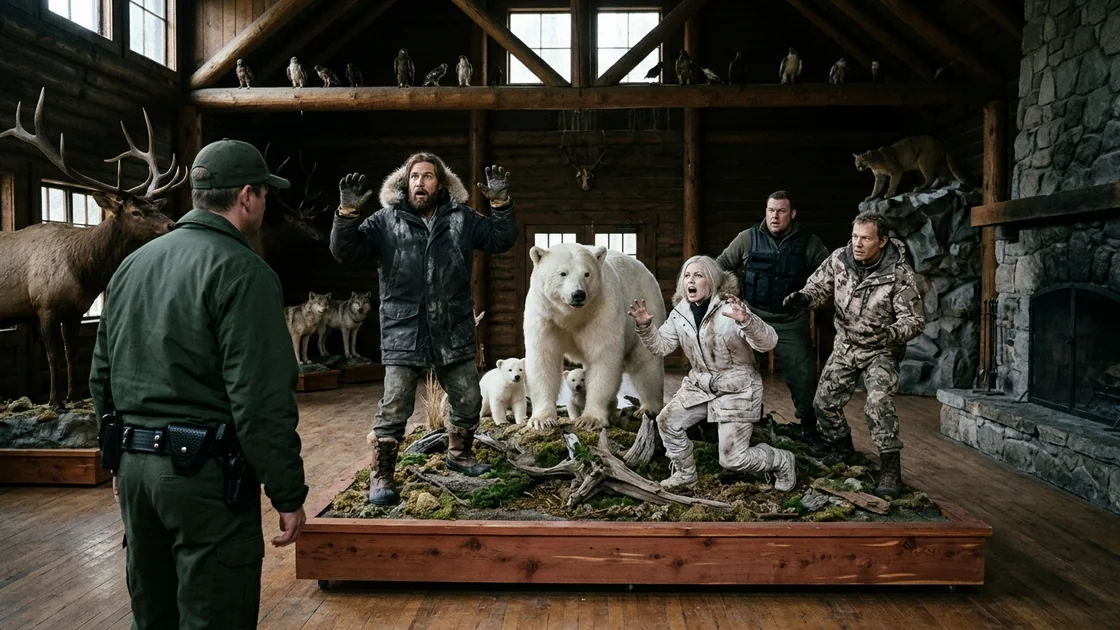
Set upon a long plinth of freshly oiled red cedar, arranged around the magnificent, seamless mount of a rare white spirit bear and her two cubs, stood four new figures.
Miller thought at first they were wax mannequins, like the native figures he had seen in the state historical museum in Helena, dressed in high-end Arctic hunting gear and holding unloaded, broken-action rifles. They were posed in a half-circle around the white bears, their heads tilted back in expressions of frozen, silent terror, their postures sculpted with such staggering anatomical tension that every tendon in their necks and hands looked ready to snap.
Miller leaned in closer to the tallest of the four mannequins—a handsome, bearded man in a snow-leopard parka whose leather-gloved hands were raised as if warding off a blow from the towering Kodiak bear across the room.
Miller frowned, reaching out a finger to touch the figure's cheek, then pulled his hand back sharply.
It wasn't wax. The skin had the dry, cool, unmistakable grain of alum-cured leather, stitched with microscopic, invisible seams along the hairline and the collar, smelling faintly of bitter wintergreen and arsenic soap. And beneath the meticulously glued eyelashes, set deep within sockets of painted gray clay, a pair of hand-blown German crystal spheres stared out into the quiet hall—catching the May sunlight in a silent, screaming plea that would never, for a hundred winters to come, be heard.