The Bloodline of Fenwick Hall
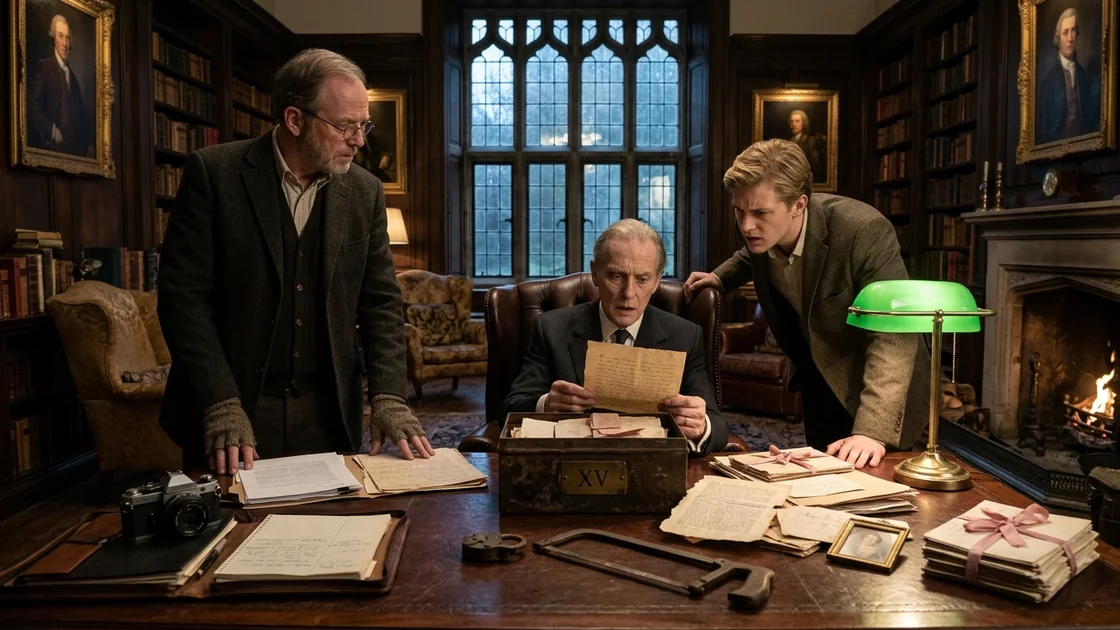
Arthur Pendelton, a meticulous genealogist, is hired by the arrogant Earl of Fenwick to prove the purity of his aristocratic lineage for a lucrative heritage grant. Upon arriving at Fenwick Hall, Arthur witnesses the cruel eviction of Barnaby Gorse, the estate's elderly groundskeeper. While digging through centuries of decaying family archives, Arthur uncovers a dark eighteenth-century conspiracy involving a secret marriage, bigamy, and a stolen birthright. The evidence irrefutably proves that the current aristocratic family are illegitimate usurpers and that the evicted groundskeeper is the true, lawful Earl of Fenwick. When the family attempts to destroy the evidence and silence him, Arthur publishes the explosive truth, stripping the proud lords of their titles and restoring the estate to the humble man they cast out.
The rain in North Yorkshire did not fall so much as it laid siege. It drove horizontally across the bleak expanse of the moors, rattling against the windows of the station taxi like handfuls of flung gravel. Inside the cab, Arthur Pendelton adjusted his spectacles, pulled the collar of his tweed overcoat tighter around his neck, and peered out at the sodden landscape. For thirty years, Arthur had made his living among the dead. As a fellow of the Society of Genealogists and a frequent consultant to the College of Arms, he had spent decades squinting at faded iron-gall ink, deciphering the cramped secretary hand of Tudor clerks, and untangling the knotted vanity of England’s gentry. He knew better than most that family trees were rarely the stately oaks their owners imagined; more often, they were choked with ivy, grafted with lies, and rooted in mud.
The taxi slowed as it approached a pair of monumental wrought-iron gates, their gilded finials flaking into rust. Flanked by stone pillars topped with the stone-carved wyverns of the Calloway family, the gates stood open, leading onto a mile-long avenue of ancient, rain-blackened beech trees. Beyond them, rising out of the mist like a jagged tooth of grey limestone, stood Fenwick Hall.
"Looks like a right commotion up at the West Lodge, mate," the driver muttered, easing the vehicle onto the gravel verge.
Arthur leaned forward. Just inside the perimeter wall stood a small, Mullioned-windowed gatehouse built of the same honey-grey stone as the main hall. Parked haphazardly across the neat boxwood hedge was a mud-splattered tractor towing a flat-bed trailer, and beside it sat a gleaming, forest-green Range Rover. A group of four men stood in the pouring rain. Two of them were burly estate labourers looking thoroughly miserable, their heads bowed against the squall as they carried a worn horsehair sofa out of the cottage door and heaved it onto the trailer, where it was immediately soaked.
Standing beneath a wide golf umbrella was a tall, gaunt man in his early sixties wearing a tailored Savile Row tweed suit and calfskin boots. Beside him stood a younger version of the same man—twenty-something, blond, with a weak chin and a sneer that seemed permanently etched into his features.
Facing them, without a coat or hat, stood an old man. He must have been past seventy, with a thick shock of white hair plastered to his skull by the rain and a face as weathered and deeply fissured as the bark of the surrounding beeches. He wore a faded moleskin waistcoat over a flannel shirt, and in his large, trembling hands, he clutched a terracotta pot containing a dormant, pruned rosebush.
"I’ll tell the driver to wait here until the drive is clear," Arthur said, reaching for the door handle. "Actually, leave my bags in the boot for a moment. I’ll walk the rest of the way."
Arthur stepped out into the deluge, unfurling his black umbrella. He walked slowly toward the gatehouse, the crunch of his shoes on the wet gravel masked by the drumming rain and the rising voices ahead.
"I don't care what my grandfather promised your father in nineteen-fifty-whatever, Gorse," the younger man said, his voice carrying the nasal, clipped drawl of an expensive public school. "Verbal agreements aren't worth the breath wasted on them. The cottage is estate property. Your employment was terminated on Friday. It is now Monday afternoon. Technically, you’re trespassing."
"Fifty-four years, Mr. Sebastian," the old man said. His voice was a low, resonant rumble, thick with the broad vowels of the Yorkshire dales, yet remarkably steady despite his shivering frame. "Fifty-four years I’ve kept these grounds. My father kept 'em for forty before me, and his father before him. When I took the head groundskeeper post under the eighth Earl, it was written in the ledger that the West Lodge was mine for life upon retirement. You’re turning me out on a trumped-up charge over three missing chainsaws that you know fine well were sold by your own gamekeeper at the Thirsk market."
The older gentleman beneath the golf umbrella sighed, checking a gold wristwatch. This, Arthur knew from the preliminary briefing dossier in his briefcase, was Alistair Calloway, Tenth Earl of Fenwick.
"That is quite enough, Barnaby," Lord Fenwick said coldly. "Accusing active staff to cover your own negligence is beneath you. The estate is modernizing. This gatehouse is prime holiday-let real estate. Once we gut it and put in an en-suite, it will bring in two thousand pounds a week during the shooting season. I cannot subsidize sentimentality. You have your state pension, and the council has offered you a bedsit in Ripon."
"I was born in that back bedroom, m'lord," Barnaby Gorse said quietly, looking past the Earl toward the stone lintel above the cottage door. "My Sarah died in that parlour. Every rose in the south parterre was grafted by my own thumb. I don't want your money. Just let me have the winter out. Spring comes, I’ll find a place in the village."
"Out of the question," Sebastian snapped. "The builders start tomorrow morning. Come on, hurry it up!" he barked at the two labourers, who were emerging with an oak dresser.
As Barnaby stepped back to let the men pass, his heel caught on the slick stone edge of the drainage ditch. He stumbled, dropping to one knee in the mud. The terracotta pot slipped from his grasp, striking the gravel path and shattering into half a dozen jagged shards. The root ball of the rosebush spilled out into a puddle of oily rainwater.
Barnaby let out a sound that was half gasp, half groan, and reached out to gather the exposed roots.
Sebastian laughed, a short, braying sound, and stepped forward. Rather than offering a hand, he planted the heel of his riding boot directly onto the root ball, grinding the delicate white fibrous roots and the grafted crown into the sharp granite chippings of the drive.
"Oops," Sebastian smirked, twisting his heel before stepping back toward the Range Rover. "Clumsy me. Looks like that’s one less weed to worry about. Have the trailer off the property in twenty minutes, Gorse, or I’ll have the police haul it to the tip."
Lord Fenwick didn't even look down. He turned on his heel, climbed into the passenger side of the Range Rover, and slammed the door. Sebastian hopped into the driver's seat, gunned the engine, and reversed violently, spraying a fan of muddy water over the kneeling old man before roaring off up the beech avenue toward the Hall.
The two labourers exchanged a look of profound shame. One of them set down his end of the dresser and hurried over to help Barnaby to his feet. "I’m sorry, Barney," the younger labourer whispered. "If I didn't have the bairn at home, I'd have told 'im where to stick his job."
"I know, lad. I know," Barnaby murmured, wiping mud from his forehead with the back of a calloused hand. "It’s not your doing. Load the dresser. Put the tarpaulin over it so the wet doesn't warp the drawers. Sarah’s father made that."
Arthur stood a few yards away, entirely unnoticed until he stepped forward and knelt by the puddle. With gloved fingers, he carefully picked up the crushed root ball of the rosebush. The main stem was split, and the lower roots were mangled, but a small lateral node near the graft union remained intact, holding a tiny, stubborn nub of red growth. Arthur pulled a clean linen handkerchief from his pocket, wrapped it gently around the remaining roots to keep the damp earth packed around them, and stood up.
He walked over to Barnaby and held out the bundle.
Barnaby blinked the rain from his eyes, looking at the stranger in the spectacles and London overcoat, then down at the linen-wrapped plant. "The crown's split, mister," the old man said softly. "He killed it. That was a Rosa mundi. Cut from a bush planted here in seventeen-hundred-and-eighty. The last one left after they ploughed up the old orchard for the tennis courts."
"The graft node isn't entirely severed," Arthur said gently. "With a clean cut below the split, a little rooting hormone, and a warm windowsill, it might just strike before the frost takes hold. The old varieties are remarkably stubborn."
Barnaby looked up, his pale blue eyes sharp and assessing despite the redness around their rims. He took the bundle with surprising delicacy, cradling it against his chest. "Aye," he said after a long pause. "They are at that. Who might you be, then? Not one of the developers?"
"My name is Arthur Pendelton. I am an archivist and genealogist. Lord Fenwick hired me to examine the family muniments."
A bitter smile touched the corners of Barnaby’s mouth. "Come to polish the family silver, have you? Well, you’ll have your work cut out for you up at the big house, Mr. Pendelton. There’s plenty of rot under the varnish."
"So I am beginning to gather," Arthur replied, looking up the long, dark avenue toward the looming silhouette of Fenwick Hall. "Good luck with the rose, Mr. Gorse."
Fenwick Hall was a monument to freezing, cavernous pride. Built largely in the late seventeenth century over the ruins of a medieval priory, and heavily remodeled in the Georgian era, it smelled of damp plaster, furniture polish, and ancient soot.
Arthur was shown to his quarters by Mrs. Finch, a pinched, quiet housekeeper who walked as though she were trying not to wake ghosts. After changing out of his damp clothes, Arthur was summoned to the Small Drawing Room—a room that could easily have accommodated two badminton courts—where Lord Fenwick, his wife Lady Cordelia, and Sebastian were taking pre-dinner sherry before a weak fire that seemed to produce more smoke than heat.
"Ah, Pendelton," Lord Fenwick said, not rising from his leather wingback chair. He gestured vaguely toward a decanter on the sideboard. "Help yourself if you drink. We don't stand on ceremony with the professional help, though I expect you’ll take your meals in the steward's room after tonight. Mrs. Finch will see to it."
"Thank you, Lord Fenwick. I don't care for sherry," Arthur said, taking a seat on a stiff-backed brocade sofa and opening his leather portfolio. "Perhaps we might review the exact parameters of my commission so I can begin in the muniment room first thing tomorrow."
"The parameters are simple," Lord Fenwick said, swirling his amber glass. "Next month marks the tercentenary of the creation of the Earldom of Fenwick—granted by King George the First to my ancestor, Sir Reginald Calloway, in seventeen-twenty-six. More importantly, the National Heritage Memorial Trust is finalizing a five-million-pound endowment for the permanent preservation of estates held in unbroken, direct male descent by the original grantee families."
"Five million," Sebastian chimed in from where he slouched against the mantelpiece, scrolling through his phone. "Tax-free, non-repayable. Enough to finally fix the bloody roof and clear the overdraft at Coutts."
"Sebastian, please," Lady Cordelia hissed, adjusting her pearls. She turned a brittle, artificial smile on Arthur. "What my son means to say, Mr. Pendelton, is that the Calloway bloodline is one of the purest in the North Riding. However, the Trust’s board of trustees is infuriatingly bureaucratic. Earlier this year, a dreadful little academic from Durham University published a monograph suggesting there were... irregularities in several northern peerages during the Regency period. Because of him, the Trust is demanding a newly audited, unimpeachable genealogical pedigree certified by a fellow of the Society before they release the first tranche of funds at our Tercentenary Gala."
"I know Dr. Hawthorne’s monograph well," Arthur remarked mildly. "He proved that the Baronetcy of Kildale was actually extinct in 1812 and that the subsequent holders were descended from a coachman. A very thorough piece of scholarship."
A heavy, unpleasant silence fell over the room.
"Hawthorne is a Marxist muckraker," Lord Fenwick snapped, his gaunt cheeks flushing. "There is nothing of the sort here. Our line is documented in both Burke’s and Debrett’s. What I require from you, Pendelton, is not an investigation, but a verification. You will go into the muniment room, locate the original marriage settlements, baptismal certificates, and letters patent for all ten generations, catalog them, and write a glowing, definitive treatise for the Trust and for publication in The Heraldic & Genealogical Chronicle. I have already arranged with the editor to feature the Calloway lineage as the cover story for the autumn issue, coinciding with the Gala."
"I am happy to examine the records and write the report, Lord Fenwick," Arthur said, uncapping his fountain pen. "However, as is stated in clause four of my standard contract—which you signed last Tuesday—my certification is contingent upon the primary evidence. I only publish what can be proven by original documentation."
"Obviously," Fenwick waved a dismissive hand. "The documents are all there. My family never threw away a scrap of parchment. The muniment room hasn't been properly organized since my grandfather’s time, so you’ll have to wade through some dust, that’s all. You have three weeks. Five thousand pounds now, and another five thousand when the Trust signs off on the pedigree. Do we understand each other?"
"Perfectly," Arthur said. He paused, looking at the fire. "On my way up the drive, I couldn't help noticing the eviction at the West Lodge. The man Gorse... he mentioned his family had been on the estate for generations. Do the estate wage ledgers go back that far? Sometimes servant records are interleaved with family papers."
Sebastian snorted. "The Gorses are like woodworm, Pendelton. They’ve been burrowing into the floorboards of this place since the seventeen-hundreds, living off Calloway charity. Good riddance to bad rubbish, I say. Don't waste your billable hours reading about stable boys and turnip-diggers. Stick to the Earls."
"Of course," Arthur said smoothly, closing his portfolio. "One must always keep one's eye on the true bloodline."
The muniment room of Fenwick Hall was located on the second floor of the oldest wing, a stone-vaulted chamber with narrow lancet windows and a heavy oak door reinforced with iron straps. To most people, it would have been a miserable dungeon; to Arthur Pendelton, it was paradise.
When Mrs. Finch unlocked the door for him the next morning and switched on a single, buzzing fluorescent tube hanging from the vaulted ceiling, Arthur took a deep, appreciative breath. The air smelled of dry rot, beeswax, sheep parchment, and three hundred years of undisturbed silence. Floor-to-ceiling wooden shelving lined three of the walls, crammed with leather-bound estate ledgers, tied bundles of correspondence, manorial court rolls, and black-painted tin deed boxes stenciled with the names of past Earls in faded gold leaf. In the center of the room stood a massive mahogany library table and an electric radiator that clicked and pinged as it fought a losing battle against the Yorkshire chill.
"I've brought you a thermos of tea and some shortbread, Mr. Pendelton," Mrs. Finch said, setting a tray on the corner of the table. She lingered by the door, her hands clasped over her apron. "Mr. Gorse... that is, Barnaby... he called the kitchen line from the village this morning. He said to tell you the cutting is in a pot on the south sill at the pub, and he thanked you for the handkerchief. He says he'll wash and iron it before he gives it back."
"Tell him there is no rush at all, Mrs. Finch," Arthur smiled warmly. "You knew him well?"
The housekeeper’s eyes darkened with a quiet, fierce resentment that Arthur had seen many times in the long-suffering staff of great houses. "Thirty years I've worked here, sir, and Barnaby was the only gentleman on the estate. When my late husband was laid up with his lungs, it was Barnaby who split our firewood and left baskets of potatoes by the back door. His lordship docked my wages for the two days I took to bury him." She glanced toward the hallway, lowering her voice. "They’re bleeding this place dry, Mr. Pendelton. The young master has gambling debts in London that would choke a horse, and his lordship’s investments in the City went sour three years ago. If they don't get that Heritage money, the bank will foreclose on the unentailed farms by Christmas, and they’ll sell off the village cottages to a London consortium. Half the village will be on the street, just like Barnaby."
"Hold on a moment, Mrs. Finch," Arthur said, his professional curiosity piqued. "You said 'the unentailed farms.' Is the main estate still under an entail? I thought the Law of Property Act of 1925 abolished most traditional entails, converting them into trusts for sale."
"I don't rightly know the law of it, sir," Mrs. Finch said. "Only what my father told me—he was clerk to the old estate solicitor in Thirsk. Fenwick Hall is under a Special Parliamentary Act from King George’s time. They can't sell the Hall, the park, or the home farms, and they can't mortgage them either. They belong strictly to whoever holds the title of Earl of Fenwick. That’s why they’re so desperate for the grant cash."
"A Parliamentary entail," Arthur murmured, his eyes widening slightly behind his glasses. "Created by private Act of Parliament to remain inalienable alongside the peerage. Just like Blenheim or Stratfield Saye. How fascinating. There are fewer than a dozen such estates left in Britain."
Once Mrs. Finch departed, Arthur put on his fingerless woollen gloves, laid out his white cotton archival gloves beside his magnifying glass and notebook, and began his work.
For the first four days, the work was routine. A good genealogist always works backward from the known to the unknown, never skipping a generation, never assuming a link without two independent pieces of contemporaneous proof.
He verified Alistair, the Tenth Earl (born 1962), and his father, Edward, the Ninth Earl (1928–2004). He worked through the Victorian and Edwardian boxes—the Eighth, Seventh, and Sixth Earls. They were a remarkably unremarkable lot: bad colonels, mediocre MPs, avid fox-hunters, and prolific spendthrifts. Their births, marriages, and deaths were all meticulously recorded in family Bibles, civil registration certificates after 1837, and embossed vellum marriage settlements.
By Friday afternoon, Arthur had reached the late eighteenth century, and the trail grew markedly colder.
He was examining the transition between the Fourth Earl, George Calloway (1760–1815), and his son, Algernon, the Fifth Earl (1788–1852). According to the printed entry in Burke’s Peerage—which Arthur kept open on the table for reference, though he trusted Burke’s about as far as he could throw the five-pound volume—George Calloway had married only once: in June 1787, at St. George’s, Hanover Square, London, to Lady Henrietta Vane, daughter of the Earl of Westmorland. Their only surviving son, Algernon, was born in April 1788.
Arthur opened the tin deed box stenciled GEORGE, 4TH EARL (1779–1815).
Inside, he found the marriage settlement with Lady Henrietta Vane, dated May 1787, bringing a massive dowry of forty thousand pounds to clear the Calloway family’s crippling debts. He found Algernon’s baptismal certificate from the Fenwick parish church. Everything seemed in order.
Yet, as a man who had spent thirty years reading between the lines of history, Arthur felt a familiar itch at the base of his skull. There was a gap.
George Calloway had inherited the title in 1779 at the age of nineteen, Wait—no. Arthur checked the box for the Third Earl, William Calloway. William had not died until 1791. Why was George’s box labeled from 1779? Because 1779 was when George came of age—or rather, when he was given management of the northern estates as Viscount Marsh, the courtesy title of the eldest son.
Arthur pulled out the personal account ledgers of George Calloway from 1780 to 1795. He turned the stiff, rag-paper pages, scanning the columns of pounds, shillings, and pence. Most of it was standard aristocratic expenditure: wine merchants, tailors in Bond Street, horseflesh, gaming debts at White’s.
Then, starting in October 1786, a new, recurring entry appeared. Every quarter—Lady Day, Midsummer, Michaelmas, and Christmas—there was a draft drawn on Hoare’s Bank in London for seventy-five pounds. A massive sum for the era, totaling three hundred pounds a year, equivalent to the annual income of a prosperous country rector.
The payee was listed simply as: Dr. Caleb Thorne, Highgate, Middlesex. For the Board and Safe Keeping of M.C.
Arthur frowned, leaning closer with his magnifying glass. He flipped through the subsequent years. 1787. 1788. 1789. 1795. 1800. Every single quarter, seventy-five pounds to Dr. Caleb Thorne for M.C. The payments stopped abruptly in the winter ledger of 1804, where a final entry read: To Dr. C. Thorne, expenses of interment at Highgate Chapel and quietus, £40.
"M.C.," Arthur whispered to the empty room.
He checked the family tree in Burke’s. George had no sisters or aunts with the initials M.C. His mother was Eleanor; his sisters were Charlotte and Sophia. Who was M.C., kept at great expense in Highgate for eighteen years and buried quietly in 1804?
Even more curious was a second anomaly. In the estate wage books for the exact same period—autumn 1786—there was an annotation written in the violent, slashing hand of the Third Earl, William (George’s father). Across the list of household and outdoor staff, six names had been aggressively crossed out with thick black ink: the head housekeeper, two parlour maids, the under-coachman, and the parish curate. Next to their names, the Third Earl had scrawled: Dismissed without character. Paid £50 hush-money each by Mr. Quill, Solicitor, on pain of transportation.
Why would an Earl pay fifty pounds—nearly ten years' wages for a maid—to six servants and a curate in 1786?
Arthur stood up and began pacing the stone floor of the muniment room. He walked over to the shelves housing the Fourth Earl's papers and pulled the tin box completely off the rack. Behind it, the stone wall was paneled in dark oak wainscot to keep out the damp.
He looked at the numbering on the tin boxes. They were numbered in Roman numerals on small brass plates riveted to their lids. Box XIV was 1779–1783. Box XVI was 1787–1815.
Where was Box XV? The years 1784 to 1786 were missing entirely from the sequence.
Arthur spent the next three hours systematically searching every inch of the muniment room. He checked the top shelves using the rolling library ladder. He checked under the bottom shelves. He looked inside the crates of nineteenth-century drainage maps and Victorian agricultural show ribbons.
At five o'clock, as the light outside the lancet windows turned the colour of bruised plums, Arthur climbed to the very top of the ladder in the darkest corner of the room, above the door, where a collection of rusted manorial man-traps and broken surveyors' chains had been tossed atop the cornice of the shelving unit.
His flashlight beam swept over the iron junk and caught the corner of a small, flat iron chest, no larger than a briefcase, shoved tightly into the masonry niche where the stone vaulting met the wall. It was covered in a century of lime dust and pigeon droppings, and it had no keyhole—instead, it was secured by a heavy iron padlock that had rusted into a solid mass of orange corrosion. Barely visible through the grime on the lid was a brass plate engraved with the Roman numerals XV.
Heart hammering against his ribs with the fierce, quiet thrill that only an archivist knows, Arthur carefully maneuvered the heavy iron box down the ladder and set it on the mahogany table.
That evening, Arthur skipped dinner in the steward’s room. Instead, he walked down the mile-long beech avenue and into the village of Fenwick St. Mary. The rain had finally cleared, leaving the air crisp and smelling of woodsmoke and wet earth.
He found the village hardware store just before it closed and purchased a small hacksaw, two spare tungsten-carbide blades, a bottle of penetrating oil, and a small brush. Before returning to the Hall, he stepped across the cobbled green to The Plough and Harrow, a low-beamed public house with warm yellow light spilling from its diamond-paned windows.
Inside, a coal fire crackled cheerily. Three old men sat at a corner table playing dominoes, and at the end of the bar, nursing a half-pint of dark mild, sat Barnaby Gorse.
And there, on the wide stone windowsill beside the radiator, sat a small plastic pot holding the salvaged stub of the Rosa mundi, covered with a clear glass jam jar like a miniature greenhouse.
"Evening, Mr. Pendelton," Barnaby said, nodding toward the barstool beside him. "I told Mrs. Finch to thank you. Have a pint?"
"Only if you let me buy the next round, Mr. Gorse," Arthur said, hanging up his coat and ordering a bitter from the landlord. He looked at the rose cutting under the jar. "How is the patient?"
"Holding its own," Barnaby said, a trace of warmth returning to his weathered face. "Leaves haven't dropped yet. If it makes it through the month without blackening at the stem, it’ll root." He took a slow sip of his ale and looked sideways at Arthur. "How’s the grand pedigree coming along? Found any kings or saints up in that dusty room?"
"Not a saint in sight, I’m afraid," Arthur replied dryly. "Mr. Gorse, I wonder if I might ask you about your own family. You mentioned the other day that that rosebush was planted in seventeen-eighty. That’s a remarkably specific date to remember through oral tradition."
Barnaby chuckled softly. "It’s not oral tradition, Mr. Pendelton. It’s written in the Gorse family Bible. Upstairs in my room right now, drying out after Monday's soaking."
Arthur went very still. His pint glass paused halfway to his mouth. "You have a family Bible going back to the eighteenth century?"
"Aye. Printed in seventeen-sixty-two in York. Belonged to my four-times great-grandfather, Jeremiah Gorse. He wasn't a groundskeeper, mind you. Back then, the Gorses were yeomen. Held the freehold on three hundred acres at High Meadow, bordering the Hall’s deer park. Jeremiah had one daughter, Mary. Born seventeen-sixty-five."
Arthur’s pulse began to race. Mary. M.C.
"What happened to High Meadow?" Arthur asked, keeping his voice carefully conversational. "And what happened to Mary Gorse?"
Barnaby’s face darkened, the old generational grievance settling back into the lines around his mouth. "The Third Earl—Wicked Will, they called him—wanted High Meadow to enclose his park. Jeremiah wouldn't sell. Then, around seventeen-eighty-five, there was a terrible falling out. The story passed down is that young Mary got into trouble with someone up at the Hall. She went away to London and died there of a fever. Old Jeremiah died of a stroke not six months later, and somehow, the Third Earl’s lawyer produced a mortgage bond claiming Jeremiah owed the estate two thousand pounds. The Earl took High Meadow, knocked down the farmhouse, and turned it into the south pasture. All that was left was Mary’s baby boy, Thomas."
"Mary had a son?" Arthur breathed.
"Born in the autumn of seventeen-eighty-five," Barnaby nodded. "Because Jeremiah was dead and the land was gone, the parish overseers were going to put the babe in the Ripon workhouse. But the young lord—George, the Fourth Earl, though he was only Viscount Marsh then—insisted the boy be kept on the estate. Gave him a cottage, had the old housekeeper raise him, and put him to work in the gardens as soon as he could hold a spade. We’ve worked the dirt of Fenwick Hall ever since, under the name of Gorse. Never owned an inch of it since Jeremiah died, though my granddad always had a funny saying when he’d had a few ales."
"What saying was that?"
Barnaby looked into his glass and recited softly: "When the Gorse is out of bloom, Calloway's pride shall meet its doom; Though the wyvern wears the crown, the root is deeper than the gown."
Arthur set his glass down on the bar. His hands were trembling slightly. "Mr. Gorse... would you allow me to see that family Bible tonight? Just for ten minutes?"
Barnaby looked at him curiously, sensing the sudden, electric intensity in the quiet London scholar. "Aye," the old man said slowly. "Come on up the stairs. It’s not much of a room, mind, with all my furniture piled to the ceiling, but you’re welcome to look."
At ten o'clock that night, Fenwick Hall was dark at the front, the family having retired to the west wing after dinner. Up in the stone-vaulted muniment room, Arthur had hung his overcoat over the narrow window to block any sliver of light from showing outside, and switched on a small desk lamp instead of the overhead fluorescent tube.
He had photographed the entries in Barnaby’s Bible with his camera in the pub room above The Plough and Harrow. The entries from the 1800s onward were clear, recording an unbroken chain of fathers and sons—Thomas to John, John to William, William to George, George to Henry, and Henry to Barnaby (born 1951).
But the earliest page—the flyleaf between the Old and New Testaments where Jeremiah Gorse had recorded his daughter Mary’s birth in 1765—had been neatly sliced in half with a razor over two hundred years ago. The bottom half of the page, where marriages and births of the 1780s would have been written, was gone.
Now, Arthur applied penetrating oil to the rusted shackle of the padlock on Box XV. Putting on his leather gloves, he gripped the hacksaw and began to draw the tungsten blade across the corroded eighteenth-century iron.
Scritch. Scritch. Scritch.
In the tomb-like silence of the muniment room, the sound seemed deafening, though he knew the two-foot-thick stone walls would absorb every decibel. Sweat beaded on his forehead despite the chill. After twenty minutes of steady, rhythmic sawing, the rusted iron gave way with a sharp ping.
Arthur set the saw down, wiped his brow, and slid the broken padlock out of the hasp. He lifted the heavy iron lid.
A faint puff of trapped air, smelling of dried lavender and centuries-old sealing wax, escaped the box. Inside lay a neat stack of documents wrapped in oiled silk and tied with faded pink legal ribbon. Resting on top of the bundle was a small, oval miniature painted on ivory, framed in tarnished gilt, and a single half-sheet of rag paper with a jagged, razor-cut top edge.
Arthur picked up the half-sheet of paper with his cotton-gloved fingers.
He didn't even need to compare the chain-lines of the watermark to the photographs on his camera; he knew instantly that it was the missing bottom half of the flyleaf from Jeremiah Gorse’s 1762 Bible. Written across it in a firm, clear hand were two entries:
Married: Mary Gorse to George Calloway, Viscount Marsh, at the Parish Church of St. Jude-in-the-Marsh, Lincolnshire, this 14th Day of November 1784. By Licence.
Born: To George and Mary, Viscount and Viscountess Marsh, a lawful Son, Thomas, at High Meadow Farm, this 2nd Day of September 1785. Baptized privately by Rev. Peter Finch, Curate of Fenwick.
Arthur let out a long, low breath that turned to vapour in the cold air. He set the Bible page down and picked up the ivory miniature. It showed a young woman of perhaps twenty, with a spray of wild yellow gorse flowers tucked into her dark curls and clear, striking pale-blue eyes—Barnaby Gorse’s eyes.
With meticulous care, Arthur untied the pink legal ribbon around the oiled silk packet and unfolded it. Inside were four documents.
The first was the original marriage certificate from the Parish of St. Jude-in-the-Marsh, dated November 14, 1784, signed by the vicar, the parish clerk, and by George Calloway and Mary Gorse. Attached to it was the Bishop of Lincoln’s marriage licence. Because George was twenty-four years old in 1784—well past the age of majority of twenty-one—the marriage did not require his father’s consent under Lord Hardwicke’s Marriage Act of 1753. It was one hundred percent legally binding and indissoluble save by an Act of Parliament.
The second document was a sworn affidavit by the Reverend Peter Finch, Curate of Fenwick, dated September 1785, certifying that he had baptized Thomas, lawful son and heir apparent of George, Viscount Marsh, and Mary his wife.
The third document was a bundle of receipts and medical reports from Dr. Caleb Thorne, proprietor of Highgate House Private Lunatic Asylum in Middlesex, detailing the admission in October 1786 of one "Mary Calloway, alias Mary Gorse, suffering from hysterics and stubborn delusions of grandeur," signed by William, Third Earl of Fenwick. The final document in that clip was the death certificate of Mary Calloway at Highgate Asylum on December 12, 1804.
The fourth and final item was a lengthy letter, six pages long, written in the shaky, gout-ridden hand of George, Fourth Earl of Fenwick, dated March 1814—a year before his death—and addressed to his family solicitor, Mr. Jeremiah Quill of Lincoln’s Inn. Across the top of the letter, the solicitor had written a nervous note: Returned to the 5th Earl unopened upon his father's sudden apoplexy; the 5th Earl having read the same, commanded me to seal it in Box XV and conceal it in the vault, lest the family be utterly ruined.
Arthur angled the desk lamp and read the Fourth Earl’s confession.
My dear Quill, the letter began. As the dropsy rises toward my heart and I know my months upon this earth are numbered, my conscience will no longer suffer me to go to the Almighty with this monstrous crime unconfessed. In the autumn of 1784, being madly in love with Mary, daughter of Jeremiah Gorse of High Meadow, and knowing her virtue to be unassailable by any dishonourable proposal, I took her into Lincolnshire and married her lawfully by Bishop’s Licence. For a year we kept our union secret from my Father, the late Earl, knowing his violent temper and the ruinous state of the family finances.
When our son Thomas was born in September 1785, Jeremiah Gorse demanded that I acknowledge my wife and child publicly. I confessed all to my Father. His rage was such as I have never witnessed in mortal man. We owed upwards of thirty-five thousand pounds to the London moneylenders, and my Father had already entered into treaty with the Earl of Westmorland for me to wed Lady Henrietta Vane and her forty thousand pounds.
My Father took matters into his own hands while I, God forgive my wretched cowardice, stood by in silence. When Jeremiah Gorse died of an apoplexy brought on by their quarrel, my Father seized High Meadow by a forged bond, tore the leaf from the Gorse Bible, ripped the baptismal page from our parish register, and bribed the curate and servants into silence. Worse still, he had two Bow Street men seize my beloved Mary in the night and convey her to Dr. Thorne’s madhouse in Highgate, though she was as sane as you or I. My Father threatened that if I did not go through with the marriage to Lady Henrietta Vane, he would instruct Thorne to have Mary bled and blistered until she perished, and would have the infant Thomas drowned in the mill-race.
To save their lives, I committed the sin of Bigamy. In June 1787, while my lawful wife Mary lived in chains at Highgate, I stood at the altar of St. George’s, Hanover Square, and went through a form of marriage with Lady Henrietta Vane. Our son Algernon was born the following year. Because Mary did not die until December 1804, my marriage to Lady Henrietta was null and void from the beginning, and Algernon is illegitimate in the eyes of God and the Law.
Meanwhile, my true and lawful son, Thomas Calloway, grows to manhood on his own estate under the name of Thomas Gorse, pruning the very trees that are his by right of birth and Parliament. He married the blacksmith's daughter last year and has a son of his own, John. I dare not tell Algernon, who has all his grandfather’s cruelty and pride, nor can I bear the disgrace of the gallows or the pillory for bigamy in my dying days. When I am dead, Quill, you must open this box and see justice done to Thomas, the rightful Fifth Earl of Fenwick...
Arthur sat back in the leather chair, the pages resting beneath his hands.
The silence of the muniment room seemed to hum with the weight of two hundred and forty years of stolen life.
Under English peerage law, there was no statute of limitations on a title of nobility. A peerage created by Letters Patent descended strictly to the heirs male of the body lawfully begotten. A bigamous marriage was completely void ab initio—from the beginning. In 1787, England did not even recognize subsequent legitimation; not that it mattered, for George had never remarried Henrietta after Mary died in 1804, as Henrietta herself had died in childbirth in 1798.
Therefore, Algernon Calloway—the so-called Fifth Earl—was born out of lawful wedlock. Neither he, nor his son the Sixth Earl, nor the Seventh, Eighth, Ninth, or the current Tenth Earl, Alistair, had a single drop of legitimate entitlement to the Earldom of Fenwick. And because Fenwick Hall and its five thousand acres were bound by a Special Parliamentary Act to follow the legal holder of the title, Alistair and Sebastian Calloway did not own a single stone of the house they lived in, nor a single blade of grass on the estate.
The legitimate Fifth Earl had been Thomas Gorse, the gardener.
And the legitimate Eleventh Earl of Fenwick—the rightful owner of Fenwick Hall, the Parliamentary entail, and the West Lodge—was currently sleeping on a camp bed surrounded by damp furniture above The Plough and Harrow.
A lesser genealogist might have rushed downstairs immediately or gone straight to the village. Arthur Pendelton was not a lesser genealogist. He knew that when challenging a sitting peer of the realm and a family entrenched for over two centuries, a single cache of private papers—no matter how damning—could be attacked by clever barristers as a forgery or an elaborate hoax, especially if those papers mysteriously vanished.
He needed corroboration from public archives outside the control of the Calloway family, and he needed a chain of custody that could withstand the scrutiny of the House of Lords Committee for Privileges and the Crown Office.
Working quietly through the night, Arthur photographed every document in Box XV at ultra-high resolution using his portable copy-stand. He then carefully placed the original documents into a waterproof archival sleeve inside his own locked briefcase, and replaced them in Box XV with blank sheets of heavy paper to maintain the weight, putting the rusted padlock back through the hasp so it looked untouched on the table.
On Saturday morning, he left a polite note for Mrs. Finch stating that he was driving to York and Lincoln for the weekend to consult the Diocesan Archives and would return on Monday afternoon.
He spent Saturday at the Lincolnshire Archives in Lincoln. Within two hours, he located the original Bishop’s Transcripts and the Marriage Licence Bonds for the Diocese of Lincoln for the year 1784. There it was, recorded by the diocesan registrar two hundred and forty-two years ago, completely independent of Fenwick Hall: the marriage bond of George Calloway, Viscount Marsh, Bachelor, of the Parish of Fenwick, Yorkshire, and Mary Gorse, Spinster, of the same parish, dated November 13, 1784, followed by the transcript of the parish register of St. Jude-in-the-Marsh recording their marriage the next day.
He paid for certified, stamped copies sealed by the Diocesan Archivist.
On Monday morning, instead of driving straight back to Yorkshire, Arthur drove south to London. He went first to the London Metropolitan Archives, where the surviving records of licensed private madhouses under the Madhouses Act of 1774 were kept. In the Commissioners' Register of Admissions for Middlesex, he found the official statutory entry for Mary Calloway at Highgate House in October 1786, and her coroner's inquest and burial record at Highgate Chapel in December 1804. Again, he obtained certified, court-admissible copies.
From there, he took the Tube to Chancery Lane and walked into the quiet, Georgian precincts of Lincoln’s Inn. He had an appointment with an old friend and frequent professional collaborator: Sir Evelyn Vance, KC, the foremost peerage and constitutional silk at the English Bar, and a member of the editorial board of The Heraldic & Genealogical Chronicle.
For two hours, Sir Evelyn sat behind his partner’s desk, peering through his half-moon spectacles at the eighteenth-century originals from Box XV, the photographs of the Gorse family Bible, the civil registration certificates of the Gorse line from 1837 to 1951, and the certified copies from Lincoln and Middlesex.
When he finally finished, Sir Evelyn took off his spectacles and rubbed the bridge of his nose, a slow, astonished smile spreading across his patrician face.
"My God, Arthur," Sir Evelyn murmured. "In forty years at the Peerage Bar, I haven't seen anything like this since the Ampthill baby case. It’s utterly watertight. The 1784 marriage in Lincolnshire is beyond dispute. The survival of the first wife until 1804 is established by statutory asylum registers. The 1787 marriage at St. George’s, Hanover Square, was unquestionably bigamous. The entire junior line—from the purported Fifth Earl down to Alistair Calloway—are strangers in blood to the patent."
"And the estate?" Arthur asked. "Mrs. Finch mentioned an eighteenth-century Parliamentary entail."
Sir Evelyn stood up and pulled a thick leather volume of Private Acts of Parliament (George I – George III) from his bookcase. He flipped through the index, found the entry for Calloway Estate Act 1727 (1 Geo. II c. 14), and read the operative clause aloud.
"'...shall stand limited and settled to the use of the said Reginald, Earl of Fenwick, and the heirs male of his body lawfully begotten who shall successively succeed to the title, dignity, and honour of Earl of Fenwick, and shall not be aliened, barred, mortgaged, or encumbered by any tenant in tail...'" Sir Evelyn snapped the book shut. "Every brick of Fenwick Hall, the chattels, the paintings, and the five thousand entailed acres belong in law and equity to Barnaby Gorse. Furthermore, because Alistair Calloway has no legal title to the peerage, he has been collecting the rents and profits of the entailed estate as a trustee de son tort. Technically, he is liable to account to Mr. Gorse for past rents."
"What about my contract with Lord Fenwick—or rather, Mr. Alistair Calloway?" Arthur asked. "He hired me to audit the lineage and submit the definitive pedigree to the National Heritage Memorial Trust and to The Heraldic & Genealogical Chronicle. Can he obtain an injunction to stop me from publishing under a breach of confidentiality?"
"Did you sign a non-disclosure agreement?"
"No. In fact, my standard contract explicitly states in Clause Six that the client authorizes me to submit my verified genealogical findings directly to the Heritage Trust and the Chronicle for publication, and acknowledges that as a Fellow of the Society, I am bound to report any historical inaccuracies or fraudulent claims to the Crown Office."
Sir Evelyn laughed aloud. "He was so arrogant about his bloodline that he signed an irrevocable mandate for you to publish the truth. However, Arthur, you must give him notice of your findings before you publish, if only to demonstrate absolute good faith. Leave the original eighteenth-century documents here in my strongroom. I will have high-grade colour facsimiles made for you this afternoon. While you drive back up to Yorkshire to inform Mr. Calloway—and our new Earl—I will prepare the formal Petition of Right to the Crown Office and brief the editor of the Chronicle."
Arthur returned to Fenwick Hall on Tuesday evening. As he drove up the beech avenue, he noticed a fleet of white vans parked near the lawn, where workmen were erecting a massive, heated marquee for the upcoming Tercentenary Gala and the formal presentation of the five-million-pound Heritage cheque, scheduled for that very Friday.
At the West Lodge, a skip had been dropped directly onto Barnaby’s immaculate front lawn, overflowing with ripped-out original eighteenth-century lath-and-plaster walls and smashed wooden paneling.
Arthur parked his car, walked into the Hall, and requested an immediate meeting with Lord Fenwick in the library.
Ten minutes later, Arthur stood before the large partner’s desk in the library. Lord Fenwick sat behind it, looking remarkably pleased with himself, while Sebastian lounged in a leather armchair nearby, nursing a glass of single malt Scotch.
"Well, Pendelton," Fenwick said briskly. "You’re back early from York. Have you finished the narrative for the Trust? The Chairman of the Board, Lord Rotherham, is arriving on Friday morning ahead of the Gala, and I want the bound pedigree on display in the Great Hall."
"I have completed the audit, yes," Arthur said evenly. He opened his briefcase and placed a thick, spiral-bound dossier on the blotter in front of the Earl, alongside a set of the colour facsimiles of the documents from Box XV and the Lincoln and Middlesex archives. "However, I am afraid the findings are not what you anticipated. As a matter of professional courtesy, I wanted to present them to you before they are formally submitted."
Fenwick frowned, putting on his reading glasses. "What do you mean, not what I anticipated? A lineage is a lineage."
"Indeed it is," Arthur said. "And as you will see from the summary on page one, the lineage of the Earls of Fenwick diverged significantly from the published directories in the year 1785."
Fenwick began to read. For the first thirty seconds, his expression was one of bored impatience. Then, as his eyes moved down the page—past the words 1784 Marriage at St. Jude-in-the-Marsh, Mary Gorse, Highgate Asylum, and Bigamy of the 4th Earl—the colour drained entirely from his gaunt face, leaving his skin the shade of old putty.
"What is the meaning of this?" Fenwick whispered, his hand trembling as he flipped past the report to look at the facsimiles of the Fourth Earl’s confession and the marriage certificate.
"What is it, Dad?" Sebastian asked, sitting up and setting his glass down. He walked over and read over his father’s shoulder. Within moments, the younger man’s face flushed a mottled, ugly crimson. "Mary Gorse? Thomas Gorse? Is this some kind of sick joke, Pendelton? Did that old bastard at the gatehouse put you up to this?"
"Mr. Gorse knew nothing of these documents when I found them," Arthur replied calmly. "They were concealed in Box XV in your own muniment room, hidden above the cornice since 1815. I have spent the last three days verifying every single detail in the Diocesan Archives at Lincoln and the Metropolitan Archives in London. In 1784, your ancestor George, the Fourth Earl, lawfully married Mary Gorse. Their legitimate son was Thomas, raised on this estate under his mother's maiden name after the Third Earl locked Mary in a private asylum."
"She died!" Fenwick barked, slamming his palm on the desk. "The family history says George had a youthful indiscretion with a farmer’s daughter who died before he married Lady Henrietta Vane!"
"So you did know there was a prior entanglement with a farmer's daughter," Arthur noted quietly. "That was not in Burke’s, Lord Fenwick. An interesting family secret. Unfortunately for your branch of the family, the Third Earl lied to you, or your ancestors lied to themselves. Mary Calloway, née Gorse, did not die until December 1804. When the Fourth Earl married Lady Henrietta Vane in 1787 and sired your ancestor Algernon in 1788, his legal wife was very much alive. Under English law, that second marriage was bigamous and void. Algernon was illegitimate. Consequently, neither he nor any of his descendants had any legal right to inherit the Earldom of Fenwick or the Parliamentary entail."
The silence in the library was absolute, save for the ticking of the tall grandfather clock in the corner.
"You're insane," Sebastian breathed, though the panic in his eyes betrayed how clearly he understood the implications. "You're saying... you're saying Barnaby Gorse—the bloody gardener who cleans out the drains—is the Earl of Fenwick?"
"By right of blood and Letters Patent, Barnaby Calloway—commonly known as Barnaby Gorse—is the de jure Eleventh Earl of Fenwick and Viscount Marsh," Arthur said. "And you, Mr. Calloway, are legally Mr. Alistair Calloway, a private citizen residing in someone else’s house."
Lord Fenwick stared down at the papers on his desk for a long time. When he finally looked up, his eyes were cold, hard, and calculating. He stood up slowly, walked past Arthur to the heavy oak doors of the library, and turned the brass key in the lock.
"Give me your briefcase, Pendelton," Fenwick said softly.
Arthur did not move. "I beg your pardon?"
"I said, give me your briefcase, your laptop, and your camera. Right now." Fenwick walked over to the roaring fireplace and picked up the heavy brass poker. Meanwhile, Sebastian scooped the dossier and the facsimile documents off the desk and hurled them directly into the heart of the flames. The dry paper caught instantly, curling into black ash as the orange flames licked upward.
"There," Sebastian sneered, watching the pages burn. "What Box XV? There never was a Box XV. That old fool Gorse has been rambling about his great-grandmother for years, and nobody gives a damn."
"Listen to me very carefully, Pendelton," Fenwick said, stepping closer, the brass poker held tightly at his side. "My family has held this house and this title for over two hundred years. We have dined with monarchs. We have sat in the House of Lords. Do you really think I am going to let five million pounds, three hundred years of prestige, and five thousand acres be handed over to a semi-literate peasant because a pedantic little clerk found a mouldering letter in an attic?"
"It is the truth," Arthur said, standing his ground despite his hammering heart. "And it is the law."
"The law is whatever I can afford to pay a silk to argue, and without original eighteenth-century documents, you have nothing but hearsay and a coincidental name in a Lincolnshire parish!" Fenwick snapped. "Now, I am going to write you a cheque for fifty thousand pounds. You are going to hand over the original papers from Box XV—which I assume are in that briefcase—and you are going to sign the verified pedigree I hired you to write. If you refuse, Sebastian and I will take that briefcase from you by force, burn the originals in that grate, and throw you off this estate. And if you utter a single word of this to the press or the Heritage Trust, I will sue you for defamation and extortion until you are living in a cardboard box under Waterloo Bridge. Do I make myself clear?"
Arthur looked from the arrogant, desperate face of the father to the cruel, grinning face of the son, and then to the fireplace, where the last of the facsimiles was crumbling into grey flakes.
A profound, icy calm settled over Arthur Pendelton. He thought of Barnaby Gorse kneeling in the mud in the pouring rain, his hands bleeding on the gravel as Sebastian ground his dead wife's rosebush under the heel of his boot.
"Here is my briefcase, Mr. Calloway," Arthur said, setting the leather case on the desk and popping the brass latches open.
Sebastian lunged forward and tore the briefcase open. Inside lay an empty thermos flask, a packet of digestive biscuits, a spare woollen jumper, and a copy of The Times.
"Where are they?" Sebastian snarled, upending the briefcase onto the desk. "Search him! Check his coat!"
"Save yourselves the indignity of common assault," Arthur said coolly, adjusting his spectacles. "Did you truly believe that a professional archivist with thirty years of experience would walk into the library of a desperate man carrying priceless eighteenth-century primary evidence?"
Fenwick froze, his knuckles whitening on the brass poker. "Where are they?"
"The original contents of Box XV—along with the Fourth Earl’s confession, the torn leaf from the Gorse Bible, the ivory miniature, and the original 1784 marriage certificate—are currently locked inside the high-security vault of Sir Evelyn Vance, King's Counsel, at Lincoln's Inn in London," Arthur said. "What your son just so dramatically burned in the fireplace were fifty-pence colour photocopies."
"I'll get an injunction!" Fenwick shouted, his voice cracking with sudden terror. "I'll call my solicitors right now! You stole private family papers from my house! They're inadmissible!"
"On the contrary," Arthur replied. "First, those papers belong in law to the rightful Earl of Fenwick—Mr. Gorse—who signed a formal letter of retrospective authorization for me to remove and safeguard them an hour before I came up the drive tonight. Second, even without the private letters, the marriage at St. Jude-in-the-Marsh and the asylum death record at Highgate are public statutory records held by the Church of England and the City of London. Anyone can order certified copies for twelve pounds fifty. You cannot burn the Diocesan Archives of Lincoln, Mr. Calloway."
Arthur walked calmly to the locked library door and looked back at the two men.
"Finally, I would remind you of Clause Six of the contract you insisted I sign last week, in which you granted me irrevocable authority to submit my findings directly to the National Heritage Memorial Trust and to The Heraldic & Genealogical Chronicle for their autumn cover story. You wanted your lineage published in time for the Tercentenary Gala on Friday. I am happy to inform you that I never miss a deadline. Now, unlock this door, or my next call will be to the North Yorkshire Police to report a kidnapping."
For ten seconds, nobody breathed. Then, with a violent curse, Sebastian strode to the door, wrenched the key round in the lock, and flung it open.
"Get out!" Lord Fenwick roared, his face purple, pointing a shaking finger toward the hall. "Get out of my house!"
"It isn't your house, Mr. Calloway," Arthur said quietly, stepping over the threshold. "Have a pleasant evening."
The next forty-eight hours moved with the precision of a military campaign, orchestrated from Sir Evelyn Vance’s chambers in London and the snug back parlour of The Plough and Harrow in Fenwick St. Mary.
At first, when Arthur and Sir Evelyn—who had taken the morning train up from King’s Cross on Wednesday—laid the entire legal reality before Barnaby Gorse, the old groundskeeper had simply shaken his head and stared at his calloused hands.
"I’m seventy-five years old, gentlemen," Barnaby had said quietly, looking at the miniature of his four-times great-grandmother Mary on the pub table. "I don't know how to be an Earl. I don't wear suits except to funerals, I don't drink wine, and I’ve no use for forty bedrooms full of draughts and gilt chairs. Let 'em keep their grand title. All I ever wanted was my cottage and my garden."
"Mr. Gorse—Lord Fenwick," Sir Evelyn had replied gently. "If you do not claim your birthright, Alistair Calloway will attempt to suppress this, or the Crown will declare the title dormant, and the unentailed lands will be seized by Calloway’s creditors next month. Have you seen the plans they filed with the district council last Friday? I pulled them from the registry this morning."
Sir Evelyn slid a set of architectural blueprints across the table.
Barnaby put on his wire-rimmed glasses and looked at them. The plans showed the demolition of the twelve historic cottages on the edge of the village—where the retired estate workers and Mrs. Finch’s sister lived—along with the clear-felling of the forty-acre ancient oak wood behind High Meadow, to build an executive golf course and thirty luxury holiday chalets.
"They’re going to fell the Great Wood?" Barnaby whispered, his fingers tracing the boundary lines he had walked every morning for half a century. "There’s badger setts in there older than the church. And if they pull down the Row, old Tom Potter and the widows won't have anywhere to go."
"Alistair Calloway has already signed a conditional contract with a Mayfair property developer to clear his son's debts," Sir Evelyn said. "The only way to stop the sale and cancel the contract is to prove in law that Alistair Calloway was never the Earl of Fenwick and had no legal authority to sign estate contracts. If you claim the Earldom and the Parliamentary entail, every contract he signed regarding the estate becomes void. You don't have to live in the forty bedrooms if you don't wish to, my lord. You can do whatever you see fit with the Hall—turn it into an agricultural college, a museum, or a trust for the village. And the West Lodge is yours forever."
Barnaby looked from the blueprints to the little Rosa mundi cutting sitting on the pub windowsill, where a tiny, unmistakable green leaf had just unfurled inside the jam jar.
Slowly, Barnaby straightened his shoulders. The deferential stoop of the lifelong servant seemed to melt away, replaced by the quiet, immovable granite of the Yorkshire dales.
"Where do I sign, Sir Evelyn?" Barnaby said.
Friday morning broke clear, bright, and crisp over the North Riding. The autumn sun gilded the limestone battlements of Fenwick Hall and glittered off the white peaks of the giant marquee erected on the south lawn.
Inside the marquee and overflowing into the Great Hall, two hundred people had gathered for the midday Tercentenary reception. There were local MPs, the Lord Lieutenant of North Yorkshire, the Bishop of Ripon, half a dozen neighboring peers, the board of trustees of the National Heritage Memorial Trust led by Lord Rotherham, and a sizable contingent of journalists and photographers from Country Life, The Yorkshire Post, and The Times.
Alistair Calloway, dressed in a morning coat with a silk cravat, moved through the crowd with a brittle, manic energy, a glass of champagne in his hand. For two days, his London solicitors had frantically tried to find out which judge Arthur Pendelton and Sir Evelyn Vance had approached, attempting to file preemptive gagging orders, only to find nothing on the civil court dockets. Alistair had convinced himself that Pendelton had bluffed—that the little genealogist had been frightened off by the threat of ruinous litigation, and that once the five-million-pound oversized cheque was handed over at noon and the photographers took their pictures, the Calloways would be untouchable.
On a velvet-draped easel near the podium sat the huge symbolic cheque from the Heritage Trust, waiting for Lord Rotherham’s signature.
At ten minutes to twelve, Lord Rotherham tapped his champagne flute with a silver spoon and stepped up to the microphone on the low stage, flanked by Alistair, Lady Cordelia, and a beaming Sebastian.
"My lords, ladies, and gentlemen," Lord Rotherham began, his voice booming through the marquee’s sound system. "We are gathered here at magnificent Fenwick Hall to celebrate three hundred years of unbroken stewardship by the Calloway family, and to formally ratify the National Heritage Memorial Trust’s five-million-pound endowment—"
A sudden murmur rippled through the back of the marquee near the main entrance from the drive.
Waiters paused with their trays. Guests turned their heads.
Walking across the manicured lawn and stepping through the open silk flaps of the marquee were four people. In the lead was Sir Evelyn Vance, KC, immaculate in a dark pin-striped suit, accompanied by a senior clerk from the Crown Office of the House of Lords carrying a red leather dispatch box. Behind them walked Arthur Pendelton, carrying a stack of freshly printed, glossy journals.
And beside Arthur walked Barnaby Gorse. He was not wearing fancy dress; he wore his clean Sunday tweed jacket, a neatly knotted woolen tie, moleskin trousers, and his polished boots. Yet he walked with his head held high, looking neither left nor right.
At the same moment, every smartphone in the pockets of the assembled journalists began to buzz and chime simultaneously as a synchronized press embargo lifted at precisely 11:55 a.m. Across the back row, reporters pulled out their phones, stared at the breaking news alerts from The Times and the Press Association, and gasped aloud.
"What the devil is that man doing here?" Alistair Calloway barked into the microphone, his composure cracking in front of the entire county elite. "Security! Have that former groundskeeper and that fraud Pendelton removed from my property immediately!"
"I would advise the estate staff to stay precisely where they are, unless they wish to be held in contempt of the High Court and the Crown Office," Sir Evelyn Vance’s resonant courtroom voice rang out clearly across the hushed marquee.
Sir Evelyn walked up the central aisle and stopped directly in front of the stage. He opened a heavy parchment folder bearing the Royal Coat of Arms and handed a copy to a bewildered Lord Rotherham on the stage, while Arthur handed out the special autumn edition of The Heraldic & Genealogical Chronicle to the front row of trustees and journalists.
On the cover of the Chronicle was a photograph of Fenwick Hall alongside the 1784 miniature of Mary Gorse, beneath the bold headline: THE TWO-HUNDRED-YEAR USURPATION: THE TRUE DESCENT OF THE EARLDOM OF FENWICK.
"Lord Rotherham, Lord Lieutenant," Sir Evelyn said, addressing the stage while the reporters frantically began snapping photographs. "My name is Sir Evelyn Vance, King's Counsel. Thirty minutes ago, the Lord Chancellor and the Attorney General, acting upon incontrovertible primary evidence verified by Mr. Arthur Pendelton, Fellow of the Society of Genealogists, and the Diocesan Registrars of Lincoln and London, issued an immediate Writ of Supersedeas and a High Court Freezing Injunction regarding the Earldom of Fenwick and the Parliamentary Entail of 1727."
Lady Cordelia dropped her champagne glass; it shattered on the parquet flooring of the stage.
"This is libel!" Alistair screamed, his face contorted with fury as he lunged toward the edge of the stage. "These men are extortionists! Rotherham, sign the cheque! My family has been here since seventeen-twenty-six!"
"The Calloway family has indeed been here since seventeen-twenty-six," Arthur Pendelton spoke up, his calm, precise voice cutting through Alistair's shouting. "Specifically, the legitimate line of the Calloway family has been pruning your roses and digging your ditches since seventeen-eighty-five. As is fully documented in the journal now in your hands, and in today's late edition of The Times, the Fourth Earl of Fenwick lawfully married Mary Gorse of High Meadow in November 1784. Their legitimate son and heir was Thomas Calloway, raised fraudulently as Thomas Gorse while his mother was unlawfully imprisoned in Highgate Asylum until her death in 1804."
A collective gasp went up from the two hundred aristocrats and dignitaries as they flipped open the glossy pages of the journal to see the high-resolution plates of the marriage register, the asylum admissions, and the Fourth Earl's signed deathbed confession.
"Because the first Countess was alive until 1804," Arthur continued, looking directly at Sebastian and Alistair, "the Fourth Earl's second marriage in 1787 to Lady Henrietta Vane was bigamous and void. Every descendant of that union—including Mr. Alistair Calloway and his son—is illegitimate in respect of the peerage and holds zero legal claim to the title or the entailed estate."
Lord Rotherham was staring down at the official High Court injunction and the Crown Office certificate in his hands, his face pale with shock. Slowly, he walked over to the velvet-draped easel, picked up the giant five-million-pound cheque, and handed it back to his secretary.
"In light of the Lord Chancellor's preliminary ruling and the High Court injunction," Lord Rotherham said into the microphone, stepping away from Alistair as though the man had a contagious disease, "the National Heritage Memorial Trust hereby suspends and revokes the grant application made by Mr. Alistair Calloway, and refers the matter of the endowment to the lawful tenant in tail."
"You can't do this!" Sebastian yelled, his voice breaking into a shrill panic as camera shutters clicked like a swarm of locusts. "We're the Calloways! He's the gardener! Look at him, he has dirt under his fingernails!"
Barnaby Gorse stepped forward to the foot of the stage and looked up at the young man who had ground his rosebush into the gravel four days earlier.
"Aye, Mr. Sebastian," Barnaby said, his deep Yorkshire voice carrying effortlessly to every corner of the tent without need of a microphone. "I have dirt under my fingernails. It’s Fenwick dirt. My family’s been tending it for two hundred and forty years while yours has been mortgaging it to pay your tab at the card tables. You told me on Monday that verbal agreements don't count for naught, and that it’s only what’s written down in black and white that matters. Well, there’s your black and white."
Barnaby turned slightly to face the dumbstruck crowd of neighbors, villagers, and catering staff lining the walls of the marquee—including Mrs. Finch, who had a hand pressed over her mouth, tears of pure joy streaming down her cheeks.
"For anyone working on this estate or living in Fenwick St. Mary," Barnaby announced clearly, "nobody is losing their home, nobody is losing their job, and the Great Wood is staying right where the good Lord planted it. As for the party—the food’s paid for, so the village is welcome to come up the drive and eat it. As for you two..." Barnaby looked back up at Alistair and Sebastian. "The builders cleared out the rubble from the West Lodge this morning. You have until Friday next week to pack your clothes and vacate the Hall. And don't touch the silverware on your way out—Mrs. Finch has the inventory."
For a moment, Alistair Calloway looked as though he might suffer the same apoplexy that had carried off his ancestor in 1815. Blinded by camera flashes, shunned by Lord Rotherham and the Lord Lieutenant who quickly stepped off the stage to avoid being photographed beside him, Alistair grabbed his wife’s arm and fled through the rear doors of the Great Hall, with Sebastian stumbling miserably behind him.
Spring came late to the North Riding the following year, but when it arrived, the dales burst into a riot of green and gold.
Once again, Arthur Pendelton took the station taxi from Thirsk up to Fenwick Hall. When the cab passed through the great wrought-iron gates—now freshly painted in black and gold leaf, with the stone wyverns repaired by a local mason—it did not need to drive the full mile up the beech avenue. Instead, it pulled up neatly outside the West Lodge.
The skip was gone. The mullioned windows gleamed in the May sunshine, the stone roof had been expertly re-slated, and the neat boxwood hedge framed a lush cottage garden buzzing with early bees. Up at the main Hall, as Arthur knew, the state rooms and the park had been leased on a ninety-nine-year peppercorn arrangement to the National Trust and the Yorkshire Agricultural College, funded by the five-million-pound Heritage endowment that had been formally released the day the House of Lords Committee for Privileges unanimously confirmed Barnaby Calloway as the Eleventh Earl of Fenwick. The villagers’ cottages had been placed into a permanent community land trust, with their rents capped for perpetuity.
As for Alistair and Sebastian Calloway, after their banks foreclosed on their personal debts and Sir Evelyn Vance agreed to waive the estate's claim for back-rents in exchange for their immediate surrender of all claims, they had last been seen moving into a two-bedroom flat above a dry cleaner's on the outskirts of Harrogate, where Sebastian had reportedly been forced to take a job selling commercial insurance.
Arthur stepped out of the taxi, paid the driver, and walked up the garden path.
Around the side of the cottage came Barnaby, wearing his familiar moleskin waistcoat and mud-caked boots, carrying a watering can. He looked ten years younger than he had in the autumn rain.
"Afternoon, Arthur!" Barnaby called out, setting the watering can down and wiping his hand on his trousers before offering a firm, warm handshake. "Right on time. Mrs. Finch sent down a steak and kidney pie from the Hall kitchen, and the kettle’s on the boil. How’s the library catalog coming along?"
"Nearly finished with the seventeenth-century manorial rolls, my lord," Arthur smiled, tapping his leather briefcase.
"None of that 'my lord' nonsense outside of London, Arthur, we agreed on that," Barnaby chuckled. "Save that for Sir Evelyn when he wants me to sign another trust deed. Come here a minute before we go in. I have something to show you."
Barnaby led the genealogist around to the south-facing wall of the stone gatehouse, where the sun baked the honey-coloured limestone warm.
There, planted in a bed of rich, dark compost at the foot of the wall, was a thriving young rosebush, already eighteen inches tall, its strong green stems covered in healthy foliage. And at the very tip of the central cane, just beginning to unfurl in the May sunlight, was a single, tightly furled bud streaked with crimson and white.
"The Rosa mundi," Arthur murmured, adjusting his spectacles as he leaned down to admire it. "It struck after all."
"Told you it would," Barnaby said softly, resting his hand on the warm stone of the cottage where he had been born. "You can crush the branches all you like, Arthur, and you can throw the pot in the mud. But if the root is true, it always comes back to the light."