The Basting Stitch of Reckoning
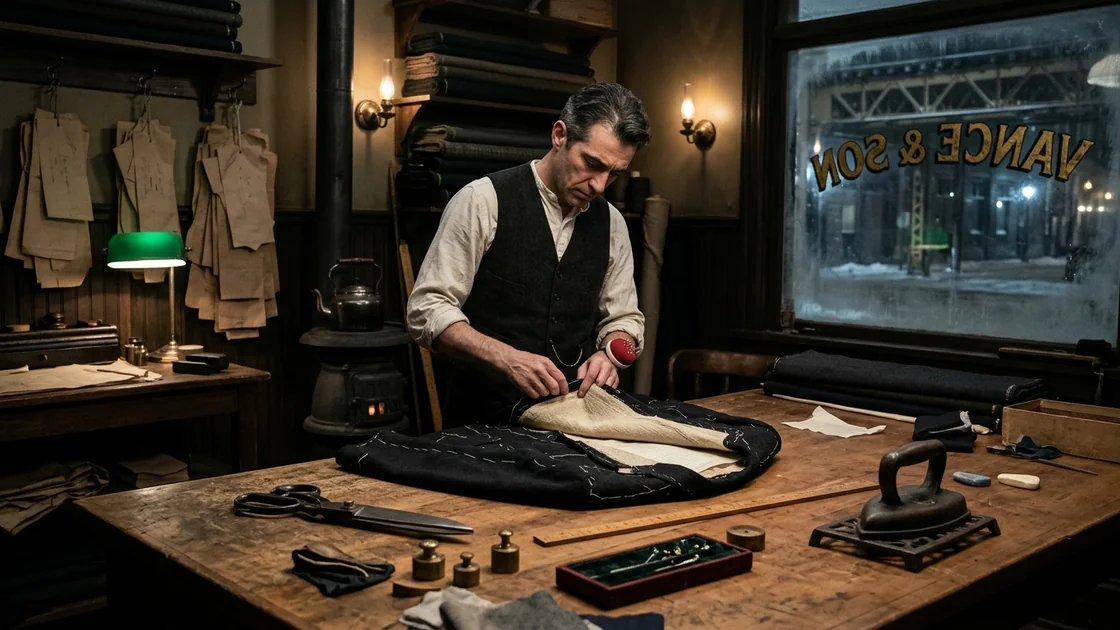
In the winter of 1929, Chicago tailor Julian Vance seeks quiet vengeance against Salvatore Marchesi, the ruthless bootlegger and crime boss who framed Julian's father for embezzlement and left him to die in Joliet prison. While crafting the vain gangster's opulent bespoke wardrobe beneath the rattling tracks of the Wabash Avenue elevated train, Julian conspires with Marchesi's grieving secretary, Clara Novak, and an incorruptible federal agent named Lawrence Hale. Piece by piece, Julian sews stolen onion-skin bribery ledgers and canceled checks into the hidden horsehair linings of Marchesi's finest suits, turning the mobster's prized armor of respectability into the very evidence that will destroy his empire.
I
When the Wabash Avenue elevated train rounded the curve at Madison, the vibration always reached the needles first. Sitting in their velvet-lined tray on the cutting table, the long steel sharps and stubby betweens would begin to hum, a faint metallic chatter that rose before the iron wheels shrieked against the frost-stiffened rails outside the second-story window. Then the gas lamps along the wall would dip their flames in unison, throwing long, swaying shadows across the bolts of Huddersfield worsted, West of England flannel, and heavy Scottish tweed stacked from floor to ceiling like the masonry of a fortress.
Julian Vance did not look up from the lapel he was pad-stitching. A good tailor learned to time his needle to the rhythm of the city; he drove the point through the wool and linen canvas on the downbeat of the passing Pullman cars, drawing the waxed thread taut just as the rumble faded south toward Twelfth Street.
It was four o'clock on a Tuesday afternoon in November, the sky beyond the streaked plate glass the color of a bruised plum. Below on the street, clerks and stenographers hurried through the gray slush with their collars turned up against the lake wind, their figures sliced into flickering strips by the iron latticework of the tracks. Inside Vance & Son, Bespoke Tailors, the air was thick with the ancient, comforting smells of wet wool, beeswax, scorched dampening rags, and cedarwood.
The "& Son" on the frosted glass of the front door had been painted in gold leaf twenty-two years ago, though the gold had flaked away at the edges until it looked like autumn leaves pressed against the pane. There was no longer a father in the shop. Arthur Vance had died eighteen months earlier in a limestone cell at the Joliet Penitentiary, his lungs filled with quarry dust and winter pneumonia, three years into a ten-year sentence for stealing forty thousand dollars from the Garment Cutters and Pressers Benevolent Fund.
Everyone on Wabash Avenue knew Arthur Vance had never stolen a nickel in his sixty-one years. Everyone knew the money had been taken by Salvatore Marchesi to buy a fleet of armoured Mack trucks for his Canadian whiskey run through Detroit. And everyone knew that when Arthur Vance, who served as the union's unpaid treasurer because he was the only man on the block who could add two columns of figures twice and get the same answer, refused to burn the original deposit slips, Marchesi had simply bought two bank examiners, a handwriting expert from St. Louis, and Judge Clarence Hollister of the Cook County Criminal Court.
Julian remembered the morning of the sentencing. His father had stood at the mahogany railing in a dark gray Saxony three-piece he had cut and sewn himself, his shoulders square, though his fingers—calloused along the sides from forty years of wielding twelve-inch Wilkinson shears—trembled against the wood. Marchesi had been sitting in the back row of the courtroom, wearing a camel-hair overcoat that hung terribly around the collar because some hack on Halsted Street had cut the neck hole too wide. When they led Arthur Vance away in irons, Marchesi had caught Julian's eye across the aisle, smiled, and smoothed his ill-fitting lapel as if to say that everything in Chicago, from a man's honor to the coat on his back, belonged to the man who could pay the freight.
Six months after his father was buried in the frozen mud of Graceland Cemetery, Salvatore Marchesi walked through the front door of Vance & Son.
Most men would have reached for the twelve-inch shears on the cutting board and driven them through the bastard's throat before his bodyguards could clear their holsters. Julian had felt the cold steel handles against his palm that day. He had measured the distance between the counter and the thick blue vein beating above Marchesi's silk collar. It was forty-two inches—three feet and a half, the length of a tall man's outseam. He could have done it. And then Frankie Bellini would have blown Julian's spine through the cedar paneling with his snub-nosed Colt, the police would have ruled it a robbery gone wrong, and Salvatore Marchesi would have been buried in a ten-thousand-dollar bronze casket with six aldermen and a Catholic bishop weeping at the graveside.
Instead, Julian had bowed his head, picked up his linen tape measure, and asked Mr. Marchesi whether he preferred a single or double vent on his lounge coats.
The bell above the staircase door jangled, sharp and brassy against the low hiss of the coal stove.
Julian slipped his needle into the red wool cushion strapped to his left wrist, stood up from the workbench, and smoothed down his waistcoat. He was thirty-two, lean and slightly stooped from the board, with dark hair prematurely silvered at the temples and quiet, hooded gray eyes that seemed to look only at seams and buttonholes, never into a man's face.
Heavy footsteps mounted the wooden stairs from the street. First came the smell of snow and wet leather, then the sweet, cloying drift of bay rum and Havana tobacco.
The door swung open, and Frankie Bellini stepped inside first. Bellini was thin and narrow-shouldered, with a yellow complexion and eyes like two wet watermelon seeds. He wore a pearl-gray fedora pulled low over one ear and a double-breasted pinstripe suit that Julian had been forced to let out an inch under the left arm to accommodate the leather shoulder harness of a .38 Police Positive. Bellini didn't say hello. He walked straight past the cutting table, pulled back the heavy green velvet curtain of the fitting room, looked inside, checked the latch on the back fire-escape window, and then leaned against the radiator with his hands buried in his overcoat pockets.
Only then did Salvatore Marchesi enter the shop.
"Christ on the cross, what a wind off that water," Marchesi boomed, shaking the melting snow from the brim of his homburg onto the polished oak floor. "Cuts right through a man's ribs like an ice pick. Julian, my boy, tell me you got the stove going."
"White ash and anthracite since six this morning, Mr. Marchesi," Julian said, stepping forward to take the boss's wet hat and gloves. His voice was soft, deferential, and entirely colorless. "Allow me to take your topcoat. The damp will draw the press out of the shoulders if you leave it buttoned."
Marchesi grinned, turning his back so Julian could slide the heavy cashmere coat from his bulky frame. At forty-five, Marchesi was built like a meat safe—five feet eight inches tall, with a forty-six-inch chest, a forty-four-inch waist, and a short, bull neck that rolled over the top of his starched collar in a thick pink crease. Yet in his own mind, he had the figure of Rudolph Valentino and the breeding of a Devonshire duke. Now that the bootlegging wars on the North Side had settled into a profitable truce and his syndicate controlled everything from the breweries in Cicero to the municipal asphalt contracts, Marchesi had developed a ravenous hunger for respectability. He bought boxes at the Civic Opera. He donated stained-glass windows to St. Stanislaus. And above all, he bought clothes from the son of the man he had murdered by gavel.
There was a perverse poetry in it that delighted Marchesi. To have Arthur Vance's boy kneeling at his feet with a mouthful of pins was proof that the world bent to muscle, not morality.
"How are we coming with the blue herringbone?" Marchesi asked, walking over to the triptych mirror on the raised wooden dais and admiring the set of his silk tie. "I got the Commerce Club luncheon at the Palmer House on Friday. The Mayor's gonna be there, and half the Sanitary District board. I don't want to walk in looking like some gin-mill greaseball from Maxwell Street."
"It is ready for the second basting fitting, sir," Julian said, hanging the wet coat on a walnut form near the stove where it would dry evenly. He walked to the rack at the rear of the shop and lifted down an unfinished jacket draped on a shaped wooden hanger.
To an untrained eye, the garment looked like a ruin. It had only one sleeve attached; the collar was a raw piece of cream-colored Irish linen stitched with hundreds of tiny diagonal threads; and the body was covered in long rows of white cotton basting stitches that held the dark blue wool to the stiff inner canvas like a spiderweb over stone.
Marchesi stepped up onto the dais and held out his thick arms. Julian slipped the skeleton of the coat over the boss's shoulders, settling the collar against the back of his neck with practiced, gentle tugs.
"Stand naturally, please, Mr. Marchesi," Julian murmured, dropping to one knee beside him and drawing a cake of French soapstone chalk from his vest pocket. "Don't throw your chest out. Let the canvas take your weight."
"My chest is out, kid," Marchesi chuckled, looking down at the top of Julian's bent head. "Been hauling beer kegs since I was twelve years old. You don't lose that."
"Of course, sir. A very powerful build. It requires a full chest piece so the lapel doesn't break when you move your arm." Julian ran his fingers down the front of the coat, feeling the layers beneath the wool.
A bespoke suit was an exercise in structural deception. The customer saw only the outer cloth—the fifteen-ounce English worsted—and the slippery Bemberg silk lining that touched his shirt. Between those two worlds lay the third layer, the unseen foundation that gave the garment its life: a chest piece constructed of floating linen canvas, coarse horsehair woven with cotton, and soft wool domette, all stitched together by hand so that it curved over the wearer's body like a shell. Without that inner skeleton, the finest cloth in the world was just a rag. And once the silk lining was felled over it, no man on earth would ever see that foundation again unless the coat was ripped apart with a blade.
"Pinches a little right here," Marchesi said, tapping his left breast, just above the heart.
"That is merely the temporary basting thread holding the horsehair in place, sir," Julian replied smoothly, his fingers brushing the exact spot. Beneath the dark blue herringbone and the first ply of hymo canvas lay a sheet of manifold onion-skin paper, seven inches by nine, treated with a solution of alum and beeswax so that it was as supple as chamois leather and entirely noiseless when flexed.
On that paper, typed in violet carbon ink by a girl in a locked room on South Water Street, were the dates, check numbers, and bank routing codes for twelve thousand dollars paid to Alderman Patrick O'Connor and Deputy Police Commissioner Walter G. Vance—no relation—in exchange for pulling the harbor patrol boats off the Calumet River docks during the third week of October.
"Once I remove the white basting cotton and press the chest over the tailor's ham, it will mold straight to your ribs," Julian said, making a neat white chalk mark along the seam. "You won't know it's there."
"Better not," Marchesi grunted, turning slightly to study his profile in the three-way glass. "I pay you two hundred and twenty bucks a suit, Julian. For two-twenty, it oughta feel like I'm wearing fog."
Over by the radiator, Frankie Bellini shifted his weight, the floorboards creaking under his thin-soled oxford shoes. "Hurry it up, Sal. We gotta be over on Randolph by five. The accountant's waiting."
Marchesi waved a meaty, manicurist-buffed hand. "Let him wait. You can't rush an artist, Frankie. Ain't that right, Julian? That's what your old man always used to say when I'd come around the union hall. 'Measure twice, cut once, Salvatore.' Smart guy, your old man. Too bad he got mixed up with bad company at the end."
Julian did not blink. He pulled a brass pin from the cushion on his wrist and slid it through the wool at the curve of Marchesi's back, one-sixteenth of an inch from the skin. "He was very particular about his work, Mr. Marchesi. Raise your right arm slightly, if you please."
"Yeah, well, he passed the knack on to you," Marchesi said, lifting his arm while Julian chalked the scye of the sleeve. "You got his hands, kid. Thank God for your sake you didn't get his head. A man in your line of work don't need opinions. He just needs good eyes and a tight mouth."
"A tailor who talks loses his customers' measurements, sir," Julian said, standing up and easing the basted jacket off the boss's shoulders. "It will be ready for delivery Thursday afternoon. Shall I send it around to the hotel?"
"Have it at the Lexington by four," Marchesi said, stepping down from the dais and letting Julian help him back into his damp cashmere overcoat. He reached into his trousers pocket, pulled out a thick roll of bills held together by a gold clip shaped like a horseshoe, and peeled off a five-dollar note. Instead of handing it to Julian, he tucked it into the breast pocket of Julian's waistcoat, giving his chest two hard, proprietary pats. "Buy yourself a steak, kid. You look like you live on cabbage soup and sewing thread."
"Thank you, Mr. Marchesi."
Julian stood beside the cutting table until their heavy footsteps had descended the stairs and the front door slammed shut at street level. A moment later, the big twelve-cylinder Packard roared to life at the curb, pulling out into the traffic beneath the iron tracks.
Only then did Julian reach into his waistcoat pocket, draw out the five-dollar bill, and walk over to the cast-iron coal stove. He pulled open the iron grate with a poker, dropped the bill onto the bed of white-hot anthracite, and watched it curl into a black flake of ash before disappearing up the flue.
Then he returned to the cutting table, laid the blue herringbone coat flat on the wood, and picked up his needle.
II
The fifth coat was nearly finished.
There were four others already hanging in the massive walnut armoire in Salvatore Marchesi's suite at the Lexington Hotel: a charcoal-gray flannel double-breasted suit sewed in July; a brown Donegal tweed Norfolk jacket delivered in August; an evening tailcoat of midnight-blue Barathea finished for the opening of the symphony in September; and a heavy Ulster travelling coat of camel hair completed in mid-October.
Each of them carried its own cargo between the canvas and the chest felt. The charcoal flannel held the August protection tallies for the First Ward speakeasies, countersigned by the precinct captains. The Donegal tweed contained the bills of lading for sixty thousand gallons of industrial alcohol diverted from a government warehouse in Peoria, complete with the forged release stamps of the Prohibition Bureau's district supervisor. The tailcoat carried the grand jury witness lists that had been sold to Marchesi's lawyers two days before three key witnesses vanished into the drainage canal. And the camel-hair Ulster held the private ledger of Judge Clarence Hollister—the very judge who had sent Arthur Vance to Joliet—showing five years of quarterly "consulting retainers" paid through a dummy real estate company in Evanston.
It was a slow, maddening way to build a gallows. Sometimes, late at night when the shop was dark save for the green-shaded lamp above his board, Julian felt as though he were trying to bail out Lake Michigan with a thimble. Why not just take the papers to the newspapers? Why not mail them to the United States Attorney?
Because Julian had seen what happened when honest men brought paper to a courthouse in Chicago.
During his father's trial, Arthur Vance's lawyer had produced three union receipt books proving that Arthur had been in Milwaukee on the afternoon the bank courier was bribed. The prosecutor had asked to examine the books overnight. By morning, the court clerk's office had suffered a mysterious water-main break that soaked the evidence locker in rusty sewage, rendering the ink illegible, and the judge had ruled them inadmissible anyway. In a city where Marchesi owned half the police captains, three federal commissioners, and clerks in every office of the Federal Building, loose papers disappeared. Messengers ended up floating under the Clark Street Bridge with sash weights wired to their ankles. Safes were cracked, files were mislaid, and witnesses suffered sudden losses of memory.
No, the evidence had to be kept in the one place on earth where Marchesi's torpedoes would never think to tear things apart, and where no corrupt clerk could destroy it before a trap was sprung. It had to be guarded by Marchesi himself, locked in his own cedar closets, brushed by his own valet, and protected by his own hired guns until the day someone strong enough to break the machine arrived to rip open the seams.
At eight o'clock that evening, long after the neighboring shops on Wabash had pulled down their iron shutters, there was a soft tap at the rear door that opened onto the narrow landing of the freight alley. Three quick knocks, a pause, and then the scrape of a key turning halfway in the deadbolt.
Julian laid down his goose iron on its iron trivet, crossed the back storage room among the headless dressmaker's dummies, and slid back the bolt.
Clara Novak slipped inside out of the sleet like a shadow detached from the brick wall.
She was twenty-four, small-boned and pale, wearing a drab brown cloth coat with a worn rabbit-fur collar and a cloche hat pulled down to her eyebrows. Beneath her left arm she carried a brown paper parcel tied with baker's string, shaped unmistakably like a garment box from Marshall Field's. Her lips were blue with the cold, and when Julian shut the door and threw the iron bar into its bracket, she leaned her forehead against the wood for a second, letting out a long, shuddering breath.
"Did anyone follow you from the Clark Street car?" Julian asked quietly, taking the wet parcel from her frozen fingers and leading her toward the warmth of the front room.
"No," she whispered, pulling off her wet cotton gloves and holding her chapped hands over the stove. "I got off at Randolph, walked through the basement of the Boston Store, and took the alley behind the Palmer House. Nobody was out in this weather but a mounted policeman by the car barn."
Julian poured hot water from the kettle sitting on the stove into a tin mug, added a spoonful of sugar and a splash of brandy he kept in a medicine bottle behind the button drawers, and pressed it into her hands.
Clara drank, her dark eyes fixed on the blue herringbone jacket hanging on the dress form beside the cutting table. Four years ago, her father, Josef Novak, had been a night watchman at the municipal pier warehouse. One foggy night in April, he had walked out onto the slip with his lantern and seen six of Marchesi's men unloading cases of Canadian Scotch from a lake tug straight into police Paddy wagons. He hadn't even blown his whistle; he had simply turned around to walk back to his shed. They found him three weeks later caught against the pilings of the Michigan Avenue bridge, his skull crushed by a cargo hook. The coroner's jury took eleven minutes to call it an accidental fall.
Clara had spent two years at a secretarial college on Madison Street learning Gregg shorthand and double-entry bookkeeping, changing her surname to her mother's maiden name—Kovacs—before applying for a job as a junior typist at the Starlight Olive Oil & Importing Company on South Water Street. Because she was quiet, plain-dressed, and could type ninety words a minute without looking at the keys, she had gradually been moved upstairs to the third floor, where Marchesi's chief bookkeeper, a blind-in-one-eye former bank teller named Sidney Weiss, kept the real books.
"What did you bring?" Julian asked, untying the baker's string on the Marshall Field's box.
Inside lay a woman's black wool skirt with a torn hem—the excuse should anyone ever stop her on the stairs—and pinned inside the waistband, rolled around a cardboard ribbon spool, were four sheets of extra-thin manifold tissue.
"Weiss was in a state all afternoon," Clara said, her hands warming around the tin mug. "That was why Bellini came to fetch Marchesi so early. The Internal Revenue people in Washington sent a new supervisor to the Chicago office last week—some man who doesn't belong to the local collector's machine. Weiss is afraid they're going to audit the Starlight Importing accounts from 1927."
Julian carefully unpinned the tissue cylinder and laid the sheets flat under the green-shaded lamp, weighing down the corners with brass tailor's weights.
The typing was faint, done without a ribbon by letting the bare steel keys strike through a sheet of fresh purple carbon paper onto the tissue beneath, leaving the original ledger page completely unmarked while producing a ghost copy on the onion skin.
"He had me retyping the transfer summaries for the Cicero brewery syndicates," Clara continued, stepping beside the table and pointing a slender finger at a column of figures halfway down the second page. "Look there. Those aren't the usual precinct payoffs, Julian. That's the Appellate Court bond account. And below it—those initials, E.J.M.—that's the United States Commissioner for the Northern District. Every time the federal dry agents raid one of Marchesi's distilleries, the commissioner tips off Weiss twelve hours before he signs the search warrant, so by the time the agents break the doors down, there's nothing inside but empty copper vats and two stray cats."
Julian bent low over the paper with his magnifying glass—a small brass linen-tester used for counting the thread density of fine woolens. The numbers were astonishing. In eleven months, Marchesi had funneled nearly four hundred thousand dollars through four different loop banks into the pockets of twenty-nine municipal and federal officials. Every payment was cross-referenced to a specific cashier's check held in the vault of the Prairie State Trust.
"If Weiss is nervous about Washington," Julian said slowly, "he'll start burning the old voucher files."
"He already started," Clara said, a tremor coming into her voice. "This afternoon at four-thirty, he had the janitor carry two crates of the 1926 receipts down to the boiler room. I had to pull these carbon sheets out of my wastebasket while he was in the washroom and stuff them down the lining of my galoshes before Frankie Bellini got back."
Julian looked up from the brass lens. In the yellow pool of lamplight, Clara's face looked thin to the point of transparency, the dark hollows beneath her eyes like smudges of charcoal. If Sidney Weiss or Frankie Bellini ever caught her with a single sheet of carbon paper in her coat, they wouldn't bother with a cargo hook and the river. They would take her down to the basement under the olive oil vats where the lime pits were.
"You shouldn't take any more out this week, Clara," Julian said firmly. "If Weiss is burning files, he'll be watching the wastebaskets. Stay away from the private ledger until things quiet down."
"If we wait until things quiet down, there won't be anything left to take!" she said fiercely, setting the tin mug down on the edge of the table with a sharp click. "My father didn't get to wait until things were safe, Julian. Neither did yours. Every day that man walks down Michigan Avenue in your coats, tipping his hat to women and throwing quarters to newsboys like he's some kind of king—it makes me sick in my throat. How many more coats are you going to sew for him before we do something?"
"Until we find a prosecutor who doesn't have his initials on these pages," Julian said, tapping the tissue paper where E.J.M. sat beside a five-thousand-dollar entry. "Look at what you just brought me. The United States Commissioner. Two assistant district attorneys. The chief investigator for the State's Attorney's office. If we walk into the Federal Building tomorrow morning with the five coats Marchesi owns right now, whose desk do they land on? Within an hour, Marchesi gets a telephone call at the Lexington, his valet takes a razor to his wardrobe while he eats breakfast, and by nightfall both of us are at the bottom of the Sanitary Canal."
Clara looked away, biting her lower lip as the anger drained out of her, leaving only the cold exhaustion of a girl who spent eight hours a day smiling at her father's murderers. "Then who is left, Julian? Does he own the whole country?"
"Not all of it," Julian said quietly. He reached into the drawer beneath the cutting table and pulled out a folded clipping from the back pages of the Chicago Daily News, dated three days earlier. He slid it across the brown butcher paper toward her.
It was a four-line item buried beneath the livestock quotes and the Great Lakes shipping notices:
TREASURY DEPT. TRANSFERS HALE. Lawrence R. Hale, Special Intelligence Unit, Bureau of Internal Revenue, has arrived from St. Paul to assume temporary duties at the Lakeside Building on Clark Street regarding delinquent corporate surtaxes.
"That's the man Weiss was talking about," Clara whispered, leaning over the clipping. "How did you know?"
"Because Lawrence Hale was the junior federal investigator who tried to get my father out of Joliet in 1927," Julian said. "Back then he didn't have the rank or the subpoena power. Judge Hollister threatened to hold him in contempt of court if he didn't drop the inquiry, and his superiors in Chicago had him transferred out to Minnesota to audit timber companies in the woods. Now Washington has sent him back over their heads."
"Have you gone to see him?"
"Not at the Lakeside Building. Half the elevator operators and telephone girls in that building take five dollars a week from Frankie Bellini to report who walks into the tax offices." Julian picked up a pair of small buttonhole scissors and trimmed the raw white border off the four sheets of onion skin. "He'll come here."
"How do you know he'll come here?"
"Because yesterday morning I sent an unsigned post card to his residential hotel on Cass Street, telling him that if he wanted a suit of clothes that wouldn't leak in a Chicago rainstorm, Arthur Vance's son was still doing business at the old address."
Julian walked over to the porcelain sink in the corner where a flat enameled photographic tray sat filled with a milky liquid—a mixture of boiled linseed mucilage, alum water, and beeswax dissolved in turpentine. Working with the rapid, delicate precision of an apothecary, he laid each of the four tissue sheets across a square of unbleached linen duck, brushing the solution over the paper with a wide badger-hair brush. Instead of dissolving the thin tissue, the wax mixture bonded the fibers directly into the weave of the linen, turning paper and cloth into a single, waterproof, crackle-free skin that could withstand steam irons, dry-cleaning fluid, and a dozen years of body heat.
He hung the four squares of linen on a taut wire directly behind the stove to cure. Within twenty minutes they would be dry enough to baste behind the right breast pocket and across the shoulder blades of Marchesi's blue herringbone lounge coat.
"Drink the rest of your brandy," Julian told her without turning around, his eyes watching the violet typing dry into the pale cloth. "I'll mend the hem on that black skirt so you have something to show if the watchman at your boardinghouse asks where you've been."
III
On Thursday morning, the weather broke into a false, crystalline thaw that set the icicles along the Wabash tracks dripping like a million ticking clocks, only to freeze again by dusk when the sun dropped behind the smoke of the West Side rail yards.
At three o'clock, Frankie Bellini's younger cousin, a nineteen-year-old wheelman named Little Tony who smelled perpetually of hair pomade and vulcanized rubber, came up the stairs to collect the finished blue herringbone suit. Julian packed it into a heavy cardboard suit box lined with green acid-free tissue paper, folded the trousers over a felt-covered bar, and watched from the window as Tony laid the box carefully across the velvet back seat of Marchesi's Packard.
Four hours later, the man from St. Paul walked through the door.
Julian knew him before he even saw his face, simply by the cut of his coat. It was a ready-made brown cheviot bought off a rack in some chilly northern department store—Sears, Roebuck, perhaps, or Donaldson's in Minneapolis—with machine-punched buttonholes, stiff glue-fused lapels that stood away from the collarbone, and sleeves half an inch too short for a man with long, rangy wrists.
Lawrence Hale took off his brown felt hat and stood just inside the door, letting his eyes travel around the room: the pyramids of cloth bolts, the gas jets singing in their frosted globes, the row of brown paper patterns hanging from steel hooks along the wall like cured hams, each bearing a customer's name in black India ink.
He was about forty, tall and spare, with thinning sandy hair, steel-rimmed spectacles, and the wind-chapped cheeks of a man who walked to work because streetcar fares didn't always fit on a government expense voucher.
"You're open late," Hale said. His voice was dry, flat, and Midwestern, carrying the faint nasal twang of the Iowa border.
"Alterations take whatever hours the day leaves over, Mr. Hale," Julian said from behind the cutting table, where he was chalking out a pair of striped cashmere morning trousers. "Step over by the stove if you're cold."
Hale didn't move toward the stove. He walked slowly along the front counter, his eyes dropping to the open appointment ledger where Julian recorded fittings. Right there at the top of Tuesday's page, written in a neat Spencerian hand, was S. Marchesi — 1 D.B. Blue Herringbone, 2nd try-on.
Hale looked up from the page, his pale blue eyes hardening behind the steel rims. "When I got your postcard, Julian, I thought maybe you'd kept something of your father's from the union hall. I didn't expect to walk in here and find out you're dressing the bastard who killed him."
Julian laid down his piece of French chalk and wiped his dusty fingertips on a scrap of wool flannel. "A tailor doesn't choose who walks up his stairs, Mr. Hale. Any more than a tax collector chooses who pays his salary in Washington."
"There's a difference between collecting taxes and kneeling on the floor to cuff the pants of the man who put Arthur Vance in a convict's shirt," Hale said, a dull flush rising above his collar. "I went down to Joliet twice before they shipped me out to St. Paul. Your father talked about you the whole forty minutes they gave us in the visiting room. Told me you were the finest coat-maker between New York and San Francisco. If he knew—"
"If he knew what I was doing," Julian interrupted, his quiet voice cutting through the agent's anger like a freshly stropped blade, "he would tell me to make sure my stitches don't show on the right side of the cloth."
Hale stopped. He stared at Julian for a long moment, the silence between them filled by the sudden, thunderous roar of an express train hurtling north toward Lake Street. The needles in the velvet tray danced their brief jig and fell still.
Julian walked around the end of the table, went to the front door, turned the brass deadbolt, and pulled down the green linen roller blind until the word CLOSED faced the dim staircase. Then he walked to the fitting room, pulled back the curtain to show it was empty, and nodded toward the raised wooden dais in front of the three-way mirror.
"Step up on the block, Mr. Hale, and take off your jacket. If any of Marchesi's lookouts across the street at the cigar stand saw you come up here, you're a customer getting measured for a winter suit. You look like you need one anyway. Whoever sewed that right shoulder pad in your cheviot put it an inch too far forward."
Slowly, Hale unbuttoned his brown coat, slipped it off, and stepped up onto the wooden platform. Julian picked up his yellow boxwood yardstick and draped his linen tape around his neck.
"Forty-inch chest, thirty-four waist, right shoulder half an inch lower than the left—you carry a heavy briefcase in your right hand," Julian murmured, passing the tape around Hale's ribs and calling out the numbers as if an invisible clerk were writing them down. As he brought the tape up under Hale's arms, his voice dropped to a bare murmur against the agent's shirtfront. "Who did you bring with you from St. Paul?"
"Four men," Hale said, staring straight ahead into the mirror as Julian measured across his shoulder blades. "Two accountants from Omaha, an investigator from Kansas City, and a stenographer who belongs to my wife's church in Minneapolis. Not one of them has ever set foot in Illinois before Monday."
"Who do you report to?"
"Direct to the head of the Special Intelligence Unit in Washington. I don't even use the mail pouch at the Lakeside Building. I send my dispatches by registered railway express out of the LaSalle Street depot." Hale's eyes met Julian's in the mirror. "Now stop playing games with the tape measure and tell me what you've got."
"I have the whole city of Chicago," Julian said softly, running the yardstick down the inside of Hale's leg to measure the inseam. "I have the protection ledgers for the First, Fourth, and Nineteenth Wards. I have the forged warehouse releases from the Prohibition Bureau in Peoria. I have the canceled cashier's checks and the routing numbers for Judge Hollister's bribe account in Evanston. And since five o'clock this afternoon, I have the Appellate Court bond payoffs and the dates and sums paid to the United States Commissioner for tipping off the Cicero breweries before federal raids."
Hale went completely still on the wooden block. "Original records? Or somebody's say-so?"
"Carbon manifold impressions typed at the Starlight Importing Company by the girl who sits ten feet from Sidney Weiss's desk, backed up by the bank serial numbers," Julian said, standing up and measuring the length of Hale's arm from the center seam of the neck over the bent elbow to the wrist bone. "Enough to convict Marchesi of tax evasion, conspiracy to defraud the United States, and bribery of federal officers in twenty different courts—and enough to put half the bench in Cook County in the cell block right next to him."
"Where are they?" Hale demanded, his breath quickening. "If they're in this shop, Julian, you're insane. I can get a federal marshal's detail over here in twenty minutes—"
"They aren't in this shop," Julian said calmly, stepping back from the dais and folding his tape measure into a neat square. "Four of the ledgers are hanging in the walnut wardrobe in Suite 602 of the Lexington Hotel. The fifth is currently sitting on the back of Salvatore Marchesi's shoulders at a banquet room in the Bismarck."
Hale stared at him as if the tailor had spoken in Greek. "What are you talking about?"
Julian walked over to the cutting table and picked up a scrap of unfinished chest canvas—a three-ply sandwich of linen, horsehair, and thin cotton felt stitched together in a diamond grid. He handed it to Hale.
"Feel that," Julian said.
Hale rubbed the stiff, springy fabric between his thumb and forefinger. "It's coat lining."
"It's interlining. The chest piece that sits behind the lapels of a man's suit to keep the wool from collapsing. Take my pocket knife and cut the threads along the bottom edge."
Hale opened the small pearl-handled penknife Julian offered him and sliced through the rows of tiny diagonal pad-stitches. When he peeled back the horsehair from the linen duck, there, bonded flat and indelible against the pale cloth in clear violet type, was a duplicate trial sheet from a ledger—a test page Clara had brought him in June before they perfected the wax solution.
Hale looked from the cloth in his hand to Julian's quiet, unblinking face. A slow, astonished comprehension spread across the agent's features.
"Good God Almighty," Hale whispered. "He's wearing them."
"He owns five suits and overcoats that I have made for him since June," Julian said, taking the sample back and tossing it into the open grate of the coal stove, where it flared briefly into yellow flame. "Every time he orders a new garment, I build the latest pages from Weiss's office into the chest canvas, the shoulder pads, and the collar melton. His bodyguards frisk every man who comes within ten feet of him, they guard his hotel room day and night, and his valet locks his closet whenever he goes out. Nobody in Chicago could guard your evidence better than Salvatore Marchesi is guarding it right now."
Hale stepped down off the wooden block, forgetting to put his brown cheviot coat back on. He ran a hand through his thinning sandy hair, his mind racing through the legal mechanics of it. "Carbon impressions are good for audit leads and bank subpoenas, Julian, and they'll corroborate the girl's testimony on the witness stand. With the bank routing numbers on those sheets, I can quietly pull the micro-records from the Federal Reserve clearinghouse in St. Louis without tipping off a single bank president in Chicago." He paused, turning back to Julian. "But to nail the coffin shut so tight that not even the Supreme Court can pry it open, I need one thing with wet ink on it. One original canceled check or signed voucher with Marchesi's or Weiss's handwriting alongside a federal official's endorsement. Have you got anything like that in the suits?"
"Not yet," Julian said. "Weiss keeps the canceled checks in a steel strongbox inside the big walk-in vault until the end of the quarter, then burns them. Clara hasn't been able to get near the strongbox while it's unlocked."
"When is the end of the quarter?"
"December fifteenth. Three weeks from Saturday."
Hale picked up his brown coat from the chair and slipped his arms into it. "Yesterday morning, Marchesi was invited to sit on the platform at the Civic Charity Ball at the Drake Hotel on December sixteenth. The Governor's going to be there, along with the Chief Justice of the Municipal Court and three congressmen. My people tell me Marchesi's bragging all over the First Ward that he's going to hand the archbishop a check for twenty-five thousand dollars in front of the newspaper photographers."
"I know," Julian said, glancing toward the high shelf at the back of the shop where a bolt of dark brown cloth sat wrapped in oiled silk, locked inside a cedar chest. "He ordered a full evening dress suit of West of England superfine and a double-breasted overcoat of genuine Andean vicuña for that night. The vicuña alone cost him nine hundred dollars the yard. He comes in next week for the first fitting."
Hale walked up to the cutting table and placed both palms flat on the scarred maple wood. "If your girl can get her hands on five or six of those original canceled checks before Weiss burns them on the fifteenth, and you can build them into the coats he wears into the Drake Hotel—or if you give me the exact list of which suits in his closet hold the rest—I can get a special federal seizure warrant signed by a circuit judge from Milwaukee under seal. We won't raid a brewery. We won't arrest a single truck driver. We'll walk straight into the ballroom of the Drake while the flashbulbs are popping, serve the warrant on the clothes on his back, and take an armed guard over to the Lexington to empty his closets before Frankie Bellini can reach for a telephone."
"And what about Clara?" Julian asked, his eyes holding Hale's. "Once you rip open those coats, Marchesi and Weiss will know inside of five minutes where the carbon sheets came from. All the federal marshals in Washington won't keep her alive if she stays in Chicago."
"The night before we serve the warrant, I'll put her on the Twentieth Century Limited with a railway policeman sitting outside her compartment all the way to New York," Hale said. "When the trial is over, the Treasury Department will give her a civil service transfer to San Francisco or Seattle under whatever name she wants. You too, Julian."
Julian looked around the shop—at the gas lamps, the worn hollows in the floorboards where his father's heels had stood for forty years, the heavy Wilkinson shears gleaming in the light.
"We'll talk about railway tickets when the vicuña is finished," Julian said. "Come back next Wednesday at noon to try on the basted frame for your gray worsted. Bring thirty dollars in cash so I can write you a proper receipt in the book. If Frankie Bellini ever looks at my ledger, I want him to see you paid a deposit like everyone else."
IV
He did not expect the knock that came at two o'clock on Sunday morning.
Julian lived in two small rooms directly behind the shop, separated from the workroom by a pine partition and a narrow hallway stacked with cardboard pattern boxes. He was lying awake in the dark, listening to the freezing rain rattle like birdshot against the skylight, when someone began hammering on the downstairs street door with the butt of a heavy revolver.
Bam-bam-bam-bam.
The brass bell didn't ring; whoever was down there was hitting the thick oak frame hard enough to shake the frosted glass in its putty.
Julian swung his legs out of bed, pulled his woolen trousers and collarless work shirt on over his union suit, and shoved his feet into his leather slippers. His heart gave one hard, sickening thud against his ribs. Had Weiss noticed something missing from the boiler room crates? Had Clara been caught going back into the office on a Saturday night?
He walked out into the dark workroom and crossed to the front window, standing to one side of the frame so he could peer down through the gap in the window shade to the slick pavement below.
Beneath the yellow glare of the streetlamp under the Wabash trestle stood Marchesi's long black Packard. The rear door hung open. Two men were standing at the bottom of the stairs while a third—Frankie Bellini—hammered on the glass with the barrel of his Colt.
"Vance!" Bellini's voice carried up through the ventilator grate above the window, tight and shrill with panic. "Open the goddamned door! Get down here!"
Julian didn't hesitate. If they had come to kill him over the ledgers, they would have kicked the lock out of the old pine jamb in three seconds and come up the stairs in the dark. He lit a single gas jet above the cutting table, hurried down the narrow wooden steps, and drew back the two iron bolts on the street door.
Before he could turn the knob, Bellini shoved the door inward with his shoulder.
Between Bellini and Little Tony walked Salvatore Marchesi.
The boss was pale as tallow beneath his barber-shop tan, his homburg hat missing and his thick grey-streaked hair plastered across his forehead with sweat and freezing rain. He was holding a blood-soaked linen handkerchief wadded tightly against his left shoulder, and the left lapel of his favorite blue herringbone suit—the very suit Julian had delivered on Thursday—was torn and blackened around a jagged hole two inches above the breast pocket.
"Get him upstairs!" Bellini snarled at Little Tony, turning to scan the empty, rain-swept length of Wabash Avenue with his revolver still in his fist before slamming the door shut and throwing both bolts. "Lock the street door and pull the blind down! If a cop walks by on his beat and sees a light, I'll put a slug in your ear!"
They hauled Marchesi up the steep stairs, the big man cursing between clenched teeth with every step, his polished alligator shoes scraping against the risers. When they reached the workroom, they dumped him into the wide leather armchair beside the coal stove.
"You want a doctor, Sal?" Tony asked, his young face green under his flat cap as he looked at the blood seeping between Marchesi's stubby fingers. "I can go get Doc Gallo over on Halsted in ten minutes—"
"Shut up!" Marchesi roared, then winced and grabbed his collarbone. "Every hospital and quack doctor on the West Side has got detectives sitting in the parlor tonight since the shooting started on Clark Street! It didn't go in, I tell you. It just creased the meat. Get this coat off me before I bleed all over the chair!"
Julian stepped forward, his face a mask of shocked concern, though his eyes were fixed entirely on the ragged tear in the blue herringbone lapel.
"Allow me, Mr. Marchesi," Julian said quickly, before Bellini's clumsy hands could yank at the fabric and tear the inner canvas open. "Don't pull your arm back—let me ease the sleeve down from the left side."
With infinite care, Julian unbuttoned the blood-smeared front of the jacket, slid it down Marchesi's thick right arm, and then drew the torn left side away from the wound.
Marchesi's white silk shirt was ripped open at the top of the pectoral muscle, revealing a three-inch furrow across the flesh where a .45 slug from a Thompson submachine gun had grazed him cleanly and passed out through the edge of the armhole. It was bleeding freely, as shallow flesh wounds do, soaking his undershirt in bright crimson, but it hadn't touched bone or artery.
"See?" Marchesi panted, leaning his head back against the leather chair while Julian hurried to the sink and brought back a stack of clean white linen dampening cloths and a bottle of rubbing alcohol. "What did I tell you, Frankie? Those North Side micks couldn't hit a barn from the inside. Two hundred rounds they put through the windshield outside the Chez Pierre, and all they got was my coat."
While Bellini poured half the bottle of alcohol over the gouge—sending Marchesi into a string of blasphemous Italian oaths that rattled the gas globes—Julian carried the damaged blue herringbone jacket over to the cutting table beneath the green-shaded lamp.
His hands were steady, though a cold bead of sweat trickled down the hollow of his spine.
He laid the coat flat on the wood and examined the bullet path.
The heavy copper-jacketed slug had struck the rolling edge of the left lapel just below the silk buttonhole, ripped through the outer wool, sheared through two layers of Irish linen and horsehair canvas, and exited through the side lining under the arm.
Less than three-eighths of an inch below the scorched channel where the bullet had passed, Julian's fingertips felt the smooth, wax-treated edge of the onion-skin ledger detailing the Calumet River police payoffs.
Had the gunman on Clark Street held his barrel half a finger's breadth lower, the bullet would have exploded the chest piece and sent shredded fragments of violet-typed manifold paper fluttering across the back seat of the Packard like confetti.
"Look at this goddamned thing," Marchesi groaned from the chair, where Bellini was binding a folded linen towel around his shoulder with strips of unbleached calico Julian had torn from a bolt. "Brand new suit. First night I wear it out on the town, and Bugs Moran's punks put a tunnel through it."
Bellini walked over to the cutting table, wiping his bloody hands on a rag, and looked down over Julian's shoulder. He smelled of cordite, wet wool, and cheap gin. He reached out a yellow-stained forefinger and poked directly at the torn gap in the lapel, his fingernail brushing the scorched horsehair fibers a fraction of an inch from the hidden document.
"Throw it in the stove, Sal," Bellini said. "You got twenty suits at the hotel. You can't wear a coat with a bullet hole in it. If a bull sees it, he'll know you was in the car on Clark Street."
"Throw it in the stove?" Marchesi sat up straight in the armchair, his dark, superstitious peasant eyes flashing. "Are you crazy, Frankie? This coat saved my life! Two inches to the right and that slug goes straight through my pump! My grandmother back in Castellammare always said if a piece of clothing turns a blade or a bullet, you never throw it away or your luck goes into the fire with it. Julian!"
"Yes, Mr. Marchesi," Julian said, gently moving the lapel out from under Bellini's hovering finger as he reached for his small trimming scissors.
"Can you fix it? Not a patch—I don't want no tailor's patch on my chest like some hobo. Can you do that invisible weave your old man used to do when somebody burned a hole in their pants with a cigar?"
"French re-weaving, sir," Julian said, his pulse finally slowing to its normal, measured beat as he saw the opening before him. "Yes, I can draw matching threads from the inside seam allowance of the trousers and re-weave the warp and weft right across the hole. When it is steamed and pressed, not even a man standing two feet away will know the cloth was ever broken. And I will replace the bloodstained silk lining on the left side with fresh Bemberg."
"How long?"
"Wait here? No, sir, re-weaving fifty threads by hand under a magnifying glass takes six or seven hours of steady work. If you have Mr. Bellini bring you a fresh coat from the hotel now, I can have this one back in your closet by tomorrow night, completely clean and whole."
Marchesi looked at Bellini, then nodded slowly, reaching into his waistcoat with his good right hand to pull out a cigar. "Go over to the Lexington, Frankie. Bring me the gray stripe and a clean shirt, and tell the night clerk if anybody calls looking for me, I been asleep in Suite 602 since ten o'clock."
For the next forty minutes, while Bellini and Tony were gone, Julian worked beside the silent gangster. He washed the dried blood from Marchesi's neck with warm water, brewed a pot of strong black coffee on the top of the stove, and began snipping away the charred wool fibers around the bullet hole with his finest embroidery scissors.
Marchesi sat smoking his cigar with his right hand, watching Julian's pale, slender fingers move beneath the green lamp. Perhaps it was the shock of the near miss on Clark Street, or the quiet, warm familiarity of the little shop while the freezing rain beat against the glass outside, that made the boss talkative.
"You know why those Irish bastards tried to clip me tonight, Julian?" Marchesi said softly, blowing a ring of blue smoke toward the ceiling. "Because they're animals. All they know is hijack a truck, shoot up a saloon, rob a payroll. They don't see how the world works."
"No, sir," Julian murmured, carefully tucking a flap of fresh linen canvas over the exposed edge of the Calumet ledger and tacking it down with three swift, invisible basting stitches before Marchesi could ever lean forward to look.
"This country's changing, kid," Marchesi went on, staring into the red glow of the stove grate. "In two, three years, they're gonna repeal the Volstead Act. Liquor's gonna be legal again, and all these two-bit hoodlums with their Tommy guns are gonna be out on the street selling apples. Not me. By the time that happens, I'm gonna be sitting on the board of two banks, the streetcar company, and the biggest construction outfit in Illinois. I've got judges, senators, union bosses—all of 'em eating out of my hand because I keep the accounts straight and I pay on the first of the month."
He looked over at the cutting table, where the big twelve-inch Wilkinson shears—Arthur Vance's shears—lay gleaming beside Julian's elbow.
"Your old man never understood that," Marchesi said, his voice dropping an octave, devoid of any remorse, only a mild, baffled contempt. "I sat right where you're sitting back in twenty-four and offered him five grand just to lose one little ledger book for a week. Five grand! He could've bought a house in Oak Park, sent you to college, retired from this dusty hole. Instead he looks at me like I'm something he scraped off his shoe and says he's going to the district attorney in the morning. What was I supposed to do, Julian? Let one stubborn old tailor with a pencil ruin a two-million-dollar enterprise?"
Julian's left hand rested on the blue wool half an inch from the cold steel grip of the shears. Beneath the green lamp, the light caught the bevel of the nine-inch blades—sharp enough to slice through six plies of heavy boxcloth at a single stroke without fraying a thread. Marchesi was sitting down, his left arm bound in a sling, his bodyguards twenty blocks away on Michigan Avenue, and his pistol tucked deep inside the pocket of the cashmere overcoat hanging behind the stove.
One step. One downward drive into the thick pink crease above his collarbone.
And then the ledgers in the walnut closet at the Lexington would burn before noon tomorrow, Judge Hollister would die in bed of old age with his bribes intact, Clara Novak's father would remain an "accidental drowning" in the coroner's books, and Arthur Vance's name would stay carved on the prison register at Joliet as a common thief forever.
Julian picked up his brass linen-tester, set it over the bullet hole, and threaded a fine darning needle with a single strand of dark blue wool drawn from the inner hem.
"My father was an old-fashioned man, Mr. Marchesi," Julian said softly, drawing the first thread across the void where the bullet had passed. "He never could see the larger pattern."
Marchesi grunted, satisfied, and leaned his head back to close his eyes until Bellini returned.
V
The second week of December brought a blizzard that buried Chicago from the Stock Yards to Evanston under three feet of drifting white powder. The streetcars stalled on Madison, horses stood under canvas blankets with frost hanging from their nostrils like white beards, and the wind off the lake howled through the iron latticework of the Wabash El like a pack of wolves.
In the shop, Julian worked eighteen hours a day.
On the main dress form stood the masterpiece: Salvatore Marchesi's double-breasted overcoat cut from three and a half yards of pure Peruvian vicuña.
It was cloth fit for an emperor, spun from the underbelly wool of wild mountain camels in the high Andes—so fine and soft that running a bare palm across the nap felt like stroking warm cream, and yet warmer than the heaviest beaver pelt. It had a wide Ulster collar, six genuine horn buttons dyed to match the rich cinnamon-brown pile, and a lining of heavy champagne-colored duchesse satin.
Beside it hung the midnight-blue Barathea evening dress coat with peaked lapels faced in ribbed Lyons grosgrain silk, waiting for its final lining before the Civic Charity Ball at the Drake Hotel on Saturday night.
On Thursday afternoon, December twelfth—three days before Sidney Weiss was scheduled to empty the quarterly strongbox into the boiler room furnace, and four days before the Ball—Lawrence Hale came in for the final fitting of his gray worsted suit.
He looked thinner and more haggard than he had two weeks before, his spectacles fogged by the steam from the pressing board as he stepped into the fitting booth, though there was a sharp, electric tension in his movements.
"I got the clearinghouse photostats back from the Federal Reserve in St. Louis this morning," Hale whispered while Julian knelt before him on the dais, pinning the cuff of his left trouser leg over his shoe. "Every single routing number from the four coats in the Lexington checked out to the penny. We traced the Evanston dummy corporation straight into Judge Hollister's wife's safety deposit box. We traced the Peoria warehouse bribes into the Prohibition administrator's brother-in-law's grain brokerage."
"And the warrant?" Julian asked around two brass pins held in the corner of his mouth.
"Circuit Judge Lindquist is coming down on the morning train from Milwaukee on Saturday," Hale said. "He's meeting me in a private room at the Union League Club at four o'clock in the afternoon to sign the search and seizure orders. Not a single clerk in the Chicago courthouse knows he's coming. I've got twelve federal marshals from the Indianapolis and Milwaukee offices coming down on the five o'clock train—men who don't know Marchesi from Adam and wouldn't take a nickel from the Pope."
Julian stood up, marked the break of the trouser leg with his soapstone chalk, and looked into Hale's eyes. "Clara says Weiss is cleaning out the third-floor vault tomorrow afternoon at five. Once the clerks go home for the weekend, he reconciles the fourth-quarter canceled checks against the bank statements, locks the ledger in the safe, and takes the checks down to the furnace. She's going to stay late pretending to finish the January shipping manifests and switch five of the checks from the burn basket with blank voucher slips."
"Tell her she brings them straight here the second she walks out of that building," Hale said grimly. "She doesn't go back to her boardinghouse, she doesn't pack a suitcase, she doesn't even stop for a cup of coffee. My man from Kansas City will be waiting here at eight o'clock tomorrow night with a closed cab to put her on the eight-forty-five train to New York."
"She knows," Julian said. "What about Saturday night?"
"Marchesi arrives at the Drake at eight-thirty. The dinner starts at nine. At nine-fifteen, right when they call him up to the dais to hand the check to the archbishop, I walk in through the kitchens with Judge Lindquist's warrant and twelve marshals with riot guns. Simultaneously, my Omaha team hits Suite 602 at the Lexington with the hotel manager and a locksmith to seize the five suits in the walnut armoire." Hale paused, adjusting his spectacles. "The warrant specifies that the evidence is concealed within the structural tailoring of the garments worn by Salvatore Marchesi. If we haul him all the way down to the Federal Building before we open the coat, his lawyers will meet us on the steps with a writ of habeas corpus from one of his crooked local judges and try to impound the coat in the property room—where it'll vanish before midnight. I need to open that coat right there in front of the press table, the Governor, and thirty witnesses who can't pretend they didn't see what came out of it."
"Then you will need a tailor," Julian said quietly. "If one of your marshals goes at a vicuña coat with a pocket knife, he'll slice right through the checks inside the chest piece."
"If you walk into that ballroom with a pair of shears, Julian, every hoodlum in Marchesi's outfit will know for the rest of their lives who put him in Atlanta."
"I don't want them to wonder who did it," Julian said, his gray eyes cold and clear as lake ice. "I want Salvatore Marchesi to see my father's shears in my hand when the seams come open."
VI
Friday, December thirteenth, dawned bitterly cold, the sky low and leaden over the frozen roofs of the Loop.
All day Julian worked on the internals of the vicuña overcoat and the Barathea dress suit, leaving a six-inch gap in the basting of the left silk lining of each garment—like an open envelope waiting for its letter—so that the moment Clara arrived with the canceled checks at seven o'clock, he could wax them into the chest piece, fell the silk shut with blind stitches, and press the seams before Little Tony came to collect the clothes on Saturday morning.
Five o'clock came and went. The clerks and shopgirls hurried past below the El tracks, their breath trailing behind them in white plumes under the streetlamps.
Six o'clock struck on the church bells over on State Street.
At six-thirty, Julian put the goose iron back on the stove to keep it hot, walked to the rear window overlooking the freight alley, and wiped a circle of frost from the glass. The narrow brick canyon was empty, drifted deep with undisturbed snow illuminated only by the dim yellow bulb above the back door of the millinery supply house opposite.
Seven o'clock.
Julian's hands never trembled when he held a needle, yet as the hands of the round wall clock crept past seven-fifteen, he found himself gripping the edge of the cutting table until his knuckles turned white. Clara had never been more than ten minutes late in six months. If Weiss had been delayed in the vault, she would have waited, yes—unless Weiss had counted the burn basket before going down to the basement.
At seven-twenty-five, footsteps scrambled up the iron exterior fire stairs in the back alley—not the quiet, measured step Clara usually took, but a desperate, slipping clatter of leather heels against ice.
Before she could even knock, Julian tore open the back bolt and pulled the door inward.
Clara fell into his arms, gasping for air so violently she couldn't speak. She had no hat; her dark hair had come unpinned and hung in wet, snow-crusted tangles across her face; and she wasn't wearing her brown cloth coat—only her thin gray office blouse and wool skirt, with a man's oversize oilskin slicker thrown over her shoulders. Beneath her left elbow, clutched against her ribs, was a flat manila file folder stained with coal soot.
"Clara!" Julian pulled her inside, slammed the heavy oak door, dropped the iron bar into its iron brackets, and half-carried her into the back storage room, away from the windows. "What happened? Did Weiss see you?"
"Not Weiss—Bellini!" she choked out, her whole body shaking as she pressed the soot-stained folder into Julian's hands. "Weiss had a cold—he went home at four and left Frankie Bellini to watch the janitor burn the quarterly crates in the boiler room! I didn't know Bellini was downstairs until I came down the back stairs with the checks under my blotter!"
Julian's blood turned to ice water. "Did he see your face?"
"No—the lights were out on the second-floor landing, and I dropped my blotter when he yelled down the shaft," she gasped, clutching at his waistcoat with frozen, ink-stained fingers. "I went out through the loading dock behind the olive oil barrels and grabbed a teamster's slicker off a hook. Look—I didn't have time to pick out five checks—I took the whole December bundle out of the strongbox tray before I heard him on the stairs!"
Julian opened the manila folder. Inside were nearly forty original canceled cashier's checks and signed receipt vouchers from the Prairie State Trust, banded together with a thick rubber strap—every one of them bearing Sidney Weiss's countersignature on the front and the wet-ink endorsements of judges, police commanders, and federal officials on the back, stamped with the perforated PAID holes of the clearinghouse bank.
Then, from three blocks away toward South Water Street, came the faint, unmistakable wail of a car taking a corner too fast on the icy cobblestones, followed thirty seconds later by the deep throbbing roar of a twelve-cylinder Packard turning onto Wabash Avenue.
"He found your coat upstairs in the cloakroom," Julian said, his mind working with terrifying clarity. "Did your coat have anything in the pockets?"
"No! Nothing! Just my streetcar tokens and a handkerchief!"
"Where did you buy that brown coat, Clara?"
She stared at him in terror. "At—at Rothschild's basement two years ago. Why?"
"No!" Julian grabbed her shoulders. "Think! Last month, when the button came off the collar—I sewed a new horn button on it for you and put a square of black silk behind the neck to stop the rabbit fur from chafing!"
A square of black Bemberg lining silk, stitched with the distinctive, microscopic crow's-foot tack that only two men in Chicago—Arthur Vance and his son—had ever used. And Frankie Bellini had spent six months watching Julian sew buttons onto Salvatore Marchesi's coats.
Down on Wabash Avenue, tires locked and slid across the frozen slush right below the shop window. Car doors slammed.
"How long before Hale's man gets here with the cab?" Clara whispered, her eyes wide with horror as heavy boots hit the bottom of the street staircase.
"Thirty minutes," Julian said, looking at the clock: 7:32. "Too late for the stairs. They're coming up the front right now, and Little Tony will be pulling into the back alley in ten seconds to block the fire escape."
He looked around the workroom. The fitting booth? Bellini always checked the fitting booth first thing. The living quarters in the back? Two tiny rooms with a bed and a wardrobe—they'd turn them upside down in sixty seconds.
His eyes landed on the long, three-tiered rack along the north wall where thirty-five winter overcoats belonging to loop bankers, lawyers, and railroad executives hung inside six-foot-long canvas moth-bags waiting for spring storage or December delivery, smelling strongly of camphor and crushed cedar shavings.
At the very back of the rack, wedged into the dark corner between the brick chimney breast and a towering stack of tweed bolts, hung a massive size-fifty-four raccoon-skin motorist's coat belonging to a judge from Oak Park who had gone to Florida for the winter.
"Take off your shoes," Julian hissed, snatching the oilskin slicker from her shoulders and shoving it deep into the coal bin beside the stove, burying it under two shovelfuls of black anthracite.
Clara kicked off her wet leather pumps. Julian grabbed them, tossed them into the bottom of a scrap-rag barrel, and hurried her to the back corner of the coat rack. He unzipped the heavy canvas moth-bag containing the giant raccoon coat, lifted her by the waist so her stockinged feet didn't even touch the dusty floorboard at the base, and had her wrap her arms and legs around the padded wooden cross-post behind the thick, bulky animal pelts.
"Breathe through the fur," he whispered against her ear as he pulled the canvas moth-bag shut from the inside clip, leaving a half-inch gap along the seam against the dark brick chimney. "Whatever happens out here, whatever you hear, do not move a muscle."
He stepped back to the cutting table with seven seconds to spare.
Working with blurring speed, he pulled the rubber band off the forty canceled checks, slid the whole flat stack directly between the linen canvas and the horsehair chest piece of Marchesi's vicuña overcoat on the table, and threw the hot goose iron on top of a wet pressing rag right over the spot, filling the room with a blinding cloud of hissing white steam just as the brass bell above the staircase door jangled violently.
The door flew open.
Frankie Bellini walked in first, his pearl-gray fedora dusted with snow, his right hand buried deep inside his overcoat pocket around the grip of his .38. Behind him came a thick-necked gunman named Rocco, carrying Clara's brown cloth coat over his arm.
Julian looked up through the cloud of rising steam, his face mildly startled, his left hand resting on the wooden handle of the sixteen-pound iron.
"Good evening, Mr. Bellini," Julian said calmly. "I wasn't expecting you until ten tomorrow morning. The vicuña is just getting its final steam press—"
Bellini didn't look at the vicuña coat. His small, wet-seed eyes darted across the room—to the stove, to the closed door of Julian's living quarters, to the green velvet curtain of the fitting room. Without saying a word, he nodded to Rocco.
Rocco dropped Clara's brown coat onto the front counter, drew a blue-steel automatic from under his armpit, and walked straight into the back rooms, kicking open the bedroom door and shoving the closet curtains aside with the barrel of his gun.
Bellini walked slowly up to the cutting table and picked up Clara's coat from the counter, tossing it down onto the brown butcher paper beside Julian's yardstick. He flipped the rabbit-fur collar back to show the little diamond-shaped patch of black Bemberg silk sewn neatly over the torn neck label.
"Funny thing happened over at the Starlight office tonight, Vance," Bellini said, his voice soft and conversational. "Some little Polack twist who works for Sidney Weiss stayed late after hours and tried to walk out with a folder of papers from the vault. I chased her down the back stairs, and she ran right out into a blizzard without her coat."
Julian looked down at the brown cloth coat on his table, then up into Bellini's yellow face. He didn't pretend not to recognize it. A lie that could be disproved in two seconds was a fool's lie.
"That is Miss Kovacs's coat," Julian said evenly. "I replaced the top horn button and reinforced the collar lining for her three weeks ago. She works in the building down on South Water Street."
"Yeah? How comes a girl making twenty-two bucks a week typing invoices goes to a two-hundred-dollar tailor on Wabash Avenue to get a ten-cent button sewed on?"
"She doesn't pay two hundred dollars, Mr. Bellini," Julian said, lifting the heavy iron off the steaming pressing cloth and setting it on its iron trivet with an unhurried clink. "Her father and mine belonged to the same Bohemian lodge on Eighteenth Street before the war. Half the Czech and Polish girls working in the Loop bring their winter coats up here after six o'clock for half-dollar mendings because they know I won't charge them Marshall Field prices. Check the little ledger under the counter—you'll find a dozen of them."
From the back rooms, Rocco emerged, shaking his head. "Nobody back there, Frankie. Bed ain't even been slept in. Back door's barred from the inside, and Tony says there ain't a single footprint in the snow on the alley fire escape."
Bellini didn't take his eyes off Julian's face. "When was the last time you saw her?"
"Tuesday before Thanksgiving," Julian lied smoothly, picking up his wooden clapper block and beating the rising steam out of the vicuña lapel right over the forty stolen checks. "She brought in a black wool skirt with a torn hem. Why? What did she take from Mr. Marchesi's office?"
Bellini stepped closer to the edge of the cutting table, his left hand coming out of his pocket to rest beside the twelve-inch Wilkinson shears while his right stayed curled around the revolver inside his wool coat. His eyes traveled slowly around the shop—past the bolts of cloth, past the pressing sink, and toward the long rack of canvas moth-bags hanging along the north brick wall.
"Nothing she's gonna live long enough to spend," Bellini murmured, taking a slow step toward the row of hanging canvas bags. "She didn't have no car fare in her skirt, and a girl in a thin blouse don't walk far on a night like this. She's gotta hole up somewhere warm."
He reached the first canvas bag on the rack and struck it hard in the center with the flat of his left hand. The empty wool overcoat inside swung harmlessly on its hanger.
He moved to the second bag and hit it. Then the third.
There were twelve bags between Bellini's fist and the corner where Clara hung suspended inside the judge's raccoon coat.
Julian did not look toward the rack. Instead, he picked up the unfinished midnight-blue Barathea evening dress coat from the dress form, turned it inside out to show the gleaming white Bemberg silk sleeve linings, and spoke in a tone of quiet, professional irritation.
"If you are going to beat the dust out of Judge Hollister's spring overcoats, Mr. Bellini, I suggest you wash the coal soot off your gloves first. And while you are here, you had better tell me what Mr. Marchesi wants done about the left breast pocket on his dress tails for the Drake banquet tomorrow night."
Bellini stopped at the sixth bag, five feet from the corner, and looked back over his shoulder, frowning. "What about his breast pocket?"
"Mr. Marchesi told me on the telephone this morning that you would be riding with him to the Drake tomorrow night, and that because the Governor's secret service detail will be searching the anterooms at the hotel, you wouldn't be able to carry your revolver under your arm during dinner," Julian improvised effortlessly, holding up the evening coat. "He asked me whether I could build a chamois-lined pistol pocket into the left skirt of his tailcoat so he could carry your small nickel-plated Derringer himself without spoiling the hang of the waist. Unless, of course, you didn't tell him you were planning to let him walk into the Drake Hotel unarmed five days after Bugs Moran put a bullet through his lapel on Clark Street?"
Bellini froze.
Every muscle in the gunman's thin face tightened. Not five days ago, Marchesi had nearly taken his head off for letting the North Side gunmen get close to the Packard outside the Chez Pierre. And here was a problem that touched directly on Frankie's own hide—and on the boss's vanity for tomorrow night's grand triumph.
"Sal didn't say nothing to me about no Derringer pocket," Bellini muttered, stepping away from the moth-bags—four bags short of the raccoon fur—and walking back toward the cutting table to squint suspiciously at the evening coat.
"Perhaps he had other things on his mind," Julian said drily, laying the tailcoat down beside the vicuña. "If Iweight the right tail with three lead dressmaker's coins to counterbalance the four ounces of a two-shot Derringer on the left, the coat will hang completely perpendicular when he walks up to the archbishop's table. Nobody looking at him will ever guess he has iron in his coat."
Bellini stared at the tailcoat, then nodded slowly, a grudging respect flickering in his small eyes. "Yeah. Yeah, do that. Put the chamois pocket in the left tail. We'll be back here at ten tomorrow morning to pick up both coats. And listen to me, needle-pusher—"
Bellini leaned across the table until his yellow teeth were six inches from Julian's face.
"If that little Polack shows her face around this staircase tonight looking for her coat, or looking for five bucks to buy a train ticket, you lock her in that back room and you call the Lexington number before you take another breath. If I find out you gave her so much as a cup of hot water, I'll come back here and sew your eyelids together with your own wire. Got it?"
"I am a tailor, Mr. Bellini," Julian said quietly, meeting the killer's gaze without a flicker of fear. "I don't get mixed up in my customers' business. My father taught me that."
Bellini spat onto the sawdust beside the stove, motioned to Rocco, and scooped Clara's brown cloth coat off the table. "Let's go check the streetcar depot on State Street and her aunt's flat over in Pilsen."
They clattered down the stairs. The front door slammed. Two minutes later, the Packard roared out of Wabash Avenue, followed by the second car pulling out of the rear alley.
Julian waited until the elevated train rattled past the window, drowning out the fading rumble of their engines, before he hurried to the back corner of the rack and pulled open the canvas moth-bag.
Clara tumbled out into his arms, half-fainting from the lack of air and the smell of camphor, her face buried against his shoulder as she wept without making a sound.
Ten minutes later, when Hale's man from Kansas City knocked three times at the alley door, Julian wrapped Clara in one of his own heavy wool overcoats, put a pair of his father's wool socks and leather galoshes on her feet, and watched from the dark landing as the unmarked black Nash sedan carried her away through the falling snow toward the LaSalle Street station and the night express to New York.
Then Julian bolted the door, walked back to his table, and spent the remaining hours until dawn sewing forty original canceled checks into the warm, cinnamon-brown breast of Salvatore Marchesi's vicuña overcoat.
VII
The Grand Ballroom of the Drake Hotel looked like the winter palace of a Russian czar.
Outside, the icy rollers of Lake Michigan crashed against the stone breakwater along Oak Street Drive, throwing freezing spray high into the glare of the headlamps where liveried doormen helped women in white ermine wraps out of town cars and Duesenbergs. Inside, beneath six towering crystal chandeliers, five hundred of Chicago's richest and most powerful citizens sat at round tables draped in white Irish damask, banked with hothouse white roses and gilded ferns.
An orchestra in the gallery was playing "Stardust" softly behind the hum of conversation and the clink of silver spoons against terrapin soup bowls. Waiters in white gloves moved between the tables pouring champagne out of linen-wrapped pitchers into porcelain coffee cups—a polite fiction maintained for the benefit of the Governor and the bishops sitting at the long head table beneath the velvet draperies on the dais, though every drop of the Veuve Clicquot in the room had come off Salvatore Marchesi's launches at Navy Pier forty-eight hours earlier.
At Table One, directly in front of the speaker's podium and the wooden tripods of seven newspaper photographers, sat Salvatore Marchesi.
He was in heaven.
To his right sat Alderman Patrick O'Connor and Judge Clarence Hollister; to his left sat a State Senator and the chairman of the Sanitary District Board. And Marchesi himself looked every inch the prince of the city in his midnight-blue Barathea tailcoat, white piqué waistcoat, and starched wing collar. He had refused to leave his nine-hundred-dollar-a-yard Andean vicuña overcoat in the public cloakroom with the check-girls; instead, it sat draped majestically across the velvet-padded arms of a gilt valet's chair placed directly behind his own, guarded by Frankie Bellini, who stood against the marble pilaster six feet away in an ill-fitting rented tuxedo.
Out in the serving pantry behind the swinging brass doors of the main kitchen, amidst the steam of boiled lobster and the clatter of silver chafing dishes, stood Lawrence Hale.
He was wearing his new charcoal-gray worsted suit—which hung impeccably across his slightly uneven shoulders—and in his right hand he held a four-page document bearing the crimson wax seal of the United States Circuit Court of Appeals for the Seventh Circuit. Behind him stood twelve broad-shouldered federal marshals from Wisconsin and Indiana in dark winter overcoats, their hands resting inside their unbuttoned flaps on the walnut stocks of short-barreled Winchester riot guns, while two hotel house detectives stared from the corner against the ice chests, pale and silent under the watch of a third marshal.
Beside Hale stood Julian Vance.
Julian wore a dark black Cheviot sack suit—the suit he had made for his father's funeral—with a narrow black silk tie and no jewelry save for the small red wool pincushion strapped to his left wrist. Under his right arm, wrapped in a piece of soft grey chamois leather like a surgeon's instrument case, he carried the twelve-inch Wilkinson shears.
Hale looked at his gold pocket watch: 9:14.
Twenty minutes earlier, his Omaha team had telephoned the kitchen steward's office from the lobby of the Lexington Hotel. The walnut armoire in Suite 602 had been emptied without a shot fired; all five suits were already locked inside an armoured mail truck parked inside the courtyard of the Federal Building, guarded by six regular army soldiers from Fort Sheridan.
Through the round glass porthole of the kitchen doors, Julian watched the monsignor at the center of the dais tap his water glass with a silver knife and rise to the microphone.
"...and so tonight," the monsignor's voice boomed across the ballroom through the brass horns of the public address system, silencing the chatter at the tables, "before I introduce His Excellency the Governor, it is my privilege to call upon a public-spirited citizen of our great city, a self-made businessman whose generosity to the St. Jude Orphanage Fund has exceeded all previous years. Gentlemen and ladies, Mr. Salvatore Marchesi."
Polite, scattered applause rose from the back tables, swelling to a thunderous roar around the front where twenty ward heelers, judges, and contractors beat their palms together.
Smiling broadly, his diamond shirt studs flashing under the chandeliers, Marchesi stood up from Table One. Before stepping up the three carpeted steps to the dais, he turned and snapped his stubby fingers at Frankie Bellini.
"Frankie—bring the coat up. It's drafty up there under the vents, and the boys from the Tribune want a picture of me heading out to the car after."
Bellini lifted the magnificent cinnamon-brown vicuña overcoat from the gilt chair and draped it cape-style over Marchesi's wide shoulders as the boss mounted the dais.
"Now," Hale said.
The two heavy brass-bound doors of the serving pantry swung open simultaneously.
Twelve federal marshals stepped out onto the parquet dance floor in two disciplined ranks, their boots ringing loudly across the polished oak as six of them fanned out to cover the main entrance doors to the Palm Court and six marched straight down the center aisle between the white-draped tables toward the dais.
The music in the gallery faltered—a violin sliding off key before the conductor tapped his baton and the orchestra died away altogether. Women stopped with coffee cups halfway to their lips. At Table One, Judge Clarence Hollister's face went the color of wet putty.
Against the marble pilaster, Frankie Bellini cursed and reached under the left lapel of his rented tuxedo, only to find the twin cold muzzles of a Winchester twelve-gauge shotgun pressed squarely against the bridge of his nose by a marshal from Milwaukee who stood six feet four inches tall. A second marshal reached inside Bellini's coat, plucked out the .38 Colt, and snapped a pair of steel Peerless handcuffs onto his wrists with a sharp metallic click that echoed from the high coffered ceiling.
Up on the dais, Marchesi had just taken the oversized ceremonial check from his breast pocket. He looked down at the tall man in the steel-rimmed spectacles walking calmly up the center aisle, and for a second a look of genuine, outraged amusement crossed his heavy features.
"What the hell is this?" Marchesi demanded into the live microphone, his rough Maxwell Street voice booming through the loudspeakers across the silent room. "Some kind of joke? O'Connor! Hollister! Who let these bums crash a charity dinner?"
Lawrence Hale mounted the three steps to the dais and held up the crimson-sealed warrant so the seven newspaper photographers at the foot of the platform could see it clearly.
"Salvatore Marchesi," Hale said, his flat, dry Midwestern voice carrying clearly through the microphone beside the podium, "I am Special Agent Lawrence Hale of the United States Treasury Department. I hold a warrant issued under seal by Judge Gustav Lindquist of the Seventh Federal Circuit Court authorizing the immediate arrest of your person for conspiracy to defraud the United States Revenue and bribery of federal officers—and the immediate physical seizure of the garments currently upon your back as criminal contraband and material evidence of felony."
For two seconds there was absolute silence in the Grand Ballroom. Then Marchesi threw back his bull neck and laughed—a loud, barking laugh of pure relief.
"The clothes on my back?" Marchesi roared, turning to spread his thick arms toward the reporters and the rows of tuxedoed politicians. "You hear this, boys? The dry agents in this town are so desperate for a headline they're arresting a man's overcoat! Go ahead, four-eyes—pat the pockets! If you find a hip flask in this vicuña, I'll give the orphans another ten grand! Hollister, get up here and hold this lunatic in contempt!"
At Table One, Judge Clarence Hollister did not stand up. He was staring past Hale, his mouth hanging slightly open, looking at the lean, dark-haired man with the silvered temples who had just stepped out from behind the marshals at the foot of the dais.
Julian Vance walked up the three carpeted steps.
Marchesi's laughter died in his throat.
He looked at Julian. He looked at the small red wool pincushion strapped to Julian's left wrist. And he looked down as Julian unwrapped the grey chamois cloth and drew out the twelve-inch Wilkinson shears.
"Julian?" Marchesi said, taking half a step backward as the heavy vicuña coat slipped slightly on his shoulders. "What—what are you doing here, kid?"
"I have come to perform an alteration, Mr. Marchesi," Julian said. He did not speak into the microphone, yet in the dead hush of the ballroom, every person at the front tables heard him clearly. "You told me at your first fitting that my father was a smart man who didn't see how the world worked. He always told me that if a coat is built on a crooked foundation, the only remedy is to rip it back to the canvas."
"Stay away from me!" Marchesi snarled, his right hand dropping instinctively toward the left skirt of his tailcoat—where there was no Derringer, only three lead weights sewed into empty chamois. Before he could take another step, two marshals caught him by both elbows, locking his thick arms straight out from his sides like a man standing on a tailor's block.
Flashbulbs exploded at the foot of the stage—boom, boom, boom—filling the air with the sharp white flash and blue smoke of magnesium powder as Julian stepped directly in front of the mob boss.
With the rapid, practiced grace of a master cutter who could disassemble a coat in the dark, Julian slipped the lower blade of his father's shears beneath the champagne duchesse satin lining at the bottom hem of the vicuña overcoat.
Shhhk.
The steel blades glided upward in one long, unbroken stroke, parting the silk from waist to collarbone without touching a single thread of the wool beneath.
Julian reached inside the parted silk, caught the edge of the horsehair chest piece between his thumb and forefinger, and gave a sharp downward tug that snapped the white cotton basting threads like dry twigs.
Out from against Salvatore Marchesi's left breast spilled forty original canceled checks from the Prairie State Trust, fanning across the front of his starched white shirt before fluttering down onto the red carpet at the feet of the Governor and the reporters.
"Look closely at the endorsements on the back of those checks, gentlemen," Hale told the scrambling newspaper photographers as two marshals knelt to gather them into a leather evidence satchel while the reporters shouted out the names they read on the carpet. "You will find Alderman Patrick O'Connor, United States Commissioner Edward J. Miller, and forty-two thousand dollars endorsed to the Evanston holding account of Judge Clarence Hollister, currently sitting at Table One."
At Table One, a woman screamed as Judge Hollister tried to push his chair back, knocking over a crystal pitcher of champagne before two marshals stepped behind his shoulders and placed their hands on his collar.
Up on the dais, Marchesi wasn't looking at the checks on the floor. His face had gone purple, the thick veins in his neck standing out like knotted ropes as he stared in horror at the remaining coat on his body—the midnight-blue Barathea dress coat.
"And beneath the left lapel of the dress coat," Julian continued calmly, sliding the point of the Wilkinson shears under the ribbed grosgrain silk facing of Marchesi's chest, "you will find the original November transfer voucher for the Cicero brewery syndicate, signed by Sidney Weiss, together with the cipher key to the five ledgers currently in federal custody from the closets of the Lexington Hotel."
Shhhk.
The black silk parted. The pale linen canvas peeled away from the horsehair. And there, bonded flat and indestructible against the cloth that had rested over Marchesi's heart all evening, gleamed the purple carbon tables and the signed master sheet.
Marchesi lunged forward against the marshals' grip, spitting like a cornered boar. "You son of a bitch! I paid you! I kept your shop open! I put meat on your table!"
Julian stepped back half a pace, closed the Wilkinson shears with a clean, resonant clack, and looked squarely into the eyes of the man who had sent Arthur Vance to die in the limestone dust of Joliet.
"You paid two hundred and twenty dollars a suit, Mr. Marchesi," Julian said softly, wiping the steel blades on his chamois cloth as the marshals snapped the steel cuffs around the gangster's wrists. "My father's price was considerably higher."
VIII
Ten minutes before midnight, the snow stopped falling.
Down on Wabash Avenue, the wind had swept the tracks clean, and the last southbound local of the night went rattling past the second-story windows of Vance & Son with its yellow parlor lights glowing warmly against the dark brick facades of the Loop.
Inside the shop, a single gas jet burned above the cutting table.
There was no longer any unfinished blue herringbone or cinnamon vicuña hanging on the dress forms. The racks along the wall had been tagged with white cardboard claim tickets so that the junior cutter from the shop down on Monroe Street—who was buying the lease and the bolts of cloth on Monday morning—would know which banker or railroad lawyer owned which overcoat.
Julian stood beside the cutting table in his wool overcoat and fedora, a single battered leather Gladstone bag resting on the floor by his feet.
He walked over to the front window and looked up at the gold-leaf lettering painted backward on the frosted glass: VANCE & SON — BESPOKE TAILORS.
He reached out and touched the flaking gold "& Son" with the tip of his bare finger. Tomorrow the morning papers would be on every corner from Halsted Street to Lake Shore Drive, their front pages filled with photographs of Salvatore Marchesi standing in the ballroom of the Drake Hotel in his shredded silk and horsehair, surrounded by federal marshals and weeping aldermen. Within six months, Marchesi, Bellini, Weiss, and Judge Hollister would be riding the prison train down to the federal penitentiary in Atlanta, and embedded in the permanent record of the United States District Court would be a formal stipulation clearing the name of Arthur Vance of all charges from the year 1924.
Julian took the small red pincushion off his left wrist and laid it in the center of the bare maple table. Beside his leather bag sat a narrower hardwood case lined with green baize, holding his father's twelve-inch Wilkinson shears, three cakes of French soapstone chalk, a linen tape measure, and a spool of waxed thread—all a tailor needed to start over in a city by the Pacific Ocean where the trains didn't run past the second-story windows and a girl who knew double-entry bookkeeping would be waiting at the station in five days' time.
He reached up, turned the brass key on the gas jet until the blue flame winked out into darkness, and walked down the stairs into the clean, cold air of the street.