The Ballad of the Silenced Tongue
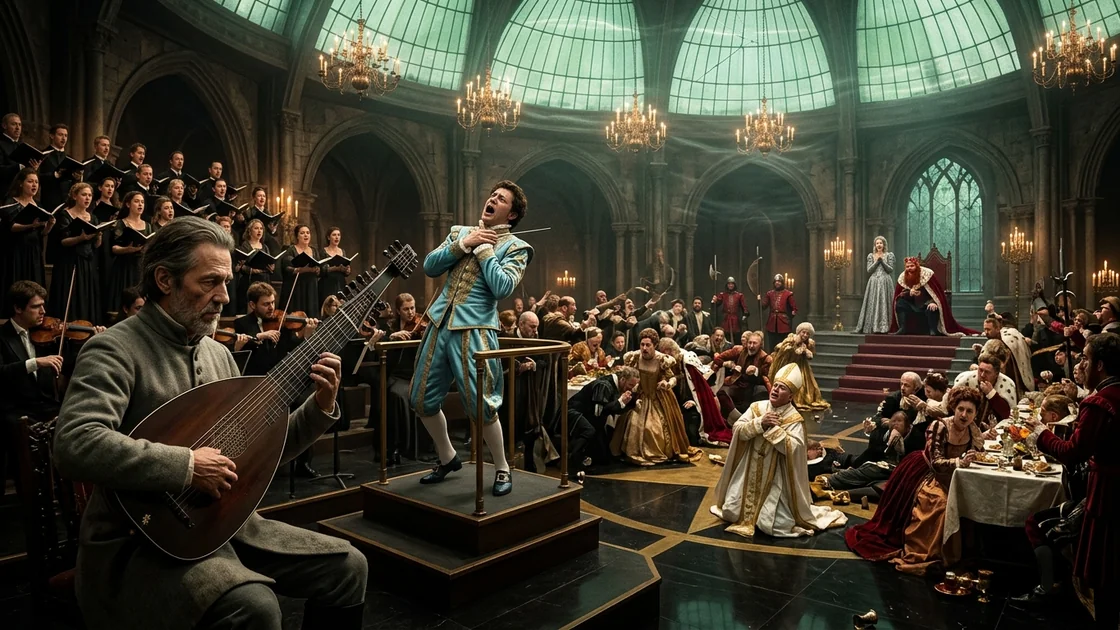
Caelen Vane was once the most celebrated bard in the kingdom of Aethelgard until King Malakor ordered his vocal cords burned with silver ash for singing a ballad that hinted at the monarch's fratricide. Living in poverty in the damp lower tiers of the city, Caelen is unexpectedly commissioned by the arrogant royal court to compose a grand symphony for the tenth anniversary of the King's reign, with the stipulation that his bitterest rival will sing the lead. Accepting the humiliating offer, Caelen uses forbidden acoustic magic and his own blood to weave an inescapable curse of absolute honesty into the celebratory music. When the song is performed at the royal banquet beneath the resonant glass domes of the palace, the infectious melody traps the nobles in an unending chorus where they are forced to sing their darkest treasons, murders, and secrets aloud, ultimately destroying the corrupt regime from within while the mute composer watches in quiet triumph.
The rain in the Sunken Ward never truly fell; it merely seeped from the belly of the upper city, dripping through the grates of the Artisans' Walk to collect in the narrow, cobbled alleys below. By the time the water reached the eaves of Caelen’s workshop, it carried the runoff of a thousand gilded carriages, the grease of roast swan from noble kitchens, and the faint, metallic tang of the alchemy forges.
Caelen sat by his single tallow candle, a small knife poised between his scarred thumb and forefinger. Across his knees lay the belly of a lute carved from bog-oak, dark and dense as iron. With slow, deliberate strokes, he scraped a curl of wood from the internal bracing. Shhhk. Shhhk.
He did not tap the wood to hear its pitch with his ears alone. Instead, he pressed his bare collarbone against the curve of the instrument’s ribs, plucking a single gut string with his calloused right thumb. The vibration traveled through the bone of his chest, up the column of his neck, and settled into the ruin of his throat.
It was a slightly flat F-sharp. The brace was still too thick by the breadth of a fingernail.
Caelen exhaled, and the sound that left his lips was not a sigh, for a sigh required the gentle approximation of vocal folds. What came from Caelen was a dry, hollow rattle, like dead autumn leaves scraping across a gravestone. Three years had passed since the High Justiciar’s iron funnel had been forced between his teeth, three years since the spoonful of white-hot silver ash had been poured down his gullet to sear away the treasonous instrument of his voice. The external scars were hidden beneath a high-collared tunic of faded grey wool, but the internal emptiness remained a constant, aching void. Every time he swallowed, he tasted cold metal and memory.
A heavy boot struck the door of his shop, rattling the iron latch and sending a tremor through the jars of hide glue and varnish lining his shelves.
Before Caelen could rise to draw the bolt, the latch was lifted from the outside. Three men stepped into the cramped, sawdust-scented gloom, their presence immediately shrinking the room. Two were Royal Halberdiers in polished cuirasses and cloaks of crimson wool that steamed in the damp air. Between them stood a man who held a perfumed silk handkerchief over his nose as though the scent of spruce shavings and resin were a mortal pestilence.
It was Julian of the Silver Lyre, wearing the velvet doublet and gold-chained mantle that had once belonged to Caelen himself—the vestments of the Master of the Royal Choir.
"Still whittling in the dark, Caelen?" Julian’s voice was a rich, resonant baritone, meticulously trained, oiled with honeyed tea, and pitched to carry to the back rows of an amphitheater even in casual conversation. He lowered the handkerchief just enough to offer a thin, pitying smile. "One would think a man who cannot speak would at least keep a brighter fire. The damp is terrible for the lungs. Though, I suppose for you, the condition of your windpipe is a matter of purely academic concern."
Caelen did not set down his paring knife. He remained seated on his three-legged stool, his dark eyes fixed on the pearl buttons of Julian’s doublet—right over the breastbone, where a heart would beat if the man possessed one. Slowly, Caelen reached to his side, picked up a small slate and a piece of tailor’s chalk, and wrote two words. He turned the slate around.
Why here?
Julian chuckled, stepping further into the room and flicking a curling ribbon of spruce wood off a workbench with a gloved finger. "Ever the economist with words. A stark contrast to your youth, when we could scarcely get you to stop reciting twelve-hundred-line epics about the fall of the Elder Kings. I am here, my dear former mentor, by the grace and command of His Radiant Majesty, King Malakor the First."
At the mention of the King's name, the two guards tapped the butts of their halberds against the floorboards in unison. The low thud vibrated in the bog-oak lute across Caelen’s knees.
"In six weeks' time," Julian continued, pacing the narrow aisle between Caelen’s hanging viol carcasses, "the realm celebrates the Golden Decade. Ten years since our benevolent sovereign ascended the Glass Throne following the... tragic hunting accident of his brother, Prince Regent Aldous. Ten years of peace, prosperity, and order."
Caelen’s face remained a mask of weathered stone, though his fingers tightened imperceptibly on the handle of the small knife. Hunting accident. Aldous had been found in his own bedchamber three leagues from the nearest forest, his neck broken and a crossbow bolt driven into his chest after his heart had already stopped beating. Caelen had only written a four-line allegoric verse about a stag slain in its stall by a jealous hound, yet that had been enough to earn him the silver ash. And it had been Julian, his most promising apprentice, who had delivered the private parchment from Caelen’s desk into the hands of the High Justiciar.
"The court requires a masterpiece," Julian said, turning back to face him, his eyes glinting in the candlelight. "A grand chaconne for full orchestra, four-part choir, and solo tenor. 'The Lay of the Golden Decade.' It is to be performed in the Grand Rotunda during the Midnight Banquet."
Caelen wiped the slate with the heel of his palm and chalked a new reply.
You are the Master of Choirs. Write it yourself.
A flash of genuine irritation crossed Julian’s handsome features before he smoothed it away. "My duties at court are taxing, Caelen. The diplomacy, the administration of the conservatory, the constant demand for my voice in the Queen’s private salon—it leaves precious little time for the tedious architecture of full orchestration. Besides..." Julian leaned over the workbench, lowering his voice so the guards by the door could barely hear. "The King himself asked for your hand on the parchment. Do you know why?"
Caelen stared back, unblinking.
"Because Malakor is a collector of broken things," Julian whispered, a cruel delight curling the corners of his mouth. "He drinks from the skull-cup of the rebel Lord Darion. He walks upon carpets woven by the blinded weavers of Qarth. And for his tenth anniversary, he wants the greatest composer of the age—the man who tried to sing him off his throne—to write the hymn of his eternal glory. You will write the music, Caelen. I will write the lyrics of praise, and I will sing them before the assembled peerage of Aethelgard. My voice, soaring upon the wings of your silent servitude."
Julian straightened up and reached into his cloak, withdrawing a heavy leather pouch that landed on the workbench with the unmistakable, dull clink of gold sovereigns. Beside it, he placed a rolled cylinder of vellum sealed with the royal signet in blood-red wax.
"Fifty crowns now," Julian said briskly, returning to his public voice. "Two hundred upon completion of the score. And, should the King fail to be moved to tears by the beauty of your composition, the High Justiciar has suggested that a man with no tongue has very little need for fingers. Rehearsals begin in the Citadel in three weeks. Do try to wash the sawdust from your hair before you present yourself at the Servants' Gate."
With a swirl of his velvet mantle, Julian turned and swept out into the drizzling dark, the two guards falling into step behind him. The door clicked shut, leaving the scent of expensive bergamot perfume warring with the smell of wet dog and boiled hide glue.
Caelen sat motionless for a long time. The tallow candle burned down, the flame guttering in a pool of grease until it threw vast, monstrous shadows of the hanging lutes across the peeling plaster walls.
Slowly, Caelen set down his paring knife. He did not touch the pouch of gold. Instead, he picked up the royal cylinder, broke the red wax with his thumb, and unrolled the vellum.
It was not a blank scroll. It was a list of specifications written in Julian’s flamboyant, looping script, detailing the themes that must be included in each movement: The Valor of King Malakor, The Chastity and Grace of Queen Seraphina, The Generosity of Duke Cassian, The Piety of Prelate Moros. Below the themes were the first few stanzas of Julian’s lyrics—clumsy, heavy-handed rhymes stuffed with hollow flattery, their meter limping like a three-legged horse.
Caelen looked at the halting meter. He looked at the requirement that the piece be performed in the Grand Rotunda—the heart of the Citadel of Spires, where seven domes of spun mountain-glass converged overhead to create the most sensitive acoustic chamber in the known world.
A tremor ran through Caelen’s frame. His shoulders began to shake, and from his ruined throat came that terrible, rasping rattle—hss-khh, hss-khh, hss-khh—as he laughed in the dark.
Malakor wanted a monument. Julian wanted immortality. They had forgotten the first law of the old conservatory, the law written in bronze above the doors before the King had melted the plaques down for cannon shot:
The singer owns the breath, but the composer owns the soul.
Caelen stood up, crossing the small room to a heavy oak chest buried beneath a pile of moldering wool blankets in the corner. He knelt, pulling a tarnished brass key from a cord around his neck, and unlocked the iron padlock. Pushing aside bundles of dried wormwood and old parchment scores from his youth, he reached the false bottom of the chest. He pried up the floorboards with his chisel and lifted out a long object wrapped in oiled lambskin, along with a small, iron-bound book whose pages were made not of paper or vellum, but of cured human skin—the Ars Resonantia, the forbidden treatise of the first Arch-Bards who had raised the walls of the ancient world with sound alone.
He unwrapped the lambskin. Inside lay an instrument he had not touched since the night the guards had dragged him from his bed. It was an Arch-Lute of seventeen courses, its neck inlaid with mother-of-pearl and cold iron, its soundboard cut from a lightning-struck yew tree that had grown over a mass grave.
Caelen ran his fingertips over the slack, dusty strings. They wanted a song for the Golden Decade. He would give them a song they would never stop singing for the rest of their lives.
To build a trap out of air, one must first measure the cage.
Two mornings later, Caelen stood at the postern gate of the Citadel of Spires, his threadbare cloak soaked through by the morning mist. After a humiliating twenty-minute inspection by the gate wardens—who mocked his mute gestures and poked at his leather portfolio with their pike-tips—he was issued a tin badge stamped with the mark of a temporary laborer and escorted up the winding service stairs toward the palace proper.
The Citadel was a marvel of stolen grandeur. Built four centuries ago by the dynasty Malakor’s family had usurped, it rose from the cliffs above the river like a cluster of frozen waterfalls. As Caelen emerged from the servants' passages into the Grand Rotunda, the sheer scale of the room pressed down upon him.
The floor was an expanse of polished black obsidian inlaid with constellations of brass. Seventy feet above, the seven interlocking domes of pale green glass caught the watery morning sunlight, fracturing it into shifting emerald webs that danced across the marble pillars. Galleries encircled the hall in three tiers, their balustrades carved in the likeness of weeping dryads and trumpeting seraphim. At the far end of the hall, raised upon twelve steps of porphyry, stood the Glass Throne.
Today, the hall was bustling with preparations for the upcoming jubilee. Servants on tall ladders polished the brass sconces; upholsterers hung forty-foot banners of gold and crimson silk between the pillars; and in the center of the floor, a gaggle of courtiers stood around a scale model of the banquet tables, arguing over seating precedence.
Caelen slipped into the shadows behind a fluted column of veined marble, pulling a small leather-bound notebook and a stick of graphite from his coat. He closed his eyes and listened.
Since losing his voice, his hearing had sharpened to a painful degree. He did not merely hear sounds; he perceived the geometry of their decay.
Across the room, a carpenter dropped a mallet. Crack.
Caelen counted the pulse beats in his wrist as the sound traveled upward, struck the central dome, bled into the six surrounding semi-domes, and returned to the floor in a focused ring around the dais. Four and a half seconds of reverberation. A fundamental resonant frequency hovering just below a concert B-flat. And yet, the new silk banners the upholsterers were hanging were dampening the upper harmonics, absorbing the high overtones like sponges soaking up spilled wine.
If the banners remained where they were, the acoustic focal point would shift three yards to the left of the throne, and the sympathetic vibrations required for the Harmonic Bind would scatter harmlessly into the upper galleries.
Caelen stepped out from behind the pillar and walked toward the Master of Revels, a portly man in a brocade surcoat named Lord Vane, who was currently sweating through his powdered wig as three different nobles shouted at him at once.
"—quite impossible, Vane!" snapped a tall, hawk-nosed man in velvet trimmed with sable. This was Duke Cassian, the Lord Treasurer, whose estates in the southern marches had tripled in size during the great grain blight two winters ago. "If you seat the house of Westmarch below the salt-cellars of Lord Corvus, I shall take it as a personal insult to the Treasury! Who do you think financed the gold leaf on those ridiculous triumphal arches in the plaza?"
"My dear Duke, please," Vane pleaded, dabbing his forehead with a lace cuff. "Her Majesty insisted that the martial houses hold the inner ring, closer to General Kael—"
"General Kael is an upstart butcher's son with horse dung on his spurs!" hissed a woman standing beside Cassian. Caelen recognized her immediately: Lady Evelyn, first lady-in-waiting to Queen Seraphina, though her eyes were darting nervously toward the upper gallery where the Queen herself stood beside a broad-shouldered man in gleaming black plate armor. Even from fifty paces away, Caelen could see the way General Kael’s armored hand rested just an inch too close to Queen Seraphina’s hip upon the marble balustrade, hidden from the main floor by a stone cherub, yet visible from Caelen’s low angle near the pillars.
"Ah, and what does the Church say, Prelate?" Duke Cassian demanded, turning to a gaunt man in the white and gold robes of the High Synod. Prelate Moros had fingers like bundled birch twigs, heavily ringed with amethysts, which he was currently using to pluck candied plums from a silver tray held by a terrified pageboy.
"The Synod cares little for where the flesh sits, so long as the spirit kneels," Prelate Moros murmured in a voice like oiled parchment. His eyes, however, were fixed greedily on the pageboy’s blonde curls before flicking toward the heavy gold chain around Cassian’s neck. "Though, naturally, the Prelacy must remain at the King's left hand, to bless the vintage. A vintage that I trust has been properly tithed, Duke Cassian? The last shipment of southern brandy from your ports seemed... remarkably light on the temple tariff."
"A clerical error at the docks, Holiness," Cassian said smoothly, though his jaw tightened. "Easily rectified before the feast."
Hypocrites, thieves, adulterers, and vultures. They stood in a tight knot, smiling with their teeth while their eyes measured one another’s backs for the width of a stiletto blade.
Caelen approached the edge of their circle and rapped his knuckles sharply against the wooden edge of the table model. Tak-tak-tak.
The rhythmic triple-knock cut through their bickering. Lord Vane spun around, his face purple with outrage at the interruption, until his eyes fell upon the tin badge on Caelen’s lapel and the scarred throat beneath his chin.
"Gods below, it’s the mute," Vane muttered, stepping back half a pace as if deafness or dumbness were contagious. "What do you want, Vane? Julian said you wouldn't be needed for the blocking until next week."
Caelen pulled his slate from under his arm and held it up. He had already written the message before stepping out from the pillar.
The crimson banners on the eastern and western pillars will choke the choir's voices. The King's praise will sound like mud. Hang them flat against the rear gallery walls instead. And move the high tables three paces inward toward the brass star on the floor, or the echo from the domes will drown out the Royal Herald.
Lord Vane squinted at the chalked letters through his monocle. "Move the tables? Rehang the silk? Do you have any idea how many hours the riggers spent hoisting those rods?"
"Let me see that," Duke Cassian said, snatching the slate from Caelen’s hands with the casual entitlement of a man who had never been denied anything. He read it, then glanced up at the forty-foot banners, then down at the brass star inlaid in the obsidian floor directly beneath the central dome. "He’s right about the echo. Last year, when Julian sang his ode to the tax collectors, the bounce off the pillars made it sound as though he were singing inside a beer barrel. I couldn't hear half the verses celebrating my ledger reforms."
"And moving the tables inward toward the star would widen the central aisle," Lady Evelyn added shrewdly, her eyes gleaming. "Allowing both Westmarch and Corvus to sit at equal distance from the dais."
"Well, I..." Lord Vane blinked, looking from the Duke to the Lady, then back to Caelen. "Very well. Riggers! Down with the pillar silks! Move them to the rear balconies!"
Duke Cassian tossed the slate back at Caelen’s chest. Caelen caught it deftly with one hand before it could clatter to the stone.
"Run along back to your garret, songbird," Cassian said dismissively, wiping his gloved fingers where they had touched the dusty slate. "See that the music is lively. If I fall asleep during the third course, I'll have Vane deduct the cost of the candles from your fee."
Caelen bowed low—so low that none of them could see the cold, terrifying smile that stretched across his face.
By moving the tables onto the points of the brass star and clearing the pillars of silk, they had just agreed to seat the entire high peerage of Aethelgard directly inside the primary nodal ring of the Rotunda’s acoustic lens. Every word sung from the minstrels' platform would strike the central dome and rain down upon their heads with tenfold intensity, trapping them in a cage of standing waves from which no human mind could break free.
Before leaving the hall, Caelen did one more thing. As he passed each of the nobles, he slowed his steps, listening not to their voices, but to the subtle, unconscious rhythms of their bodies.
Duke Cassian tapped his signet ring against his belt buckle when he was anxious: a brisk, nervous one-two-three, one-two-three, sixty-eight beats to the minute.
Prelate Moros breathed with a wet, wheezing catch at the top of his lungs, his chest rising and falling in a slow, ponderous four-count.
Up in the gallery, Queen Seraphina’s silk fan fluttered against her wrist in a syncopated triple meter as she whispered to her general.
Every human being possessed a rhythmic signature, a pulse dictated by the weight of their blood and the cadence of their thoughts. Caelen memorized them all, etching their tempos into his mind as he slipped back through the servants' door and descended into the bowels of the city.
The next fourteen days were a descent into a madness of mathematics and blood.
Caelen nailed thick horsehair blankets over the single window and the door of his workshop in the Sunken Ward, sealing out both the light of day and the prying ears of the street. He lived on hardtack softened in weak beer and the occasional bowl of salt-fish soup left outside his door by Marta, the widow who ran the chandlery next door and who was the only soul in the ward who remembered when Caelen had paid for the winter coal of every family on the lane.
Upon his long workbench, the Ars Resonantia lay open to the chapter titled De Vinculis Veritatis—On the Chains of Truth.
The ancient bards had not viewed music as entertainment. To them, sound was the fundamental architecture of creation; matter was merely vibration slowed down until it could be touched, and thought was vibration sped up until it became invisible. The human mind, with its web of memories, lies, and desires, was like a complex lock with a dozen tumblers. A normal song merely brushed against the outside of the lock, evoking a fleeting sadness or a momentary joy.
Wait for the right combination of intervals, however—layer a polyphonic weave where each voice turned a different tumbler—and the lock would spring open.
"To compel the tongue to speak what the heart conceals," the ancient Latinate script read upon the cured parchment, "the weaver must construct the Unbroken Labyrinth. The ground bass must mirror the beating of the terrified heart, anchored in the sub-audible registers of the great strings. Above this, the tenor and alto must pursue one another in a perpetual canon at the interval of the augmented fourth—the Diabolus in Musica—which the mortal ear cannot bear to leave unresolved. Yet the composer must deny them resolution."
Caelen’s quill scratched furiously across broadsheets of ruled parchment.
It was the most difficult compositional puzzle he had ever attempted. On the surface, the music had to sound magnificent, triumphant, and overwhelmingly catchy—an earworm of such radiant simplicity that drunken lords and tone-deaf ladies would find themselves humming the refrain after hearing it only once. If it sounded discordant or sinister, Julian would refuse to sing it, or the King would halt the performance before the trap was sprung.
Therefore, Caelen hid the dissonance inside the acoustics of the room itself.
He wrote the main melody in a bright, soaring D-Major—the key of brass trumpets and royal glory. It was a deceptively simple four-bar phrase that rose like a sunburst and cascaded down in a series of joyous triplets. He fitted Julian’s pompous lyrics to it with surgical precision:
Hail to the Crown of the Golden Ten, Shield of the realm and the Master of Men! Pure is the heart on the throne of glass, Long may his glory and justice last!
On paper, it looked entirely innocent. Even an accomplished master of counterpoint examining the score would see only a brilliant, festive chaconne over a repeating eight-bar bassline.
What the paper did not show was what would happen when that specific melody was sung inside the seven glass domes of the Grand Rotunda with a four-second reverberation time.
Because of the four-second delay, the third bar of the melody—sung by the sopranos—would still be hanging in the air beneath the central dome when the tenors sang the fifth bar below. In the air, forty feet above the floor, the lingering A-sharp of the third bar would collide with the E-natural of the fifth bar, generating a phantom overtone—a howling, invisible tritone that existed nowhere on the written page, born entirely from the marriage of Caelen’s timing and the palace's glass ceiling.
Bar after bar, variation after variation, these phantom overtones would stack upon one another in the center of the room, pressing down upon the minds of those seated on the brass star. It would create an unbearable cognitive itch, a pressure behind the eyes that could only be relieved by joining the song. And once a person opened their mouth to sing the melody, the mathematical rhythm of the chaconne—calibrated to the exact pulse rates Caelen had observed in the hall—would bypass their conscious will entirely, coupling their vocal cords directly to the deepest, most heavily guarded chambers of their memory.
To seal the enchantment into the physical world, however, the music required a catalyst. The phantom notes needed an anchor in the room, an instrument prepared according to the old rites to strike the fundamental frequency that would ignite the chain reaction.
On the twelfth night, when the moon was dark and the rain beat a steady tattoo against the roof tiles, Caelen prepared his Arch-Lute.
He had spent thirty of Julian’s gold crowns in the black markets beneath the slaughterhouses to acquire the raw materials. From a smuggler out of the waste-lands, he had bought the cured intestines of a cavern-blind wyrm, a creature that navigated entirely by echolocation and could not perceive illusions. These he spun, washed in lye and potash, and twisted into seventeen gleaming strings of varying gauges.
Next, he turned to the ink for the master score and the varnish for his soundboard.
Caelen placed a small bronze brazier on his workbench and lit a block of charcoal. Over it, he set a crucible containing amber resin, oil of turpentine, and a pinch of powdered echo-stone chiseled from the deepest stalactites of the Whispering Caves. As the mixture began to bubble and give off a sharp, piney vapor, Caelen picked up his paring knife.
He did not slice his palm; a lute player needed his hands whole and supple. Instead, he pulled open the collar of his tunic, exposing the knotted, silver-white scar tissue at the base of his throat—the exact spot where the King’s iron funnel had burned him from within.
Looking into a shard of tarnished mirror propped against a glue pot, Caelen pressed the point of the blade into the thick scar tissue over his larynx and drew a shallow, two-inch line.
Dark crimson welled up, spilling over the pale plateau of the scar. He held a porcelain saucer beneath his chin, letting the blood drip—plink, plink, plink—in strict three-quarter time. Blood from the site of the crime. The silence of the victim distilled into liquid iron.
He poured seven drops of the blood into the simmering varnish, and the remainder into his inkwell, mixing it with oak-gall and soot until it formed a glossy, black-red paste. When he brushed the warm varnish onto the yew-wood belly of the Arch-Lute, the wood seemed to drink it in with a faint, thirsty hiss, turning the color of dried wine.
When the varnish dried at dawn, Caelen strung the seventeen courses. As he tuned the lowest bass string—a thick cord wrapped in fine silver wire—he plucked it once.
Thrum.
The note was so low it was scarcely a sound at all, more a localized earthquake in the small room. The dust motes suspended in the candlebeams suddenly snapped into geometric grids, hanging in the air in perfect hexagonal patterns for three full seconds before drifting apart. Next door, through the thick stone wall, he heard the widow Marta’s shelves rattle and her dog begin to whine in its sleep.
Caelen laid his palm flat across the strings, silencing them. His fingertips tingled with a cold, electric static. The instrument was awake.
Now, all that remained was to teach the court how to load their own gallows.
Rehearsals began in the third week, held in the Conservatory Hall in the eastern wing of the Citadel before moving to the Grand Rotunda for the final dress sitzprobe.
It was a strange, surreal torture for Caelen to sit upon the conductor’s podium where he had once ruled supreme, reduced now to a shadowy figure beside the harpsichord while Julian stood at the front, waving a baton tipped with a pearl as large as a pigeon’s egg.
Sixty musicians of the Royal Chapel Orchestra and forty singers of the Sovereign Choir filled the tiered benches. Many of them had been Caelen’s students or colleagues three years ago. When Caelen first walked in with his bundle of blood-inked scores under his arm, a profound, uncomfortable silence fell over the room. First Violinist Lukas dropped his bow and stared at his shoes; the lead soprano, a woman named Clara whom Caelen had personally discovered singing in a wool-mill in the provinces, turned bright red and hid her face behind her music folder. None of them had spoken a word in his defense when the Justiciar’s men had dragged him away, and the guilt in the room was as thick and sour as curdled milk.
Only Julian was entirely unbothered.
"Places, everyone, places!" Julian clapped his hands, magnificent in a slashed-sleeve doublet of sky-blue satin. "Pass out the parts. As you know, His Majesty has graciously permitted Caelen to assist me with the orchestration of my latest work, The Lay of the Golden Decade. A touching act of royal clemency, allowing a fallen servant to earn his bread through humble copying work."
Caelen said nothing—could say nothing—as the apprentice boys distributed the sheets. He merely walked to the rear of the continuo section, took his seat on a plain wooden stool with a standard, unenchanted theorbo-lute (his true Arch-Lute remained safely hidden in his workshop until the night of the feast), and watched.
"From the top, then!" Julian tapped his baton against his gilded music stand. "Andante maestoso. Let me hear the brass ring out! One, two, three!"
The orchestra breathed in, and the first chords of Caelen’s chaconne rolled through the hall.
Even without the glass domes of the Rotunda, even without the blood-varnished Arch-Lute anchoring the bass, the music was staggering in its beauty. The cellos and bassoons laid down the walking eight-bar ground bass—a steady, inexorable heartbeat that seemed to reach straight into the chest cavity of everyone in the room and synchronize their pulses. Over this, the violins wove a shimmering canopy of sound, bright as sunlit water, before Julian’s baritone entered on the downbeat of the ninth measure:
Hail to the Crown of the Golden Ten, Shield of the realm and the Master of Men!
By the sixteenth bar, the posture of every musician in the room had changed. The slouching horn players sat bolt upright; Lukas’s eyes widened as his fingers flew across the fingerboard of his violin, entranced by the effortless logic of the voice-leading. The melody was like liquid gold poured into the ear. Once it entered the mind, it refused to leave; it curled around the brainstem, sweet and hypnotic, demanding to be repeated.
When they reached the end of the first variation and Julian cut them off, the hall rang with a stunned silence. Out in the corridor, three palace footmen and a scullery maid who had been passing by with a laundry basket were standing frozen against the open double doors, their mouths slightly open, humming the four-bar refrain under their breath without even realizing they were doing it.
"Hmm. Adequate," Julian said, though his eyes were shining with greedy triumph as he looked down at the score. He knew genius when he sang it, and more importantly, he knew that every noble in the kingdom would believe it was his genius. "The tenors were a fraction late on the third beat of measure twenty-two, and the violas must bring out the counter-melody more warmly. Wait..."
Julian frowned, leaning closer to the master conductor's score on his stand. He flipped forward four pages, toward the seventh variation—the moment where the four-part choir divided into an eight-part canon while the solo voice soared above them.
Caelen’s pulse slowed. He kept his face blank, his hands resting lightly on the neck of his theorbo.
"Caelen," Julian called out, tapping the page with his pearl-tipped baton. "Come here a moment."
Caelen rose from his stool and walked down the center aisle between the violins and the cellos, stepping up beside the podium.
"What is this voicing in the second altos and first tenors from measure eighty-four to ninety-six?" Julian pointed a manicured finger at the red-black ink. "You have the tenors holding a sustained E while the sopranos enter on an A-sharp four bars earlier, and here—in the continuo figure—you’ve written an unresolved seventh that repeats six times in a row without dropping to the third. On paper, it looks like a typographical error. It should clash horribly."
Around the room, several of the older musicians leaned forward, checking their own parts.
Caelen picked up the piece of chalk from the lip of Julian’s stand and wrote directly on the dark wood of the podium base, where everyone could see.
Acoustic compensation for the Rotunda domes. The glass swallows the third. Without the seventh, your high A will sound flat from the King's throne.
Julian paused, his mouth opening and closing slightly. Like all vain singers, the terror of sounding flat in front of his patrons superseded all other rational thought. He squinted at the score again, trying to hear the eight-part counterpoint in his head, a feat that was well beyond his actual musical education.
"To make my high A ring truer?" Julian murmured. "Let us hear how it sounds from measure eighty. Choir only, with continuo. One, two, three."
The choir sang the passage. In the timber-roofed Conservatory Hall, where the reverberation was less than a second, the passage sounded merely lush and slightly exotic—a rich, impressionistic swell of harmony that never stayed in the air long enough for the lethal phantom tritones to collide and lock together. And over the top of it, Julian sang his sustained high A. Because of the way Caelen had voiced the supporting chords underneath him, Julian’s note sounded twice as large and heroic as it actually was.
Julian finished the phrase, beaming with self-satisfaction as he patted his chest. "Remarkable. Truly, my instincts for vocal placement remain unmatched. Yes, leave the voicing as it stands. You see, my friends, a master composer must write not for the eye, but for the grand architecture of the palace! Take five minutes to rest your voices, then we shall run the second movement."
As the choir broke into chatter—half of them immediately humming the opening refrain as they reached for their water goblets—Caelen wiped his chalk marks off the podium with his sleeve.
As he stepped down, he caught the eye of Clara, the first soprano. She was staring at the ink on her sheet music, where a slightly thicker drop of Caelen’s blood-mixed gall had dried in the shape of a tiny, dark tear at the bottom of the page. She looked up at Caelen’s scarred throat, then at Julian’s preening back, and a shiver went through her shoulders. She did not know what Caelen had built into those black notes, not precisely, but she had studied under him long enough to know that Caelen Vane never wrote a single rest without a reason.
Caelen raised one finger to his closed lips, his dark eyes steady and calm.
Clara swallowed hard, looked down at her shoes, and gave a tiny, imperceptible nod. In the third measure of the King’s solo praise, the sopranos had a high, piercing entrance. She would sing it louder than she had ever sung anything in her life.
The night of the Golden Decade arrived wrapped in velvet and frost.
From the riverbanks to the high cliffs, the city of Solaris blazed with ten thousand pitch torches, though in the Sunken Ward the poor only watched the glow reflected against the underside of the fog while Royal Dragoons patrolled the bridges to ensure no ragged silhouettes marred the view from the palace terraces.
Inside the Grand Rotunda of the Citadel, it was noon at midnight.
Three thousand beeswax candles burned in tiered chandeliers of cut crystal suspended beneath the seven glass domes. Their light rained down upon the great tables arranged in a tight circle around the brass star on the obsidian floor. Four hundred of the highest lords, ladies, prelates, and commanders of Aethelgard sat draped in ermine, silk brocade, and cloth-of-gold, gorging themselves on thirty courses of peacock baked in its own feathers, lampreys stewed in spiced Malmsey wine, and sugar sculptures of King Malakor trampling a seven-headed hydra representing treason.
High upon the porphyry dais sat the King himself.
Malakor was a man built like a siege tower gone slightly to rust. His shoulders were vast beneath a mantle of crimson velvet embroidered with golden suns, his beard braided with rubies that matched the heavy, jagged crown upon his brow. His eyes, deep-set and perpetually suspicious, roved ceaselessly over his court as he tore the leg from a roasted capon with his bare teeth. To his right sat Queen Seraphina, pale and exquisite as a porcelain doll in silver lace, her long fingers resting lightly on the stem of her untouched wine goblet while her gaze drifted every few minutes down the steps to where General Kael sat at the head of the Captains' Table.
To the King’s left sat Prelate Moros, his white robes already stained with pomegranate juice, whispering into the ear of Duke Cassian, who was busily tapping his nervous one-two-three, one-two-three against the gold rim of his trencher.
And opposite the throne, at the focal point of the eastern curve of the hall, rose the tiered platform of the Royal Orchestra and Choir.
Caelen sat in the second row of the continuo section, half-hidden behind the broad back of the double-bass player and the gilded wing of the harpsichord. Across his knees rested the seventeen-course Arch-Lute, its blood-varnished yew belly gleaming darkly in the candlelight. No one had questioned the unusual instrument when he brought it through the servants' entrance in a battered canvas sack; to the guards and the court stewards, one lute was much the same as another, and Caelen himself was less than a piece of furniture.
A fanfare of six silver trumpets sounded from the upper gallery, cutting through the roar of drunken conversation and clattering silver plates.
Lord Vane, the Master of Revels, stepped to the center of the brass star on the floor and struck the obsidian three times with his ivory staff of office.
"My Lords, My Ladies, High Prelates, and Captains of the Realm!" Vane’s voice echoed beneath the glass domes—and Caelen felt a fierce, cold satisfaction as he heard the exact four-and-a-half-second decay ring back down onto the tables, unimpeded by the rehung banners. "His Radiant Majesty bids you fill your goblets with the vintage of the Southern Isles! For the culmination of our feast, the Royal Conservatory presents a work commissioned especially for this auspicious midnight: The Lay of the Golden Decade, composed and sung by the Master of the Royal Choir, Julian of the Silver Lyre!"
Polite, wine-flushed applause rippled around the circular tables. King Malakor leaned back into the cushions of the Glass Throne, swirling his golden cup, while his cold eyes bypassed Julian entirely to find Caelen sitting in the shadows of the orchestra pit. A slow, cruel smirk touched the King’s bearded lips. He raised his cup an inch toward the mute bard in mock salute, then drank deeply.
At the front of the platform, Julian bowed low to the throne, his white silk cape pooling behind him like swan wings. He turned to the orchestra, raised his pearl-tipped baton, and smiled.
He gave the downbeat.
Caelen struck the first note on the silver-wound seventeenth string of his Arch-Lute.
THRUM.
It was not loud, yet every candle flame in the lower chandeliers bowed simultaneously toward the center of the room as the sub-audible pressure wave rolled off the yew soundboard. The cellos, bassoons, and double basses joined on the instant, locking into the eight-bar ground bass.
One-two-three, one-two-three. Sixty-eight beats to the minute.
Across the floor, Duke Cassian’s hand stopped tapping his plate. His fingers froze, then began to move again, synchronized perfectly with the bassline. Beside him, Prelate Moros’s wheezing breath hitched and fell into step with the four-bar phrasing of the violas. Up on the dais, Queen Seraphina’s fluttering silk fan slowed until its rhythm matched the syncopated plucking of Caelen’s middle strings.
The lock was engaged. The first tumbler clicked into place.
Now the violins entered, soaring upward into the glass domes with that radiant, irresistible D-Major melody. Heads turned all around the banquet tables. Conversations died away not out of politeness, but because the melody was so luminously sweet that the human ear was drawn to it like a moth to a lantern flame. Noblewomen smiled dreamily; battle-hardened captains leaned their chins on their knuckles, their boots tapping softly against the obsidian floor.
Julian stepped forward, puffed out his satin-clad chest, and sang:
Hail to the Crown of the Golden Ten, Shield of the realm and the Master of Men! Pure is the heart on the throne of glass, Long may his glory and justice last!
His voice was undeniably magnificent. It rose sixty feet into the air, struck the central green dome, and rained back down upon the circle of tables like warm honey. When the choir answered him in four-part harmony, repetirng the refrain, Caelen saw dozens of nobles already mouthing the words along with them, swaying in their chairs. Even King Malakor was nodding his heavy head in time to the music, his thick fingers drumming the arm of the Glass Throne.
Variation followed variation. With each repetition of the eight-bar ground bass, Caelen played a slightly more intricate counter-melody on the wyrm-gut strings of his Arch-Lute, weaving the blood-magic deeper into the standing waves of the Rotunda.
By the fourth variation, the air inside the circle of tables had grown visibly thick, shimmering like the air above a desert road in July. The acoustic delay of the domes was doing its work: the lingering notes of the sopranos were colliding with the rising entrances of the tenors, giving birth to those phantom tritones forty feet overhead.
Nobody in the hall could hear the tritones consciously, for they were masked by the glorious D-Major triumph of the orchestra. Instead, the nobles felt them as a sudden, feverish euphoria mixed with an unbearable tightness in the chest—a desperate, itching compulsion behind the breastbone that whispered: Sing. Open your mouth and resolve the chord. Unburden yourself into the music.
At the tables, several drunken barons had begun singing the chorus out loud along with the choir, their voices booming across the roast peacocks. Lady Evelyn was humming at full volume, her eyes glassy and fixed on the ceiling.
On the conductor's podium, they reached measure eighty-four. The Seventh Variation. The Eight-Part Canon.
Caelen leaned over his Arch-Lute. His scarred throat burned as if the silver ash were fresh inside him. His fingers shifted up the neck of the instrument, pressing the wyrm-gut strings down against the cold iron frets at the twelfth position. Instead of playing the written continuo part he had rehearsed in the Conservatory, Caelen played the hidden ninth voice—the Clavis Veritatis, the Key of Truth—a piercing, jagged series of harmonic overtones that sliced straight through the center of the eight-part choir like a scalpel cutting a taut rope.
In the front row of the sopranos, Clara took a massive breath and sang her high A-sharp with every ounce of strength in her lungs.
Up in the central glass dome, the eight voices of the canon, the four-second echo, and Caelen’s iron-fretted harmonics collided at the exact mathematical center of the ceiling.
CRACK.
A sound like a crystal wineglass snapping in half rang out high overhead—a tiny hairline fracture shooting across the central pane of the green dome as the standing wave locked into permanent, self-sustaining resonance.
Down on the podium, Julian opened his mouth to sing the grand solo cadenza of the second verse, a verse meant to celebrate how he and the King had purged the court of treasonous elements three years ago.
And gone are the vipers who whispered of old— Julian sang, his voice soaring out over the hall.
Then his eyes went wide with sudden, abject horror.
His jaw remained open. He tried to snap his teeth shut, tried to step back from the edge of the platform, his white-gloved hands flying up toward his own face. Yet his chest expanded against his will, his diaphragm contracting to the inexorable sixty-eight-beat pulse of Caelen’s bassline, and his magnificent, honeyed baritone poured forth into the silent hall with crystal-clear diction:
—Though the traitor was me if the truth must be told! I forged the four verses on Caelen’s own sheet, And laid the false parchment at Malakor’s feet! For I coveted dearly his gold and his choir, So I bought the good Judge and the silver-ash fire!
Julian clapped both hands over his mouth, his eyes bulging above his white silk fingers like a terrified horse’s. muffled for only half a beat before a compulsion stronger than bone forced his hands down to his sides, his body swaying rhythmically to the violins as he hit a soaring high G:
And old Master Corwin didn't die of the gout, I poured hemlock root down his throat through a spout!
At the high tables, four hundred goblets froze halfway to four hundred mouths.
In the orchestra, First Violinist Lukas gasped and tried to lift his bow from the strings, only to find that his wrist was locked into the rhythm of the chaconne. The cellists stared in terror at their own moving hands; the wyrm-gut vibrations from Caelen’s Arch-Lute had enslaved the sympathetic resonance of every wooden instrument on the platform. They could not stop playing. The music rolled on, bright, joyous, and utterly merciless, into the eight-bar choral refrain.
"What is the meaning of this?!" Duke Cassian stood up at the Treasury table, slamming his fist down on the linen tablecloth so hard the salt-cellars jumped. He pointed a trembling finger at the stage. "Julian, you drunken fool, shut your mouth at once! Guards, remove him!"
Except Duke Cassian did not shout those words.
Because he was standing directly upon the brass star at the focal point of the glass dome, the moment he drew breath to speak, the unresolved phantom tritone in the air seized his larynx and forced his outrage into flawless, bouncing baritone triplets set to Caelen’s melody:
Shut your mouth at once, you pathetic old knave, Or you’ll sing yourself straight to a pauper’s cold grave!
Duke Cassian stopped dead, his hands flying to his own throat as his eyes darted wildly around the table. He tried to cough, tried to swallow, tried to sit back down, but the ground bass had been written to the exact sixty-eight-beat tempo of his own anxious heart. His foot began to tap. His chest heaved, and as the violins swept into the tenth variation, the Lord Treasurer of Aethelgard threw back his head and sang in a booming, rhythmic patter:
Though speaking of paupers and graves in the dirt, I’ll confess how I bought my new sable-lined shirt! There was never a blight in the southern grain store, I burned half the wheat-barns to double the score! Four thousand poor peasants starved dead in the snow, While I sold the King’s reserves down in Mordeaux! And a third of the gold that belongs to the Crown, Is buried in bricks under my house in town!
A collective shriek went up from the noblewomen along the western curve of the tables. Duke Cassian grabbed a linen napkin and stuffed it entirely into his own mouth, biting down on the cloth until his knuckles turned white—yet his chest continued to pump, and through his nose came a loud, resonant humming of the four-bar chorus before he tore the napkin out with a strangled sob to hit the final cadence:
—Beneath the third flagstone right next to the well, Oh Gods have mercy, I’m singing to Hell!
"Silence!" roared King Malakor, rising from the Glass Throne, his face the color of a bruised plum beneath his ruby-braided beard. He gripped the edges of the porphyry dais, glaring down at his Treasurer. "Treason! Vane, stop the orchestra! Halberdiers, clear the hall!"
At the doors, the Royal Halberdiers took two steps forward onto the obsidian floor—and immediately crossed the threshold of the outer acoustic ring.
The Captain of the Guard opened his mouth to bellow an order to his men, and instead burst into a cheerful, marching tenor:
Form up a line, boys, and lower your pikes, Though I sold the gate-keys to the smuggling dykes!
Behind him, three halberdiers harmonized in a pristine four-part barbershop chord:
And we water the wine in the barracks below, And we spat in the soup of the Duke of Mordeaux!
In the orchestra pit, Caelen’s fingers danced across the seventeen strings of the Arch-Lute, his eyes blazing like dark coals in the candlelight. He was no longer merely playing the instrument; he was conducting the entire architecture of the palace. He shifted his thumb to the fourteenth course, altering the harmonic emphasis from the lower tables to the slow, wheezing four-count of the Prelate’s seat, and simultaneously flicking a sharp syncopated triplet toward the Queen’s dais.
Beside Duke Cassian, Prelate Moros fell to his knees on the obsidian floor, his amethyst rings clattering against the stone as he clawed at his collar. He tried to pray in Latin to break the spell, but the moment his tongue moved, the golden D-Major melody hijacked his lungs, turning his oily voice into a weeping counter-tenor:
Dominus save us, my sins are too deep, I rob every widow who comes here to weep! I don't even believe in the Gods up above, It's only the gold and the choirboys I love! And the relic of Sainted King Aldous’s bone, Is the leg of a mutton I boiled on my own!
Across the table, Lord Corvus—who had paid the Prelate ten thousand crowns the previous winter to touch that very relic and cure his wife’s barrenness—leapt across the roast peacocks with a carving knife in his hand. Yet the moment Corvus opened his mouth to curse the priest, the melody caught him mid-leap, forcing him to dance a stately pavane step around the spilled wine tureens while singing:
You swindling bastard, I’ll cut out your liver, Like I drowned my own nephew down in the cold river!
It was a contagion of absolute, catastrophic truth.
No one could escape the room, because the guards at the heavy oak doors were too busy singing a spirited sea-shanty variation about how they took bribes from the city guilds to let assassins into the gardens, their halberds crossed in an accidental blockade that kept the scrambling nobles penned inside the circle of tables. Lords and ladies who tried to crawl under the tables found that the obsidian floor conducted the sub-audible bass of Caelen’s Arch-Lute ten times more efficiently than the air; the moment their knees or palms touched the black stone, they were jerked upright like marionettes on wire, joining the grand four-hundred-voice choir on the refrain:
Hail to the Crown of the Golden Ten, A pit of dark vipers and murderous men! Rotten the heart on the throne of glass, Nowhere to hide when the judgment comes past!
Blood was beginning to fleck the lips of Julian on the podium and Duke Cassian on the floor as their vocal cords strained under the relentless volume the spell demanded, yet they could not stop. When one noble collapsed onto a couch, gasping for air, two others stood up in his place to take the next verse. Lady Evelyn sang a piercing coloratura aria detailing the seventeen different lords she had blackmailed with stolen love letters; the Master of the Mint sang a booming bass solo explaining how he had shaved three grains of silver off every coin minted since the coronation and replaced the weight with cheap lead.
Up on the dais, King Malakor stood frozen in horror, watching his entire government, his church, and his treasury unravel in strict three-quarter time. His eyes whipped toward his wife as Queen Seraphina suddenly rose from her ivory chair, her porcelain face twisted in sheer terror as her hands clutched at the silver lace over her throat.
"Seraphina," the King rasped, backing away from the edge of the steps where the acoustic waves were strongest. "Seraphina, do not breathe! Hold your breath, woman!"
Queen Seraphina tried. She clamped her teeth together until her jaw muscles bulged, turning purple in the face for twenty seconds, thirty seconds—until her body’s survival instinct broke her will. She gasped in a lungful of the vibrating, music-saturated air, and as Caelen struck a sweeping arpeggio across the upper strings of his lute, the Queen of Aethelgard stepped to the edge of the porphyry dais and sang in a bell-like, soaring soprano that outshone Clara herself:
My husband the boar has the brains of a stone, And soon I’ll be sitting alone on his throne! For the child in my womb has no drop of his blood, I conceived him with Kael in the hunting-lodge wood!
At the Captains' Table below, General Kael went white as chalk. Two of the King’s personal bodyguards instantly drew their broadswords and lunged toward the General—while Kael himself stood up and answered his lover in a thunderous, operatic duet, drawing his own blade in time with the downbeat:
And tonight was the night that the boar was to die, With a pinch of white arsenic baked in his pie! Yes, the goblet of wine that sits right by his hand, Has enough spider-venom to widow the land!
King Malakor looked down at the golden goblet beside his throne—the goblet from which he had already drunk three deep draughts when saluting Caelen at the beginning of the piece.
A sudden, icy sweat broke out across the King’s brow. He clutched at his stomach, feeling the first faint, burning cramp tightening in his bowels. With a roar of beastly fury, Malakor kicked the golden table down the porphyry steps, sending platters of gold and crystal crashing onto the obsidian floor.
And in kicking the table, the King stepped two paces forward off the throne platform—bringing his boots directly into the focal ring of the central glass dome.
Caelen stood up in the orchestra pit.
He lifted the heavy Arch-Lute against his chest, stepping over the low wooden rail at the front of the platform, walking right past the weeping, bleeding-lipped Julian until he stood at the very edge of the stage, directly facing the dais across the sea of dancing, confessing nobles.
King Malakor’s eyes locked onto Caelen’s. The monarch’s hand fumbled at his belt for his dagger, his belly cramping with the Queen’s poison, his lungs filling with the composer’s air.
Caelen looked at the man who had taken his voice, his home, and his life. Then, with his right thumb, Caelen reached down and plucked the seventeenth string—the silver-wound wyrm-gut bass—pulling it back an inch before releasing it so that it snapped against the iron fretboards like a whipcrack.
The final tumbler turned. The deepest lock in the room sprang open.
King Malakor dropped to his knees on the top step of the dais. His crown tilted sideways on his head. He dug his fingernails into his own beard, tearing out red-gold hairs and rubies alike as he fought with every ounce of his tyrant’s will to keep his mouth closed. Blood leaked from between his clenched teeth where he had bitten through his own tongue to stop it from moving.
It did not matter. In Caelen’s music, one did not even need a whole tongue to tell the truth—only breath and bone.
The King’s jaw pried itself open with an audible pop, and a voice ragged with blood and venom boomed out beneath the seven domes, drowning out the choir, the nobles, and the orchestra alike:
I murdered my brother! I broke his own neck! To steal the Glass Throne and keep Aethelgard in check! He begged me for mercy, he called out my name, While I smothered his face in the dark without shame! And I burned Caelen’s throat with the silver-ash coal, Because I was terrified of his pure soul! For a king built on murder can never abide, A song that exposes the rot that he hides!
In the doorways and the upper galleries, the common servants—the footmen, the scullery maids, the wine-stewards, and the lower guards who stood outside the acoustic ring of the domes—stared down in stunned, terrible silence. For ten years they had whispered; for ten years they had suspected. Now, the King himself was screaming the confession to the rafters while his Queen sang of poisoning him, his General sang of treason, his Treasurer sang of starving the realm, and his High Prelate sang of atheism and theft.
Not a single guard moved to save the King as Malakor pitched forward down the porphyry steps, clutching his poisoned gut, still singing ragged, bloody fragments of his brother’s final words as he rolled onto the brass star in the center of the floor.
Instead, General Kael’s captains began fighting the Duke’s household guards in the aisles, while both sides continued to sing the four-bar chorus between sword-strokes. In the orchestra, the musicians’ fingers were bleeding onto their fingerboards; the choir’s voices had been reduced to raw, rasping whispers—hss-khh, hss-khh—the exact sound of Caelen’s own ruined throat, as the unending chaconne ground their vocal cords down to ash.
Caelen watched them for one full measure more.
He looked at Julian, who had collapsed against the harpsichord, still weakly wheezing out confessions of stolen compositions through a throat that would never hit a pure note again as long as he lived. He looked at the nobles tearing their own silk garments in madness, trapped in the acoustic loop of the glass domes, where the four-second echo now fed upon itself in a perpetual, self-sustaining feedback loop that no longer required Caelen’s accompaniment to continue. As long as one person in that circle drew breath to scream, the domes would turn that scream into the D-Major tritone and force the next person to sing the refrain.
Slowly, Caelen drew his small luthier’s paring knife from his belt.
With a single, swift downward stroke across the bridge of the Arch-Lute, he severed all seventeen strings.
TWANG-SNAP.
The strings curled back like dying serpents. Caelen laid the silent yew-wood instrument gently down upon the conductor’s podium, right over the blood-inked pages of the master score.
He reached up to his lapel, unpinned the tin laborer’s badge, and let it drop to the boards.
Turning his back on the screaming, singing ruin of the royal court of Aethelgard, Caelen walked down the side steps of the platform. The servants and pages crowded around the service doors parted before him like water before the prow of a ship, their eyes wide with awe and terror, none of them daring to touch the hem of his faded grey wool cloak.
Caelen pushed open the heavy oak doors, walked down the long marble corridors of the Citadel, and stepped out through the postern gate into the cool, clean rain of the early morning.
High behind him, filtering through the green glass domes of the palace, the muffled, rhythmic chorus of four hundred breaking voices rose into the mist. Caelen turned his collar up against the drizzle, put his hands in his pockets, and walked down the hill toward the quiet of the Sunken Ward, listening to the silence inside his own chest, which had never sounded so sweet.