The Ash-Born Reckoning
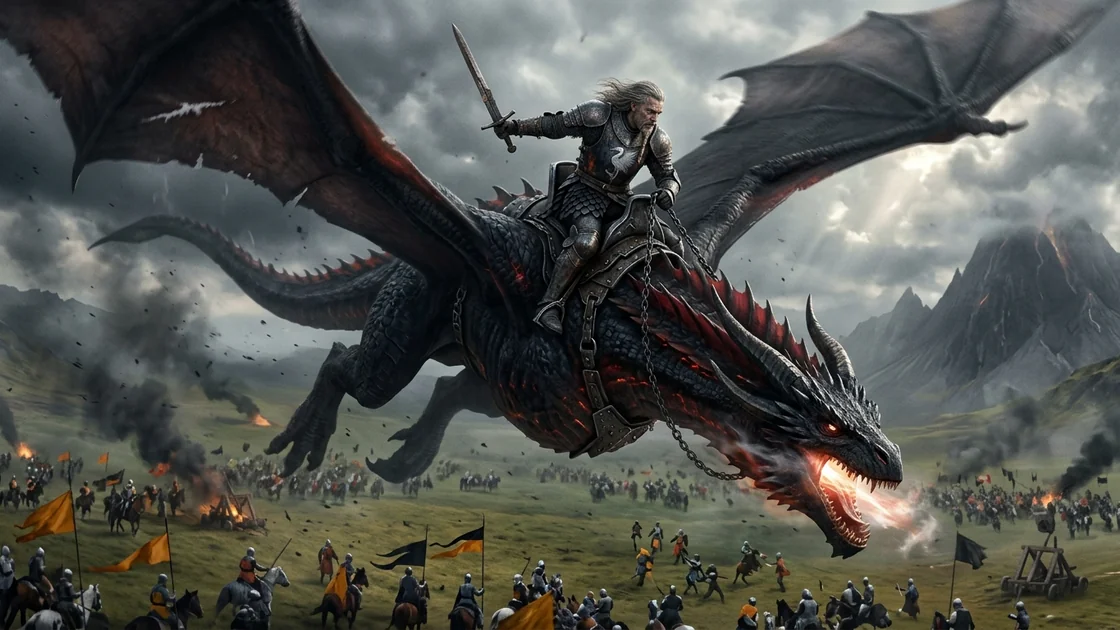
Ser Kaelen Vance is betrayed on the blood-soaked fields of the Red Ford by his ambitious liege, Lord Malakor, who leaves the loyal vanguard commander for dead to secure a dishonorable victory and erase his war debts. Stripped of his titles, his ancestral blade broken, and branded a traitor by the very ruler he bled to protect, Kaelen is cast into exile in the scorched wasteland of the Cinder Peaks. Within the vitrified, melted ruins of Highspire, the fortress of Malakor's greatest rival, Kaelen discovers a starving, crippled dragon chained in the subterranean vaults. He realizes that Malakor secretly used the juvenile beast to incinerate his rival's keep before collapsing the tunnels to bury the evidence of his forbidden crime. Over five grueling years in the frozen mountains, the broken knight and the abandoned wyrm forge an unbreakable bond through mutual survival, nursing one another back to lethal strength while fashioning a harness of salvaged iron. When Lord Malakor marches his grand host to the Whispering Plains to claim the High Crown of the realm, Kaelen takes to the skies atop the fully grown dread-drake, descending upon the battlefield to deliver a fiery reckoning to the liege who betrayed him.
The rain at the Red Ford did not fall so much as it hung in the air, a thick, choking curtain of gray mist that turned the churned mud of the riverbank into a sucking mire of clay and opened veins. Ser Kaelen Vance stood ankle-deep in the crimson slush, his left shoulder pressed hard against the dented boss of his kite shield, his lungs burning for want of clean air. Every breath tasted of wet iron, horse dung, and the sour sweat of terrified men.
"Hold the stakes!" Kaelen roared, his voice rasping like a rusted saw inside the narrow steel cage of his bascinet. A heavy broadhead arrow glanced off the crown of his helm with a deafening clang that made his teeth ache, spinning away into the murk. "Drop your spears to the chest-line! If the pike-block breaks, we swim home in our own guts! Hold!"
To his left, young Joren, his squire of three summers, whimpered as he braced the butt of a twelve-foot ash pike against his booted instep. The boy was seventeen, his face smeared with river silt and someone else’s arterial spray, his eyes wide and white behind the visorless rim of his kettle hat.
"Ser Kaelen," the boy gasped, his gauntleted hands trembling on the slick wood of the shaft. "The horns! Where are the horns? Lord Malakor swore the heavy lancers would cross at the upper shallows when the sun cleared the ridge!"
Kaelen did not look up at the sky. There was no sun, only the bruised, swollen belly of the autumn clouds pressing down upon the valley of Oakhaven. Yet he knew the hour by the ache in his thighs and the height of the dead piled before his shield wall. It was past noon. They had been holding the ford against the remnant host of Duke Toma’s household guard since dawn, pinning the desperate enemy against the swollen torrent of the river while waiting for Lord Malakor’s hammer to fall upon their rear.
Four hundred men of the Ironhold Vanguard had waded into the shallows that morning. Fewer than two hundred remained on their feet.
"Keep your eyes on the mail in front of you, boy!" Kaelen barked, stepping into a gap where a bearded sergeant had just taken a poleaxe through the gorget. Kaelen swung Dawn-Cleaver, his father’s bastard sword, in a short, brutal arc. The heavy steel bit through the wet leather and chainmail of a charging Toma man-at-arms, cleaving collarbone and lung before Kaelen wrenched the blade free with a practiced twist of his wrists. "The Lord of Ironhold does not miss his mark. The mud slows the destriers. Give him ten more minutes of your spine!"
He did not believe his own words. A cold, greasy knot had been tightening in Kaelen’s belly for the last hour.
Three hundred yards behind them, up the gentle slope of broom-scrub and heather, the banner of House Malakor—a black portcullis on a field of saffron—hung limp from its standard pole. Even through the driving drizzle and the steam rising from four thousand colliding bodies, Kaelen had caught glimpses of the ridge during brief lulls in the press. The reserve cavalry had not moved. Two thousand fresh knights and armored lancers sat motionless in their saddles, their pennons dry, their lances upright like a forest of winter pine. And lined along the crest directly below them stood six hundred Welsh-bowmen of the Black Fletch, their longbows strung, their quivers full.
Why had Malakor not sounded the charge? Duke Toma was dead—burned alive in his impregnable mountain fortress of Highspire three weeks prior in a cataclysmic fire that the priests called the wrath of heaven and the soldiers called a miracle. Toma’s younger brother, Ser Aldous, commanded this surviving host of two thousand men. They were cornered, starving, and fighting with the rabid fury of wolves caught in a deadfall. If Kaelen’s vanguard broke, Aldous would burst through the center and roll up Malakor’s archers before the heavy horse could even form a trot on the slick grass.
"They’re massing!" Ser Garrett, Kaelen’s second-in-command, spat a mouthful of blood through his breathing holes as he shoved a dead pikeman off the sharpened wooden stakes Kaelen’s engineers had driven into the mud at first light. "Aldous is bringing up his dismounted knights! Kaelen, we haven't the weight to stop full plate on foot! We need the horse, or we need to pull back to the scrub!"
"If we pull back from the stakes, their cavalry will cross the ford and ride us down in the open," Kaelen said grimly, wiping rain and gore from his eye-slits with the back of his mailed thumb. "Joren! Run to the ridge. Find Lord Malakor or Ser Vane. Tell them the anvil is cracking. Tell them if the hammer does not fall now, there will be nothing left to strike!"
Joren hesitated, looking from Kaelen’s battered, blood-caked surcoat—the silver heron of House Vance—to the wall of steel gathering on the far bank of the churned river. "My place is at your shield, Ser."
"Your place is where I command it!" Kaelen snarled, grabbing the boy by his leather shoulder-strap and shoving him toward the rear. "Run, damn you! Run!"
The boy turned and scrambled up the slippery bank, his boots kicking up clods of wet turf. Kaelen watched him for three heartbeats—just long enough to see Joren clear the immediate carnage of the wounded dragging themselves out of the water—before the horn of Ser Aldous blew on the opposite shore.
It was a low, mournful blast, the sound of men who knew they were already ghosts and wished only to take their killers into the dark with them.
"Shields!" Kaelen bellowed, his voice cracking with the strain. "Lock! Lock, you bastards! For Ironhold! For Vance!"
Two hundred shields slammed together with the sound of felled timber. A heartbeat later, six hundred dismounted knights and heavy infantry under the torn banner of Highspire crashed into them like a winter tide striking a seawall.
The impact drove Kaelen backward a full pace, the mud sucking at his greaves. A two-handed greatsword came down toward his helm; he caught it on the angled rim of his shield, feeling the wood splinter beneath the painted hide and his forearm go numb from wrist to elbow. He thrust Dawn-Cleaver under the attacker’s guard, feeling the point skate off a steel cuirass before finding the softer mail of the armpit. He leaned his whole weight into the pommel, driving the knight backward into the press, then wrenched the sword out and hammered his shield-boss into the visor of a man swinging a flanged mace.
It was not swordsmanship; it was butchery in a phone booth. Men screamed as their knees were shattered beneath the crush. Wounded soldiers fell into the thigh-deep slush and drowned under the iron-shod boots of their brothers. Kaelen fought like a machine, his world reduced to a two-inch horizontal slit of gray light and flashing iron. Parry, thrust, bash, step. Parry, thrust, bash, step. His shoulder burned where an earlier spear-thrust had parted his mail; his thighs trembled like those of an old horse at the end of a winter logging haul.
Then, above the din of clashing iron and shrieking men, a new sound cut through the drizzle.
It was the deep, brazen bray of the ridge-horns. Three short blasts.
Kaelen’s heart leaped against his bruised ribs. The charge. Malakor was finally loosing the lancers.
"They come!" Kaelen shouted, rallying his flagging line as he split the face of a bearded axeman with his crossguard. "The Lord of Ironhold comes! Press them! Press them into the river!"
Beside him, Ser Garrett raised his notched longsword, his voice rising in a hoarse cheer—and then Garrett stopped, his head tilting up toward the gray sky.
"Kaelen?" Garrett whispered. That was not the sound of hooves trembling the earth.
It was a hiss. A vast, whispering sigh that seemed to drink all the moisture from the air, like the wind rushing through a forest of dry reeds before a thunderstorm.
Kaelen looked up through his visor slit. The gray sky above the ridge had turned entirely black.
Not with cavalry. With ash-wood shafts and black goose feathers.
Six hundred longbows had loosed as one. Not over the melee into the rear ranks of the Highspire host on the far bank. The arc was too low, too flat, aimed directly into the center of the Red Ford.
"Shields up!" Kaelen screamed, the terror in his throat tearing the words to rags. "Overhead! Over—"
The sky fell.
It sounded like a thousand hailstones striking a tin roof, mixed with the wet, meaty thuds of iron bodkins punching through sodden wool, leather, and flesh. Men on both sides—the blue-and-white of Highspire and the silver-and-saffron of the Ironhold Vanguard—crumpled instantly. Ser Garrett took two shafts through his open visor-slit before he could drop his chin; he fell backward into the mud without a sound, his fingers twitching on the hilt of his sword.
Kaelen threw his splintered shield above his head, feeling three arrows punch through the oak planks with such force that their three-sided steel points stopped an inch from his nose. Around him, his men were screaming—not the battle-cries of soldiers, but the high, bewildered shrieks of sheep caught in the slaughter-pen.
"Foul!" a voice roared through the rain of death. "We are your own! Cease! In the gods' names, cease!"
On the ridge, the horns blew a second time. Another whisper filled the heavens.
Kaelen looked toward the slope as the second volley descended. Halfway up the hill, lying face-down in the heather with four black-fletched arrows protruding from his back like the quills of a butchered boar, lay Joren. The boy had never even reached the archers' line. They had shot him down as he ran toward them with Kaelen’s plea on his lips.
Comprehension hit Kaelen harder than the iron shaft that followed a fraction of a second later.
House Vance was the oldest vassal in the Westfold. Lord Malakor owed Kaelen’s estate forty thousand crowns in gold borrowed to fund the mercenaries for this very campaign—a debt that died if the last male of the Vance bloodline perished without issue on the field of honor. And more than gold, Kaelen and his vanguard were the only men in the realm who knew that Malakor had marched toward Highspire with twelve covered wagons of eastern alchemists three weeks before Duke Toma’s castle had melted like tallow in a furnace.
Malakor had never intended to relieve the ford. The Vanguard was the bait, and the anvil was meant to be shattered alongside the hammer.
A blinding white pain exploded beneath Kaelen’s right collarbone as a heavy bodkin arrow punched through the joint of his pauldron, driving him to his knees in the red water. A second shaft struck the side of his bascinet, tearing the leather chin-strap and spinning the helmet halfway around his head, blinding him. As he tore the twisted helm from his skull, gasping for air, a third arrow grazed his temple, laying open the scalp from brow to ear and filling his eyes with hot, blinding crimson.
Through the veil of his own blood, he heard the thunder of hooves at last. Now that the ford was a carpet of dead and dying men from both armies, Lord Malakor’s heavy horse was coming down the hill to trample whatever still breathed.
Kaelen tried to raise Dawn-Cleaver, his fingers locked around the wire-wrapped grip, before the iron-shod hoof of a passing destrier caught him squarely in the temple, and the world dissolved into cold black water.
He did not die in the mud, though for three days in the back of a jolting corpse-cart he prayed to every cold god of the northern peaks that he had.
It was a camp follower—a toothless old crone scavenging boots and silver rings from the swollen dead along the riverbank after the main host marched back to Ironhold—who found him breathing beneath the bloated belly of a dead warhorse. Seeing the gold-inlaid spurs at his heels and the fine Toledo steel of his breastplate, she had not slit his throat with her skinning knife; instead, she had sold him for three silver groats to the provost-marshal’s rear-guard, thinking Lord Malakor would pay a handsome bounty for the miraculous return of his Vanguard Commander.
The crone had been hanged from a baggage-wagon tongue within the hour to keep her mouth shut, and Kaelen had woken in iron fetters.
Ten days after the battle at the Red Ford, they dragged him into the Great Hall of Ironhold.
His wounds had not been tended, only cauterized with boiling pitch by a drunken farrier so he would not bleed out before the spectacle. The broken shaft of the bodkin arrow had been yanked from his shoulder with blacksmith’s tongs, leaving a ragged, weeping hole that smelled of green rot and fever. He wore only his filthy, blood-stiffened gambeson and breeches, his ankles linked by a short length of heavy logging chain that forced him to shuffle like a hobbled mule across the polished flagstones he had walked as an honored guest since boyhood.
The Great Hall was packed to the rafters. Every minor baron, landed knight, and wealthy guild-master of the Westfold stood beneath the high lancet windows, their silks and velvets rustling like dry leaves as they craned their necks to see the prisoner.
At the far end of the hall, upon the raised dais of black basalt, sat Lord Malakor.
He was a tall man in his fortieth year, lean and angular as a winter wolf, with hair the color of tarnished silver and a neatly trimmed beard that hid a weak, ruthless mouth. He wore no armor today—only a robe of black velvet trimmed with sable, and around his neck hung the heavy gold chain of the High Justiciar. To his right stood Ser Vane, the captain of the household horse, a hulking brute with a nose broken in three places. To his left, resting upon a velvet cushion held by a page, lay Dawn-Cleaver.
Two guards kicked the backs of Kaelen’s knees, sending him crashing down onto the cold stone at the foot of the dais. The jar sent a lance of white-hot agony through his festering shoulder, yet Kaelen bit the inside of his cheek until his mouth filled with copper, refusing to give them a groan. He raised his head, his left eye swollen shut beneath a crust of dried blood and matted hair, and fixed his good eye—pale gray and sharp as a winter flint—upon his liege.
Lord Malakor looked down at him with an expression of profound, theatrical sorrow.
"My lords," Malakor’s voice carried effortlessly to the galleries, rich and resonant, the voice of a grieving father forced to chastise a wayward son. "It is with a heavy heart that we convene this court upon a day that should be given over to thanksgiving. The rebellion of House Toma is ended. The usurper’s brother lies dead at the Red Ford, and peace returns to the Westfold."
A murmur of approval rippled through the crowd, though Kaelen noticed several faces near the front that did not join in—Lord Hoster, whose two sons had ridden in Kaelen’s vanguard; Lady Meredyth, whose husband had stood five paces to Kaelen’s right when the black arrows fell.
"Yet victory was bought at a bitter, needless price," Malakor continued, rising slowly from his chair. He stepped to the edge of the dais, looking down at Kaelen. "Four hundred of our finest sons took the vanguard at the Red Ford. My strict command to Ser Kaelen Vance was to hold the high ground above the western bank and await the positioning of my heavy lancers. Instead, driven by a vainglorious hunger for personal glory—or, as darker rumors whisper, a secret compact with the traitors of Highspire—Ser Kaelen led those four hundred men into the river shallows against my express orders."
Kaelen stared up at him, the sheer audacity of the lie stealing the breath from his lungs for a second before the rage ignited in his chest.
"And when the battle turned against his reckless charge," Malakor’s voice dropped to a disgusted whisper that nonetheless echoed off the stone walls, "when the sons of your houses were dying in the mud where he had led them... this man threw down his shield, tore the Vance heraldry from his breast, and crawled beneath the dead like a dog, leaving his squire and his brothers-in-arms to be butchered while my archers were forced to fire into the press to save the center of our line."
"Liar," Kaelen croaked. His throat was parched as kiln-brick, his lips cracked and bleeding, yet he forced the word out from the bottom of his diaphragm. He braced his chained hands against the flagstones and shoved himself upright, standing swaying on his feet despite the guards who moved to club him back down.
Malakor raised a slender, ringed hand, halting the guards. "Let the broken man speak his piece, if he has the stomach for it."
Kaelen turned his head, spitting a gob of bloody saliva onto the bottom step of the dais. He looked not at Malakor, but at Lord Hoster and the grieving fathers in the front ranks.
"Your sons held that ford from dawn until past noon with nothing in their bellies but cold water and iron," Kaelen’s voice grew stronger with every syllable, the old parade-ground bark of the Vanguard Commander cutting through the perfumed air of the hall. "We held two thousand desperate men on a strip of mud twenty paces wide while that whore’s son on the dais sat his horse on dry heather and watched us bleed! Ask him whose arrows killed your boys, Hoster! Pull the shafts from their corpses if he hasn't burned them in a pit already! You’ll find black goose feathers and Ironhold bodkins in their backs!"
A sharp intake of breath hissed through the hall. Lord Hoster’s hand dropped instinctively to the pommel of his court sword, his eyes narrowing as he looked toward Ser Vane.
"He raves with wound-fever," Ser Vane barked, stepping forward, his hand resting on the hilt of a heavy broadsword. "We pulled three dozen Highspire shafts from the vanguard dead."
"You shot my squire down in the heather fifty yards from your own bow-line!" Kaelen roared, lunging a half-step forward before the guards hauled back on his chains, tearing the iron cuffs into his wrists. "A boy of seventeen carrying my call for the cavalry! Malakor owed my house forty thousand gold crowns, and he paid it in black-fletched iron! Just as he paid his debt to Duke Toma not with steel in the field, but with eastern wildfire and alchemists’ pitch in the dark of the night!"
For the space of a single heartbeat, the mask of sorrow slipped from Lord Malakor’s face. His dark eyes contracted to pinpricks of pure, glacial malice. The mention of the eastern wagons had struck the nerve.
"Enough," Malakor said softly.
Ser Vane nodded once. He stepped down from the dais, took a pair of heavy iron pincers from the belt of the Castle Blacksmith standing by the pillar, and wrenched Kaelen’s heels up one at a time, snapping the golden knightly spurs from his boots with two brutal twists that nearly broke Kaelen’s ankles. The spurs clattered across the stone floor like discarded coins.
Then Vane took Dawn-Cleaver from the page’s cushion.
"Don't touch that blade, you dog," Kaelen snarled, thrashing against the four men holding his chains, the wound in his shoulder bursting open anew and soaking his ragged sleeve in dark red. "Your grandfather was shoveling pig-shit in the marshes when my blood forged that steel!"
Vane smiled—a slow, ugly curving of his scarred lips. He laid the flat of the ancestral bastard sword across the iron anvil block that had been carried into the hall for this very ritual. The blacksmith raised a twenty-pound sledgehammer above his head.
"By the judgment of the Westfold," Malakor intoned from the throne, "for cowardice in the face of the enemy, for treasonous slander against his liege, and for the murder by negligence of four hundred loyal subjects, I strip Kaelen of House Vance of all lands, titles, castles, and honors. His name is struck from the rolls of chivalry. His bloodline is attainted."
The sledgehammer fell.
The sound was like a church bell cracking in a deep freeze—a high, agonizing ring that vibrated in Kaelen’s very marrow. Four hundred years of folded Valen-steel snapped six inches above the crossguard. The long, gleaming upper two-thirds of the blade spun across the flagstones and came to rest at Lord Hoster’s feet.
Kaelen stopped struggling. The hot rage in his veins seemed to freeze into something infinitely heavier, colder, and sharper than the steel they had just broken. He looked at the jagged stump of his father’s sword, then up into Malakor’s eyes.
"My mercy is greater than your honor, Kaelen of Nowhere," Malakor said, settling back into the black basalt chair. "In memory of your father’s service to mine, I spare your neck the hangman’s noose. Cast him beyond the northern pale into the Cinder Peaks. If he sets one foot upon green grass south of the Stonewash River before the worms have him, any peasant may take his head for the price of a wolf’s pelt."
"Keep your gold ready, Malakor," Kaelen whispered, so low that only Ser Vane and the lord on the dais could hear him as the guards dragged him backward toward the great oak doors. "You’re going to need a taller wall than this."
They drove him north in the back of an open wicker cage for six days, pelted by the turning of the season as the autumn rains hardened into the biting sleet of early winter. At the Stonewash River—the ancient boundary where the fertile valleys of the Westfold gave way to the jagged, volcanic spine of the Cinder Peaks—Ser Vane’s outriders unlocked his fetters, threw him into the freezing gravel of the northern bank, and tossed the broken hilt and snapped blade of Dawn-Cleaver into the dirt beside him as a final mockery.
"Give our regards to Duke Toma’s ghosts, traitor," the corporal laughed, wheeling his horse back into the river. "Tell them to leave a warm spot by the ashes for you."
Kaelen lay on the shingle until the sound of their horses faded into the roar of the rapids.
He had no cloak, no boots save the torn leather riding shoes from which his spurs had been ripped, no food, and a festering hole in his right shoulder that burned like a hot coal with every beat of his heart. Around him, the Cinder Peaks rose like the blackened teeth of a dead leviathan against a sky the color of wet slate. Nothing grew here save lichen, stunted mountain pine, and thorn-gorse. Before the war, the only men who ventured north of the Stonewash were tin-miners, outlaws, and the garrison of Highspire, which had guarded the high passes against the hill-tribes.
Now the mines were abandoned, the outlaws had fled south from the smoke, and Highspire was a tomb.
Kaelen reached out with his left hand and closed his raw, bleeding fingers around the leather grip of Dawn-Cleaver. With his teeth, he tore a strip of linen from the hem of his filthy gambeson, wrapped the loose two-foot length of broken blade so he could carry it without slicing his palm, and used the jagged stump of the hilt to lever himself to his feet.
If he stayed by the river, the frost would kill him before dawn, or Malakor’s border patrols would decide a wolf-bounty was easier earned on the north bank than the south. Only one place within twenty miles held the promise of shelter from the coming blizzard, and perhaps salvaged stores buried beneath the rubble.
He turned his face toward the black, smoking tooth of Mount Surt, where the ruins of Highspire clung to the crags, and began to walk.
It took him three days to climb the winding mountain road—a feat that would have taken a healthy man on a mule six hours. By the second day, the fever had him by the throat. He walked through a waking delirium where the stunted pines along the switchbacks became the pikemen of his vanguard standing silent in the snow, their eye-sockets hollow, their chests bristling with black-fletched arrows. Joren walked beside him for five miles, his kettle hat crooked, asking over and over why the horns had sounded if the horses weren't coming.
"I didn't know, boy," Kaelen muttered through chattering, blue-tinged lips, stumbling over a frozen rut and tearing his knees on the sharp basalt gravel. "I swore to a snake, and you paid the venom. Keep walking. We’ll find a fire at the top."
He ate snow to quench the furnace in his chest and chewed the bitter inner bark of dwarf-birch when his stomach cramped with hunger. On the afternoon of the third day, as a howling whiteout swept down from the northern glaciers, he crested the final ridge of the King’s Stair and looked upon Highspire.
Kaelen stopped, the delirium shocked out of his brain by the sheer, unnatural horror of what lay before him.
Highspire had been the mightiest fortress in the northern marches—a concentric citadel of gray granite curtains, five-foot-thick drum towers, and a central keep that rose two hundred feet above the gorge. It had withstood three sieges during the Iron Wars without losing a single battlement.
It had not been battered down. It had been melted.
The great curtain wall facing the road looked like a candle left too close to a hearth fire. Massive blocks of mountain granite had liquefied and run down the cliffside in smooth, glossy black rivers of vitrified stone, freezing into grotesque ripples and stalactites as they cooled. The central keep had collapsed inward upon itself, its upper stories twisted like black glass taffy, while the courtyard was drifted three feet deep not with snow, but with a fine, greasy gray ash that smelled faintly of sulfur and roasted marrow. Whatever snow fell upon the inner ward melted within minutes; even three weeks after the cataclysm, a shimmering heat-haze rose from the collapsed vaults beneath the keep.
No alchemist’s pitch did this, Kaelen thought, a cold shiver running down his spine that had nothing to do with the wind tearing at his rags. He had seen Greek fire in the southern wars, and he had seen the exploding powder-pots of the eastern engineers. They blackened stone and shattered mortar; they did not turn twelve feet of solid mountain granite into flowing glass.
A gust of icy wind shrieked down from the peaks, driving needles of sleet into his open shoulder wound. Kaelen doubled over, coughing up a string of pink froth. Ghosts or devils, it made no matter; if he stayed in the open another hour, he would freeze solid before the rot in his flesh could finish him.
Shuffling through the warm drifts of gray ash, he passed beneath the sagging, vitrified arch of the main gatehouse. Nothing stirred in the courtyard. There were no bodies, no crows, no rats—only occasional mounds of black slag where armor and bone had fused together in an instant of unimaginable heat.
Near the base of the ruined donjon, where the great kitchen stairs had once descended into the mountain’s natural limestone caverns, a gaping fissure had opened in the melted courtyard. Warm, damp air smelling of wet iron, sulfur, and old char wafted up from the dark.
Kaelen bound the broken blade of Dawn-Cleaver to his belt with a strip of leather, gripped the six-inch jagged stump of the hilt in his left hand like a dagger, and lowered himself down the shattered steps into the belly of the mountain.
The darkness below was not total. Deep within the collapsed undercroft, veins of exposed coal in the mountain wall still smoldered with a dull, sullen orange glow, casting long, wavering shadows across the vaulted wine cellars and granaries. Kaelen moved slowly, his shoulder brushing the warm stone wall to keep his balance. Here, shielded from the direct blast of whatever had struck the upper keep, some things had survived the inferno. He found a smashed cask of salted herrings buried under a fallen beam and crammed two of the briny, half-cooked fish into his mouth, chewing them bones and all while his stomach rebelled and then greedily accepted the salt and fat. Near a crushed guardroom, he found a heavy wool horse-blanket scorched around the edges and an unbroken flask of sour Dornish vinegar.
Sitting on an overturned stone bench, Kaelen bit down on a piece of dry wood, uncorked the vinegar, and poured the entire flask straight into the black, stinking hole in his right shoulder.
The pain was a white sun exploding behind his eyes. He fainted for what might have been a minute or an hour, waking on his side on the warm stone floor with blood and yellow pus draining freely from the cleansed wound. Panting, trembling like a newborn foal, he packed the hole with clean spiderwebs scraped from a dry corner of the vault, bound it tight with strips of the scorched blanket, and wrapped the rest of the heavy wool around his shivering shoulders.
Only then, in the profound silence of the mountain’s roots, did he hear the breathing.
It was coming from the deepest vault—the Great Cistern, where Highspire had stored its siege-water in a vast natural cavern beneath the keep.
It was a slow, ragged, whistling rasp, like a blacksmith’s bellows with a torn leather lung, followed by the heavy, metallic clank-drag of massive iron links scraping across stone.
Kaelen froze. Slowly, he drew the broken stump of his sword with his left hand and picked up a smoldering brand of pine-beam from a nearby coal-seam. Step by silent step, he crept down the cracked gallery toward the arched entrance of the cistern.
The archway had partially caved in, blocked by tons of fallen granite from the keep above, leaving a gap three feet wide. Kaelen pressed his back to the warm stone and peered through the cleft, holding his torch high.
His breath caught in his throat.
The cistern was dry, its ten thousand gallons of water long since flashed into steam. In the center of the cavern, pinned beneath a fallen forty-ton pillar of granite that had crushed its left wing and pinned its tail against the floor, lay a beast out of the oldest songs of the First Age.
It was no larger than a heavy draft horse, though its serpentine neck and long, whip-like tail made it look thirty feet from snout to tip. Its scales were the color of cooled forge-slag—a deep, matte charcoal-black that drank the torchlight, save along the ridges of its spine and the underside of its throat, where the plates glowed with a faint, sickly ember-red, like dying coals beneath a layer of soot. Its head was narrow and wedge-shaped, crowned with two sweeping horns of black bone, and its jaws were lined with curved, translucent teeth the size of dirks.
It was a dragon. A young one—barely more than a hatchling by the reckoning of the old tapestries Kaelen had seen in the halls of the south—and it was dying.
Its ribs pressed sharp and jagged against its dull, flaking scales. Its left wing was twisted at a hideous angle beneath the fallen masonry, the leathery membrane torn and festering where jagged stones had pierced it. Around its long, muscular neck was locked a massive collar of dull gray dwarven adamant—a metal that no fire could melt—from which trailed twenty feet of wrist-thick chain anchored to an iron siege-spike driven deep into the bedrock.
Beside the siege-spike lay the crushed, half-charred skeletons of three men in leather aprons, surrounded by broken glass retorts, iron prods, and a heavy bronze lockbox that had split open under falling rock.
Stamped clearly into the heavy iron lockplate of the dwarven collar round the beast’s throat was a seal Kaelen knew as well as his own face: a black portcullis surmounted by the secret alchemical cipher of Ironhold’s High Artificer.
Kaelen stared at the scene, the last pieces of the puzzle clicking together in his mind with cold, dreadful clarity.
Malakor’s twelve covered wagons. The fortune borrowed from House Vance to pay "eastern mercenaries." He had not hired men from the Shadow Wastes beyond the Red Sea; he had bought a stolen dragon-wyrm from the subterranean pits of Asshai or the Bone Mountains. His artificers had smuggled the beast into the secret sally-port tunnels beneath Highspire during a truce parley, starved it to madness, smeared the upper keep with alchemical bait that drew the creature’s fire, and loosed it into the ventilation shafts. And when the young dragon’s rage had melted Duke Toma’s fortress down upon its own head, burying the beast and its handlers alike in the cistern, Malakor had simply marched away, leaving the creature chained in the dark to starve to death and erase the evidence of an abomination that would have turned every pious lord and septum in the realm against him.
Just as he had left Kaelen at the Red Ford.
At the scrape of Kaelen’s boot on the gravel, the dragon’s head snapped around.
Its eyes were huge, slit-pupiled orbs of molten gold, filmed over with the milky haze of pain and dehydration. A low, vibrating hiss rumbled in its chest, shaking loose dust from the ceiling of the cavern. The ember-red plates beneath its throat flared briefly to a dull orange, and its jaws parted to send a tongue of flame at the intruder—but nothing came out save a pathetic cough of gray smoke and a splatter of black, acidic bile that sizzled harmlessly on the stone six feet from Kaelen’s toes.
The effort exhausted it. The beast’s long neck dropped back onto the cold stone with a heavy thud, its golden eyes remaining fixed on Kaelen with pure, unblinking hatred—and beneath the hatred, the quiet resignation of a proud thing waiting for the butcher’s knife.
Kaelen looked down at the six inches of jagged steel in his left hand.
He was a knight of the Westfold. Every song, every sermon, every code of chivalry taught that the wyrms of the old world were beasts of chaos and hellfire, to be slain on sight. The dragon was weak, pinned, its fire spent. Even with one arm and a broken sword, Kaelen could walk around behind the curve of its neck, avoid its snapping jaws, and drive the jagged steel through its eye-socket into its brain. He could take its horns, walk down to the free towns south of the border in the spring, sell the dragon-bone for enough gold to buy passage across the narrow sea, and live out his life as a sellsword captain under a false name.
Kaelen looked at the iron collar biting deep into the raw, bleeding flesh beneath the dragon’s jaw. He touched his own raw wrists, where Malakor’s fetters had torn the skin to the bone. He looked at the festering, mangled wing pinned beneath the granite pillar, and felt the dull, throbbing agony of the bodkin hole in his own right shoulder.
"He used you to win his war," Kaelen said aloud, his voice echoing hollowly in the vast cistern. "And when the work was done, he buried you in the dark so no one would see how he bought his crown."
The dragon’s golden eye narrowed slightly at the sound of his voice. A low growl vibrated through the stone floor into Kaelen’s soles.
Kaelen slowly sheathed the broken hilt of Dawn-Cleaver in his belt.
"I have no use for the narrow sea," Kaelen told the beast, stepping through the cleft into the cavern. "And I think we both have a debt to collect in Ironhold."
The first month in the roots of Highspire was a slow, brutal negotiation with death.
Kaelen could not lift the forty-ton granite pillar pinning the dragon’s wing and tail, nor could he break the dwarven adamant collar with iron tools. What he had was time, the stubborn discipline of a siege-engineer, and the ruined armory of Duke Toma’s subterranean barracks.
Before he could free the beast, he had to keep it from dying of thirst. The cistern was bone-dry, and the dragon’s tongue was black and swollen in its jaws. On his second day in the ruins, Kaelen found a dented iron cauldron in the crushed kitchens, dragged it out into the blizzard raging in the upper courtyard, packed it full of snow, and hauled it back down the stairs with his one good arm until the heat of the burning coal-seams melted it into three gallons of gray, sooty water.
Approaching the dragon’s head was like walking up to a cocked siege-arbalest. When Kaelen came within ten feet, dragging the heavy cauldron, the wyrm lunged to the end of its adamant chain. The iron spike screamed in the bedrock; the massive jaws snapped shut six inches from Kaelen’s face with a sound like a bear-trap closing, spraying his beard with hot, sulfurous spittle.
Kaelen did not flinch. He had stood in the front rank of twelve shield walls; he knew the smell of fear, and he knew that predators respected only things that refused to flinch.
"Snap again and I’ll pour it on the coals, you scaly bastard," Kaelen rasped, his face pale with fever sweat as he used a long wooden pike-shaft to shove the cauldron two feet closer, just within reach of the beast’s snout. "Drink, or die here in Lord Malakor’s chains. It’s all one to me."
He stepped back three paces and sat down on a fallen stone block, resting his good hand on his knee, never breaking eye contact with the slit-pupiled golden orbs.
For a long time, the dragon only hissed, its nostrils flaring as it scented the cold mountain water and the man-sweat of the knight. Then, slowly, never taking its gaze off Kaelen, it lowered its narrow head and plunged its snout into the cauldron. It drank with desperate, gulping swallows, emptying the vessel in four breaths and licking the wet iron dry with a forked, rough tongue.
"Good," Kaelen said, rising stiffly. "Now for meat. If I freeze to death on the crags hunting goats for you, I’ll haunt this hole till the mountain falls."
For three weeks, while his shoulder slowly healed from an angry, weeping pit into a puckered mass of hard pink scar tissue, Kaelen lived the life of a ghost in the snow-choked ruins. In the deep guardrooms that had escaped the melting of the upper keep, he found coats of mail, fur-lined cloaks of blue Highspire wool, boots of oiled wolf-hide, and a heavy huntsman’s crossbow with three dozen steel quarrels. He learned to cock the bow using a belt-claw and his legs to spare his healing right arm, stalking the shaggy mountain ibex and snow-hares that came down to the warm, ash-covered outer slopes of Highspire to lick the mineral salts exposed by the fire.
Every carcass he brought down into the cistern. At first, he had to toss the meat from beyond the reach of the chain. By the second week, the dragon allowed him to drag a whole gutted ibex within five feet of its jaws without lunging, making only a low, rumbling clicking sound deep in its gullet as Kaelen hacked the frozen meat into swallowable chunks with a salvaged wood-axe.
In the evenings, by the light of tallow candles rendered from goat-fat, Kaelen worked on the granite pillar pinning the dragon’s left wing and tail.
He could not move the stone, so he chipped away the limestone floor beneath it.
Every time Kaelen crawled around to the beast’s flank with his heavy mason’s hammer and iron wedges, the dragon tensed, its tail-spikes rattling against the stone, the plates along its spine glowing a warning orange as he worked inches from its torn, sensitive wing-membrane. The smell of the crushed wing was foul—even dragon-flesh could rot when pinned in damp stone without air or fire to cleanse it.
"Still, now," Kaelen murmured on the twentieth night, his shirt off, his gaunt, scarred torso gleaming with sweat as he poised a heavy chisel against the last shelf of limestone holding the pillar’s weight upon the wing-joint. "This is going to hurt worse than the arrow they pulled out of me. If you roast me before the rock gives, you’ll stay pinned here until you grow too fat to breathe."
He struck the chisel with the ten-pound sledge, swinging left-handed with a accuracy born of twenty days of blisters.
Crack.
A fissure shot through the bedrock beneath the pillar. With a groan of grinding stone, the forty-ton block settled four inches into the trench Kaelen had excavated beneath its center, tilting away from the cavern floor on the left side.
With a shriek that nearly burst Kaelen’s eardrums, the dragon wrenched its pinned wing and tail free from the three-inch gap.
Kaelen threw himself backward as the beast thrashed across the cavern floor, its twenty-foot tail whipping through the air and shattering a stalagmite into powder. The dragon curled into a tight, protective coil against the far wall, panting heavily, licking furiously at the crushed, bleeding joint of its left wing. The primary wing-finger—a bone as thick as a man’s wrist—was cleanly broken and healing crookedly beneath the torn leathery web. If it knitted that way, the creature would never leave the ground; it would be a crawling worm for the rest of its days.
Kaelen wiped the limestone dust from his forehead, picked up two long, straight splints he had fashioned from iron lance-shafts, and grabbed a bucket of boiled goat-tallow mixed with crushed willow-bark and sulfur.
He walked slowly toward the coiled beast.
The dragon raised its head, its jaws parting. This time, fed on three weeks of fresh meat and clean water, the fire in its belly was no longer dead. The back of its gullet glowed with a blinding, white-hot light that lit the entire cistern like noon, and heat washed over Kaelen’s bare chest like the opening of a glass-foundry door.
Kaelen stopped three feet from the open jaws. He held out the iron lance-splints in one hand and the bucket of salve in the other. He did not raise a weapon. He looked straight into the molten gold eyes.
"A grounded dragon and a horse-less knight are worth the same in this world," Kaelen said quietly. "Nothing. Burn me, and crawl in the dirt. Or let me set the bone, and we’ll see how high the clouds are above Ironhold."
For five long seconds, the white fire danced at the back of the dragon’s throat. Kaelen could smell his own eyebrows singeing in the radiant heat. He did not blink.
Slowly, the white glow dimmed to orange, then to dull red, and died. The dragon closed its jaws, exhaling a long plume of warm, sulfurous smoke that enveloped Kaelen like a benediction, and stretched its crippled left wing out flat across the stone floor toward him.
It took three hours to re-break the improperly knitted bone with a wooden mallet and lash the iron lance-shafts along the wing-spar with strips of boiled bull-hide. Twice during the setting, the dragon’s claws dug four-inch furrows into the solid limestone floor from the agony, and its tail lashed the walls until rock-dust rained down upon them both, yet it never once turned its teeth upon the man kneeling beside its shoulder. When it was done, Kaelen smeared the torn membrane with the sulfur-and-tallow salve and collapsed backward against the dragon’s warm flank, utterly spent.
Before he fell asleep, he felt the heavy, horned head swing around in the dark. The beast’s snout nudged his healing right shoulder—gently, barely scraping the skin—and then the massive curve of its neck settled around him like a wall of heated iron, shielding him from the cold draft blowing down from the upper ruins.
That night, Kaelen named him Vorrak—the word in the old hill-tongue for the red heart of a forge.
Three days later, having found a cache of dwarven mining-acids in the dead artificers’ lockbox that weakened the lock-pins of the adamant collar, Kaelen drove a cold chisel into the hinge and shattered the iron shackle from Vorrak’s neck.
Five winters came and went upon the Cinder Peaks, and the world south of the Stonewash River forgot the name of Kaelen Vance.
In the first year, when the spring thaws cleared the lower passes, Vorrak was strong enough to crawl up through the collapsed fissure of the great hall into the open courtyard of Highspire. The iron splints had come off his left wing in the late winter; the bone had knitted straight and thick, reinforced by a ridge of calcified scale, though a jagged white scar ran the length of the black membrane like a streak of lightning.
Kaelen never forgot the first day the dragon spread his wings beneath the open sky.
Since the day he had entered the cistern, the beast had already grown by a third, fed on Kaelen’s relentless hunting and the mineral-rich ash and coal-seams of the mountain, which the dragon devoured by the mouthful to fuel the alchemical furnace in his craw. In the bright, cold sunlight of the high peaks, Vorrak’s scales were no longer dull charcoal; they gleamed like polished obsidian armor, edged with veins of deep crimson along his throat and belly.
Vorrak beat his wings tentatively against the thin mountain air, kicking up great swirling clouds of gray ash, hopped clumsily onto the melted parapet of the southern curtain wall, and launched himself out over the thousand-foot drop of the gorge.
Kaelen ran to the edge of the vitrified battlement, his heart in his throat as the dragon plummeted like a black stone toward the jagged rocks below. At three hundred feet, the scarred left wing snapped open with the report of a ships' mainsail catching a gale. Vorrak caught the updraft rising from the canyon, banked sharply around a pinnacle of ice, and shot upward into the dazzling blue sky with a triumphant, ear-splitting roar that sent avalanches thundering down three neighboring peaks.
After that, Kaelen no longer had to hunt with a crossbow.
Vorrak hunted for them both, ranging north into the uninhabited tundra beyond the glaciers where great herds of shaggy mountain aurochs and snow-elk roamed unseen by men. And as the dragon grew with terrifying speed—doubling in bulk between his second and third winter, and doubling again by the fourth until his head was the size of a war-chariot and his wingspan shadowed half the courtyard—Kaelen grew back into something hard and lethal alongside him.
His right shoulder never regained the fluid grace of a tournament jouster, so Kaelen taught himself to fight with his left hand as his primary and his right as a shield-arm and grappling hook. Every morning, in the thin, freezing air of the high courtyard, he strapped iron weights to his wrists and ankles and ran the perimeter of the melted walls until his lungs bled, then practiced for four hours against wooden pell-posts using the greatswords and poleaxes salvaged from Duke Toma’s armory. His hair grew long and silver-streaked, tied back with strips of rawhide; his beard was braided in the fashion of the old mountain kings; his armor was a patchwork of fire-blackened Highspire plate and cured dragon-sheddings—for as Vorrak grew, he molted his smaller chest and leg scales each spring, leaving plates of natural armor harder than Toledo steel and lighter than boiled leather.
In the third summer, when Vorrak’s back was broad enough behind the shoulder-blades to seat a man between the dorsal spines, Kaelen built the harness.
He did not use leather, which would rot in the mountain rains or burn when Vorrak’s spine-plates flared red during a dive. He collected the unmelted iron chains from the keep’s portcullis mechanisms and the high-carbon steel breastplates of Toma’s dead paladins. Using Vorrak’s own carefully controlled breath—a thin, blue-white jet of flame that the dragon learned to exhale at Kaelen’s whistled command without scorching the stone three feet away—Kaelen built a makeshift forge in the courtyard.
He hammered out a high-cantled war-saddle of blackened steel, padded with four layers of mountain-ram fleece and anchored by chest-straps of linked chainmail that passed around Vorrak’s breastbone without hindering the massive pectoral muscles that drove his wings. Instead of reins—for no bit could ever turn a forty-foot dragon—Kaelen forged two curved iron pommel-horns and foot-stirrups with spring-latches, learning to direct the beast through shifts of his weight, the pressure of his knees against the warm scales of the neck, and a vocabulary of short, sharp whistles and spoken words in the old hill-tongue.
The first ten times they flew together, Kaelen came down bruised, bleeding, and half-frozen from the screaming gales of the upper sky. By the fourth winter, they could drop out of the sun from two miles up in a vertical dive, pull out thirty feet above the jagged pines of the gorges without Kaelen losing his seat, and shear the tops off stone crags with a single pass of Vorrak’s tail.
They were alone at the top of the world, until the spring of the fifth year, when the past climbed the King’s Stair.
It was a clear morning in late May. Kaelen was down in the lower gorge, five hundred feet below the castle, checking a line of snares for small game to vary his diet of charred elk-haunch, while Vorrak slept in the sun on the warm black glass of the upper keep’s rubble.
As Kaelen climbed back up the narrow goat-path toward the main road, he smelled woodsmoke and horse-sweat—and heard the unmistakable clink of Westfold steel.
Moving silently in his dragon-scale boots, Kaelen slipped behind a ridge of vitrified granite overlooking the gatehouse courtyard.
Twelve men had ridden through the melted archway on sturdy mountain garrons, leading four pack-mules laden with heavy iron picks, saws, and empty wicker panniers. Ten of them wore the brigandine jacks and saffron-and-black badges of Lord Malakor’s border rangers. The eleventh was a stoop-shouldered clerk in the robes of the Ironhold Artificers’ Guild.
And the twelfth man, sitting a big roan courser and spitting into the gray ash, was Ser Vane’s younger brother, Red Wat—the very sergeant who had held Kaelen’s chains while the blacksmith snapped Dawn-Cleaver in the Great Hall.
"Pox on this place," Red Wat growled, pulling his wool cloak tighter against the chill breeze swirling through the ruins. "Five years and it still smells like a blacksmith’s privy. Are you sure the beast is down the hole, Master Penn? If we dragged twelve mules up the Stair for a pile of rotten bone that’s buried under fifty feet of granite, my brother will have your hide."
"The dwarven chain was anchored to bedrock in the Great Cistern, good ser," the artificer said nervously, consulting a parchment scroll. "With the upper keep collapsed, the creature could not have escaped, and without water it would have perished within the first moon of the siege. Five years is ample time for the flesh to have rotted clean away. Lord Malakor’s armorers require the wing-bones and the horn-keratin before the coronation next week. A bow laminated with dragon-horn can punch through full plate at four hundred paces, and His Grace wishes the Royal Guard equipped before he meets the Eastern Earls on the Whispering Plains."
In the shadow of the rocks, Kaelen went very still. Coronation. The Whispering Plains.
"Much need he’ll have of horn-bows," one of the rangers laughed, dismounting and loosening a heavy pickaxe from a mule’s saddle. "The Earls have six thousand men at the Plains; Malakor’s marching out of Ironhold tomorrow with twelve thousand foot, three thousand heavy horse, and forty mangonels. By next Sunday he’ll have the High Crown on his brow, and every lord from the sea to the mountains will be kissing his boots."
"Less chatter, more digging," Red Wat barked, swinging down from his roan. "Find the cistern stairs, hack the skull and the horns loose from the collar, and we can be back across the Stonewash before the wolves come out."
Kaelen stepped out from behind the vitrified granite pillar into the center of the courtyard.
He wore no helm. His long, silver-streaked hair blew in the mountain wind; over his mail hauberk he wore a sleeveless coat of overlapping black dragon-scales that drank the morning sunlight, and on his left hip hung the scabbard containing the two broken pieces of his father’s sword, while a heavy Highspire poleaxe rested casually across his scarred left shoulder.
The twelve men froze. For three seconds, nobody moved; to the soldiers from the fertile valleys below, the tall, gaunt figure standing in the ash looked like one of the carved stone kings from the barrows come to life.
Then Red Wat’s eyes narrowed as he took in the pale gray eyes and the puckered scar running from Kaelen’s brow to his ear.
"Gods be damned," Wat breathed, his hand dropping to his sword hilt. "Vance? You’re dead. The frost took you five winters back!"
"The mountain was warmer than Ironhold’s hospitality, Wat," Kaelen said. His voice was rusty from five years of speaking only to the wind and a dragon, low and gravelly as grinding stones. "So Malakor marches to the Whispering Plains tomorrow to steal a crown. Tell me—does he still keep the Black Fletch archers in the center of his line?"
Red Wat recovered his wits, an ugly grin spreading across his face as he looked around at his ten armed rangers. Three of them already had their crossbows coming up to their shoulders.
"He keeps six hundred of 'em, traitor," Wat sneered, drawing his broadsword. "And Lord Malakor said any man who brings your head south gets the price of a wolf’s pelt. Looks like we get dragon-bone and bounty silver on the same trip. Shoot him in the guts, boys—I want him kicking while I take his ears!"
Three crossbows twanged in the quiet courtyard.
Kaelen did not dodge. He simply turned his right shoulder into the volley and raised his dragon-scale cloak over his face. The heavy steel quarrels struck the overlapping black plates of Vorrak’s shed skin with three sharp clacks and shattered into harmless iron splinters, dropping into the ash without leaving so much as a scratch on the scales beneath.
The rangers’ jaws dropped.
Before they could reach for their windlasses to reload, Kaelen moved. Five years of training in thin mountain air made the valley men look as though they were wading through cold molasses. In four massive strides he crossed the twenty paces between them. The heavy poleaxe blurred in his left hand—the top-spike punched through the breastplate of the nearest crossbowman, lifting him off his feet and hurling him into the second, while the back-sweep of the axe-blade took the third man cleanly at the neck.
"Kill him!" Wat roared, charging forward with seven men at his back, their blades flashing in the sun. "He’s one man! Cut him down!"
Kaelen did not raise the poleaxe again. He planted the butt in the ash, tilted his head back, and let out a single, piercing, two-note whistle that echoed off the crags of Mount Surt.
High above them, atop the collapsed hundred-foot mound of the central keep, the rubble moved.
Wait and his rangers skidded to a halt in the ash, their swords wavering as a shadow fell over the courtyard, blotting out the morning sun.
Slowly, unfolding like a storm cloud rising over the edge of the world, Vorrak stood up on the summit of the ruined keep.
He was no longer the horse-sized, starving wyrm of the cistern. From his horned snout to the spiked mace of his tail, he measured seventy feet of coiled, volcanic muscle and midnight-black plate. His wings, when he spread them wide to balance on the jagged glass of the keep’s crown, spanned a hundred feet from tip to tip, the white lightning-scar on the left membrane glowing translucent against the glare of the sun. Around his throat, where the dwarven collar had rubbed the scales raw five years ago, a ring of thicker, blood-red plates had grown like a natural gorget of rubies.
With a sound like a landslide, Vorrak launched himself off the keep and landed squarely behind Kaelen in the courtyard, his four taloned feet shattering the vitrified stone beneath the ash and throwing every mule and horse into a screaming frenzy of terror.
The artificer fell to his knees and wet himself, his hands raised blindly toward the sky. Red Wat’s sword slipped from his nerveless fingers and fell silently into the soot.
Vorrak lowered his massive, wedge-shaped head until his nostrils—each wide enough to admit a man’s head—were level with Kaelen’s chest. A low, vibrating purr that rattled the teeth in the rangers’ skulls rumbled through the dragon’s chest as his golden eyes fixed on the trembling soldiers.
"You came for the bones, Master Penn," Kaelen said calmly, stepping back to rest a gauntleted hand against the warm, pulsing scales of Vorrak’s jawline. "Come and take them."
One of the rangers broke and bolted for the gatehouse arch.
Vorrak did not even move his feet. His long neck whipped out with the speed of a striking viper; his jaws closed around the fleeing man and his horse together, biting both in half with a single crunch of bone and iron, before tossing the remains aside.
The remaining men screamed, throwing down their weapons and falling flat on their faces in the ash—all save Red Wat, who backed slowly against the melted base of the gatehouse tower, his face the color of sour milk.
"Kaelen..." Wat whimpered, holding up trembling hands. "Ser Kaelen... I only followed orders at the hall! My brother—Malakor made us—"
"How many days’ march from Ironhold to the Whispering Plains with siege engines?" Kaelen asked softly.
"Five!" Wat babbled, tears cutting tracks through the soot on his cheeks. "Five days by the Great South Road! The battle is set for the seventh day of the week at the old river crossing! Spare me, Ser, in the name of the Mother, spare me!"
"You left a boy of seventeen with four arrows in his back on the heather at Oakhaven," Kaelen said. "Tell him you were following orders."
Kaelen gave a single, low click of his tongue.
Vorrak inhaled. The crimson plates along his throat and chest flared from dull red to blinding, incandescent white-gold. When he opened his jaws, the sound was not a roar, but the deafening shriek of a volcano venting through a narrow fissure. A torrent of liquid white-and-crimson fire engulfed the gatehouse archway, turning soldiers, mules, and stone alike into incandescent vapor within three heartbeats.
Kaelen stood unmoving in the wash of heat, his eyes narrowed against the glare, breathing in the familiar scent of sulfur and ozone.
When the flames died, leaving the gatehouse arch glowing a cherry-red in the morning chill, Kaelen walked over to the spot where he had built his stone anvil four years ago. He drew the two pieces of Dawn-Cleaver from his belt and laid them side by side on the flat block of basalt.
"One more job before we fly, old friend," Kaelen murmured, looking up at the giant black head looming over him. "Give me a breath. Hot and narrow."
All that afternoon, while the mountain wind cooled the newly melted stone of the gatehouse, the ring of Kaelen’s hammer echoed through the ruins of Highspire for the last time. Using the pure, alchemical heat of dragon-fire—the only flame hot enough to reweld true Valen-steel without brittle seams—he fused the broken blade back onto its tang, folding a strip of shed dragon-scale into the weld so that a jagged black scar, like a bolt of dark lightning, ran across the bright silver steel six inches above the crossguard.
When the sun dipped below the western peaks, turning the snowfields the color of freshly spilled blood, Kaelen quenched the reforged blade in a trough of snow-water, strapped his steel war-saddle onto Vorrak’s back between the great shoulder-spines, and climbed into the seat.
He locked his boots into the spring-stirrups, took the iron pommel-horns in his hands, and looked south toward the rich, darkening valleys of the Westfold.
"Fly," Kaelen whispered.
The Whispering Plains took their name from the endless sea of tall, silver-plumed buffalo grass that rolled for thirty leagues between the Silverfork River and the foothills of the Eastern Marches. On the seventh morning of the week, however, the grass did not whisper; it groaned beneath the weight of eighteen thousand armoured men.
Upon a high green knoll half a mile behind his center line sat Lord Malakor of Ironhold, mounted upon a milk-white destrier caparisoned in saffron velvet and black steel plate. Upon his brow, welded directly to the crown of his open-faced gilt bascinet, sat the high, spiked circlet of gold he had commissioned from the smiths of the capital—the crown of the Westfold and the Marches, waiting only for the blood of the Eastern Earls to sanctify it.
Around the knoll stood his personal guard: four hundred dismounted knights of the Ironhold Household, and in a massive crescent before the hill stood six hundred longbowmen of the Black Fletch, protected by a hedge of sharpened wooden stakes and forty heavy mangonels that were already hurling barrels of burning pitch into the massed pike-squares of the Eastern Earls half a mile away across the plain.
"Look at them break, my lord," Ser Vane laughed, sitting his heavy black warhorse beside Malakor’s stirrup and pointing with his steel baton toward the center of the field.
Down in the trampled grass, Malakor’s three thousand heavy lancers had just struck the Earls’ left flank while the mangonels tore bloody lanes through their center. The eastern banners—the stag of Redmont, the three towers of Ashford—were wavering, their formations buckling under the combined weight of iron and alchemical pitch. Near the rear of Malakor’s own right wing, a small contingent of reluctant western vassals—led by the aging Lord Hoster, who had been forced to bring his remaining levies under threat of attainder—watched the slaughter in grim, sullen silence.
"By noon, the Earls will be begging for terms," Ser Vane said, grinning through his broken nose. "And once Red Wat gets back from Highspire with the dragon-bone for your guard’s bows, not even the southern king will dare march against us."
Malakor smiled thinly, adjusting the heavy gold-embroidered reins in his gauntleted hands. "Wat is late. He should have crossed the Stonewash two days ago."
"Mountain passes are slick with spring melt, Your Grace," Vane shrugged. "What could keep ten rangers in a dead castle? Ghosts?"
Across the sunny, wind-swept plain, every warhorse on the knoll suddenly threw up its head and screamed.
Malakor’s white destrier reared without warning, its eyes rolling white in its skull, nearly unseating the newly crowned king before two grooms lunged forward to seize its bridle. Down in the grass below, the charge of the three thousand heavy lancers faltered into chaos as trained warhorses—beasts bred to charge straight into hedges of steel pikes without blinking—bolted sideways, bucking their armored riders into the dirt and trampling their own infantry in a blind, primal panic to flee southward.
"What devilry is this?" Malakor snarled, fighting his plunging stallion. "Vane! Sound the horns! Order the lancers to reform!"
Ser Vane did not answer. He was staring straight up into the dazzling blue vault of the late-morning sky, the steel baton slipping from his gauntleted hand to thud into the turf.
High above the clouds, directly out of the blinding disc of the sun, something was falling.
At first it looked like a black meteor trailing a thin ribbon of crimson smoke. Then the wind carried the sound down to the plains—not a roar, not yet, but the vast, terrifying whistle of wind rushing over a hundred feet of scarred, leathery membrane dropping at two hundred miles an hour.
"Down!" an old veteran among the archers screamed, his voice cracking with a terror that belonged to fairy tales and nightmares. "Gods save us, it’s a wyrm! A wyrm out of the north!"
At five hundred feet above the battlefield, the falling black shape snapped its gigantic wings open.
The crack of displaced air struck the field like a thunderclap, flattening the tall buffalo grass for two hundred yards in every direction and knocking dozens of foot-soldiers off their feet. All across the two armies—eighteen thousand men locked in a death-struggle—swords dropped, pikes lowered, and every eye turned upward as the shadow of the dread-drake swept across the sunlit plain like an eclipse.
Vorrak did not circle. Guided by the iron knees of the rider strapped between his shoulder-blades, he leveled out forty feet above the turf, flying straight down the line of Malakor’s forty siege mangonels and the six hundred archers of the Black Fletch.
Kaelen leaned forward over the iron pommel-horns, the wind tearing at his silver-streaked hair, his pale eyes locked on the saffron-and-black banners below. In his left hand, raised high toward the sky, Dawn-Cleaver caught the morning sun—a blade of blinding silver split near the hilt by a jagged bolt of black dragon-scale.
Kaelen gave two sharp whistles.
Vorrak opened his jaws, and the sky turned to liquid fire.
A column of white-hot crimson flame, thirty feet wide and burning with the concentrated fury of five years of mountain coal and sulfur, roared down upon the mangonel line. The siege engines did not merely catch fire; stacked with barrels of alchemical pitch and dry timber, they exploded in a chain of deafening fireballs that sent burning wheels and iron counterweights spinning hundreds of feet into the air.
Vorrak swept along the crest of the ridge in a single, devastating pass. The six hundred archers of the Black Fletch—the men who had rained iron into the backs of Kaelen’s vanguard at the Red Ford and shot young Joren down in the heather—never even had time to nock an arrow. Their wooden protective stakes flashed into white ash; their bowstrings snapped in the radiant heat fifty yards before the fire even reached them; and then the torrent of dragon-flame rolled over their ranks from end to end, turning the pride of Ironhold’s army into a half-mile trench of glowing black glass and drifting cinders.
Banking hard at the end of the ridge, Vorrak’s seventy-foot tail dragged through the massed pavilion tents of Malakor’s baggage train, shattering oak tent-poles like dry twigs and sending silk banners flaming into the sky, before the great beast beat his wings twice, rose a hundred feet into the smoke-filled air, and hovered directly before the command knoll.
Down on the plain, the battle had ended instantly. The Eastern Earls’ army was retreating in awed, terrified silence toward the river; on the right wing, old Lord Hoster had reined in his horse, staring up through tears of fierce, incredulous joy at the rider visible through the swirling smoke—and the battered silver heron of House Vance painted in white ash upon the rider’s black scale breastplate.
On the knoll, three hundred of Malakor’s household knights had already thrown down their shields and fled down the back of the hill, leaving less than a hundred terrified men huddled around the king and Ser Vane.
Vorrak dropped out of the smoke like a falling tower, landing thirty paces in front of Malakor’s rearing white horse. The impact split the turf to the clay beneath. The dragon folded his wings partway back, lowered his horned head, and let out a roar so loud that blood trickled from the ears of the men still standing on the hill.
High between the beast’s shoulders, Kaelen unlatched his stirrups, vaulted down the stepped iron plates of the saddle, and dropped lightly onto the charred grass in front of Vorrak’s steaming jaws.
"Malakor!" Kaelen’s voice rang out across the sudden, dead silence of the burned hilltop, carrying down to the thousands of watching soldiers on the plain below. "You told me any man who took my head south of the Stonewash would get the price of a wolf’s pelt! I brought it to your doorstep! Come and weigh the silver!"
Lord Malakor sat frozen upon his trembling horse, his face gray beneath his gilt bascinet, his eyes darting wildly from the monstrous black wyrm—around whose neck the red scar of his own dwarven collar still gleamed like a ring of blood—to the ghost standing before him with the reforged sword of House Vance in his left hand.
"Treason!" Malakor’s voice was a high, shrill shriek, all the courtly resonance gone. "Witchcraft! Vane! Kill him! He’s one man on foot! Ten thousand crowns of gold to the man who puts a lance through his heart! Charge!"
None of the surviving household knights moved a muscle; their eyes were fixed on the massive golden orbs of the dragon poised behind Kaelen’s shoulder, smoke curling lazily from its nostrils.
Only Ser Vane, knowing that if Malakor fell his own neck was already in the noose for a hundred crimes, cursed through his teeth, wrenched a heavy war-lance from a frozen standard-bearer, and dug his spurs deep into the flanks of his blindfolded charger.
Because the horse was blindfolded against the smoke, it obeyed the spurs. Twelve hundred pounds of barded horseflesh and steel thundered across the thirty paces toward Kaelen, the couched lance-point aimed squarely at the silver heron on his chest.
Behind Kaelen, Vorrak tensed to incinerate horse and rider alike, his throat flaring orange.
Kaelen raised two fingers of his right hand without looking back. Mine.
The dragon held its breath.
Kaelen stood motionless until the iron-shod hooves were ten feet away. Then he stepped aside with the fluid economy of a man who had dodged a seventy-foot dragon’s tail on icy cliffs for five years. As the lance-point flashed past his ribs, Dawn-Cleaver whistled through the air in a two-handed upward cleave.
The reforged Valen-steel did not notch or bind. It sheared straight through the steel crinet protecting the horse’s neck, through the iron lance-shaft, and through Ser Vane’s right thigh above the knee, taking leg, saddle-skirt, and chainmail off in a single spray of bright arterial blood.
The horse crashed into the turf fifty feet behind Kaelen, sending Vane rolling across the grass, screaming and clutching the ragged stump of his thigh.
Kaelen did not even turn to look at him. He walked slowly up the gentle slope toward Lord Malakor, whose horse had finally collapsed onto its hocks in sheer terror, spilling the would-be king into the dirt in a tangle of saffron velvet and gilt plate.
The remaining household guards parted like water before a ship’s prow, backing silently down the hill and throwing their weapons into the grass until Lord Malakor was completely alone on the summit of the knoll.
Malakor scrambled backward on his hands and heels through the soot, his gilded crown-helmet knocking askew over one eye, until his back hit the iron-bound wheel of a wrecked command wagon. With a shaking hand, he drew his jeweled court-sword and held it out before him like a talisman.
"Kaelen," Malakor gasped, saliva wetting his neat silver beard. "Ser Kaelen! Listen to me! The realm—I did it to unite the realm! Toma would have bled the Westfold white in ten years of border wars! I can give you everything back! Highspire, Ironhold, half the treasury! We can rule the whole continent with that beast at our backs! You and I!"
Kaelen stopped five paces away. Behind him, Vorrak stepped quietly up the slope, his massive chest radiating a heat that made the air shimmer around them both, his shadow falling completely over the man cowering against the wagon wheel.
"Four hundred men waded into the Red Ford on your word, Malakor," Kaelen said, his voice quiet and steady. "They didn't ask for half a continent. They asked for the horses you promised them when the sun cleared the ridge."
Malakor’s eyes flicked past Kaelen to the dragon, then back to the black-scarred sword in Kaelen’s left hand. With a desperate, sobbing cry, the Lord of Ironhold lunged forward from his knees, thrusting his jeweled blade at Kaelen’s groin where the dragon-scale coat parted.
Kaelen beat the thrust aside with a single, contemptuous flick of Dawn-Cleaver, snapping the court-sword in half six inches from the hilt—just where his own blade had been broken five years before. In the same fluid motion, he stepped in and drove his armored right elbow squarely into Malakor’s open face, shattering his nose and knocking him flat on his back in the burned grass.
Kaelen planted his dragon-hide boot on Malakor’s steel breastplate, pinning him to the earth.
"You told the hall my bloodline was attainted," Kaelen said, looking down into the bloodied, terrified face of his former liege. "And you left your weapon chained in the dark when you were done with it. I brought it back to you."
Kaelen took his boot off Malakor’s chest, sheathed Dawn-Cleaver with a soft metallic ring, and stepped three paces back up the hill.
"No," Malakor whispered, trying to crawl away as the seventy-foot shadow loomed directly over him, his fingers digging into the blackened turf. "Kaelen! I am your anointed liege! By the laws of chivalry—"
"Chivalry died in the mud at Oakhaven," Kaelen said. "Vorrak. Collect your debt."
The dragon lowered his great horned head until his slit-pupiled golden eyes were two feet from Malakor’s face. For a long moment, the beast let the man look into the furnace he had bought with stolen gold and left to starve beneath a mountain.
Then Vorrak breathed—not a roaring torrent to turn the man to instant vapor, but a slow, measured wash of crimson flame, just hot enough to melt the gold crown upon Malakor’s helm and the steel plate upon his chest into glowing liquid slag that ran down into the dirt around his screaming jaws.
When the screaming stopped, nothing remained against the charred wagon wheel save a shapeless lump of blackened iron veined with trickles of cooled yellow gold.
Silence hung over the Whispering Plains, broken only by the crackle of burning siege engines and the wind sighing through the tall grass beyond the scorched ridge.
Slowly, down on the plain, three hundred yards from the foot of the knoll, old Lord Hoster rode forward alone from the ranks of the western levies. Behind him, the surviving captains of the Westfold and the Eastern Earls alike sat their horses in stunned stillness. Hoster reached the base of the burned hill, dismounted stiffly, and dropped to one knee in the soot, laying his drawn sword flat across his palms.
One by one, like a wave rolling across ten thousand men, every soldier and lord on the field dropped to their knees in the grass.
"The realm is yours, my lord," Hoster’s voice carried up the slope, trembling with emotion. "The High Crown is yours."
Kaelen looked down at the sea of kneeling iron and silk. He looked at the puddle of melted gold cooling beside the blackened bones of the man he had once sworn his life to serve. He smelled the sour sweat of armies, the rot of ambition, and the thick, choking dust of the low country.
Then he turned and looked at Vorrak, whose obsidian scales gleamed clean and dark in the noon sun, and felt the cold, pure wind of the northern peaks calling from beyond the horizon.
"Keep your crowns!" Kaelen called back down the hill, his voice clear and strong across the quiet field. "And remember the Red Ford if you ever choose to forge another!"
He walked to Vorrak’s flank, climbed the iron plates of the harness into the saddle between the great black wings, and locked his boots into the stirrups. With a shift of his weight and a single, low whistle, the dread-drake spread its hundred-foot wings, beat the smoky air into a gale that sent the banners of twenty houses fluttering to the turf, and rose into the clean blue sky, turning its horned head northward toward the high, untamed silence of the Cinder Peaks.