The Architecture of Vengeance
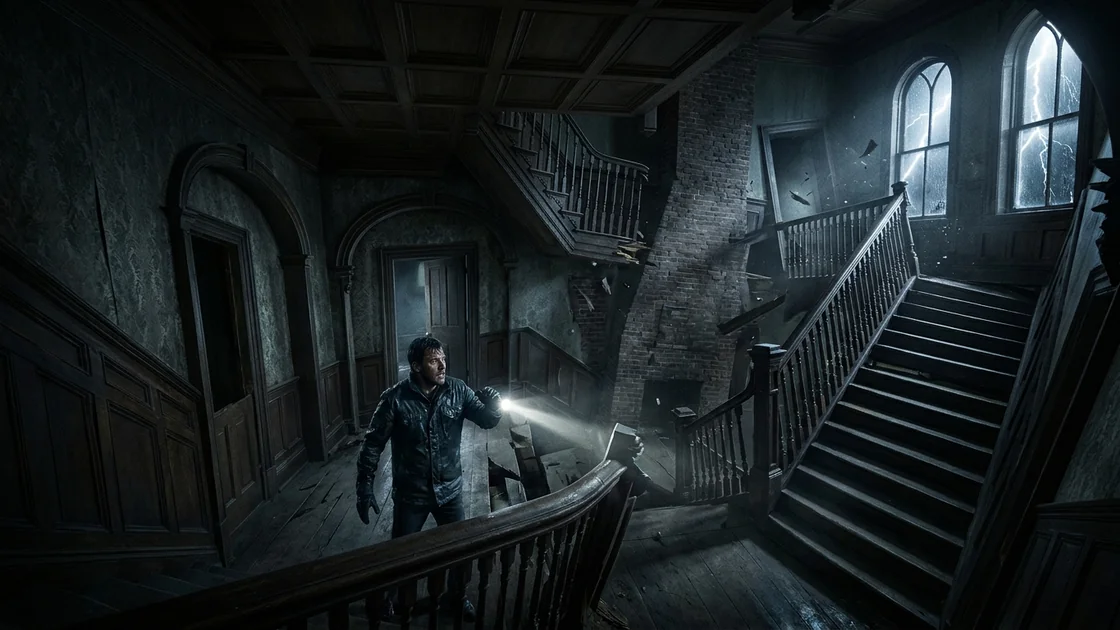
When the Miller family moves into the Victorian expanse of Ashcroft Hall, they are entirely unaware that the house is haunted by the spirits of its original builders, who were murdered by a ruthless real estate developer named Julian Sterling. Rather than terrifying the gentle newcomers who lovingly polish its oak banisters and repair its drafty windows, the sentient mansion decides to protect them at all costs, acting as an invisible guardian that warms their floors and finds their lost keys. However, when Sterling returns in the dead of night to burn the historic property to the ground for an insurance payout and land-development scheme, the house awakens its darkest capabilities. Sealing the sleeping family in a soundproof pocket of safety, Ashcroft Hall rearranges its own doors, staircases, and corridors into an inescapable, shifting labyrinth designed to guide the killer straight into the hollowed heart of its foundations.
I. The Memory of Wood and Lime
A house does not begin to remember on the day its roof is raised, nor on the day the first fire is lit within its central hearth. It learns to remember in the long, quiet intervals between human breaths, when the green timber of its framing seasons in the dark and shrinks by fractions of an inch around the hand-forged nails that bind it. It remembers through pressure. It learns the weight of a bride’s trunk dragged across the threshold, the rhythmic pacing of an expectant father in the downstairs parlor, the microscopic vibration of laughter settling into the horsehair plaster like dust into velvet.
Ashcroft Hall had been remembering for one hundred and forty-two years, and until twenty-six months ago, all of its memories had been warm.
It had been built in the autumn of 1882 by Thomas Ashcroft, a shipwright turned master carpenter who believed that a home on dry land ought to be constructed with the same tight, stubborn integrity as a brigantine meant to round Cape Horn. Its joists were cut from old-growth heart pine that smelled of turpentine even after a century; its interior walls were lined with chestnut wainscoting joined by mortise and tenon so exact that a razor blade could not be slipped between the seams. Over the decades, the house had passed down through four generations of the same bloodline, culminating in Arthur and Eleanor Vance.
Arthur had inherited his great-grandfather’s reverence for grain and plumb line. In his seventy-four years, he had never once used a power saw inside the halls if a hand plane would do the work more quietly. Eleanor, a retired archivist with silver hair braided like a crown and fingers permanently stained with walnut ink and garden soil, knew the voice of every floorboard from the scullery to the third-floor cupola. When the north wind came off the river and made the west gable groan, Eleanor would pat the plaster beside the landing and say, "Easy now, old girl, it is only November." And the house, in the subtle way of seasoned timber and lime mortar, would settle its weight a little more squarely upon its granite foundation and hold the cold at bay.
Then came Julian Sterling, and the house learned a new word: malice.
Sterling did not walk into a room the way the Vances did, with a soft transfer of weight that respected the flex of the floorboards. He struck the oak parquet with the steel-tipped heels of his Italian loafers as if he were testing the ice on a pond he intended to drain. He smelled of synthetic bergamot, expensive dry cleaning, and the cold, metallic ozone of a man who viewed three acres of century-old copper beeches and hand-carved gables solely as an algebraic equation waiting to be solved by a bulldozer.
"The zoning board has already rezoned the river corridor for high-density residential, Mr. Vance," Sterling had said on a Tuesday in late October two years ago. He had stood in the library, not sitting in the leather armchair Eleanor had offered him, not touching the teacup she had poured. His eyes had drifted up to the coffered ceiling, not admiring the linenfold carving, but calculating the tonnage of debris it would generate in a dump truck. "Sterling Horizon Developments owns the parcels to your north, south, and east. Your three acres are an anachronism. A missing tooth in a thirty-million-dollar smile. My offer is twenty percent above market value for the land alone."
"The land is not divorced from the house, Mr. Sterling," Arthur had replied, his voice dry and steady as seasoned ash. "And the house is not for sale. My great-grandfather laid that hearthstone. My wife and I intend to die under this roof."
Sterling had smiled then—a flat, geometric stretching of his mouth that never reached his pale gray eyes. "People of your vintage often say that, Arthur. They rarely realize how quickly a roof can become a liability."
The house had felt the lie before the Vances did. It felt the grease of Sterling’s palms when he asked to use the downstairs lavatory and instead slipped down the cellar stairs. The house had no voice with which to shout, no hands with which to bar the bulkhead door, for it was still only wood and stone then, drowsy with a century of peace. It could only watch through the blind eyes of its iron rivets and copper pipes as Sterling returned three nights later with a heavy brass wrench and a length of corroded flex-pipe he had brought in a canvas briefcase.
He had entered through the coal chute while Arthur and Eleanor slept in the four-poster bed on the second floor. The house had tried to groan—it had thrown all the tension of its winter-chilled beams into a sharp, cracking report above the dining room—to wake them. Arthur had stirred, murmuring in the dark, reaching for his spectacles on the nightstand.
Down in the belly of the cellar, Sterling had worked by the narrow blue beam of a penlight. He had unscrewed the union joint on the main gas line feeding the ancient Cast-Iron Monarch boiler, replacing the sound brass fitting Arthur maintained every September with the cracked, fatigued coupling from his bag. Then he had climbed into the narrow service chase behind the central chimney breast, wedging a roll of lead flashing and damp fiberglass insulation deep into the main flue, sealing the exhaust path tight. Before leaving, he had turned the thermostat in the front hall up to eighty-five degrees.
The boiler had roared to life at three in the morning.
The house felt the poison rising through its veins like black water. It tried to rattle the bedroom windows in their sashes, to snap the sash cords and let the freezing river air rush in, but three coats of summer paint and Arthur’s own meticulous weather-stripping held the frames shut tight. The odorless gas crept through the brass floor registers with a soft, warm hiss.
Arthur never made it out of bed. Eleanor woke once, her lungs burning with a phantom confusion, and managed to place her bare feet upon the wide pine boards of the hallway before her knees buckled. She fell with her cheek pressed against the wainscot at the top of the stairs, her palm flattened against the heartwood of the main newel post.
As her heart slowed, as the last electrical spark of her devotion and terror and furious sorrow guttered out of her nervous system, the wood drank it in. Across the threshold, Arthur’s final breath soaked into the plaster and lath.
They did not go away. A shipwright’s house does not let its crew drown in the dark and drift out to sea. The timber closed around them. The lime mortar absorbed their fierce, unfinished love; the iron nails magnetized around their sudden, violent grief. When the coroner came the next morning, summoned by a mail carrier who noticed the newspaper untouched on the frost-rimed veranda, they carried out two light, empty husks under white sheets.
Everything that mattered had stayed behind in the grain.
For two years, Ashcroft Hall sat in the dark and practiced.
Sterling had acquired the estate four months after the funeral through a Delaware shell company at a probate auction, after rumors of faulty gas lines, black mold, and structural rot—rumors planted by Sterling’s own contracted inspectors—scared off every legitimate preservationist buyer. Yet, to Sterling’s silent fury, Eleanor’s final act two weeks before her death had come to fruition: the state Historic Preservation Trust had approved her petition, placing Ashcroft Hall under a strict Grade-I architectural covenant. Sterling could not legally touch a single shingle with a wrecking ball unless the structure was deemed beyond repair by an act of God or catastrophic accident.
And so the house waited in the weeds, flexing its joints. In the empty afternoons, it learned how to pull a rusted nail an eighth of an inch out of a stud and push it back in. It learned that if it shifted the load from the eastern king-post to the western tie-beam, the hallway on the second floor did not merely creak—it elongated, stretching the shadow between the linen closet and the nursery by three feet. It learned that a door frame was only a suggestion of passage, and that behind every wall lay a dark, hollow geometry of studs and dead space that could be folded like an origami box if the wood remembered how it had once bent in the forest wind.
It was waiting for Julian Sterling to come back with a match.
Instead, on a bright, wind-scoured morning in April, a battered blue station wagon with a tied-down mattress on its roof turned up the gravel drive.
II. The Unwanted Haunting
The house bristled as the tires crunched over the weeds growing through the circular turnaround. Down in the cellar, the iron belly of the new boiler gave a low, subterranean rumble. Upstairs, the shutters of the attic dormers narrowed like eyelids.
Intruder, the joists hummed to one another. Thieves. Wreckers.
Through the wavy, hand-blown glass of the parlor bay window, the house watched the doors of the station wagon swing open. Out stepped a man in his mid-thirties wearing a faded flannel shirt with sawdust caught in the cuffs and a smudge of burnt umber paint across the bridge of his nose. Around the other side stepped a woman in sensible mud-boots, her dark hair pinned up with a wooden pencil, carrying a terracotta pot housing a massive, drooping Boston fern.
Then the back door flew open, and out tumbled two creatures of pure, chaotic kinetic energy: a girl of about eight in bright yellow rain boots despite the cloudless sky, and a three-legged golden retriever who immediately sneezed, barked joyously at a stone gargoyle on the carriage block, and began rolling Ecstatically in a patch of wild clover.
"Look at the turret, Dad!" the girl shouted, craning her neck back so far her braided pigtails brushed her shoulder blades. "It has witch hats! The windows have little eyebrows!"
David Miller rested his hands on his hips, looking up at the peeling Gingerbread trim along the eaves, the sagging porch steps, and the towering, soot-darkened brick chimneys. Where Julian Sterling had seen tonnage and demolition costs, David’s eyes traced the sweeping curve of the porte-cochère with something approaching religious awe.
"Those are hooded dormers, Maya," David said softly, walking up to the veranda and laying a gentle, calloused hand against one of the turned cedar columns. He didn't knock against it with a knuckle; he stroked it, feeling the raised grain beneath the blistered white lead paint. "And that’s solid old-growth cypress. Clara, look at the joinery on these brackets. Not a single lag bolt. They’re pinned with oak dowels."
Clara joined him at the foot of the steps, shifting the heavy fern onto her hip. Her eyes were tired—the eyes of a woman who had spent the last six months arguing with hospital billing departments after her daughter’s winter pneumonia and watching their savings evaporate in a cramped city apartment—but as she looked at the wide, wrap-around porch and the neglected conservatory glinting on the southern flank of the house, her shoulders dropped two inches.
"The realtor said the developer who owned the holding company practically gave it away because the restoration costs under the historic covenant were too steep for a quick flip," Clara murmured, rubbing her cheek against the top of Maya’s head. "I still half-expect the floors to be missing inside."
"Even if they are," David said, pulling a heavy brass skeleton key on a red ribbon from his pocket, "we’ve got a lifetime to put them back. Come on. Let’s go meet her."
Inside the vestibule, the house hesitated.
It had prepared a welcome meant for Sterling’s surveyors. It had gathered all the damp chill of the cistern and drawn it up into the front foyer until the air hung at forty-two degrees. It had loosened a four-pound plaster rosette in the center of the ceiling medallion directly above the threshold, poised to drop with a skull-cracking thud the moment the front door swung inward. It had marshaled a legion of cellar spiders into the coat closet and coaxed a low, sub-audible vibration into the floorboards—the exact nineteen-hertz frequency that made the human eye hallucinate gray shadows in its peripheral vision and filled the human bowel with nameless dread.
David fitted the key into the mortise lock. The bolt was rusted, stubborn. Instead of kicking the bottom panel of the door as the last inspector had done, David paused. He reached into his canvas tool belt, produced a small tin of graphite oil, and carefully lubricated the keyhole and the brass latch-tongue.
"Easy does it," he whispered to the lock. "Nobody’s going to force you."
A strange tremor ran up the mahogany doorframe and into the main crossbeam. Nobody’s going to force you. It was the exact cadence Arthur Vance had used when freeing a swollen window sash after an August thunderstorm.
The lock clicked back as smoothly as butter.
As the double doors swung open and Maya bolted inside, followed by the thumping hop-step of Barnaby the three-legged dog, the house frantically tightened its grip on the ceiling medallion. Dust sifted down in a pale ring, but the four-pound plaster rose stayed firmly overhead, held fast by a sudden, desperate contraction of the lath.
"Whoa," Maya breathed, coming to a dead stop in the center of the checkerboard marble and oak foyer.
The nineteen-hertz hum died in the floorboards. The house drew the cistern-chill back down through the floorboards like a sharply inhaled breath, letting a shaft of April sunlight spear unhindered through the stained-glass transom above the door. Red and amber diamonds of light fell across Maya’s yellow boots.
"It smells like old books and cinnamon," Maya announced to the empty grand staircase. She walked over to the massive oak newel post—the very post where Eleanor had rested her hand at the end—and wrapped both arms around it, pressing her ear against the carved acanthus leaves. "Hello, house! I’m Maya. This is Barnaby. He only has three legs because of a car, so he clomps a little bit on stairs, please don't be mad at him."
Deep within the heartwood of the staircase, something that had been frozen in a rictus of jagged rage for seven hundred and ninety days suddenly thawed.
Warmth—not from the boiler, which wasn't even lit yet, but the sun-stored, resinous warmth of a hundred summers—bloomed beneath the varnish right under the child’s cheek. Maya giggled, stepping back. "Dad! The wood is warm!"
"Sun through the transom, sweetpea," David said, though he looked puzzled as he stepped into the hall and felt the air change from tomb-like dampness to the pleasant, dry mildness of a well-kept library. He knelt on one knee, running his fingers over a deep gouge in the parquet floor near the parlor entrance—a scar left when Sterling’s hired movers had dragged Arthur’s rolltop desk out to the estate sale truck.
David frowned, his thumb tracing the splintered oak. "Savages," he muttered softly. "Who drags iron casters across unsealed white oak? Don't worry, Clara, I can steam this out with a damp iron and fill the tear with some matched wood dust and hide glue. You won't even see the scar by Tuesday."
In the walls, the chestnut wainscoting gave a soft, collective sigh that sounded remarkably like an old woman settling into her favorite rocking chair with a knitting basket.
All through that first afternoon, as the Millers carried in their mismatched boxes, battered bookshelves, and crates of art supplies and potting soil, Ashcroft Hall watched them with the intense, awkward fascination of a feral dog offered a bowl of warm broth.
When Clara carried her heavy fern toward the conservatory at the back of the house, she found the double glass doors swollen shut in their frames. Her hands were full, the terracotta pot slipping against her sweater. Before she could set it down on the dusty tile, the house quietly shifted the granite pier under the south wall by two millimeters. With a gentle snick, the brass latch cleared the strike plate, and the right-hand door swung gracefully inward on silent hinges.
"Oh!" Clara blinked, looking at the hinges. "Well. Must be a draft."
She stepped into the glass-domed room. Dead vines from two winters ago still clung to the iron trellises—Eleanor’s beloved climbing jasmine and passionflower, crispy and brown. Clara set her fern on the cedar potting bench and touched one of the brittle stems with genuine sorrow.
"Oh, you poor things," she whispered, her fingers brushing the dry leaves with the gentle precision of the high school botany teacher she was. "Look how well someone trained you up the ribs. You were so loved." She bent down, inspecting the base of the massive cedar planter box built into the floor. Nestled deep against the root crown, protected by a thick mulch of pine needles Eleanor had laid down the day before she died, a single, pale green shoot was stubbornly pushing through the dry crust.
Clara gasped with delight. "You’re still alive! Hang on, just hang on, I saw an outside spigot by the pantry window."
When she hurried out to the kitchen and turned the brass tap over the soapstone sink, the house hastily purged the two-year-old rust from the lead-free copper replacement pipes Arthur had installed in the nineties, redirecting the brown sludge down the gray-water drain until the stream that rushed into Clara’s watering can was clear, cold, and sweet.
Upstairs, the house was having an even busier afternoon.
Barnaby, eager to explore the upper realms where squirrels could be seen at eye level through the maple branches, had tackled the grand staircase. With only one hind leg, his ascent was a heroic, lurching series of hops. Near the turn of the landing, his front paw slipped on a patch of slick, decades-old beeswax.
Instantly, the oak tread beneath his back paw tilted upward by four degrees while the riser ahead of him seemed to drop half an inch, catching his chest before his chin could hit the step. Simultaneously, the faded Persian runner that had been bunched against the wall slithered three inches to the left, sliding directly beneath his scrambling claws to give him traction.
Barnaby paused on the landing, panting happily, gave the banister a wet, appreciative lick, and bounded down the upper hall.
By twilight, the movers had gone, the pizza boxes were stacked on the kitchen counter, and a fine April rain had begun to patter against the slate roof. Normally, there was a missing shingle over the northeast valley—knocked loose by a falling branch the previous winter—that allowed a thin, miserable trickle of water to run down the lath behind the master bedroom closet.
As David and Clara collapsed onto their mattress on the floor of the master bedroom, exhausted and holding hands under a quilt, the house reached up into its own rafters. It coerced a thick mat of dry oak leaves and pine resin into the gap under the overlapping slate, sealing the leak tight. Down in the cellar, it nudged the pilot light assembly on the furnace until the thermocouple seated properly, sending a steady, whispering breath of warm air up through the registers.
Maya was already asleep in the smaller room next door, her hand dangling over the edge of her bed, fingers brushing the baseboard.
They are very small, the mortar murmured to the beams. And the man has glue and planes. And the woman watered the jasmine.
They are ours, the heartwood answered, wrapping the house’s great, invisible arms around the three sleeping breaths and the snoring dog. No cold. No gas. No fear.
III. The Domestic Symbiosis
By June, the people of the town down the hill had begun to talk, though not in the way they usually talked about the old Vance place.
For two years, teenagers had dared one another to touch the iron gates of Ashcroft Hall after dark, swearing that the windows glowed like stagnant swamp water and that if you listened by the hedge, you could hear the sound of someone choking in the cellar. Two of Julian Sterling’s subcontracted maintenance men had quit on the spot the previous autumn after claiming a hallway on the second floor had turned into a dead-end closet and locked them in the dark for four hours until they broke through the drywall—only to find the drywall perfectly intact when the sheriff came to take their report.
Now, the iron gates stood propped open with whitewashed river stones. The overgrown privet hedges had been trimmed back by Clara on sunny Saturdays, and the front porch gleamed with a fresh coat of heritage cream paint that David had mixed himself to match a chip he’d found preserved behind the downspout.
If the Millers noticed that Ashcroft Hall was an unusually cooperative piece of nineteenth-century architecture, they attributed it to the legendary craftsmanship of Thomas Ashcroft.
"I swear this house wants to be fixed," David told Clara one evening in late July. They were sitting on the porch steps drinking iced tea, watching Maya throw a tennis ball across the lawn for Barnaby. "Remember that rotted sill beam under the scullery window I was dreading replacing? I went down into the crawlspace this morning with the hydraulic jack and a new piece of pressure-treated timber. When I shone my work light on it, the rot didn't go through the heartwood at all. In fact, the beam was bone-dry and harder than iron. My chisel practically bounced off it."
"Maybe the previous inspector misread his moisture meter," Clara said, leaning her head on his shoulder. "You know how sketchy that report was in the closing documents. Half of it looked fabricated just to drive the assessment down."
"That’s not the half of it," David laughed, shaking his head. "When I was up on the scaffolding stripping the paint off the dining room crown molding, I dropped my favorite brass detail scraper. Heard it hit the floor. When I climbed down, it wasn't on the drop cloth—it was sitting neatly on the top step of the ladder, handle pointing right toward my hand. And every time I go looking for a specific size of wood screw in those hundreds of little glass jars old Mr. Vance left in the carriage house workshop, the exact jar I need is always sitting right at the front of the shelf."
Clara smiled, looking back through the screen door into the warm, golden glow of the front hall. "Don't complain. After that pre-war apartment on Fourth Street where the radiator tried to scald us and the bathroom door locked from the outside, we deserve a polite house."
Polite was an understatement. Ashcroft Hall had become an obsessive nanny, a doting grandparent, and a silent apprentice all at once.
Its favorite, undeniably, was Maya.
During the first weeks of summer vacation, before Maya had made friends with the children down on River Road, the eight-year-old spent rainy afternoons exploring the vast, labyrinthine interior of the house. She discovered the hand-cranked dumbwaiter that ran from the butler’s pantry behind the kitchen all the way up to the third-floor sewing room.
The ropes were frayed hemp, seventy years old, and should have snapped under ten pounds of tension. The house knew this. While Maya was eating lunch one Tuesday, the house spent forty minutes painstakingly weaving microscopic strands of horsehair from the plaster and tough, fibrous tendrils of ivy that had grown into the outer brick chimney chase directly into the core of the hemp rope, twisting the fibers tight until the cable could have hoisted an anvil.
That afternoon, Maya put her plastic tea set and her stuffed rabbit, Mr. Barnaby Junior, into the dumbwaiter car in the kitchen and pulled the haul-rope. She barely had to tug; the iron counterweight inside the wall seemed to plunge down of its own accord, lifting the wooden box up to the second floor with a smooth, oiled whirr.
When she opened the little paneled door in the upstairs hallway, not only were her teacups unspilled, but sitting beside the stuffed rabbit was a small, tarnished silver thimble engraved with the letter E, and three antique glass marbles swirled with cobalt blue and milky white that had rolled behind the baseboard in 1924.
"Thank you, Mrs. House," Maya whispered into the dark shaft, which smelled faintly of lavender water and cedar shavings. "Do you want a biscuit?"
She placed a slightly crushed animal cracker on the wooden shelf and shut the door. Three seconds later, the rope gave a tiny, cheerful tug, and when she opened it again, the cracker was gone—dropped neatly into a mouse-hole in the sub-cellar where a family of harmless field mice lived under the house’s strict supervision (they were permitted in the coal bin, never in Clara’s pantry).
At night, if Maya had a bad dream and kicked off her blankets, the transom window above her bedroom door would silently swing shut to block the night draft, and the radiator under her window would click three times, radiating a gentle, localized heat even though the main boiler was turned off for the summer.
For Clara, the house offered its garden and its light. It angled the reflective brass plates inside the conservatory’s ridge-vents so that the morning sun hit her trays of heirloom tomato seedlings for an extra forty-five minutes each day. When she forgot her gardening shears under a bush before a sudden thunderstorm, she would find them the next morning sitting dry and rust-free on the flat stone under the veranda eaves, where the rain had conveniently washed them there—uphill, across twenty feet of gravel.
For David, who worked from a studio he had set up in the bright north turret, illustrating historical architecture textbooks and taking on local furniture restoration commissions, the house was a muse. When he was commissioned to draw a cross-section of a nineteenth-century hammer-beam roof truss and couldn't quite get the perspective of the wind-braces right, he went downstairs for coffee. When he returned, the late-afternoon light streaming through the turret’s wavy glass panes was refracting through dust motes in the exact geometric angles he needed, casting sharp, ruler-straight lines of shadow and gold across his drafting table.
The house was happy. The ragged scar in its aura where Arthur and Eleanor had been torn from the world was slowly filling in with the sound of Clara’s cello records playing in the parlor, the smell of David’s linseed oil and baking bread, and the rhythmic thump-pad, thump-pad of Barnaby patrolling the halls.
It had almost forgotten how to hate.
And then, on the fourteenth of October, a sleek black Mercedes-AMG turned through the open iron gates, its wide tires crushing two of Clara’s border marigolds as it parked crookedly on the gravel drive.
IV. The Fox in the Vineyard
Julian Sterling sat behind the wheel for a moment with the engine idling, staring through his tinted windshield in genuine disbelief.
He had been tied up in Manhattan for the last five months securing mezzanine financing for the Riverview Luxury Condominiums—Phase One of which was already rising in a forest of concrete cranes and steel girders just half a mile north of the Ashcroft boundary line. His Phase Two pitch to the Zurich investment consortium relied entirely on the acquisition and clearing of the three-acre Ashcroft parcel, which possessed the only deep-water granite bluff capable of supporting a forty-story cantilevered tower and a private marina.
When the Historic Preservation Trust had slapped the Grade-I covenant on the house right after the old couple’s "tragic accident," Sterling had pivoted smoothly. A vacant historic house was watched like a hawk by preservationist busybodies and municipal inspectors; if it burned down while sitting empty under the ownership of his shell company, Oakleaf Holdings, the state arson investigators and the insurance underwriters would strip his development licenses bare.
So he had instructed his proxy realtor to dump the property at a steep discount to the first naive, underfunded buyers who walked through the door—specifically targeting a young family with no liquid capital for major structural repairs. The plan was simple, elegant, and time-tested in the darker corners of urban development: let the buyers move in, let them start tearing into the walls for "DIY renovations," and then, come autumn when the ancient furnace was fired up for the first time, arrange for a catastrophic electrical-and-gas fire originating in the basement junction box. Tragic amateur wiring mistake. Old dry timber goes up like a matchbox in twenty minutes. The city condemns the blackened chimney stacks as a public hazard, the historic covenant dissolves because the structure no longer exists, and Oakleaf Holdings exercises the secret right-of-first-refusal clause buried on page forty-two of the Millers' mortgage rider to buy back the scorched land from their insurance payout.
He had expected to find the place looking like a money pit—tarps on the roof, peeling paint, frustrated owners drowning in contractor estimates.
Instead, as Sterling stepped out of his car and buttoned his charcoal cashmere overcoat against the crisp October breeze, Ashcroft Hall towered above him looking as if it had just stepped out of an 1890 architectural digest.
The cedar columns gleamed. The copper gutters shone where they had been cleared and soldered. The gardens were manicuring themselves into lush autumn cascades of chrysanthemums and deep red asters. Even the slate roof looked tighter, straighter, its ridge-line sharp as a knife against the gray sky.
The moment Sterling’s leather sole touched the bottom granite step of the veranda, the temperature inside the front hall dropped twelve degrees.
Up in the studio turret, David’s charcoal pencil snapped against his drawing paper for no reason. Down in the kitchen, Barnaby lifted his head from his water bowl, his soft golden ears flattening against his skull as a low, vibrating growl rumbled in his chest.
In the walls, the timber woke up like a sleeping dragon poked with a hot iron.
Him.
The scent of synthetic bergamot and cold greed drifted through the keyhole before he even reached for the brass bell-pull. The house knew the exact pound-per-square-inch pressure of his footsteps. It remembered the blue penlight in the cellar. It remembered the sound of the brass union joint unscrewing on the gas line. It remembered the suffocating weight of the fiberglass shoved up its throat while Eleanor gasped on the stairs.
Every nail in the front door strained in its socket, yearning to shoot outward like shrapnel. A twenty-foot section of crown molding in the foyer trembled, ready to tear itself from the lath.
No, a deeper, calmer pulse moved through the foundation stones—the patient, shipwright wisdom of Arthur mixed with the fierce maternal shielding of Eleanor. The woman is in the kitchen. The man is in the turret. If we strike him on the porch, the law will come. The family will be blamed. Wait. See what the rat wants.
The house forced its joists to still, though a drop of dark, bitter pine pitch squeezed out of a knot in the porch ceiling and fell squarely onto the shoulder of Sterling’s three-thousand-dollar coat, where it would never wash out.
David opened the front door a moment later, wiping his hands on a rag, with Barnaby pressed tightly against his legs, teeth bared in a silent snarl I'd never seen the gentle dog make before.
"Easy, Barnaby, hush," David said, surprised, resting a hand on the dog’s trembling scruff. He looked up at the stranger in the expensive coat. "Can I help you?"
Sterling put on his best country-club smile, extending a manicured hand. "Mr. Miller? Julian Sterling. I represent the regional oversight board for Oakleaf Holdings, the group that held the note on the property before your purchase."
David shook the hand briefly, noticing how cold the man’s skin felt—or perhaps it was the sudden, biting draft that seemed to be blowing straight out of the hallway behind him. "Oh, right. The seller’s group. Is there an issue with the closing paperwork? Everything went through back in March."
"Nothing like that, no, no," Sterling said smoothly, craning his neck to peer past David’s shoulder into the foyer. His eyes narrowed slightly as he took in the polished parquet—the deep gouge near the parlor was completely invisible—and the gleaming oak staircase. "In fact, I see you’ve done... remarkable cosmetic work. Rather surprising, given the state of the place. Actually, I’m here on a routine municipal compliance matter. As part of the historic covenant transfer, our engineering underwriters require a six-month walk-through to verify that any ongoing renovations haven't compromised the original load-bearing masonry or the vintage mechanical systems in the basement. Standard insurance liability protocol before the winter heating season."
"Really?" David frowned. "Our lawyer didn't mention an autumn inspection."
"Sub-clause fourteen in the historic preservation addendum," Sterling lied effortlessly, tapping his breast pocket as if the document lived next to his heart. "It will only take ten minutes. I just need to snap a few photographs of the main electrical panel, the boiler room, and the central chimney breast on the first and second floors. If I don't file the compliance sheet by Friday, the town’s code enforcement office gets terribly bureaucratic with fines. I figured I’d save you the headache since I was up checking on the Riverview project."
Clara appeared from the kitchen archway, wiping her hands on a dish towel. She stopped three feet behind David, her eyes fixing on Sterling. She didn't know why, but the moment she looked at the man’s pale gray eyes, a sudden, nauseating taste of coal gas and copper pennies filled the back of her throat.
"David?" she asked quietly.
"Mr. Sterling here says he needs to take a couple of photos of the basement boiler and the chimney for the historic covenant insurance," David explained, looking a bit apologetic. "Ten minutes?"
"Eight, if I walk fast," Sterling beamed, stepping across the threshold before Clara could voice the sudden, irrational urge she had to slam the heavy oak doors in his face.
As Sterling’s heel clicked onto the foyer marble, Barnaby let out a sharp, furious bark, lunging forward until David caught his collar.
"Barnaby! What has gotten into you?" David looked mortified. "I am so sorry, Mr. Sterling, he has literally never barked at a guest in his life. Clara, could you take him out to the conservatory while I show Mr. Sterling the cellar?"
"Of course," Clara said, though her eyes never left Sterling’s back as she guided the growling dog down the hall. Over her shoulder, she called out, "Make sure you watch your head on the cellar stairs, Mr. Sterling. The clearance is low for people who don't belong down there."
She blinked the moment she said it, wondering where on earth such a sharp, rude phrasing had come from.
"I’ll be careful, Mrs. Miller," Sterling chuckled softly.
What Sterling actually needed was five minutes to assess the layout for his return trip. He needed to see if David had upgraded the old cloth-wrapped knob-and-tube wiring near the cellar ceiling, whether they had installed modern smoke detectors wired into a central alarm grid, and which ground-floor window had the simplest latch to bypass from the outside.
"Right this way," David said, leading him toward the door beneath the main staircase.
The house watched them move. It could not trap him now—David was right there, walking two paces ahead—but it could deny him his map.
Sterling was a man who understood blueprints. Before coming today, he had pulled the 1978 county tax-assessor sketches of Ashcroft Hall from the town archives. He knew the cellar stairs descended from the main hall directly beneath the grand staircase, running east-to-west, terminating twenty feet from the boiler and ten feet from the coal-chute bulkhead.
David reached for the porcelain doorknob under the stairs. "I put a brighter bulb down here last month, so watch your—"
As David pulled the door open, Sterling stepped forward with his smartphone raised to take a subtle video of the approach.
Instead of wooden steps leading down into the smell of damp earth and limewash, the door opened onto a shallow, cedar-lined coat closet packed with winter parkas and Maya’s rain boots.
David stopped dead, his hand still on the porcelain knob. He stared at the hanging coats for five full seconds, his brow furrowing deeply. "What the..."
Sterling frowned, lowering his phone. "Thought you said it was under the stairs."
"It... it is," David muttered, rubbing the back of his neck with a laugh that sounded slightly unnerved. "Sorry, brain fog. I’ve been inhaling turpentine all morning. This is the front coat closet. The cellar door is... right, it’s further back, across from the butler’s pantry."
It was not across from the butler’s pantry, the house whispered to itself with grim satisfaction as it silently slid the entire structural framing of the cellar stairwell twelve feet down the central corridor, swapping its mouth with the linen press between the dining room and the kitchen.
When they reached the door across from the pantry—a door David would have sworn on his mother’s life had held extra table leaves and ironing boards yesterday—it opened smoothly onto the cellar stairs.
"Here we go," David said, shaking his head at himself and flipping the wall switch.
They descended. As Sterling walked down the wooden steps, he surreptitiously ran his hand along the underside of the main stringer beam. Dry. Bone-dry, ninety-year-old resinous pine. If he placed two thermite incendiary pucks—the kind used for welding railroad ties, which left minimal chemical residue beyond iron oxide and aluminum dust that looked just like melted junction conduits—right against the main breaker panel and simultaneously cracked the flare nut on the gas manifold, the heart pine joists would ignite at two thousand degrees within ninety seconds.
"Here’s the Monarch," David said, gesturing toward the massive cast-iron boiler sitting in the center of the stone room. "Had a guy from the gas company come out in April before we turned the water heater on. He said the main intake union looked brand new, oddly enough, though the rest of the unit is a dinosaur. Runs like a Swiss watch, though."
Sterling’s eyes flicked to the brass coupling on the gas line. It was the exact corroded, cracked piece he had installed the night the Vances died. The county investigators had missed it, attributing the carbon monoxide backup entirely to "fallen squirrel nests and decayed masonry" in the flue—after Sterling had slipped back in during the estate appraisal to yank the fiberglass out of the chimney.
Yet as Sterling stared at the brass union joint now, a prickle of sweat broke out along his hairline. The hairline crack in the brass—the one he had widened with a cold chisel in his own garage—was gone. The metal looked seamlessly fused, wrapped in a strange, calcified patina of mineral deposits from the air, as if the house had sweated lime and copper over the wound until it was thicker than the pipe itself.
"Very... sturdy," Sterling murmured, snapping two quick photos of the breaker panel on the west wall. His eyes darted to the coal chute in the northeast corner. The old iron latch was held shut by a simple wooden peg. Easy to pop from the outside with a flat bar.
Except, as he turned back toward the stairs, he noticed the cellar seemed much larger than the tax map indicated. The stone foundation walls stretched off into a series of arched brick vaults that vanished into pitch darkness toward the river side of the property.
"Did you expand the basement?" Sterling asked sharply.
"Expand a granite foundation?" David laughed, already halfway up the stairs. "With what money? No, it’s just an optical illusion with the shadows down here. The brickwork under the conservatory has weird acoustics, makes it look deeper than it is. Did you get what-all you needed down here?"
"Yes. Just need a quick glance at the second-floor chimney breast in the hallway to verify the mortar pointing isn't shifting," Sterling said, climbing the stairs faster than he intended. Beneath his loafers, the wooden treads felt spongy, like stepping on the tongue of something alive.
Up on the second floor, Maya was sitting cross-legged in the hallway outside her room, rolling one of the blue-and-white glass marbles across the floor.
She didn't roll it toward a wall. She rolled it straight down the center of the flat oak boards. Halfway down the hall, the marble stopped on its own, spun in a neat circle, and rolled briskly back into her open palm.
Sterling stopped at the top of the landing, staring at the child. "Hello there."
Maya looked up. Her wide brown eyes fixed on Sterling, and instantly her hand closed tight around the marble. She didn't smile. She didn't say hello. She stood up slowly, hugging her stuffed rabbit to her chest, and backed toward her bedroom door.
"The house doesn't like your shoes," Maya said in a small, clear voice. "And it says you have dirty hands."
"Maya!" David came up the stairs behind Sterling, flushing crimson. "That is no way to speak to a guest. Apologize right now."
"It’s quite alright," Sterling said tightly, his pale eyes narrowing at the little girl before her bedroom door swung shut—seemingly without her touching it—and the heavy brass lock clicked into place from the inside. "Children have vivid imaginations in old places like this. Makes them nervous. Truthfully, Mr. Miller, houses of this vintage are deathtraps. One spark in these hollow walls—what they call balloon framing—and the whole building acts like a chimney. Fire shoots from the cellar to the attic in under three minutes. No firebreaks between the studs. You really ought to make sure your family has a clear evacuation route."
"We have smoke detectors on every landing, Mr. Sterling," David said, his hospitable tone cooling considerably at the man’s sudden morbid lecture in front of his daughter’s room. "The chimney mortar is right behind the wallpaper here on the central shaft. As you can see, no cracks, no settling."
Sterling snapped a final, perfunctory photo of the hallway wall. He had what he needed. The layout was clear enough: coal chute entry on the northeast corner, straight shot to the breaker box and gas manifold, out the kitchen garden door. No wired security system panels on the walls, no motion sensors in the corners. Just an old house, a three-legged dog, and a family sleeping on the second floor.
If the Millers died in the fire, too? Well. That would actually make the city council’s condemnation order move twice as fast. No sympathetic displaced homeowners petitioning for rebuilding grants. Just a tragic headline in the local paper, a candlelight vigil, and by spring, forty stories of glass and steel rising over the river.
"Everything looks to be in order," Sterling said, turning back toward the stairs. "I won't take up any more of your afternoon."
As Sterling walked down the grand staircase, he reached out casually to steady himself on the polished mahogany handrail.
A splinter of cured, iron-hard oak—two inches long and sharp as a sewing needle—shot upward out of the perfectly smooth grain, driving itself deep beneath the fingernail of his right index finger and snapping off flush with the skin.
Sterling hissed through his teeth, jerking his hand back, a bead of dark blood welling from beneath his nail.
"You okay?" David asked from the landing above.
"Fine," Sterling bit out, wrapping his silk pocket square around his throbbing finger as he hurried across the foyer and yanked the heavy front door open. "Just a rough spot on the banister. You missed a piece with your sandpaper, Miller. Have a good evening."
He didn't wait for an answer. He strode down the veranda steps, got into his Mercedes, and spun the gravel as he reversed down the drive.
Behind him, Ashcroft Hall watched through twelve leaded-glass eyes as the black car disappeared beyond the gates.
On the porch ceiling, the tiny bead of pine resin dried into amber. On the banister, the wood grain closed smoothly over the spot where the splinter had launched, leaving not so much as a pinhole in the varnish.
And deep within the walls, for the first time in over a century, the house began to redraw its own blueprints.
V. The Vigil of October
Ten days passed. The October weather turned from crisp gold to the bruised, heavy purple of late autumn off the Atlantic.
The Millers went about their lives, entirely unaware that the walls around them were running through nightly calisthenics. Every night between two and four in the morning, while David, Clara, Maya, and Barnaby slept in the deep, dreamless peace the house wove over their beds, Ashcroft Hall practiced.
In the dark, without making a single creak loud enough to disturb a mouse, the house unhinged its internal geography. It tested how far the downstairs corridor could be bent before the plaster cracked (discovered: if the lime mortar was kept slightly damp with river-mist drawn through the weeping tiles, the walls could curve at a thirty-degree arc like green willow wands without shedding a flake of paint). It practiced detaching the back servants' staircase from the second-floor landing and reattaching it to the attic crawlspace, turning the ascent into a seamless M.C. Escher loop where a man could climb upward forever and only ever arrive at the bottom of the same thirteen steps.
most importantly, in the dead-space behind the central fireplace—that narrow, four-foot-by-four-foot vertical shaft of rough brick and timber framing that ran from the cellar foundation to the roof ridge, the exact shaft where Julian Sterling had stuffed the fiberglass insulation to murder the Vances—the house hollowed out a chamber.
It pulled back the wooden cross-braces. It softened the nineteenth-century lime mortar between the outer chimney bricks and the inner hearth-wall until the masonry could be parted like heavy velvet curtains and sealed back up in seconds.
On the night of October twenty-fourth, a nor’easter rolled in from the coast.
By nine o'clock, the rain was lashing against the gables in horizontal sheets, and the wind was roaring through the giant copper beeches along the property line with the sound of a freight train. Down on River Road, a transformer blew in a flash of blue-green lightning, knocking out power to the entire rural grid outside of town.
Inside Ashcroft Hall, the lights flickered and died, but the house was far from cold.
David lit a dozen beeswax candles and built a massive fire of seasoned applewood in the parlor hearth. Clara brought down thick wool blankets and mugs of hot cider spiced with cinnamon sticks. For two hours, they sat on the rug before the fire playing board games by candlelight while the storm battered the world outside. The house held the wind easily; not a single window rattled in its sash, not a single draft crept under the doors.
At eleven-thirty, they banked the parlor fire and carried their candles upstairs.
"Do you think the roof will hold in this gale?" Clara asked as she brushed her hair in the dim glow of a hurricane lamp on her vanity.
David looked up at the ceiling, listening to the muted, solid thrum of the timber framing taking the sixty-mile-an-hour gusts without so much as a groan. "Clara, this house survived the Hurricane of '38 without losing a chimney pot. We could not be in a safer place on earth right now."
By one in the morning, the entire family was asleep.
At one-forty-five, a battered, unmarked Ford pickup truck with mud smeared over its license plates turned off River Road and rolled to a stop in the shelter of the dense fir trees a hundred yards outside the iron gates of Ashcroft Hall.
Julian Sterling killed the headlights.
He was dressed entirely in dark gray contractor’s coveralls, cheap rubber-soled work boots he intended to burn in a barrel at his construction site by dawn, and a pair of heavy nitrile gloves beneath leather work mitts. His right index finger still throbbed dully under a bandage—the splinter from the banister had festered into a stubborn, deep-tissue infection that two rounds of antibiotics hadn't quite cleared, fueling a sour, simmering rage that had kept him awake for three nights.
He checked his watch. 1:48 AM. The municipal power outage was a gift from heaven. No streetlamps on the road, no neighborhood ring-cameras running on Wi-Fi, and the howling gale would drown out the sound of a freight train, let alone the pop of a cellar latch. Furthermore, the wind would fan an attic-and-cellar structural fire into an unstoppable inferno long before the volunteer fire department could navigate the downed oak branches blocking the lower road.
Sterling picked up his waterproof canvas rucksack from the passenger seat. Inside were two commercial-grade thermite ignition blocks, a magnesium flare fuse with a six-minute chemical delay timer, a twelve-inch heavy crescent wrench, and a pry bar.
He stepped out into the deluge, pulling the hood of his slicker low over his face, and jogged through the driving rain toward the dark bulk of the mansion.
As his boot crossed the stone boundary wall of the estate, Ashcroft Hall opened its eyes.
It did not wake the Millers. Instead, it did the exact opposite.
Up on the second floor, the house drew the sap and the dense, fibrous mass of its oak framing together around the master bedroom and Maya’s room. The two-inch solid core doors expanded in their frames, fusing into the jambs like vault doors. Inside the walls surrounding their beds, the house shifted layers of horsehair plaster, sawdust insulation, and dead-air pockets until the two bedrooms were encased in an acoustic vacuum so absolute that a cannon fired in the downstairs hall would not register as a whisper on their pillows. It kept their radiators gently radiating stored thermal heat. In the master bedroom, where Barnaby slept on his orthopedic mat, the house released a faint, soothing scent of warm cedar and chamomile from the floorboards; the dog twitched his paws in a dream of chasing rabbits and did not stir.
The family was sealed in an ark at the top of the house.
Down below, the remainder of Ashcroft Hall stripped off two centuries of civilization and became a forest in the dark, hungry and vast.
VI. The Shifting Labyrinth
Sterling crouched in the pouring rain beside the northeast corner of the granite foundation, water streaming off the brim of his hood. He wedged the flat teeth of his pry bar under the slanted iron doors of the coal chute and leaned his weight onto the steel shaft.
He expected the wooden peg inside to snap with a sharp crack.
Instead, the iron doors gave way effortlessly, swinging upward on silent hinges before he had even applied twenty pounds of torque.
"Idiot didn't even latch it," Sterling muttered under his breath, a cold smirk touching his lips.
He shone his red-filtered tactical penlight down into the chute. The metal slide had been removed years ago, replaced by five steep stone steps leading down to the cellar floor. Sterling swung his legs over the lip, ducked his head, and dropped softly onto the concrete floor of the basement, pulling the iron bulkhead doors shut behind him to keep the rain from dampening the ignition blocks.
The silence inside the cellar was sudden and immense.
Outside, the storm had been a deafening roar of wind and water. The moment the iron doors clicked shut behind Sterling’s shoulders, the sound of the gale vanished completely, replaced by a thick, pressurized quiet that made his ears pop as if he had just descended three thousand feet in a mine shaft.
He paused, frowning in the dark, and swept his red light across the basement.
Everything was where it had been ten days ago. Twenty feet ahead stood the hulking black silhouette of the Monarch cast-iron boiler. To its right, mounted on a sheet of plywood bolted to the granite wall, was the gray metal square of the main electrical breaker panel.
Sterling didn't waste a second. He moved quickly to the boiler, knelt on the cold stone, and pulled the heavy crescent wrench from his bag. He fitted the jaws around the brass union joint on the main gas intake pipe—the same joint that had mysteriously calcified over his previous sabotage—and braced his boot against the boiler casing to wrench it loose.
He pulled. The wrench didn't budge.
Sterling grunted, shifting his grip and throwing all one hundred and ninety pounds of his body weight onto the steel handle. The brass nut didn't turn a millimeter. Instead, with a dull, metallic crunch, the hardened drop-forged steel jaws of his crescent wrench sheared cleanly in half, sending him tumbling backward onto his elbows on the concrete floor.
"What the hell?" Sterling hissed, sitting up and staring at the broken head of his tool in the red beam of his light. Drop-forged vanadium steel didn't snap like cheap pot-metal against soft yellow brass.
He scrambled back to his knees and leaned his face six inches from the gas pipe.
In the red light, the pipe wasn't cold brass anymore. It was warm—hot as a fevered throat—and as he stared at the hexagonal union nut, he saw the metal slowly ripple, the sharp corners rounding off and smoothing into a continuous, seamless cylinder of bronze that pulsed with a slow, rhythmic thud-thud... thud-thud, like a jugular vein pumping black blood from the earth.
Sterling jerked back, his breath catching in his throat. "Hallucinating," he whispered, shaking his head hard. His infected finger was throbbing violently inside his glove; maybe the infection had given him a fever. "It’s just corrosion. Forget the gas. The thermite on the main beam and the breaker box will take the whole floor out anyway."
He stood up, snatched his rucksack, and turned toward the west wall where the breaker box had been ten seconds ago.
His red light hit solid, mortared granite.
Sterling froze. He swept the beam left. Granite. He swept it right. Granite. No plywood backing. No gray steel box. No black Romex cables stapled to the overhead joists.
In fact, as he tilted the light upward toward the ceiling, he saw that the overhead joists weren't running east-to-west anymore. They were angled downward like the ribs of a whale, and they were weeping thick, glistening beads of turpentine and sap that smelled overwhelmingly of fresh-cut pine and old walnut ink.
"Okay," Sterling breathed, his heart rate kicking up into a hard, erratic gallop against his ribs. "Okay, I turned around in the dark. Disoriented."
He spun back toward the northeast corner to get his bearings from the coal chute where he had just entered.
The five stone steps and the iron bulkhead doors were gone. In their place stood a tall, narrow archway of crumbling red brick that led into a subterranean corridor he had never seen on any blueprint—a corridor lined with rotting cedar trellises overgrown with pale, leafless jasmine vines that twined through the mortar in the pitch dark.
A wave of pure, icy adrenaline flooded Sterling’s stomach. He switched his flashlight from the dim red tactical filter to its full, blinding eight-hundred-lumen white beam.
The cellar was gone. Or rather, the cellar had unfolded.
The Monarch boiler still sat ten feet away, its cast-iron grate grinning like a mouth full of black teeth, but the room around it had stretched into a cavernous hall of rough-hewn stone piers and low timber arches that receded beyond the reach of his high-powered beam. And the wooden staircase leading up to the first-floor hallway—the stairs he had climbed with David Miller ten days ago—was now standing completely freestanding in the middle of the room, rising fifteen feet into the air and terminating flat against the solid oak planks of the ceiling with no doorway at the top.
Get out, the rational part of Sterling’s brain screamed, overriding the greed, the condo towers, and the Zurich investors in a single heartbeat. Get up to the ground floor and break a window.
Wait—there was another staircase. Off to his left, half-hidden behind a brick cistern, a narrow flight of unpainted servants' stairs rose up into a rectangular opening where a pale white porcelain doorknob gleamed at the top.
Sterling bolted for it, his rucksack slapping against his spine. He took the wooden steps three at a time. Beneath his boots, the treads didn't just creak; they shifted laterally, sliding two inches left, then two inches right, trying to throw his balance off like a bucking deck on a storm-tossed ship. He grabbed the rough two-by-four handrail—immediately jerking his left hand back with a cry as a dozen stiff, needle-sharp splinters bristled out of the pine like porcupine quills, piercing his leather glove.
He reached the top landing, slammed his shoulder against the paneled door, and twisted the porcelain knob with his bloodied hand.
The door flew open, and Sterling stumbled out onto polished oak parquet, gasping for air.
He shone his flashlight around wildly.
He was on the first floor. Thank God. He recognized the chestnut wainscoting and the flocked burgundy wallpaper of the central hallway. The front foyer—and the heavy oak double doors with their glass sidelights—should be thirty feet ahead of him to the south. He could put a chair right through the leaded glass and be back at his truck in ninety seconds.
Sterling broke into a dead run down the hallway toward the foyer.
He ran thirty feet. Then fifty feet. Then a hundred feet.
His boots pounded rhythmically on the parquet, echoing against the high plaster ceiling, yet the archway into the front foyer stayed the exact same distance ahead of him—a dim, shimmering rectangle in the peripheral glow of his flashlight that receded foot for foot with every stride he took.
Panting, his lungs burning with cold air that smelled strongly of coal gas despite the sealed pipe downstairs, Sterling skidded to a halt.
He shone his beam against the left wall. There was the mahogany side table where Clara Miller kept a brass bowl for keys. He looked behind him down the way he had just sprinted. Fifteen feet back stood the exact same mahogany side table with the exact same brass bowl. He looked ahead again. Fifteen feet forward stood the mahogany side table.
He wasn't running down a straight hall. The house had bent space into a tight, closed torus, or was laying the floorboards down in front of him and pulling them up behind him like a treadmill made of centuries-old oak.
"Stop it!" Sterling shouted, his voice cracking as it echoed back at him with a strange, metallic flatness. "Miller! David! Wake up! I’m down here!"
He lunged toward the parlor double-doors on his right—solid pocket doors that slid into the wall. If he could get into the parlor, the huge bay window faced the front lawn.
He grabbed the recessed brass pulls and wrenched the pocket doors apart.
Behind them was no parlor, no bay window, no fireplace with glowing applewood embers.
Behind the pocket doors was a solid wall of wet, weeping lath and horsehair plaster, and embedded upright in the gray mortar, like fossils in a cliffside, were the rusted brass wrench head he had dropped in the cellar and his own muddy footprints from ten days ago.
As Sterling stared in horror, the vertical wooden lath strips began to flex inward and outward like a ribcage breathing in the dark.
People of your vintage, a voice whispered—not a human voice, not a sound carried on the air, but a dry, rasping cadence formed by the rubbing together of ten thousand mortise-and-tenon joints throughout the walls, rarely realize how quickly a roof can become a liability.
Sterling shrieked, stumbling backward until his spine hit the opposite wall.
Immediately, a door behind him that had not been there a microsecond ago swung open into a black void, and the floorboards beneath his heels tilted sharply upward at a forty-five-degree angle, pitching him backward through the doorway.
He fell down a short flight of carpeted steps, landing hard on his knees and bruising his ribs against his canvas bag. His flashlight rolled across the floor, its white beam spinning wildly across floral wallpaper and a ceiling medallion before coming to rest against a baseboard.
Sterling scrambled on hands and knees to snatch up the light, sobbing for breath, sweat plastering his hair to his forehead.
He was on the second floor. He knew the floral wallpaper—it was the upstairs corridor where the little girl had rolled the marble.
And right there, ten feet away, was the door to the master bedroom.
If he could get into the bedroom with the Millers, whatever insane, demonic machinery operated this house wouldn't dare crush the room with its beloved pets inside. He would use them as human shields until daylight.
Sterling lunged to his feet and threw himself at the master bedroom door. He grabbed the brass handle and twisted.
There was no handle.
The moment his fingers closed around the brass knob, it sank smoothly into the oak panel like a piece of warm wax, disappearing completely. The seam around the door frame vanished next—the wood grain of the door knitting itself seamlessly into the wood grain of the jamb and the surrounding wainscot until the wall was a single, unbroken expanse of solid chestnut from floor to ceiling.
He spun toward the child’s bedroom door across the hall. Before he could take a step, that door too dissolved into the plaster, the transom window above it sealing over with lath and wallpaper as if a room had never existed there at all.
The hallway was completely blind. A narrow wooden coffin fifty feet long and eight feet wide, with no doors, no windows, and no stairs.
At the far end of the hall, sitting in the center of the floor where the grand staircase landing used to be, sat a single small blue-and-white glass marble.
As Sterling watched, trembling so violently the beam of his flashlight danced in frantic circles, the floor at the far end of the hall began to rise.
Not tilt—fold.
Like a carpenter’s wooden folding rule being closed by invisible giant hands, the ceiling, walls, and floor at the northern end of the corridor hinged inward at ninety-degree angles, crushing the space out of existence with the deafening, majestic roar of shifting ship-timbers.
CRACK-GROAN.
Ten feet of the hallway folded into solid wood, advancing toward him. And rolling calmly ahead of the advancing wall of timber came the little glass marble, clicking softly along the oak boards.
Click-whirr. Click-whirr.
Sterling looked behind him. At the southern end of the corridor, directly behind his back, a single rectangular opening had appeared in the wall. It wasn't a room door; it was the small, waist-high paneled door of the dumbwaiter shaft, only stretched upward until it was six feet tall and two feet wide—just wide enough for a tall man’s shoulders if he turned sideways.
From inside the dark shaft came the smell of warm brick and old soot.
CRACK-GROAN.
Another ten feet of the hallway folded shut behind the rolling marble. The air pressure in the shrinking corridor spiked, driving a blast of stale, pine-scented wind against Sterling’s face. The wainscot panels beside his shoulders began to bow inward, the chestnut boards curving like jaws preparing to snap shut.
Sterling didn't have a choice. With a choked animal whimper, he dropped his rucksack—leaving the thermite blocks and the magnesium flares on the floor—and squeezed himself sideways through the narrow dumbwaiter opening just as the hallway behind him slammed together like the pages of a closed book.
VII. The Draftsman's Reckoning
He did not fall down a shaft.
There was no rope, no wooden box, no iron counterweight. His boots landed on a narrow ledge of rough, unmortared fieldstone surrounded on all four sides by hot, suffocating darkness.
When he raised his trembling flashlight, the beam illuminated less than three feet in any direction before hitting ragged red brick crusted with black creosote and furry gray cobwebs. Above him, the rectangular opening he had just squeezed through was already bricking itself shut—not with falling rubble, but with red clay bricks sliding horizontally out of the adjacent courses like puzzle boxes locking into place, sealing the gap with wet, hissing lime mortar that hardened to granite in three seconds flat.
Sterling beat his bleeding fists against the fresh masonry until his knuckles split through the torn leather gloves. "Let me out! You can have the land! I’ll tear up the mortgage rider! I’ll dissolve the holding company! Arthur! Eleanor! Please!"
He knew where he was now.
The smell of old applewood smoke from the parlor fire below, the diagonal stepped ledges of rough brick, the four-foot-by-four-foot vertical confinement—he was inside the dead-space of the central chimney breast. The exact service chase he had climbed into two Octobers ago with a roll of lead flashing and damp fiberglass insulation.
Look down, the bricks seemed to hum against his knees.
Sterling shone his light between his boots. Wedged into a crevice where the main flue pipe met the masonry smoke-shelf was a crumpled, forgotten scrap of foil-backed fiberglass insulation—a piece he had dropped two years ago and missed when he came back to clean the scene.
Around him, the bricks were getting hotter. Not burning hot—not the catastrophic inferno he had planned to unleash—because a fire would wake the family upstairs and damage the heart pine joists. Instead, it was the slow, stifling, hundred-and-ten-degree heat of a closed kiln, radiating combined warmth from the banked parlor hearth below and the hot-water riser pipes that snaked up through the chase to warm Maya’s radiator.
And the air was thinning.
High above, fifty feet up at the top of the dark brick throat, a tiny square of rain-washed night sky was visible through the chimney cap. As Sterling craned his neck back, gasping for the cold October rain that fell in sparse drops onto his upturned face, he saw the heavy cast-iron damper plate at the base of the upper flue begin to move.
There was no hand on the iron lever in the parlor below. The rusted iron plate simply ground across its tracks of its own accord, screeching like a dull saw through bone, sliding inch by inch across the square of sky until it clanged against the brick stop, sealing the chimney throat shut.
Darkness fell like a hammer.
His flashlight flickered once, twice, as the house reached into the lithium battery cell and drained the current directly into the iron nails of the framing, leaving the bulb dead.
In the pitch black of the chimney breast, Julian Sterling screamed.
He screamed until his vocal cords tore into raw ribbons, clawing at the bricks with his fingernails until the infected splinter in his index finger was driven all the way down to the bone. Yet two feet away, on the other side of three courses of brick and a layer of horsehair plaster, not a single vibration reached the hallway.
The house drank the sound. It drank the frantic hammering of his heels against the smoke-shelf. It routed the vibrations down through the eight-foot-thick granite piers in the cellar and dispersed them harmlessly into the bedrock beneath the river bluff, where they sounded like nothing more than the deep, geological settling of an old hill in the rain.
As the oxygen in the sealed chase slowly turned to carbon dioxide—mirroring, breath for suffocating breath, the quiet agony Arthur and Eleanor Vance had endured on the second floor two years before—the inner bricks of the chimney breast began to lean inward.
They did not crush him quickly. A shipwright’s house does not do sloppy work.
Over the course of two hours, the oak framing timbers surrounding the central chimney expanded, pressing the internal masonry courses tighter and tighter around the hollow void, wrapping the intruder in lime and clay and heartwood, sealing the toxin away inside the deepest, blindest core of its foundation where no inspector’s hammer would ever tap and no wrecking ball would ever reach.
By four in the morning, the storm passed out to sea.
Down in the hallway where the corridor had unfolded back into its pristine, sunlit proportions, the house opened a narrow seam in the floorboards beneath the dropped canvas rucksack. It swallowed the thermite blocks, the broken wrench, and the magnesium flares down into the deep silt beneath the cellar cistern, burying them under six feet of wet river clay.
Out in the fir trees beyond the iron gates, the wind blew a massive, rotted limb from an oak tree—a tree on Sterling’s own adjacent development parcel—sending three tons of wet timber crashing directly across the cab of the unmarked pickup truck, washing its mud-covered tracks away in the runoff of the overflowing ditch. To the state police who would find the crushed, empty truck three days later near the flooded river bank, it would look like Julian Sterling had been out checking on his prized Riverview construction site during the gale, stepped out onto the crumbling bluff in the dark to inspect erosion, and been swept twenty miles out into the Atlantic sound by the storm surge.
Inside Ashcroft Hall, the central chimney gave one final, deep, satisfied groan as the mortar set hard as iron.
And for the first time in twenty-six months, the house slept too.
VIII. Settling Foundations
Morning came with the brilliant, washed clarity that only follows an October nor’easter. The sky above the river was a pale, cloudless robin’s-egg blue, and the giant copper beeches along the drive shook the last of the rain from their bronze leaves in the sunlight.
Up on the second floor, the oak doors of the master bedroom and Maya’s room quietly relaxed their fibers, shrinking back by two millimeters in their frames until their brass latches turned with the touch of a finger.
Maya was the first one awake. She padded out into the hallway in her flannel pajamas, rubbing her eyes, with Barnaby hopping cheerfully at her heels.
She stopped at the top of the stairs and put her hand on the central wall—right over the main chimney breast.
"Morning, Mrs. House," she yawned.
The plaster beneath her small palm was wonderfully, evenly warm, radiating a deep, steady heat that felt like the purr of a giant cat that had finally caught the rat in the barn.
Downstairs, Clara was already in the kitchen filling the kettle when David came down, buttoning his flannel shirt and looking around the foyer with a strange expression of wonder on his face.
"Did you sleep well?" Clara asked, handing him a mug as the gas stove clicked on with a crisp, blue flame.
"Like the dead," David said, leaning against the doorframe and looking out through the pantry toward the main hall. "Didn't even hear the wind after midnight. Do you feel that, though?"
Clara paused, holding her teacup, and tilted her head.
She had lived in the house for six months now, and while she had loved it from the very first day, she hadn't realized until this exact second that there had always been a faint, almost imperceptible tension in the air—like a violin string tuned one half-step too tight, or someone holding their breath in the next room.
Now, the tension was gone.
The air in the kitchen felt light, sweet, and vast. The sunlight pouring through the conservatory windows seemed brighter, as if a film of old soot had been washed not from the glass, but from the very light itself. Even the persistent, tiny cold spot at the bottom of the cellar stairs—the one Barnaby had always hopped over on his way to the laundry room—had vanished completely, replaced by the dry, pleasant scent of warm brick and seasoned pine.
"It feels like the house finally settled," Clara said softly.
"That’s not all it did," David said, a slow, bewildered smile spreading across his face. "Come look in the library."
Clara followed him out of the kitchen and down the central hall—where the mahogany side table sat squarely in its proper place—and into the library on the west side of the house.
To the left of the library fireplace, there had always been a wide panel of linenfold chestnut wainscot that sounded solid when David had tapped it back in the spring.
Now, the panel stood ajar on hidden brass pivot-hinges, swung inward by six inches as if the storm’s barometric pressure had popped a century-old secret catch. Behind it was a small, cedar-lined fireproof vault built into the masonry beside the flue.
Sitting on the single wooden shelf inside was a tin document box painted with black lacquer and gold leaf, and resting right on top of the box was a small, tarnished silver pocket watch on a braided chain and a pair of gold-rimmed reading spectacles.
David reached in carefully, his fingers brushing the cedar walls with the reverence he always showed the house’s handiwork, and lifted the tin box out onto the library table.
The lid wasn't locked. Inside, wrapped in oilcloth and smelled faintly of Eleanor Vance’s lavender sachets, lay a thick sheaf of parchment documents tied with red ribbon, alongside a notarized envelope dated four days before the Vances had died.
Clara leaned over David’s shoulder as he slipped the ribbon off and unfolded the top document.
It wasn't a bill of sale to Oakleaf Holdings.
"David," Clara whispered, her hand flying to her mouth as her eyes scanned the notarized legal text. "Look at the dates."
The document was an irrevocable charitable remainder trust and historic endowment executed by Arthur and Eleanor Vance. Four days before their deaths, suspecting that Julian Sterling was attempting to manipulate the municipal zoning board and defraud their estate, the Vances had quietly transferred the original, unencumbered allodial title of Ashcroft Hall—along with a four-hundred-thousand-dollar maintenance endowment held in a Boston preservation bank—into a private trust. The trust stipulated that the property could never be sold at probate auction to any commercial development corporation, and that clear, debt-free title was to be vested automatically in the first private family who occupied the residence as its primary stewards and maintained its historic timber and gardens for six consecutive months.
"Sterling’s shell company never legally owned the deed," David breathed, his hands trembling slightly as he turned the heavy parchment page. "He bought a void probate claim at the county auction because this document was sitting in the wall before Eleanor could mail the duplicate to the county clerk. Our mortgage with Oakleaf Holdings—the whole note, the right-of-first-refusal rider, all of it—is legally void. The house belongs to the trust. And as of October fifteenth..."
He looked up at Clara, his eyes shining with sudden, disbelieving tears.
"As of six months from the day we unlocked the front door, the trust transfers the deed and the restoration endowment directly to us. Free and clear."
Outside in the hallway, Maya came skipping down the grand staircase, her yellow boots clomping happily on the oak treads while Barnaby bounded down beside her without slipping once.
Clara looked up from the parchment, gazing at the high, coffered ceiling of the library, at the warm golden sheen of the chestnut wainscoting, and at the massive brick chimney breast that rose straight and unshakable through the center of the house.
She reached out and laid her palm flat against the warm wood beside the secret alcove.
"Thank you, Eleanor," Clara whispered to the grain. "Thank you, Arthur."
No voice answered her, for a house does not speak in words.
Instead, a shaft of morning sunlight shifted through the leaded bay window, warming the floorboards beneath their feet, and out in the conservatory, where the morning mist was rising off the glass dome, Eleanor’s climbing jasmine broke into a hundred tiny, snow-white blossoms all at once, filling the halls of Ashcroft Hall with the scent of summer just before the winter snows began.