The Architecture of a Lie
Arthur Pendelton accepts a lucrative contract to ghostwrite the autobiography of Julian Vance, a narcissistic billionaire CEO whose pharmaceutical conglomerate secretly ruined Arthur and his late father years earlier. Trapped under a draconian nondisclosure agreement and constant surveillance at Vance's cliffside estate, Arthur discovers undeniable proof of Vance's illegal insider trading hidden within the billionaire's personal archives. Unable to smuggle physical or digital evidence past the estate's security team, Arthur devises an intricate steganographic cipher, embedding a full cryptographic confession, offshore account numbers, and transaction dates directly into the prose of the memoir. By flattering Vance's massive ego, Arthur convinces the CEO that the rigid, mathematically precise sentence structures are a revolutionary neuromarketing technique, ensuring that neither editors nor corporate lawyers alter a single word before the book becomes a runaway bestseller and triggers Vance's downfall.
I. The Glass Citadel
The road to Julian Vance’s estate did not wind through the mountains so much as it disciplined them. Cut directly into the jagged basalt cliffs of Big Sur, the private tarmac was reinforced with cantilevered steel beams that jutted out over the churning white foam of the Pacific, three hundred feet below. When the fog rolled in from the ocean, as it did on that Tuesday in late October, the road looked like a bridge leading into nothingness.
Arthur Pendelton sat in the back of the matte-black Mercedes Maybach, his hands resting flat on the worn leather of his briefcase. Inside the briefcase were three fountain pens, four blank Rhodia notebooks, a digital voice recorder that he knew would be confiscated within the hour, and a travel-sized bottle of aspirin. He was forty-two years old, wore a tweed jacket that had seen better decades at the Columbia journalism faculty, and possessed a bank account containing precisely four hundred and twelve dollars.
The driver did not speak. He hadn't spoken since picking Arthur up at the private airstrip in Monterey. There was a partition of thick acoustic glass between them, tinted just dark enough that Arthur could only see his own pale reflection superimposed over the looming silhouettes of the coastal redwoods.
When the car finally glided to a halt, there was no grand iron gate, only a seamless slab of poured concrete that slid silently into the hillside. Beyond it stood the house—though calling it a house felt like calling a cathedral a shelter. It was a sprawling geometric cascade of low-iron glass and brushed titanium, tiered down the cliffside in three massive pavilions. Julian Vance called it Aethelgard. Architectural Digest had called it a triumph of brutalist minimalism. Arthur thought it looked like an airport terminal designed by a sociopath.
The rear door of the Maybach clicked open before Arthur could reach for the handle. A woman stood on the heated slate flagstones of the motor court. She was tall, dressed in a sharp, charcoal-grey bespoke trouser suit that defied the coastal dampness, her blonde hair pulled back with a tension that suggested it was holding her entire skull together.
"Mr. Pendelton," she said. It was not a greeting; it was an inventory check. "I am Elena Rostova, Chief Legal Counsel for Vespera Global and Mr. Vance’s personal estate. You are four minutes early. The car was instructed to drive at fifty-two miles per hour along Highway 1."
"The wind was at our back," Arthur said, stepping out and buttoning his jacket against the salt-heavy air. "And I suspect your driver doesn't like lingering in the fog."
Elena didn't smile. She extended a hand, not to shake his, but palm up, waiting. "Your phone, your laptop, your smartwatch, and the Olympus WS-853 recorder currently sitting in the left gusset of your briefcase."
Arthur raised an eyebrow. "The agency said the screening would be thorough. They didn't mention X-ray vision."
"We purchased the inventory manifest from the boutique electronics shop on Amsterdam Avenue where you bought the recorder two days ago using a credit card that is currently ninety days past due," Elena replied smoothly. She motioned toward a sleek security kiosk tucked into the concrete entryway, manned by two men who looked like former intelligence contractors dressed in Loro Piana cashmere. "Everything electronic stays in a Faraday locker here at the perimeter. While you are on the premises of Aethelgard, you will use the hardware provided to you. It is air-gapped, localized, and keystroke-logged."
Arthur unlatched his briefcase, retrieved the recorder, and pulled his aging smartphone from his breast pocket. He placed them into the grey plastic tray one of the guards held out. "And my notebooks?"
"Paper is permitted inside the residence, provided it remains inside the residence," Elena said, turning on her heel and leading him toward the twelve-foot glass pivot door. "Every sheet you bring in will be weighed and scanned. Every sheet you take out when the contract concludes in six months will be accounted for. If you tear a page out and flush it down the toilet, the plumbing traps in the guesthouse will catch it, and you will be in breach of Section 14 of your retainer."
"You make the creative process sound terribly romantic, Ms. Rostova."
"You aren't here to be romantic, Mr. Pendelton. You are here to be a mirror."
They stepped inside. The warmth of the radiant floor heating hit him instantly, accompanied by a faint, engineered scent—cedarwood, ozone, and something metallic, like rain on hot copper. The main gallery of the house was eighty feet long, entirely devoid of interior walls, looking straight out over the Pacific through seamless panes of structural glass. On the far wall hung a Mark Rothko canvas in deep, bruised purples and blacks, flanked by a pair of seventh-century Tang Dynasty funerary horses.
Elena led him down a floating staircase of cantilevered white oak into a subterranean wing that smelled of espresso and conditioned air. The conference room they entered had no windows. On the polished obsidian table sat a stack of bond paper three inches thick, bound with brass fasteners, alongside a silver Montblanc pen.
"Before you meet Julian," Elena said, gesturing to a leather chair, "we finish the paperwork. The preliminary NDA you signed in New York merely covered the disclosure that a book was being written. This is the comprehensive covenant."
Arthur sat down and pulled the stack toward him. He didn't need to read every clause to know what it was; he had spent the better part of his thirties watching whistleblowers get buried under similar mountains of legalese when he still worked the investigative desk at the Chronicle. Still, he flipped through the pages, letting the crisp paper whisper under his thumb.
Liquidated damages of twenty-five million dollars per infraction. Mandatory arbitration in a private tribunal in Geneva. Perpetual assignment of all moral, intellectual, and derivative rights. A sweeping waiver of fourth-amendment protections while on Vespera property.
"If I sneeze while Julian is talking about quarterly projections," Arthur murmured, "do you own the handkerchief?"
"We incinerate the handkerchief," Elena said, sitting across from him and steepling her fingers. "Let’s be entirely clear with one another, Arthur. You were not my first choice for this project. You weren't my tenth. I wanted Walter Isaacson, or at least one of the business professors from Wharton who write those toothless hagiographies for Davos attendees. Julian, however, read The Hollow Spire."
Arthur’s hand paused on page forty-seven. The Hollow Spire was his only novel, published nine years ago to rave reviews in small literary quarterlies and total commercial indifference everywhere else. It had sold fewer than four thousand copies before going out of print.
"Julian liked the prose," Elena continued, her voice tinged with faint distaste, as if Julian had developed a sudden fondness for street food. "He said it had 'architectural severity.' And when I ran your background check, I saw why you were sudden value for money. Two hundred thousand dollars upon signing, three hundred thousand upon delivery of the final manuscript. For a man drowning in medical debt from his late father’s long-term care facility, and who hasn't had a byline in a major publication since his messy little defamation suit three years ago, half a million dollars isn't just a payday. It’s a resurrection."
Arthur kept his eyes fixed on the signature line. At the mention of his father, something cold and sharp shifted behind his ribs, settling into a familiar groove. He kept his breathing slow, his face a mask of tired middle-aged compliance.
"The defamation suit was dropped," Arthur said mildly. "The source recanted after the subject’s equity firm bought the newspaper’s parent company."
"Which proved you lack institutional protection," Elena said. "And that makes you safe. You have no platform left to burn, no savings to fund a legal defense, and a desperate need for the completion bonus. Sign on the tabs marked with the red flags. Initial every page at the bottom right."
It took him twelve minutes to initial and sign all one hundred and forty pages. His wrist ached by the time he set the Montblanc down. Elena inspected every signature with the methodical precision of a central banker checking serial numbers, then gathered the stack and tapped it neat against the table.
"Good," she said. "Now, forget everything you know about investigative journalism. Julian Vance is not a subject to be interrogated. He is the founder and chief executive of a four-hundred-billion-dollar enterprise that has redefined synthetic biology, global cold-chain logistics, and predictive healthcare. This book—The Prometheus Principle—is going to be published in the fall to coincide with Vespera’s tenth anniversary on the New York Stock Exchange. It will be a masterpiece of leadership philosophy. Your job is to take his thoughts and give them the cadence of Marcus Aurelius."
"Marcus Aurelius didn't intend for his Meditations to be published," Arthur noted, standing up. "That was the whole point of them."
"Julian isn't Marcus Aurelius," a voice boomed from the doorway. "Aurelius inherited an empire at its peak and spent twenty years letting it rot in the German mud while he wrote sad little diary entries about accepting fate. I don't accept fate, Arthur. I acquisition it."
Julian Vance stood in the threshold. He was shorter than he looked on CNBC, perhaps five foot nine, but he possessed the dense, coiled kinetic energy of a middleweight boxer. He was fifty-one, though his skin had the tight, hyper-oxygenated sheen of a man who spent millions of dollars a year on peptide infusions, hyperbaric chambers, and plasma exchanges. He wore a black cashmere crewneck sweater, tailored joggers, and pristine white sneakers without socks. His hair was a thick silver brush, and his eyes, behind rimless titanium glasses, were a startling, pale amber.
"Julian," Elena said, her posture shifting subtly from inquisitor to courtier. "We’ve just concluded the covenants."
"Leave us, Elena. Take the paper. Paper is dead weight unless it has my name on the spine." Julian stepped into the room and clapped Arthur on the shoulder. His grip was intentionally hard, a classic boardroom dominance play. "Arthur Pendelton. Come upstairs. You look like you’ve been living on radiator coffee and existential dread. Let’s get some chlorophyll into you."
II. The Myth of the Prophet
For the first three weeks, Arthur was little more than a piece of luggage with a notebook.
He was quartered in the "Writer’s Pavilion," a six-hundred-square-foot glass box cantilevered over a grove of eucalyptus trees three hundred yards south of the main residence. It was luxurious in an aggressive, sterile way: a Duxiana bed that adjusted its firmness based on his biometric sleep data, a refrigerator stocked automatically with cold-pressed green juices and wild-caught salmon, and a workstation featuring a custom-built terminal running a stripped-down Linux distribution with no network card, no USB ports, and a single word-processing application.
Every morning at six, a chime sounded in the ceiling. By six-thirty, Arthur was expected on the main terrace, where Julian would be finishing a ninety-minute calisthenics and ice-bath routine while shouting into a pair of bone-conduction headphones at currency traders in London and Frankfurt.
"Write this down, Arthur," Julian said on the tenth morning, standing naked to the waist in the forty-degree coastal wind, toweling ice water from his hair while a butler set down a bowl of steamed sea urchin and egg whites. "Chapter One. We don't start with my childhood in Ohio. Nobody cares about a dentist’s son mowing lawns in Akron. Everybody starts their memoir in the dirt because they want the reader to forgive them for being rich. I don't want forgiveness. I want awe."
Arthur sat at the teak patio table, his fingers wrapped around a mug of black coffee he had negotiated from the kitchen staff after three days of green sludge. His fountain pen hovered over the third Rhodia notebook. "Where do we start, then?"
"We start with the fire," Julian said, sitting down and pointing a titanium fork at Arthur’s chest. "October 2018. The day the market realized that traditional small-molecule pharmacology was dead and Vespera’s algorithmic folding platform was the only game in town. Start with me on the floor of the library in Zurich, looking at the ticker as Aegis Bio collapsed."
Arthur’s pen did not twitch. It did not blot the paper. He had practiced for this moment in the mirror of his cramped Manhattan bathroom for four weeks before flying west. He lowered the nib to the cream-colored vellum and wrote in his neat, cramped cursive: Zurich. Oct 2018. Aegis collapse.
"Aegis Bio," Arthur said, his voice flat, almost bored. "That was the firm you acquired to build out Vespera’s oncology division, wasn't it?"
Julian barked a laugh, chewing a mouthful of sea urchin. "Acquired? I salvaged them from the scrap heap, Arthur. Aegis was run by old men in lab coats who thought science was a charity project. Thomas Pendelton and his little gang of purists—wait." Julian stopped chewing, his amber eyes narrowing behind the rimless glasses. "Pendelton. Why didn't I make that connection? Any relation?"
The ocean roared against the basalt cliffs three hundred feet below. In the reflection of the terrace glass, Arthur could see a security guard standing thirty feet away by the infinity pool, hands clasped over his belt. Elena’s background check had missed it, and Arthur knew exactly why: his father’s name hadn't been Thomas Pendelton. When Arthur had gone into journalism at twenty-two, he had legally taken his mother’s maiden name to avoid riding the coattails of his father, Dr. Thomas Sterling, the chief of molecular research at Aegis Bio. Julian had just slipped up, conflating Arthur's surname with his father's first name in his own memory—a telling proof that Julian still remembered the faces of the men he had crushed, even if the names blurred together.
"Pendelton is a common enough name in New England," Arthur said smoothly, looking up with a mildly self-deprecating smile. "My father taught high school Latin in Connecticut. If he had biotech equity, he certainly forgot to mention it in his will."
Julian studied him for three seconds—the famous "Vance Stare" that Fortune magazine claimed had made three different CFOs weep during earnings reviews—then relaxed, waving his fork dismissively. "Right. Dr. Thomas Sterling. That was the old dinosaur’s name. Brilliant chemist, zero killer instinct. They were developing a targeted kinase inhibitor called AX-109. Bet the entire company’s capitalization on Phase III trials. And I told the street, six months in advance, that their delivery mechanism was toxic to hepatic tissue. Everybody called me a vulture. They said Vespera was spreading fear because our synthetic platform wasn't ready."
"And then the FDA halted the Phase III trial on October 14th," Arthur said, reciting the history as if he had merely read it on Wikipedia in the prep pack Elena had provided. "Liver toxicity in three patients. Aegis lost eighty-eight percent of its market cap in four hours."
"Ninety-one percent by the closing bell," Julian corrected, his eyes gleaming with a nostalgic, almost erotic satisfaction. "Their stock went from seventy-four dollars a share to six dollars and change. The board panicked. The pension funds got wiped out. And on October 16th, Vespera stepped in and bought the entire company—their patents, their synthesis labs in Boston, their ten years of clinical data—for pennies on the dollar. Twelve months later, we tweaked the lipid nanoparticle shell using our proprietary AI, rebranded AX-109 as Vespiron, and now it generates fourteen billion a year in recurring revenue. That, Arthur, is the difference between a scientist and an architect. The scientist falls in love with the brick. The architect only cares about the cathedral."
"A compelling metaphor," Arthur said, writing steadily. The brick vs. the cathedral.
He didn't write down what had actually happened on October 15, 2018. He didn't write about his sixty-six-year-old father sitting at the kitchen table in Lexington, staring at a laptop screen as thirty years of deferred compensation and company stock evaporated before lunch. He didn't write about the stroke that had hit Thomas Sterling three weeks later, brought on by twenty-hour days spent desperately auditing the Phase III clinical data because Thomas swore—until the day the bleeding in his brain stole his ability to speak—that the three patients who suffered liver failure in the Biloxi trial site had been given contaminated batches that didn't match the control lot in Boston.
And Arthur didn't write about the five years his father had spent in a state-run nursing home, staring at a water-stained ceiling, while Arthur sold his apartment, emptied his savings, and eventually took blood money from corporate PR firms just to keep his father in a room with a window until his heart finally gave out eight months ago.
At the time of the collapse, the SEC had looked into the massive short positions taken out against Aegis Bio in the seventy-two hours prior to the FDA halt. Somebody had made nearly nine hundred million dollars betting that Aegis would crash on the exact week of the interim safety review. The trades had been routed through a labyrinth of clearinghouses in Liechtenstein, Mauritius, and the Cayman Islands. The SEC investigation had hit a brick wall of sovereign bank secrecy laws and closed after eighteen months without an indictment.
Arthur had applied to the ghostwriting agency that represented Elena’s search firm the day after his father’s funeral. He had spent his last three thousand dollars bribing a junior associate at the agency to bury the manuscripts of the three other finalists and place a copy of The Hollow Spire directly on Julian Vance’s private Gulfstream before a fourteen-hour flight to Tokyo.
He hadn't come to Big Sur for the half-million dollars. He had come because he knew Julian Vance couldn't keep a secret from his own reflection.
III. The Vault of the Voice
The breakthrough came in the fifth week, born not from Arthur’s investigation, but from Julian’s impatience.
They were aboard The Sovereign, Julian’s Gulfstream G700, forty-three thousand feet above the North Atlantic, flying back from a longevity conference in Geneva. Julian had consumed half a bottle of 1978 Domaine de la Romanée-Conti—despite his public persona as a teetotaling bio-hacker—and was pacing the cream-colored carpet of the cabin while reading the first three chapters Arthur had printed out before departure.
"It’s too clean, Arthur," Julian said, tossing the pages onto the burr-walnut conference table. "It sounds like a speech writer wrote it. It sounds like you wrote it. Where is the jagged edge? Where is the rhythm of my mind when I’m in the flow state?"
Arthur, sitting belted into a club chair opposite Elena, folded his hands. "I only have what you give me in our morning sessions, Julian. During the day, you're in closed meetings. What you give me on the terrace is curated. You’re performing for posterity. If you want the book to sound like the inside of your head during a crisis, I need to hear how you actually sounded when the crises were happening."
Elena looked up sharply from her iPad. "Out of the question. Internal corporate communications are subject to privileged retention schedules."
"I’m not talking about corporate emails, Elena," Julian snapped, waving a hand at her without looking. "Emails are written for lawyers. Nobody puts the truth in an email." He turned back to Arthur, tapping his temple. "Since 2012, I’ve carried a custom Sony PCM-D100 voice recorder everywhere I go. Every idea I have at three in the morning, every post-mortem after I gut a competitor, every raw strategic breakdown—I dictate it to myself. Thousands of hours. I never listen to them twice; the act of speaking it crystallizes the neural pathway."
Elena’s voice dropped half an octave. "Julian. Those tapes have never been vetted by legal. They aren't even indexed."
"They’re kept in the biometric vault in the sub-basement at Aethelgard," Julian said, his eyes lighting up with the grandiosity that always seized him after midnight. "Raw genius, completely unfiltered. If Arthur listens to the 2017 through 2020 drives, he’ll get the cadence. He’ll hear the syntax of war."
"Julian, I must strongly advise—"
"Elena, did Arthur sign the twenty-five-million-dollar covenant or didn't he?" Julian demanded. "Can he walk out of the sub-basement with anything other than his own skin?"
"No," she admitted tightly. "The vault is below the waterline, encased in four feet of rebar-reinforced concrete, with a guarded sally port. We can set the playback terminal to read-only with no external ports, and subject him to a millimeter-wave body scan upon entry and exit."
"Then stop acting like a compliance officer and start acting like a visionary," Julian said, dropping into the leather divan and closing his eyes. "Give him the drives when we land. Let him hear what it sounds like when a god builds a universe."
Two days later, Arthur descended into the bowels of Aethelgard.
Below the wine cellar and the private cinema lay the infrastructure that kept the cliffside palace alive: geothermal heat exchangers, desalination tanks, backup diesel generators, and, at the very end of a white-tiled corridor, a circular brushed-steel door manufactured by Diebold.
A security guard named Vance—no relation, just an unfortunate coincidence that Julian found hilarious—scanned Arthur with a handheld wand, made him empty his pockets entirely, and even unscrewed the barrel of Arthur’s Pelikan fountain pen to verify it held nothing but standard blue-black ink cartridge fluid. He was permitted to bring in a single fifty-sheet yellow legal pad, each page stamped in the corner with a sequential ultraviolet security number by Elena’s assistant.
The room inside was twelve feet square, windowless, and chilly. A single desk stood in the center, bearing a dumb terminal connected to a rack-mounted storage array containing forty terabytes of solid-state drives. A pair of studio-grade Sennheiser headphones rested on the blotter.
"Six hours," the guard said from the doorway. "There is a camera in the ceiling corner. It records high-definition video, including the surface of your desk. Do not fold the paper. Do not tear the paper. Do not cover the paper with your forearm while writing. If you need to use the restroom, press the yellow button and wait to be escorted."
The heavy door swung shut with a pneumatic hiss and the deep, metallic thud of four locking bolts engaging.
Arthur sat down, put on the headphones, and clicked the mouse.
The directory structure was a chaotic testament to Julian’s narcissism. There were no folders organized by subject or company—only by year, month, and day, labeled with locations: 2018_04_12_GSTAAD, 2018_07_29_MONACO, 2018_09_03_ASPEN.
Arthur did not click straight to October 2018. He knew Elena, or one of her digital forensics people, would review the access logs of the server. If he went straight to the week of the Aegis Bio collapse, it would trip an alarm in her paranoid mind.
Instead, he spent the first four days in the vault listening chronologically from January 2016, taking copious, legitimate notes on Julian’s speech patterns, his favorite verbal tics (he used the word ontological entirely wrong at least twice a day, and referred to layoffs exclusively as shedding necrotic tissue), and anecdotes about his early logistics ventures.
On the fifth day in the vault, Arthur reached September 2018.
He kept his posture relaxed, leaning back slightly so the ceiling camera had a clear, unobstructed view of his yellow legal pad. He wrote down a quote about supply chains in Singapore. Then he clicked on a file labeled 2018_10_09_ZURICH_0314AM.wav.
The audio began with the clink of ice against crystal and the low hum of a hotel suite’s HVAC system. Then came Julian’s voice—not the booming, theatrical baritone of the morning terrace, nor the manic missionary of the private jet, but something quieter, tighter, and infinitely colder.
"Memo to self. Baur au Lac, Suite 402. Three-fourteen. Shaw just called on the burner from Maryland."
Arthur’s hand kept moving across the legal pad, writing a completely unrelated sentence about Julian’s philosophy on European regulatory frameworks, keeping his pen strokes fluid and unbroken while his heart hammered against his sternum.
"Shaw confirms the Biloxi site samples were swapped during the third-party cold storage transfer on August 19th," Julian’s voice murmured into the microphone six years ago. "Three patients showing acute transaminitis. Alt levels over eight hundred. Sterling and his Boy Scouts in Boston are losing their minds trying to figure out why the Biloxi cohort is failing while Sloan Kettering is clean. They’re requesting an emergency unblinding of the lot numbers, but Shaw is sitting on the paperwork at the Center for Drug Evaluation until the safety monitoring board meets on the fourteenth. Five days. That’s the window."
There was a long pause on the tape, the sound of Julian taking a slow sip of his drink.
"I’ve instructed Marcus at the Calypso Trust in George Town to execute the second tranche. Account KY-9940-8821-V. We are leveraging the bearer bonds from the Panama liquidation to purchase four hundred thousand out-of-the-money put options on Aegis, strike price twenty-five, expiring October 19th, split across seven prime brokers in Zurich and Vaduz under the Lazarus Holdings shell. When Shaw drops the clinical hold hammer on Monday morning at eight-thirty Eastern, Aegis goes through the floor. We clear eight hundred and forty million on the puts, wire forty million to Shaw’s consultancy in Nevis by Christmas, and use the remaining liquidity to finance the hostile tender offer by Wednesday afternoon. Sterling won't even have time to hire Goldman for a poison pill. God, it’s elegant. It’s like watching a clockwork universe that I wound myself."
The recording clicked off.
In the sterile silence of the vault, Arthur sat motionless for three seconds, then smoothly wrote at the bottom of his legal pad: Note: Chapter 6 transition—use the clockwork universe metaphor here. Very strong.
He didn't replay the file. Playing it twice would leave a timestamp discrepancy in the server logs that showed particular interest in a ninety-second clip out of four thousand hours of audio. Instead, he clicked immediately onto 2018_10_11_LONDON_1120PM.wav and let Julian’s voice wash over him as he talked about a real estate deal in Canary Wharf.
Dr. Leonard Shaw.
Arthur knew the name. Shaw had been the Deputy Director of the FDA’s Division of Oncology Products in 2018. Two years after the Aegis collapse, Shaw had retired from federal service and joined the board of directors of a biotech venture capital fund in Zurich—a fund whose primary limited partner, Arthur now realized, was Vespera Global.
It hadn't just been insider trading. Julian hadn't merely received a tip that the drug was failing. He had paid to have the Biloxi clinical samples sabotaged in transit, murdered or permanently sickened three terminal cancer patients in Mississippi to trigger an FDA hold, shorted the stock through an illegal Cayman trust using the advance knowledge of the regulatory shutdown, and then bought the company’s perfectly functional cancer drug for a tenth of its value.
And he had put it on tape because his ego was so monumental, so utterly pathological, that he could not bear the thought that history—even a history consisting only of himself—might think he had merely gotten lucky.
Arthur spent the next three hours listening to the rest of October
and November 2018. He found two more files. In one, dated October 15th,
Julian read aloud the exact SWIFT transaction confirmation numbers for
the profits flowing into the Calypso Trust
(CH93-0076-2011-6238-5295-7) and the subsequent payment to
Leonard Shaw’s shell company, Asclepius Advisory Ltd. in
Charlestown, Nevis (KN18-8801-0042-9910).
He didn't write a single digit of those numbers down on the legal pad.
He had always had a gift for prosody and memory—it was why he had studied classics and linguistics before turning to journalism, and how he had memorized entire cantos of Dante and Pound during his twenties. While his right hand wrote harmless notes about Julian’s leadership style on the yellow paper for the ceiling camera to see, Arthur used the ancient Method of Loci—the memory palace technique invented by Simonides of Ceos.
In his mind, he walked through the rooms of his childhood home in Lexington, Massachusetts.
On the front porch, he placed a calendar turned to October 9, 2018.
In the foyer, hanging from the coat rack, he visualized a neon sign
flashing KY-9940-8821-V. Sitting on his father’s worn
leather armchair in the study was Dr. Leonard Shaw, holding three vials
of poisoned medicine labeled Biloxi. Written in red paint
across the kitchen cabinetry were the SWIFT codes for Zurich and
Nevis.
When the pneumatic door hissed open at five o'clock, Arthur handed the yellow legal pad to the guard. Elena was waiting in the hallway outside, holding an ultraviolet lamp. She fanned the pages, counted them—all fifty present—and then spent ten minutes reading every single line Arthur had written.
"Clockwork universe," she read aloud, looking up at him with cold, appraising eyes. "You listened to sixtyfiles today, and you only took four pages of notes?"
"Ninety percent of it is him yelling about the thread count of his hotel sheets in Geneva or complaining about the European Central Bank," Arthur said, rubbing his eyes and yawning as if exhausted by the sheer tedium of the billionaire’s mind. "I’m looking for cadence and metaphor, Elena, not a transcript. Though if you’d like me to include his twenty-minute rant about why the Prime Minister of Belgium has weak bone structure, I’m happy to oblige."
Elena handed the pad back to the guard to be locked in the night safe. "Stick to the philosophy, Mr. Pendelton."
"Oh, I intend to," Arthur said.
IV. The Aurelian Cadence
That night, lying in the dark of the Writer’s Pavilion while the Pacific wind rattled the eucalyptus branches outside the glass walls, Arthur stared at the ceiling and confronted the logistics of his war.
He had the confession. He knew the exact path of the money, the name of the corrupt federal official, the shell companies, the account numbers, and the exact file names on the sub-basement server where Julian’s own voice admitted to tampering with clinical trials and executing an eight-hundred-million-dollar insider trade.
If he simply finished his contract, flew back to New York in April, and walked into the Securities and Exchange Commission or the Department of Justice with the story, two things would happen.
First, he would have zero physical evidence. His word was that of a disgraced, broke journalist whose father had lost money in Aegis Bio—an obvious motive for fabrication. By the time a federal prosecutor could even consider applying for a subpoena to search the sub-basement of Aethelgard, Elena’s team would see the legal filing, walk downstairs, and incinerate the solid-state drives in the estate’s plasma furnace.
Second, the moment Arthur spoke the words "Vespera" or "Aegis" to a third party, Elena’s automated monitoring systems would trigger the NDA. Vespera’s lawyers would obtain an immediate federal injunction, freeze Arthur’s assets, tie him up in closed-door arbitration in Geneva, and have him arrested for industrial espionage and criminal extortion before an SEC analyst even finished reading his intake form.
To bring Julian Vance down, the evidence couldn't come from Arthur Pendelton. It had to bypass Elena’s legal review, survive the scrutiny of a major Manhattan publishing house, pass through the hands of copyeditors and proofreaders, and be distributed to a hundred thousand people simultaneously—signed, endorsed, and promoted by Julian Vance himself.
And it had to be mathematically undeniable that the data inside the book had been written while Arthur was locked inside Aethelgard, proving the source was the estate's internal archives.
Arthur got out of bed at two in the morning. He didn't turn on the lights, knowing the pavilion’s smart-home system logged electrical usage patterns. He sat on the floor in the bathroom—the only room without glass walls—and began to design the machine inside his head.
Steganography—the art of hiding a message within another message so that the very existence of the secret is concealed—was as old as Herodotus. Historically, people used acrostics, where the first letters of every line spelled out a message, or null ciphers, where every fifth or tenth word formed a secret sentence.
Both were useless here.
First, Elena Rostova employed computational forensic software to scan outgoing documents for basic acrostics and unusual character clusters. Second, and far more dangerous to a cryptographer, was the Manhattan copyeditor. Copyeditors were the natural enemies of steganography. If Arthur hid a message in every seventh word of a chapter, and a sharp-eyed editor at Harrington & Cross Publishing decided to cut an adjective on page twelve or split a compound sentence on page fourteen, the entire mathematical grid would shift by one word, turning the rest of the cipher into complete gibberish.
The cipher had to be editor-proof. It had to be built into the structural bones of the book in such a way that Julian Vance would violently forbid anyone from changing a single syllable.
How do you make a narcissist protect your cipher? You tell him the cipher is a monument to his genius.
The next morning on the terrace, Arthur didn't bring his coffee. He walked out holding three pages printed from his air-gapped terminal, his posture brisk, his eyes bright with simulated creative fervor.
Julian was on the rowing machine. "You're late, Arthur. Six minutes."
"I didn't sleep," Arthur said, setting the pages on the glass table and placing a heavy stone paperweight on top of them so the sea breeze wouldn't catch them. "I spent the night breaking down the linguistic waveforms of your 2018 Zurich recordings."
Julian stopped rowing. The flywheel whirred softly in the salt air. He wiped his brow with a black towel and stepped off the machine. "Linguistic waveforms?"
"When you speak in public—on CNBC, at shareholder meetings—you speak in standard English rhythms," Arthur said, stepping into the role of the sycophantic academic with terrifying ease. "Iambic and trochaic patterns. It’s persuasive, sure, because it’s familiar. It’s how politicians talk. Behind closed doors, however, on those late-night tapes when you're operating at peak cognitive load, your syntax changes completely. Have you ever heard of the Aurelian Ratio?"
It didn't exist. Arthur had invented the term while brushing his teeth twenty minutes earlier.
Julian’s chin lifted slightly. "During my classics tutorial at Stanford, perhaps. Refresh me."
"It’s a neurolinguistic phenomenon observed in high-dominance historical texts—specifically Julius Caesar’s Commentaries on the Gallic War and certain fragments of pre-Socratic Greek," Arthur lied smoothly, looking Julian dead in the eye. "Most writers vary their sentence lengths randomly for aesthetic pleasure. Caesar didn't. And neither do you when you're in what you call the flow state. On those tapes, you instinctively construct paragraphs where the syllabic and word-count ratios follow a strict numerical progression. It bypasses the reader’s critical prefrontal cortex and registers in the auditory cortex as absolute, unquestionable authority. It doesn't ask for agreement; it induces compliance."
Julian stared at him. Slowly, a flush of pure, intoxicating vanity rose up the billionaire’s neck. "I always knew my dictation had a different geometry," Julian said softly. "When I’m at three in the morning, I don't think in words. I think in vectors."
"Exactly," Arthur said, leaning in. "Vectors. So I threw out the first three chapters. I’ve rewritten Chapter One using a strict formalist constraint modeled directly on your acoustic vectors. Every chapter will begin with a three-paragraph italic epigraph—we’ll call them The Twelve Axioms of Ascent—followed by the narrative text. Now, Ihave to warn you, Julian: to the average literary editor in New York, some of the word choices and sentence lengths are going to look unconventional. An editor is going to want to smooth them out, add conjunctions, swap out precise archaic nouns for everyday synonyms to make it 'accessible' for the airport bookstore crowd."
Julian’s face hardened instantly. "Accessible? Accessible is for middle management. Do I build accessible companies?"
"If an editor changes even one word or punctuation mark in the Axioms or the vector paragraphs," Arthur warned gravely, "the mathematical symmetry collapses. The subconscious dominance effect evaporates, and it becomes just another business memoir."
Julian picked up the three pages from the table and read the opening paragraph aloud:
Vision requires absolute severance from the herd. Triumph demands nine ruthless calculations before dawn. Fortune favors architects who build beneath the surface. Nothing endures except the silent leverage of power.
"Four sentences," Arthur pointed out quietly. "Sentence lengths: seven words, seven words, eight words, eight words. Look at the rhythm. It hits like a hammer on an anvil."
"It sounds like bronze," Julian breathed, staring at the paper as if gazing into a pool of water. "If anybody at Harrington & Cross tries to touch a comma of this, I’ll buy their parent company and turn their offices into a parking garage."
Arthur looked down at the patio flagstones to hide the cold smile touching the corners of his mouth.
In that four-sentence epigraph, using a dual-layer Polybius-Fibonacci
word-length and initial-character index that he had spent four hours
perfecting, Arthur had just encoded the exact server path to the October
9th audio file:
VAULT_DRIVE_04_2018_10_09_ZURICH_0314AM.
The machine was running.
V. The Lexicon of Treason
Over the next sixteen weeks, as the winter rains lashed the Big Sur coast and turned the Pacific into a cauldron of grey iron, Arthur wrote ninety-two thousand words of The Prometheus Principle.
By day, he sat in the sub-basement vault or shadowed Julian through board meetings in San Francisco and clinical lab tours in San Diego. By night, locked in the glass pavilion, he constructed the most elaborate piece of literary espionage since the Zimmermann Telegram.
He knew that relying on a single cryptographic method was fatal; if a single layer was too obscure, it might never be solved, and if it was too simple, Elena’s text-analysis algorithms would flag the entropy anomaly. Therefore, Arthur built a three-tiered architecture into the twenty-four chapters of the manuscript.
Tier One: The Epigraphs (The Map). Each of the
twenty-four chapters began with one of Julian’s Axioms of
Ascent—short, punchy, italicized paragraphs of philosophical
bombast that Julian adored and memorized to quote at dinner parties. To
the naked eye, they were ruthless corporate maxims. Cryptographically,
they functioned as a Trithemius Ave Maria Cipher
combined with a syllable-count hex converter. Each word in the
twenty-four epigraphs was chosen from a specific grammatical category
where the number of letters in the word (modulo 16) corresponded to a
hexadecimal digit (0 through F). Read
sequentially across all twenty-four chapter openings, the hexadecimal
string converted directly into ASCII text, yielding the exact directory
paths, file names, and SHA-256 cryptographic hashes of the seven
incriminating audio files inside the Aethelgard sub-basement vault,
along with the structural layout of the house showing the location of
the Diebold door below the desalination tanks.
Tier Two: The Narrative Prose (The Ledger). Within
the main body of the book, Arthur needed to embed the financial data:
the Cayman Islands account number (KY-9940-8821-V), the
name of the trust (Calypso Trust), the shell company
(Lazarus Holdings), the Nevis entity (Asclepius Advisory
Ltd.), and the two SWIFT transaction strings
(CH93-0076-2011-6238-5295-7 and
KN18-8801-0042-9910). Numbers and alphanumeric bank codes
cannot be spelled out in standard acrostics without producing
unpronounceable consonant clusters like K-Y-N-N-F-Z that would
immediately trigger Elena’s software. Instead, Arthur used
Lexical Steganography via Prime-Indexed Clauses. In
every chapter, at every prime-numbered paragraph (Paragraphs 2, 3, 5, 7,
11, 13, 17, 19, 23...), the exact word immediately following the first
comma of the second sentence functioned as a carrier word. For
alphabetical characters, the first and last letters of the carrier word
provided a two-letter bigram. For numerical digits, the carrier word was
an adjective whose character length minus three equaled the digit
(0 to 9), with a three-letter word
representing zero.
It was agonizingly difficult to write. Arthur had to craft gripping,
seamless stories about Julian’s childhood in Ohio, his days at Stanford,
his first warehouse logistics company in Nevada, and his triumphs on
Wall Street, while ensuring that in the eleventh paragraph of Chapter
Nine, right after the first comma of the second sentence, sat an
eleven-letter adjective (yielding the digit 8), followed in
the thirteenth paragraph by another eleven-letter adjective
(8), followed in the seventeenth paragraph by a five-letter
adjective (2), and in the nineteenth by a four-letter
adjective (1).
To make the prose flow naturally around these rigid mathematical
pilings, Arthur had to deploy every ounce of his literary talent. He
spent four hours on a single paragraph describing a snowstorm in Davos
just to justify placing the word kaleidoscopic (thirteen
letters, yielding K and C on the alpha-grid)
immediately after a comma without making the sentence sound stilted.
Tier Three: The Confession (The Voice). Numbers and server paths were enough for an SEC forensic accountant, but Arthur wanted more than a regulatory fine. He wanted the public, the shareholders, and the families of the three dead cancer patients in Biloxi to read Julian Vance’s confession in plain English. Throughout the entire ninety-two-thousand-word book, whenever Julian was quoted directly in dialogue—which happened dozens of times per chapter—Arthur applied a Null Cipher anchored by Trigger Nouns. Whenever a paragraph contained one of Julian’s three favorite buzzwords (vector, architect, or paradigm), the fifth word following that buzzword was part of the plaintext message.
Over the course of six hundred pages, those fifth words, plucked out of the surrounding sea of corporate megalomania and strung together in order, read:
On August nineteenth twenty eighteen I paid Deputy Director Leonard Shaw forty million dollars via Asclepius Advisory in Nevis to contaminate three patient vials at the Biloxi clinical site during Phase Three trials of Aegis Bio drug AX one zero nine to induce fatal liver toxicity and trigger an FDA hold on October fourteenth while I shorted four hundred thousand put options through Lazarus Holdings and the Calypso Trust in Grand Cayman netting eight hundred forty million dollars before acquiring Aegis and rebranding the unaltered compound as Vespiron.
Eighty-three words. Eighty-three triggers scattered across twenty-four chapters. Roughly three and a half words per chapter. Distributed that thinly across ninety-two thousand words of text, the statistical entropy of the manuscript was completely indistinguishable from normal English prose. No automated algorithm on earth could detect it without already possessing the three trigger words and the offset number five.
By mid-February, the strain of maintaining the double life began to show on Arthur. He had lost twelve pounds. Dark hollows bruised the skin beneath his eyes, and his fingers were permanently stained with Pelikan blue-black ink.
One rainy Tuesday afternoon, Elena walked into the Writer’s Pavilion unannounced. She didn't knock; her master keycard simply clicked the lock open while Arthur was sitting at the Linux terminal, working on Chapter Eighteen—the chapter ironically dedicated to Vespera’s acquisition of Aegis Bio.
Arthur didn't flinch. There was nothing on the screen except the manuscript text. All his cryptographic scratchpads were inside his own skull; he had never once written a cipher grid or a calculation on the stamped yellow legal pads.
Elena stood behind his chair, smelling of expensive rainwater and white tea, looking over his shoulder at the monitor.
"You’ve written the Aegis chapter without once mentioning the SEC inquiry into the short-selling volume," she observed quietly.
"Julian told me not to dignify regulatory flies with a swat," Arthur replied, not taking his hands off the keyboard. "Wait—actually, look at paragraph seven. We address the market rumors right there."
Elena leaned closer, reading the screen:
Critics and short-sighted regulators always look for conspiracies when a dying paradigm collapses overnight. Inside the glass towers of Washington, bureaucrats cannot fathom that predictive algorithms see clinical failure months before their archaic paperwork registers a tremor. When Vespiron rose from the ashes of Aegis, it was not luck; it was the inevitable triumph of superior architecture.
Elena’s eyes narrowed slightly. "Why did you use the word tremor there instead of problem or flaw? And 'superior architecture' at the end feels repetitive; you used architect four sentences earlier."
Arthur felt a cold bead of sweat trace his spine. Paragraph seven was
a prime paragraph. In the second sentence, right after the comma
("Inside the glass towers of Washington, bureaucrats..."), sat
the word bureaucrats—an eleven-letter word encoding the second
8 in the Nevis SWIFT code. And four words after the trigger
word paradigm in the first sentence sat the word
overnight—Wait. No, the trigger in that sentence was
paradigm: "dying paradigm collapses [1]
overnight [2] Inside [3] the [4] glass [5]..." No, he
had neutralized paradigm there by placing it in a non-dialogue
paragraph—Tier Three only activated in paragraphs containing direct
dialogue marks, a rule he had added in December to prevent accidental
triggers!
Still, if she changed bureaucrats to regulators
(ten letters), the 8 would become a 7,
corrupting the Nevis bank routing number.
"Read it out loud, Elena," Arthur said, turning in his chair and looking up at her with the arrogant, slightly unhinged intensity of a method actor who had spent four months locked in a cage with Julian Vance. "Count the beats. In-side the glass tow-ers of Wash-ing-ton, bu-reau-crats can-not fa-thom... Three trochees followed by a dactyl. If you put regulators there, you get four syllables instead of three, and the percussive stress on the hard 'B' disappears. Julian read this page twenty minutes ago in the gym. He said the rhythm of that sentence felt like a guillotine dropping."
Elena looked from the screen to Arthur’s gaunt, ink-stained face. For a long moment, the silence in the glass pavilion was absolute save for the drum of rain on the roof. She was trying to figure out if Arthur had genuinely lost his mind and been absorbed into Julian’s cult of personality, or if he was playing a game she couldn't see.
"I ran your first sixteen chapters through Palantir’s linguistic anomaly suite in Palo Alto yesterday," she said softly.
Arthur held her gaze, letting his mouth twist into a bitter, exhausted smirk. "Looking for acrostics? Maybe you thought I spelled 'Julian is a mean boss' down the left margin?"
"It came back clean," she said, though she didn't sound pleased about it. "Except for a 1.4 standard deviation increase in strict clause length uniformity compared to your novel The Hollow Spire. Which my analysts attributed to your 'Aurelian Ratio' nonsense."
"It isn't nonsense if it sells two million copies, Ms. Rostova," Arthur said, turning back to the keyboard. "Now, unless you have a legal objection to the word bureaucrats—which is neither libelous nor proprietary—I have six chapters left to deliver before the March first deadline, and my wrist hurts."
Elena watched him for five seconds longer, then turned and walked out into the rain.
VI. The Gauntlet of Ink
On March 12th, the manuscript was finished.
Arthur was not released from his gilded cage immediately. Instead, the mountain came to Julian. Rather than sending Julian to New York for editorial meetings, Harrington & Cross—the venerable fifth-avenue publishing house that had paid a seven-million-dollar advance for world rights—flew their team out to Big Sur.
The summit took place in the main dining pavilion of Aethelgard, around a twenty-foot slab of petrified redwood.
At the head of the table sat Julian, dressed in all black, flanking himself with Elena and two junior Vespera litigation attorneys. Across from them sat David Sterling—no relation to Arthur’s father, though the shared surname gave Arthur a quiet jolt every time someone said it—the Executive Vice President and Editor-in-Chief of Harrington & Cross, accompanied by his managing copyeditor, a sharp-featured woman in her sixties named Martha Greene who held a red-tabbed binder containing the printed manuscript.
Arthur sat at the far end of the table, silent, hands folded over his water glass, watching the bomb he had built sit in the middle of the room.
"First of all, Julian," David began, flashing the polished, sixty-thousand-dollar veneer smile of a man who lunched at Michael’s four days a week, "let me say that this book is seismic. It’s The Art of the Deal meets Zero to One by way of Nietzsche. We’ve already got pre-orders from forty Fortune 500 CEOs for bulk corporate purchases totaling three hundred thousand copies before we even hit the street."
"Three hundred thousand is a warm-up, David," Julian said, leaning back and steepling his fingers. "I want a million copies in the first printing."
"And we will get there," David assured him smoothly. "Which brings us to Martha’s notes. Now, the narrative propulsion is extraordinary—hats off to Arthur here, the voice capture is uncanny—but as with any first draft, we’ve done a standard line-edit to tighten the prose, smooth out some repetitive phrasing, and make a few of the more esoteric passages flow better for the general reader."
Martha Greene opened her massive binder with a crisp snap. "Specifically, Mr. Vance, in the chapter epigraphs—the Axioms of Ascent—several of the word choices feel slightly stilted. For instance, in Axiom Seven, you write: 'Yielding forfeits sovereign dominion; titans harvest perilous tempests.' From a grammatical standpoint, we’d love to change that to: 'Compromise destroys market leadership; great leaders capitalize on crisis.' It’s much clearer."
Arthur didn't breathe. Axiom Seven held the hexadecimal characters
for the directory folder 2018_10 and the first half of the
SHA-256 hash of the Biloxi sabotage tape. If Martha changed those eight
words, the link to the server path would be severed completely.
Arthur didn't say a word. He didn't have to. He simply shifted slightly in his chair and looked at Julian with an expression of quiet, shared pity—the look of two artists forced to listen to a philistine suggest painting a smile on the Mona Lisa.
Julian didn't even look at Martha. He stared at David.
"Great leaders capitalize on crisis," Julian repeated, his voice dropping into the deadly, quiet register Arthur had heard on the Zurich tapes. "Did you get that off a motivational poster in a dentist’s waiting room in New Jersey, David?"
David’s smile faltered. "Julian, Martha is just looking at reader comprehension metrics—"
"Reader comprehension?" Julian stood up, placing both palms flat on the petrified redwood table. "Do you think people are buying my book because they want to read a community college business textbook? 'Titans harvest perilous tempests' is constructed on a four-four syllabic vector using the Aurelian Ratio! Every paragraph that Martha has put her little red sticky notes on was engineered to the exact syllable to replicate the acoustic dominance patterns of my neural flow state!"
Martha blinked behind her spectacles, looking down at her binder. "Well, yes, Mr. Vance, I did notice a very peculiar rhythmic rigidity in the prime-numbered paragraphs throughout the text, almost like a constraint exercise, which is why I went through and varied the sentence structures on pages forty-two through three hundred—"
"You touched the prime paragraphs?" Julian’s voice echoed off the twelve-foot glass walls. Outside, a sea gull wheeled away from the terrace in alarm. "Arthur spent four months calibrating those clauses to match my vocal cadences from the Zurich archives! Every comma, every adjective after the caesura, is locked into the geometry of the book!"
Elena looked over at Arthur. Her eyes were narrowed to slits. For a fraction of a second, hearing Martha Greene independently identify "peculiar rhythmic rigidity in the prime-numbered paragraphs," Elena was within half an inch of the truth. She was staring right at the lock on the vault door.
Arthur met Elena’s gaze and sighed, shaking his head in mild annoyance as he spoke up for the first time. "I warned you about this in February, Elena. Copyeditors are trained to flatten out anything that doesn't sound like the New Yorker style guide. When I ran the draft past your Palantir team, even your software flagged the clause uniformity as a 1.4 standard deviation variance. If Martha rewrites those sentences into standard mid-list prose, the entire subconscious authority metric Julian paid me half a million dollars to build gets wiped out."
By explicitly reminding Elena of her own Palantir scan—which had already cleared the manuscript of hidden messages and attributed the pattern to the "Aurelian Ratio"—Arthur closed the psychological door right in her face. Elena’s posture relaxed by a millimeter; she had already investigated this anomaly and signed off on it. To question it now in front of Julian would mean admitting her million-dollar forensic software was incompetent.
"Arthur is right," Elena said coolly, turning to David Sterling. "Furthermore, my legal team has spent the last ten days reviewing the exact text currently on the table for regulatory and defamation compliance. If your copyeditors start swapping out nouns and restructuring clauses, the entire legal sign-off is invalidated, and we miss the September print window."
Julian walked slowly around the table until he was standing directly behind David Sterling’s chair. He reached down, took Martha Greene’s three-inch binder full of red editorial marks, closed it, and dropped it into the brushed- titanium wastebasket by the sideboard.
"Here is my editorial note, David," Julian said softly. "You will take the digital file Elena hands you today. You will check it for typographical spelling errors—if Arthur misspelled accommodation, you have my permission to add a 'm'. You will not change a word. You will not move a comma. You will not alter a paragraph break. If the bound galleys come back from the printer with a single syllable different from the file on that thumb drive, I will pull the book, sue Harrington & Cross for breach of creative covenant, and publish it myself through Amazon while telling every talk show host in America that your editors are illiterate cowards. Do we understand each other?"
David Sterling swallowed hard, his forehead glistening under the recessed halogen lights. "Crystal clear, Julian. Stet across the board. We’ll send it straight to typesetting as-is."
Under the table, Arthur’s left hand unclenched against his knee.
VII. The Critical Edition
In late April, after the page proofs had been verified word-for-word against the master file, Arthur’s sentence at Aethelgard came to an end.
The exit procedure was as clinical as the arrival. His clothes were laundered and inspected by security; his briefcase was returned containing his phone (battery long dead), his laptop, and his voice recorder. The three fountain pens were replaced with brand-new, sealed duplicates in case he had scratched micro-writing onto the resin barrels. Not a single scrap of paper—not a note, not a galley proof, not a napkin—left the estate with him.
In the concrete motor court, Elena handed him a single sheet of bank confirmation paper showing a wire transfer of three hundred thousand dollars into his Chase checking account, clearing his late father’s remaining nursing home liens with two hundred and ten thousand dollars to spare.
"A word of advice, Mr. Pendelton," Elena said as the driver opened the door of the Maybach. "Do not give interviews about the weather in Big Sur. Do not tell women in bars that you know what Julian eats for breakfast. For the rest of your natural life, as far as the world is concerned, you spent the winter of 2023 in a cabin in Vermont working on a failed second novel. If your name ever appears in the same database query as Julian Vance’s, I will bankrupt you before dinner."
"Vermont is lovely in the winter, Ms. Rostova," Arthur said, stepping into the car. "Though I’m sure I’ll find the architecture somewhat lacking in severity."
He flew back to New York in coach, unlocked the door to his cramped one-bedroom apartment in Morningside Heights, and slept for nineteen straight hours.
Through May, June, and July, Arthur did nothing. He knew that Elena’s private intelligence contractors would keep a passive digital and physical tail on him for at least ninety days post-contract, waiting to see if he met with journalists, lawyers, or short-sellers. He paid off his debts, bought groceries at D'Agostino, walked in Riverside Park, and spent his afternoons at the New York Public Library reading seventeenth-century cryptography manuals that he didn't check out under his own card.
By August, the publicity machine for The Prometheus Principle had begun to roar across Manhattan.
Billboards featuring Julian Vance’s intense, silver-haired profile towered over Times Square with the tagline: ARCHITECT THE FUTURE. Excerpts—carefully selected by Elena to include none of the prime paragraphs in contiguous blocks, though she didn't know why that mattered—ran in the Wall Street Journal and Wired. Julian appeared on podcasts with tech bros and morning shows with daytime anchors, bragging endlessly about how he had written every single word himself at three in the morning using "neuro-vector geometry."
Release day was Tuesday, September 17th.
At nine o'clock that morning, Arthur walked into the Barnes & Noble on 82nd and Broadway and bought a single hardcover copy of The Prometheus Principle with cash. He carried it home in a brown paper bag, sat at his kitchen table, and opened it to Chapter One.
Vision requires absolute severance from the herd. Triumph demands nine ruthless calculations before dawn...
He flipped to Chapter Eighteen, Paragraph Seven.
Inside the glass towers of Washington, bureaucrats cannot fathom...
Every word was there. Every comma was in place. Three hundred and fifty thousand hardcover copies were currently sitting on pallets in warehouses, on bookstore tables across fifty states, and on the bedside tables of every hedge fund manager, financial journalist, and federal regulator on the Eastern Seaboard. There was no plasma furnace large enough for Elena Rostova to burn them all.
Now, the bomb only needed a detonator.
If Arthur sent the cipher key directly to the SEC from his own computer, or even from an internet cafe where street cameras might catch his face, Vespera’s defense attorneys would argue during the trial that the ghostwriter had fabricated the cipher out of whole cloth to frame his client—after all, a ghostwriter can write whatever he wants into a book!
Wait. How do you prove that the ghostwriter didn't just make up the confession?
Because the cipher didn't just contain a story; it contained private cryptographic keys, exact SWIFT bank wire confirmation numbers from 2018, the exact room number at the Baur au Lac hotel, and the SHA-256 digital thumbprints of audio files currently sitting on an air-gapped server behind a Diebold vault door in Big Sur.
No outsider could invent a twenty-two-character SWIFT routing
confirmation that matched the confidential ledgers of Credit Suisse in
Zurich and the Bank of Nevis. Once the SEC and the Justice Department
decoded the SWIFT numbers from the book and subpoenaed the international
clearinghouse records for CH93-0076-2011-6238-5295-7, the
bank records would match the book to the penny. And once the bank
records matched, a federal judge would sign a no-knock warrant for the
sub-basement of Aethelgard before Elena could even pick up a phone.
Four days before the book's release, while walking through the crowded subterranean concourse of Penn Station during the five o'clock Friday rush hour—wearing a baseball cap, a bulked-up winter coat, and a surgical mask like thousands of other commuters—Arthur had slipped a prepaid, cash-purchased burner tablet into the backpack of a college student waiting for a train to Philadelphia, using the tablet's local script to transmit a scheduled delay-send package over the station’s public Wi-Fi sixty hours later, right before the train pulled out and carried the hardware eighty miles away.
The package was sent to three recipients on the morning of Friday, September 20th—three days after the New York Times officially announced that The Prometheus Principle would debut at #1 on the Hardcover Nonfiction Bestseller List.
The first recipient was Clara Lin, the senior investigative financial correspondent at the Wall Street Journal—a woman Arthur had mentored fifteen years earlier at the Chronicle, known for her obsession with biotech accounting fraud and her hobby as an amateur competitive cryptographer.
The second recipient was the Deputy Chief of the SEC’s Market Abuse Unit in Washington.
The third recipient was an anonymous pastebin thread on r/cryptography and r/wallstreetbets, titled simply: How to Read Julian Vance’s "Aurelian Ratio": A Python Script for the #1 Bestseller.
VIII. The Detonation
The gala to celebrate The Prometheus Principle reaching number one on the New York Times bestseller list was held on Friday evening in the Celeste Bartos Forum of the New York Public Library on 42nd Street.
Julian had rented the entire marble rotunda beneath the vast domed skylight. Four hundred of Manhattan’s elite—investment bankers, biotech analysts, media executives, senators, and literary agents—stood beneath the towering Corinthian columns, drinking vintage Dom Pérignon while a string quartet from Juilliard played Vivaldi at double tempo because Julian thought the original tempo lacked urgency.
At the far end of the hall stood a ten-foot pyramid constructed entirely of black-and-gold hardcover copies of The Prometheus Principle.
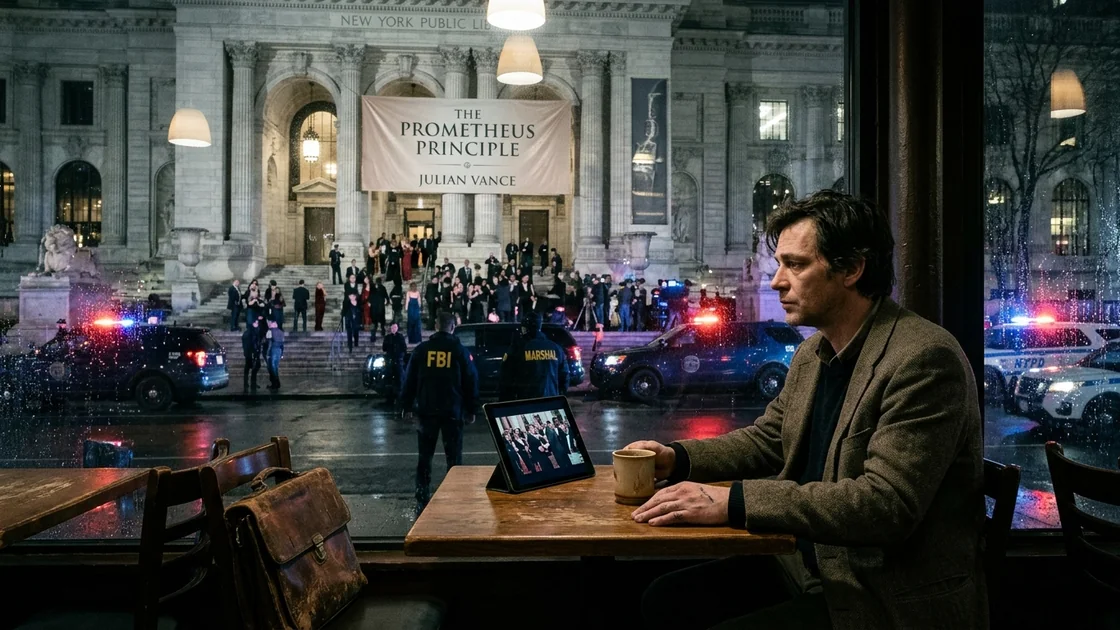
Arthur wasn't inside the rotunda. He wasn't on the guest list; ghostwriters were the invisible scaffolding removed before the statue was unveiled. Instead, he sat across Fifth Avenue at a corner table inside a quiet second-floor coffee shop, nursing a cup of tea and watching the library steps through the rain-streaked glass while an iPad propped against his sugar dispenser streamed Vespera Global’s live promotional feed of the event.
On the screen, Julian Vance stepped up to the lucite podium in front of the book pyramid. He wore a bespoke Tom Ford tuxedo, glowing under the television lights as the applause washed over him. Near the edge of the stage stood Elena Rostova in an emerald silk gown, next to David Sterling of Harrington & Cross.
It was 7:15 PM.
"Six months ago," Julian’s voice boomed through the rotunda’s sound system and into Arthur’s single earbud, "the literary establishment told me that a book written in pure cognitive vectors wouldn't be understood by the public. My editors—God bless you, David, don't look so nervous—begged me to water down the syntax. They wanted me to change the words! They wanted to sand off the edges of the Axioms of Ascent!"
The crowd laughed appreciatively. David Sterling raised his champagne flute in a sheepish, theatrical toast.
"I told them no," Julian said, gripping the edges of the podium and leaning forward into the cameras. "I told them that every single word in this book, every comma, every syllable, came directly from the vault of my own mind! Not a single letter was put on those pages by accident. When you read The Prometheus Principle, you aren't reading a story. You are reading the exact ledger of how I built Vespera Global!"
In the coffee shop across the street, Arthur opened a second tab on his iPad.
The Reddit thread on r/cryptography, posted at 5:30 PM, now had four thousand comments. The top comment, posted twenty minutes ago by a quantitative analyst at Citadel who had downloaded the EPUB file of The Prometheus Principle and run the anonymous forty-line Python script against the text, read:
Holy mother of God. The script works. It’s not a LARP. If you extract every 5th word after ["vector", "architect", "paradigm"] in the dialogue blocks, and run the prime-paragraph post-comma length index, it spits out a verbatim confession to sabotaging the 2018 Aegis Bio clinical trials, complete with Cayman account numbers and SWIFT codes. And the chapter epigraphs convert via mod-16 hex into SHA-256 hashes of audio files in a Big Sur basement.
Three minutes later, at 7:21 PM, the Wall Street Journal pushed a breaking news alert to two million mobile devices simultaneously:
WSJ EXCLUSIVE: SEC AND DOJ OBTAIN EMERGENCY WARRANTS FOR VESPERA CEO JULIAN VANCE’S ESTATE AFTER CRYPTOGRAPHIC CONFESSION TO $840M INSIDER TRADING AND CLINICAL SABOTAGE DISCOVERED IN BESTSELLING MEMOIR; SWISS BANK RECORDS CONFIRM EMBEDDED SWIFT CODES.
Below the headline, Clara Lin had written a twelve-hundred-word masterpiece explaining that federal prosecutors in the Southern District of New York, working off an anonymous cryptographic key received that morning, had already cross-referenced the SWIFT numbers hidden in Chapters 9 through 18 of Julian’s memoir with confidential clearinghouse data from Zurich and Nevis—confirming that forty million dollars had indeed been wired from a Cayman trust controlled by Julian Vance to former FDA Deputy Director Leonard Shaw six weeks after the deadly Biloxi clinical hold.
On the live stream, Arthur watched the ripple hit the room inside the library before the sound ever stopped.
It started in the back rows, where the thirty-year-old hedge fund analysts stood. One man pulled his phone from his tuxedo pocket, stared at the screen, and went dead white. He grabbed the arm of the managing director next to him. Within fifteen seconds, across the vast marble rotunda, two hundred smartphones came out of pockets and evening clutches simultaneously. The low murmur of polite awe that had accompanied Julian’s speech morphed into a bizarre, rising buzz, like a disturbed hive of hornets.
At the side of the stage, Elena Rostova’s phone vibrated in her hand.
Arthur zoomed the video feed in on her face. He watched her look down at her screen. He watched her read the Wall Street Journal headline. He saw her eyes dart instantly from her phone to the ten-foot pyramid of books behind Julian—the books she had personally forbidden Harrington & Cross from editing, the books whose "1.4 standard deviation clause uniformity" she had dismissed in the rain at Big Sur.
All the color drained from Elena’s face, leaving her skin the shade of the marble columns behind her. She took half a step toward the podium, her mouth opening to call Julian’s name, just as the heavy bronze doors at the rear of the Celeste Bartos Forum swung open.
Julian, blinded by the stage spotlights and drunk on the sound of his own voice, was still speaking into the microphone.
"...because when the history of the twenty-first century is written," Julian proclaimed to the room of people staring horrified at their phones, "they will not look at the regulators! They will not look at the scientists who fell in love with the brick! They will look at the code I wrote into the very fabric of—"
Eight men and women in dark windbreakers and conservative suits stepped past the velvet ropes at the back of the hall—four United States Marshals and four special agents from the FBI’s White-Collar Crime squad, accompanied by an Assistant United States Attorney holding a blue-backed federal warrant. At the exact same moment, three thousand miles away on the foggy cliffs of Big Sur, a tactical team from the San Francisco field office was cutting through the concrete gate of Aethelgard before Elena’s stunned fingers could even dial the estate's security desk to order the destruction of the sub-basement drives.
Julian stopped talking as the two marshals mounted the steps of the stage. He blinked into the lights, looking down at the agents with a mixture of confusion and aristocratic annoyance.
"Excuse me," Julian said into the live microphone, his voice echoing across four hundred silent guests and tens of thousands of viewers online. "This is a private event. Elena, who are these people?"
Elena didn't answer. She was already backing slowly toward the service exit behind the string quartet, her hands trembling as she dropped her phone into her clutch.
"Julian Vance," the lead agent said, stepping up to the lucite podium so close that his voice was picked up crystal-clear by the broadcast microphone. "You are under arrest for securities fraud, wire fraud, conspiracy to commit murder in connection with the tampering of federal clinical drug trials, and obstruction of justice."
Julian let out a high, incredulous laugh, resting one hand on the stack of his own books next to the lectern. "Are you insane? Based on what evidence?"
The Assistant U.S. Attorney stepped forward and held up a pristine, black-and-gold hardcover copy of The Prometheus Principle, with thirty yellow sticky notes protruding from the top edge like feathers.
"Pages twelve through three hundred and eighty, Mr. Vance," the prosecutor said. "You signed the cover page yourself."
Across Fifth Avenue, Arthur Pendelton closed the cover of his iPad. He left a twenty-dollar bill under the saucer for his three-dollar tea, picked up his worn leather briefcase, and stood up.
Outside, the rain had stopped, leaving the pavement shining like dark glass under the streetlights. He buttoned his tweed jacket, stepped out onto the sidewalk, and walked uptown into the crowd, leaving the architect in the cathedral he had built.