The Architects of Rot and Silica
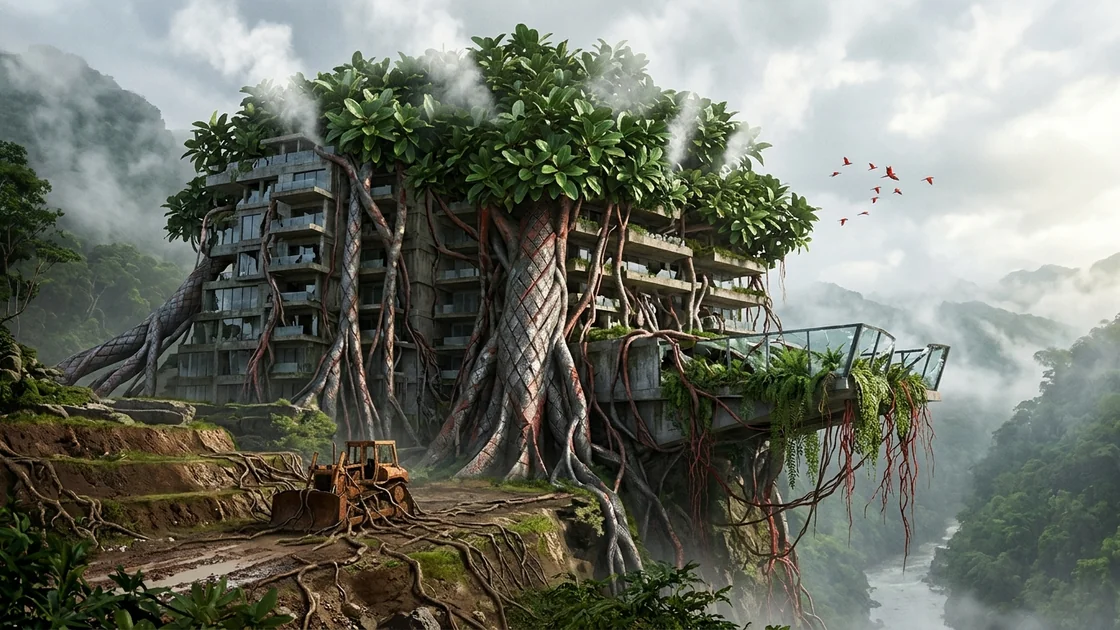
Dr. Aris Thorne spent twenty-four years cultivating an experimental rainforest reserve in the misty lowlands of the Veridian Basin, only to watch it get flattened in forty-eight hours by a multinational hospitality conglomerate. Armed with a stolen thermos of genetically altered plant tissue and a lifetime of esoteric botanical knowledge, the disgraced scientist retreats to a moldering river town to engineer a biological reckoning. By splicing the aggressive growth hormones of a tropical strangler fig with mineral-leaching extremophile bacteria, Aris creates a flora species that feeds directly on Portland cement and structural steel. He infiltrates the construction site of the luxury resort built over his life's work, seeding its deep foundations with dormant spores that wait for the first monsoon to awaken and reclaim the earth in a catastrophic eruption of wood and stone.
The rain in the Veridian Basin did not fall so much as it hung suspended in the pressurized air, a warm, particulate soup of transpired moisture, fungal spores, and volatile terpenes exhaled by four hundred species of vascular plants per hectare. For twenty-four years, Dr. Aris Thorne had breathed that soup until he was certain his own alveoli were lined with bryophytes.
He stood on the slick aluminum catwalk of Canopy Station Alpha, eighty feet above the forest floor, listening to the diesel engines grinding gears three miles down the logging road.
They sounded like iron hornets trapped in a wet canvas sack. A low, rhythmic thrumming that vibrated through the basalt bedrock, traveled up the massive buttress roots of the Ceiba pentandra supporting the station, and hummed against the soles of his rubber boots.
"They aren't stopping at the river boundary, Aris," Mateo said. The younger man’s voice was tight, stripped of its usual melodious cadence. He was leaning over the galvanized railing, a pair of high-powered binoculars pressed to his bruised eyes. "The barge just dropped the ramp. That’s two D9 caterpillars and an excavator with a forestry mulcher head. They have the Ministry Police with them. Four trucks."
Aris did not look up from the polycarbonate germination tray he was packing into a padded aluminum case. His fingers, permanently stained a mottled mahogany from decades of handling walnut hulls, tannin-rich bark, and silver nitrate solutions, moved with a terrifying, methodical calm. He was sixty-one years old, built like a seasoned liana—all twisted tendon, sun-cured skin, and stubborn fibrous mass.
"Of course they didn't stop at the river," Aris murmured, his voice dry as pressed herbarium paper. "The river is where the limestone karst forms those natural thermal springs. Marcus Vance didn't bribe three appellate judges and the Deputy Minister of Agrarian Reform just to build his infinity pools on alluvial mud. He wants the travertine ledges. Which means he needs the ridge. Which means Sector Four goes first."
"Sector Four is the mother grove," Mateo whispered, lowering the binoculars. He looked at the older man, panic finally breaking through his academic composure. "Aris, the twelve-year trials are in Sector Four. The mycorrhizal bridges. The carbon-sink hybrids. If they mulch the soil horizon there, the symbiotic web dies in an afternoon. We have the injunction application in the capital—"
"The injunction is sitting beneath a paperweight on the desk of a man whose brother-in-law owns the concrete batching plant in Puerto Sombra," Aris said. He snapped the latches of the aluminum case shut. The metallic clack echoed sharply off the broad, waxy leaves of the philodendrons crowding the platform. "The law is a deciduous thing down here, Mateo. It drops its leaves whenever the season gets dry enough for money to blow through."
"So what are we doing? Packing? You're just going to pack?"
"I am salvaging," Aris corrected. He walked into the small, climate-controlled geodesic dome that served as their primary field laboratory.
The air inside smelled of autoclaved agar, rubbing alcohol, and the sharp, almond-like scent of benzaldehyde. Along the walls, racks of magenta-lit growth chambers bathed hundreds of glass flasks in wavelengths optimized for chlorophyll A and B absorption. Within those flasks, suspended in clear nutrient gels, sat pale, undifferentiated clumps of plant cells—calluses—alongside twisting, pale green shoots that pressed against the borosilicate glass like tiny, desperate fingers.
Aris bypassed the rows of mahogany hybrids, the blight-resistant cacao variants, and the nitrogen-fixing bromeliads that had earned the Veridian Research Initiative three international grants and a feature in Nature. He went straight to the rear of the lab, where a reinforced stainless-steel Dewar flask sat bolted to the floorboards, humming quietly on battery backup.
He keyed in a six-digit code on the digital padlock, popped the vacuum seal with a soft hiss of escaping nitrogen vapor, and pulled out a cylindrical titanium canister no larger than a wine bottle.
Mateo followed him into the dome, his boots squeaking on the linoleum. When he saw the titanium cylinder, his posture stiffened. "You told the oversight committee you autoclaved the Strain Eighty-Eight cultures last October."
"I told the oversight committee that the ecological risk profile of Strain Eighty-Eight was incompatible with open-canopy testing," Aris replied smoothly, slipping the cold cylinder into a custom-fitted neoprene sling inside his canvas rucksack. "Which was entirely true. In an intact primary rainforest, it has no off-switch. Its hormonal cascade doesn't recognize canopy saturation."
"It's a biological meat grinder, Aris. You spliced Ficus aurea with the silicate-accumulating genes from giant horsetail and the root-pressure mechanics of desert mesquite. The test sapling in the quarantine pit cracked a six-inch ferro-cement containment liner in nineteen days."
"Seventeen days," Aris corrected softly. "The cracks began on day twelve, though they were microscopic. And it wasn't designed to be a meat grinder, Mateo. It was designed for the highland strip-mines in Peru. Places where the topsoil has been washed into the Amazon and nothing is left but toxic tailings and compacted shale. You needed a pioneer species that didn't wait for soil to form. You needed a tree that could make its own soil by chewing through rock, locking up heavy metals in its heartwood, and laying down five tons of leaf litter a year."
"And the committee killed it because if a single fig wasp got into the quarantine greenhouse and carried pollen into the wild, it would strangle every hardwood from here to Panama."
"It's sterile," Aris said, zipping the rucksack. "Triploid chromosomes. Just like a commercial banana. It cannot produce viable pollen, and its syconia do not produce the volatile kairomones required to attract Pegoscapus fig wasps. It only reproduces clonally, or from the synthetic somatic embryos in this canister."
Down below, through the emerald floor of leaves, a sound tore through the valley. It was not the low rumble of the diesels anymore. It was the high, screaming whine of a hydraulic mulcher spinning at two thousand revolutions per minute, followed immediately by the gunshot crack of a century-old Dipteryx panamensis—an almendro tree whose wood was so dense it was known locally as mountain iron—shearing at the trunk.
The entire canopy station shuddered. A flock of scarlet macaws exploded from the upper crowns three hundred yards away, their raucous cries swallowed instantly by the mechanical roar.
Aris closed his eyes. He knew that tree. He had climbed it in his forties with a crossbow and fishing line to rig the first dendrometer bands. It supported sixty-eight distinct species of orchids, four families of nocturnal tree frogs that never touched the ground from birth to death, and a colony of stingless bees whose honey contained an antibiotic compound he hadn't even finished sequencing yet.
In forty seconds of hydraulic torque, ten thousand years of co-evolution had been reduced to woodchips the size of matchbooks.
"We have to get down," Mateo said, grabbing Aris by the shoulder. Tears were cutting clean tracks through the sweat and dust on the young man's face. "If they hit the western anchor cables with the blades, this whole platform is coming down with the ceiba."
Aris didn't pull away, nor did he hurry. He looked around the lab one last time. Thirty years of field notebooks sat on the shelves—though the data was backed up on drives in his bag, the physical pages held the pressed leaves, the penciled margins written by candlelight during power outages, the handwriting of his late wife, Elena, whose ashes were scattered at the base of the very almendro tree that had just been mulched into paste.
"Take the laptop and the spectrometer, Mateo," Aris said, his voice dropping an octave, cold and steady as subterranean water. "Go down the spiral stair and walk out the eastern trail toward the indigenous reserve. Do not talk to the police. Do not stand in front of the machines."
"What about you?"
"I am going to talk to the man who signed the work order."
Marcus Vance did not look like a villain from an environmental fable; he looked like a man who subscribed to journals on mindfulness and paid forty dollars for cold-pressed juices. He was forty-two, dressed in bespoke linen trousers, articulated hiking boots that had never seen mud prior to twenty minutes ago, and a high-visibility vest worn loosely over a black merino polo.
He was standing near the edge of the newly cleared scar—a raw, bleeding wound of churning orange laterite clay and shattered chlorophyll—pointing at a tablet screen while a site engineer nodded furiously. The heat in the clearing was already unbearable. Without the triple-tiered canopy to intercept ninety-eight percent of the solar radiation, the equatorial sun hammered the exposed mud, baking the crushed mycorrhizal fungi and earthworms into a stinking crust.
Aris walked out of the wall of green. He still wore his canvas rucksack. Two Ministry policemen in olive-drab uniforms and riot helmets stepped forward, hands dropping to the stocks of their carbines, before Vance raised two fingers to wave them off.
"Dr. Thorne," Vance called out over the roar of the D9 bulldozer, which was currently shoving the shattered crown of an ancient mahogany into a ravine. Vance slipped on a pair of polarized sunglasses and walked over, extending a hand. "I was hoping we could do this amicably at the Ministry office last week, instead of out here in the noise."
Aris looked at the extended hand, then up into the polarized lenses where his own gaunt, sweat-streaked reflection stared back at him twice.
"You are fifteen days early on the eviction notice, Mr. Vance," Aris said. "Our lease revocation is still under administrative review in the Third Circuit."
Vance sighed, dropping his hand and sliding it into his linen pocket. He offered a practiced, sympathetic grimace. "The Third Circuit issued an emergency stay on your appeal at eight o'clock this morning, Doctor. Eminent domain for Strategic National Tourism Development. Look, I get it. If I had spent my life out here in a treehouse counting beetles, I’d be bitter too. That’s why Aethelgard Hospitality offered the endowment. Two hundred thousand dollars to relocate your greenhouse to the university campus in the capital. You never signed the release."
"You cannot relocate a climax rainforest to a college courtyard," Aris said evenly. "What your machine just ground into pulp over there was a soil matrix that took since the last glacial maximum to balance its phosphorus cycle. You are scraping six inches of living skin off twenty feet of dead clay. Within two rainy seasons, without the root networks to hold the slope, half this ridge is going to slide into the river."
"Which is why we have the finest geotechnical engineers from Zurich on payroll," Vance said brightly, turning to gesture across the mud pit. "We aren't building log cabins, Doctor. The Solstice Grand is going to be an architectural marvel. Deep-pile caissons driven forty feet directly into the limestone bedrock. Cantilevered glass pavilions floating over the thermal springs. Zero-carbon operational footprint once the solar array on the south slope is active. We're bringing high-net-worth conservation awareness to the Veridian Basin. People don't protect what they can't experience in comfort."
Aris stared past him. Fifty yards away, the giant Ceiba pentandra—the tree that held Canopy Station Alpha—was being rigged with heavy steel cables by two men in hard hats. They didn't even bother to take the aluminum platforms down first. The excavator swung its articulated arm around, planting its massive hydraulic thumb against the silver-gray bark of the trunk, while the bulldozer took up the slack on the cable.
"My equipment is still up there," Aris said softly.
"You had thirty days to vacate the parcel," Vance replied, checking his wristwatch—a titanium chronograph that cost more than Mateo’s five-year doctoral stipend. "Whatever's left on the land is legally classified as abandoned industrial debris. My crew is on a tight bonus schedule to get the grading done before the October rains start. If we miss the dry window for the foundation pours, it pushes the soft opening past Christmas."
A sawyer at the base of the ceiba pulled the starter cord on a Stihl forestry chainsaw with a four-foot bar. The two-stroke engine shrieked to life, coughing blue oil smoke into the humid air.
Aris watched the blade sink into the base of the buttress root. White, milky sap—the lifeblood of the tree, pressurized to push water two hundred feet against gravity—sprayed out over the sawyer’s chaps like severed arterial spray.
"My wife’s ashes are in that soil," Aris said. He didn't raise his voice. He barely moved his lips.
Vance paused, a flicker of genuine awkwardness crossing his tanned, handsome face, before his corporate training smoothed it away. "I’m truly sorry for your loss, Doctor. When the resort is finished, we’re dedicating a four-acre botanical walk along the perimeter. Native flora, plaque descriptions, the whole thing. I’ll personally see to it that there’s a memorial bench with her name on it. Right by the orchid conservatory."
The chainsaw stopped. The sawyer sprinted back thirty feet and waved a yellow flag.
The D9 bulldozer revved until its exhaust stack belched a column of black soot straight toward the clouds. The steel cable went taut, singing like a cello string pulled to the breaking point.
For ten seconds, the giant tree refused to yield. Its taproots and spreading lateral buttresses, woven through twenty-five thousand cubic feet of earth and limestone fissures, held fast against four hundred horsepower of American steel. Then, with a sound like a subterranean cannon firing, the primary tension root snapped underground.
The crown tilted. The aluminum catwalks of Station Alpha twisted like tin foil as the supporting limbs torqued against one another. Glass flasks shattered in the geodesic dome eighty feet in the air, raining glittering shards and purple nutrient agar down through the tearing vines. With a long, rushing roar of displaced air and snapping lianas—a sound that pulled down a dozen smaller trees braided into its canopy—the monarch struck the mud.
A shockwave of mud, crushed bromeliads, and stunned insects washed outward, splattering the cuffs of Vance’s linen trousers.
Where the tree had stood for three hundred years, there was now a jagged stump bleeding froth and an empty hole in the sky, blindingly bright and intolerably hot.
Aris stood completely still as the dust and shredded leaves settled over his gray hair. He reached into his pocket, felt the cold outline of the titanium canister through the canvas of his bag, and looked back at Marcus Vance.
"Concrete," Aris said conversationally, "is a fascinating material, Mr. Vance. Most people think it dries. It doesn't. It cures through hydration. Tricalcium silicate reacting with water to form calcium-silicate-hydrate gel and calcium hydroxide. It's an alkaline rock, full of microscopic capillary pores."
Vance blinked, wiping a speck of mud from his sunglasses with a microfiber cloth. "I'm glad you appreciate the engineering, Doctor. Now, the officers are going to escort you to the road gate. If you come back onto Aethelgard property without a guest reservation, you'll be arrested for criminal trespass."
"I won't need a reservation," Aris said, turning his back on the clearing and walking toward the waiting police truck. "The forest has a very long memory. It just needs someone to remind it how to chew."
Puerto Sombra sat twelve miles downriver, where the clear, mineral-heavy waters of the thermal tributaries met the sluggish, silt-choked brown expanse of the Río Culebra. It was a town built on extraction and rot. In the nineteenth century, it had been rubber; in the twentieth, mahogany and alluvial gold; now, it was gravel barges, cheap labor, and sex work catering to the three hundred construction contractors pouring into the valley to build the Solstice Grand.
Aris rented the top floor of a derelict cinder-block structure that had once been an ice house above a boat repair yard. The roof was corrugated zinc patched with roofing tar, and the air smelled perpetually of diesel bilge, frying plantains, and the sour, fermenting stench of the river mud at low tide.
It was perfect. Nobody asked why the old gringo on the second floor ran three window air-conditioning units twenty-four hours a day, or why he paid the local scrap-metal boys fifty pesos a sack for broken concrete test cylinders discarded from the construction site’s quality-control lab.
Within three weeks, the former ice house looked like the lair of an alchemist who had traded gold for chlorophyll.
Mateo had returned to the capital after the first week, broken-hearted and terrified of losing his academic credentials if he stayed associated with a man who had threatened Marcus Vance in front of Ministry police. Aris hadn't blamed him. Young men had futures that required institutional approval. Old men with dead wives and mulched life's work had only time and basic chemistry.
Aris stood over an improvised laminar flow hood constructed from a salvaged restaurant range exhaust, HEPA filters stolen from the university hospital dump, and heavy plastic sheeting taped with silicone sealant.
Inside the hood sat twelve wide-mouthed Mason jars. At the bottom of each jar rested a two-inch cube of cured high-strength Portland cement—the exact mix specification being poured at the Solstice Grand, complete with crystalline waterproofing admixtures and steel rebar shavings.
Atop each concrete cube sat a translucent, emerald-green mass of tissue the size of a walnut.
"Let's see how hungry you are today, Eight-Eight Bravo," Aris murmured to the glass.
He lifted the third jar and placed it under the lens of his stereo microscope, adjusting the halogen ring light.
In nature, the strangler fig—whether Ficus aurea in the Americas or Ficus virens in the Old World—was already one of evolution’s most patient and ruthless siege engines. It began life as a tiny seed dropped by a bird or bat high in the crotch of a host tree. As a hemiepiphyte, it did not try to grow up from the dark forest floor; it grew down from the light. It sent thin, questing aerial roots trickling down the bark of its host like slow-motion lightning bolts. Once those roots touched the earth and tapped into soil nutrients, the fig dropped its mask of harmless tenant. The roots thickened, branched, and underwent anastomosis—wherever two roots touched, their bark dissolved and their vascular cambiums fused together into a living, woody weld. Over decades, the fig wove a rigid, diamond-patterned lattice around the host tree’s trunk, cutting off its phloem transport, stealing its sunlight above, and crushing its vascular system below until the host rotted away inside a hollow cathedral of fig wood.
Strain Eighty-Eight had been Aris’s attempt to compress that thirty-year siege into a single wet season.
By modifying the genes regulating auxin and cytokinin transport, and introducing a synthetic promoter linked to cellular turgor pressure, he had created a fig whose meristematic cells divided at the rate of bamboo—up to thirty-six inches a day under optimal nutrient load—while retaining the lignified wood density of mature tropical hardwood.
Still, bamboo-speed growth required massive inputs of carbon, nitrogen, potassium, calcium, and silica. In the wild, no soil could supply minerals fast enough to sustain that metabolic furnace without burning out.
Unless the soil was the building.
Through the microscope oculars, Aris watched the root tips of Variant Bravo where they interfaced with the gray concrete cube.
Two weeks ago, using an Agrobacterium vector he had cultured from geothermal vents near the volcano, Aris had spliced a new metabolic pathway into the fig's root-cap cells. It was derived from Thiobacillus and lithotrophic fungi—organisms that lived inside solid rock by secreting concentrated organic acids to dissolve mineral lattices.
Through the lens, the microscopic root hairs of Variant Bravo didn't just brush against the concrete; they formed sealed, mucilaginous suction cups against the gray stone. Within those microscopic pockets, the plant was pumping out a cocktail of oxalic, citric, and carbonic acids at a pH of 1.8.
The high alkalinity of the Portland cement—normally pH 12 or 13, which protected the internal steel rebar from rusting—was neutralizing the acid, and in doing so, destroying itself. Tiny bubbles of carbon dioxide fizzed inside the clear mucilage as the calcium-silicate-hydrate binder dissolved into free calcium ions and orthosilicic acid.
The fig wasn't poisoned by the dissolved concrete; it was drinking it.
Aris adjusted the focus fifty microns deeper. The vascular bundles of the root were glowing with tiny, refractive geometric crystals. The plant was taking the dissolved silica from the cement and the oxidized iron from the steel shavings and depositing them directly into its own cell walls as biogenic opal and iron-lignin complexes.
He picked up a steel dissecting needle, opened the jar, and pressed the sharp point hard against a root no thicker than a violin string.
The steel needle bent. A tiny spark of static or friction—almost invisible—flashed against the mineralized bark. The root didn't even bruise.
"Phytolith armor," Aris whispered, a slow, terrible smile stretching the dry skin of his cheeks. "Try putting a Stihl chainsaw through a tree whose vascular cambium is forty percent quartz and iron oxide."
There was only one flaw left to solve. If the fig started growing at thirty inches a day the moment it touched the wet concrete of the foundations, Vance’s engineers would see green shoots erupting from the cellar slabs long before the first glass wall was hung. They would bring in backhoes, jackhammers, and barrels of triclopyr herbicide while the root mass was still shallow enough to excavate.
The organism needed a fuse. A latency period.
For ten days, Aris worked through the sweltering afternoons and mosquito-thick nights, living on black coffee and canned sardines. He manipulated the plant's phytochromes and abscisic acid pathways—the hormonal switches that tell a seed whether to sleep through a drought or wake for the spring.
He engineered a synthetic repressor gene into the upward-growing apical meristems—the shoots that sought the sun and produced leaves. As long as the ambient soil environment remained below a specific electrical conductivity and lacked a very specific chemical trigger, the plant was genetically forbidden from growing up.
Instead, 100 percent of its hyper-accelerated metabolic energy would be directed down and out, strictly subterranean and intrastructural. It would behave like a subterranean fungal mycelium made of ironwood. Its roots would follow two stimuli: hydrotropism (seeking plumbing pipes and subterranean water tables) and chemotropism (seeking the high-calcium, high-iron signature of reinforced concrete). It would thread itself through every hairline shrinkage crack, every conduit sleeve, every cold joint in the concrete pilings, expanding only to the width of a pencil so as not to crack the surface slabs prematurely, weaving a silent, miles-long nervous system through the bones of the resort while feeding on the thermal energy of the curing cement and the rich organic nitrogen of the crushed rainforest buried beneath the site.
And the trigger to wake the canopy?
Aris held up a vial of synthetic brassinosteroid—a plant steroid hormone modified with a fluorinated carbon ring that did not exist in nature. If introduced into the water table at even five parts per million, coupled with the sudden barometric pressure drop of a tropical depression, the repressor gene would cleave itself permanently. Every dormant node along miles of hidden root network would simultaneously switch from stealth infiltration to explosive vegetative expansion.
"First the roots," Aris told the rows of glowing magenta jars as thunder rumbled over the distant tin roofs of Puerto Sombra. "Then the trunk. Then the canopy. Just like the forest taught us."
In November, the dry winds came down from the cordillera, turning the mud of the Veridian Basin into red talcum powder that coated the leaves of the surviving forest a half-mile back from the construction fence.
The site of the Solstice Grand looked like an open-pit mine on the moon, floodlit twenty-four hours a day by portable halogen towers so the concrete crews could pour during the cooler night hours.
Aris stood in line at the contractor gate at ten o’clock on a Tuesday night, wearing a faded blue coverall, steel-toed boots scuffed with gray mortar, a yellow hard hat, and a dusty N95 particulate mask covering the lower half of his face. His gray hair was dyed a dull, patchy black with drugstore henna, and his forged municipal identity card identified him as Arturo Mendoza, Concrete Curing & Maintenance, Sub-tier 3.
The private security guards at the turnstile barely looked at the card. Sixty men a week quit the night shift because of the heat down in the foundation pits and the caustic lime burns from the wet cement; anyone willing to carry a sprayer wand and wet-burlap rolls for twelve dollars an hour was waved through with a grunt.
Aris stepped through the chain-link gate, the heavy plastic five-gallon agricultural sprayer tank strapped to his back sloshing rhythmically against his spine.
It took all of his discipline not to stop and stare.
Sector Four—the cathedral of ancient almendros, strangler figs, and towering ceibas—was gone. Not merely cut down, but erased from the topography. The ridge had been terraced by explosives and hydraulic breakers into three massive, stepped plateaus overlooking the steaming thermal pools in the gorge below.
In the center of the main plateau yawned a rectangular excavation pit three hundred feet long and forty feet deep, shored up by steel sheet-piling and bristling with a forest of vertical rebar cages. Down at the bottom of the pit, six massive caisson shafts—each eight feet in diameter—had been drilled forty feet further down into the fractured limestone bedrock to anchor the resort’s ten-story cantilevered central atrium.
Concrete pump trucks sat along the rim of the pit like giant mechanical giraffes, their articulated booms reaching down into the floodlit chasm, pulsing every three seconds as hydraulic pistons shoved tons of wet gray slurry through steel pipes into the rebar cages.
"Mendoza!" a foreman barked in rapid Spanish, waving a clipboard near the ramp leading down into the pit. "The west caisson caps and the elevator core slab just finished floating. Get down there with the curing compound before the wind crusts the surface. And watch your boots around the post-tensioning ducts—you step on a plastic sleeve before the second pour tomorrow, I dock you three days' pay."
"Sí, jefe," Aris muttered behind his mask, keeping his shoulders hunched and his eyes down.
He walked down the timber switchback ramp into the belly of the beast.
The air at the bottom of the pit was ninety-eight degrees and smelled suffocatingly of wet lime, diesel exhaust, and the damp, iron-rich scent of the butchered earth weeping through the gaps in the steel retaining walls. Beneath the newly poured six-inch mud slab, he knew, lay thousands of tons of graded fill dirt mixed with the mulched remains of his forest—a rotting, nitrogen-rich compost bed trapped beneath an airtight cap of stone.
Aris unclipped the brass wand of his backpack sprayer.
In a normal curing operation, the tank would contain a milky white acrylic emulsion designed to seal moisture into the fresh concrete so it didn't crack while hydrating.
Aris’s tank contained four gallons of distilled river water, polyvinyl alcohol as a clear suspension binder, and forty million somatic micro-embryos of Ficus vorax Strain Eighty-Eight Bravo, each encapsulated in a microscopic bead of alginate gel no larger than a grain of silt.
He began to walk the perimeter of the elevator core slab, pumping the lever with his left hand and sweeping the brass nozzle back and forth in slow, methodical arcs.
A fine, invisible mist settled over the warm, sweating gray surface of the concrete. Within seconds, capillary action sucked the microscopic alginate beads straight down into the bleed-water channels and micro-fissures of the hydrating cement.
He moved to the six colossal caisson shafts that hadn't been capped yet. Inside the circular cages of two-inch-thick deformed steel rebar, the concrete had been poured up to the collar, leaving a rough, jagged surface studded with vertical steel dowels waiting for the main column forms to be bolted on next week.
Aris paused by Caisson Three—the primary load-bearing pier that would support the resort’s suspended glass-bottomed sky pool and the presidential suite tower above it.
He looked around. The vibrators and trowel crews had moved fifty yards east to the service tunnel forms.
Aris reached into the pocket of his coveralls and pulled out six objects that looked like gray concrete mortar blocks—commonly called "dobies" by ironworkers, used to prop rebar up off the dirt so the concrete flows underneath. Every construction site had tens of thousands of them wired to the steel cages.
Except Aris’s dobies were cast from porous gypsum plaster laced with iron sulfate, and inside the hollow core of each block sat a live, fifty-gram root-knot of Strain Eighty-Eight, already metabolically active and starving.
Working with the practiced speed of a surgeon tying sutures, Aris kneeled by the rebar cage of Caisson Three, slipped three of his hollow blocks deep into the impenetrable tangle of intersecting two-inch steel bars at the base of the column, and twisted standard sixteen-gauge tie-wire around them to secure them in place. Tomorrow afternoon, when the carpenters enclosed the column in plywood forms and poured thirty tons of concrete inside, those blocks would be entombed forever at the exact structural nexus where the vertical load of the building met the subterranean bedrock.
He did the same to Caissons One, Two, Four, Five, and Six.
Then he walked into the subterranean utility trenches—the deep concrete arteries that would carry high-voltage electrical conduits, chilled water pipes for the air conditioning, and the main greywater drainage lines out toward the river gorge.
Here, where the limestone bedrock was exposed and weeping warm mineral water from the natural springs, Aris didn't just spray; he unscrewed the cap of his tank and poured a quart of the concentrated embryo slurry directly into the gravel bedding beneath the main forty-inch storm drain pipe.
He placed his bare hand against the wet, warm concrete of the central core wall. Under his palm, he could feel the faint exothermic heat of the chemical reaction inside the slab, and deeper still, the timeless, silent pressure of the groundwater trying to push its way back into the light.
Eat well, he thought. Stay dark. Stay quiet. Wait for the rain.
Seven months later, the Solstice Grand Resort and Spa did not merely sit on the ridge; it thrust itself out over the Veridian Gorge like the prow of an alabaster battleship.
Marcus Vance had kept his word to his investors: the architecture was breathtaking in its arrogance. Four interlocking tiers of board-formed architectural concrete—left intentionally raw to show the grain of the timber forms—rose out of the hillside, connected by soaring sky-bridges of triple-laminated structural glass. From the third tier, the famous infinity pool cantilevered sixty feet out over empty air, its transparent acrylic floor allowing guests swimming in chlorinated mountain spring water to look straight down into the tops of the surviving trees along the riverbanks two hundred feet below.
To soften the brutalist geometry, Vance’s landscape architects had imported four hundred mature royal palms from Florida and draped the concrete balconies with sterile, nursery-grown pothos vines irrigated by hidden drip lines.
Down in Puerto Sombra, Aris sat by his open window with a directional Yagi antenna wired to a modified hydrological data-logger.
During his five nights working on the foundation crew back in November, he had buried four passive RFID moisture-and-impedance transponders inside the elevator pit walls, powered inductively by the building’s own high-voltage grounding grid.
For two hundred days, the data streams had shown a slow, logarithmic curve that made Aris’s heart beat with a fierce, quiet joy every morning while he drank his coffee.
Electrical resistance inside the concrete foundation pilings had dropped by forty-two percent, while acoustic impedance had risen sharply.
To a structural engineer who wasn't looking for it, the numbers would have looked like exceptionally dense concrete curing. To Aris, the telemetry painted a vivid three-dimensional map.
Strain Eighty-Eight Bravo had not died in the dark, alkaline tomb of the foundations.
Deprived of light and locked in its repressed subterranean phase, the fig had spent seven months digesting the interior of the concrete caissons from the inside out. Using its acidic root-sheaths, it had bored millions of microscopic tunnels—none wider than a hypodermic needle—along the length of the steel rebar cages, following the iron from the bedrock forty feet below ground all the way up through the core walls, the load-bearing columns, the hollow-core floor slabs, and the service shafts of all ten stories.
The building was no longer reinforced with steel and cement alone. It was reinforced with a living, pressurized vascular network of silicified fig roots that had replaced roughly twelve percent of the interior concrete mass while maintaining—for now—the exact same compressive strength, because the roots themselves were packed with biogenic quartz and iron.
The Solstice Grand was a hollow host tree that didn't know it had already been colonized from root-tip to crown.
And inside the building, the minor anomalies had already begun.
Aris knew this because he bought beers at the river cantina for the resort’s maintenance plumbers and electricians every Friday night.
"The building settles weird, viejo," a young electrician named Paco had told him two nights ago over a bottle of warm lager. "I tried to pull a new fiber-optic cable through a two-inch galvanized conduit in the sub-basement last Tuesday. The pipe was poured solid into the slab four months ago. Should be empty except for one wire. Instead, the fish-tape hits a wall twenty feet in. We put a borescope camera down there. The pipe was crushed flat from the outside—right inside solid concrete—and full of what looked like wet copper wire or woody roots. When my partner tried to cut through it with a reciprocating saw, he stripped the teeth off three bi-metal blades in thirty seconds. Sparks flying everywhere in the dark."
"Karst limestone shifts," Aris had replied sagely, sipping his rum. "And high-mineral groundwater leaves scale deposits hard as flint."
"Scale doesn't bleed white milk when you hit it with a cold chisel," Paco muttered, crossing himself. "And it doesn't make the walls warm. You touch the concrete columns in the parking garage with your bare hand, it feels like touching a dog's belly. Ninety-five degrees. And at night, when the chillers cycle down, you can hear the walls ticking. Like wood drying in an oven."
Turgor pressure, Aris had thought, hiding his trembling hands beneath the table. Four hundred atmospheres of osmotic root pressure building up against the repressor gene, waiting for the valve to open.
On the nineteenth of June, the weather satellite imagery on Aris’s laptop showed a sprawling, swirling comma of deep crimson and violet pushing across the warm waters of the Caribbean toward the coast: Tropical Storm Isidora, stalling right against the mountain range of the Veridian Basin. Meteorologist projections called for eighteen inches of rain in thirty-six hours.
The same morning, the national newspaper ran a two-page spread announcing the Grand Inaugural Gala of the Solstice Grand Resort that Friday night.
In attendance would be the Minister of Tourism, the Deputy Minister of Agrarian Reform, three board members of Aethelgard Hospitality from Geneva, forty international travel journalists, and Marcus Vance himself.
Aris closed his laptop.
He walked over to his workbench, picked up a two-liter stainless-steel fire extinguisher he had modified with a Schraeder tire valve, and poured in the entire contents of a heavy amber glass bottle: twelve hundred milliliters of fluorinated brassinosteroid trigger compound, dissolved in dimethyl sulfoxide (DMSO)—a medical solvent capable of carrying dissolved molecules straight through skin, bark, or porous stone in seconds.
He pressurized the cylinder to one hundred andtwenty pounds per square inch with a bicycle pump, placed it inside a leather tool bag, and took his pressed grey suit—the one he had worn to accept the National Medal of Botanical Science twelve years ago—off its wire hanger.
The rain began at four o’clock on Friday afternoon—not the gentle mist of the cloud forest, but a warm, deafening deluge that turned the sky the color of bruised lead and dropped visibility in the gorge to fifty yards.
Inside the Grand Atrium of the Solstice Resort, however, the storm was merely theatrical wallpaper.
Behind forty-foot walls of half-inch tempered low-iron glass, a string quartet played Vivaldi near a sunken bar carved from a single slab of poached rosewood. Two hundred guests in silk gowns and tailored tuxedos drifted across polished terrazzo floors, sipping champagne while lightning forked silently through the boiling clouds down in the river valley.
Aris entered not through the porte-cochère where the valets were sprinting with golf umbrellas, but through the service loading dock on Level Minus-Two, flashing an expired vendor badge from the HVAC contractor who had hired him for a two-day filter inspection back in May. In the chaos of catering trucks unloading ice sculptures and Wagyu beef in the driving rain, no one looked twice at an older man in a neat dark suit carrying a leather technician’s satchel and a clipboard.
He didn't go up to the ballroom. He went down.
Level Minus-Three was the mechanical crypt of the resort, carved directly into the damp limestone cliffside behind the main foundation caissons. Here, the air was loud with the rhythmic thrum of massive variable-frequency water pumps, ozone filtration tanks for the infinity pool, and the domestic cold-water booster system that drew directly from the resort’s deep subterranean well and distributed water to every toilet, decorative fountain, irrigation line, and fire sprinkler in the complex.
As Aris walked down the long, raw-concrete corridor toward the pump room, he slowed his pace.
He took off his suit jacket, rolled up his shirtsleeves, and pressed his palm flat against the massive eight-foot octagonal concrete column of Caisson Three where it passed through the sub-basement ceiling.
Paco the electrician hadn't been exaggerating.
The concrete was hot. Not warm—hot, easily a hundred and two degrees Fahrenheit, radiating the furious metabolic waste-heat of millions of dividing plant cells packed tight inside the stone. And beneath the hum of the water pumps, Aris could feel a high-frequency vibration in the column. A subtle, relentless creak-tick-creak, like the timber hull of a galleon diving into a heavy swell.
Look closely at the gray board-formed concrete, and you could see a lacy, geometric map of dark, damp lines spider-webbing across the entire surface of the pillar. The roots inside had drank the surrounding cement paste so dry of free calcium and water that they were now sweating mildly acidic condensation along the micro-fissures, etching their own vascular blueprint onto the skin of the building.
And in the corner where the column met the floor slab, a single, pale-yellow tendril the thickness of a human thumb had pushed right through four inches of sixty-megapascal concrete without leaving a pile of dust—it had simply dissolved the stone in front of its cap and replaced the volume with itself, fusing instantly into the floor junction.
"Hello, my beauty," Aris whispered, kneeling to touch the tendril. It felt like warm, living ivory coated in fine sandpaper. "Are you tired of the dark?"
The heavy steel fire door at the end of the corridor banged open.
Aris stood up smoothly, stepping back toward the brass manifold of the primary water injection loop, his hand already inside his leather satchel.
Marcus Vance stood in the doorway, flanked by a nervous-looking man in a rumpled dress shirt holding a structural blueprint tube—the resort's chief resident engineer, Henderson. Vance looked immaculate in a midnight-blue dinner jacket, though a muscle was jumping in his jaw.
"—don't care what the piezometers say, Henderson," Vance was snapping as they walked in. "The glass panels on the third-floor sky-bridge just popped two neoprene gaskets. I have Architectural Digest upstairs drinking Dom Pérignon, and there’s rainwater dripping onto the carpet because the frame is racked a quarter-inch out of square! Tell me why a sixty-million-dollar foundation is settling in a rainstorm!"
"Mr. Vance, it’s not settling down," Henderson said, his voice cracking with bewildered exhaustion as he pointed at the pressure gauges on the wall. "According to the laser levels in the elevator shaft, the central core has actually lifted three millimeters since noon. And the groundwater drainage sumps are completely dry despite six inches of rain in three hours. Something under the slab is drinking forty thousand gallons of runoff an hour—"
Henderson stopped dead.
Vance followed his gaze and froze ten feet away from the main domestic water manifold.
Aris stood calmly beside the stainless-steel chemical dosing port—the valve used to inject chlorine and anti-scalants into the building's entire plumbing and perimeter irrigation network. The brass hose of Aris’s modified steel cylinder was already threaded onto the quick-connect fitting.
For three seconds, the only sound was the thrumming of the three-hundred-horsepower booster pumps and the muffled boom of thunder vibrating through the bedrock.
Vance squinted under the harsh fluorescent lights, his eyes moving from the gray hair and lined face to the brass valve in Aris’s hand. Recognition hit him slowly, followed by an almost comical flash of irritation.
"Thorne?" Vance stepped forward, incredulous. "Are you out of your mind? How the hell did you get past dock security?" He glanced down at the cylinder attached to the water main, his voice hardening into genuine alarm. "Step away from that manifold right now. Henderson, call security—tell them to get the Ministry police down to Minus-Three immediately! The crazy bastard is trying to poison the water supply!"
"It isn't poison, Mr. Vance," Aris said, looking at the younger man with an expression of profound, almost gentle pity. "If you drank a glass of this right now, the worst it would give you is a taste of garlic on your breath from the DMSO solvent. Mammals don't have brassinosteroid receptors."
Aris turned the brass ball-valve ninety degrees.
With a sharp, pneumatic shhhhh-clack, the hundred-and-twenty-pound pressure charge blew all twelve hundred milliliters of the amber trigger fluid straight into the suction side of the main turbine pump.
The sight-glass on the manifold flashed pale gold for half a second, and then the turbine impellers sheared the fluid into a homogeneous solution and blasted it upward at eighty gallons per second into every pipe, drainage weeping tile, humidifier line, and foundation cooling loop in the Solstice Grand.
"What did you just put in my system?" Vance demanded, lunging forward and grabbing Aris by the lapel of his old suit jacket. Vance was twenty years younger and four inches taller, smelling of expensive sandalwood cologne and panic. He shoved Aris back against the concrete column of Caisson Three. "Speak to me, old man! Is that acid? Biological contaminants?"
"You told me the forest was abandoned industrial debris," Aris said softly, not even raising his hands to defend himself as his spine pressed against the hot, vibrating concrete of the pillar. "You told me people don't protect what they can't experience in comfort. I am about to make them very uncomfortable."
"Henderson, shut down the main pumps!" Vance roared over his shoulder. "Dump the holding tanks into the river!"
Henderson sprinted to the master breaker panel on the wall and threw the heavy red disconnect switch.
The whine of the turbine pumps died. The fluorescent lights flickered as the load dropped.
"Too late," Aris murmured. "The foundation perimeter drains and the chilled-water loops already cycled ten thousand gallons in the last twelve seconds. And the DMSO penetrates saturated concrete at roughly four millimeters a minute."
Vance stared into Aris’s eyes, breathing hard, his fist still bunched in the old botanist's jacket. "You're pathetic, you know that? A washed-up tree-hugger playing Eco-warrior with a garden sprayer. Whatever herbicide or sewage you just pumped into the sprinklers, my insurance will cover the flush-out by Tuesday, and you’re going to die in a federal penitentiary."
Behind Vance’s head, the eight-foot-thick concrete column of Caisson Three made a sound.
It was not a tick anymore.
It sounded like a thick manila hawser being pulled over a rusty iron capstan under ten tons of tension. Grooooaaaan—CRACK.
A flake of gray concrete the size of a dinner plate spalled violently off the face of the column, whizzing past Vance’s ear and shattering against the steel housing of the water pump like a ceramic tile.
Vance let go of Aris and stumbled back a step, staring at the raw spot on the pillar.
Inside the spalled crater, there was no gray gravel aggregate. There was no two-inch steel rebar.
Where the steel reinforcing bar should have been, there was a glistening, braided cable of dark crimson and metallic silver wood, thick as a man's thigh, pulsing visibly like an exposed jugular vein. The steel rebar had been partially dissolved and enveloped, its iron drawn into the bark in glittering black streaks of magnetite and hematite, while the woody tissue around it was visibly swelling—expanding radially as its cells absorbed water from the surrounding stone and slammed into hyper-mitosis.
"What is that?" Henderson whispered from the breaker panel, his face draining of all color. "Mr. Vance... that's inside the primary load path."
"The repressor gene just cleaved," Aris said, stepping away from the column and brushing the concrete dust from his shoulders. "For seven months, Ficus vorax has been forbidden from producing gibberellins or expanding its secondary xylem. It has been storing starch and mineral silicates along fourteen miles of microscopic root threads woven through every pour you made since November. Now, it thinks it has finally reached the forest floor. And when a strangler fig reaches the floor, Mr. Vance, it thickens its trunk and reaches for the sun."
A dull, subterranean boom echoed from beneath the six-inch concrete floor slab under their feet.
The floor heaved upward two inches in a jagged ridge running the entire length of the mechanical room. The epoxy floor paint split with a sound like ripping canvas.
From the fissure erupted not dirt, but a dense, writhing mat of pale, translucent root-tips coated in steaming acidic mucilage. You could actually see them moving—not like animals, not with muscular contraction, but with the terrifying, unstoppable hydraulic creep of time-lapse photography brought into real time. As the root tips hit the humid air of the room, they turned from pale white to copper-green in seconds, twisting around one another, touching, their bark dissolving on contact with a hiss of steam, fusing via instant anastomosis into rigid, latticed arches of iron-wood.
One of the roots touched the cast-iron housing of the main six-inch fire main. It didn't bounce off; it flattened itself against the iron like hot wax, while three lateral shoots whipped around the pipe flange.
Four seconds later, as the root wood behind the tip underwent rapid lignification and expanded by thirty percent in diameter, the half-inch steel bolts holding the flange sheared in half like carrots.
High-pressure water—laced with the remaining trigger hormone—blasted across the mechanical room in a roaring white geyser, drenching the walls, the ceiling, and the electrical busbars.
Up on the Grand Atrium level, the string quartet had stopped playing five minutes ago.
At first, the two hundred guests had assumed the low, rhythmic thudding beneath the terrazzo floor was part of an elaborate sound-and-light installation for the gala, or perhaps a minor seismic tremor common to the volcanic cordillera.
Then the champagne flutes on the rosewood bar began to dance in concentric rings, sliding toward the edge and shattering on the stone.
The Minister of Tourism was halfway through his keynote speech on the floating glass stage over the atrium pool when the main forty-foot architectural concrete wall behind him—the wall Marcus Vance had praised for its raw, incorruptible brutalist honesty—began to bleed.
Dark, vertical stains appeared simultaneously along the form-tie holes, weeping a steaming, milky sap that smelled sharply of crushed almonds and hot wet iron.
Then the concrete began to bulge.
Concrete has immense compressive strength—it can support mountains pushing straight down—but it has almost zero tensile strength. When pulled apart from the inside, it is as brittle as chalk.
With a roar like a string of demolition charges detonating in sequence up an elevator shaft, the interior face of the forty-foot wall ruptured from floor to ceiling.
Tons of fractured gray rubble cascaded onto the empty buffet tables, and out of the jagged, smoking wounds in the concrete burst a prehistoric cascade of woody cables. They didn't fall limp; they uncoiled under immense internal turgor pressure, thick as fire hoses, armored in rough, glittering gray-black bark that threw off sparks as they ground against the twisted remnants of the steel rebar cages.
High above, along the ceiling coffers where the electrical conduits and HVAC ducts ran, hundreds of aerial roots—the canopy phase of the organism, finally unlocked—punched straight through the drywall soffits and acoustic tiles. They dropped forty feet through the conditioned air of the atrium like weighted harpoons, swaying slightly in the draft of the shattering windows as they hunted for the floor.
Screams tore through the ballroom, drowning out the monsoon rain outside. Guests bolted for the main bronze entrance doors, slipping on wet terrazzo that was already buckling upward like pack ice in a spring thaw.
Down in Level Minus-Three, the emergency lights were flashing red through clouds of warm steam and atomized water spraying from the ruptured fire main.
Henderson had bolted up the concrete stairwell thirty seconds ago, screaming for the upper floors to evacuate.
Vance hadn't moved. He stood knee-deep in swirling, warm floodwater, staring in catatonic horror at Caisson Three.
The eight-foot concrete pillar was gone.
In its place stood a living, hollow tower of fused, diamond-latticed fig roots that had completely consumed the concrete core and expanded to twelve feet in diameter. The wood was dark as gunmetal, hot to the touch, and groaning with the sound of a forest in a hurricane as it took the entire ten-story load of the resort above onto its own cellular framework—and then began to push upward, unequally, jacking the western side of the building four inches higher than the eastern side.
"You're insane," Vance whispered, his dinner jacket soaked dark, his hair plastered to his forehead. He looked at Aris, who was standing calmly by the stairwell door with the water rising around his shins. "There are two hundred people upstairs! If the cantilever fails—"
"The cantilever won't drop them into the gorge, Mr. Vance," Aris called out over the deafening shriek of shearing structural steel and cracking stone echoing through the floor slabs above. "A strangler fig does not chop down its host tree! It replaces it! It wants the height! Why waste energy building a trunk from the ground when you have already built a ten-story mineral trellis for it to climb?"
Above their heads, the twelve-inch hollow-core ceiling slab cracked completely across the width of the room. Instead of collapsing onto them, the concrete chunks were held suspended in a woven hammock of cross-hatched roots that had already fused across the ceiling like vaulted Gothic ribs.
"Your guests have plenty of time to walk out to the parking lot," Aris said, reaching for the handrail of the service stairs. "Though I strongly suggest they leave their cars behind. The retaining wall on the access road was poured with the first batch of slurry in November. By midnight, that road is going to be a forty-foot hedge of silica-wood."
"This is a hundred-and-forty-million-dollar asset!" Vance shrieked, his corporate veneer finally shattering into raw, hysterical rage. He splashed through the rising water toward a heavy steel tool cabinet bolted to the wall, wrenching it open to grab a thirty-inch wrecking bar. "We’ll burn it out! We’ll bring in industrial defoliants! Diesel! Napalm! I’ll salt this whole goddamn ridge until bacteria can't grow on it!"
He swung the heavy steel bar with both hands, not at Aris, but at a thick lateral root that had just burst out of the electrical switchgear box and was wrapping itself around the main transformer housing.
The steel wrecking bar struck the root with a ringing, metallic CLANG that sent a shower of white sparks across the dark room.
The root didn't even dent. The shock rattled up Vance’s arms so violently he dropped the bar into the water with a cry of pain, clutching his numb wrists.
As if responding to the thigmotropic stimulus of the blow—the touch-response Aris had dialed up to maximum sensitivity—three smaller feeder roots the thickness of whipcord lashed out from the main trunk. They didn't strike like snakes; they simply grew over the submerged wrecking bar in a matter of seconds, pinning it to the concrete floor and fusing over the steel until it was buried in wood.
One of the pale, mucilage-slicked root tips brushed across the toe of Vance’s Italian leather Oxford.
The acidic slime ate through the calfskin in two seconds. Vance yelped as the pH 1.8 secretion burned his skin, yanking his foot back and slipping backward into the knee-deep water.
Around the walls of the mechanical room, the main electrical busbars—carrying four thousand amps from the solar battery array and the backup diesel generators—were being slowly, inexorably crushed by anastomosing root collars. Insulation melted with acrid puffs of black smoke. And yet, when the bare copper bars touched the iron-rich, wet bark of the fig, the plant didn't electrocute itself; the current grounded straight through the mineralized xylem into the limestone bedrock forty feet below, driving the electrochemical uptake of calcium and iron even faster.
The room was shrinking. The walls were moving inward as the biomass expanded, squeezing the air out into the stairwell, filling the subterranean tomb with the overwhelming, primal stench of wet earth, ozone, and boiling sap.
Aris looked down at Marcus Vance, who was scrambling backward on his hands and knees through the warm water toward the stairs, his eyes wide and white in the flashing red strobe of the fire alarms.
"Come along, Mr. Vance," Aris said, holding the stairwell door open against a cluster of pale green shoots that were already curling around the hinges like ivy on fast-forward. "The forest is reclaiming its lease. You don't want to be here when it closes the canopy."
By dawn on Saturday, Tropical Storm Isidora had passed over the cordillera, leaving behind a sky washed clean and luminous, the color of a robin’s egg.
Two miles down the mud-choked logging road, where the asphalt ended at a newly erupted barricade of twisted, six-foot-high buttress roots that had torn the guardrails into corkscrews, the evacuated guests and staff of the Solstice Grand sat wrapped in silver mylar emergency blankets inside the backs of Ministry police trucks.
No one had died. Seven people had been treated for minor cuts from falling glass, and the Deputy Minister of Agrarian Reform had broken his ankle tripping over a root that had erupted through the marble floor of the VIP lounge while he was trying to save his briefcase.
Marcus Vance sat on the lowered tailgate of an ambulance, his tuxedo shredded at the knees, staring up the valley without blinking.
Half a mile away, on the ridge where Sector Four had once stood, the Solstice Grand was still standing—and yet it was completely gone.
Over the course of twelve hours of warm, torrential rain and unlimited mineral nutrition, Ficus vorax had completed its vegetative explosion and hit its programmable canopy-saturation limit, where the sudden exposure to full morning ultraviolet light triggered a massive flood of abscisic acid that slowed its cell division back down to that of a normal, mature rainforest tree.
What remained on the ridge looked like the ruin of an ancient Mayan temple that had been abandoned for ten thousand years, sculpted by an alien intelligence.
The ten-story geometry of the resort was still discernible, but every straight line had been warped, softened, and devoured by a colossal, interconnected cage of dark, metallic-gray wood. Trunks twenty feet thick wrapped the exterior columns in diamond-patterned embraces, their bark glinting in the morning sun with millions of embedded quartz and iron crystals. The cantilevered glass infinity pool hung at a drunken fifteen-degree angle out over the gorge, its acrylic bottom shattered, transformed into a hanging aerial marsh from which curtains of thirty-foot red aerial roots trailed down into the mist of the thermal springs below.
And from the roof, the balconies, the shattered window frames, and the elevator penthouse, a dense, triple-tiered crown of broad, leathery emerald leaves had unfurled—millions of square feet of new photosynthetic surface area, drinking the equatorial sun and exhaling a visible plume of white water vapor that rose to meet the mountain clouds.
Down at the base of the ridge, two Ministry bulldozer operators who had been ordered by a hysterical Vance at four in the morning to clear a path back to the lobby stood beside their D9 caterpillar.
The bulldozer’s twelve-foot steel blade was wedged against a lateral buttress root that had grown across the main service drive. The root hadn't yielded an inch, and while the operator had revved the diesel engine trying to push through it, six secondary roots had crept out of the ditch, climbed the steel tracks while they were spinning in the mud, and fused themselves through the drive sprockets and around the hydraulic lift cylinders, locking the forty-ton machine to the earth like a beetle pinned to a board.
One of the workmen had tried to free the tracks with a heavy forestry chainsaw. He was sitting on a rock nearby, staring dumbly at his saw; the hardened steel teeth of the chain had been ground completely flat into a smooth silver ribbon against the silica-armored bark, while the tree itself bore only a faint, shallow scratch that was already sealing over with milky latex that dried as hard as porcelain.
Five hundred yards across the gorge, on an untouched rocky outcrop along the boundary of the indigenous reserve, Aris Thorne lowered his binoculars.
His old suit was ruined, stained with rust and concrete dust, and he had nothing left in his pockets but his dead wife’s silver wedding band and thirty pesos. He would have to walk twelve miles through the mud to the upper river crossing, and from there take a banana barge south toward the border before Vance’s lawyers figured out how to explain to a judge that an old man had murdered a building with a tree.
Aris looked back across the valley one last time.
As the morning sun warmed the new canopy of the iron-fig, a pair of scarlet macaws—displaced seven months ago when the big ceiba fell—wheeled out from the surviving forest on the western ridge. They circled the towering, jagged green monolith that had been the Solstice Grand, their red wings flashing against the dark, glittering wood of the strangled penthouse.
With a raucous, echoing cry that carried clear across the gorge, the birds folded their wings and dropped into the new crown to roost.
Aris smiled, turned his back on the ridge, and walked into the shadow of the trees.