The Architect of Silence
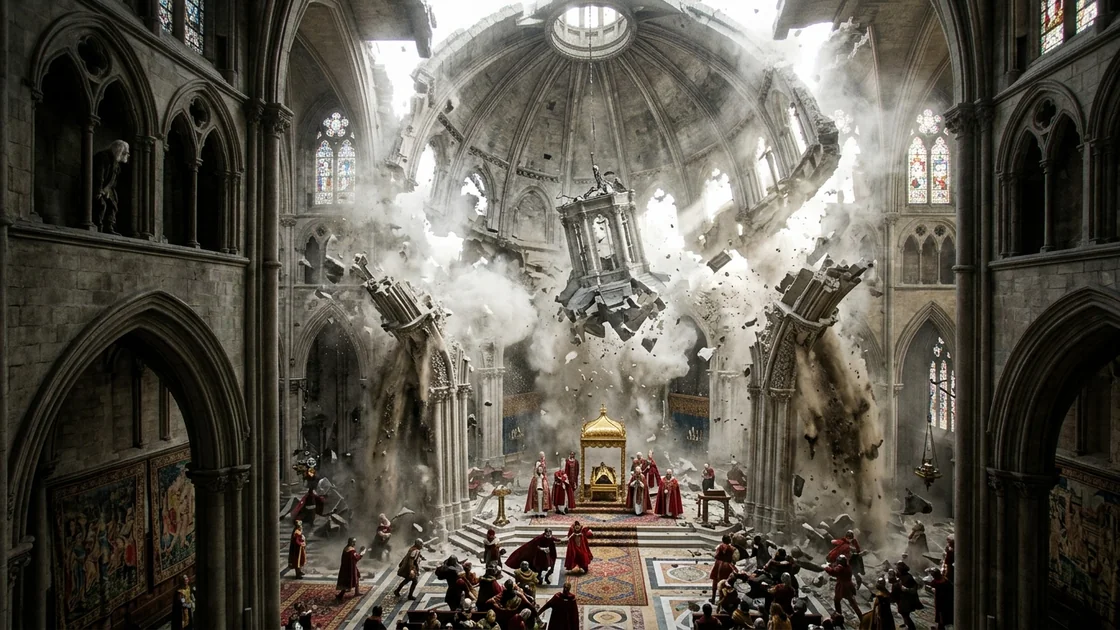
Master Elian of Oakhaven, a brilliant medieval stonemason, is wrongfully blamed when a royal bridge collapses due to King Malakor's corrupt use of cheap mortar, resulting in the execution of Elian's son and the crushing of the mason's right hand. Spared only so the tyrant can exploit his genius to build the Grand Cathedral of Saint Jude, the disgraced and enslaved architect spends forty years secretly engineering a fatal acoustic flaw into the cathedral's massive central dome. By combining brittle resonant stone, hidden bronze vessels, and high-tensioned keystones tuned to a specific musical frequency, Elian creates a structural trap waiting for the right voice. Just before the cathedral's consecration and the King's Golden Jubilee, Elian manipulates an ambitious choirmaster into composing a piece of music featuring a sustained, resonant chord, which ultimately shatters the dome's hidden load-bearing joints and brings ten thousand tons of stone crashing down upon King Malakor and his entire dynasty.
The river Vane did not take the bridge in a roar of spring floodwater, as the chroniclers later wrote at the King’s command. It took it in the dead hush of a January midnight, when the frost had driven deep into the unslaked lime and expanded like iron wedges inside the piers.
Elian had known it would happen three months before the first keystone was dropped into the wooden centering. He had stood on the riverbank in the autumn rain, holding a lump of the grey, crumbly mortar between his calloused thumb and forefinger, and crushed it into powder as easily as dried dung.
"There is no volcanic ash in this mix, my Lord Steward," Elian had told Lord Vane, the King’s cousin and Master of the Royal Works. "And the lime was burned from chalk, not hard river-stone. The kiln masters drew it too soon to save on firewood. When the river rises and the winter freeze comes, the water will leech the binder out of the core. The ashlar facing will peel away like the skin of a boiled onion."
Lord Vane had not even looked down from his palfrey. He had been wearing a cloak lined with Russian sable, paid for with the silver pennies that should have bought thirty barge-loads of hydraulic trass from the southern quarries. "The King wants the crossing open before the Martinmas fairs, Master Elian. The tolls must be collected. Lay the stones. If the river complains, I shall have the bishop excommunicate the water."
Elian had argued. He had written petitions on scraps of vellum, stained with mud and tallow, and sent his son, Julian, to nail them to the doors of the Exchequer. Julian was nineteen, a boy with his mother’s grey eyes and his father’s broad, flat thumbs—the thumbs of a natural carver who could feel the grain of oolitic limestone in the dark. Together, they had tried to shore up the central pier with oak pilings bought on Elian’s own credit from the timber guild, driving them into the freezing silt until their palms bled.
It had not mattered. On the twelfth night of Christmas, while a baggage train of the Queen’s household was crossing by torchlight, the third pier sighed. It was not a crack, not a thunderclap, but a long, wet exhalation as the rotten core liquefied under the weight of three hundred tons of dressed sandstone. The central arch folded inward like a man dropping to his knees in prayer. Fourteen wagons, sixty mules, three ladies-in-waiting, and a chest of the King’s war-tax vanished into the black, churning slush of the Vane.
Three days later, they dragged Elian and Julian out of their workshop in the mason’s yard.
The Great Hall of Solaris smelled of wet wool, tallow smoke, and the sour sweat of terrified men. King Malakor sat upon the Dais of the Sun, a granite chair carved two hundred years before by masons who had known their craft. Malakor was thirty then, his beard trimmed to a sharp iron spade, his eyes the color of river ice. Beside him stood Lord Vane, holding a roll of parchment that trembled only slightly in his ringed fingers.
"Negligence," Lord Vane read, his voice echoing off the timbered roof. "The deliberate dilution of the royal mortar with river sand, the selling of the King’s good lime for private profit, and the hasty laying of the voussoirs without proper geometry."
Elian, on his knees in the dirty rushes with iron shackles biting into his ankles, raised his head. "The tally sticks are in my chest at the yard, Sire! Every cart of chalk-lime carries the seal of Lord Vane’s own bailiff. Look at the mortar in the rubble! Test it with vinegar! I begged for trass. I begged for another month of curing before the centering was struck!"
Next to him, Julian struggled against the two men-at-arms holding his shoulders. The boy’s lip was split, dripping dark blood onto his sheepskin jerkin. "My father spent his own silver on the oak pilings!" Julian shouted, his voice cracking with the fierce, stupid bravery of youth. "Your cousin stole the lime-silver, Sire! Everyone in the yard knows it! Look at his cloak!"
A profound silence fell over the hall. Lord Vane went white around the nostrils. King Malakor did not look at his cousin. A king who admits his cousin is a thief admits his crown is weak; a king who punishes a tradesman proves his justice is swift. Malakor looked down at Julian as a butcher looks at a calf that has kicked over the milk pail.
"A mason’s son has no business speaking in the presence of anointed blood," Malakor said softly. His voice was surprisingly light, almost musical, carrying clearly to the back of the hall. "A craftsman speaks with his hands. Since the father’s hands built falsehood, and the son’s tongue speaks treason, we shall correct both instruments."
"No," Elian whispered. The cold of the stone floor seemed to rush up through his knees and stop his heart. "Sire, the boy only mixed the troughs. He laid not a single course of the pier. Take my life. Hang me from the broken arch. Let the boy go."
"The boy goes," Malakor agreed. He gestured with two fingers. "Take him to the courtyard. Let him swing from the timber crane he used to hoist his father’s crooked stones. As for the Master of Oakhaven—we have need of his head, though not his pride."
Elian fought then. He was a man who spent fourteen hours a day lifting hundred-pound blocks of freestone, and it took six of the King’s halberdiers to pin him to the flagstones while they dragged Julian out through the great oak doors. Elian’s face was pressed against the cold grit of the floor, a booted knee grinding into his neck, while Julian’s voice echoed back from the snowy bailey—not screaming for mercy, only calling out, Father! Keep the plumb line true, Father! until the creak of a windlass rope and a sudden, wooden thud cut the words in half.
Something inside Elian’s chest broke with the exact sound of a dry pine beam snapping under too much load. He stopped thrashing. He lay entirely still when the smith was brought in with a six-pound iron maul and an oak block.
They stretched Elian’s right arm across the block.
"The thumb and the first two fingers," Lord Vane instructed from the steps of the dais, his voice steady now that the boy was dead. "Leave him enough of the left hand to hold a charcoal stick and a pair of dividers. The King’s Cathedral must begin in the spring, and Master Gervais requires a draughtsman to calculate the thrust of the great crossing."
The iron came down three times. Each blow felt less like pain and more like a blinding white light behind Elian’s eyes, accompanied by the wet crunch of small, precise bones giving way. He did not scream. He bit down on the leather strap of his own apron until his teeth met through the cowhide, staring up at the timber roof of the hall, counting the rafters, measuring their span, calculating their dead weight.
When they threw him into the cellar beneath the Chancellery with a bowl of salt water and a rag of filthy linen, Elian lay in the dark for four days. The fever came, hot and stinking of rot, and in the fever, Julian sat beside him on a block of white limestone, turning a mason’s chisel over and over in his whole, unblemished hands.
Why did it fall, Father? the boy asked in the dark.
"Because the binder was weak," Elian muttered to the rats and the damp stones, clutching his mangled, throbbing right hand to his ribs. "Because the mortar had no tooth."
No, the ghost of the boy said, tapping the chisel against the stone wall until it gave off a clear, high ring, like a silver bell. It fell because you built it to stand, and they broke it. Next time, build it to fall.
On the fifth day, the fever broke. Elian sat up in the straw. His right hand was a useless claw of fused bone and purple scar tissue, shaped like a dried root. With his left hand, he reached out and touched the foundation wall of the cellar. He pressed his ear against the cold, sweating granite.
Far above him, through forty feet of earth and mortared rubble, he could hear the faint, rhythmic thrum of the castle garrison marching across the courtyard. He could hear the vibration of the well-chain grating against its stone lip. He could hear the groan of the keep’s eastern tower settling an eighth of an inch into the winter clay.
Stone was not dead. That was the first lie they taught the apprentices, to keep them from fearing the mountains they carved. Stone was frozen water; it was compressed time; it was a taut lute string stretched between the earth and the sky. Every arch was a bow bent forever, waiting to loose its arrow toward the center of the world.
When the turnkey came down with a crust of barley bread and a horn of small beer, Elian was standing by the door.
"Tell Master Gervais," Elian said, his voice rasping like a saw through hard grit, "that if he digs the foundation trenches for the nave less than twenty feet deep on the south side, the marsh-silt will tilt his clerestory before the roof is leaded. And tell him I need a pair of brass dividers and a flat board of lime-wood."
The Cathedral of Saint Jude the Martyr—though every soul in the kingdom knew it was built not for the saint, but as the eternal mausoleum and throne-room of King Malakor—began as a scar in the mud four hundred paces long and two hundred wide.
To clear the ground on the highest hill of Solaris, Malakor had pulled down three parish churches, the guildhall of the weavers, and four hundred hovels, driving the tenants out into the ditches beyond the city walls. Where children had played in the kennel-mud and looms had clattered, two thousand laborers now swarmed like ants in a breached hill.
Elian lived in a lean-to shed built directly against the northern wall of the tracing house. He had an iron ring riveted around his left ankle, attached to twelve feet of light chain that allowed him to reach his straw pallet, the charcoal brazier, and the great plaster floor where the cathedral was born before a single stone was cut.
Master Gervais was a plump man from the southern provinces who wore velvet robes lined with miniver and carried a silver measuring rod he rarely unfolded. Gervais knew how to bow to bishops; he knew how to flatter the King’s mistresses; he knew how to copy the floral tracery of the French cathedrals from parchment pattern-books. What Gervais did not know was how to hold up ten thousand tons of stone two hundred feet in the air without the walls buckling outward like an overfilled barrel.
"The King demands that the central crossing be crowned with a dome, not a timber spire," Gervais said one morning in the second year of the works. He kicked the iron chain that lay coiled near Elian’s ankle, just to hear it clink, before unrolling a parchment across the trestle table. "He saw a drawing of the great church in Constantinople, brought back by the Venetian merchants. Only he wants it higher. Two hundred and twenty feet from the pavement to the lantern. And he wants the four piers of the crossing thinner than the ones at Oakhaven, so the court in the transepts may have an unobstructed view of the High Altar—and the Royal Dais."
Elian looked at the drawing with his one good eye; the left had grown milky from the constant smoke of the lime kilns that drifted through his unglazed window. With his left hand—which had grown thick-muscled and preternaturally steady over the past twenty months—he picked up his brass dividers.
"A dome of that span pushes outward with the weight of a falling mountain, Master Gervais," Elian said mildly, keeping his gaze on the parchment as he had learned to do. "If you thin the four central piers, the lateral thrust of the pendentives will shear the columns at the capitals before you even strike the wooden centering."
Gervais’s jowls reddened. "Do not tell me what cannot be done, cripple. The King had the smith take three of your fingers; he will have the executioner take your head if I tell him his vision is impossible. Find a way to lighten the dome, or transfer the thrust. That is why you eat the King’s bread."
Elian stared at the intersection of the nave and the transept on the parchment—the exact spot where the Royal Dais would stand, forty feet square, inlaid with imperial porphyry.
Build it to fall, Julian whispered from the corner of the tracing house, where the dust motes turned in a shaft of pale spring sunlight.
If he built it weak now, it would collapse while the masons and the hod-carriers were standing on the scaffolds. It would crush men like Thomas, the freckled twelve-year-old boy who brought Elian his water bucket and secretly slipped him roasted chestnuts from the cook-fires. It would crush the quarry-men, the carpenters, the rope-makers. And then Malakor would simply execute Gervais, hang Elian, and hire another mason to rebuild it with thicker piers.
No. The cathedral had to stand. It had to stand through the gales of autumn and the frosts of winter. It had to stand when the wooden scaffolding was knocked away. It had to stand for twenty years, thirty years, forty years—however long it took to carve every gargoyle, lead every roof, relead the stained glass, and lay the last square of porphyry on the King’s floor. It had to stand until the day the doors were shut against the rabble, and the King and all his bloodline, his lords, his bishops, and Lord Vane’s fat grandchildren were gathered beneath the eye of the dome to celebrate the completion of the work.
"There is a way," Elian said slowly.
Gervais leaned forward, the scent of clove-water and greasepaint washing over the table. "Speak."
"Vitruvius," Elian murmured, tapping the dead claw of his right hand against the plaster tracing floor. "The Roman architect. Two years ago, before my... misfortune, a monk at the Abbey of Saint Clement showed me a Latin scroll he had copied in Monte Cassino. To lighten a great vault, and to make the voices of the priests carry like thunder without echoing, the ancients embedded hollow vessels of bronze and fired clay into the haunches of the dome. Echea, they called them. Resonating chambers."
Gervais frowned, his small eyes narrowing. "Hollow pots? In the load-bearing ribs?"
"Not pots, Master Gervais. Tuned bronze cylinders, cast like bells, sealed within the masonry between the inner and outer shells of the dome, and linked by narrow flues—whispering tubes—running down through the pendentives into the four great piers." Elian’s left hand moved rapidly across the plaster floor, scratching arcs and tangents with an iron stylus. "We build the dome with a double shell. The ribs will not be cut from heavy brown sandstone, which would crush your slender piers. We will cut them from the grey slate-limestone of the upper Crag Quarry."
"The Crag stone?" Gervais scoffed. "The quarrymen call it clink-stone. It is brittle as glass when you strike it across the bed. It rings like an anvil."
"Only if you strike it across the grain," Elian lied smoothly, his heart beating a slow, heavy rhythm against his ribs. "Under direct compression—stone pressing straight down upon stone in a parabolic arch—clink-stone is harder than granite. It weighs a third less than river-stone. And because it rings, Master Gervais, when it is coupled with the bronze vessels in the vault, the King’s voice from the Royal Dais will be magnified tenfold. When His Majesty speaks from his throne, the dome itself will answer him like the voice of God out of a whirlwind."
Gervais stared at the scratched lines on the plaster floor. He did not understand the geometry of the catenary curve Elian had just drawn, nor did he know the true properties of phonolite—the volcanic clink-stone that held tremendous compressive strength until subjected to high-frequency shear vibration, at which point it shattered like sugar-ice. What Gervais understood was the image of King Malakor whispering a command on his dais and hearing it boom like thunder over the heads of terrified ambassadors.
"Show me the calculations for the piers," Gervais said, reaching for his silver rod as if he had just invented the concept himself. "I shall present my design for the Whispering Dome to His Majesty this afternoon."
"Of course, Master Gervais," Elian whispered, bowing his head until his matted grey hair touched the plaster. "Your genius will be remembered for a thousand years."
It took seven years to raise the walls of the nave and the four great piers of the crossing to the height of the triforium gallery, ninety feet above the mud.
In those seven years, the city of Solaris grew leaner as the cathedral grew fat. Malakor levied the Stone-Tithe, then the Lead-Tithe, then the Glass-Penny. When the weavers of the northern ward rose in riot because their children were eating boiled nettles while the cathedral’s choir stalls were being carved from imported Baltic oak, Malakor rode into the ward with five hundred heavy horse and hung a weaver from every third gable.
From the high scaffolding of the south transept—where his ankle-chain was now padlocked to a runner-cable that allowed him to inspect the masonry—Elian watched the black smoke rise from the weavers’ quarter. He smelled the burning thatch and the sweeter, fouler smell beneath it.
Beside him on the plank, young Thomas—now nineteen, the exact age Julian had been when the bridge fell—set down a wooden hod of mortar and wiped his forehead with a rag. The boy had grown broad-shouldered and quiet, with a keen eye for a level course. For five years, Elian had taught him in secret during the noon rest: how to read the stars for true north, how to extract a square root using only a knotted cord, how to listen to a block of stone by tapping it with a mallet hammer to find hidden frost-cracks inside the heart of the rock.
"My uncle was in that street," Thomas said softly, looking out over the city roofs toward the smudge of grease-black smoke. His hands were clenched white on the handle of his trowel. "He made wool-combs. Never held a pike in his life."
Elian reached out with his good hand and pushed the boy’s knuckles down until the trowel lay flat against the fresh mortar bed. "Look at the stone, Thomas. Not the smoke. If you look at the smoke, they see your face. If they see your face, you end up on a beam."
"How do you bear it, Master?" Thomas breathed, the old forbidden title slipping out where no bailiff could hear, eighty feet above the noise of the yard. "They killed your boy. They broke your hand. They keep you on a dog’s chain while fat Gervais wears a gold chain of office and takes the King’s purses for your drawings. And yet you build him the greatest church in Christendom. Look at these piers—there isn't a hair’s breadth of play in the joints. They’ll stand till Judgment Day."
Elian picked up a plumb bob—a pear-shaped weight of cast lead suspended from a braided flax string—and dropped it over the inner edge of the great northeast crossing pier. He watched the lead spin, slow, and settle dead center over the chalk mark eighty feet below.
"Will they?" Elian asked quietly.
Thomas frowned, looking down at the core of the pier they were currently sealing before the drum of the dome was begun. "Well... aye. Though I still don't see why you had me leave these four vertical shafts hollow inside the ashlar skin, nor why we poured fifty sacks of kiln-dried silver sand into the chambers above the capitals."
"Sand does not compress, Thomas," Elian said, repeating the explanation he had given Gervais a month prior. "It distributes the dead load of the upper drum evenly across the pier’s core, preventing the outer casing from splitting."
It was half true. Dry quartz sand under containment was as solid as granite. So long as it remained contained.
Elian looked down into the dark, narrow cavity at the heart of the pier before the capstone was lowered by the treadwheel crane. At the bottom of the sand-chamber, resting directly upon the load-bearing junction where the future pendentive arch would concentrate sixty percent of the dome’s lateral thrust, sat a plug of cast horn-silver and high-quartz clink-stone, ground to a thickness of precisely three-quarters of an inch and wedged into a bronze collar.
Below that plug was a hollow vertical flue—twenty feet deep, empty as a well—leading down into the rubble foundation.
So long as that brittle stone plug held, the sand above it supported the massive capstone upon which the main rib of the dome would rest. If that plug ever shattered, the kiln-dried sand would drain down into the empty foundation shaft like an hourglass running out in the dark. The capstone would drop four inches into the resulting void.
Four inches was nothing in a wooden barn. In a rigid, high-tensioned parabolic dome of brittle clink-stone two hundred feet in the air, a sudden four-inch drop at all four cardinal piers simultaneously would convert fifty thousand tons of compressive force into instant, catastrophic shear stress. The dome would not lean; it would not crack over a week. It would fold inward upon its own center like a fist closing.
"And the bronze collar around the plug?" Thomas asked, squinting into the dark hole as the crane above them began to groan, swinging the two-ton granite capstone out over the gulf of the crossing. "Why did the bell-founder have to cast it to the exact weight and thickness of an organ pipe?"
"To let the stone breathe when the weather changes," Elian said. He placed his mangled right hand against the cold bronze rim inside the shaft, feeling the faint, natural hum of the metal responding to the wind whistling through the scaffolding. "Every building has a voice, Thomas. A good mason makes sure it only sings when it is spoken to."
"Lower away!" shouted the crane-master from the timber cage overhead, where four blinded prisoners walked endlessly inside the great thirty-foot treadwheel.
The hemp ropes creaked, smelling of tar and tallow. The huge block of granite descended, blocking out the sky, and settled onto its bed of lime-putty with a soft, wet sigh, sealing the sand-chamber—and the brittle key beneath it—into total darkness.
In the nineteenth year of the building, the winter was so fierce that wine froze solid in the chalices upon the altars of the city, and wolves came over the ice of the river Vane to dig up the paupers’ graves outside the walls.
The work on the cathedral did not stop. King Malakor was fifty now. A riding accident had left him with an ulcerated leg that never healed, smelling faintly of gangrene beneath his perfumes of musk and civet, and as his body rotted, his obsession with the dome grew frantic. He had himself carried into the roofless nave in a horse-litter heated with pans of glowing charcoal, wrapped in furs to his nose, staring up through the swirling snow at the great octagon of the drum rising above the crossing.
"It goes too slowly, Gervais," the King snarled, his breath pluming white against the velvet curtains of his litter. Beside him sat his son, Prince Malakor the Younger—a youth of twenty who had already earned the name of the Red Spur for the way he hunted runaway serfs with bloodhounds through the royal forests. "I will not be laid in a crypt covered with tarpaulins and scaffolding! I want the dome closed before my Golden Jubilee!"
"Sire, the mortar cannot cure in this frost unless we burn charcoal braziers along every foot of the gallery," Master Gervais pleaded, kneeling in the slush of the nave floor, his fine velvet knees ruined by frozen mud. "And the bronze-founders are behind on the acoustic vessels for the ribs—"
"Then take the bells from the parish churches and melt them down!" the Prince laughed, leaning out of the litter to spit onto the ice. "Let the peasants wake by the crowing of cocks instead of bronze. And who is this?"
The Prince’s cold, watery eyes had caught movement high up on the triforium ledge, only forty feet above the litter. Elian had come to the edge of the stonework to measure the deflection of the wind-braces. The wind caught his ragged grey cloak, revealing the iron chain rattling against the stone balustrade.
"That is only the old draughtsman, Your Highness," Gervais said quickly, sweating despite the freezing gale. "Elian, once of Oakhaven. Your royal father spared him after the affair of the bridge to work the numbers for the vaults."
King Malakor tilted his head back. The skin of his face was grey and tight over his cheekbones, his eyes sunken into dark hollows of constant pain. For a long moment, the King stared up through the falling snow at the crippled mason, and the mason looked straight down into the face of the man who had murdered his son.
Twenty years had passed. Elian was fifty-six, though he looked seventy; his beard was white as lime-ash, his shoulders hunched from forty thousand hours bent over a drawing board, his right hand tucked into his belt like a dead bird. Yet as he looked down at the rotting tyrant in the golden litter, Elian felt a strange, fierce surge of warmth in his chest.
Look at him, Elian thought, his fingers tightening on his brass dividers. He is dying by inches in his furs, terrified of the worms, while I am whole. Every stone above his head is mine.
"Is he still alive?" the King murmured, his voice carrying up to the gallery through the cold, still air between snow-gusts. "He has the look of a badger in a hole. Make sure he does not die before the lantern is capped, Gervais. And when the last keystone is set... drop him from it. I do not want the man who knows the bones of my church living to draw another."
"As Your Majesty commands," Gervais bowed.
Three days later, a greater danger than the King’s malice climbed the ladders to the tracing house.
It was Brother Anselm, the papal legates' engineer, sent from Avignon to inspect the marvel of the northern kingdom and verify that the church was structurally sound enough to receive the Pope’s blessing—and the vast indulgences Malakor was purchasing to fund the final decoration.
Anselm was not like Gervais. He was a thin, hook-nosed Dominican from Lombardy whose ink-stained fingers bore the familiar lime-scars of a man who had actually laid brick and dressed stone in his youth. He spent two days climbing the icy scaffolding of the drum alone, tapping the clink-stone ribs with a small steel hammer, peering into the open mouths of the thirty-two bronze echea embedded in the pendentives, and measuring the curvature of the inner vault with a quadrant.
On the third evening, after the laborers had been driven down to their barracks by the dusk bell, Anselm walked into the tracing house. He closed the heavy timber door against the wind, shutting out Master Gervais, who was down in the city dining on roast capon at the Bishop’s palace.
Elian was sitting on his three-legged stool by the tiny brazier, eating a bowl of cold pea-pottage with his left hand.
Brother Anselm did not speak at first. He walked across the vast plaster floor, his black habit whispering over the hundreds of intersecting geometric lines scratched into the gypsum. He stopped at the full-scale profile of the dome’s central rib.
"You are not using the Roman fifth, nor the octave, in the tuning of the bronze vessels," Anselm said in clear, accented speech. "Vitruvius specifies that the echea should be tuned in harmonic cuarta and quinta, to disperse the standing waves of the choir so the words of the liturgy remain distinct."
Elian continued to chew his dry peas, his one good eye fixed on the monk’s muddy sandals. "Master Gervais ordered the founders to cast them thus, Reverend Brother. I only draw the circles."
"Master Gervais could not calculate the volume of his own chamber pot," the Dominican said mildly. He crouched down on his heels beside the plaster profile, tracing a finger along the narrow, serpentine line that represented the internal acoustic flues linking the dome’s ribs to the four great crossing piers. "I climbed into the upper gallery this afternoon with a tuning pipe. Every single one of your thirty-two bronze chambers is tuned to the exact same pitch—or rather, two pitches separated by a Pythagorean comma. An F-sharp and a G-flat that do not quite meet."
Elian stopped chewing. Slowly, he set his wooden bowl down on the floor beside the brazier.
"The wolf interval," Anselm murmured, looking up across the dim room at the chained mason. "In the organs of Paris and Milan, the builders spend their lives trying to hide the wolf fifth in the keys no choir ever uses, because when those two notes are sounded together, the air itself beats like a hammer. It creates a pulse so violent it can shake the solder out of lead pipes. Yet you have built an entire dome—seventy feet across, made of high-tensioned volcanic slate—as a single parabolic mirror designed to focus that exact beating frequency straight down into the four piers."
The silence in the tracing house was absolute. Outside, the wind howled through the unfinished ribs of the dome, producing a low, mournful moan—the very beginning of the voice Elian had given it.
Elian looked at the iron poker resting in the red coals of his brazier. With twelve feet of chain, he could reach the monk before the man stood up. One blow to the temple, and he could roll the body off the north scaffold into the lime-pits below; by morning, there would be nothing left of the Dominican but his belt buckle.
Anselm seemed to read the thought in the sudden tightening of Elian’s left shoulder. The monk did not flinch, nor did he move back out of the chain’s radius.
"I was in the city yesterday," Anselm said softly. "I walked through the weavers’ quarter where the rafters are still black. I saw children with bellies swollen like wineskins begging for horse-beans outside the barracks of the Prince’s guard. And I went down to the river Vane, where the old piers of the Martinmas bridge still stick out of the mud like rotten teeth. An old ferryman told me about a boy named Julian who was hanged from a crane twenty years ago because Lord Vane stole the lime-silver."
Elian’s hand did not leave the handle of the iron poker, though it trembled. "What do you want, priest? If you tell Gervais, he will not believe you—to admit the flaw is to admit he never read the drawings. If you tell the King, he will boil us both in lead to keep the secret of his weak church from his enemies."
"I am a servant of God, Master Elian, not of King Malakor," Anselm said, rising slowly and brushing the plaster dust from his black knees. "Though I confess, in this country, it seems the Devil sits upon both thrones. Tell me only one thing, mason to mason. Will the vault fall when the wooden centering is struck?"
"No," Elian said, and there was the fierce pride of forty years of mastery in the syllable. "The parabolic arch is true to a sixteenth of an inch. The dead weight holds the clink-stone in pure compression. A hurricane could blow off the western sea and that dome would not tremble. The bells in the western towers can ring all day for a century, and the stone will ignore them, because their bronze is low and heavy, and their sound is scattered by the nave pillars."
"Then what breaks the seal?"
"A choir," Elian whispered, his milky eye gleaming in the dull red glow of the coals. "Standing directly beneath the focal point of the lantern, when the great doors are closed and the tapestries are hung along the aisles to deaden the low echoes. Sixty voices and the great organ, singing the wolf fifth in the upper register—sustained for the space of three breaths. The bronze vessels in the vault will catch the beat and multiply it. The clink-stone ribs will begin to hum at their natural cleavage note. And the vibration will travel down the speaking-tubes into the four piers, where four disks of brittle horn-stone are holding back two hundred tons of dry sand."
Brother Anselm crossed himself slowly, his eyes wide with a mixture of horror and profound, terrifying awe. He looked up at the timber ceiling of the shed, as if he could see through it to the monstrous stone engine looming above them in the snow.
"You have built the horns of Jericho into the stone itself," the monk breathed. "A trumpet made of rock, waiting for a breath."
"God knocked down Jericho, Brother," Elian said, taking his hand off the poker and picking up his bowl of cold peas again. "I am only giving Him a place to stand when He blows."
Anselm walked to the door and lifted the iron latch. He paused, looking back over his shoulder into the gloom. "My report to Avignon will state that the geometry of Master Gervais is bold, novel, and entirely beyond the comprehension of our southern masons. I leave for Rome at dawn. May God have mercy on your soul, Master Elian—for you have left none for theirs."
"I do not want His mercy," Elian said to the closing door. "I only want His silence."
In the thirty-fourth year of the work, they struck the centering of the Great Dome.
It was the most dangerous hour in the life of any cathedral. For twelve years, a forest of massive oak timbers—ten thousand trees felled in the royal woods and hoisted two hundred feet into the air—had supported the sixteen ribs and the double shell of grey clink-stone while the mortar cured. Now, the dome was closed. The great stone lantern sat atop the oculus like a crown of thorns, waiting for its gilded cross. Inside the church, the wooden scaffolding had to be knocked away so the stone could take its own weight.
Master Gervais, now sixty and so fat he had to be carried up the spiral turret stairs in a canvas sling by four breathless serfs, refused to stand beneath the dome when the wedges were drawn. He stood far back in the western narthex, near the open doors, surrounded by royal guards.
"Bring the cripple down from the gallery!" Gervais shouted, his voice echoing nervously through the vast, shadowy forest of timber uprights that filled the crossing. "Chain him to the center post under the lantern! If his numbers are false, let the first stone take his skull!"
They unlocked Elian from his gallery cable and dragged him down the three hundred steps of the north turret—the first time his feet had touched the pavement of the church floor in twenty-six years. His knees cracked like dry twigs as they marched him across the unfinished floor of the crossing and padlocked his chain to the central oak mast, directly over the unpolished porphyry slabs of the Royal Dais.
High above in the gloom of the vault, forty carpenters stood on hanging cradles with iron sledges in their hands, waiting to knock out the sand-boxes and oak wedges that held the wooden ribs against the stone.
Before the signal was given, a pair of hands gripped Elian’s ragged sleeve from behind the central mast. It was Thomas. He was thirty-four now, a Master Carver in his own right, with a wife and three small daughters living in a cottage near the river gate.
"Master," Thomas whispered urgently, pressing a small, cold iron chisel into Elian’s good hand. "I bribed the smith who forged the lower link of your chain. The pin is soft lead, not iron. One strike when the dust falls, and you can slip the shackle. I have a cart of turnip-tops waiting by the river postern—get under the straw and I’ll have you in the hills before nightfall."
Elian looked at the boy he had raised in the shadow of Julian’s memory. He pressed the chisel back into Thomas’s broad, calloused palm and closed the young man’s fingers over it.
"If I run today, Thomas, they will know there is something to fear in the roof," Elian said softly. "And if they look for someone to blame for my flight, they will look at the man who brought my water for twenty years. Go back to the north aisle. And when the King’s Jubilee comes—six years from now, when the glass is in and the gold is laid on the altar—take your wife and your girls to your cousin’s farm in Oakhaven the week before the consecration. Do not come back to Solaris until you hear the bells stop."
Thomas’s eyes widened. He looked up at the monstrous cavern of timber and stone overhead, then back at Elian’s calm, ruined face. For the first time, the younger mason understood that the four sand-chambers in the piers were not meant to hold the dome up.
"Master..." Thomas breathed.
"Go," Elian commanded, his voice hardening with the old authority of the yard. "Stand by the north wall. Watch the plumb line."
A trumpet blew from the narthex.
High in the darkness of the dome, forty sledges struck forty oak wedges in simultaneous rhythm. Crack. Crack. Crack.
A sound ran through the cathedral that no living man in Solaris had ever heard before. As the wooden framework dropped six inches away from the masonry, fifty thousand tons of cut stone woke up and took their own weight.
It was a deep, subterranean groan that shook the dust from the rafters and made the guards at the western doors drop to their knees in terror. Above Elian’s head, the sixteen ribs of clink-stone pressed inward against the central ring of the lantern, and the lateral thrust rushed downward through the pendentives like four invisible waterfalls of force, slamming into the four crossing piers.
Inside the piers, the dry sand compacted by a sixteenth of an inch against the four brittle disks of horn-stone.
A rain of dried mortar-crusts, lime dust, and wood splinters hailed down through the gloom, whitening Elian’s hair and beard as he stood chained to the center post. He tilted his head back, closing his eyes, listening with every bone in his body.
Groan, went the four piers, settling into the clay.
Hiss, went the sand in the dark shafts, locking tight.
Hmmmmmmmm, went the thirty-two bronze vessels in the dome, catching the vibration of the settling rock and turning it into a faint, metallic chord that hung in the dusty air for ten full seconds before fading into silence.
Nothing fell. Not a single voussoir slipped from its bed.
When the white dust cleared, the wooden centering hung loose below the vault, and above it, two hundred and twenty feet in the air, the Whispering Dome of Saint Jude hung suspended like a grey cloud frozen in the sky.
From the western doors, Master Gervais let out a high, giggling sob of relief and immediately turned to the Bishop of Solaris to accept his congratulations.
Elian stood alone at the center of the cross, wiping the lime dust from his cheek with his crippled wrist, and smiled into the dark.
King Malakor did not die when the dome was capped, nor did he keep his word to drop the old mason from the lantern.
Perhaps the King had forgotten he ever gave the order; his mind was wandering in those final years, fogged by milk-of-the-poppy and the terror of the flames he saw waiting for him at the foot of his bed. Or perhaps Master Gervais kept Elian alive because the great western rose window and the flying buttresses of the choir still needed their stresses calculated, and Gervais was terrified of touching the stone without the cripple’s numbers.
Instead, they moved Elian out of the tracing house—which was torn down to make way for the royal stables—and locked him in the blind triforium gallery eighty feet up inside the thickness of the north transept wall.
It was a narrow stone tunnel, four feet wide and a hundred feet long, running behind an arcade of slender marble shafts that looked directly down upon the crossing and upward into the belly of the dome. Nobody ever came up the narrow corkscrew stair to the gallery except a deaf mute boy from the almonry who brought a loaf of black bread and a pitcher of water twice a week. To the court, the guild, and the city, Master Elian of Oakhaven was already dead, bricked up into the walls of the church like the mason’s dogs of old legends.
He was sixty-eight years old when they brought the Great Organ into the cathedral.
For six years, Elian had watched from his dark slit in the stone as the rough carcass of his building was dressed in the stolen wealth of a starving kingdom. He watched them lay the floor of the crossing in purple porphyry and green serpentine marble. He watched them hang giant tapestries of Arras wool along the lower nave walls—tapestries that drank up the low, muddy echoes of the floor, just as he had calculated they would, leaving the upper air of the dome clear and sharp as a crystal goblet.
He was almost entirely blind now. The world below him was a blur of gold leaf, candle-flames, and moving shadows. But his ears had become monstrous in their precision. Sitting in the stone gallery with his spine pressed against the load-bearing ashlar, he did not merely hear the cathedral; he wore it like a second skin.
He could hear a sacristan drop a brass snuffing-cone onto the altar steps a hundred feet below, and trace the sound as it leaped up into the dome, struck the thirty-two bronze echea, and rebounded straight down onto the King’s empty throne with the crispness of a whip-crack.
Yet a sword in a scabbard kills no one until a hand draws it. The cathedral was finished, and still it stood, because the monks who chanted the daily hours sang in flat, unison plainsong—low, droning Gregorian modes that slid harmlessly off the clink-stone ribs without waking the beast in the piers.
Then came Maestro Lorenzo of Florence.
King Malakor’s Golden Jubilee—the fiftieth year of his reign, and the fortieth since the fall of the Martinmas bridge—was set for the Feast of Saint Jude in late October. To consecrate the cathedral and crown his grandson as heir, the King had hired the most famous, and most controversial, composer in Europe.
Lorenzo was a practitioner of the Ars Nova—the New Art of complex, soaring polyphony that the old bishops hated because it stacked four and five independent voices on top of one another until the words of the Mass were lost in a towering cathedral of pure sound.
One rainy evening in September, five weeks before the Jubilee, Maestro Lorenzo remained in the cathedral after the workmen and priests had gone, testing the acoustics of the crossing with a single choirboy and a portable positive organ.
"Again!" Lorenzo’s voice drifted up from the dark floor of the crossing, sharp with Italian impatience. "Hold the cantus on the A, boy! Why does the sound die in the corners of the transept? They told me this dome was a marvel of resonance, and it sounds like we are singing into a barrel of wool!"
Up in the blind gallery, eighty feet above the candle-lit organ, Elian rose from his straw pallet. His ankle-chain had rusted through its ring three years ago; he had simply left it wrapped around his leg with a piece of twine lest the mute boy notice and bring the smith. Slowly, feeling his way along the cold marble shafts with his fused right hand, the old man crept down the corkscrew stair inside the northeast pier until he stood behind the carved oak screen of the choir stalls.
Through the trefoil lattice of the wood, Elian saw the blur of four candles and the silhouette of a thin, richly dressed young man slapping a roll of vellum against his music desk.
"Because you are singing to the floor, Maestro," Elian said.
His voice, unused for months save to mutter to Julian’s ghost in the dark, came out like two millstones grinding together.
The choirboy shrieked and dropped his candle. Maestro Lorenzo spun around, grabbing a heavy brass candlestick from the organ top and holding it high. "Who is there? Come out! The church is closed to beggars!"
Elian stepped out through the small priest’s door in the screen, dragging his rusted chain across the porphyry tiles. In the candlelight, he looked less like a man than a gargoyle that had climbed down from the parapet: white hair hanging to his waist, eyes filmed with white cataracts, clothes stiff with forty years of lime dust and grease.
"Saint Peter’s bones," Lorenzo whispered, lowering the candlestick an inch as he stared at the apparition. "What are you?"
"I am the man who tuned the bell you are standing inside," Elian said. He walked forward until his bare, calloused toes touched the first step of the Royal Dais. He pointed upward with his mangled right hand into the pitch-black gulf of the dome. "Who told you to pitch your Mass in the Dorian mode, Maestro?"
Lorenzo blinked, his artistic pride momentarily overriding his fear of the madman. "The Bishop of Solaris. He insists upon the old intervals—fourth and fifth, no sharps, no musica ficta."
"The Bishop is an ass who knows nothing of Vitruvius," Elian rasped. "Look above you. That dome is not a hemisphere; it is a parabola of volcanic slate, and inside its haunches sit thirty-two vessels of cast bronze. If you sing to it in flat fifths, the bronze swallows your voice to prevent echoes. It was built for a higher music. A sharper music."
Lorenzo stepped down from the organ bench, his dark eyes narrowing with sudden, fierce curiosity. He looked at the iron shackle on Elian’s ankle, then at the pale, scarred thumb of his left hand—the unmistakable thumb of a master mason. "You are Elian of Oakhaven," the Italian breathed. "The Master of the Glass-Painters told me you died ten years ago."
"I am waiting to hear your Mass before I die," Elian said. He walked to the small organ and laid his left hand upon the bone keys. "Pump the bellows, boy."
The terrified choirboy looked at Lorenzo, who nodded sharply. The boy pumped the leather handle. Air hissed into the lead pipes.
Elian did not know how to play a melody, nor could he read a single note of Lorenzo’s square-noted parchment. What he knew was mathematics—the exact ratio of string lengths and pipe volumes he had given the bell-founders twenty-two years ago. Counting from the lowest pipe on the rack, Elian pressed down two keys in the upper octave—an F-sharp and the slightly flattened G above it, the dreaded wolf interval of the Pythagorean scale, transposed into the piercing register of the boys’ treble.
The two pipes spoke together.
At first, it was an ugly, jarring dissonance that made Lorenzo wince and reach out to stop the old man’s hand.
"Wait," Elian commanded. "Listen to the stone, not the pipe."
For three seconds, the two notes clashed in the damp air of the crossing. And then, two hundred feet overhead, the thirty-two bronze echea woke up.
Because the two frequencies were separated by a fraction of a tone, their sound waves collided in the focal point of the parabolic dome, creating a third sound—a deep, rapid, throbbing pulse that did not seem to come from the organ at all, but from the air itself. Wah-wah-wah-wah. The acoustic beating rolled down from the invisible vault like golden thunder, filling the crossing with a shimmering, terrifying presence that made the candle flames flatten and dance in geometric spirals, and set the brass sanctuary lamps swinging on their hundred-foot chains.
Elian lifted his hand from the keys.
For twelve seconds after the pipes stopped, the dome continued to sing the chord back to them in the dark, louder and purer than the organ had played it, while high up in the four crossing piers, four tiny trickles of white stone-dust drifted silently down through the joints of the capitals like snow.
Maestro Lorenzo stood frozen in the center of the Royal Dais, his mouth open, the hairs on his arms standing straight up. Tears had sprung into the young Italian’s eyes. To a man who lived for music, hearing a building amplify a dissonant chord into the voice of an archangel was like seeing the face of God.
"How..." Lorenzo whispered, staring up into the ringing darkness. "In all of Italy, in all of France, there is no vault that answers like that! It turns the wolf interval into a trumpet of fire!"
"Only if it is sustained," Elian said softly, stepping back into the shadows of the choir screen. "A single organ cannot hold the breath long enough to fill the upper lantern. It requires the great organ in the loft, the brass cornetts, and sixty voices in the choir stalls. Give the tenors the lower note on the Sanctus. Let the boys’ trebles strike the wolf-note above them on the third Dominus Deus Sabaoth, and hold it—hold it for the space of four slow measures while the basses drop away. Do that, Maestro, and I promise you... no man who hears your Mass in this cathedral will ever hear another piece of music on this earth."
Lorenzo was already scrambling back to his desk, snatching up his quill and dipping it frantically into the inkhorn, crossing out whole staves of the Bishop’s conservative plainsong. "Four measures on the Sabaoth! The Bishop will call it the Devil’s harmony until the dome answers, and then he will weep! Stay, old man—show me the exact pitch of the bronze vessels in the lower transept!"
When Lorenzo looked up from his parchment, the candlelit crossing was empty. Only a faint trail of grey lime dust led back toward the dark door of the north pier.
The morning of the Feast of Saint Jude broke clear, cold, and sharp as a newly ground chisel.
From dawn, the great bells in the western towers—each weighing six tons, cast from the melted pots and tools of a hundred ruined villages—began to toll over Solaris. Their low, booming roar shook the frost from the tiled roofs of the city and sent flocks of rooks wheeling into the pale October sky, though up in the high vault of the crossing, the clink-stone ribs remained cold and deaf to their bass thunder.
The city square outside the cathedral was packed with ten thousand peasants, weavers, tanners, and beggars, held back from the carved western portals by a triple ring of the Prince’s halberdiers. The common folk were not permitted inside the House of God they had paid for with forty years of blood and famine; they were only allowed to kneel in the mud of the parvis and watch their masters go in.
And they all went in.
From his narrow stone slit in the north triforium gallery, eighty feet above the pavement, Elian listened to them fill the mouse-trap.
He could not see their faces through the milky veil of his cataracts, only the shifting, glittering river of gold brocade, scarlet silk, and polished plate armor flowing down the nave toward the crossing. Better than eyes, he had the whispering tubes of his piers, which brought every word, every cough, every rustle of ermine up from the Royal Dais to his ear as clearly as if they were standing in the narrow tunnel beside him.
He heard Master Gervais—now Lord Gervais of the Works, knighted that very morning on the cathedral steps—wheezing and bragging to the Papal Legate as he took his seat of honor directly beneath the northeast pier.
"Forty years of my life, Eminence," Gervais puffed, his heavy gold chain clinking against his breastplate of velvet. "Every arch, every vault, drawn by my own hand. Notice how slender the four central piers are! The old masons of Oakhaven said a dome of this span required twenty-foot bastions of solid rubble, yet I held it up on shafts no thicker than a lady’s waist!"
He heard Lord Vane—an ancient, toothless skeleton of eighty, carried in a sedan chair by four liveried footmen—arguing with his three sons and seven grandsons over the division of the river-tolls, while their wives chattered like magpies in the front stalls of the south transept.
And then the brass trumpets sounded at the western doors, and the great timber portals were swung shut and barred from the inside to keep the cold drafts—and the smell of the rabble—out of the sanctuary.
When those four-inch oak doors thudded shut, the air pressure inside the cathedral changed. Elian felt it against his eardrums. The church was sealed now, a vast, closed organ pipe of stone and glass, lined with heavy wool tapestries along the lower walls that trapped every breath of sound and forced it upward into the focusing mirror of the dome.
Down the center aisle came the procession of the Royal House.
King Malakor did not walk; he was borne upon a golden bier carried on the shoulders of twelve knights, propped up on pillows of purple samite so he could look upon his monument. He was seventy years old, a living corpse painted with white lead and rouge, the stench of his rotting leg masked by twenty swinging censers of burning frankincense and myrrh that trailed blue smoke into the shafts of colored light falling from the clerestory windows.
Around his bier walked his dynasty: Prince Malakor the Red Spur, wearing the heavy iron-and-gold crown of the Regent; the Prince’s four sons in their gilded mail; the dukes of the blood, the barons of the Exchequer, the judges of the King’s Bench, the generals who had burned the borderlands, and the bishops who had blessed the torches.
Not a single mason, carpenter, quarryman, or mortar-mixer stood within the walls. Every soul beneath the seventy-foot circle of the dome was either a tyrant, the child of a tyrant, or the servant of a tyrant.
"Set me down in the center," King Malakor’s thin, reedy voice floated up the acoustic flue into Elian’s ear, magnified by the very stones he was resting upon. "Right beneath the lantern. Let me see the sky I have bought."
The knights lowered the golden bier onto the central square of imperial porphyry. The princes, lords, and prelates ranged themselves in tight, concentric rings around the throne, filling the forty-foot square of the crossing from pier to pier.
The Consecration Mass began.
Up in the dark gallery, Elian sat down on the cold stone floor. He leaned his back against the inner wall of the northeast pier and laid his mangled right hand flat against the marble shaft beside him, while his left hand held the rusted iron shackle on his ankle.
Are you watching, Julian? he asked the dark.
Through the Kyrie and the Gloria, Maestro Lorenzo teased the beast. The sixty voices of the royal choir and the great three-manual organ in the rood loft wove intricate, climbing tapestries of sound that rose into the dome and came back bathed in golden reverb. Down on the dais, the lords murmured in wonder, looking up at the painted angels on the pendentives as if the paint itself were singing.
King Malakor’s withered hand beat a weak, triumphant rhythm on the arm of his bier. "Listen to it, Vane," the old King whispered. "The stone sings my name. It will sing it when the mountains are dust."
The Gospel was read. The Offertory passed in a cloud of incense so thick the candles on the High Altar looked like drowned stars. The Bishop raised the golden thurible, and Maestro Lorenzo stepped up onto the conductor’s podium in the choir, raising his white baton.
Sanctus, Sanctus, Sanctus, sang the basses and tenors, a deep, rolling wave of sound that filled the lower nave.
Elian closed his blind eyes. He stopped breathing. He listened only with his fingers pressed against the pier.
The music climbed. The four parts split into six, then eight, spiraling upward through the scale like masons climbing a winding stair toward the lantern. The organ master pulled out the great brass stops—the Trompette and the Bombarde—coupled to the twenty-foot lead pipes that shook the dust from the triforium floor.
"Now," Elian whispered.
Dominus... Deus... sang the choir, rising to the top of the staff.
Maestro Lorenzo brought his baton down in a wide, sweeping slash.
SABAOTH!
Twenty choirboys and ten falsettists struck the high G-flat at the exact instant the thirty tenors and the full organ blasted the F-sharp half a step below it.
The wolf interval hit the dome like a physical blow.
In the first second—the first measure of Lorenzo’s four—the sound was simply glorious, a blinding, piercing sword of harmony that made the ladies on the dais gasp and cover their ears in ecstatic terror.
In the second measure, the thirty-two bronze echea inside the haunches of the dome caught the twin frequencies and locked into sympathetic resonance.
The air inside the seventy-foot vault began to beat. Thrum-thrum-thrum-thrum. It was no longer music; it was a piston of compressed air driving downward from the parabolic crown of the dome straight onto the crossing floor and into the mouths of the four speaking-tubes in the piers.
Beneath Elian’s crippled hand, the marble shaft of the gallery began to hum. It was a high, frantic vibration, like a hornet trapped inside a glass jar, growing stronger with every tenth of a second that the choir held the note.
Down in the choir stalls, Maestro Lorenzo felt the floor vibrating through the soles of his shoes. A normal man would have cut the choir off; Lorenzo, drunk on the monstrous power of the sound pouring out of the sky, rose on his toes and stretched his arms wide, demanding more breath, more wind from the organ bellows, extending the chord into the third measure.
Inside the heart of the northeast pier, twenty feet below Elian’s boots, the three-quarter-inch disk of brittle clink-stone and horn-silver hit its natural resonant frequency.
Under sixty tons of compressed quartz sand, the disk began to sing along with the boys’ choir. It vibrated three hundred times a second—across its brittle, glassy grain.
Tick, went the northeast disk, a hairline fracture splitting it from rim to rim.
Tick-tick, went the southeast and northwest disks an instant later, as the standing wave in the dome equalized the pressure across all four piers.
In the fourth measure, as the choirboys’ faces turned purple with the effort of holding the note and the organ bellows wheezed at their limit, all four stone plugs shattered into powder simultaneously.
The choir cut off.
In the sudden, ringing silence that followed the chord, nobody in the crossing moved. They were waiting for the glorious, twelve-second echo to roll back down from the dome.
Instead, there was another sound.
It came from inside the four slender piers surrounding the Royal Dais: a loud, rushing, sibilant roar, like four giant waterfalls opening inside the dry rock. Shhhhhhhhhhhhhhhhhh.
Two hundred tons of kiln-dried silver sand were pouring out of the upper compression chambers, rushing down through the shattered bronze collars into the empty twenty-foot shafts in the foundations.
Master Gervais stood up in his stall beneath the northeast pier, the smile freezing on his fat, painted face. He knew that sound. He looked at the pier beside him.
"Wait," Gervais whispered into the dead hush of the sanctuary.
With a noise like four cannons firing at once, the four two-ton granite capstones at the top of the piers dropped four inches into the emptied sand-chambers.
The outer ashlar skin of the piers—deprived of its internal core and suddenly subjected to the entire unbraced lateral thrust of the dome—buckled outward. Chunks of polished marble facing the size of millstones exploded off the columns with the velocity of crossbow bolts, scything through the front ranks of the dukes and bishops before they could even rise from their knees.
High above, in the grey gloom of the vault, the sixteen ribs of volcanic clink-stone lost their compression simultaneously.
For forty years, those stones had pressed against one another in a perfect, balanced stalemate. Now, with their feet kicked out from under them by a four-inch drop, the parabolic arch inverted its geometry. Compression became shear. And as Elian had promised twenty-five years before in the tracing house, when clink-stone is struck across the grain by shear stress, it does not bend.
A web of white cracks raced across the seventy-foot belly of the dome at the speed of lightning, accompanied by a sound that was neither a roar nor a crash, but a single, deafening, crystalline RING—as if a bell the size of a mountain had been struck by the hammer of God and broken in half.
Down on the purple porphyry of the Royal Dais, King Malakor looked up from his golden bier. His mouth opened to scream a command, to summon his guards, to order the stone to obey the Crown.
The sixteen ribs folded inward toward the center, and the great stone lantern—four hundred tons of carved granite—dropped straight down out of the sky like a mason’s plumb bob finding true center.
Elian did not run down the corkscrew stair. The outer walls of the nave and the heavy masonry of the north transept, buttressed from the outside and separated from the dome’s thrust by the shear-joints he had left in the triforium, shuddered violently as if struck by an earthquake, but they stood fast.
A hurricane of white lime dust, splintered oak, and pulverized porphyry blasted upward through the arcade of the gallery, blinding the remaining light and filling Elian’s lungs with the dry, sharp taste of his craft—the taste of river-stone, burnt chalk, and volcanic ash.
The roar of ten thousand tons of falling masonry lasted for nine seconds. It shook the hill of Solaris to its bedrock; it knocked the gilded weathercocks off the roofs of the Chancellery half a mile away; it sent a wave of water three feet high sloshing over the broken piers of the old Martinmas bridge in the river Vane.
And then the last block of clink-stone settled onto the mountain of white rubble that filled the crossing forty feet deep, burying the golden bier, the iron crown, the Red Spur, the cousins, the judges, the bishops, and Master Gervais in a tomb that no pickaxe would ever unseal.
Up in the ruined gallery, looking out into the open, sunlit October sky where the dome had been a moment before, Master Elian leaned his head back against the warm, motionless stone of the northern wall.
In the ringing silence that followed the fall, before the screams of the liberated city began outside the gates, the old mason listened to the rock beneath his hand.
The tension was gone. The arch was at rest. For the first time in forty years, the stone was completely quiet.