The Architect of Borrowed Terrors
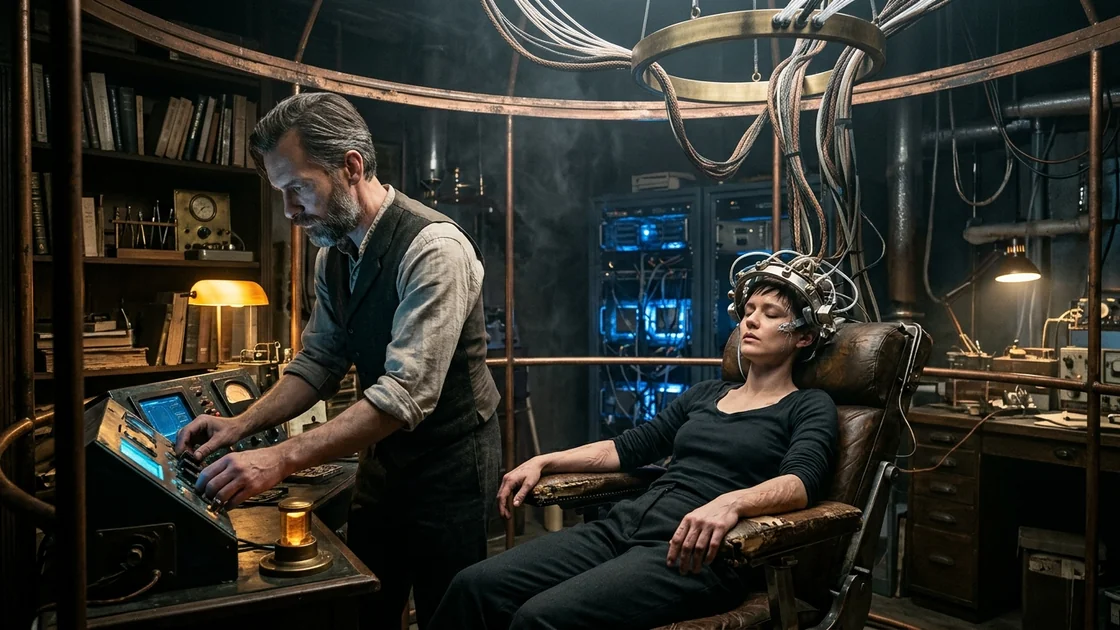
Julian Kael operates in the perpetual twilight of New Meridian, working as a unlicensed dream broker who extracts recurring nightmares from trauma survivors and pays them handsomely for the relief. While the city believes he recycles these dark neural recordings into cheap thrills for the underground market, Julian actually uses his skills as a former luxury dream designer to weaponize them. He wraps the raw, agonizing memories of victims inside gilded, deceptive interfaces and sells them as bespoke lucid fantasies to the wealthy, untouchable perpetrators who caused the suffering in the first place. When a half-mad industrial engineer named Elena comes to his clinic carrying the horrific sensory memory of a deliberate corporate disaster that boiled forty-two workers alive, Julian sets his sights on his most dangerous target yet. To deliver justice, he must infiltrate the cloud-piercing fortress of billionaire Anton Mercer, bypass a ruthless neural security audit, and lock a man who views human lives as numbers into the inescapable hell of his own making.
The rain in the Lower Wards never truly fell; it hung in the air like a fine, greasy mist of condensation and industrial runoff, clinging to wool coats and corroding the cheap chrome of streetlamps. Inside the parlor of the Quiet Room, however, the air was filtered to a crisp, scentless sterility, broken only by the faint ozone hum of the cooling racks in the back room.
Julian Kael adjusted the cuffs of his linen shirt and leaned over the porcelain sink, washing the conductive gel from his fingertips. The water ran pink for a second—a capillary had burst near his left temple during the last dive—before clearing to a steady, translucent stream. He looked up into the tarnished mirror above the basin. The face staring back was thirty-eight going on sixty, with hollow cheeks, dark crescents permanently bruised beneath slate-gray eyes, and a neat, silver-threaded beard that hid the faint scar of an old cortical port along his jawline.
In the adjoining room, Councilman Marcus Vance was waking up. Or rather, Councilman Marcus Vance was trying to wake up, and finding that his nervous system had forgotten the geometry of his own body.
Julian dried his hands on a linen towel, folded it into precise quarters, and stepped through the heavy velvet curtains into the synthesis suite. This wasn't his clinic in the slums; this was a rented showroom on the mid-tier levels of the Promenade, furnished with synth-mahogany panels, soft amber lighting, and a single, decadent reclining chair upholstered in calfskin.
Vance was thrashing against the soft leather restraints. They weren't meant to hold a prisoner; they were standard safety straps to keep high-paying clients from rolling off the couch during the kinetic peaks of an erotic or power-fantasy construct. Yet Vance was pulling against them with white-knuckled ferocity, his silk collar soaked through with sweat, his chest heaving in shallow, ragged gasps. Beneath the silver halo of the neural crown, the councilman’s eyelids fluttered wildly in the hyper-accelerated rhythm of a deep REM-lock.
Julian walked over to the diagnostic console. The holoscreen cast a cool blue glow across his impassive face.
On the surface layer of the monitor, the structural integrity of the dream spindle read as stable. Ninety minutes ago, Vance had paid Julian forty thousand sovereigns for an exclusive, un-watermarked spindle titled The Villa at Baiae. It had been advertised through three layers of encrypted brokers as an ancient Roman bacchanal—fourteen subjective hours of warm Mediterranean sun, crushed grapes, compliant flesh, and the intoxicating sensation of absolute imperial authority.
For the first six minutes of real-time, that was precisely what Vance’s parietal and occipital lobes had received. Julian had crafted the opening sequence himself, using stock luxury textures he had hoarded from his days at Aethelgard Oneirics. He had given the councilman the taste of honeyed wine and the warm salt breeze off the Tyrrhenian Sea. He had waited until the diagnostic telemetry showed Vance’s prefrontal cortex relaxing, surrendering its critical vigilance as the dopamine flooded his synapses.
Then, the splice had triggered.
The Mediterranean sun hadn't set; it had simply grown hotter, turning the sky the color of blistered paint. The marble pillars of the villa had blackened and shrunk into rotting pine joists. The smell of roasted boar and myrrh had curdled into the choking, acrid stench of melting PVC insulation and burning human hair.
Julian watched the biometric readout. Vance’s heart rate was holding steady at one hundred and forty beats per minute—dangerous for a man of sixty who lived on synth-brandy and marbled beef, so Julian tapped a key on the console, administering a micro-dose of beta-blockers through the chair’s intravenous line. He didn't want Vance having a coronary. Death was an exit. Death was a failure of architecture.
On the secondary monitor, the core engram was playing out its final, inexorable loop. The file name in Julian’s private directory was Ward7_Tenement_Milo_04.
Six months ago, a block of pre-collapse apartment buildings in the Seventh Ward had gone up in flames at three in the morning. The fire suppression systems had been remotely disabled two days prior by a shell company owned by Councilman Vance, who needed the lot cleared of its rent-controlled tenants so he could sell the land to a mag-lev freight consortium. Seventeen people had died in the blaze. The municipal inquest had ruled it an accidental electrical fault caused by illegal space heaters, and Vance had broken ground on the freight depot three weeks later, smiling for the news-drones with a golden shovel in his soft hands.
Milo had been nine years old. He had spent four hours trapped beneath a collapsed wardrobe in a third-floor bedroom while the ceiling burned six inches above his back, listening to his mother suffocate in the hallway outside, inhaling superheated soot until the firefighters finally broke through the exterior wall.
Milo had survived, physically. His lungs had been rebuilt with biosynthetic mesh at a charity ward, and his skin had been grafted with vat-grown dermis. But every time the boy closed his eyes for more than ten minutes, his brain dragged him back under that wardrobe. The human amygdala does not understand the concept of the past tense; to the limbic system, a sufficiently traumatic memory is not a story about what happened then, it is an emergency broadcast about what is happening now. Milo was burning alive every night, starving of sleep, his mind fracturing under the weight of an unending present.
Julian had found the boy through a free-clinic nurse who knew what Julian did, or at least half of what he did. Julian had brought Milo to the Quiet Room, placed the extraction crown on his small, shaved head, and spent six grueling hours teasing the nightmare out of the boy’s hippocampus like a surgeon removing shrapnel from a beating heart. He had given Milo’s aunt fifteen thousand sovereigns—enough to move them out of New Meridian to the agricultural domes in the south—and left the boy sleeping a dreamless, peaceful twelve-hour stretch for the first time in half a year.
Now, Councilman Vance was nine years old.
Because of the way Julian had braided the synaptic pathways, Vance did not have access to his own adult ego inside the construct. He didn't know he was a wealthy politician sitting in a leather chair on the Promenade. His proprioceptive map had been overwritten by Milo’s. He was three feet andeleven inches tall. His chest was crushed under three hundred pounds of charred oak. Every breath he drew felt like swallowing crushed glass and boiling oil. And through the crack beneath the bedroom door, he could hear a woman coughing her life out on the landing, calling a name that Vance’s hijacked brain recognized, with tearing, absolute love, as his own.
"Time," Julian murmured to the empty room, checking his pocket watch.
He reached over and slid the attenuation fader down to zero, disengaging the temporal dilator and sending a sharp, depolarizing pulse through the crown’s temporal electrodes.
Vance’s eyes snapped open.
He didn't scream—he didn't have the breath for it. He made a wet, rasping sound at the back of his throat, his hands flying up once Julian released the magnetic locks on the wrist straps, clawing at his own chest, tearing the pearl buttons from his silk shirt as if trying to shove a heavy weight off his ribs. He rolled sideways out of the chair, hitting the plush carpet on his knees, coughing spasmodically into the floorboards.
"M-mama," Vance choked out, his voice high and cracked, before his adult vocal cords asserted themselves and the word dissolved into a dry, retching sob. "The door—it’s hot, the brass is melting—"
Julian lifted the neural crown from the floor where it had fallen, wiping the contacts with an alcohol swab. He stood over the trembling politician, his posture polite, his expression that of a solicitous tailor waiting for a client to finish dressing.
"A profound experience, Councilman," Julian said softly. "The sensory fidelity on these un-watermarked imports is really quite extraordinary, isn't it?"
Vance blinked up at him from the carpet. His pupils were dilated to the edges of his irises, swallowing the pale blue of his eyes. Slowly, agonizingly, the architecture of his own identity was reassembling itself in his prefrontal cortex, colliding with the phantom residue of the boy’s terror. The confusion on his face curdled into a sick, grey horror as he recognized where the dream had taken him. He knew that hallway. He had seen the structural blueprints before he authorized the arson crew to cut the standpipes.
"You..." Vance wheezed, pressing a trembling hand to his throat, feeling for blisters that weren't there. "What did you... what was that? That wasn't Baiae. That was—"
"That was what you asked for, sir," Julian replied smoothly, sliding the diagnostic tablet into his leather satchel. "You told Sera you were bored with standard commercial lucidity. You wanted something raw. Something where you could truly feel the heat."
"I couldn't wake up," Vance whispered, tears leaking from the corners of his eyes, tracking through the sweat on his pudgy cheeks. "The fail-safe word... I tried to say the fail-safe word, and my mouth wouldn't work. I was small. I couldn't reach the latch. For hours, Kael. I was under there for hours."
"Forty-two minutes of real time, with an eight-to-one temporal compression ratio," Julian corrected gently. "Roughly five and a half hours subjective. Though I imagine the last hour felt somewhat longer, given the carbon monoxide saturation in the memory's sensory track."
Vance grabbed the edge of the reclining chair, hauling himself up until he was sitting slumped against the calfskin. He stared at Julian with a mixture of naked terror and rising, blustering rage. "You poisoned my rig. Who paid you? Was it Sterling? Was it the zoning committee? I'll have the Civic Guard strip your cortex down to the stem! I'll have you thrown in the vats!"
Julian paused with his hand on the brass latch of the showroom door. He turned back, offering the councilman a faint, clinical smile.
"And tell the Guard what, precisely?" Julian asked. "That you purchased an illegal, un-indexed black-market dream spindle in a back-alley showroom without a medical license? That if they subpoena the spindle—which I am leaving right there on the side table for you, by the way, at no extra charge—their forensic neuro-techs will discover it is a verbatim cortical recording of a survivor from the Seventh Ward fire? A fire that your holding company is still technically under federal audit for?"
Vance’s mouth opened, then closed. A tremor ran through his left cheek.
"Furthermore," Julian continued, his voice dropping an octave, losing its velvet merchant's veneer until it sounded like two flat stones grinding together, "I didn't simply play the recording for you, Marcus. I used a synaptic graft to map the boy’s trauma response directly onto your own thalamic relay. Every time you smell woodsmoke, every time you hear a siren, every time you fall into deep REM sleep without chemical suppression, your brain is going to reach for that memory as if it belongs to you. Because now, it does. You bought it. It’s yours."
Julian opened the door, letting the damp draft of the hallway spill into the perfumed room.
"Have a pleasant evening, Councilman. If you find you can't sleep, I hear there are several charity clinics in the Seventh Ward that prescribe sedatives. Though the waiting lists are terribly long."
He stepped out and pulled the door shut behind him, just as Vance began to weep in earnest.
The transit car down to the Lower Wards smelled of wet dog, cheap synthetic tobacco, and the metallic tang of ozone from the induction rails. Julian sat in the rear corner, his satchel clamped between his knees, watching the golden advertisements of the upper city disappear above the concrete retaining walls as the car plunged into the subterranean gloom of the Undercroft.
Up on the Promenade and higher still in the Spire, New Meridian was a monument to post-scarcity elegance—a forest of white aerogel towers catching the coastal sun, connected by glass skybridges where the air was heated and scented with artificial pine. Down here, beneath the tectonic plates of the city’s structural foundation, the sky was a ceiling of sweating riveted iron and weeping condensation pipes. Neon signs in four languages flickered over noodle stalls, pawnshops, and unlicensed cyber-clinics, their reflections bleeding across the flooded cobblestones.
Julian unlocked the heavy iron grate of number 44 Sunken Lane, stepped through the narrow vestibule, and bolted three separate physical deadbolts behind him. He didn't trust electronic locks; anything with a wireless receiver could be whispered open by a corporate splicer with a directional antenna.
This was the real Quiet Room. The front parlor was modest, lined with shelves of paper books—old neurology textbooks, manuals on pre-digital watchmaking, volumes of twentieth-century poetry—and smelled faintly of dried lavender and rubbing alcohol.
He walked behind the counter, unlocked the floor safe, and tossed Vance’s forty-thousand-sovereign bearer chip onto a stack of similar hexagonal disks. After deducting the fifteen thousand he had given Milo’s aunt, the three thousand he owed Sera Vane for brokering the introduction to Vance, and the rental fee for the Promenade showroom, he was still twenty thousand ahead. It was blood money, distilled from cruelty and fermented in greed, and he spent almost none of it on himself. His coat was four years old; his diet consisted largely of lentil stew and bitter black tea. The money sat in the dark, waiting to buy the next nightmare from someone who couldn't afford to carry it anymore.
He was just hanging his coat on the bentwood rack when the brass bell above the street door gave a single, hesitant jingle.
Julian froze, his hand slipping inside his waistcoat toward the compact flechette pistol holstered beneath his left arm. He was sure he had thrown the deadbolts. No—he looked toward the front door and realized he had locked the outer security grate, leaving the inner glass-paned door unlatched while a client was already sitting in the shadowed alcove behind the velvet privacy screen.
She had been there before he arrived. She must have let herself in with the spare key he left with Sister Mara at the St. Jude Hospice.
"I'm closed for the evening," Julian said, keeping his hand near his ribs as he stepped around the counter. "If Sister Mara sent you, I generally only take intake consultations on Tuesdays."
A figure shifted in the gloom behind the screen. When she stepped out into the yellow pool of the desk lamp, Julian’s fingers slowly relaxed, sliding away from the grip of the pistol.
She was a woman in her early thirties, though like Julian, she wore an exhaustion that made age a secondary characteristic. She was tall, dressed in a heavy canvas mechanic’s jacket with the unit patches ripped off the shoulders, leaving dark squares of un-faded fabric. Her hair was cropped unevenly near her ears, as if she had cut it herself with kitchen shears, and her left hand—resting on the back of a wooden chair for support—was a lattice of pale, puckered thermal scars that ran from her knuckles up disappeared beneath her frayed cuff.
What caught Julian’s eye, however, was the collar of her shirt. Around her neck hung a crude homemade harness holding a modified industrial taser node pressed directly against her carotid artery, wired to a biometric wristband on her scarred left arm.
Julian knew what that was. It was a dead-man's switch for sleepers. When the wristband detected the drop in heart rate and galvanic skin response that signaled the onset of Stage 3 sleep, it fired a forty-volt shock into the neck to jolt the wearer awake before REM could begin.
The skin beneath the node on her throat was raw, scabbed, and weeping clear fluid.
"You're Kael," she said. Her voice was like gravel sliding down a tin roof—hoarse, dehydrated, vibrating with the brittle hyper-vigilance of someone running on massive doses of amphetamines and terror. "Mara said you don't charge. She said you pay."
"Only if the merchandise is unique," Julian said, his tone softening into the quiet, unthreatening cadence he used with feral animals and shattered people. He gestured toward the upholstered armchair beside his desk. "And please, turn off the collar while you're in here. If you pass out in that chair, I give you my word I won't let you drop into REM without a cortical block in place."
The woman hesitated, her dark, sunken eyes darting toward the curtain that led to his surgical bay, then back to his face. With a trembling, scarred thumb, she flicked the toggle switch on her wristband. The tiny green LED on her neck died. Almost immediately, her knees buckled by an inch, as if the mere threat of electric shock was the only thing keeping her spine vertical. She sank into the chair, gripping the armrests.
"When did you last sleep?" Julian asked, moving to the small electric kettle in the corner.
"Four days ago," she whispered. "Twenty minutes on the floor of the washroom at the foundry. Before the collar batteries died and I went under. Before that... forty minutes in the clinic last week."
"And what are you taking to stay upright? Modafinil? Military-grade Synodril?"
"Stims from the dockyard crews," she said, staring at the worn Oriental rug between her boots. "Yellow-jackets. Crushed in water."
Julian winced inwardly. Dockyard methamphetamine was cut with industrial vasoconstrictors; it kept the body awake by starving the peripheral tissue of blood while frying the dopamine receptors in the basal ganglia. Another two weeks of that, and her heart would simply fibrillate and stop, or she would slip into permanent stimulant psychosis where the nightmare wouldn't need her to close her eyes to manifest.
He set a mug of steaming chamomile and glucose broth on the corner of the desk within her reach, though he knew she wouldn't touch it until she trusted him. He sat down opposite her, folding his hands on the blotter.
"What is your name?"
"Elena," she said. "Elena Rostova. I was a Senior Atmospheric Technician, Grade 4."
The past tense hung heavy in the quiet room. Julian tilted his head slightly. "For whom?"
Elena looked up. The look in her eyes wasn't sadness, and it wasn't just fear; it was a vast, hollowed-out abyss where a person used to live.
"Mercer Dynamics," she said. "Helios-Four."
Julian went very still. Outside, a heavy freight transport rumbled along the elevated tracks a hundred feet above the lane, making the water in the kettle vibrate in concentric rings.
Everyone in New Meridian knew the name Helios-Four. Two years ago, an orbital-tether atmospheric processing plant situated forty miles off the coast had suffered a catastrophic containment breach in its primary deuterium-cooling manifolds. Forty-two engineers and maintenance workers on the lower sub-levels had been killed instantly when the superheated heavy-water vapor flooded the compartments.
It had been a tragedy of the highest corporate order. Anton Mercer himself had appeared on every public holoscreen in the sector, dressed in mourning black, his silver hair impeccably groomed, announcing a ten-million-sovereign memorial fund for the families and blaming the disaster on a cascading software failure in the automated pressure-relief valves—valves manufactured by a defunct subcontractor in the Outer Rim. Mercer Dynamics’ stock had dipped for four days, then surged to record highs when the insurance payout funded the automated, crewless Helios-Five facility.
"The official manifest listed forty-two fatalities and zero survivors on Sub-Level C," Julian said carefully.
"Forty-two dead," Elena corrected, her scarred hand tightening on the velvet armrest until the wood groaned. "One left behind in the secondary exhaust scrubber conduit when the rescue tugs finally cut through the hull thirty-six hours later. Me. Mercer’s security team pulled me out before the municipal inspectors arrived. Put me in a private medical coma for three months while the scars healed, gave me two hundred thousand sovereigns in hush-scrip, and told me that if I ever spoke to a union rep or a journalist, they'd retroactively charge me with criminal negligence for the valve failure and let me rot in an orbital penitentiary."
She reached into her canvas jacket and pulled out a heavy, rectangular metal wafer—a high-capacity corporate payment bond—and dropped it onto Julian’s desk. It landed with a dull thud.
"I don't want your money," Elena said, her voice cracking for the first time. "You can have that. There's a hundred and eighty thousand left on it. Just take it out of my head, Kael. Please. Take it out, or give me something from your cabinet that will stop my heart before the sun comes up. I can't go back into that pipe."
Julian looked at the bond on his desk, then up at Elena’s ruined throat.
"Tell me what happened on Sub-Level C," he said softly. "Not for the extraction—the machine will read the sensory engram regardless. Tell me so I know where the edges of the room are before I go in with you."
Elena closed her eyes for a fraction of a second, flinched violently as if the darkness behind her eyelids had teeth, and snapped them open again.
"There was no software failure," she whispered, staring fixedly at the brass lamp on the desk. "We were running an unscheduled purge on the primary catalyst beds because Mercer wanted to increase output by twelve percent before the quarterly shareholder summit. The pressure in the main torus spiked. If the torus ruptured, it would have slagged the orbital tether anchor—eight billion sovereigns of hardware."
She swallowed hard, her throat clicking.
"The relief valves didn't fail, Kael. They were manually overridden from the Spire. I was in the sub-station monitor booth with the comms open. I heard the override code come down the laser-link from Mercer’s personal terminal on the hundredth floor. Authorization Alpha-Zero-Mercer. He had two choices: vent the superheated coolant into the ocean and let the torus warp from thermal shock, or vent the steam directly into the occupied maintenance bays on Sub-Level C to use the structural bulkheads as a heat sink."
Julian felt a cold, familiar stillness settle into the pit of his stomach. "He used the crew compartments as a radiator."
"He locked the blast doors from his desk fifty miles away while he was probably eating his lunch," Elena said, a single tear finally spilling over her lower lashes, cutting a clean track through the grime on her cheek. "We had ninety seconds from the klaxon to the purge. Forty-three of us pounding on twelve-inch titanium doors while the intercom played the automated safety message. I was small enough to crawl up into the six-inch inspection hatch for the exhaust scrubber. I pulled the hatch mostly shut, just a quarter-inch gap because the dog-latch was jammed with rust. And then the vents opened."
She stopped. Her breathing was coming fast and shallow now, the panic rising like black water.
"You don't have to say the rest," Julian said, standing up and picking up the corporate bond. He walked around the desk and slid the metal wafer back into the pocket of her canvas jacket. "Keep your money, Elena. You're going to need it when you wake up."
"You'll do it?" she breathed, looking up at him with desperate, terrified hope. "You'll cut it out?"
"I don't cut," Julian said, pulling back the heavy velvet curtain that separated the parlor from the surgical suite. "Cutting leaves scar tissue, and scar tissue in the hippocampus causes retrograde amnesia—you'd lose your childhood, your trade, your mother's face. I don't use a scalpel. I use the Loom."
He gestured her inside.
The back room of the Quiet Room looked less like an operating theater and more like the cabin of an ancient submarine crossed with a cathedral organ loft. Two tandem chairs sat facing each other in the center of a copper-mesh Faraday cage, connected by thick bundles of braided fiber-optic cables that rose to a suspended brass ring overhead. Along the walls, racks of liquid-cooled quantum processors hummed in a bath of luminescent blue fluorocarbon.
"How does it work?" Elena asked as Julian helped her out of her heavy jacket and guided her into the patient’s chair. She was shivering violently now that the adrenaline of her pitch was fading, her body screaming for the sleep she had denied it for ninety-six hours.
"A traumatic memory is different from a normal memory," Julian explained, his hands deft and impersonal as he parted her cropped hair and began applying conductive silver paste to her scalp at twelve precise cranial landmarks. "Normal memories are filed away in the neocortex—indexed by time, stripped of their immediate sensory sting, turned into narrative. A nightmare like yours is trapped in a feedback loop between the amygdala and the sensory cortex. It has too much voltage. Every time your brain tries to process it during REM sleep to file it away, the emotional charge trips the circuit breaker, waking you up in terror and reinforcing the synaptic pathway. The groove gets deeper every night."
He lowered the primary extraction crown over her head, securing the chin strap with a gentle click.
"What the Loom does," Julian continued, moving to the main console to calibrate the impedance levels, "is induce a targeted, hyper-plastic state using transcranial magnetic resonance and a synthetic neuro-peptide called Lethe-9. While your brain is in that state, it replays the memory one final time. As the synapses fire to reconstruct the nightmare, my rig intercepts the electrical and chemical pattern, copies the entire multi-sensory engram onto a blank crystal spindle, and simultaneously floods those specific firing pathways in your brain with a protein inhibitor."
Elena watched him through half-lidded eyes. "A protein inhibitor?"
"When you recall a memory, you actually unlock it and rebuild it from scratch before saving it again—neurologists call it reconsolidation," Julian said, sitting down in the opposite chair and lowering the secondary headset over his own temples. "If I block the protein synthesis while the memory is unlocked and pouring into my spindle, the memory simply fails to re-save. When you wake up, you will still know, intellectually, that you were on Helios-Four. You will know that forty-two of your friends died, and you will know that Anton Mercer killed them. The narrative facts in your neocortex won't be touched. But the sensory recording—the heat, the sound, the smell, the terror—will be gone. It will be sitting in this crystal cylinder instead of your skull."
"And why are you wearing a crown?" she slurred, the pre-sedative mist beginning to hiss from the respirator mask Julian held near her face.
"Because the Loom is a blind machine," Julian said quietly. "It can't tell the difference between the nightmare and the adjacent memories of your life. Somebody has to go in there with you to hold the lantern and trace the edges of the rot, or the machine will take too much. Close your eyes, Elena. Count backward from ten. You only have to survive it one more time. And this time, you aren't alone in the pipe."
She didn't make it to seven. Her eyelids dropped, her scarred hand went limp on the armrest, and on the monitor between them, her brainwaves plunged like a stone dropped down an elevator shaft, bypassing light sleep entirely as seven days of REM-rebound hit her cortex all at once.
Julian took a deep breath, tasted the copper tang of his own worn-out synapses, and threw the engagement switch on his armrest.
The Quiet Room vanished.
There was no transition, no gentle fade to black. Julian slammed into the memory like a diver hitting concrete.
The first thing that hit him was the pressure—not physical weight, but the suffocating, absolute claustrophobia of twenty-two inches of curved corrugated steel pressed against his spine, his knees, his forehead. He was folded in half like a corpse in a burial urn, wedged inside an overhead exhaust duct that smelled of old grease, ozone, and his own cold sweat.
Stay detached, Julian’s training whispered as the Loom’s HUD flickered to life across his visual field, rendering the edges of the memory in faint wireframe grids of emerald green. You are the observer. Keep your ego-boundary intact.
It was almost impossible. The raw affective voltage coming off Elena’s amygdala was a Category 5 hurricane of panic. Julian felt her heartbeat in his own throat—two hundred beats a minute, a trapped bird battering its wings to pulp against an iron cage.
Below him, through the quarter-inch gap of the rusted inspection hatch that wouldn't close, a slice of harsh orange emergency light cut upward into the dark of the pipe.
And then came the sound.
Down on the deck of Sub-Level C, forty-two people were screaming. It wasn't the theatrical screaming of a cinema; it was a chaotic, overlapping wall of human voices cracking with disbelief and animal terror.
"The bulkhead's dogged from the outside! Control, open Hatch Four, we're still in here!" "Tom, help me with the crowbar, the manual release is sheared—" "Oh God, look at the pressure gauge on the manifold, it's past the red, it's going to—"
Julian worked furiously inside the construct, his spectral hands moving through the wireframe architecture of the dream, planting neural anchors around the perimeter of the sensory data. He had to isolate the auditory track, tag the olfactory channels, map the exact frequency of the dread so the Loom could siphon it clean.
Then, with a sound like a mountain splitting in half, the overhead vents blew open.
What followed was not fire; it was worse than fire. A white, roaring wall of superheated heavy-water vapor at four hundred degrees Celsius filled the compartment below in less than three seconds.
The screams didn't stop all at once. They changed pitch. They turned wet, ragged, and impossibly loud as the steam hit lungs and skin, before the pressure wave slammed the inspection hatch upward against its rusted latch, sealing the gap almost shut—almost, except for a thin, hissing ribbon of scalding white vapor that jetted straight through the seam and across Elena’s left hand and forearm.
Julian bit down hard on his own tongue in the real world as the phantom pain of third-degree thermal burns ripped up his left arm. The Loom recorded the spike: Nociceptive input, 9.8 on the Dol scale, C-fiber saturation.
And then, after three minutes that felt like three centuries, the roaring stopped. The screaming stopped.
What remained was the true heart of the nightmare. Not the three minutes of the purge, which any thriller-junkie in the Undercroft might recognize as action, as drama. No—the horror that was killing Elena Rostova was the thirty-six hours that came after.
Total, lightless, absolute pitch black.
The air inside the duct was fifty degrees Celsius, thick with the sweet, nauseating stench of boiled meat and trace deuterium oxide—a slow neurotoxin that caused auditory hallucinations and creeping paralysis. She couldn't move an inch to her left or right; her blistered left hand was fused to the hot metal of the pipe by her own melted sleeve. Below her, four feet away on the other side of a quarter-inch of steel, forty-two people she had eaten breakfast with were cooling in the dark, and as the metal of the hull contracted in the deep ocean chill outside, the deck plates groaned and popped with sounds that sounded exactly like footsteps. Like burned fingers scratching at the underside of the hatch, asking why she hadn't made room for them in the pipe.
Julian stayed with her in that dark for four hours of real time, compressing thirty-six hours of subjective hell into the crystalline lattice of the spindle. He held the neural boundaries steady while the protein inhibitors washed through her firing synapses, erasing the scorching heat from her somatosensory cortex, scrubbing the smell of the steam from her olfactory bulb, quietening the scratching ghosts beneath the hatch until the emerald wireframe of the memory turned pale, translucent, and finally dissolved into warm, featureless grey mist.
When the console chimed the completion of the transfer, Julian tore the headset off his skull and leaned over the side of his chair, dry-heaving onto the copper floor mesh.
His left arm was shaking so badly he couldn't lift it; his brain was still convinced the skin from his wrist to his elbow had been boiled off, even though the pale flesh beneath his rolled-up linen sleeve was untouched.
Across from him, Elena Rostova didn't move. Her breathing had slowed to twelve deep, rhythmic cycles per minute. On the monitor, her brainwaves showed the slow, rolling delta waves of Stage 4 restorative sleep—no spikes, no jagged bursts of cortisol, no frantic REM thrashing. Her face, slack against the leather headrest, looked ten years younger.
Julian sat on the floor for a long time, resting his damp forehead against the cool metal of the equipment rack, watching the crystal spindle glow with a trapped, malevolent amber light inside the write-bay.
Usually, when he pulled a nightmare of this magnitude—a Category 4 or 5 trauma—he had to trim the edges before he packaged it for a perpetrator. The human brain, if subjected to thirty-six subjective hours of unmitigated sensory torture in a single dive, risked neurogenic shock or permanent catatonia. He was a broker of justice, not an executioner; he wanted men like Councilman Vance awake, walking around the city, carrying the ghosts of their victims inside their skulls for the rest of their natural lives.
He reached up, popped the warm crystal cylinder from the bay, and held it up to the blue light of the cooling tanks. Forty-two dead. Eight billion sovereigns of hardware saved. A two-hundred-thousand-sovereign bribe and a threat of prison to the sole survivor.
"No trimming," Julian whispered to the quiet room. "Not one second."
For the next three days, while Elena slept on the cot in his recovery alcove—waking only twice to drink broth, stare in stunned, weeping wonder at the silence inside her own head, and fall back asleep—Julian became an artist again.
Before he had faked his own death during the corporate purges of '84 and vanished into the Undercroft, Julian Kael had been the Principal Oneiric Architect at Aethelgard. He had designed playgrounds for the gods of New Meridian. He knew how the wealthy dreamed, and more importantly, he knew why they couldn't dream on their own anymore.
Power was an anesthetic. When a man like Anton Mercer could purchase any physical sensation, ruin any rival with a keystroke, and live in a climate-controlled sanctuary two miles above the smog, his dopamine receptors grew calloused. Normal sleep offered nothing. Standard commercial lucid dreams—flying over crystal oceans, bedding synthetic goddesses, slaying dragons—felt like cheap cardboard theater to a mind accustomed to owning the real world. To feel anything at all, the hyper-elite needed extreme proprioceptive novelty. They needed to transcend the human form entirely.
Julian sat at his editing console, wearing a pair of jeweler’s loupes linked to his optic nerve, manipulating the raw, jagged waveform of Elena’s nightmare with a haptic stylus.
If he simply handed this spindle to Mercer’s people, their security scanners would flag it in half a millisecond. Every high-end dream rig had an affective pre-screener—a diagnostic algorithm that read the emotional metadata of a spindle before dive-initiation to check for corrupted code, rogue malware, or traumatic spikes that could damage the user's nervous system. Elena’s engram looked like a seismograph during an earthquake: massive, jagged mountains of terror, claustrophobia, and extreme thermal pain.
You couldn't hide a mountain by painting it green. You had to convince the scanner that the mountain was supposed to be there—that the terror was actually awe, that the crushing claustrophobia was the sensation of infinite cosmic density, and that the boiling heat was the rapture of solar fusion.
Julian called the technique chromatic inversion.
Working sixteen hours a day, fueled by black tea and cold focus, he built a wrapper around the Helios-Four recording. He didn't alter the core sensory tracks—if he touched the original synaptic recording, it would lose the undeniable, terrifying authenticity that only a real human memory possessed. Instead, he built an interpretive buffer layer that sat over the spindle like a stained-glass window over a furnace.
He titled the piece Apotheosis: The Corona Dive.
When a diagnostic scanner—or a user during the first ten minutes of the dive—interfaced with the spindle, the buffer layer translated the data streams into the ultimate megalomaniacal fantasy. The user would not begin as a human being; they would begin as a celestial entity of pure gravitational force, descending from the freezing vacuum of deep space into the heart of a dying blue supergiant star.
The crushing claustrophobia of the twenty-two-inch exhaust pipe? The scanner would read that proprioceptive compression as the exhilarating, godlike sensation of ten billion tons of stellar plasma pressing against an indestructible body—the birth of a neutron star.
The four-hundred-degree thermal spike of the heavy-water purge? Translated by the outer shell as the ecstatic ignition of a supernova, a baptism of pure, harmless solar fire.
The screaming of the forty-two workers? Phase-shifted by a simple harmonic filter on the outer layer so that, to an external diagnostic sweep, the audio track registered as the deep, resonant choir of planetary magnetospheres—the literal music of the spheres.
It was a masterpiece of cryptographic forgery. An external auditor could run the spindle through a military-grade heuristic emulator, and all they would see was a ninety-minute, hyper-avant-garde lucid masterpiece designed for a man who wanted to feel like a god birthing a universe.
Except for the key.
Buried deep in the sub-thalamic handshake protocol—the piece of code that only executed once the user was physically connected, once their prefrontal cortex was suppressed in deep REM and the temporal dilator was locked at maximum compression—Julian planted a twenty-line logic bomb.
The bomb didn't add anything to the dream. It simply deleted the buffer layer from the inside.
The stained glass would shatter. The harmonic filter would drop. The ego-shield that told the dreamer I am an immortal star would dissolve, leaving the naked, unshielded consciousness of Anton Mercer fused directly to the biological neural map of Elena Rostova at the exact moment the vents blew open. And because Julian had removed the wake-up interrupt from the spindle's firmware, the rig wouldn't recognize Mercer’s subsequent limbic panic as an error; it would read his screaming vital signs as the expected peak of the Apotheosis experience and keep him locked under for the full thirty-six subjective hours.
On the fourth evening, Elena walked out of the surgical bay.
She was wearing a clean flannel shirt of Julian’s that hung past her hips and her old canvas trousers. The grey, corpse-like pallor was gone from her skin, replaced by the pale but living flush of someone whose blood was finally carrying oxygen instead of dockyard speed. The raw scab on her neck where the taser collar had sat was already healing.
She stood beside the editing console, looking down at the glowing crystal cylinder resting in the velvet-lined presentation case.
"Is that it?" she asked. Her voice was no longer gravel; it was a clear, steady alto.
"That's it," Julian said, snapping the silver clasps of the case shut.
Elena reached up and touched her temple, right where the silver paste had been. Her brow furrowed slightly, like someone trying to remember a word on the tip of their tongue.
"I tried to look at it this morning," she said quietly. "When I woke up. I was terrified to even think the word Helios, because usually just the word is enough to make my chest lock up. So I forced myself to remember."
Julian watched her carefully. "And?"
"I remember crawling into the pipe," she said, staring at the closed case. "I remember the names of every person on my shift. I remember Marcus Chen giving me half his orange at break. I know they died beneath me, and I know I was in there for a day and a half before the cutters broke through. When I think about them, I feel... grief. Just quiet, heavy grief, like thinking about my grandfather's funeral. My hands don't shake. I can't smell the steam anymore, Julian. Where did the smell go?"
"Right here," Julian said, tapping the leather case.
Elena looked from the case to his eyes. She wasn't a child like Milo, and she wasn't naive. She had seen the stacks of high-denomination bearer chips in his safe when he opened it to give her travel money, and she had watched him spend seventy-two hours weaving gold thread around her personal hell instead of smashing the crystal with a hammer.
"You aren't destroying it," she said. It wasn't a question.
"No," Julian said. "The data density on a genuine survival engram is irreplaceable. There is a very small, very wealthy clientele in the Spire who pay fortunes for intensities they can't get from synthetic constructs."
Elena studied his face for a long moment—the hollow cheeks, the old corporate scar along his jaw, the way his left hand still occasionally twitched as if remembering a burn it had never suffered.
"Mercer collects rare spindles," she said softly. "It was company gossip even down on the rigs. He has a private vault on the hundredth floor. He doesn't trust commercial houses because he's afraid of industrial espionage while he's under. He only buys one-of-a-kind pieces from private estates."
Julian didn't confirm or deny it. He reached into his coat pocket and handed her a forged transit pass and a bearer chip for fifty thousand sovereigns—Mercer would be paying him five times that by tomorrow night, if Julian survived the audition.
"The night train to the Southern Agrarian Domes leaves from Platform 9 at midnight," Julian said. "Use your own bond once you cross the border into the Free Cantons—Mercer’s flags won't trigger their banking net there. Buy a repair shop. Fix tractors. Stay away from pressurized pipes, and stay away from the coast."
Elena took the chip, her scarred left hand brushing his fingers. She held onto his hand for a second longer than necessary.
"If it goes to him," she whispered, her dark eyes fierce and clear, "make sure the latch on the hatch is jammed with rust."
"I never alter the primary geometry," Julian replied evenly. "Have a safe trip, Elena."
The Velvet Glade occupied the entirety of the sixty-fourth floor of the Olympus Tower, suspended high enough above the Undercroft that the rain below looked like nothing more than a silver velvet carpet rolled out beneath the clouds. Inside, the club was a biosphere of genetically modified bioluminescent orchids that pulsed in slow, hypnotic waves of violet and teal in time with the ambient cello music drifting through the mist.
Julian sat in a private booth carved from the trunk of a petrified sequoia, nursing a glass of sparkling water with lime. He wore his one surviving suit from his previous life—charcoal spider-silk that didn't wrinkle, cut in the severe, collarless style of the high guilds.
Sera Vane slid into the booth across from him without making a sound. She looked like a porcelain doll designed by a weapons manufacturer: alabaster skin, eyes replaced with multifaceted obsidian lenses that zoomed with a faint mechanical purr, and a gown of woven fiber-optic thread that shifted color to match the orchids behind her.
"You look terrible, darling," Sera said, signaling a floating service drone with a flick of two manicured fingers. "Like a priest who’s been sleeping in a crypt. Tell me you didn't dive raw into whatever is inside that box."
"I always audit my own inventory, Sera," Julian said, resting his hand on the leather case between them. "Did Corvus take the bait?"
"Corvus doesn't take bait; Corvus bites the hook, the line, and the fisherman's arm off at the elbow to see if the meat is poisoned," Sera said, accepting a flute of pink synthetic champagne from the drone. Her obsidian eyes whirred as they focused on Julian’s face. "Anton Mercer isn't Councilman Vance, Julian. Vance is a pig in a silk waistcoat who buys black-market spindles to get his rocks off on Tuesday nights. Mercer hasn't left the top five floors of the Mercer Dynamics Spire in fourteen months. He has three former Directorate intelligence officers on his personal detail, and his in-house neural physician is Dr. Aris Thorne."
Julian’s fingers tightened imperceptibly on his glass. "Thorne is with Mercer now?"
"Bought him out of Aethelgard six months after you supposedly jumped off the North Sea seawall," Sera said, taking a slow sip of her champagne. "Which brings me to my point. Thorne knew your work when you were Julian Vane, Chief Architect. He knows your brushstroke. If you walk into the Spire tomorrow, or if Thorne looks closely at the synaptic weave on that spindle, are we both going to end up dissolved in a vat of industrial reclamation acid?"
"I won't be walking in as Julian Vane," Julian said calmly. "I am Lukas Brandt, estate liquidator for the late Baron vonesser of the Zurich Enclave. And as for Thorne... Aris was always a brilliant diagnostician, Sera, and an utter mediocrity as an artist. He looks at metadata and code structure. I built the outer shell of this spindle using Aethelgard’s old legacy compiler—the one Thorne himself wrote ten years ago. When he scans it, he won't see my signature. He'll see his own."
Sera stared at him over the rim of her glass, a slow, predatory smile curving her painted lips. "You really are a cold bastard, Julian. I always wondered what you did with the dark spindles you pull out of those charity cases down in the muck. I figured you were wiping the crystals and reusing the hardware."
"Hardware is cheap," Julian said. "Justice is expensive."
"It's not justice, darling, it's revenge by proxy, and it's going to get you killed one day," Sera said lightly, setting her glass down and sliding a heavy platinum pass-key across the petrified wood table. "Two o'clock tomorrow afternoon. Pad 4 on the ninety-eighth floor of the Mercer Spire. The price agreed upon is four hundred thousand sovereigns—half on passing Thorne’s diagnostic scan, half when Mercer wakes up satisfied. Which poses a rather delicate logistical problem for you, doesn't it?"
"How so?"
"Mercer never dives alone anymore," Sera said, her obsidian lenses narrowing. "Since the assassination attempt on the Ceres Chairman last year using a seized neural rig, Mercer’s protocol is absolute. The broker stays in the sanctuary while the client is under. If Mercer’s vitals flatline, or if he wakes up displeased, Corvus puts a heavy-caliber slug through the broker's brainstem before the crown even comes off."
Julian looked down at the platinum pass-key. He had anticipated a rigorous scan by Thorne; he hadn't anticipated being held as a biological hostage for the duration of the dive.
Forty-two minutes, he calculated silently. With the temporal dilator set to fifty-to-one—the maximum the Spire’s military-grade rig could handle—thirty-six hours of Elena’s nightmare would take forty-three minutes and twelve seconds of real time. For the first six minutes, while Mercer descended through the fake golden corona of the Apotheosis wrapper, his vitals would read as normal lucid euphoria.
At minute six, the logic bomb would strip the buffer.
At minute six and ten seconds, Mercer’s heart rate, blood pressure, and adrenal output would skyrocket into total sympathetic nervous system terror as the vents on Sub-Level C blew open. Thorne would see the spike on the monitors immediately.
"Julian?" Sera’s voice dropped its affectation, becoming sharp and quiet. "Leave the box here. I'll tell Corvus the courier got picked up by Customs at the orbital port. We walk away. You've already helped the girl."
Julian thought of the forty-two names Elena had whispered while the Lethe-9 was taking hold. He thought of the rust on the hatch, and the sound of cooling metal in the dark, and Anton Mercer sitting at a mahogany desk fifty miles away, keying in Authorization Alpha-Zero-Mercer while his lunch stayed warm.
If Julian walked away now, Elena was cured, yes. Until the next time Mercer decided a maintenance crew was cheaper than a radiator. Monsters didn't stop eating people because you bandaged the ones they dropped; they only stopped when you broke their teeth.
"Tell Corvus that Herr Brandt will be punctual," Julian said, picking up the platinum key and slipping it into his breast pocket. "And Sera? Take your twenty percent out of the initial diagnostic half as soon as Thorne clears the transfer. Transfer it to an offshore ring and leave the city for the weekend."
Sera looked at him for a long time, the violet light of the orchids reflecting in the black glass of her eyes. "I liked you better when you just built castles in the clouds, Julian."
"Those castles were built on pipes like Helios-Four," Julian said, standing up and buttoning his jacket. "I just finally went down to inspect the foundation."
At two miles above sea level, the sky outside the Mercer Dynamics Spire wasn't blue; it was the deep, bruised indigo of the stratosphere. Below the floor-to-ceiling diamond-pane windows, the cloud layer stretched from horizon to horizon like an unbroken snowfield, blindingly white in the afternoon sun, completely sealing off the grey, rotting reality of New Meridian beneath it.
Julian stood in the center of Anton Mercer’s private atrium on the hundredth floor, his hands resting calmly on the silver handle of his cane—a prop he had added that morning, along with a pair of thick, gold-rimmed prosthetic spectacles that slightly altered the geometry of his cheekbones through micro-tension pads and masked his iris patterns from security cameras. His beard was dyed a harsh, Teutonic black, and he held his left shoulder slightly hunched, mimicking the posture of an aging Swiss archivist.
Two yards behind him stood Corvus. Mercer’s head of security didn't look like a street thug; he looked like a monastic executioner. He was six feet four inches of vat-grown muscle encased in a charcoal turtleneck, his skull completely hairless and crisscrossed with the silver sub-dermal tracers of military reflex-boosters. He had already scanned Julian with a millimeter-wave wand at the elevator, confiscating nothing because Julian carried nothing but the spindle case and a solid hickory cane with a brass ferrule.
At the far end of the atrium, beside an indoor reflecting pool stocked with ghost-white koi, stood the Somnarium.
It was a custom-built Aethelgard Mark IX cradle, suspended inside three concentric gyroscopic rings of brushed titanium that rotated silently to simulate zero-gravity during flight constructs. Sitting at the diagnostic console beside the cradle was Dr. Aris Thorne.
Thorne hadn't changed in six years. He was still a thin, bird-like man with nervous hands, wearing a white lab coat with the collar turned up, squinting through a neural monocle as he ran Julian’s crystal spindle through the pre-screening array.
Julian kept his breathing slow and shallow—sixty beats per minute, zero galvanic skin response—even as he watched his former colleague dissect his forgery ten feet away.
"The structural lattice is extraordinary," Thorne murmured, his fingers dancing across the holographic waveform floating above the console. Above the glass, a miniature rendering of the Apotheosis wrapper was playing: a blinding, majestic sphere of blue solar fire, accompanied by the low, thrumming harmonic chord of the masked audio track. "Look at the proprioceptive density in the second movement. There’s none of the usual procedural repetition you get from algorithmic rendering. How did vonesser’s architect compile the thermal mapping? The C-fiber excitation curves are completely organic, yet the pain-gate is locked at zero."
"The Baron hired a private team from the Geneva Institute before his stroke," Julian said, pitching his voice into the dry, nasal baritone of a Zurich bureaucrat. "They used a composite recording from three high-altitude free-fall jumpers and a deep-mantle thermal probe, braided over a legacy Aethelgard kernel. You may recognize the compiler architecture, Doctor. I believe it is an early version of your own Ariadne suite."
Thorne blinked, his vanity instantly snagged, just as Julian knew it would be. The doctor zoomed in on the header code of the outer shell, a flush of pleased recognition coloring his pale cheeks.
"Good God, it is," Thorne breathed. "Ariadne 4.2. Look at the way the thalamic handshake is nested—nobody at the firm after '85 knew how to balance the feedback loops like this without using automated dampeners. Corvus, tell Mr. Mercer the spindle is clean. More than clean—it's museum-grade."
A hidden door in the travertine marble wall slid open behind the reflecting pool.
Anton Mercer did not walk like a man of sixty-five; he walked like a man whose organs had been replaced one by one with bespoke clones whenever they showed a five-percent drop in efficiency. He wore a loose kimono of un-dyed raw silk over linen trousers, his silver hair swept back from a high, smooth forehead. His eyes were a pale, watery amber, holding the mild, detached curiosity of an entomologist looking at a beetle pinned to a corkboard.
"Herr Brandt," Mercer said. His voice was surprisingly gentle, cultured, carrying the faint mid-Atlantic cadence of the orbital boarding schools. "Aris tells me the late Baron kept the best piece of his collection out of the Sotheby's auction."
"The Baron was a man of specific tastes, Herr Mercer," Julian said, offering a stiff, slight bow over his cane. "The auction houses have grown timid since the regulatory tightening. They balk at anything that pushes temporal compression past ten-to-one, or anything that dissolves the human body-map entirely. They call it dissociative hazard. The Baron called it transcendence."
Mercer walked slowly around the reflecting pool, stopping three feet from Julian. Up close, Julian could smell the faint scent of sandalwood and ozone that clung to him. This was the man. Those clean, manicured hands tucked into the silk sleeves had typed Alpha-Zero-Mercer while forty-two people pounded on titanium doors in the dark. There was no guilt around his eyes. There was no tremor in his jaw. Why would there be? To a god on the hundredth floor, people in the sub-basement weren't people; they were friction in a spreadsheet.
"They are cowards," Mercer said softly, looking past Julian toward the glowing blue hologram of the star above Thorne’s console. "Every dream broker who comes up that elevator brings me variations on the same pathetic mortal appetites. Castles. Women. Battles where the blood looks like paint. I own four hundred companies, Herr Brandt. I can buy a castle before dinner and have it demolished by breakfast. Do you know what I cannot buy?"
"Perspective, sir," Julian said quietly.
"Scale," Mercer corrected, a rare, thin smile touching his lips. "To cease being an organism altogether. To be a force of physics. Aris, what is the maximum safe compression on this lattice?"
Thorne glanced at the telemetry. "The Baron’s team built the spindle with an unusually rigid temporal spine, sir. Normally I wouldn't recommend taking a non-synthetic weave past twelve-to-one, because the sensory data degrades into static. But the resolution on this recording is so dense... you could push the Mark IX to forty-to-one, even fifty-to-one, without losing a single frame of fidelity. Forty minutes in the chair would give you roughly thirty-six subjective hours inside the star's core."
"Thirty-six hours," Mercer murmured, savoring the number. He didn't even recognize it. Thirty-six hours was the exact duration of the rescue operation on Helios-Four before they cut Elena out of the hull, a number that had appeared in a hundred pages of his own company's suppressed internal briefings, and it meant nothing to him at all. "Set the dilator to fifty-to-one, Aris. Disengage the verbal wake-interrupt; I don't want a stray vocalization during the ego-dissolution phase pulling me out early."
Thorne hesitated for a fraction of a second, his professional caution flaring. "Sir, without the verbal interrupt, the only way out before the spindle finishes its cycle is a manual depolarizing pulse from my console."
"Which is why I pay you a very large retainer to sit in that chair and watch my vitals, Aris," Mercer said, already untying his silk robe and stepping up onto the platform of the gyroscopic cradle. "Transfer the first half of Herr Brandt’s fee. Herr Brandt, please take a seat by the pool. Corvus will get you some tea. When I return, we will discuss what else the Baron left in his vault."
Julian inclined his head, walked calmly over to a low travertine bench beside the koi pond, and sat down, resting both hands on the head of his cane. In his breast pocket, his encrypted ledger-chip gave a single silent vibration as two hundred thousand sovereigns cleared into his blind Zurich account, automatically routing forty thousand to Sera before bouncing the rest into three charity trusts in the Southern Cantons.
Mercer lay back in the leather cradle. Thorne lowered the gleaming gold neural crown over his silver hair, securing the temporal induction pads.
"Initiating thalamic handshake," Thorne announced, sliding the main fader up. "Engaging temporal dilator at fifty-to-one. Dive commencing in three... two... one."
The three concentric titanium rings began to spin, rising on magnetic bearings until Mercer was suspended ten feet in the air inside a whispering sphere of spinning metal.
Julian looked at the antique mechanical watch on his wrist. 2:14 PM.
He had six minutes before the shell cracked.
"You don't want tea," Corvus said from six feet to Julian’s left. It wasn't a question. The security chief was leaning against a marble pillar, his arms crossed, his cold grey eyes fixed on Julian’s profile.
"My stomach is delicate at high altitudes," Julian replied in his clipped Swiss accent, watching the white koi drift beneath the lily pads.
Across the room, Thorne was watching the biometric bank. "Cortical sync at ninety-eight percent," the doctor reported to the quiet room, mostly to himself. "Prefrontal activity dropping... ego-dissolution nominal. He's in the descent phase. Dopamine and serotonin markers are elevated. Remarkable. The brain is accepting the non-human proprioceptive map without a hint of vestibular nausea."
Inside the spinning rings, Anton Mercer’s face was serene, almost beatific.
Julian knew exactly what Mercer was seeing right now. He was floating in a silent, velvet cosmos, looking down at a boiling ocean of sapphire and gold fire. He felt ten thousand miles wide. He felt immortal, weightless, untouchable, descending slowly into the heart of creation while a choir of planetary frequencies sang his name.
Two minutes.
Julian shifted his grip on his hickory cane, his thumb finding the microscopic seam just below the silver collar.
Four minutes.
"Entering the corona layer," Thorne murmured, adjusting his monocle. "The thermal translation is kicking in now. Heart rate up slightly to eighty-five... respiration deep. He's completely submerged in the construct. The temporal lock is solid."
Five minutes and thirty seconds.
Julian stood up slowly from the bench, wincing slightly as if his arthritic knee had stiffened, and walked three paces toward the floor-to-ceiling glass window looking out over the sea of clouds, angling his path so that it brought him within four paces of the back of Thorne’s console—and placed the diagnostic bank directly between himself and Corvus.
"Stay by the bench, Brandt," Corvus said instantly, pushing off the pillar.
"Forgive me," Julian said, pausing and gesturing with his cane toward the horizon. "In Zurich, we have the Alps, yet one rarely sees a cloud shelf quite so—"
Six minutes.
Deep inside the quantum lattice of the spindle, the logic bomb hit the end of its countdown.
On Thorne’s console, the holographic projection of the blue supergiant star didn't flicker; it vanished. In its place, the wireframe diagnostic window turned the color of dried blood as the buffer layer deleted itself from the active memory registers.
Inside Anton Mercer’s head, the sapphire fire went black.
The ten-thousand-mile cosmos collapsed inward at the speed of light, slamming down until it was twenty-two inches of rusted, grease-smeared corrugated steel pressed against his face, his spine, his shins. The music of the spheres tore apart into the deafening, terrifying shriek of a klaxon and forty-two human voices screaming in a cramped metal box below him.
Mercer’s brain tried to reach for his name, his money, his Spire, his silk robe—and found nothing. The synaptic graft held him pinned inside the somatic map of a five-foot-four atmospheric technician wedged in an overhead exhaust pipe. He didn't know why he was in the pipe, only that he couldn't breathe, that he couldn't turn around, and that the titanium doors below were locked from the outside.
And then, in the first ten seconds of the sixth minute, the vents blew open, and a jet of four-hundred-degree heavy-water steam hissed through the rusted quarter-inch gap of the hatch and boiled the flesh off his left arm.
In the real world, the biometric alarms on the Mark IX console didn't just chime; they shrieked.
Inside the spinning gyroscopic rings, Anton Mercer arched his back so violently against the magnetic restraints that his spine gave an audible pop, his mouth stretched wide in a silent, lock-jawed scream as every pain receptor and panic circuit in his nervous system fired at once.
"What the hell—!" Thorne lunged forward in his chair, his eyes wide with horror as the telemetry screens bled crimson. "Nociceptive spike! It's off the scale—his amygdala is lighting up like a seizure! The buffer—the whole outer wrapper just vanished from the directory! It's a Trojan!"
Corvus’s hand blurred toward the holster beneath his arm, his military reflex-boosters kicking in before Thorne had even finished the sentence.
Julian was already moving. He didn't have cybernetic reflexes, and he wasn't a soldier, but he had rehearsed the geometry of this room for forty-eight hours, and he had the two-second head start of the man who had lit the fuse.
As Corvus cleared his heavy automatic from his ribs, Julian twisted the silver head of his hickory cane ninety degrees and whipped the shaft upward. A compressed carbon-dioxide cartridge inside the cane ruptured with a sharp crack, firing a dense, blinding cloud of silver-iodide chaff and neuro-muscular tear gas across the twenty-foot gap between himself and the bodyguard.
Corvus fired twice through the expanding silver cloud. Two heavy-caliber rounds punched through the travertine bench where Julian had been sitting a second earlier, sending shards of marble whistling across the koi pond.
Julian didn't run for the elevator—Corvus held the master lock for the lift, and the shaft was a kill-box. Instead, Julian vaulted low behind the heavy titanium base of Thorne’s diagnostic console just as Thorne reached for the red manual emergency depolarization switch to pull Mercer out of the dive.
"Don't touch that switch, Aris," Julian said, dropping the Swiss accent as he drew a compact, non-metallic ceramic pistol from the hollowed-out foam lining of the spindle presentation case he had left on the edge of the console.
Thorne froze, his hand hovering two inches above the emergency abort lever. He stared down the barrel of the ceramic gun, then up at Julian’s face as Julian tore the prosthetic spectacles from his nose.
"Julian?" Thorne whispered, his jaw slackening in utter, paralyzed shock. "You're dead. They dragged the bay for three days—"
"Step away from the console, Aris," Julian said calmly, keeping the titanium housing of the diagnostic rig between his chest and the coughing, metallic rasp of Corvus circling through the silver chaff cloud on the far side of the pool.
Above them, inside the spinning rings, Mercer was convulsing, froth gathering at the corners of his lips as the beta-blockers in the Mark IX's automated life-support fought to keep his heart from exploding under the strain of Elena’s terror.
"He's going to go into neurogenic shock!" Thorne stammered, backing up a pace with his hands raised, glancing wildly at the crimson monitors. "Whatever you put on that spindle, Julian, it's raw C-fiber trauma at fifty-to-one compression! His heart won't take forty minutes of this!"
"His heart is twelve years old and grown in a Zurich vat, Aris; it'll hold," Julian said, reaching over with his left hand and firing a single ceramic slug straight into the manual depolarization switch housing. Sparks showered across the glass floor as the physical relay fused into a melted lump of slag. "And even if you cut the power to the rings, the Mark IX’s internal battery backup will run the crown until the spindle finishes its cycle. You designed the fail-safe yourself, remember? To prevent cortical shearing from power outages."
Across the atrium, a dark shape lunged out of the thinning silver smoke—Corvus, his eyes bloodshot and streaming tears from the gas, his left arm raised to shield his face while his right swept the heavy automatic toward the console in a blind suppression pattern.
Julian didn't try to shoot it out with an armored operative. He turned and fired the remaining four rounds of high-velocity ceramic munition into the single structural stress point he had studied on the architectural blueprints of the Spire: the hydraulic pressure valve at the base of the three-thousand-gallon reflecting pool where it cantilevered out toward the exterior glass curtain wall.
The valve shattered. Simultaneously, one of Corvus’s heavy armor-piercing rounds missed Julian’s shoulder by an inch and struck the lower corner of the twelve-foot diamond-pane exterior window, crazing the pressurized laminate into a web of milky fractures.
"Down, Aris!" Julian barked, shoving his former colleague flat behind the heavy steel transformer bank and grabbing the maintenance harness tethered to the window-washing davit beside the pillar.
The fractured window didn't hold against the three atmospheres of pressure differential between the hundredth floor and the thin upper air outside. With a sound like a cannon shot, the twelve-foot pane blew outward into the clouds.
Instantly, a roaring tornado of decompression sucked the silver smoke, the silk furniture, the floating koi pond water, and anyone not anchored to the floor straight toward the gaping hole in the sky. Corvus, caught mid-stride on the slick wet marble without cover, skidded three feet toward the abyss, dropping his pistol as he hooked one massive arm frantically around a bronze decorative column to keep from being hurled two miles down into the bay.
Julian didn't look back at him. Clipping the carabiner of the maintenance davit to the reinforced D-ring sewn inside the lining of his spider-silk coat, he stepped out onto the wet marble ledge of the shattered window.
Behind him, bolted to the bedrock core of the tower, the gyroscopic rings of the Mark IX continued to spin in impervious, silent perfection amidst the howling gale. Inside the sphere, Anton Mercer’s eyes were squeezed shut, tears streaming sideways across his temples, trapped in the dark, boiling metal pipe on Sub-Level C with thirty-four subjective hours still to go.
Julian hit the emergency descent release on the exterior maintenance winch and stepped off the edge of the hundredth floor into the blinding white snowfield of the clouds.
The friction brake on the maintenance cable screamed as Julian plunged through the cloud deck, the icy mist soaking his charcoal suit and ripping the black dye from his beard in freezing streaks. Fifty floors down, where the Spire widened into the commercial terraces of the mid-city and the air became breathable again, the automated safety catch engaged with a bone-jarring jerk, swinging him inward onto the deserted service balcony of the fiftieth-floor HVAC exchange.
He unclipped the harness with stiff, bruised fingers, stripped off the ruined spider-silk jacket and the shoulder padding, and stuffed them into an incineration chute. Beneath them, he wore a reversible grey canvas dockworker's vest and a flat cap tucked into his belt. Within four minutes, he was on a crowded freight elevator packed with afternoon shift-workers heading down toward the transit hubs of the Undercroft, looking like nothing more than another tired mechanic with a bruised cheekbone going home in the rain.
By the time the city news-drones began flashing urgent bulletins on the transit car monitors—reporting an unexplained "medical emergency and decompression incident" at the Mercer Dynamics Spire—Julian was already unlocking the three iron deadbolts of number 44 Sunken Lane.
The Quiet Room was still, smelling faintly of dried lavender and cold tea.
He walked into the back room, sat down at his console, and opened a passive, triple-bounced monitoring tap he had piggybacked onto the St. Jude Archangel Hospital’s high-security trauma net.
Mercer hadn't died. Just as Julian had calculated, the billionaire’s vat-grown heart and the Mark IX’s automated pharmaceutical stabilizers had kept his body alive through the full forty-three minutes it took Corvus and Thorne to cut through the titanium rings with a plasma torch after the spindle completed its cycle.
He was alive, sitting in a private bio-isolation suite on the top floor of the Archangel, surrounded by the best neurologists money could buy.
Julian scrolled down through the leaked diagnostic notes that Thorne had uploaded in a panic to the consulting board ten minutes ago.
Patient is conscious and physically stable, showing zero structural ischemia or organic brain damage. However, patient exhibits severe, refractory dissociative delusion and acute somatoform trauma response. Patient refuses to remain in any room with closed doors or overhead ventilation ducts. Patient continuously attempts to claw the skin from his left forearm, claiming it is fused to hot steel. When addressed by name, patient weeps uncontrollably and begs to be let out of the pipe, repeating that he hears forty-two people scratching at the floor beneath his bed. Prognosis for cortical un-mapping: Zero. The foreign memory engram has fully consolidated across the patient's native limbic architecture.
Julian closed the terminal. The blue glow of the screen faded, leaving him sitting in the quiet amber light of the desk lamp.
His left arm didn't shake anymore. He turned his wrist over, looking at the pale, unblemished skin below his cuff, then stood up and walked over to the small electric kettle to put water on for tea.
Outside, the evening mist was thickening into rain against the iron grate, washing the soot down the gutters toward the bay. Above him, two miles up in the cold, sterile dark above the clouds, a man who had wanted to feel like a star was lying awake in the dark with the lights on, listening to the metal cool. And three hundred miles to the south, as the night train rattled across the plains toward the agrarian domes, a woman with a scarred hand was sleeping with her head against the cool glass of the passenger car, dreaming of nothing at all.
The brass bell above the front door gave a soft, hesitant jingle.
Julian turned down the flame beneath the kettle, smoothed the front of his waistcoat, and stepped out through the velvet curtains to see who needed to sell him the dark.