The Afternoon of Arthur Vance
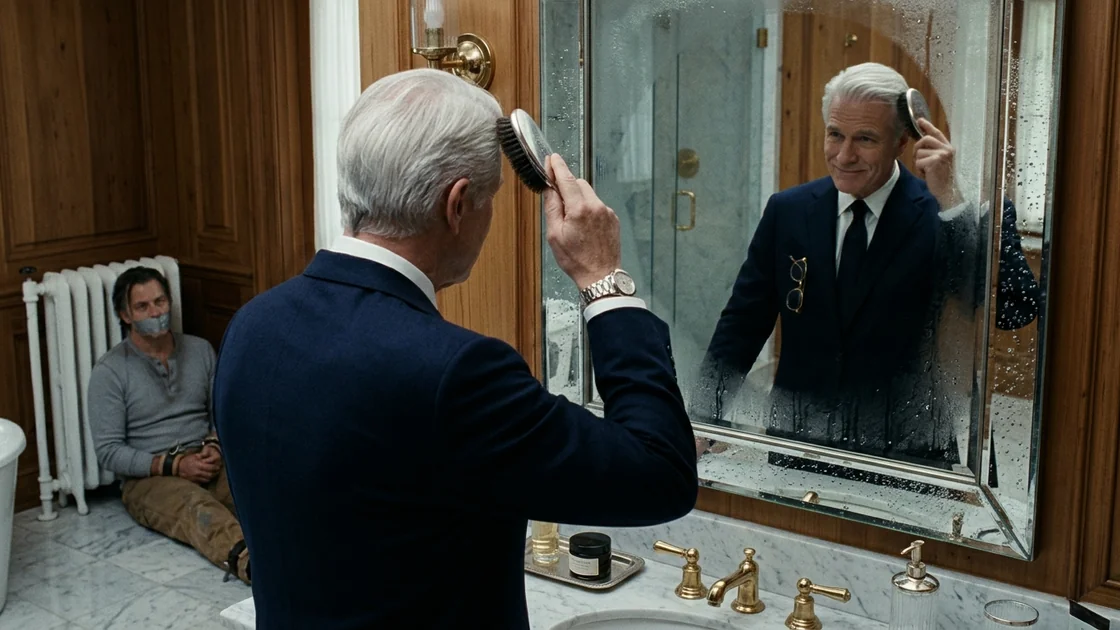
Julian Vance spent thirty years paying for a fatal warehouse fire that his twin brother Arthur ignited to build a corporate empire. On a crisp October afternoon, Julian intercepts his wealthy brother prior to a televised civic gala, assumes his identity, and infiltrates the highest echelons of the city they both came from. Rather than stealing Arthur's fortune or begging the courts for a pardon that would never come, Julian uses his single afternoon in his brother's bespoke suit to access a biometric vault, gather thirty-year-old ledgers of bribery and fraud, and step onto a stage before live cameras to confess to the murder and arson as Arthur Vance himself.
I. The Geometry of the Mirror
The steam in the cedar-lined bathroom of the Lakehouse Estate smelled of eucalyptus and expensive solitude. Julian stood before the vanity, a silver-backed badger hairbrush poised in his right hand, watching the condensation retreat from the edges of the bevelled glass. For thirty years, his own reflection had been something to avoid—a map of bad weather, prison dentistry, and the particular slump of the shoulders that men acquire when they spend a decade and a half being told when to stand, when to eat, and when to turn out the light.
Now, staring back at him, was a man who had never carried his own luggage.
It had taken Julian four years of quiet, monastic preparation in a two-room apartment above a dry cleaner’s in Tacoma to erase the divergence between them. Genetics had laid the foundation; they were monozygotic, split from a single fertilized egg sixty-two years ago in St. Jude’s Maternity Ward. In youth, their mother had tied a blue thread around Arthur’s left wrist and a red one around Julian’s just to tell who had been fed. But time is an aggressive sculptor. Prison had carved hollow trenches beneath Julian’s cheekbones and left a crescent-shaped white scar across his left eyebrow where a man named Miller—no relation to the dead watchman, though the irony had never been lost on Julian—had struck him with a food tray in the third year of his sentence.
Arthur, conversely, had been preserved in the amber of capital. While Julian was hauling cedar logs in the rain of the Olympic Peninsula after his parole, Arthur was having his skin resurfaced by dermatologists in Zurich, his posture aligned by private pilates instructors, and his teeth capped in porcelain of a shade that looked natural only in boardrooms.
To become Arthur for a single afternoon had required every dime Julian had saved from nineteen years of working night shifts on freight docks and driving long-haul rigs across the northern corridor. Eighteen months ago, he had crossed the border into Tijuana for the dental work, sitting for nineteen hours over three days while a surgeon ground down his yellowed, chipped molars and fitted him with the exact symmetrical bridgework he had studied in high-resolution photographs of Arthur’s charity appearances. Six months ago, a cosmetic technician in Seattle had used laser resurfacing and silicone micro-fillers to flatten the crescent scar above his eye and fill the weathered crevices around his mouth. For the past thirty days, Julian had soaked his calloused hands nightly in salicylic acid and lanolin, paring away the horn and diesel-stained ridges of a laborer until his palms were soft, pink, and useless-looking.
On the marble floor behind him, the real Arthur Vance made a wet, muffled sound through three layers of medical-grade cloth tape.
Julian did not turn around right away. He leaned closer to the mirror, parting his silver-white hair two inches above the left temple, sweeping it back with a dab of the imported pomade sitting on the tray. He practiced the smile. Arthur’s smile did not use the muscles around the eyes; it was a horizontal expansion of the mouth, engineered to project benevolence from a stage while keeping the upper half of the face entirely unreadable.
Julian let the smile fade, picked up a pair of gold-rimmed reading glasses from the tray, slipped them into the breast pocket of the navy cashmere suit, and turned.
Arthur was sitting against the radiator pipe, his wrists and ankles secured with padded leather restraints Julian had ordered from a medical supply house in Spokane. Julian had not hit him. A bruise on Arthur’s face would have complicated the second half of the afternoon. Instead, when Arthur had stepped out of his sauna at eleven-thirty that morning—having sent his housekeeper and groundskeeper away for the weekend, as he always did before the autumn convocation so he could rehearse his speech in peace—Julian had simply stepped out from the shadow of the boathouse pantry with a veterinary tranquilizer syringe loaded with a precisely calculated milligram dosage of midazolam and ketamine.
Arthur was awake now, though his pupils were the size of dimes and his motor cortex was operating through three feet of heavy silt. He was wearing Julian’s clothes: a pair of faded Carhartt work pants, scuffed steel-toed boots with the laces removed, and a gray thermal henley that smelled faintly of sawdust and cheap laundry detergent.
"You're breathing too fast, Artie," Julian said. Even his voice had been retrained. For two years, he had listened to recordings of Arthur’s quarterly earnings calls and university commencement addresses while driving forty-ton trailers through the snow of Montana passes. He had smoothed out the gravelly lower register that cigarettes and shouting over factory machinery had given him, raising his larynx slightly, adopting the clipped, mid-Atlantic cadence of a man who expected the room to quiet down whenever he cleared his throat. "Breathe through your nose. The sedative raises your heart rate if you fight the confusion. It’ll level out in twenty minutes."
Arthur’s head lolled against the white-painted iron of the radiator. His eyes tracked Julian from the handmade Italian oxfords up the immaculate break of the trousers to the platinum Patek Philippe Calatrava resting against Julian’s left wrist bone. Arthur tried to form consonants behind the tape, a low, nasal hum vibrating in his throat.
Julian crouched beside him, careful not to crease the knees of the trousers. He reached out and adjusted the collar of the gray henley around Arthur’s neck. Up close, the differences were still there if one knew where to look. Arthur had a small brown mole just behind his right earlobe that Julian had replicated on himself that morning using theatrical spirit gum and tinted wax. Julian had a slight thickening of the knuckle on his right index finger from a break that had never been set; Arthur’s fingers were long, tapered, and pale as tallow.
"You're wondering what the number is," Julian said quietly. "That's how your mind works, isn't it? Everything has a clearing price. You see me standing here in your shoes, and you're calculating what liquidity you have in the Cayman accounts, how fast you can wire five million, ten million, to a numbered bank in Panama so I’ll take the tape off your mouth and go back into the trees."
Arthur blinked rapidly, then nodded once, frantically. The terror in his eyes receded by a fraction of a degree, replaced by the familiar, transactional gleam that Julian remembered from the autumn of 1994. Arthur loved a negotiation. If a problem had a price, it wasn't a tragedy; it was just an invoice.
"I don't want your money, Arthur," Julian said.
The gleam vanished. Arthur’s brow furrowed, the skin wrinkling against the remnants of his last Botox treatment.
"I have a secondary syringe in my coat," Julian continued, checking his watch—Arthur’s watch—which read twelve-fifteen. "In about three minutes, I’m going to put an intravenous butterfly needle into the vein of your left forearm and hook it to a gravity-fed saline bag containing a slow-drip maintenance dose. It will keep you completely paralyzed and lightly asleep until four-fifteen this afternoon. At four-fifteen, the drip will run dry. By four-thirty, you’ll have enough coordination to work your jaw against the adhesive and use the small box-cutter I’m going to leave eighteen inches from your right boot."
Arthur stared at him, his chest heaving beneath the gray cotton.
"The town car is arriving at the front gate at twelve-thirty," Julian said, standing up and smoothing the lapels of the jacket. "Hollis is driving. I know he doesn't come up the driveway when you're at the Lakehouse because he hates turning the Maybach around by the fountain. I’ll walk down through the birch trees, get in the back seat, and let him drive me into the city. At one-thirty, I’ll go up to the sixty-fourth floor of the Vance Building. At two-thirty, I’ll walk across the plaza to the Conservatory. And at three-fifteen, when the Governor hands me the Founders' Medal in front of six hundred people and the regional broadcast cameras, I’m going to give your speech."
Arthur made a violent, choking sound, lunging forward against the leather straps holding his ankles to the radiator pipe. The iron clanked loudly against the floorboards.
"Not the one on the teleprompter, obviously," Julian said, picking up Arthur’s alligator-skin briefcase from the dressing table. "I read the draft on your desk. A lot of talk about civic stewardship and the heritage of the port. Very moving. Especially the part about our father teaching us the value of honest risk." Julian paused at the threshold of the bathroom, looking back down at the man who had worn his face for sixty-two years. "I’m going to tell them about Dock Four, Arthur. I’m going to tell them about Thomas Miller. And I’m going to give them the ledger."
Arthur’s eyes went wide, the whites showing all the way around the irises.
"Wait," Julian murmured, tilting his head as if listening to a faint melody. "You thought you burned the ledger in ninety-seven? You never burned anything that gave you leverage over Ray Halstead and Marcus Thorne, Artie. You kept it. Because that’s who you are. You can’t sleep unless you have a gun pointed at the people who helped you."
Julian knelt one last time, uncapped the secondary syringe, and reached for his brother’s arm.
II. The Chauffeur and the Glass Tower
The gravel of the long driveway crunched with a dry, rhythmic precision beneath the soles of Arthur’s shoes. Julian walked with a measured, slightly stiff-backed gait. Twelve years ago, Arthur had torn his meniscus skiing in Gstaad and had refused the arthroscopic surgery because it fell during the middle of a hostile takeover of a regional rail line; ever since, he favored his left leg almost imperceptibly when walking down an incline. Julian had practiced the limp with a pebble wedged into the heel of his right boot for six months until the muscle memory was automatic.
At the wrought-iron gates, the black Maybach idled with a whisper so faint it was drowned out by the wind shaking the yellow leaves from the birches.
Hollis was standing by the rear passenger door. He was a man in his late fifties with a thick neck, a gray crew cut, and the alert, unblinking posture of retired municipal police—which he was, having served under Detective Ray Halstead in the harbor precinct during the late nineties before transitioning to private security.
This was the first test. A wife sees what she expects to see after thirty years of domestic attrition; a lawyer sees a client; a crowd sees a symbol. A bodyguard looks at hands, eyes, and posture.
Julian did not make eye contact as he approached. In all the hours of video footage he had studied, Arthur never acknowledged service personnel until he was seated, and even then, only via reflection. Julian kept his eyes fixed on the screen of Arthur’s unlocked iPhone—unlocked thirty minutes ago by holding the device twelve inches in front of Arthur’s sedated face—scrolling through a string of congratulatory text messages from city councilmen and board members.
"Afternoon, Mr. Vance," Hollis said, pulling the heavy door open.
"Hollis," Julian said, not looking up as he ducked into the cool, Connolly-leather interior. "Did Thorne call the car?"
"No, sir. Just the office confirming the catering load-in at the Conservatory is finished. Security sweep wrapped up at noon. The Governor’s detail is already on site."
"Good. Take the coastal bypass. I don't want to look at the bridge traffic today."
"Yes, sir."
The door shut with the solid, vacuum-sealed thud of a bank vault. Julian settled back against the headrest as Hollis slid behind the wheel and the long automobile glided onto the two-lane county road.
Through the tinted partition glass, Julian watched the back of Hollis’s head. The driver adjusted the rearview mirror slightly, his eyes flicking up once to verify his passenger was settled, then dropping back to the asphalt. No hesitation. No second glance. To Hollis, the man in the back seat was simply eighty million dollars a year in commercial real estate dividends wearing a five-thousand-dollar suit.
As the car picked up speed, following the curve of the coastline toward Porthaven, Julian looked out the window at the gray expanse of the sound.
Thirty years is a strange denomination of time. When the judge had read the sentence—twenty-five to life for second-degree felony murder and first-degree arson of an occupied structure, later commuted to twelve years on a technicality regarding the fire marshal’s chain of custody—Julian had felt as though he had been pushed off the stern of a ship in the middle of the ocean while the vessel kept steaming toward the horizon, lights blazing, music playing on the upper decks. In Blackwood Penitentiary, time did not move linearly; it stacked upward like cordwood until the weight of it crushed the memory of who you were before the gates closed.
For the first four years, Julian had been noisy. He had written four hundred letters—to the Innocence Project, to the State Bar Association, to the Porthaven Herald, to his mother before her second stroke took her ability to read, and to Clara.
Especially to Clara.
He had drawn maps of Dock Four on lined yellow legal pads, showing the exact angle of the padlock on the eastern corrugate door, proving that from where his pickup truck had been parked at ten-fifteen that night, he could not have hauled six five-gallon jerrycans of marine kerosene into the dry-dock cradle without being caught on the grain terminal’s security camera three hundred yards north. He had screamed at his public defender that the zippo lighter found near the bilge pump—engraved J.V. 1989—had been sitting on the dresser in the apartment he shared with Arthur three days before the fire, with a broken flint wheel he hadn't bothered to replace.
Nobody cared about a broken flint wheel. Why would they? The state had a dead sixty-year-old watchman with two daughters and a widow; they had a twenty-two-year-old twin with a history of bar fights on the docks and three months of unpaid rent; and they had the tearful, devastatingly composed testimony of the other twin—the honor student, the junior accountant who wore a dark suit to the witness stand and wept into a white handkerchief as he told the jury that Julian had threatened to burn their father’s insolvent company to the ground rather than let the bank foreclose on it.
And then Clara had taken the stand.
In the quiet back seat of the Maybach, Julian’s right hand tightened slightly on the leather armrest. He forced his fingers to relax, spreading them flat against his knee, breathing out slowly through his nose.
In the fifth year of his sentence, a man in the cell next to him—an elderly bookkeeper from Bellingham who had embezzled two million dollars from a timber union—had told Julian the only true thing he ever learned in prison.
“You’re shouting in the wrong voice, kid,” the old man had said through the ventilation grate one winter night. “Once the state writes your name in the book under the word Guilty, everything that comes out of your mouth is just prison noise. It doesn't matter if you have photographs from God Himself. Nobody listens to the man in the cage. People only listen to the man holding the keys.”
That was the night Julian stopped writing letters. He became a model prisoner. He worked in the machine shop, read corporate tax law in the library, and watched television whenever his brother’s face appeared on the local news—cutting ribbons on waterfront condominiums built on the exact footprint of the old Vance & Sons Marine Supply docks, shaking hands with mayors, establishing the Thomas Miller Memorial Scholarship Fund with a publicized donation of fifty thousand dollars a year.
When Julian walked out of Blackwood in 2006 with a canvas duffle bag and two hundred dollars in gate money, he did not go back to Porthaven. He went north. He let Arthur believe that prison had broken him, that he had drifted into the transient labor camps of the Pacific Northwest to drink himself to death in obscurity. Once every three years, Julian would intentionally get himself cited for a minor misdemeanor in a remote county—an expired fishing license in Ketchikan, a public intoxication ticket in Coeur d'Alene where he spilled cheap whiskey on his coat without drinking a drop—just so that when Ray Halstead ran his name through the NCIC database for Arthur, a comforting little ping would show up on the screen: Julian Vance, indigent, harmless, five hundred miles away.
The Maybach exited the coastal highway and climbed the concrete ramp toward the downtown core.
Porthaven had changed from a rusted timber-and-shipping town into a forest of blue glass and brushed steel, and the tallest tree in that forest was the Vance Building. Sixty-four stories of cantilevered curtain wall rising above the harbor like a guillotine blade.
Hollis pulled the car down the private spiral ramp beneath the plaza, bypassing the public parking levels, and stopped beside a brushed-steel elevator bank marked EXECUTIVE ONLY.
"Will you need me to bring the car around to the east portico of the Conservatory at four, sir, or are you riding with Mrs. Vance to the reception afterward?" Hollis asked, opening the door.
Julian stepped out onto the polished epoxy floor. "Bring it to the east portico at three-forty-five, Hollis. Keep the engine running. My stomach has been acting up since breakfast; I may skip the reception and go straight back to the lake."
"Understood, sir."
Julian walked to the private elevator. There was no call button, only an optical scanner mounted flush into the granite wall at eye level and a capacitive fingerprint pad below it.
Julian did not use the fingerprint pad.Monozygotic twins share one hundred percent of their DNA, the same blood type, the same iris coloration, and the same facial bone structure, which is why modern facial-recognition cameras—which measure the nodal distances between the pupils, the bridge of the nose, and the corners of the mouth—cannot distinguish between them. Whirls and ridges on the fingertips, however, are formed in the womb by the random pressure of amniotic fluid and the fetus touching the uterine wall; their fingerprints were entirely different.
Julian looked directly into the optical lens. The infrared sensor mapped the eighty-four nodal points of his face in four-hundredths of a second. A soft chime sounded, the indicator light turned green, and the steel doors parted.
The ride to the sixty-fourth floor took forty seconds. Julian watched the digital numbers climb, feeling his eardrums pop slightly at the fortieth floor. When the doors opened, they revealed not a bustling floor of cubicles, but a vast, quiet reception gallery paneled in dark walnut, with floor-to-ceiling windows looking directly down at the container ships crawling across Porthaven Bay.
A woman in her thirties sat behind a curved glass desk. According to Julian’s notebooks, this was Evelyn Soto, Arthur’s senior executive assistant for the past four years.
"Good afternoon, Mr. Vance," she said, standing immediately and picking up a tablet. "Mr. Thorne is already in your office waiting to go over the final bond covenant language before the speech. And Mrs. Vance called from the salon—she wanted to remind you that she’s meeting you directly in the green room at the Conservatory at two-forty."
"Thank you, Evelyn," Julian said, keeping his stride brisk as he passed her desk. "Hold all calls until we walk over. And have security send a courier down to the press pool at the Conservatory by three o'clock—I'll have a flash drive of supplementary historical data for the financial reporters."
"Of course, sir. Right away."
Julian pushed open the twelve-foot double doors at the end of the corridor and stepped into the nerve center of Arthur’s life.
The office was the size of the entire cellblock tier Julian had lived on for twelve years. A custom mahogany desk sat near the western window, flanked by abstract bronze sculptures and framed photographs showing Arthur with two presidents, three governors, and the Archbishop. Standing near the wet bar, pouring sparkling water into a crystal tumbler, was Marcus Thorne.
Thorne was sixty-five, though his hair was dyed the color of wet shoe polish. Thirty years ago, he had been a thirty-five-year-old junior partner at a second-tier maritime law firm who realized that Arthur Vance had just committed a capital felony to collect four point two million dollars from Lloyd’s of London, and instead of calling the district attorney, Thorne had negotiated a twenty-percent equity stake in the nascent Vance Holdings in exchange for drafting the blind trusts that hid the money until Julian’s trial was over.
"Arthur," Thorne said, turning with the glass in his hand. He looked at his watch. "You’re cutting it close. The Governor hates waiting in holding rooms, and his chief of staff has already asked me twice if the municipal bond announcement is still on the agenda."
"Let him sweat, Marcus," Julian said. He walked past Thorne without shaking his hand, setting the alligator briefcase on the mahogany desk. "He needs our infrastructure underwriting for his reelection campaign far more than I need another bronze plaque from the statehouse."
Thorne chuckled—a dry, rattling sound—and walked over to the leather sofa, opening a thick red folder. "True enough. Still, we need to sign the final indemnity riders on the Port Authority lease transfer before five o'clock today, or the underwriters in New York will hold the escrow until Monday. I have the signature pages tabbed right here."
Julian stood behind the desk, looking down at the leather blotter. He couldn't sign the documents. Not because he couldn't forge Arthur’s signature—he had practiced the sweeping, arrogant loop of the A and the jagged slash of the V ten thousand times on butcher paper—but because if he signed a binding corporate instrument while impersonating his brother, Marcus’s lawyers would later use that act to argue that the afternoon was a financial fraud perpetrated by an impostor, tainting everything else that happened before five o'clock.
"I’ll sign them after the speech," Julian said, walking toward the paneled walnut wall behind the bookcase on the far side of the room.
Thorne frowned, looking up over his half-moon spectacles. "After? The market closes at four Eastern, Arthur. That’s one o'clock our time. We’re already on an extension with the clearinghouse in Chicago. It takes ten seconds to initial five pages."
Julian stopped with his hand on the brass latch of the hidden panel that concealed the vault door. He turned his head slowly and looked at Thorne. He used the expression he had seen Arthur use during a senate subcommittee hearing in 2014 when a junior senator had asked about Vance Global’s environmental compliance at the port—a look of bone-deep, icy boredom that made the other man feel like an insect on a windshield.
"Did I stutter, Marcus?" Julian asked softly. "Or have you forgotten who owns the floor you’re standing on?"
Thorne blinked, his mouth opening slightly. A flush of dark red crept up from his starched white collar into his jowls. For thirty years, Thorne had been the architect, the consigliere, the man who knew where the bodies were buried. Being spoken to like a paralegal clearly stung, yet the habit of deference to Arthur’s volatile temper won out.
"No," Thorne muttered, closing the red folder with a snap. "I'll call Chicago and tell them they'll have the PDFs by four-thirty Pacific. Why are you going into the safe now?"
"Because I want the original deed to Dock Four on the podium with me when I talk about my father," Julian said, swinging open the walnut panel to reveal a brushed-titanium Mosler wall safe equipped with both an optical scanner and a digital keypad. "Props play well on camera. You told me that yourself ten years ago."
"Sentimentality," Thorne said with a snort, turning back toward the bar to top off his water. "The crowd eats it up. Just don't leave it on the lectern like you did with the city charter replica in Seattle."
With Thorne’s back turned, Julian looked into the optical scanner of the Mosler safe. A green light blinked, followed by a prompt on the small LCD screen: ENTER 6-DIGIT PIN.
During the twenty minutes in the bathroom at the Lakehouse before the ketamine had fully taken Arthur under, Julian had not needed to torture the number out of him. He already knew it. In every interview Arthur had ever given about his rise to power, he cited one date as the turning point of his life, the date Vance Global was incorporated in Delaware: November 2, 1994. Nineteen days after the fire. Twenty-four hours after the grand jury indicted Julian.
Julian typed 110294.
The heavy solenoids inside the titanium door retracted with a heavy clunk. Julian pulled the handle down and swung the door open.
The interior of the safe was divided into three velvet-lined shelves. On the top shelf sat stacks of bearer bonds, four gold bullion bars, and three passports. On the middle shelf sat a wooden box containing their father’s old brass sextant and the original yellowed deed to the Vance & Sons Marine Supply pier.
And on the bottom shelf, pushed all the way to the back behind an iron strongbox of stock certificates, was a black leather ledger bound with a brass clasp, alongside a silver two-terabyte solid-state hard drive labeled in Arthur’s neat block handwriting: ARCHIVE / H-T-C.
Halstead. Thorne. Clara.
Julian’s heart beat once, hard, against his ribs. For thirty years, he had gambled his entire remaining existence on a single psychological certainty: that Arthur Vance was incapable of trusting his accomplices. A man who frames his own twin brother does not believe in human loyalty. To keep Ray Halstead from ever developing a deathbed conscience, to keep Marcus Thorne from ever leveraging the firm against him, Arthur had kept the original paper trail of the pay-offs—and digitized it for redundancy.
Julian took the yellowed 1968 deed to Dock Four and placed it in his briefcase. Then, quietly, he slid the black leather ledger and the silver hard drive into the interior silk pocket of the briefcase, zipping the compartment shut.
He closed the safe door, spun the dial, and shut the walnut panel just as Thorne turned back around.
"Ready?" Thorne asked, checking his watch again. "Ray is waiting downstairs by the plaza entrance to walk us across."
"Lead the way, Marcus," Julian said.
III. The Ghosts of Dock Four
The autumn air in the plaza between the Vance Building and the Municipal Conservatory was sharp with the smell of salt water and roasted chestnuts from the street vendors lining the perimeter barricades. A crowd of two hundred onlookers and a dozen local television crews with shoulder-mounted cameras had gathered behind the velvet ropes where the red carpet led up the granite steps of the Conservatory.
Waiting at the bottom of the steps, hands clasped behind the small of his back, was Ray Halstead.
At seventy-two, the former homicide detective looked like an oak tree that had been struck by lightning and refused to fall. He was six-foot-three, broad-bellied, with a nose broken twice in his youth and skin the texture of dry oatmeal. He wore a bespoke charcoal overcoat with the gold lapel pin of Vance Global’s Director of Executive Protection, and a clear coiled earpiece trailed disappears into his collar.
When Julian stepped out of the revolving doors of the tower alongside Thorne, Halstead fell into step on Julian’s left flank.
"Afternoon, Arthur," Halstead rumbled. His voice sounded like coal sliding down a chute. "Perimeter is tight. We had three protesters from the dockworkers' union trying to get near the east fountain with a banner about the automation contract, but Porthaven PD moved them two blocks south before the cameras got a wide shot."
Julian looked at the side of Halstead’s neck, right where the carotid artery pulsed beneath the loose, freckled skin.
In October 1994, Ray Halstead had been forty-two years old, three months behind on the mortgage for his house in the suburbs after a messy divorce, and nursing a quiet, lucrative relationship with the dockside bookmakers who held seventy thousand dollars of Arthur Vance’s sports gambling markers.
As they walked across the granite flagstones toward the Conservatory, the bright afternoon sun seemed to bleach out the glass towers around them, and in the back of Julian’s mind, the smell of roasted chestnuts dissolved into the thick, suffocating stench of burning creosote, diesel oil, and wet wool.
October 14, 1994.
It had been raining all week in Porthaven, a cold, sideways drizzle off the Pacific that turned the sawdust in the Vance & Sons boatyard into gray porridge. Their father, Robert Vance, was lying in a room at Mercy Hospital with his left side paralyzed from a cerebral hemorrhage, unable to speak, while the bank’s receivership notice sat nailed to the dispatch shed door.
Julian had spent fourteen hours that day beneath the hull of a sixty-foot halibut schooner in Cradle Two, welding replacement steel plates onto a rusted keel in the freezing rain to earn the four thousand dollars the boat’s owner had promised upon completion—money Julian intended to use to pay the night nurses at the hospital. His hands were blistered from the slag, his coveralls soaked through with grease and bilge water.
At nine-thirty that night, Arthur had come down to the yard. He was wearing his beige cashmere overcoat—bought on credit from a men’s shop downtown—and carrying a thermos of coffee.
“Go home and get cleaned up, Julie,” Arthur had said, leaning against the timber scaffolding while Julian flipped up his welding mask. “Clara’s coming over to the apartment at ten-thirty to make dinner. I’ll finish locking up the supply warehouse and checking the compressors with Old Man Miller.”
“You don't even know which breaker runs the main bilge pump on Cradle Two, Artie,” Julian had laughed, wiping his forehead with a greasy rag. “If that pump trips before midnight, the tide comes into the pit and swamped the welder.”
“I grew up in this yard same as you,” Arthur had smiled—that same warm, brotherly smile he used before he learned the corporate one. “Give me the keys to the eastern padlock and leave your truck by the gate so Miller knows one of us is still on the books tonight. Take my sedan. The heater actually works in mine.”
“Keep my jacket, then,” Julian had said, stripping off his heavy canvas barn coat—the one with the broken zippo lighter in the right pocket—and tossing it onto the workbench beside the kerosene drums. “It’s freezing out there on the pier.”
Julian had driven Arthur’s sedan back to the apartment on Fourth Street. Clara hadn't been there. He had waited until ten-forty-five, showered the grease out of his hair, and then, worried because the phone at the boatyard wasn't answering when he called to check on the bilge pump, he had walked the eight blocks back down to the waterfront.
He had smelled the smoke at Second Street.
By the time he reached Dock Four, the sky above the sound was the color of bruised meat, lit from below by forty-foot tongues of orange flame roaring through the tar-paper roof of the main warehouse. The heat was so intense it blistered the paint on Julian’s pickup truck parked forty yards from the gate. Inside the corrugated iron doors of the dry-dock shed, someone was hammering against the sheet metal from the inside—a frantic, rhythmic banging that was rapidly growing weaker.
Thomas Miller.
Julian had run into the smoke without thinking. He had grabbed the heavy iron chain that had been looped through the exterior handles of the eastern sliding door—locked from the outside with Julian’s own brass padlock—and tried to wrench it apart with a crowbar while the scorching iron seared the flesh of his palms. He was still screaming Miller’s name, his hands bleeding and black with soot, when two patrol cars and an unmarked sedan skidded to a halt on the wet gravel behind him.
Detective Ray Halstead had stepped out of the unmarked car, drawn his service revolver, and pointed it at Julian’s chest before the first fire engine had even hooked its hoses to the hydrant.
And standing twenty feet behind Halstead, wrapped in a gray police blanket, his face streaked with theatrical tears, was Arthur. Wearing his own beige cashmere overcoat. While Julian’s canvas barn coat lay just inside the perimeter fence where the arson dog would find it ten minutes later, soaked to the collar in marine kerosene.
"Arthur? You with me?"
Halstead’s gruff voice pulled Julian back to the granite steps of the Conservatory.
They had reached the top landing, just outside the tall mahogany doors where the uniformed security detail was scanning credentials. Halstead was looking at him closely, his bushy gray eyebrows drawn together over the bridge of his broken nose.
"You stopped walking," Halstead said, lowering his voice so Thorne, who was three paces ahead speaking to the Governor’s aide, couldn't hear. "Your color looks off. You taking your blood pressure pills?"
Julian looked at the old detective. He remembered the interrogation room at the harbor precinct. Halstead sitting across the metal table while a young paramedic wrapped gauze around Julian’s second-degree burns. Halstead leaning across the table after the paramedic left, blowing stale cigarette smoke into Julian’s face, and saying very quietly: “Your brother’s a smart kid, Julian. He knows which way the wind blows in this town. You’re a grease monkey with three assault beefs at the Sailor’s Rest. Take the plea for fifteen, keep your mouth shut about your brother’s bookie, or I’ll make sure the prosecutor asks for the needle because Old Man Miller’s lungs were full of soot before his heart stopped.”
Wait, Julian thought. Look at his hands.
Julian raised his right hand, wrapped in white gauze in the memory, now pale and manicured in the October sunlight, and laid it briefly on Halstead’s thick wool shoulder.
"Just thinking about how long thirty years is, Ray," Julian said in Arthur’s crisp, measured baritone. "Thirty years to the week since the old yard went up. Funny how the smell of the harbor never really changes, no matter how much concrete we pour over it."
Halstead stiffened slightly beneath Julian’s hand. His small, pale eyes darted left and right to ensure the television microphones fifteen feet below on the red carpet weren't pointed at them.
"What the hell has gotten into you today?" Halstead muttered, his jaw tightening. "First Marcus tells me you're pulling old property deeds out of the safe, now you're waxing poetic about ninety-four on a live mic line? Leave the ghosts in the ground, Arthur. The kid is up in Idaho or Alaska working a chainsaw, and Miller’s family has cashed thirty scholarship checks without a peep. Put your game face on."
"My game face is on, Ray," Julian said, patting the detective’s shoulder twice before walking past him through the mahogany doors. "By the way—make sure your men secure the press room distribution hub until three-fifteen. Evelyn is sending down a drive of archival financials I want released the moment I step up to the podium."
Halstead frowned behind him. "Financials? Nobody told me about a press packet release."
"I'm telling you now," Julian said without turning back.
IV. The Woman in the Green Room
The interior of the Municipal Conservatory was a turn-of-the-century masterpiece of cast iron, gilded plaster, and vaulted glass domes that rose eighty feet above a central auditorium. Today, the main hall was packed with six hundred people seated at circular banquet tables covered in white damask linen. The air hummed with the low, expensive murmur of strings from a chamber quartet on the mezzanine and the clink of silver against bone china.
Marcus Thorne guided Julian down a velvet-carpeted side corridor backstage, bypassing the main catering kitchens and the chaotic cluster of broadcast technicians operating the mobile production van parked in the alley.
"You have twenty minutes before the Governor finishes his introductory remarks," Thorne said, stopping before a heavy white door marked VIP LOUNGE A. "Clara is inside. For God’s sake, Arthur, be civil to her when you walk out on stage together. The Herald society photographer is right in the front pit."
"When am I anything less than civil, Marcus?" Julian asked.
Thorne gave him a dry look, shook his head, and walked down the hall toward the stage manager’s desk.
Julian stood alone before the white door for five seconds.
Handling Hollis had required posture. Handling Thorne had required arrogance. Handling Halstead had required cold detachment.
Behind this door was the woman who had known the cadence of his breathing when he was twenty-two years old.
In 1994, Clara Lindstrom had been a paralegal at the county assessor’s office with chestnut hair that smelled of green apples and a desperate, consuming terror of ending up like her parents, who lived in a rusted single-wide trailer behind the pulp mill. She had dated Julian for two years. They had looked at a small house with a wraparound porch on the south side of the bay; Julian had put three hundred dollars down in earnest money with the realtor the week before his father’s stroke.
What Julian hadn't known—not until he sat at the defense table in courtroom 4B and watched her walk up to the witness box wearing a pearl necklace he certainly hadn't bought her—was that for the last four months of those two years, while Julian was working double shifts in the boatyard pit to save for the closing costs, Clara had been spending her afternoons at a boutique hotel in Tacoma with Arthur.
On the stand, she had sworn under oath that Julian had come to the Fourth Street apartment at ten-thirty on the night of October 14th smelling of kerosene, his hands burned, confessing in a manic rage that he had torched the warehouse because his father had intended to leave the controlling shares of the business to Arthur. And she had sworn that Arthur had been with her at her sister’s apartment across town until ten o'clock, when he left to drive down to the yard to stop his brother.
Sixteen months after the prison bus carried Julian through the gates of Blackwood, Clara Lindstrom married Arthur Vance at St. Jude’s Cathedral.
Julian turned the brass knob and stepped inside.
The green room was softly lit by brass floor lamps, furnished with velvet wingback chairs and a long vanity mirror bordered by warm tungsten bulbs. A silver ice bucket held an unopened bottle of Dom Pérignon.
Clara stood by the tall arched window overlooking the botanical courtyard. At sixty, she was still striking, though in the brittle, hyper-maintained way of women whose husbands view aging as a breach of contract. Her chestnut hair was now a cool, ash-blonde chignon; her figure was whittled down to sharp angles beneath an emerald-green silk Chanel suit; and around her throat sat a triple strand of South Sea pearls that probably cost more than the entire boatyard had been worth in 1994.
She did not turn around when the door clicked shut. She was holding a short crystal glass filled with two inches of amber liquid—not champagne. Scotch.
"If you’re going to lecture me about having a drink before the cameras go live, save your breath," she said, her voice lower and huskier than the bright girl’s voice Julian remembered from thirty years ago, worn down by decades of polite silence. "I had to spend forty minutes in the foyer listening to the Governor’s wife talk about her dressage horses while pretending you and I actually slept in the same house this week."
Julian closed the door and set the alligator briefcase on the low glass coffee table between the chairs.
"I wasn't going to say anything about the drink, Clara," Julian said.
At the sound of his voice, she turned from the window.
Why had she paused? Julian had used the exact vocal register he had used with Thorne and Halstead—Arthur’s register. Yet as Clara’s green eyes settled on his face across the twenty feet of Persian carpet, her hand froze halfway to her mouth.
Men look at what a person does; women look at the space a person occupies in a room.
Arthur occupied space aggressively, like a landlord inspecting a property for damage. Even when standing still, Arthur had a habit of shifting his weight onto the balls of his feet, his chin tilted slightly up, his eyes scanning the corners of the room for someone more important to talk to. Julian, despite all his training, stood with the stillness of a man who had spent four thousand days in a six-by-nine concrete box—economical, grounded, his gaze fixed entirely on the person in front of him without darting away.
Clara lowered the glass slowly. She took two steps toward the center of the room, the emerald silk rustling softly in the quiet.
"Why are you looking at me like that?" she asked.
Julian forced himself to break the gaze, turning slightly toward the vanity table to pour himself a glass of flat water from the carafe, mimicking Arthur’s dismissive turn of the shoulder. "Like what? I'm going over the speech in my head. Marcus is in a panic about the Chicago clearinghouse."
"No," she said quietly. She walked closer, stopping six feet behind him so that their eyes met in the tungsten-lit vanity mirror. "You haven't looked me in the eyes for longer than two seconds since Elena went away to college in 2012. And you didn't check your phone when you walked through the door."
Julian raised the water glass to his lips and took a small sip. In the mirror, he watched her eyes move across his reflection—from the silver hair at his temples, down to the faint, laser-smoothed skin above his left eyebrow, and finally down to his hands resting on the marble counter.
"It’s October fourteenth, Clara," Julian said softly to the mirror. "Maybe I’m just feeling my age."
The color drained from Clara’s face so rapidly that the blush on her cheekbones stood out like two brushstrokes of red paint on chalk.
Arthur never said the date. In thirty years of marriage, as Julian knew from the divorce depositions Clara had filed and abruptly withdrawn in 2008—public records Julian had paid a clerk in the county courthouse two hundred dollars to photocopy—Arthur had an iron rule in their household: the year 1994 did not exist. The boatyard was referred to only as the original parcel. Julian’s name had not been spoken aloud inside their walls since the day the parole board sent the mandatory victim-notification letter to the estate in 2006.
Clara’s gaze dropped from the mirror to Julian’s left hand resting on the marble edge of the sink.
In the spring of 1993, while helping Clara move a cast-iron stove into her sister’s third-floor walk-up, Julian had caught his left ring finger between the iron leg and the doorframe, splitting the nail bed down to the matrix. For the rest of his life, that fingernail had grown back with a faint, vertical white ridge running straight down the center. No amount of salicylic acid, lanolin, or buffing could remove a scar in the nail matrix.
Clara stared at the vertical white ridge on the fingernail resting two inches from the platinum Patek Philippe.
Her crystal glass slipped from her fingers. It did not shatter on the thick Persian rug; it landed with a dull thud, spilling single-malt scotch across the toe of her emerald pump.
She did not scream. When she looked back up from his hand to his face—not in the mirror now, turning her head to look directly at the man standing beside her—her lips were parted, trembling so violently she had to press the back of her hand against her mouth.
"Julian?"
The name came out as a dry whisper, barely audible over the distant muffled swell of applause from the main auditorium down the hall where the preliminary speakers were warming up the crowd.
Julian turned fully around and leaned back against the vanity table, folding his arms across the chest of Arthur’s cashmere suit. Now that he didn't have to act in this room, he let Arthur’s posture fall away. His shoulders settled half an inch lower; his eyes lost their cold boardroom glaze and became what they actually were—the eyes of a sixty-two-year-old man who had been buried alive by the woman standing in front of him.
"Hello, Clara," he said in his own voice—lower, rougher, carrying the salt and gravel of thirty years in the cold.
She stumbled backward a step until the back of her knees hit the velvet arm of the sofa, and she sank down onto the cushion as if her tendons had been severed.
"Where..." She swallowed hard, her eyes darting wildly toward the closed white door. "Where is Arthur? Did you—did you kill him?"
"Why does everyone in this family jump straight to murder?" Julian asked mildly. "He’s asleep on the bathroom floor at the Lakehouse. I gave him a sedative. He’ll wake up around four-thirty with a dry mouth and a sore neck. Which is considerably better than waking up in a reception cell at Blackwood with second-degree burns on your hands and twenty-five years on your sheet."
Clara stared at him, her chest rising and falling in shallow, jagged gasps. She looked at his clothes, his hair, his teeth, her mind visibly fracturing as it tried to reconcile the phantom of the boy she had sent to prison with the billionaire husband she had seen at breakfast the day before.
"How..." she whispered. "Even Ray—you walked right past Ray?"
"Ray sees a paycheck in a suit," Julian said. "You only noticed because you were looking for a reason to hate him today, and I didn't give you the right cues."
"What are you doing here?" Her voice rose half an octave, panic clawing through the shock. "Julian, if you want money—I have my own accounts in Seattle, accounts Arthur doesn't control. Three million in liquid bonds. I can wire it to you this afternoon! You can leave out the courtyard door right now, before the Governor finishes—"
"Look at me, Clara," Julian said.
She stopped talking, her hands clutching the silk fabric over her knees.
"Three hundred dollars," Julian said quietly. "That was the earnest money on the house on South Bay Road. Remember the yellow kitchen? The one with the pantry window that looked out at the cedar trees? I worked nineteen hours straight in the freezing rain under a rusted halibut boat to pay for my father’s hospital room and that house. And while I was down at Dock Four tearing the skin off my hands trying to pull a sixty-year-old man out of a fire your lover set, you were sitting in a hotel room rehearsing how to tell twelve strangers that I was a monster."
Tears spilled over her lower lashes, cutting dark tracks through her foundation. "I didn't know Thomas Miller was inside! Arthur swore to me the yard was empty! He said your father was going to die owing the bank six hundred thousand dollars, that the family would be out on the street, that the insurance payout was the only way any of us were ever going to get out of Porthaven!"
"And when you found out Miller was inside?" Julian asked, taking a single step toward the sofa. "When the body came out in a rubber bag the next morning, and Arthur told you he had dropped my lighter by the kerosene drums and locked the eastern door with my keys—what was the calculation then, Clara? That one dead watchman and one brother in a cage was a fair price for a house on the hill?"
"By the time I knew Miller was dead, I had already given my preliminary statement to Ray Halstead!" she sobbed, covering her face with both hands. "Ray told me if I changed a single word of my alibi for Arthur, the prosecutor would charge me as an accessory to felony murder! I was twenty-one years old, Julian! I was terrified! And Arthur—Arthur promised he would hire the best appellate lawyers in the state once the insurance money cleared, that he’d get your conviction overturned on a technicality within two years!"
"He waited twelve," Julian said. "Just long enough for the statute of limitations on perjury and fraud to expire, and for my mother to die, and for the money to be buried so deep in municipal real estate that no court could ever claw it back."
Clara lowered her hands, looking up at him with raw, desperate eyes. "What are you going to do out there?"
Julian walked over to the coffee table, clicked open the brass latches of Arthur’s briefcase, and pulled out the silver two-terabyte hard drive and the yellowed 1968 deed. He left the black leather ledger inside the case, snapping it shut again.
Just then, a sharp knock sounded at the door.
Julian’s face transformed instantly. The shoulders rose; the jaw hardened; the eyes went flat and imperial. He looked down at Clara and drew his index finger slowly across his lips.
"Five minutes, Mr. Vance," Evelyn Soto’s voice called from the corridor, opening the door a crack. "Did you have that flash drive for the press pool?"
Julian stepped to the door, preventing Evelyn from seeing Clara sitting pale and trembling on the sofa with a wet stain on the rug beside her shoe. He handed the silver hard drive through the gap.
"Here it is, Evelyn," Julian said in Arthur’s flawless baritone. "Take it directly to the broadcast pool director and the Herald desk in the media riser. Tell them the folder marked PUBLIC RELEASE 1994 is cleared for immediate upload across their news wires the moment I take the podium. Don't let Marcus intercept it; he thinks the historical disclosures are too dry for the afternoon cycle, but I want the transparency."
"Understood, sir. I’ll walk it down to the riser myself right now."
The door clicked shut.
Julian turned back to Clara.
"What is on that drive?" she whispered, the blood gone from her lips.
"Arthur’s insurance policy," Julian said. "Not the Lloyd’s of London one. The one he kept in his wall safe in case you, Marcus, or Ray ever decided to turn state’s evidence. Cancelled checks from the Cayman shell company to Ray Halstead’s offshore account in ninety-five. Wire transfers paying off Arthur’s bookie the week after the settlement cleared. Audio recordings of Marcus discussing how to bribe the bailiff on my appellate panel. And a signed, notarized affidavit Arthur forced you to write during your 2008 divorce filing—the one where he made you confess to perjury on paper as a condition of him not cutting you off without a dime when you tried to leave him."
Clara stared at him as if he were holding a live grenade in the center of the room. "If the press gets that... there’s no statute of limitations on capital murder, Julian. Or conspiracy to commit murder resulting in death. We’ll all go to prison. Me, Marcus, Ray—"
"And Arthur," Julian said. "Especially Arthur."
"They won't believe it!" she gasped, scrambling up from the sofa, her mind grasping for a lifeline. "Even with the files—the moment Arthur wakes up at the Lakehouse and comes into the city, his lawyers will prove you broke into his house, drugged him, and stole the drive from his safe! They’ll call it a fabricated stunt by a bitter ex-con! You’ll go right back to Blackwood for kidnapping and assault!"
"You're still thinking like I'm going out on that stage as Julian Vance," he said calmly.
She froze. "What?"
"Remember what the old bookkeeper in Cellblock C taught me, Clara? Nobody listens to the man in the cage. If Julian Vance walks onto that stage and shouts that he’s innocent, security tackles him in thirty seconds and the evening news calls it a tragic mental health episode by the billionaire’s troubled twin."
Julian walked to the vanity mirror, adjusted the knot of his silk tie one last time, and picked up the alligator briefcase containing the original black ledger.
"Julian Vance isn't going out on that stage," he said, looking at her through the glass. "Arthur Vance is going out on that stage. Overcome by thirty years of unbearable guilt on the anniversary of the fire that built his empire. Right in front of the Governor, six hundred witnesses, and four high-definition television cameras broadcasting live to three million people. Arthur Vance is going to open the original handwritten ledger, look straight into the camera lens, and confess that he murdered Thomas Miller and framed his innocent brother."
Clara’s mouth fell open. The sheer, inescapable symmetry of the trap hit her all at once.
If Julian claimed Arthur was guilty, it was a conspiracy theory. If Arthur claimed Arthur was guilty—while simultaneously releasing thirty years of forensic financial proof from his own biometric safe—no PR firm, no army of defense attorneys, and no subsequent retraction when the real Arthur showed up screaming about a twin in a bathroom would ever put the genie back in the bottle. A billionaire confessing on live television with corroborated bank records was an irreversible legal and historical detonation. And when the real Arthur arrived two hours later, wild-eyed, dressed in dirty logging clothes, smelling of ketamine, and screaming that his twin brother had impersonated him to confess to his crimes? He would sound like a cornered psychopath attempting the most absurd insanity defense in the history of the state.
"Wait," Clara breathed, her hand flying to her pearls. "Wait—what about me? Do I have to walk out there?"
"No," Julian said, his hand on the doorknob. "Stay right here, Clara. Have another scotch. In fact, if you leave through the botanical courtyard right now and drive to the airport, you might even clear customs in Vancouver before the district attorney finishes reading the affidavit Evelyn just handed to the Herald."
He opened the door and stepped out into the bright backstage corridor without looking back to see which choice she made.
V. The Founders' Medal
The stage wing of the Municipal Conservatory smelled of hot theatrical cables, pine rosin, and floor wax.
Through the black velvet curtains, Julian could see the vast auditorium bathed in golden light from the glass dome high above. At the center lectern, beneath a thirty-foot high-definition projection screen bearing the seal of the Vance Foundation, the Governor was concluding his introduction.
In the front row of the VIP riser sat Marcus Thorne, his legs crossed, checking his BlackBerry with a smug, distracted half-smile. Ten feet to the left of the stage steps stood Ray Halstead, his arms folded over his charcoal overcoat, his eyes scanning the banquet tables where waiters stood frozen at the perimeter walls.
And sitting at Table Fourteen, near the middle of the room—invited every year by the Foundation as a piece of living public relations—was a woman in her late thirties with Thomas Miller’s broad forehead and quiet gray eyes. Sarah Miller-Ross, the watchman’s youngest daughter, who had been seven years old the night her father didn't come home from Dock Four.
"—a man whose vision pulled Porthaven out of the rust of the twentieth century and into the gleaming promise of the twenty-first," the Governor’s voice boomed through the line-array speakers overhead. "Ladies and gentlemen, please join me in welcoming the recipient of this year’s Founders' Medal for Civic Stewardship—Arthur Vance!"
Six hundred people rose to their feet as one. The applause rolled toward the stage like surf hitting a seawall.
The stage manager patted Julian’s shoulder, whispering into his headset, "Cue house walk-up music. Teleprompter is live on both glass panels, Mr. Vance. Go right ahead."
Julian walked out from behind the velvet curtain into the blinding white glare of the follow-spots.
He remembered the slightly stiff left knee. He remembered the horizontal, eye-dead smile. He raised his right hand in a modest, patrician wave to the standing ovation as he crossed the polished oak boards to the center of the stage.
The Governor embraced him briefly for the photographers—camera shutters clicking like a swarm of locusts from the press pit below the apron—and slipped the wide blue ribbon of the heavy gold Founders' Medal over Julian’s head. It settled against his breastbone with the cold, dead weight of a padlock.
The Governor stepped back to the side chairs. Julian stepped up to the mahogany lectern.
Directly in front of him, twenty feet away on the elevated camera platform, the red tally light on Camera One glowed like a single burning coal. Just below the platform, in the press rows, Julian saw reporters looking down at their laptops and tablets as their incoming file alerts chimed—Evelyn had just distributed the contents of the silver hard drive to the media hub. A reporter from the Herald frowned at his screen, clicked open a directory, and froze.
Julian set the alligator briefcase on the shelf beneath the lectern, took out the black leather ledger, and laid it flat on the mahogany surface beside the microphone.
He gestured with two fingers downward, indicating the crowd should take their seats. The rustle of six hundred silk dresses and wool suits subsiding into chairs filled the hall, followed by an expectant, cathedral silence.
On the two transparent glass teleprompter screens flanking the podium, green text began to scroll: THANK YOU, GOVERNOR. THIRTY YEARS AGO THIS WEEK, MY FATHER STOOD ON THE DOCKS OF THIS HARBOR...
Julian reached down to the small brass toggle switch mounted on the inner lip of the lectern—the manual override Arthur always insisted on having installed so he could pause the scroll when ad-libbing—and flipped it off.
He gripped the edges of the lectern with both hands, leaned two inches closer to the twin Sennheiser microphones, and looked directly into the red tally light of Camera One.
"Thank you, Governor," Julian said, his voice carrying across the glass vault of the Conservatory with total, resonant clarity. "Thirty years ago this week, on the night of October fourteenth, 1994, a fire destroyed the Vance & Sons Marine Supply warehouse at Dock Four."
In the front row, Marcus Thorne looked up from his BlackBerry. That wasn't the first line of the vetted speech, though it was close enough that Thorne merely tilted his head slightly.
"For three decades," Julian continued, his cadence steady, aristocratic, and unhurried, "I have stood in rooms very much like this one and told a story about how this company rose from those ashes. I have spoken about resilience. I have handed out scholarship checks bearing the name of Thomas Miller, the sixty-year-old night watchman who died of smoke inhalation inside that dry-dock shed while the doors were chained shut from the outside."
By the stage steps, Ray Halstead’s arms unfolded slowly. His hand moved six inches toward the radio mic clipped inside his lapel.
In the press pit, three more reporters were now staring violently at their laptop screens, whispering urgently to the camera operators beside them, pointing at the PDF documents and audio files blooming across their monitors from the press hub upload.
"As many of you know," Julian said, his voice dropping half a tone into a quiet, confessional intimacy that forced every person in the banquet hall to lean forward, "when a man reaches his sixties, the architecture he has built around his life begins to feel less like a fortress and more like a tomb. You look at the glass towers, and all you can see is what lies beneath the foundation."
In the front row, Marcus Thorne’s phone buzzed in his hand—an alert from his own office assistant who was copied on the press distribution list. Thorne looked down at his screen, saw the file names scrolling across the press wire—HALSTEAD_CAYMAN_1995.PDF, CLARA_VANCE_PERJURY_AFFIDAVIT_2008.PDF, LLOYDS_FRAUD_LEDGER_1994.TIFF—and the blood drained from his face so fast he looked like a corpse propped in a chair.
Thorne lunged to his feet, shouting toward the side of the stage, "Ray! Cut the mic! Cut the broadcast feed right now!"
A murmur of startled confusion rippled through the front tables at Thorne’s outburst. The Governor looked from Thorne back to Julian in bewilderment.
Ray Halstead bolted toward the stage steps, shouting into his wrist mic for the AV booth to kill the main board.
Julian didn't speed up. Why would he? Three minutes before walking into the green room, while passing the main circuit pillar in the backstage corridor, he had slipped a ten-cent steel padlock from his pocket through the hasp of the sound booth’s hallway fire door, jamming the latch from the outside so Halstead’s guards couldn't break in on the technicians before the sentence was finished—and the television vans in the alley took their audio directly from the split XLR box at the base of the podium, completely independent of the house PA. Even if the room went silent, three million television screens and internet streams would hear every syllable.
"I am speaking to you today as Arthur Robert Vance," Julian said directly into the live microphones, his voice booming over Thorne’s frantic shouting in the front row. "And I am making a formal, voluntary confession to the District Attorney of Porthaven County and the Attorney General of this state."
In the center of the hall, at Table Fourteen, Sarah Miller-Ross stood up slowly, both hands pressed against her chest.
"My brother, Julian Vance, did not set the fire at Dock Four on October fourteenth, 1994," Julian said, holding up the black leather ledger before the cameras so the brass clasp glinted in the spotlights. "Julian Vance was entirely innocent of every charge brought against him. I set the fire at Dock Four. I poured thirty gallons of marine kerosene into the bilge pit of Cradle Two to defraud Lloyd’s of London out of four point two million dollars to cover my gambling debts and fund the incorporation of Vance Holdings. I locked the eastern corrugated doors from the outside with my brother’s padlock while knowing that Thomas Miller was making his ten o'clock rounds inside the shed."
A collective, suffocating gasp tore through the six hundred people in the hall. Chairs scraped violently against the parquet floor as councilmen, bankers, and journalists stood up on chairs to see the stage. Every camera shutter in the press pit was firing in a continuous, deafening roar.
"I planted my brother’s coat and lighter at the scene," Julian said, his eyes shifting from the camera lens directly down to Ray Halstead, who had just reached the top of the stage steps, his face purple, lungs heaving as he charged across the boards toward the lectern. "I paid Detective Ray Halstead two hundred and fifty thousand dollars from the insurance settlement to suppress the grain-terminal security tape and coerce witnesses. I employed Marcus Thorne to launder the proceeds through Delaware trusts. And I watched my twin brother spend twelve years in Blackwood Penitentiary and eighteen years as a pariah for a murder that I committed with my own hands."
Julian set the ledger down directly over the microphone stand, stepped back one pace as Halstead reached him, and raised both hands peacefully in the air.
"The complete financial records, wire transfers, and recordings are already in the hands of every journalist in this room," Julian said clearly, letting the lapel microphone clipped to Arthur’s cashmere jacket catch his final words as Halstead’s heavy hands grabbed him by the shoulders. "I am turning myself in to the Porthaven Police Department. I have nothing further to say without counsel."
VI. The Man in the Carhartt Coat
Pandemonium does not happen all at once; it fractures a room in waves.
First came the shouting from the press pit as reporters vaulted over the low velvet rope to grab the physical ledger off the lectern before Halstead could seize it—only for two uniformed municipal police officers assigned to the Governor’s detail to step between Halstead and the podium, their hands dropping to their service belts as they looked from the former detective to the Governor in acute confusion.
"Mr. Vance, step back toward us!" a state trooper captain barked at Julian, pushing Halstead’s arm off Julian’s lapel. With six hundred witnesses and live network cameras rolling, even Ray Halstead couldn't silence a man who had just accused him of capital bribery and demanded police custody.
Halstead stood frozen under the stage lights, his chest heaving, looking down at the press pit where a reporter was already reading the Cayman account numbers aloud into a live microphone for the afternoon broadcast. Down in the front row, Marcus Thorne was pushing violently through the crowd toward the main exit doors, his face hidden behind his red legal folder as three cameras chased him into the foyer.
"Take me out the back to the precinct, Captain," Julian said calmly to the state trooper, letting his shoulders slump forward in the exhausted posture of a penitent sinner who had finally laid down a thirty-year burden. "Just get me out of the lights. I need to use the restroom backstage before we get in the patrol car—my stomach is turning over."
"Right this way, Mr. Vance," the captain said, motioning to two troopers to flank them while keeping a wary eye on Halstead, who stood motionless near the curtain, staring at Julian with a sudden, dawning horror in his pale eyes as he finally looked closely at the man he had just grabbed.
Halstead took a step forward, his finger rising toward Julian’s face. "Wait a minute—look at his—"
"Step back, Mr. Halstead!" the second trooper snapped, blocking the old detective’s path as the captain ushered Julian through the black velvet stage curtains into the backstage corridor. "The District Attorney’s office is already on the line with the Governor’s aide. Nobody from Vance Global touches him."
In the backstage hallway, the chaos was even louder as catering staff and stagehands crowded the doorways, staring at monitors showing the replay of the confession.
Julian stopped beside the door to VIP LOUNGE A.
"Captain, give me sixty seconds in the lounge bathroom to throw some water on my face and take my nitroglycerin pill," Julian said, pressing a hand over the breast pocket of his suit. "There’s only one door in and out onto the enclosed courtyard, and your men are standing right here."
The captain opened the door to the green room and glanced inside.
The room was empty. Clara was gone. The emerald-stained spot on the Persian rug where her scotch glass had fallen was the only sign she had ever been there; the French doors leading out into the enclosed botanical courtyard were latched from the inside, though Julian knew the service gate beyond the hedges led straight to the east portico alley.
"Make it ninety seconds, Mr. Vance," the captain said, pulling the hallway door shut and posting himself directly outside the threshold.
Julian did not waste a single second of the ninety.
He walked straight to the potted palm in the corner behind the vanity screen where, two days earlier during the catering load-in, dressed in green coveralls as a temporary floral contractor, he had wedged a waterproof canvas roll inside the ceramic planter base.
He stripped off the heavy gold Founders' Medal and laid it on the vanity table. He unclasped the platinum Patek Philippe watch and laid it beside the medal. He pulled off Arthur’s navy cashmere jacket, the silk tie, the bespoke white dress shirt, and the tailored trousers, folding them neatly over the arm of the velvet sofa.
From the canvas roll, he pulled out a faded blue flannel shirt, a pair of worn Levi’s, a brown canvas barn coat very much like the one he had owned in 1994, and a dark wool watch cap. With a cotton pad soaked in isopropyl alcohol, he wiped the theatrical spirit-gum mole from behind his right ear and rubbed the pomade out of his hair, letting the silver-white strands fall forward raggedly over his forehead.
He checked the time on a nineteen-dollar Casio watch strapped inside the pocket of the barn coat: 3:42 PM.
Wait—why leave the room empty when the trooper opened the door? He wasn't leaving the trooper with an empty room for long.
Because at three-thirty, twenty minutes earlier than Julian had told Arthur in the bathroom at the Lakehouse, the small gravity-fed IV drip bag Julian had rigged had actually been calibrated to run dry at two-fifteen.
Julian had lied to Arthur about the four-fifteen wake-up time.
If Arthur woke up at four-fifteen, he wouldn't reach the city until five o'clock, long after Julian was booked into a holding cell where fingerprint scanners would eventually complicate the paperwork. Julian didn't want to be booked. He wanted the real Arthur Vance to arrive at the Conservatory in a blind, foaming panic at three-forty-five—right when the police were looking for Arthur Vance.
Julian unlocked the French doors to the botanical courtyard, slipped through the boxwood hedges into the east service alley, and paused in the shadow of the brickwork.
Fifty yards down the alley, Hollis was standing beside the idling Maybach at the east portico, staring down at his phone in disbelief as the breaking news alerts flashed across his screen.
And screaming up the granite ramp from the street barricade at that exact moment was a battered yellow taxicab.
Before the cab had even come to a complete stop against the police sawhorses, the rear door flew open and the real Arthur Vance tumbled out onto the pavement.
He was a terrifying sight. He was still wearing Julian’s oversized gray thermal henley and the unlaced steel-toed work boots from the Lakehouse bathroom. A strip of white medical tape still clung to the stubble on his left cheek where he had ripped it frantically from his skin in the cab. His silver hair stood up in wild, sweat-matted tufts, his pupils were still dilated from the tail end of the midazolam, and he had no wallet, no phone, and no identification—only a handful of crumpled ones he had stolen from the Lakehouse kitchen jar to pay the cabbie.
"Stop the broadcast!" Arthur shrieked, his voice cracking into a high, ragged rasp that sounded nothing like the composed billionaire the city knew. He shoved past two startled television cameramen at the barricade, stumbling in the unlaced boots as he pointed wildly toward the Conservatory doors. "I'm Arthur Vance! That's my brother in there! He drugged me! He stole my clothes! He's an ex-con!"
A cameraman swung his lens onto the disheveled, wild-eyed man in dirty laborer’s clothes screaming at the police line.
"Sir, get back behind the barricade!" a uniformed sergeant barked, grabbing Arthur by the front of the gray thermal shirt as Arthur swung a clumsy, uncoordinated fist at him.
"Don't touch me, you idiot!" Arthur howled, spitting foam as two more officers piled onto him, forcing him against the hood of a patrol car while the live broadcast cameras zoomed in on his contorted face. "Check my teeth! Check my eyes! I'm Arthur Vance! That’s Julian inside! I didn't confess to anything! He broke into my safe!"
Inside the backstage corridor of the Conservatory, the state trooper captain heard the commotion erupting on his police radio from the east portico—“We’ve got a subject at the east gate claiming to be Vance, fighting with officers, looks like the twin brother in work clothes—Wait, or is he—”
The captain shoved open the door to VIP LOUNGE A.
The lounge was empty. On the velvet sofa lay the navy cashmere suit, the platinum watch, and the gold Founders' Medal. The French doors to the courtyard stood three inches ajar, swaying in the October breeze.
"He went out the courtyard toward the east portico!" the captain shouted into his shoulder mic, bolting through the French doors with his two troopers right behind him, sprinting down the gravel path toward the street where the real Arthur Vance was currently on his knees in handcuffs on the asphalt, screaming at the top of his lungs that he had never meant for Thomas Miller to be in the shed, that Clara had lied on her own, that the ledger was stolen property, that his brother had tricked him—hanging himself with every hysterical, defensive syllable in front of six network microphones while the state troopers ran up to take custody of the man they believed had just changed out of his suit in the green room to flee the building.
VII. The Ferry at Four
Julian stood across the boulevard, beneath the striped awning of a closed espresso stand, hands buried deep in the pockets of his brown canvas barn coat.
Across the street, the flashing red and blue lights of six Porthaven PD cruisers painted the glass facade of the Vance Building in alternating strokes of crimson and sapphire. He watched the state troopers lift his screaming, kicking brother off the asphalt and guide his head down into the rear cage of a patrol car.
On the giant LED ticker wrapping the second-story facade of the regional bank building on the corner, the headline was already scrolling in two-foot-tall amber letters: BREAKING: BILLIONAIRE ARTHUR VANCE CONFESSES ON LIVE TV TO 1994 ARSON MURDER; RELEASES DECADES OF BRIBERY RECORDS; TAKEN INTO CUSTODY AFTER ATTEMPTING DISGUISED ESCAPE.
By tomorrow morning, of course, when the fingerprint technicians at the county jail ran the prints of the man in the holding cell and compared them against the military and prison cards from forty years ago, the lawyers and the district attorney would realize what had actually happened between twelve-thirty and three-forty-five that afternoon.
And what would it matter?
Could Arthur’s defense attorneys prosecute Julian for trespassing and unlawful restraint? Only if they put Julian on the witness stand in open court to explain why he had done it. Meanwhile, the silver hard drive and the black leather ledger were already replicated on ten thousand servers across the world. The forensic accountants at the Attorney General’s office were already matching the wire transfers to Ray Halstead’s bank records; Marcus Thorne had already been detained by federal marshals at the heliport on Pier Nine with three bearer bonds from his desk; and Thomas Miller’s family was already standing with the District Attorney on the steps of the Conservatory.
Julian Vance would receive a full, expedited judicial exoneration before Christmas, not because a politician felt sorry for him, and not because a speech by an impostor was legally binding as a confession in court, but because the impostor had used Arthur’s own face to unlock the tomb where Arthur had kept the proof for thirty years—and had forced the real Arthur to scream his own guilt on the pavement when the trap snapped shut.
Julian turned away from the flashing lights and walked down the steep cobblestone hill toward the water.
The wind off the sound was colder now, carrying the smell of rain coming down from the Olympic Mountains and the familiar, clean tang of salt and diesel from the ferry terminal at Pier Two. The old Vance & Sons boatyard half a mile north was gone, replaced by glass condominiums whose residents were currently standing on their balconies watching the police helicopters circle the downtown core.
Julian paid nine dollars in cash at the turnstile and walked up the gangplank of the four-fifteen ferry to Bainbridge Island.
He didn't go inside the heated passenger cabin. He walked all the way forward to the open bow deck, leaning his forearms against the white-painted steel rail as the heavy diesel engines thrummed beneath his boots, throwing up a churn of white foam at the stern.
As the vessel pulled away from the slip, Julian took his hands out of his pockets and laid them flat along the cold iron railing. In the gray light of the late afternoon, he looked at the faint white ridge running down the center of his left fingernail, and the pale, smooth skin where the prison scars had been erased.
For thirty years, he had been a ghost wearing another man’s sins. Now, watching the glass guillotine of the Vance Building shrink into the fog behind the wake, he was just a sixty-two-year-old man on a boat, heading into the trees, with nothing in his pockets that belonged to anyone else.