The Acoustics of a Perfect Alibi
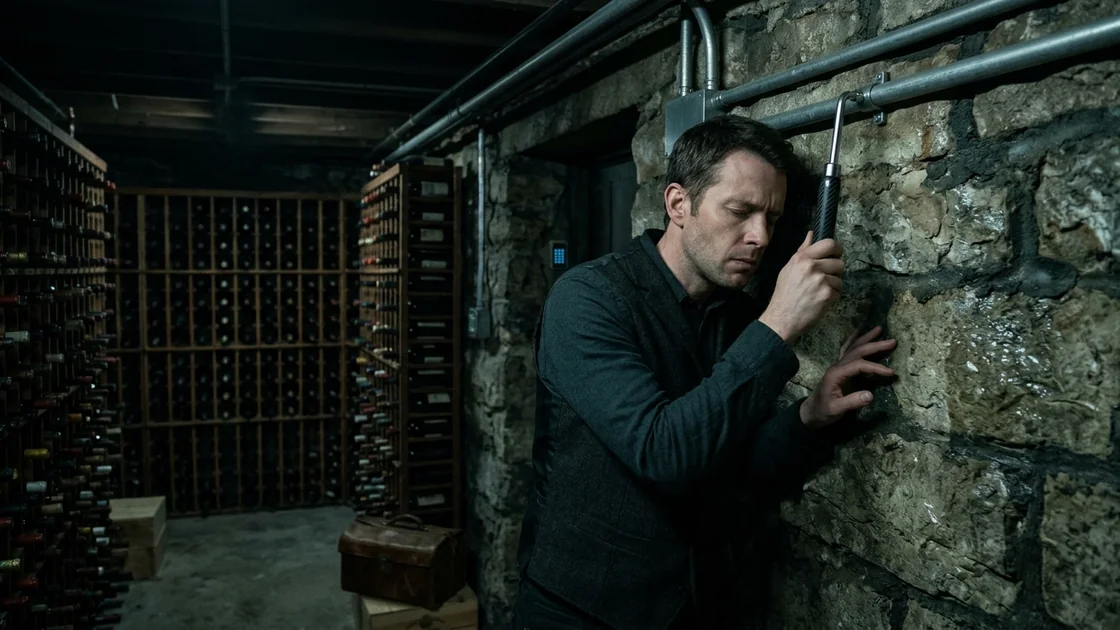
Blind piano tuner Julian Vance travels to the cliffside mansion of billionaire Alistair Thorne to service a rare concert grand piano only six days after his younger sister Clara was abducted for ransom. While working on the instrument, Julian overhears Thorne speaking to the lead police detective and recognizes the subtle vocal mechanics of his sister's kidnapper despite the man having used a digital voice disguiser during the ransom call. When the detective accepts Thorne's seemingly ironclad audio and video alibi placing him in a distant glass pavilion during the crime, Julian realizes the recording was acoustically fabricated using the mansion's complex architecture. Trapped in the estate overnight during a violent coastal storm, Julian uses his tuning tools, his mastery of sound physics, and the resonant properties of the house itself to dismantle the billionaire's alibi, locate the hidden subterranean vault where Clara is being held, and survive a deadly confrontation in the pitch dark.
The rain against the windshield of the town car did not sound like water; it sounded like thousands of tiny fingernails tapping against laminated safety glass at three hundred beats per minute. Julian Vance sat in the back seat with his leather tool case resting across his knees, his fingers resting lightly on the brass latches. He did not need to look out the window to know they had left the coastal highway and begun the ascent up the private road to Cliffhaven. He knew it because the tire noise had shifted from the broadband hiss of wet asphalt to the hollow, rhythmic clatter of interlocking Belgian cobblestones, and the low-frequency roar of the Pacific surf had dropped from his left ear into a cavern far below the chassis.
Six days. One hundred and forty-four hours since Clara’s phone had gone straight to voicemail while she was locking up her restoration studio in the arts district. Ninety-six hours since the forty-two-second audio file had arrived in an encrypted drop-box addressed to Julian and the FBI task force.
Julian pressed his thumb against the corner of his brass latch until the metal bit into his skin. People who could see believed that sound was a fleeting thing, an ephemeral ripple in the air that vanished the moment a mouth closed or a string stopped vibrating. They were wrong. Sound was physical. It was kinetic energy carving its shape into the air molecules of a room, bouncing off plaster and glass, betraying the size of the walls, the density of the floorboards, and the shape of the throat that produced it.
The car slowed, the engine pitch dropping as the driver shifted down. Ahead of them, a pair of heavy wrought-iron gates groaned open—two distinct electric motors, the left one running slightly dry on grease, whining at a sharp F-sharp above middle C.
"We're coming up to the main courtyard, Mr. Vance," the driver said. His voice was cramped by the low plush ceiling of the sedan. "Mr. Thorne's house manager is waiting under the portico."
"Thank you, Paul," Julian said quietly.
The car glided under a stone overhang. Instantly, the chaotic drumbeat of the storm was sliced away, replaced by the tight, crisp reflection of idling cylinders bouncing off quarried limestone. The door opened, letting in a gust of salt-heavy air and the faint, sharp smell of wet slate and rosemary.
"Mr. Vance? I'm Elena Rostova, Mr. Thorne's estate manager." Her voice came from five feet four inches above the pavement, slightly nasal, tightened by chronic anxiety. Her shoes were leather-soled heels that clicked with a brisk, nervous staccato. "Thank you for coming out in this weather. With the foundation recital tomorrow night, Mr. Thorne was insistent that the Fazioli be serviced today. I know you've had... personal difficulties this week."
Julian stepped out, unfolding his white carbon-fiber cane with a single flick of his wrist. The tungsten carbide tip struck the stone, sending a tiny, bright transient pulse outward. The echo returned to his ears in three milliseconds. Two massive columns flanked the doorway; the ceiling of the portico arched twenty feet overhead; the front doors were already open, revealing a cavernous interior that swallowed the ambient noise of the storm.
"Work is the only thing keeping my hands steady, Ms. Rostova," Julian said. It was only half a lie. The truth was that Detective Sarah Miller had told him there was nothing left for him to do at his apartment but wait for a second contact, and Clara's calendar—which the police had read aloud to him—listed Cliffhaven as one of the four estates she had visited during the month prior to her disappearance to inspect privately held Renaissance panels. The police had already cleared the estate's staff logs, finding nothing unusual, and Julian had been on Cliffhaven's quarterly maintenance schedule for two years, though his older partner, Arthur, usually made the drive. Three days ago, Julian had told Arthur he would take the Cliffhaven call himself. He didn't expect to find Clara here. He only wanted to breathe the air of the places she had walked before the world swallowed her.
"Right this way," Elena said, stepping back. "Mind the threshold. There is a two-inch bronze weather-strip."
Julian stepped over it cleanly, tapping his cane once on the interior floor.
The sound bloomed like a pistol shot in a cathedral.
Julian stopped dead for a fraction of a second, his head tilting three degrees to the left as the acoustic wave washed back over him. The foyer of Cliffhaven was a masterclass in architectural arrogance. The floor was honed Italian travertine—dense, non-porous, reflecting nearly ninety-eight percent of high-frequency energy. Above him, the space rose at least thirty-five feet to a coffered wood ceiling, while to his right, a sweeping cantilevered staircase curved upward without supporting risers. To his left, a long gallery stretched away toward the ocean side of the house, lined with hard, flat rectangles that broke up the mid-range reflections—canvases and wood-panel paintings hanging against Venetian plaster.
And beneath it all, buried in the structural bones of the house, was its heartbeat: the whisper of a pressurized variable-air-volume HVAC system running at an astonishingly quiet Noise Criterion of fifteen, and the faint, nineteen-kilohertz ultrasonic mosquito-whine of high-definition security cameras mounted in the upper corners of the molding.
"The conservatory is at the end of the west gallery," Elena said, her heels striking sharp, overlapping echoes that took two point four seconds to fully decay—an RT60 reverberation time that made normal conversation feel like speaking inside a marble quarry. "Mr. Thorne is currently in the library with a visitor, so we won't be disturbed."
"A visitor?" Julian asked, keeping his tone light as he followed the crisp trail of her footsteps and the faint floral trail of her soap.
"A detective from the city," Elena murmured, lowering her voice as if the paintings might overhear. "Just routine follow-up regarding your sister, actually. Since Clara was here three weeks ago examining the Crivelli triptych in the north loggia, Mr. Thorne insisted on cooperating personally rather than handing the matter to his legal team. He was terribly shaken when he heard the news."
Julian’s grip tightened imperceptibly on the handle of his tool case. Detective Miller was here.
"He's very generous with his time," Julian said.
They passed through a set of heavy pocket doors lined with brushed bronze, and the acoustic environment shifted abruptly. The harsh, icy reflections of the travertine foyer vanished, replaced by a warmer, broader spatial envelope. This was the conservatory.
Julian tapped his cane twice—once forcefully, once softly—and clicked his tongue against the roof of his mouth.
The room was a vast octagon, roughly forty feet across. Three of its walls were floor-to-ceiling structural glass facing the cliffs; he could hear the rain lashing against the exterior panes as a dull, low-mid rumble because the glass was triple-glazed laminated acoustic pane, at least an inch and a half thick. The ceiling above was not flat plaster, but suspended slats of Western red cedar angled to diffuse standing waves. Underfoot, the stone had given way to wide planks of quarter-sawn white oak glued directly to a concrete slab.
And in the center of the room sat the beast.
Julian didn't need to touch the Fazioli F308 to know where it was. A ten-foot concert grand piano with its lid raised on the full prop stick was not merely a piece of furniture; it was a massive acoustic lens. The two hundred and thirty steel and copper-wound strings, stretched across a cast-iron plate under forty thousand pounds of cumulative tension, hummed microscopically in sympathy with the room's air currents. Even at rest, the giant spruce soundboard breathed back the ambient frequencies of the conservatory, casting a warm acoustic shadow toward the center of the floor.
"Here we are," Elena said. "The humidity system in the room is set to forty-two percent, just as your firm requested, though with the storm rolling in, the barometric pressure has dropped quite a bit since yesterday. Do you need anything? Coffee? Water?"
"Nothing, thank you, Ms. Rostova. I work best in complete quiet. It will take me about three hours to fine-tune the unisons and check the regulation on the fourth pedal."
"Of course. I'll leave you to it. Just press the intercom button by the door if you need me."
Her heels clicked back toward the gallery, the heavy bronze-trimmed pocket doors sliding nearly shut behind her—stopping two inches short of the latch, caught on a thick Persian runner.
Julian stood motionless until the vibration of her footsteps vanished into the east wing. Then he walked directly to the piano bench, set his leather case on the oak floor without a sound, and ran his left hand along the cool, satin-ebony cheek of the Fazioli.
He knew this model intimately. Built in Sacile, Italy, with a soundboard crafted from the same Val diiemme red spruce that Stradivarius had used for his violins, the F308 possessed a fourth pedal to the left of the una corda that brought the hammers closer to the strings without shifting them sideways, reducing volume without altering timbre. It was an instrument worth more than three hundred thousand dollars, capable of producing a bass note so deep and pure it could rattle the fillings in a listener's teeth a hundred feet away.
Julian sat on the adjustable leather bench, flipped open his case, and laid out his tools with the ritual precision of a surgeon: his carbon-fiber tuning lever with a two-degree angled head, three tapered rubber wedges, a strip of red wool temperament felt, and his matched set of steel tuning forks.
He struck middle C gently with his right index finger.
The note rang out, rich and luminous, blooming against the cedar ceiling and sliding across the triple-pane glass. To an ordinary ear, or even a conservatory-trained pianist, the piano sounded magnificent. To Julian, it was a kaleidoscope of microscopic fractures. The extreme drop in barometric pressure from the coastal storm had caused the spruce soundboard to crown upward by a fraction of a millimeter, increasing the down-bearing pressure on the beechwood bridges. The center strings of the middle register had gone sharp by nearly four cents relative to the bass, and the three strings that made up the single middle C unison were fighting each other, producing a slow, lazy wobble—one beat every three seconds—where their sound waves collided out of phase.
Julian didn't hear music when he tuned. He heard mathematics. He heard the collision of overtones—the second partial an octave above, the third partial a twelfth above, the fifth partial two octaves and a major third higher—weaving a dense, invisible lattice in the air.
He threaded the red wool felt strip through the middle octave, muting the outer strings of each three-string group so that only the center strings could speak. He fitted the star-shaped socket of his tuning lever over the steel tuning pin for A4, lifted his 440-hertz fork to his knee, tapped it, and held the base of the stem against the wooden music desk.
The pure, sine-wave hum of the fork filled the cavity of the piano. Julian struck the A key, felt the microscopic rotational resistance of the steel pin set deep into the rock-maple pinblock, and flexed his wrist by a hair's breadth, easing the tension until the wobble between the fork and the string slowed, stretched out, and vanished into a single, laser-straight beam of sound.
He worked outward through the temperament circle, matching fourths and fifths, counting the exact number of beats per second—three beats every two seconds for a narrow fourth, one beat per second for a wide fifth—locking the foundational skeleton of the instrument into place. It was a meditative trance, a discipline that normally quieted the roaring terror that had lived behind his ribs since Tuesday night.
Today, it didn't work.
Every time a note decayed into the silence of the conservatory, Julian heard the forty-two-second recording in his head. He had convinced Detective Miller to let him keep a lossless WAV copy of the ransom call on his portable field recorder. Over the last four days, while sitting in the dark of his apartment, he had listened to it seven hundred and twelve times through electrostatic reference headphones.
“Your sister is alive. Do not contact the federal authorities again. Two million dollars in Monero will be transferred to the address in the attached text file by midnight on Sunday. If you attempt to trace the routing, or if the media prints her name before the transfer clears, you will receive her index finger in the Monday mail.”
The FBI's forensic audio lab in Quantico had run the file through every spectral deconvolution algorithm they possessed. Their report had been bleak: the caller had routed the audio through a hardware pitch-shifter and ring modulator, dropping the fundamental frequency down into a synthetic baritone rasp while scrambling the harmonic structure. Worse, the caller had used a hardware noise gate that chopped off the audio signal the instant the voice stopped speaking, leaving dead digital silence between the words so that no background noise could be isolated.
Quantico had looked at the spectrograms with their eyes. They had looked for pitch, and when the pitch was destroyed, they declared the voice unrecoverable.
Julian hadn't listened to the pitch. A pitch-shifter could alter the frequency of the vocal cords, just as tightening a piano string raised its note, but it could not change the physical geometry of the instrument itself. It could not change the length of the speaker's pharynx, the shape of his sinus cavities, or the mechanical habits of his tongue and teeth.
After the three-hundredth listen, Julian had mapped the ghost behind the machine. The speaker was a man between fifty and sixty-five—the pérdida of elasticity in the laryngeal cartilage caused a microscopic sub-harmonic rattle at the very beginning of vowel sounds, a phenomenon called creaky voice onset that a ring modulator only duplicated at a lower octave. Second, the man had a distinct alveolar click whenever he transitioned from a nasal consonant like N to a vowel, caused by an unusually dry soft palate. Third, and most fatally, when the man pronounced the word six or sister, there was a tiny, high-frequency whistle at exactly six thousand four hundred hertz—a sibilant laminar airflow escaping through a slight gap or bevel between the lower left lateral incisor and the canine tooth.
And the noise gate hadn't been fast enough to hide the room. While the gate muted the silence between sentences, the room's acoustic reflections were still mixed underneath the voice while the man was speaking. Beneath the words "Your sister is alive," Julian had isolated three things: a sixty-hertz electrical transformer hum with a strong third harmonic at one hundred and eighty hertz; a strange, hollow standing wave resonant peak at one hundred and forty-six point eight hertz—almost a perfect D below middle C; and a faint, rhythmic hydraulic thud that occurred precisely every two point four seconds.
Julian was reaching to set his rubber wedge between the strings of F-sharp above middle C when the heavy doors of the library down the east gallery opened.
He froze, his fingers hovering an inch above the ivory keys.
Because the bronze pocket doors to the conservatory were wedged two inches ajar on the Persian rug, and because the travertine gallery acted as a giant acoustic waveguide, the voices coming from the foyer traveled straight into the conservatory and reflected off the raised spruce underside of the Fazioli's lid directly into Julian's ears. It was the functional equivalent of sitting inside a six-foot parabolic microphone.
"I appreciate your thoroughness, Detective Miller," a man’s voice said, approaching the center of the foyer. "Truly, if there is anything my foundation or my private security team can do to assist the bureau, you have only to ask."
The tuning lever slipped half an inch in Julian’s palm, the carbon-fiber handle pressing hard against his lifeline.
His heart stopped. The blood in his carotid arteries roared so loudly he had to hold his breath to hear over it.
The voice was warm, patrician, and resonant, speaking at a comfortable baritone fundamental of one hundred and ten hertz. It sounded nothing like the robotic monster on the ransom tape to an untrained ear.
Until he said the word assist.
At the exact midpoint of the double-S in assist, a needle-thin whistle spiked at six thousand four hundred hertz—air jetting through a micro-bevel on the lower left canine. And when he transitioned from the N in anything to the vowel, his tongue broke away from the alveolar ridge with a wet, asymmetrical snap, preceded by a three-millisecond sub-glottal rattle on the vowel onset.
Alistair Thorne.
Julian sat paralyzed on the piano bench, his blind eyes wide and staring toward the cedar wall. His brain, honed by thirty years of comparing complex harmonic profiles to a fraction of a cent, ran the biometric comparison in real time. The cadence. The phrasing rhythm—a slight elongation of tonic vowels followed by a clipped terminal consonant. The tiny inspiratory wheeze in the left nostril caused by a minor septal deviation.
The probability wasn't eighty percent. It wasn't ninety percent. To Julian's ears, Alistair Thorne had might as well have signed his name in blood across the spectrogram.
Out in the foyer, Detective Sarah Miller spoke. Her voice was flat, exhausted, roughened by four days of stale coffee and no sleep. "Thank you, Mr. Thorne. As you know, in cases like this, we have to eliminate everyone who had contact with Clara Vance in the month prior to her abduction before we can narrow our focus. You've already provided your security logs for Tuesday night, which show you were at the symphony board dinner in downtown San Francisco until midnight. The only remaining formality is the timestamp of the proof-of-life call on Thursday afternoon."
"Ah, yes," Thorne said smoothly. His footsteps—bespoke leather loafers with rubber heel inserts—paced slowly across the travertine. "Three-fourteen PM, wasn't it?"
Again. On the word wasn't, the sibilant whistle flared at sixty-four hundred hertz.
"Three-fourteen and twelve seconds," Miller confirmed. "The call was routed through a chain of Tor exit nodes in Eastern Europe, so it had to be initiated live—the kidnapper read a headline from Thursday afternoon's two o'clock Associated Press wire to prove Clara was still breathing at that hour."
"A gruesome business," Thorne murmured. "Well, as my counsel informed your office this morning, on Thursday from two-thirty until four o'clock, I was in the North Bluff Pavilion here on the estate, chairing a live-streamed architectural review with our partners in Zurich and Tokyo. Because it involves public municipal bonds for the new waterfront museum, the entire session was recorded with continuous encrypted timestamps, both video and high-definition audio."
"Your assistant emailed the file link to my partner twenty minutes ago," Miller said. "We're still waiting for downtown to verify it, unless you have the local master here."
"Better than that," Thorne said, a note of polite triumph entering his voice. "I had Elena pull it up on the tablet here on the console table so you wouldn't have to waste another hour driving back and forth. Here—let me play the segment from three-ten to three-twenty for you."
Inside the conservatory, Julian rose silently from the bench. Moving without his cane, his socked feet sliding noiselessly after he slipped out of his oxfords, he crossed the oak floor to the gap in the bronze pocket doors. He pressed his ear three inches from the vertical crack between the door and the jamb.
In the foyer, the crisp click of a tablet screen being tapped echoed off the marble, followed by the unmistakable sound of a portable Bluetooth speaker tower engaging on the console table.
The recording began to play.
"—and if we examine the load-bearing tolerances on the third-tier cantilevers," Alistair Thorne’s recorded voice came through the speaker, clear and conversational, "you will see that the Swiss engineering team has already accounted for seismic shear. Martin, do you have the updated schematics on your screen in Zurich?"
"Yes, Alistair, we see them clearly," a heavily accented male voice replied over a conference line. "The timestamp on your revision shows fourteen-fifteen UTC—that is fourteen minutes past three your time, ja?"
"Correct," Thorne's recorded voice answered.
And then, in the background of the recording, two things happened simultaneously.
First, a deep, resonant grandfather clock began to chime the quarter-hour—the familiar four-note Westminster chime, followed by a rich, lingering decay.
Second, a heavy, thrumming low-frequency roar swept across the microphone feed—the unmistakable blade-slap of a twin-engine Sikorsky helicopter passing low along the coastline. In the recording, Thorne paused, chuckling lightly. "Pardon the noise, gentlemen. The Coast Guard is running patrols along the bluff today."
Thorne paused the playback.
"As you can see, Detective," Thorne said in the foyer, "the video feed shows me sitting at the glass conference table in the North Pavilion with the ocean behind me. The grandfather clock you hear in the recording is the eighteenth-century Thomas Tompion longcase clock standing right there in the north archway, which chimes at fourteen minutes past the hour because the mechanism runs ninety seconds fast. And if you check with Air Station San Francisco, you will find that a Coast Guard MH-65 Dolphin helicopter passed the Cliffhaven GPS coordinates heading south at precisely three-fourteen and twenty seconds on Thursday afternoon."
Julian heard the rustle of Detective Miller’s notebook closing. Her sigh carried the heavy, defeated weight of an investigator hitting a solid brick wall.
"We already pulled the FAA coastal radar logs on the drive up after your lawyer mentioned the helicopter," Miller admitted. "Flight CG-6542 passed two hundred yards off your bluff at three-fourteen and eighteen seconds. And the Zurich participants confirmed the live stream." She paused. "I'm sorry to have taken up your afternoon, Mr. Thorne. We can cross Cliffhaven off the board."
"Think nothing of it, Detective," Thorne said warmly. "I only pray you find the poor girl before Sunday night. Please, let Elena get you an umbrella for the walk to your car."
Behind the bronze pocket door, Julian stood frozen in the shadows, his fingernails digging into the flesh of his palms until they ached.
Miller was leaving. She had seen the video; she had heard the clock; she had verified the Coast Guard helicopter on radar. To a sighted detective and a team of visual analysts, the alibi was ironclad. Alistair Thorne could not have been in a hidden room reading the two o'clock news wire into a voice modulator at 3:14 PM on Thursday if he was sitting in a glass pavilion on the north bluff speaking to Zurich while a verified helicopter flew past his window and his grandfather clock chimed in the background.
Except the recording was a lie.
Julian knew it with the absolute, cold certainty of physical law. His brain didn't care what the video showed; video could be looped, greenscreened, or pre-rendered if a man owned a tech conglomerate and controlled the conference server. Audio was harder to fake, because sound obeyed the geometry of the universe in ways no layperson ever thought to calculate.
During those forty seconds of playback, Julian’s ears had dissected the recording into three distinct acoustic layers—and all three of them contradicted each other.
First: the North Bluff Pavilion, as Elena had described it to him on a previous visit last year, was a standalone glass-and-steel cube perched on the headland two hundred yards north of the main house. Yet in the recording, Thorne’s voice had an early-reflection pattern of twelve milliseconds with warm mid-frequency absorption around five hundred hertz—the exact acoustic signature of a small room lined with high-density acoustic foam or heavy drapery, not a glass cube where sound would ping-pong off four panes with a metallic flutter echo!
Second: the Thomas Tompion grandfather clock. Thorne had just pointed it out to Detective Miller standing in the north archway of the main house foyer. If Thorne had been in the North Pavilion two hundred yards away across an open, wind-swept courtyard, how had the clock's chime appeared in his microphone feed? Even if the pavilion doors were open, a chime traveling two hundred yards through outdoor air would suffer massive high-frequency atmospheric attenuation—the bright metallic strike of the hammer against the bell would be gone, leaving only the dull fundamental tone—and the sound would arrive nearly half a second late with zero indoor reverberation. Instead, the clock chime on Thorne's alibi recording had a pristine four-kilohertz hammer transient and a one-point-eight-second indoor reverb tail that matched the travertine foyer right outside this door!
Third, and most damning of all: the Coast Guard helicopter. When the helicopter passed on the recording, the forty-hertz blade-slap exhibited a textbook acoustic phenomenon called comb filtering—a sweeping, hollow phase-cancellation notch that slid from two hundred hertz down to eighty hertz. Comb filtering occurs when a direct sound wave arrives at a microphone fractions of a millisecond before the same wave bounces off a single flat, massive boundary directly behind the microphone. Based on the eighty-hertz cancellation notch, the reflecting boundary was exactly seven feet behind the microphone, and because there was zero wind buffeting on the capsule, the microphone wasn't inside a glass pavilion on an open bluff—it was mounted on the exterior southern cliff face under a stone overhang, mixed artificially into the audio track!
Thorne hadn't been in the North Pavilion at 3:14 PM on Thursday. He had mixed live feeds from the house's architectural microphones—one near the foyer clock, one outside on the cliff face—into a pre-recorded or split-channel conference track while he was somewhere else entirely.
Somewhere with a sixty-hertz transformer hum, a two-point-four-second hydraulic thud, and a standing wave at D below middle C.
Clara wasn't just taken by Alistair Thorne. She was here. Right now. Somewhere beneath or within the walls of Cliffhaven.
Out in the foyer, the heavy oak front door opened, letting in a sudden roar of wind and rain as Detective Miller stepped out under the portico.
For one wild, desperate second, Julian’s hand reached for the brass handle of the conservatory door. He wanted to fling it open, sprint into the foyer, and shout to Miller before her car pulled away. Stop! Arrest him! The comb filtering on the rotor wash is wrong! His left premolar whistles at sixty-four hundred hertz!
Julian stopped himself, his hand trembling against the cold bronze.
What would happen if he ran out there right now? Miller was a pragmatic homicide-and-kidnap detective who had just been handed a timestamped international video stream corroborated by FAA radar. If a blind, sleep-deprived brother burst out of a side room screaming about phase-cancellation notches and alveolar clicks, Miller would look at him with pity. She would think the grief and exhaustion had broken his mind. Even if she humored him and asked Thorne for permission to search the thirty-thousand-square-foot estate, Thorne’s lawyers would demand a warrant. No judge on earth would sign a no-knock search warrant for a billionaire's residence based on a piano tuner's unverified auditory opinion over an FBI forensic lab report that said the voice was unidentifiable.
And the moment Miller left to "look into it," Thorne would know Julian had made him. Within ten minutes, Clara would be dead, weighted with lead, and dropped into the submarine trench off the coast.
No. If Detective Miller was going to come back through that front door with guns drawn, Julian needed more than an acoustic theory. He needed to dismantle the alibi from the inside, find the exact room generating that 146.8-hertz standing wave, and put Clara’s living voice—or Thorne’s undeniable confession—directly into Miller’s hands.
In the foyer, the front door thudded shut.
Footsteps turned back across the travertine. Not heading toward the library. Heading west.
Toward the conservatory.
Julian moved with the speed of a striking viper. In four silent strides he was back across the oak floor, sliding his feet into his leather oxfords, sitting down on the bench, and picking up his tuning lever just as the bronze pocket doors rolled wide open.
Alistair Thorne stood in the threshold.
Julian didn't look up; blind men who looked directly at someone who hadn't spoken yet gave away how closely they were tracking footsteps. Instead, he kept his head bowed toward the bass strings, striking an F-sharp octave and tilting his right ear toward the soundboard.
"Mr. Vance," Thorne said, stepping onto the oak planks. Up close, without the travertine echo of the foyer, his voice was rich with expensive calm, accompanied by the dry, resinous scent of Vetiver cologne and the faint metallic tick of a mechanical tourbillon wristwatch beating at twenty-eight thousand eight hundred vibrations per hour on his left wrist. "I didn't realize you had already arrived. Elena told me Arthur was ill and you had stepped in."
"Good afternoon, Mr. Thorne," Julian said, his voice steady, quiet, and deferential—the invisible craftsman who existed only to serve the machine. He let his tuning lever rest on a pin and turned his head slightly toward Thorne's chest. "Yes, Arthur's arthritis flares up when the coastal fronts come in. I hope my being here isn't an imposition."
"On the contrary," Thorne said, walking slowly around the curve of the ten-foot rim, his fingertips brushing the polished ebony. "When Detective Miller mentioned you were Clara's brother, I was astonished at your fortitude. To be out working while your family is enduring such an ordeal... I cannot imagine the strain."
He was testing him. Julian could hear the microscopic tightening in Thorne's cricothyroid muscle—the slight upward creep in vocal tension that accompanied a predator watching a prey animal for a flinch.
"The police told me the worst thing I could do was sit by the telephone," Julian said softly, letting a convincing tremor of grief edge into his breath. "Here, at least, the math makes sense. If a string is out of tune, I can fix it."
"A noble philosophy," Thorne murmured. He stopped five feet from the keyboard, looking down into the gilded cast-iron belly of the Fazioli. "How is she holding up? The instrument, I mean. Signor Volpi is flying in from Milan tomorrow morning for the evening gala, and he is notoriously temperamental about the action."
Julian drew a slow breath. If he tuned the piano and walked out the front door in two hours, Paul the driver would take him back to the city, the gates of Cliffhaven would lock behind him, and by Sunday night Clara would be dead. He had to stay inside these walls past nightfall.
Julian reached his left hand deep into the action cavity, past the gilt frame, pretending to check the tension of the Sostenuto rod while his right hand played a rapid, cascading chromatic run near the top of the fourth octave.
As his left pinky dropped behind the whippen assembly of D5, his thumbnail caught the thin braided cotton bridle tape connecting the whippen to the catcher, and with a tiny, practiced twist against the brass flange screw, he popped the jack spring out of its tiny felt groove while wedging a sliver of broken cedar shim under the repetition lever.
He struck D5 four times in rapid succession.
The first note sounded. The second choked. On the third strike, the key stayed depressed at the bottom of the keybed, producing a dead, wooden thud as the hammer failed to return.
Thorne made a sharp sound of displeasure in his throat. "What was that?"
Julian frowned, leaning over the music desk and tapping the dead key twice more. "That is what I was afraid of when I felt the draft in the hallway," Julian said, shaking his head with professional gravity. "The barometric drop from this storm has driven moisture straight into the action centers. The wool bushings inside the repetition flanges are swelling against the nickel pins. Right now it’s just D5 sticking, but by eight o'clock tonight, when the humidity peaks, you’re going to have a dozen seized hammers across the middle register."
"That is unacceptable," Thorne said, the warmth vanishing from his voice, leaving the cold, clipped cadence Julian remembered from the tape. "I have forty donors coming tomorrow night paying twenty-five thousand dollars a plate. Fix it."
"I can't simply tune out swollen flange bushings, Mr. Thorne," Julian said calmly. "To prevent the action from seizing during Volpi's performance, I have to pull the action frame out of the keybed, ease the center pins on all eighty-eight keys with a sizing burnisher, and re-regulate the let-off and after-touch once the wood acclimates to the overnight temperature." He paused, calculating his bait. "That’s seven or eight hours of meticulous bench work. I can pack up now and try to come back tomorrow afternoon, though that won't leave time for the strings to settle before the concert..."
Silence hung in the conservatory for five seconds, broken only by the lash of rain against the triple-glazed glass and the rapid tick of Thorne's mechanical watch.
Thorne was weighing the risk. To Thorne, Julian Vance was a blind, harmless technician who knew nothing outside of wood and wire. Having Julian leave and return tomorrow meant disrupting the security prep for the gala; having the piano fail in front of Milan's premier soloist meant humiliation for Thorne's ego.
"Stay and finish it tonight," Thorne decided. "Elena can prepare a room for you in the staff wing if you need to rest, or my security head, Cole, can call a car for you whenever you finish—midnight, two in the morning, whenever it is done. Provided you remain in the conservatory wing. The rest of the house is locked down for security protocols at ten."
"I shouldn't need to leave this room except for the washroom down the hall," Julian said, bowing his head slightly. "Thank you, Mr. Thorne. She'll play like silk by morning."
"See that she does," Thorne said.
He turned and walked out of the conservatory, his rubber-heeled loafers whispering across the oak and then clicking onto the travertine of the gallery. This time, he pulled the bronze pocket doors all the way shut until the latch clicked home.
Julian sat alone at the keyboard, listening as Thorne’s footsteps faded into the distant east wing.
He was in.
Now he had roughly six hours until the estate settled into sleep to prepare his instruments, and the rest of the night to prove a man guilty using nothing but the air between the walls.
For the next five hours, Julian worked on the Fazioli in earnest—not because he cared about Signor Volpi’s gala, but because he knew the nineteen-kilohertz ultrasonic hum in the upper north corner of the conservatory belonged to a ceiling dome camera. If Thorne or his head of security, Cole, glanced at the monitor, they needed to see the blind piano tuner hunched over the action frame, methodically extracting keys, easing pins, and adjusting capstan screws.
While his hands worked automatically, his ears were building a three-dimensional wireframe model of Cliffhaven.
A house during a storm is not quiet; it is an acoustic wind tunnel. Every time a fifty-knot gust slammed against the western cliff face, the low-frequency pressure wave traveled through the reinforced concrete foundation and vibrated the structural steel I-beams buried in the ceilings. By listening to how those vibrations traveled through the floor beneath his feet and Up through the casters of the piano, Julian mapped the load-bearing geometry of the mansion.
Directly beneath the conservatory, the floor was solid—poured concrete directly over coastal bedrock. There was no basement under this room. However, forty feet to the east, beneath the main foyer and the library, the thirty-hertz rumble of the wind resonated with a hollow, drum-like amplification. That meant there was a subterranean level beneath the center of the house—likely the wine cellar and mechanical plant.
At eight o'clock, Elena brought him a tray with roast chicken, bread, and sparkling water. From the way her breathing hitched when she set the tray on the side table, Julian could tell she had been told he was staying late and was eager to go home to her own quarters.
"I'm heading off to the gatehouse for the night, Mr. Vance," she said. "Mr. Thorne has retired to his private suite on the upper floor, and Mr. Cole is at the security desk by the service entrance. Just pick up the house phone if you’re ready to leave."
"Have a safe walk in the rain, Ms. Rostova," Julian said.
At ten o'clock, the house changed its breathing.
Julian heard the heavy magnetic locks engage on the exterior perimeter doors—a series of dull, metallic clunks accompanied by a faint sixty-hertz electrical hum in the wall conduits. The main HVAC system stepped down into its nighttime setback mode, dropping the airflow velocity by half. The house became so still that Julian could hear the expansion ticks of the cedar ceiling slats cooling in the night air and the distant, muffled boom of twenty-foot storm swells colliding with the basalt cliffs a hundred feet below.
At eleven-thirty, Julian slid the heavy wooden action frame back into the belly of the Fazioli, replaced the fallboard, and closed his tool case—leaving out three items he slipped into the inside pockets of his dark wool vest: his carbon-fiber tuning lever, his 440-hertz tuning fork, and a small plastic canister holding twenty heavy brass center-pins and three lead key-weights.
He stood up, walked to the wall switch beside the bronze pocket doors, and flipped off the conservatory lights.
To anyone watching the security monitor, the room had just plunged into blackness, followed two seconds later by the tiny, nearly inaudible click of the camera’s mechanical infrared cut-filter sliding across the lens and the faint nineteen-Point-two-kilohertz whine of the IR LED ring powering up to illuminate the room in night-vision monochrome.
Julian didn't walk out the door. If Cole was watching the screen, seeing the blind tuner leave the conservatory would trigger an immediate interception. Instead, Julian needed to know if Cole was actually looking at the monitors, or where the guard was stationed.
He picked up the house phone on the side table and dialed zero—the operator extension Elena had mentioned.
Across the estate, far down in the northeast service wing, a console phone chirped twice before being picked up.
"Security. Cole," a gravel-toned baritone answered. Beneath his voice, Julian heard the crisp crackle of a muted television sports broadcast—the distinct cadence of a late-night basketball replay leaking from a single earbud—and the creak of a leather swivel chair leaning back. Better still, there was no acoustic feedback or slap-back from the conservatory hallway, meaning the security office was completely isolated on the far side of the kitchen wing.
"Mr. Cole, this is Julian Vance in the conservatory," Julian said apologetically. "I've just finished the action regulation and I need to let the strings settle for forty-five minutes before I do the final fine-tuning pass. I'm going to step into the washroom down the hall and then sit quietly in the dark to rest my ears—the ballast in your ceiling spotlights has a high-pitched buzz that interferes with harmonic tuning. Please don't be alarmed if the lights stay off."
Cole grunted, clearly more interested in his tablet screen than an eccentric blind tradesman. "Yeah, whatever you need, pal. Washroom's first door on the left in the west gallery. Don't wander past the foyer archway or you'll trip the motion beams for the east wing."
"Understood. Thank you."
Julian hung up the receiver.
By telling the guard he had turned off the lights because of electrical dimmer buzz—a common complaint among high-end tuners—and announcing he would be sitting motionless or using the washroom, he had just neutralized any suspicion when he disappeared from the conservatory camera feed.
Julian eased the bronze pocket doors open three inches, slipped through into the pitch-black west gallery, and left his white cane leaning inside the conservatory door.
In the dark, without his cane, Julian was no longer a disabled visitor navigating a sighted man's fortress. He was in his native element.
He used passive and active echolocation so subtle no microphone could register it as anything more than ambient settling. As he glided down the travertine gallery in his socked feet, he rubbed the pad of his right thumb lightly against his middle finger near his hip—producing a tiny, two-millisecond friction snap at eight kilohertz every ten paces.
To Julian’s auditory cortex, which had repurposed the visual center of his occipital lobe over twenty-six years of total blindness, each tiny finger-snap painted the hallway in silver ghostly relief. He perceived the flat, dead rectangles of the Renaissance paintings on his left; the six-inch projection of the marble pilasters every twelve feet; the sudden drop in air pressure against his right cheekbone—what blind navigators called facial vision, caused by thermal radiation and micro-turbulence—as he approached the open threshold of the foyer.
He stopped precisely one foot short of the foyer archway.
Just above his head, mounted in the upper right cornice, he heard the faint twenty-four-kilohertz ultrasonic ping of a dual-technology motion sensor. It wasn't just passive infrared; it was sending out an ultrasonic cone into the center of the foyer to detect Doppler shifts from a moving body.
Julian stood dead still at the edge of the archway and listened to the foyer.
Thirty feet away, in the north archway leading toward the garden terrace, stood the eighteenth-century Thomas Tompion longcase clock. Its brass pendulum swung with a stately, metallic tick-tock every one point zero seconds, running slightly fast just as Thorne had said.
And mounted directly into the ornate carved oak molding three feet above the clock’s hood was something that had no business being near an antique timepiece: a miniature, phantom-powered boundary microphone wired into a recessed wall plate, betrayed by the faint, sixty-hertz ground-loop hum of its preamplifier transformer.
Julian smiled coldly in the dark.
There it was. Piece one of the fabricated alibi. Thorne hadn't captured the clock's chime across two hundred yards of open courtyard from the North Pavilion. The mansion was wired with an architectural audio matrix—likely a commercial-grade Dante audio-over-IP network designed to pipe music and intercom feeds throughout the estate—and Thorne had placed a dedicated condenser mic right over the foyer clock so he could mix its real-time chimes into his conference call feed from anywhere on the network!
Now Julian needed to find where all those network cables converged—and where the 146.8-hertz standing wave lived.
He couldn't cross the foyer without tripping the ultrasonic motion sensor. Instead, he turned left, toward the washroom door Cole had cleared him to use, and paused beside the recessed service panel set into the wainscoting next to it.
Wait. Directly opposite the washroom was a secondary door fitted with a heavy neoprene acoustic gasket around the frame.
Julian pressed his ear against the seam of the gasketed door.
Down below, muffled by a flight of concrete stairs, he heard the deep, purring hum of three-phase electrical transformers and the whisper of chilled-water pipes. The basement access staircase. And because it was inside the west gallery perimeter, behind the foyer's ultrasonic curtain, it wasn't covered by the foyer sensor.
Julian tested the brushed-steel lever handle. It was unlocked—service staff and catering crews would need it tomorrow morning to bring up cases from the wine cellar.
He eased the door open an inch at a time, counting to ten between each movement to ensure the pneumatic closer didn't hiss, slipped onto the concrete landing, and let the door seal shut behind him.
The darkness here was absolute—the subterranean, airless dark of a tomb.
Julian stood at the top of the stairs and listened.
The basement was divided into three distinct acoustic zones. To his left, at the bottom of the stairs, the air smelled of damp cedar and cork, and the reflections were broken up by thousands of small cylindrical surfaces: the wine cellar. Straight ahead, behind a heavy fire door, roared the sixty-hertz electrical switchgear and the HVAC chillers.
And to his right, beyond the wine cellar, there was a long, narrow corridor where the air temperature dropped by four degrees—and from the far end of that corridor, vibrating through the soles of Julian’s socks, came a dull, heavy thud... thud... thud.
Julian reached into his pocket, pulled out his mechanical wrist chronometer with its flipped-open Braille dial, and felt the sweeping second hand against his fingertip while counting the thuds.
One. Two. And four-tenths of a second.
Thud.
One. Two. And four-tenths of a second.
Thud.
It was the hydraulic wave-damper or high-pressure sump pump mounted in the lower sea-cave foundation to keep the storm surge out of the cliffside pilings. The exact rhythmic heartbeat he had heard beneath the noise gate on his sister’s ransom call.
Julian’s pulse hammered against his eardrums. He forced himself to breathe through his nose, slow and silent, as he descended the concrete steps.
At the bottom of the stairs, he paused. A ceiling camera hummed softly at nineteen kilohertz directly above the main wine cellar aisle, aimed at the vintage cages. If Cole glanced at the basement feed, the central aisle was exposed.
Julian crouched low, keeping the six-foot oak wine racks between his body and the high-frequency whine of the camera lens. Using the racks as cover, he crept along the outer limestone foundation wall toward the back of the cellar.
At the end of the racks, the cellar terminated in what felt like a solid wall of rough-hewn decorative limestone blocks stacked floor to ceiling.
Julian reached out with both hands, pressing his palms flat against the cold stone.
To a sighted person—even to a police search team tapping the stones with a flashlight—this was the natural bedrock wall of the cliff.
Julian didn't trust his hands alone. He pulled the 440-hertz steel tuning fork from his vest pocket, struck the tines sharply against the heel of his shoe, and pressed the metal base of the fork directly against the limestone block at chest height.
For two blocks to the left, the stone swallowed the vibration immediately; the sound was dead, dampened by ten thousand tons of solid coastal earth behind it.
Then he moved the vibrating fork twelve inches to the right and pressed it against the next mortared joint.
A faint, metallic ring sang back into his fingertips, accompanied by a hollow cavity resonance an octave lower.
Behind that three-inch veneer of sliced limestone facing was a half-inch steel security plate and an air gap.
A hidden door.
Julian ran his sensitive fingertips over the mortar joints surrounding the hollow section. The door was four feet wide and six feet eight inches tall. On the right side, hidden inside a deep vertical crevice between two jagged limestone blocks, his fingers found a recessed biometric keypad and a magnetic shear-lock housing that buzzed faintly with twenty-four-volt current.
He couldn't pick a biometric lock. And if he shorted it out right now, an alarm would instantly flash on Cole’s security console upstairs.
Wait. He needed to know if Clara was inside that room right now—and he needed to know if the room behind this steel door matched the acoustic signature of the crime before he risked everything on a breach.
How do you listen through a soundproofed steel door?
You don't listen through the air. You listen through the steel conduits that penetrate it.
Julian reached up along the top of the limestone wall where the ceiling joists met the rock. Tucked above the decorative stone molding was a two-inch galvanized steel pipe carrying the high-voltage electrical conduit and the fiber-optic Dante network lines directly through the rock header into the hidden chamber.
Julian took his carbon-fiber tuning lever from his vest, wedged the hardened steel socket tightly against the galvanized conduit pipe, and pressed the bone right behind his left ear—his mastoid process—firmly against the wooden handle of the lever.
The bone-conduction pathway bypassed his outer ear entirely, sending the mechanical vibrations of the pipe straight into his cochlea.
Instantly, the hidden room bloomed inside his skull.
First came the sixty-hertz electrical hum of a dedicated isolation transformer inside the room.
Second came the resonant hum of the room's air volume vibrating against the pipe—a steady, unmistakable standing wave peaking at one hundred and forty-six point eight hertz. Because the speed of sound in cool subterranean air is eleven hundred and twenty-five feet per second, a standing wave at 146.8 hertz meant the hidden room had an interior dimension that was an exact multiple of the half-wavelength: three點eight-three feet, or doubled to seven feet eight inches high by fifteen feet four inches long!
And then, traveling along the rigid steel pipe from inside the vault, Julian heard a sound that made his throat close up so tightly he nearly choked.
A dry, exhausted cough, followed by the metallic clink of a small glass bottle being set on a steel table, and a quiet, ragged voice murmuring to itself to stay sane in the dark:
"Red ochre, lead-tin yellow, azurite... focus, Clara, keep your hands steady..."
It was Clara.
She was alive. She was less than four feet away from him, locked inside a subterranean restoration bunker, being forced to work on something under lights that never told her whether it was day or night.
Julian lowered the tuning lever from his mastoid bone, tears scalding his sightless eyes in the pitch dark. He wanted to bang on the pipe, to scream her name so she would know he had found her, that she wasn't alone.
He bit his own lip until he tasted copper. If he startled her and she cried out, or if there was an active microphone inside her cell monitored by Thorne upstairs, they would both be dead within five minutes.
Julian backed away from the wall, his mind racing at fever pitch.
Why had Thorne kidnapped Clara, staged a two-million-dollar crypto ransom demand to the FBI, and locked her in a subterranean vault beneath his own estate?
“Red ochre, lead-tin yellow, azurite...”
Those were Renaissance pigments. Three weeks ago, Clara had come to Cliffhaven to examine Alistair Thorne’s newly acquired Crivelli triptych before it was unveiled at tomorrow night's foundation gala and donated to the museum for a forty-million-dollar tax write-off and international prestige. If Clara had discovered the triptych was a modern forgery—or worse, a Nazi-looted masterpiece with a falsified provenance layer that she refused to sign off on—Thorne couldn't simply murder her in her studio without drawing homicide detectives directly to her client list. Instead, he had abducted her, forced her to chemically alter the painting's ground layer or forge an authentication report in his basement vault, and staged a random, greedy ransom kidnapping that would end with her "kidnappers" killing her on Sunday night once the work was finished!
And Detective Miller had already walked out the front door, convinced Thorne was innocent because of a manipulated audio-video stream.
Wait. If Julian called 911 or Detective Miller right now from the house phone and said, I'm in the wine cellar and I heard my sister through a pipe, what would happen? The moment he dialed out from the estate PBX system—or the moment police cruisers turned onto the two-mile coastal drive with sirens or headlights—Cole would alert Thorne. Thorne had a fifteen-minute head start before any police unit could breach the iron gates of Cliffhaven. In fifteen minutes, a man with a subterranean sea-cave access and a weighted boat or a sealed vault could make Clara—and Julian—vanish forever, or flood the chamber and claim he knew nothing about an old smuggling tunnel.
Even worse, if Thorne simply opened the hidden vault door during the fifteen-minute approach, moved Clara into the sea cave, and wiped the hard drives, it would still be Julian’s word against Thorne’s ironclad Zurich alibi.
Julian couldn't call the cavalry until two things were accomplished: first, he had to get that vault door open or get control of the room where the audio matrix lived so Thorne couldn't reach Clara; second, he had to broadcast undeniable, real-time physical proof to Detective Miller before Thorne realized the trap had been sprung.
How did Thorne control the vault and the audio matrix?
Julian pressed his ear back to the tuning lever against the conduit pipe and traced the pipe with his free hand along the ceiling of the wine cellar.
The fiber-optic and audio lines didn't just go upstairs toward the main house. A thick braided trunk line branched off thirty feet back, running into a smaller cedar-paneled room adjacent to the wine cellar that smelled faintly of solder, warm silicon, and leather.
The estate's media and server room.
Julian crept back along the wine racks, staying below the camera's nineteen-kilohertz cone, until he reached the cedar door of the server room. It had a standard mechanical pin-tumbler lock—meant to keep out curious guests, not a man whose fingers could feel metal tolerances to a ten-thousandth of an inch.
Wait—he didn't even need to pick it. The door wasn't latched properly; a thick temporary coaxial cable had been run across the threshold from the exterior conduit box, propping the latch bolt back by a sixteenth of an inch!
Thorne had run that temporary coax cable from the exterior southern cliff microphone straight into the server room on Thursday to mix the live Coast Guard helicopter and ocean ambiance into his Zurich call.
Julian pushed the cedar door open and stepped inside, pulling it almost shut behind him.
The room was ten feet by twelve, humming with the cool, dry breeze of dedicated server fans. Along the left wall stood three nineteen-inch equipment racks loaded with network switches, uninterruptible power supplies, and—at chest height in the center rack—a Yamaha digital mixing console and a sixty-four-channel Dante audio patch bay connected to a workstation PC.
And sitting on the desk next to the mixing console was a leather-bound notepad and a dedicated biometric master controller wired directly into the wall conduit heading toward the hidden vault.
Julian’s fingers flew over the mixing console. He didn't need to see the screen to know a sixty-four-channel digital matrix; he had spent dozens of hours in recording studios tuning Steinways for symphony engineers. Every physical fader channel had a plastic scribble-strip lip, and plugged into inputs one through four were heavy Neutrik XLR connectors labeled with embossed plastic tape—thick enough that Julian could read the raised capital letters with the tip of his right index finger like oversized Braille:
Channel 1: FOYER CLOCK Channel 2:
S. CLIFF EXT Channel 3: N. PAVILION Channel 4:
VAULT INTERCOM
And next to the console sat a small black hardware box with four rotary potentiometers and an XLR microphone input: the hardware ring-modulator and pitch-shifter Thorne had used to make the ransom call!
Julian’s chest heaved as the entire blueprint of the crime locked together under his fingertips. On Thursday at 3:14 PM, Thorne had stood right here in this twelve-by-ten server room—or inside the vault next door—conducting the Zurich conference call over a pre-rendered video loop of himself in the North Pavilion while blending Channel 1 (the foyer clock) and Channel 2 (the southern cliff microphone capturing the Coast Guard helicopter) into his outgoing audio bus. Then, during a ninety-second period when his Swiss colleague was speaking on the conference call, Thorne had muted his conference mic, turned to the hardware pitch-shifter on his left, and recorded the live proof-of-life ransom call with the two o'clock news headline while the vault intercom channel bled that 146.8-hertz standing wave and the 2.4-second sea-cave sump pump into the background!
Suddenly, from the ceiling speaker above the workstation—which was tied into the internal security intercom at low volume—Julian heard the distinct sound of the elevator in the main house arriving at the ground floor, followed by a double-click of a radio handset.
"Cole," Alistair Thorne’s voice came through the security channel, crisp and wide awake. "I can't sleep with this wind hammering the shutters. Why is the conservatory camera showing an empty bench? Where is the tuner?"
Julian’s blood turned to ice water.
"He called down twenty minutes ago, Mr. Thorne," Cole’s voice replied over the radio. "Said the spotlights were buzzing and he was going to use the washroom in the west gallery and sit in the dark to rest his ears while the strings settled."
A three-second silence stretched over the radio. When Thorne spoke again, the patrician warmth was gone, replaced by a razor-sharp chill.
"The conservatory spotlights are low-voltage DC LEDs, Cole. They don't have magnetic ballasts, and they don't buzz. Check the west gallery washroom. Now. I'm coming down."
Julian had less than ninety seconds before Cole reached the basement stairs and saw the temporary coaxial cable disturbed at the server room door.
He couldn't outrun an armed security guard up a single flight of stairs. And he couldn't open the vault door without Thorne's thumbprint on the biometric reader on the desk—or could he?
Julian’s hands traced the back of the biometric master controller on the desk. The controller was wired into a twenty-four-volt magnetic shear lock via a standard green Phoenix screw-terminal block. Magnetic locks are fail-safe by fire code: they only stay locked as long as twenty-four volts of direct current are flowing through the electromagnet. Cut the power, and the magnet releases instantly!
Wait—if he pulled the green terminal block right now, the vault door would unlock with a loud metallic clank, and an alarm would scream on Cole's belt before Julian could even get Clara up the stairs, trapping them both in a dead-end basement against two armed men!
No. He needed Thorne and Cole to come down here—and he needed Detective Sarah Miller listening to every single word when they did.
Beside the mixing console sat the estate’s VoIP studio telephone interface—the exact unit patched into the Dante network that allowed calls to be routed through the mixing board for remote conferences.
Julian tapped the hook switch, dialed Detective Miller’s direct cell
number—which he had memorized to the last digit four days ago—and
flipped the routing toggle switch on Channel 1 through Channel 4 to
LIVE BUS A - OUTGOING PHONE.
In his ear, through the console's monitor headphone jack which he held for half a second against his cheek, the line rang once. Twice. Three times.
At one o'clock in the morning, a desperate detective working a kidnapping case always answers her phone, or lets it roll to a live recording voicemail.
On the fourth ring, the line clicked open.
"Julian?" Detective Miller’s sleep-rough voice rasped through the single headphone cup. "Julian, it's one-fifteen in the morning, has there been a second contact—"
Julian didn't answer her into the desk mic. If he spoke now, Miller wouldn't have enough to get a tactical team through the gates before Thorne killed him, or the phone sound would alert Thorne. Instead, Julian slid the outgoing listen-bus faders all the way up—connecting Miller’s open cell phone line directly to the hidden ceiling microphones in the wine cellar, the vault intercom, and the grand conservatory upstairs—while muting the return path so Miller’s voice couldn't be heard in the house!
Then he leaned two inches from the studio condenser microphone on the desk and whispered at the lowest audible register:
"Don't speak, Detective. Your line is muted on my end. Put this call on recording and trace my cell tower or dispatch tactical units to Cliffhaven immediately. I am in Alistair Thorne's basement server room. Clara is alive inside a hidden vault behind the wine cellar. Stay on the line—I'm going to let him explain how he faked the Zurich alibi himself."
Julian didn't wait for a reply. He gripped the green twenty-four-volt power terminal on the back of the vault lock controller, yanked it free from its socket—cutting the power to the hidden vault's magnetic lock—and slipped out of the server room just as the heavy door at the top of the basement stairs burst open.
Footsteps pounded down the concrete steps—two pairs. Cole’s heavy tactical boots in front, followed by the brisk, lethal tread of Alistair Thorne.
In the back of the wine cellar, as the twenty-four-volt capacitor bled out, the magnetic shear-lock on the hidden limestone door released with a sharp, echoing CLANG, and the heavy steel-backed stone door swung two inches ajar under its own counterweighted balance.
"He's in the cellar!" Cole barked, the barrel of a drawn pistol clicking against the safety catch as the guard rounded the wine racks. "The vault door is tripped!"
Julian didn't hide. If he hid among the racks, they would shoot into the dark or seal Clara back inside before saying a word. Instead, he stepped calmly out into the center aisle between the vintage Bordeaux cages, standing directly beneath the hidden ceiling microphone that was streaming high-definition audio up to the server room's VoIP line.
"Hold your fire, Cole," Thorne’s voice commanded sharply from ten feet behind the guard.
The bright beam of a tactical flashlight slammed into Julian’s face—he felt the tiny radiant heat of the high-lumen LED beam on his skin—and stopped.
For a long moment, nobody moved. The only sounds in the cellar were the sixty-hertz hum of the machinery, the 2.4-second thud of the sea-cave pump through the cracked vault door, and the ragged breathing of the two men staring at an unarmed blind man standing in his socked feet with a carbon-fiber piano tuning lever in his right hand.
Behind Julian, from the two-inch gap in the limestone wall, a weak, disbelieving gasp echoed out into the cellar.
"Julian?" Clara’s voice trembled through the crack. "Julian, is that you? Get out of here, it's Thorne, he has a gun—"
"Be quiet in there, Miss Vance," Thorne called out smoothly, walking past Cole until he stood twelve feet from Julian. He wasn't even breathing hard. "Keep your gun on him, Cole, though I hardly think a tuning wrench presents a ballistic threat." Thorne paused, tilting his head as he studied Julian in the flashlight beam. "I must admit, Mr. Vance, I am fascinated. The FBI's cyber division spent four days chasing servers in Bucharest, and Detective Miller left my foyer seven hours ago apologizing for the inconvenience. How on earth did you end up down here?"
Julian kept his posture slightly hunched, playing into Thorne’s overwhelming narcissism. A billionaire who believed he had engineered the perfect crime could never resist diagnosing the single flaw in his masterpiece when he believed the only witness was already dead.
"You shouldn't have spoken to me in the conservatory," Julian said, his voice carrying clearly into the overhead boundary mic ten feet above Thorne's head. "And you shouldn't have played that alibi recording for Detective Miller while the pocket doors were open."
Thorne let out a soft, incredulous laugh. "The recording? My dear man, the recording was verified by three bankers in Zurich and the United States Coast Guard."
"Your left lateral incisor has a micro-bevel that whistles at six thousand four hundred hertz whenever you make a double-S sound," Julian said calmly. "A hardware ring modulator drops the fundamental pitch of your vocal cords, Mr. Thorne, but it doesn't filter out high-frequency laminar airflow above five kilohertz unless you put a low-pass filter in the chain. You forgot the low-pass filter on Thursday's ransom call."
Thorne’s breath stilled slightly. "An amusing theory. Hardly something you could prove."
"I didn't need to prove your teeth," Julian continued, taking a half-step sideways so Thorne would naturally turn to face him, orienting Thorne's mouth directly toward the ceiling microphone's cardioid pickup pattern. "Your alibi recording was an acoustic impossibility. You told Detective Miller you were in the North Bluff Pavilion two hundred yards away. Yet the Thomas Tompion clock in your foyer chimed on the recording with a four-kilohertz hammer transient and a one-point-eight-second indoor travertine reverb tail. And the Coast Guard helicopter had an eighty-hertz comb-filtering notch that only happens when rotor wash reflects off a vertical limestone wall seven feet behind a fixed microphone—like the exterior mic mounted on your southern cliff face."
Julian gestured slightly toward the server room door. "You weren't in the pavilion on Thursday at three-fourteen. You pre-recorded the video loop, sat at the Dante mixing console in that server room blending the foyer clock mic and the cliff mic into the Zurich audio feed, and used the ninety seconds while Martin was speaking in Zurich to record my sister's ransom call through the pitch-shifter on your desk. That's why the ransom call has a 146.8-hertz standing wave underneath your voice—it bled through the open intercom channel from this seven-foot-eight-inch vault while Clara was locked inside."
Silence hung in the damp air of the wine cellar for four full seconds.
Then Alistair Thorne clapped his hands together once—a dry, slow sound of genuine admiration.
"Bravo," Thorne said quietly. "Truly, Mr. Vance, if your sister had possessed half your pragmatism instead of her tiresome moral rigidity, none of us would be standing in a cold cellar at one in the morning. All she had to do was sign the conservation condition report certifying that the Crivelli triptych's ground layer was uninterrupted fifteenth-century gesso, instead of threatening to report the Linz museum inventory stamp she found under ultraviolet light."
Behind Julian, Clara's voice rang out, fierce despite her exhaustion: "That painting was stolen from a family in Vienna in nineteen forty-one! You had me strip the backing board to hide the restitution mark!"
"And by four o'clock this morning, now that you've finished re-varnishing the cradle, the ultraviolet fluorescence will match the seventeenth-century restoration records," Thorne replied conversationally. "By Sunday midnight, the FBI will assume your abductors panicked when the crypto transfer failed, and by Monday night the triptych will hang in the civic museum with an impeccable provenance." He sighed, looking back at Julian. "As for you, Mr. Vance... a tragic accident, really. A blind man, distraught over his missing sister, stayed late to work on the piano, became disoriented when he wandered onto the south terrace during a gale-force storm, and went over the low parapet onto the rocks below."
"You can't kill both of us here," Julian said, his fingers tightening around the carbon-fiber tuning lever while his left hand slipped into his vest pocket, wrapping around the twenty brass center-pins and lead key-weights. "Detective Miller—"
"Detective Miller is asleep in her bed forty miles away," Thorne interrupted coldly. "And the storm will wash the rocks clean by dawn. Cole, secure him. Don't shoot him in the cellar—blood in the limestone grout is impossible to explain if the dogs ever come through. Use the zip-ties, and we'll take him up to the terrace."
"Right," Cole grunted, holstering his pistol or shifting it to his left hand as his heavy boots crunched forward across the floor.
That was what Julian had been waiting for.
A man aiming a pistol from fifteen feet away cannot be beaten by a blind man. A man who has been ordered not to fire indoors, stepping within arm's reach while holding a flashlight in a narrow aisle between seven-foot oak wine racks, is entering a world governed by mass and velocity—provided you take away his eyes.
Wait—the cellar wasn't dark right now; the overhead low-voltage work lights were on, and Cole held a flashlight.
How do you plunge a subterranean basement into total pitch blackness without touching a wall switch?
When Julian had stepped out of the server room ninety seconds ago, he had noticed the master residual-current circuit breaker panel mounted on the cedar wall just outside the server room door—and before stepping into the aisle, he had unlatched the panel cover and wedged a stripped copper grounding wire a millimeter away from the main lighting bus bar, held back only by a loop of piano wire wrapped around the bottom rack upright next to his heel!
As Cole stepped within six feet, reaching for the plastic zip-ties on his belt, Julian kicked his right heel backward against the bottom of the oak wine rack.
The piano wire snapped taut, pulling the bare copper ground straight across the two-hundred-amp lighting bus inside the breaker box.
CRACK-ZZZT!
A blinding blue arc flashed in the hallway, the main ground-fault breaker tripped with the force of a shotgun blast, and every light in the basement—except the isolated battery-backup server rack inside the closed media room—died instantly.
Total, absolute subterranean darkness swallowed the cellar.
"What the—" Cole barked, swinging his flashlight beam wildly as his pupils struggled to dilate from the sudden glare of the electrical arc.
Julian didn't run away from the flashlight. He knew the exact geometry of the human body from the position of Cole's voice—six feet two inches tall, right hand on his belt, left hand holding the flashlight at chest height.
Before Cole's eyes could adjust, Julian whipped his left hand upward, flinging the handful of heavy lead piano key-weights and brass pins high into the far left corner of the wine cellar, twenty feet behind Thorne.
A dozen three-ounce lead weights slammed into a rack of empty magnum bottles with a deafening, shattering crash of glass and wood.
Instinct is faster than thought. At the explosive crash behind them, both Cole and Thorne whipped their heads and the flashlight beam around toward the back left corner of the cellar!
In that half-second while the flashlight beam swung away, Julian lunged forward in complete silence.
He didn't swing blindly. He heard the intake of Cole's breath and the nylon rustle of the guard's jacket sleeves twenty-eight inches in front of him. Julian drove the heavy, hardened-steel star socket of his twelve-inch tuning lever upward in a compact, vicious arc straight into Cole’s left forearm—shattering the radius bone with an audible snap and sending the tactical flashlight spinning across the concrete floor where its lens smashed against the stone wall and blinked out!
Now the darkness was total.
Cole screamed, dropping to one knee as his right hand fumbled frantically for his holster. Julian didn't give him the quarter-second needed to draw. Stepping inside the guard's reach, Julian hooked his left foot behind Cole's ankle and drove the steel head of the tuning lever down against the side of the guard's collarbone and carotid sinus, sending the two-hundred-pound man crashing into the cantilevered oak wine rack.
Two hundred bottles of vintage Bordeaux toppled inward as the rack gave way, burying the stunned guard under four hundred pounds of splintered oak and cascading glass.
"Cole!" Thorne shouted in the black dark.
From ten feet back toward the stairs, Julian heard the unmistakable metallic slide of a compact semi-automatic pistol being racked in Thorne’s hands. Thorne had been carrying his own weapon under his dressing gown.
Julian didn't wait for the muzzle flash. He grabbed Clara’s cold, trembling hand as she stumbled out of the open vault doorway, pulled her low behind the second row of heavy oak wine casks, and pushed her rapidly toward the concrete staircase while the sound of smashing wine bottles masked their bare and socked footsteps.
BANG! BANG!
Two nine-millimeter rounds erupted in the confined stone cellar. To Julian, the gunshots were like physical blows to the skull, a deafening broadband shockwave of one hundred and sixty decibels that temporarily flattened his high-frequency hearing into a ringing white roar. The bullets punched into the empty vault doorframe where Julian had been standing two seconds earlier, spraying stone chips across the cellar.
"Go up the stairs!" Julian hissed into Clara’s ear, pushing her onto the bottom concrete risers as his hearing fought to recover through the tinnitus. "Lock yourself in the washroom or break a window in the gallery—run!"
"Julian, no, come with me!" she gasped, clutching his vest.
On the cellar floor twenty feet behind them, Thorne’s leather loafers crunched rapidly over broken glass, heading straight for the staircase. If Julian went up the stairs directly behind Clara, Thorne would hear them on the steps and fire blindly up the narrow concrete chute, hitting them both in the back!
"Go!" Julian shoved her upward onto the landing and turned back into the mouth of the cellar, intentionally striking his steel tuning lever against the iron handrail at the base of the stairs before diving sideways through the alternate service doorway that led up the secondary spiral stair into the conservatory!
CLANG!
At the ring of steel on the main staircase handrail, Thorne fired twice more up the main stairwell—a hair's breadth after Clara rolled through the upper gallery door—and then paused as he heard Julian’s footsteps sprinting up the secondary service steps into the conservatory.
Thorne didn't go after Clara in the main house; he knew Clara had no idea about the server room or the technical proof, or he realized in a flash of cold rage that Julian was the one who had unraveled his entire life's work. Better still, the conservatory was a sealed dead end at the edge of the cliff.
Julian burst through the low service panel into the vast, forty-foot octagon of the conservatory and slammed the bronze pocket doors leading to the gallery shut, throwing the heavy deadbolt just as Clara's footsteps raced safely toward the front foyer outside.
Wait—Thorne hadn't followed Clara up the main stairs at all. He had come right behind Julian up the concrete service spiral from the mechanical room!
The service door at the back of the conservatory banged open.
Alistair Thorne stepped onto the quarter-sawn oak floor, breathing hard, the nine-millimeter pistol gripped in both hands.
The conservatory was pitch dark—the storm outside had knocked out the exterior landscape floods, or the tripped ground-fault breaker had killed the west wing sub-panel, leaving only the faint, slate-gray sheen of storm clouds over the churning Pacific thirty feet beyond the triple-glazed glass.
Julian stood on the far side of the ten-foot Fazioli concert grand, twenty-five feet from Thorne, completely still.
And up in the cedar ceiling slats, directly above the center of the piano, the recessed studio condenser microphone that Thorne used to record recitals was still live—feeding every breath through the Dante network down to Detective Sarah Miller’s open phone line.
"There is nowhere left to go, Mr. Vance," Thorne said, his voice tight and echoing slightly off the glass walls as he took three slow steps into the room. Even in the faint storm-light from the ocean windows, the huge black mass of the ten-foot piano hid Julian crouched behind the curved bass rim. "The terrace doors are magnetically locked until morning. Stand up and drop the wrench."
Julian didn't stand up. His ears were still ringing at four kilohertz from the cellar gunshots, dulling his high-frequency echolocation, so he couldn't rely on tiny finger-snaps to pinpoint Thorne's gun barrel.
He needed a bigger sound source.
He had a three-hundred-thousand-dollar, ten-foot acoustic weapon sitting right in front of him.
Julian crept noiselessly underneath the belly of the Fazioli, where the four heavy brass pedals rose through the lyre assembly into the underside of the keybed. With his left hand, he reached up and jammed his tapered rubber tuning wedge straight into the mechanical linkage of the right-hand sustain pedal—locking all eighty-eight felt dampers completely off the strings!
Instantly, the Fazioli became an open, hyper-sensitive acoustic chamber. Every single one of its two hundred and thirty strings was now free to vibrate in sympathy with any sound in the room.
When Thorne took a single step forward across the oak floor and his leather heel creaked at three hundred hertz, the D4 and E-flat4 strings inside the piano sang back a ghostly, shimmering phantom chord that betrayed Thorne's exact distance and angle!
Thorne froze at the uncanny metallic whisper coming from the piano. "What are you doing?" he snapped.
The moment Thorne spoke, his baritone voice excited the bass strings of the Fazioli—the heavy copper-wound A1 and B1 strings hummed directly above Julian's head, triangulating Thorne’s voice against the parabolic reflection of the raised ten-foot lid!
Thorne was twelve feet from the treble curve of the piano, moving slowly clockwise toward the keyboard, his pistol raised at chest height.
"You left the server room door open, Mr. Thorne," Julian said quietly from beneath the center of the spruce soundboard. Because Julian was speaking directly into the curved wooden underside of the soundboard, the piano amplified and diffused his voice across the entire forty-foot room at once, making it sound as though he were standing in three different places simultaneously!
Thorne spun thirty degrees to his left, aiming at the empty bench, then jerked the barrel back toward the tail of the piano as the cedar ceiling slats bounced Julian's voice from behind him. "Come out from behind there!"
"When you ran that temporary coaxial cable across the server room floor to fake the Coast Guard helicopter," Julian’s omnidirectional voice echoed from the humming strings, "you propped the latch open. Your Dante mixing console has been streaming Input Four and the conservatory ceiling mics onto an open VoIP line to Detective Sarah Miller’s cell phone for the last eight minutes. She heard Clara in the vault. And she heard every word you said about the Crivelli triptych."
Thorne let out a ragged, furious breath—the wet alveolar click and the deviated septum wheeze echoing off the spruce soundboard like a bass drum to Julian’s ears.
"Then it hardly matters how you die, does it?" Thorne snarled, lunging around the cheek of the keyboard as his eyes finally caught the dark silhouette of Julian rising behind the open lid!
Julian didn't wait for the trigger pull.
He knew the exact weight of a Fazioli F308 concert lid—eighty-five pounds of solid laminated spruce and high-density lacquer balanced on a single polished brass prop stick forty inches above the cast-iron frame.
As Thorne stepped directly beside the treble rim and thrust his pistol arm across the open cavity of the piano to fire at point-blank range, Julian hooked his carbon-fiber tuning lever around the base of the brass prop stick and wrenched it backward with all his strength while slamming his left hand down across the lowest two octaves of the bass keys!
A thunderous, apocalyptic roar of twenty-four bass strings erupted at a hundred and ten decibels inside Thorne's face—shattering the billionaire's equilibrium—and an instant later, the eighty-five-pound concert lid came crashing down like a guillotine!
CRACK!
The solid hardwood edge of the falling lid slammed down directly across Thorne’s extended wrists and the barrel of the nine-millimeter pistol against the bevel of the piano rim!
The gun discharged once into the oak floorboards as the bones in Thorne’s right wrist snapped under the immense kinetic impact of the lid, and the pistol clattered harmlessly across the polished floor into the dark.
Thorne collapsed to his knees beside the keyboard with a strangled cry, clutching his shattered wrist against his chest as the cavernous reverberation of the bass chord and the slammed lid slowly decayed across the cedar ceiling.
Julian vaulted cleanly over the piano bench, kicked the fallen pistol twenty feet away against the glass wall, and stood over Thorne in the dark, the heavy steel tuning lever raised in his fist.
Far outside, cutting through the howl of the coastal wind and the roar of the Pacific surf, a new frequency rose along the cliffside road—a sweeping, oscillating siren wail jumping between six hundred and fourteen hundred hertz as half a dozen police cruisers and highway patrol units tore through the open iron gates of Cliffhaven, where Clara had already hit the emergency release button in the foyer.
Red and blue strobes flashed silently through the triple-glazed glass of the conservatory, painting the black satin curve of the piano in alternating washes of crimson and sapphire that Julian could neither see nor needed to see.
Julian lowered the tuning lever slowly to his side.
He reached down with his left hand into the gap beneath the closed lid, pulled the rubber wedge free from the sustain pedal linkage so the felt dampers dropped softly back onto the strings, and silenced the echoes of the room.
Then he sat down on the leather bench, rested his hands on his knees as the front doors of the mansion burst open to the sound of Detective Miller calling his and Clara's names, and reached out with one finger to strike middle C.
The three steel strings vibrated together in the dark—pure, steady, and completely without beats.