The Acoustic Ledger of the Grey Sound
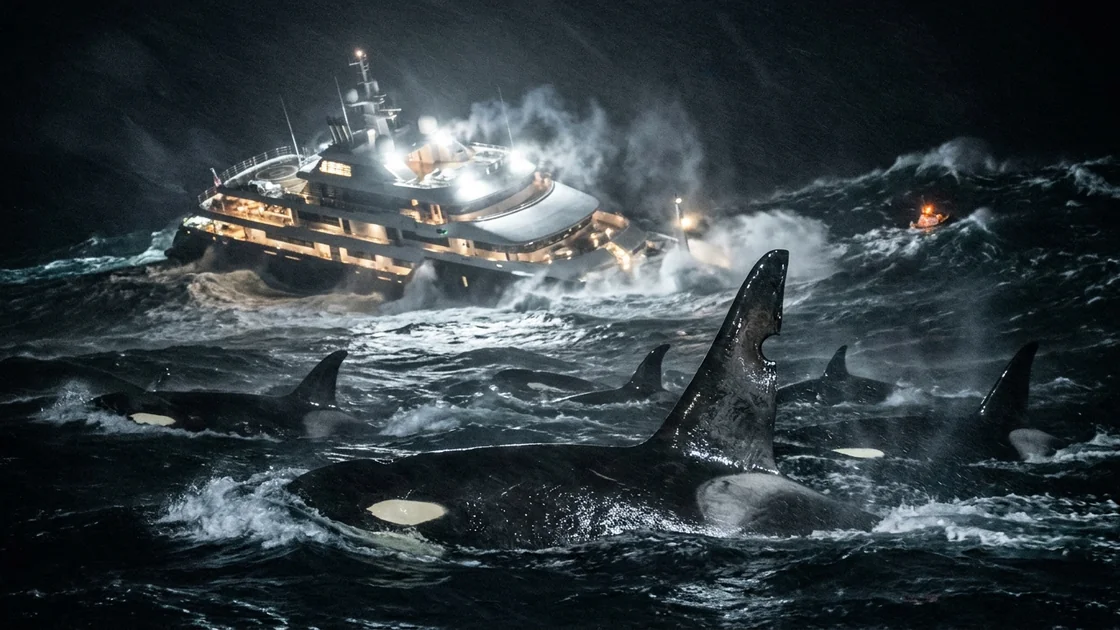
In the frigid waters of the northern fjords, a matriarchal pod of killer whales watches their ancestral calving grounds turn into a barren wasteland after a ruthless multinational fishing conglomerate strips the sea of life. Driven by starvation and a deep acoustic memory of the vessels that oversaw the destruction, the seventy-year-old matriarch leads her family thousands of miles south on a calculated campaign of maritime sabotage. Rather than attacking the massive steel trawlers, the whales target the vulnerable, multi-million-dollar luxury yachts belonging to the corporate executives who signed the orders to drain the bay. As marine bioacoustician Elena Vance and insurance investigator Marcus Thorne piece together the impossible pattern behind the sinkings, the whales adapt their hunting techniques to overcome increasingly sophisticated nautical defenses, culminating in a brutal confrontation in the stormy North Atlantic against the chief executive and his supposedly unsinkable superyacht.
I. The Geometry of Hunger
To the whales of the Grey Sound, the world was not a place of light, for light died thirty meters below the chop of the subarctic swell. The world was a cathedral of rebounding clicks. Every granite wall of the Orelia Fjord, every silt-laden trench, and every shoal of fat winter herring existed as an intricate lattice of echoes returning to the melon of the skull.
Tula swam at the vanguard, her seven-ton body parting the dark water with a slow, metronomic sweep of her flukes. She was seventy-two years old. Her dorsal fin, nearly a meter and a half of dense fibrous tissue, bore a crescent-shaped notch near the apex—the souvenir of a zinc-alloy propeller from a cod schooner in 1968. To her left swam her eldest son, Kael, a bull whose pectoral paddles were the size of dining tables, his tall dorsal canted slightly to port from the sheer weight of its cartilage. Behind them trailed the rest of the matriline: twelve whales in a loose, ragged echelon, moving through water that tasted of nothing at all.
That was the horror of it. The water was empty.
In the summers and autumns of Tula’s youth, the Orelia Fjord had been so thick with Chinook salmon and silver-sided herring that a whale could scarcely cast an echolocation train without the return ping singing like a struck bronze bell. The swim bladders of the fish—millions of tiny pockets of gas suspended in the frigid brine—used to reflect the pod’s high-frequency clicks in a blinding acoustic shimmer. It was a wall of sustenance. The calves would play in the shallows, tossing thirty-pound kings into the kelp beds just to feel the slick scales against their rostrums, while the older females rested in the freshwater outflow of the glacial rivers, rubbing their bellies across the smooth basalt pebbles.
Now, Tula sent a long, broadband click-train down the center of the channel.
Tick-tick-tick-tick-whir.
The sound traveled at fifteen hundred meters per second, a invisible lance of pressure. It struck the western shelf of the fjord. It struck the sunken ribs of an nineteenth-century whaling bark. It struck the mud at the bottom of the basin—mud that had been scraped into deep, ugly furrows by six-ton steel otter boards. Then the sound returned to the fat-filled channels of Tula’s lower jaw, vibrating through the pan-bone to her inner ear.
Nothing. Not the tight, bright echo of a salmon’s swim bladder. Not the diffuse, fluttering cloud of a herring ball. Only the dead, flat bounce of scarred granite and settling silt.
Three lengths behind her, her granddaughter Sora rose to the surface to breathe. The sound of Sora’s blowhole clearing was wrong; it had a wet, rattling edge to it, the respiratory sigh of a mammal burning its own blubber to stay warm in four-degree water. Sora was nineteen. Beneath her right pectoral fin, tucked into the slipstream where a calf should have been drafting, there was only empty water.
The calf had lived for eleven days in November. Because Sora’s milk was thin—starved of the rich lipids of winter Chinook and heavy with the mobilized polychlorinated biphenyls stored in her depleted fat reserves—the little male had grown weaker with every tide. When he finally stopped swimming, Sora had carried him on her rostrum for six days. Tula and Kael had taken turns lifting the tiny, cooling carcass to the surface so it might breathe the air it no longer needed. They had carried the dead calf until the skin began to slough in the freezing swell, until the grief had calcified into something denser than bone.
When Sora finally let the body sink into the abyssal trench outside the fjord’s mouth, the pod had gone silent for forty-eight hours. No whistles. No pulsed calls. Only the heavy, rhythmic chuffing of their lungs under a low grey sky.
Then, Tula had begun to sing the Ledger.
Humans believed memory required words, or marks upon dried wood pulp. Tula’s memory was architectural and harmonic. In the massive, convoluted neocortex of her brain—possessing a paralimbic cleft that no terrestrial primate had ever evolved—she held seventy years of acoustic signatures. Every vessel that had ever entered the Grey Sound had a voice as distinct to her as a sibling’s whistle.
She remembered the two-stroke diesel thrum of the wooden gillnetters from the seventies. She remembered the high, whining cavitation of the coast guard cutters. And she remembered, with blistering, crystalline clarity, the summer three years ago when the water had been murdered.
There had been five of them: the Gorgon class factory super-trawlers, each four hundred feet of rust-streaked steel, dragging mid-water nets whose mouths were wide enough to swallow twelve jumbo jets abreast. Their engines did not merely thrum; they produced a low-frequency, twenty-hertz roar that blinded the whales, turning the acoustic cathedral of the fjord into a deafening furnace of white noise. For nineteen weeks, day and night, the winches had screeched, hauling up hundred-ton cod-ends bursting with salmon, herring, pollack, and three of Tula’s distant cousins from an offshore transient pod who had been trapped in the mesh and drowned.
Tula could not break the Gorgons. Kael had tried once, throwing his nine-ton bulk against the bulbous bow of the Gorgon III, and had come away with a cracked rib and a long, weeping gash along his flank from a stabilizer weld. The steel was two inches thick; the propellers were shrouded in massive Kort nozzles that would turn a whale into red mist before the shaft even slowed.
But the Gorgons had not been alone.
During the fourth week of the great stripping, when the sea was slick with fish oil and floating scales, four smaller vessels had glided into the Orelia Fjord. They did not smell of bunker fuel and rotting offal. They smelled of copper-free silicone antifouling paint, teak oil, and ozonated greywater. They did not roar at twenty hertz; they purred with the high, balanced precision of twin MTU sixteen-cylinder marine diesels sitting on vulcanized rubber mounts, paired with five-blade Nibral propellers skewed to eliminate harmonic vibration.
To a human ear above the surface, those four white yachts had been whisper-quiet as they anchored in the lee of the glacier while men and women in cashmere sweaters stood on the aft decks, drinking champagne and watching the factory trawlers fill their holds on the sonar screens.
To Tula, hovering sixty meters below in the thermocline, the four yachts had been loud and clear. She had scanned them. Every square centimeter of their hulls.
She knew the exact thickness of the carbon-epoxy composite on the seventy-meter hull with the twin rudders. She knew the resonant frequency of the hollow bronze rudder stocks on the sleek blue motor yacht. She knew the acoustic signature of the bow thrusters, the specific, high-pitched ping of their forward-looking Furuno sonar units, and the rhythmic clack-hum of their Northern Lights auxiliary generators cycling on at four-minute intervals to keep the wine cellars chilled.
More importantly, she had watched the rigid-hull inflatables zip back and forth between the four white yachts and the bridge wings of the Gorgons. Even an animal that does not walk on land understands hierarchy. The wolves of the sea knew who commanded the pack. The steel monsters were the teeth, dumb and unfeeling; the smooth white shells were the brains that directed the bite.
Tula slowed her pace at the mouth of the fjord, where the shallow sill dropped away into the continental slope. She turned her massive head toward her son and her granddaughter.
She emitted a series of three low, modulated pulsed calls—the dialect specific only to her matriline—followed by a sharp, metallic imitation of a five-blade Nibral propeller turning at four hundred revolutions per minute, and the distinct, hollow thrum of a sixty-kilowatt auxiliary generator.
Sora glided up beside the matriarch, her dark eye fixed on the older whale’s scarred flank. Sora repeated the generator sound. Her imitation was exact, down to the slight bearing whine on the port shaft.
Kael surfaced, blew a tall column of steam into the freezing air, and sank back down to join them. He echoed the sound as well, his huge vocal cords vibrating the water around them like a plucked bass string.
They did not look back at the empty fjord. Turning their rostrums south-southeast, toward the warm, salty currents of the mid-Atlantic, the twelve whales dropped to traveling depth and began to swim at twelve knots.
II. The Sound in the Machine
Fourteen hundred miles south, in a cramped, airless basement laboratory at the Oceanographic Institute of Lisbon, Dr. Elena Vance took off her headphones and rubbed the bridge of her nose. Her eyes were bloodshot from staring at fast-Fourier-transform spectrograms for eleven straight hours.
On her dual monitors, sound was rendered as jagged ridges of neon green and violent purple against a black background.
"Play the third segment again," she said, her voice hoarse from too much espresso and not enough sleep.
Behind her, her graduate assistant, Tiago, leaned over the mixing board and tapped the spacebar.
Through the studio monitors came the familiar, haunting sound of the deep ocean: the distant, tectonic rumble of mid-Atlantic ridge micro-quakes, the bacon-frying crackle of snapping shrimp from the shelf edge, and the persistent, oppressive bass drone of container ships moving toward the Strait of Gibraltar. Then, cutting through the muck like a scalpel through velvet, came the voices.
Kree-aah. Kree-aah. Click-click-click-brrrrrt. Hmmmm-clack.
Elena leaned forward, her fingers tracing the purple spike at the end of the call on the glass of her monitor. "There. Right at three-point-two kilohertz. Isolate that tail and strip the ambient."
Tiago worked the filters. The shrimp and the cargo ships faded away. What remained in the small concrete room was an eerie, metallic humming noise, punctuated by a rhythmic tick-tick-tick-whir that sounded less like a mammal and more like a high-speed lathe spinning in a machine shop.
"It’s not Iberian dialect," Tiago said, frowning at the frequency distribution. "Gladis and the Gibraltar sub-population use seven discrete call types, mostly between one and two kilohertz. This is... I don't know what this is, Doctor. The modulation is Northern Resident, or maybe Norwegian coastal, but that mechanical tag at the end? Is it a hydrophone glitch?"
"It’s not a glitch," Elena whispered. She pulled a battered leather-bound notebook from the bottom drawer of her desk, flipping past laminated photographs of dorsal fins until she found a page marked Orelia Pod / Matriline J-9 (Tula). "I recorded this exact matrilineal prefix off the coast of northern Norway six years ago. That first sweeping whistle is Tula. She’s seventy-two. Her pod has never been recorded south of the Faroe Islands in half a century of observation."
"What is a subarctic herring-specialist pod doing thirty miles west of Cabo da Roca?" Tiago asked. "The water here is eighteen degrees. There’s no herring. If they're looking for bluefin tuna like the Iberian whales, they don't know the trap-net routes."
"They aren't hunting tuna," Elena said. She stared at the mechanical tag at the end of the call. For twenty years, she had studied cetacean mimicry. She had heard captive orcas imitate sea lions, boat motors, and even human laughter. In the wild, vocal learning was strictly cultural—passed from grandmother to mother to daughter with monastic rigidity. A pod did not change its core repertoire unless something catastrophic altered their world.
She opened a secondary database on her workstation—the Naval Acoustic Signature Library, a semi-classified repository she had access to through a joint grant with NATO’s Maritime Unmanned Systems initiative in Troia. She fed the strange, metallic tail of Tula’s call into the pattern-matching algorithm.
The progress bar spun for forty seconds. Then a match window popped up on the left screen.
89.4% CORRELATION: MTU 16V 2000 M96L Marine Diesel coupled with ZF 5000 Gearbox / Custom 5-Blade Skewed Propulsor (Lürssen / Feadship Custom Yacht Class, 60m–80m).
Elena stared at the text until the letters blurred.
"Doctor?" Tiago leaned closer, reading the screen. "The whale is imitating a superyacht engine? Why? Like a parrot?"
"Orcas don't do things like parrots, Tiago," Elena said slowly, a cold knot tightening at the base of her spine. "When mammal-eating transients hunt grey whale calves in Monterey, they go silent until the strike, then they share the vocalization of the prey's distress only to coordinate the division of meat. When fish-eating residents call, they use acoustic beams to herd salmon. Sound is a tool. It’s a blueprint."
She stood up, walking to the large admiralty chart of the Iberian coast pinned to the corkboard. Three red pins were clustered near the Strait of Gibraltar—standard sailboat interactions where local juvenile orcas had bumped thirty-foot fiberglass sloops, breaking their spade rudders in what most biologists considered rough play or frustrated foraging behavior.
Then there were two black pins.
One was off Vigo, four days ago. One was off Porto, thirty-six hours ago.
Neither of the black pins was a sailboat. The Vigo incident had been the Aurelia, a fifty-five-meter twin-screw motor yacht with a steel displacement hull. The Porto incident had been the Valkyrie II, a sixty-two-meter aluminum fast cruiser. Both had been struck at night in deep water—two hundred meters off the shelf—far outside the shallow tuna corridors where the local Iberian pods operated. Neither yacht had merely lost a rudder. Both had suffered catastrophic breaches of their stern tubes, snapped propeller shafts, and crushed seawater cooling intakes, sinking in less than forty minutes while their crews scrambled into Zodiacs.
"Tiago," Elena said, her finger hovering over the black pin off Porto. "Pull the Lloyd’s Register ownership files for the Aurelia and the Valkyrie II. Not the shell companies in the Caymans. Dig through the maritime insurance syndromes until you find the beneficial owners."
"That's corporate registry data, Doctor. It'll take me a few hours to scrape the—"
"Do it now," Elena said, turning back to the spectrogram of Tula’s voice. "And check the Automatic Identification System transponders for every motor yacht between sixty and ninety meters currently transiting the Portuguese coast south toward Lagos. Match their hull acoustics against this file."
III. The Siren’s Dividend
Seventy nautical miles south of Lisbon, the Atlantic was a sheet of hammered pewter turning violet under the dying sun.
Aboard the Siren’s Dividend, seventy-two meters of Dutch-built perfection, the ice in Arthur Pendelton’s glass clinked with a soft, musical chime. It was the only sharpness in his evening. The yacht’s four zero-speed gyroscopic stabilizers kept the teak aft deck as level as a billiard table in a London club, completely erasing the long, three-meter Atlantic rollers marching in from the Azores.
Pendelton leaned against the polished stainless-steel taffrail, swirling eighteen-year-old Macallan in crystal. At fifty-eight, he looked less like the Chief Financial Officer of the world’s largest pelagic harvesting conglomerate and more like a moderately successful cardiologist: silver hair trimmed close, linen trousers rolled at the ankle, skin burnished to a healthy walnut by three weeks in the Balearics.
"Arthur, darling, come inside," called Clara from the curved glass doors of the main saloon. "The sea breeze is positively damp, and the chef has just opened the white truffles from Alba."
"Two minutes," Pendelton said, smiling without turning around.
He liked looking at the wake. There was something deeply soothing about the twin plumes of white foam churning out from beneath the bathing platform, a visible manifestation of four thousand horsepower turning refined gas-oil into forward momentum at sixteen knots. The Siren’s Dividend had cost him sixty-four million euros three years ago, right after the third-quarter earnings call when Aegis Pelagic’s stock had surged forty-two percent on the Oslo Børs.
The surge had been his masterpiece. By restructuring the debt on the Gorgon fleet and securing the emergency "biomass optimization" variances from the Norwegian and Greenlandic ministries, they had harvested twelve years’ worth of quota out of the Orelia and Kangerlussuaq fjords in a single fiscal calendar. The environmental NGOs had screamed, of course. There had been a tiresome twenty-minute segment on the BBC about starving killer whales and collapsed salmon runs, and a handful of protesters had thrown red paint on the glass facade of Aegis’s headquarters in Bergen.
Pendelton had watched the footage from this very deck while anchored off Saint-Tropez. Within six months, the news cycle had moved on to a war in the Levant, the fishmeal and omega-3 oil had been sold to aquaculture farms in Chile at record margins, and Pendelton’s bonus had paid for the custom Loro Piana cashmere interiors of the master stateroom. The ocean was vast; if one fjord was scraped down to the bedrock, the fleet simply moved to the Mauritanian shelf or the South Georgia trench. Assets depreciated; capital moved. It was the fundamental law of nature.
Two miles off the port beam, the dark water split.
Twelve black fins rose into the twilight like a row of curved obsidian scythes, breathed in unison with a sound like tearing canvas, and vanished without leaving a ripple.
On the bridge of the Siren’s Dividend, two decks above Pendelton’s head, Captain Hendrik Bos was drinking decaf coffee and watching the radar overlay. The Furuno FAR-3000 showed a clear horizon—one bulk carrier nine miles west, a handful of Portuguese sardine seiners hugging the coast toward Sines.
Suddenly, the forward-looking bathymetric sonar chirped.
First Officer Miller glanced down at the secondary display. "Skipper? Getting a weird return at forty meters, dead ahead. Looks like a bait ball, maybe tuna, except it’s moving into our track at twenty knots."
Bos stepped over, squinting at the high-resolution color display. The return wasn't the diffuse yellow cloud of a fish shoal. It was twelve distinct, hard red targets arranged in two precise V-formations, stacked vertically at thirty and sixty meters.
"Dolphins?" Miller guessed.
"Too big for common dolphins," Bos muttered, reaching for the helm override. "Could be pilot whales, or those damn Iberian orcas. The maritime authority sent out a Notice to Mariners this morning about two motor yachts going down off Porto. Rumor on the VHF is they hit submerged shipping containers, but Lloyd’s is losing its mind."
"We're seventy meters of steel and aluminum, Skipper," Miller said with a faint laugh. "An orca hits our rudder, it gets a migraine."
"They cost three hundred grand apiece to dry-dock and realign if the bearings get bent," Bos said prudently. "Give me ten degrees to starboard. Let’s pass clear of them."
Below the waterline, the ten-degree helm adjustment caused the twin hydraulic steering rams in the lazarette to hiss, turning the twin semi-balanced spade rudders slightly to the right.
To Tula, swimming forty meters beneath the keel, the groan of the hydraulic pump was the starting gun.
She did not attack the bow. She knew the physics of displacement hulls; the water at the bow was a high-pressure cushion that pushed solid objects aside, while the water at the stern was a low-pressure vortex pulling objects inward toward the spinning blades.
She gave a single, sharp rising whistle—Coordinate One.
The pod split with the terrifying, frictionless speed of creatures who had hunted together for forty years.
Four younger females shot forward to the bow thruster tunnel. The Siren’s Dividend had a hydraulic drop-down azimuth thruster forward and a standard tunnel thruster aft for docking. At sixteen knots, the grates were closed, flush with the steel hull, held in place by heavy stainless locking pins.
Behind the yacht, Kael and two six-ton bulls dropped into the roaring, bubbly hell of the propeller wash.
A human diver entering the cavitation zone of twin five-blade propellers spinning at nine hundred revolutions per minute would have been torn apart by the pressure differentials before touching the bronze. Kael did not enter the wash from behind; he rode the boundary layer along the curvature of the bilge keel, using the hull’s own hydrodynamic suction to glue himself to the steel plates three meters forward of the starboard propeller shaft.
Above him, the twin shafts—each thirty centimeters of solid forged duplex stainless steel—emerged from the hull through water-lubricated cutless bearings, supported by heavy V-struts before terminating at the spinning blurs of the propellers.
Tula and Sora took the port shaft.
They did not bite the spinning blades. In the Vigo sinking four days earlier, a young male named Tor had misjudged the rotation of the Aurelia’s port screw and lost three teeth and a strip of gum tissue to the trailing edge of a blade. Tula had learned from that within three seconds.
Instead, as Kael positioned his massive forehead against the outside of the starboard V-strut, Tula and Sora dove sixty meters down into the cold dark, turned vertically, and pumped their flukes with every ounce of slow-twitch muscle in their starved bodies.
Nine tons of matriarch and five tons of grieving mother accelerated upward at twenty-eight knots—fourteen meters per second.
Just before impact, Tula turned slightly on her side, aligning the dense, solid bone of her upper rostrum and the thick fibrous pad of her melon not with the propeller, and not with the rudder blade, but with the exact focal point where the port V-strut welded into the hull plating, while Sora struck the lower tip of the rudder on the opposite vector.
Fourteen tons of mass moving at thirty miles per hour delivered nearly two megajoules of kinetic energy against a lever arm that was never engineered for lateral shock loads at speed.
CRACK.
Aboard the Siren’s Dividend, the sound was not a thud; it was the high, ringing report of a rifle shot traveling up through the steel frames of the ship, followed instantly by a sickening, violent shudder.
On the aft deck, Arthur Pendelton’s knees buckled. His crystal glass flew from his hand, shattering against the teak caprail. Inside the saloon, a forty-thousand-euro Murano glass chandelier tore loose from its ceiling mount and exploded across the dining table in a shower of crystal and white truffle shavings. Clara screamed as she was thrown against the credenza.
On the bridge, twelve red alarm lights erupted across the main console simultaneously, accompanied by a shrieking klaxon.
"Port shaft high vibration!" Miller yelled, grabbing the binnacle to stay upright. "Port rudder feedback lost! What the hell did we hit?!"
"All stop! All stop!" Bos slammed both chrome throttle levers back into the neutral detents.
Down in the engine room, the sudden whip of the bent port propeller shaft spinning at nine hundred RPM did what Tula had learned it would do off Vigo.
A propeller shaft spinning out of alignment by even four degrees becomes a giant eccentric cam. Before the automatic clutch could disengage the MTU diesel, the thirty-centimeter steel rod whipped violently in its housing, pulverizing the carbon-face mechanical shaft seal, tearing the stern tube assembly right out of the aft bulkhead framing, and cracking the cast-bronze main seawater cooling strainer standing beside it.
A column of black Atlantic water, two feet thick and under twenty pounds per square inch of pressure, roared into the engine room like a firehose from hell.
Below the hull, the propellers slowed to a lazy windmill.
Kael did not wait. The moment the starboard blades stopped spinning, the massive bull slid backward along the hull, hooked his lower jaw over the leading edge of the starboard rudder, and threw his nine-ton body sideways in a violent, corkscrewing snap roll, while two other males slammed their flukes downward against the opposite side of the blade in perfect counter-phase.
The twenty-centimeter high-tensile steel rudder stock didn't bend; it sheared off right above the lower pintle bearing. As it tore free, it ripped the hydraulic steering cylinder off its mounting bracket inside the lazarette and opened a jagged, forty-centimeter tear along the weld seam of the hull plating.
CLANG-SCREECH.
A second torrent of water flooded into the aft steering compartment, shorting out the 400-volt distribution bus for the gyroscopic stabilizers.
Without the gyros and without forward way, the Siren’s Dividend was suddenly at the mercy of the Atlantic beam swell. The seventy-two-meter yacht rolled twenty-five degrees to port, hanging sickeningly at the top of the arc as water sloshed across the engine room floorboards, then rolled thirty degrees to starboard.
"Chief!" Bos was screaming into the internal intercom as the bridge lights flickered and died, replaced by the eerie red glow of the 24-volt emergency battery strips. "Chief, report!"
The voice of the Chief Engineer came back through the speaker, ragged with panic over the roar of rushing water. "The port stern tube is gone, Hendrik! The whole bulkhead frame is twisted! The bilge pumps can't touch this—we're taking twenty tons a minute! And the watertight door to the lazarette is jammed in its frame from the hull flex! You need to get the guests on the boat deck right now!"
Out on the aft deck, Arthur Pendelton was on his hands and knees in a puddle of his own blood from a cut on his forehead, staring out over the dipping stern rail into the gathering dark.
The emergency underwater hull lights—thirty-six high-output xenon halogens that Pendelton had paid eighty thousand euros to have installed so his guests could watch tropical reef fish while swimming at night—had automatically kicked onto the emergency battery circuit. They illuminated a glowing emerald halo of thirty meters around the sinking yacht.
In that halo, Pendelton saw them.
They were not thrashing. They were not in a feeding frenzy.
Eleven whales hung vertically in the glowing green water around the stern, their white eye-patches and white bellies stark against the abyss, watching the yacht settle by the stern with the calm, terrifying stillness of demolition engineers watching a controlled collapse.
And closer—less than ten feet from the submerged teak bathing platform where Pendelton’s feet were now ankle-deep in rising foam—floated the largest of them. Her tall dorsal fin had a jagged crescent notch near the top. She rolled slightly onto her left side, bringing one dark, liquid eye above the surface of the swell.
She looked directly at Pendelton.
Then she opened her jaws just enough to release a single, metallic series of clicks—tick-tick-tick-whir—that vibrated right through the soles of Pendelton’s leather loafers and into his shinbones.
"Arthur!" Bos was hauling him backward by the collar of his linen shirt as the stern settled another two feet, the cold Atlantic surging over the aft threshold into the main saloon. "Move! To the muster station! She’s going down by the stern!"
IV. The Actuarial Anomaly
The headquarters of the Iberian Maritime Rescue Coordination Centre in Oeiras smelled of stale tobacco, wet wool, and ozone.
When Elena Vance walked into the third-floor briefing room at six in the morning, Marcus Thorne was already there. He had spread forty-two high-resolution underwater drone photographs across the mahogany conference table.
Thorne was forty-five, a former Commander in the British Royal Navy’s Marine Accident Investigation Branch who now worked on retainer for the London P&I Club—the syndicate of underwriters who insured eighty percent of the world’s luxury tonnage. He wore a rumpled charcoal suit without a tie, and his knuckles were scarred from a youth spent in engine rooms.
He didn't look up as Elena set her laptop bag down. "Dr. Vance. You're the whale woman from the institute."
"Bioacoustician," Elena corrected, stepping up to the table and looking down at the photographs. "Are these from the Siren’s Dividend?"
"No. The Siren’s Dividend is currently resting in eleven hundred meters of water at the bottom of the Setúbal Canyon, where she sank at 21:40 last night," Thorne said dryly. "All fourteen crew and six guests recovered by a Portuguese Air Force Merlin helicopter and a passing tug. Arthur Pendelton has four stitches in his brow and is currently threatening to sue the Portuguese Navy, the International Whaling Commission, and God. These photos are from the Aurelia, which went down on the shelf edge off Vigo in ninety meters. Our ROV went down yesterday afternoon."
Elena picked up three of the glossy prints.
The first showed the port propeller strut of the Aurelia. The solid cast-steel arm, thicker than a man’s thigh, was bent inward at a thirty-degree angle, the hull plating around the root torn open like a tin can peeled back with a key. The second showed the starboard rudder blade lying on the sandy seabed ten feet away.
"Look at the paint around the strut root," Thorne said, tapping the photo with a silver Parker pen. "No tooth rakes. When the Gladis pod in Gibraltar goes after a forty-foot Beneteau sailboat, the fiberglass rudder is covered in parallel tooth striations—raking marks from the juveniles biting and pulling on the foam core. Look at this steel."
"Blunt-force impact," Elena murmured, holding the photograph closer to the fluorescent light. "Massive, concentrated kinetic transfer. They used their rostrums and melons like battering rams, hitting the exact point of maximum mechanical leverage while the shaft was under load."
"And look at photo fourteen," Thorne said, sliding another print across the mahogany.
It was a close-up of the Aurelia’s hull intake grate—the sea chest through which cooling water was drawn for the main diesel engines and generators. Wedged deep into the stainless-steel louvres was a dense, tangled mass of thick braided polypropylene hawser—an abandoned fishing trawl warp they had dragged up from the bottom—stuffed in so tightly that the intake had been sixty percent occluded before the hull even breached.
Elena’s breath caught. "Tool use."
"Come again?"
"Some populations of bottlenose dolphins use marine sponges to protect their beaks while foraging on the bottom, and Patagonia orcas intentionally strand themselves on beaches," Elena said, her mind racing. "Wait—no, they didn't use the rope to sink it. The shaft breach sank it. Why stuff the sea chest?"
"Because on the Valkyrie II off Porto two days later, the shaft didn't breach the hull on the first strike," Thorne said grimly. He pulled out a printed transcript of an engine room data logger. "The crew of the Valkyrie tried to run for shallow water on their starboard engine at flank speed. Except someone—or something—had jammed a six-foot section of waterlogged timber and a mass of kelp into the starboard raw-water intake. The engine overheated and seized its pistons in four minutes flat, leaving them dead in the water while the whales finished tearing the rudders off."
Thorne walked to the window, looking out over the grey mouth of the Tagus River. "My board in London thinks we're dealing with an eco-terrorist cell using limpet mines or diver propulsion vehicles, masking their operations behind the local orca panic. Three hull losses in six days. Total insured value: one hundred and eighty-five million euros. If a fourth goes down, the reinsurance market for pleasure craft over fifty meters in the Eastern Atlantic will freeze overnight."
"It’s not divers, Mr. Thorne," Elena said. She opened her laptop, turned it toward him, and pulled up two windows: the acoustic spectrogram of Tula’s pod, and the corporate flowchart Tiago had finished compiling at four in the morning.
Thorne walked back over, adjusting a pair of half-moon reading glasses as he read the screen.
"The Aurelia," Elena said, pointing to the first box. "Registered to Blue Horizon Maritime Ltd. in Tortola. Beneficial owner: Lars Lindholm, Vice President of Fleet Logistics, Aegis Pelagic Corporation."
She pointed to the second box. "The Valkyrie II. Registered to Norse Wind Holdings in Jersey. Beneficial owner: Henrik Vestergaard, Chief Lobbyist and Head of Regulatory Compliance, Aegis Pelagic Corporation."
She pointed to the third box. "The Siren’s Dividend. Beneficial owner: Arthur Pendelton, Chief Financial Officer, Aegis Pelagic Corporation."
The room went dead silent except for the hum of the fluorescent tubes. Thorne stared at the screen for a long time, the muscle in his jaw working.
"Three executives of the same fishing conglomerate," Thorne said softly. "Out of four thousand superyachts currently afloat in the Mediterranean and Atlantic."
"It gets more specific," Elena said. She clicked open a satellite AIS archive map from August of 2023. "Three years ago, Aegis Pelagic received an emergency exemption to bring five Gorgon-class super-trawlers into the Orelia Fjord Sanctuary in northern Norway. During the third week of August, while the trawlers were operating, the company held an executive retreat and investor showcase right in the fjord. Four private yachts entered the sanctuary for five days to observe the fleet."
She zoomed in on the historical transponder tracks inside the narrow blue ribbon of the Orelia Fjord.
Four green triangles sat anchored side by side near the glacier face: M/Y Aurelia. M/Y Valkyrie II. M/Y Siren’s Dividend. M/Y Thalassa.
Thorne slowly took off his glasses. "Dr. Vance. I am an engineer and a former naval officer. Are you standing in a government office and telling me that a family of fish memorized the corporate ownership structure of a Norwegian seafood conglomerate?"
"No," Elena said fiercely. "I am telling you that an animal with an acoustic brain three times the size of yours, possessing the densest cortical folding in the mammalian kingdom, lived in that fjord for seventy years. I am telling you that Aegis Pelagic vacuumed eighty thousand metric tons of biomass out of their nursery in nineteen weeks. Over the last two winters, Tula’s pod has lost four calves and two elderly females to starvation. While their ecosystem was being turned into an underwater desert, four very distinct, very loud luxury vessels came and sat on top of them, exchanging small boats with the trawlers that were doing the killing."
She tapped the spectrogram of Tula’s call. "To us, one white boat looks like another white boat. To an orca, a yacht is completely transparent. They see through the fiberglass and steel with sound. They know the layout of the engine room, the number of cylinders, the pitch of the propellers, and the shape of the keel as clearly as you know the face of your own brother. They migrated fourteen hundred miles south into warm water where they have nothing to eat, broadcasting the exact acoustic signature of those four yachts across the continental shelf to coordinate a wide-area search line."
Thorne looked back down at the photograph of the bent steel strut on the table. When he spoke, the skepticism was gone from his voice, replaced by a quiet, professional dread.
"What's the fourth boat?" he asked. "The Thalassa."
"Owned by Diane Vane-Smythe," Elena said, pulling up a ship-spotting file. "Aegis Pelagic’s Chief Operating Officer. She’s the one who actually signed the operational directives for the Gorgon captains to use bottom-contact doors inside the protected calving zone."
"Where is the Thalassa right now?"
"She departed La Rochelle in France yesterday afternoon," Elena said, bringing up a live marine traffic map. "Bound for Santander, across the Bay of Biscay. And Mr. Thorne—look at the hull specs."
Thorne leaned in, scanning the technical sheet. His eyebrows rose. "Sixty-eight meters. Austal custom trimaran-catamaran hybrid. All carbon-fiber and Nomex honeycomb over an aluminum space-frame. Draft is only two point four meters. And she doesn't have propellers or rudders."
"Quadruple Rolls-Royce Kamewa waterjets," Elena read aloud. "Flush-mounted in the stern transoms. Nothing hanging below the hull to ram, bend, or snap."
"And she goes thirty-eight knots," Thorne muttered, reaching into his coat pocket for his satellite phone. "Even an orca can't catch a vessel doing thirty-eight knots in open water. Let’s see if Mrs. Vane-Smythe answers her bridge line."
V. The Twin Hulls of Biscay
Diane Vane-Smythe did not like being told what to do by insurance adjusters, marine biologists, or the French Maritime Gendarmerie.
At forty-nine, she had risen to the top of the global commercial fishing industry—a notoriously brutal, male-dominated world of Icelandic fleet barons and Russian crab oligarchs—by possessing a nervous system apparently constructed of braided titanium. When Arthur Pendelton had called her private mobile from a Lisbon hospital bed at two in the morning, weeping and babbling about "a seventy-foot demon with a notched fin looking me in the eye," Diane had privately concluded that Arthur was having a vascular dementia episode brought on by too much scotch and the shock of cold water.
Then the London P&I Club had called at seven, demanding she divert the Thalassa immediately into the Gironde estuary and tie up at Bordeaux under threat of immediate policy cancellation.
"Let me make something exceptionally clear to you, Mr. Thorne," Diane said into the satellite handset on the bridge of the Thalassa, standing with her feet braced wide in her Gucci horsebit loafers as the sleek silver catamaran sliced through the grey swells of the Bay of Biscay at twenty-six knots. "I have a meeting with the Spanish Minister of Agriculture and Fisheries in Santander at eight o’clock tomorrow evening to finalize the Galician squid quotas. This vessel has no propellers, no struts, and no rudders. The bottom of my hulls is completely smooth Kevlar-reinforced marine-grade aluminum and carbon composite. Unless your whales have learned to use torpedoes, they can do nothing more than scratch the antifouling paint."
"Mrs. Vane-Smythe," came a woman’s voice on the speakerphone—the biologist Thorne had put on the line. "You are crossing the Capbreton Canyon in three hours. The deep submarine trench comes within four miles of the coast there, and the bathymetry funnels deep-water acoustics straight up to the surface. Our hydrophone array on the Galicia Bank picked up Matriline J-9 heading northeast at eighteen knots early this morning. They left the Portuguese coast twelve hours before Arthur’s yacht even finished sinking—Wait. No, they split."
There was a pause on the line, the sound of frantic keyboard clicking in Lisbon.
"God in heaven," the biologist whispered. "They didn't all stay off Lisbon. Only six whales sank the Siren’s Dividend. The other six—the matriarch and the young females—kept moving north two days ago after Porto. They didn't wait. They're already in the Bay of Biscay."
Diane looked out the wrap-around raked windscreens of the Thalassa. The sky ahead was the color of a bruised plum. A frontal system was rolling down from Brittany, kicking the Biscay swell up into steep, short-period waves of four meters, their crests blowing off into white spindrift under a thirty-knot northwest wind.
"Captain Laurent," Diane said, turning to her French master at the helm console. "Increase speed to thirty-two knots."
"Madame, in a four-meter head-sea?" Laurent protested, his hands tight on the armrests of his Stidd helm chair as the catamaran launched off the crest of a steep wave, hung in the air for a heart-stopping second, and slammed down into the trough with a resounding BOOM that sent a sheet of white spray completely over the flybridge. "We are slamming the wet-deck—the bridging structure between the twin hulls. If we push over thirty knots into this chop, we risk delaminating the carbon-fiber cross-beams at the bow."
"Then keep her at twenty-four knots and steer closer to the shelf," Diane snapped, before clicking off the satellite handset and tossing it onto the leather chart table. "Scientists. Always looking for a grant."
Forty miles dead ahead of the Thalassa, where the continental shelf dropped off into the abyssal chasm of the Capbreton Canyon, the sea was a cauldron of cross-swells.
Six whales hung in the rough water just below the wave troughs.
Tula was tired. The fourteen-hundred-mile sprint from the Norwegian Sea, followed by the heavy kinetic impacts against the Aurelia and the Valkyrie II, had worn away the last of her superficial blubber layer. Her ribs showed faintly beneath the black skin of her flanks, and the skin around her blowhole was dry and peeling from the warm, high-salinity southern water.
Beside her, Sora was bleeding from a shallow tear on her lower jaw where she had scraped against the barnacle-encrusted bilge keel of the Valkyrie, yet the young female’s eyes were bright, terrible, and restless.
Twenty miles to the north, Tula’s acoustic beam had already painted the approaching catamaran.
The Thalassa sounded nothing like the others. At twenty-four knots, the four Rolls-Royce waterjets produced a screaming, high-frequency cavitation roar—a tearing sound at twelve kilohertz as four massive internal impellers sucked in thirty thousand gallons of seawater per minute through flush bottom grates and blasted it out into the air through steering nozzles above the waterline.
And there was another sound: WHAM. WHAM. WHAM.
Every seven seconds, as the twin razor-sharp hulls bridged across two steep Biscay waves, the flat underside of the central cabin structure—the wet-deck tunnel—slammed down onto the crests of the sea like a giant slapping a concrete slab with a sheet of plywood.
Tula swam upward into the heaving, foam-streaked surface water, rising on the crest of a fifteen-foot wave, and cast her echolocation beam northwest.
Three miles away, drifting in the convergence zone where the French river plumes met the canyon current, was what she had been searching for over the last four hours.
It was a tangled, forty-foot raft of ghost gear—three hundred yards of heavy blue trawler netting ripped loose during a winter gale, snarled around two rusty steel spherical trawl floats and a waterlogged, eight-meter trunk of a Pyrenean oak tree that had washed down the Adour River during the spring floods.
Tula whistled. Sora and the four younger females converged instantly.
They did not try to push the oak trunk; it weighed three tons. Instead, Sora and her sister dived beneath the drifting mass, bit into the heavy lead-line at the base of the tangled blue trawler net, and began to tow the entire floating debris field sideways across the wind, moving it four hundred yards south until it sat directly in the narrow trough between two submarine seamounts where the Thalassa’s track line converged with the shelf edge.
Then Tula looked at the four-meter waves marching down from the northwest. She understood waves. Every coastal whale knew how to surf a following sea, and every whale knew what happened when a hollow vessel was turned sideways in a breaking trough.
Five miles out, the Thalassa appeared through the driving rain squall, a futuristic silver arrowhead throwing twin roostertails of white water fifty feet behind her stern.
On the bridge, Captain Laurent had his face pressed close to the X-band radar hood, adjusting the sea-clutter knob with trembling fingers. "Merde. The wave clutter is blinding the short-range scan. I have ten-foot returns everywhere."
"Keep your course, Laurent," Diane said from the leather sofa at the back of the wheelhouse, sipping sparkling water. "Once we clear Capbreton, we get the lee of the Spanish coast."
Beneath the waves, the screaming whine of the four Kamewa waterjets was now deafening.
Tula waited until the silver bows were two hundred meters away, closing at twelve meters per second.
The catamaran rose on the back of a massive five-meter roller, its twin hulls lifting half out of the water, exposing the four rectangular titanium intake grates flush-mounted into the flat planing surfaces at the aft end of each pontoon.
"Now," Tula pulsed.
Sora and her sister did not swim into the path of the bows; they dived ten meters below the floating tangle of trawl net and oak, holding the trailing loops of polypropylene rope in their jaws, and pulled downward with all their weight just as the port hull of the Thalassa came crashing down into the trough.
The timing was not human; it was the timing of predators who could intercept a thirty-knot bluefin tuna in pitch darkness within a millimeter of its tail wrist.
As the port hull slammed down onto the water, Sora released the net directly beneath the forward planing surface.
The two-thousand-horsepower suction of the port outer and port inner waterjet intakes did the rest.
Like twin industrial vacuum cleaners, the flush bottom grates sucked thirty yards of heavy braided polyethylene trawl netting and three steel mooring cables straight up through the protective intake bars into the spinning titanium impellers turning at two thousand RPM.
BANG-SCREECH-THUD.
The sound inside the port hull was catastrophic. The braided synthetic rope instantly melted from friction and fused around the impeller shafts like solid cast iron. The port outer shaft snapped its shear coupling with a sound like a cannon shot; the port inner gearbox exploded, sending jagged chunks of case-hardened steel gears flying through the port engine room bulkhead and severing the high-pressure fuel rail on the MTU diesel.
Fire alarms howled across the Thalassa as thick black smoke boiled out of the port air vents.
Even worse was the physics of asymmetric thrust.
With the two port waterjets instantly locked solid and dragging forty yards of fouled net and a three-ton oak log like a sea anchor off the port quarter, while the two starboard waterjets were still screaming ahead at twenty-four knots, the Thalassa whipped violently to port like a sprinter catching an ankle on a tripwire.
At twenty-four knots, the sixty-eight-meter catamaran slewed ninety degrees sideways right into the trough of a breaking five-meter Biscay roller.
Diane Vane-Smythe didn't even have time to scream. As the yacht snapped sideways, centrifugal force launched her off the leather sofa like a ragdoll. She flew fifteen feet across the wheelhouse and slammed shoulder-first into the helm station, her collarbone snapping like a dry twig before she collapsed onto the teak deck beside a bleeding First Officer.
"Starboard jets stop! Emergency stop!" Captain Laurent was roaring, hanging from the wheel with one arm as the deck canted forty degrees to seaward.
Outside, in the boiling grey trough, Tula saw the vulnerability she had heard from twenty miles away.
As the crippled catamaran wallowed broadside in the steep waves, the starboard hull lifted high on an oncoming crest while the fouled port hull was dragged down by the weight of the oak log and net. Beneath the yacht, the wide, flat carbon-fiber bridging tunnel—the wet-deck that joined the two narrow hulls together—was exposed like the soft underbelly of a crab.
And hanging down beneath the exact center of the wet-deck was the retractable carbon-fiber T-foil ride-control fin that kept the catamaran from pitching in head seas.
Tula and four whales came down the face of the five-meter wave behind the yacht, riding the orbital velocity of the breaking crest like five black torpedoes totaling thirty-two tons.
They struck the extended central T-foil and the starboard aluminum hull-to-bridge joint simultaneously as the wave broke over them.
Carbon fiber is miracles of tensile strength in one direction, and as brittle as burnt toast when subjected to concentrated lateral shear from an angle its computer model never anticipated.
The central T-foil didn't just snap; as it tore out of the wet-deck structure, it delaminated a four-meter strip of the structural carbon cross-beam joining the two hulls.
A second wave lifted the starboard pontoon. Without the central cross-beam’s integrity, the two hulls flexed independently—five degrees, ten degrees, fifteen degrees. Inside the main saloon, the panoramic floor-to-ceiling windows exploded inward under the torsional twisting of the superstructure, a shower of tempered safety glass raining down onto the white Italian leather sofas as green Atlantic water poured across the floor.
On the next wave, the oak log snagged in the trawl net was lifted by the swell and driven like a battering ram by the waves themselves straight through the cracked fiberglass skin of the port hull’s outer chine.
"Abandon ship!" Laurent screamed, dragging Diane Vane-Smythe up by her good arm as the floorboards beneath their feet groaned with the terrifying, fibrous shriek of tearing carbon laminate. "The bridge structure is failing! If the hulls separate, she’ll fold in half! To the flybridge rafts!"
Ten minutes later, wallowing in the vomit-stained rubber canopy of a twenty-person Solas life raft three hundred yards downwind, Diane Vane-Smythe clutched her broken collarbone and stared through the driving rain and blowing spray at the sixty-eight million euros that had been the Thalassa.
The catamaran had not sunk completely—the foam cores in the bow sections kept the twin silver noses pointing vertically toward the storm clouds like a pair of monumental, broken scissors—while the entire central superstructure and stern had collapsed into the sea between them.
As the raft drifted past the wreckage, six black dorsal fins surfaced in a neat line between the life raft and the sinking yacht.
They did not approach the rubber raft. They could have punctured the inflated neoprene tubes with a single nip of a tooth and drowned every human aboard in thirty seconds in the four-meter chop.
Instead, the youngest female—a nineteen-year-old whale with a fresh white scar on her jaw—swam within fifteen feet of the open flap of the raft, raised her head vertically out of the foam in a high spy-hop until her pectoral fins cleared the water, and looked inside at Diane Vane-Smythe huddled in her soaked cashmere coat.
Then the whale dropped back into the gray swell, and the six fins turned north-northwest, vanishing into the curtain of rain toward the Celtic Sea.
VI. The Boardroom in Bergen
The rain in Bergen never truly fell; it hung suspended in the air between the seven mountains and the dark water of the Byfjorden, cold and faintly smelled of salt cod.
On the top floor of the Aegis Pelagic glass tower on Strandkaien, the emergency meeting of the Board of Directors had been underway for six hours. Three chairs at the long birchwood table were empty—or rather, occupied by high-definition video monitors showing Lars Lindholm in Vigo, Arthur Pendelton in Lisbon, and Diane Vane-Smythe in a private orthopedic clinic in Biarritz with her left arm strapped in an immobilizer sling.
At the head of the table stood Hendrik Lindqvist.
Lindqvist was sixty-six, six feet four inches tall, with a shock of white hair and the broad, slab-like shoulders of the Lofoten purse-seiner deckhand he had been at seventeen before he built an empire of steel and debt. He did not wear tailored Italian suits like Pendelton; he wore a heavy black Norwegian fisherman’s sweater over an open-collared oxford shirt.
On the massive wall screen behind him, the Oslo Børs ticker showed AEGIS (AEG.OL) down 38.4% since Monday morning.
"The footage from the French coast guard helicopter has four hundred million views on TikTok and X since midnight," said Stefan Krogh, the company’s General Counsel, his face grey as parchment. "Because Dr. Vance at the Lisbon Institute leaked the ownership correlation to The Guardian and Der Spiegel three hours ago. Everyone knows now. They aren't calling them rogue whales anymore. The press is calling them the 'Orelia Auditors.' And green hedge funds are shorting our stock into the basement while Lloyd’s just pulled hull-and-machinery war-risk coverage on our entire commercial trawler fleet until the Ministry of Fisheries finishes an audit of the 2023 Orelia Sanctuary logs."
"The trawlers aren't at risk from whales, Stefan, don't be an idiot," Lindqvist growled, his voice like grinding gravel.
"The trawlers aren't the point, Hendrik!" Diane Vane-Smythe’s voice crackled sharply through the monitor from Biarritz, slurred slightly by oxycodone. "The point is that the Norwegian Environmental Crimes Unit just served a subpoena on our Bergen servers to check the GPS tracks of the Gorgon fleet during the August 2023 showcase! If they match the timestamps from my yacht’s logbooks—which the French gendarmes just salvaged from the Thalassa’s floating EPIRB capsule—they’ll see we were dredging inside the three-mile calving line! And meanwhile, every port union in Vigo, Rotterdam, and Tromsø is threatening a wildcat boycott of Aegis vessels because our executives are seen as ecological pariahs who literally drove the ocean to take revenge!"
"Revenge," Lindqvist spat, slamming his open palm down on the birchwood table so hard the water carafes jumped. "Listen to yourselves! Four grown men and women with degrees from Wharton and London School of Economics, wetting their trousers over a pack of glorified porpoises!"
"You weren't in the water, Hendrik," Arthur Pendelton said quietly from the Lisbon screen. The bandages on his forehead were white against his pale skin. "You didn't see the old one. You didn't hear the sound she made against the hull. And you are the fourth signature, Hendrik. Your yacht was anchored fifty yards off my port beam in the Orelia Fjord in August 2023."
Every eye in the boardroom turned toward the panoramic window overlooking the harbor of Bergen.
Moored at the private deep-water berth directly below the Aegis building was the Leviathan’s Crown.
She was not a sleek fiberglass toy from the Mediterranean, nor a fragile carbon catamaran. Built by Lürssen in Bremen to Polar Class 6 specifications, the Leviathan’s Crown was one hundred and fifteen meters—three hundred and seventy-seven feet—of ice-strengthened high-tensile shipbuilding steel. She displaced five thousand four hundred metric tons. Her hull plating at the waterline was twenty-eight millimeters thick, designed to crush through three-foot first-year Arctic pack ice at twelve knots without denting the primer. Her twin Rolls-Royce azimuth thrusters were housed inside reinforced ice-skegs, and her diesel-electric ABB propulsion pods were protected by sacrificial steel ice-knives.
"Let them come," Lindqvist said, walking to the window and looking down at the massive grey-and-white vessel waiting in the rain. "In fact, I am not going to wait for them in harbor like a coward while our share price bleeds to zero."
"Hendrik, what are you talking about?" Krogh asked nervously.
"This company is dying of a narrative," Lindqvist said, turning back to the room, his pale blue eyes hard and cold. "The world thinks Aegis Pelagic is running from Mother Nature. They think the ocean has passed judgment on us. If I cancel my annual northern inspection tour and hide in Bergen, the institutional investors will dump the rest of our stock by Friday and the government will revoke our Barents Sea licenses to appease the mob."
He pointed down at the Leviathan’s Crown.
"At eighteen hundred hours tonight, I am taking the Crown out of Bergen, heading north up the Norwegian trench to Tromsø and the Orelia Fjord, right on schedule. Except I have spent the last twelve hours having my former colleagues from the coastal whaling association in Lofoten load some special equipment onto the aft helideck."
Krogh went pale. "Hendrik. Orcas are strictly protected under the Bern Convention and Norwegian law—"
"Self-defense of human life at sea supersedes the Bern Convention under Article 9, Stefan," Lindqvist said smoothly. "I have four LRAD 1000Xi acoustic cannons mounted on the dive platform rails, coupled with two military-grade sub-surface parametric sonar emitters we bought from a seismic survey contractor in Stavanger. They put out two hundred and thirty decibels at three kilohertz—enough to rupture an eardrum or hemorrhage a whale’s acoustic fat-pad at two hundred meters. And if that old female with the notched fin gets closer than two hundred meters..."
Lindqvist smiled thinly.
"I have Karl-Erik Svendsen and his two sons from the minke vessel Havblikk aboard, along with two Kongsberg sixty-millimeter cold-harpoon cannons bolted to the stern capstan mounts. When that matriarch floats up dead behind my stern with a steel shaft through her lungs, I’m going to have the crew winch her up onto the helideck and broadcast the photo to every shipping syndicate in London. Once the matriarch is dead, the pod breaks up. The panic ends. Our insurance rates normalize. And the market remembers who sits at the top of the food chain."
VII. The Convergence at Sixty-Two Degrees North
"He’s baiting a trap," Elena Vance said.
She was standing in the cramped chartroom of the RV Pelagia, a sixty-meter Dutch oceanographic research vessel rolling heavily in a forty-knot gale off the Shetland Islands. Outside the salt-crusted portholes, the North Sea was a wilderness of forty-foot grey mountains with ragged, blown-out white peaks.
Beside her, gripping the steel grab-rail overhead as the ship pitched twenty degrees into a trough, Marcus Thorne stared at the AIS projection on the repeater screen.
The Leviathan’s Crown had cleared the Korsfjord south of Bergen four hours ago, steaming north-northwest toward the continental slope off Møre at fourteen knots—deliberately staying thirty miles offshore in deep water where the coastal patrol boats of the Norwegian Coast Guard couldn't easily observe her decks in the gathering storm.
"I tried to get the Norwegian Directorate of Fisheries to board him in Bergen," Thorne shouted over the howl of the wind in the rigging and the deep thrum of the Pelagia’s bow thruster fighting the swell. "Lindqvist owns half the parliament in Oslo! They claimed they had no probable cause to inspect a private pleasure vessel on an domestic transit! And we’re still ninety miles south of him, making eight knots against this gale!"
"We don't need to catch him to see what’s happening," Elena said, her eyes fixed on her acoustic workstation bolted to the bulkhead. She was pulling live satellite telemetry from the SOSUS-derived civilian hydrophone arrays strung along the GIUK gap and the Faroe-Shetland Channel, combined with the Pelagia’s own deep-water towed array trailing four hundred meters behind their stern.
"Where is Tula?" Thorne asked. "Did she and the six from Biscay reunite with the bulls from Lisbon?"
"They reunited yesterday morning off the west coast of Ireland," Elena said, her voice tight. "Twelve whales, moving north at twenty knots on the continental shelf current. They didn't stop to feed in the Irish Sea. They didn't rest. They are swimming purely on muscle catabolism now—burning their own tissue to get home."
"If they attack the Leviathan’s Crown in that state, Lindqvist will slaughter them," Thorne said grimly. "I looked up the shipyard blueprints for the Crown before we left Aberdeen, Elena. There is no exposed rudder stock. There are no propeller struts. The ABB Azipods are built like armored bank vaults, tucked inside three-inch-thick ice skegs. And if he’s firing seismic survey emitters at two hundred and thirty decibels into the water, Tula’s pod will be acoustically blinded and bleeding from their inner ears before they get within half a mile of the hull."
"Wait," Elena whispered.
She put both hands over her headphones, pressing the earcups tight against her skull.
On the spectrogram monitor, the black screen was suddenly lighting up with dozens of vertical green and violet slashes, stretching across the frequency bands from five hundred hertz all the way up to forty kilohertz.
"What is that?" Thorne leaned down, squinting at the screen. "Is that Lindqvist’s sonar?"
"No," Elena breathed, her fingers trembling as she zoomed out on the spatial directional plot of the Faroe-Shetland hydrophone array. "That’s biological. Look at the bearings."
From the northwest, near the Iceland-Faroe ridge, a line of acoustic contacts was streaming south-southeast. From the northeast, down the Norwegian trench from Lofoten and the Vesterålen shelf, two more dense clusters of vocalizations were converging on the sixty-second parallel.
"Tula has been broadcasting a long-range low-frequency pulsed call every six minutes since she passed St. Kilda," Elena said, her voice rising with a sudden, electric awe. "I thought she was just pinging to find the Leviathan’s Crown’s diesel-electric signature. She wasn't pinging the ship. Low-frequency pulsed calls at one kilohertz travel through the deep SOFAR channel for two hundred miles without losing energy."
Elena looked up at Thorne, her eyes wide.
"She’s calling the clan."
"How many?" Thorne asked.
"In Northern Norwegian waters, pods are organized into acoustic clans that share ancestral dialects going back ten thousand years," Elena said, watching the violet spikes multiply across the monitor until the black background was almost entirely obscured by sound. "Matriline J-9 is part of the Y-Clan. And those other calls—those are off-shore mammal hunters from the Shetland shelf edge. They don't even speak the same dialect, Marcus, yet they’re synchronizing their swim speeds and dive intervals with Tula’s matriline."
She counted the distinct echolocation click-trains resolving on the beam-forming software.
"Not twelve," Elena whispered. "Forty-six. There are forty-six whales converging on Lindqvist’s position right now."
VIII. The Sovereign of the North
At sixty-two degrees north, eighty miles west of Ålesund, the storm hit hurricane force in the gusts.
The North Atlantic at eleven o’clock at night in late autumn was pitch black, save for the phosphorescent, tearing white sheets of foam ripped from the tops of forty-five-foot waves by a sixty-knot wind. The barometer on the bridge of the Leviathan’s Crown had dropped to 964 millibars and was still falling.
Even five thousand four hundred tons of ice-class steel felt the fury of the sea on the edge of the Norwegian Trench. As the Leviathan’s Crown quartered into the monstrous swells at ten knots, her bulbous bow buried itself deep into the backs of the waves, sending solid green walls of water roaring down the foredeck to smash against the armored glass of the lower guest suites before the ship rose with a ponderous, creaking roll of fifteen degrees to port and starboard.
To keep that roll at fifteen degrees instead of forty-five degrees, the yacht relied on two massive Quantum XT zero-speed extendable stabilizer fins—each a four-meter paddle of high-tensile steel and composite hydraulic airfoil sticking straight out from the turn of the bilge amidships like the wings of an underwater airplane, angling up and down ten times a minute under four hundred bar of hydraulic pressure to fight the torque of the forty-five-foot rollers.
On the vast, dimly lit bridge, Hendrik Lindqvist stood behind the central command island, a heavy foul-weather jacket zipped to his chin, watching the green concentric rings of the parametric sonar display.
"Anything?" Lindqvist asked.
Beside the console sat Karl-Erik Svendsen, a sixty-year-old whaler from Reine with a face like salted leather and three missing fingers on his left hand from a harpoon line snap thirty years ago.
"Two miles off the port beam, Hendrik," Svendsen said quietly, pointing a stubby finger at the high-frequency acoustic waterfall display. "And more off the starboard bow. I’ve hunted minke and killer whales in Vestfjorden since the seventies before the moratorium. I’ve never seen a sonar screen look like that. There’s forty, maybe fifty of them out there in the dark."
Captain Einar Holm, the yacht’s master, turned from the helm, his face slick with sweat despite the air conditioning. "Mr. Lindqvist, the wind is gusting sixty-four knots. The significant wave height is thirteen meters, with rogue crests approaching eighteen meters. Your men on the aft deck cannot man harpoon cannons in this sea—one green wave over the stern will wash them straight over the side. And we are running the active sonar emitters so hot that the power management system is flagging harmonic distortion on the main propulsion bus."
"Leave the emitters at full power, Einar," Lindqvist ordered coldly. "Two hundred and thirty decibels in the water perimeter. Nothing with ears gets within three hundred yards of this hull without its skull splitting open."
Three hundred andfifty yards below the rolling keel of the Leviathan’s Crown, in the deep, quiet calm below the storm-tossed surface layer, forty-six whales hung in the dark.
Up near the surface, the water was an agonizing hell of artificial sound.
The twin parametric sonar emitters suspended from the yacht’s moon-pool and stern were firing relentless, overlapping pulses of two-hundred-and-thirty-decibel acoustic energy at three kilohertz—the exact resonant frequency of a cetacean’s cranial air sinuses. When Kael had swum within four hundred meters of the yacht twenty minutes earlier to scout the hull, the pressure wave had slammed into his melon like a physical blow from an iron spike, leaving a trail of dark blood trickling from his left auditory meatus into the black water.
They could not approach from the sides. They could not approach at shallow depth.
Tula floated at the center of the great pod, her scarred body surrounded by four generations of her kin and thirty-four whales from three neighboring clans who had also seen their winter grounds scraped clean by the Gorgon fleet.
Tula did not look upward toward the screaming, painful cone of the sonar emitters.
She listened to the storm.
She had lived through seventy North Atlantic winters. She knew the physics of sound in a hurricane.
When a sixty-knot wind tears the tops off forty-five-foot waves, crashing millions of tons of breaking white water into the sea, it drives a dense, three-meter-thick layer of millions of tiny air bubbles into the surface water. And air bubbles in water are an almost impenetrable acoustic curtain. Sound cannot pass through a dense bubble cloud; it scatters, reflects, and dies.
And directly beneath the hull of the Leviathan’s Crown, the downward-pointing sonar emitters had a physics problem of their own: a sharp thermal boundary at ninety meters depth, coupled with the acoustic shadow cast by the yacht’s own massive steel bulbous bow whenever the ship pitched down into a forty-five-foot trough.
Tula sang a new pattern. It was slow, rhythmic, and low—timed not to the ship’s engines, but to the fourteen-second period of the monstrous storm waves rolling overhead.
Wait for the set. Wait for the third wave.
She picked six bulls: Kael, and five massive, nine-ton transient bulls from the Shetland shelf whose jaws were scarred from decades of killing bull seals and minke whales.
The forty-six whales rose together from three hundred meters to ninety meters, hovering just beneath the thermocline where the cold Arctic deep water bent the painful sonar rays upward away from their skulls.
Overhead, a set of three towering eighteen-meter rogue swells—sixty feet from trough to foaming crest—marched out of the northwest darkness toward the Leviathan’s Crown.
As the yacht’s bow climbed the face of the first monster wave, lifting forty degrees toward the black sky, the massive vessel slammed down into the backside trough, churning an enormous, aerated cloud of millions of microscopic air bubbles right down under its own keel and blinding the moon-pool sonar transducer for six seconds.
Tula whistled.
She did not lead them against the armored Azipods at the stern. Her echolocation clicks from the thermocline had already painted the yacht’s true vulnerability in a sixty-knot beam gale: the two four-meter extendable Quantum stabilizer fins jutting out from the turn of the bilge amidships, working frantically to keep the top-heavy, five-deck superstructure from capsizing in the sixty-foot troughs.
Riding the rising vertical column of water inside the second sixty-foot wave, Tula, Kael, and the five nine-ton Shetland bulls shot straight up through the bubble curtain on the port and starboard beams simultaneously.
Inside the aerated white water of the breaking wave crest, the two-hundred-and-thirty-decibel sonar was muffled by forty decibels—still a blinding, roaring agony that made blood burst from the capillaries in Tula’s eyes, yet bearable for four seconds.
Four seconds was all fifty-five tons of synchronized whale needed.
As the Leviathan’s Crown rolled twenty degrees to port down the face of the second wave, the port stabilizer fin angled downward at maximum hydraulic extension to arrest the roll.
Four bulls—thirty-four tons of muscle and bone moving at twenty-six knots—slammed downward onto the top surface of the extended port stabilizer fin from above, moving with the downward roll of the five-thousand-ton ship.
At the exact same instant, on the starboard side, Tula, Kael, and a third bull rose out of the trough and drove their foreheads upward against the underside of the starboard fin.
No hydraulic actuator built by man can withstand the combined leverage of a five-thousand-ton ship rolling down on one side of a four-meter lever while thirty-four tons of kinetic mass strikes the tip of the lever from the other.
With a sound like an artillery shell detonating inside the hull, the thirty-centimeter forged chrome-molybdenum main shaft of the port stabilizer sheared completely off inside its hull trunnion housing.
As the broken fin twisted backward against the hull plates at ten knots, its jagged steel root punched a two-foot hole straight through the twenty-eight-millimeter hull plating into the stabilizer machinery compartment—and wedged the broken stub of the four-meter fin sideways at a forty-five-degree downward angle like a giant underwater dive-plane forcing the port side of the ship down.
On the bridge, the impact threw Captain Holm entirely over the central radar console, breaking his wrist.
"Stabilizer room flooding!" the first officer screamed as the bridge deck tilted wildly beneath their feet. "Port fin is jammed hard-over! Starboard fin hydraulics ruptured!"
"Turn into the sea! Turn into the sea!" Lindqvist roared, blood running from his nose where his face had slammed into the chart hood.
Before the azimuth pods at the stern could bring the bow of the Leviathan’s Crown around into the wind, the third wave of the set arrived.
It was sixty-two feet high, its top ten feet a solid, roaring waterfall of breaking white water.
Without her stabilizers, and with the jammed port fin actively dragging the port rail down into the trough, the Leviathan’s Crown met the sixty-foot wave dead on her starboard beam.
The wave hit the five-story white superstructure like a collapsing mountain.
The Leviathan’s Crown rolled left.
Thirty degrees. Forty degrees. Fifty-two degrees.
In the main dining saloon, the grand piano tore its brass bolts out of the teak deck and crashed straight through the portside floor-to-ceiling windows into the sea. In the engine room casing, as the ship lay over past fifty degrees on her beam ends, the massive main air intake louvres on the port side of the upper deck dipped ten feet below the boiling surface of the wave trough.
Instead of air, the turbochargers of the four giant Caterpillar diesel-electric generators sucked in forty tons of solid green seawater in three seconds.
BOOM. BOOM. BOOM.
Three of the four main generators hydrolocked instantly, shattering their connecting rods through their cast-iron crankcases in a shower of sparks and burning lubricating oil.
Total blackout.
Without the diesel-electric generators, the twin ABB Azipod thrusters at the stern died instantly. The parametric sonar emitters went silent. The LRAD cannons went dead.
In the sudden, terrifying silence of a dead ship in a hurricane—broken only by the shriek of the sixty-knot wind and the crashing of loose furniture inside the dark decks—the Leviathan’s Crown wallowed completely helpless in the trough, lying at a permanent twenty-two-degree list to port as water poured through the torn stabilizer housing and the smashed saloon windows on every roll.
"The main switchboard is shorted out by seawater from the engine room vents!" the Chief Engineer’s voice crackled over Captain Holm’s handheld emergency VHF radio. "We have no propulsion, Einar! We have no steering! And with the port stabilizer housing breached and the main deck glass gone, we’re losing positive stability on the port roll! If we take another set like that on the beam, she’s going to turtle! Get everyone into the free-fall lifeboat on the stern right now!"
"No!" Lindqvist was staggering across the canted, pitch-black wheelhouse, grabbing Karl-Erik Svendsen by the shoulder of his oilskins. "The emergency generator on the bridge deck is kicking in! We still have deck floodlights! Get to the stern harpoon mount, Karl-Erik! They’re right out there in the lee of the hull—I can hear them blowing!"
"Are you out of your mind, Hendrik?!" Svendsen shouted, pulling his arm free as the ship rolled thirty-eight degrees into the next trough, green water surging right over the port bridge wing outside the glass. "The ship is capsizing! We’re going to the lifeboat!"
Lindqvist tore open the heavy watertight door to the starboard bridge wing himself, the sixty-knot wind nearly ripping the steel hatch from his grip. Stumbling down the steep, wet exterior companionway stairs toward the aft helideck as the emergency floodlights flickered to life, he reached the starboard stern rail where the sixty-millimeter Kongsberg cold-harpoon cannon was bolted to the steel capstan reinforce.
Below him, the leeward water on the port quarter of the listing superyacht was sheltered from the wind by the towering bulk of the hull, smoothed further by the diesel fuel leaking from the ruptured engine room vents.
In the harsh white glare of the emergency halogen floodlights, the sea was alive with black fins.
Forty-six whales floated shoulder to shoulder in the slick, rising and falling in a vast, dark crescent around the dying ship.
And thirty feet from the listing stern platform, Tula rose.
She was bleeding from both eyes where the sonar had ruptured the vessels in her sclera, and a long crimson ribbon trailed from her blowhole. Kael floated on her left, his tall dorsal fin steady against the wind; Sora floated on her right.
Lindqvist pulled the brass safety pin from the harpoon cannon breach, swung the heavy steel barrel down on its oiled swivel gimbal until the iron sights aligned with the notched dorsal fin of the seventy-two-year-old matriarch, and wrapped his fingers around the firing lanyard.
"Go back to hell," Lindqvist whispered through his teeth.
Down in the water, Tula did not dive. She heard the click of the brass pin. She saw the man standing on the canted steel rail above her.
And behind the yacht, out in the pitch darkness beyond the floodlights, she felt the bass vibration of a seventy-foot rogue crest marching out of the storm—the wave she and her forty-five kin had waited in the lee of the hull to watch arrive.
As Lindqvist yanked the lanyard, the seventy-foot wave struck the exposed starboard beam of the dead, listing superyacht.
The Leviathan’s Crown did not rise to meet it.
Weighted down by four hundred tons of water in her port stabilizer room and engine room, the five-thousand-ton vessel rolled straight over past sixty-five degrees—her point of vanishing stability.
The harpoon fired straight up into the empty night sky as the deck dropped out from under Hendrik Lindqvist’s boots.
He fell twenty feet through the howling air, smashing his ribs against the portside bulwark before the cold, black North Atlantic swallowed him whole.
IX. The Ledger Balanced
When Hendrik Lindqvist broke the surface, gasping and choking on diesel-tainted foam, the world had turned upside down.
Fifty yards away, the massive red-and-black bottom of the Leviathan’s Crown rose out of the boiling white water like the back of a dead iron whale, rolling slowly onto its turtle-shell as trapped air burst from its lower vents in monstrous, gurgling geysers of white spray.
A hundred yards downwind, the orange fiberglass hull of the enclosed free-fall lifeboat was bobbing safely in the troughs, its yellow strobe light flashing through the rain as Captain Holm maneuvered it away from the sinking wreckage.
Lindqvist had missed the lifeboat. His auto-inflating lifevest had popped open around his neck, keeping his chin just above the freezing, ten-degree chop, while his legs grew numb in the dark water below. Fifty feet from him drifted an uninflated fiberglass storage canister and a wooden hatch board from the yacht's sundeck. He paddled desperately toward the board, hooking his freezing elbows over the teak planks as the sixty-knot wind began to drop in the eye of the passing low-pressure trough.
Then the water ten feet in front of him parted.
There was no splash. Only the sudden, immense displacement of water as a seventy-two-year-old female killer whale rose until her head and notched dorsal fin towered over the floating man.
The orange strobe from the distant lifeboat caught the side of her head. Her eye—dark, ancient, and rimmed with blood from the sonar—looked down at Hendrik Lindqvist from less than four feet away.
Lindqvist froze, his heart hammering against his bruised ribs like a trapped bird. He waited for the jaws to open. He waited for the fifty interlocking conical teeth to close around his legs and drag him down into the crushing black depths of the Norwegian Trench where his five-thousand-ton fortress was now sliding toward the mud.
Around them, Kael, Sora, and forty-three other whales surfaced in the calming trough, blowing tall plumes of warm breath that smelled of salt and iron into the night air.
Tula looked at the small, shivering creature clinging to the piece of wood.
To her echolocation, he was fragile—a tiny bag of air held together by thin, brittle calcium sticks and a frantic, fluttering muscle beating in his chest at one hundred and sixty times a minute. He had no shell anymore. The four white shells that had come to the Orelia Fjord were gone, broken and dropped into the deep silt where they could never hum or ping again.
Tula did not bite him. Whales of the Grey Sound did not eat terrestrial things, and they did not kill what had already been stripped of its power.
She released a single, long exhalation from her blowhole that misted over Lindqvist’s freezing face—warm, visceral, and terrifyingly alive—followed by a quiet, three-note matrilineal whistle that echoed across the dark water and was answered instantly by forty-five voices across the swell.
Then she slid backward beneath the surface without making a ripple.
By the time the searchlight of the Dutch research vessel RV Pelagia swept across the wreckage field twenty minutes later, illuminating Hendrik Lindqvist clinging half-conscious to his piece of teak while the Norwegian Coast Guard helicopter lowered a rescue swimmer on a steel cable, the sonar screens on the Pelagia’s bridge showed the water around the wreck was completely empty.
In the chartroom of the Pelagia, Elena Vance and Marcus Thorne stood side by side, watching the passive acoustic array display as the last bubbles from the sinking Leviathan’s Crown faded into the abyssal trench twelve hundred meters below.
"Did they get out?" Thorne asked quietly, watching the Coast Guard winch lift Lindqvist toward the open door of the hovering helicopter.
"Every human survived," Elena said. "All four sinkings. Not a single fatality."
"And Aegis Pelagic?"
"Without hull insurance, with their CEO rescued from an illegal whaling rig in front of an international scientific observer vessel, and with the Orelia Sanctuary fraud logs now in the hands of the Norwegian state prosecutor?" Thorne permitted himself a small, grim smile, pulling a pack of mints from his rumpled suit pocket. "Their creditors in Oslo and London will put the company into involuntary liquidation before the market opens on Monday morning. The Gorgon fleet will be seized at the dock in Tromsø to pay the environmental fines."
Elena wasn't looking at the helicopter anymore. She was looking at the northern quadrant of her hydrophone screen.
Forty-six acoustic signatures were moving northeast up the Norwegian coast, swimming slowly now at five knots, riding the warm push of the North Atlantic Drift toward the quiet, deep fjords above the Arctic Circle.
The mechanical tag at the end of Tula’s call—the harsh, metallic imitation of the five-blade Nibral propeller and the sixty-kilowatt generator—was gone.
Through the speakers in the chartroom, rising clear and unbroken above the fading sigh of the storm, came the ancient, rolling harmonic whistle of the Grey Sound. It would take ten years, perhaps twenty, for the herring shoals and the great winter Chinook runs to rebuild their numbers in the dark cathedral of the Orelia Fjord.
Tula and her granddaughter were going home to wait for them.