Severing the Sky
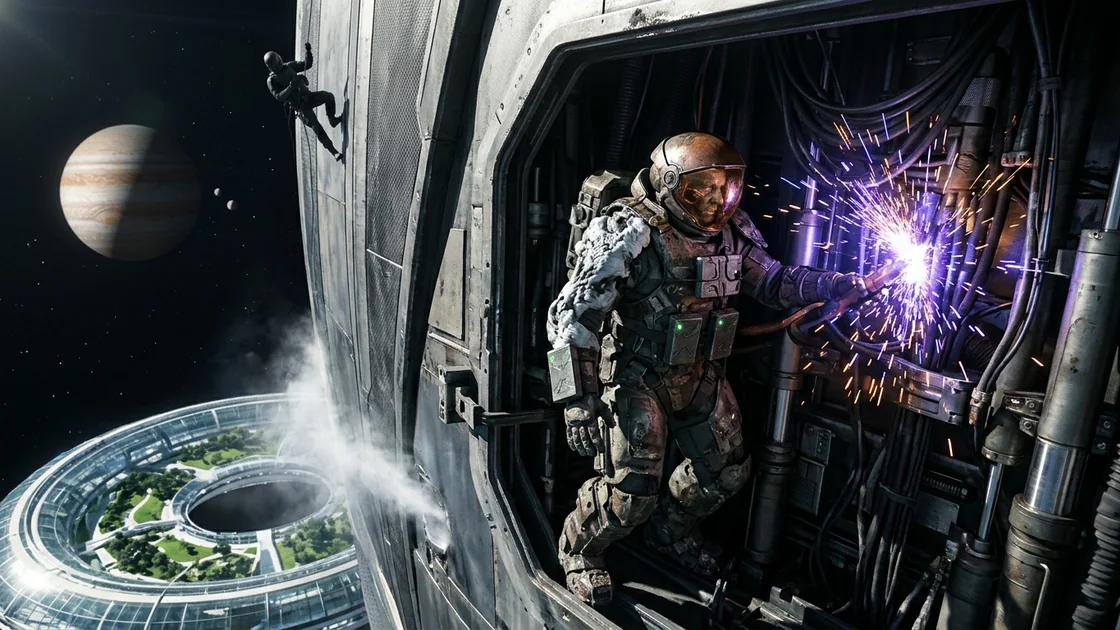
This story follows Kaelen Voss, a veteran deep-space asteroid miner who infiltrates the maintenance crew of Elysium Spires, an opulent orbital habitat owned by the Solaris-Vanguard Syndicate. Six months prior, the Syndicate intentionally shut down the oxygen supply to Kaelen's home colony of Cinder-7 to crush a labor strike, killing three hundred miners and their families while Kaelen was away on an ice-hauling run. Armed with salvaged industrial demolition equipment and an intimate knowledge of structural physics, Kaelen disguises himself as a low-level tether mechanic to reach the primary tension junction holding the spinning habitat to its asteroid counterweight. Amidst the Syndicate's centennial gala, Kaelen overcomes corporate security and sabotages the gravity tether, broadcasting the final recordings of his suffocating colony to the elite residents just before severing their world from its anchor and plunging their artificial paradise into chaotic freefall.
The grease inside the joints of an Mark-IV industrial exo-suit never truly froze, even in the deep shadow of the Jovian Trojans, but it thickened enough to fight a man’s knuckles every time he closed his fist. Kaelen Voss flexed his right gauntlet, feeling the sluggish resistance of the synthetic polymer hydraulic fluid, and watched the welding arc spit violet fire across the darkness. Above him, if the arbitrary alignment of his magnetic boots could be called down, hung the belly of the Aethelgard’s Anchor—afour-billion-ton chunk of nickel-iron slag that had been cored out, smelted from the inside, and wrapped in a cage of titanium girders. Below him, stretching three hundred kilometers into the velvet blackness toward the sunlit crescent of Jupiter’s outer moons, was the Line.
They called it the Umbilical in the corporate brochures, or the Golden Thread when the poets paid by the Solaris-Vanguard Syndicate were feeling particularly inspired. To the men and women who greased its dampeners and patched its micrometeorite pitting, it was just the Line. It was twelve meters thick, woven from twelve distinct macro-strands of carbon-boron nanotubes, sheathed in an ablative skin of kevlar-aerogel, and hummed with a low, sub-audible tension that Kaelen could feel in the fillings of his back teeth through the soles of his boots.
At the other end of that three-hundred-kilometer cable spun Elysium Spires. Even from the Anchor, the habitat looked like a discarded diamond necklace catching the distant, pale light of the sun. It was a wide, gleaming torus of spun glass, polished alloy, and pressurized arboretums, pulled in a relentless circle around the system’s central barycenter by the mass of the asteroid Kaelen stood upon. That spin gave the twelve thousand executives, shareholders, and politicians inside a crisp, unblemished nine-tenths of Earth gravity. It gave them babbling brooks that actually ran downhill. It gave them rain that fell from artificial clouds onto manicured golf courses, and wine that stayed at the bottom of crystal goblets without needing a sippy-cup lid.
Kaelen killed the plasma torch. The violet glare died, leaving only the amber HUD reflections inside his scratched polycarbonate faceplate and the distant, mocking glitter of the ring down-cable.
"Seal checks out green on Flange Seven, Breck," a voice crackled in his ear. It was Jaxon, the twenty-two-year-old telemetry tech sitting in the warm, pressurized blister of the rig-tender fifty meters away. Jaxon still had all his original teeth and lungs that didn’t rattle like dry leaves when the habitat humidity dropped below thirty percent. "Pressure sensors along the secondary coolant jacket are holding steady. Cobb says you can pack the lance and cycle in. Shift’s dead."
"Copy," Kaelen said, using the falsified name that had cost him forty thousand credits and the last piece of his wife’s wedding platinum in the black clinics of Callisto. "Securing the housing now. Give me four minutes on the winch."
"Don't milk the clock, Breck," another voice cut in, heavier and thick with the phlegmy rasp of cheap narcotic chew. Foreman Cobb. "The Gala charters are already docking at the central spindle. Vanguard Sec wants the exterior crawlers locked down and the work-gangs behind the bulkheads before the fireworks start. Anybody still on the skin in twenty minutes gets their tether clipped by an automated sentry."
"Four minutes, Foreman," Kaelen repeated, his voice flat, devoid of the resentment that usually got belt-miners spaced or blacklisted. He had burned all his visible anger out months ago, rendering it down like raw ore until all that remained was a cold, dense ingot in the pit of his stomach.
He didn't pack the plasma lance into the side-holster of his rig. Instead, he knelt on the curved titanium collar of the Anchor’s main gimbal—the massive mechanical throat where the carbon-nanotube braids exited the asteroid rock and began their long reach toward the habitat. Using the bulk of his broad shoulders to block the line-of-sight from the tender’s optical cameras, Kaelen unlatched the maintenance panel just beneath Flange Seven.
Inside the cavity, nestled between the pulsing superconducting power conduits that fed Elysium from the Anchor’s fusion reactors, sat a cylindrical package wrapped in lead-lined thermal foil. He had planted it there three shifts ago. Today, he added its twin, sliding the heavy, rectangular housing of a modified Type-9 seismic thumper out of his suit’s spare oxygen bay.
A Type-9 wasn't a weapon, not on paper. In the outer belt, when you found a chondrite rock rich in platinum-group metals that was too dense for laser scoring and too unpredictable for nuclear fracturing, you clamped a series of Type-9s along its natural fault lines. They used magneto-hydrodynamic pistons to hammer the stone at its exact resonant frequency until the asteroid shook itself apart from the inside out. Kaelen had spent nineteen years reading the grain of space rock, listening to the way vibration traveled through iron, silicate, and ice. A carbon-nanotube tether wasn't rock, but under six hundred million metric tons of centrifugal tension, it had a song of its own. And anything with a song could be made to shatter if you sang back to it at the right pitch.
He wired the thumper’s draw-lead directly into the auxiliary diagnostic junction, his thick, suited fingers moving with practiced economy. A tiny green LED blinked once behind the foil before he sealed the inspection plate and spot-welded the corners shut—just enough to look like a factory seal to a cursory drone sweep, weak enough not to interfere with the piston’s stroke.
As he stood and clipped his safety line to the crawler’s haul-cable, Kaelen looked down the dizzying length of the tether again. Inside his helmet, tucked into the edge of his copper-lined gasket where it brushed his left cheek, was a strip of faded thermal paper. There was nothing printed on it anymore; the heat of his skin and the sweat of six hundred hours in a work-suit had turned the whole strip black. But he didn't need to read the telemetry printout from Cinder-7. He knew the numbers by heart.
One hundred and one kilopascals. That was Earth-normal sea level, the pressure the Solaris-Vanguard Syndicate promised in the standard colonial charter before the budget revisions started.
Seventy-two kilopascals. That was what they dropped Cinder-7 to during the third year, claiming the electrolysis stacks were awaiting replacement filters from the inner system. At seventy-two, the kids got nosebleeds during games in the tunnels, and the old miners couldn't sleep lying flat because the fluid gathered in their lungs.
Forty-one kilopascals. That was where the barometer stood on the fourth day of the strike, twelve hours after Kaelen had lifted off in the water-tug Mule’s Ear to harvest a passing comet fragment because the colony’s cisterns were down to brown sludge. The miners hadn't asked for luxury. They hadn't asked for artificial grass or real beef. They had asked for six new scrubbing cores and the blast-shielding that had been paid for out of their own tonnage withholdings two years prior, after a solar flare cooked twelve men in Sector Four.
Director Vance Thorne hadn't sent negotiators. He hadn't even sent strike-breakers in drop-ships, because drop-ships burned hydrazine, and hydrazine cost sixty credits a liter out past the belt. Instead, Thorne’s office at Elysium Spires had transmitted a seven-digit override code to Cinder-7’s main environmental control hub.
The automated bulkheads had dropped, sealing the three hundred and twelve residents—including Kaelen’s wife, Lyra, and his fourteen-year-old son, Sam—into the central habitation cavern. Then, the exterior vent valves had opened for ninety seconds. Not enough to explosive-decompress the rock and damage the expensive sorting machinery. Just enough to drop the partial pressure of oxygen below the threshold of human consciousness, while simultaneously purging the nitrogen reserves into the vacuum so the colonists couldn't manually repressurize from the emergency tanks.
Kaelen had been forty thousand kilometers out when the distress beacon tripped. The Mule’s Ear had a top burn of point-three G, and her reaction tanks were half-empty for the cargo load. It had taken him thirty-one hours to burn back to the rock.
For the first nineteen of those hours, the radio had been alive.
He had listened to the miners trying to cut through the four-inch vanadium blast doors with mining lasers whose batteries died because the Syndicate had cut the main grid. He had listened to Lyra’s voice, calm and measured as she organized the children into the smallest airtight storage lockers to conserve what little air remained, singing old folk songs from an Earth none of them had ever seen so the toddlers wouldn't hyperventilate and burn the oxygen faster.
By hour twenty-two, the singing had stopped. By hour twenty-five, there was only the sound of shallow, ragged gasping over the open carrier wave, the metallic tink-tink-tink of someone tapping a wrench against a dead air duct, and then, for the last six hours of his burn, nothing at all except the hiss of Jupiter’s magnetosphere.
When the Syndicate salvage crews arrived a week later, their official accident report blamed an improperly maintained gasket in the primary greenhouse—Lyra’s greenhouse—citing "colonial negligence during an unauthorized work stoppage." The board of directors had written off the facility as a tax depreciation, collected the catastrophic loss insurance from the Bank of Luna, and used the payout to fund the construction of the third-tier aquatic gardens on Elysium Spires.
The haul-cable jerked, pulling Kaelen out of the memory and dragging him backward toward the airlock blister of the Anchor.
Inside the staging bay, gravity didn't exist—only the faint, sickening sideways tug of the Anchor’s slow rotation around the system’s center of mass. The bay smelled of scorched insulation, recycled urine, and the sour metallic tang of asteroid dust that never quite left the iron bulkheads.
Kaelen cycled through the decontamination lock, letting the ultrasonic shakers rattle the grit off his plates before stepping into the changing rack. Four other mechanics were already stripping out of their rigs, their pale, stunted bodies marked with the purple spiderweb veins of long-term microgravity and cheap vascular meds.
At the far end of the cages stood Foreman Cobb, his magnetic boots planted wide on the deck plating, a heavy poly-alloy clipboard clamped under one meaty arm. Beside him was Jaxon, looking nervous, his eyes darting between Kaelen’s rig and the diagnostic console built into the bulkhead.
"Took you five minutes, Breck," Cobb grunted as Kaelen popped his helmet seal and lifted the heavy dome clear. The air in the room was cold and tasted like copper, but Kaelen breathed it in without flinching. "Five minutes is a long time to spend staring at a welded seam."
"Slag inclusion on the lower lip," Kaelen said, reaching down to unfasten his chest plate. "If I left a cold lap on a high-tension collar and it cracked during the Gala spin-up, you’d have my license. Took an extra pass with the filler rod to make sure."
"Funny thing about that," Cobb said, taking a slow, heavy step forward. The mag-soles of his boots went clack-hum, clack-hum against the deck. "Jaxon here was watching your power draw on the tender’s umbilical. Says your plasma lance shut down at the forty-second mark. Didn't draw a single amp for the last four minutes you were out on the gimbal."
The locker room went quiet. The two mechanics nearest Kaelen stopped unlacing their thermal undersuits, their eyes dropping to the floor plates before they hurriedly kicked off the walls and drifted into the shower alcove, wanting no part of whatever was coming. Only Mara stayed. She was an older woman from the Ceres shipyards, her gray hair cropped to the skull, a jagged burn scar pulling down the left corner of her mouth. She stayed by her locker three meters behind Cobb, slowly wiping down a torque wrench with an oily rag, her dark eyes fixed on the Foreman’s back.
Kaelen didn't freeze, and he didn't reach for a weapon. He let his chest plate swing open on its hinges, exposing his sweaty gray thermal shirt, and looked directly at Jaxon. The kid flinched.
"The rig umbilical had a ground fault in the wrist coupling," Kaelen said smoothly, stepping out of the exo-frame’s leg stirrups. "So I switched to the suit’s internal battery pack to finish the tack. Didn't want to spike the tender’s inverter. You can pull the suit cell and check the discharge curve if you're feeling thorough."
Cobb stopped three feet away. He was a big man, built like a cargo container, with a Syndicate loyalty tattoo—the golden sunburst over a stylized V—inked right onto the bald crown of his skull. He reached out and slapped a heavy hand against the shoulder of Kaelen’s empty exo-suit, right above the auxiliary oxygen bay.
"I don't care about the battery curve, Breck," Cobb said, his voice dropping an octave. "What I care about is the mass-balance log on the crawler. You went out with four kilos of welding rod and a standard patch kit. According to the strain gauges on the haul-winch, you came back twenty-two kilos lighter than you left."
Cobb’s hand slid down to the latch of the spare oxygen bay on the back of the rig.
"Now," the foreman whispered, showing teeth stained brown by betel-chew, "unless you vented twenty kilos of solid steel out of your boots, you left something out on my gimbal. Maybe a smuggler’s drop for the dock-rats? Or maybe something worse."
With a sharp jerk, Cobb popped the bay latch. The compartment swung open. Inside, instead of the twin emergency O2 cylinders, sat a nest of stripped wiring, residual lead foil, and the unmistakable shaped-aluminum cradle of an industrial seismic charge.
Jaxon let out a sharp, choked gasp by the console. "Foreman, that's—that's a core-breaker bracket. From the deep demolition lockers."
"Call Sec, kid," Cobb barked, his right hand already dropping to the heavy pneumatic rivet-gun hanging from his utility belt. "Hit the red stud! We got a—"
Kaelen didn't move like a man who had spent forty years in low gravity; he moved with the brutal, compact snap of someone who had spent the last six months doing isometric resistance drills until his tendons tore. Before Cobb could clear the safety catch on the rivet-gun, Kaelen’s left hand shot out and seized the hydraulic line at the elbow of his own open exo-suit. With his right, he jammed the manual actuator lever on the suit’s forearm.
Powered by a three-thousand-PSI accumulator, the exo-suit’s empty steel gauntlet swung upward in a vicious, blindly mechanical arc.
The five-fingered titanium claw caught Cobb squarely under the jaw with the sound of a dry timber snapping. The force of the blow lifted the two-hundred-pound foreman right out of his magnetic boot-locks, sending him spinning upward into the overhead lighting grates in a spray of crimson droplets that hung in the zero-G air like rubies.
Jaxon lunged for the emergency klaxon on the console. He never reached it. Mara kicked off from her locker with the silent grace of a lifelong spacer, soaring across the bay in a flat trajectory. As she passed the console, she swung the heavy forty-millimeter torque wrench in a short, economical chop that clipped the base of Jaxon’s skull. The kid folded against the polycarbonate screen and drifted limp, a thin ribbon of blood curling lazily from behind his ear.
Kaelen was already on Cobb. The foreman had crashed back against the lockers, stunned and choking on a crushed larynx, his fingers scrabbling blindly at his throat. Kaelen caught him by the collar of his coveralls, slammed him into the open cage of Locker Four, and jammed the heavy mesh door shut on the man’s chest, pinning him inside before snapping the padlock hasp home.
Breathing hard, Kaelen turned toward Mara. His hand was resting on the grip of the plasma cutter hanging from his rig’s hip mount.
Mara floated near the ceiling, one boot hooked around an air pipe, looking down at the unconscious tech and then across at Kaelen. She didn't drop the wrench, and she didn't raise it.
"You're not Breck," she said quietly. Her voice was raspy, damaged by the same bad air that had scarred her face. "Breck was an alcoholic dock-welder from Ganymede who couldn't read a strain-gauge without his spectacles. Who are you?"
"Someone you don't want to know," Kaelen said, pulling Jaxon’s unconscious form away from the console and binding the boy’s wrists and ankles with high-tensile zip-ties from his belt. "Take a pod, Mara. The tug at Airlock Three has full tanks. You can be clear of the local traffic control zone in ten minutes."
Mara floated down, her boots clicking onto the deck plates beside the open back of Kaelen’s rig. She looked into the empty oxygen bay at the core-breaker cradle, then out the thick quartz porthole where the silver ribbon of the tether stretched down toward the glowing ring of Elysium.
"Six Type-9s," she murmured, reading the shape of the cradle with a professional’s eye. "You've been stripping the decommissioning bay in Sector Nine for a month. I wondered where the thorium cells were going." She looked up at him, her scarred mouth twisting into something that wasn't quite a smile. "You're from Cinder-7."
Kaelen paused with his hand on Jaxon’s collar. "What makes you say that?"
"Only two crews in the belt ever wired Type-9s into a sequential daisy-chain off a standard diagnostic bus," Mara said, tossing the bloody wrench into an open tool bin. "Old man Harker’s crew on Vesta, and Kaelen Voss’s gang on Cinder-7. And Harker died of liver rot five years ago." She stepped over to the main telemetry console and began typing rapidly, her blunt fingers flying across the grease-stained keys. "How many have you got on the Line?"
"Four on the upper collar," Kaelen said, watching her closely. "Two more in my pack for the lower Knuckle, right above the spindle."
"Won't work," she said without looking up.
"It'll work. I ran the math."
"You ran the math for the old sixty-strand cable they used on the Ceres elevator," Mara countered sharply, pulling up a schematic of the tether that glowed blue against her lined face. "Vanguard upgraded the Elysium line two years ago when they added the new casino ring. If you pop the upper collar and the lower Knuckle at the same time, the central load-balancers at Kilometer One-Fifty will sense the tension drop in three milliseconds. They’ll fire the explosive shear-bolts on the outer four sacrificial strands and dump the kinetic whip into the magnetic dampeners. You’ll give the rich folks down there a nasty five-minute shake, break some expensive wine glasses, and then the emergency thrusters on the habitat will stabilize the ring until the repair tugs get here."
Kaelen stared at the schematic. Cold sweat pricked the back of his neck. The specifications he had bought on Callisto had been three years old—the newest he could get without tripping Syndicate intelligence flags. "The central balancers are hardwired?"
"Hardwired into the primary fiber-optic trunk that runs down Channel Zero," Mara said. She tapped a blinking red node half a kilometer above the habitat’s main docking spindle. "Right there, at the lower Knuckle. You don't just have to shake the cable, Voss. You have to blind the balancer’s optical brain for six seconds while the resonance wave builds, and you have to cut the primary dampener hydraulics manually with a heavy lance so the energy has nowhere to go except straight down the core strands."
Kaelen looked at her. "Why are you telling me this?"
Mara reached up and touched the puckered, shiny skin pulling at the corner of her mouth. "Twelve years ago, before they called themselves Solaris-Vanguard, they were just Vanguard Resource Group. I worked the cracking towers on the Rhea atmospheric processor. One of the hydro-valves blew on a double shift. My sister and nineteen other techs were inside the scrubber torus."
She tapped a final command into the console, locking out the local security sub-routine and setting a looping green status signal on the bay’s master transceiver.
"If they vented the torus inward to save the crew, the corrosive slush would have ruined forty million credits worth of platinum catalyst," Mara said softly. "So the station manager locked the inner hatches from his office and vented the boil-off through the crew compartment instead. My sister lived for four days in the infirmary with no skin left on her lungs. The man who signed the maintenance deferment on that valve was a junior operations executive named Vance Thorne."
Inside Locker Four, Foreman Cobb made a wet, rattling sound and kicked weakly against the steel mesh. Neither of them looked at him.
"The Gala broadcast just started on the open corporate band," Mara said, turning back to Kaelen. "Thorne’s giving the keynote speech in forty minutes from the Grand Arboretum. If you take the external crawler down the Line now, the automated defense turrets at the midpoint will pick you off before you hit Kilometer One Hundred. They track anything moving slower than fifty meters a second."
"Then I don't take the crawler," Kaelen said, walking back to his exo-suit and lifting a heavy, canvas-wrapped bundle from the bottom of his personal locker. "I take a brake-sled down the Chariot rail."
Mara’s eyes widened slightly. The Chariots were the high-speed magnetic elevator cars that ferried VIPs and supplies between the Anchor’s starport and the habitat below. A brake-sled was nothing more than a two-meter slab of induction copper with handgrips and a manual friction shoe, used only for emergency evacuations when the main power failed. Riding one down three hundred kilometers of vertical cable, accelerating solely under the rising pull of centrifugal force, was the closest thing to falling into a star a man could survive.
"You'll hit four Gs of deceleration when you throw the shoe at the Knuckle," Mara said. "If the copper melts before you stop, you'll hit the habitat spindle at eight hundred kilometers an hour."
"I packed extra copper," Kaelen said.
He climbed back into the open torso of his Mark-IV suit, feeling the cold embrace of the steel cradle close around his ribs. Mara stepped over and helped him dog the heavy rear latches, her movements brisk and efficient. She unplugged two fully charged lithium-sulfur power cells from the wall charger and slammed them into his hip holsters, then handed him a heavy industrial data-splice clamp.
"Channel Zero is sheathed in orange teflon on the north face of the Knuckle," she said, holding his helmet before lowering it over his head. "When you cut the balancer line, you'll be sitting directly on the habitat’s main fiber trunk. Everything they see, hear, and say down there runs through that glass. Make sure they know who turned out the lights, Kaelen."
"Get to the tug, Mara," Kaelen said as the helmet ring clicked home and the suit’s internal fans whined to life, filling his ears with the familiar roar of canned air. "And take the kid with you. He didn't sign the purge order."
Mara gave a single, sharp nod through his visor. "Good hunting, miner."
Ten minutes later, Kaelen Voss was clamped to the side of the Line like a beetle on a silver wire, staring straight down into the spinning eye of God.
From the exterior maintenance gantry of the Chariot bay, the view was physically nauseating. In deep space, there was no up or down, only the local reference of whatever hull you were standing on. Here, the three-hundred-kilometer tether created a harsh, undeniable geometry. Directly behind him was the jagged black mass of the Anchor. Directly ahead, at the bottom of a ruler-straight highway of braided black nanotube and gleaming magnetic guide-rails, hung Elysium Spires.
The habitat was fully lit for the Centennial Gala. Its outer hull was armored in polished white ceramic, but the inner curve of the torus—facing back up toward the Anchor—was a continuous band of transparent aluminum-oxynitride crystal, four kilometers across and a kilometer wide. Even at this distance, Kaelen’s suit optics zoomed in enough to resolve the lush emerald green of the central parklands, the sapphire ribbon of the artificial river curving through the villa districts, and the warm golden glow of the central plaza where ten thousand tiny lights pulsed in choreographed harmony.
Kaelen muscled the eighty-kilo induction sled onto the Guide Rail B, feeling the fierce magnetic flux of the track grab at the copper runners and pull them into alignment with a sharp clank. He checked his suit tether, locked his boot stirrups into the sled’s bottom bracket, and tested the manual friction lever between his knees. Strapped to his chest were the last two Type-9 seismic thumpers, his heavy-duty plasma lance, and the data-splice clamp Mara had given him.
Inside his helmet, he tuned his auxiliary comm receiver to the habitat’s public broadcast channel. Instantly, the soaring, delicate strings of a live chamber orchestra filled his ears, accompanied by the polite murmur of thousands of clinking glasses and the soft, cultured voice of a Syndicate commentator describing the arrival of the board of directors at the Spire of Dawn.
Kaelen reached down and pulled the release pin on the sled’s upper docking clamp.
At first, nothing happened. Up here near the Anchor, he was just above the system’s center of rotation; the centrifugal pull was less than a twentieth of a G. Slowly, silently, the sled began to slide down the rail. The titanium collar of the Anchor drifted away behind him, receding into the dark.
By Kilometer Ten, he was moving at forty meters a second. The sub-audible hum of the tether began to rise in pitch, vibrating through the copper runners of the sled and straight up his shinbones.
By Kilometer Fifty, the centrifugal pseudogravity had climbed to a fifth of a G, and it wasn't pulling him smoothly anymore—it was dragging him downward with a greedy, accelerating fist while the Coriolis force of the system’s rotation slammed his right shoulder continuously against the guide-rail’s magnetic cushion. The stars around him weren't stationary; they were wheeling in a slow, majestic carousel, swinging past the dazzling white ring below like sparks thrown from a grinding wheel.
Inside his helmet, the orchestra faded, replaced by a fanfare of brass and the warm, booming voice of Director Vance Thorne.
"One hundred years ago," Thorne’s voice echoed, rich and resonant, enhanced by the finest acoustic engineering money could buy, "our founders looked out at the cold, chaotic debris of the outer system and saw not a wasteland, but a vault. They understood a fundamental truth of human destiny: that order requires vision, and vision requires the courage to refine the raw, unruly matter of the universe into something enduring. Something pure."
At Kilometer One-Fifty, Kaelen hurtled past the central load-balancer station. He was traveling at nearly three hundred miles an hour now. The station—a massive, spider-like ring of hydraulic accumulators and automated laser turrets—flashed past him in a blur of warning strobes and yellow steel. The tracking radar on the upper turret swiveled, catching his thermal bloom, and its targeting laser painted a fleeting crimson line across his chest plate. Kaelen didn't flinch; before the turret’s combat computer could verify whether the fast-moving metal mass on the VIP rail was an unauthorized sled or ascheduled courier pod, he was already two kilometers down-line and plunging deeper into the gravity well.
The pull was half a G now. Kaelen felt the blood draining from his head, pooling in his calves and thighs inside the compression liner of his suit. It was a sensation every belt-miner hated—the heavy, suffocating drag of planetary weight, the feeling that the universe was trying to crush your ribs and pin you to the floor.
"There are those in the inner parliament who question the cost of our stewardship," Thorne continued in Kaelen’s ear, followed by a ripple of polite, dismissive laughter from the crowd in the arboretum. "They look at our balance sheets and forget that civilization is not built by sentiment. When a branch withers on a great tree, the gardener does not weep for the dead wood; he prunes it, so that the canopy may reach higher into the light. Today, looking out over the gardens of Elysium, who among us can doubt that the harvest was worth the pruning?"
Applause rolled through Kaelen’s headset like distant surf.
He looked at his altimeter. Kilometer Two-Sixty. The habitat wasn't a distant necklace anymore; it filled his entire field of vision below, a vast, wheeling continent of light and glass rushing up to swallow him. The Coriolis force was roaring through the sled’s chassis, fighting the magnetic levitation pads, throwing showers of blue electrostatic sparks into the vacuum behind his boots.
Two-Seventy. Two-Eighty.
Kaelen braced his gauntleted hands against the brake lever and threw his weight backward.
The copper induction shoe dropped three millimeters, closing the gap with the primary steel guide-rail. Instantly, eddy currents of terrifying magnitude swirled through the sled’s baseplate, converting his downward kinetic energy into raw thermal radiation.
The deceleration slammed Kaelen down into his boot stirrups at four and a half Gs. His vision grayed out at the edges, narrowing to a dim tunnel centered on the blinding white spire of the habitat’s central docking hub ten kilometers below. His ribs groaned against the suit’s inner padding; the old fracture in his left collarbone—souvenir of an ice-slide on Cinder-7 five years back—screamed like a hot wire buried in the bone. Beneath his boots, the sled’s copper plate turned dull cherry red, then bright orange, shedding globules of molten metal that trailed behind him like falling stars.
His HUD flashed a dozen crimson warnings: SLED THERMAL LIMIT EXCEEDED. STRUCTURAL FAILURE IN TEN SECONDS. EIGHT.
At Kilometer Two-Ninety-Nine, right where the twelve massive strands of the tether flared outward like the roots of an iron sequoia to anchor into the habitat’s titanium spindle, Kaelen kicked the emergency release bolts on his stirrups and fired his suit’s cold-gas thrusters at maximum burn.
Two seconds later, the induction sled’s copper shoe vaporized in a silent flash of green-white plasma. Released from its magnetic grip, the twisted remnant of the chassis shot down the remaining kilometer of track like a railgun slug and slammed into the upper buffer springs of the VIP terminal in an explosion of silent sparks.
Kaelen tumbled through the dark, his thrusters screaming as they fought the eight-tenths G pull of the spinning ring below and the sideways whip of the Coriolis force. He swung his right arm out and fired his magnetic grapple-harpoon at the massive collar of the lower Knuckle.
The tungsten barb struck a secondary coolant pipe, skittered across the curved steel with a shower of sparks, and hooked solidly into the inspection grating of Node Zero-Four. The high-tensile kevlar line snapped taut. The violent jerk nearly tore Kaelen’s right arm out of its socket, slamming him flat against the vertical wall of the tether housing with a bone-rattling clang.
For ten seconds, Kaelen just hung there, his magnetic boots locked onto the vertical plating, listening to the ragged, whistling wheeze of his own breathing inside the helmet. His vision was swimming with black spots, and the warm, salty taste of blood filled his mouth where he had bitten clean through his lower lip during the G-spike.
Down here, five hundred meters above the main docking spindle, the sensation of gravity was absolute and terrifying. The tether wasn't beneath him anymore; it was a colossal cliff face rising straight up into the starry black sky, and he was a fly clinging to its side while the vast, illuminated bowl of Elysium Spires rotated majestically directly beneath his dangling heels. If his boot magnets failed now, he wouldn't float away. He would plummet straight down like a dropped stone, smash through the five-inch crystal skylight of the Grand Arboretum, and paint the manicured lawns with his bones.
"Alert," a flat, synthesized voice broke into the corporate broadcast channel, overriding the music for a split second before cutting to the security sub-band Mara had unlocked for him. "Unidentified mass impact on Guide Rail B, Upper Spindle buffer. Structural damage minor. Dispatching Drop-Team Alpha from the Hub barracks to investigate."
Kaelen spat blood onto the inside of his chin-guard and pulled himself across the grating toward the northern face of the Knuckle. Every movement was an agonizing chore; in 0.85 G, his Mark-IV mining suit weighed nearly three hundred pounds, and its servomotors were tuned for zero-G weightlessness, whining in protest as they hauled his bulk across the vertical steel.
He reached the inspection hatch for Channel Zero. Using his plasma lance at max amperage, he didn't bother with the bolts—he simply sliced the hinges straight off the bulkhead in a shower of white-hot slag, kicked the eighty-pound steel door free, and watched it fall away behind him, tumbling end over end down toward the glittering dome of the habitat.
Inside the recessed cavity lay the heart of the bolo’s stability: four massive hydraulic dampener pistons, each as thick as an ancient oak tree, pulsing rhythmically as they absorbed the micro-vibrations of the three-hundred-kilometer cable above, and beside them, encased in bright orange teflon armor, the primary fiber-optic trunk line.
Kaelen pulled the last two Type-9 seismic thumpers from his chest rig and slapped their magnetic bases directly onto the central junction plate where the twelve nanotube macro-strands converged into the titanium shear-pins. He flipped their arming toggles and linked their transceivers to the four charges waiting three hundred kilometers above him at the Anchor.
On his HUD, six amber icons blinked in unison, then turned solid green: HARMONIC LINK ESTABLISHED. LINE TENSION: 6.12 x 10^8 NEWTONS. RESONANCE CASCADE READY.
Now he needed six seconds of blindness on the optical line, and he needed those four hydraulic dampeners bled dry.
He reached for the orange fiber-optic conduit with Mara’s data-splice clamp.
Before his fingers touched the teflon, a high-velocity tungsten dart struck the steel plating three inches from his right visor, shattering into a spray of incandescent pyrophoric dust that pitted his polycarbonate faceplate.
Kaelen threw himself flat into the maintenance recess just as a second dart clipped the upper housing of his backpack, shearing away his primary radio antenna and venting his reserve nitrogen tank in a screaming white plume of frost.
He twisted his neck, looking up the vertical expanse of the tether.
Sliding down the auxiliary safety cables from the spindle’s upper defense ring were four figures in sleek, matte-black zero-G combat armor. Vanguard Drop-Sec. Unlike Kaelen’s bulky, industrial rig, their suits were agile, streamlined shells equipped with gyro-stabilized pulse rifles and vector-thrust packs that allowed them to dance along the side of the gravity well like hawks riding an updraft.
"Target visual at Node Zero-Four," the lead trooper’s voice barked over the local tactical band. "Heavy industrial rig, unauthorized demolition gear exposed on the main pins. Lethal force authorized. Clear the asset, do not hit the primary strands!"
Two of the troopers kicked off the cable fifty meters above him, firing their vector thrusters to swing out wide and get a clear firing angle into the recessed bay where Kaelen crouched. The other two continued straight down the guide-rail, leveling their rifles to pin him in place.
They were trained soldiers, conditioned in orbital kill-houses and armed with state-of-the-art antipersonnel weapons.
Kaelen Voss was a man who had spent twenty years wrestling thousand-ton boulders of tumbling iron in the dark with nothing between him and eternity but three millimeters of patched rubber and a welding torch. He didn't know tactics, and he didn't care about living until tomorrow.
As the two flanking troopers arced outward against the starry backdrop, Kaelen reached down to the primary hydraulic bleeder valve on Dampener Piston One—a high-pressure line carrying superheated synthetic oil at twelve thousand pounds per square inch. He didn't use a wrench. He jammed the nozzle of his plasma lance straight against the brass relief union and pulled the trigger.
The brass didn't melt; it sublimated instantly.
A geyser of boiling, pressurized hydraulic fluid erupted from the ruptured union with the roar of a rocket engine, shooting thirty meters straight out into the vacuum. In the zero-pressure environment, the superheated oil flashed instantly into a blinding, turbulent fog of freezing aerosol droplets and ice crystals, creating an impenetrable white cloud right in the flight path of the two flanking troopers.
Blind inside the freezing oil-fog, the lead flanker panicked and fired his thrusters to pull up. The ignition flare of his hydrazine pack lit the aerosolized hydraulic fluid.
In vacuum, oil couldn't burn without an oxidizer, but the trooper’s thruster exhaust was rich in uncombusted dinitrogen tetroxide. The cloud flashed into a silent, violent fireball of greasy orange flame that coated both troopers’ visors in opaque black carbon soot and gummed their thruster nozzles with polymerized sludge. Out of control, spinning wildly in the grip of the Coriolis force, the two black-armored figures missed the tether entirely, cartwheeling past Kaelen’s bay and plunging helplessly down toward the massive ceramic rim of the habitat below.
Kaelen didn't watch them fall. The remaining two troopers on the rail above were only twenty meters away now, braking hard with their magnetic claws, their rifles spitting three-round bursts of armor-piercing darts that chewed sparks out of the recess lip.
One dart found the seam between Kaelen’s left shoulder plate and his neck ring.
It felt like someone had driven a white-hot railroad spike through his trapezius. The impact slammed him back against the pulsing steel of Dampener Piston Two. His suit’s internal alarms shrieked as cabin pressure dropped from ninety kilopascals to sixty in two seconds, the whistling scream of escaping air deafening inside his helmet before the suit’s emergency bio-foam injectors triggered, flooding his left shoulder cavity with icy, expanding resin that sealed the puncture and locked his left arm completely immobile against his chest.
Through a haze of red pain, Kaelen saw the third trooper land on the grating right outside the bay, raising his pulse rifle at point-blank range.
With his left arm frozen in hardened foam, Kaelen released his magnetic boot locks for a fraction of a second, letting the eight-tenths G pull drag him downward two feet—just enough for the trooper’s burst to pass harmlessly over his helmet and shatter the ceramic insulator behind him. As he fell past the lip of the bay, Kaelen swung his heavy right arm out, his fingers locked around the trigger of the industrial grapple-harpoon mounted to his forearm.
At a range of four feet, the tungsten harpoon didn't just pierce the trooper’s composite breastplate; it punched clean through the man’s sternum and came out the back of his thruster pack in a pink mist of frozen blood.
Kaelen didn't let go of the line. As the dead trooper’s two-hundred-pound armored corpse was yanked downward by the habitat’s gravity, falling past the bay toward the spindle below, Kaelen looped the slack of the kevlar grapple cable over the rifle barrel of the fourth trooper who was just landing beside his partner.
The falling corpse hit the end of the twenty-meter line like a hangman’s weight. The kevlar cable snapped taut with three tons of downward jerk, ripping the rifle—and the fourth trooper’s magnetically locked gauntlets along with it—straight off the grating. The soldier didn't even have time to scream over the comm before he was dragged over the edge into the abyss, pulled down by his dead comrade into the blinding lights of the docking hub half a kilometer below.
Kaelen slammed his boot magnets back on, catching himself on the lower lip of the bay with a jarring thud that made him vomit a mouthful of blood and bile against his chin guard. His left side was entirely numb now, the bio-foam pressing hard against his punctured flesh, and his suit oxygen counter was flashing amber: TWELVE MINUTES REMAINING.
"Drop-Team Alpha, report!" the tactical dispatcher’s voice barked in his ear. "Alpha Lead, we’ve lost your telemetry transponders! Visual from Spindle Camera Four shows—Christ almighty, we have four bodies impacting the upper docking dome! Who is on that line? Patch me through to the Node Zero-Four maintenance intercom!"
Moving solely with his right arm, dragging his dead left side behind himlike an anchor, Kaelen hauled himself back into the recess. The plasma lance was still hanging by its power tether from his hip. He grabbed it, wedged the trigger open with a steel cotter pin from his belt, and jammed the roaring four-thousand-degree torch directly into the nexus of the remaining three hydraulic dampener lines and the optical balancer trunk.
Then he took Mara’s data-splice clamp, crushed its induction jaws over the exposed, glowing glass fibers of the habitat’s main broadcast trunk, and plugged the patch-cord into the external data port on the side of his helmet.
Down in the Grand Arboretum of Elysium Spires, under a vaulted ceiling of crystal that framed the swirling amber clouds of Jupiter, twelve thousand of the wealthiest human beings in the solar system stood beneath faux-marble colonnades and genetically engineered cherry trees that shed pink blossoms in a gentle, perfumed breeze.
On a raised dais of white martian alabaster stood Director Vance Thorne, immaculate in a high-collared tunic of spider-silk, raising a flute of vintage terrestrial champagne toward the fifty-meter holographic banner of the Solaris-Vanguard Syndicate hovering above the artificial lake.
"To the next century!" Thorne’s voice rang out across the water, amplified by ten thousand invisible acoustic projectors. "To the builders of the high frontier, and to the eternal stability of—"
The fifty-meter hologram above the lake vanished in a jagged burst of static.
Across the four-kilometer sweep of the torus, every chandelier dimmed to emergency red. The gentle orchestral music died, replaced instantly by a deafening, high-gain hiss of cosmic background radiation that made the partygoers wince and cover their ears, spilling champagne across the imported grass.
Before the security technicians in the central hub could physically pull the breakers on the main trunk, another voice came through the speakers—not Kaelen’s, and not Thorne’s.
It was a recording, six months old, scarred by magnetic interference and the hollow, tinny echo of an iron tunnel five hundred million miles away.
"—pressure is down to thirty-four kilopascals," a woman’s voice said, calm, exhausted, and terribly clear as it echoed off the marble villas and crystal towers of Elysium. "If anyone on the outer haul-lanes is reading this, the Vanguard override has welded the main locks from the outside. The children are in the seed-vaults, but the CO2 scrubbers are dead. Please. Tell Kaelen we waited as long as we could."
In the background of the recording, unmistakable and rhythmic, was the sound of fifty small voices coughing in the dark, and the slow, steady clink-clink-clink of someone tapping a steel wrench against an empty oxygen pipe.
On the alabaster dais, Vance Thorne froze, the champagne flute trembling in his fingers as the blood drained from his patrician face. Seconds later, his personal comm-link overrode the local loop, connecting directly to the active splice at Node Zero-Four.
"Who is this?" Thorne’s voice hissed in Kaelen’s helmet, stripped of its oratorical warmth, raw with sudden, naked terror. "Whatever you want—credits, a ship, an executive pardon—take your hands off the dampener controls! Do you have any idea what will happen to the ring’s structural integrity if that tether—"
"Thirty-one hours, Vance," Kaelen whispered into his bloody microphone, his right thumb hovering over the master firing stud of the Type-9 transceiver. "That’s how long it took my tug to get back to Cinder-7. You didn't even let them have the nitrogen."
"Wait! Listen to me, you lunatic, there are twelve thousand people in this ring! You can't—"
"Good harvest, Director," Kaelen said, and pressed the stud.
Three hundred kilometers above him at the Anchor, and three feet in front of his visor at the Knuckle, six magneto-hydrodynamic pistons slammed forward against the carbon-nanotube braids at precisely forty-two point six hertz.
The first second, nothing visible happened.
The second second, the low, sub-audible hum that Kaelen had felt in his teeth all week suddenly found a voice—a deep, terrifying bass note that turned the residual air in his suit into vibrating jelly and shook a blizzard of frost and rust off the entire three-hundred-kilometer length of the Line.
Because the optical trunk to the midpoint balancer was melted into slag, the automated shear-bolts at Kilometer One-Fifty never fired. Because the four hydraulic dampeners at the Knuckle were venting their boiling oil into space, there was nothing to swallow the wave.
The mechanical vibration raced up the cable from the habitat and down the cable from the asteroid at twelve kilometers per second. At the exact midpoint, the two resonance waves met, constructively interfered, and doubled their amplitude. Then they bounced back toward the ends.
By the fourth second, the twelve-meter-thick tether was no longer straight. It was writhing against the stars like a struck violin string three hundred miles long, whipping side to side in fifty-meter arcs that ripped the magnetic Chariot rails straight out of their brackets and flung them into the dark like tangled ribbons of tin.
At the fifth second, the plasma lance wedged into the junction box burned through the last safety interlock on the primary titanium shear-pins.
At the sixth second, Strand One reached its tensile limit.
When a steel cable snaps under load, it sounds like a rifle shot. When a four-meter braid of woven carbon-boron nanotubes under fifty million tons of tension fails, it doesn't just break—the stored elastic energy converts instantly into thermal plasma along the fracture plane.
Strand One didn't snap; it detonated in a blinding horizontal slash of ultraviolet lightning that vaporized the maintenance bay ten feet above Kaelen’s head.
Instantly, the load shifted to the remaining eleven strands.
Bang. Bang. Bang-bang-bang.
It was a chain reaction moving at the speed of sound through solid diamond. Kaelen barely had time to kick his magnetic boots free of the grating and fire his last dregs of thruster gas to push himself backward away from the cliff face before the remaining eleven macro-strands blew apart in a ragged, catastrophic crescendo of white fire.
For a fraction of a millisecond, a gap of pure vacuum opened between the lower Knuckle and the dangling end of the three-hundred-kilometer cable.
Then the recoil took hold.
Freed from the six-hundred-million-ton anchor of the habitat, the upper tether contracted like a rubber band the size of a mountain range. The jagged, frayed end of the Line whipped upward toward the asteroid Anchor at four times the speed of sound, vanishing into the dark above in a swirling hurricane of shattered kevlar, snapping power conduits, and blue electrical arcs that lit the surrounding space like a localized supernova.
And below Kaelen, Elysium Spires lost the sky.
The physics of a rotating bolo are mercilessly simple. For ten years, the habitat had been swinging in a circle at nearly a kilometer per second, held in its curved path only by the relentless inward pull of the tether. The instant the tether parted, there was no longer a circle.
Obeying Newton’s first law, the four-kilometer-wide luxury ring immediately ceased orbiting the barycenter and shot off on a straight-line tangent into the deep outer dark, like a stone released from a sling.
Inside the habitat, the consequences were instantaneous and biblical.
Without the tether to pull the ring inward around the central hub, the smooth, stable rotation vector destabilized within three seconds. The habitat still had its own angular momentum, spinning wildly around its own mismatched center of mass like a coin dropped unevenly onto a table, wobbling into a violent, precessing tumble.
From five hundred meters above the central crystal dome, tumbling slowly backward in his crippled suit, Kaelen had a front-row seat as paradise came undone.
The nine-tenths of Earth gravity that the residents of Elysium had paid billions to enjoy vanished in a heartbeat, replaced by a chaotic, alternating nightmare of zero-G weightlessness and violent sideways shear as the torus wobbled on its axis.
Down in the Grand Arboretum, the artificial river and the central lake simply lifted out of their beds. Millions of gallons of emerald-tinted water rose into the air inside the dome in a single, undulating, kilometer-wide tsunami that broke apart into ten thousand floating, suffocating spheres of liquid. The cherry trees tore free of their shallow hydroponic soil beds, swirling upward in a blizzard of mud, roots, and pink blossoms that collided with the floating crowds of screaming partygoers.
Then the wobble hit the structural frame.
Elysium Spires had been engineered to bear weight pressing strictly outward against its hull plates, never sideways against its decorative interior ribs. As the untethered ring precessed, a massive torsional flex rippled through the four-kilometer wheel.
In the villa district on the eastern curve, the delicate towers of spun glass and martian alabaster sheared off at their foundations, drifting upward across the interior sky to smash against the opposite side of the ring in silent, glittering avalanches. The artificial cloud-generators ruptured along the ceiling struts, filling the habitat’s air with blinding, freezing fog, while the main decorative aqueducts burst, turning the zero-G interior into a tumbling blender of shattered crystal, drowning water-globes, unmoored banquet tables, and panic.
The habitat wouldn't decompress completely—its outer ceramic hull was triple-layered against meteoroids, and its emergency bulkheads were already slamming shut between the sectors, trapping the survivors in dark, flooding compartments. And the people inside wouldn't die of asphyxiation tonight; their reserve tanks had weeks of air, and eventually, after days or weeks of chasing the runaway ring as it hurtled out of the Jovian system at three thousand kilometers an hour toward the empty black between the stars, Syndicate rescue cruisers would catch up to it, cut through the hulls, and pull the battered, traumatized survivors out of the cold dark.
They would live.
But they would spend the next two hundred hours floating in the freezing, pitch-black wreckage of their own opulence, listening to the groan of failing bulkheads, fighting for breaths between floating spheres of dirty water, listening to the endless, looping echo of a dying mining colony playing over the battery-backed emergency speakers that no one could reach to turn off. They would know, down in the marrow of their bones, what it felt like when someone else decided to turn off the world.
Kaelen drifted backward into the velvet silence.
His suit thrusters were empty. His left arm was locked in a tomb of hardened white foam against his chest, and the blood inside his helmet had dried into a dark crust across his cheek. His oxygen counter blinked a steady, unhurried red: FOUR MINUTES.
Below him, shrinking rapidly as it hurtled away on its tangent into the outer dark, the great wheel of Elysium Spires tumbled silently through the void, its interior lights flickering out sector by sector until it was just a dim, wounded ember against the giant, indifferent eye of Jupiter. Above him, miles away, the frayed ribbon of the severed tether coiled around the asteroid Anchor like a dead serpent.
Here in the middle, there was no gravity at all. No four-G crush, no sideways Coriolis whip, no nine-tenths planetary drag pulling at his tired heart.
Kaelen Voss let his right arm float free beside him, his thick, grease-stained gauntlet open and relaxed against the stars. With his last ounce of strength, he turned his head slightly inside the helmet until his left cheek rested against the copper gasket, right where the faded, black strip of thermal paper from Cinder-7 was tucked against the metal.
The air in the suit was getting thin now, dropping past fifty kilopascals, then forty, growing cold and sweet and light in his scarred lungs. He didn't fight it, and he didn't reach for the reserve valve. He just closed his eyes, listened to the quiet hum of the dark, and let himself float.