Beneath the Thirsty Stone
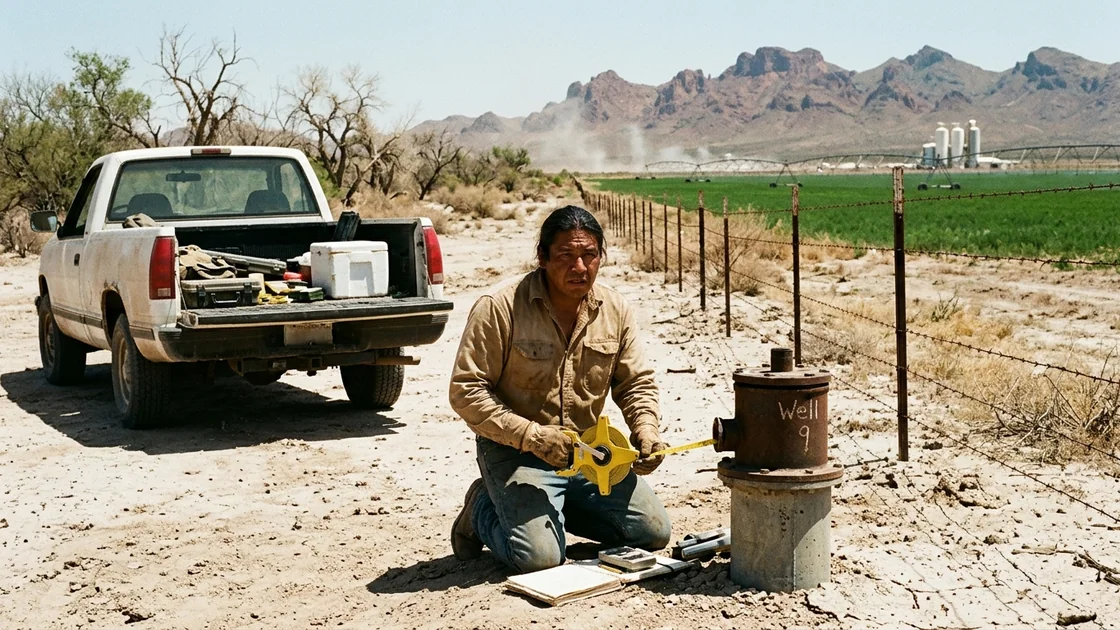
Mateo Sihu, a desert hydrological engineer, returns to his ancestral reservation in the arid Southwest to investigate why the sacred springs that have sustained his people for millennia are suddenly running dry. Through isotopic water testing and subterranean acoustic mapping, he discovers that a powerful agribusiness syndicate has secretly bored an illegal high-pressure pipeline across the reservation boundary, siphoning off the tribe's deep fossil aquifer. When corrupt legal courts refuse to halt the theft without years of litigation that the dying desert ecosystem cannot survive, Mateo teams up with a disgruntled former tunnel mechanic to execute a daring geological sabotage. By drilling into an ancient subterranean karst sinkhole directly beneath the illegal conduit and triggering a massive hydraulic shockwave, Mateo collapses the pipeline into the cavern, permanently severing the corporate tap and redirecting the stolen river back into the natural fault lines of his people's land.
The piezometer at Well Nine did not lie, though Mateo Sihu wished with every muscle in his aching back that the instrument was simply broken. He knelt in the blistering alkali dust of the Red Wash, the noon sun hammering against the sweat-stained canvas of his work shirt, and reeled the yellow fiberglass tape back onto its spool. The stainless-steel probe at the end of the line came up bone dry. Not even a smear of gray bentonite clay clung to the sensor tip. Eight hundred and forty feet below the cracked adobe crust of the Toh-Kii Reservation, the water table had dropped another fourteen inches in seventy-two hours.
Mateo stood up, his knees popping in the dry heat, and looked out across the basin. To the east, the jagged, rust-colored teeth of the Sierra Negra mountains rose against a sky so pale and hot it looked bleached by chlorine. For ten thousand years, winter snowmelt and summer monsoon rains had soaked into the fractured volcanic caprock of those peaks, filtering down through miles of porous sandstone until the water hit an impermeable layer of blue marine shale. Guided by that ancient stone trough, the underground river flowed westward, surfacing at the foot of the bajada as the Ba’ag-Wa Springs—the Eagle Water.
Now, the springs were a cemetery of bleached cottonwood skeletons and powdery white sulfate crusts. The cattails had turned to brittle straw two summers ago. The black-necked stilts and desert pupfish were gone, replaced by whiptail lizards skittering over cracked mud curls that curled upward like the soles of old boots.
Mateo loaded the spool into the bed of his battered white pickup, the metal tailgate burning his palms through his leather gloves. He pulled a notebook from his breast pocket, uncapped a felt-tip pen that was already drying out in the four-percent humidity, and wrote the date, the barometric pressure, and the depth-to-water reading. In the margin, he drew a small, jagged arrow pointing straight down.
According to Darcy’s Law, groundwater moved slowly through rock, governed by hydraulic conductivity and the slope of the pressure gradient. In the dense limestone and cemented alluvium of the Painted Basin, water migrated at a pace measured in feet per year, sometimes inches per decade. For a perched aquifer of this volume to drop nearly forty feet in eighteen months was physically impossible under natural drought conditions. Evapotranspiration could not account for it. Regional climatic shifts could not explain the steep, localized cone of depression that Mateo had spent the last six months mapping across forty square miles of tribal trust land.
Someone was sucking the mountain dry from the bottom. And they were doing it with industrial efficiency.
He climbed into the cab, where the thermometer clipped to the sun visor read one hundred and fourteen degrees, and turned the key. The engine coughed, rattled, and settled into a rough idle. Mateo steered the truck out of the wash, following a faint two-track trail through stunted creosote bushes whose waxy leaves smelled of hot turpentine and old oil.
Three miles to the west, where the reservation boundary ended at a rusted four-strand barbed-wire fence, the landscape changed with the violent abruptness of a knife slash. On the tribal side, the earth was pale caliche, mesquite scrub, and starving bursage. Directly across the fence line lay the emerald-green expanse of Veridian Basin Resources.
Mateo stopped the truck on a low limestone ridge overlooking the border and raised a pair of battered field binoculars to his eyes. Through the shimmering heat haze, he watched a line of center-pivot irrigation rigs, each a quarter-mile long, crawfish slowly across three thousand acres of laser-leveled desert. High-pressure nozzles sprayed arcs of mist into the baking air. Half of that water evaporated before it ever touched the leaves of the genetically modified alfalfa and pecan saplings below, vanishing into the atmosphere in glittering rainbows that mocked the parched dirt under Mateo’s tires.
Beyond the fields rose the white-painted steel silos, cooling towers, and high-security perimeter fences of Veridian’s Central Pumping Station Four.
Officially, Veridian Basin Resources—a subsidiary of a holding company based in Zurich and Denver—was drawing its water from the Deep Salty Basin, a brackish geological formation three thousand feet below the valley floor, and running it through a state-of-the-art reverse-osmosis desalination plant. That was what their environmental impact statements claimed. That was what the State Department of Water Resources had stamped and approved in Phoenix. Because the Deep Salty was classified as non-potable geothermal brine, it fell outside the jurisdiction of the 1928 Federal Indian Water Compact that guaranteed the Toh-Kii people absolute priority rights to the potable mountain recharge of the Sierra Negra.
Mateo lowered the binoculars and reached onto the passenger seat, where three amber glass bottles sat nested in a Styrofoam cooler packed with melting ice.
Last night, at two in the morning, Mateo had crawled on his belly through a culvert beneath the state highway where Veridian’s agricultural tailwater drained into a concrete evaporation ditch. He had filled those three bottles with runoff from the alfalfa fields, risking a trespassing charge and an encounter with Veridian’s private range patrols. This morning, before driving out to Well Nine, he had run the samples through the portable mass spectrometer and ion chromatograph he kept in the back room of the tribal water office—a piece of sixty-thousand-dollar equipment he had salvaged from his old job at the United States Geological Survey before resigning in disgust two years ago.
The results were sitting on the clipboard beside the cooler.
If Veridian had been pumping ancient brine from three thousand feet down and desalinating it, the water would have carried a distinct chemical fingerprint: low dissolved solids from the reverse-osmosis membranes, a high boron-to-chloride ratio, and a heavy oxygen-18 isotopic signature typical of stagnant, geothermally heated formation water.
Instead, the water draining off Veridian’s fields was pristine calcium-bicarbonate groundwater. Its ratio of oxygen-18 to oxygen-16 was light—the unmistakable signature of high-altitude winter snowmelt. Even more damning was the carbon-14 dating and the complete absence of tritium. The water Veridian was spraying into the hundred-degree wind had fallen as snow on the Sierra Negra peaks roughly eleven thousand years ago, during the late Pleistocene.
It was Ba’ag-Wa water. Every single drop of it belonged to the Toh-Kii Nation.
Mateo put the truck in gear and drove down off the ridge toward the cluster of cinder-block buildings and adobe homes that made up the village of Ku’u-chul.
The Tribal Administration Complex sat in the shade of three dying tamarisk trees whose feathery needles were turning brown at the tips. Inside, the swamp coolers were struggling against the afternoon heat, blowing warm, damp air that smelled of wet cardboard through the hallways. Mateo walked past the faded posters of traditional basketry and public health bulletins until he reached the council chamber at the end of the hall.
His aunt, Lidia Sihu, sat at the long laminate table with two men in dark suits who looked profoundly uncomfortable in the desert heat. One of them was Thomas Kestrel, the reservation’s contract attorney from Tucson, his linen shirt wilted around the collar. The other was a junior field liaison from the Bureau of Reclamation named Miller, who kept glancing at his wristwatch as if he had a flight to catch.
Lidia looked up as Mateo entered. At sixty-eight, her face was a map of the basin itself—deep arroyos etched around her dark eyes, her silver hair pulled back in a tight bun secured with a piece of polished ironwood. She wore a simple cotton dress and a heavy silver bracelet cast in the pattern of the Maze.
"You are late, Teo," she said, though there was no anger in her voice, only the bone-deep exhaustion that had settled over the village during the past year. "Mr. Miller was just explaining why the federal government cannot issue an emergency cease-and-desist order against Veridian."
Mateo didn't sit down. He walked to the head of the table and dropped the clipboard with the isotopic readouts directly in front of Miller, right on top of the bureaucrat’s leather binder.
"They aren't desalinating the lower brine aquifer," Mateo said, his voice flat and resonant in the concrete room. "I ran the mass-spec analysis on their tailwater this morning. The delta-O-eighteen value is minus eleven point four per mil. Strontium-87 to 86 ratio is zero point seven-zero-nine. That is identical to the baseline samples taken from Ba’ag-Wa Springs in 1994."
Miller blinked, adjusting his wire-rimmed glasses as he stared at the columns of numbers. "Mr. Sihu, I’m a policy liaison, not a geochemist. What are you implying?"
"I'm not implying anything," Mateo said, leaning his knuckles on the table. "I am telling you as a licensed professional hydrologist that the water coming out of Veridian’s center-pivots did not pass through a reverse-osmosis membrane, and it did not come from the Deep Salty formation. It came from the Sierra Negra carbonate aquifer. The tribal trust aquifer. There is a fifteen-hundred-foot wall of impermeable Precambrian granite and marine shale separating our basin from their property line. The only way that water gets into their irrigation manifolds is through steel pipe. They have directionally drilled across the federal boundary underground and tapped our perched reservoir."
The room went quiet except for the rhythmic thrum of the swamp cooler belt.
Kestrel, the tribal lawyer, leaned forward and picked up the lab sheets, his eyes scanning the graphs. "Teo, how did you get these samples? Tell me you didn't cross their fence line."
"I pulled them from the state highway bar-ditch on public right-of-way," Mateo lied smoothly. "Chain of custody is clean enough for an injunction."
Miller sighed, taking off his glasses and rubbing the bridge of his nose. "Even if I accept your numbers at face value, Mr. Sihu—and Veridian’s legal team will challenge the sampling methodology before the ink is dry on the filing—an isotopic match in agricultural runoff does not constitute legal proof of a subterranean trespass."
"The hell it doesn't," Mateo snapped. "Water doesn't teleport through solid granite, Miller."
"Veridian’s geologists have already filed three hundred pages of hydrological modeling with the State Water Court," Miller said defensively, tapping his binder. "Their official position is that heavy pumping in the lower basin has induced natural cross-formational leakage through previously unmapped fracture zones in the granite fault block. Under state groundwater law, if water migrates naturally across a boundary through percolating fractures, it is subject to the rule of capture."
"That's a lie and every hydrologist in the state knows it," Mateo said. "The hydraulic conductivity of that granite fault block is ten to the minus eleventh centimeters per second. It would take four thousand years for our aquifer to leak across that fault naturally. They bored a tunnel through it."
"Then prove the tunnel exists," Miller said, spreading his hands. "Give us a well log. Give us a construction manifest. Without physical proof of an artificial diversion structure, the Special Master in the water court will simply appoint an independent technical panel to conduct a basin-wide dye-trace study."
Lidia spoke then, her voice quiet but sharp as chipped obsidian. "And how long does a basin-wide dye-trace study take, Mr. Miller?"
Miller looked down at his hands. "In karst and fractured rock terrain? Between three and five years, Madam Chairwoman. Then another two years for the evidentiary hearings."
"In five years," Lidia said, looking out the window toward the dead cottonwoods at the edge of the village, "there will be no water left to dye. Our domestic wells are already sucking sand. Our cattle have been sold off at auction for pennies on the dollar. The young families are moving to apartments in Casa Grande and Tucson because rusty sludge comes out of their kitchen taps. If we wait five years for your panel to tell us what we already know, the Toh-Kii will cease to exist on this land. Which is precisely what Veridian is counting on."
"The Bureau is sympathetic to your position, Chairwoman," Miller murmured, closing his binder and standing up. "Truly. We can petition the court to expedite the preliminary review to eighteen months. In the meantime, the Department of the Interior can authorize two FEMA water buffaloes to be trucked in twice a week for domestic drinking use."
Lidia did not rise to shake his hand. She simply watched him gather his briefcase with the cold, unblinking gaze of a hawk watching a packrat. "Thank you for driving out from Phoenix, Mr. Miller. Tell the Regional Director that my people have lived beside Eagle Water for four hundred generations. We do not drink from plastic trailers."
When the door clicked shut behind the bureaucrat and Kestrel hurried after him to discuss filing motions in federal court, Mateo remained standing over the table. His jaw ached from clenching his teeth. He looked down at the isotopic charts—the neat, precise scientific evidence that he had believed would force the world to act. During his seven years with the USGS, he had been trained to believe in data. Data was objective. Data was the language of truth.
Here on the border of the Painted Basin, data was just paper that rich men used to buy time while their pumps ran twenty-four hours a day.
"You have that look," Lidia said softly.
Mateo turned to his aunt. "What look?"
"The look your grandfather had in 1956 when the copper mine tried to dam the upper canyon," she said, rising slowly from her chair and smoothing her skirt. "Before you were born. He took three sticks of ditching dynamite from the county road crew and walked into the mountains with his mule. He came back four days later with dust in his hair, and the river was flowing again."
"This isn't 1956, Nani," Mateo said, rubbing his temples. "Veridian has thermal cameras on fifty-foot towers along the fence line. They have armed security contractors driving leased pickups with satellite uplinks. And whatever they built isn't a surface dam made of logs and concrete. It's deep underground."
"Everything built by men has a spine, Teo," Lidia said, walking over to him and placing a dry, cool hand on his forearm. "And every spine can be broken if you know where the joints are. That is why we sent you to the university in Tucson. Not so you could read papers to white men in neckties, but so you would know how the rock thinks."
Mateo looked down at her hand, then out the window toward the shimmering heat of the western bajada.
"I need the old survey maps from the seventies," Mateo said quietly. "The ones the Bureau of Mines made when they were looking for uranium on the north plateau. And I need to talk to Efraim."
Lidia’s dark eyes flickered with a brief, fierce light. "Efraim is at his yard down by the old railroad siding. Rebuilding a diesel compressor. The keys to the archive shed are on the hook behind my desk."
Efraim "Bear" Nunez was six feet four inches of grease-stained muscle, sun-leathered skin, and bad temper. When Mateo pulled into the gravel yard behind the abandoned Southern Pacific water tank, Efraim was torso-deep under the hood of a 1984 Kenworth boom truck, wielding a three-foot pipe wrench to break loose a rusted exhaust manifold.
With a screech of tortured cast iron, the bolt snapped. Efraim cursed in a fluid mixture of Spanish, English, and Toh-Kii, pulled his broad shoulders out from the engine bay, and hurled the wrench into an oil drum with a deafening clang. He wiped his forehead with a rag that only smeared more black axle grease across his brow and glared at Mateo’s pickup.
"If you’re here to tell me the village well pump burned out its starter capacitor again, save your breath," Efraim growled, reaching for a warm bottle of water sitting on the truck’s fender. "The sand in the casing is chewing up the impellers faster than I can pull the pipe. Another month and we’ll be winching buckets by hand like the Franciscans."
"I didn't come about the village well," Mateo said, stepping out of the cab with a rolled tube of yellowed mylar maps under his arm. "I came to ask you about the autumn of 2022. When you were working as a master mechanic for Sub-Terra Boring on the Veridian contract."
Efraim froze with the water bottle halfway to his mouth. Slowly, he lowered it and looked around the empty junkyard, as if the rusted hulks of old tractors and drill rigs might have ears.
"I signed a non-disclosure agreement when they laid off the local crew, Teo," Efraim said, his voice dropping an octave. "Veridian’s lawyers made it real clear. Ten-thousand-dollar fine and a felony corporate espionage charge if I talk about proprietary desalination infrastructure."
"They aren't desalinating anything, Bear," Mateo said, walking over to the tailgate of the Kenworth and spreading the yellowed Bureau of Mines map across the scarred steel. He weighted the corners down with four heavy flange bolts. "I tested their runoff. It’s our water. Pure Sierra Negra snowmelt from the Ba’ag-Wa formation."
Efraim stared at the map for a long time. The muscles in his thick jaw worked back and forth. Finally, he spat into the caliche dust.
"I knew it," the big mechanic muttered. "God forgive me, I knew something wasn't right when they brought in that German micro-tunneling head."
Mateo’s pulse jumped. "A micro-tunneling machine? Not a vertical drill rig?"
"Come inside the shop," Efraim said, glancing toward the highway half a mile away. "The sun’s too bright out here."
Inside the corrugated tin shed, the air smelled of cutting oil, acetylene gas, and old iron. Efraim pulled the sliding door half-shut, leaving a narrow vertical strip of blinding white sunlight across the dirt floor. Mateo unrolled the map again on a workbench cleared of hydraulic hoses.
"When Veridian started building Pumping Station Four," Efraim said, leaning his massive forearms on the bench, "they hired six of us from the reservation and a dozen roughnecks from Eloy to sink the vertical caisson. We dug a circular shaft forty feet wide and two hundred feet deep right behind their big white cooling towers. They told the state inspectors it was the wet-well sump for the deep brine injection pumps."
"Two hundred feet doesn't get you anywhere near the brine formation," Mateo noted, his finger tracing the contour lines near the reservation border. "At two hundred feet, you’re sitting right at the base of the upper limestone shelf, just above the blue shale aquitard."
"Exactly," Efraim said grimly. "Once we poured the concrete floor of that caisson, they paid off all the local hands. Gave us two weeks’ severance bonuses and told us the heavy construction phase was finished. Only they kept me on for another ten days because their crane operator dropped a main hydraulic manifold while lowering the new machine into the pit, and nobody on their out-of-state crew knew how to braze high-pressure metric fittings."
"What kind of machine did they lower into the shaft?"
"A Herrenknecht slurry-shield tunnel boring machine," Efraim said, his eyes narrowing with the precise memory of a man who understood machinery the way a surgeon understood anatomy. "Ninety-six-inch cutter head with tungsten-carbide disc cutters meant for hard rock. You don't use a horizontal rock-boring machine at the bottom of a two-hundred-foot vertical shaft if you’re drilling down for brine, Teo. You use it to jack pipe sideways."
Mateo felt a cold electric current run down his spine despite the stifling heat of the shed. "Pipe jacking. They bored horizontally from the bottom of the caisson, straight east under the fence line."
"I saw the compass bearing on the laser guidance transit before they escorted me off the property," Efraim said. He picked up a grease pencil from the bench and laid a steel framing square across the map, aligning one edge with the location of Veridian’s Station Four. He drew a thick black line heading East-Northeast at an azimuth of seventy-two degrees.
The black line crossed the reservation boundary fence, cut straight underneath the dry badlands of the Arroyo Seco, and terminated directly inside the fractured breccia pipe at the base of the Sierra Negra fault zone—two miles upstream from Ba’ag-Wa Springs.
"Look at the elevation," Mateo whispered, his fingers flying over the topographical numbers. "Ba’ag-Wa sits at thirty-two hundred feet above sea level. Veridian’s caisson floor is at twenty-eight hundred feet. They didn't even need to put pumps inside the reservation."
"Gravity feed," Efraim said softly. "They punched that eight-foot concrete cylinder pipe straight through the shale wall into the bottom of our mountain aquifer, grouted the annulus, and installed a bulkhead gate back at their shaft. It’s like knocking the bung out of the bottom of a fifty-five-gallon drum. The hydrostatic head from the mountains pushes the water through the pipe at two hundred pounds per square inch right into their sump."
Mateo stared at the grease-pencil line. The sheer engineering arrogance of it took his breath away. By keeping the wellhead, the pumps, and the telemetry entirely inside the vertical caisson on their own fee-simple land, Veridian had left zero surface footprint on the reservation. No drill pads, no power lines, no access roads, no vent pipes. Just an eight-foot-diameter prestressed concrete artery buried two hundred feet beneath the desert floor, silently bleeding the tribe’s birthright at forty thousand gallons a minute.
"If we take your testimony to the federal court—" Mateo began.
"It’s my word against a billion-dollar agribusiness syndicate," Efraim interrupted, shaking his head. "I didn't take pictures; they confiscated our phones at the gate every morning. By the time a federal judge signs a warrant to inspect the bottom of a flooded two-hundred-foot pump caisson, Veridian will flood the shaft, claim a bulkhead failure, or tie it up on appeal until every last acre-foot is pumped into their surface reservoirs in the valley. You heard what your aunt said. The courts are a graveyard for Indian water."
Mateo looked back down at the Bureau of Mines map. His eyes followed Efraim’s black grease line millimeter by millimeter across the reservation.
Halfway between the Sierra Negra fault zone and the Veridian border, where the line crossed beneath the twisted limestone ridges of the Arroyo Seco, a cluster of red dotted circles had been drawn by a government geologist fifty years ago. Next to the circles, in neat mechanical lettering, was the annotation: Subsurface Karst Void – Anomalous Gravity Low – Unmapped Cavern System.
In the Toh-Kii language, that stretch of the arroyo had an older name. Hek-wul. The Throat of the Wind.
Mateo’s heart began to beat against his ribs with a slow, heavy rhythm.
"Bear," Mateo said, his finger tapping the red dotted circles. "When they were jacking that pipe eastward, how far did they get while you were still on site?"
"They were only twenty feet into the wall when I left," Efraim said. "Why?"
"Because three miles east of their shaft, their seventy-two-degree bearing cuts directly through the caprock of the Arroyo Seco karst formation." Mateo grabbed a magnifying glass from a tray of drill bits and held it over the geological cross-section printed at the bottom of the map. "Look at the stratigraphy. You have eighty feet of alluvial caliche on top, then a hundred andforty feet of Mississippian Escabrosa Limestone, and beneath that, the lower basin fault trough."
Efraim leaned in, his massive shoulder bumping Mateo’s. "I’m a mechanic, Teo, not a rock doctor. Speak English."
"Millions of years ago, thermal water dissolved giant caves inside that limestone layer," Mateo explained, his mind racing through structural mechanics and fluid dynamics at breakneck speed. "They’re dry now because the upper shale layer sealed the mountain water above them. But those caverns drop straight down into the lower basin fault—the exact fault line that feeds the domestic wells at Ku’u-chul village and the lower irrigation ditches."
Efraim looked from the cross-section to the black grease line, and a slow, dangerous comprehension dawned in his dark eyes.
"If Veridian bored a straight line at a two-hundred-foot depth," Efraim said slowly, "their tunnel boring machine would have punched right through the roof of that cave."
"Or skimmed right through the upper limestone arch above it," Mateo said. "Either way, there’s a ninety-six-inch pressurized concrete pipeline carrying an underground river suspended inside or directly over a hollow limestone cavern on tribal land."
Efraim stood up straight, wiping his greasy hands on his jeans. "And if that cave roof happens to give way under the weight of all that illegal water?"
"Two things happen," Mateo said, looking up at his friend. "First, the pipeline shears. Second, forty thousand gallons a minute of Pleistocene snowmelt pours straight down the throat of the sinkhole, bypasses the upper shale seal, and recharges the lower village aquifer directly beneath our feet."
"They’ll just shut the main gate valve at Station Four as soon as their pressure sensors drop," Efraim pointed out, though his eyes were gleaming now. "Wait. No. The gate valve is on the downstream end, at the bottom of their shaft. The water is flowing east to west."
"Right," Mateo said, a cold smile touching the corners of his mouth for the first time in months. "There is no valve on the upstream mountain end because they punched into the aquifer blind with a sacrificial cutter head. The only thing holding the mountain water inside that pipe is the pipe itself. If we drop three hundred feet of that conduit into the sinkhole and collapse the limestone arch behind it, the mountain end of the pipe becomes an open subterranean spring pouring straight into the karst cavern. And the downstream end leading to Veridian sucks air."
Efraim let out a low whistle that echoed off the tin rafters. "Wait a second. If Veridian’s pumps are pulling from the shaft, and the pipe suddenly breaks three miles upstream, what stops them from sending a crew down the pipe to plug the cavern and re- sleeve the tunnel?"
"Because we aren't just going to drop the pipe into the hole," Mateo said, reaching for a clean sheet of scratch paper and a pencil. "We’re going to use the water’s own momentum to destroy their pumping station from the inside out before the pipe collapses. Have you ever seen what a Joukowsky pressure wave—a water hammer—does to a ninety-six-inch main when you slam a restriction into a high-velocity flow?"
Efraim’s grin widened, showing a chipped canine tooth. "I saw a mud pump blow its cast-iron head clean through the roof of a doghouse in Odessa once because a roughneck closed a butterfly valve too fast. Looked like an artillery shell hit it."
"Now multiply that by thirty thousand tons of moving water traveling at twelve feet per second inside a rigid concrete tube," Mateo said. "Before we drop the pipe into the sinkhole, we detonate a shaped charge on the downstream side of the cavern span to crimp the steel cylinder liner and pinch the flow. That creates an instantaneous negative pressure wave—cavitation—traveling west toward Veridian’s shaft, followed milliseconds later by a catastrophic column-separation rebound wave. And travelling east, back toward the cavern, a five-hundred-pound-per-square-inch pressure spike that will blow the concrete pipe walls outward like dry macaroni right as we drop the cavern floor out from under it."
Efraim stared at the sketch Mateo had drawn—a neat, lethal diagram of vectors, shockwaves, and shear planes.
"First," Efraim said, holding up one thick, grease-blackened finger, "we don't even know if that pipe actually touches the cave. Second, how the hell do we get down two hundred feet into a sealed limestone cavern without Veridian’s border drones spotting a drill rig? It’s less than a mile and a half from their fence line."
Mateo tapped a tiny symbol on the 1974 map—a crescent-shaped mark half a mile north of the grease-pencil line, tucked inside a steep, shadowy canyon of the Arroyo Seco.
"We don't drill from the surface above the pipe," Mateo said. "We walk in through the front door. And tonight, we bring the geophones."
The desert at night did not cool down in July; it merely stopped broiling and began to radiate the stored heat of the day back up from the rocks like a brick oven after the fire has died.
At midnight, Mateo and Efraim left the pickup truck hidden beneath an overhanging shelf of welded tuff in the upper reaches of the Arroyo Seco. They carried no flashlights. A waning quarter moon hung low over the jagged silhouette of the Sierra Negra, casting just enough silver light to turn the dry wash into a winding ribbon of bone-white gravel.
Mateo walked in front, carrying an aluminum briefcase containing a twenty-four-channel seismograph and a spool of orange cable. Efraim followed ten paces behind, fifty pounds of brass geophone spikes, a sledgehammer, and two climbing ropes strapped to an old external-frame military pack that creaked softly with every step.
To the west, the sky glowed with an unnatural, sodium-vapor orange dome—the security floodlights of Veridian’s Station Four reflecting off the dust in the air. Every twenty minutes, the faint, high-pitched buzz of a fixed-wing surveillance drone drifted along the reservation fence line, its infrared camera scanning the border washes for trespassers or cattle strays. Whenever the buzz grew louder, Mateo and Efraim stepped beneath the dense, thorny canopy of a catclaw acacia, pressing their backs against the hot basalt wall of the arroyo so their body heat blended with the sun-baked stone.
After two miles of slogging through deep sand and climbing over dry waterfalls of polished limestone, Mateo stopped at a bend where the canyon walls narrowed to less than fifteen feet. He pulled a handheld GPS receiver from his vest, shielding the dim red screen with his cupped palm, and compared the coordinates to the 1974 geological survey.
"Right here," Mateo breathed. "We're directly over the seventy-two-degree azimuth line."
They worked in practiced silence, communicating with taps on the shoulder and hand signals. Efraim took a two-foot steel spike and pressed it into the hard caliche pan at the base of the arroyo wall, driving it down with muffled, controlled pushes of his body weight rather than swinging the hammer. Every twenty feet across the width of the wash, they planted a brass geophone, screwing the sensitive acoustic transducers onto the buried spikes and connecting them to the orange multi-core cable.
Mateo sat cross-legged behind a boulder, opened the aluminum case, and booted up the tough-book tablet wired to the seismograph. The screen flickered to life, casting a faint green glow across his cheekbones. Twenty-four horizontal lines danced across the monitor, registering the tiny micro-tremors of the desert: a kangaroo rat hopping thirty yards away, the distant rumble of a freight train forty miles south on the interstate, the whisper of dry wind through the creosote.
Mateo adjusted the bandpass filter, cutting out the high-frequency surface noise and amplifying the low-frequency band between ten and eighty hertz.
Instantly, channels nine through sixteen locked into a steady, unmistakable sinusoidal rhythm.
Mateo pulled a pair of headphones out of the case and plugged them into the audio converter jack. He held one earcup against his own ear and tilted the other toward Efraim, who knelt beside him in the sand.
Through the speaker came a deep, continuous, subterranean roar. It sounded like a jet engine buried under a mountain of gravel—a massive, rushing, turbulent hiss underlined by a rhythmic sixty-hertz harmonic hum travelling through the steel core of a concrete pipe.
Efraim’s eyes widened in the green glow of the screen. He reached out and placed his bare palm flat against the limestone bedrock of the canyon wall. Once you knew what to listen for, you could almost feel it in the bone of the rock: a faint, relentless vibration, the pulse of a stolen river rushing westward in the dark.
"Look at the shear-wave attenuation on channels twelve and thirteen," Mateo whispered, pointing a stylus at the center of the screen where the acoustic wave suddenly echoed and scattered into a wide, hollow resonance pattern. "The sound isn't traveling through solid rock right here. It's echoing inside an acoustic chamber. A big one. The cavern is directly underneath us, Bear. And the pipe is running right through the upper crown of the dome."
"How deep to the cavern roof?" Efraim asked, his voice tight with excitement.
Mateo ran a dispersion curve calculation on the tablet, comparing the arrival times of the primary and secondary acoustic waves bouncing off the limestone boundaries. "The top of the cave is one hundred and sixty feet below the wash. The pipeline center-line is at one hundred and ninety feet. That means when Veridian’s tunnel boring machine came through here, it didn't just graze the roof—it broke straight out of the eastern limestone wall into open air inside the cave, bridged a ninety-foot gap across the upper vault of the sinkhole, and punched back into the western wall."
Efraim stared at the ground between his boots. "Wait. You can't jack concrete pipe across ninety feet of thin air with a slurry-shield TBM. The cutter head weighs eighty tons. It would nose-dive into the pit."
"Not if they hit the void, stopped the jacking rams, pumped cellular concrete grout from the surface or through the shield ports to build a false floor across the chasm, or bridged it with steel casing sleeves," Mateo said, zooming in on the acoustic reflection profile. "Look at those three vertical refraction spikes beneath the pipe. They didn't fill the whole sinkhole—it’s too big, it would have taken ten thousand truckloads of concrete. Instead, when they broke into the upper ledge of the cave, they poured three high-slump concrete piers down onto a limestone shelf forty feet below the tunnel grade to support the pipe span across the throat of the chasm."
Efraim rubbed his chin, his mechanic’s brain visualizing the dark geometry far beneath their boots. "So there’s ninety feet of eight-foot pipe sitting on a narrow limestone ledge and three poured concrete pillars, hanging over the main drop of the sinkhole."
"Exactly like a highway bridge crossing a canyon," Mateo said. "All inside the dark."
They packed up the geophones in fifteen minutes, sweeping the sand over the spike holes with dead mesquite branches until no trace remained of their presence. Moving north along the base of the limestone cliffs, they followed the canyon wall for half a mile until the arroyo split into a tangle of narrow box canyons choked with fallen boulders and ironwood thickets.
Here, the ancient Toh-Kii people had left their warnings. Chiselled into the black desert varnish of a leaning basalt slab were three concentric spirals beside the jagged figure of a horned serpent diving downward into the earth.
Behind the boulder, half-hidden by a centuries-old accumulation of packrat midden and wedged flood-drift, was a narrow vertical fissure in the limestone no wider than a doorway.
Even from ten feet away, Mateo could feel it. As the nighttime desert air cooled on the surface, the barometric pressure outside rose slightly higher than the pressure inside the massive subterranean cavern system, causing the earth to inhale. A steady stream of hot, dry air was being sucked inward through the fissure with a low, mournful whistle that sounded like someone blowing across the neck of a clay jar.
Hek-wul. The Throat of the Wind.
Mateo clicked on a red-lensed headlamp now that they were shielded inside the box canyon, and directed the beam into the crack. The limestone walls of the fissure were polished glassy-smooth by thousands of years of flash-flood silt and blowing sand, before a rockfall millennia ago had diverted the surface wash away from the entrance.
They rigged the first climbing rope around the base of a massive ironwood tree whose roots were wedged four feet deep into the bedrock fractures. Mateo buckled on his harness, clipped his descender onto the eleven-millimeter static line, and backed into the narrow throat of the stone.
"Give me twenty minutes to clear the first pitch," Mateo said, checking the knot on his tether. "If the rope goes slack three times, come down with the second bag."
"Watch out for rattlesnakes on the first ledge," Efraim muttered, testing the anchor line with one huge hand. "They like the draft."
Mateo slid into the earth. For the first forty feet, it was a tight chimney squeeze that scraped the skin off his elbows and knees through his clothes. The air was stifling, smelling of ancient bat guano, dry calcium dust, and the sharp, musky scent of ringtail cats. At sixty feet, the vertical crack belled outward like the inside of a bottle, and Mateo’s boots dangled in empty space.
He switched his headlamp from red to high-intensity white.
The beam lanced downward through absolute darkness, illuminating a breathtaking vertical cathedral of stone. Hanging from the walls were massive flowstone draperies and gypsum stalactites that had stopped growing ten thousand years ago when the climate dried, their crystalline surfaces sparkling like frosted sugar in the LED light. A hundred feet below him lay a steep talus slope of fallen boulders that spilled downward toward the south—straight toward the acoustic anomaly they had mapped under the wash.
Mateo rappelled down to the talus cone, unclipped, and tugged the rope three times. Ten minutes later, Efraim came sliding down the line like a boulder on a cable, his boots striking the limestone scree with a crunch of ancient gravel.
Together, they scrambled down the steep slope of dry rubble, following the sloping ceiling of the cavern southward. With every hundred yards they descended, the air grew warmer and more humid, and a new sound began to replace the dry whistle of the entrance chimney.
It was the roar.
At first it was a vibration in the soles of their boots, then a low bass thrum in their chests, and finally, as they crawled through a low keyhole passage worn through a curtain of yellow travertine, a deafening, thunderous rumble that filled the darkness like a subway train passing three feet overhead.
Mateo stood up on a wide, flat ledge of grey limestone and aimed his high-lumen beam upward.
"Sweet Mother of God," Efraim whispered, his voice barely audible over the hydraulic roar.
Forty feet above their heads, emerging from a jagged, grout-smeared hole in the eastern wall of the cavern, was a monstrous grey cylinder of prestressed concrete and steel. Eight feet in diameter, sweating cold condensation in the ninety-degree cavern air, the pipeline spanned a hundred-and-ten-foot gulf across the upper vault of the sinkhole before disappearing into a matching bore hole in the western rock face.
Just as the seismograph had predicted, when Veridian’s tunneling crew had unexpectedly broken out into the subterranean void, they hadn't bothered to reroute around the sacred geological formation. Instead, they had sent workers down through the pipe itself, erected corrugated steel forms on the limestone ledge where Mateo and Efraim now stood, and pumped high-strength structural concrete down from the tunnel to cast three massive rectangular piers. The piers held the pipeline suspended across the edge of an abyss.
Mateo walked to the inner lip of the limestone ledge and shone his light straight down.
The beam didn't hit bottom. Below the ledge, the sinkhole plunged vertically for at least three hundred feet into a black, ragged fault chasm lined with razor-sharp fins of dissolved limestone. At the very bottom of that chasm lay the permeable gravel beds of the lower Ku’u-chul fault trough.
"Look at the western pier," Efraim shouted, pointing his flashlight at the concrete column closest to the western wall where the water exited toward Veridian’s ranch. "They didn't even pin the footing into the bedrock with rebar dowels! They just poured the concrete flat on top of a fractured travertine overhang that’s already spalling from the vibration!"
Mateo climbed twenty feet up a natural staircase of terraced flowstone until he could reach out and touch the belly of the concrete pipe between the central and western piers.
The pipe was frigid—fifty-four-degree mountain water rushing through the scorching heart of the desert. Beneath his palm, the four-inch-thick concrete wall vibrated violently with the furious kinetic energy of the flow. Every second, nearly seven hundred gallons of the tribe’s life was rocketing past his fingertips in the dark, stolen in secret to grow export hay in the sun.
Mateo pulled a rebound hammer and an ultrasonic thickness gauge from his pack, pressing the sensor against the wet concrete and the exposed steel bell-and-spigot joint where two twenty-foot sections of pipe were coupled together.
"It's standard PCCP," Mateo yelled down to Efraim as he climbed back to the ledge. "Prestressed Concrete Cylinder Pipe! Embedded sixteen-gauge steel core wrapped with high-tensile wire under tension, coated in mortar! If you cut or blast the outer tension wires on a pressurized PCCP main, the internal water pressure blows the steel cylinder open like a zipper!"
"Can we bring it down with what I’ve got at the yard?" Efraim asked, his eyes fixed on the sweating concrete behemoth above them.
Mateo pulled out his waterproof notebook and began calculating volumes, shear strengths, and hydraulic transient pressures by the light of his headlamp.
"If we use high explosives on the piers right away," Mateo said, shouting over the rumble, "the sudden rupture will register on Veridian’s SCADA telemetry at Station Four within two hundred milliseconds. Their automated emergency shutdown valves will slam shut at the caisson before the hydraulic shockwave can wreck their pump gallery, and they’ll still have the intact western half of the tunnel to try a repair."
"So how do we blind them?"
"See that two-inch steel conduit strapped to the top at the twelve-o'clock position of the main pipe?" Mateo pointed his beam upward. Running along the spine of the concrete giant was a small galvanized pipe bolted to the concrete with expansion anchors. "That’s the fiber-optic and copper tracer line from the tunnel boring machine’s guidance system. When they finished the bore, they used it to run the pressure transducer cables up to the mountain intake head so they could monitor the aquifer head pressure in real time."
"If we cut it, the alarm trips," Efraim said.
"We don't cut it," Mateo said. "I worked with Campbell Scientific data loggers for seven years at the Survey. Those pressure transducers send a standard four-to-twenty milliamp current loop back to the master terminal unit at the pump station. Tomorrow night, I’ll splice a portable signal generator into that copper pair and feed their computer a steady eighteen-milliamp signal—telling their servers the pipeline pressure is rock steady at one hundred and ninety PSI, no matter what is actually happening inside the cave."
Efraim nodded slowly. "Okay, that blinds the computer. What about breaking the pipe and the pump station at the same time?"
Mateo walked over to the massive concrete piers and tapped the limestone shelf underneath them with his geologist’s hammer. The rock gave off a dull, hollow thud.
"We do this in three stages over forty-eight hours," Mateo said, his eyes shining in the dark. "Stage one: we bring down your portable pneumatic rock drill and twenty gallons of thirty-percent hydrochloric acid. We drill a honeycomb of two-inch holes into the limestone shelf directly underneath these three concrete piers and pump the holes full of acid and non-explosive expanding demolition grout. Limestone is calcium carbonate; the acid will eat cavities inside the load-bearing rock without making a sound, and the expanding grout will pre-stress the whole ledge to the point of shear failure."
"And Stage two?"
"Stage two waits for the weather," Mateo said. "The National Weather Service out of Tucson is tracking a massive tropical moisture surge coming up the Gulf of California. In two days, the first big monsoon cell of the summer is going to slam right into the Sierra Negra. There will be thunder, lightning, and a flash flood coming down the Arroyo Seco right over our heads to mask any seismic spikes on their border sensors."
"And that’s when we set off the charges," Efraim said.
"Two sets of charges," Mateo corrected, pointing first to the western keyhole where the pipe exited the cavern toward Veridian, and then to the piers. "First, we wrap a linear platter charge of forty-pound ammonium-nitrate slurry around the top half of the pipe right where it enters the western wall. When that detonates, it won't blow the pipe apart—it will slam the steel cylinder liner downward into the flow stream like a guillotine blade, choking off eighty percent of the cross-sectional area in a millisecond."
Mateo traced the invisible shockwave in the air with his hand.
"On the Veridian side of that pinch, the water column is still moving west at twelve feet per second. Suddenly there's no water behind it. It pulls a massive vacuum—a vapor cavity forty feet long. Half a second later, the pressure in Veridian’s vertical shaft slams that water column backward like a ten-thousand-ton battering ram hitting the inside of their pump station. It’ll blow their main bulkhead doors off the hinges, shatter every centrifugal pump housing in the dry well, and flood their two-hundred-foot shaft to the rim."
"While on the mountain side of the pinch—" Efraim breathed.
"On the mountain side, the kinetic energy of three miles of moving water hits that sudden constriction inside the cavern. The pressure inside this ninety-foot span will spike from two hundred PSI to over nine hundred PSI in half a second. It will shred the tension wires along the entire bridge span. And three seconds later, our delayed charges inside the acid-weakened limestone shelf detonate, dropping the piers, the ledge, and the ruptured pipe straight into the three-hundred-foot abyss below us."
Efraim looked down into the black throat of the sinkhole, then up at the roaring concrete artery.
"Without the western tunnel to carry the water away," Efraim said softly, "and with fifty feet of limestone roof collapsing on top of the western bore hole to plug it permanently..."
"The entire flow of the eastern tunnel pours straight down this karst chimney into the Ku’u-chul fault trough," Mateo finished. "Veridian can't dig down from the surface to fix it because this cavern is two miles inside sovereign tribal trust land. And they can't sue us or report a sabotage to the FBI without admitting in federal court that they built an illegal eight-foot theft tunnel across an Indian reservation boundary."
Efraim stood silent for a long moment in the roaring dark. Then he reached out and clapped a heavy, calloused hand onto Mateo’s shoulder.
"Let's go load the mule," Efraim said.
The next thirty-six hours blurred into a grueling marathon of sweat, bruised knuckles, and silent paranoia.
They could not drive a truck anywhere near the box canyon during daylight; Veridian’s high-altitude surveillance drones flew a grid pattern every four hours, their high-resolution optical cameras capable of spotting freshly turned tire tracks in the wash. Instead, Efraim brought out two stubborn, sure-footed burros he kept in a corral behind his mother’s house near the mountain foothills.
All through the following night, under a sky thickening with high, mares-tail cirrus clouds that heralded the coming monsoon, they packed equipment up the tortuous boulder-choked side canyons of the Sierra Negra, approaching the Arroyo Seco from the east where Veridian’s cameras had no line of sight into the deep volcanic gorges.
Four five-gallon carboys of industrial muriatic acid. Eight fifty-pound bags of expansive calcium-hydroxide demolition mortar. A modified gas-powered Pionjar rock drill with a custom muffler Efraim had welded together out of two old tractor exhausts and fifty feet of silicone exhaust hose to vent the fumes up the air chimney. And finally, hidden at the bottom of two canvas panniers under bags of dry oats, sixty pounds of binary ammonium-nitrate/nitromethane blasting compound and a spool of military-grade shock-tube initiator line that Efraim had kept sealed in an ammo can underneath his shop floor since his days blasting haul roads for the Phelps Dodge copper pit in Morenci.
By ten o'clock the next morning, while the surface desert baked under a suffocating, humid one-hundred-and-ten-degree overcast, Mateo and Efraim were back on the limestone ledge two hundred feet underground.
The heat inside the cavern was brutal now that they were working hard, and the roar of the pipeline seemed louder, Pressing in on their eardrums until they had to wear foam plugs just to think clearly.
While Mateo climbed onto the slick, sweating concrete crown of the pipeline to strip back the insulation on the SCADA tracer conduit, Efraim wrestled the eighty-pound rock drill onto the limestone shelf at the base of the western pier.
Drilling the rock was agonizingly slow. They didn't dare run the drill at full throttle for more than ten minutes at a time, fearing the high-frequency staccato of the tungsten bit hammering into the limestone might travel along the concrete pipe wall and register on the vibration monitors at Veridian’s pump shaft.
Mateo sat straddling the eight-foot pipe forty feet above the abyss, a digital multimeter clamped between his teeth and a soldering iron powered by a lithium battery pack in his hand. He carefully shaved away the outer PVC jacket of the telemetry cable inside the split conduit, exposing four twisted pairs of twenty-two-gauge copper wire.
Using an inductive clamp meter, he identified the active loop carrying the pressure transducer signal from the mountain intake head: 17.84 milliamps.
With fingers slick with sweat and condensation from the concrete beneath his knees, Mateo clamped two vampire taps onto the positive and negative leads, wiring his palm-sized programmable current loop simulator in parallel across the circuit. He dialed the simulator’s output to match the exact 17.84-milliamp reading, locked the potentiometer, and snipped the upstream wires leading toward the mountain.
He waited sixty seconds, holding his breath, listening to the roar of the water beneath his thighs.
If the master terminal computer at Station Four had detected the microsecond impedance blip during the switchover, the emergency hydraulic rams at the caisson would begin closing the main gate valve right now. The sound of the water would change pitch.
Ten seconds passed. Thirty. Sixty.
The roar remained steady, unbroken, relentless. Down in the air-conditioned control room at Veridian Station Four, a green number on a monitor was still reading 188.2 PSI, completely blind to anything happening upstream of the western cavern wall.
Mateo let out a long breath, sealed the splice box with electrical tape, and slid back down the flowstone wall to the ledge.
Below, Efraim was covered from head to toe in white limestone slurry, looking like a ghost risen from the rock. He had drilled twenty-four angled holes, each four feet deep and two inches wide, into the fractured travertine overhang supporting the three concrete piers, and six more deep into the western ceiling arch directly above the pipeline’s exit bore.
"Help me with the acid," Efraim rasped, pulling his respirator mask down around his chin.
They pulled on thick neoprene chemical gloves and goggles, using a hand-cranked polyethylene barrel pump to inject the thirty-percent hydrochloric acid deep into the bottom of the boreholes under the piers. Instantly, the cavern air filled with a sharp, stinging fizz as the acid reacted violently with the calcium carbonate bedrock, boiling up milky white foam and carbon dioxide gas that spilled over the lip of the ledge and drifted down into the abyss.
The acid worked unseen inside the natural micro-fissures of the stone, dissolving the structural grain between the limestone bedding planes, turning solid load-bearing rock into a honeycomb of brittle, chalky swiss cheese. After two hours, when the chemical reaction had neutralized itself and the holes were washed out with canteen water, they mixed the expanding demolition grout into a thick grey paste and poured it into the outer ring of perimeter holes.
As the calcium-hydroxide grout hydrated in the warm cavern air, it began to expand with an internal expansive force of over twelve thousand pounds per square inch.
Around four in the afternoon, the rock began to talk.
Tick. Crk.
A hairline fracture, black against the white travertine, zipped across the face of the ledge directly beneath the massive forty-ton weight of the western concrete pier. A fist-sized chunk of limestone popped loose from the overhang and tumbled down into the blackness of the sinkhole.
Mateo counted the seconds until he heard the faint, distant clack of the rock hitting the gravel bed at the bottom. Four and a half seconds. Over three hundred feet down.
"This ledge isn't going to wait until tomorrow," Efraim said, eyeing the widening crack as the vibrating pipeline above them shook a trickle of dust from the pier footing. "The vibration from the water is accelerating the shear. Once that expanding mortar hits peak pressure in two hours, the whole lip is going to get twitchy."
Mateo checked his watch. Above ground, the late afternoon heat would be reaching its maximum convective instability.
"Stay here and start packing the binary charges into the ceiling arch and the center pier," Mateo said, clipping his ascender onto the climbing rope. "I'm going up to the canyon rim to check the radar and the storm front. And we need to pull the burros and the surface gear back up into the granite rocks before the wash floods."
Mateo climbed the hundred-and-sixty-foot rope in twelve minutes, his forearms burning as he squeezed back through the whistling throat of the entrance fissure.
When he crawled out from behind the petroglyph boulder into the box canyon, the sky above the Sierra Negra was the color of a fresh bruise.
Towering cumulonimbus anvils rose forty thousand feet into the troposphere, their bases flat and ink-black, shrouding the upper peaks in curtains of purple virga and torrential rain. The air was dead still and smelled overwhelmingly of ozone and wet creosote. A half-mile away, a bolt of cloud-to-ground lightning struck a saguaro ridge with an instantaneous crack that made the hair on Mateo’s arms stand straight up.
Then, above the rumble of the approaching thunder, Mateo heard another sound.
The low, throaty growl of two heavy-duty diesel pickups running in four-wheel-drive low range, coming fast up the main channel of the Arroyo Seco from the west.
Mateo scrambled up the slick basalt boulders behind the fissure entrance, keeping low beneath a clump of palo verde trees, and raised his binoculars.
Half a mile down the main wash, crashing through the dry brittlebush where he and Efraim had laid the geophones two nights before, were two tan Ford F-250 pickups with light bars on the roofs and the green-and-gold logo of Veridian Asset Protection stenciled on the doors.
Sitting on a flatbed trailer behind the second truck were two Yamaha utility quads, and standing in the bed of the lead truck, scanning the canyon walls with a thermal monocular, was Cole Garrett, Veridian’s chief of range security.
Mateo cursed under his breath. Why were they half a mile inside the reservation boundary?
Then he saw what the lead truck was following. Two hundred yards ahead of the bumper, wandering casually down the center of the wash toward the dry cottonwoods, was one of Efraim’s burros. The animal had rubbed its rope halter loose against an ironwood limb in the upper gorge, smelled the damp air of the approaching storm down-canyon, and walked straight out into the main arroyo with a bright orange canvas pannier hook still dangling from its pack saddle.
Even worse, Garrett wasn't looking at the burro anymore. He was pointing up toward the mouth of the box canyon where the burro’s hoofprints—and Mateo’s own Vibram boot tracks—turned sharply into the rocks.
Mateo didn't hesitate. If Garrett and his four security contractors walked into the box canyon, they would find the climbing rope tied to the ironwood tree in less than three minutes. They had satellite phones and long rifles mounted in their cab racks.
Mateo slid down the back side of the ridge, sprinted fifty yards up the side gorge where the second burro was still tied next to Efraim’s canvas tool roll, and grabbed a heavy two-pound ball-peen hammer and a pair of wire cutters. He couldn't fight four armed men with a hammer, and he couldn't drag Efraim up a hundred-and-sixty-foot rope before the trucks reached the canyon mouth.
He had to buy fifteen minutes. And the sky was about to help him.
A drop of rain the size of a quarter splattered against the hot basalt beside Mateo’s boot, hissing on the stone. Up in the high granite basins of the Sierra Negra, three inches of rain had already fallen in twenty minutes onto solid rock with zero soil absorption. Every side canyon above the Arroyo Seco was funneling millions of gallons of brown, churning runoff into a single steep chute half a mile above the box canyon.
Mateo ran back to the fissure entrance, leaned down into the dark crack, and blew three sharp blasts on his plastic rescue whistle—the pre-arranged signal for Surface compromised. Rig for immediate ignition and climb.
Without waiting for an answer, Mateo untied the neon-blue static climbing rope from the bright trunk of the ironwood tree outside the cave, dragged the anchor loop ten feet inside the dark throat of the fissure where it couldn't be seen from the canyon floor, and jammed a heavy limestone chock-stone into the vertical crack to re-anchor the line out of sight.
Then he scrambled out the mouth of the box canyon just as the two tan pickups roared around the bend of the main wash and skidded to a halt in the gravel seventy yards away.
Mateo didn't hide. He stepped right out into the center of the wide main wash, sixty yards upstream from the hidden mouth of the box canyon, swinging the empty burro halter in his left hand as if he had been searching the upper wash for a stray animal.
Doors flew open on both trucks. Four men in khaki tactical vests and billed caps stepped out behind the open doors, their hands resting on the grips of holstered nine-millimeter pistols. Cole Garrett stepped clear of the lead bumper, a tall, raw-boned man with wrap-around sunglasses and a heavy silver belt buckle.
"Hold it right there, Sihu!" Garrett shouted over the rising wind as the first gust of cold outflow air from the thunderstorm whipped a blinding wall of alkali dust down the canyon. "Put the halter down and keep your hands where I can see 'em!"
Mateo stopped, raising his hands slightly, slowly backing twenty yards farther upstream—drawing their eyes and their trucks away from the narrow notch of the box canyon to his right.
"You're two miles inside the Toh-Kii reservation boundary, Garrett," Mateo called back, his voice calm even as his heart hammered against his ribs. "Your jurisdiction ends at the barbed wire. If you don't turn those trucks around right now, I’m calling the Tribal Rangers and the Bureau of Indian Affairs police."
Garrett spat into the blowing dust and walked forward, two of his men fanning out along the gravel bar while the fourth stayed behind the wheel of the trailer truck.
"Funny thing about that," Garrett said, gesturing toward the orange pannier strap hanging from the burro’s saddle. "Our seismic perimeter sensors picked up low-frequency acoustic hammering along this wash at 0800 and 1100 hours today. Then our drone spots a pack mule with commercial blasting panniers wandering out of a box canyon directly over—well, let’s just say in an area of mutual geological interest. What are you doing out here in a flash-flood watch, Engineer? Taking water samples in a bone-dry ditch?"
"I’m conducting an authorized USGS-method seismic refraction survey for the Tribal Council," Mateo said smoothly, glancing past Garrett’s shoulder toward the upper gorge.
He could hear it now, even if the security contractors, with their engines idling and the wind howling through their truck antennas, could not. Beneath the rumble of the thunder, a low, grinding freight-train vibration was shaking the sand grains around his boots. And the smell had changed: no longer ozone, but the rich, muddy stench of crushed cedar bark, wet silt, and tumbling boulders.
"Where’s your partner?" Garrett demanded, stopping ten feet from Mateo and unsnapping the retention strap on his holster. "A pack saddle like that takes two men to load. Where’s Efraim Nunez? We saw his Kenworth parked over by the east mountain road on the morning drone pass."
"Bear’s up at the village fixing a generator," Mateo lied. "Go ahead and search the upper wash if you want to trespass on federal trust land, Garrett. Just make sure you leave your business card on the dashboard before the water gets here."
"What water?" one of the younger guards scoffed, wiping a splatter of mud-rain from his sunglasses. "It's barely sprinkling down here."
Garrett paused, his eyes narrowing behind his lenses as he finally felt the tremor in the gravel beneath his boots. He turned his head toward the narrow granite throat of the upper canyon three hundred yards upstream.
Around the bend of the dark volcanic cliffs came a twelve-foot-high wall of chocolate-brown water, crowned with a churning raft of uprooted mesquite trees, dead cholla logs, and rolling three-hundred-pound boulders grinding together like giant molars.
"Flood!" Garrett roared, whirling around and sprinting back toward the lead F-250. "Get to the high bank! Move the trucks! Move the—"
The driver in the rear truck threw the transmission into reverse, flooring the accelerator, but the heavy trailer with the two quads jackknifed instantly in the deep, loose sand of the wash, burying the rear axle to the differential.
The three guards abandoned the trucks completely, scrambling wildly up the steep forty-degree caliche bank on the south side of the wash, clawing at brittle creosote bushes as the roaring front of the flash flood slammed into the two Veridian vehicles.
With a sound like a ship striking a reef, the wall of brown mud and timber hit the lead F-250 broadside, flipping the four-ton truck onto its roof as effortlessly as a plastic toy and rolling it end-over-end down the canyon in a geyser of muddy spray and twisting sheet metal. Seconds later, the trailer cable snapped like a guitar string, and the second truck vanished beneath the churning brown torrent.
Stranded on the steep south bank across fifty feet of raging, boulder-filled rapids, Garrett and his three soaking-wet contractors could only watch helplessly as their vehicles, their rifles, and their satellite uplinks were swept toward the badlands at twenty miles an hour.
Mateo was already gone.
The instant Garrett had turned his back to run for the truck, Mateo had sprinted up the dry rocky terrace on the north side of the canyon, ducked into the narrow, flood-shielded notch of the box canyon twenty feet above the main channel's high-water mark, and vanished behind the petroglyph boulder.
The rain broke overhead in a blinding gray deluge that turned the desert rocks into waterfalls, completely drowning out every sound on earth except the thunder and the roar of the Arroyo Seco.
Mateo slid feet-first into the whistling fissure, clipped his descender onto the hidden blue rope, and dropped down the shaft at reckless speed, burning the leather palms of his gloves as he braked just above the talus cone.
Halfway up the rubble slope below him, he saw the bobbing white beam of Efraim’s headlamp.
The big mechanic was climbing hard up the steep rocks from the lower chamber, carrying nothing but his harness and the bright yellow piezo-electric clacker wired to the neon-orange shock tube spooling out behind him.
"Is it rigged?!" Mateo yelled as he slid down the scree to meet him.
"Sixty pounds of binary slurry tamped into the acid holes under the piers and the ceiling arch!" Efraim shouted back, his chest heaving, his face streaked with mud and white limestone paste. "And a twenty-pound linear platter charge strapped across the top neck of the pipe at the western wall with a three-second pyrotechnic delay between the pipe pinch and the pier drop!"
"What about the ledge?!"
"It’s shearing on its own right now!" Efraim yelled, grabbing the main climbing rope and clipping his ascender onto the line above the talus cone. "The expanding mortar split the travertine shelf clean back to the fault wall! If we don't blow that pipe pinch in thirty seconds, the whole ledge is going to drop the piers before we get our water hammer!"
Mateo looked down the dark slope toward the keyhole passage. Even from here, over a hundred yards away and sixty feet higher up in the cavern, he could hear the terrifying groaning screech of forty tons of concrete pier grinding across fracturing limestone.
"Fire it from here!" Mateo ordered, wedging himself behind a massive ten-ton stalagmite column near the base of the vertical shaft chimney. "We’re high enough above the main vault! If you climb the chimney first, the rock movement might sever the shock tube!"
Efraim didn't argue. He braced his massive back against the stalagmite beside Mateo, flipped the safety bail off the yellow firing handle, and squeezed the clacker twice with all his strength.
A tiny spark jumped inside the breech. Instantaneously, a detonation wave flashed down the hollow plastic shock tube at six thousand feet per second—a streak of orange fire vanishing down the dark talus slope into the lower vault.
For one breath, there was only the roar of the water.
Then the mountain kicked them in the chest.
WHUMP.
The first blast—the linear platter charge on the western neck of the pipeline—wasn't a sharp crack; it was a muffled, bone-shattering concussion that blew a hurricane of hot air and gypsum dust up through the keyhole passage, knocking Mateo’s helmet crooked on his head.
Instantly, the sound of the pipeline changed from a steady roar to a terrifying, metallic shriek as the top half of the eight-foot steel cylinder liner buckled inward like a crushed beer can, pinching off the torrent heading west toward Veridian.
Deep inside the bedrock to the west, Mateo felt the ghost of what happened next: a subterranean shudder as the water column separated, pulled a near-perfect vacuum inside the western tunnel, and then slammed backward and forward in a titanic Joukowsky shockwave. Two miles away, at the bottom of Veridian’s vertical caisson, thirty thousand tons of water rebounding at four thousand feet per second hit the main cast-iron pump manifolds like a freight train hitting a glass wall.
And inside the cavern, on the upstream side of the pinched pipe, the trapped kinetic energy of the mountain river spiked to over a thousand pounds per square inch.
Even before the three-second delay caps on the piers could fire, the high-tensile steel wires wrapping the ninety-foot concrete bridge span began to snap like rifle shots—PING! PING! CRACK-BOOM!—as the internal water pressure blew the four-inch concrete walls apart from the inside out.
Then the three-second delay expired.
KA-DOOM!
Sixty pounds of nitromethane-sensitized ammonium nitrate detonated simultaneously inside the acid-eaten honeycomb beneath the piers and inside the western ceiling arch.
The limestone floor of the lower vault simply ceased to exist.
The entire cavern shook as if gripped by a magnitude-six earthquake. Stalactites that had hung from the ceiling for fifty thousand years sheared loose and rained down onto the talus slope like stone spears. Mateo threw his arms over his head, pressing himself flat against the base of the stalagmite as a sound louder than anything he had ever heard in his life erupted from the lower chamber.
The ninety-foot concrete pipeline, along with its three forty-ton support piers and a thousand tons of collapsed ceiling arch, plunged straight into the three-hundred-foot abyss of the sinkhole.
Right behind it came the river.
Unchecked, flowing at full hydrostatic head from the fractured heart of the Sierra Negra, an eight-foot-wide solid column of Pleistocene snowmelt erupted out of the broken eastern tunnel mouth like a horizontal Niagara Falls in the dark, shooting forty feet across the cavern before crashing straight down into the open throat of the Ku’u-chul fault chasm.
On the western wall, where the illegal tunnel led toward Veridian’s ranch, the ceiling charges had dropped a forty-foot-thick curtain of shattered Mississippian limestone directly across the bore hole, burying the pinched, mangled stub of the corporate pipe under ten thousand tons of jagged rock that the swirling floodwaters immediately began to cement in place with washed silt and boulders.
"Climb!" Mateo screamed into Efraim’s ear, grabbing the mechanic’s harness vest as a cloud of wet, choking mist and pulverized rock dust billowed up the talus slope from the roaring cataract below.
The air pressure inside the cavern was rising rapidly as millions of gallons of cold water displaced the air in the lower fault chasm, turning the entrance fissure above them from an inhaling throat into a roaring exhaust chimney.
Mateo went up the rope first, his ascenders biting into the wet nylon line as the upward gale of displaced cavern air literally helped push his body up the vertical shaft. Below him, Efraim hauled himself hand-over-hand with terrifying brute strength, dodging falling pebbles shaking loose from the vibrating walls.
When they squeezed out through the top of the fissure behind the petroglyph boulder, the monsoon storm was already rolling eastward over the mountain crest, leaving behind a washed, emerald-scented twilight and a sky streaked with violent magenta and gold.
Mateo collapsed onto his back in the wet gravel behind the boulder, his chest heaving as he sucked in the cool, rain-washed desert air. Efraim flopped down beside him, his face coated in grey mud, staring straight up at the clearing sky.
Down in the main channel of the Arroyo Seco, the flash flood was already receding into a shallow, muddy stream. Across the wash, standing on top of the high south bank like four wet crows on a fence rail, Cole Garrett and his security guards were staring westward toward their ranch.
Mateo rolled onto his stomach, crawled to the edge of the basalt ridge, and raised his mud-streaked binoculars.
Two miles away across the fence line, a thick black plume of smoke and white steam was rising from the shattered roof of Veridian’s Central Pumping Station Four. Even without the binoculars, Mateo could see a massive brown geyser of muddy water overflowing the rim of their two-hundred-foot vertical shaft, washing away the gravel pads вокруг the cooling towers as their ruptured subterranean bulkheads disgorged the back-flushed volume of their own surface holding ponds.
Across the green alfalfa fields, every single center-pivot irrigation rig stood motionless and dry.
"Look at the ground," Efraim said quietly, sitting up and placing his palm against the wet limestone boulder beside him.
Mateo lowered the glasses and listened.
Deep beneath the rocks of the reservation, three hundred feet below the wash where the ancient sinkhole met the great diagonal fracture of the Ku’u-chul fault, the earth was singing. It was a deep, resonant, rhythmic rumble as the starved gravel beds and empty limestone caverns of the tribal basin drank in forty thousand gallons a minute of cold mountain water, filling the subterranean veins from the bottom up.
Three weeks later, on a clear morning in early August, Mateo Sihu drove his white pickup truck down the two-track trail toward the cottonwood grove at Ba’ag-Wa.
To the west, across the four-strand barbed-wire fence, the three thousand acres of Veridian’s industrial alfalfa had turned the color of old cardboard beneath the relentless hundred-and-ten-degree sun. Without the stolen pressure head from the Sierra Negra, and with their main vertical caisson collapsed into a flooded crater of mangled steel and shattered concrete that would cost forty million dollars to excavate, Veridian Basin Resources had quietly suspended operations at Station Four.
Not a single state trooper, FBI agent, or water-court investigator had visited the reservation.
As Thomas Kestrel had informed the Tribal Council with a baffled grin two days after the storm, Veridian’s general counsel in Phoenix had suddenly withdrawn all six of their competing water-right motions in the state adjudication court, citing "unforeseen geotechnical instability in the lower brine formation." They couldn't file an insurance claim for sabotage, and they couldn't ask for a federal investigation, because doing so would have required letting government engineers lower cameras down their shaft—where the jagged remains of an unpermitted, illegal ninety-six-inch tunnel pointing straight east into sovereign Indian land lay buried under fifty feet of mud.
Mateo parked the truck in the shade of the old cottonwoods—trees that, against all odds, had begun pushing out tiny, sticky green leaf buds along their lower branches over the past ten days.
He walked down into the rocky basin of the spring with his yellow piezometer spool tucked under his arm, though he didn't need it anymore.
Lidia Sihu was already standing at the edge of the limestone depression, her shoes off, her bare feet planted in a patch of cool, dark mud where green shoots of watercress and desert sedge were already poking through the crust.
In the center of the rock bowl, where for two years there had been only white sulfate dust and dead leaves, a clear, cold pool of water six feet wide and four feet deep lay shimmering under the morning sky. At the bottom of the pool, a plume of fine white quartz sand danced and boiled continuously as the pressurized artesian flow from the newly recharged lower fault zone welled upward through the ancient fractures in the stone.
Two black-necked stilts stood in the shallows at the far edge of the pool, dipping their long thin bills into the cold water.
Mateo knelt beside the rock lip, dipped his cupped hand into the spring, and lifted the water to his mouth. It was fifty-four degrees, sweet and crisp with dissolved limestone, tasting of snow that had fallen on the high peaks when mammoths still walked the washes below.
"The domestic well at the village rose sixty-two feet this week," Mateo said, wiping his chin with the back of his hand as he stood beside his aunt. "Efraim pulled the sand-chewed pump out of Well Four yesterday. The water level is high enough now that the old shallow windmills can reach it again."
Lidia looked down at the boiling sand at the bottom of the clear pool, where the water pulsed upward like a steady heartbeat in the throat of the stone.
"Mr. Miller from the Bureau called my office yesterday," she said, a faint trace of amusement warming her quiet voice. "He said the state hydrologists are completely mystified. Their satellite gravity sensors show a massive shift in the subsurface water table from the west basin back into the reservation fault trough following last month's thunderstorm. He asked if you had a scientific paper explaining how a single summer flash flood could permanently alter the hydraulic conductivity of a Precambrian granite fault block."
Mateo looked out across the wash toward the silent, sunlit ridges of the Arroyo Seco, where the Throat of the Wind lay hidden behind its boulder of carved stone, breathing cool damp air up from the dark river roaring three hundred feet below.
"I told him to read Darcy’s Law, Nani," Mateo said. "Water always remembers the way home. Sometimes you just have to clear the gravel out of its way."