Beneath the Crimson Glaze
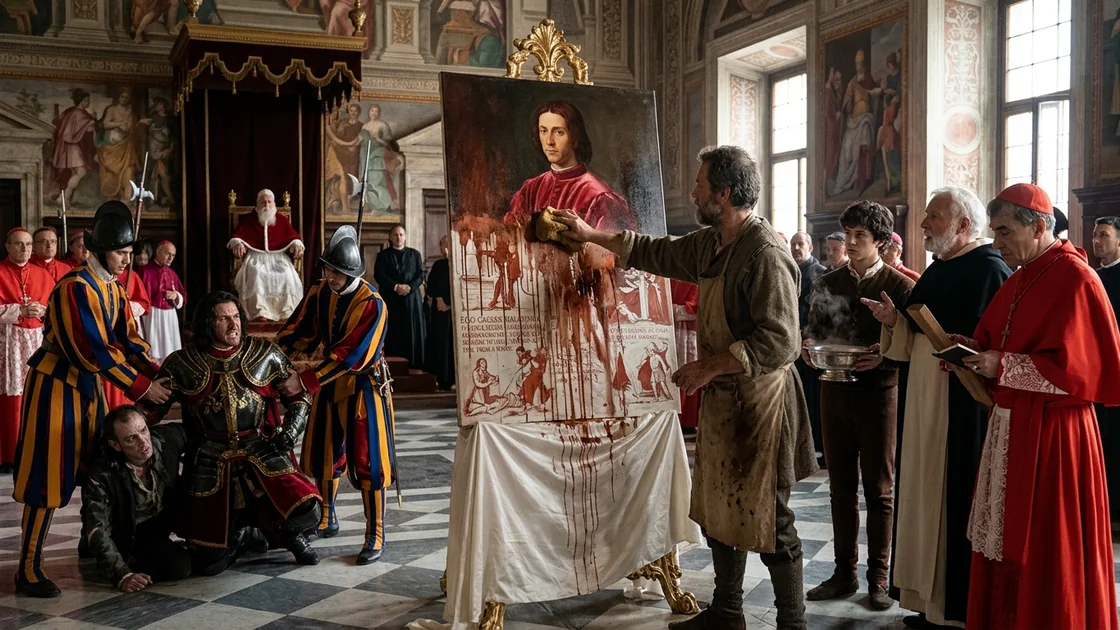
Maestro Valerio Conti is summoned to the remote mountain fortress of Duke Cesare Malaspina to paint a grand state portrait meant as a diplomatic gift for the Pope in the Vatican. While preparing his materials in the castle studio, Valerio discovers that his former apprentice, who served as the previous court painter, was murdered after uncovering the truth behind three high-profile deaths: the Duke secretly assassinated his own elder brother, strangled his young wife, and poisoned a visiting Papal Legate to seize absolute control of the duchy. Realizing that the Duke intends to execute him as soon as the masterpiece is completed to ensure his silence, Valerio devises a daring scheme of artistic vengeance. Using his mastery of Renaissance chemistry and pigment layering, he paints a detailed visual and written confession of the Duke's crimes into the permanent lead-white underpainting, sealing it beneath a soluble barrier and covering it with a magnificent, flattering portrait in crimson glazes. After narrowly escaping an assassination attempt on the night the painting is finished, Valerio races to Rome to intercept the unveiling at the Apostolic Palace, where a wash of warm spirits strips away the upper glaze before the eyes of the Pope and the College of Cardinals, exposing the Duke's bloody treacheries and bringing about his downfall.
Chapter I: The Fortress of the Iron Falcon
The rain in the high Apennines did not fall like the gentle, misting showers of the Umbrian valleys; it struck like iron nails driven by a hammer of ice. For four days, Maestro Valerio Conti and his seventeen-year-old apprentice, Luca, had guided their pair of pack mules up the jagged limestone switchbacks that climbed toward the Rocca di Monteserra. Below them, the gorges dropped away into a churning sea of November fog, where the river Aso tore through black slate canyons with a roar that sounded like the grinding of the earth's bones.
Valerio rode with his shoulders hunched beneath a heavy cloak of oiled wool, his fingers tucked into his armpits to preserve their warmth. To a painter past his fiftieth year, cold was not merely a discomfort; it was an enemy that stiffened the knuckles, thickened the synovial fluid of the wrist, and robbed the hand of that microscopic steadiness required to lay a hairline of gold leaf or feather the edge of a shadow.
"Look there, Maestro," Luca called out, his voice cracking against the wind. The boy pointed upward with a raw, reddened finger. "The clouds are breaking."
Valerio raised his eyes. Through a rent in the slate-colored vapor stood the fortress of Monteserra. It did not appear to have been built upon the mountain so much as extruded from it—a brutal geometry of gray ashlar blocks, machicolated towers, and swallow-tailed battlements that clung to the sheer crag like a bird of prey gripping a carcass. Above the highest keep, whipped stiff by the gale, flew the banner of the House of Malaspina: an iron falcon clutching a thorn branch on a field of blood red.
"Keep your hand on the tether of the gray mule, Luca," Valerio said, his voice low and raspy from the damp. "If she slips on this shale, we lose the ultramarine and the Venice turpentine. And if we arrive at the Duke's gate without our blues and our resins, we may as well cast ourselves into the gorge behind her."
"He paid fifty ducats in advance just to fetch us from Perugia, Maestro," Luca replied, tugging the stubborn mule away from the crumbling lip of the road. "Surely a lord so generous with his florins has an apothecary of his own."
"A lord who pays fifty ducats in advance to bring an aging painter into the clouds in the dead of winter is not generous, boy. He is in haste. And when great men are in haste, small men must be careful of their necks."
Valerio did not speak his deeper fear aloud. Six months earlier, he had sent his finest journeyman—a brilliant, light-hearted youth of twenty-two named Giuliano da Foligno—to this very fortress. Duke Cesare Malaspina's brother, the old Duke Lorenzo, had written to Valerio's workshop in Perugia requesting a skilled hand to restore the frescoes in the castle chapel. Valerio, overburdened with altar pieces for the priors of San Pietro, had sent Giuliano in his stead. For three months, letters had arrived regularly down the mountain, filled with Giuliano's sketches of mountain falcons and complaints about the sour wine of the Marches. Then, in August, the letters had stopped.
In September, word had reached Perugia that a season of terrible misfortune had descended upon Monteserra. First, Duke Lorenzo had fallen from the battlements while inspecting the night watch, his neck broken upon the stones of the inner bailey. Scarcely three weeks later, Lorenzo's young widow, the Duchess Bianca, had succumbed to a sudden, violent winter fever before the leaves had even turned. And in October, Cardinal Gaspare Morosini, the Papal Legate sent by Rome to oversee the transition of the duchy to the younger brother, Cesare, had died in his sleep of an apoplexy at the castle banquet table.
Now, Cesare Malaspina wore the ducal coronet. And in the courier's pouch that had brought the fifty gold ducats to Valerio's door had been a brief, terse note sealed in black wax by the Duke's chamberlain: Your former pupil, Giuliano da Foligno, departed our service in the autumn after taking a chill in the lungs, leaving our chapel unfinished and our court without a limner. His Grace requires the master himself to paint a portrait of state for the Holy Father in Rome. Come at once, or forfeit the patronage of Monteserra forever.
Giuliano had never returned to Perugia. Nor had he gone home to his mother in Foligno. He had simply vanished into the mountain mists.
The iron portcullis of the Rocca groaned upward as they approached, its rusted chains screaming over wooden windlasses. Four guards in blackened steel breastplates stepped out from the gatehouse. They did not offer to help Luca with the mules until a tall, gaunt man in a doublet of black velvet trimmed with marten fur descended the steps of the inner courtyard. He carried an ivory-headed cane, though he walked without a limp, using the staff instead like a pointer to direct the grooms.
"Maestro Valerio Conti?" the man asked. His voice had the dry, whispering quality of dead leaves scraping across flagstones. His eyes were pale gray, set deep beneath hairless brows, and a long, puckered scar ran from the corner of his left eye down into his neatly trimmed silver beard.
"I am he," Valerio said, dismounting stiffly and bowing his head to the exact degree required by a free master of the Guild of Saint Luke when addressing a nobleman's servant—respectful, yet unbowed. "And this is my apprentice, Luca di Benvenuto."
"I am Capitano Vieri, Chamberlain and Captain of the Watch to His Grace, Duke Cesare," the man said. He tapped the wooden crates strapped to the gray mule with the tip of his ivory cane. "You have brought the panel?"
"No man carries a seasoned poplar panel four feet high across the spine of the Apennines in November rain, Capitano," Valerio answered calmly. "It would warp like a wet boot before we reached the first pass. Your courier assured me that the castle carpenter had timber laid up in the dry-lofts, and that my former pupil, Giuliano, had already prepared several boards before his... departure."
For the fraction of a heartbeat, Vieri's pale eyes flickered. It was a tiny movement, no more than the twitch of a lizard's eyelid on a sunny wall, yet Valerio had spent forty years studying the human face. He earned his bread by reading the muscles around the mouth and the tension in the orbicularis of the eye. Capitano Vieri was lying—or rather, remembering a lie.
"Indeed," Vieri said smoothly. "The boy left his workshop in the northern turret in some disorder when the fever took him. He was eager to reach the warm air of the plains. We gave him a horse and twenty silver carlini, and he rode south toward Spoleto. Did he not reach you?"
"He did not," Valerio said evenly. "Perhaps the bandits of the Valnerina found his twenty carlini too heavy for his purse."
"The roads are wicked in these troubled times," Vieri agreed without a shred of pity. "Come. His Grace will see you in the Hall of the Griffins as soon as you have shaken the wet from your cloaks. Do not keep him waiting. The Pope's consistory meets in Rome before the Epiphany, and this portrait must be dry, varnished, and crated before the December snows seal the passes."
Chapter II: The Prince in Mourning
The Hall of the Griffins was vast, cold, and smelled of damp tapestries and burning juniper wood. At the far end of the room, before a hearth large enough to roast an ox whole, stood a man of thirty-five. He wore mourning black from throat to heel, yet there was nothing penitential about his attire. His doublet was of the richest Florentine cut-velvet, slashed at the sleeves to reveal silk the color of dried arterial blood, and around his neck hung a heavy gold chain set with cabochon rubies that caught the firelight like drops of fresh wine.
Duke Cesare Malaspina was not an ugly man; on the contrary, he possessed the sharp, classical symmetry of a Roman coin. His jaw was square and clean-shaven, his nose high-bridged and aquiline, his hair as black and glossy as a raven's wing. Yet as Valerio approached across the checkered marble floor, he felt an instinctive recoil in the pit of his stomach. There was a stillness to the Duke that did not belong to living flesh. When he turned his head, his neck moved all at once, like the bronze equestrian statues Valerio had seen in Venice.
"Maestro Valerio," Cesare said. His voice was a rich, resonant baritone, cultivated to fill council chambers and echo over the din of battlefields. "They told me in Urbino that since old Perugino grew pious and repetitive, you had the truest eye for flesh and velvet north of Rome. Look at me, old man. Tell me what you see."
Valerio stopped ten paces from the dais, sinking into a low bow before rising to meet the Duke's dark, unblinking gaze. "I see a prince in the winter of his grief, Your Grace, who nonetheless bears the weight of his state with iron resolve."
Cesare let out a short, barking laugh that held no humor. "Save the poetry for the papal ambassadors, Maestro. We are both craftsmen here, are we not? You work in oil and earth; I work in men and stone. Tell me what you see with a painter's eye, not a courtier's tongue."
Valerio studied him for a long moment. "I see a bone structure that favors strong light from a single high window. The ridge of your brow casts a deep shadow over the inner corner of the eye, which gives an impression of severe contemplation. Your mouth sets slightly lower on the left than the right—the mark of a man who clenches his teeth when he listens to fools. To paint you in flat light would make you look like a marble bust on a tomb. To paint you in deep chiaroscuro, emerging from darkness into the light of grace, will make the Pope believe he is looking upon a sword forged for the Church."
A slow, genuine smile spread across Cesare's lips, though it never reached his dark eyes. "Good. Very good. That poor fool you sent me in the spring—Giuliano—he had the hand of an angel for painting cherubs and flower garlands, yes, but he had the soul of a parish priest. Every time he sketched my face, he made me look as though I were asking pardon for my sins. Does a Malaspina ask pardon, Vieri?"
"Never, Your Grace," the Chamberlain murmured from the shadows beside the hearth.
"You know why you are here, Maestro?" Cesare asked, stepping down from the dais and circling Valerio slowly.
"To paint Your Grace's likeness for His Holiness, Pope Julius."
"Not merely a likeness," Cesare corrected, stopping so close that Valerio could smell the cloves and ambergris the Duke used to scent his beard. "An argument. My brother Lorenzo was weak. He let the barons of the valley withhold their taxes, and he bowed his knee whenever a cardinal sneezed in Rome. Now Lorenzo is with God, his barren wife beside him, and poor old Cardinal Morosini—whose belly was always too fond of heavy eels and rich sauces—lies in our crypt awaiting the spring thaw so we may send his bones back to Venice. Yet Rome is a city of whispers. My enemies in the Curia—Cardinal Riario chief among them—whisper in the Pope's ear that three deaths in one autumn is an unnatural harvest. They urge Julius to withhold the Papal Bull of Investiture and claim Monteserra as a lapsed fief of the Church."
Cesare laid a heavy, ringed hand on Valerio's shoulder. The pressure of his fingers dug through the damp wool like iron talons.
"Next month, I ride to Rome with five hundred lances at my back to swear fealty in the Sala Regia," the Duke continued softly. "Before me will go my gifts: ten thousand gold ducats for the rebuilding of Saint Peter's, and this portrait, which will hang in the Apostolic Palace. When Giuliano della Rovere looks upon that panel, Valerio, I do not want him to see a mountain warlord. I want him to see a Christian prince, broken-hearted by the loss of his brother and his bride, pious, steadfast, and above all, legitimate. Paint me as a saint in armor, old man, and I will fill your saddlebags with so much gold your mules will kneel under the weight. Fail me, or delay me by a single day..."
He did not finish the sentence. He merely tapped the ruby ring on his forefinger against Valerio's collarbone, turned on his heel, and walked back to the fire.
"Vieri will show you to the northern turret," the Duke said, waving a hand toward the door. "Everything your boy left behind is still there. Begin the preparation of the wood tonight. I will sit for you tomorrow at the third hour after dawn."
Chapter III: Ghosts in the Gesso
The northern turret was reached by a spiraling stair of worn gray stone that wound upward until Valerio's calves burned and Luca was gasping for breath under the weight of the pigment chests. Vieri unlocked the heavy oak door with an iron key that hung from his belt, pushed it open, and handed Valerio a tallow candle.
"The boy sleeps here in the anteroom," Vieri said, indicating a narrow pallet of straw near the door. "Your bed is in the alcove beyond the studio. Meal trays will be brought at noon and at vespers. At dusk, the guard at the foot of the stair locks the lower gate."
"Locks us in?" Valerio asked, raising an eyebrow.
"Locks the draft out, and keeps the castle hounds from wandering up to lick your oil pots," Vieri replied smoothly. "The turret is high, Maestro, and the battlements outside the window have crumbled since the last earthquake. Do not lean out too far to empty your washbasins. That is how Duke Lorenzo met his end—dizzy from the height. A terrible thing, how the mountain wind can pull a man down."
When the Chamberlain's footsteps had faded down the stone corkscrew, Valerio lifted the candle high.
The studio was a vast octagonal chamber with three tall lancet windows facing north, glazed with thick, greenish bull's-eye glass against which the rain lashed incessantly. It was freezing, though a stack of split beech logs lay beside a small corner fireplace. Across the room stood a heavy oak easel, a worktable scarred with knife marks, shelves lined with apothecary jars, and three large panels of Lombardy poplar leaning against the dry interior wall.
"Maestro," Luca whispered, shivering as he set the heavy chest down. "Look at the table."
Valerio walked over and held the candle above the workbench. A wooden palette lay near the edge, still crusted with dried mounds of yellow ochre, burnt umber, and lead white. Beside it sat a copper cup half-filled with walnut oil that had skinned over into a tough, leathery film, in which three squirrel-hair brushes stood trapped like insects in amber.
Valerio reached out and touched the handle of the largest brush. Carved into the birchwood shaft with a penknife were two tiny initials: G.F.
A master painter never left his brushes soaking in drying oil overnight, let alone when departing on a journey. And no journeyman who had spent four years learning to bind his own ferrules and select hairs from the winter coats of Russian squirrels would ever leave his tools behind. Those brushes were worth ten silver carlini by themselves.
"Light the fire, Luca," Valerio said quietly, his heart beating a slow, heavy rhythm against his ribs. "And draw the wool curtains across the lancets. Do not make a sound."
While the boy knelt by the hearth with flint and steel, Valerio moved methodically through the studio. He knew Giuliano's habits better than the boy's own mother did; Giuliano had lived under Valerio's roof from his fourteenth year. He knew the youth was left-handed, that he always kept his willow charcoal in a hollowed gourd to keep it dry, and that when he ground precious pigments on the porphyry slab, he had a habit of humming peasant songs from the hills of Foligno.
Valerio lifted the porphyry mulling stone—a heavy, dome-shaped block of dark red Egyptian stone with a flat bottom used for crushing minerals into powder on a larger porphyry slab. The bottom of the muller was stained faint green with malachite, as if it had been wiped hastily with a rag. He examined thethree poplar panels leaning against the wall. Two were raw wood, fitted with horizontal battens at the back to prevent warping. The third had already been prepared with eight coats of gesso sottile—slaked plaster of Paris mixed with warm rabbit-skin glue—and scraped to a surface as smooth and white as polished ivory.
Upon that white surface, someone had begun a drawing in willow charcoal, and then furiously scrubbed it out with a wet sponge and a scraping knife. Only faint gray smudges remained in the grain of the plaster, impossible to read.
Why would Giuliano prepare a four-foot state portrait panel when he had been hired only to restore frescoes in the chapel?
Valerio turned back to the workbench. He knelt on the cold stone floor and ran his fingers beneath the heavy oak apron of the table, where he himself, in his Perugia workshop, had taught his pupils to wedge their private sketchbooks when the inquisitors or guild tax-collectors came calling. His fingertips met nothing but rough timber and cobwebs.
He stood up and looked at the hearth, where Luca had coaxed a small flame from the dry kindling. Above the fireplace, the stone chimney-breast jutted out into the room, built of irregular blocks of dark gray tufa. Valerio stepped closer, holding his candle near the mortar lines at eye level.
Near the left corner, behind a hanging bundle of dried rosemary and lavender—herbs used for distilling spike oil—one of the tufa blocks had no soot in its crevices. Valerio glanced toward the heavy oak door to ensure the iron latch was down, then slipped his palette knife into the vertical joint of the stone. The mortar was not mortar at all; it was dried potter's clay dusted with wood ash.
With a gentle pry of the steel blade, the stone slid forward two inches. Valerio gripped it with both hands, pulled it free, and set it silently on the hearthstone.
Inside the dark cavity lay a small leather pouch tied with hemp twine, a crumpled linen handkerchief stained brown at the corners, and a booklet of twelve sheets of Fabriano paper sewn together with linen thread.
"Saint Luke preserve us," Luca breathed, staring over Valerio's shoulder. "Is that Giuliano's?"
"Stand by the door, Luca," Valerio commanded in a fierce whisper. "Put your ear to the oak. If you hear the bottom gate creak or a boot on the stair, tap twice with your knuckles."
The boy scurried to the door, his face pale in the flickering light. Valerio carried the bundle to the workbench, untied the hemp cord with steady fingers, and opened the leather pouch first. Out rolled a heavy gold ring set with a large, square-cut amethyst engraved with a cardinal's galero—the wide-brimmed hat with fifteen tassels on either side—above the coat of arms of the Venetian family of Morosini. Beside the ring was a tiny glass vial, stoppered with wax, containing half a dram of crystalline white powder that sparkled like frost.
Valerio unfolded the linen handkerchief. Even after weeks in the dark stone wall, it gave off a faint, sickly sweet odor, like crushed bitter almonds mixed with old copper and rotted garlic. Across the corner was embroidered a tiny coronet above the letter B—Duchess Bianca.
With hands that finally betrayed a slight tremor, Valerio opened the paper booklet. The pages were covered in Giuliano's unmistakable left-handed script, written in iron-gall ink so hastily that the quill had splattered across the margins, interspersed with frantic, masterly drawings in red chalk and bistre.
Fourteenth day of October, in the year of our Lord 1506, the first page read. If any Christian soul finds this book, carry it for the love of Christ to Maestro Valerio Conti in Perugia, or to Fra Domenico del Piombo at the Vatican Sacristy in Rome. I, Giuliano di Matteo da Foligno, write this in the certainty of my death.
Valerio turned the page. There, rendered with terrifying anatomical precision in red chalk, was a sketch of the castle chapel's high gallery. Below the gallery railing, seen from above, two men were holding a slender young woman down upon a kneeling-bench. One of the men was Capitano Vieri, his scarred cheek unmistakable; he held a folded linen cloth over the woman's nose and mouth. The other man, gripping her wrists as her heels drummed against the altar steps, was Duke Cesare.
I was laying gold leaf on the halo of the Virgin in the organ loft three weeks after Duke Lorenzo fell—or was cast—from the watchtower, Giuliano had written beneath the drawing. They did not know I was behind the organ pipes. Duchess Bianca had come to pray for her husband's soul at matins. She told Cesare she carried Lorenzo's child in her womb—an heir who would strip Cesare of the succession. Cesare laughed and said the child would be baptized in heaven before dawn. Vieri poured a sweet-smelling spirit upon her kerchief and held it until her limbs grew still, and then Cesare himself twisted her silk cord around her throat to make sure the breath would not return, before laying her back in her bed to call the physicians and weep of a sudden fever.
Valerio turned the next leaf. His stomach contracted as if he had swallowed molten lead.
This drawing showed the great kitchen passage behind the banquet hall. Through a serving hatch, Duke Cesare and the castle apothecary were pouring white powder from a glass vial into a silver flagon of spiced malmsey reserved for the Papal Legate, Cardinal Morosini.
On the night of the twelfth of October, the Cardinal told Cesare in private that the Duchess's maid had confessed her lady was with child before she died, and that he intended to ride to Rome at daybreak to lay the matter before Pope Julius, the text continued. That night at supper, they gave him the white arsenic of the alchemists in his spiced wine. As the old man choked and clutched his belly, his amethyst ring slipped from his swollen finger under the rushes of the dais. When they carried him to his chamber to die, Cesare ordered me brought here to the turret to paint his portrait for the Pope—a portrait to prove his piety while the Cardinal's body was sealed in lead in the lower crypt, before the Roman physicians could ever see how black his tongue and nails had turned.
Valerio turned to the final written page. The ink here was pale and watery, written in the dark.
Tonight, Vieri came to inspect my charcoal sketch on the great panel. While he stood beside my easel, I saw my own reflection in the polished steel of his breastplate, and I knew by the way he measured my neck with his eyes that as soon as the last coat of varnish dries upon Duke Cesare's face, I will go down into the lime pits under the old keep to join the Duchess's maid. I scraped my drawing from the gesso in a rage when he left, which has only sealed my doom for tomorrow. Maestro Valerio, if he sends for you—for he swore no other hand in Umbria was steady enough to deceive the Pope—fly from this mountain. Do not touch brush to wood, for the day the painting is finished is the day the painter dies.
The remaining pages were blank.
Valerio stood motionless for a long time, listening to the shriek of the wind against the bull's-eye glass and the crackle of the beech logs in the hearth. His eyes fell again upon the three squirrel-hair brushes standing stiff and ruined in the hardened walnut oil. Giuliano had never walked out of this room to ride south toward Spoleto. Vieri had come back up the stairs that very night, found the scraped panel, and ended the boy's life before morning.
"Maestro?" Luca whispered from the door, his young eyes wide with terror as he watched Valerio's face. "What does it say? Where is Giuliano?"
Valerio closed the booklet carefully. He looked at the seventeen-year-old boy—the son of a Perugian baker who had entrusted his child to Valerio's care two years ago. If they demanded to leave tomorrow, claiming illness or lack of materials, Cesare and Vieri would instantly suspect they had found something in the studio, or simply kill them out of caution lest they spread rumors of the Duke's haste in Rome. The fortress sat on a sheer crag; there was only one road down, guarded by three gates and forty men-at-arms.
And yet, in four weeks' time, the painting—if completed—would travel in state through those very gates, escorted to the feet of Pope Julius II in the Vatican.
Valerio looked at the gleaming white expanse of the four-foot poplar panel that Giuliano had gessoed with his own murdered hands.
"Giuliano has gone before us, Luca," Valerio said, his voice dropping so low it scarcely rose above the hiss of the wet logs. "And unless we are wiser than the serpents of Genesis, we shall follow him into the lime pits before Advent is done."
"Can we not climb down the tower rope?" Luca trembled. "Or bribe the stable grooms?"
"There is no rope long enough for a three-hundred-foot crag, and Vieri's grooms would sell our skins for a copper quattrino before our boots touched the mud," Valerio said. He walked over to the white panel and laid his weathered palm flat against the cold, glassy plaster. "No, Luca. The Duke wants a masterpiece to hang in the Apostolic Palace. If we refuse to paint it, we die tomorrow. If we paint it slowly, he will torture us to make us hurry. And if we finish it on time, he will murder us the night the varnish dries."
"Then we are dead men either way!" the boy choked out, tears springing to his eyes.
"Not if the painting speaks for us before the blade falls," Valerio said softly. His dark eyes narrowed as his mind—trained for four decades in the hidden alchemy of oils, gums, balsams, and earth—began to construct a mechanism more lethal than any crossbow. "Do you remember who holds the office of Keeper of the Papal Seals and Inspector of Works at the Vatican, Luca?"
Luca wiped his nose on his sleeve, blinking. "Your old comrade from Master Perugino's workshop. Fra Domenico."
"Fra Domenico," Valerio repeated, nodding slowly. "Before Domenico took the friar's habit in Rome, he and I ground colors side by side for seven years in Florence and Perugia. When we were young and arrogant, and the priors of the country churches tried to cheat us out of our final payment after a panel was hung, do you remember what trick Domenico and I used to play upon them?"
Luca frowned, thinking back to the studio lore Valerio sometimes told over winter suppers. "The... the beggar's shroud?"
"The velo di mendicante," Valerio whispered, a cold, fierce light igniting behind his eyes. "A soluble skin of clarified honey, gum tragacanth, ox-gall, and spike-oil soot, sandwiched between two skins of oil. To the eye—even to the eye of a prince standing a hand's-breadth away—the upper glazes of oil and mastic look as rich, deep, and permanent as a panel by Van Eyck. It will endure the damp air of a mountain castle and the jolting of a baggage cart for six months without cracking. Yet the moment a restorer touches it with warm spirits of aqua vitae and a drop of lye..."
"The upper painting washes away like mud in a gutter," Luca breathed, his jaw dropping. "Leaving only the hardened lead-white underpainting beneath!"
"Which no spirit, nor lye, nor fire short of burning the wood itself can ever dissolve once I bake it with litharge and walnut oil," Valerio said, picking up the dead boy's palette knife and testing its flexible steel edge against his thumb. "Duke Cesare wants an argument to lay before the Pope in the Sala Regia. By God and Saint Luke, we are going to paint him one."
Chapter IV: The First Sitting
At the third hour after dawn, two halberdiers escorted Duke Cesare and Capitano Vieri up the winding stair to the northern turret.
The studio had been transformed. A bright fire crackled in the hearth, taking the raw bite out of the air, while the three northern lancet windows had been draped on their lower halves with dark wool, forcing a high, theatrical shaft of cold gray morning light to fall directly upon a raised wooden platform in the center of the room. Upon the platform stood a high-backed curule chair draped in crimson damask.
At the easel stood Valerio, wearing a clean linen smock over his woolen tunic, a stick of willow charcoal held in a brass port-crayon between his fingers. Behind him, at the porphyry slab, Luca was rhythmically grinding lump terra verde—green earth from Verona—with linseed oil, his head bowed meekly like any terrified apprentice in the presence of royalty.
Cesare paused on the threshold, his nostrils flaring at the sharp, resinous scent of Venice turpentine, roasted walnut oil, and boiled hide glue. His dark eyes swept the room, lingering for a second on the clean workbench where Giuliano's crusted brushes had stood the day before, and then moving to the gleaming white poplar panel on the easel.
"You have scraped the board clean, Maestro," Vieri observed, stepping toward the easel and peering closely at the pristine gesso. "Your boy had left some clumsy smears of charcoal upon it before he fell ill."
"Giuliano always had a heavy wrist when blocking in his proportions, Capitano," Valerio replied smoothly, dipping a rag into a cup of turpentine as if tidying his stand. "I gave the panel two fresh coats of gesso sottile before midnight, dried it four paces from the embers, and scraped it down with a Toledo blade at dawn. A portrait meant for the Vicar of Christ cannot rest upon a halting foundation. Every layer, from the wood to the varnish, must contain the whole truth of the man."
Cesare stepped onto the platform and seated himself in the curule chair. Today he had cast aside his mourning velvet for a magnificent brigandine of Milanese steel inlaid with gold arabesques, over which he wore a surcoat of deep crimson brocade bordered with sable. On a small lectura table beside his right elbow lay an illuminated Book of Hours open to the Penitential Psalms, a rosary of carved coral beads, and—at his explicit command—a human skull polished to the color of old butter.
"You see the device I have chosen, Maestro?" Cesare asked, resting his left hand upon the crown of the skull while his right forefinger marked a verse in the prayer book.
"Memento mori, Your Grace," Valerio said, stepping back behind his easel and squinting through one half-closed eye to measure the Duke's head against the shaft of his charcoal holder. "Remember that you must die. And yet the coral rosary and the Psalms declare that Your Grace looks beyond the grave toward the mercy of heaven, while the steel beneath your velvet reminds the Pope that your arm remains strong to defend the Papal States."
"Precisely," Cesare murmured, tilting his chin slightly upward toward the high light of the lancet window. "My brother Lorenzo was fond of that skull. He kept it in his oratory to remind him of the vanity of earthly ambition. When they brought his broken body up from the courtyard stones, I took it for my own. It pleases me to keep my brother close at hand."
Closer than he wished in life, Valerio thought, his charcoal touching the smooth white gesso with a soft, dry whisper.
"Hold that angle of the chin, if it please Your Grace," Valerio said aloud, his voice taking on the calm, hypnotic cadence he used with cardinals, duchesses, and wealthy cloth-merchants alike. "Do not fix your eyes upon the window glass, or they will water in the glare. Look instead at the iron ring set into the stone pillar to my left. Breathe from the ribs, not the shoulders."
For an hour, the only sounds in the turret were the scratch of charcoal on plaster, the wet, rhythmic grinding of Luca's muller on the red stone slab, and the sleet-laden wind beating against the tower like the wings of great black birds.
Valerio drew with extraordinary speed and certainty. As he laid down the sweeping vertical lines of the crimson surcoat, the sharp geometric planes of the Milanese armor, and the severe, handsome architecture of Cesare's face, his eyes were doing double work. He was not merely mapping the portrait the Duke would inspect at the end of the day; he was calculating the exact spatial geometry of the secret painting that would lie beneath it.
Every dark mass in the final portrait had to correspond to a bright, dense mass of lead white in the hidden layer, so that no ghostly ridge of impasto—what the workshops called pentimento—would betray the secret image when the light struck the panel from the side.
"You are quiet as a monk, Conti," Cesare said suddenly, without moving his lips more than a fraction. "Your pupil Giuliano could not hold his tongue for ten minutes together. He was forever babbling about perspective lines, or the frescoes of Signorelli in Orvieto, or asking why the wind howled so loudly down the chapel flue."
"Youth is noisy, Your Grace," Valerio answered, shading the hollow beneath the Duke's cheekbone with the side of his thumb. "When a man is twenty, he thinks the world wants to hear his voice. When he reaches fifty, he knows the world only wants to see his work—and prefers him deaf and dumb when the doors are shut."
Cesare's dark eyes shifted slightly from the iron ring to study Valerio's weathered face. "You are a prudent man, Maestro. Had your boy possessed half your prudence, perhaps the mountain air would not have disagreed so fatally with his lungs."
"The mountains are unforgiving to those who do not know where to place their feet, my lord," Valerio murmured, stepping back to blow a pinch of charcoal dust from the collar of the drawing.
"Tell me, painter," Cesare continued, his fingers drumming a slow, silent tattoo against the parietal bone of the skull beside him. "You have painted the great lords of Perugia—the Baglioni—and the Borgia captains when Cesare Borgia marched through the Romagna. When you look into the faces of men who hold the power of life and death, do you see any mark upon them that separates them from the herd? Does God write Cain's sign upon the forehead of a prince who clears his path with steel?"
In the corner, Luca's mulling stone gave a tiny, involuntary scrape against the porphyry slab. Valerio did not even blink.
"God is a subtle limner, Your Grace," Valerio replied smoothly, his charcoal tracing the cruel, downward hook at the left corner of the Duke's mouth. "The friars in the piazza preach that a wicked man wears the face of a toad or a demon, because the common folk need simple pictures to frighten them from sin. Yet when I painted Giampaolo Baglioni two summers ago—the week after he slaughtered his cousins in their beds—he had the calmest brow and the clearest blue eyes of any youth in Umbria. Blood does not stain the skin of the man who sheds it, my lord; it only stains the linen of the man who dies."
A low chuckle rose from Cesare's chest. "By the Virgin, Vieri, I told you this Perugian was worth his fifty ducats! He understands the craft of statecraft better than that Venetian dotard Morosini ever did. The Cardinal sat at my table for three weeks lecturing me on canon law and the sanctity of widows, as if the Estates of the Church themselves were not won by iron and poison!"
"Your Grace speaks generously," Vieri said, though his pale, scarred face remained tight with suspicion as he stepped behind Valerio to examine the charcoal drawing. "Yet even a deaf and dumb painter has eyes, my lord."
"Let him look," Cesare said indifferently, rising from the curule chair and stretching his armored shoulders as the chapel bell below struck noon. He walked over to the easel and stared at the charcoal cartoon.
Even in bare black lines upon white plaster, the likeness was startling. Cesare stood framed before a heavy velvet curtain, one hand commanding the skull of mortality, the other resting upon the word of God, while through an open casement to the left stretched a craggy mountain landscape representing his domain of Monteserra.
"Magnificent," the Duke breathed. "The hand of a master. How long before you lay on the color?"
"Tomorrow I seal the charcoal with thin size and lay in the verdaccio and the dead-coloring in lead white and umber," Valerio said, bowing. "That is the foundation layer, Your Grace—rough, pale, and lifeless as a corpse, meant only to establish the relief of the light and shadow and dry hard as bone before the true flesh tones and crimson glazes are floated over it. For the next five days, I shall not need Your Grace in the chair, for I will be working on the armor, the curtain, and the background landscape from the armor-stand and the window. When the dead-layer is dry and sealed on Monday, I shall beg Your Grace to sit again for the living flesh."
Cesare nodded slowly. "Five days. Good. I have barons from the lower valley arriving tomorrow whose necks require bending before I ride to Rome. Vieri will inspect your progress each evening at vespers. See that you do not slacken."
Chapter V: The Dead Layer
When the iron gate at the foot of the turret stairs clanged shut behind the halberdiers that evening, Valerio did not touch the supper tray of cold mutton and coarse bread. Instead, he barred the upper oak door from the inside with a heavy wooden wedge he had carved from a beech log, masking the wedge with an empty canvas leaning against the jamb so no eye peering through the keyhole could see it.
"Luca," Valerio whispered, his eyes gleaming in the light of four tallow candles he had arranged in tin reflectors around the easel. "Bring me the red Venetian ceruse—the finest lead white from the bottom of the chest. Bring the native cinnabar, the bone black, and the pot of linseed oil we boiled with litharge of silver and burned wine."
Luca hurried to obey, laying the jars and oil flasks upon the table with trembling hands. "Maestro, if Vieri comes up at vespers tomorrow and sees three dead bodies painted across the Duke's chest, he will cut our throats right here upon the hearthstone!"
"Vieri will never see them," Valerio said grimly. "Do you think I have lived fifty years in the guilds without knowing how to hide a heresy from an inquisitor? Listen to me closely, boy, and learn a craft they do not teach apprentices in the first year."
Valerio dipped a wide badger-hair brush into a mixture of warm rabbit-skin glue and alum, sweeping it deftly over the charcoal drawing of Duke Cesare to fix the black lines permanently into the gesso. While the size dried before the warmth of the fire, he mixed a mound of lead white—dense, heavy carbonate of lead corroded over vinegar vats in Venice—with a tiny drop of walnut oil and a pinch of litharge, a golden-yellow lead oxide that acted as a powerful drier.
"A painting is built like a cathedral, Luca," Valerio explained softly as his palette knife worked the stiff, gleaming paste until it stood up in sharp peaks like whipped egg-white. "At the bottom is the gesso, which drinks the oil. Above that goes the abbozzo—the underpainting in lead white and earth. When lead white is mixed with litharge and walnut oil and baked near a hearth, it cures inside of forty hours into a stony enamel. You could scrub it with boiling aqua vitae, or scrape it with horn, and it would not yield a grain."
He pointed with the tip of his knife to the charcoal drawing of Duke Cesare on the easel.
"In every portrait, there are three regions where the dead-layer must be built up thick and rough to catch the light beneath the final glazes: the broad folds of the crimson surcoat across the breast, the bright sky and rocks of the landscape window on the left, and the polished curve of the skull and prayer book on the table."
Valerio picked up a fine sable brush, loaded it with the dense lead-white and vermilion paste, and stepped to the easel.
"Watch where the Duke's crimson velvet surcoat crosses his heart," Valerio whispered.
With rapid, jewel-like strokes—the miniature technique he had learned thirty years ago illuminating choir books for the Benedictines of Monte Cassino—Valerio did not paint the flat folds of a velvet garment. Instead, using the folds of the surcoat to disguise the contours of his ridges, he painted a scene no larger than the palm of a man's hand, yet rendered with terrifying clarity in high-contrast grisaille and blood-red cinnabar.
There, right over Duke Cesare's heart, stood the high gallery of the castle chapel. Beneath the organ pipes knelt the slender figure of Duchess Bianca, her belly visibly swollen with child, her hands raised in supplication as Capitano Vieri crushed the poisoned kerchief against her face and Duke Cesare himself twisted the crimson silk cord around her throat.
Beneath the tiny figures, disguised as the gold-thread embroidery bordering the Duke's surcoat, Valerio painted a line of crisp Roman capitals in pure lead white and mercury vermilion:
EGO CAESAR MALASPINA UXOREM FRATRIS MEI BIANCAM GRAVIDAM IN SACELLO SUFFOCAVI. (I, Cesare Malaspina, strangled my brother's pregnant wife Bianca in the chapel.)
Luca stared, his hand clapped over his mouth to stifle a gasp. "Maestro... it looks like an ivory carving stained with blood!"
"And when it dries tomorrow afternoon, before Vieri's boots ever touch the bottom stair," Valerio murmured, his brush flying without pause toward the open window in the background of the panel, "I will coat these confessions with a thin skin of egg-white glair mixed with honey, ox-gall, and gum arabic, and over that soluble barrier, I will paint a second, false verdaccio dead-layer of innocent velvet folds and mountain crags in slow-drying walnut oil!"
Valerio's brush moved into the landscape window to the left of the Duke's head. Where the charcoal lines showed the jagged battlements of the Rocca di Monteserra against the dawn sky, Valerio painted two figures casting a third man headfirst over the broken crenelations into the abyss—Duke Lorenzo, wearing his ducal coronet, pushed to his death by his brother Cesare. Below, at the base of the painted tower, where a peasant's cart seemed at first glance to stand beside an old quarry shaft, Valerio painted four men shoveling quicklime over the body of a left-handed boy clutching a bundle of paintbrushes, alongside a weeping serving maid.
Along the stone sill of the painted window, where an ordinary artist would have placed his signature, Valerio inscribed in microscopic, razor-sharp letters of lead white:
FRATREM MEUM LAURENTIUM DE TURRI PRAECIPITAVI ET GIULIANUM PICTOREM IN CALCEM SEPELIVI. (I cast my brother Lorenzo from the tower, and buried the painter Giuliano in the lime pit.)
Hour after hour the candles burned down into pools of tallow. The cold crept back into the corners of the turret as the fire sank to red ash, yet Valerio did not stop to throw on another log. Sweat stood in beads upon his forehead despite the chill; his eyes burned like hot coals behind his horn-rimmed spectacles, and the cramped muscles of his right thumb throbbed with a dull, relentless ache.
After midnight, he moved to the lower right quadrant of the panel, where the Duke's hands rested upon the skull and the Book of Hours.
Upon the curve of the skull itself, hidden within what would later appear to be the reflected light of the room upon polished bone, Valerio painted the death-mask of Cardinal Gaspare Morosini, his mouth twisted in the agony of arsenic poisoning, while across the open pages of the Penitential Psalms—where the Latin verses of King David should have been—Valerio painted the kitchen hatch, the glass vial of white arsenic, and the words that would seal Cesare Malaspina's earthly damnation before the College of Cardinals:
CARDINALEM MOROSINI LEGATUM APOSTOLICUM ARSENICO INTERFECI. CORPUS IN CRYPTA PLUMBEA SUB ALTARI IACET. ANULUS EIUS ET CHIROGRAPHUM GIULIANI IN CAPSA CRUCIS HUJUS TABULAE ABSCONDITA SUNT. (I slew Cardinal Morosini, the Papal Legate, with arsenic. His body lies in the leaden crypt beneath the altar. His ring and the manuscript of Giuliano are hidden inside the cross-batten on the back of this panel.)
Two hours before dawn, Valerio stepped back from the easel. His hand shook so violently he dropped the sable brush onto the floorboards.
On the easel stood a phantasmagoria of murder. The ghostly white-and-crimson silhouette of Duke Cesare seemed to be constructed entirely out of the corpses of his victims, wrapped in bands of damning Latin testimony that gleamed like bone in the candlelight.
"Help me lift the panel to the hearth-screen, Luca," Valerio rasped. "Set it three cubits from the embers—close enough to bake the litharge and linseed oil into stone by noon, far enough that the poplar does not shrink by the breadth of a hair."
While the deadly underpainting cured in the dry heat of the glowing beech coals, Valerio took a fine woodworking chisel and a gimlet to the heavy oak dovetail batten that braced the back of the poplar panel. Carefully sliding the wooden cross-bar out three inches along its tapered channel, he hollowed a long, flat chamber into the hidden underside of the oak bar—a trick smugglers in Venice used to carry forbidden Lutheran tracts or uncut diamonds across the Alps.
Into that dark slot he laid Giuliano's blood-red chalk booklet, the Duchess's poisoned handkerchief, and the tiny wax-sealed vial of white arsenic, packing them tight with lamb's wool so they could not rattle when the panel was lifted. For the Cardinal's heavy amethyst ring, he bored a circular hole matching its exact circumference into the dead center of the batten, pressed the ring in flush with the wood, glued a thin veneer of aged oak shavings over the seam, and tapped the batten back into its dovetail groove with a muffled wooden mallet.
By the third hour after noon, the litharge-laced lead white on the front of the panel had set so hard that when Valerio tapped it with his fingernail, it gave a sharp, porcelain click.
"Now, Luca," Valerio said, picking up a wide, soft hog-bristle brush and dipping it into a warm porcelain bowl containing clarified honey, gum tragacanth, Venice soap, and three drops of ox-gall to break the surface tension. "Now we lay the beggar's shroud."
He brushed the transparent, water-and-spirit-soluble mucilage evenly over the entire surface of the panel, sealing the murder scenes beneath a microscopic glass-like film. Within an hour before the fire, the gum had dried completely invisible and tack-free.
Immediately, working with furious speed as the gray November afternoon began to darken toward vespers, Valerio mixed a quick-drying tempera-and-oil emulsion of Verona green earth, raw umber, and bone black. Standing before the easel with two brushes in his right hand and two in his left, he swept a conventional, muted green-and-gray verdaccio underpainting directly over the gum barrier, utterly blotting out the chapel strangling, the falling brother, the lime pit, and the Latin inscriptions beneath the legitimate, shadowy modeling of a prince's velvet robe, a mountain vista, and a quiet prayer book.
Just as the chapel bell below began to toll the first stroke of vespers, and the heavy iron grate at the bottom of the turret stairs groaned on its hinges, Valerio drew a dry badger blender across the wet green shadows of the Duke's face, stepped back, and tossed his dirty rags into the turpentine pot.
The oak door swung open. Capitano Vieri stepped inside, followed by a small, stoop-shouldered man in a stained black robe carrying a brass lantern.
Vieri did not look at Valerio first. He inhaled the air of the studio deeply, his scarred nostril twitching, and then walked straight to the easel alongside the little man in black.
"This is Maestro Corrado, our court physician and apothecary," Vieri said coldly. "His Grace wished him to see whether you require any fresh oils or driers from his stores."
Valerio bowed smoothly, though he instantly recognized the stoop-shouldered physician from Giuliano's second drawing—the man who had helped Cesare pour the white arsenic into Cardinal Morosini's spiced malmsey. Vieri had not brought him to offer supplies; he had brought the castle's most educated eye to make sure the Perugian painter was doing nothing irregular.
Corrado lifted his brass lantern to within six inches of the wet panel, squinting through thick spectacles at the somber green-and-brown verdaccio modeling of the Duke.
"Traditional Umbrian dead-coloring," Corrado murmured in a wet, wheezing voice. "Terra verde, burnt umber, and white lead over gesso. Very smooth. No lumps in the plaster. He has laid in the shadows of the armor and the folds of the surcoat with admirable precision."
Vieri leaned closer, his pale gray eyes narrowing at the open prayer book in the lower corner of the painting, where the gray block-in showed only soft, blurred lines indicating pages of text. "And the writing in the book, Maestro? Yesterday the Duke's book was open to the fifty-first Psalm."
"In the dead-layer, Capitano, one paints only the general mass of the light upon the vellum," Valerio explained patiently, wiping his hands on his smock. "The fine calligraphy of the psalm will be inscribed upon the final glaze with a three-hair sable brush on the very last day, before the mastic varnish goes on."
Vieri stared at the panel for five long seconds, then turned his gaze toward the fireplace, the workbench, and finally the pale face of young Luca standing by the mulling slab.
"You work quickly, Maestro," the Chamberlain said softly. "Almost as if the devil himself were breathing upon your neck. Keep up this pace, and your work here at Monteserra will soon be finished forever."
Chapter VI: A Game of Varnish and Venom
For the next twelve days, the northern turret became a silent theater of exquisite craft and mortal dread.
Once the false verdaccio had dried over the gum barrier, Duke Cesare returned to the curule chair every morning for four hours. With each passing day, as the upper painting grew from a pale greenish specter into a breathing, three-dimensional illusion of velvet, steel, and living flesh, the Duke became more expansive—and more dangerous.
Valerio worked in translucent glazes, grinding precious madder lake and kermes—the crimson dye extracted from dried scale insects imported from the Levant—into sun-thickened walnut oil mixed with a touch of pine balsam. As he floated layer after layer of deep, blood-red glaze over the Duke's surcoat, the portrait began to glow from within, as though a lamp were burning behind the wood.
The irony of that optical miracle nearly stopped Valerio's breath every time he looked at it: the reason the Duke's crimson velvet possessed such blinding, miraculous luminosity was that the light passing through the red glaze was bouncing directly off the dense lead-white bodies of the strangled Duchess Bianca and her murderers hidden beneath the soluble barrier!
"Look at that sleeve, Vieri," Cesare marvelled on the tenth morning, rising from his chair to stand beside Valerio at the easel. "You would swear that if you pricked that damask with a dagger, warm blood would run down onto the floorboards. How do you achieve such depth in the shadows of the breast, Conti?"
"It is all in the foundation, Your Grace," Valerio said calmly, touching a tiny highlight of pale Naples yellow to the gold filigree of the painted armor. "When the truth of the underpainting is laid down without fear or hesitation in pure white lead, the red glaze above it takes on the richness of a ruby held to the sun. A painter who skimps on what lies beneath the surface produces only flat, dead mud."
Cesare turned his dark, hawk-like eyes upon Valerio. "You speak like a theologian, old man. Yet tell me—when this panel hangs in the Sala Regia at the Vatican, and Pope Julius and his cardinals stand before it, will any man know what lies beneath your crimson glaze?"
"Unless a man knows where to apply the solvent that strips away the prince's robe, Your Grace," Valerio replied without missing a stroke of his brush, "they will see only what Your Grace desires them to see."
For a long, freezing moment, the silence in the turret was absolute. Vieri's hand moved two inches toward the hilt of his poniard.
Then Valerio added lightly, with a self-deprecating shrug of his aged shoulders: "Which is why the Guild forbids any man to wash a fresh oil painting with aqua vitae before the first year is out, lest he strip the master's glazes down to the bare plaster and ruin a hundred ducats' worth of kermes. A painting is like a treaty of state, my lord—handle it roughly while it is young, and the whole design falls to pieces."
Cesare smiled, the tension draining from his square jaw. "Rest assured, Conti, when I reach Rome with five hundred lances, no man in the Vatican will handle anything of mine roughly. By the looks of the sky this morning, the high passes will hold clear of deep snow for another week. How many days remain before the panel can be crated?"
"Tomorrow I finish the highlights of the eyes, the lace of the collar, and the calligraphy of the prayer book," Valerio said. "Tomorrow night, when the oil has set skin-deep before the hearth, I will lay on the final varnish of Chios mastic dissolved in oil of turpentine. By Thursday morning it will be dry to the touch and ready for the road."
"Tomorrow night, then," Cesare said softly. He exchanged a brief, unreadable glance with Capitano Vieri. "See that Maestro Conti and his boy are served a supper worthy of a royal limner tomorrow evening, Vieri. Send up a flagon of my own spiced malmsey from the cellar—the vintage poor Cardinal Morosini praised so highly on the night he was taken to God."
"It shall be done, Your Grace," Vieri bowed.
When the door closed behind them, Luca sank onto his knees beside the porphyry slab, his face as gray as the waste plaster in the bucket.
"The spiced malmsey," the boy whispered, his teeth chattering. "Maestro, he just pronounced our death sentence to our faces! Tomorrow night, as soon as the mastic varnish is brushed on, Vieri and the apothecary will send up the arsenic wine—and if we do not drink it, the guards will come up with pikes before dawn!"
Valerio did not set down his palette. Instead, he walked to the northern lancet window and looked down through the wavy greenish glass.
Three hundred feet below, at the base of the sheer limestone cliff, the river Aso boiled white over black boulders. Yet directly beneath the window, jutting out some forty feet below the turret's corbels, was the steep slate roof of the old alchemical buttery and the castle cistern-house, which fed a stone drainage sluice that ran out under the postern wall where the washerwomen beat the castle linens in the summer.
Valerio had not spent the past twelve days merely painting. Every time he had emptied his wash-water bucket down the stone sink-chute built into the thickness of the turret's eastern wall, he had listened to where the water fell. It did not drop three hundred feet into the river; it clattered down a wide, vertical stone shaft—an ancient garde-robe and rainwater conduit—that exited directly onto the leaded gutter of the cistern roof forty feet below.
Forty feet was still high enough to break a man's legs on wet slate.
Unless a man had forty feet of braided hemp and boiled canvas.
"Luca," Valerio said quietly, turning back from the window. "How many yards of raw Flemish linen canvas did we bring in the bottom of the long crate for lining altar-frames?"
"Twelve yards, Maestro. Two bolts, each eighteen feet long and three feet wide."
"And the hemp cord binding the pigment chests?"
"Another thirty feet, doubled."
"Tonight, after the guard locks the bottom gate, we do not sleep," Valerio said. "You are going to cut that Flemish linen into strips four inches wide, soak them in boiled linseed oil and rabbit-skin glue so the fibers cannot fray against sharp stone, and braid them with the hemp cord into a cable thick enough to hold a horse."
"And the painting?" Luca asked, looking back at the gleaming portrait on the easel. "If we flee down the rainwater shaft tomorrow night, how will Fra Domenico in Rome know that he must wash the portrait with spirits of wine instead of hanging it on the Vatican wall as it stands?"
Valerio smiled—a thin, fierce expression that made him look, for an instant, more dangerous than the warlord on his easel.
"Come here, boy," Valerio said, beckoning Luca to the easel. "Look at the coral rosary hanging over the edge of the Duke's table, right beside the skull."
Luca peered closely at the painted beads of glowing vermilion and madder lake. "I see it, Maestro. Ten small Ave beads, a golden Paternoster bead, and a little gold cross dangling at the bottom."
"Look closer at the five tiny gold filigree rosettes engraved upon the arms of that little cross," Valerio murmured. "When Fra Domenico and I were young devils in Master Perugino's bottega in Florence, we invented that five-petalled rosette as our secret workshop cipher whenever we laid the velo di mendicante over an unpaid panel. Five gold dots arranged in a quincunx on the cross, followed by three tiny Roman letters painted into the wood-grain of the table edge just beneath it: L.A.V.—Lava Aqua Vitae. Wash with the Water of Life."
Luca's eyes widened as he leaned within three inches of the wet paint. There, disguised as tiny natural knots and medullary rays in the painted oak of the Duke's prayer table, were the minuscule strokes of umber that spelled L-A-V. To any courtier, physician, or prince, it was nothing more than the grain of the timber. To Fra Domenico, Inspector of Works at the Apostolic Palace, who examined every square inch of every gift brought before Pope Julius with a jeweler's lens to check for flaking varnish or blasphemous conceits, it would shout like a trumpet from the rooftop of Saint Peter's.
"Even if you and I break our necks on the slate roof tomorrow night, Luca," Valerio said softly, laying a gentle hand on the boy's shoulder, "Duke Cesare Malaspina will ride to Rome carrying his own scaffold in a gilded crate."
Chapter VII: The Alchemist's Cup
The final day broke under a sky the color of bruised lead, with the first dry flakes of December snow swirling past the lancet windows of the turret.
Duke Cesare sat for two brief hours in the morning while Valerio applied the tiny, dazzling pinpricks of pure lead white to the corneas of the painted eyes—the luce viva that gave the portrait the uncanny illusion of following the viewer across the room—and inscribed the opening verses of the fifty-first Psalm (Miserere mei, Deus, secundum magnam misericordiam tuam) across the painted vellum of the Book of Hours over the hidden arsenic confession.
When Cesare stood before the finished panel at noon, flanked by Capitano Vieri and Maestro Corrado the apothecary, even the scarred Chamberlain seemed struck dumb by the power of the work.
The Duke stepped out of the gloom of the panel like a living sovereign—stern, sorrowful, magnificent in his glowing crimson brocade and gold-inlaid steel, his hand resting upon his brother's skull in pious meditation while the crags of Monteserra towered behind him.
"By the blood of Christ," Cesare whispered, his dark eyes shining with triumph as he stared into his own painted face. "Not even Raphael of Urbino could have given me such majesty. When Giuliano della Rovere looks upon this face in the Sala Regia, he will tear up Cardinal Riario's accusations with his own hands and sign the Bull of Investiture before the wax is cold!"
He turned to Valerio, his smile radiant, warm, and utterly terrifying.
"Tonight you lay on the mastic varnish, Maestro?"
"As soon as the evening fire has warmed the board and driven the last dampness from the room, Your Grace," Valerio bowed low. "I have already dissolved the Chios tears in warm spirit of turpentine. By midnight, the surface will be sealed like a mirror."
"Good. Tomorrow at dawn, the royal carpenters will come up to build the traveling crate around the panel, and my vanguard marches for the Flaminian Way at noon. Tonight, Maestro Conti, rest from your labors. Vieri will bring your supper and a purse of two hundred gold ducats at the second hour of the night. Drink to my health in the Cardinal's malmsey, and sleep deeply."
"Your Grace's generosity leaves me without words," Valerio said, keeping his head bowed so the Duke would not see the cold steel in his eyes.
Throughout the afternoon, while the snow thickened outside into a blinding white curtain, Valerio and Luca worked in complete silence. Valerio warmed the jar of Chios mastic varnish in a basin of hot water on the hearth and, laying the portrait flat upon two padded trestles to prevent runs, brushed on a thin, crystal-clear coat of resin. Under the varnish, the crimson kermes and deep ultramarine shadows leaped into brilliant, jewel-like focus.
At the first hour after sunset, steps echoed up the stone stair. Valerio quickly kicked the braided forty-foot linen cable under the straw of his bed in the alcove and stood warming his hands by the fire as the door was unlocked.
It was a castle page carrying a heavy silver tray, watched closely from the doorway by Capitano Vieri. Upon the tray steamed a dish of roasted venison in pepper sauce, two loaves of white manchet bread, a dish of candied quinces, and a tall pewter flagon of spiced malmsey accompanied by two silver goblets.
Vieri stepped into the room, walked first to the trestles to verify that the finished portrait lay gleaming and immaculate under its wet varnish, and then tossed a heavy leather purse onto the workbench. It struck the oak with the unmistakable, musical clink of gold coin.
"Two hundred ducats of the mint of Venice, Maestro," Vieri said, his pale eyes glittering in the firelight. "His Grace commands that you drink a cup to his safe journey to Rome before you retire. The castle gates open at dawn for your mules."
"Our humble thanks to His Grace, and to you, Capitano," Valerio said, stepping to the tray and pouring the dark, fragrant wine into both silver goblets. Even through the heavy scent of cinnamon, cloves, and nutmeg, Valerio's trained nose—accustomed for forty years to the fumes of metallic pigments, orpiment, and realgar—caught the faint, unmistakable sweet-garlic tang of white arsenic trioxide dissolved in hot acid wine.
Vieri did not leave. He stood by the open door, his hand resting casually on the pommel of his ivory cane, waiting to see them drink.
Behind Vieri's back, Luca stood by the workbench, his fingers white as he gripped the edge of the oak table. Valerio knew that if they refused to raise the cups while Vieri watched, two halberdiers waiting on the landing below would be summoned in an instant to finish the matter with cold iron—perhaps damaging the wet painting in the struggle or searching their packs and finding their rope.
Valerio lifted both goblets, handed one to Luca with a subtle, warning pressure of his thumb against the boy's knuckle, and raised his own toward Vieri.
"To the long life of Duke Cesare Malaspina," Valerio said clearly, "and may the Holy Father in Rome reward him according to his works."
Valerio raised the silver rim to his lips, tilted his head back, and—using the oldest trick of the tavern brawlers of Perugia—pressed the tip of his tongue firmly against the narrow opening between his teeth while letting two mouthfuls of the dark wine fill his hollow cheeks without a single drop passing his throat. Behind him, Luca imitated the gesture, lowering his cup and wiping his mouth with the back of his wide linen sleeve, coughing slightly from the spice while spitting his small mouthful quietly into the folds of the dark turpentine rag clutched in his fist.
"Strong wine for men who have lived on mountain water for a fortnight," Valerio wheezed around the liquid held in his cheek, setting his goblet down and turning toward the water bucket as if to rinse his fingers, where he spat the burning, metallic draft silently into the dirty gray wash-water and immediately rinsed his mouth twice from his water flask.
Vieri smiled—a thin, satisfied stretching of his scarred cheek. He knew the dose Corrado had mixed into that flagon: within two hours, the cramps would seize their bowels; within four, their hearts would stop in the cold dark, and at dawn the carpenters would wrap their stiff bodies in coarse canvas and drop them down the lime shaft while the portrait was loaded onto the papal baggage wagon.
"Sleep well, Maestro," Vieri said softly, stepping backward onto the landing and pulling the heavy oak door shut.
This time, the iron bolt on the outside of the upper door was shot home with a heavy thud, followed a moment later by the clang of the iron gate at the foot of the stairs.
"Rinse your mouth again with walnut oil and spit it into the ashes, Luca!" Valerio hissed instantly, seizing the oil flask and thrusting it into the boy's hands. "The oil binds the mineral if any grain clung to your gums. Quick!"
For five minutes they rinsed and spat into the turf at the back of the hearth until their mouths tasted only of raw walnuts. Then, moving like shadows in the dim light of a single guttering candle, they pulled on their heavy oiled-wool cloaks, tied their boots tight with leather thongs, and dragged the forty-foot braided linen cable from beneath the pallet.
Valerio did not take a single coin from the Duke's leather purse on the table; if Vieri broke the door down before dawn and saw the gold untouched and the wine half-drunk, he might think for a crucial minute that the painters had crawled into some dark corner or rafters in their death-delirium. Better still: Valerio tipped the remainder of the poisoned wine into the straw beneath the two beds, knocked both silver goblets onto the floorboards beside a puddle of foul wash-water resembling vomit, and stuffed two spare bolsters and pigment sacks beneath the blankets in the dark alcove to mimic motionless bodies from the doorway.
Then he tied one end of the braided linen cable around the central stone mullion of the eastern sink-alcove.
The stone drainage chute was twenty-two inches wide—barely broad enough for a man's shoulders if he breathed out—and angled steeply downward through the eight-foot thickness of the outer curtain wall before dropping straight down thirty feet through the open snow-filled night onto the leaded gutter of the cistern roof.
"I go first to test the knot and clear the ice on the slate below," Valerio whispered, wrapping his hands in thick strips of woolen rag to prevent the oil-soaked linen rope from burning the flesh from his palms. "Count to one hundred after I vanish, then follow me down. Keep your feet braced against the stone wall until the shaft ends, and do not look down at the gorge."
"May Saint Luke hold the cord, Maestro," Luca whispered, crossing himself.
Valerio squeezed his lean frame head-first and then feet-first into the freezing stone chute, gripping the braided linen cable between his knees and bound hands. The stone was slimy with frozen moss and old turpentine washings. As his boots cleared the lower lip of the chute, the howling December gale caught his cloak like a sail, swinging him out over the black void of the Aso gorge while snow lashed his face like broken glass.
Hand under hand, his fifty-year-old shoulders screaming with the strain, Valerio lowered himself down the slick, vertical wall of the keep. Twenty feet... thirty feet... thirty-five...
His boot heels struck something solid and sloped covered in three inches of wet snow. He dug the iron-shod heel of his boot into the lead flashing of the cistern gutter, arrested his slide just three feet from the sheer three-hundred-foot precipice, and gave two sharp tugs on the rope.
Two minutes later, Luca dropped out of the swirling snow above, landing with a muffled thump beside him in the gutter.
Without a word, they crept on hands and knees along the snow-covered ridge of the cistern roof to where it joined the outer wall of the lower laundry courtyard. From there, a wooden grape-arbor, dry and brittle with winter frost, led down to the stone trough behind the empty wash-houses, and right beneath the iron grate of the water-sluice that drained the courtyard rain out onto the mule-track below the outer barbican.
Working in the blinding roar of the mountain blizzard, Valerio and Luca pried the rusted iron bars of the water-sluice out of their rotten sandstone sockets with an iron crowbar from the wash-house boiler, wormed their way on their bellies through icy slush, and tumbled out into the pine forest two hundred yards below the castle gates.
Chapter VIII: The Road to the Tiber
How they survived the first forty-eight hours in the high Apennines without horses or shelter, Valerio could never afterward fully recount.
They knew that by dawn on Thursday, Capitano Vieri would unlock the turret door with the carpenters, find the beds stuffed with bolsters and the rope hanging down the drainage shaft, and send riders with bloodhounds down the main postern road toward Spoleto. Yet Vieri would also face a terrifying dilemma: Duke Cesare's vanguard was scheduled to march for Rome at noon with the portrait. Would Vieri dare tell the volatile Duke that the painter had escaped—and risk having his own head struck off for negligence—when he was certain that two men on foot in a December blizzard without food or coats would freeze to death in the wolf-infested ravines before noon, or at worst flee north toward their home in Perugia rather than south toward the Duke's five hundred lances?
Valerio counted on Vieri's cowardice—and did the one thing no fugitive would ever be expected to do. Instead of fleeing north toward the safety of Perugia, he and Luca cut straight south across the high goat-tracks of the Sabine hills, heading directly for Rome.
On the second day, half-frozen and dizzy with hunger, they stumbled into the courtyard of a remote Olivetan monastery above Rieti. When Valerio pulled from the lining of his doublet his stamped vellum diploma naming him a Master of the Guild of Saint Luke and personal acquaintance of Fra Domenico at the Vatican, the Abbot gave them hot broth, dry boots, and two sturdy mountain ponies from the monastery stables.
For six days they rode through freezing rain, mud that sucked at the ponies' fetlocks, and flooded river fords along the Via Salaria. Twice, from the high wooded ridges overlooking the junction of the Flaminian Way near Narni, they looked down and saw the glittering column of Duke Cesare Malaspina's embassy winding southward like a black-and-crimson serpent: five hundred mounted men-at-arms with lances pennoned with the Iron Falcon, trumpeters in mourning velvet, and in the center of the column, drawn by four white oxen draped in waxed cloth, a gilded wagon bearing the crated portrait for the Pope.
The Duke was marching at the slow pace of an army and an ox-wagon. Two men on tough mountain ponies, riding sixteen hours a day until they swayed in their saddles, could beat an ox-cart by twenty-four hours.
At dusk on the nineteenth day of December, as the great bells of Rome were tolling the Angelus across the swollen yellow waters of the Tiber, Valerio and Luca rode through the Porta del Popolo, their cloaks caked to the waist in gray mud, and urged their exhausted ponies across the Ponte Sant'Angelo toward the high, torch-lit bastions of the Vatican.
At the Bronze Doors of the Apostolic Palace, two Swiss Guards in blue-and-yellow striped doublets crossed their halberds before Valerio's chest, eyeing his mud-splashed boots and hollow, unshaven cheeks as if he were a highwayman from the Campagna.
"Step back, old man," the sergeant barked in harsh German-accented Italian. "The palace is closed to petitioners. Tomorrow His Holiness holds public consistory in the Sala Regia to receive the Embassy of Monteserra."
"I do not seek an audience with the Pontiff, soldier," Valerio rasped, drawing himself up to his full height and pressing a silver gros tournois into the clerk's hand beside the guard-desk. "Carry this word at once to the Sacristy of the Sistine Chapel, to Fra Domenico del Piombo, Inspector of the Papal Works. Tell him that Valerio of Perugia waits at the Bronze Gate, and brings him a cipher of five golden roses upon a coral cross."
Twenty minutes later, a tall, white-haired Dominican friar in a black-and-white wool habit came running down the marble Scala Regia so fast his wooden rosary clattered like castanets against his knee.
When Fra Domenico saw Valerio standing beneath the torchlight between the Swiss Guards, he stopped dead, crossed himself, and seized Valerio by both shoulders.
"Valerio! By the wounds of Christ, when Duke Cesare's herald arrived this afternoon with the great portrait from Monteserra and told me that both you and young Giuliano had died of the winter plague in the mountains after finishing the panel, I went straight to the chapel to say a Mass for your souls!"
Valerio gripped his old friend's wrists with fingers like iron hooks. "Giuliano is in heaven, Domenico—murdered and thrown into a lime pit at Monteserra. And unless you have kept your jar of rectified aqua vitae and spirit of lavender in the restoration room behind the Sala Regia, the man who murdered him—and who poisoned Cardinal Gaspare Morosini—will kiss the Pope's slipper tomorrow morning and walk out of Rome a consecrated sovereign!"
Fra Domenico's ruddy face went white to the lips. He glanced swiftly at the Swiss Guards, threw the skirt of his black mantle around Valerio and Luca's shoulders, and hurried them through a side postern into the warm, incense-scented labyrinth of the Vatican Sacristy.
Chapter IX: The Judgment of the Solvent
On the morning of the twentieth of December, the Sala Regia—the grand hall of state adjoining the Sistine Chapel—blazed with the terrifying splendor of the Church Militant.
Beneath the coffered ceiling, seated upon the Papal Cathedra under a canopy of crimson velvet embroidered with the oak tree of the Della Rovere family, sat Pope Julius II. His long white beard fell over his silk mozzetta like a frozen waterfall, and his deep-set, fierce eyes swept the assembled College of Cardinals like a general inspecting his artillery before a siege.
To the left of the throne stood Cardinal Raffaele Riario, the Camerlengo, his face stern and skeptical as he held the parchment scroll of the Papal Bull of Investiture, awaiting the Pope's signature and leaden bulla.
In the center of the vast marble floor knelt Duke Cesare Malaspina in polished parade armor of black and gold, flanked by Capitano Vieri and twenty knights of Monteserra. Ten paces to their right, mounted upon a gilded ceremonial easel draped in white silk and guarded by four Swiss halberdiers, stood the four-foot poplar panel that had arrived the night before.
"Holy Father," Duke Cesare's resonant baritone echoed through the high vault as he rose from one knee at the Master of Ceremonies' nod. "I come before the Throne of Saint Peter not in the pride of arms, though five hundred lances of the Marches wait outside the walls of Rome to march wherever Your Holiness commands against the French or the Venetians. I come as a house watered with tears. In a single autumn, Almighty God saw fit to take my beloved brother Lorenzo, his chaste widow Bianca, and Your Holiness's own revered Legate, Cardinal Gaspare Morosini, who breathed his last in my arms while blessing our house."
Beside the throne, Cardinal Riario leaned down toward the Pope's ear. "A house so tragically emptied, Holy Father, that not a single witness to the old Duke's will—save Capitano Vieri yonder—survived the frosts of October."
Cesare did not flinch at the Camerlengo's barb. Instead, he turned with a sweeping gesture of his armored arm toward the draped easel.
"I know that wicked tongues in the Curia have sought to poison Your Holiness's mind against a loyal son of the Church," Cesare proclaimed, his voice ringing with righteous indignation. "Words may be counterfeited by lawyers, Most Blessed Father. Gold may be minted by usurpers. Yet the ancients taught that the eye is the window of the soul, and that no murderer may look upon the Vicar of Christ without his guilt twisting his countenance! Before he succumbed to the mountain fever last week, the greatest master of Perugia—Valerio Conti—poured his last breath into painting my true soul upon that wood, so that when I am fighting Your Holiness's wars in the north, my heart may remain forever beneath your gaze in the Vatican!"
At a nod from the Pope, two acolytes stepped forward and drew away the white silk veil.
A collective murmur of awe rolled through the ranks of the crimson-robed cardinals. Even Pope Julius—a man who had argued daily with Michelangelo Buonarroti on the scaffolding of the chapel next door and knew great art better than any pontiff in history—leaned forward in his throne, gripping the carved acorns of his armrests.
There in the Roman morning light stood the image of Cesare Malaspina: so noble in his sorrow, so luminous in his glowing crimson velvet, his fingers resting in humble piety upon the Penitential Psalms and his brother's skull, that the painted figure seemed more virtuous and regal than any living prince in Christendom.
"By Saint Peter's keys," Pope Julius muttered, his fierce brow relaxing in genuine admiration. "The Perugian had the brush of an angel. Look at the depth of that crimson surcoat, Riario! Could a man with fratricide in his heart sit with such serene grace before the mirror of art?"
"Art is a courteous flatterer, Holy Father," Cardinal Riario murmured, though even he looked shaken by the sheer pious authority of the portrait.
Then, from the shadowy archway leading to the Sacristy, stepped Fra Domenico in his black-and-white Dominican habit, carrying a silver basin, two large sea-sponges, and a crystal flagon that gave off the sharp, clean scent of rectified spirits of wine and oil of spike lavender. Behind him walked two figures in the hooded gray cloaks of Vatican lay-assistants, their faces hidden in the cowls.
"What is this, Fra Domenico?" the Papal Master of Ceremonies hissed, stepping forward to block the friar. "The consistory is in session! You may varnish and hang the panel after noon!"
"Forgive me, Monsignor—and forgive me, Most Blessed Father," Fra Domenico said in a loud, clear voice that carried to the farthest corner of the Sala Regia. He dropped to one knee before the Pope, then rose and pointed toward the portrait. "As Inspector of the Sacred Palaces, it is my sworn duty under the bull of Pope Sixtus to test every panel brought from foreign courts with consecrated spirits before it remains in the presence of His Holiness—both to prevent the smuggling of contact poisons in the varnish, and to cure the blanching of the resin caused by the mountain snows!"
In the center of the floor, Capitano Vieri stiffened slightly, his hand falling to his dagger. Duke Cesare merely smiled with supreme arrogance. He had watched Maestro Corrado test the Chios mastic varnish before it left Monteserra; there was no poison on the surface, and the painting was a masterpiece of praise.
"Let the good friar perform his office, Holy Father," Cesare said magnanimously, spreading his hands. "My house has nothing to hide from the light of Rome, nor from the spirits of the Sacristy."
"Proceed, Fra Domenico, and be brief," Pope Julius commanded, waving a jeweled hand.
Fra Domenico stepped to the gilded easel. The two hooded lay-assistants stepped up beside him, lifting the silver basin of warm, steaming aqua vitae mixed with mild potash lye and lavender spike oil.
One of the assistants reached up and drew back his gray woolen cowl.
Across the marble floor, Capitano Vieri let out a sound like a man who had taken a crossbow bolt through the lungs. His face turned the color of sour milk.
"Your Grace!" Vieri choked out, his finger trembling as he pointed at Valerio Conti's weathered, calm face beside the easel. "The painter! The painter lives!"
Duke Cesare spun around, his jaw dropping as the blood drained from his cheeks. "Conti? How—"
Before Cesare could take a single step toward the easel, four Swiss Guards lowered their halberds with a ringing crash of steel, barring him from moving closer to the Papal throne, while Valerio dipped both large sea-sponges into the steaming basin of aqua vitae, handed one to Fra Domenico, and pressed the other squarely against the glowing crimson breast of the painted Duke.
"You asked me in the turret of Monteserra, my lord Duke," Valerio's voice rang out through the hushed hall like an iron bell, "whether any man in Rome would ever see what lay beneath my crimson glaze! Look upon your soul now!"
With three broad, sweeping strokes of the spirit-soaked sponges, Valerio and Fra Domenico washed the face of the four-foot panel from top to bottom.
A gasp of pure horror tore from the throats of fifty cardinals.
The moment the warm aqua vitae and lye bit through the thin mastic varnish and touched the hidden barrier of gum tragacanth, honey, and Venice soap, the magnificent crimson velvet surcoat, the tranquil mountain sky, and the pious calligraphy of the Psalms dissolved like frost before a furnace. Thick crimson and brown streams of wet oil paint ran down the white silk drapery of the easel onto the marble floor like rivers of fresh blood.
And beneath that melting mask of nobility, untouched by the boiling spirit, gleaming hard and white as carved ivory and fresh arterial cinnabar, emerged the rock-hard lead-white underpainting.
Pope Julius stood straight up from the Throne of Saint Peter, his eyes blazing with terrible wrath as he stared at the panel.
Where the Duke's noble heart had been, there now glared the vivid miniature of the castle chapel: Duke Cesare and Capitano Vieri strangling the pregnant Duchess Bianca beneath the organ loft. Where the peaceful mountain crags had stood, Duke Lorenzo plunged headfirst from the battlements under his brother's murderous hands, while the body of young Giuliano was shoveled into the glowing lime pit below. And across the skull and the open prayer book, in letters of scarlet and white that shone like fire in the morning sun, stood the damning Latin confession:
CARDINALEM MOROSINI LEGATUM APOSTOLICUM ARSENICO INTERFECI. CORPUS IN CRYPTA PLUMBEA SUB ALTARI IACET. ANULUS EIUS ET CHIROGRAPHUM GIULIANI IN CAPSA CRUCIS HUJUS TABULAE ABSCONDITA SUNT.
"Treason!" Cesare roared, his face contorting into the likeness of a cornered wolf as he tore his sword half an inch from its scabbard. "Sorcery and lies! This villain was paid by my enemies in Perugia to defame me with a trick of paint!"
"Read the final line upon the prayer book, Holy Father!" Valerio called out, stepping behind the easel and drawing a small steel wedge from his belt. With a single sharp blow of his palm, he drove out the wooden pin holding the oak cross-batten at the back of the poplar panel and slid the hollowed bar free.
Into the outstretched hands of Cardinal Riario, Valerio poured the contents of the hidden chamber: the blood-red chalk notebook written by Giuliano da Foligno, the poison-stained handkerchief of the strangled Duchess, the wax-stoppered vial of white arsenic, and—pried from its circular bed in the oak—the heavy amethyst ring of Cardinal Gaspare Morosini, still bearing traces of dried skin and rush-dust inside the golden band.
Cardinal Riario held the amethyst ring up to the light before Pope Julius's eyes, then opened Giuliano's sketchbook to the drawing of the kitchen hatch and the chapel gallery.
Looked upon side by side with the scarred, trembling face of Capitano Vieri standing ten paces away, the likeness in the dead boy's red chalk was undeniable.
Before Cesare's sword could clear its scabbard, twenty Swiss halberds closed around him and his knights in a bristling hedge of cold steel. Capitano Vieri dropped to his knees on the marble floor, screaming before a blade had even touched him:
"Mercy, Holy Father! Benefit of clergy! It was the Duke and the apothecary Corrado who mixed the arsenic for the Cardinal! I only held the lantern! The Cardinal's body is still in the lead coffin under the chapel flagstones—if you send legates to Monteserra, you will find the arsenic in his bones and the Duchess's silk cord in the Duke's strongbox!"
"Silence, Judas!" Cesare shrieked, lunging at his chamberlain before two brawny Swiss guards smashed the butts of their halberds across his armored shoulders, driving the Lord of Monteserra to his knees upon the red streams of dissolved kermes glaze pooling on the marble floor.
Pope Julius II stood above him like the bronze Moses of Scripture, his white beard trembling with volcanic fury as he pointed a shaking finger toward the river fortress of Rome.
"Take this fratricide and murderer of my Legate to the deepest dungeon of the Castel Sant'Angelo!" the Pontiff thundered. "Send three hundred papal horsemen to Monteserra before noon to unseal the crypt and hang this apothecary from his own turret! When the physicians have confirmed the arsenic in Cardinal Morosini's remains, let Cesare Malaspina and his captain be drawn on hurdles to the Piazza di Ponte and broken upon the wheel!"
As the shouting, struggling Duke and his weeping chamberlain were dragged backward through the Bronze Doors in iron chains, the crimson-robed cardinals crowded around the easel in hushed, awe-struck silence, gazing upon the haunting, ghostly masterpiece of white lead and cinnabar that had brought down a dynasty without shedding a single drop of blood.
Valerio Conti stepped back into the quiet shadow of a marble pilaster, wiping the smell of aqua vitae and dissolved crimson glaze from his weathered hands with a clean linen rag. Beside him, young Luca let out a long, trembling breath that seemed to have been held all the way from the snows of the Apennines.
Pope Julius descended three steps from his throne and looked across the hall at the aging painter.
"Maestro Valerio of Perugia," the Pope said, his deep voice softening with a fierce, grudging reverence. "Duke Cesare told us that you had painted his true soul upon that wood so that it might remain forever beneath our eyes in the Vatican. For once in his wicked life, the traitor spoke the truth. What did he pay you for this panel?"
"Two hundred gold ducats, Beatissimo Padre," Valerio answered, bowing his head. "Which I left untouched upon his table in Monteserra, for they smelled too strongly of my pupil Giuliano's blood."
"Then the Apostolic Camera will pay you five hundred from the confiscated treasury of Monteserra," Julius declared, "and one hundred more to build a marble tomb in the cathedral of Foligno for your apprentice, when my soldiers bring his bones up from the lime pit into consecrated ground. Leave this panel exactly as it stands, Fra Domenico. Varnish the confession where it lies, and hang it in the anteroom of our Audience Chamber—so that every prince of Italy who comes to Rome to lie to St. Peter may look upon that board, and remember that there is no glaze thick enough to hide murder from the eyes of God."