A Recipe for Ash and Gold
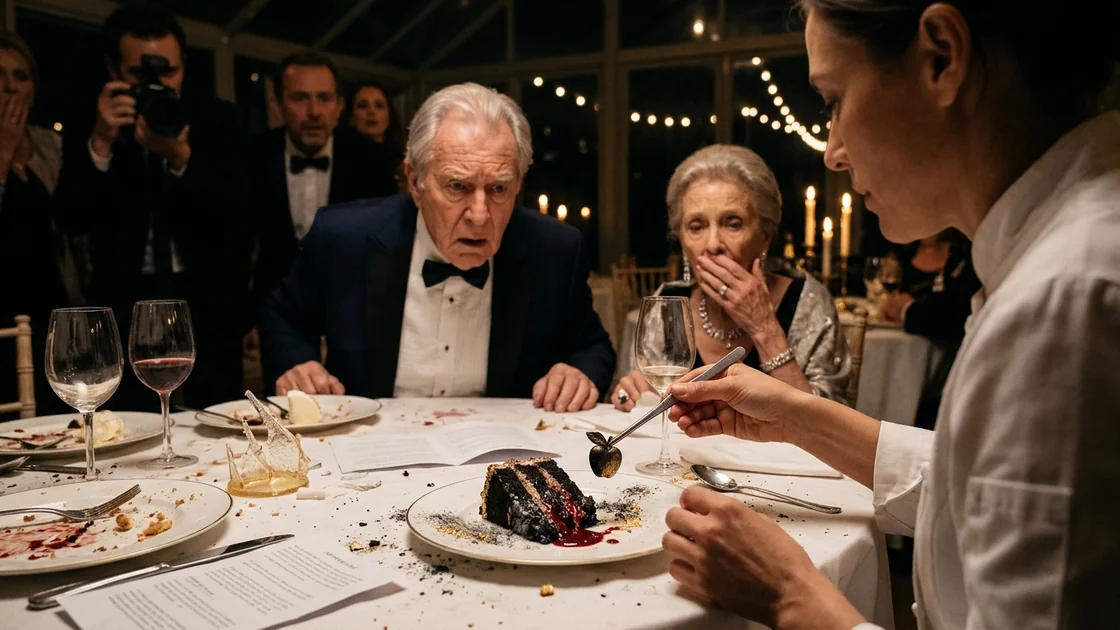
Clara Miller spends thirty years learning how to control heat after watching her family orchard burn to the ground on a dry October night. When Arthur and Evelyn Sterling hire her small-town bakery to cater their fiftieth wedding anniversary at the vineyard they built over her father's ruined land, they believe their decades-old crime is buried forever. Instead of a traditional feast, Clara prepares a five-course tasting menu that meticulously reconstructs the timeline of the arson through smoke, sugar, and bitter ash, forcing the wealthy couple to consume the evidence of their sins in front of the entire town.
The ovens in the back of the bakery always smelled faintly of orchard wood, even though Clara used electric convection elements calibrated to the tenth of a degree. It was a phantom scent, trapped in the mortar of her own memory rather than the bricks of the shop. At four in the morning, with the street lamps of Oakhaven still buzzing against a sky the color of a bruised plum, she stood before the stainless-steel workbench and sifted charred applewood ash through a triple-mesh tamis. The powder fell onto the parchment paper like gray snow, weightless and silent.
"You're going to ruin your lungs doing that without a mask," Mateo said, coming up from the basement with afifty-pound sack of bread flour slung over one shoulder. He dropped it onto the dunnage rack with a dull thud that sent a puff of white dust into the humid air.
"It's food-grade," Clara said without looking up. She tapped the rim of the sieve with the heel of her palm. Tap, tap, pause. The exact rhythm her father used when knocking soil from the roots of bare-root saplings before grafting. "Burned at nine hundred degrees in a closed retort. Nothing left in it but carbon, calcium carbonate, and potassium. No tars. No soot."
Mateo leaned his hip against the dough mixer, crossing his flour-streaked forearms. At twenty-four, he had been Clara’s assistant for three years, long enough to know that when she spoke like a textbook, she was hiding something sharp beneath her tongue. "Still looks like crematorium sweepings to me. And you're putting that in the crackers for the Sterling gala?"
"In the crackers," Clara said, folding the parchment with surgical precision and funneling the gray powder into a glass apothecary jar. "And in the salt crust for the fourth course. And dusted between the layers of the cake."
"Rich people eat weird things," Mateo muttered, shaking his head as he turned to the walk-in cooler. "My grandmother spent forty years scrubbing soot off the stove in the old cannery, and now Arthur Sterling is paying you twelve thousand dollars to feed it to him on bone china."
"Fifteen thousand," Clara corrected softly. "They added a late surcharge for table-side service."
She screwed the brass lid onto the jar. Through the curved glass, the ash looked soft, almost velvety, like the wings of the moths that used to gather around the porch light of the farmhouse on Miller Ridge.
There was no farmhouse on Miller Ridge anymore. Where the two-story clapboard house with its wraparound porch and rusted tin roof had stood for ninety-two years, there was now a glass-and-limestone tasting room with cantilevered decks overhanging sixty acres of Pinot Noir and Chardonnay. Tourists drove up from the city every weekend in sleek electric sedans to drink forty-dollar glasses of wine that tasted of overly oaked vanilla and irrigation water, looking out over the valley while standing directly above the cellar hole where Clara’s mother had kept six hundred jars of spiced crabapples and pear butter.
The town called it Sterling Estates. Before the autumn of 1996, for four generations, the county map had simply labeled the slope The Miller Trees.
Clara walked to the front of the bakery, flipping the brass switch that illuminated the display cases. Outside, Main Street was empty. Oakhaven had once been a rough-knuckled farming community of apple packers, tractor mechanics, and timber cruisers, with mud on the sidewalks and the sour-sweet stink of fermenting pomace hanging over the river every October. After the orchard burned and the smaller growers panicked during the drought that followed, Arthur Sterling’s land development syndicate had swept through the valley like a second fire. They bought out the foreclosures, rezoned the agricultural belts into luxury cul-de-sacs, and turned Main Street into a strip of linen boutiques, art galleries, and olive oil tasting bars.
Clara’s shop, The Hollow Hearth, was the only business on the block where the proprietor actually made something with blistered hands. She survived because her laminated doughs were better than anything within a hundred miles, her sourdough starter was forty years old, and the wealthy wives who summered on the ridge liked to tell their houseguests that their baker was "authentic local stock."
Evelyn Sterling had used those exact words when she came into the shop six months ago.
It had been a Tuesday in April, just after the lunch rush. The bell above the door had chimed, and the scent of yeast and browned butter had been instantly colonized by Evelyn’s perfume—something heavy with white lily and synthetic musk that cost more per ounce than a cord of seasoned oak. At seventy-two, Evelyn was a small, bird-boned woman maintained by cosmetic dermatology and an absolute certainty that the world had been arranged for her convenience. She wore a camel-hair coat draped over her shoulders and a diamond on her left hand the size of a hailstone.
"Clara, darling," Evelyn had said, peering over the sneeze guard at the rows of kouign-amann and rye galettes as if inspecting livestock. "Look at this place. So cozy. Arthur and I were just saying the other night at the country club how proud your poor father would be to see how you’ve made a little life for yourself down here."
Clara had kept her hands flat on the butcher-block counter, right above the magnetic strip where her ten-inch chef's knife hung out of sight. "Good afternoon, Mrs. Sterling. Did you want the seeded baguette today?"
"Oh, heavens no, I'm avoiding gluten this month. It’s the Golden Anniversary, you see. Fifty years in October." Evelyn had smiled, a tight, pleated folding of skin around teeth that were too white for her age. "We’re having a hundred people under a pavilion on the terrace. The Governor’s chief of staff is coming, and that dreadful food critic from the Chronicle. We were going to fly a chef in from San Francisco, of course, but Arthur had the most marvelous idea. He said, 'Evelyn, fifty years in Oakhaven means we should honor the valley’s roots.' And who has deeper roots than you, Clara?"
My roots are six feet under your parking lot, Clara had thought, watching the morning light catch the gold clasp of Evelyn’s handbag. And they are black as coal.
"We aren't a full-service caterer, Mrs. Sterling," Clara had replied, her voice even and unhurried, the way she spoke to dough that was refusing to rise. "We do pastries and bread."
"Nonsense. Everyone knows you worked in those fancy kitchens in Chicago before you came back to take care of your mother. We'll pay whatever you ask. Double your usual rate." Evelyn had reached into her purse and laid a cream-colored checkbook on the glass. "I want a five-course tasting menu. Something that tells a story about the land. About transformation. Arthur loves a narrative. Make it dramatic, Clara. You know how easily our friends get bored."
Clara had looked down at the checkbook, then up into Evelyn’s pale blue eyes. She searched for a flicker of awareness—a shadow of guilt, a twitch of cruelty, any sign that Evelyn remembered the eleven-year-old girl standing barefoot in the gravel driveway in a scorched nightgown while two hundred acres of century-old apple trees turned the midnight sky the color of an open furnace.
There was nothing. To Evelyn Sterling, the fire of 1996 was not a crime; it was merely a weather event that had cleared the brush for her rose garden. A piece of fortunate history, like a glacier retreating to leave behind a convenient valley.
"A story about transformation," Clara had repeated slowly. "From the old valley to the new."
"Exactly," Evelyn had beamed. "I knew you’d understand. You have such a delicate touch."
"I'll do it," Clara had said. "On one condition. The menu remains entirely secret until the plates are set down. If you want drama, Mrs. Sterling, the surprise is half the seasoning."
Evelyn had clapped her gloved hands together. "Oh, like those underground restaurants in Paris! Arthur will be thrilled."
Now, six months later, the October morning had arrived.
Clara left the storefront and walked back into the dry-storage office at the rear of the building. Behind three fifty-pound bins of rolled oats, bolted directly into the concrete foundation, sat an old Mosler safe that had survived the farmhouse fire. Its green paint was blistered and peeled away on the left side, the cast iron underneath permanently stained with a rainbow slick of oxidized heat. Her father had dragged it out of the ashes with a tractor chain three days after the blaze, four weeks before the fluid in his damaged lungs finally stopped his heart in a hospital bed in the county seat.
Clara spun the dial—eleven right, forty-two left, twelve right. The numbers weren't a birthday. They were the timestamps from the volunteer fire department’s dispatch log on October 14, 1996.
She pulled the heavy door open. Inside, instead of cash or property deeds, sat a rusted biscuit tin that had belonged to Chief Walt Halvorsen, the county fire investigator who had signed off on the insurance report thirty years ago.
For twenty-seven of those years, the official truth of Oakhaven was that Samuel Miller, desperate and half-mad from a three-year drought and mounting bank debt, had been tinkering with a leaky fuel line on his 1974 International Harvester tractor inside the main barn late at night. A wrench had slipped. A spark had caught the dry timothy hay stacked to the rafters. Driven by a forty-mile-an-hour Santa Ana wind roaring down the canyon, the fire had jumped the gravel road and consumed the dry-farmed trees before the volunteer pumper truck could even make it up the grade. Because the fire had started due to "owner negligence in violation of agricultural storage codes," the insurance company had voided the policy. Six weeks after Samuel’s funeral, Clara’s mother had signed the foreclosure transfer to Sterling Land & Trust for eleven cents on the dollar.
Clara had believed it too, in the numb, hollowed-out way a grieving child believes adults in uniforms. She had hated the memory of her father’s carelessness almost as much as she missed the smell of his flannel shirts.
Then, three winters ago, Walt Halvorsen died of throat cancer at eighty-one. A week after the burial, his daughter, Sarah—who had gone to middle school with Clara and had moved away to Oregon twenty years prior—walked into the bakery while cleaning out her father’s house. She didn't say much. Her face was gray with the specific exhaustion of someone who had just discovered that the man who raised her was a coward. She simply set the rusted biscuit tin on the counter between a tray of cinnamon rolls and the cash register, said, "He kept this under the floorboards in his fishing shed. I don't want it in my car," and walked out.
Clara reached into the safe now and lifted the lid off the tin.
Inside lay four objects she had examined so many times she knew their weight in the dark.
First: a heavy brass Master padlock, its shackle sheared cleanly through by the jaws of thirty-six-inch bolt cutters. A yellowed evidence tag tied to it with twine read, in Walt’s cramped handwriting: Miller Pump House #1. Found in weeds 20 ft north of wellhead. Valve turned to OFF position. 10/15/96, 05:30 AM.
Second: a carbon-copy printout from an independent environmental testing laboratory in Sacramento, dated November 2, 1996, marked PERSONAL & CONFIDENTIAL - W. HALVORSEN. It was a gas chromatography analysis of six soil samples taken from the base of the centennial Black Twig trees in the upper grove—four hundred yards upwind of the tractor barn. Every single sample tested positive for heavy petroleum distillates consistent with Grade 1-K Kerosene.
Third: a deposit slip from the First National Bank of Oakhaven, dated November 18, 1996, showing a wire transfer of $85,000 from a Cayman Islands holding company called A&E Foothill Ventures into an account owned by Halvorsen Marine & Tackle.
And fourth, resting on a square of cotton batting at the bottom of the tin: a heavy eighteen-karat gold cufflink shaped like a Braeburn leaf, its stem bent as if wrenched violently from a French cuff when a man snagged his sleeve on the barbed wire fence behind the pump house. One edge of the gold was blackened with soot and melted slightly into a dull bead. On the flat reverse side, still legible beneath a jeweler’s loupe, was the engraving: A.S. from E.S. — Oct 14, 1976. Our Tenth.
Arthur and Evelyn had set the fire on the night of their twentieth wedding anniversary. They had probably come straight from dinner at the Inn, dressed in silk and wool, carrying two five-gallon jerrycans in the trunk of Arthur’s Mercedes, high on champagne and the impatience of people who did not like to wait for an old man to die before taking his view.
Clara picked up the gold cufflink. She had already boiled it in vinegar and baking soda, then sanitized it in the autoclave she used for her canning jars. It was completely sterile.
She dropped it into the front pocket of her chef’s whites, right over her breastbone, where it tapped against her ribs like a second, colder heart.
"Clara?" Mateo called from the kitchen. "The duck stock reduced by half, and the delivery driver is here with the liquid nitrogen and the dry ice. Where do you want the smoking cloches?"
Clara closed the safe, spun the dial, and stood up. Her knees popped softly in the quiet office.
"Put the cloches in the van first, wrapped in moving blankets," she called back, walking out into the bright fluorescent light of the kitchen. "We're going to need all sixty of them. Nobody on that terrace is going to breathe a single lungful of air tonight that I haven't flavored myself."
By two o'clock in the afternoon, the bakery van was climbing the switchbacks of Miller Ridge Road—now renamed Via Sterling on cast-iron street signs bordered with gilded grape leaves.
Clara drove in second gear, taking the corners slowly so the sixty-pound carboys of clarified consommé and the delicate racks of dehydrator sheets wouldn't shift in the back. Beside her in the passenger seat, Hannah, a nineteen-year-old community college student who worked weekends plating desserts, was staring out the window at the vineyard rows scrolling past.
"God, look at the color on those leaves," Hannah breathed, pressing her forehead against the glass. The grapevines were turning a brilliant, uniform gold in the autumn sun, stretched across galvanized steel trellises that ran up the hillside with military precision. "It looks like a postcard from Italy."
"Grapes have shallow roots," Clara said, her eyes fixed on the asphalt. "Or rather, the ones they planted here do. They had to rip the ground four feet deep with bulldozers to get the old apple roots out, and they still couldn't reach the bottom of them. Every spring, if the vineyard crew misses a week with the herbicide, little green shoots of Ashmead’s Kernel and Winesap still push up right between the Pinot vines."
Hannah glanced over at her. "Your family grew Ashmead’s Kernel? I thought those were extinct around here."
"They are," Clara said. "They're an ugly apple. Russeted skin, rough like leather, shaped like a lopsided potato. You can't sell them in a supermarket because people buy with their eyes. Wait until after the first frost to pick them, though, and the juice inside tastes like honey mixed with lemon peel and champagne. My great-grandfather brought the scion wood over from Gloucestershire wrapped in wet turnip greens."
She shifted down as they approached the wrought-iron gates of Sterling Estates. The gates stood twenty feet high, topped with gilded spears and an intertwined S and E forged into the scrollwork.
Just to the left of the gatepost, where the manicured turf ended and a steep ravine dropped down toward the dry creek bed, a tangle of wild blackberry brambles grew over a pile of cracked fieldstones. That had been the end of the original gravel lane. Clara didn't need to look at it to know that beneath the brambles, half-buried in leaf mold, lay the rusted iron rim of a wagon wheel her father had used to prop up the mailbox.
A security guard in a navy blazer stepped out of a stone kiosk, checked a clipboard, and waved them through toward the service drive.
The estate was buzzing with the frantic, expensive choreography of a high-society event. White-gloved valets were polishing brass stanchions near the fountain; florists were hanging thousands of imported white orchids and gilded olive branches from the rafters of a massive clear-span glass pavilion erected on the south lawn; audio engineers were testing discreet Bose speakers hidden inside giant terracotta urns.
Clara backed the van up to the loading dock of the estate’s catering kitchen, a sprawling, seldom-used room on the ground floor of the main villa that gleamed with Viking ranges and Carrara marble counters.
For the next four hours, Clara disappeared into the work.
There is a specific kind of silence that falls over a professional kitchen when the head chef knows every movement in her bones. Clara did not shout. She did not drop pans. She moved from the immersion circulators to the blast chiller to the pastry marble with a terrifying, clockwork economy. She had hired four extra line cooks from the culinary academy down in the valley and eight experienced servers from a hotel in the city, paying them in cash and instructing them with a single sheet of paper taped above the pass.
The paper did not list ingredients. It listed times.
Course 1: 11:15 PM (Served at 7:00 PM) Course 2: 11:42 PM (Served at 7:40 PM) Course 3: 12:10 AM (Served at 8:20 PM) Course 4: 01:30 AM (Served at 9:00 PM) Course 5: 03:00 AM (Served at 9:45 PM)
At six-thirty, as the sun slipped behind the coastal range and stained the western sky a deep, ember orange, the sound of a string quartet drifted through the kitchen’s open ventilation windows. Vivaldi’s Autumn. The guests were arriving.
Clara stood by the narrow service window that looked out onto the terrace and watched them gather under the strings of Edison bulbs.
There was Mayor Hendry, laughing too loudly with a glass of vintage champagne in his fist, his campaign funds having been bankrolled by Sterling PACs for three consecutive terms. There was Judge Calloway, eighty years old now, leaning on a silver-headed cane—the same man who had denied Samuel Miller’s widow a thirty-day stay of foreclosure in December of 1996 because "sentimentality cannot impede the productive development of county tax parcels." There was Victor Sterling, Arthur’s younger brother, whose construction firm had billed the county four hundred thousand dollars to bulldoze and haul away the charred timber of the Miller orchard, only to resell the cured heartwood two years later as reclaimed lumber for upscale ski chalets in Tahoe.
And at the center of the terrace, standing beside an ice sculpture of two swans, were Arthur and Evelyn.
Arthur Sterling was seventy-six, tall and broad-shouldered, with a full head of silver hair swept back from a high, sun-spotted forehead. He wore a custom midnight-blue tuxedo with a gold silk pocket square. When he spoke to the young journalist from the Valley Chronicle—a twenty-something woman with a digital recorder and a press lanyard whom Evelyn had invited to ensure the party dominated the Sunday society pages—he rested one large, manicured hand on the young woman’s shoulder, his posture radiating the heavy, benevolent authority of a feudal lord.
Every few minutes, Arthur would glance out over the balustrade at the dark slopes of the vineyard, and a small, private smile would tug at the corners of his mouth. It was the look of a man who had gotten away with everything. Not just survived, not just prospered, but rewritten the ledger of the world so thoroughly that the land itself seemed to agree with him.
"Chef?"
Clara turned from the window. Mateo was standing by the cold table, holding a tray of black slate slabs that had been chilling in the freezer since four o'clock.
"The event coordinator says they're taking their seats," Mateo said, wiping sweat from his brow with his sleeve. "Head table is twelve people. Eight tables of ten around them. Are we firing the first course?"
Clara looked down at the sixty slate tiles laid out across the stainless-steel counters.
"Yes," she said. "Bring out the sugar chains."
At seven o'clock sharp, the string quartet faded out, and Arthur Sterling tapped the side of his crystal flute with a gold spoon.
Inside the glass pavilion, a hundred people fell into an appreciative hush. Chandeliers made of gilded grapevine roots hung overhead, casting intricate, twisted shadows across the crisp white linen tablecloths.
"My friends," Arthur said, his rich baritone carrying easily without a microphone. "Fifty years ago today, Evelyn and I stood in a very small church with four hundred dollars in our bank account and a rather foolish belief that we could build something permanent. When we first looked up at this ridge thirty years ago, it was a wasteland. Blighted, neglected, choked with dead wood and failed history. People told us the soil was too thin. They told us the water wasn't enough."
He reached down and took Evelyn’s hand, lifting it to his lips. The crowd murmured with warm approval.
"Everything you see tonight," Arthur continued, sweeping his free arm toward the dark glass walls and the floodlit vines beyond, "was born from clearing away what no longer served the future. To fifty years of vision. And to my wife, who never once looked back."
"To Arthur and Evelyn!" Judge Calloway barked, raising his glass.
A chorus of crystal clinked across the room. As the guests lowered their glasses, the double doors of the service pantry swung open, and eight servers stepped out in a single, synchronized file.
Clara watched from the shadowed archway behind the floral backdrop, concealed by a bank of white hydrangeas.
There were no bread baskets on the tables. There was no butter. Instead, before each guest, the servers placed a heavy slab of rough black slate, chilled so deeply that a white skin of frost formed instantly upon contact with the humid air of the pavilion.
In the center of the slate rested what looked like the ruins of a tiny stone wellhead.
Clara had made the "stones" from dense, dehydrated goat curd mixed with black sesame paste and rolled in the applewood ash she had sifted that morning. They were stacked in a broken circle around a shallow depression in the slate—a depression that was conspicuously bone-dry, dusted only with parched, toasted milk powder that sucked the moisture from the tongue the moment it touched the mouth.
Draped across the broken stones was a delicate, life-sized padlock and three links of heavy chain, blown and pulled from transparent isomalt sugar tinted with copper luster dust to look precisely like aged, tarnished brass. The shackle of the sugar padlock was snapped cleanly in two, the jagged ends resting apart on the frost.
Beside it lay a single sprig of wild dry-hill thyme that had been crisped in a dehydrator until it was brittle as dead brush, accompanied by a tiny silver pipette filled with two milliliters of dark, metallic-red reduction made from blood orange, beetroot, and iron-rich duck blood.
The guests leaned over their plates, murmuring in delighted confusion.
At the head table, the food critic from the Chronicle pulled out his phone to take a photograph. "Brilliant," he said loudly to Evelyn. "Very Noma. Very Nordic foraging meets California drought. Look at the sugar work on that lock."
A server stepped up behind Arthur and Evelyn’s chairs and recited the line Clara had made them memorize that afternoon:
*"Course One: Eleven-Fifteen. The Dry Well and the Cut Brass. Ash-cured chevre, parched milk earth, bitter thyme, and a broken sugar lock."
Arthur was chuckling, reaching for his fork, when the words hit him.
His hand stopped two inches above the napkin.
Clara, watching through the gaps in the hydrangeas twenty feet away, saw the exact millisecond the geometry of the plate registered behind Arthur’s eyes.
Eleven-fifteen.
On the night of October 14, 1996, the county agricultural water district’s automated telemetry had recorded a sudden pressure drop at the main junction box at 11:15 PM—the exact moment someone had taken a pair of thirty-six-inch bolt cutters to the brass padlock on Samuel Miller’s primary irrigation pump house, entered the shed, and spun the main cast-iron wheel valve clockwise until the four-inch standpipe feeding the orchard sprinklers was shut off tight as a tomb.
Arthur stared down at the snapped brass-colored sugar lock on his black slate. Slowly, he turned his head to look at Evelyn.
Evelyn hadn't heard the timestamp—she had been laughing at something the Mayor’s wife said—and was already tapping the sugar padlock with the back of her dessert spoon. Crack. It shattered with a sharp, glassy ring. She picked up one of the ash-coated cheese stones and popped it into her mouth.
"Oh, my," Evelyn said, her smile faltering slightly as the toasted milk powder and dry ash absorbed the saliva in her mouth, leaving a parched, metallic tang of blood orange and iron on the back of her palate. She reached immediately for her water goblet. "It’s... very dry, isn't it? Almost like eating dust."
"It’s meant to evoke the autumn drought before the harvest, darling," the critic said enthusiastically, crunching his own sugar chain. "The contrast between the sweet isomalt and the bitter ash is extraordinary. Who did you say this baker was?"
"Clara," Arthur said. His voice had lost a fraction of its resonance. He hadn't touched his plate. His eyes scanned the perimeter of the pavilion, looking past the string quartet, past the servers, searching for the kitchen doors. "Clara Miller."
"Samuel Miller’s girl," Judge Calloway said from three seats down, wiping a crumb of gray ash from his lip with his thumb. "Good to see she didn't inherit her father’s head for business. Hell of a cook, though. Tastes just like the ridge used to smell at the end of a dry September."
Arthur looked back down at the broken sugar shackle. The frost on the slate was melting now, sending a single thin trickle of clear water winding away from the dry center of the plate, disappearing over the edge into the white tablecloth.
With a slow, deliberate motion, Arthur picked up his fork and crushed the remaining half of the sugar padlock into powder. He didn't take a bite. When the servers returned ten minutes later to clear the slates, his plate went back to the kitchen untouched, save for the pulverized brass sugar.
In the pantry, Mateo looked down at Arthur’s returned slate. "Guess the boss doesn't have a sweet tooth."
"He remembers," Clara said softly, lifting the lids off four thirty-quart stockpots on the range. "He just thinks it's a coincidence."
"Why would a padlock be a coincidence?" Mateo asked.
Clara didn't answer. She picked up a ladle. "Line up the bowls for Course Two. Make sure the hay oil is heated to a hundred andforty degrees so the aromatics bloom the second it hits the broth."
The second course arrived at seven-forty.
By now, the wine was flowing freely—cases of Sterling Estates Reserve Chardonnay—and the chatter under the glass roof had risen to a warm, self-congratulatory roar. The autumn air outside had dropped into the forties, and the guests felt snug inside their glowing glass box on the hill.
The servers set down deep, wide-rimmed bowls of matte black stoneware.
At the bottom of each bowl sat a tight bundle of dry, golden timothy hay tied with charred butcher’s twine—inedible, functioning only as a bed—upon which rested three blistered, skinless cherry tomatoes that had been smoked over diesel-soaked hickory chips (burned until only the acrid, heavy hydrocarbon scent remained, then washed and cold-smoked again with clean hay) alongside a quenelle of black garlic custard.
A second rank of servers followed immediately behind with copper pots, pouring a steaming, crystal-clear consommé into the bowls tableside.
Clara had spent three days making that broth. She had roasted twenty pounds of dry field hay in the ovens until it caught fire, extinguishing the flames with a lid so the charred grass steeped in its own bitter smoke. She had infused that burned hay into a rich duck and mushroom stock, clarified it with egg whites until it looked like weak tea, and then prepared the finishing oil: a blend of scallion oil, squid ink, and distilled purple basil essence that had the exact refractive index of heavy motor oil.
As the hot consommé hit the bowls, the heat volatilized the aromatics trapped in the hay and the oil.
Across the entire pavilion, a hundred people inhaled at once.
It didn't smell like a French kitchen. It smelled like the inside of a wooden barn on a hot night. It smelled of dry cured grass, old dust, scorched leather, and—floating in an iridescent, rainbow-sheened slick across the surface of the soup—the unmistakable, throat-catching phantom of tractor grease and struck matches.
The server behind the head table leaned between Arthur and Evelyn.
"Course Two: Eleven-Forty-Two. The Decoy in the Barn. Burned timothy hay infusion, blistered nightshades, and an iridescent slick of charred allium oil."
This time, Evelyn stopped too.
Her hand, sparkling with the three-carat diamond, hovered over her soup spoon. The steam rising from the black bowl curled into her nostrils.
Eleven-forty-two.
On the night of the fire, after Arthur had cut the lock on the pump house down in the ravine, Evelyn had waited behind the wheel of the Mercedes on the dirt logging road behind the Miller property. At 11:42 PM, Victor Sterling—who had slipped into the lower tractor barn on foot—had kicked over a pan of waste oil near Samuel Miller’s International Harvester and tossed a highway flare into the hayloft to draw Samuel and the volunteer fire trucks to the bottom of the hill, away from the real target: the centennial trees on the upper ridge where the water rights were tied to the living orchard.
Evelyn stared down into the bowl. In the clear amber liquid, the drop of dark oil was spreading outward in concentric, shimmering rings of violet, green, and blue, exactly like petroleum spreading across a puddle on a garage floor.
"Arthur," Evelyn whispered. The word barely cleared the rim of her glass. Her face had gone the color of raw pastry dough beneath her rouge. "Arthur, smell that."
"Eat your soup, Evelyn," Arthur said between his teeth. His jaw was clenched so hard a muscle jumped beneath his ear. He picked up his spoon, dipped it into the broth, and forced a mouthful past his lips without looking at her.
"It smells like the barn," she hissed, leaning closer to him while smiling stiffly at the Mayor’s wife across the table. "Did you hear what that boy said? Eleven-forty-two. The Decoy in the Barn."
"It's a rustic theme," Arthur said, his voice low and flat. "You told her to make it about the history of the land. Everybody in this valley knows the Miller barn burned down at night. She's trying to be clever. She's trying to make us feel guilty for buying the foreclosure."
"Wait," Victor Sterling said, leaning across his wife from two seats down. Victor had put on forty pounds in thirty years, his neck bulging over his wing collar, his face red from three glasses of Chardonnay. He was staring into his bowl with his small eyes narrowed. "Why did the waiter say decoy? Nobody ever called the barn a decoy. The fire report said the barn was the origin."
"Shut up, Victor," Arthur said sharply.
At the center of the table, the journalist from the Chronicle looked up from her notebook, her pen poised. "I'm sorry, Mr. Sterling—did the server say The Decoy in the Barn? Is there a local story behind that?"
Arthur’s face rearranged itself instantly into the practiced mask of the patient patriarch. He chuckled, a dry sound like boots on gravel. "Oh, just baker’s poetry, my dear. When the old Miller place caught fire back in ninety-six, the wind was blowing so hard everyone thought the main house would go first, so the barn fire fooled the volunteer brigade for the first twenty minutes. A tragedy, really. Old Sam Miller refused to modernize his equipment. We tried to help the family afterward, of course."
In the shadow of the service hallway, Clara heard every word through the open pass.
Her hands were entirely steady as she reached for a butane blowtorch.
On the stainless-steel counter before her stood twelve long, narrow planks of reclaimed applewood—wood she had bought five years ago from an architectural salvage yard in Reno after tracing the lot numbers back to Victor Sterling’s demolition company. They were slabs cut from the trunks of her great-grandfather’s Black Twig trees. When she had planed them down in her father’s old workshop, the steel blades had hit pockets of embedded charcoal three inches deep in the grain.
Down the center of each three-foot board, Clara had routed a narrow, winding groove—an exact topological miniature of the drainage swale that ran along the upper ridge of the orchard.
"Mateo," Clara said. "Check the temperature on the squab."
"One-thirty-two internal, Chef," Mateo said, pulling the probes from rows of small, dark roasted birds resting on cooling racks. They had been brined in hard apple cider and molasses, then lacquered with reduced blackberry juice and activated charcoal until their skins were shiny and black as tar. Their legs were trussed tightly against their breasts, looking unnervingly like the dozens of barn swallows Clara had found lying in the warm ash the morning after the fire, suffocated by the smoke before they could fly out of the canopy.
"Plate them in the grooves," Clara instructed. "Three birds per board. Place the rosemary bundles between them, exactly as we practiced. Don't skimp on the pine needles underneath. And bring the cloches."
At eight-twenty, the lighting inside the pavilion was dimmed by the event coordinator at Clara’s prior instruction—"to highlight the dramatic presentation of the main course," she had told him that afternoon.
The chandeliers dropped to twenty percent, leaving the room bathed in a low, golden twilight.
Through the pantry doors came all twelve servers at once. Because the applewood boards were designed for shared family-style service down the center of the tables, each server carried a heavy wooden plank resting beneath twin elongated glass domes. Inside the glass domes, the air was completely opaque, swirling with thick, milky-white smoke that churned lazily against the glass like trapped storm clouds.
Behind the servers walked a second rank carrying small copper pitchers filled with clear, hundred-and-thirty-proof applejack brandy that Clara had redistilled in her basement with fenugreek seeds, burnt birch bark, and a trace of peat malt—a completely food-safe combination of organic esters that, when heated, produced an olfactory illusion almost indistinguishable from Grade 1-K kerosene.
The boards were set down down the center of the tables.
At the head table, a long plank was placed directly in front of Arthur, Evelyn, and Victor.
The server stood at Arthur’s left shoulder. In the dim light, the young man’s face was solemn.
"Course Three: Twelve-Ten. The Kerosene Line in the Upper Grove. Cider-brined squab blackened in molasses, resting on old-growth Black Twig heartwood, served with a trench of liquid fire."
Arthur’s hand slammed down on the edge of the table. The silverware jumped.
"Wait a minute—" Arthur began, starting to rise from his chair.
He was too late. Across the room, on cue, twelve servers simultaneously lifted the twenty-four glass cloches and poured the warm, flaming applejack out of the copper pitchers directly into the routed grooves of the wooden boards.
Whoosh.
A ribbon of pale blue and orange flame raced down the center of every table in the pavilion, igniting the dried rosemary needles and pine resin tucked between the blackened birds.
At the exact same moment, twenty-four clouds of dense, cold-trapped applewood and peat smoke rolled out from beneath the lifted glass domes, spilling across the white tablecloths, cascading over the guests' laps, and rising toward the glass ceiling.
Within three seconds, the entire pavilion was transformed into October 14, 1996.
The air grew thick and hazy. The polite smell of white orchids and expensive perfume was obliterated by the sudden, violent stench of burning fruitwood, sizzling fat, scorching pine needles, and the sharp, chemical phantom of kerosene accelerant.
Around the room, several guests gasped, coughing slightly before laughing nervously at the sheer theatricality of the spectacle.
"My God!" the food critic coughed, waving a hand in front of his face as his eyes watered, his face lit from below by the blue flames dancing along the wooden trench. "It’s a forest fire! She’s recreated a wildfire on the table! Look at the char on the wood!"
At the head table, Evelyn was not laughing.
She had shoved her chair back so violently it collided with the server behind her. Both of her hands were pressed over her mouth and nose. Through the swirling gray smoke, looking across the trench of fire running down the grain of the applewood board, she wasn't seeing squab or rosemary.
She was seeing the upper grove at 12:10 AM.
She was seeing Arthur running between the rows of gnarled, hundred-year-old trees with a yellow plastic jerrycan, pouring a steady ribbon of kerosene from trunk to trunk along the dry drainage swale while the sirens wailed uselessly down at the barn half a mile away. She was seeing the moment Arthur dropped the match into the trench, and the blue flame zipped up the hillside faster than a horse could run, catching the dry autumn leaves in the canopy until the whole sky turned red and the birds began falling out of the branches like black stones.
"Put it out!" Evelyn shrieked, her voice cracking into a high, ragged tremor that cut straight through the murmur of the room. "Arthur, put it out! The trees!"
The conversations at the nearest tables died instantly. Heads turned through the smoke.
Victor Sterling had gone white as tallow. He grabbed his linen napkin and began beating frantically at the flaming groove on the board in front of him, which only scattered burning rosemary needles onto the tablecloth, leaving tiny black singe marks in the damask. "Get this off the table!" Victor shouted at the server, his voice shaking with panic. "What the hell did you pour on this? That’s fuel! She’s pouring fuel on the tables!"
"It’s apple brandy, sir," the server said calmly, stepping back as the alcohol burned itself out naturally after thirty seconds, leaving behind only glowing red embers of rosemary and the dark, glistening carcasses of the small birds. "One hundred percent distilled cider from the valley."
Arthur was standing now, both palms flat on the table, leaning into the curling smoke. His silver hair had fallen across his forehead. His eyes were locked on the wooden board itself.
He recognized the wood. He had stood over the flatbeds when Victor’s crew loaded the sawed logs out of the upper grove in November of ninety-six. And he recognized the curve of the routed groove. It wasn't a random decorative line. It had a sharp dogleg to the left at the third bird, right where the granite outcrop in the upper pasture had forced him to detour around the boulder with the second jerrycan because the rock was too steep to climb in his dress shoes.
She knows.
The realization didn't arrive as a suspicion; it arrived with the physical impact of a timber falling across his chest. She didn't just suspect. She didn't just have a grudge. Somehow, in the impossible dark of the last thirty years, Samuel Miller’s quiet little daughter had stood invisible behind them on the ridge and mapped every footstep they had taken.
"Arthur?" Mayor Hendry called out from Table Two, squinting through the haze with an uncertain smile. "Everything all right up there? A bit smoky, isn't it?"
Arthur forced his ribs to expand. He looked around the pavilion. Ninety people were watching him, their faces lit by the dying embers on the boards, waiting for their host to tell them how to react. To his right, the young journalist from the Chronicle had stood up to get a clearer view of Evelyn, who was trembling violently and clutching her throat.
If Arthur stopped the dinner now—if he stormed into the kitchen, threw Clara off the property, or called the sheriff—he would turn a bizarre culinary performance into a public scandal. The journalist would ask why Evelyn had screamed "The trees!" Victor would blab in his panic.
After all, what was on the table? Smoked birds. Apple brandy. Wood. You couldn't arrest a woman for serving burned rosemary. It was psychological warfare, private and unprovable, meant to make him break in front of his peers.
She has nothing, Arthur told himself, his old, ruthless predator's brain kicking through the shock. If she had proof, she’d be at the District Attorney’s office, not behind a stove. She’s trying to make us confess.
Arthur forced a broad, booming laugh out of his chest. He reached over and laid a heavy, warning hand on Evelyn’s trembling shoulder, squeezing her collarbone hard enough to bruise until she bit back a whimper and sank down into her chair.
"My apologies, everyone!" Arthur called out, raising his voice with jovial authority. "Evelyn has a terribly sensitive throat when it comes to woodsmoke—ever since the great fire of ninety-six! Clara has certainly given us the sensory realism we asked for. Open the side vents a bit, will you, steward? Let the night air in, and let's taste this remarkable bird!"
He sat down, picked up his steak knife, and stabbed it straight through the breastbone of the blackened squab in front of him. Looking straight toward the dark archway of the kitchen, he sliced off a piece of dark meat smeared with charcoal and blackberry reduction, put it in his mouth, and chewed with slow, defiant deliberation.
Behind the hydrangeas, Clara watched him swallow.
"He's tough," she murmured to the empty hallway. "My father always said scrub oak takes twice as long to burn through as pine."
She turned back into the kitchen.
"Clear Course Three in ten minutes," she told the staff. "And bring the mallets for Course Four."
Inside the kitchen, the atmosphere had shifted. The young servers weren't talking anymore as they scraped the untouched plates from the head table into the trash bins. They had seen Evelyn Sterling’s face; they had heard Victor shouting about fuel; they had felt the thick, suffocating dread hanging under the glass roof of the pavilion.
Hannah stood by the pastry station, her hands twisting her apron strings as she watched Clara pull six heavy hotel pans from the five-hundred-degree convection ovens.
"Clara," Hannah whispered, her voice trembling. "Mrs. Sterling looked like she was going to have a stroke out there. Are you sure we shouldn't just skip to the coffee? People are getting weirded out."
Clara set the hotel pans on the heat-proof trivet.
Inside the pans sat fifty large, gnarled spheres made of coarse gray sea salt, egg whites, and sifted applewood ash, baked until they were hard as river boulders and blackened on the outside with a blowtorch to resemble the hollowed, smoldering stumps of old-growth trees after the canopy has burned away.
"We were contracted for five courses, Hannah," Clara said, her voice completely gentle. "If you don't want to go back out on the floor, you can stay here and pack the van. I won't dock your pay."
Hannah looked at the blackened salt domes, then at Clara’s calm, sweat-sheened face. "What's inside them?"
"Celeriac root," Clara said. "Hollowed out, stuffed with beef bone marrow, black walnuts, and sour cherries soaked in smoke water, then wrapped in soaked burlap and baked inside the ash crust for four hours."
She didn't mention that she had also tucked a tiny strip of food-grade rice paper inside the cavity of the two domes destined for Arthur and Evelyn—rice paper that dissolved instantly into the hot marrow fat, releasing a concentrated essence of bitter almond and wintergreen that mimicked the smell of nitroglycerin pills and scorched wool.
At 1:30 AM on the night of the fire, after the pumper trucks finally abandoned the ruined barn and fought their way up the ridge road, Samuel Miller had run alone into the burning upper grove with a shovel, trying to beat back the flames from the mother trees—the hollow-trunked hundred-year-old standards his grandfather had planted. The fire had gotten inside the hollow heartwood of the trunks, turning the trees into roaring chimneys that shot sparks thirty feet into the air. When the volunteer firemen pulled Samuel out at 1:30 AM, his wool coat was smoldering, his pocket watch had stopped from the radiant heat, and he was on his knees in the dirt, crushing nitroglycerin tablets between his teeth while his heart tore itself apart from the smoke and the grief.
At nine o'clock, the servers carried the blackened stumps into the pavilion.
The glass walls had been cracked open three inches at the bottom to let the smoke out, and a cold mountain wind was whistling along the floorboards, making the flames of the table candles gutter and dance. Nobody was laughing anymore. The wine glasses sat half-full. Even the guests who knew nothing about the crime could feel that they were no longer at an anniversary party; they were trapped inside an autopsy.
A single blackened ash-dome was placed between every pair of guests, accompanied by a heavy iron meat tenderizer.
At the head table, the server set a large, jagged crust directly between Arthur and Evelyn, laying the iron mallet beside Arthur’s right hand.
"Course Four: One-Thirty in the Morning. The Heartwood Collapses and the Stopped Watch. Hollowed root baked in orchard ash, stuffed with marrow and bitter cherry. To be broken at the table."
Evelyn had her eyes squeezed shut. Tears had cut two shiny tracks through the powder on her cheeks. "Make it stop, Arthur," she whimpered, her fingers dug into the white linen. "Please, God, tell them to take it away. That’s when the old man collapsed. One-thirty. Walt told us the ambulance log said one-thirty."
"Quiet," Arthur hissed. His face was gray now, slick with a cold sweat that had nothing to do with the heat of the food. Across the table, Victor had pushed his chair back three feet and was staring at the blackened lump of ash-crust as if it were an unexploded bomb.
Around the room, the dull thud-crack, thud-crack of iron mallets striking salt crusts echoed under the glass ceiling as guests tentatively broke open their dishes.
"Go on, Arthur," Judge Calloway said from down the table. The old judge’s eyes were darting nervously between Evelyn’s tear-stained face and Arthur’s rigid posture. Calloway was no fool; he had signed the foreclosure papers, and he had drank scotch with Walt Halvorsen at the Elks Lodge for twenty years. The pieces were clicking together in the old lawyer’s head with a cold, terrifying clarity. "Break the crust. Let’s get on to the cake and go home. It’s getting late."
Arthur’s hand shook as he closed his fingers around the handle of the iron mallet.
He raised it six inches and brought it down on the top of the blackened dome.
Crack.
The ash-and-salt shell split down the middle, falling away in two jagged black halves like a split stump.
From the hollow center of the roasted celeriac root, a wave of wet, heavy steam billowed straight up into Arthur’s face. Inside the pale white cavity of the root, the dark red cherry reduction and melted bone marrow pooled together like coagulated blood inside a ribcage, studded with pieces of blackened walnut that looked like charred bone fragments.
Arthur recoiled as the steam hit his nose—bitter almond, wintergreen, wet wool, and deep, suffocating char.
Evelyn looked down into the split cavity, made a small, choking sound in the back of her throat, and vomited her Chardonnay onto the floor beside her silk shoes.
"Evelyn!" the Mayor’s wife gasped, jumping up as her chair scraped backward.
"She’s ill," Victor said loudly, standing up so fast he knocked his water goblet over. "The food is off! The girl has poisoned the food!"
"The food isn't poisoned, Victor," a clear, calm voice said from the center of the pavilion.
Every head in the room snapped toward the service doors.
Clara Miller was walking out from behind the bank of white hydrangeas.
She had taken off her stained apron. Her white chef’s jacket was buttoned to the throat, crisp and immaculate, though her forearms were still bare and red from the heat of the ovens. She wasn't hiding in the pantry anymore. She was pushing a gleaming stainless-steel rolling cart down the wide center aisle between the tables, the rubber wheels whispering softly over the hardwood floor.
On the cart sat the Golden Anniversary Cake.
It was a masterpiece of sugar and architecture. Four tiers high, standing nearly three feet tall, it was covered in wafer-thin sheets of white marzipan scored and painted to look exactly like the peeled, papery bark of white birch and old apple trees, wrapped in cascading ribbons of real twenty-four-karat gold leaf that shimmered in the candlelight. Atop the highest tier sat a delicate nest woven from pulled amber sugar, glistening like spun glass.
Behind Clara walked Mateo and Hannah. They weren't carrying plates. Instead, draped over their forearms were stacks of heavy cream-colored linen napkins—a fresh, stiffly starched napkin for the final course, folded into neat pockets.
The room fell so silent that the only sound was the wind rattling the glass panels of the pavilion and the squeak of the cart’s left wheel.
"Nobody is poisoned, Mr. Sterling," Clara said, bringing the cart to a halt directly in front of the head table, three feet from Arthur. She looked around the room, offering the guests a small, polite nod. "Everything served tonight was prepared under county health inspection standards using locally sourced ingredients from this very ridge. You asked for a menu that told the story of how Sterling Estates came to be. You asked for transformation."
Arthur stood slowly, placing his body slightly in front of Evelyn, who was slumped in her chair dabbing at her mouth with a lace handkerchief.
"You've done your job, Clara," Arthur said, his voice dropping into a low, dangerous register that only the head table could fully hear, though he kept his posture regal for the room. "We’re all very impressed by your memory. Now leave the cake, take your staff, and get off my land. My lawyer will mail your check in the morning."
"I don't want your check, Mr. Sterling," Clara said. "Consider this my gift for your fiftieth. After all, my family gave you the land for your twentieth."
She nodded to Mateo and Hannah. "Distribute the dessert linens, please. Every guest gets one."
While Mateo and Hannah moved swiftly from table to table, laying a fresh folded cream napkin beside every guest—making sure to place the very first one directly in front of the young journalist from the Valley Chronicle and the second in front of the Governor’s chief of staff—Clara picked up a long, silver cake knife from the cart.
"Course Five," Clara said, her voice carrying clearly to the farthest corners of the glass pavilion. "Three O'Clock in the Morning. The Ash Fall and What Remains in the Dirt."
She rested the tip of the blade against the top tier of the cake, right below the spun-sugar nest.
"Most people in Oakhaven think that when an orchard burns at twelve hundred degrees, everything disappears," Clara said conversationally, as if teaching a pastry class. "They think the wood turns to smoke, the smoke blows out to sea, and by morning, you have a clean slate to plant grapes. Isn't that what you said in your toast, Mr. Sterling? Clearing away what no longer served the future."
"Get out of here," Victor snarled, taking a step around the table toward her, his fists balled. "Security! Where the hell is the gate guard?"
"Sit down, Victor," Judge Calloway barked suddenly, his voice sharp with a lawyer’s self-preservation. He had just picked up the fresh linen napkin Mateo had laid beside his plate and felt the stiff, heavy paper folded inside it.
Clara pressed the silver knife down through the white marzipan and gold leaf.
As she drew the blade out and lifted the first wedge of cake onto a bone-china plate, a collective murmur went through the front tables.
Inside the pristine white and gold exterior, the cake was black as coal—four layers of dense charcoal-and-black-sesame sponge separated by thick, glistening strata of blood-red currant reduction that oozed out from the cut edges like sap bleeding from a split trunk. Between each layer, Clara had dusted a millimeter of dry gray applewood ash, so that as the knife sliced through, a tiny cloud of actual ash puffed out over the gold leaf.
"Fire doesn't erase everything," Clara continued, setting the bleeding black wedge on a plate. "It doesn't burn through brass. It doesn't evaporate the heavy hydrocarbon chains of Grade 1-K kerosene once they soak six inches into the clay under the upper grove. And it doesn't melt eighteen-karat gold."
With the tongs in her left hand, Clara reached up into the spun-sugar bird's nest at the very peak of the cake, lifted out a small, gleaming object that had been resting at the bottom of the sugar twigs, and dropped it onto the white china rim of Arthur’s plate.
Clink.
The sound was tiny, bright, and sharp as a pistol shot.
Arthur looked down at the plate.
Resting beside the bleeding wedge of black cake was a heavy gold cufflink shaped like an apple leaf, its stem bent where it had caught on the pump-house barbed wire at 11:18 PM on October 14, 1996, its left edge blistered with thirty-year-old soot.
Arthur’s breath left him in a ragged wheeze. His knees buckled slightly, and he caught himself on the edge of the table, knocking his champagne flute onto the floor where it shattered into a thousand pieces.
"My cufflink," Arthur whispered, the words slipping out of his mouth before his brain could stop them. "Walt said... Walt said the earthmover buried it..."
"Chief Halvorsen kept a very neat biscuit tin under his fishing shed, Mr. Sterling," Clara said softly. She turned her gaze to the hundred guests seated around the pavilion, whose hands were now opening the cream linen napkins in front of them. "If everyone would open their dessert napkins, you'll find the tasting notes for the final course."
Across the room, the rustle of heavy bond paper replaced the sound of the wind.
Inside every single napkin, Clara had tucked a high-resolution color photocopy made at the county library that morning.
Page one was the Sacramento laboratory’s gas chromatography report from November 2, 1996, with the words POSITIVE FOR KEROSENE ACCELERANT - UPPER GROVE SAMPLES 1 THROUGH 6 highlighted in yellow, signed as received by Fire Chief Walt Halvorsen.
Page two was the photograph of the sheared pump-house padlock alongside Halvorsen’s handwritten evidence tag noting that the irrigation valve had been manually shut off before the fire started.
Page three was the $85,000 wire transfer receipt from A&E Foothill Ventures to Halvorsen’s personal bank account four days after the insurance company voided Samuel Miller’s policy, below a magnified photograph of the back of the gold cufflink showing the engraving: A.S. from E.S. — Oct 14, 1976.
For five seconds, nobody spoke. They simply stared down at the pages in their laps.
Then the journalist from the Chronicle stood up so fast her chair tipped backward onto the floor. She held her phone over the pages, the camera shutter clicking rapidly in the quiet room—chk-chk-chk-chk—before she spun toward the head table, holding her digital voice recorder out toward Arthur like a weapon.
"Mr. Sterling!" she shouted, her polite society-page demeanor vanishing into the fierce hunger of a young reporter who had just been handed a Pulitzer on a linen napkin. "Is this your cufflink? Did you pay Chief Halvorsen eighty-five thousand dollars to suppress an arson report on the Miller orchard?"
"It’s a forgery!" Arthur roared, his face purple, the veins in his neck standing out like cords as he lunged across the cake cart and grabbed the front of Clara’s white jacket with one shaking hand. "You crazy little bitch, you had that made! You planted—"
"Don't touch her, Arthur!" the Governor’s chief of staff snapped, stepping rapidly backward away from the head table as if the Sterlings had suddenly become radioactive, his eyes darting toward the reporter’s camera. "Let go of her right now! Good God, man, the State Attorney’s office is going to subpoena the bank records by nine o'clock Monday morning!"
"It wasn't my idea!" Victor Sterling yelled, pointing a trembling, pudgy finger across the table at his brother as the guests at the surrounding tables began standing up in a wave of horrified murmurs and scraping chairs. "He told me the old man was going to die anyway! I just lit the hay in the barn to keep the trucks at the bottom of the hill! Arthur poured the kerosene! Arthur and Evelyn!"
"Victor, shut your mouth!" Arthur screamed, releasing Clara’s jacket and whirling on his brother.
Beside him, Evelyn didn't say a word. She had picked up the gold cufflink from the rim of the china plate. She held it in her palm, staring down at the blackened leaf that matched the single lonely cufflink that had sat in the back of Arthur’s velvet jewelry box upstairs for thirty years. Slowly, she began to laugh—a high, thin, broken sound that made the women at the nearest table pull their wraps around their shoulders and hurry toward the exits.
Clara stepped back from the cart.
She smoothed the front of her white jacket where Arthur’s fist had crumpled the cotton. Then she laid the silver cake knife neatly across the top of the stainless-steel cart, wiped her hands on a side towel, and looked down at Arthur Sterling.
Without his calm, without his money acting as a buffer between him and the room, he didn't look like a lord of the valley anymore. He just looked like an old, frightened thief standing in the middle of a field he had stolen, watching the wind turn against him.
"There is no statute of limitations on arson resulting in a death in this state, Mr. Sterling," Clara said quietly, though with the pandemonium rising in the pavilion, only Arthur and Evelyn heard her. "My father died of pulmonary fibrosis caused by acute smoke inhalation thirty-one days after the fire. The county coroner kept his tissue slides in the basement archive. I already sent the original tin to the State Attorney General’s cold-case unit in Sacramento by registered courier at five o'clock this afternoon. They should be opening it Monday morning."
Arthur stared at her, his chest heaving, his mouth opening and closing without a sound. Behind him, through the glass walls of the pavilion, dozens of guests were already streaming out onto the gravel paths, pulling out their phones, calling their lawyers, calling their spouses, eager to distance themselves from the Sterling name before the sirens started.
"Happy anniversary," Clara said.
She turned and walked back through the swinging doors of the service kitchen.
Twenty minutes later, the bakery van was loaded.
Mateo and Hannah had packed the crates in record time, moving with wide-eyed, breathless silence, glancing constantly toward the terrace where shouting could still be heard echoing off the limestone walls of the villa.
"Take the van back down to the shop," Clara told Mateo, handing him the keys on the loading dock. "Don't worry about washing the dishes tonight. Just put the stockpots in the walk-in and lock the back door. Take Monday and Tuesday off, both of you. Paid."
Mateo looked at the keys in his hand, then up at the glowing glass pavilion on the hill, where a valet was frantically bringing cars around for fleeing guests.
"How are you getting down the mountain, Chef?" he asked.
"I'm going to walk as far as the gate," Clara said, picking up her canvas knife roll and a small, damp burlap sack from the back bumper of the van. "I need the air."
Mateo hesitated, then nodded once, a fierce, quiet respect in his eyes. "That was a hell of a menu, Clara."
"Thank you, Mateo. You plated it well."
She waited until the van’s taillights disappeared around the first switchback of the drive.
Then, with her knife roll tucked under her left arm, Clara walked down the dark edge of the manicured lawn toward the twenty-foot wrought-iron gates at the entrance of the property. The security guard was gone from his kiosk, having run up to the main house when Victor started screaming at the reporters.
Just before the gatepost, where the floodlights ended and the steep ravine dropped away into the dark, Clara stepped off the asphalt and pushed through the waist-high tangle of wild blackberry brambles.
Thorns caught at her chef’s trousers, pulling at the heavy houndstooth cotton, but she knew the footing here even in the dark. Her shoes found the flat shelf of rock beside the buried iron wagon wheel.
Here, thirty feet below the reach of the bulldozers that had ripped up the ridge in 1997, shielded by the damp shadow of the ravine, stood a crooked, stunted trunk no thicker than a woman’s wrist.
It wasn't a grafted tree anymore. The top had burned away to the soil line thirty years ago. What had grown back from the deep, unkillable rootstock was a wild crabapple sprout, tangled and thorny, except for one single lower branch on the north side—a branch where her father had made a low cleft graft of Ashmead’s Kernel when Clara was eight years old, letting her wrap the grafting wax around the union with her own small thumbs.
Clara set her knife roll on a flat stone and unrolled the canvas.
She didn't reach for the chef’s knife or the bread serrated blade. She pulled out a small, curved stainless-steel paring knife with a rosewood handle that had belonged to Samuel Miller.
Reaching up into the dark leaves, she felt along the smooth gray bark of the lower limb until her fingers found the swollen knuckle of the old graft union, and above it, a vigorous, pencil-thick shoot of this year’s wood, its buds tight and dormant for the coming winter.
With a single clean, diagonal pull of the blade, she severed a twelve-inch length of scion wood.
And then, dangling heavy and cold in the dark just beneath her wrist, her knuckles brushed against a single small, lopsided apple that the birds had missed.
Clara plucked it from the branch. She wrapped the cut scion wood carefully inside the damp burlap sack so it would stay alive in her refrigerator until spring grafting season, tucked her knife back into the roll, and walked out through the iron gates onto the county road.
Behind her, at the top of the ridge, the lights of Sterling Estates blazed against the black October sky like a ship going down at sea. Down in the valley, four miles away, a single red-and-blue light had just turned onto the bottom of the ridge road—probably the county sheriff responding to a disturbance call at the gala, the first of many uniforms that would be climbing that hill in the weeks to come.
Clara didn't turn around to watch it.
She rubbed the rough, russeted skin of the ugly little apple against the sleeve of her white jacket, raised it to her mouth in the cold mountain dark, and bit straight through to the core.
It tasted of honey, and frost, and lemon peel. And for the first time in thirty years, there was no smoke in it at all.