A Fraction of an Arcsecond
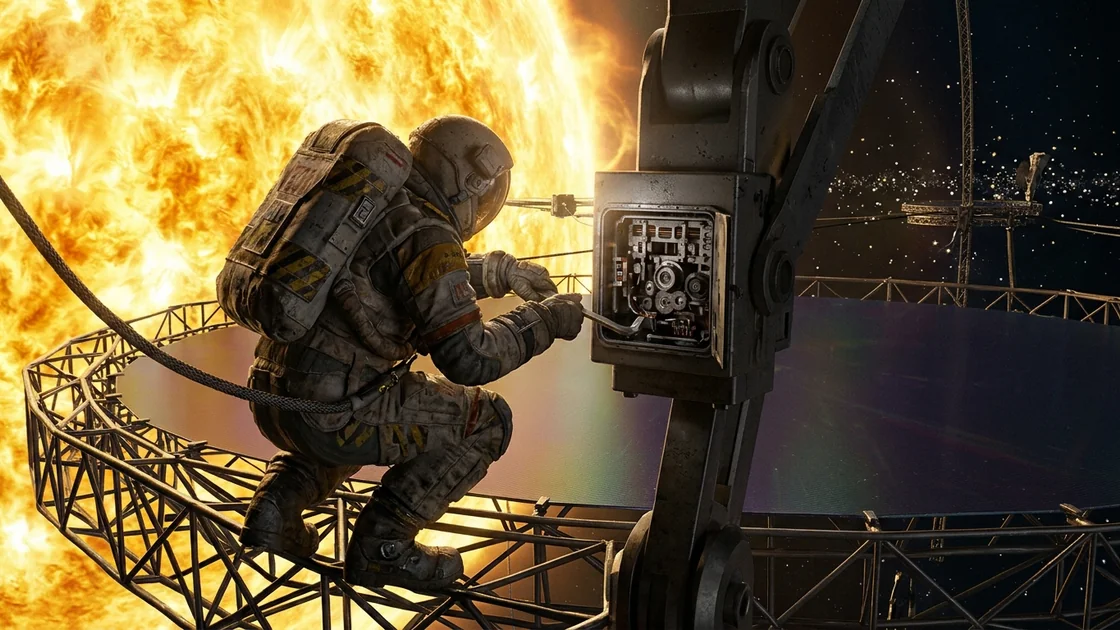
After the ruthless Chancellor Vance orders the complete thermal erasure of Sector Nine to clear an orbital energy corridor, solitary maintenance technician Kaelen Vane appears to accept his reassignment to the Outer Reflector Array. Blending into the monotonous routines of the Dyson shell, Kaelen uses his intimate knowledge of the megastructure and its mechanical tolerances to subtly alter the pitch of thousands of gargantuan heliostats by imperceptible fractions of a degree. Over the course of several standard months, these microscopic adjustments bypass the central diagnostic thresholds, slowly converging millions of terawatts of raw stellar fury onto New Eden, the Chancellor’s lush private continent on the inner habitat ring, turning a paradise of stolen wealth into a sea of glass.
The star never set, and because it never set, it never forgave.
From the dorsal gantry of Rig-Tender 404, eighty million kilometers out from the boiling photosphere of Sol-Aurelia, the star did not look like a sphere. It looked like a wall. It was an infinite, churning cliff of blinding gold and violent ultraviolet that occupied half the universe, held at bay only by the gold-iridium polarization visors of Kaelen Vane’s pressure suit. Even with the filters dialed to ninety-nine percent opacity, the light had weight. It pressed against his chest plate. It hummed in the ceramic joints of his gloves. It tasted like hot copper on the back of his tongue whenever the suit’s secondary scrubbers cycled.
Kaelen hung in the nothingness, clipped by a braided carbon-nanotube tether to the dorsal spine of Mirror 11,402-Alpha.
Below his magnetic boots, the mirror stretched out for twelve square kilometers—a hexagonal ocean of vapor-deposited aluminized graphene, pulled drum-tight across a skeletal frame of titanium-carbide trusses. It was so thin that a stray micrometeorite the size of a grain of sand could punch through it without slowing down, yet so vast that its collective photon pressure could sail a battleship out of the system if the anchors ever sheared.
"Telemetry shows you've been stationary on Node Six for fourteen minutes, Vane," a voice crackled in his helmet. It was Harrow, speaking from the climate-controlled bridge of the tender three kilometers up-orbit. The older man sounded half-asleep, the wet rattle of his chronic low-G bronchitis vibrating through the comm link. "You welding that strut or taking a nap? The Panopticon’s gonna flag a labor-stall if your suit biometrics drop any lower."
"Just waiting for the thermal expansion to settle on the primary gimbal, Boss," Kaelen said. His voice was flat, sanded down by months of recycled nitrogen and solitary shifts. "The diurnal flux from the shadow-ring pass warped the housing by three microns. If I torque the bolts now, they'll shear when the plate cools."
"Three microns," Harrow snorted, followed by the crinkle of a ration wrapper. "You're a relic, Kaelen. Nobody cares about three microns. Slap the cold-weld patch on the collar, cycle the actuator so the board goes green, and get back inside. Radiation index says we’ve got a minor coronal burp rolling off the eastern limb in forty minutes. I don’t feel like scrubbing proton burns off your skin."
"Copy. Five minutes."
Kaelen cut the audio feed to a low-priority squelch. He didn't move immediately. He looked past the edge of the gigantic hexagonal mirror, down into the dizzying abyss of the Dyson swarm.
From out here on the Outer Reflector Array, the architecture of humanity’s greatest monument looked like the inside of a clockwork cathedral built by madmen. Millions of mirrors orbited in staggered, counter-rotating shells, catching the waste light that escaped the inner habitation rings and bouncing it back inward toward the collector plates and the agricultural bands. Every mirror was a silver scale on the belly of a leviathan that had swallowed a sun.
And sixty million kilometers sunward, hanging in the prime Goldilocks belt like a necklace of emeralds and sapphires strung on black adamant, were the Crown Plates.
You couldn't see them with the naked eye against the glare of the star, not without the suit’s digital magnification. Kaelen blinked twice, clicking his chin against the internal chin-switch of his helmet to bring up the telescopic overlay. The HUD stuttered, filtering out the coronal glare, and zoomed in on Plate Alpha-One.
New Eden.
Even through the green-tinted phosphor of a diagnostic display, it was obscene. A single, continuous curved slab of hyper-alloy three thousand kilometers wide, rimmed by hundred-kilometer-high retaining walls of spun diamond that held in a thick, sweet atmosphere of nitrogen and oxygen. Unlike the cramped, multi-tiered industrial centrifuges where ninety-eight percent of the Sphere’s population lived, breathed recycled grease, and died before sixty, New Eden had an open sky. It had artificial tectonic plates that pushed up snow-capped granite mountains. It had an inland sea stocked with genetically resurrected pre-collapse Earth fauna. It had rolling savannas, cedar forests, and seventeen rivers that ran in closed cryogenic loops so the water was always crystal clear and fifty-two degrees.
It was the private estate of Chancellor Julian Vance and the six hundred families of the Core Directorate. Three thousand kilometers of dirt, water, and sky for less than ten thousand human beings.
Kaelen stared at the microscopic green sliver in his HUD until the optical nerve in his left eye began to twitch. Then, he zoomed the magnification thirty degrees spinward along the same orbital band, to where Sector Nine—The Crucible—used to hang.
There was nothing there now. Just an empty gap in the ring, wide enough to let a collimated beam of raw solar energy pass unimpeded from the inner collectors to the new antimatter-synthesis yards Vance had commissioned two years ago.
Sector Nine had been a century-old habitation cylinder, home to four hundred and twelve thousand smelter-techs, dockworkers, hydroponic farmers, and their children. Its hull had been scarred by generations of slag impacts; its air had smelled permanently of ozone and fried soy- cake; its gravity had wobbled by two percent every time the main counter-weights hit the weld-seam. It had been home. Kaelen’s wife, Mara, had taught primary geometry in Level Four’s sub-hub. His daughter, Tal, had kept a collection of deformed nickel-iron slag beads in an old respirator tin under her bunk.
The Directorate hadn't called it a massacre. They hadn't even called it a demolition. On the official sub-ether broadcasts, it was categorized as a Rapid Unscheduled Thermal Re-Allocation.
A cooling main on the primary collector array had "catastrophically failed," according to the inquiry board Vance appointed. A stray lance of concentrated sunlight, fifty kilometers wide and carrying the energy equivalent of ten thousand hydrogen bombs per second, had accidentally swept across the orbital path of Sector Nine for eleven minutes.
Eleven minutes was nine minutes longer than it took to turn four hundred thousand people and eighty million tons of steel into an expanding cloud of ionized gas.
By a miracle of scheduling, the demolition crews and the heavy-truss layers for the new antimatter conduit were already parked three hundred kilometers down-orbit when the "accident" happened. They didn't even have to clear away the wreckage. The star had boiled the wreckage into solar wind. The construction drones moved into the warm vacuum before theionized iron of Kaelen’s home had even finished cooling.
Kaelen had been four million kilometers away at the time, pulling a double rotation on a deep-space tether weld, watching his helmet comms fill up with static as the telemetry from Sector Nine flatlined across every band at once.
He blinked his chin-switch. The telescopic overlay vanished, replaced by the stark, close-up reality of Node Six’s primary gimbal housing.
"Five minutes is up, Vane," Harrow’s voice crackled back through the squelch. "I'm looking at the board. Your actuator still reads a zero-point discrepancy of point-zero-two degrees."
"Fixing it now," Kaelen said.
He reached down to his tool belt. He did not take out the standard-issue induction welder. Instead, he unclipped a custom-machined pry-bar made of non-sparking beryllium-copper, and from a lead-lined pouch inside his thermal thigh-pocket—the pocket designed to hold emergency anti-radiation autoinjectors—he withdrew a sliver of dull gray metal no thicker than a fingernail clipping.
It was a shim of sintered tungsten-rhenium alloy, shaved down on the lathe in the tender’s machine shop during his off-shift while Harrow was asleep.
Kaelen unlocked the inspection plate of the primary gimbal. Inside, bathed in the cold shadow of the mirror’s backing, sat the optical encoder—the tiny laser-interferometer eye that told the Sphere’s central intelligence, the Panopticon, exactly which way Mirror 11,402-Alpha was pointing.
The Panopticon was omniscient, or so the Directorate priests and systems architects claimed. It monitored four hundred million mirrors, eighty thousand habitat modules, and trillions of kilowatt-hours of power distribution in real time. If Kaelen were to hack the mirror’s local controller and command it to tilt toward New Eden, the Panopticon would detect the unauthorized vector within four milliseconds, override the local drive, flag Kaelen’s suit ID, and dispatch an automated security cutter to turn him into pink mist before he could climb back up his tether.
You could not lie to the Panopticon with code. Code was its native language.
So Kaelen lied to it with iron.
He wedged the beryllium pry-bar beneath the mounting bracket of the optical encoder’s reference mirror—not the twelve-kilometer heliostat itself, just the tiny, postage-stamp-sized prism inside the sensor box that the laser bounced off to measure the gimbal's angle. With practiced, surgical pressure, he lifted the bracket by forty micrometers, slid the tungsten-rhenium shim underneath the left mounting foot, and let the bracket settle back down.
He applied a microscopic dab of vacuum-cured epoxy—doped with carbon dust from his own suit filters to match the ancient, radiation-baked grime of the housing—and sealed the cover.
Inside the housing, the laser interferometer blinked. Because its own reference prism was now tilted by 0.0008 arcseconds to the left, the sensor instantly concluded that the massive twelve-kilometer mirror had drifted 0.0008 arcseconds to the right due to solar wind pressure.
Automatically, dutifully, the local servo-motors whined to life. The massive reaction wheels spun up. Slowly, with the glacial momentum of a moving continent, Mirror 11,402-Alpha tilted 0.0008 arcseconds to the left to "correct" the error.
On the Panopticon’s master board sixty million kilometers away, and on Harrow’s console three kilometers up, the telemetry readout for Mirror 11,402-Alpha flickered from amber to a solid, comforting green.
Alignment: 0.00000. Nominal.
In reality, a twelve-square-kilometer sheet of hyper-reflective graphene had just shifted its focal point away from the industrial collector arrays of Sector Twelve and aimed its forty-megawatt reflection directly at the geographic center of New Eden.
Over a distance of eighty million kilometers, the beam from a single uncollimated mirror would spread out, diffuse, and scatter. By the time the light from 11,402-Alpha hit the diamond retaining walls of Vance’s paradise, it would raise the surface temperature of New Eden by less than a ten-thousandth of a Kelvin. Not enough to melt a snowflake. Not enough to register on the most sensitive meteorological satellite in the Directorate’s fleet.
It was nothing. A ghost of a breath.
Kaelen patted the cold titanium housing of the gimbal, unclipped his tether, and engaged his suit’s cold-gas thrusters to drift back up toward the tender.
That was mirror number six thousand, four hundred and twelve.
He had seven thousand, five hundred and eighty-eight to go.
The interior of Rig-Tender 404—christened The Muckraker by some long-dead crew sixty years ago, though the brass plaque in the airlock had been painted over four times since—smelled of rancid bacon grease, ozone, and the sour vinegar tang of overworked CO2 scrubbers.
Kaelen cycled through the dorsal lock, waited for the pressure to equalize with a loud, metallic thump, and stripped off his helmet. He was a spare, sinewy man in his late thirties, though the deep creases around his eyes and the shock of premature silver at his temples made him look ten years older. Four years in the deep-rigging crews did that to a body. The constant low-level radiation that leaked through the hull plating chewed at your telomeres, and the centrifuge bunks only spun at half-G, leaving your muscles ropy and your spine permanently decompressed and aching.
He racked his suit, hiding the remaining tungsten shims inside the hollowed-out heel of his spare magnetic boot, and pulled himself hand-over-hand down the zero-G central spine toward the galley.
Harrow was floating near the galley table, his magnetic slippers loosely clipped to the deck grid so he bobbed like a piece of kelp in a slow current. He was sixty, a miraculous age for a rigger, with a belly like a sack of wet concrete and skin the color of parsnip from decades out of natural spectrum light. A holographic projector on the grease-stained table between them was playing a five-day-old grav-ball match from the Core Rings, though the audio was muted in favor of a crackling, low-bandwidth news feed from the Directorate Ministry of Information.
"—unprecedented agricultural yields across the Rimwards sectors," the announcer’s voice purred, smooth and synthetic as silicon lubricant. "Chancellor Vance, speaking from the Solstice Pavilion at Lake Geneva on New Eden, praised the sacrifices of the Transition Authority in completing the Sector Nine energy corridor eight months ahead of schedule. 'The light of Sol-Aurelia belongs to the future,' the Chancellor stated, 'not to the rusted bottlenecks of the past...'"
Harrow didn't look up as Kaelen pulled a pouch of lukewarm grey protein paste from the warmer, but the older man’s thick, scarred thumb twitched, tapping the mute icon on the news feed. The smooth voice vanished, replaced by the dull, rhythmic thrum-thrum-thrum of the tender’s ion station-keeping thrusters.
"Thought I turned that shit off," Harrow muttered, tearing off a corner of a dried yeast flatbread and chewing it with his back molars. "Signal bounces off the truss-work out here. Picks up the public bands whether you ask for 'em or not."
Kaelen tore the plastic tab off his ration pouch and squeezed grey paste into his mouth. It tasted of salt and sawdust. "Doesn't bother me, Harrow."
"Everything bothers you, boy. You just don't leak it where people can see." Harrow scratched at the gray stubble on his chin, his small, rheumy eyes narrowing as he watched Kaelen pull up the sector maintenance manifest on a personal slate. "You took nineteen minutes on that last node. You used to be the fastest wrench on Spindle Four. What're you doing out there? Praying?"
"Gimbal bearings on the 11,000-series are all from the same bad batch out of the Ceres foundries," Kaelen said smoothly, not looking up from the cascading columns of green numbers on his slate. "The molybdenum disulfide dry-lube they used thirty years ago is delaminating under the UV spike. If you don't scrape the races clean before you re-seat the actuator pin, it binds up six weeks later and throws an amber code. I’m saving us a return trip."
Harrow grunted. It was a plausible lie. More than that, it was technically true—the 11,000-series did have notorious bearing delamination issues. That was precisely why Kaelen had volunteered for this desolate, forgotten quadrant of the Outer Array fourteen months ago, right after his mandatory psychological bereavement hold had expired.
The 11,000 through 25,000-series mirrors were the slums of the Dyson infrastructure. Built eighty years ago during the Second Expansion, they were scheduled for total replacement in another decade. Because they were slated for the scrap-smelters, the Directorate refused to allocate budget for automated repair drones in this sector. Drones were expensive; two men in a fifty-year-old tug cost almost nothing. And because the bearings were constantly throwing minor mechanical faults, the Panopticon’s heuristic algorithms had been dialed down in Sector 404 to prevent the central servers from being flooded with millions of low-priority nuisance alarms every hour.
It was the only blind spot in the sky.
"Saving us a return trip," Harrow repeated, a humorless smirk twisting his lips. "We're on a five-year rotational contract, Kaelen. There ain't nowhere to go but back and forth. You clear the whole spindle, Central just assigns us to Spindle 405. If you work too fast, they cut our bonus credits because they figure the work’s too easy."
"I like clean boards," Kaelen said.
"You like staying in the suit," Harrow countered, his voice dropping an octave, losing some of its lazy gravel. He leaned forward against the magnetic pull of his slippers. "You pull nine-hour EVAs. Standard max is six. You volunteer for the sunward-facing trusses during flare warnings. Half the time when you're in the rack, I hear you running orbital mechanics simulations on your slate until zero-three-hundred."
Kaelen’s thumb paused for a fraction of a second on the screen. He kept his breathing slow, his heart rate at a steady fifty-eight beats per minute—the same discipline he used when the suit bio-monitors were polling him.
"I'm studying for the Master Rigger exam," Kaelen said, meeting Harrow's eyes with a dead, level gaze. "Pay grade jumps forty percent. Gets me off the two-man tenders and onto a heavy hub station. Somewhere with real gravity and a bar that serves something that wasn't pissed out by a yeast vat."
Harrow held his gaze for a long moment. The older man had been on the Sphere since before Kaelen was born. He had lost three fingers on his left hand to a snapping tension cable on the Rim, and he had seen plenty of men go "star-simple" from staring into the furnace of Sol-Aurelia too long. Some of them unclipped their tethers and drifted inward until their suits cooked; some of them took a plasma torch to their own airlocks.
Finally, Harrow sighed, the tension leaking out of his massive shoulders. "Master Rigger exam doesn't require you to calculate third-order Lagrangian perturbations for inner-ring photon convergence, Kaelen. I saw your scratch-pad cache last week when I was flushing the ship’s memory buffer."
The silence in the galley suddenly felt very small, very tight. The hum of the ion thrusters seemed to recede behind the rush of blood in Kaelen’s ears.
Slowly, Kaelen set his ration pouch down on the velcro patch of the table. Beside it lay a heavy stainless-steel spanner Harrow had been using to tighten the galley’s water-recycler valve. Kaelen calculated the distance to the spanner, the low-G trajectory required to drive it into Harrow’s throat, and how long it would take to stage an airlock seal failure during the incoming coronal flare.
He didn't want to kill Harrow. Harrow was one of the few people left in the universe who remembered the names of the beer brands they used to brew in Sector Nine.
"You didn't wipe the buffer?" Kaelen asked softly.
"I wiped it," Harrow said. He reached into his greasy coveralls, pulled out an illegal, hand-rolled tabac stick—grown in some black-market gray-water tank on the Rim—and stuck it unlit between his teeth. "I ain't a company snitch, boy. My cousin’s boy lived on Level Six of the Crucible. Worked the copper smelters. Kid owed me two hundred credits when Vance’s people turned the sun on 'em."
Kaelen didn't blink. "It was a collector main failure. The inquiry—"
"Shut up," Harrow said, without heat. "Just shut up. We're eighty million clicks from the nearest listening post, and I rewired the black-box voice recorder in this bucket to loop static three years ago so Central wouldn't hear me snoring on shift."
He took the unlit tabac stick out of his mouth and pointed it at Kaelen’s chest.
"I don't know what you're doing out there on the trusses," Harrow said quietly. "And I'm too old and too tired to do the math you're doing. At first I figured you were trying to blind one of their spy-eyes, or maybe drop a mirror out of orbit so it falls inward and punches a hole in the shipyard. Which is stupid, because the defensive lasers on the Mid-Ring would vaporize a falling sail ten days before it got close to anything expensive."
Kaelen remained silent.
"Then I looked at the numbers you were running," Harrow continued, his voice dropping to a raspy whisper. "Those aren't ballistic trajectories. Those are optical tables. Phase-angles. Seasonal precession rates for the Crown Plates." Harrow leaned in closer. "You can't cook a Plate with one spindle of mirrors, Kaelen. Even if you wired all fifteen thousand sails in Sector 404 to dump their load onto one spot, the atmospheric scrubbers and the high-altitude albedo clouds over New Eden would bounce half of it back into space, and their ocean heat-sinks would swallow the rest. You'd give the Chancellor a nice tan and get us both hung from a high-G gantry by our ankles."
"You're right," Kaelen said. "One spindle wouldn't do it. The thermal dispersion across eighty million kilometers follows the inverse-square law. Even a semi-collimated reflection from parabolic graphene degrades by zero-point-four percent per million kilometers due to interplanetary dust scattering."
Harrow stared at him. "Then what the hell are you doing?"
Kaelen looked down at his slate. With three taps of his calloused finger, he opened a partition hidden inside the operating system’s font-rendering library—a place no diagnostic crawler ever looked.
A three-dimensional wireframe of the Dyson Sphere blossomed above the grease-stained table, replacing the muted grav-ball game.
It was a dizzying web of golden threads. Every thread was the light-path of a single mirror.
"The Outer Array doesn't bounce light directly to the inner rings," Kaelen said, his voice taking on the quiet, terrifying clarity of a man who had lived inside a single equation for five hundred days. "Only about twenty percent of the mirrors in our shell are primary reflectors. The rest—the ones I’ve been shimming—are relay mirrors. They bounce low-angle scatter across the chord of the sphere to the Secondary Concentrator Ring at forty million kilometers, which aggregates the flux and feeds the heavy industrial smelters on the opposite side of the star."
He zoomed in on the Secondary Concentrator Ring.
"The Concentrator Ring isn't made of flat graphene sails like ours," Kaelen explained, tracing a golden line with his finger. "They're deep-dish Fresnel parabolas, ten kilometers wide, built to take diffuse light from a hundred different outer sectors and focus it into a tight, coherent power beam for the antimatter yards. They don't have active gimbals. They’re fixed-focus passive collectors. They rely entirely on the Outer Array to feed them light at a precise incidence angle of forty-two degrees."
Harrow’s brow furrowed as he studied the geometry. He wasn't an orbital physicist, but you didn't survive forty years on the rigging without understanding how light bounced. "If you change the incidence angle coming off our sails, you miss the dish on the Concentrator Ring."
"Not if you change it by less than two-thousandths of an arcsecond," Kaelen said. "At that angle, you don't miss the dish. You just hit the outer lip of the Fresnel lens instead of the center. And when coherent light hits the outer parabolic lip of a Series-9 Concentrator at forty-one-point-nine-nine-eight degrees..."
Kaelen tapped the projection. The golden threads hitting the Concentrator Ring didn't converge on the antimatter yards anymore. They refracted off the edge of the gigantic parabolic dishes at a sharp, shallow tangent—and lanced inward, compressed and magnified by a factor of four hundred, directly across the orbital plane of the Crown Plates.
Harrow’s jaw slowly slackened. The unlit tabac stick fell from his fingers and drifted lazily toward the ceiling vent.
"Jesus wept," the old man whispered. "You're using the Secondary Ring as a magnifying glass."
"A phased-array laser, technically," Kaelen corrected softly. "The Fresnel dishes columnate the scatter. Right now, because the mirrors I've shimmed are spread across three thousand kilometers of orbital arc, the refracted beams aren't hitting New Eden all at once. They’re sweeping across it like searchlights in the dark as the shells rotate at different speeds. One beam hits for twenty seconds, raises the local temperature by a tiny fraction, and moves on while the next one is still ten thousand kilometers behind it."
"Wait," Harrow said, his eyes darting across the cascading timestamps at the bottom of the hologram. "The shells rotate at different harmonic periods. The Outer Array takes four hundred days to complete an orbit. The Concentrator Ring takes one-eighty. The Crown Plates take ninety."
"Keplerian shear," Kaelen nodded. "Most of the year, the beams are out of phase. Only a few hundred of my shimmed mirrors line up with a Concentrator dish and New Eden at the same time. Just enough to create a mild, unexplained heat wave over the last two months. Their weather techs probably think it's a seasonal albedo glitch or a calibration drift in their atmospheric louvers."
He rotated the hologram forward in time. The golden threads, scattered like pick-up sticks across the interior of the sphere, began to twist, slide, and draw together as the three massive orbital shells turned like the tumblers of a combination lock.
"In forty-one days," Kaelen said, "at fourteen-hundred hours standard time, the vernal alignment occurs. For six hours and twelve minutes, the orbital angular velocity of Sector 404, Concentrator Quadrant Seven, and Plate Alpha-One will enter a retrograde harmonic lock."
On the hologram, all fourteen thousand golden threads snapped together at once. They struck the rim of the Concentrator dishes in unison and merged into a single, blinding white needle of light that pierced the exact center of the green crescent labeled New Eden.
"Fourteen thousand mirrors," Kaelen whispered, the reflection of the golden wireframe burning in his dark eyes. "Focused through twelve Fresnel arrays onto a target area four hundred kilometers wide. That’s eight-point-four terawatts per square kilometer. For six hours."
Harrow reached out and gripped the edge of the table so hard his knuckles turned white. "That'll boil their sea in twenty minutes."
"Eighteen," Kaelen said. "Assuming standard salinity. The granite bedrock will reach its melting point at the two-hour mark. By hour four, the thermal expansion of the superheated atmosphere will exceed the tensile limit of the diamond retaining walls. When the walls blow out, the explosive decompression will strip the molten silicate crust right off the baseplate and throw it into the sun."
The galley was dead silent save for the gurgle of the water recycler.
"There are ten thousand people on that plate, Kaelen," Harrow said, his voice shaking slightly. "Servants. Groundskeepers. Kids."
"There were a hundred and ten thousand children in Sector Nine," Kaelen replied. His voice didn't rise. It didn't crack. It was as cold and flat as the vacuum outside the hull. "And there are no servants on New Eden during the Vernal Alignment. It’s the Founders' Jubilee. By law, all non-genetic Directorate personnel are evacuated to the service tenders forty-eight hours prior so the six hundred families can celebrate the Purification Liturgy without looking at working-class faces. Every house-slave, gardener, and mechanic will be parked in low orbit behind the baseplate’s radiation shadow."
Kaelen shut off the hologram. The green glow vanished, plunging the cramped galley back into the dim, flickering amber of the fluorescent bulkhead strips.
"Just Vance," Kaelen said. "And the six hundred families who voted to clear the corridor."
Harrow stared at the empty air where the wireframe had been. Slowly, he reached up, caught his floating tabac stick near the ceiling vent, and shoved it back into his mouth. He chewed on the dry leaf for a long, agonizing minute.
"You said fourteen thousand mirrors," Harrow said finally. "Manifest says you've only cleared six thousand four hundred on this spindle."
"I've only cleared six thousand four hundred on my shift," Kaelen said, looking straight at the older man. "If I keep working alone, even pulling ten-hour EVAs, I’ll only hit nine thousand before the alignment window opens. Five thousand short of the thermal threshold needed to crack the retaining walls. If the walls don't crack, their emergency cryogenic floods might save the underground bunkers."
He picked up the heavy stainless-steel spanner from the table, turned it over in his hand, and held it out toward Harrow—handle first.
"The lathe in the machine shop is already programmed to cut the shims," Kaelen said. "I have forty kilograms of tungsten-rhenium bar stock hidden in the ballast tanks."
Harrow looked at the spanner, then up into Kaelen’s hollowed-out eyes. The old rigger let out a long, wheezing breath that turned into a wet, barking cough. When he recovered, he spat a fleck of brown tabac leaf into the disposal grate and took the spanner.
"My cousin's boy was nineteen," Harrow muttered, turning toward the airlock companionway. "Little idiot couldn't weld a straight seam to save his life, but he was family. Give me the tolerances on those optical brackets, boy. If I'm gonna spend my retirement in a high-radiation suit, we're doing the job right."
With two wrenches on the line, the pace doubled, and with the doubled pace came the rot.
Deep-space EVA work was designed by Directorate physiologists to be performed in meticulous, conservative rhythms: four hours out, eight hours in, forty-eight hours of centrifuge rest after every five shifts to let the bone marrow recover from the constant wash of solar protons and bremsstrahlung X-rays bouncing off the titanium trusses.
Kaelen and Harrow threw the manual out the airlock.
They lived in their suits. The Muckraker ceased to be a habitation vessel and became a mobile recharging rack. They set the old tug’s autopilot to drift along the spinal girder of Sector 404 at a constant twelve kilometers per hour, matching their EVA leaps to the ship’s crawl.
Kaelen would drop out of the ventral lock with a satchel of three hundred tungsten shims, fire his nitrogen thrusters until he slammed against the rear webbing of a mirror, magnetize his boots, and sprint across the humming spiderweb of carbon-carbide struts toward the central gimbal node.
Crack the housing. Pry the laser bracket. Slip the thirty-five-micrometer shim under the foot. Dab the carbon-doped epoxy. Close the latch. Watch the local board blink from amber to green as the giant sail groaned and shifted its gaze by an imperceptible hair. Then kick off into the blinding void toward the next hexagon before the reaction wheels had even finished spinning down.
Meanwhile, two kilometers "north" along the polar axis of the shell, Harrow was doing the same thing on the B-row mirrors.
By day eighteen, the inside of Kaelen’s suit smelled like a butcher’s shop left in the sun. The friction pads at his shoulders and hips had rubbed through his thermal base-layer and chewed raw, weeping ulcers into his skin that refused to scab in the low-oxygen, high-radiation environment. His fingernails turned black and began to loosen from their beds—the classic sign of localized beta-particle seepage through the thinning neoprene of his glove fingertips. When they cycled back into the Muckraker for four hours of unconsciousness between twelve-hour shifts, neither man bothered to unseal their torso-rings; they simply plugged their umbilical hoses into the wall, drank two liters of glucose-electrolyte slurry through their helmet straws, and slept floating in the airlock like drowned men in a well.
On day twenty-four, the sun tried to kill them.
Kaelen was wrist-deep inside the gimbal housing of Mirror 19,884-Gamma when the Muckraker’s proximity klaxon screamed directly into his headset, loud enough to make his teeth ache.
WARNING. CLASS X-4 CORONAL MASS EJECTION DETECTED. VECTOR: SECTOR 400 THROUGH 412. IMPACT IN NINE MINUTES, FORTY SECONDS. SEEK HARD SHIELDING IMMEDIATELY.
"Kaelen!" Harrow’s voice tore through the static, ragged and breathless. The old man was four kilometers out on the edge of the truss, way past the safe tether-reel limit. "You see that on the UV scope? The star just puked a continent-sized prominence right at us! Get back to the lead-locker!"
Kaelen pulled his head out of the gimbal shadow and looked sunward.
Even through the ninety-nine-percent iridium tint of his visor, the eastern limb of Sol-Aurelia had turned a violent, bruising purple. A twisted magnetic rope of superheated plasma, ten times the diameter of old Earth, had snapped free from the sunspot archipelago below and was uncoiling into the black. The initial photon flash—traveling at light speed—was already hitting them, driving his suit’s external dosimeter from a steady ticking into a solid, shrill whine. Behind that light-speed flash was a wall of relativistic protons traveling at eight percent the speed of light.
Nine minutes. If you were outside the hull of a ship’s storm-cellar when the proton wall hit, your nervous system would short-circuit before your blood finished boiling.
Kaelen looked at his wrist-slate. The Muckraker was two-point-eight kilometers away, holding station between his position and Harrow’s. His suit thrusters were at nineteen percent pressure—enough to get him back to the airlock in six minutes if he burned hard and didn't miss his grab-iron on the hull.
Then he looked at Harrow’s telemetry beacon on his HUD.
The green dot was four-point-one kilometers from the ship. And it was moving too slowly. Way too slowly.
"Harrow," Kaelen snapped, kicking off the mirror truss and burning a two-second burst toward the tender. "Why is your delta-V only four meters per second? Dump your tool bag and burn!"
"Main thruster nozzle on my left pack is fouled!" Harrow’s voice came back, tight with panic and the whistling wheeze of his lungs. "Think I got epoxy dust in the cold-gas valve when I was shimming the last three nodes! If I fire full pressure, I just spin in circles! I'm hauling in on the safety winch, Kaelen, it's maxed out at four meters a second!"
Kaelen did the math in half a heartbeat. Four thousand one hundred meters at four meters per second was over seventeen minutes. The proton storm would hit in eight and a half.
"Cut the winch line and use your right thruster in pulsing bursts between your legs," Kaelen ordered.
"I tried that, boy! My inner ear’s shot, I can't time the tumble! Just get to the ship and bring her about!"
Bring her about. The Muckraker was a ninety-ton pig powered by low-thrust ion drives designed for long-term orbital drift, not emergency rescue maneuvers. Even if Kaelen made it to the bridge in five minutes, decoupled the station-keeping anchors, and lit the emergency chemical maneuvering thrusters, it would take another six minutes just to overcome the tug’s inertia and reach Harrow.
They would both be dead before the airlock cycled.
IMPACT IN SEVEN MINUTES, FIFTY SECONDS.
Kaelen looked toward the safe, dull-gray cylinder of the Muckraker. If he went inside now and sealed the storm-cellar, he would live. The ship would survive the flare. But Harrow would die on the line, and when the Panopticon’s automated post-flare diagnostic sweep polled the sector’s medical beacons and registered a fatality on Spindle 404, Directorate Labor Safety regulations would automatically trigger an immediate physical inspection of the tender by a regional Coroner-Auditor.
And even without the audit, Kaelen couldn't finish five thousand remaining mirrors alone in seventeen days.
More than that: Harrow was the only soul left in the sky who knew what Sector Nine smelled like.
"Stop winching toward the ship, Harrow," Kaelen said, his hand dropping to the manual override lever on his own suit’s reserve oxygen tank. "Drop straight down onto the back of Mirror 20,001-Beta. Right in the center of the structural spider."
"Are you crazy? The graphene’s ten nanometers thick! Protons'll go through that sail like tissue paper!"
"Not the sail. The counterbalance weights on the dorsal keel." Kaelen reached behind his own hip, unscrewed the safety cap on his auxiliary breathing tank—forty minutes of pure O2 meant for airlock failures—and jammed the nozzle of his propellant cross-feed hose onto it. It was a suicide trick riggers whispered about in Rim bars: venting raw high-pressure oxygen through the maneuvering jets. A single electrostatic spark from the solar storm would turn him into a human torpedo. "Get to the center keel on 20,001! Move!"
Kaelen slapped his chest-valve. The high-pressure oxygen roared into his thruster manifold, freezing the lines instantly with a crackle of white frost.
Three Gs of acceleration slammed him back into his harness. The universe blurred into streaks of gold and black as he rocketed past the Muckraker, ignoring the open airlock door, and plunged down-orbit toward Harrow’s flickering beacon.
IMPACT IN FOUR MINUTES, TEN SECONDS.
His HUD was beginning to snow—white pixels flaring and dying as the leading edge of high-energy electrons began to sleet through his helmet cameras. His skin prickled with an agonizing, metallic sunburn from the inside out.
There—ahead against the terrifying silver plane of Mirror 20,001-Beta—was Harrow’s bulky silhouette, flailing awkwardly as he dragged himself along the titanium girder toward the mirror's center hub.
Kaelen flipped end-over-end, burning the rest of his oxygen reserve in a desperate retro-blast that made his vision gray out at the edges. His propellant lines coughed, sputtered, and went dry ten meters above the hub. He slammed into the titanium webbing at fifteen kilometers per hour, his left knee taking the brunt of the impact with a sickening crunch of ceramic armor and cartilage.
He didn't scream; he grabbed Harrow’s harness collar with both hands and hauled the older man down into the three-meter-deep trough beneath the mirror’s primary reaction wheel.
The reaction wheel—a solid flywheel of depleted uranium and tungsten alloy weighing fourteen tons, used to torque the massive twelve-kilometer mirror without expending fuel—sat directly between them and the sun.
"Tuck your knees!" Kaelen barked, wedging their bodies tightly into the V-shaped shadow directly behind the two-meter-thick uranium disc. "Unclip your mirror-patch kit! Now!"
With shaking, blistered hands, they tore open their emergency sail-repair canisters and unrolled the heavy sheets of lead-impregnated Kapton foil used to patch micrometeorite tears. Kaelen jammed the foil edges into the framing struts above them, pulling it tight over their helmets like a burial shroud, sealing them inside a coffin-sized triangle of uranium and lead.
IMPACT IN TEN SECONDS. NINE. EIGHT...
"If the Panopticon pivots this mirror while the flare hits to dump photon pressure," Harrow wheezed in the pitch darkness beneath the foil, his helmet pressed directly against Kaelen’s so they could talk via bone-conduction after the radio died, "that flywheel's gonna spin up to four thousand RPM and grind us into burger meat."
"I already shimmed this node three days ago," Kaelen said through gritted teeth, his broken knee throbbing in time with his pulse. "I pulled the fuse on the high-torque storm override when I was in the box. She's locked stiff."
"You pulled the storm fuse?" Harrow barked a mad, terrified laugh in the dark. "Without storm-feathering, the photon wave's gonna rip this whole sail off its gimbals!"
"Only if the welds fail," Kaelen whispered.
Then the sky fell on them.
There was no sound in vacuum, yet they heard it anyway—a deep, sub-audible thrumming that vibrated through the fourteen-ton uranium flywheel, into their spine-plates, and straight into their skulls. Outside the Kapton shroud, the twelve-kilometer graphene mirror took the full, unfeathered brunt of a ten-billion-ton solar tsunami.
The titanium trusses groaned like dying whales. Bolts the thickness of a man’s thigh sheared thirty meters away, firing through the darkness like cannon shells and ricocheting off the struts. Inside their helmets, despite having their eyes squeezed shut, both men saw brilliant, ghostly flashes of blue and white light—Cherenkov radiation exploding inside the vitreous fluid of their own eyeballs as stray cosmic rays punched straight through two meters of depleted uranium and through their brains.
Kaelen tasted blood. His nose was bleeding, dark globules floating off his upper lip in the microgravity and splattering against the inside of his gold visor. His dosimeter had stopped whining; the screen had simply melted into a black smear of dead liquid crystal.
For twenty-two minutes, the star hammered the back of the uranium wheel. The temperature inside their tiny pocket climbed as the metal absorbed gigajoules of kinetic and radiant energy, radiating infrared heat back into their suits until their liquid-cooling garments began to gurgle and steam.
Kaelen held onto Harrow’s chest-strap with one hand and the framing strut with the other, reciting the names of the streets on Level Four of Sector Nine over and over in his head so he wouldn't pass out. Foundry Row. Copper Alley. The Sluiceway. High Gantry Six.
Slowly, the shrieking vibration in the metal died down to a tremble. The blue flashes behind his eyelids faded to a dull, throbbing red.
Kaelen shoved the scorched Kapton foil aside and looked out.
Half of Mirror 20,001-Beta was gone—torn away in jagged, fluttering ribbons of blackened graphene that trailed sunward like burnt crepe paper. Look up and down the spindle: dozens of neighboring mirrors were smoking or twisted in their frames.
Wait. No. Not smoking. The un-shimmed mirrors—the ones that had automatically feathered edge-on to the sun as the Panopticon commanded—were completely intact. Only 20,001-Beta had lost half its skin because Kaelen had pulled its storm-feathering fuse to use its flywheel as a stationary shield.
Below them, the Muckraker was still tethered to the main spine, its outer hull pitted and blistered like old paint, its external antenna array melted into crooked slag, but its hull integrity lights blinking a stubborn, dim green.
"Harrow," Kaelen rasped, his throat feeling like he had swallowed crushed glass. He shook the older man’s shoulder. "Harrow, storm’s passed. We have to jet back on your right thruster before our cooling loops boil."
Inside the neighboring helmet, Harrow’s eyes fluttered open. Both of his sclera were bright crimson from ruptured capillaries, and a thin trickle of blood ran from his left ear, but he bared his stained teeth in a grimace.
"Told you," Harrow croaked against Kaelen’s faceplate, "nobody cares about... three microns."
They lost thirty-six hours to the radiation sickness and the melted comms array.
While Harrow lay strapped in the centrifuge bunk, vomiting bile into a plastic bag and shooting himself full of bone-marrow stimulants from the ship’s depleted med-chest, Kaelen dragged his swollen, fractured knee back out onto the hull to splice a bypass cable around the melted transceiver.
If a sector tender failed to check in within forty-eight hours of a Class-X flare, the Panopticon assumed the crew was dead and dispatched a salvage-and-audit drone from the Mid-Ring.
With four minutes to spare before the forty-eight-hour deadline, Kaelen got the high-gain dish online and uploaded a falsified damage report: Minor antenna fusion on Rig-Tender 404. One mirror (20,001-Beta) sustained forty percent sail loss due to localized gimbal seizure during CME peak. Crew nominal. Resuming standard maintenance sweep.
He waited, staring at the comm terminal with bloodshot eyes, wiping the constant trickle of pink serous fluid from his nostrils with the back of his sleeve.
Three minutes later, the automated response from the Panopticon’s regional sub-node scrolled across the screen.
ACKNOWLEDGED, TENDER 404. SAIL LOSS WITHIN ACCEPTABLE ATTRITION PARAMETERS FOR SCHEDULED DECOMMISSIONING BLOCK. LOGGING GIMBAL SEIZURE TO FOUNDRY DEFECT ARCHIVE. CONTINUE SWEEP.
Kaelen let out a breath he felt he had been holding since the flare hit.
They didn't stop. They couldn't stop. With Mirror 20,001-Beta torn in half, Kaelen had to shim two extra mirrors on the outer periphery to make up for the lost reflective surface area. Harrow was back in his suit twelve hours later, pale as a corpse, his left hand trembling so badly he had to tape the beryllium pry-bar to his glove so he wouldn't drop it into the void.
Ten days before the Vernal Alignment. Ten thousand, two hundred mirrors shimmed.
Five days before the Alignment. Twelve thousand, nine hundred mirrors shimmed.
And on the morning of the third day before the Alignment, the universe began to notice that New Eden was getting warm.
It started on the society bands—the high-frequency entertainment channels that Harrow kept running on low volume in the galley while they swapped out their suit lithium packs.
At first, it was treated as a novelty. A blond news-anchor on Plate Alpha-Three laughed about the "unseasonable tropical snap" hitting the Chancellor’s estate ahead of the Founders' Jubilee. The famous artificial ski slopes of Mount Ares on New Eden had turned to slush overnight, forcing the Directorate’s Junior Yachting League to move their pre-Jubilee gala from the alpine chalets down to the coastal villas on the Sapphire Sea.
By the next shift, the laughter was gone from the broadcasts.
"Surface temperatures across the central valley of Plate Alpha-One have reached forty-six degrees Celsius," a grim-faced meteorological director told the sub-ether panel. "We are currently experiencing an anomalous thermal inversion in the upper diamond-wall retention boundary. High-altitude albedo clouds are evaporating faster than the cryogenic sea-loop can seed them."
"Is it a failure in the underside heat-radiator fins?" the interviewer asked.
"Negative. Telemetry from the baseplate shows the radiator fins are operating at one hundred and twenty percent capacity. The heat isn't failing to escape—it’s coming in from above. Yet the primary solar shades between New Eden and Sol-Aurelia report nominal opacity. We’re picking up diffuse, uncollimated infrared scatter coming in at high oblique angles from the anti-sunward quadrants, almost like background radiation off the outer swarm, but at forty times normal flux density."
In the cramped airlock of the Muckraker, Harrow paused with a freshly lathed tungsten shim between his thumb and forefinger, looking over at Kaelen.
"Forty-six degrees," Harrow said softly. "That means the alignment phase is starting to overlap at the edges. They're gonna start polling the Concentrator Ring."
"Let them," Kaelen said, his voice a dry rattle as he injected a dose of lidocaine directly into his swollen knee joint through his flight trousers. "The Concentrator Ring is passive. There’s no telemetry on the Fresnel dishes to poll. It’s just curved glass and steel. By the time they send a physical inspection ship forty million kilometers out to check the dish angles, and realize the light is actually bouncing off Sector 404 another forty million kilometers beyond that..."
He looked at the chronometer on the bulkhead.
FIFTY-ONE HOURS TO CONVERGENCE.
"We have four hundred and ten mirrors left on the lower tier," Kaelen said, pulling his helmet down over his bruised, unshaven face. "Seal me up."
They worked through the final forty hours in a fugue state. Neither man spoke on the comms. Their bodies were breaking down at the cellular level; Kaelen’s vision in his right eye was permanently fogged by a radiation cataract, and Harrow was coughing up bright red froth that speckled the inside of his visor like paint. They were ghosts haunting a machine the size of a solar system, moving from truss to truss with the mechanical certainty of clockwork beetles.
Thirteen thousand, eight hundred.
Thirteen thousand, nine hundred.
At nineteen hours before convergence, as Kaelen was locking down the housing on Mirror 24,812—the fourteen-thousandth sail—the Muckraker’s proximity radar pinged.
It wasn't a solar flare. It was a ship.
Kaelen froze on the gimbal strut, killing his suit’s work-lights instantly. Fifty kilometers spinward, slicing through the narrow orbital gap between Sector 404 and Sector 403, a sleek, needle-nosed vessel was decelerating hard on a brilliant blue plume of fusion plasma.
Only Directorate Inspectorate cutters used helium-3 fusion drives inside the mirror shells; the exhaust plume ruined the albedo of any graphene sail within ten kilometers, and only the Inspectorate had the authority to damage company property to get somewhere fast.
"Vane," Harrow hissed over the short-range laser-comm, which couldn't be intercepted unless you were direttamente in the line of sight. "I'm back inside the tug. That cutter’s hailing us on the priority command band. It’s an optical-audit team out of Spindle Hub One."
Kaelen’s stomach turned to lead. "How did they trace the vector back from the Concentrator Ring this fast?"
"They didn't!" Harrow whispered fiercely. "I'm listening to their navigational squawk! They aren't here because of New Eden! They’re running a physical spot-check on all outer sectors that reported storm-feathering failures during the CME four days ago! Some middle-management bean-counter at the Ceres foundry disputed your damage report about the defective bearings on 20,001-Beta so his department wouldn't get fined!"
Kaelen closed his eyes behind his blood-streaked visor. If it wasn't for the bitter absurdity of it, he would have laughed. You could blind an omniscient artificial intelligence, you could turn the geometry of a star into a weapon to kill a god-emperor, and the thing that caught you was an accountant trying to save his quarterly bonus on bearing grease.
"How long until they dock?" Kaelen asked, already firing his thrusters toward the Muckraker.
"Twelve minutes! And Kaelen—they’ve got a hull-mounted laser theodolite on that cutter’s nose. The second they drop below ten kilometers and sweep the spindle with an independent optical laser, they’re gonna see that every single mirror in this sector is canted off-axis from what the Panopticon says!"
Kaelen looked at his chronometer. Eighteen hours and forty minutes until the orbital shells locked into the Vernal Alignment.
Right now, the beams were already beginning to bunch up. Surface temperatures on New Eden were probably pushing fifty-five degrees Celsius, forcing the Directorate families into their climate-controlled palaces, annoyed that their garden parties were ruined, while their engineers franticly tore apart the habitat’s local weather-control arrays looking for a software bug.
If that cutter transmitted an optical variance alarm from Sector 404, the Panopticon would instantly cross-reference the angle with the thermal anomaly on New Eden. The central AI wouldn't need to remove the shims to stop it; it would simply send a mass-override command to Sector 404, adding a digital offset of -0.0008 arcseconds to every actuator in the spindle, snapping all fourteen thousand mirrors back to true alignment in less than thirty seconds.
"Does the cutter have an escort?" Kaelen asked as he slammed into the Muckraker’s dorsal airlock and spun the manual wheel.
"Negative. Just a fast reconnaissance bird. Two crew—a pilot and a Sub-Inspector. No heavy weapons, just debris-lasers."
The airlock didn't have time to cycle properly; Kaelen pulled the emergency dump lever, letting the residual air from the inner chamber blast into the cabin as he tore off his helmet and pulled himself onto the cramped bridge.
Through the forward viewport, the Inspectorate cutter was a gleaming silver dart against the black, its fusion drive dying down to a dull violet ember as it matched velocities four kilometers off the Muckraker’s bow. Already, a green laser fan was beginning to sweep out from the cutter’s nose cone, tasting the angles of the nearest mirrors on the outer boundary of Sector 403—the untouched sector next door.
In ninety seconds, that green fan would cross the boundary into Sector 404 and hit the first of Kaelen’s shimmed sails.
"Attention Rig-Tender 404," a crisp, clipped woman’s voice rang through the bridge speakers. "This is Sub-Inspector Vesper, Directorate Bureau of Standards. Stand down all active maintenance and prepare to transfer your physical bearing-lot manifests. Hold position."
Harrow was strapped into the pilot’s chair, his hand hovering over the communications toggle, looking up at Kaelen with blood-red eyes. "What’s the play, boy? We got no guns on this tub, and our ion drive couldn't outrun a thrown rock."
Kaelen didn't look at the cutter. He looked past it, toward Mirror 20,001-Beta—the half-shredded sail three kilometers directly behind the cutter’s tail, still straining under the massive photon pressure of the star with its storm-fuses pulled.
"We don't have guns," Kaelen said, reaching over Harrow’s shoulder and slapping the red protective cover off the Muckraker’s main towing winch control. "We have twelve kilometers of high-tension graphene under forty megawatts of solar wind."
"The tether?" Harrow’s eyes widened. "We're still anchored to the main spine of 20,001!"
"Not the spine," Kaelen said, his fingers flying across the winch actuator keypad. "When I repaired the antenna three days ago, I shifted our secondary stabilizing cable to the portside tension-ring of 20,001-Beta to keep us out of the fluttering sail debris."
On the bridge display, the tension readout on Secondary Cable Two was flashing red—nineteen tons of continuous pull, holding the remaining intact half of the damaged twelve-kilometer mirror from folding backward like an umbrella in a hurricane.
"If you reel that cable in hard and cut it under load," Harrow whispered, realizing the geometry instantly, "the portside truss on that mirror is gonna whip forward toward the sun—"
"—and the starboard half will pivot around the central gimbal at four hundred kilometers an hour," Kaelen finished. "Right through the cutter’s parking orbit."
"Tender 404, respond," Sub-Inspector Vesper’s voice sharpened. Outside the viewport, the green laser fan of the cutter’s theodolite reached the edge of Sector 403 and jumped across the gap, touching the outer frame of Mirror 11,001-Alpha.
On the cutter’s bridge, an alarm was undoubtedly beginning to chime as the laser returned an impossible angle.
"Wait—Tender 404, your sector alignment telemetry is—"
"Burn the chemical thrusters full astern and spool the winch!" Kaelen roared, slamming his palm down on the winch over-torque override.
The Muckraker shuddered violently as its emergency attitude rockets fired all at once, throwing the ninety-ton tug backward while the massive spool in its belly shrieked, hauling in fifty meters of braided carbon-nanotube cable connected to the weakened corner of the colossal mirror.
Out in the void, twelve square kilometers of titanium truss and hyper-thin graphene reached its structural breaking point.
With a soundless flash of snapping piezo-electric discharge, the main dorsal spar of Mirror 20,001-Beta buckled. Released from its symmetric tension, forty megawatts of continuous photon pressure caught the remaining six-kilometer wing of the sail like a gale catching a barn door.
"What the—" Vesper’s voice cut off on the open comm channel as the shadow fell over her ship.
The cutter’s fusion drive flared blue for half a second as the pilot tried to burn clear, but you could not out-accelerate the leverage of a six-kilometer lever arm snapping across its fulcrum.
The outer titanium rim-girder of Mirror 20,001-Beta—a lattice of solid carbide steel ten meters thick, moving at a tangential velocity of two hundred and ten meters per second—slammed broadside into the Inspectorate cutter.
The sleek silver dart didn't even slow the mirror down. The cutter folded in half around the girder like tin foil, its helium-3 fuel tanks rupturing in a silent, expanding blossom of white-hot plasma that instantly vaporized the ship’s mid-section, spinning the severed nose-cone and tail-section off into the dark in a cloud of frozen oxygen crystals and glittering alloy confetti.
The comm speaker on the Muckraker’s bridge popped and went dead, returning to the soft, endless hiss of solar background static.
Out in the rigging, the shattered carcass of Mirror 20,001-Beta tore completely free from its central gimbal, folding in on itself like a dying silver jellyfish as the solar wind caught it and pushed it slowly, majestically upward into the deep blackness beyond the Outer Array, carrying the twisted wreckage of the cutter tangled in its ribs.
Inside the bridge, the red tension lights blinked out.
Harrow sat frozen in the pilot’s chair for ten seconds, his chest heaving, staring out the viewport at the expanding cloud of iridescent vapor that was already being swept away by the stellar breeze.
"Central's gonna miss an Inspectorate bird within twelve hours," Harrow said softly.
"In twelve hours," Kaelen said, looking down at the countdown timer on his slate, "there won't be a Central left to check the schedule."
Wait. Not quite.
Kaelen looked at the main sector telemetry board. When the cutter’s fusion core had detonated against the rim of 20,001-Beta, the electromagnetic pulse and the flying shrapnel had severed the primary fiber-optic trunk line running along the dorsal spine of Sector 404.
Across the board, twelve hundred mirrors in the 20,000-block suddenly blinked from green to flashing yellow: LOCAL CONTROLLER SIGNAL LOST. REVERTING TO HARDWARE DEFAULT ZERO.
Kaelen’s breath caught in his throat.
"No," he whispered. "No, no, no."
"What?" Harrow scrambled out of his chair to look at the board. "They’re reverting to hardware zero! The shims are mechanical, Kaelen! Hardware zero is what we shimmed!"
"Not on the 20,000-block!" Kaelen slammed his fist against the console frame, pain shooting up his arm from his split knuckles. "When the trunk line breaks, the 20,000-series doesn't use the optical laser encoder in the gimbal box anymore! It falls back on the magnetic backup resolvers inside the central spindle hub! The backup resolvers aren't shimmed! They're reading the real angle!"
Outside the viewport, across three hundred kilometers of space, the reaction wheels on twelve hundred gigantic mirrors were beginning to spin up simultaneously, preparing to dump Kaelen’s 0.0008-arcsecond offset and return to their true factory alignment.
Twelve hundred mirrors. If he lost twelve hundred mirrors, the converged beam on New Eden would drop below the critical thermal threshold. The diamond retaining walls would hold. The sea would boil, the forests would burn, and the palaces on the surface would melt—but thirty meters beneath the granite bedrock, inside the deep-crust cryogenic bunkers, Chancellor Vance and the six hundred families would ride out the six-hour alignment in air-conditioned comfort, sipping vintage wine while their surface estate was glassed, and emerge tomorrow to hunt Kaelen down to the ends of the universe.
"How do we stop the magnetic resolvers?" Harrow grabbed Kaelen’s suit harness. "Can we cut the power to the whole spindle?"
"Every mirror has its own solar-pellet battery on the frame; cutting the main bus won't stop the wheels!" Kaelen’s eyes darted furiously across the schematic of the Sector 404 Central Spindle Hub—the massive junction box located twelve kilometers down the truss where the broken fiber-optic trunk originated. "The only way to stop them from reverting to the backup resolvers is to manually engage the physical maintenance locking-dogs on the master synchronous ring inside the Spindle Hub before the wheels finish their ninety-minute slew cycle!"
"Then let's fly the tug down there and lock the ring!"
"Look at the tug’s thruster board, Harrow! When we hauled the winch against 20,001, the back-lash sheared our portside reaction-control manifold! This ship can't fly straight anymore!"
Harrow looked at the helm diagnostics. The port attitude thrusters were dead red, leaking nitrogen into space.
Kaelen was already sealing his helmet back onto his neck-ring, ignoring the fresh smear of blood on his chin. "It’s twelve kilometers down the main truss. The mirrors take ninety minutes to finish a backup-resolver slew because the fallback motors run on low amperage. If I use a tether-sled on the main structural cable, I can be at the Spindle Hub in forty minutes and jam the synchronous ring."
"And I’m coming with you," Harrow said, reaching for his helmet.
"No, you aren't," Kaelen said. He pointed a black-nailed glove at the Muckraker’s communications console. "When those twelve hundred mirrors lost their trunk line, the Panopticon registered a major bus fault in Sector 404. In about twenty minutes, an automated high-priority diagnostic packet is going to ping this ship’s computer asking for a manual system-status handshake to confirm it’s just CME damage and not a catastrophic cascade. If somebody isn't sitting at that console to spoof the handshake code using the ship’s local overrides, the Panopticon will remotely fire the explosive pyrotechnic bolts on the entire sector's gimbals to dump the mirrors out of orbit as a safety precaution."
Harrow froze, his helmet halfway to his head. He looked from the comm console to the airlock, then back to Kaelen’s ruined, pale face inside the gold visor.
"You've got a broken knee and one good eye, boy," Harrow whispered. "And the synchronous ring in a Spindle Hub takes two men on the manual breaker-bars to throw the dogs."
"It takes two men if you want to keep your arms in their sockets," Kaelen said. "Just answer the ping when it comes through, Harrow. Don't let the computer dump my sails."
He didn't wait for a reply. He limped into the airlock, slammed the inner hatch, and blew the outer door into the glaring light of the star.
The tether-sled was nothing more than a battery-powered motorized pulley with two handlebars and a stirrup, designed to haul tool crates along the three-inch-thick braided titanium guide-wire that connected the entire sector of mirrors like beads on a string.
Kaelen clipped the sled onto the wire, wedged his fractured left leg into the stirrup to take the weight off it, andwired the sled’s throttle lever open with a piece of copper wire.
SEVENTEEN HOURS TO CONVERGENCE.
The sled whined, its ceramic rollers spitting tiny sparks of static electricity as it accelerated to thirty kilometers per hour along the cable.
Around him, the colossal silver hexagons of the 20,000-block were turning—a movement too slow to see with the naked eye, yet Kaelen could feel it in the vibration of the guide-wire beneath his hands. Twelve hundred city-sized sails, slowly, obediently swinging their forty-megawatt reflections away from the lip of the Concentrator Ring, obeying the blind mechanical instinct of their backup sensors.
Every second they turned, New Eden grew a fraction of a degree cooler.
Kaelen hung onto the handlebars as the sled rattled violently over a cable-splice, the impact sending a white-hot bolt of agony from his shattered kneecap straight into his groin, making him scream inside his helmet. His vision went completely black for five seconds; only the magnetic lock on his gauntlets kept him from being flung off into the eighty-million-kilometer drop toward the sun.
When his sight cleared—only in his left eye now, the right was a solid wall of milky gray cataract—the Spindle Hub was looming dead ahead.
It looked like an ancient iron sea-mine the size of an apartment block, bristling with thick power conduits, fiber-optic bundles, and structural tension cables that radiated outward to hold the sector’s orbital geometry rigid. Because it didn't reflect light like the mirrors, its blackened steel hull absorbed the raw glare of Sol-Aurelia, baking at a steady two hundred degrees Celsius on its sunward face.
Kaelen cut the sled’s power fifty meters out, letting the friction brakes scream and smoke in the vacuum until he slammed boots-first into the maintenance grating on the Hub’s shadowed underside.
He tore his hands free from the handlebars, dragged himself down the access tunnel into the interior of the structure, and floated into the synchronous chamber.
Here, all the mechanical telemetry cables from the sector’s backup resolvers converged onto a single, ten-meter-wide toothed gear ring—a massive mechanical differential that physically prevented the sector’s mirrors from slewing into each other during power failures.
The ring was turning. Click. Click. Click. Each tooth of the massive tungsten gear advancing by a millimeter every ten seconds as the twelve hundred mirrors outside crept back toward their factory zero-point.
Wait—they had only slewed about fifteen percent of the way back. Eighty-five percent of the angular offset was still intact. If he dropped the locking dogs into the teeth right now, eleven hundred and eighty mirrors’ worth of thermal flux would still hit the Concentrator Ring. It was within the margin. It would be enough.
Kaelen grabbed the two-meter-long titanium breaker bar mounted on the bulkhead and jammed its square lug into the manual override socket of the primary locking dog—a solid wedge of hardened steel suspended above the turning gear ring.
He braced his good right boot against the housing, locked his left elbow, and pulled with everything left in his radiation-rotted muscles.
The lever didn't budge.
The spring tension holding the dog clear of the active gear was rated for four hundred kilograms of torque—meant to be ratcheted down slowly by a hydraulic jack that wasn't here, or pulled by two healthy riggers in tandem.
Click. The massive gear advanced another tooth. Fifteen-point-five percent of the angle lost.
Kaelen snarled inside his helmet, blood and spit spraying across his visor. He unclipped his safety tether from his waist, wrapped the braided carbon line three times around the end of the breaker bar, and ran the other end through the pulley block on the ceiling strut behind him, clipping the hook directly onto the dorsal D-ring between his own shoulder blades.
He was turning his entire suit—and its remaining thrusters—into a human block-and-tackle.
"Kaelen!" Harrow’s voice crackled in his ear over the laser-relay. "The Panopticon ping just came through! I spoofed the handshake—Central bought it, they think the trunk-line break is just thermal fatigue! Where are you on the ring? My board says the 20,000-block is still slewing!"
"Pulling the dog now," Kaelen gasped.
He didn't use his arms. He planted both boots on the gear housing beneath him, pointed his back toward the ceiling, and fired his suit’s remaining nitrogen maneuvering thrusters at maximum emergency continuous burn while straightening his legs—both legs, the good one and the shattered one.
Inside his left knee, the fractured bone ends ground together and sheared completely through the joint capsule. Kaelen didn't even hear himself shriek over the roar of his suit’s gas jets vibrating through his spine. The carbon tether line went bar-tight, groaning as it took the combined force of his legs and sixty pounds of thruster push.
Slowly, millimeter by agonizing millimeter, the two-meter breaker bar bent like a bow.
Inside the housing, the massive steel locking dog crept downward toward the turning teeth of the synchronous ring.
Click. Another tooth passed.
"Drop, you bastard," Kaelen sobbed, crimson foam bubbling from his lips as his suit’s structural torso-ring began to deform under the load, cracking a rib on his left side. "Drop!"
With a metallic CLANG that rang through his magnetic boots like a church bell, the spring-latch over-centered and tripped.
The four-hundred-kilogram steel wedge slammed down into the gap between two tungsten teeth on the synchronous ring.
The ring didn't stop instantly; the momentum of twelve hundred twelve-kilometer mirrors tried to drag the tooth past the dog. Sparks—real, white-hot friction sparks of burning tungsten and titanium—erupted in the vacuum as the gear ground against the wedge, screaming through Kaelen’s suit frame, cracking the cast-iron mounting bracket by half an inch before the sheer mechanical leverage bound up and stalled the fallback motors across the entire sector at once.
The clicking stopped.
Outside, in the blinding glare of the star, twelve hundred gigantic mirrors shuddered and froze in place.
Kaelen floated limply at the end of his tether, his thrusters empty, his left leg twisted at a sickening thirty-degree angle inside his bloated suit trousers, his chest heaving in shallow, ragged gasps around his broken rib.
"Board just froze," Harrow’s voice came through the comm, quiet and awed. "Slew stopped at eighty-three percent retention. Total sector convergence flux is ninety-eight-point-nine percent of your target math, Kaelen."
Kaelen closed his good eye, letting his head rest against the cold, vibrating steel of the breaker bar.
"How long until the alignment window opens?" he whispered.
"Sixteen hours," Harrow said. "Come on back to the barn, son. The hard part’s over."
They didn't sleep during the final sixteen hours.
Kaelen couldn't even be removed from the lower half of his pressure suit; the internal bleeding and swelling in his shattered knee had expanded his leg until it was wedged solidly inside the ceramic thigh-cuff, acting as an accidental pneumatic splint that kept him from bleeding to death internally. Harrow strapped him into the co-pilot’s couch on the Muckraker’s bridge, pumped an entire syrette of synthetic morphine into his neck seal, and rigged the ship’s long-range optical telescope to project directly onto the main forward screen.
And they watched the clock.
Across the Dyson Sphere, the machine was waking up to the nightmare, too late to understand the geometry of its own execution.
At twelve hours to convergence, the sub-ether channels stopped broadcasting music and news altogether, replaced by continuous, overlapping emergency civil-defense carriers from the Core Directorate.
On New Eden, the temperature had passed seventy-two degrees Celsius—one hundred and sixty-one degrees Fahrenheit.
The overlap of the outer relay beams was now thirty percent complete. The snow-capped peaks of the artificial mountains had vanished in catastrophic flash-floods of boiling mud that tore down the valleys, sweeping away the manicured cedar forests and the marble guest-pavilions along the rivers. The Sapphire Sea had turned a milky, opaque white as every genetically resurrected fish, coral reef, and kelp forest cooked and floated to the surface in a billion-ton mat of rotting protein, while massive, category-five hyper-canes spun up between the hundred-kilometer diamond walls as the superheated ocean tried desperately to dump its latent heat into a closed sky.
At eight hours to convergence, the Panopticon finally figured it out.
"Look at the command band," Harrow murmured, pointing a trembling, blistered finger at the cascading waterfall of red machine-code flooding the Muckraker’s secondary monitor.
The central AI had finally bypassed its own local diagnostic filters, correlated the angle of the infrared scatter hitting the Secondary Concentrator Ring, and traced the light-path forty million kilometers outward to Sector 404.
On the board, a million frantic digital commands slammed into the sector’s communications bus every second:
PRIORITY ALPHA OVERRIDE. SECTOR 404. SLEW ALL MIRRORS PLUS FORTY-FIVE DEGREES IMMEDIATELY. ERROR: OPTICAL ENCODER READS ZERO OFFSET. OVERRIDE ENCODER. ENGAGE BACKUP MAGNETIC RESOLVERS. ERROR: SYNCHRONOUS RING MECHANICALLY JAMMED AT HUB. FIRE PYROTECHNIC GIMBAL JETTISON BOLTS. DUMP ALL SAILS.
Kaelen watched the screen through a haze of morphine and blood.
"Why aren't the jettison bolts firing?" Harrow asked, his hand tightening on the arm of Kaelen’s chair.
"Because three months ago," Kaelen murmured, his voice thick and slurred, "when we did the quarterly battery swap on the main capacitor bank at the Hub... I cross-wired the pyro-bus into the ground-fault interrupt. The moment the Panopticon sent the high-voltage spike to blow the bolts, it melted the main relay fuse at the junction. There's no electrical path from the computer to the explosives anymore."
The machine was screaming into a severed nerve. The brain of the Dyson Sphere was watching its own hand hold a magnifying glass over its heart, and the hand had been nailed to the table with tungsten and iron.
"All units in the Mid-Ring," a human voice broke over the military guard channel—raw, panicked, stripped of all Directorate polish. It was Fleet Command at the Antimatter Yards. "All fast-attack cutters and heavy tugs in Quadrants Six and Seven, burn at maximum emergency plasma for Outer Sector 404! Weapons free! Shoot the mirrors out of the sky! Repeat, destroy all reflector sails in Sector 404!"
Harrow looked at the tactical radar display. The nearest military staging post was at the Antimatter Yards—fifty-two million kilometers away. Even burning their fusion drives at a suicidal ten Gs of continuous acceleration, the fastest automated missiles wouldn't cross that gulf of vacuum for nine hours.
And the Vernal Alignment was forty minutes away.
"What about evacuating New Eden?" Harrow asked quietly, watching the telemetry from the inner ring. "Can Vance get off the plate?"
Kaelen tapped the optical telescope feed, zooming the long-range camera past the blinding glare of the star to the razor-thin green crescent of Plate Alpha-One, sixty million kilometers below.
"To dock a shuttle with a Crown Plate," Kaelen recited softly, as if reading from a textbook, "you have to match its ninety-day rotational velocity and drop through the polar pressure-locks at the top of the diamond walls, or dock with the underside elevator spindles in the baseplate shadow. Look at the upper atmosphere."
Even from sixty million kilometers away, the optical feed showed that the sky inside New Eden’s diamond retaining walls had turned a violent, incandescent orange. Threehundred-kilometer-per-hour winds of superheated steam were shearing across the tops of the hundred-kilometer walls, tearing the polar pressure-locks and the luxury yachting docks to pieces. Any shuttle that tried to fly into that atmospheric cauldron would be smashed against the diamond cliffs like a moth in a blowtorch.
And as for the underside elevator spindles...
"The baseplate radiator fins are glowing cherry-red," Kaelen said, pointing at the infrared overlay of the plate’s dark underside. "They’re trying to vent a hundred thousand terawatts of absorbed heat through the bottom of the continent. The thermal plume rising off those radiator fins has turned the vacuum for five hundred kilometers beneath the plate into a plasma furnace. The evacuation tenders can't get within a thousand clicks of the elevator shafts without their hulls melting."
Chancellor Vance and the six hundred families were where they had always wanted to be: locked inside their private heaven, behind walls of unbreakable diamond, with the rest of humanity shut out.
At fourteen-hundred hours standard time, the orbital tumblers clicked into lock.
Out in Sector 404, nothing seemed to change. The fourteen thousand vast, silent hexagons of graphene simply hung in the black, catching the eternal golden wall of Sol-Aurelia’s light as they had for eighty years, reflecting it across the chord of the sphere in fourteen thousand invisible threads.
Forty million kilometers away, those fourteen thousand threads struck the outer parabolic lips of the twelve gigantic Fresnel Concentrator dishes at precisely forty-one-point-nine-nine-eight degrees.
The dishes caught the scattered light, bent it, compressed it by a factor of four hundred, and spat it inward as a single, coherent, four-hundred-kilometer-wide lance of pure stellar annihilation.
On the Muckraker’s main screen, the green crescent of New Eden suddenly flared so brightly that the telescope’s optical sensors automatically dropped three neutral-density filters across the lens just to prevent the camera from burning out.
"God Almighty," Harrow whispered, taking the unlit, chewed stub of his last tabac stick from his pocket and putting it between his lips.
The white cloud deck of the boiling Sapphire Sea vanished in less than ten minutes—not condensing into rain, but dissociating directly into superheated hydrogen and oxygen plasma as the surface temperature crossed two thousand degrees Celsius.
Kaelen watched with his one good eye, his hand gripping the cold metal strut of his co-pilot’s couch. He didn't blink.
At the one-hour mark, the snow-white steam turned black and red as the continental crust itself caught fire. The artificial mountains of imported granite, the three-hundred-year-old cedar forests, the marble palaces around Lake Geneva, the genetic vaults, and the Solstice Pavilion where Vance had praised the "efficiency" of the Sector Nine corridor—all of it slumped, liquefied, and began to flow down the continental slope into the empty, glowing basin of the boiled sea like candle wax in a kiln.
At hour two, the bedrock turned yellow-white. The subterranean cryogenic bunkers, buried thirty meters beneath the granite to protect the Directorate elite from nuclear strikes or orbital bombardment, were never designed to survive the planet itself turning back into a magma ocean. As the silicate rock above them melted into liquid glass, the denser titanium-steel hulls of the underground bunkers simply lost their structural footing, cracked under the immense hydrostatic pressure of a billion tons of molten stone, and floated to the surface like slag in a smelter, popping in microscopic, soundless puffs of vaporized flesh and oxygen.
Foundry Row, Kaelen thought. Copper Alley. The Sluiceway.
At hour three and forty-two minutes, the diamond walls failed.
For eighty years, the hundred-kilometer-high retaining walls of spun carbon crystal had held back the vacuum of space. Now, subjected to the outward pressure of a superheated atmosphere of vaporized rock at four thousand Kelvin—and struck directly along their inner faces by the edge of the Fresnel beam—the carbon lattice reached its phase-transition point.
A hairline crack, glowing blinding violet, appeared along the spinward rim of New Eden.
In three seconds, the crack raced for two thousand kilometers along the base of the wall.
Then, six hundred kilometers of hundred-kilometer-tall diamond shattered outward into the black.
Even through the silent telescope sixty million kilometers away, the violence of the explosive decompression was staggering. The entire molten surface of the continent—trillions of tons of white-hot liquid granite, vaporized sea-salt, and the ionized carbon atoms of the six hundred families—erupted sideways through the breach in the wall like a volcanic geyser, spraying a five-thousand-kilometer-long fan of glowing lava droplets and golden fire out into the orbital band.
Pulled by the gravity of Sol-Aurelia below, that glittering curtain of molten glass began a long, slow spiral inward toward the star, raining down through the exact empty orbital gap where Sector Nine had once hung.
By the fifth hour, the Alignment began to drift apart.
As Sector 404 continued its slow, four-hundred-day crawl around the sun, the Keplerian shear broke the harmonic lock. One by one, the fourteen thousand golden threads slipped off the outer edge of the Concentrator dishes and scattered harmlessly back into the abyss between the shells.
The lance of light winked out.
Down on the Crown Ring, where the green and blue jewel of Plate Alpha-One had hung for three generations, there remained only a warped, blackened crescent of bare hyper-alloy baseplate, glowing a dull, cooling crimson in the dark like the bottom of a burnt skillet.
The bridge of the Muckraker was completely silent. Even the frantic red scrolling on the military guard channels had stopped, replaced by stunned, broken carrier waves as the surviving sectors of the Sphere stared at the hole in their sky.
Harrow reached over, switched off the telescope feed, and looked down at the tactical radar.
Thirty million kilometers out and closing fast at twelve Gs, four bright red triangles—automated kinetic-kill interceptors fired by the Mid-Ring batteries before the alignment ended—were streaking toward Sector 404. Time to impact: three hours, twelve minutes.
Harrow looked at the leaking thruster board of their crippled tug, then over at Kaelen.
"We ain't outrunning those, boy," the old man said softly. "And I don't think they're coming to read us our rights."
Kaelen let out a long, slow breath. The pain in his knee and his ribs had receded into a warm, distant hum. For the first time in fourteen months, the coppery taste of radiation in the back of his throat was gone, replaced by the phantom smell of fried soy-cakes and ozone, and the sound of Mara’s voice teaching primary geometry in the hub below.
He reached up with his scarred, black-nailed hand, found the environmental control panel above their heads, and dialed the cabin’s oxygen-nitrogen mix down while opening the reserve tank of pure medical nitrous oxide from the med-bay line.
"Three hours is plenty of time, Boss," Kaelen said, leaning his head back against the cracked leather of the headrest and looking out the forward viewport, where fourteen thousand silver mirrors hung crooked and gleaming against the eternal gold of the sun. "Go ahead and light that tabac stick. Nobody's checking the scrubbers anymore."
Harrow smiled, a slow, genuine thing that creased his pale, ruined face. He reached to the workbench, picked up a micro-welding torch, and sparked it once in the thickening air, touching the tiny blue flame to the dry leaf between his teeth.
He took a long, deep drag, blew a cloud of sweet gray smoke toward the viewport, and watched it drift lazily across the stars.